
Chapter 7

All … birds and beasts are useless.
—Kenkō, Essays in Idleness
Buddhist expansion across Asia shares something in common with later European colonial expansion in the modern period: both expansions were propelled by a drive to control and exploit the people and resources on the commodity frontier. Weberian interpretations and the modern romanticization of the Dharma, however, have obscured this shared feature.
Orientalism has played a role as well. Notions such as that of the “oriental despot” have impeded a proper understanding of Asian history, and Buddhism. The idea of Oriental despotism extends back to the Greeks, from whom Renaissance scholars picked it up. It shaped European political thought through the nineteenth century, including most notably Marx’s “Asiatic Mode of Production.”1 Unsurprisingly, this pervasive orientalist trope continues to inform popular perceptions about Asia and Asian history, even though scholars have shown that premodern Asian states were more often the antithesis of the Oriental despotic model. They were not massive, all-powerful states driven by a unifying ideology, but the opposite: ideologically eclectic with diffuse power.2 Many large-scale public works were undertaken not by states but by the “non-government initiative” of entrepreneurial individuals,3 the majority of whom, as archaeological and written evidence from India to China shows, were Buddhists.4 To understand Buddhist history we therefore need to include these nongovernmental Buddhist actors, such as monastics and the laity, who were instrumental in both spreading and institutionalizing the Dharma.
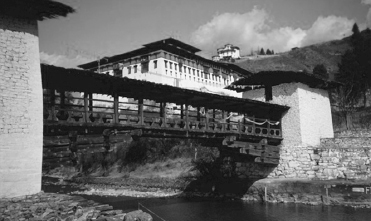
Figure 13. Bridge to the Paro Dzong (Bhutan, 1991).
Photo by author.
The nation-state model has too often defined Buddhist history.5 The modern notion of a nation-state did not exist during early Buddhism, and, by elevating the state as the prime mover of Asian history, we inadvertently perpetuate the oriental despotic paradigm that obscures what actually did link Asia together: the protocapitalist drive at the heart of the Buddhist tradition. It pushed monks and merchants onto the frontier, where they set about intensifying local economic activity and extracting commodities from the natural world. Even though states certainly benefited from this economic expansion, its agents were not solely state actors. Therefore, in order to understand both Buddhism and Asian history, we need to look at the whole complex of Buddhist actors and their activities in the borderlands. By incorporating in my analysis the individual religious entrepreneurs who pushed into the frontier and promoted economic development, I recognize that both state-sponsored ideology and individual action drove the spread of Buddhism. By bringing all three categories of Buddhist actors into our historical narrative—the state, the laity, and the monastics—we will better understand not only how the Dharma helped weave together the fabric of Asia, but also how these Buddhists radically transformed Asia’s environment.6
As I have argued throughout the preceding chapters, the success of the Dharma was intimately connected to the expansion of the market economy. For Buddhism to function properly, the laity had to support the monks; for that, an economic surplus was necessary. Early Buddhists were instrumental in monetizing the Indian economy; in the process, they also turned the natural world into commodities.7 Similarly, in medieval Japan Buddhists “played a positive role in provincial monetization. Many were quick to embrace the emerging cash economy. Jinin and other lay religious figures sometimes worked as merchants, utilizing their special status to move easily throughout society. In fact, some appear to have specifically sought religious affiliation precisely because it facilitated their business travels. And, as is well known, major temples such as Enryakuji and Kofukuji became the leading moneylenders of the age, managing large operations and stationing agents throughout Japan during the medieval period…. Their contributions to the spread of money in this period cannot be overstated.”8 Early India and medieval Japan were not unique. Buddhists throughout Asia—both monks and the laity—promoted a market economy; to accelerate that process, they established monasteries as centers of financial innovation.9
Economic historians have ably explored Buddhism’s role in monetizing the Asian economy, but less attention has been paid to the Buddhist willingness to exploit not only the natural world for monetary gain but also the people who lived in proximity to the resources. It is these people who not only “owned” the natural resources that Buddhists wanted, but who labored to extract it for them.10 Thus, like European colonists, Buddhists were more often than not both the “expediting entrepreneurs” and the metropolitan “consumers.”
The Dharma had remarkable success establishing and sustaining a system that exploited both people and natural resources across Asia. The moral hierarchy of Buddhism explains that success. The Buddhist theory of merit institutionalized a socially stratified moral hierarchy. The laity cannot live according to the high Buddhist ethical demands while also providing labor for themselves and the monastic community. As a result, the Buddhist tradition legitimizes a social hierarchy wherein certain groups of people, especially the monastics and the wealthy laity, are not only karmically superior but also justified in exploiting those karmically inferior.11 James Scott has put it this way: “The great [Buddhist] tradition holds out a model of behavior for civilized man which the peasantry lacks the cultural and material resources to emulate.”12
Buddhists have historically taken a rather dim view of the people on the periphery. The Theravada Vinaya, for example, discusses the problems that “savages” cause on the frontier.13 The Mahavamsa says of the founding of Buddhist Sri Lanka: “the kingdom is to be carved out of the wild spaces themselves,” which requires the “pacification of the wild beings [i.e., the local inhabitants].”14 A later Buddhist text goes so far as to declare that the Dharma should not even be taught in a “borderland” since its inhabitants were beyond the pale.15 Still other texts, especially those in the wealthy man-about-town genre (such as the famous Kamasutra), associate the borderlands with desirable goods. The Buddhist Purnavadana, for example, is filled with descriptions of “luxury in the hands of marginal and wild peoples.”16 Buddhabhaṭṭa’s Ratnaparīksā makes this connection rather differently. It describes foreign lands as filled with minerals and goods but fails to mention any inhabitants, implying that neither they nor their interests were of much significance to entrepreneurial Buddhists.
The Buddhist tradition justified its exploitation of others not only in terms of its prosperity theology and hierarchical karma theory, but also, ironically enough, in terms of ahimsa, the principle of nonviolence toward all living things, especially animals. Nonviolence is foundational to today’s eco-Buddhist discourse, but the historical origins of ahimsa call its moral foundations into question. In early Buddhism, ahimsa was part of a critique of Vedic animal sacrifice, which Buddhists often criticized in order to make themselves look better in comparison.17 The Buddhist theory and promotion of ahimsa were specifically intended to denigrate Brahmins and their rituals.
Later, the anti-Vedic critique was put to different uses. Asoka, for instance, appears to use ahimsa to promote animal welfare in his inscriptions promoting the Dharma, and modern Buddhists hold up such statements as confirming what they believe to be the essence of the Dharma.18 But, as Patrick Olivelle has shown, Asoka’s advocacy of ahimsa was less about animal welfare and more about curtailing the power of the Brahmins. By adapting the Buddhist critique of Vedic sacrifice to suit his purposes, Asoka undermined the religious authority of the Brahmins and put all the religious specialists on “equal footing.”19 All religious specialists, be they Buddhist or Hindu, fell under his own authority. Asoka’s discourse about animal welfare and protection was also concerned with the control of natural resources. As economic historians have shown based on cases from around the world, royal prerogatives to prohibit killing are more often than not a strategy to control a certain territory. Thus when Asoka embraced ahimsa, “the idea was hardly to protect sentient beings, but to claim monopoly rights over their use.”20 In short, Asoka was less concerned about ethics and animals and more concerned about consolidating control over his conquered territories and securing his political power.
The implications of this “animal rights” discourse in Asoka’s edicts, however, go deeper than control of the Mauryan Empire and its natural resources. As scholarship on Buddhist Japan has shown, laws governing the protection of animals and antihunting regulations always include ideas about humans:
Any recasting of what it means to be “animal” usually goes hand in hand with a recasting of what it means to be “human.” … For Japan’s Buddhist practitioners in the seventh and eighth centuries, it meant that those who piously upheld Buddhist laws and beliefs, just as the king did, were to be considered the most ideal humans. And so, ironically, as early Japanese Buddhists defined nonhuman animals in ways that associated the killing of them with barbarity, those people who continued to kill animals came themselves to be seen as “inhuman beasts.” In other words, the symbolic recasting of animals made it possible for those with religious and political authority to dehumanize people who did not fall in line with Buddhist teachings and thereby to legitimate the assertion of power over these same humans.21
Within the Buddhist logic of exploitation, then, the theory of ahimsa, with its admonition not to kill animals, was itself a technique of colonial dehumanization.
As Buddhists traders came to dominate Eurasian trade—in everything from Southeast Asia’s high-quality tin22 (which supplied 90–95 percent of Eurasia’s demand),23 to the global trade in gemstones,24 and the early bulk trade in sandalwood25—they did so with force. As evidenced in the case of Tamil Buddhist traders in Indonesia, who “supported by armed mercenaries made their way deep into the hinterland, perhaps to the sources of the forest resins that were traded to the coast and to the Kato plateau where folk memories suggest the appearance of south Indian merchants accompanied by numerous well-armed guards.”26 The extent of violence in resource extraction in the early Buddhist world is not known, but this episode provides an inkling of the consequences that Buddhist exploitation of the commodity frontier had for both humans and nature.27
The founding of Buddhist monasteries also helped expand into the frontiers. Contrary to popular images, Buddhist monasteries were not refuges separated from the hurly-burly of trade and other economic activity. Rather, they were at the very center of global trade networks. Monasteries projected economic power. They functioned as “pioneers and as centres providing information on cropping patterns, distant markets, organization of village settlements and trade,” and “helped establish channels of communication in newly colonized regions.”28 One monastery in South India bears an inscription that highlights its connections across Asia, including Kashmir, northwest India, the Himalayas, Varanasi, Orissa, Bengal, Sri Lanka, and China.29 Monasteries also replaced local practices with Buddhist ones.30 Archaeological evidence confirms that many monasteries were specifically built on top of earlier sacred sites in order to displace earlier traditions with the new laws, languages, and religio-economic systems of the burgeoning Buddhist ecumene.
Furthermore, Buddhist monasteries established themselves in borderland areas where they could access the local resource wealth. The three major areas where the Dharma first flourished—northwest India, the Krishna valley in south central India, and Amaravati on India’s east coast—were all hinterlands extraordinarily rich in natural resources.31 In northwest India, Gandhara had access to a remarkable array of natural resources: from iron and copper to gemstones like emeralds, yellow-green epidote, green actinole, beryl, many types of multicolored tourmalines, topaz, feldspar (moonstone), quartz, crystal, and lapis lazuli.32 The tailings left behind at the Buddhist city of Mes Aynak in Afghanistan indicate that Buddhists were involved in resource extraction there.33 As the National Geographic noted in a photographic essay, “Copper mines here made Buddhist monasteries very wealthy; colossal deposits of purple, blue, and green slag, the solidified residue from their smelting, spill down the slopes of Baba Wali [mountain], attesting to production on a nearly industrial scale.”34 The remarkable cultural flourishing of Buddhism in northwest India was in no small part built on this extractive economy.
Wherever the Dharma became established this same dynamic played itself out: Buddhists brought local resources into global trading networks.35 When the Dharma reached Tibet, for example, the emperor called for the mining of copper, crystal, and gold.36 And in Borneo and Sumatra, Buddhist traders moved up the river valleys in order to “trade in alluvial gold and forest products.”37 This network was based on “the exchange and trade of subsistence items, such as, agricultural products, timber, spices, dyes, aromatics, cloth and metal [as well as prestige] items such as horses, pearls, gold and precious stones.”38 Indeed, these far-flung Buddhist trading networks in Indonesia established an interlinked commercial network across the Bay of Bengal.39
Such expansion into the commodity frontier was not solely the initiative of individual Buddhists and monastic institutions. As several studies have shown, state actors were also seeking to control the extraction of natural resources.40 I noted above that the expansion of the Mauryan Empire during the reign of Asoka was premised on controlling natural resources. Asoka pushed south into the Deccan Plateau because of the mineral resources of the Vindhyan range and the “gold sources along the Tungabhadra River in the Kolar region of south India.”41 Asoka’s Minor Rock Edict at Maski is even located on a goldfield. The two Koppal edicts are no more than thirty miles from the Gadag band of gold mines, and the three edicts at Brahmagiri are equally near to several mines in north Mysore and Sandur, while the other two sites of inscriptions at Yerragudi and near Pattikonda are in the center of an area long famous for its diamonds. As F. R. Allchin has pointed out: “The Asokan edicts of the south reflect a very material interest in the area, and though they may also proclaim the sincere Buddhism of their author they tempt us to ask whether this was not rather a case of the banner of the Dharma following the prospectors than vice versa?”42
Beyond Asoka’s India, the early Buddhist states of Thailand also thrived by exploiting natural resources and selling them to China.43 Similarly, the famous Malay Buddhist empire of Srivijaya (seventh to eleventh centuries) developed at Palembang because of its gold and other metal deposits44 and later came to dominate the trade in local commodities to China (especially camphor45 and various aromatic woods).46 The Silk Road Buddhist kingdom of Khotan came to power through its trade in jade and its production of brass, which depended on abundant zinc resources. They had learned the difficult process of cooking brass from the Persians.47
In order to extract and sell these resources, Buddhist polities needed to maintain control over them. The Buddhist Pyu Kingdom in Burma (fifth to eighth centuries), for example, was initially founded at Sri Ksetra on account of its gold deposits, but it eventually became a regional power center by controlling the salt, gold, serpentine, and amber mines of Upper Burma.48 Later, in 832, when the Buddhist Nanchao Kingdom of South China wanted access to these same resources, they “destroyed the capital Halingyi and deported 3,000 prisoners to wash the ‘goldbearing sands’ of the upper Irrawaddy.”49
This conquest was one of the many battles between competing Buddhist kingdoms over the spoils of northern Burma. One of the more consequential episodes (before the arrival of the British)50 occurred during the fifteenth century when control of these mines passed from the Ava Kingdom to the Shan states of Kachin. These new mountain polities were to a large extent financed by the “gem fever” of the newly affluent Chinese of the Ming dynasty (1368–1644 CE), many of whom were Buddhist.51 Sources indicate that they were spending up to 418,000 pounds of silver currency a year to purchase Shan gems from upper Burma. The Ming court tried to staunch this trade imbalance by passing sixty sumptuary laws, to no apparent avail.52 The gem trade between the Kachin states and Ming China—as well as the simultaneous trade in metal, such as gold, silver, copper, and iron between Thailand and China—played a large role in establishing the nascent Southeast Asian Buddhist states of the early modern period.53
These “resource wars” amid the expansion and domination of a commodity frontier lead me to a cautious comparison between these early Asian states and later European colonial powers. The Chinese author Han Yu (768–824) evocatively captures the scale of the trade during the Tang dynasty (618–907 CE): “The commodities of the outer nations arrive daily: pearls and aromatics, rhinoceros and elephant [horn and ivory], tortoise shells and curious objects—these overflow in the Middle Kingdom beyond the possibility of use.”54 But, of course, what Buddhist traders and the early diffuse states of Asia extracted from the natural world pales in comparison to the scale of extraction the European colonial powers would later engage in. For example, there was apparently a lively Eurasian trade in tortoiseshell during the first millennium, but we have no evidence that it achieved anything like the ruthless harvesting undertaken during more recent centuries. During the height of the Tang dynasty, when Chinese fashion dictated that women should wear up to twenty hairclips made of tortoiseshell, the dynastic records indicate the importation of only a hundred kilos a year. Of course, that does not mean that tortoiseshell was not being imported undetected from India and Southeast Asia. The Muslim trader Sulaiman wrote in his Akhbār aṣ-Sån wa l’Hind of 850 that tortoiseshell was “one of the principal imports to China; the other products were ivory, frankincense, copper, camphor, and rhinoceros horns.”55 It may simply be the case that much of this trade escaped the ever vigilant monitoring of the Chinese state. In fact, during the Song dynasty (960–1279 CE) when the trade was more open and better regulated—and thus better documented—it appears as if the annual amount of silver shipped from China to Buddhist Southeast Asia to purchase commodities extracted from the natural world was equivalent to nearly half the state’s entire tax revenues.56
Even though the Buddhist exploitation of the commodity frontier may not have been on the same scale as that of European empires, it was still massive. Moreover, as Indian Ocean trade connected India with the Mediterranean, Buddhist trade expanded beyond Asia.57 Based on the Periplus Maris Erythraei, a mid-first-century CE survey of Indian Ocean trade written by an Egyptian Greek, it is clear that the bulk of the commodities sold to the markets of the West were drawn from the natural world. These include costus (a medicinal herb from Kashmir), bdellium (gum resin from the gugul tree, similar to myrrh), lykion (a medicine derived from the western Himalayan barberry or extracted from the wood of Acacia catechu), nard (a fragrant plant of the valerian class used for making expensive oils), Indian myrrh, indigo, turquoise, lapis lazuli, onyx, agate, ivory, cotton cloth, fine cotton garments, silk cloth and yarn, Chinese pelts, pepper, cinnamon, gems, diamonds, sapphires, and tortoiseshell.58 From the second-century Muziris Papyrus, which documents a shipping loan contract and a partial manifest of goods bought in India, we know that just one ship contained eight thousand pounds of ivory.59 We can grasp the scale of this trade when we consider that the vessels plying this trade were massive 340-ton ships, and that more than a hundred were sent every year.60
In fact, the influx of Roman gold coinage into India from trade during the first centuries of the Common Era was so large that it changed Buddhist ritual practice. Previously monks had operated as a field of merit and were thus duty-bound to be accessible for the laity to give them offerings. They therefore did daily rounds to collect food, which enabled the donors to generate merit. However, on account of the wealth that Buddhist traders were accumulating, this ritual system was reinterpreted so that rather than giving daily or onetime donations to monks in order to generate merit, Buddhist donors instead established large-scale endowments. Called akṣayaṇīvi, meaning “undying capital,” these donations would generate annual interest that would then be used to purchase gifts for the monks—and merit for the donor—in perpetuity.61
Again contrary to Weber, Buddhists were indeed economically “rational.” They not only devised these financial innovations but they also built a market economy that linked together three continents. The Buddhist exploitation of the commodity frontier and Buddhism’s attendant involvement with global trade greatly impacted the natural world. Indeed, in many ways Buddhist expansion parallels the dynamics that environmental historians have explored in capitalist economies in the early modern period, which devoured natural resources and transformed them into commodities to meet the demands of manufacturers and consumers. William Beinart and Lotte Hughes have argued that the “deep structures” of the British Empire were what led it to exploit the commodity frontier, and I contend that the same was true of the Buddhist ecumene.62 The Dharma was the deep structure that drove Buddhists to monetize the economy and extract resources across the commodity frontiers of Asia.