
PART II

Chapter 6
I have seen with my divine eye how thousands of devas were taking up lodging there…. Ananda, as far as the Aryan realm extends, as far as its trade extends, this will be the chief city, Pataliputta, scattering its seeds far and wide.
—Mahaparinibbana Sutta
The following chapters will explore how Buddhist ideology drove its adherents to push into the frontier and to transform the environment through agricultural expansion, trade, urbanization, deforestation, and landscape alteration. Before exploring the details of those specific dynamics, this chapter provides an overview of the spread of Buddhism across Asia from its beginnings to the arrival of Europeans in the fifteenth century. In addition to helping orient the reader, I intend to provide a framework for understanding Buddhist Asia as a unified space, which the social system of Buddhism, premised as it was on expanding into the commodity frontier, brought together.
Let us begin with the well-known fact that early Buddhism was a political failure.1 None of the early kingdoms and empires in India became expressly Buddhist,2 and most of the courts across South and Southeast Asia adopted the political ideas and practices of Hindu Brahmins.3 That said, Buddhism thrived in early South Asia. On account of the Dharma’s ideology of wealth and its inherent connection to the merchant class and their expanding networks of trade, Buddhism came to play a pivotal role in the religious life of Asia.
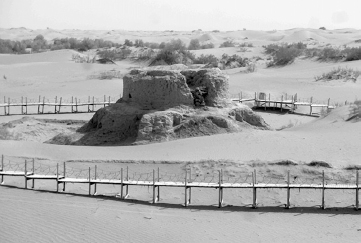
Figure 10. Ruins of Rawak Stupa, Khotan (China, 2016).
Photo by author.
Buddhism’s institutionalization began in north central India where the Buddha had lived, preached, and ultimately passed away. The locations of these life events became important sites of worship and pilgrimage, but they were not the only sites of Buddhist devotion. A crucial aspect of early Buddhism was the worship of the Buddha’s relics, which, being themselves a field of merit, were vehicles for the accumulation of good karma.4 As Buddhist monks and merchants pushed outward in order to develop new markets and to extract natural resources for the growing urban centers, these relics followed and came to be enshrined in monumental reliquaries, called stupas, which are found across Buddhist Asia.5
The earliest and grandest such monuments were built in the third to first centuries BCE south of the Vindhyan range at Sanchi and Bharhut in what is now the Indian state of Madhya Pradesh.
By the first centuries of the Common Era, Buddhists were firmly established on the east coast of India at Amaravati (today’s Andhra Pradesh) as well as in northwest India, or Gandhara (in today’s Pakistan and Afghanistan). In both of these areas the Dharma flourished with support from both the urban elites and various states (the Kushans in Gandhara, and the Satavahana and Iksvaku in Amaravati). Such support resulted in an explosion of monumental Buddhist art in these areas, which also became staging grounds for the further dissemination of the Dharma.6
The Dharma eventually made it from Amaravati to Sri Lanka.7 Legend has it that the missionary son of the Indian ruler Asoka had converted the Sri Lankan king, Devanampiya Tissa, in the third century BCE. Outside of legend, we know that Buddhism became increasingly intertwined with royal power on the island at this time. As the court at Anuradhapura expanded its irrigation systems with revenues gained from the Rome-China trade routes, Buddhism of all three traditions—Nikaya, Mahayana, and Tantric—flourished in Sri Lanka.8 At the end of the tenth century, however, the Chola Kingdom of south India demolished Anuradhapura. In its wake, the royal court during the Polonnaruva era (eleventh to thirteenth centuries) came to exclusively patronize the Theravada tradition. Sinhalese envoys, traders, and monks eventually took their Theravada Buddhism to Burma and central and northern Thailand.9 There, local rulers adopted it in their own state-building enterprises, resulting in the Theravada Buddhist states of Pagan (849–1297) and Ava (1364–1555) in Burma; Sukhothai in central Thailand (1238–1583); and the Lan Na Kingdom of northern Thailand (1292–1775).10
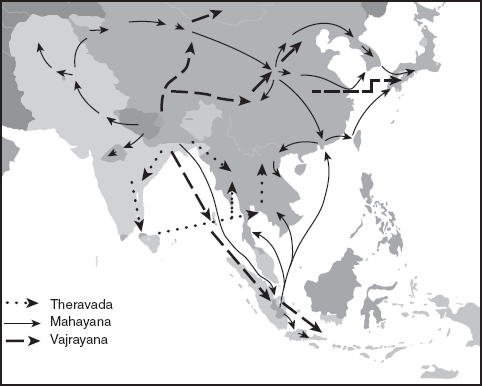
Map 5. The historical spread of Buddhism across Asia.
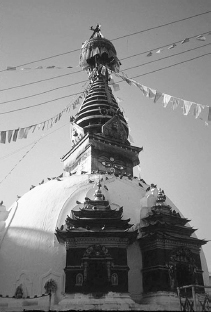
Figure 11. Swayambhunath Stupa (Katmandu, Nepal, 1990).
Photo by author.
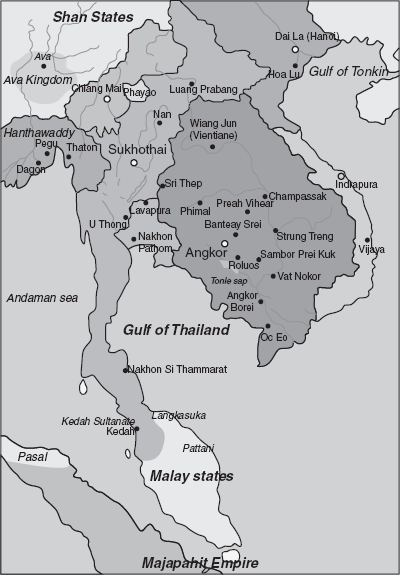
Map 6. Buddhist kingdoms of Southeast Asia
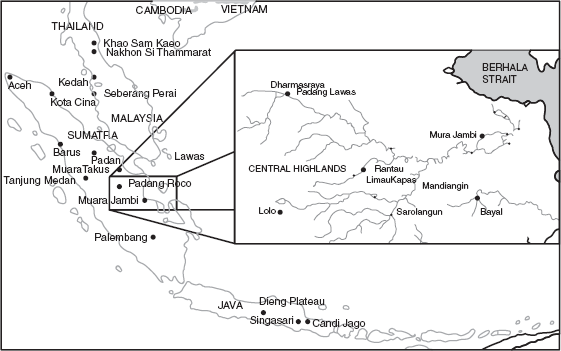
Map 7. Buddhist sites in the Malay world.
Yet this was not the first time that the Dharma had traveled to mainland Southeast Asia. Rather, as in Sri Lanka, Buddhists of all kinds—envoys, monks, and merchants following all three forms of Buddhism—had been part of the area’s cultural mix for centuries.11 In Burma, for example, there is evidence that Buddhism was already being followed in the Pyu Kingdom in the second century CE,12 and that in Thailand an eclectic Buddhism developed at Dvaravati (just south of Bangkok) in the fourth century. This “Tantric Theravada”13 moved east into the empires of the Khmer in today’s Cambodia and Champa in today’s Vietnam.14 These Buddhists also moved south along the trade routes into the Malay world.15
The Buddhists of the Malay Peninsula, Sumatra, and Java traded not only with their northern neighbors in mainland Southeast Asia but many others.16 Again, as in Sri Lanka, the Dharma came to thrive across what we today call Indonesia on account of several Buddhist trading empires: Sri Vijaya (seventh to thirteenth centuries), Sailendra (eighth to ninth centuries), Mataram (eighth to tenth centuries), and Majapahit (thirteenth to fifteenth centuries).17 These empires were built from the exploitation of the rich natural resources of these regions—everything from spices to camphor to bird feathers—which they sold across the Sino-Indian trade routes. With their wealth, they supported the Dharma lavishly, as the massive Borobudur Stupa in central Java demonstrates.18
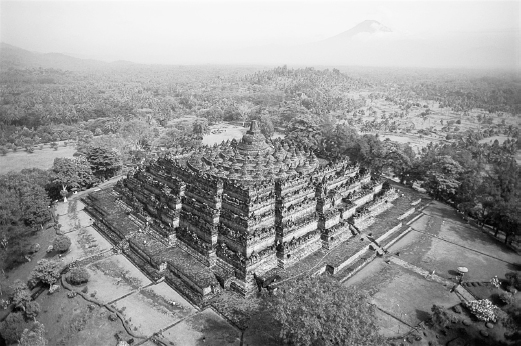
Figure 12. Borobudur in Magelang, Central Java (Indonesia).
Photo: Wikimedia.
In addition to building monuments, these Malay states also supported Buddhist scholasticism, with scholars coming from as far away as China and India.19 The famous Indian monk Atisa (982–1054), for example, studied with Dharmakirti in Sumatra and later traveled to Tibet, where he was instrumental in fostering the revival known as the Tibetan renaissance (which I discuss below).20
As monks and merchants in South Asia moved into new territories across the Bay of Bengal, the Buddhists of northwest India moved into Central Asia.21 By the second century CE Buddhists were established in Bactria (northern Afghanistan and southern Uzbekistan), and by the third century in Merv (Turkmenistan).22 As archaeological evidence from Tajikistan and Kirghizstan confirms, Buddhism thrived in Central Asia well into the eighth century.23
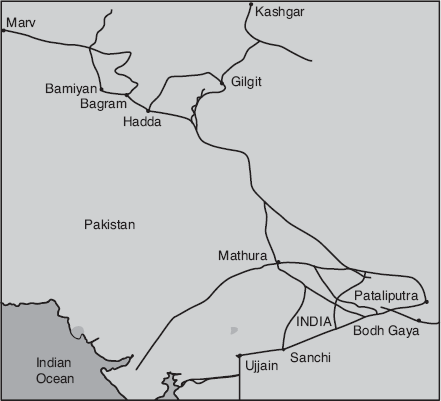
Map 8. Buddhist northwest India.
Yet the Buddhists of Gandhara also traveled east, helping to establish the fabled Buddhist oasis cities of the Silk Road in the Tarim Basin. The earliest of these oasis cities—Khotan, Miran, Loulan, and Shanshan—were established along the southern edge of the Taklamakan desert.24 By the fifth century, however, all of these cities but Khotan had to be abandoned for lack of water (see figure 10).25
As a result of these climatic changes in the southern Taklamakan, Buddhists started to use the northern route from Kashgar to Dunhuang. Nikaya Buddhism eventually became established among the Indo-European Tokharians who resided in Aksu and Kucha.26 The Dharma thrived along the northern route for centuries, including when the area was gradually taken over by Turks beginning in the ninth century.27 (The Turks first preferred the Mahayana, but, later, during the Mongol Empire, Tantric Buddhism dominated.)28
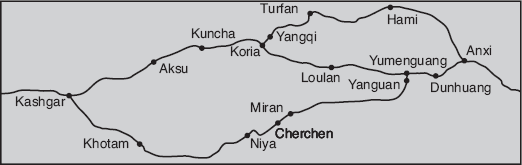
Map 9. The Silk Road.
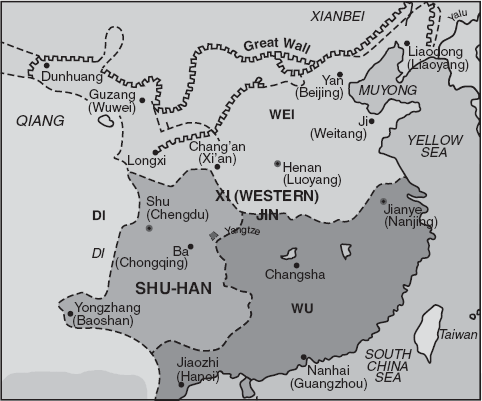
Map 10. Six Dynasties China.
The Buddhists of northwest India and Central Asia had transmitted the Mahayana to China by the first century CE, but because of Confucian dominance during the Han dynasty (206 BCE-220 CE), the Dharma did not have much early success as a missionary religion in China.29 This changed, however, with the fall of the Han and the sociopolitical mayhem of the chaotic Six Dynasties period (311–589 CE).30
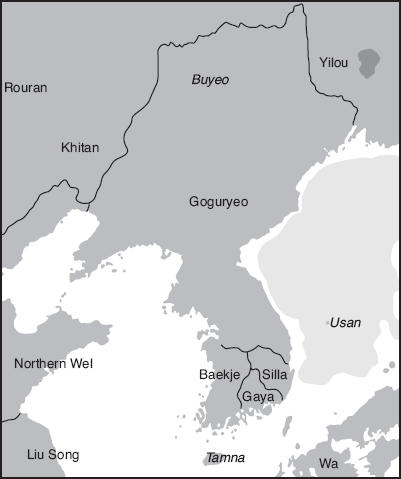
Map 11. The Three Kingdoms of Korea.
During this period the non-Chinese Northern Wei dynasty adopted the Dharma to differentiate itself from the Han Chinese in the south (Map 10).31 An intense period of soul-searching among the Chinese ensued, which resulted not only in the growth of religious Daoism but also in the intellectual adoption of Buddhism by the Han literati.32 Thus when the pro-Buddhist Sui dynasty (589–618 CE) finally unified China, the Dharma was primed to move beyond the lofty world of the elites. During the Tang (618–907 CE) and Song dynasties (960–1279 CE), Chinese Buddhism reached its greatest heights of intellectual creativity and institutional prosperity. Buddhism penetrated into all levels of society and thereby became a fundamental part of the Chinese religious world.33
During the religious ferment of the Six Dynasties period (311–589 CE), as the competing dynasties sought economic and political allies abroad, they brought Korea into the Buddhist ecumene.34 At the time, the Korean peninsula was divided into three kingdoms—Koguryo in the north, Paekche in the southwest, and Silla in the southeast—each of which made alliances with different Chinese dynasties.
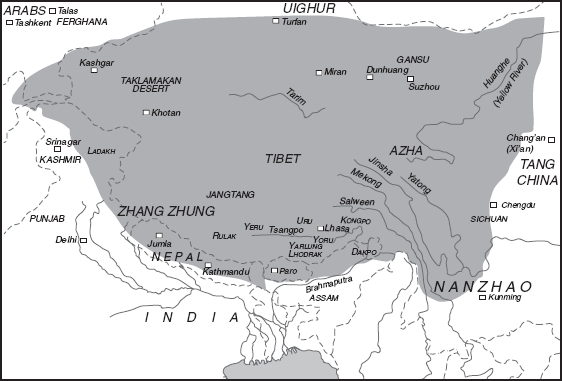
Map. 12. The Tibetan Empire.
Ardent Buddhists ruled each of those Chinese dynasties, and, as part of their effort to secure military and political alliances, they sent Buddhist monks to Korea. Silla, the smallest of the Korean kingdoms, took the most advantage of their new alliances, especially the technology and political ideologies that the Chinese Buddhists brought with them. By 680 CE Silla (57 BCE-935 CE) unified the peninsula and began the process of making the Dharma an integral part of Korean society.35 During the subsequent Koryo dynasty (918–1392), Buddhism came to play a key role in imperial ideology and practice of the Dharma was woven into Korean society.36
Buddhism would also become an integral part of the state in Japan since Prince Shotoku had the Dharma written into its first constitution of 604 CE.37 This political integration of Buddhism set the stage for a court-sanctioned explosion of Buddhism during the Nara period (710–784 CE). And although Japan was largely closed to foreign influences during the subsequent Heian period (794–1185 CE), the Dharma continued to expand and develop within the country. In the Kamakura period (1185–1333), the teachings of Hōnen (1133–1212) and Shinran (1173–1262) energized the Pure Land tradition, and Eisai (1141–1215) and Dōgen (1200–1253) promoted the Zen traditions. Perhaps even more important were the teachings of the Buddhist reformer Nichiren (1222–1282), who played a pivotal role in bringing the Dharma out of its aristocratic circles and into the broader society.38
A similar process of political integration had occurred earlier in Tibet, where the ruling elite had brought in Buddhism from India as part of the project of forging the Tibetan Empire.39 The Tibetan court supported the Dharma during the height of its empire from the seventh to ninth centuries, but once it collapsed, so too did Tibetan support of Buddhism.40
The Tibetan “dark age” ended in the eleventh century when elites began to invite Buddhist masters from India once again to teach the Dharma.41 This process ushered in what is known as the Tibetan renaissance, whereby Buddhism came to be the defining feature of Tibetan civilization.42 Its distinctive form of Tantric Buddhism would greatly impress the Mongols in the thirteenth century, when, with the support of the Mongol Empire, Tibetan Buddhism came to play an outsize role in the early modern history of Eurasia.43
During the thirteenth century, as Tibetan Buddhism was expanding into China and Iran, Japan was experiencing its own Buddhist renaissance, and powerful Buddhist states were being forged in Southeast Asia. But in India, the land of its origin, the Dharma was actually disappearing.44 By the time Europeans arrived in India in the fifteenth century, the Dharma and its many monuments were long-lost memories. In fact, it took Europeans quite some time to figure out that the religion practiced from Sri Lanka to Korea, Mongolia, and Laos was actually one and the same.45 Whether or not apparent at the time, Buddhists of all categories—monastics, the laity, and states—had created a unified environmental history for Asia, as they worked to continually expand the commodity frontier in support of the Dharma.