
IV
9
It is but fair to ourselves and to the nation that they [landlords] should get the treatment proposed by the Minister. Perhaps it is fitting that they should have held out until a National Parliament would dispose of the last remnant of Irish landlordism. This Oireachtas will put an end to a system that was the curse of this country, and I hope we will hear no more of it in that shape.
(William Sears TD (Mayo, Cumann na nGaedheal), Dáil Debates, vol. 3, 28 May 1923, 1152–53)
Damage to cultural property belonging to any people whatsoever means damage to the cultural heritage of all mankind, since each people makes its contribution to the culture of the world.
(Hague Convention for the Protection of Cultural Property in the Event of Armed Conflict (1954); quoted in Bevan, The Destruction of Memory, p. 23)
1. ‘There are numerous demesnes with Big Houses on them’
The aim of this book has been to provide an additional dimension to the scholarly understanding of the Irish revolution by examining how the tumultuous events of the period 1914–23 impacted on the Irish landed elite, most particularly the aristocracy, the class which most experienced revolutionary change, certainly in the more extended period from 1879 to 1923 and beyond, and yet which has been largely neglected in the historiography. The ‘beyond’ is important because the story of the aristocracy illustrates how the social ambitions of revolutionaries eventually played out in the longer term.
In this study, the landlord experience has been examined through the prism of the Big House. One of the central arguments has been that the British Land Acts passed for Ireland (1870–1909) failed to address rural inequalities which meant that land questions remained vibrant and came to the fore once more during the First World War when the former landed elite were at their most vulnerable. Of course, their continued loyalism to Britain during the War of Independence left them in an invidious political position, but so also their retention of extensive tracts of demesne and untenanted lands post-1903 left them in an equally precarious social position. This work has therefore argued that the burning of almost 300 Big Houses in 1920–23 was as symptomatic of the continued land question as it was of the aristocracy’s continued loyalism. When a burning was linked to an agrarian motive rather than a political one, the chances of it being recalled in a local community were diminished. This is not unusual in the global context of revolution and the destruction of architecture associated with the perceived enemy. As Robert Bevan has written:
If the touchstones of identity are no longer there to be touched, memories fragment and dislocate – their hostile destruction is an amnesia forced upon the group as a group and on its individual constituent members. Out of sight can become, literally, out of mind both for those whose patrimony has been destroyed and for the destroyers.1
In the Irish context, to recall a house being burned for agrarian reasons as opposed to political was at odds with the nationalist narrative. In her study of the burning of Ballydugan House, Ann O’Riordan describes how the local community fell into conspiratorial silence when in 2014–15 she asked questions about the motivation. The hunger for land was not the version of events that was palatable to locals who preferred to remember that it was not even the IRA but the Black and Tans who burned the house (if that was the case it would have made Ballydugan unique).2 In line with Timothy Mawe, O’Riordan argues that ‘Nobody was willing to stick their head above the parapet to challenge a version that was best left alone.’3 Historians are sometimes guilty of the same.
It is arguable that post-1922 the credibility of Irish independence depended upon the decolonialisation of the new state. In this respect, the final dismantling of the aristocracy’s physical landscape began with the passing of the 1923 Land Act. When it was being debated at the Bill stage in Dáil Éireann, it was clear that a residue of grievance relating to colonial land confiscations and plantations, which had long set political and social agendas in Ireland, continued to exist. One TD was delighted to tell his parliamentary colleagues: ‘I believe that implicit in this event alone is the undoing of the conquest of Ireland. For the conquest of Ireland was the conquest of the land of Ireland, held by Irish tenure, from the people of Ireland by foreigners who held by foreign tenure from a foreign king.’4 There were TDs who called for the ‘expropriation’ of aristocratic lands, and reference to ‘descendants of Cromwellian planters’, and calls for retribution for Famine ‘hardships’, ‘sufferings’ and ‘penalties’. It was clear from the rhetoric of many TDs that all existing demesnes and untenanted estates were obvious targets. John Lyons (Longford-Westmeath, Labour) pointed out that ‘There are thousands of acres in the hands of a few people, and the least we can expect from our own Government is that these lands will be taken over. A large part of this land is in the hands of the descendants of Cromwell’s settlers and should be taken over and given to the descendants of those to whom it formerly belonged.’5 William Sears (Mayo, Cumann na nGaedheal) got to the crux of what the act would mean: ‘There are numerous demesnes with Big Houses on them. I hope the Minister is not going to be too tender about dealing with these demesnes. They have been for 500 years in the possession of these landlord families. I think that is long enough for them to have them, and it is time for the people to get them now.’6
This type of rhetoric had been inherited from the Land War, as had the doctrine of confiscation and redistribution, and both strongly hinted at the rural grievances that underpinned the burning of so many houses. This was by no means unique to Ireland; after all, the backdrop to modern revolutions in agrarian societies, where people have risen in revolt against alien or oppressive regimes, has frequently been land redistribution. ‘The land for the people’, a catch-cry for revolutionaries in nineteenth-century Ireland, has more recently been echoed as far away in distance and time as Iran in 1960–80 and Indonesia in the early twenty-first century.7 More contemporary with the Irish revolution, the decree on land adopted by the Russian Congress on 8 November 1917 laid the foundation for the confiscation of landlords’ estates and the nationalisation of all lands. Within months, 75 per cent of Russian estates were appropriated. Between 1917 and 1923, revolutionaries in Hungary and Bulgaria demanded land redistribution. In Spain, in 1919, estate owners abandoned their country houses because of a revolt of landless labourers. In Italy, conditions of the landless who had served in the war were exacerbated by the broken promises of the ruling classes who had pledged land redistribution as a reward for service.8 In Mexico, between 1910 and 1920, village peasants and revolutionaries continuously negotiated land redistribution.9
The latter revolution seems to have had some influence on the mindset of Kevin O’Higgins, Minister for Home Affairs, who, in his much-quoted remark, described his contemporaries as the ‘most conservative-minded revolutionaries that ever put through a successful revolution’.10 Sometime around 1923, O’Higgins wrote a piece called ‘Mexican Politics’ which, as the title clearly indicated, emphasised that he wanted no peasant revolt as had happened under Emiliano Zapata (1879–1919), leader of the peasant revolt in Morelos and founder of the agrarian Zapatismo movement.11 During the Civil War, O’Higgins and Patrick Hogan, Minister for Agriculture, both tellingly from strong farming and middle-class professional backgrounds, worked together to put an end to agrarian activism and any threat of a social revolution through repression and legislation, something of the traditional coercion and conciliation tactics that had been familiar in rural Ireland in the nineteenth century.12

9.1 Kevin O’Higgins (1892–1927), Minister for Home Affairs, and close friend and political ally of Patrick Hogan. Shot and killed by the IRA on 10 July 1927 when on his way to Mass.

9.2 Patrick Hogan (1831–1936), Minister for Agriculture (1922–24) and architect of the 1923 Land Act. Killed in a car accident in 1936.
They were chief amongst those in the Cumann na nGaedheal government who realised they had to be astute in their financial engineering in order to advance social policy in a country with very limited financial or material resources of its own.13 They moved towards an economic liberalism rather than the revolutionary socialist model that had emerged in Russia and which had influenced Sinn Féin’s pre-independence Democratic Programme of 1919.14 As Roy Foster has argued, they were amongst a clique who, in the construction of the new state, ‘resolutely ignored even the vague social and economic desiderata once outlined for Pearse’s visionary republic’.15 Thus, in December 1922, Hogan, in pursuit of international credit rating, called upon the Irish Government to deal resolutely with land agitation emphasising that:
If we miss this chance of getting English credit on easy terms because the tenant and the landless men refuse to see anything like reason, it will be an incalculable loss . . . It will alienate from us all conservative support in Ireland, and this will probably have serious reactions on the financial settlement which we must make this year with England.16
The Irish government needed to raise £30 million that Hogan estimated it would cost to complete land purchase and implement other land reform, especially redistribution.17 It had to look to Britain and, as the British cabinets of Andrew Bonar Law (October 1922–May 1923) and Stanley Baldwin (May 1923–January 1924) were still predominantly patrician with the likes of Salisbury, Curzon, Devonshire, Derby, Cecil and Peel in positions of influence, it had to tread carefully in relation to land policy. Secret negotiations held in February 1923 between Hogan, Cosgrave and members of the British cabinet resulted in the latter agreeing to provide the cash and stock to guarantee the 1923 Land Act and, in return, the Irish government undertook to collect each year the full amount of annuities (annual interest repayments from purchasing farmers) and to hand them over to the British Treasury.18 With the funding in place, an attempt could now be made to return the countryside to law and order. On 28 May 1923, O’Higgins, speaking on the Land Bill, told the Dáil of his intentions:
Within the last year, under cover of activities against the Government, men have gone out in an entirely selfish, wilful, and criminal spirit to seize land by the strong hand, or by the hand which they thought was strong . . . [I will urge] on the Minister for Agriculture from my department, that the people who go out in that spirit, who go out in defiance of the law and in defiance of the Parliament to press their claims by their own violence and their own illegalities be placed definitely outside the benefits of this Bill.19
The speech deliberately emphasised that those found guilty of offences would be barred from land redistribution schemes, in the knowledge, or at least the hope, that such a threat would help halt agrarianism and any residual support for the anti-Treatyite cause, especially in the west, that emanated from its land policy. That same month O’Higgins also saw through the Dáil a Public Safety Act that was intended to put an end to pervasive criminality; it gave the government wide-ranging powers to seize trespassing cattle, and to restore stolen goods and property, including lands, to their rightful owners. On 14 June 1923, O’Higgins again told the Dáil that land grabbers would be those most severely dealt with:
They cannot have law and violence. They cannot have an act and their own plunder and, in so far as I can secure it, I will see that they do not have it . . . and by the time this Bill reaches its closing stages, I hope to be able to assure the Dáil that there is not in any county, over which we have for the time being responsibility and jurisdiction, one acre of land in the possession of any person but the legal owner.20
The politics of land redistribution were now being used to threaten potential enemies of the state.
The 1923 Land Act had two main objectives, the first of which was the completion of land purchase. By 1923, there were around 114,000 farms comprising roughly 3,125,000 acres still to be transferred.21 On 10 April 1923, matters had come to a head at the Land Purchase and Arrears Conference in Dublin, where landlord and tenant representatives met to discuss the current state of the land question. Afterwards, Hogan reported to his cabinet colleagues, emphasising the mood of a significant proportion of the electorate:
They [the tenant representatives] informed the landlords in all moods and tenses that a great change had come; that they were now in a small minority, and an unpopular minority; that they could take the land from them for nothing if they wished; that the people meant to have the land cheaply, and that if the present government did not meet the wishes of the people in this respect, they would put in a government the next time who would.22
Hogan then informed W.T. Cosgrave that the tenant representatives wanted a Bill ‘on terms which would amount to confiscation’. But that could not happen, given the settlement reached with the British government less than two months before and so Hogan told the Dáil: ‘No matter how obnoxious a landlord may be personally his legal position as vendor confers on him certain rights which cannot be ignored without running the risk of such diminution of the credit of the nation.’23 Thus, the aristocracy’s lands were not expropriated, as revolutionaries might have demanded, but neither were they paid for in cash, so the aristocracy were denied the generous terms available under the 1903 Land Act. They did not publicly challenge this; their legal representative, Harry Franks, had informed Hogan at the land conference that they were ‘prepared to take what they can get now, providing it is anything approaching fair play, rather than take their chance of what they can get from the next parliament’.24 In the Senate, instead of barking loudly, the aristocratic interest acquiesced, with the exception of Sir John Keane, who ‘opposed the basic principle of the bill and . . . fought Hogan doggedly on almost every issue’, but to little avail, largely because his numerous amendments were not supported by his more lethargic aristocratic colleagues.25
Amongst the largest of the tenanted estates were the Lansdowne estate in Kerry (47,818 acres); Coote estate in Co Laois (24,460); Wrixon-Becher in Cork (16,338); Courtown in Wexford (12,706); and Windham in Monaghan (10,940).26 Already the houses on the Derreen and Courtown estates had been burned (as well as Lady Windham’s land agent’s house) and within a decade Ballyfin, Castle Hyde and Dartrey would be sold and/or demolished, their lands transferred to the tenant occupiers. Either fate emphasised the role of land in the Irish revolution and that a Big House without its land bank was inevitably unsustainable.
The second aim of the act was the redistribution of land for the relief of congestion. Politically, the smallholders and the landless were not as influential as the strong farmers, but they were the very classes that had provided significant support to the rank and file of the revolutionary movement. Promises of redistribution made them compliant, at least in the short term. They welcomed the fact that the reconstituted Irish Land Commission was provided with powers to compulsorily acquire the lands of those represented as the traditional enemies of Ireland.27 At the same time, the targeting of demesnes for acquisition took the focus away from the larger middle-class farmers who had experienced their fair share of agrarianism in 1917–23. A policy to relieve congestion was not the same as one supportive of a revolution of the proletariat: as far as both Hogan and O’Higgins were concerned the support of middle Ireland was crucial to future stability, and as far as the large farmers were concerned the 1923 Land Act, working in tandem with the Public Safety Act, provided comfort and security and so they very quickly came to support the institutions of the new state, even though they had shown no strong commitment to the Republic or the War of Independence. By using the democratic legislative process, the government could not be compared to the Bolshevists in Russia. Much the same approach had been adopted a long time before in New York during the American Revolution of the 1770s, where Howard Pashman found that redistribution of property ‘drove the change from popular uprising to stable legal systems . . . because it offered both material relief and revenge against Britain’s supporters at a time when society demanded these actions’.28
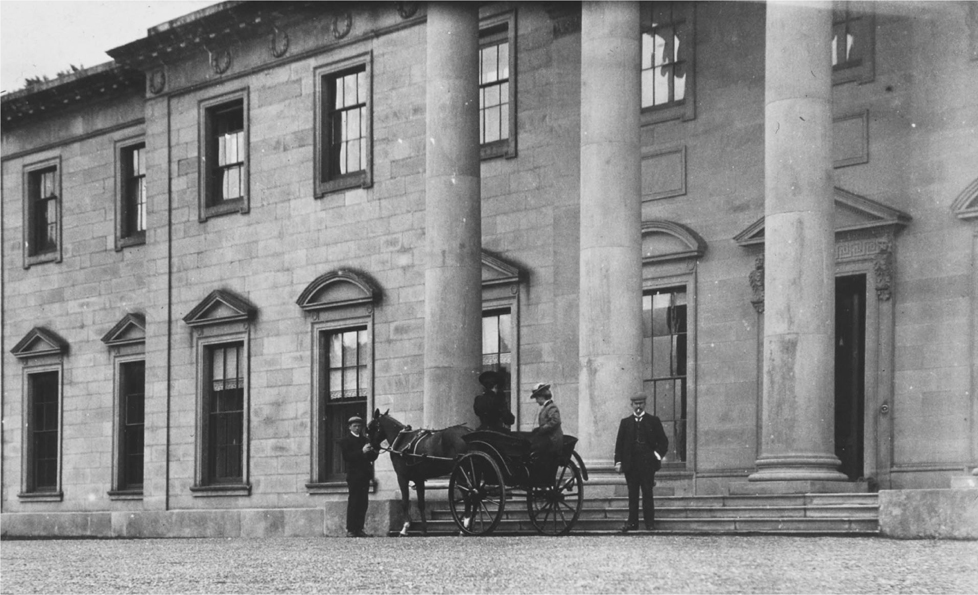
9.3 Ballyfin, Co Laois, sold by the Coote family in the 1920s to the Patrician Brothers for use as a secondary school. The photo taken c.1901 shows the then owner, Sir Algernon Coote, standing outside his classical mansion. In the early 21st century, Ballyfin was magnificently restored by Fred and Kay Krehbiel.
In the decade after the passing of the 1923 Land Act, the Irish Land Commission compulsorily acquired and redistributed at least 178 demesnes and untenanted estates.29 Significantly, amongst the first demesnes targeted for acquisition were those belonging to houses burned in 1920–23, including those of Lord Castlemaine, Lord Langford, Chichester Constable and Sybil Lucas-Scudamore. None of these owners had any intention of returning to Ireland. The example of Castleshane epitomises the fact that once the house and the owner were taken out of the equation, local conditions changed dramatically though not always immediately. After Sybil Lucas-Scudamore left for England, the management of the estate was taken over by George Morgan, the steward. He was soon reporting how difficult matters were in a depressed economy. In August 1920, farming was disrupted by ‘the most awful weather nothing but rain and very cold, nothing seems to grow . . . potatoes are blighted very bad all round’. Until then pigs were doing well selling at £12 a hundredweight but at the beginning of August, just as the second lot of pigs that year were ready for market, the bottom fell out of the market.30
To compound matters, with the landlord presence removed, farmers who had taken Lucas-Scudamore lands on conacre became reluctant to pay their rents. The family solicitor advised the issuing of writs, but Morgan believed this would only lead to a boycott.31 By March 1921, the demesne was being pillaged.32 Less than a month after the Treaty had been signed, T.F. Crozier, the estate agent, strongly advised Sybil that the entire demesne should be sold because a Land Bill was imminent: ‘I should not be a bit surprised that there might be compulsory powers to acquire land situated such as Castleshane is now, namely the owners living in England, and the mansion house burned.’33 At the end of 1921, during the truce period, Morgan reported an attempt to destroy the surviving wing of the castle.34 There were obviously those who were now intent on ensuring that the Lucas-Scudamores never returned.35
Sybil eventually took Crozier’s advice and sold off the untenanted lands in 1922 but she retained the demesne. For almost a decade she held out, for what reason is not clear, perhaps some romantic notion that her son Jack might want to return to Ireland. However, local smallholders exerted pressure on the Land Commission to have the demesne redistributed, and in 1931 M.T. Henchey was sent to carry out a survey of the demesne.36 It was on the eve of a general election and to win local votes Cumann na nGaedheal were anxious to expedite land redistribution because the rising Fianna Fáil party in their election manifesto had committed to do so if returned to office. The following year the demesne was compulsorily acquired for £3,715 payable in 4.5 per cent land bonds, ending the Lucas-Scudamore association with Monaghan.

9.4 Woodlawn, Co Galway, formerly the home of Lord Ashtown, described as ‘one of the creepiest places in Ireland’.
Under the 1923 and subsequent land acts, the revolution that had been begun in 1879 against the ‘alien usurpers’ of Irish lands was eventually completed 100 years later; by 1973, virtually all the untenanted lands recorded in the 1906 Return had been eliminated.37 As demesnes were compulsorily acquired, the Land Commission inherited emptied country houses. In 1944 when Deputy Oliver Flanagan asked the Minister for Lands if he would ‘arrange to hand over mansions and large houses of divided lands to organisations such as An Oige [Irish youth council], Irish Tourist Board, Youth Training Body etc. instead of permitting them to fall into decay, or be demolished, as often happens’, he received from Fianna Fáil’s Seán Moylan the following rather unsympathetic reply:
Residences on lands acquired by the Land Commission for division which are not suitable for disposal to allottees may be demolished in order to provide material for building smaller houses for allottees or may be sold by public auction, at which it is open for such bodies as the Deputy mentions to bid for them.38
Because records are not accessible, it is impossible to determine how many houses from 1923 onwards were acquired by the Irish Land Commission. However, Emer Crooke, using Department of Lands records has identified thirty-six houses acquired by the Land Commission for the period 1954–58 alone, and it should be noted that this was long after land acquisition had begun to slow down.39 On 5 August 1958, the secretary of the Department of Lands explained to his superiors that ‘in acquiring land the Land Commission acquire a number of mansions and large houses in good repair which are unsuitable for their uses’ and that ‘with comparatively little adaptation save the erection of new buildings for institutional use for agricultural education, homes, hospitals, residential schools, etc., or as country-type houses to stimulate tourism’.40 Some houses with minimal ‘accommodation land’ were sold to religious orders and converted to schools, convents and monasteries or used by the state as training facilities: Ballyfin, Garbally, Kylemore Abbey, Johnstown Castle and Ballyhaise for instance. But the more general case was that Big Houses, especially those of an aristocratic nature, ‘proved unsaleable and had to be demolished’.41
At least nine of the houses listed in the ownership of the Land Commission in 1958 were demolished at this time, including Dalystown in Galway (‘Considered to be suitable only for demolition and is therefore unlikely to be available for sale’) and Shanbally Castle in Tipperary, which was still in very good condition (‘stone built, slated roof, 20 principal bed and dressing rooms, bathrooms and ample servant accommodation’).42 Built c.1806, Shanbally was considered John Nash’s ‘most important and largest Irish castle’.43 The Land Commission’s intention was to try to sell it and 173 adjoining acres, but no bidders could be found. Despite local opposition – the local TD, for example, told the Minister for Lands, Erskine Childers, that this was seen to be ‘a national calamity in the eyes of the people of South Tipperary and adjoining counties’ – the mansion was demolished.44 According to N.K. Robinson, The Knight of Glin and D.J. Griffin: ‘Its destruction was one of Ireland’s great architectural losses this century.’45 In 1988, the same authors catalogued around 600 Big Houses demolished or abandoned to ruin (including some burned in 1920–23) and theirs was by no means a complete inventory. These included such architecturally imposing structures as Castle Morres in Kilkenny (demolished following a demolition sale in 1940), Courtown in Wexford (demolished mid-1940s), Dunsandle in Galway and Mote Park in Roscommon, both demolished in 1958.
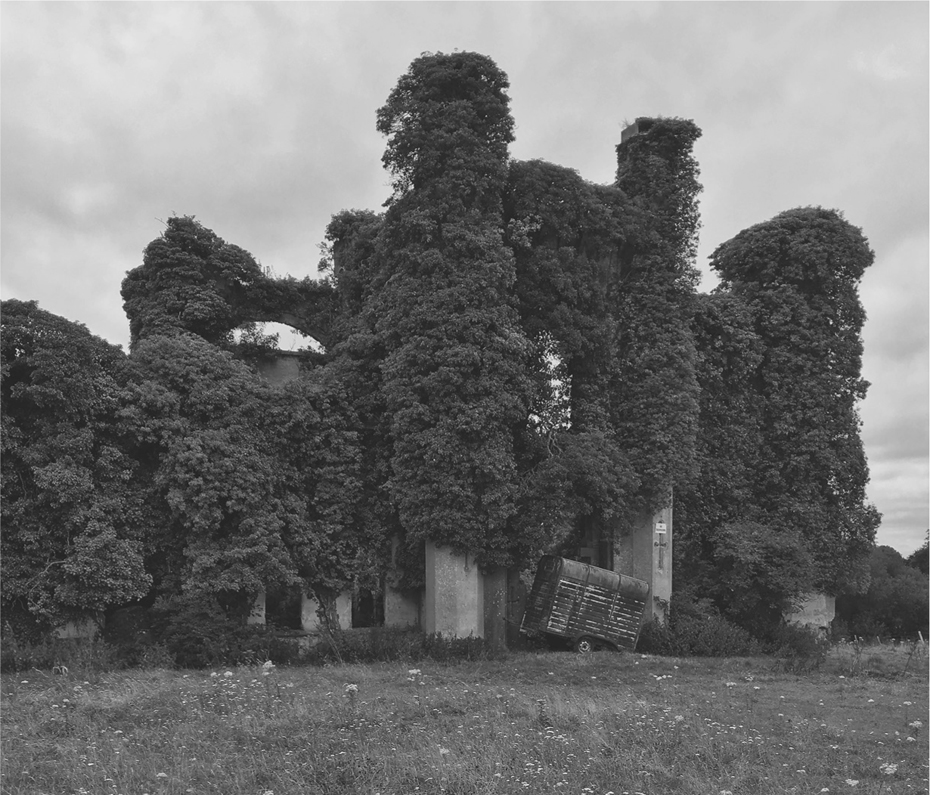
9.5 Moydrum Castle in ruins, c.2020. A similar image was famously used by U2 on the cover of their album The Unforgettable Fire.
Thus, the Land Commission completed the process begun by political and social revolutionaries in 1920–23. Houses no longer had to be burned; they could instead be financially strangled by being denuded of whatever lands they had retained (exceptions will be discussed below).46 Lord Ashtown had struggled through the revolutionary period at Woodlawn in Galway but, as L.P Curtis Jr has shown, under the 1923 Act he was forced to sell virtually all his tenanted and untenanted land, almost 21,700 acres for £136,000 in 4 per cent land bonds.47 It ultimately ended the family’s presence in the area, so that by 2012, Woodlawn was described as ‘a vast crumbling mansion in Co Galway . . . so scary in its ruinous state that even the team who produced The Blair Witch Project thought it was one of the creepiest places in Ireland’.48
Similarly, in 1927, the Land Commission compulsorily acquired the Ballinahinch demesne of around 1,100 acres – ‘splendid grazing tillage and meadow lands’ – paying Mrs Gore £8,000 in 4.5 per cent bonds. The Commission treated the Big House as ‘valueless’, allowing her only £90 for the outbuildings, including a greenhouse that had been built for £2,000. Even before the boom of the war years, £15 per acre would have been a modest price for good quality land and would have yielded Mrs Gore £16,500 in cash. The Land Commission demolished the mansion ‘to use stones for cottages’.49
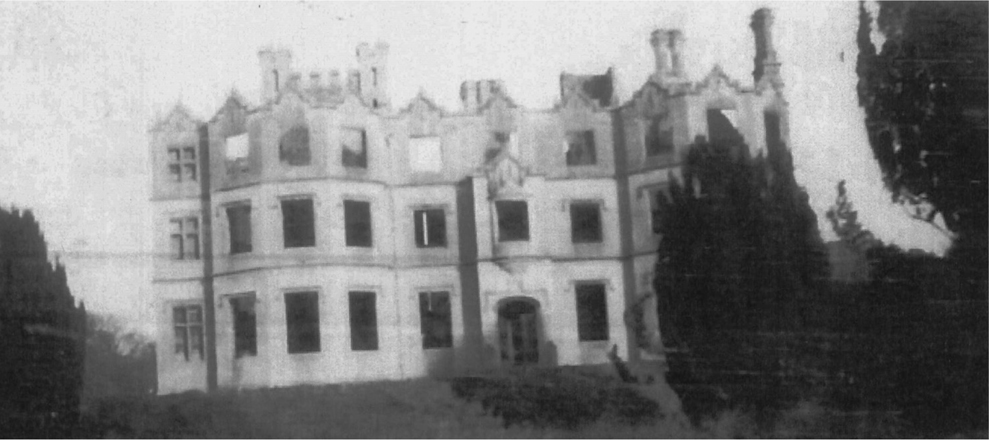
9.6 Castleshane in ruins. Having been burned in 1920, it was later commandeered by anti-Treatyites and used by local people as a dance venue. Its demesne was eventually acquired by the Irish Land Commission in the 1930s and planted with firs.
Under the Cumann na nGaedheal government of 1923–32 several extensive demesnes managed to evade acquisition. There may have been some who did so because of sheer luck, or possibly even political connections, but most did so because of safeguards in the 1923 Land Act. For example, in 1926 the Land Commission inspected the 2,000-acre demesne and untenanted lands in the possession of Lady Howard Bury of Charleville Forest in Tullamore with a view to compulsory acquisition, but on finding that thirty-eight local families were dependent upon employment provided by the demesne decided not to proceed.50 The following year, Patrick Hogan told the Dáil that the Land Commission was not going to acquire the substantial Franks estate in Cork because of the progressive manner in which the land was farmed and because it gave employment to ‘a substantial number’ of labourers.51 In 1927, the Commission did not proceed against George Mansfield, who had a 600-acre demesne at Caragh in Kildare, because ‘this man tills considerably and gives a lot of employment’.52 In other words, the government was prepared to balance the loss of employment against acquisition.
Under the 1923 Act, the breeding of thoroughbred animals or the existence of historical woodland also exempted a demesne from acquisition. Some TDs quickly became cynical about the rather sudden establishment of stud farms on demesnes at Ballinlough, Killeen and Slane Castle in Co Meath alone.53 When Martin Roddy told the Dáil in 1927 that the Gill estate in Offaly was not to be divided, William Davin enquired sarcastically: ‘Is this another of the many stud farms supposed to be allowed in this particular area?’54 The breeding of Kerry Blues and the existence of historic woodlands meant that the owners of Carton House – by 1923 it had passed out of the ownership of the Duke of Leinster to Sir Henry Mallaby-Deeley – were allowed to retain in excess of 1,200 acres. The same applied to the Earl of Dunraven at Adare, who held on to 1,160 acres in Limerick; Lord Rossmore, who retained 1,430 acres in Monaghan; Lord De Vesci, who kept over 1,000 acres in Laois; and Lord Rathdonnell, around 1,290 acres in Carlow.55 All of these houses survived with the exception of Rossmore Park, a very large Tudor Revival house built in 1827 to the design of William Vitruvius Morrison, which was invaded by dry rot in the 1940s and demolished in the mid-1970s. Carton and Adare evolved to fulfil very different functions by the end of the twentieth century as exclusive country house hotels with golf courses; only the retention of their demesnes allowed for this transition.
Finally, the objective of the 1923 Land Act is brought into further relief by contrasting the situation with Northern Ireland where, as Olwen Purdue points out, the 1925 Land Act provided them with much more favourable terms on the sale of their tenanted estates than the Hogan Act and ‘allowed landowners to retain their untenanted land for their own use [which] was of major importance as it enabled some of them to farm on a sufficiently large scale to generate a good income or utilise their remaining natural resources in other ways’.56 Granted, supplementary incomes were more often necessary but at least their lands were not targeted for compulsory acquisition and redistribution. The northern aristocracy were, it seems, more adept at connecting with the commercial world of Belfast than the southern aristocracy were in moving from the old world of landed income to the investment world of the City. Very importantly for them, they remained part of the United Kingdom and so ‘rather than being a small, provincial and declining clique they had a strong sense of being an integral part of a larger, active and vibrant social group’ because of their attachment to the empire, and their sense of identity guaranteed they had less reason to migrate from the island than their southern counterparts.57
2. ‘These men and their dependents are entitled to anything we can do for them’
There are remaining loose ends to be tidied up in this book. For example, were members of the IRA eventually rewarded with lands under the government redistribution schemes post-1923? The answer is yes, but how many and to what extent is impossible to determine because of the inaccessibility of the Land Commission records to the research public. Other evidence is, however, worth considering. Before the Civil War broke out in earnest, the first debate on providing land for the IRA took place in the Dáil on 1 March 1922. David Kent (Cork, Sinn Féin, later Coalition Republic) introduced a motion:
That it be decreed [by Dáil Éireann] that all lands which were in the occupation of enemy forces in Ireland and which have now been evacuated, except those that may be retained as necessary training grounds for the IRA, be divided up into economic holdings and distributed among landless men; and that preference be given to those men, or dependents of those men, who have been active members of the IRA prior to the Truce, July 1921 . . . These men and their dependents are entitled to anything we can do for them. These men came out not for any pecuniary gain, but for love of country. And the first duty of a nation should be to the soldiers who fought for them.58
Kent’s proposal was never implemented, essentially because of the outbreak of the Civil War.
When Patrick Hogan formulated the terms of the 1923 Land Act and set out the hierarchy of allottees to whom land was to be given, there was no mention of the IRA but that is hardly surprising given that the anti-Treatyites had been held responsible for much of the land agitation that accompanied the Civil War. However, there were certainly officers of the National Army who were given farms. A document drawn up by the Old IRA Association of County Meath in the 1930s listed ‘Free State army pensioners and gratuitants (who took up arms against the Republican troops) and who are resident in County Meath and environs’, at least ten of whom had received land in Meath, including Seán Boylan, the most prominent IRA leader in Meath during the War of Independence and later a Free State army officer, who had given the order to burn Summerhill. He received fifty acres from a ‘grateful’ Land Commission.59
The issue of land for the rank and file remained a vibrant one. In January 1923, the government’s reluctance to reward IRA veterans for their efforts prompted General Liam Tobin and some others to establish the organisation that became the Old IRA. The intention was to bring to the government’s attention the widespread grievances of men who felt that they had not been compensated for their sacrifices during the War of Independence. For instance, in the Dáil in December 1925 John Nolan (Limerick, Cumann na nGaedheal) contended that:
There is one class who seems to be nobody’s children and they are the ex-army men of the old Volunteers. I think if any class of people are entitled to consideration as regards land, they have first claim, because the Act of 1923 would not have been in existence at all, and we would not be here, were it not for them. They seem to have been forgotten in every department, and I hope when the minister sends his inspectors out that he will give them directions to have these men given special consideration.60
After being voted into power in 1932, Fianna Fáil provided impetus with a Land Act the following year. Richard Dunphy has argued the pivotal role that the IRA played in the rise of Fianna Fáil from the mid-1920s: the most important source of recruitment of supporters to the party, he writes, was ‘the large pool of disillusioned republicans who had not been politically active at all since the end of the Civil War; many of them may not even have voted in 1923’.61 Fianna Fáil organisers toured the country, contacting local former IRA commanders who more often than not were highly regarded in their local communities ‘as heroic or charismatic figureheads’ because of ‘their (real or legendary) exploits during the War of Independence and Civil War’.62 After Fianna Fáil entered the Dáil for the first time in 1927, giving the party political legitimacy, established Old IRA associations simply evolved into local Fianna Fáil cumainn [units] offering support to the party.63 Very soon a cumann existed in nearly every parish in the country and their lobbying at local and national levels became crucial in securing farms and allotments for their members, not just Old IRA. In the lead up to the 1932 general election, one of Fianna Fáil’s central planks was to expedite land division, which greatly appealed to the small farmer electorate.64 In office, they quickly developed their own land act.
As David Seth Jones reveals, the loopholes of the 1923 Act that allowed the aristocracy to retain their demesnes were ‘a matter of urgent concern’ to De Valera.65 In 1926, he had told the Fianna Fáil Ard Fheis [conference] that it was the party’s aim ‘to complete land purchase, break up the large grazing ranches, and distribute them as economic farms amongst young men and agricultural labourers, such as those compelled at present to emigrate’.66 Thus, under the 1933 Land Act, the Land Commission was given more radical powers: it could now acquire the demesne lands, parklands and home farms previously exempted; an abandoned Big House could no longer be used as proof of residency, so absentees were particularly targeted; lands not used ‘in the same manner as an ordinary farmer in accordance with proper methods of husbandry’ ruled out those who had claimed exemption status as stud farmers.67
Reforms introduced by the temporary Minister for Lands, Frank Aiken, increased the opportunity for allocating land to landless men, including IRA veterans. It became commonplace for Fianna Fáil politicians to promise members of the Old IRA that they would be rewarded with land for past sacrifices. In 1935, Dr Con Ward (Monaghan, first Fianna Fáil parliamentary secretary to the Minister for Local Government) told a rally in Monaghan: ‘He would see that those who fought for their country had first claim in the division of land in the county, and they would also have first preference in the division of large ranches in Meath and Roscommon.’68 In 1933, a resolution passed by the Tipperary Old IRA bolsters the argument made in chapter five that if men fought for patriotic reasons they also fought in the hope of bettering their economic futures:
Governments in the past have proved themselves notoriously ungrateful and convinently [sic] forgetful of the men who made them and as our only hope of compensation is through the medium of land, we mean to see it, as far as in our power lies that a reoccurence [sic] of this treatment is not meted out to those who gave the best years of their lives to make this country a land without footing or shelter for slaves.69
Six months previously, on 2 October 1932, a conference of the South Tipperary Old IRA, held in Thurles, passed a series of resolutions proposing inter alia that the 1923 Land Act should be abolished; that the ranches of Tipperary should be distributed immediately amongst local uneconomic holders and landless men with ‘first preference [to] be given to Republican soldiers’.70 In 1935, Sam Waddell, one of the chief land commissioners, issued his staff with instructions that: ‘Pre-Truce IRA men who have been awarded small pensions for national service under Saorstat Pensions Acts are not affected if eligible for land and capable of working it.’71 That same year, the editor of the Meath Chronicle was delighted to announce:
We are able to give the names of some of the allottees on the Deerpark and at Dunmoe and for those of us who lived in and had a fair share of our being in the resurgent years from 1916 to 1922 and 1923, it is pleasant to see amongst them brave men and brave families that took their full share of the perils of that glorious if dangerous epoch . . . families that sheltered the soldiers of the Republic when the hounds of England were at their heels. . . . Too long were many of these men forgotten and the Land Minister can rest assured that there are few indeed who begrudge the restoration of the land to the men, and to the breed of men, who fought and wrought and bled for Ireland.72
This was part of the Dillon demesne of Lismullin House, which had been burned in April 1923.
One must remember that this work has focused primarily on lands attached to Big Houses that were burned; it has not dealt with the hundreds of other estates where agrarianism was a feature of the 1920s, where lands were taken over by locals and it was then up to the Land Commission to sort out the muddle. That is an even more ambitious study for someone else in the future. The final case study in this work looks at a Big House – Tubberdaly in King’s County – burned because of agrarianism, but where there was very likely also IRA involvement, and where the muddle was not sorted until the 1930s. It elucidates the impact of the national on the local during the 1914–23 period and by going beyond 1923 it underlines the necessity to look past the end of the Civil War to fully understand the Irish revolution in all its complexity.73
3. ‘The campaign was originated with a view to terrorizing Mr Nesbitt’
In April 1920, an article in the Irish Times presented the revolutionary movement in Ireland as tripartite arguing that it began as a labour movement during the war; it developed into a political movement for independence after 1919; and by the spring of 1920 it had also taken on an agrarian character, ‘not directed against high rents or against grazing ranches as such but seems to be animated by a general desire for the expropriation of land’.74 This judgement was particularly relevant to the Tubberdaly estate.
In 1886, at the height of the Plan of Campaign, Edward John Beaumont-Nesbitt, the eldest son of a Suffolk Church of England rector, inherited an 8,000-acre estate from his cousin Catherine Downing Nesbitt of Leixlip House in Kildare.75 The bulk of the estate was in King’s County, so he came to reside at Tubberdaly, a rather plain and austere Georgian house built near the site of a ruinous medieval castle that added little but antiquity to the aesthetics of the landscape. Beaumont-Nesbitt quickly became respected amongst the King’s County aristocracy, becoming high sheriff of the county in 1892 (he would later become the last Lord Lieutenant of the county, 1918–22). As a progressive farmer, he also became internationally renowned as a breeder of Aberdeen Angus cattle, winning many prestigious prizes including the Queen Victoria Cup for best herd in 1905.76 His diversified estate enterprise included a demesne sawmill that provided a great deal of local employment.77 Like most of his peers, he sold the bulk of his estate under the Wyndham Land Act but retained around 1,200 acres of demesne and untenanted lands. Up to the First World War the Tubberdaly estate was a hive of industry, and, in typically aristocratic fashion, a major centre of leisure activity that ranged from organised sports days for the employees and their families held on the front lawn of Tubberdaly to annual shooting parties – ‘a major social event in the county’ – for the aristocracy and gentry.78
Beaumont-Nesbitt was well regarded as a landlord but at the same time there were local tensions coincident with the rise of the land and national movements from the 1880s. On New Year’s Eve 1898, on the eve of the first county council elections in Ireland, a letter appeared in the nationalist Leinster Leader from the anonymous ‘Ratepayer’:

9.7 Tubberdaly, King’s County, home of E.J. Beaumont-Nesbitt, burned as a result of local agrarian issues and the demand to have its demesne and untenanted lands redistributed. It was not rebuilt; Beaumont-Nesbitt argued: ‘There is no use trying to fight out my corner . . . if I started to rebuild or build anything new, I should just be robbed.’
Mr Nesbitt is an Englishman who came to this country a few years ago, and during his short stay took such a lively interest in public affairs and had the welfare of the country so much at heart, that when the last Home Rule Bill was before Parliament, he exerted himself so much as to organise a meeting in Edenderry to oppose a measure that would prove disastrous to the country. Mr Nesbitt’s entire retinue of Scotch and English servants attended the meeting, and, like their master, signed a petition against Home Rule for a country of whose requirements they knew nothing.79
There were several grievances at play in this letter: firstly, Beaumont-Nesbitt was presented as an Englishman, an outsider, a new generation ‘planter’ who did not understand or care about Ireland. ‘Ratepayer’ portrayed him as a staunch Unionist. That was true: he played a high-profile role in the Irish Unionist Alliance at local and national levels. But the charge that he may have been discriminatory towards Catholics in terms of his employment policy was more complex. As was the case with most landlords of the era, his house and estate management staff shared his religion and were taken in from outside the area, but those employed on the estate farm and mill were local Catholics, mainly from Rhode and the surrounding areas.80 The creation of myths that bred hostility, especially those that had roots in the 1880s, had long-term consequences.
The First World War brought great change for the family. Typical of an aristocratic second son, Wilfrid (b.1894) had been educated for colonial service, in his case for the Navy at Osborne and Dartmouth. However, he left the navy in 1912 (the reason has not been ascertained) and went to Trinity College, Cambridge. He left as soon as the war broke out and joined his brother, Frederick, in the Grenadier Guards and in 1915 he was promoted to the rank of captain. In the summer of 1916, he was wounded at the Somme. Meanwhile, back home in King’s County, with Home Rule on the statute books, and southern unionist opposition and organisation on the decline, it looked for a while as if there might be some local rapprochement between opposing parties. In March 1915, Beaumont-Nesbitt and the Nationalist chairman of the county council convened a meeting in Tullamore ‘for the purpose of impressing upon the young people of the County the urgent duty which is cast upon them of joining the army in defence of their King and Country, in the present terrible crisis of the fortunes of the Empire’.81 Any optimism was misplaced. In the family memory, the fallout from the Easter Rising of 1916 had a damaging effect on their local standing: Beaumont-Nesbitt’s eldest son, Frederick, later recorded in his memoirs: ‘I do not recall a single incident during my boyhood when hostility was shown either to myself or a member of my family, at least not until the outbreak of Easter week 1916.’82
While, as we have already seen, the 1916 Rising became an iconic nationalist site of memory for those wanting to commemorate the beginning of the Irish fight for independence, for Frederick and the wider Anglo-Irish aristocracy it signalled the beginning of the Troubles. Just over a year later, Wilfrid was killed at Fontaine on 27 November 1917.83 It was a blow from which his parents struggled to recover.84 His mother died the following year aged just forty-nine and from then on Edward spent considerable time away from Tubberdaly, leaving the management of the estate to stewards. Perhaps this was a mistake that many aristocrats made during the Great War, based on a decision very often dictated by their concentration on the war effort but also by emotional strain: through absence they lost their local influence and whatever popularity they may have had was forgotten.
The rise of Sinn Féin, its success at the 1918 General Election, the establishment of Dáil Éireann and the rise of Labour changed the deferential landscape in King’s County. In local politics, attitudes hardened towards Beaumont-Nesbitt. In June 1919, at the statutory meeting of the Edenderry Rural District Council, he was nominated for the position of vice-chairman, which he had held up to then, but an objection was made ‘on the grounds that Mr Nesbitt was a member of a recent deputation to the Government asking for more coercion and more militarism against the Irish people’.85 His nomination was withdrawn.
At the same time, the labourers on Tubberdaly’s demesne farm and sawmill went on strike for four months for higher wages and better working conditions.86 It was a growing trend in midland counties such as Offaly and neighbouring Kildare.87 When it was eventually resolved, three of the ringleaders were dismissed by Beaumont-Nesbitt: Christopher Jones, a carpenter, John Connor, a labourer, and Matthew Geraghty, the sawyer. For some years, Jones, who Beaumont-Nesbitt described as ‘a jolly bad carpenter’, had lived in one of the estate cottages rented from a tenant farmer who held around thirty-five acres. When the farmer emigrated, Beaumont-Nesbitt bought the tenant interest, grazed it, but allowed Jones and his family to stay on in the cottage.88 According to the 1911 census Jones, then aged forty-one, was married with four sons and a daughter (the eldest Christopher Jr, then aged thirteen, and his sister, Mary, aged twelve, will feature later). Beaumont-Nesbitt initiated proceedings to have him ejected from his home but in January 1920 his petition for ejection was rejected by the court.89 Three months later, Christopher Jr joined the IRA; his pension application form shows he was a member of the 1st Offaly Brigade, 3rd Battalion, D Company between 1 April 1920 and 30 September 1923, for which he successfully received a pension under the Military Service Pensions Act, 1949, and a Service Medal (1917–1921) without Bar.90 His sister, Mary, was a captain in the 3rd Battalion of the Offaly Cumann na mBan.91 According to one of her pension application referees, Colonel Liam Egan: ‘She was a member of the Jones family of Tubberdaly, all of whom rendered constant and unselfish service to the National Cause.’92 How significant was this when their father came into conflict with his former employer?
For sure, Jones became more aggressive as revolution took hold. Beaumont-Nesbitt later told his sister that ‘When the bad times came he [Jones] put stock on my land, turned mine off, and later on when I was letting the grazing, he threatened to shoot anyone who disturbed him’ and later complained that ‘He has given me all the trouble he can ever since he was unemployed, and I look upon him as the ringleader of most of the attempts to damage my property.’93 If newspaper reports can be relied upon, this was a time of rising criminality in the county as a whole. At the summer assizes in King’s County in 1920, where Beaumont-Nesbitt was chairman of the Grand Jury, one of the visiting magistrates pointed to the fact that, on the list of 100 crimes, ‘only four persons are amenable to the law, there being absolute immunity for the remaining 96. Well, that means that the criminals have a free hand to do as they like. As far as I can see the state of the county is very sad.’94 The breakdown in the British judicial system may in part explain the fact that it was not until May 1921 that Beaumont-Nesbitt got a decree for possession of his estate cottage but, as he put it, ‘owing to the state of the country’, he was unable to enforce it.
As Beaumont-Nesbitt said in his letter, there were numerous attempts on his property. On 11 July 1921, the morning on which the Anglo-Irish truce was called, his Scottish estate steward, Lewis Fraser, was attacked by a gang of men who came to his home. He made good his escape, but his house was burned down. The following month he was replaced by Henry McMullan. Full of bravado, McMullan called all the employees together and told them that ‘If Jones was allowed to so graze the lands, it would lead to others doing the same, and eventually Mr Nesbitt might be forced to give up the lands with the result that they would be out of employment.’ He asked the men to help him drive Jones’s cattle off the demesne. Most complied, but there was a cohort of around seven who did not. That night a group of armed men called at McMullan’s house, dragged him out and threatened to shoot him.95 Jones was not in the gang, but McMullan would later claim that he instigated it and that the men who threatened to shoot him said ‘Jones had no place else to put his cattle.’96 It is not beyond the realms of possibility that comrades of Christopher Jr became involved in this intimidation. Young Jones was interned at the time, having been lifted in May 1921, but in his pension application, Christopher Jr included under an earlier date of April 1920 that he had ‘fired into Tubberdaly steward’s house at [?] Frazer who luckily escaped then’, perhaps suggesting some crossover in activity.97
The culmination of the intimidation was the burning of Tubberdaly on 15 April 1923, coming towards the end of the Civil War. At about 2 a.m. on that Sunday morning, a party of armed men called on McMullan – whose house was about 300 yards from Jones’s home – and ordered him to hand over the key of Tubberdaly.98 Like all Big House burnings it was a monumental task; in this case when the flames did not take as quickly as the raiders might have liked, they used ‘incendiary bombs’. The newspaper reports simply stated that ‘The place was filled with valuable furniture, including three pianos, while the library was packed with rare and costly volumes, all of which went to the flames.’99 When the job was finished, the raiders were said to have ‘cheered and fired shots’.100 The papers were also quick to point out the repercussions: one noted, for example, that ‘a large number of employees are thrown out of work’, and that it would be the ratepayers who ultimately would pay the price.101 The nationalist Leinster Leader was sympathetic towards Beaumont-Nesbitt:
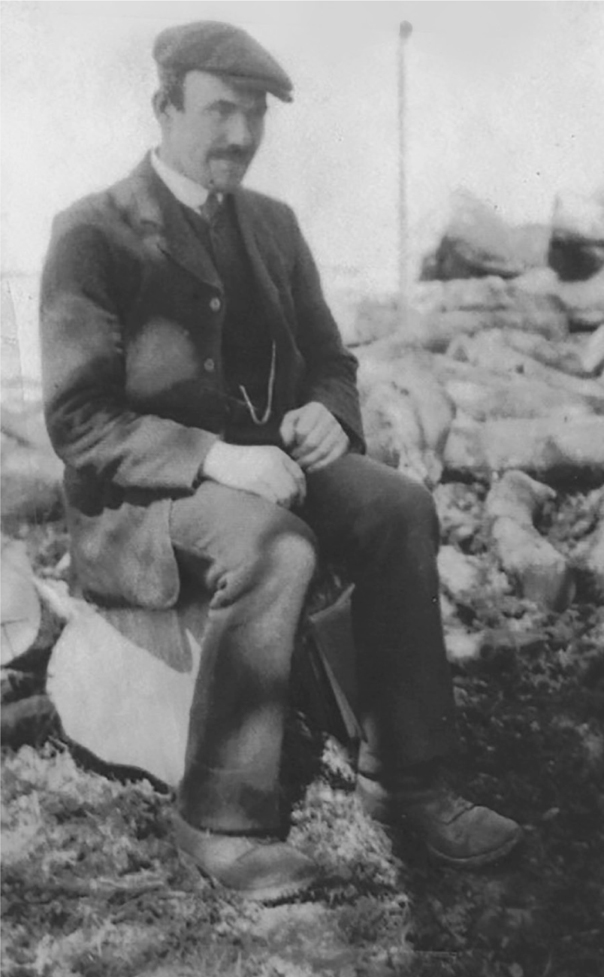
9.8 Lewis Fraser, the steward at Tubberdaly, who was driven away by agitators.
He is very popular in the district in which he has resided for many years. . . . He worked very hard in the effort to ameliorate the conditions of people around him, took the deepest interest in their work and doings, and aided the District Council very materially in their administration by his energy, initiative, and help. He supported schemes for erection of labourers’ cottages, a great many of which were built in his district, gave wide employment at good wages, proved to be a kind landlord and generally tried in every possible way to act up to the best traditions of his class.102
This was in the best tradition of an obituary, in this case for a Big House and a way of life. Two months later, whatever had been salvaged from the ruins, as well as various modes of transport – motor car, trap, carriage – were sold by public auction.103 And in the following September ‘the entire famous herd’ of Beaumont-Nesbitt’s Aberdeen Angus was sold at the Royal Dublin Show (and his other farm stock and farm implements in a separate auction at Tubberdaly House), the same day that Sir John Dillon’s Lismullin herd was also sold.104 Farming on both estates had become the victim of the destruction of the Big House.
One of the central arguments of this book is that it is challenging to ascribe any single motive to the burning of a country house. Tubberdaly is no exception. Beaumont-Nesbitt himself claimed there was a political dimension. When filling in his compensation appeal form for the Irish Grants Committee, he wrote: ‘I was Lord Lieutenant of the county and well-known as a Unionist, and the policy of the Republican party in the Free State at the time was to select Unionists for reprisals when they destroyed property. I am satisfied that it was the primary cause . . .’ However, that was in answer to the question, was the burning ‘occasioned in respect or on account of your allegiance to the Government of the UK?’105 As detailed in a previous chapter, that was a prerequisite for compensation in the first place. Beaumont-Nesbitt knew he was being disingenuous in his claim.
Local historian Philip McConway has suggested that the burning of Tubberdaly should be linked to the execution of two anti-Treatyites, Joseph Byrne and Patrick Geraghty, on 27 January 1923, under the Public Safety Act of November 1922.106 Chapter four has shown it was certainly true that the anti-Treatyites burned Big Houses in reprisal for the execution of their comrades, including Greenhills in Offaly, where it was reported: ‘The leader announced they were republicans who had come to burn the house as a reprisal for the execution of Patrick Geraghty.’ In 1943, when Christopher Jones Jr applied for a military service medal, he included in his list of commanding officers ‘Patrick Geraghty (executed)’.107 Jones Jr had been arrested in October 1922 and spent consecutive terms in military prisons at Templemore (Co Tipperary), and Newbridge and the Curragh (Co Kildare) until February 1924.108 When he later filled in his pension form he claimed to have fired shots ‘when Tubberdaly House – an enemy link – was destroyed by the IRA’.109 He could not have been there, but he does identify the house as ‘an enemy link’, which would suggest some loose politico-military basis. Moreover, on his sister’s active service record are listed the ‘Destruction of Ballyburly and Greenhill Houses’ and the ‘Destruction of Tubberdaly House’.110 And Patrick Cox witnessed that she had acted as lookout for the IRA when they burned Fraser’s house at Tubberdaly.111 All of this points to some republican involvement but the burning of Tubberdaly took place almost two months after the executions of Byrne and Geraghty, and while reprisal may have played a role, further investigation suggests other ulterior motives were more important.112 It does not mean that the IRA were not involved but rather that members had simultaneous agendas.
While Mary Jones’s role in the burning of country houses and the attack on Fraser were later represented as acts of patriotic endeavour, contemporaries had a different view of it. On 2 July 1923, Eamonn Coogan, the Garda Deputy Commissioner, wrote a comprehensive report to O’Higgins’s Department of Home Affairs: ‘The trouble is not strictly labour . . . The campaign was originated with a view to terrorizing Mr Nesbitt and his employees and ultimately to succeed by such methods to have the ranch [meaning demesne farm] divided up and distributed.’113 As studies by Gemma Clark and Gavin Foster have shown, the Civil War changed the landscape of everyday violence, including a rise in agrarian crime, a rise that, as we have seen in chapter 5, greatly disturbed Patrick Hogan and Kevin O’Higgins.114 Related to this was the escalation in country house burnings, and their wider geographical dispersal.115 In Offaly, as it was renamed by 1922, Ciarán Reilly has found that ‘land-related issues played a predominant role’.116 Reilly references a meeting of Tullamore Rural District Council in April 1923, held about a week after Tubberdaly was burned, where Councillor Dunne boasted (mistakenly) that Offaly led the way in Big House burnings and put it down to the fact that ‘it had been the most planted part of the country’, thereby associating such actions with the undoing of the Tudor colonisation scheme of the sixteenth century. However, the editor of the Midland Tribune rebuked Dunne: ‘The burnings in Offaly is not a matter to boast of,’ he wrote, ‘land hunger and not the Gaelic state or republic was the motive of a good many of them.’117
Local land issues, entwined with labour disputes, therefore provided the main motive for the burning of Tubberdaly. The burning took place after three years of local agrarian unrest during a period of intense civil unrest which provided the opportunity to burn the house to ensure that Beaumont-Nesbitt would never return. Jones Snr and his followers, including the Geraghtys, had been occupying demesne buildings and lands. Two successive stewards had been intimidated, threatened with murder and eventually driven away from Tubberdaly. Beaumont-Nesbitt had no home to return to, even if he wanted, though he remained relatively unperturbed. He told the Irish Grants Committee in 1926: ‘I am in quite comfortable circumstances and have a sufficient income not to have been more than inconvenienced by what has occurred.’118 It is legitimate to argue, therefore, that Christopher Jones Snr, his followers, and even his own children, decided to take advantage of the times.
After the burning, sometime in May 1923 Beaumont-Nesbitt wrote to the Irish government telling them of his situation; this was while the new Land Bill was being prepared. At that very time, Kevin O’Higgins made public his contempt for the men who had ‘gone out in an entirely selfish, wilful and criminal spirit to seize land by the strong hand’.119 He promised to ‘bring to bear on the Minister for Agriculture, and whatever influence I can bring to bear upon the Executive Council . . . to seeing that such people do not benefit by this Act’.120 In early July, Patrick Hogan met with Beaumont-Nesbitt in Dublin.121 In preparation for the meeting, an inspector of the Land Settlement Department had reported to Hogan on the importance of Beaumont-Nesbitt’s Aberdeen Angus herd and advised that he ‘should get ample protection for this herd and his splendid yards etc.’122 He further pointed out that Beaumont-Nesbitt’s yearly wage bill was at least £1,400, so he was a major employer that the locality could ill afford to lose.123 He suggested the arrest of Jones and four others.124 Almost concurrently, on 10 July, Beaumont-Nesbitt received a letter from Jones:
Sir, This is the fourth letter I wrote you. Got no reply about the farm. I have my case entered this two years. I expect you have a letter from IRA Headquarters. I am going to cut the meadows. I have no other means. I’ll pay you for grass and clear you of all debts. I am willing to buy the farm honestly as no one else will be allowed to do so.125
It deserves a little unpacking: Jones presumably had made application to Beaumont-Nesbitt to buy the farm he was occupying (that went with the cottage). Beaumont-Nesbitt could have sold it to him, as he had purchased the tenant right from the previous farmer who had emigrated to America. But he was not prepared to facilitate Jones, a fact he made clear in his letter to Mrs Savage-Armstrong:
There are several of my old labourers whom I want to help as much as I can, and if I do sell I think that I can arrange that these get helped first, and thereby I can put a spoke in the wheels of some that I do not want to help. I am quite philosophic about it all, I’ve had my innings and am out now, and if I can help any decent men to get a living out of the wreck, that is all I care about.126
Jones was willing to act in a reasonable manner, as he saw it, by paying for the cut meadow. As in the Land League days, he anticipated that no outsider would bid on the farm, and he could claim, with some authority, that he had the local anti-Treatyite IRA behind him. When several of Christopher Jr’s former officers submitted a statement to support his pension claim, they finished off:
The said Christopher Jones endured prolonged hardships on and off the run, and in internment camps, his home was a rendezvous for many prominent IRA men and members of the ASN. He and his family harboured and maintained, and scouted for, escorted and conducted to safety, wanted IRA men during the Black and Tans and 1922–23 struggles. He deserves the maximum consideration and support of the Pension Board.127
On 13 July 1923, Hogan wrote to O’Higgins: ‘Mr Nesbitt is a very useful man, a first class farmer and employs a very large number of labourers, and he has done a lot for livestock in this country. It is a case that should be dealt with very firmly and I think it would be well to get a report from the Committee of Order as to the present condition.’128 The letter suggested Cumann na nGaedheal’s empathy for the large farming class which was to be much derided by their political opponents in the years ahead. Hogan followed the communication up on 14 July with a note to O’Higgins: ‘Jones is the principal cause of the trouble down there and he should be arrested at once. Could you have that arranged?’129 It was just over two weeks before the 1923 Land Act was passed on 3 August. O’Higgins had to stand by his Dáil speech of 28 May.130 Jones was arrested and on 24 July he was charged at Tullamore with being ‘in illegal possession of a farm of land, the property of Mr Nesbitt’. McMullan testified that on the night he had been attacked the armed but unmasked men had told him ‘Jones had no place else to put his cattle’.131 Jones, who denied any complicity, was remanded in custody to Tullamore Districts Court Sessions on 3 August.132 According to Garda William Hickey of Rhode, Jones said to him: ‘Ye are no Irishmen to come and arrest me. I wrote to Mr Nesbitt on three or four occasions offering him a price for the land, but he never replied to any of my letters. I could get no employment and I had to find some means of living.’133 The last sentence is worth consideration: land grabbing should not necessarily be associated with greed, sometimes it was driven by necessity. Jones had probably not been employed since he was dismissed by Beaumont-Nesbitt.
The date of the remand hearing was significant. It was two days after the government enacted the Public Safety (Emergency Powers) Act on 1 August 1923. The act was directed against all enemies of the Free State government who ‘have created a spirit of rebellion’. Amongst the crimes punishable by arrest, imprisonment and whipping were ‘wrongful entry on and retention of possession of land without colour or pretence of title or authority’.134 When Jones came back before the Tullamore court, he was charged with ‘unlawfully and by force entering the lands of Tubberdaly . . . and retaining the land by force and excluding Mr Nesbitt by force and threats from the use of the lands from Sept[ember] 1922, to the present time’.135 However, Jones, who had no legal representation, was released on bail to be returned for trial at a later date. The reason was set out by a frustrated Deputy Commissioner Coogan, who pointed out that, because Jones’s offence took place before 3 August, ‘he could not be made amenable under the Public Safety Act’.136 To Coogan, Jones was ‘a thoroughly lawless scoundrel, and his family being connected with the Irregulars, he would get a certain amount of assistance from that section of the people in the locality’.137
The adjourned case came before the Tullamore Quarter Sessions in June 1924. This time Jones was represented by a solicitor, and on advice he pleaded guilty ‘of trespassing on the lands’. His solicitor pleaded ‘mitigating circumstances’. His client, he argued, ‘like a good many other people at the time, foolishly thought he could get a bit of land, he put his cows on Mr Nesbitt’s farm. He had since given up possession.’138 On undertaking that he would not again interfere, Jones was discharged under the Probation of Offenders Act under his own recognisance of £50.139 It was an astute move, for Section 1 of the Act provided as follows:
Where any person is charged before a court of summary jurisdiction with an offence punishable by such court, and the court thinks that the charge is proved, but is of opinion that, having regard to the character, antecedents, age, health or mental condition of the person charged, or the trivial nature of the offence, or to the extenuating circumstances under which the offence was committed, it is inexpedient to inflict any punishment or any other than a nominal punishment, or that it is expedient to release the offender on probation, the court may, without proceeding to conviction, make an order . . . discharging the offended conditionally on his entering into a recognizance . . . to be of good behaviour . . .140
Jones was introduced to the court as a ‘small farmer’: he may have given up his career as carpenter but he was not prepared to give up possession of the land he had grabbed and that was more information than the judge required. Jones returned to his estate cottage on the Tubberdaly demesne and to the land he had grabbed, that the local authorities were now turning a blind eye to. In 1925, Beaumont-Nesbitt wrote to his sisters that Jones, ‘with a good many’ of the former labourers, ‘decided that if any dividing up takes place no one is to come in until they are satisfied’.141
Under the Damage to Property (Compensation) Act, Beaumont-Nesbitt, then in residence in Penton Lodge in Hampshire, claimed £24,574 for the destruction of Tubberdaly (with separate claims for other properties bringing the total up to around £35,000). He received less than one third. Like many other burned-out country house owners, he was not prepared to accept a ‘reinstatement clause’ that would have forced him to rebuild on the original site, even though he would have received considerably more. He was resigned to all of this, accepted that ‘there is no use trying to fight out my corner’ and that ‘if I started to rebuild or build anything new, I should just be robbed’.142 He may have been misinformed that the Irish people were asking ‘when [will] the English come back?’ but was more accurate in his assessment that ‘The so-called Free State is broke, and that for generations there will be poverty and want far greater than ever occurred in the remembrance of anyone now living.’143 He never returned to Ireland. In 1925, the Land Commission purchased the demesne and paid Beaumont-Nesbitt £8,138, £2,038 in cash and £6,100 in 5 per cent compensation stock (which he sold for £5,777).144 Many years later, when his grandson Brian visited the ruins of Tubberdaly in 1991, he felt ‘a mixture of anger against the blackguards who burned it, nostalgia for something I never knew – and regret that the site had been invaded by so many buildings including the power station [at Rhode] and all those electricity pylons’.145 Whether he knew it or not, salvage from Tubberdaly and other burned houses in Offaly had been used to build the power station: old Ireland had literally helped give rise to the new.146 When around the same time, this author spoke with a descendent of one of ‘the blackguards’ still resident on the demesne, he had a very different remembrance: ‘We burned the bastards out!’ he gleefully told me.
For almost ten years, the Cumann na nGaedheal government failed to deal with the redistribution of the Tubberdaly demesne. By late 1931, the writing was on the wall for the government; the country was fed up with austerity, and rural Ireland was frustrated with the delays in land redistribution so much promised in 1917–23. Fianna Fáil was on the rise and expediting land redistribution was at the core of its rural policies. Revealingly, it was not until October 1931 that a meeting was held in Rhode to form a branch of Cumann na nGaedheal, a case perhaps of locking the stable door after the horse had bolted. One participant lamented the ‘very strange’ and ‘long promised distribution of the lands of Tubberdaly’ and that ‘Since the place was put in the hands of the Land Commission there was a decided change for the worse.’147 It was more stagnation than change and John O’Connor only felt comfortable in hinting at it: ‘Some strange things had happened which were not for the good of the people of the district.’148 These may never be revealed but undoubtedly were due to the local influence of those who had ‘decided that if any dividing up takes place no one is to come in until they are satisfied’. At that Cumann na nGaedheal meeting, there was no mention of Joneses or Geraghtys who had continued to reside on the demesne, all staunch Fianna Fáil supporters. Jones’s sister, Mary (whose married name was now Swords), told the IRA pensions board that her brother, Christopher Jr, ‘has been an ardent worker for F[ianna] F[áil] all down the years’.149
Three months after Fianna Fáil came to power, in May 1932, the new Minister for Lands and Fisheries, P.J. Ruttledge, replied to an answer in the Dáil that a scheme for the redistribution of the Tubberdaly demesne would be ‘put into operation at an early date’.150 Ruttledge was an IRA veteran of the War of Independence who was elected as Sinn Féin TD for Mayo in 1921 and later wounded in the Civil War. During the Civil War, he had worked on behalf of the IRA Executive in drawing up a programme which included ‘the question of the demesnes and ranches and had adopted a scheme for their confiscation and distribution’.151 What he postulated in 1923 was carried through under the first Fianna Fáil government’s land legislation a decade later, and IRA veterans were given priority in local land division schemes.152
In June 1923, the newly elected Fianna Fáil representatives for Offaly – Patrick Boland and P.J. Gorry – met with a ‘large deputation’ including the ‘uneconomic holders of Rhode’ to hear an ‘important development in connection with the proposed distribution of the lands of Tubberdaly’.153 (Years later, P.J. Gorry was one of those who supported Christopher Jones Jr’s IRA pension application.154) The meeting was chaired by Patrick Cox, Jones’s former IRA officer. John O’Connor said those present ‘did not deplore the going of such as he [Beaumont-Nesbitt] from Ireland, but they did deplore the fact that nothing had been done to substitute the livelihood got from him’.155 The irony of the comment was lost on himself, but those who had lost their livelihood included Jones.
The following year, Fianna Fáil introduced its own Land Act and changed the hierarchy of allottees, giving preference to discharged labourers, uneconomic holders in the immediate vicinity of the estate being divided and landless men ‘of a deserving class’. Preference in all categories was to be given to IRA veterans.156 Both Joneses, father and son, came under the heading of ‘discharged labourers’ (at least technically) and IRA veterans. In 1936, when Christopher Jones Jr was making his IRA pension application, the review board received an enquiry from the Irish Land Commission to say that he had applied for land and to confirm whether he had given ‘first class meritorious IRA service during the Pre-Truce period’, to which the board replied in the affirmative. Jones Jr got an additional divide to what his father already held, and the other labourers, including James Geraghty, were at last officially installed in their demesne farms and houses, Geraghty in the one that formerly belonged to Fraser. In the end, local power brokers might be said to have outmanoeuvred Hogan and O’Higgins. When Christopher Jr died in June 1964, his obituary in the Irish Press stated that his funeral took place with full military honours. He was a War of Independence hero. His other story and that of his father and the Tubberdaly labourers was not given the same airing.
4. ‘His lordship was a good man’
Finally, if there were roughly 1,500 Big Houses occupied in Ireland in 1906, the burning of 20 per cent of them represents a modest rate of destruction.157 This begs the question as to why many more were not destroyed. While this would make for an interesting book in its own right, some preliminary points may be offered.
After the burning of Lismullin in Meath in April 1923 the editor of the nationalist Leinster Leader complained that: ‘The burning of this beautiful building seems inexplicable as the owner [Sir John Dillon] has not been identified with any political organisation, merely confining himself to his principal occupation as a large farmer and breeder of pedigree stock.’158 And the Meath Chronicle praised Sir John for ‘attending to his home and his demesne, where he gave a great deal of employment. His permanent staff exceeded thirty, and his weekly wages bill amounted to a very considerable sum indeed. He was justly regarded as an excellent employer, paying the highest standard wage.’159
The importance of the Big House to the local economy is often overlooked, because traditionally it was more often associated with oppression rather than progression. While there were those who burned Big Houses for material gain, equally there were others to whom the burning of the local Big House made no economic sense, and, indeed, the loss of the Big House to the local economy from 1903 onwards deserves closer examination. This was particularly true in relation to the loss of employment. For instance, after the burning of Lord Dunalley’s Tipperary mansion and his temporary migration to London, the Irish Times lamented that ‘Thirty men have been thrown out of work owing to the destruction of Kilboy.’160

9.9 Kilboy House in Co Tipperary, 2021. Originally the home of Lord Dunalley, the house was burned in 1922, rebuilt in the late 1920s, demolished by the family in the 1950s and rebuilt once more in magnificent style by Mr and Mrs Shane Ryan in 2013.
Local lore has it that when a group of anti-Treatyites came to torch Carton House in 1922, they were shown a portrait of Lord Edward FitzGerald (1763–98), son of the 1st Duke of Leinster, but more crucially a leader of the United Irishmen in 1798. The raiders are said to have been so impressed with his Republican credentials that they departed. The story was apocryphal; the more likely reason for not burning Carton was less romantic, and significantly more practical. Despite the sale of the estate under the 1903 Land Act, house and demesne continued to be one of the largest employers in north Kildare and a major contributor to the local economy. In June 1922, when it was learned that Carton had been lost by the FitzGeralds as the result of a gamble and that it was to be taken over by Sir Henry Mallaby-Deeley, there was local consternation.161 This was assuaged to some degree by Mallaby-Deeley’s assertions that ‘I am bearing the whole expenses of the estate, and my agreement with the Duke is that everything should be carried on exactly as it has been in the past.’162 He had also been informed by the Leinster estate agent Charles Hamilton that ‘Carton has been run in the past with the view of giving as much employment as possible to the people in Maynooth.’163 The Leinster Leader, picking up on Mallaby-Deeley’s comments, pointed out:
Any severance of the FitzGerald family with the management of the Leinster property will be greatly regretted in Kildare, where despite the fact that the land has been largely sold to tenants they still retain large interests in the ground rents and many buildings and homes in practically all the towns being held from them. Very extensive employment is given on the demesnes, tillage being intensive and a splendid class of livestock bred. Being a resident family, a very deep interest was taken in the welfare of the employees, who are comfortably housed and well treated. In addition, the Leinster estate trustees always subscribed generously to any object that tended to benefit Kildare and its people.164
In 2021, while circumstances have greatly changed, Carton remains one of the largest employers in north Kildare.
During the Civil War, as burnings escalated, some employees made their concerns known to the Free State government. In November 1922, the workers on the Bessborough estate in Kilkenny wrote to W.T. Cosgrave reporting several raids on the house and pointing out that 500 people were dependent upon wages from the estate and expressing their fear that they would lose their jobs if Bessborough should be destroyed.165 A few months previously, in May 1922, the Marquess of Sligo had written to the Minister for Local Government complaining that the Town Workers Association – dominated by republicans, or so he claimed – were demanding the breakup of his 1,500-acre demesne. Sligo described himself as ‘a serious farmer’ and argued that, if the demesne was acquired, he would have to close Westport House and leave. He finished with a warning: ‘I need hardly point out, that if I am driven away, my departure will entail much financial loss to Westport. No one has ever given so much employment, and it is not likely anyone ever will.’166 The family remained resident for almost a century more and Westport House played a pivotal role in the development of the town’s tourism potential.
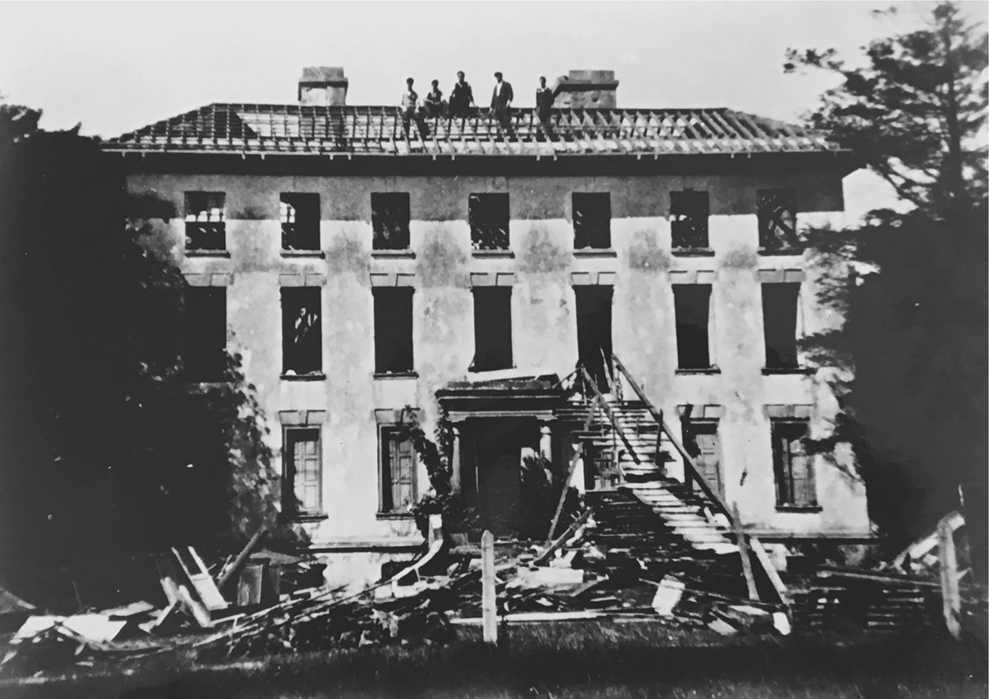
9.10 Thomastown House in Co Roscommon during its demolition, 1958, following acquisition of its remaining lands by the Irish Land Commission.
At the height of Big House raids in Meath, Sir Nugent Everard of Randalstown, described as ‘a very popular landowner’ and one who showed ‘keen interest . . . in the Irish industries movement’, had his home protected by the National Army.167 In 1929, M.R. Heffernan TD (Tipperary, Farmers’ Party) argued in the Dáil for the continuation of this: ‘Serious consideration’, he argued, ‘should be given to the fact whether more useful work could not be done by leaving the land in the hands of a man who is giving considerable employment on those lands than by placing a number of agricultural workers without capital on the same land.’168 In the mid-1920s, the McCalmont family at Mount Juliet in Kilkenny continued to run a 1,000-acre farm giving employment to at least fifty families in the area.169 The same was true of other huge demesne farms at Adare in Limerick (1,160 acres), Rossmore Park in Monaghan (1,430 acres) and Rathvinden in Carlow (1,290 acres).170 This was one of the reasons why working demesnes were protected under the 1923 Land Act: it was not to allow the house privileged privacy, but rather to protect the employment of stewards, bailiffs, herdsmen, gardeners, agricultural labourers and tradesmen, as well as to protect modernising agricultural practice.
During the Civil War, some community representatives made successful representations to the government for the protection of the local Big House. In January 1923, Father Brett of Kilmaine in Mayo wrote to William Sears, his local TD, asking that protection be given to Lord Iveagh’s Ashford Castle at Cong.171 It has survived to become one of Ireland’s most exclusive hotels. In December 1922, T.M. Healy, formerly one of the Irish Parliamentary Party’s most prominent MPs and by then Governor General of Ireland, wrote to Richard Mulcahy, Minister of Defence, looking for protection for Glin Castle in Limerick: ‘I hear that the Knight of Glin . . . is being very badly treated’, Healy wrote. ‘He is paralysed and unable to protect himself, and he does not know who to blame and to whom to appeal for protection. If it is in your power to afford him a little protection, I should feel obliged.’ Mulcahy wrote to the officer in command at Limerick to ‘make arrangements to have the Knight of Glin seen, with a view to assuring him of whatever protection from molestation he may require’.172 During the Truce period, the Knight had endeared himself to local Nationalists by allowing numerous Gaelic Athletic Association matches to be played on the demesne; a report on one game in October 1921 stated that it was played ‘within touch of the castle’ while the IRA ‘held a gate collection and maintained order’.173 Glin Castle has remained in the family ownership.
The Carton story was apocryphal, but similar versions are to be found elsewhere. Lyons House, also in Kildare, was the home of Valentine Lawless, 2nd Baron Cloncurry (1773–1853), imprisoned for three years in the Tower of London for his involvement with the United Irishmen in 1798.174 The story goes that when the anti-Treatyites came to burn it, they were shown a bust of Cloncurry; according to Sir Shane Leslie (who loved a good story): ‘The Republicans solemnly saluted the figure in turn and left the house in peace and under protection.’175 Perhaps its salvation lay in the fact that in April 1922 Lord Cloncurry made a donation of £10 to the Free State election fund. The acknowledgement from its secretary K. Dorrian was instructive: ‘In accordance with your wish your name will not appear on any published list.’176
Lady Daisy Fingall claimed of Castletown House, Ireland’s most impressive Palladian mansion:
Just before the petrol was thrown, a motorcycle came up the long avenue in a great hurry. And a breathless young man, with some mysterious authority, rode into the group of burners, to say that on no account was the house to be touched that had been built with Irish money by William Conolly, who was Speaker of the Irish House of Commons two hundred years or so earlier.177
Again, there is no reliable substantiating evidence, but these stories are all, individually and collectively, revelatory in relation to local attitudes to Big Houses. It was suggested by Lord Dunsany’s biographer that his ancestral home was left untouched because one of the family’s gate keepers ‘was an ardent Sinn Féiner . . . [who] could dissuade anyone who thought of bothering the castle’.178 Mark Bence-Jones related anecdotes of Lord Dunraven employing a Republican gillie during the revolutionary period who kept Adare safe and Sir Ralph Coote at Ballyfin, who ‘was sensible enough to put in a caretaker who was an ardent Sinn Féin supporter and had been imprisoned by the British at the Curragh Camp.’179 Philip Bull found a more authentic example in Myles Fenlon, ‘an employee and able carpenter’ at Monksgrange House in Wexford, who by the time of the Civil War was also a member of the 2nd Battalion of the North Wexford IRA (anti-Treatyite). The anti-Treatyites may have raided Monksgrange on several occasions, but the house was not burned. Adela Orpen later pointed out that Fenlon’s presence was important, but she perceptively noted ‘the house was the source of his livelihood’.180 Marie Coleman has similarly suggested just how detrimental the loss of a Big House could be to a local community: in the years after Currygrane in Co Longford was burned there was a 72 per cent decrease in the local Church of Ireland population (from fifty-four to fifteen), most of whom were probably domestic and farm servants, gamekeepers and gardeners who had been made redundant.181
According to family lore, Glaslough in Monaghan was spared because of the family’s benevolence during the Famine but, and not necessarily meaning to detract from that, it was also the case that Glaslough was unusual in a twenty-six county setting in that it was located in a strongly Protestant village and was guarded by well-armed former members of the Ulster Volunteer Force and dead-shot gamekeepers such as James Vogan, who had instructed the local company of the UVF in the use of arms in 1913–14.
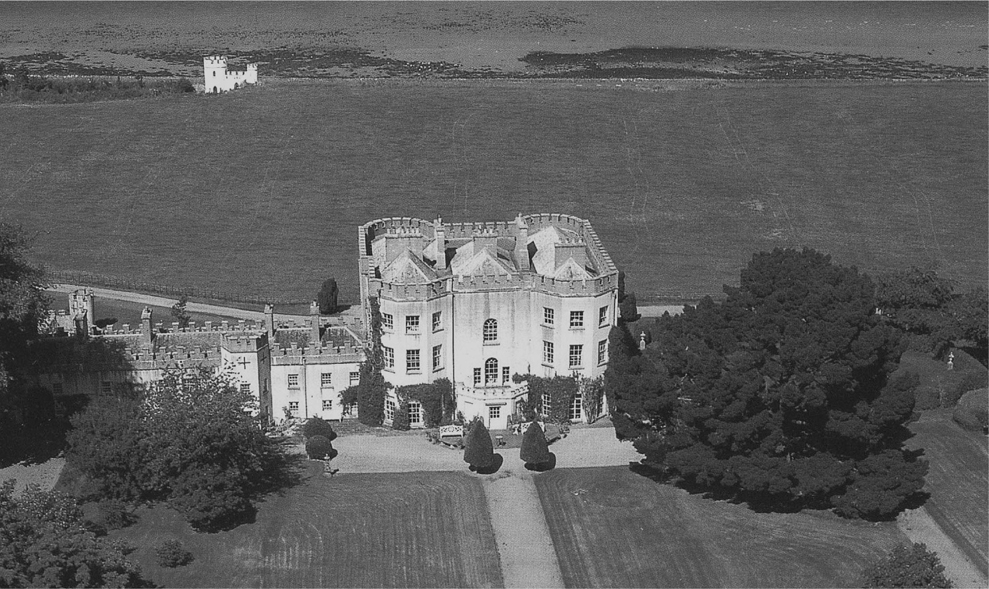
9.11 Glin Castle, Co Limerick, an example of a house protected from destruction by political sympathy. In December 1922, Timothy Healy, Governor General of Ireland wrote to Richard Mulcahy, Minister of Defence, ‘I hear that the Knight of Glin . . . is being very badly treated . . . If it is in your power to afford him a little protection, I should feel obliged.’ The house remains in the ownership of the FitzGerald family in 2021.
Fred Madden of neighbouring Hilton Park in Clones gave an interview to the Irish Times in April 2016: ‘The house wasn’t a plantation house,’ he said, ‘It was purchased and built by ancestors and so it was spared during the Troubles.’ But Fred also added, which was even more pertinent, that during the revolutionary period Major J.C.W. Madden, one of Monaghan’s most ardent Unionists, ‘trained every man on the estate in rifle practice to defend the house in event of attack’.182 Olwen Purdue has shown that well-armed estate workforces played an important role in the protection of country houses in the partitioned area of Ulster that became Northern Ireland.183 In the wider context, Andy Bielenberg has argued that: ‘In the border counties generally, Protestants made greater efforts than elsewhere to put in place armed opposition to the IRA, which gave the ethno-religious conflict there a somewhat different dynamic.’184 Further south, families or employees, as we have seen, were in a much more isolated and vulnerable position and much less disposed to trying to physically oppose Big House raiders, although, as we have also seen, they could defy the IRA in a variety of other ways such as supplying information to the crown forces. As Brian Hughes’ study illustrates, they were certainly not alone in this respect.185

9.12 James Vogan and fellow gamekeepers at Glaslough House, 1920s. Loyal (and armed) retainers such as these probably helped to safeguard Castle Leslie during the Troubles.
During the revolutionary period, not everyone was willing to take up arms, or to grab land, and not everyone condoned the burning of Big Houses. If newspapers reflect public opinion, then obviously many people did not subscribe to the idea that the destruction of country houses was patriotic or socially advantageous. Following a spate of burnings in Galway in June 1921, the Tuam Herald bemoaned:
Thus it goes on. One by one our fine old country houses are being ruthlessly destroyed. First Tyrone House, the finest in Ireland architecturally, next Ower, an old Burke mansion, now comes Marble Hill, another Burke house of some imposing beauty and family association . . . the destruction of houses is a social crime on whatever side it takes place.186
Five months later, in November, under the headline ‘The Torch of War’, the Irish Times, as might be expected, lamented the loss of ‘landowners . . . men of education, distinction, and high ideals . . . indispensable to the welfare and progress of the community at large’, and concluded:
But the present spectacle of the countryside . . . studded as it is, with blackened ruins of once stately mansions, cannot have any but the most depressing effect, not only on those immediately concerned, but on all who have the welfare of the country at heart, and who pride themselves in our national institutions, beauty spots, and splendid buildings.187
Some ruins are spectacular enough to this day, creating powerful visual impact, such as Tyrone House in Galway, a reminder of what Hannah Arendt tells us: ‘The reality and reliability of the human world rests primarily on the fact that we are surrounded by things more permanent than the activity by which they were produced.’188 Castleshane remains a haunting but gradually disappearing ruin on the Monaghan landscape. Moydrum’s ruins came to prominence in the early 1980s when Anton Corbijn’s photograph was controversially used on the front cover of U2’s album The Unforgettable Fire. In Burton Constable in Yorkshire, there is a 1920s photograph of the ruins of the Chichester Constable Roscommon home with the simple but telling pencil inscription: ‘Runnamoat House. Burned July 2nd 1922 by Irish’. Summerhill became one of the country’s crumbling spectacles. Years after its destruction, Mark Bence-Jones described it thus:
Even in its ruinous state, Summerhill was one of the wonders of Ireland; in fact, like Vanbrugh’s Seaton Delaval, it gained added drama from being a burnt-out shell. The calcining of the central feature of the garden front looked like more fantastic rustication; the stonework of the side arches was more beautiful than ever mottled with red lichen; and as the entrance front came into sight, one first became aware that it was a ruin by noticing daylight showing through the front door.189
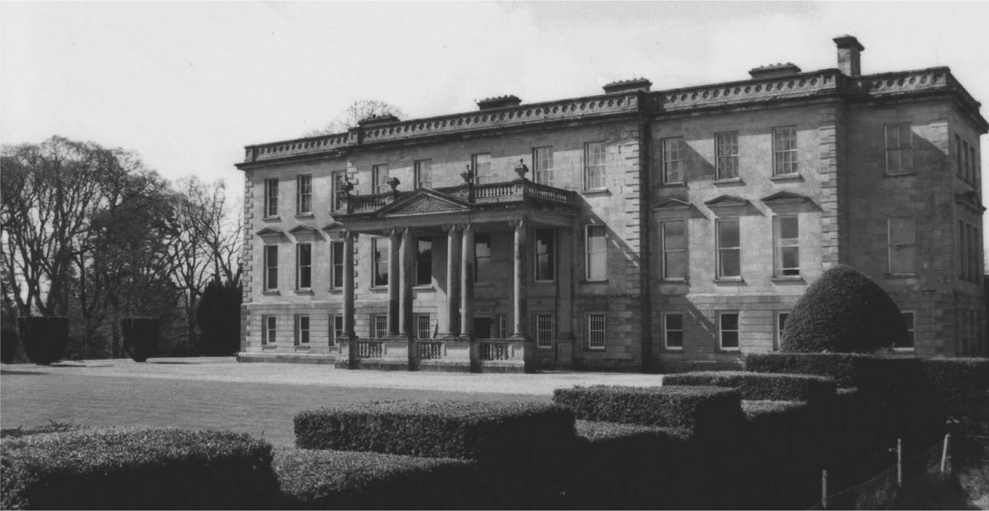
9.13 Hilton Park, Co Monaghan, home of the Madden family, untouched during the 1920–23 period. A descendant wrote of Major J.C.W. Madden, who lived there at the time, that he ‘trained every man on the estate in rifle practice to defend the house in event of attack’.
Ruins are not just the physical reminders of the imposing structure that once was, but they also symbolise the fall of the people who gave them meaning. Over time, the physical disappearance of the Big House very often led to the eradication of the memory of the house and those who occupied it.190 Where ruins remained, they became icons of revolutionary mythology in Ireland, for both sides: as trophies for those who boasted for years of their role in their destruction, or symbols for those who lamented Big Houses as victims of the Troubles. The poet laureate John Betjeman (1906–84), who lived in Ireland from 1941 to 1943, thought it romantic to immortalise ‘the distant house and its weedy walled garden and reed-choked lake’ as ‘the shell of an Adam-style mansion burnt down in “the Troubles”’.191 In the 1930s, Sir Shane Leslie likewise pronounced that ‘The Anglo-Irish families were largely burnt out’ and repeated for emphasis: ‘Others were burnt out in the later Troubles.’192 In many respects, associating ruins with revolution was a historical convenience for the aristocracy; it would have been altogether less gallant to consider the more nuanced socioeconomic factors. For those who wanted to remember the War of Independence as a glorious episode in Irish history, the social dimension that gave rise to so many house burnings was best forgotten. (The process firstly of destruction and then forgetting also endangered both the ability and the resources to remember those millions of ordinary Irish men and women who inhabited aristocratic estates, whether their lives were comfortable or deplorable.) And, as happens in post-colonial societies, nationalist Ireland tried very hard to forget its colonial past. Such forgetting may be seen as part of the healing process, but it can also endanger the memory of what brings us to the present.193 Thus, in the century after the beginning of the long revolution in 1879, the narrative of the revolutionary experience of the Big House became as fragmentary as country house ruins.
This book does not claim to have provided all the answers to the very many complex questions around the revolutionary experience of the Big House, but, then again, its aim was always to open a debate rather than definitively close one. It is hoped that, above all, this book has illuminated the experiences of the former landed elite by repositioning their story in revolutionary and independent Ireland, showing that their experiences were entwined with everything that happened in Irish life, politics and society from 1879 to 1923, and did not stand apart in isolation. It has been emphasised that the Big House experience clearly shows that the convolutions and repercussions of the revolutionary period can be more fully understood and gauged by projecting backwards to the Land War era (at least) and looking far beyond 1923. That was also a pivotal year because of the introduction of land and compensation legislation that simultaneously promised and threatened but ultimately delivered enough in terms of land redistribution to dampen any large-scale social revolution.
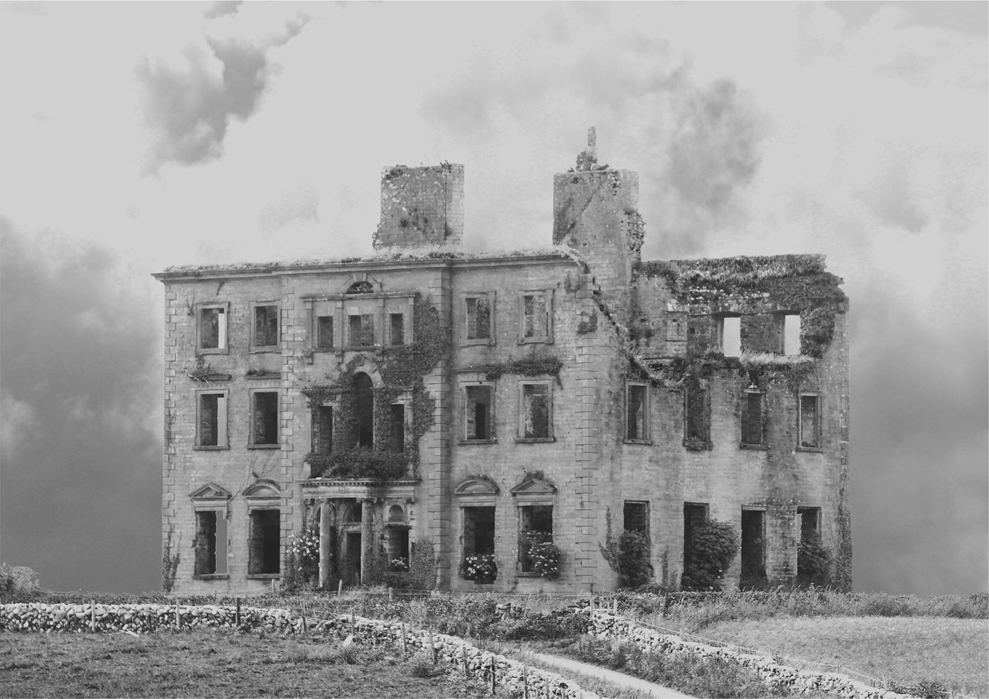
9.14 Tyrone House, Co Galway, burned by the IRA in 1920 because of rumours that it was about to be taken over by the IRA. At the time it was unoccupied except by a caretaker and ‘rather dilapidated’. The ruins have become an iconic symbol of the fall of the Irish Big House.
Imperative in the process of elucidation has been the use of local case studies which can so often reveal the totality of the past; as Raymond Gillespie has argued, local case studies ‘involve the dissection of the local experience in the complex and contested social worlds of which it is part as people strive to preserve and enhance their positions within their local societies’.194 The revolutionary experience of the Big House provides ample testimony to this.
Still, there is much that remains to be done. There is, for example, a need to more the Irish aristocracy’s revolutionary experience in a wider global context, to examine why the levels of violence directed against the former landed and colonial elite in Ireland were so restrained as opposed to the experiences of their peers in other jurisdictions around the world at different times (which calls to mind E.P. Thompson’s remark that, in a time of social chaos, ‘It is the restraint, rather than the disorder, which is remarkable.’195). Finally there is also a need to analyse and develop in more detail why the call for ‘the land for the people’ was as universal as it was parochial.