
8
The story of the compensation paid to the southern Irish Loyalists for the losses they suffered, and the atrocities committed against them for the crime of loyalty to England does not make pretty reading.
(R.D. King-Harman, The Kings, Earls of Kingston: An Account of the Family and Their Estates in Ireland between the Reigns of the Two Queen Elizabeths, London, 1959, p. 264)
The whole business is too sad for words and we are all profoundly grieved that your beautiful residence [Kilboy] has been destroyed and that you have lost so much that is valuable and that no money could compensate you.
(Howard Dudley to Lord Dunalley, 12 August 1922, NLI, MS 29810 (17))
1. ‘Sermons in stones’
On 23 February 1924, a report appeared in the provincial Sligo Champion under the heading ‘Sermons in Stones’ – presumably inspired by Duke Senior’s speech in Shakespeare’s As You Like It – in which the writer deplored the pillaging of country houses and demesnes, reports of which he pointed out ‘stuffed’ every contemporaneous provincial newspaper. In sarcastic tones, it was noted that such crimes had become so ubiquitous they no longer merited reporting in the national press, ‘except where the depradations have been on a heroic scale’.1 In particular, the writer referred to a recent compensation claim heard in the courts for the looting of Ravensdale Park in Co Louth (described in chapter 5), which led the writer to conclude: ‘This is not a description of a Russian Soviet in action, or a raid by Turkish partisans upon their Christian neighbours. It is simply an incident from a recent chapter of Irish history, some details of which are being made known to the world through the proceedings in the Compensation Courts.’2 The comparison of the fate of the Irish aristocracy to their Russian counterparts whom the Bolsheviks had stripped of their estates, wealth, status and dignity, and to the horrendous 1922 experience of tens of thousands of Orthodox Christians in the city of Smyrna at the hands of an avenging Turkish army was grossly overstated, but the report successfully highlighted the ongoing difficulties that Irish country house owners faced in search of compensation for the loss of their homes and contents in the courts. In the long term, Big House owners could argue they were not adequately compensated, but so too could all other sections of rural and urban society.3
2. ‘No risk of riot or civil commotion was covered’
Big House owners were obviously a minority amongst the many thousands of compensation claimants who lost their homes, their businesses, their farms or even ricks of hay, who had money, goods and personal effects stolen, or in the worst-case scenarios had been shot and maimed, or whose husbands, wives, sons or daughters had been murdered. However, as might be expected, given the scale of the physical destruction, the aristocracy’s individual claims for their Big Houses were amongst the highest made. While what follows focuses specifically on the latter, it is well to remember the landed elite also experienced and claimed for malicious damage to gate lodges, hunting lodges, outbuildings, police stations (which they built and leased to the RIC), demesne churches, livestock and losses accruing from the occupation of their lands and subsequent diminution of profits, the theft of timber from their demesnes, and the list could go on. Sometimes, there were so many attacks and raids on individuals and their properties it was impossible to keep track. For example, in November 1922 Lord Dunalley’s solicitor informed him: ‘I think we are making every possible claim on your behalf, but you have no idea how difficult it is to get the necessary information about the various damages done from time to time at Kilboy.’ He followed up in May 1923: ‘We have such a multitude of decrees and claims that it is very hard to keep track of them all.’4
Owners such as Dunalley were unable to claim on their insurance policies, in his case from the Northern Assurance Company, because they were not covered against riot and civil commotion.5 Like Kilboy, Mount Uniacke in Cork was insured against fire for £5,950 but ‘no risk of riot or civil commotion was covered’.6 Richard Power O’Shee had Gardenmorris insured for £5,000 with Commercial Union Insurance against accidental loss or damage by fire but not against civil commotion. In fact, it seems also to have been the case that houses and contents were hopelessly under-insured (if at all). After Ardamine House in Gorey, Co Wexford, was burned on 9 July 1921, the insurance was reported to have been ‘totally inadequate’. The legal representatives of Castleboro in the same county said the house was insured for £26,700 (whilst claiming rebuilding costs of treble that figure): ‘As no insurer for fire premeditates a fire which would cause complete destruction, this is an intimation of the value which the owner put on the residence.’7 In 1902, Lord Castletown’s policy with Hand in Hand Fire and Life Insurance Society placed a value of only £4,000 on Doneraile Park in Cork and a paltry £2,000 on contents, including paintings, prints, drawings, sculptures, articles of vertu and all other household furniture.8
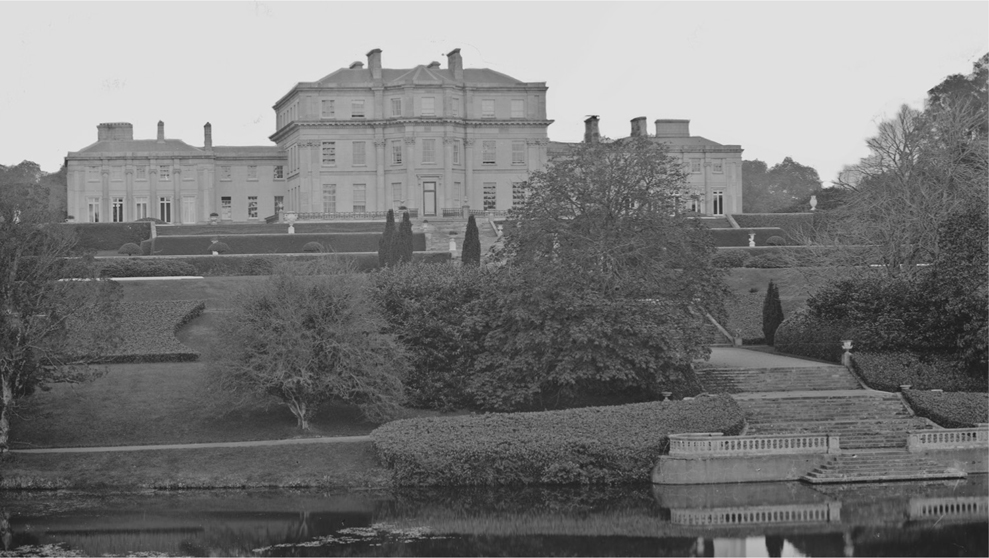
8.1 Castleboro in Co Wexford was described as ‘one of the finest dwelling houses in Ireland’. The Irish Grants Committee was far from sympathetic to Lady Gordon Cary, who inherited the burned ruin, and refused her any compensation.
Without (adequate) insurance cover, owners could resort to claiming compensation through the courts, as would have been typical in the past in relation to malicious and criminal injuries. Claims during the early period of the War of Independence therefore came under the terms of the 1898 Local Government (Ireland) Act, and then the Criminal Injuries (Ireland) Acts of 1919 and 1920, the latter two acts introduced to deal with the unprecedented national crisis of property damage.9 Under the 1898 Act, application for compensation was made against the council of the county in which the damage occurred. Each year, the council had to levy a rate to raise the money to meet its annual expenditure, which included claims for malicious injuries and damage to property. The 1919 Act modified this to spread the growing burden: compensation could now be levied against either the council of the county in which the house was located or spread across neighbouring counties. Increased claims led to further modification of the legislation in 1920. If the county councils made representation to the Lord Lieutenant that the amount of compensation could not be raised by means of the rates in one year ‘without imposing an excessive burden on the ratepayers’, he could direct that the amount be paid in instalments over a maximum five-year period. Critical in all of this was that, under these acts, the financial burden fell on the ratepayers. When Macroom Castle in Cork was burned, Thomas Healy, state solicitor, put it bluntly that it was the ratepayers who ‘have greatly suffered by the burning of this castle and the buildings round it’.10 Traditionally, the ratepayers resented any increase in taxation resultant from criminal activity. By the time the 1920 Act was passed on 23 December (the same day that the Government of Ireland Act ratified the establishment of Northern Ireland), there were further hindrances at local government level: the composition of county councils and most other local government bodies in the Free State was dominated by Sinn Féin. Following the January and May elections of that year, Sinn Féin won control of 28 out of 33 county councils (on the island of Ireland), 182 out of 206 rural district councils and 72 out of 127 urban district councils.11
It was unrealistic to consider that Sinn Féin-dominated councils would levy burdensome rates on the county at large to compensate country house owners (and others); nor, of course, were they willing to work with or within the British administrative structures. Thus, in June 1921, Sir Hamar Greenwood, the last chief secretary for Ireland (1920–22), informed the House of Commons that damages claimed came to almost £5.4 million but county councils were ignoring awards made by the county court judges, and refusing to budget for them in their rate assessments, so no money was being raised and compensation was not being paid. In June 1920, Monaghan County Council, for instance, voted to ignore all compensation claims.12 Clonmel Rural District Council ignored Lord Ashtown’s claim for £25,000 for the destruction of his hunting lodge in Waterford.13 In September 1920, Loughrea District Council ignored a claim for £3,000 compensation for the burning of Tallyho House.14 By October 1921, during the truce period, the Irish Times lamented: ‘Whether these awards are being paid to the claimants is not clear, since in the areas upon which the amounts have been assessed there appear to be difficulties in the way of collection.’15 In November 1921, it was estimated that £1.6 million was leviable off Co Cork alone, where the highest number of Big Houses had been destroyed. The only money available to meet the claims was from the Local Taxation Account to local authorities but this amounted to only £1.65 million for the whole of Ireland.
As claims for ‘the loss of persons’ received first consideration, it meant that Big House owners who were awarded significant sums by (arguably) sympathetic county court judges working under the British administrative system were not paid their awards. For example, in October 1920 Violet Tynte claimed £26,400 for the burning of Saundersgrove. The judge awarded £26,100 to be levied off the county of Wicklow.16 It was never raised. In Westmeath in October 1921, Lord Castlemaine was awarded £101,360 for the burning of Moydrum. Frederick Denning, his counsel, claimed Castlemaine ‘would sooner live in Ireland than any other country’ and wanted to rebuild the castle. Westmeath County Council, as had become the norm, did not contest the case and the judge awarded just over £101,000.17 It was later reduced by the Compensation (Ireland) Commission (see below) to just over £66,000 and Moydrum was never rebuilt.18 Lord Listowel claimed £150,000 for the burning of Convamore and was awarded £56,300 for the house, £21,324 for the furniture, £7,500 for pictures and £120 for the transit of some articles to London, a total of around £85,000.19 Again, this does not seem to have been paid.
As far as Big House owners were concerned, the early appeal mechanisms were no more satisfactory. In February 1921 Baroness Massy of Ardfinan House in Cahir took a case in the Kings Bench Division Dublin against the county councils of neighbouring Limerick and Clare to secure the £29,000 awarded her in October 1920 for the burning of The Hermitage at Castleconnell. Her solicitor had written to both county councils in January but had ‘received evasive replies’.20 He asked that the rates due to the councils be used to pay the award and Justice Moore granted the order.21 But granting the order and receiving payment were two different matters. In October 1922 Lord Shaw of Dunfermline, who was to chair the Compensation (Ireland) Commission, pointed out that: ‘County councils who, in ordinary circumstances, would have stood defendants in the issue of claims for malicious damage to property, were declining to defend the cases. The reasons for that may have been partly financial and partly owing to the state of the country.’22 The councils were in an invidious position. The majority gave their allegiance to Dáil Éireann in defiance of the Local Government Board, which in retaliation threatened to cut off their annual grants so that by the end of 1920 county councils’ finances were in crisis.23 This was compounded by the ratepayers generally taking advantage of the political and social chaos to avoid paying any rates at all, just as unpurchased tenants were refusing to pay rents to their landlords and annuitants were refusing to pay annuities to the Irish Land Commission.
3. ‘I do not think we should mention the point officially’
The compensation issue was not on the treaty talks agenda. But the day before the treaty was signed the Irish Chief Secretary, Hamar Greenwood, admitted in the Commons: ‘Those who have lost their property only are not likely to receive much consideration.’ Even if they did, he argued, ‘There is little prospect that those who have suffered in this way are likely to re-invest their money where so little security to life and property is to be found.’24 By that stage, many owners who had been burned out had already migrated permanently to England with no intention of returning. The inheritor of Summerhill, Colonel Rowley, sought advice from his relatives about the prospect of rebuilding; his cousin Douglas Rowley wrote to him from the Riviera: ‘Much as I should like to see the old house rebuilt, one must remember that even if this was done you could not put back the old things that formed part of it.’25
Nevertheless, both sides recognised that the compensation question had to be tackled and on 24 January 1922, in London, it was formally recognised in the working arrangements set out for implementing the treaty agreed by ministers of both the British and Irish governments. According to clause 3, ‘fair compensation’ was to be paid: ‘in respect of injuries which are the subject of compensation under the enactments relating to criminal injuries, including losses sustained through the destruction of property by order of the military authorities under martial law’.26 Each side was to pay the losses it had inflicted between 21 January 1919 and 11 July 1921, the period of the War of Independence. Unpaid and undefended decrees were suspended because it was felt that too many claims had been inflated and so it was back to the drawing board for those who had come through the county court process. Clause 5 provided for the setting up of a commission to hear claims and determine awards for malicious damage to property to be comprised of three members (one appointed by each government and an agreed chairman), which became known as the Compensation (Ireland) Commission. In March 1922, Lord Shaw of Dunfermline, Scottish Liberal peer and judge, was appointed chairman; James Dowdall, a member of the Incorporated Chamber of Commerce and Shipping, formerly a member of the Cork Harbour Board, and who served on the Commission of Inquiry into the Industrial Resources of Ireland, was the Irish nominee; while C.J. Howell Thomas, Deputy Chief Valuer to the Board of Inland Revenue, was the British nominee.27 The Compensation (Ireland) Commission sat in Ireland under the presidency of Shaw and subsequently Sir Alexander Wood-Renton until 1925 (when the Irish Free State government assumed all liability in respect of malicious damage done to property after 21 January 1919, and was provided with £900,000 by the British government in assistance).28
The Shaw Commission diminished awards previously made after both governments came to realise the potential scale involved. One Irish official noted in July 1922 that ‘A general revision of independent decrees would seem to be in the interest of the two governments, as the fall in prices which has occurred since the decrees were granted would be a reason for fixing revised awards at lower levels.’29 A few months later, in October, two senior civil servants shared an opinion; A.P. Waterfield wrote to Joseph Brennan: ‘It is of course essential that the Commission should in no case go beyond the amount of the existing decree . . . I do not think we should mention the point officially.’30 For instance, in the case of Herbert Sullivan, his preliminary claim for the destruction of Curramore House was £18,000 and this was reduced to £8,300 (the original had been prepared by Sullivan’s less than independent valuers31).
The Shaw Commission began its operations in May 1922 and made it clear that the compensation which they recommended was to be ‘in full substitution of all rights’ under previous proceedings.32 Kiltannon House in Clare, burned on 3 September 1920, was one of the first to come before the Commission in Green Street Courthouse in May 1922. Gerald Fitzgibbon KC appeared for the applicant and Timothy Healy KC appeared for the Provisional Government. Fitzgibbon outlined that the original claim amounted to just over £47,000, including £18,000 for rebuilding, £6,600 for contents and almost £2,000 for silver plate and pictures. In October, a month after the burning, the county court judge had made a decree for the full £47,000.33 The process now was much more thorough because the state contested and questioned the original valuations and decrees. There was considerable time spent hearing the evidence of various engineers, architects and builders as to what material would be required, whether such materials were available in the post-war economy, what of the ruins could be recycled, in other words what walls were sturdy enough to be retained. Valuators and auctioneers were queried about the estimated prices of pictures. When Bennett Valuators were asked at the Kiltannon House hearing about the original value they had placed on the paintings, their representative admitted: ‘He did not see the pictures for which he had estimated – the judge at the hearing fixed the prices estimated.’ Nor did he know the names of the artists.34 When Healy asked its owner, William Molony, if he would be prepared ‘to have annexed a condition to rebuild’, Molony replied, ‘Not at present’. Healy wondered, therefore, how he could justify asking for rebuilding costs if he was not prepared to live in the area. Molony quickly had a change of mind and told the chairman he wanted to return to Ireland as ‘There is plenty of fishing and shooting, and the place is very picturesque.’35 It was hardly a convincing reason. Molony was awarded £30,000.36
In September 1921, Lord Langford had claimed just over £102,500 for Summerhill in Meath: the house was 389,000 cubic feet, the cost of rebuilding at 3s 6d per foot would amount to £72,500, and £30,000 for the contents. Edward Swayne KC and Theodore Kingsmill Moore appeared on Langford’s behalf at the county court hearing. Meath County Council was not represented. Judge Fleming of the county court said: ‘There was a great difficulty in fixing compensation in a case such as this, where only one side was heard’ and awarded £65,000 for the house and £11,000 for the contents, to be levied off the county.37 This sum was never paid. In April 1923, the Shaw Commission reviewed the award and reduced it dramatically to £16,775, at least £12,000 of which had to be spent on the building of a new house on the demesne or else used towards the rebuilding of the old house. If no building was carried out the award was to be further diminished to a mere £2,000.38 An appeal was lodged in August 1923 and the award for the house was raised to £27,500 with no obligation to rebuild. £16,500 was added for contents bringing the total up to £44,500, which was still £32,500 less than Judge Fleming’s original award, and £59,000 less than the original claim submitted.39
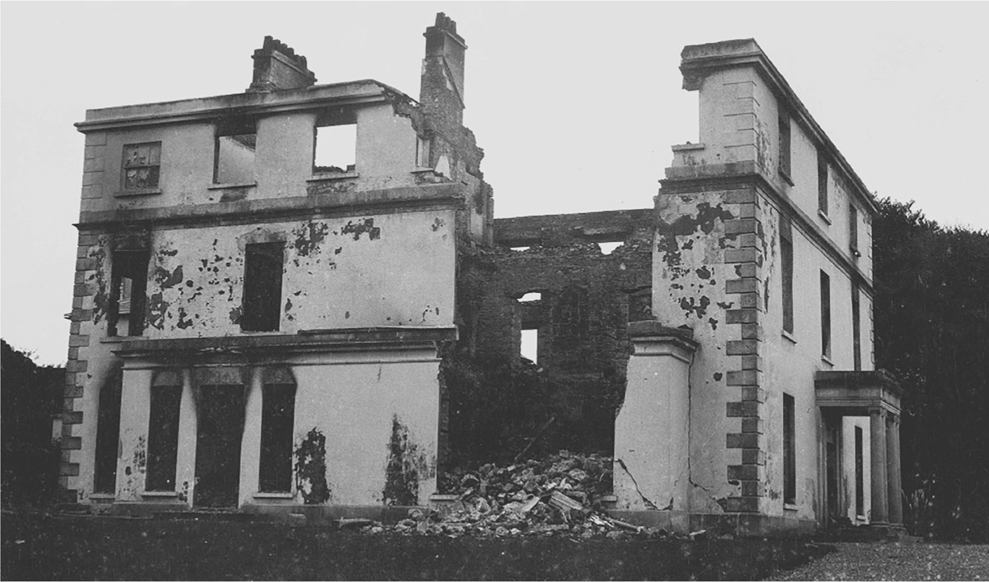
8.2 Kiltannon House in Co Clare, burned in 1920, and now in a ruinous state. Amongst the many treasures and family heirlooms lost was a marble inlaid table given to the family by King Louis XIV of France.
Delays in settling claims were a grave source of concern. As early as July 1922 Mark Sturgis, Assistant Under-Secretary for Irish Services (1922–24) and a former senior civil servant in Dublin Castle, had written to the Provisional Government that ‘The inevitable delay in starting to dispose of claims on this agreed system has naturally caused apprehension and sometimes hardship among those whose claims await settlement.’40 In September, Sir Samuel Hoare, Conservative MP, visited Dublin and was ‘shocked by how slowly the Commission was working’.41 Throughout 1922, the Irish government was criticised for the delays in processing cases, and there were accusations that appeals were a deliberate ploy to ensure that judges of their own nomination – ‘who might be regarded as antagonistic to the claims of Loyalists’ – were sure to diminish awards, if not disqualify them.42 It seems to have been a fair enough point, but could anything else have been expected in a post-colonial scenario? In Clare, Judge Bodkin achieved notoriety in the eyes of Loyalists for reducing awards by at least 50 per cent and refusing to accept any recommendation for compensation for loss by looting or larceny.43 By April 1923, the landlord-sympathetic Morning Post was bemoaning the fact that the working of the Commission was ‘unsatisfactory’ and that Loyalists were being coerced into accepting very reduced amounts ‘through the fear of suffering a total loss unless they agreed with their adversary quickly’.44
Country house owners were similarly complaining and arguing hardship. By 1923, Captain Cook Collis of Castlecooke in Cork had received nothing of the compensation awarded to him over two years before and wrote: ‘I have to leave the country forthwith. Until I get some of the £26,716 awarded to me, I have nothing to live on . . . merely because I am and ever have been loyal is the only cause of my appalling state.’45 In 1920, R.C. Williams had been awarded £16,000 for the burning of Coolcower, also in Cork, but over two years later had received nothing. He was by then ‘in urgent need of cash’ and feared that if he did not get at least an advance he would lose his herd of Angus cattle (of which he claimed he was the largest breeder in the Free State) and therefore his livelihood.46 In 1924, M.J. Crotty, on behalf of the Earl of Desart, complained that ‘The premises at Desart Court are deteriorating by being exposed to the weather and every day that passes before they are put into repair will increase the ultimate cost of the repair.’47 In March 1924, Louisa Uniacke of Mount Uniacke in Cork wrote to the Minister for Finance: ‘I would be greatly obliged if you could let me know when our claim for compensation will be heard as this uncertainty is very trying, and my husband and his two sisters are nearly 80 years of age and it is very hard to keep things paid, and keep a house of any sort without something coming in.’48
The Shaw Commission certainly did not give priority to the aristocracy, a privilege they might have been extended in the past, and in fairness most of the delays were simply down to the levels of applications and the lack of manpower to adjudicate on them. In October 1922, Lord Shaw estimated that the total number of claims would be in the region of 30,000 and that £20 million would be needed to meet them. It was impossible to find that scale of funding. In March 1926, the Commission finished its work, by which time it had dealt with a total of 40,700 claims for £19.1 million and had made awards in 17,800 cases paying £7.04 million.49 It may have fallen far short but, in fairness to the Commission, it was still a remarkable achievement for the length of time it had operated.
4. ‘These exceptional claims’
In the interim there were, of course, more ominous developments. The Civil War compounded the compensation problem. On 7 July 1922, Winston Churchill announced in the Commons that a new set of considerations had now come into play because ‘the damage done in the post-truce period is evidently going to be very extensive’.50 Three weeks later, Mark Sturgis asked the Free State government what measures were being adopted ‘to meet these exceptional claims’ because ‘His Majesty’s Government cannot divest themselves of a duty to see that such claims are met equitably and as promptly as inevitable difficulties allow.’51 Senior politicians within the British administration argued that it was incumbent upon their government to ensure Irish Loyalists were not deserted. In October, the Conservative Prime Minister, Andrew Bonar Law, promised that ‘It certainly will be the business and the duty of this Government by constant communication with the Government of the Free State to see that these claims for compensation are fairly, honourably and justly considered.’52 In November, Lord Birkenhead, the Lord Chancellor and signatory to the Anglo-Irish treaty, commenting on the ‘destruction and savagery’ of the Civil War, urged that ‘The ultimate position’ of Britain ‘by whatever quasi-legal terms you may attempt to describe it, must be that of a guarantor to a liability which was incurred by pursuance of Imperial interests’.53 The only way the British Government could interfere at this stage was to provide a contribution to the fund, which, as we shall see presently, they did. However, it was not until May 1923 that the Irish Free State Government introduced the Damage to Property (Compensation) Act while it was also debating a Land Bill.54 The coincidence was significant (chapter 9).
Under the terms of the new act, injuries committed after 11 July 1921, the beginning of the Anglo-Irish truce, on which a decree had been made prior to the passing of the act, were to be reopened and reheard on the application of the applicant or the Minister for Finance. The funding of the act fell once more upon the county councils; the sum required to be paid by the county at large was to be assessed and raised in much the same manner as under the earlier Criminal Injuries Acts. Again, this was ominous for Big House owners. It had to be proved that those who burned or stole had been ‘engaged in or purporting to act or who might reasonably be presumed to have been acting in the name or on behalf of any combination or conspiracy’ for the overthrow of the Free State Government. The right to compensation was limited to damage done to the house during its burning and did not extend to consequential damage or the loss of ‘articles of personal ornament’. There was an obvious reluctance, driven by economic necessity but also historical grievance, to compensate the aristocracy for the loss of luxury goods. For example, Lord Inchiquin had two cars stolen, one a 24-horsepower 8-cylinder De Dion-Bouton and the other a 12-horsepower 4-cylinder Talbot ‘with a specially made body to carry eight people, with a permanent hood and side curtains’. The De Dion was recovered ‘wrecked’; the Talbot never seen again. Not for the first time, Lord Inchiquin wrote to W.T. Cosgrave, President of the Executive Council, who forwarded the correspondence to Ernest Blythe, Minister for Finance, who, in turn, replied to Inchiquin: ‘I have again considered the case of your cars and I have nothing further to add to my previous letter.’55 In other words, no compensation would be forthcoming.
Lord Dunalley had a similar experience. He claimed £75,500 and received £17,400 for the destruction of Kilboy, and £9,500 for contents. He claimed a further £18,400 for the outbuildings and received £5,100.56 Dunalley was still unhappy that his wife received only £20 in compensation for her claim of £220 for stolen jewellery. Dudley explained: ‘I point out to you that all jewellery looted are expressly excluded and with reference to all other articles taken the applicant must be in a position to state that the parties who took them represented themselves as belonging to the IRA.’ The theft of the jewellery took place in November 1921 and in his original claim Dunalley stated that ‘Five or six men entered Kilboy by the kitchen door having imprisoned maids by locking them in a larder and then ransacked the house and looted the articles mentioned.’ He did not say it was the IRA, thus the greatly diminished award.57 Dudley advised:
To enable us to succeed we have to prove that they were not common ordinary robbers or burglars, but in determining this question the judge takes into account the manner and appearance of the raiders, how they were dressed, whether in uniform or in leggings, trench coat, bandoliers, rifles etc. and also whether they appear to be acting under orders from a leader, so that often a chance piece of evidence or a chance remark just turns the scale.58
Dunalley was determined to proceed but, just as Dudley had predicted, the case was dismissed by the county court judge in May 1924. Dudley wrote to Dunalley: ‘We were unable to prove that the things were taken by the Irregulars and as a matter of fact I believe they were not taken by these people for the whole place was plundered principally by the “mountainy” people [locals around the Silvermines area] after the burning.’59
Furthermore, when assessing the amount of compensation, judges had to take into consideration ‘the steps taken or which might reasonably have been taken by the owner of the property, his servants or agents’ to protect the house from any anticipated injury, or to resist, prevent or defeat the committal of the injury’. Firstly, as we know, many Big Houses were vacant when burned and rarely, even where the family or staff were resident, was any type of resistance forthcoming. Almost certainly that would have been tantamount to a much worse fate for the occupants. Thus, in April 1923, an article in the ultra-Unionist Morning Post made the point: ‘Take the case of the Loyalist owner having to leave the country to save his life. He may be deprived altogether of compensation by the judge for failing to take steps to protect the property from an injury he could anticipate.’60 The biased Post denounced the 1923 Compensation Bill as, ‘an extraordinary and barefaced travesty of justice’ intended to deprive Loyalists ‘who have suffered loss of the compensation to which they are entitled’.61
Clause 10 was also contentious. It stipulated that compensation would be payable only upon fulfilment of conditions which the court might impose requiring the building to be wholly or partially reinstated. Full reinstatement required the erection of a house on the original site, essentially a rebuild. Partial reinstatement meant the erection of a new house in a place approved by the court. Aristocrats were critical of these restrictions. Lord Dunalley was advised by his solicitors that the first question he was likely to be asked was whether he intended to rebuild:
Well and good – you will certainly be awarded a very large sum with the reconstruction and rebuilding clauses attached, which means that the money will never be paid into your own hands to do what you like with, but will only be paid to the actual building contractor on the architect’s certificate from time to time as the work proceeds. None of this money will be free to do what you like with . . . Every penny of this will be tied up for building and reconstruction and will be of no earthly use to you except for those special purposes . . . If you don’t build, you don’t get the money.62
Dunalley was clearly displeased because Dudley had to further advise him:
You must put the old [compensation] procedure . . . entirely out of your head. In the old days . . . the amount awarded as compensation was . . . based on restoration with no condition as to rebuilding or reconstruction attached, so that a man who had suffered a loss could put the amount rewarded in his pocket and do what he liked with it. That is all a thing of the past now.63
Full reinstatement was not palatable to those who did not want to return to Ireland; early in 1923, the Duke of Devonshire wrote to Timothy Healy: ‘There are owners of property who feel that they cannot with safety return to Ireland or in view of the destruction of homes to which they were attached, do not wish to return.’64 During the debate on the Bill, Cosgrave showed his own awareness that ‘There are some who feel that it would not be safe to return to the insecurity in which the loss has been occasioned.’65 But the government was determined that compensation money would not leave Ireland to be invested elsewhere, as had happened under the 1903 Land Act. It was argued in the Department of Finance that, in light of the ‘general housing shortage’, the attachment of a reinstatement condition was ‘desirable in every case in which an award was made in respect of a building’; if owners did not want to rebuild the Big House, they could do something useful for the state by building houses for sale elsewhere, as was the case with the Mitchelstown Castle compensation award (chapter 6).66 Cork County Council demanded that any compensation to be paid Lady Ardilaun for the burning of Macroom Castle ‘should be expended in the erection of dwelling houses suitable to the requirement of the neighbourhood of Macroom’.67 This case was still dragging on in the early 1930s.
While the British Government did not interfere directly, a Commission of Enquiry under Lord Dunedin was set up to review a sample of twenty-five cases concerning those deemed to have received inequitable compensation or who had suffered inordinate delays in relation to payment. The Dunedin Commission concluded that the 1923 Compensation Act had breached the original terms of agreement between the two governments. Dunedin heavily criticised the act for abolishing compensation for consequential loss, for making ‘market value’ the criterion instead of real value, with the result that the compensation awards made were a fraction of what they would have been under the earlier legislation. Niamh Brennan has concluded that all of Dunedin’s criticisms ‘seemed to point one way: to the cold indifference of the Free State government to the fate of a significant proportion of its population which faced persecution, largely from a people which up to recently it had declared to be the enemy of the state.’68
Evidence of this can easily be found in Dáil rhetoric which followed the familiar path of demanding some form of retribution from the aristocracy for historical wrongs and rectifying social inequality. Labour TD William Davin referred to the aristocracy as ‘the remnants of England’s loyal garrison in this country’, who were different from ‘the Irish people’, less deserving of financial assistance than the estate workers who lost their jobs because of the destruction of a house.69 It was understandable that a Labour TD would take this stance, but annotations to W.T. Cosgrave’s draft speech on the Compensation Bill were no less revelatory: ‘Practically every claim for financial accommodation to economic interest is accompanied by a statement [from Loyalists] that the government can find millions to compensate a class which never benefited the nation and drew its revenues from rents and lands etc. etc.’70 It might reasonably be argued that the Free State government, through its diminished awards, was deliberately punishing the old colonial elite, doing little to entice them to remain in Ireland. However, the Dunedin review also presented a long list of the broken pledges made to Irish Loyalists from 1922 by British politicians including Churchill and Birkenhead.71 And, very pertinent to this study, Dunedin also acknowledged that ‘The problem of the Big House is not confined to Ireland. For many years past the accommodation in such houses has, as a rule, been only very partially used; they are extremely expensive to maintain: and it may fairly be said that in most cases the owners would prefer to have a house half the size or less.’ The Dunedin report concluded that it was not, therefore, unreasonable that the Free State government ‘being compelled to study economy, should protect themselves against having to pay the replacement value of such houses’.72
Even aristocrats themselves understood that Big Houses were ‘white elephants’, no longer viable or sustainable in a rapidly changing society; in April 1923, Lord Glenavy told the Senate: ‘Nobody was anxious to have a building reinstated in its old form. It had grown out of their needs and they wanted a different style of architecture.’73 Sir John Keane agreed; after Cosgrave addressed the Senate on the Compensation Bill in March 1923, Keane said that the rebuilding clause was understandable: ‘The economic welfare of the country must be preserved.’ He believed that, for many of his peers, ‘Financial conditions alone would make it impossible for them to resume the character of their past life.’74 The point has already been made that even without revolution, hundreds of great houses would have been (and were) abandoned across Ireland from the 1920s, a trend that was equally evident across Britain as their owners could no longer afford their upkeep.75
A register of claims under the 1923 Compensation Act survives recording the claims of individual Big House owners throughout the country and the final awards granted along with any conditions attached.76 From this register a random sample of fifty Big Houses was chosen. In total the owners made claims for £1,908,605. They were awarded £493,428, or around 26 per cent. Twenty-six (52 per cent) of these Big Houses were rebuilt. Cecilia Burrows, owner of Milestown in Louth, had claimed £17,400 of which she was awarded £11,750 (£8,500 subject to reinstatement). Milestown was rebuilt in 1925 using the old walls. Sir Bryan Mahon claimed £60,000 for Mullaboden in late February 1922, and in November 1924 was awarded £10,900 with a partial reinstatement condition for the rebuilding of a less extravagant house.77 In Galway, Colonel Bernard was awarded £33,500 and rebuilt a downsized two-storeyed Castle Hackett.78 In the same county, William Persse claimed £33,500 for Roxborough and was awarded £17,000. He did not rebuild. Lady Augusta Gregory, who had been born and reared there, visited the ruins in 1924: ‘The house – the ruin – is very sad, just the walls standing, blackened, and all the long yards silent . . . I am afraid the house will never be built up, all silent that had been so full of life and stir in my childhood, and never deserted until now.’79
In December 1925, Lord Mayo’s case was heard at Naas district court before Judge Doyle. The counsel for the applicant told the court that Mayo intended ‘the restoration of the house worthy of the occupants, and not more extravagant or better than the one which had been destroyed’.80 In his judgement, Doyle praised Mayo: ‘By this patriotic action the applicant has relieved the State from a very large sum of money.’81 Mayo was awarded £52,000 and Palmerstown was rebuilt. Glascott Symes makes the significant point that 90 per cent of the senators’ houses were rebuilt, including Palmerstown, Ballynastragh, Desart Court, Marlfield, Mullaboden and Cappoquin, because the aristocrats ‘who had accepted nomination to the Senate had already made a firm commitment to remain and adapt to the new order in Ireland’.82 However, as the following case study of Sir Thomas Esmonde will illustrate, they were not given any special consideration.
5. ‘I do not feel in any way beholden to the Government of the Free State’
Ballynastragh in Co Wexford had been the ancestral home of the Esmonde family for over three hundred years. Like so many great houses it had undergone several phases of remodelling and modification. In the second half of the eighteenth century, Sir Thomas Esmonde, 8th Baronet, enlarged and modernised the original house to a three-storey over basement construct with seven bays, a three-bay breakfront and a colonnaded portico, while his son, also Thomas, carried out further embellishment between 1803 and 1825, castellating it as was the early-nineteenth century fashion. In 1837, Samuel Lewis described the house as: ‘A handsome modernised mansion, with a light Grecian portico. The grounds are tastefully laid out and embellished with a fine sheet of water and rich woods.’83
A rare surviving inventory from 1910 shows that Ballynastragh was rich in contents and collections. The many paintings included attributions to Albert Cuyp (War Vessels and Other Shipping at Rotterdam); Breughel (St Catherine Amidst a Wreath of Flowers); Lenfranco (St Jerome); and two attributed to Caravaggio (Evangelist Pointing to the Scriptures and John the Baptist).84 According to a newspaper account of 1925, the silver collection dating from the seventeenth to nineteenth centuries was ‘famed throughout the country’ and had been exhibited in Dublin in 1872.85 Sir Thomas had travelled the world as a collector as was shown in the vast array of curios: ornaments from New Zealand; shells and beads from the South Sea Islands; ivory and ebony from Asia; Etruscan, Mexican and Greek pottery. Ballynastragh was further adorned by pieces of historical and antiquarian interest: a Flemish buffet taken from a wreck of the Spanish Armada; a monk’s refectory table reputedly used by Oliver Cromwell in St John’s Abbey in Enniscorthy in 1649; a mahogany high-backed chair belonging to Henry Grattan, the Irish politician and patriot. The archival collection was of huge importance, containing family correspondence with Grattan, Charles J. Fox, Daniel O’Connell, William Smith O’Brien, John Mitchel, W.E. Gladstone, Charles Stewart Parnell and various popes. In 1910, the total contents were valued at £17,238 including: furnishings (including carpets, bedding, fixtures and fittings) at £6,721; paintings at £3,164; the silver at £2,258; family plate at £359; engravings, pastels and water colours at £574; and the library at £691.86
Given his nationalist credentials – including Irish Parliamentary Party MP for South Dublin (1885–92), West Kerry (1892–1900) and North Wexford (1900–18) – it was no surprise that Sir Thomas, 11th Baronet, was nominated to the Seanad in 1922. On 9 March 1923, the anti-Treatyites burned Ballynastragh as a reprisal for executions. Sir Thomas was in London at the time and the only occupants were his brother, Laurence and five servants. They were given ten minutes to evacuate the house. Laurence received permission to remove the gold chalice and vestments from the chapel. Otherwise, only five Chippendale chairs, six Queen Anne chairs, Henry Grattan’s chair and one mahogany Jacobean chair were rescued, valued in total at £775.87 There were subsequent reports of looting, and of locals making off with quantities of silver, Old Sheffield and electroplate and farm implements from the outbuildings.88 However, while thirty-two paintings were reported destroyed, Sir Thomas had taken the precaution of removing some of the more valuable ones from the house before he left for London, including paintings that went into storage in the National Gallery of Ireland.89
From the outset, it was Sir Thomas’s intention to rebuild Ballynastragh. In June 1923, he wrote to Lord Eversley: ‘I have only the one country after all and there is a place in it where the happiest and the best and holiest of my memories are centred. If I can rebuild I certainly will, but these things take time.’90 His words were to prove prophetic. Esmonde made a claim for £77,500 under the 1923 Compensation Act. His case was not heard until February 1925, by which time he had become increasingly disillusioned. During the hearing, the solicitor representing Gorey District Council claimed that, while the burning of Ballynastragh was ‘wanton and outrageous’, the claim was ‘somewhat excessive’.91 John Costello SC (future Taoiseach 1948–51, 1954–57), representing the Minister for Finance, argued that the old walls could be used for rebuilding and that £21,000 would be sufficient compensation.92 Judge Doyle was, however, less convinced and decreed that ‘it would be a far too dangerous risk’ to require Esmonde to rebuild on the old walls and awarded £55,100, based on full reinstatement. Sir Thomas was advised by Myles Higgins, his solicitor: ‘I think in the present times the amount sufficient to replace not all, but middling things, is sometimes best.’93
In March, the government used its right to appeal the county court judge’s award. A clipping from the Irish Independent, which Sir Thomas kept in his personal papers, mirrored his own frustrations: in it, the editor, while warning that the government had to guard against exorbitant claims, argued there were no excuses for the ‘vexatious delays in payment, the repeated appeals against obviously reasonable awards, the petty haggling of officials and the want of courtesy displayed by ignoring complaints’.94 In May 1925, Esmonde wrote to W.T. Cosgrave that he had not yet found ‘a suitable house’ and that ‘the increasing discomfort . . . of the nomad existence I am forced to live is my reason for writing this letter’.95 He was even having issues with the National Gallery: in January 1924 the director, Philip Hanson, had informed him that he could no longer guarantee the safety of his paintings. A despondent Esmonde replied: ‘My trouble is that I have nowhere to house them, and I see no prospect of being able to house them for some time to come as my compensation case has not yet been heard.’96
The appeal was eventually held in July 1924 in the High Court in Dublin and the award was reduced by Justice Sullivan to £44,800, or by around 25 per cent: £31,700 for the house, £10,000 for the furniture, £900 for personal effects and £2,200 for the contents of the library. Thus, Esmonde was awarded less than 60 per cent of what he had originally claimed. His disillusionment was clear in a letter to Cosgrave on 27 July 1925 that is worth quoting at length as it was surely indicative of the plight and frustration of many other Big House owners:
The proceedings in my compensation case are now ended. I think it right to tell you that I do not feel in any way beholden to the Government of the Free State for the result. From the outset of this very unpleasant business, I have been treated as a criminal on his trial. If I had destroyed somebody else’s home and property I would not have been used as harshly . . .
The award in the matter of my library and family papers I regard as an outrage. I am granted in compensation about what I spent out of my own pocket in improving the library in my time while the historical manuscripts which I regard – and any student of history would regard – as priceless are deemed to be worthless. [He argued he should have received at least £6,000]
As to the £30,000 awarded for rebuilding . . . what everybody knows is that I got none of the nominal £30,000 and that to obtain whatever this £30,000 may represent I shall have to spend many thousands of my own in addition. In my own time I spent at least £100,000 on the estate.
I have helped so far as I could in the formation and in the proceedings of the Senate: though from the outset I was aware that neither my help nor my co-operation were desired . . .
You must excuse me if after the treatment I have received from the officers of your government I do not continue to support it with enthusiasm. I shall reconsider my purpose of rebuilding as well as remaining in a country where such things are possible.97
Here then was an aristocrat who had accepted nomination to the Senate, who considered himself very much in the mould of an Irish patriot, but who was bitterly aggrieved by the lack of sympathy from the government. In the end, his affection for Ballynastragh won out and Esmonde rebuilt a more modest mansion which was completed in 1937 to the design of Dermot St. John Gogarty.98
6. ‘Only a little justice for the rich’
Inadequate compensation or delays in payment, as well as the rise in the number of loyalist emigrees who made their way to Britain in the early 1920s, gave rise to the establishment of the Irish Distress Committee (May 1922), reconstituted as the Irish Grants Committee (IGC) on 23 March 1923 with the backing of the British government. On 11 November 1925, Lord Danesfort outlined why he thought it was necessary:
The Free State has wholly failed to carry out its undertakings. They passed in 1923 an act . . . which fundamentally, to the great detriment of the Loyalists, altered the principles on which compensation was provided by the British Criminal Injuries Acts, repealed all the British statutes relating to this subject, cancelled all awards already made and . . . deprived British subjects of their vested rights to compensation.99
The IGC was tasked to pay advances against decrees or ‘well-founded claims of compensation’.100 It first met on 8 October 1926 to deal with cases of ‘special hardship’ that occurred from 11 July 1921 to 12 May 1923, from the Anglo-Irish truce to the end of the Civil War. In December 1927, a limit of £400,000 expenditure was placed on the committee. The first £250 of a payment recommended by the IGC would be paid in full, 50 per cent from £250 up to £1,000 and 30 per cent from £1,000 to £50,000.101
As Niamh Brennan points out, ‘It was the importance of the link between loyalty and injury that was emphasised by the committee.’102 Question 5 on the IGC claim form asked: ‘Do you claim that the loss or injury described was occasioned in respect of or on account of your allegiance to the Government of the United Kingdom?’ The point has earlier been made that, from the historian’s perspective, it was an unfortunate leading question that distorted the facts behind many burnings. But from the perspective of those aristocrats who had accepted nomination to the Free State Senate, it also had consequences. Both Sir John Keane and John Bagwell were refused awards because the IGC told them that ‘a role in independent Ireland was incompatible with their allegiance to Britain’. Keane was informed: ‘The destruction in your case may be attributable to a motive other than the record of the public services to which you refer’, thereby denying his twenty years’ service in the British army from the Boer War to the end of the First World War.103 Bagwell’s modest claim for the loss of his wife’s jewellery was rejected on the grounds that ‘His action in allowing himself to be nominated was the act of a Loyalist determined to support the new Government placed in power on the withdrawal of the British Government from Ireland.’104
In other cases, the IGC found that Boskell Hall in Limerick was burned ‘in the course of a conflict between the Irish Regular and Irregular Forces’, and ruled that the ‘claimant cannot say that this injury was directed against him on account of his support of the British government prior to the Truce’.105 Under question 5, Lord De Freyne cited as evidence of his loyalism that several of his brothers had served in the Great War. The committee was not impressed: ‘He is now only 43 and not apparently incapacitated. He might have served himself.’106
In 1923, the representatives of the deceased Lord Carew sold three holdings on the Castleboro demesne totalling around 1,300 acres for around £9,000. They argued that in peacetime they could have received £17,800; the estate representatives submitted that: ‘The impossibility of the owners occupying the estate and to the conditions existing in Ireland and to the loss of the residence applicant had to sell the lands . . . at a gross undervalue and under conditions amounting to a forced sale.’107 They sought to make up the difference through the IGC but it had little sympathy and ruled: ‘The lands were, in fact, sold at the prevailing market value for land of this description, and it is well known owing to the operations of the Irish Land Act of 1923, and the general economic depreciation of the Irish Free State, that the price of land fell considerably between 1921 and 1926.’ Furthermore, they saw it as a voluntary sale by an absentee who ‘No doubt, thought it best to realise the asset which she [Lord Carew’s heir] had inherited during the disturbances.’108 No compensation for loss was paid.
Levels of hardship suffered since the destruction of their houses was another determining factor in receiving IGC support. Robert King-Harman, inheritor of Mitchelstown Castle, later complained that ‘The committee were to take account of the degree of hardship suffered in all cases, which, as interpreted, meant that a well-to-do man was not to get as much compensation for a proved loss as a man who had lost everything.’ He felt it was ‘justice for the poor, but only a little justice for the rich’.109 The case of Castleboro in Co Wexford is illuminating in this respect.
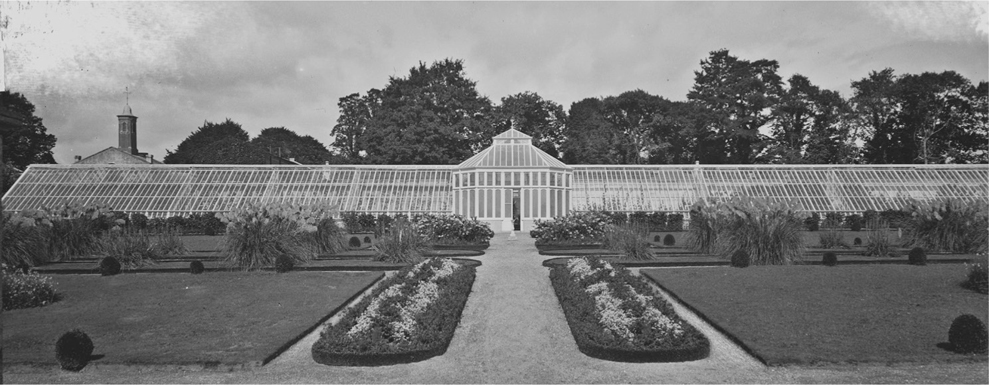
8.3 The impressive glasshouses at Castleboro, Co Wexford, c.1910.
Castleboro was a ‘palatial house’ built in the Classical style and described as ‘one of the finest dwelling houses in Ireland’.110 The ground floor contained the great hall, south and north drawing rooms, dining room, library and study. On the first floor, there were two galleries which surrounded a magnificent library that extended through two storeys. There were ten family bedrooms and five dressing rooms. On the second floor there were six further bedrooms and four dressing rooms. And in the basement, thirty-five apartments including rooms for all the servants, a hall, kitchens and a variety of utility rooms. The yard complex had three coach houses, numerous stables, two dairies, a gardener’s house with five rooms, a steward’s house with nine rooms, living quarters for at least eight men, a whole range of outbuildings including forges, slaughterhouse, hothouses, hay barns, piggeries and so on. There were 5 acres of walled gardens, 30 acres of front lawn, 33 acres of back lawn, 64 acres of plantation to screen the house, 32 acres along the main avenue, 9 acres of fishponds, 500 acres of outer plantations and miles of private avenues interspersed with 5 gate lodges.
It was estimated that the house was 597,000 cubic feet which at a cost of 4 shillings and 6 pence per foot would cost £134,528 to rebuild, minus £73,990 for the surviving walls. In Ireland, the compensation case was heard on 3 May 1924 by the county court judge and a mere £15,000 was awarded for the mansion. An appeal was lodged by the state and at the hearing in March 1925 it was further reduced to £13,000. Lord Carew died the following month and was succeeded by his sister-in-law, Lady Gordon Cary.111 The IGC heard that Lady Gordon lived with her second husband in Monmouth, and concluded she ‘would appear to be a person of considerable means’. As it could not be determined that they suffered any ‘special hardship within the meaning of the committee’s terms of reference’, the case was dismissed.112 Castleboro remains a spectacularly haunting ruin on the Irish landscape.
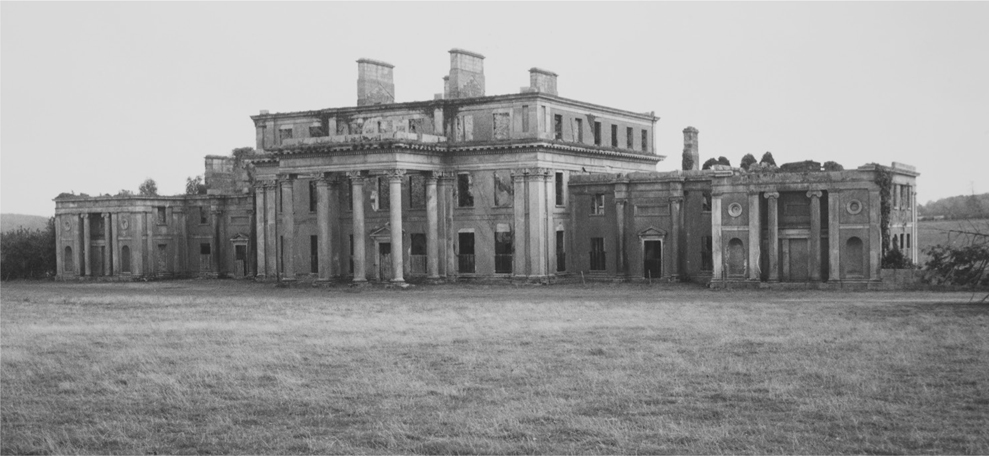
8.4 The ruins of Castleboro, Co Wexford, its once magnificent gardens and designed landscape no longer evident.
7. ‘The feeling that one had a base, that one really belonged somewhere’
The rebuilding of a Big House in the mid-1920s must have represented an interesting short period in a local community’s history, but very little is known about this aspect. What, for example, were the feelings of those who burned a house when they saw it rise phoenix-like from the ashes? Local tradesmen – in the case of Cappoquin, a local mason, Edward Brady, and a carpenter, James Hackett – were sufficiently skilled to oversee building projects, as had been the case in the eighteenth century, and employment was surely welcomed in an otherwise depressed economic climate. A new generation of architects – professional and amateur – were provided with exciting opportunities to replicate, and modify, the architectural grandeur of the Georgian era. For instance, Richard Orpen, brother of William the renowned artist, was the architect in charge of the rebuilding of Cappoquin; he introduced several architectural changes from the original house: the main entrance was changed from the south to the north front; the parapet balustrade was extended around the whole roof; the original pitched roof was replaced by a flat concrete one designed by Delap and Waller engineers.113 Sir John Keane instructed the project team to purchase as much as possible from the local co-operative, but the contracts for the highly skilled decorous interior work all went to London firms, including the contract for the fibrous plaster decoration and embellished joinery in the door architraves and window shutters, which went to G. Jackson and Sons of London. Perhaps indicative of the difficult times being faced by country house owners throughout Ireland was a response to an advertisement Keane placed in the Irish Times looking for antique doors: Walter Bond of Newtown Bond in Longford offered to take out the doors in his own house and sell them to Keane.114
Another of the great Georgian houses rebuilt was Kilboy in Co Tipperary. Lord Dunalley received only about 23 per cent of his original claim and a reinstatement clause was added to the award.115 A diminished award obviously meant rebuilding on a reduced scale; Dunalley was advised that ‘If the cellars were sealed up altogether and the top storey taken off’, it would allow him ‘sufficient space for a smaller staff of servants but with sufficient accommodation for a fair-sized ordinary house fitted up with modern requirements such as central heating, electric light etc.’116 This was the plan adhered to.117 Desmond Prittie, later 6th Baron Dunalley, was not, however, impressed by the new design and later complained that his parents ‘had not included some very necessary conveniences. There was no strong room, no box room, no larder, no dairy.’118 But Terence, his younger brother, born in 1913, who had lived a peripatetic life with his parents and Desmond since the burning of Kilboy, was much more relieved:
For the first time in about seven years Desmond and I had rooms of our own, a place for our books and other belongings, a feeling of security. And Kilboy was a wonderful home. There was a lake where one could fish or bathe. There were acres of garden and woodland in which there was much to do . . . There was good rough shooting all around us.119
The real joy was ‘the feeling that one had a base, that one really belonged somewhere’, no more hotels, relatives’ lodgings, suitcases, no more being an imposition. But the rebuilding of Kilboy soon reflected the fact that Big Houses were no longer sustainable. The family financial situation deteriorated rapidly in the late 1920s and 1930s; Henry Cornelius, 5th Baron, continued to serve in the Rifle Brigade but the income was not sufficient to maintain Kilboy.120 His wife did not understand the concept to ‘economise’; her grandson recalled: ‘Dismissing any of the staff was a sin against her feudal instinct. Standards of eating, drinking and hospitality had to be maintained. My grandmother took to darning the carpets herself, while still employing a lady’s maid.’121 When Henry died in 1948, the debts were insurmountable for his heir and so Kilboy was demolished and a bungalow built in its place.122 However, at the beginning of the twenty-first century, Kilboy was spectacularly rebuilt a second time by Mr and Mrs Shane Ryan; the aim was to replicate the architectural structure of the original house, the end result was the creation of what Country Life described as ‘The Greatest New House in Europe’.123
There were considerably more owners who did not rebuild either because their awards were inadequate to allow them to do so or because they were reluctant to come back to live in Ireland. George Moore put in a claim of £25,000 for Moore Hall but was awarded only one third of that sum.124 He knew he would possibly have received a better settlement if he had agreed to rebuild but he told a friend: ‘Since the burning of my house, I don’t think I shall ever be able to set foot in Ireland again.’125 The house has remained an impressive ruin ever since. In 1925, Colonel Charles Warden made his feelings known about rebuilding Derryquin (burned in 1922), after he and his mother were forced to flee to England:
I bought Derryquin [and 25,000 acres in 1879] to live in, and to end my days in, and I expended thirty years of labour on it, but after my experiences there in 1922, it would be impossible for me to have any further pleasure in living there, and therefore, I do not care to rebuild Derryquin Castle.126
He applied for compensation under the 1923 Act. At a meeting in London between an architect for the Free State government and Warden, a sum of £62,000 was agreed for compensation on a restoration basis. In October 1927, the award was diminished in the Kerry circuit court to £25,000 plus £2,000 for the electric light and refrigeration plants. The following month, the government appealed and the £2,000 was struck out and £25,000 awarded on a partial restoration condition. Warden’s spokesperson had argued: ‘The sole reason against reconstructing Derryquin Castle was the continuance of the criminal acts and conditions which rendered it impossible for applicant to reside on his property . . .’127 In the end Warden entered into an agreement to sell his decree for £20,000 to Dublin Corporation payable in 5 per cent compensation stock to build houses there.128 Twenty-six houses were subsequently erected on Griffith Avenue in Clontarf, and Warden was entitled to the lease on up to four of them. Neither did the equally disillusioned J.M. Wilson, who claimed £59,000 but was awarded only £12,000, rebuild Currygrane in Longford. Instead, he built several villas in south Co Dublin.
Similarly, Alec King-Harman used the £27,500 compensation money for Mitchelstown Castle to build seventeen houses in the Dublin suburb of Clontarf.129 In this way, historic landscapes were altered (in a way yet to be fully elucidated): in one place the great house and demesne that for generations had dominated the local rural landscape disappeared, while Dublin suburbs expanded because of the building conditions attached to the compensation awards. In this respect, the Irish government had been astute, refusing to allow compensation awards to leave the country at a time when there was a housing crisis, though it could be argued that the building of villas in the leafy suburbs of Clontarf or Dun Laoghaire (formerly Kingstown) only benefited another emerging elite.
8. ‘We should have a smaller comfortable house for two people growing old’
Long before it was burned, a massive edifice such as Mitchelstown had outlived its original purpose and affordability and large parts of it were already in an advanced state of deterioration, locked off from use as the family retrenched to a small area for comfort and affordability. Some families were possibly better off by the fact that their houses were burned.130 Mount Uniacke ‘was not in a good state of repair at the time of its destruction’, the feeling was that Mrs Uniacke did well to get £5,000 in compensation to build a more modest version.131 Sir Horace Plunkett’s Kilteragh was not a country house as in the definition used here, but his comments following its burning were interesting: ‘It is all very sad, but a small cottage will do me for the rest of my days.’132 As Lady Fingall awaited the raiders, she contemplated the advantages of having Killeen Castle burned:
We should have a smaller comfortable house for two people growing old, and their children and their friends. I thought of my struggles to heat Killeen, and how all the roaring wood and turf fires could only warm corners of the great rooms. We should have a lower house, well-fitting windows, no draughts or ghosts, and the bathrooms that I had always dreamed of, with plenty of hot water.133
After the burning of Castleshane, Sybil Lucas-Scudamore was advised by her agent to sell the entire demesne because ‘The possibility of rebuilding any class of house that would be in keeping with the demesne is entirely out of the question.’ The practicalities were simple enough: ‘Demesnes are being split up and sold all over the country, and I am just working the sale of a very large demesne in Galway, where the family will never be able to reside again, though the house was not burned down, but it would take the majority of the income to keep it up in firing, lighting, servants etc.’134 It was an opinion that would have resonance for those families who struggled to maintain their houses in Ireland long after revolution had finished with them.135
In February 1923, Lord Oranmore returned to his ancestral home, Castle MacGarrett, to arrange the transport of his furniture and family portraits to England. He summed up how many of his peers felt: ‘We must try to save what we can out of the wreck, but I don’t think it will ever be possible to go back and live at home. Even if the Free State functions, it is certain that they will curtail all our demesnes and what is the good of a big house with a couple of hundred acres in the West of Ireland? Better have it in Kent.’136 It was to prove a prophetic diagnosis: over time, the 1923 Land Act (and its successors) would target the ‘couple of hundred acres’, and not just in the west, denuding Big Houses of what defined them, and ultimately sustained them, and completing the revolution that had begun in 1879.