
II
4
The Irish Republican Army came out by night and by day we did the opposite: we went about our affairs in daylight and during the hours of darkness we locked ourselves (as securely as we could) into our houses . . . The castle then seemed extra vast and lonely. Every night . . . in tweed skirt and thick shoes, with valuables packed in suitcases ready to throw out of the window, I lay awake . . . When dawn came and the birds twittered, I slept.
(Mabel M. Annesley, As the Sight is Bent: An Unfinished Autobiography, London, 1964, p. 29)
1. ‘Receding imperialism’
The last two chapters have described the great changes on multiple levels which the Irish aristocracy experienced in 1914–18: great changes in a rapidly changing world. Five years before the war, the Church of Ireland rector and novelist Reverend J.O. Hannay [aka George Birmingham] had scorned the aristocracy for continuing to look beyond Ireland’s shores to Britain as their spiritual home, and their continued loyalism through the Home Rule crises, Hannay concluded, had compounded their isolation:
The Irish gentleman has not understood that an empire is a quickly passing thing, nailed together by force, varnished by diplomacy, waiting the inevitable dissolution of all such structures. In taking Imperialism to his heart and scorning patriotism he has mistaken the transitory for the permanent . . . Men do not make their homes in empires but in countries . . . Here is the last great mistake of the Irish gentry. They have taken the empire for their country, which is the same as if a man should set himself down in some great caravanserai and say that he has found a home.1
There was a certain prescience in this. The Irish aristocracy had taken the British Empire to heart at the beginning of the Great War, but at its end empires were crumbling in the face of rising nationalism, and the Ireland that the survivors returned to was very different to the one they had left, not least because the rise of separatist nationalism and the intransigence of Ulster Unionism had swept away any notions that a pre-Home Rule type settlement was now acceptable to either side. After 1918, like the Loyalists in America in the 1770s or, more contemporaneously, like the Greeks in Asia Minor, the Muslims in the Balkans or the Swedes in Finland, the Irish aristocracy became victims in Ireland of what R.B. McDowell has called ‘receding imperialism’.2 And successive British governments did little to alleviate their plight. Reflecting on this period, David Cannadine has concluded: ‘For the essence of their tragedy was that the Irish patricians had stood by the empire in its greatest time of mortal danger and had profligately spilled their blood and selflessly given their lives in its defence. Yet in the darkest crisis of their own lives and their own order, the same empire had not lifted a finger to save them.’3
2. ‘Honest, decent citizens have no protection’
The beginning of the War of Independence in Ireland is traditionally dated to 21 January 1919 when an attack by Irish Volunteers on a police patrol at Soloheadbeg in Tipperary, which resulted in the deaths of two RIC men, coincided with the first sitting of Dáil Éireann in the Mansion House in Dublin. (There was no connection between the two events.) During that year, one of the main priorities of the Volunteers, who would gradually become known as the Irish Republican Army (IRA), was to acquire arms and ammunition. Volunteers believed that country houses had excellent potential in this respect, given that shooting was one of the aristocracy’s favourite leisure pursuits, that they had a tradition of service in the military and that further north they had stored UVF arms and ammunition in their houses and on their demesnes. However, in 1918 many of the aristocracy had already chosen to hand in their arms to the local RIC barracks under a government proclamation that had warned of ‘uneasiness . . . caused in the minds of law-abiding people in many parts of Ireland by the raiding of houses for arms by gangs of ill-disposed persons’.4 Some later regretted they had done so. On 24 February 1922, Major Arthur Blennerhassett of Ballyseedy, for instance, complained that ‘the Imperial forces including the Royal Irish Constabulary were removed from Kerry and my arms having been surrendered previously to the British government, my family and I were left at Ballyseedy utterly unprotected’.5
By extension, this meant that IRA raids were not as successful as Volunteers might have hoped. In February 1919, only two rifles, two shotguns and a collection of swords and daggers were secured from Ravensdale Park in Louth.6 On 25 September 1919, Woodbrook, the Roscommon home of Colonel Kirkwood, yielded only a revolver, a blunderbuss, 400 cartridges, a sword and a number of daggers.7 Volunteer Michael Reilly of Ballyturin in Galway recalled raiding a number of Big Houses for arms but getting only two shotguns from Major Persse’s gamekeeper, a haul of mixed ammunition from Bagot’s of Ballyturin and facing stiff opposition at Lough Cutra from the well-armed Scots gamekeeper.8 In January 1920, armed raiders got off with a rifle, a double-barrelled shotgun, a rook rifle and two revolvers from Colonel O’Callaghan Westropp’s home in Clare.9 In February 1920, raiders came to Sir Vincent Nash’s Shannon View House in Limerick and demanded guns. He showed them a receipt for those he had handed in to the RIC and told them he only had a service rifle belonging to his son, who had been killed at the Front. In their sympathy for Nash, ‘The raiders intimated that they would not take the gun and apologised to Sir Vincent over the matter.’10 As at Lough Cutra, the IRA did not always have it their own way: in September 1920, Colonel Collis successfully defended his Cork home, Barrymore, from an upstairs window from where ‘he kept about thirty men at bay for two hours’, but his actions and such examples were rare.11
Until the spring of 1920, country houses continued to be well protected by the local RIC, as traditionally had been the case, especially during the more violent period of the Land War, but beginning in February the IRA launched a large-scale offensive on barracks in isolated rural areas, forcing the closure of approximately 500, most of which were destroyed to prevent their future reoccupation.12 Large swathes of the countryside were, therefore, left without police protection or, at best, occasional patrols, allowing the IRA more freedom of movement. Typical of what this meant can be gauged from Thomas Costello’s BMH statement (he was one of the leaders who burned Moydrum Castle, which is described below):
In our area, Creggan and Brawny barracks were evacuated, and we burned both of these on Easter Saturday night, 1920, in conformation with the rest of the country. . . . This evacuation, though only a limited withdrawal, was the beginning of the end, and was a great blessing to us as it allowed us greater freedom of movement.13
After the spring offensive, IRA raids on houses for arms became a matter of course: from July to September 1920 alone (and these were only the cases reported in the Irish Times), Ballymakee, Knock and Mount Congreve in Waterford, Glenveagh and Brown Hall in Donegal, Castlesaunderson and Crossdowney in Cavan, Adare in Limerick, Ballymore in Cork, Moydrum in Westmeath, Dromoland in Clare, Powerscourt in Wicklow, Lissadell in Sligo (where arms were found stashed on the demesne), Castle Forbes in Longford, Kilkea Castle in Kildare and Mount Juliet in Kilkenny were all raided.
The destruction of RIC barracks was hugely disconcerting for the aristocracy. Nora Robinson described her anxieties following the collapse of rural policing: ‘English people in their law-abiding country had no conception of the horror and dread and all-pervading misery of a war fought round one’s own home, in one’s own countryside: a war which meant daily and hourly suspicion and discomfort as well as fear of maiming and death.’14 In June 1921, Lord Dunraven complained in the House of Lords: ‘There is in Ireland today absolutely no protection whatever for life or property. Honest, decent citizens have no protection, and can get no protection from the police and are not allowed to protect themselves.’15 Police patrols were not the answer to the problem. In March 1920, Mountifort Longfield thought that ‘the chance of their being in the right place at the right time’ was ‘very remote’ and that the small police barracks in rural Ireland should have been ‘strengthened and not vacated’.16 His home, Castlemary in Cork, was burned six months later.
This is all remindful of the fact that at the most fundamental level Ireland fought a War of Independence between January 1919 and July 1921 (although it was late 1920 before it became violent). Such a war is calculated to win political freedom from an alien power and is fought against occupying forces and those who support the same. From the IRA’s perspective, country houses were regarded as highly politicised targets because of the loyalism of their owners, who openly proclaimed the same. When, for example, James Ormsby Lawder of Leitrim was asked by the Irish Grants Committee if he was a Loyalist, his reply was very typical: ‘Most certainly so. I was a JP and DL for 43 years, always an upholder of law and order, actively engaged in recruiting and chairman of the United Services Fund in Co Leitrim. High Sheriff for Leitrim in 1909 and 1919.’17 The primary objective of the IRA was to cast off the administrative yoke of the British government. Thus, IRA veterans often recalled the destruction of Big Houses as a stage in this process; the physical destruction of the footprint of the coloniser not only rid a locality of an alien presence but did much to address ancestral grievances related to the servility and deference traditionally demanded by their owners. Former IRA leader Tom Barry’s Guerilla Days in Ireland (1946) frequently stressed his disdain for the Big Houses of Cork and those who resided in them. Barry, whose father was an RIC policeman, claimed to have grown up resenting the Big Houses in which ‘lived the leading British Loyalist, secure and affluent in his many acres, enclosed by high demesne walls’; these were ‘the conquerors’, who demanded subservience from employees and tenants alike.18
Volunteers claimed to have imbibed in their youth teachings that challenged aristocratic culture and alien oppression. Another Cork IRA leader, Liam Deasy, fondly remembered his teacher who ‘strove constantly to rid us of the attitude of servility and subservience towards the landed gentry which was encouraged by this class, and in its place he endeavoured to plant a sense of self-respect and independence’.19 Tipperary IRA leader, Dan Breen, recalled the influence of another teacher, Charlie Walshe, who taught a generation of revolutionaries including himself, Dinny Lacey, Seán Treacy and Seán Hogan ‘the naked facts about the English conquest of Ireland and the manner in which our country was held in bondage’.20 Breen wrote:
Many a time I walked for three or four hours without meeting even one human being. Here and there a stately mansion, around it the gate lodge of the serf, the winding avenue, the spreading oaks, and the green fields in which no man was visible. Landlordism, the willing instrument of British rule, had wrought this desolation. I renewed my resolve to do my share in bringing about the change that must come sooner or later.21
Breen also gave the impression that Big Houses were resented because they accentuated the difference between aristocrat and peasant, those who had and those who had not. While Breen may not fit into the category of socialist republican, what he hinted at had historic parallels in all modern revolutions: for example, during the French revolution, Lyon’s Place de Bellecour was erased because its grand mansions were ‘an insult to the poverty of the people and the simplicity of republican morals’.22 In some BMH witness statements, one can read that certain historical grievances, born out of social class strictures created by the landlord–tenant system, demanded retribution. Thomas Ryan’s remembrance of the burning of the Perry home at Newcastle in Limerick noted that while the attack was ostensibly a counter-reprisal for local Black and Tan atrocities, Perry’s ‘forefathers before him had been tyrannical landlords in the country’.23 When Lorcan Park House was burned in Tipperary in late June 1921, the local nationalist newspaper made a point of recalling that 200 families had been evicted from the estate 60 years before.24 Patrick Duffy, one of the IRA volunteers who participated in the burning of Summerhill in Meath, later claimed his personal motive was revenge for an ancestor who had been evicted from the estate.25 Derrycastle in Co Tipperary was one of the very first houses burned in January 1920.26 Back in 1844, on the eve of the Famine, Francis Spaight, a Limerick corn merchant, had bought Derrycastle. He found the estate burdened with a ‘deadweight’ of paupers and, in 1849, he had no hesitation in migrating 1,400 persons, telling another landlord: ‘His estate was not to be formed . . . into an electoral division to itself, and that he then anticipated that the poor rates would be within his control [sic] and that his property would be a valuable and improving one.’27 Spaight told a government enquiry that he had emigrated these people for about seventy shillings per head, that they ‘had gone gladly’ and he ‘had practically wiped out crime and distress on his estate’.28 The O’Connellite press saw it differently and there were later reports in the Tipperary Vindicator and Freeman’s Journal of men ‘who escaped from America’ and made their way back to their hovels in Derrycastle.29 Spaight’s actions undoubtedly lived long in the local memory; it was claimed that the burning of Derrycastle was because of local agrarian agitation and the struggle to have its demesne divided.
It was also the case that the desire for revenge, particularly in the spiral of violence that characterised the War of Independence where IRA ambushes led to reprisals from the British armed forces, served to spotlight country houses as legitimate targets for retaliatory counter-reprisals. Once again, this is typical in independence struggles. Pashman tells us that when the rebels in the American Revolution ‘saw an occupying army burn towns and turn families out of their homes, New Yorkers came to share a desire to strike back at those responsible for such calamities’.30 In 1914–18, architectural destruction on an industrial scale had become an everyday occurrence across Europe, familiar to people in Ireland from newspaper photographs, cinema footage and even postcards sent by soldiers from the Western Front. Irish people had also witnessed the centre of their own capital city razed by British artillery in 1916. When, during the War of Independence, the Black and Tans burned villages and towns such as Balbriggan, Trim, Knockcroghery and Cork, it reminded people of the worst excesses in Europe. Retaliation in the form of dismantling symbols of imperialism in Ireland was inevitable. Thus, Ireland in the 1920s was no different to New York in the 1770s where, in both cases, the lust for recrimination was enough to regularly unleash an orgy of arson.
For instance, Tom Barry led the most successful IRA ambush of the War of Independence at Kilmichael in Cork on 28 November 1920, in which eighteen Auxiliaries were killed. This gave rise to retribution by the crown forces in the south-western counties, including the introduction of an official reprisal policy that allowed for the burning of houses of suspected Sinn Féin or IRA sympathisers. Barry later reflected that when the British authorities agreed this policy, they ‘forgot to take into consideration [that] Ireland was studded with the castles, mansions and residences of the British ascendancy who had made their homes here’.31 He triumphantly recalled the burning of several mansions, including Cor Castle, Mayfield, Bandon, Dunboy and the Earl of Bandon’s Castle Bernard that ‘blazed half a day before it crumbled in ruins’.32 He went on to boast in a passage that unveiled several possible motivations:
Castles, mansions and residences were sent up in flames by the IRA immediately after the British fire gangs had razed the homes of Irish Republicans. Our people were suffering in this competition of terror, but the British Loyalists were paying dearly, the demesne walls were tumbling and the British ascendancy was being destroyed. Our only fear was that, as time went on, there would be no more Loyalist’s homes to destroy, for we intended to go on to the bitter end. If the Republicans of West Cork were to be homeless and without shelter, then so too would be the British supporters. West Cork might become a barren land of desolation and misery, but at least the Britishers would have more than their full share of the sufferings.33
This destruction of country houses was active rather than collateral damage. Furthermore, when ‘the Britishers’ fled, Barry claimed, as already noted, that fellow IRA officers ‘encouraged local landless men to settle on the lands and to use them’.34 Whether intentional or not, he signalled that the destruction of a Big House could have the added advantage of expediting more equitable land redistribution (chapter 5).
Big House owners themselves sensed that one reason alone might not be enough to explain the assault on their properties. W.J.H. Tyrell of Ballindoolin House in Kildare contemplated the reasons for an unsuccessful attack on his home: he wondered if it was because he allowed the British military to stay in another vacant house belonging to him at Edenderry in neighbouring King’s County (Offaly); was it because he had been a Justice of the Peace for forty-eight years, and a Deputy Lieutenant ‘always ready to help the government’; or because he had a son in the British army; or because he had ‘tried to get rid of a herd and caretakers’ for allowing local people to graze their cattle on his lands.35 While Tyrell may have focused primarily on his loyalism, it is notable that he added the possibility of an agrarian dimension. Both attacker (Barry) and victim (Tyrell) in separate cases made suggestive rather than overt claims of this largely ignored dimension of the revolutionary period, which will be examined in more detail in the next chapter. What is most illuminating in Tyrell’s reflections is that he could not make up his mind as to whether any single motive predominated, and the task is no easier for the historian. Tyrell might have considered that much depended upon the makeup of the anonymous crowd who, individually and collectively, may themselves have had mixed motives: those who resented his loyalism may have been joined by others who had been expelled from his grazing lands.
3. ‘In the usual efficient manner’
The burning of Big Houses did not begin until the spring of 1920. It is easy, therefore, to infer a correlation with the breakdown in rural law and order as the RIC withdrew to the large urban areas. But this also needs to take into consideration the consequences of the arrival of RIC reinforcements – the Black and Tans and Auxiliaries. Firstly, the thousands of extra police who arrived had no rural barracks to use as bases and so Big Houses were commandeered as billets; secondly, because of the changing nature of the conflict, an endless cycle of reprisal and counter-reprisal, those same Big Houses were then regarded as legitimate military targets by the IRA. James S. Donnelly Jr in his study of Cork concluded: ‘The ceaseless search for suitable quarters for this hugely inflated number of British soldiers and police and their officers – quarters that would put them in close striking distance of their quarry – was to become one of the main reasons for Big House burnings in Cork.’36
The same trend was discernible throughout the country. Before moving the discussion on, it is important to note, however, that many of the houses commandeered were described as temporarily vacant or long-time abandoned. The difficulty is that it is not always possible to establish exactly how long: was it since the breakup of their estates under the land acts, which means they had been effectively abandoned and therefore emptied of their contents which would mean a diminished loss of material culture? Was it since the beginning of the Great War when many families temporarily vacated to spend more time in London, or was it much more recent as fears of attack grew?
At any rate, the occupation or threatened occupation of Big Houses by the crown forces provided the IRA with a legitimacy to destroy them. In May 1920, W.P. Hanly informed the Irish Times that his home, Anagrove House in Tipperary, had ‘recently [been] inspected by the military for occupation without his knowledge’. He had not been resident for a while, but the house was occupied by a caretaker. A few nights later, after it had become rumoured the house was to be commandeered, an estimated one hundred men evicted the caretaker and his family and burned it.37 That same month, Moorock in King’s County was burned for the same reason: six months previously it had been sold by Colonel Cribbon to Thomas Moylett and had remained unoccupied.38 In December 1920, Timoleague House, owned by Robert Travers, was burned.39 James S. Donnelly explains that on 10 May three policemen had been killed nearby at Ahawadda Cross; four days later the castle was commandeered ‘as a security measure in response to the killings’; they remained for six months and during their stay ‘The soldiers conducted frequent patrols and raids and apparently committed or were associated with the commission of a gross sacrilege – the desecration of famed Timoleague Abbey.’40 When they vacated Timoleague, the IRA ensured they could not return. In June 1921, The Abbey in Templemore, Tipperary, ‘considered amongst the finest mansions in the south’, was burned but it seems to have been abandoned almost twenty years previously by the owner Sir J. Craven, Carden who had long since migrated to Scotland.41
Generally, houses were burned as soon as intelligence was received by the IRA that they were to be taken over, for example both Southpark House and Roundmount House in Roscommon in May 1920.42 When, in June 1921, three Big Houses were burned in Galway, the County Inspector reported to Dublin Castle: ‘The military were warned not to send men out to stay at these kind of houses. The CO disregarded the warning with the above results.’43 Others were destroyed after the Black and Tans or Auxiliaries left to prevent future reoccupation or perhaps even to get rid of that local contamination. In May 1920, Kilbrittain Castle in Cork, ‘a large and ancient mansion’, was destroyed after it had been occupied. So were Massey House in the same county, Ballagh Hall in Tipperary, Portloman House in Westmeath and the unoccupied and unfurnished Hermitage in Limerick.44
The most outstanding architectural casualty in this category was Summerhill in Co Meath, ancestral home of Barons Langford. It was undoubtedly one of Ireland’s grandest houses, 300 feet in length, built ‘in the manner of the Renaissance Palaces in Rome – a treatment unusual in Ireland’.45 Constructed in the early 1730s for Hercules Langford Rowley, the identity of its architect is less certain, with attributions to Richard Castle and Edward Lovett Pearce, and acknowledged influences of Sir John Vanbrugh (1664–1726), whose most notable construction was Castle Howard in Yorkshire.46 C.R. Cockerell (1788–1863), English architect, archaeologist and writer, described the entrance front to the house as ‘a massive two-storey, seven-bay block the central feature of which were four towering Corinthian columns, the whole executed in crisply cut limestone. On either side two-storey quadrants swept away from the house towards equally vast pavilions topped by towers and shallow domes.’47
There was a large and lofty entrance hall which in 1913 contained a group of statuary to the memory of Mary Pakenham, daughter of the 1st Lord Longford of Tullynally Castle, executed by Thomas Banks, the eminent English sculptor, and many family portraits by artists including Battoni. The rest of the rooms had Adam mantels or sienna and white marble and were hung with landscapes and pastels by Guardi and Hamilton. The ceilings were of the most intricate and delicate plasterwork in the rococo style.48 According to Cockerell, there were ‘few sites more magnificently chosen – the close of a long incline so that the gradual approach along a tree-lined avenue created the impression of impending drama’.49 The magnificent location was to prove its dramatic undoing.

4.1 Summerhill House, Co Meath, home of Lord Langford. This magnificent Palladian mansion was one of the largest and grandest houses burned during the early stages of the War of Independence because of rumours it was to be occupied by the British forces, although there may also have been an agrarian dimension.
In October 1919, the title of 5th Baron Langford and the Summerhill estate was inherited by John Hercules William Rowley. His younger brother, George, an officer in the King’s Royal Rifle Corps, had been killed in action in 1917. John Hercules spent most of his time in London. The house was, therefore, empty for considerable periods of each year, maintained by a modest household staff (the 1911 census returned nine residential servants). Prior to its burning on 4 February 1921, Lady Fingall, whose home at Killeen Castle was about 10 miles away, claimed ‘Langford had been corresponding with the military authorities, who proposed to quarter soldiers in the house’ and one of his letters had been intercepted by the IRA.50 Local IRA leader Seán Boylan substantiated this; he recalled that Michael Collins had received information from one of his men in Dublin Castle that the house was to be occupied and ordered it burned immediately.51 According to Seamus Finn, ‘There had been some intensive enemy activity around Summerhill . . . the forerunner to the occupation by a strong force of Auxiliaries’, but the destruction ‘forced them away from Summerhill and averted a very serious threat to one of our most important lines of communication’.52 Boylan corroborated this, adding that the burning was imperative because of the house’s strategic position, located as it was ‘on high ground which commanded one of the routes to the west. The Auxiliaries with field glasses could have swept the country.’53 On 7 February 1921, an official report from Dublin Castle also confirmed that Summerhill had been burned to prevent military occupation by British forces.54
On the night, Colonel Rowley was not in residence, and the house was occupied by only a small number of servants. At around 10 p.m., the butler heard a loud knocking on the door. He saw thirty to forty men outside. Having consulted with the maids, they decided to barricade themselves in. The raiders then proceeded to break down the door, but they also entered ‘in a number of different places’, presumably meaning windows and other doors, back and basement. They had with them about thirty to fifty gallons of paraffin which they poured over the furniture and floors. The terrified servants escaped through the basement passage and made their way to the woods where they hid until the raiders had left. The butler managed to contact Trim police station but, by the time they arrived, ‘The fire had gained such a hold that there were no hopes of saving the building.’55 The house was ‘reduced to a mass of blackened ruins’.56 Desmond FitzGerald, Knight of Glin, later lamented its burning as ‘probably the greatest tragedy in the history of Irish domestic architecture’.57
4. ‘The Black and Tans should come to the district’
There also may have been ulterior motives for the burning of Summerhill and these will be discussed in the next chapter, but Summerhill’s chances of survival were certainly imperilled by a rumour of military occupation, and the owner’s suspected collusion with the crown forces. But one person’s collusion could be defined as another’s co-operation; it depended on perspective. After all, working with the colonial administration had been a way of life for the aristocracy and gentry. They had been Deputy Lieutenants of the county, responsible for reporting crimes to Dublin Castle, and they had sat as magistrates at the petty sessions for generations. There is little doubt that the former landed elite provided information to the authorities; reporting and adjudicating crime was what they did. At the end of March 1919, for example, the Marquess of Sligo of Westport House wrote to the Chief Secretary to acquaint him ‘with certain circumstances’ connected with the murder of a local resident magistrate, J.C. Milling, and called on the government ‘to proclaim this part of the Co[unty], to place it under Martial Law, to replace the Garrison here, accompanied by machine automatic guns, and one or more armoured cars’.58 He would not have considered himself a spy in the traditional sense, but rather an upholder of law and order.
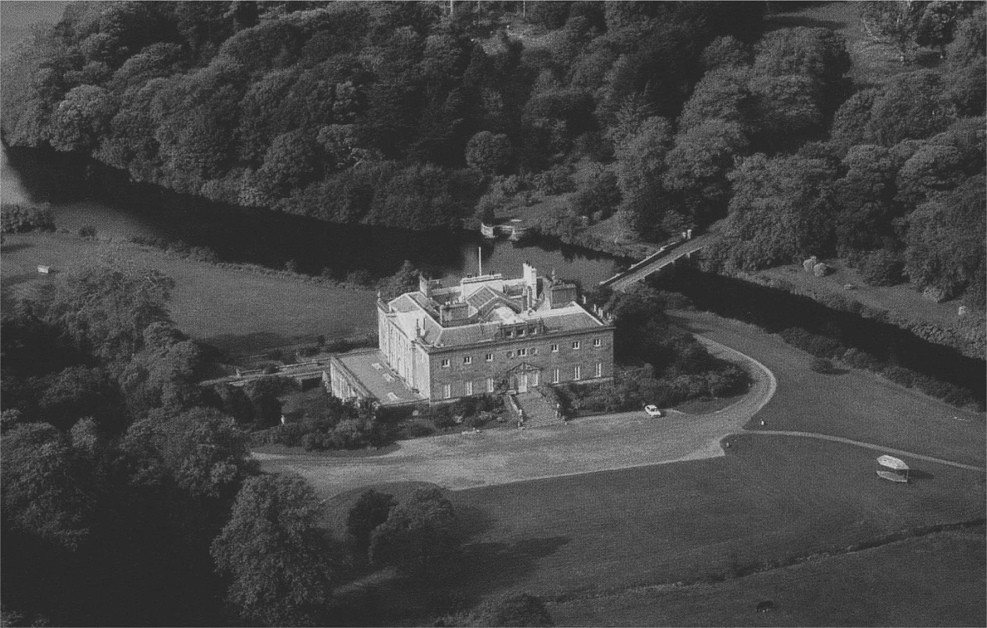
4.2 Westport House, Co Mayo, home of the Marquess of Sligo, one of the largest houses to have survived in the west of Ireland. Designed by Richard Castle in the 1730s for the Browne family, Marquesses of Sligo, it remained in family ownership until 2017.
James V. Greated’s Lydican Castle in Galway was burned in October 1922; he claimed that it was primarily on account of him being ‘very friendly’ with the military during the War of Independence. He had W.H.F. Sidley, a former District Inspector of the RIC, provide a reference to that effect:
[Greated] was a personal friend of mine and during the period 1919 to 1922 was constantly in and out of Barracks, and gave me a considerable amount of valuable help and information as to matters that were happening in the country. Mr Greated rendered valuable assistance both to the police and military. He was one of the few cases of consistent and unswerving loyalty to the British connection during the period of the Sinn Féin terror in Ireland.59
The IRA saw it differently. During the revolutionary period those who collaborated with ‘a foreign people and government’, the terminology of the 1916 Proclamation, were adjudged hostile enemies of the republic.60 After one Big House was burned in Tipperary in April 1921, an official report from Dublin Castle claimed that it was because there had been a rumour the owner ‘had suggested that the Black and Tans should come to the district’.61 When Captain Beresford Molony’s house in Tulla, Co Clare, was burned in September 1920, a letter found in the ruins read: ‘You have harboured in your house British officers and their wives. You have harboured a Black and Tan family. Now you can look for a house yourself.’62
There were two high-profile cases of country house owners being executed and their houses burned because their actions went beyond collusion and they were accused of spying, where the latter involved deliberately gathering information and passing it on to the crown forces which, in turn, led to the deaths or capture of IRA volunteers. On 14 April 1921, members of the Knockanure and Duagh companies of the IRA arrived at Kilmorna House, Listowel, Co Kerry, the home of Sir Arthur Vicars, most famous for having overseen the Irish crown jewels before they were stolen from Dublin Castle in 1907. According to the BMH statement of Matthew Finucane, Vicars had been sentenced to death as a spy and orders given to execute him and burn his home. Finucane described Vicars as an ‘ex-British officer’ who lived in what was ‘known locally as the Great House’ and who had a short time previously entertained British officers to a fishing holiday in Kilmorna.63 Patrick McElligott similarly pointed out that ‘Military parties were frequent visitors there and were entertained by Vickers on many occasions.’64 McElligott was in no doubt Vicars was a spy whose informing was responsible for the death of a young Volunteer, Michael Galvin, on 7 April 1921 in a failed IRA ambush near Kilmorna. McElligott also noted that the IRA had feared Kilmorna was to be commandeered by the military: ‘If this happened’, McElligott recalled, ‘Abbeyfeale and the surrounding areas of Duagh, Knockanure and Newtownsandes would have been in danger.’65 Michael Murphy, Vicar’s valet, who later became an officer in the National Army, and whose statement was also recorded by the BMH, claimed the IRA were mistaken that British officers had been entertained in Kilmorna before Galvin was killed.66 The statements are also conflicting on what actually happened on the day – did Vicars run from room to room defying and shooting at the IRA raiders or not? Regardless, the outcome was that he was shot dead outside the house, a note pinned to his body telling spies to beware, and Kilmorna destroyed.
The second case of the execution of an alleged spy was that of Maria Lindsay of Leemount House in Coachford, Co Cork, the widow of a senior British army officer. Donnelly contends that her ‘loyalism was above all a matter of family tradition and cultural background’, equally applicable to most Big House families.67 At the end of January 1921, she learned locally of a planned IRA ambush at Godfrey’s Cross, and she travelled to Ballincollig barracks to inform the officers of the Manchester Regiment. The crown forces soon surrounded the ambush site, eight IRA men were captured, quickly tried and five sentenced to death. On 17 February, Mrs Lindsay and her chauffeur were abducted from Leemount to be held as hostages for the release of the IRA prisoners. General Sir Edward Peter Strickland, on receiving communication from the IRA that unless their comrades were released Lindsay and Clarke would be executed as spies, communicated the information to General Sir Neville Macready, Commander-in-Chief of the British army in Ireland. The execution of the prisoners was carried out on 28 February.
Two weeks later, Leemount was attacked by forty or so IRA men and burned to the ground. On 21 March Lindsay and Clarke were executed by the IRA as spies.68 Macready later wrote in his memoirs: ‘While I would have gone to great lengths to save the gallant lady’s life, I could not listen to such a proposal, which would have resulted in the kidnapping of loyal or influential persons every time a death sentence was passed on a rebel.’69 His calculated comment was redolent of Cannadine’s point made at the beginning of this chapter: ‘In the darkest crisis of their own lives and their own order, the same empire had not lifted a finger to save them.’70 Not all Big House owners were as prepared as Mrs Lindsay to openly defy the local IRA. District Inspector Sidley, quoted above, talked of James Greated’s ‘consistent and unswerving loyalty’, but those who upheld the British connection not only put themselves in danger, they also cast suspicion on all their peers and further spotlighted their Big Houses as targets for IRA counter-reprisals.
5. ‘You being an aggressively anti-Irish person’
The War of Independence entered a more violent phase from November 1920. On the morning of 21 November – Bloody Sunday – fourteen British intelligence operatives were killed in Dublin by Michael Collins’s squad, leading to the reprisal killing of fourteen civilians that afternoon in Croke Park (and three other men that evening in Dublin Castle, two of whom were IRA officers and the third a civilian). A week later, seventeen Auxiliaries were killed in an IRA ambush led by Tom Barry at Kilmichael in Cork. That also gave rise to the spiral of reprisals recounted above. On 10 December, martial law was proclaimed in Munster, which reflected the fact that by then it was the most violent region in the country as defined by IRA activity.71 A study by Erhard Rumpf and A.C. Hepburn has also shown that British reprisals were mainly located in Cork, Tipperary, Limerick, Kerry and Clare.72 Taking both the geographic distribution of IRA violence and the geography of reprisal into consideration, one could, therefore, argue that the most obvious factor in the distribution of Big House burnings was location: 72 of the 125 Big Houses burned (almost 58 per cent) were located in these counties.73 Cork, where forty-two were burned, had by far the highest incidence of IRA violence and the highest number of towns and villages affected by British reprisals (not to mention the razing of the centre of Cork city by rampaging crown forces on 11 December 1920).74
As the War of Independence drew to a close and violence escalated, so did Big House burnings. Sixty-four of all the houses destroyed (51 per cent) were burned in the last fourteen weeks of the conflict. In May 1921, the Inspector General of the RIC reported: ‘There seemed to be an intention to burn out all Loyalists who owned property.’75 The County Inspector of Cork had previously reported to him that ‘counter reprisals in the form of burning loyalist houses is a more or less new feature’.76 In June, he repeated that ‘Loyalists are being persecuted, their mansions and houses are being burned, and a huge number of them have cleared out of the county.’77 Similarly in Tipperary, in June 1921 the County Inspector informed his superior: ‘It is thought that the campaign of burning country gentlemen’s houses is only just starting and that we may expect to see a lot more of it done in the near future.’78 James S. Donnelly attributed the escalation in Cork to ‘the collective determination of the commanders of the southern brigades to devise an effective means of stopping, or at least reducing, the seemingly endless series of official British military reprisals against the property of republicans or their sympathizers’.79 The burning of Castle Bernard, home of the 4th Earl of Bandon, on 21 June 1921 typified this policy; Tom Barry, who had nothing but disdain for Bandon – ‘on whose authority’, he declared, ‘the British armed forces purported to rule, coerce, kill and terrorise the Irish people’ – later recalled his decision to move beyond the Inishannon region: ‘As there were no other active Loyalist homes in that area, we went further afield to teach the British a lesson, and once and for all end their fire terror.’80

Map 2 County distribution of houses burned during the War of Independence 1920–21. Drafted by Dr Jack Kavanagh.
Later that month, the Irish Times headlined the ‘House Burning Mania’ that was sweeping the country as mansions from Cork to Cavan went up in flames.81 Several of the finest country houses on the western shore of Lough Derg were destroyed, including Dewsborough House near Tomgraney, Wood Park House near Mountshannon and Rinshea House in Whitegate. By this point, IRA attention had moved from abandoned or vacant country houses used as billets to inhabited ones such as Convamore, Lord Listowel’s magnificent classical mansion overlooking the River Blackwater. Prior to its destruction, Listowel’s niece was handed the following note, intended for her uncle, which clearly illustrated the local IRA’s intent to gain retribution for the destruction of their supporters’ properties by the crown forces:
On Wednesday the 13th inst., the enemy bombed and destroyed six houses of Republicans as reprisals for IRA activities on the 10th inst. You being an aggressively anti-Irish person, and your residence being in the battalion area of enemy reprisals, I [Cmdt. Cork no. 2 brigade] have hereby ordered that same be destroyed as part of our counter reprisals.82
As Donnelly points out, it is debatable if Listowel would have considered himself ‘an aggressively anti-Irish person’. An admittedly less than biased Irish Times argued in his defence: ‘The truth is that Lord Listowel has always shown a passionate attachment to his country and its people and took little part in politics.’83 But that was irrelevant: the burning of such mansions set down a marker of the IRA’s intent.
Moving away from the main theatre of violence, the burning of Moydrum Castle in Co Westmeath was typical of a reprisal attack.
This early nineteenth-century castellated mansion built to the design of Richard Morrison was the home of Lord Castlemaine, the pre-eminent aristocrat of south Westmeath. His ancestors had been granted over 5,000 acres in 1680 under the Act of Settlement, and by the early 1880s the estate had grown to over 12,000 acres.84 Castlemaine sold the bulk of his estate under the 1903 Land Act, but he and his family remained resident in Moydrum surrounded by a demesne of over 500 acres and retaining almost treble that in untenanted lands.85

4.3 Moydrum Castle, Co Westmeath, home of Lord Castlemaine, burned as a counter-reprisal by the IRA during the War of Independence, although there was also a very significant local agrarian dimension to the motive.
The attack on the castle had its origins in events that had taken place over the previous fortnight. On 20 June 1921, at around 7.30 p.m., Colonel Thomas Lambert, commanding officer of the 13th Brigade Athlone, a decorated veteran of the First World War, and Lieutenant Colonel E.L. Challoner, along with their wives and Challoner’s niece Katherine Arthur, were returning to Athlone from a tennis party, probably at Killinure House. Driving towards Glasson, they found their way blocked by an IRA party estimated at between six and twelve men. The IRA were aware of Lambert’s movements and it was their intention to kidnap him and hold him hostage for the release of Longford IRA leader Seán MacEoin, who was in Mountjoy prison awaiting execution.86 But, as there was no actual blockade, the driver of the car, Mrs Lambert, accelerated and attempted to drive on. The IRA opened fire hitting Colonel Lambert, who died from his wounds later that night, and injuring Mrs Challoner.87 That night, four lorry loads of Black and Tans went on a rampage of revenge in Knockcroghery village, across the county border in Roscommon, and, without warning, burned fifteen houses in reprisal, forcing the terrified occupants to flee across the neighbouring fields. The Irish Times reported afterwards: ‘The village presents a shocking appearance, being a mass of smouldering ruins, with the occupants of the houses homeless and destitute, all their belongings being consumed in the general conflagration.’88 A few days later, General H.S. Jeudwine, commanding officer of the 5th Division at the Curragh, issued the following statement:
His [Lambert’s] brigade will best avenge his death, as he himself would have wished, by the strict adherence to duty which he did his best to inculcate, and by a determination to maintain, by regular methods, at all risks and through all difficulties, the sovereignty and authority in Ireland of the King and his government, whose servants we are.89
Jeudwine’s statement was too late for Knockcroghery and did not put an end to the Black and Tan backlash. On 1–2 July between five and seven farmhouses were burned at Coosan.90 The ‘terror’ began at 2 a.m. when masked men called at the home of Thomas Duffy, who, along with his wife, four children and ninety-year-old aunt, was told to ‘clear out’. Petrol was poured on the beds and furniture and set alight. The Black and Tans then moved on to the homes of the Wansboro, Farrell, Coghlan and Moore families. All were prevented from saving any of their possessions. Next, the Black and Tans moved on to nearby Mount Temple, where they burned the home of Anne Hanevy, one of whose sons was interned as an IRA prisoner at Ballykinlar.91 There is no question but that this type of brutality by the Black and Tans led directly to revenge attacks on Big Houses.92 The wonder is that it was not even more widespread.
In the days after the Black and Tan reprisals, the officers of the Westmeath IRA met to decide what action they would take. Thomas Costello, Commanding Officer (OC) of the Athlone Brigade, later recalled: ‘There were a number of small places owned by Protestants in the area, but I did not consider it would be fair to burn these peoples’ houses for something which was not their fault.’93 Their attention turned to Moydrum Castle. Both Frank O’Connor and Henry O’Brien highlighted Lord Castlemaine’s loyalism.94 O’Connor’s record states:
[Castlemaine] was a member of the British House of Lords and who always opposed anything which was patriotic or Irish national and was really an enemy of Ireland. He had dismissed men from his employment because they would not join the British army. The destruction of his castle would hit in the spot where it would be most felt, whereas the destruction of a few small Loyalists’ houses would not be felt.95
In the tit-for-tat reprisals it was inevitable that there would be a sectarian dimension: in this case, it was Protestant homes the Westmeath IRA were allegedly ordered to burn, in the same way that it was Catholic nationalist homes the crown forces destroyed. In the vein of such reminiscences, Costello clearly wanted to give the impression that the IRA behaved in a much fairer way than the Black and Tans. Moydrum was chosen because of Castlemaine’s past actions: he was a representative peer in the Lords, a staunch Unionist who had been vice-president of the IUA, ‘an enemy of Ireland’ who had sacked men for not joining the British army. No mention was made of the fact that before the war he had also served on the nationalist-dominated Westmeath County Council and had been returned unopposed in several local government elections.96
The three IRA witness statements that describe events on the night are fairly congruous with each other.97 When the IRA arrived around 3 a.m., they had with them cans of petrol that had been taken from an oil depot in Athlone, and a few large hammers and sledges ‘borrowed’ from a nearby forge to break in the front door if necessary.98 Raids such as this were not spur-of-the-moment decisions: they had to be planned to ensure minimum resistance. O’Connor and his comrades knew British officers from the Athlone garrison often stayed at Moydrum, so, unless properly planned, the IRA ‘might meet with a hostile reception’.99 On the night, Lord Castlemaine was absent, fishing in Scotland, and the IRA knew this from information provided by another officer’s cousin who worked on the estate.100 With Castlemaine away, it was unlikely army officers would be there and so the house would be defended only by Lady Castlemaine, her daughter and a few servants.101 Moreover, there had been a raid for arms on the house in September 1920, and the IRA got away with ‘a large number of shotguns, rifles, revolvers and ammunition’.102 It might, therefore, have been seen as a safe house to attack.
Having forced their entrance, Costello informed Lady Castlemaine that the house was being burned as a reprisal for the recent burnings at Coosan and Mount Temple.103 Lady Castlemaine pleaded for time to remove valuables and Costello granted this and allocated ten men to help her. In their BMH statements, both Costello and Frank O’Connor agree that they told her: ‘The Tans did not grant the privilege to the people whom they had burned out.’104 The raiders spent around half an hour going into each of the thirty or so principal rooms in the castle, gathering all the furniture in piles before saturating each pile with petrol as well as some paraffin commandeered from Lady Castlemaine’s stores. Holes were made in the ceilings to provide ventilation to fan the flames, and on the roof by stripping the slates.105 The raiders then escorted the servants to a place of safety. Lady Castlemaine and her daughter were provided with armchairs from the house on which to sit; whether it was to suffer the ignominy of watching their home razed and the memories of generations obliterated is unclear. The raiders left only when the house was a raging inferno with no prospect of being saved. Moydrum was one of the last Big Houses to be burned before the Anglo-Irish truce was called on 11 July 1921. However, as we shall see in the next chapter, the revolution had not quite finished with Moydrum or the Castlemaines.
6. ‘And now England has cast us off and given us to the murderers’
On 21 August 1921, John Garvey of Tulley House in Mayo wrote to Frederick Crawford, organiser of the Larne gun running:
I would have preferred to see the Union cemented rather than dismembered but the Union is now a thing of the past. We have ‘our all’ in the west and our only chance of saving anything we have is by silence in the midst of this great revolutionary change . . . Any aggressive word or act w[oul]d be fatal to us now and our chances of security and safety are not very hopeful.106
The predicament of the southern aristocracy, as articulated by Garvey, was accentuated in the contrasting history of their peers in the new state of Northern Ireland, established under the Government of Ireland Act of December 1920. There, as Olwen Purdue has chronicled, the much different politico-religious demography meant the aristocracy found ‘a political and a social role which ensured that they would retain a degree of relevance in the society in which they lived’.107 Most importantly from their perspective, the northern aristocracy retained their position within the United Kingdom; it might be said that their role in the Ulster Unionist rebellion of 1912–14 had paid off.
While the thinning of aristocratic society further south had been ongoing since the beginning of the Land War in 1879, revolution proved to be a catalyst. In early 1920, Lady Gregory recorded in her journal: ‘An exodus from the county [Galway]. The Goughs leave the weekend and Lough Cutra is to be shut up till they see how things are . . . Lord Killanin has had trouble at Spiddal and has dismissed all his men and gone to London. The Lodells . . . are going to live in England. Amy has left Castle Taylor and lives in England.’108 After the Anglo-Irish truce (11 July 1921), as Peter Martin has pointed out, the southern aristocracy had ‘to choose to be Irish or British and it is not surprising that many of them found the new Ireland insufficiently attractive to keep them’.109 This was reflected in a report in the Munster Express in early January 1922 claiming that thirty country houses had been sold in just five months since August 1921.110 On the last day of December, just weeks after the Irish plenipotentiaries and representatives of the British government signed the Anglo-Irish treaty, Lady Alice Howard of Shelton Abbey in Wicklow confided in her diary: ‘Such a dreadful year of rebellion and murder – and now England has cast us off and given us to the murderers.’111 Lord Oranmore shared her opinion, recording in his journal: ‘It is heartbreaking to see the condition to which Ireland has been reduced by the supineness of this country [England]. When shall I be able to live in my dear home again?’112
Lord Bandon left for England in March 1922 to recover from his kidnapping ordeal and destruction of his house and reflected on why others of his class had done likewise: ‘In areas where these outrages were most frequent and most cruel no protection was afforded to human life, and many of the exiles would not dare run the risk of placing themselves again in the power of criminals who desire to injure them.’113 From the beginning of 1922, following the establishment of the Irish Free State, the British army officer class departed and with them the ‘dashing and sentimental intercourse’ that had long characterised the sociability ‘between officers and country house families’ (and also another layer of security the Big House had depended upon in the recent Troubles).114 For many aristocrats, loneliness became their only companion. In 1921, the Duc de Stacpoole noted: ‘I saw little or nothing of my neighbours, having no near ones, and English friends were afraid to come to Ireland, so that, mostly alone in my County Galway home, I had little to do but sit before the fire, reading my books or newspapers and ponder.’115
A few southern aristocrats had retained enough influence to be involved at different levels in attempts to settle the Anglo-Irish conflict. Lord Midleton was particularly prominent, but when the treaty was framed it omitted the safeguards for the minority position that had been proposed under the 1920 Government of Ireland Bill, which led him to censure it.116 He became so embittered as to conclude it was ‘one of the most deplorable desertions of their supporters of which any ministry has ever been guilty.’117 Others hoped for some semblance of participation in public affairs in the future. Lord Dunraven was more conciliatory than Midleton; he contended the treaty ‘gave to Ireland all I had long laboured for’.118 The divisions of opinion were reflected in the split of the IUA with hardliners such as Lord Farnham, Lord Dunalley, E.J. Beaumont-Nesbitt and J.M. Wilson remaining, while the likes of Lords Desart, Donoughmore, Courtown, Headfort, Mayo, Sligo and Wicklow joined the new Anti-Partition League, but that organisation was also to have a short lifespan.119 Before the War of Independence ended, some moderates tried to make peace with the new order. For example, in August 1920, a meeting of the deputy lieutenants and magistrates of Queen’s County called for dominion Home Rule. Colonel Cosby of Stradbally Hall told those present: ‘I am an old Unionist – as you know a life-long Unionist – and now I have to pocket my feelings and to do what I can for the good and benefit of my beloved country.’120 After independence, John Bagwell of Marlfield accepted nomination to the Free State Senate to represent the minority interest, and said: ‘The southern landlords have ceased to be the backbone of the British garrison in Ireland . . . they have ceased even to be Unionists, they have not ceased, however, and do not want to cease, to enrich their country with inherited gifts of loyalty and leadership and their capacity for public service.’121 He was joined in the Senate by Lords Mayo, Headfort, Lansdowne, Longford and Wicklow, Sir John Keane, Sir Horace Plunkett, Maurice Moore, Sir Thomas Esmonde, General Bryan Mahon of Mullaboden and Ellen Cuffe, Countess of Desart. Ironically for them, the anti-Treatyites would reframe their loyalism in terms of aristocratic support for the new regime and consequently, as we shall see below, their houses (or in the case of Moore and Cuffe those of their family members) were once again endangered.
John Garvey was a staunch Loyalist who decided to stay on in Mayo while many of his neighbours migrated; on 10 November 1922, he wrote to Major Charles O’Hara of Annaghmore in Sligo: ‘Most of the people who can afford to go are leaving. Miss Pery Knox Gore left Ballina House for good this week, and Miss Gore of Killala is leaving next week, and many others have abandoned their homes. We are determined to stay on to the end and my wife says she will only leave when she is carried out.’122 In his August 1921 letter to Crawford (above), he had written: ‘Your position in the north is a very difficult one chiefly on account of the religious atmosphere but with us there has been a tolerant spirit evidenced at all times. Indeed, were it not for that spirit we, a few people swimming in a great ocean, could not survive.’123
But, just six months later, he and his wife discovered that the Civil War greatly changed the local dynamic. He wrote again to Charles O’Hara in February 1923 that he and his wife ‘had the shock of our lives’ when their home was looted and burned: ‘My wife had only a coat thrown over her and I had not even a pair of boots or stockings. We had to look on in the rain while they set fire to our beautiful home and it and all its contents that were not looted are now reduced to cinders.’124 They were later left in no doubt about their future prospects in the area when they received an anonymous letter (poorly composed): ‘You will never live heare to see a home built at this communitys expense so take this as a warning to clear out or to suffer the consequence. So to Belfast or to hell with you.’125 The tone of bitter resentment and ancestral grievance encapsulated how civil wars can bring malice, revenge, spite, hatred, bitterness, jealousy, grievance and all such negatives to the fore. He was no longer welcome to stay, he could migrate to ‘his own’ in Belfast, the local nationalist community was not going to be burdened with the cost of rebuilding Tulley and, although not expressed, locals undoubtedly had their eye on his demesne lands.
7. ‘Undamaged except for a badly needed wash’
Following a bitter and acrimonious debate between mid-December 1921 and early January 1922, Dáil Éireann ratified the Anglo-Irish treaty by sixty-four votes to fifty-seven; unable to support the ratification, Éamon de Valera and his followers withdrew. For the next few months attempts were made to heal the rift but to no avail; the IRA split along the lines of those who supported the treaty (generally referred to as Treatyites or Free Staters) and those who opposed it (anti-Treatyites, more disparagingly referred to as Irregulars). On 14 April 1922, anti-Treaty forces occupied the Four Courts in Dublin; its bombardment from 28 June by the National Army signalled the beginning of civil war. In the months that followed, as Mel Farrell puts it, ‘a general state of lawlessness, masquerading as republicanism’, became ‘the new government’s chief concern’.126
With the disbandment of the RIC and the withdrawal of the crown forces in the early months of 1922, country houses were even more vulnerable to attack. Co Kildare offers a very good example. During the War of Independence, it had a very high military presence: around 10,000 troops were stationed there in 1920–21. IRA activity in the county was restricted to ‘small jobs’ and effective intelligence work, rather than the type of largescale IRA ambushes carried out in the Munster counties.127 Seamus Cullen has concluded: ‘Until 1922, loyalists in Kildare enjoyed the security experienced by no other county outside Ulster owing to the presence of British army garrisons who were considered integral members of their community.’128 No houses were burned in Kildare during the War of Independence, but there were four casualties in the Civil War. A later propagandist publication from the Irish Claims Compensation Association was at pains to emphasise that the destruction of country houses in the Free State as a whole had ‘greatly . . . increased since the evacuation by British forces took place and the Free State Government assumed office’.129 In a similar vein, but also highlighting the rise in ordinary criminality, a disillusioned Lord Midleton wrote to King George V: ‘The hasty withdrawal of British troops, against which Your Majesty’s Government were repeatedly warned, has left the South of Ireland without any force to preserve order and even if individuals were made amenable, there are no courts sitting effectively to deal with them . . . The mutiny of the IRA is probably the least serious element in crime.’130
On 21 February 1922, the government established an unarmed police force, An Garda Siochána, but given the circumstances it took the Gardaí considerable time to assert their authority, especially in strong anti-Treaty areas such as the southern counties.131 And with so much to cope with, the burning of country houses was never going to be a Garda priority. For example, in August 1922 one of the most high-profile cases was the destruction of Currygrane in Co Longford, the ancestral home of Field Marshal Sir Henry Wilson. He had been assassinated by two IRA members – Reginald Dunne and Joseph Sullivan – on his doorstep in London on 22 June. The burning came just a day after their execution. This was possibly no coincidence, as suggested by Tom Brady, captain of D Company Longford Brigade, when reporting to his superiors: ‘Sir H[enry] Wilson’s house was burned on the day after the two men were hanged in London.’132 However, the most prominent IRA leader in the county, Seán MacEoin, ‘later speculated that this was a pretext for an underlying agrarian motive’.133 (This, as shall be argued in the next chapter, was very common.) When asked by the Minister for Home Affairs to enquire into the burning of Currygrane, the Garda Commissioner, Eoin O’Duffy, replied that he did not want to convey ‘an impression of impotence concerning the Civic Guard’, but there were ‘many cases of this kind now engaging the attention of the Guard’ so that they could not ‘move in these matters so energetically as might be wished and must perforce hasten slowly’.134 Even if they could, it is doubtful if O’Duffy and his men would have had any great desire to locate the perpetrators in this case; the politics of Sir Henry and his brother, James Mackay, one of Longford’s most prominent Unionists, had made them arch enemies of Irish republicanism.
O’Duffy, formerly IRA leader in Co Monaghan during the War of Independence, had been Chief of Staff of the National Army at the beginning of the Civil War and, therefore, familiar with the fact that in that uncertain period between the calling of the truce in July 1921 and the establishment of the Provisional Government in January 1922, the IRA had commandeered vacated country houses in which to drill in the event of another outbreak of hostilities. They were merely continuing the precedent set by the crown forces. Country houses were ideal: they had defensive architectural features comparable to barracks, extensive yards and out-buildings to accommodate men and demesnes where skirmishing could be practised. And they did not belong to the ‘Irish people’; in that sense, the revolution against the landed elite continued. (Later, during the Civil War period, in a variation of the same, Dan Breen received orders from anti-Treaty headquarters for columns on active service to billet in mansions ‘which were owned by persons hostile to the republic’.135)
One of the first IRA leaders to commandeer a Big House was O’Duffy’s replacement in Monaghan, Major General Dan Hogan, who in September 1921, with about fifty of his men, commandeered Lough Bawn House, home of the Tenison family, who had temporarily departed for England. Hogan had been born into a modest farming background in Tipperary. In 1917, he began his working career as a clerk with the Great Northern Railway in Clones and ended the War of Independence as a major general in command of the 5th Northern Brigade of the IRA. During the occupation of Lough Bawn, Hogan posed for a well-choreographed portrait at the front of the Big House that left no doubt that a new order had taken over and the ancien régime was no more. He was splendidly dressed in full military regalia, with all the trappings of his rise clearly visible – his impeccable uniform, silver watch and chain and a Thompson submachine gun on his lap. Then he posed with his men, again deliberately at the front of the house.
Hogan would not have been aware of it but the owner of Lough Bawn, William Tenison, had written to a friend during the War of Independence following an IRA raid: ‘It was rather comic, they were such a seedy lot for representatives of the Irish Republic; I could hardly help laughing, it was so very like comic opera! But I did not want them to ransack the house, so I had to give up some guns and old swords and old revolver for which I have never been able to get any ammunition!’136 Had he read it, Hogan might not have left the house intact when he and his men left.
At least thirty Big Houses were commandeered by the IRA in the second half of 1921. The IRA training camp at Lough Bawn was relatively modest in scale. In September 1921, an estimated 200 IRA men set up in Huntington Castle in Carlow, and 150 more used the demesne of Captain Trench at Ashfield in Queen’s County. That same month, Carlow police reported that ‘Duckett’s Grove is now a large armed camp reported to be full of arms and ammunition’ and that it had ‘a large republican flag flying outside the front door of the house’.137 Across the country, there were camps in houses such as Highpark in Wicklow, Aghadoe House in Kerry, Stonehouse in Louth, Ballymacoll in Meath, Mantua in Roscommon, Carrigmore in Mayo, Clooncarrig in Leitrim and Kilfine in Westmeath. At Huntington Castle, a notice was fastened to the demesne gates ‘intimating that there was no admission except on business and signed IRA’.138 Ironically, those previously kept outside demesne walls were now deliberately keeping all others out.
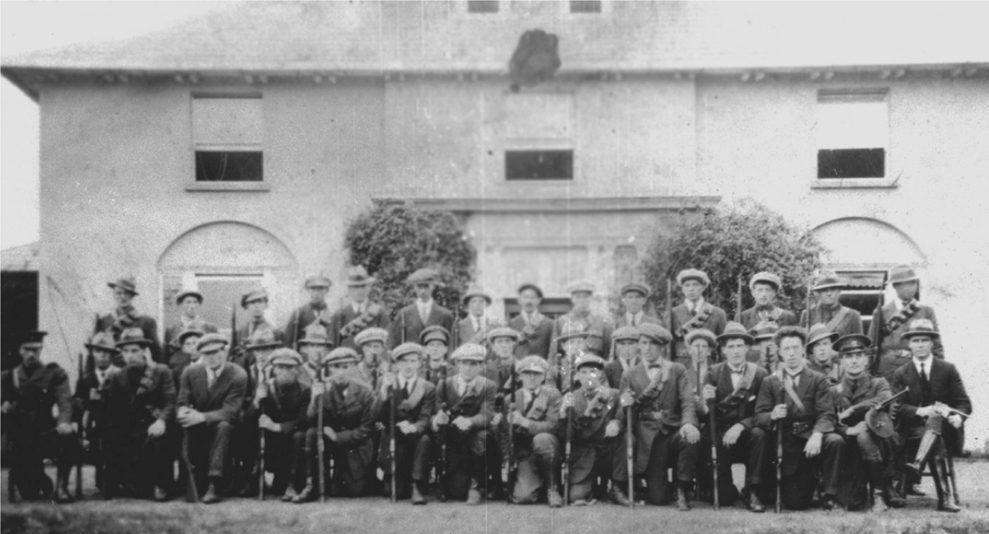
4.4 During the Truce period from 11 July 1921, several country houses throughout the country were commandeered by the IRA as billets. This photograph shows the Monaghan IRA under Major General Dan Hogan, second from right in front row with a Thompson machine gun, outside Lough Bawn House.
In September 1921, the County Inspector of Kildare mockingly reported to Dublin Castle that training camps were ‘run on comfortable lines . . . only the largest houses are fit be commandeered’. These included Harristown (unoccupied since the death of Percy La Touche earlier that year) and Dowdenstown, where the IRA were planning ‘to overawe the non-combatant and neutral section of the population’.139 After both houses were vacated, the Inspector was happy to report that: ‘The rebels have, in each case, left the house perfectly tidy and undamaged except for a badly needed wash.’140 The social class jibe in the comment was not quite as barbed as D.H. Doyne’s whose Wicklow residence was occupied on 13 July 1922 by fifteen anti-Treatyites who demanded to be fed and accommodated: ‘The damage to the house was mostly caused by dirt. All bedding, mattresses, carpets, sofas etc. will have to go to Dublin to be thoroughly disinfected.’141 In October 1921, forty IRA men took over Henry Bourke Jordan’s Thornhill House in Mayo for about ten days; they left it ‘seriously injured from a decorative point of view’, and contents such as bed clothes, pots and pans and cutlery were looted.142 But, in this case, there was also reported agrarian activity on his demesne and an element of Luddism in the destruction of farm machinery. Jordan’s fear that his stock would be injured or rustled made him sell off his thoroughbred cattle and sheep. Without machinery and stock to farm, his only option was to then sell his lands, precisely what the agitators demanded. Were the IRA and local agrarian agitators one and the same? Who benefited from the redistribution of his demesne? These are very important questions of the revolutionary period neglected to date, which will be elucidated in the next chapter.
8. ‘We have our orders my lord’
The most intense period of destruction during the Civil War was from the beginning of August to the end of October 1922 when thirty-six houses were burned. Newspapers and compensation files attributed a politico-military reason to most of these. For example, it was reported in July 1922 that anti-Treatyites attempted to blow up Mount Talbot House in Roscommon as it was occupied by Free Staters.143 On 17 August 1922, the anti-Treatyites occupying Macroom Castle expecting an attack fled to the mountains, burning the castle before they left.144 A few days before, Mitchelstown Castle, probably the largest house destroyed in the revolutionary period, was burned by evacuating anti-Treatyites (chapter six).145 In October 1922, Tullamaine Castle in Tipperary was also burned as the National Army approached.
There was a dramatic escalation in burnings between the beginning of January and the end of April 1923 when ninety-four houses were burned. On 21 January 1923, an admittedly biased Free State military report claimed that ‘With depleted numbers, lack of resources and unified control, and almost complete ineffectiveness from a military standpoint their [anti-Treaty] policy of military action is slowly changing to one of sheer destruction and obstruction of the Civil Government.’146 Destruction of all types of property was widespread but more specifically regarding Big Houses there were discernible patterns similar to the previous months.147 Thus, when Castle Hackett was burned in January, the Irish Times reported: ‘The reason given was that they [anti-Treatyites] expected the National Army to occupy it.’148 After Colonel Bryan’s Upton House in Wexford was burned the same month, his solicitors told him: ‘The reason why your place was burned was because the Irregulars, knowing you were a Loyalist, feared that Upton would be used as a military barracks.’149 But what did being a Loyalist mean in this case? Was it a supporter of the new Free State regime? Or was it in the traditional sense, suggesting that the destruction of Big Houses during the Civil War remained a priority of republicans wanting to reshape the landscape?
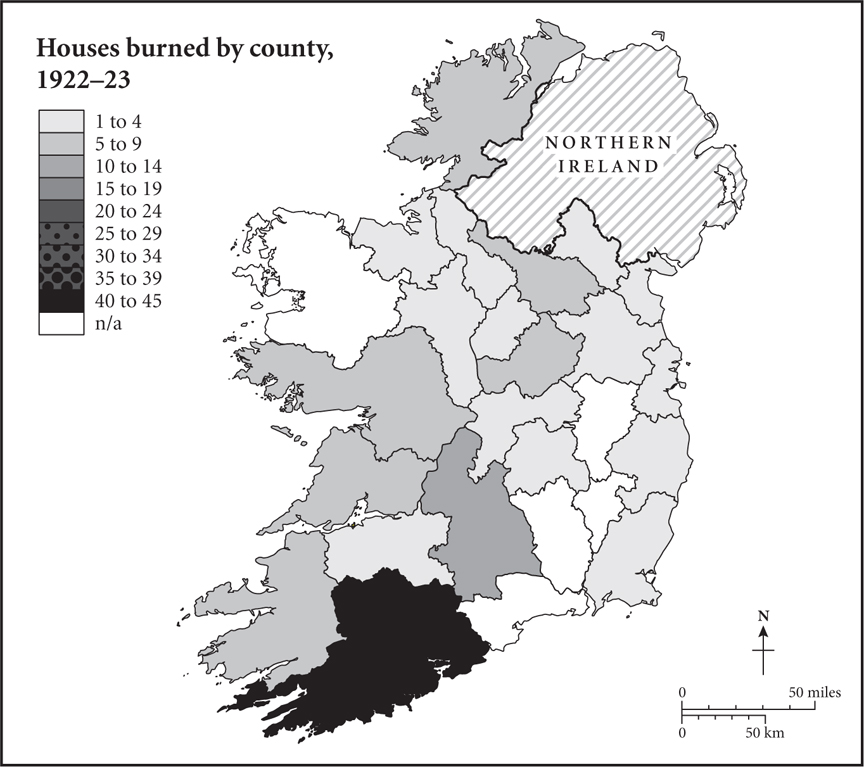
Map 3 County distribution of houses burned, 1922–23. Drafted by Dr Jack Kavanagh.
Those aristocratic senators who had chosen to support the new regime once again put their houses in the invidious position of being the most visible symbolic targets for anti-Treatyite reprisals in reaction to severe public safety legislation. On 28 September 1922, a Public Safety Resolution was sanctioned by the Provisional Government, which established military courts of enquiry authorised to impose death sentences on captured anti-Treatyites found guilty of attacks against the National Army, or offences related to ‘Looting, arson destruction, seizure, unlawful possession or removal of or damage to any public or private property. Having possession without proper authority of any bomb or article in the nature of a bomb or any dynamite, gelignite or other explosive substance or any revolver, rifle gun or other firearm or lethal weapon or any ammunition for such firearm.’150
On 19 December 1922, seven anti-Treatyites were executed in Kildare, which Breen Murphy has shown was ‘the largest individual set of executions during the Civil War’.151 The following month, January 1923, thirty-four executions took place, the highest recorded figure for any month.152 On 26 January, all OCs of anti-Treatyite Divisions were issued with ‘Operation Order No. 16: Senators’ by GHQ in Dublin. It stipulated those houses of Free State senators identified in two lists, A and B, were to be destroyed as reprisals for executions of anti-Treatyite prisoners, including Sir John Bagwell at Marlfield in Tipperary; the Earl of Granard at Castleforbes in Longford; the Marquess of Headfort at Headfort in Meath; the Marquess of Lansdowne at Derreen in Kerry; Sir Bryan Mahon at Mullaboden in Kildare; the Earl of Mayo at Palmerstown, also in Kildare; the Earl of Wicklow at Shelton Abbey in Wicklow; Sir William Hutcheson-Poe at Heywood in Laois; the Earl of Dunraven at Adare in Limerick; Sir Walter Nugent Everard at Randlestown in Meath; Sir John Keane at Cappoquin in Waterford; Sir Horace Plunkett at Kilteragh in Dublin; and Sir Thomas Esmonde at Ballynastragh in Wexford.153 In early February, the Chief of Staff of the anti-Treaty IRA, Liam Lynch, was reported in the newspapers as having declared that the IRA would ‘hold every member of the so-called Parliament, Senate and other House, and all other Executives responsible [for the executions], and shall certainly visit them with the punishment they deserve’.154 Eight of the above named senators’ homes were burned and an abortive attempt made on Lord Granard’s at Castle Forbes. The only exceptions were the homes of Headfort, Hutcheson-Poe, Dunraven and Everard.
On 29 January 1923, a party of armed men arrived at the Earl of Mayo’s Palmerstown House in Kildare.

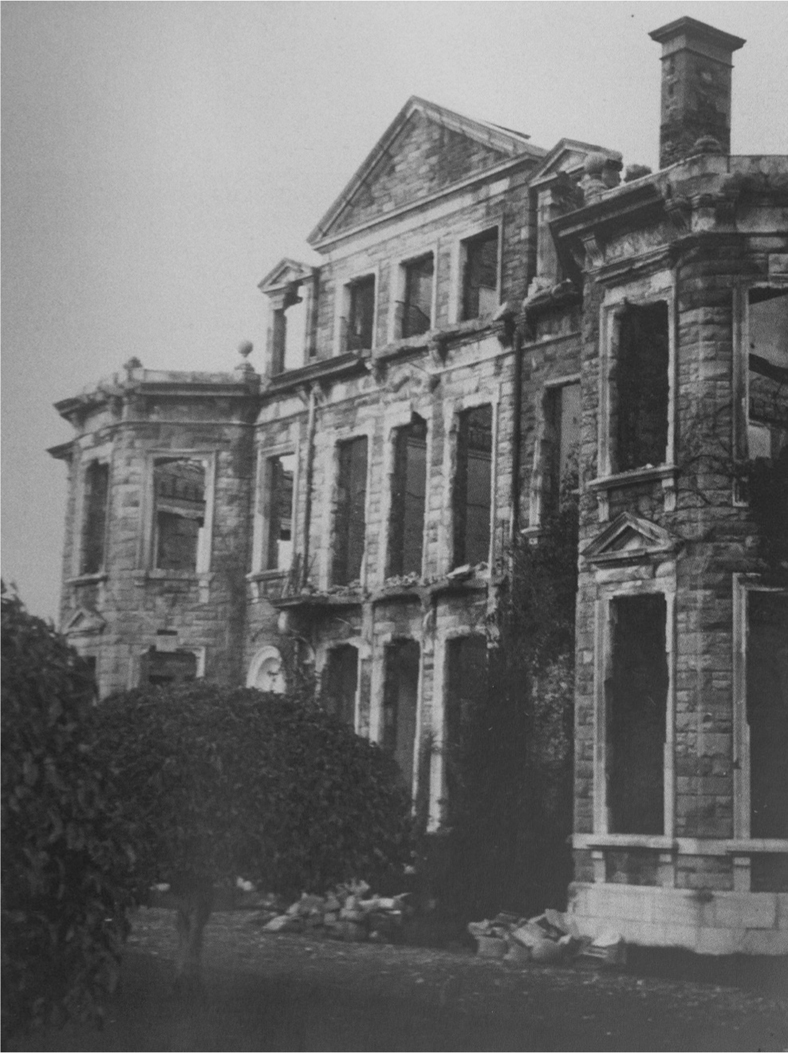
4.5 and 4.6 Palmerstown House, Co Kildare, before and after its burning during the Civil War. The anti-Treatyites told Lord Mayo they were burning the house as a reprisal for the execution of several of their comrades by the National Army. Mayo was also a senator in the Free State government, which made the house a target.
This was one of the few Irish country houses built in the last quarter of the nineteenth century and was very unusual, if not unique, in that it was constructed using funds raised by public subscription in commemoration of Richard Southwell Bourke, 6th Earl of Mayo, who in 1872, at the age of fifty, was assassinated on a tour of a penal colony on the Andaman Islands when Viceroy of India. Built in the Queen Anne style to the design of T.H. Wyatt, it cost an estimated £21,300.155 In 1923, its owner was Dermot Bourke, 7th Earl of Mayo. He had been prominent in the founding of the Kildare Archaeological Society, and along with his wife had founded the Irish Arts and Crafts Society. He had been disillusioned by the ousting of the aristocracy from national and local politics, declaring after his failure to win a seat in the 1899 county council election that it was ‘a great misfortune that the country gentlemen who have for many years administered and been identified with country government should have been so completely ousted from their position . . . they had spent years on Grand Juries and Boards of Guardians, and worked well with the most violent nationalists’.156 Nevertheless, he remained a prominent and conciliatory leader of southern Unionism, and was nominated to the Senate by W.T. Cosgrave. When the anti-Treatyites came to the front door of Palmerstown, the butler, suspecting their intentions, refused them entry. Another party knocked on the servants’ entrance door at the back of the house; this time, Patrick Behan, the hall-boy, let the raiders in. When they met Lord Mayo, they told him that they were burning his house in reprisal for the execution of their seven comrades in the Curragh, and that his house had been chosen because he was a senator. Mayo supposedly said to them, ‘Surely you are not going to burn this house full of beautiful things’, to which the reply was, ‘We have our orders, my lord.’157 The deferential tone may have been wishful remembering, or else it pointed to Mayo’s claim: ‘I know perfectly well who was engaged locally in burning my house.’158 The Curragh military fire brigade arrived around midnight but ‘could do nothing, the whole house being then in the grip of the fire, and the hose lines insufficiently long to secure any considerable quantity of water’. The fire raged all through the night, ceiling after ceiling collapsed with ‘deafening noise’, cut-stone window facings and turrets split with the heat and ‘flew in splinters and crashed to the ground’.159
A few weeks later, a group of armed men made their way to Senator Bryan Mahon’s home at Mullaboden also in Kildare. Neither he nor his wife were in residence at the time. The raiders had with them seventy tins of petrol stolen from the Anglo-Mexican Petroleum Company in Blessington, across the Wicklow border. The house servants were rounded up and ordered to pile the furniture into the middle of the rooms. The raiders broke the windows with the butts of their rifles to fan the flames. Then came the comedic part. One of the raiders, who had discovered Mahon’s British army general’s uniform, put it on in an act of mockery, and marched around the house, while a comrade, who had found a gramophone, placed it on the front steps and played a marching tune as an accompaniment to the cacophony of splintering furniture and crackling glass in the background.160 When the raiders left, the estate firefighting equipment was useless to combat the massive conflagration; so too was the Curragh military fire brigade, despite its 40 horsepower Denny engine capable of drawing water from a pond 130 yards down the avenue.161 When a reporter arrived from the Kildare Observer, he found articles of furniture scattered around the front lawn, and members of the fire brigade passing the family silver out through windows.162 The more valuable artefacts had already been removed to Dublin as a precaution following the earlier destruction of Palmerstown.
When the raiders came to Marlfield in January 1923, they told the Bagwell family (Bagwell himself was absent) that ‘They had orders to burn the house, as Mr Bagwell was a member of the Free State Senate.’163 A week before, according to the Clonmel Chronicle, 100 estate employees and their families had gathered for a party to celebrate Senator John Bagwell’s son’s coming of age and in time honoured fashion presented a gift signifying their ‘good feeling and loyalty’.164 If the number is accurate, and if many of these subsequently lost their jobs, the burning of Marlfield must have been extremely damaging to the local community and economy. Other houses belonging to senators’ relatives were burned too: Desart Court, home of the Earl of Desart, whose sister-in-law was a senator, and Moore Hall, home of George Moore, whose brother, Maurice, was a senator.

4.7 Moore Hall, Co Mayo, one of the grandest country house ruins in the west of Ireland. Burned by anti-Treatyites during the Civil War, its owner was a brother of Senator Maurice Moore, which may have contributed to its destruction.
But there were also many more houses burned in reprisal – or at least where reprisal was part of the mix – that did not belong to senators. When Greenhills was burned in Offaly in February 1923: ‘The leader announced they were Republicans who had come to burn the house as a reprisal for the execution of Patrick Geraghty’, who had been tried and executed on 27 January for possession of an automatic pistol at Croghan.165

4.8 Macroom Castle, August 1922. This is a rare photograph of a country house as it was burning. Note the crowds of curious people passing by.
In her study of everyday violence in the Irish Civil War, Gemma Clark has argued that ‘House burnings, assaults, boycotts and so on did not serve an obviously military plan.’166 In a like vein, while reflecting on the destruction of Mitchelstown by retreating anti-Treatyites, historian Bill Power has noted: ‘They [the IRA] also claimed pathetically, that by destroying the castle they were denying a base to their Free State enemies before whom they intended to retreat anyway.’167 Not long after the burning of Macroom Castle in the same county, state solicitor Thomas Healy pointed out that ‘It was considered by the people as a wanton act, unnecessary for the purpose of military operations or otherwise.’168
If there was no military logic to anti-Treatyite strategy, and they were not used as reprisal targets, there is an argument to be made that civil war conditions continued to provide further opportunity to dismantle the architecture of the Big House and to rid the countryside of the physical reminders of the coloniser, and to some this may have been at least as important as political or military struggle.169 As Robert Bevan argues, ‘The erasure of the memories, history and identity attached to architecture and place – enforced forgetting’ is very often an objective of the destroyers.
The sectarian dimension has not been comprehensively pursued in this work; would it serve any purpose given that the vast majority of Big Houses were Protestant owned? Big Houses were burned because they were owned by Protestant Loyalists, Protestant spies, Protestant senators or Protestant landlords; the evidence does not suggest they were burned simply because they were owned by Protestants. James Donnelly Jr at the beginning of his study of Big House burnings in Cork stated: ‘This is a worthwhile exercise partly because it sheds much new light on the strikingly wide extent of IRA attacks on the heavily Protestant gentry of Cork during the guerrilla war against Britain, especially in its last few months’, but concluded: ‘This examination of Big House burnings in 1920–21 does not offer any significant support to the view that members of the embattled Protestant landed elite of Cork were victimized because of their religion.’170
In this wider study, the same conclusion can be drawn. Knockabbey in Co Louth was Catholic owned. Local lore claims that the IRA burned it so that they would not be accused of sectarianism. In January 1923, when Ballygassan in the same county was attacked, its owner thought that it was for sectarian reasons but, when he put this to the leader of the raiders, he was told that it was ‘a protest against executions . . . We care nothing for religion.’171 In Irish rural society religion mattered a lot: in border counties such as Monaghan during the revolutionary period politico-religious divides gave rise to heightened sectarian tensions, but in the case of Big House burnings, while there is no doubt that religion may at times have been the incendiary, it did not cause the inferno.172 In the case of Ballygassan and most houses, other factors have to be considered including loyalism, social inequality, local jealousies, the desire for ancestral revenge and agrarian grievances, and these were very often all entwined.173 This is not, however, to entirely deny, as Clark reminds us, that ‘the deep-seated, almost subconscious nature of inter-denominational resentments’ remained ‘the lived reality for Protestants in the new country’, including the aristocracy, and she quotes Sir John Bagwell’s mother, who recalled Co Tipperary around the time of the burning of Marlfield: ‘Every man went in fear of his neighbour and the plight of Protestants living in lonely farms and cottages . . . was pitiable.’174 Harriet Bagwell’s juxtaposition of Protestants and farms brings us to the central theme of the next chapter, the role of agrarianism in Big House burnings, which will again emphasise that ‘anti-Protestantism was far too entangled with issues of landownership to explain on its own the violence against the planters’.175
9. ‘The corpses buried in the old laundry drying ground’
There were other houses fortunate to have survived occupation by either side in the Civil War and Birr Castle in King’s County (Offaly), home of the Parsons family, Earls of Rosse, one of the most significant houses in the midlands, is worth mentioning in this respect.
In July 1922, Crinkle Barracks in Birr was burned by anti-Treatyites and immediately the National Army commandeered Birr Castle as a substitute barracks. At first, Toler Garvey, the estate agent, was relieved as he had feared the worst for the castle after the burning of Crinkle. He explained to Geoffrey Parsons: ‘The place is now occupied by Gov[ernmen]t troops & I can feel easy once again as to its safety. There will possibly be fighting in the district but not in here now as it is held in force.’176 Garvey kept up almost daily correspondence with the family, advising, for example, the removal of furniture but equally assuring the family that ‘So far, no damage whatever is being done beyond dirt, which will, no doubt, entail the rooms being done up again when evacuated.’177 He kept an inventory of the furniture and utensils handed over by the housekeeper for use by the army; expressed his concerns to army GHQ about the amount of electricity being consumed, the use of the family boats on the river and the shooting of game. Eventually, he began to look for compensation for the occupancy of the Castle.178 On 5 June 1923, he wrote to the Board of Works explaining that as Lord Rosse’s mother could not return to the castle, she had to take a lease on No 1 Hyde Park Street, London, at a rent of £322 plus rates which came to £600 per annum. She also had to spend £1,500 ‘in putting it into order and redecorating it, which was essential’.179 The reply was favourable: the government was prepared to pay rent ‘at the rate of £1,000 per annum, £500 down for removal of furniture . . . and that the question of wear and tear, inside and out, is to be dealt with at the end of the occupation’.180 This sheds a different light on the occupation of houses by the National Army: they were not commandeered without payment.

4.9 Birr Castle, Co Offaly, home of Lord Rosse. Occupied by the National Army during the Civil War, it was for a while the burial ground of three young anti-Treatyites executed on the demesne. It remains in the ownership of Brendan Parsons, 7th Earl of Rosse.
There was a disturbing aspect to the occupation of Birr Castle which could have given the anti-Treatyites strong motivation to burn it. On 26 January 1923, three youths from Tullamore – William Conroy, Patrick Cunningham and Colum Kelly – were court-martialled for armed raids on houses in Ballycowan.181 The executions were carried out in the grounds of the castle and the young men were buried there. On 26 January 1923, Garvey, realising the dangers inherent in this, wrote to the OC of the National Army: ‘Acting on behalf of the Earl of Rosse’s Trustees I wish to enter a formal protest against executions taking place at Birr Castle and the burial of executed persons within the grounds. If such unfortunately had to be carried out, I do not think it should be on privately owned premises.’182 On the same day, he wrote to the Chief of Staff at Portobello Barracks: ‘I need hardly point out the stigma which will attach to the place in consequence, especially if the executed persons are buried there and I have to request on behalf of the Earl of Rosse’s Trustees that you will make other arrangements.’183 And, on the following day, he wrote to Geoffrey Parsons:
I am sorry to say that three executions were carried out in the Castle Grounds yesterday morning and the corpses buried in the old laundry drying ground close to the gravel tennis court. I wrote at once on behalf of the Trustees protesting against this having been done in private grounds and requesting that the bodies be re-interred elsewhere.184
A year later, on 3 January 1924, Garvey again wrote to the Chief of Staff:
I am directed by Lord Rosse’s trustees to inquire whether the time has not now arrived when the remains of the men executed last year and buried in the private grounds of Birr Castle could be safely removed and re-interred elsewhere. It is obvious that for many reasons they cannot be left indefinitely in the private grounds and though of course Lord Rosse’s trustees understand that the military authorities would in any case have the removal carried out before the premises are evacuated, there seems to be no good reason why it should not now be done.185
The three young men were later re-interred in an unmarked grave in Clonminch cemetery. Had the National Army evacuated before the end of the Civil War, Birr would have been very lucky to survive.
10. ‘It’s very strange to see a sentry by night in the gallery’
Finally, although outside the area of study, it is worth briefly comparing the Big House situation in the six counties of Ulster that became Northern Ireland following partition. In her study of this region, Olwen Purdue records no houses burned there during the War of Independence. She points to the fact that, given the very different politico-religious demographic, prominent aristocrats had the advantage over their southern counterparts of being better able to protect their homes. Sir Basil Brooke, for example, one of the founders of the Ulster Special Constabulary, had the comfort of four constables permanently guarding his estate, while fourteen policemen also guarded Caledon House in south Tyrone.186 In June 1921, as burnings in the south intensified, Lord Dufferin and Ava, one of the most prominent political aristocrats in Ulster, wrote to his mother:
I have ten men and 2 officers of the regiment sleeping in the house [Clandeboye]. They were sent here without any suggestion on my part. It’s very strange to see a sentry by night in the gallery with rifle and tin hat. . . . The officers stay in the billiard room and the men in the old steward’s hall. They have their beds there and it makes a splendid barrack room.187
It was not until May 1922 that the attacks on northern houses began, coinciding with the IRA’s campaign against Northern Ireland.188 On 5 May, Eoin O’Duffy, IRA Chief of Staff, decided to launch an IRA offensive in Ulster; according to his biographer this was with the knowledge of Michael Collins but not the rest of the Cabinet.189 The offensive began two weeks later, according to captured documents with the aim ‘to render impotent the so-called Government of Northern Ireland’.190 This goes some way to explaining the motives for the initial blitz in which eight houses were burned within a very short space of time.191 For example, Shane’s Castle in Randalstown, Co Antrim, which was the home of Lord O’Neill, father of Hugh O’Neill, Speaker of the Northern Ireland parliament. A week later, Culdaff House on the Innishowen peninsula, the home of Lord O’Neill’s agent, George Young, was burned.192 Young’s son was private secretary to Speaker O’Neill and his brother was Crown Solicitor for Derry. Crebilly Castle near Ballymena was the home of Ronald McNeill, later 1st Lord Cushendun, who was a Conservative MP and Parliamentary Under Secretary of State for Foreign Affairs.193 Political motives might not explain the burning of Garron Tower on 22 May 1922 which, at the time, was being leased as a hotel. According to a report in the Belfast News Letter the fifty or so raiders ‘appeared to have come over the mountain from the Parkmore district. They were led by men who spoke with southern accents, officers from some of the South of Ireland IRA headquarters, presumably.’194
The Northern Ireland government responded to the IRA offensive by proclaiming them as illegal (along with Sinn Féin and Cumann na mBan) and hundreds of suspects were arrested across the jurisdiction in a massive roundup by the Ulster Special Constabulary and the military.195 Coincident with these arrests came the burning of Oldcourt Castle in Co Down, the home of Lady de Ros, and Crebilly House in Antrim, which ‘was reduced to a pile of ruins, nothing standing but gaunt and blackened walls’.196 The Carnlough, Cushendall and Cushendun areas of Antrim subsequently witnessed pitched battles between the IRA and police (an estimated 150 IRA volunteers overran Cushendall village, where ‘for four hours a terrific battle raged between the invaders and the police’.197) On their way to Carnlough, the IRA burned Drumnasole House, home of the Turnley family. Thus, in most cases in Northern Ireland, political motives would seem obvious, though not certain, for Purdue also points out that one cannot dismiss the fact that ‘the continuing sense of insecurity provided ample opportunity for disaffected individuals to avenge their own personal grudges against landlords’.198
This common characteristic of civil wars – retribution for past grievances – also fed into the agrarianism to be dealt with in the next chapter; as Stathis Kalyvas has argued, internecine conflict often ‘provides a mere pretext, a costume in which to clothe the pursuit of private conflicts; it just disguises private and local motivations as political ones’.199 When, for instance, Castleffogarty in Tipperary was burned in April 1922, the Irish Times reported that it had been occupied by the Black and Tans until February.200 Its destruction meant that particular contamination, as local Nationalists might have perceived it, was eradicated. But in 1924, questions were being asked in the Dáil about the redistribution of part of the Castleffogarty demesne.201 Therefore, another purpose had been served by forcing the family away from the area permanently, which suggests why the role of agrarianism needs to be addressed separately. Land redistribution provides a motive powerful enough to be isolated from the others discussed in this chapter, arguably one which should be looked for in every individual case until it can be definitively excluded from the mix.