
5
‘Who does that demesne belong to, Colonel Buckley?’ ‘It belongs to me,’ Buckley replied. ‘Well, now, take a good luck at me while you can!’ the young man retorted, ‘That demesne belonged to me before you came over with Cromwell. My name’s MacFerris.’
(H.V. Morton, In Search of Ireland, London, 1930, p. 118)
When the mansion house is destroyed, the park and adjoining lands are more easily commandeered for distribution among the “soldiers of the republic”.
(Irish Claims Compensation Association, The Irish Free State: The Campaign of Fire, London, 1923, p. 8)
1. ‘Our day has come’
In his paper ‘Big House Burnings in County Cork’, James S. Donnelly argued:
Though agrarian motives played a relatively modest role in Volunteer decisions to burn particular Big Houses [during the War of Independence], what happened in the wake of these burnings before and especially after the Truce of 11 July 1921 provides strong evidence that agrarian considerations exercised considerable influence over the actions of the Cork IRA brigades and their leaders.1
Similarly, in The Decline of the Big House in Ireland (2001), this author had earlier made the point that ‘Of at least equal importance in the rise of burnings during the Civil War was the continued growth in agrarian agitation.’2 It was at the time a tentative enough conclusion but now with the benefit of hindsight, further research and the work of other historians it seems rather an understatement. In his 2011 study of house burnings in Offaly, Ciarán Reilly, for instance, concluded that at least seven of the twelve houses destroyed there ‘were targeted because of agrarian issues (and there is no discounting agrarianism as an ulterior motive in the others)’.3 Gemma Clark in her 2014 study argued that ‘Land hunger was a powerful motivator in Civil War burnings’ in the three Munster counties of Limerick, Tipperary and Waterford. But, going back to Donnelly’s argument, did agrarian motives only play a modest role during the War of Independence? What follows contends that his argument requires some modification.
Some context is required. Coincident with the ending of the Great War, a proliferation of organisations such as The Evicted Tenants Association, The Unpurchased Tenants Association and The Back to the Land Movement emerged, and these, as well as local committees, or even random gangs, began demanding in political and public arenas, or often in face-to-face confrontations with individual owners, that the remnants of the aristocracy and gentry (and, indeed, large farmers, who fall outside the scope of this study) should break up their demesnes and untenanted lands. Most of these worked with impunity. Galway was a very good example: in February 1920 at least seven landlords were approached to sell some of their lands, and it seems there was very little the authorities could do to prevent demands or intimidation.4 At the most extreme level, in March, Frank Shawe-Taylor was shot dead in the same county because he refused to negotiate the division of his estate. Kevin O’Shiel, a judge in the Dáil land courts, contended that his murder opened the floodgates to agrarian agitation: ‘The fever swept like a prairie fire over Connacht and portions of the other provinces, sparing neither great ranch nor little farm . . . inflicting, in its headlong course, sad havoc on man, beast and property.’5 In April and May, agitation on Lord Ashtown’s Woodlawn estate was aimed at ‘making a determined effort to secure land for distribution among the evicted tenants and landless men’.6 Mrs Palmer of Glenloe Abbey was ordered under threat of death to sell eighty acres of demesne land in front of the mansion to local uneconomic holders. It was reported that she offered to take £4,000, ‘but finally sold for £1,600, much below the value of the land’.7 Galway became such a hotbed of agrarianism that Padraic Fallon, born in 1905 and the son of a Galway cattle dealer, later contentiously recalled that ‘The War of Independence [in Galway was] . . . a land war and a class struggle, fought primarily against the Anglo-Irish ruling and landowning class rather than against England.’8 In total, twenty-four houses were burned there in 1920–23 (eight during the War of Independence and sixteen during the Civil War), by far the highest county total outside Munster. Agrarianism was a leading factor.
One of the more telling episodes occurred on the Ballydugan estate in the east of the county. There had been a generation or more of tension between the landlord, Michael Henry Burke, his tenants and uneconomic holders in the area because of his refusal to sell his estate under the Wyndham Land Act.9 In 1915, his precarious financial position eventually forced him to sell 300 acres to the Irish Land Commission for redistribution, but this was not enough to satisfy the land hungry. During and after the war, Burke was boycotted, locals grazed their cattle on his demesne and refused to take his lands on conacre, and this activity was intensified during the revolutionary period. The ringleader, Michael Dempsey, was a shepherd on the estate who resided in one of the estate lodges. In 1925, Burke recalled the intimidation to a friend:
Dempsey had given men to threaten my life on three different occasions and on the last occasion after they rushed into my bedroom [1921] and firing a shot close to my head, and then pointing the rifle towards my stomach made me sign a paper while Dempsey dictated his terms . . . He forcibly broke up my best meadow paddock and put as many stock on my land as he chose.10
Burke was determined, he said, not to reward Dempsey and his co-conspirators ‘with fine fat holdings and houses in the cream of the demesne’.11 On the night of 15 June 1922, when Burke was in Dublin seeking protection from the Provisional Government, three armed men broke down the front door, forced Mrs Burke and two servants into the outbuildings and set the house on fire, completely destroying it and its contents.12 Burke believed that Dempsey was ‘backed up by all the Irish Republican Army’, but Ann O’Riordan, who forensically investigated this case, found no evidence of IRA involvement, and concluded that: ‘The ongoing agrarian intimidation and the history of unrest in this region combined to form the primary motive for the burning of Ballydugan House – the desire for land.’13 Burke rebuilt Ballydugan in 1930 but he continued to be boycotted, intimidated and his house raided, while those who took his lands on conacre were attacked for years after. Land hunger did not abate after the Civil War, nor did the revolutionary experience of the Big House.
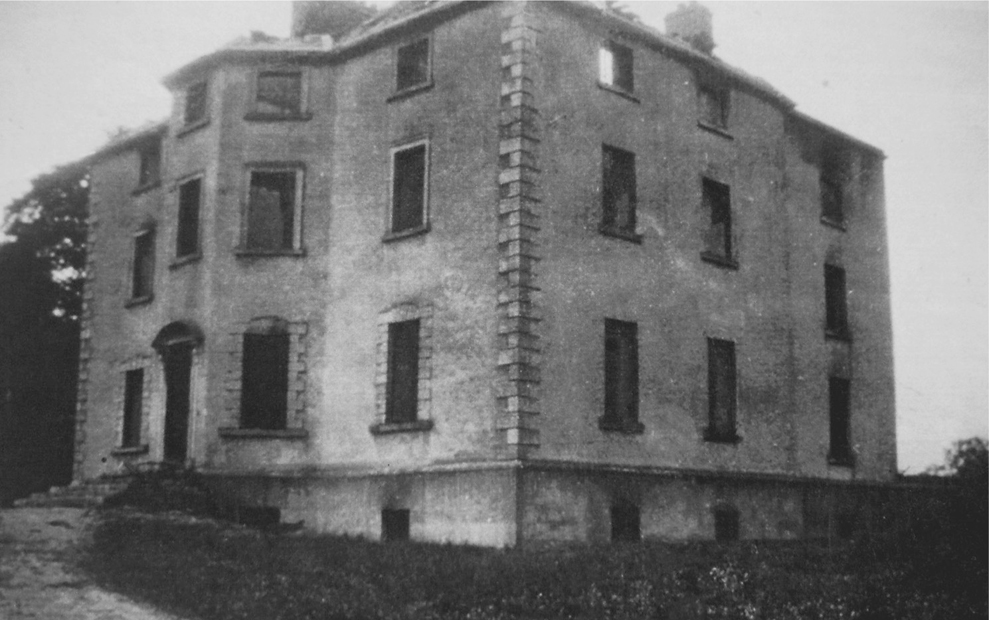
5.1 Ballydugan House, Co Galway, burned in June 1922, the motivation firmly grounded in local agrarian agitation and the demand for the breakup of the estate. The house was subsequently rebuilt in 1930.
When Art O’Connor, the Director of Agriculture, reported to the Dáil on the rise of agrarian crime that took place from the spring of 1920, he closely echoed O’Shiel’s reminiscence, stating that ‘The land war broke out with a virulence and a presage of danger which made the worst of previous years seem positively tame.’14 It is worth recalling that this was the very same time that the IRA were destroying hundreds of rural RIC barracks. It is difficult to quantitatively prove O’Connor’s statement because the data does not exist; the RIC could not gather crime statistics as reliably as in the past. However, the qualitative evidence goes some way to supporting both his and O’Shiel’s claims – and while agitation impacted all levels of agricultural society, it was certainly the case that the aristocracy came under more widespread attack than at any time in living memory.
In May 1920 alone, in Waterford 600 cattle belonging to C. Nugent Humble were driven off the land and outbuildings on his demesne were burned.15 In Leitrim, the military were forced to offer protection to Sir Gilbert King of Charlestown House to stop cattle raids.16 W.R. Hickey of Galtee Castle in Tipperary was threatened with death if he did not give up his grazing lands.17 The estate herdsman on the J.F. Kenny estate of Ballyglass House in Mayo was battered to death for failing to quit the employment of its owner.18 In Westmeath, 200 cattle belonging to Colonel J.D. Fetherstonhaugh of Rockview House were driven off the land.19 In Clare, death threats were made to the labourers on H.V. MacNamara’s estate around Ennistymon House because, it was reported, ‘Small landowners are endeavouring to compel the owner to surrender land for division.’20 In Roscommon, all farmhands and servants were forced out of employment on the Walpole estate and the military were called in to protect the land.21
The county of Roscommon was particularly affected. On 5 May 1920, buildings (though not yet the Big House) on Major Chichester-Constable’s Runnamoat estate were burned.22 On 29 May 1920, R.A. Corr wrote to the Roscommon Journal citing a letter he had in his possession that had been sent by Chichester-Constable to his herdsman in which he threatened he would be fired by 8 June unless he did his duty to ‘prevent the trespass of all stock on the lands under your charge, and to only allow such stock on the land as belong to the tenant’. Very publicly, Corr reminded Chichester-Constable that 8 June 1879 was the date on which Parnell and Davitt ‘stood side by side at the great Westport Demonstration, and made their first appeal to the Irish people to defend their homesteads and hold the harvest’. Corr concluded: ‘Some of us were only boys then, but we are seasoned soldiers today.’23 The threat was deep-rooted and clearly inherited from the Land War era.
In places where the landowner proved obstinate, O’Shiel recalled that there was often ‘a mute, significant and generally effective gesture, in the shape of a grave neatly opened on his lawn, or at his front door’.24 One landowner who experienced this was Charles Phibbs of Doobeg in Sligo. His ancestors had been landlords in the baronies of Corran and Tiretagh since the mid-seventeenth century. During the extended Land War from 1879 onwards, Phibbs was constantly in conflict with tenants over rents, turbary rights and after 1900 his purchase of a boycotted farm from Lord Harlech.25 He had long-term protection from the RIC, who were stationed in a hut on his demesne until the spring of 1920 when they were forced to evacuate by the IRA. According to Einion Thomas, Phibbs was at that stage a detested figure locally: firstly, because of his history of arrogant estate management, and, secondly, because of the perception that he was ‘the chief British sympathiser in the area’.26 By 1922, he was the target of both the IRA and local agrarianists. The former kidnapped and threatened to shoot him and the latter (but potentially both one and the same) daubed the walls of his home, Doobeg, with threatening graffiti and dug a grave outside his front door, at the head of which was planted a cross with the following epitaph: ‘Here lies the remains of Charles Phibbs/who died with a ball of lead in his ribs/His tenants are all aggrieved at as quick he went/for he went of a sudden without lifting the rent.’27 Phibbs heeded the warning and emigrated to Wales, where he settled on a 100-acre farm in Plas Gwynfryn, while the IRA took over Doobeg.28 Ten years later, the Irish Land Commission redistributed his demesne and untenanted lands for the relief of local congestion.29 It took a while, but the enforced exile of Phibbs had achieved its purpose.
As labour historian Emmet O’Connor has argued ‘radicalism was far more widespread’ in the post-war period than was once appreciated, and Bolshevism was a powerful inspiration to rural agitators.30 From the spring of 1920, Bolshevism was certainly a term growing in popularity amongst the aristocracy to describe what was unfamiliar to them, but which they generally equated with expropriation of their lands.31 In April 1920, Lord Oranmore recorded in his journal that he, Lord Midleton and Lord Desart had met the Lord Lieutenant and ‘represented to him the terrible state of the country more particularly with reference to Land Agitation which is starting once more in the West, which is virtually a form of Bolshevism’.32 Similarly, newspaper clippings kept by Sybil Lucas-Scudamore, who left Ireland after her Monaghan home, Castleshane, was burned in 1920, dealt with sensational accounts of ‘Rampant Bolshevism in the south’, and a published threatening letter of the type ‘received daily by Loyalists in Southern Ireland’:
If you don’t give back the money to the grabbers of the farms you sold and also give up the other farms . . . we are a few men who fought for Ireland and who burned your house, who are looking on and are determined to see justice done . . . no protection, official or unofficial, will save you from our vengeance. We might also say we hate Protestants as they would grind us and did when they had power. Our day has come.33

5.2 Charles Phibbs standing in a grave dug for him outside his home, Doobeg, in Co Sligo. The walls of the house were also daubed with graffiti, reflecting political beliefs of the day. After decades of agrarian agitation, the Phibbs family were eventually forced to leave the house for Wales.
Large landowners were perhaps fortunate that, in the early summer of 1920, the Irish Catholic hierarchy stringently denounced Bolshevism in Ireland.34 This was at precisely the same time that the conservative elements within the revolutionary Dáil began to tackle deep-rooted agrarianism; the coincidence of the two is inferred. The cause that incitement to land agitation had served in the popularisation of Sinn Féin had become problematic with the escalation in agrarianism, and TDs and ministers who came from propertied backgrounds suddenly recoiled. In June the Dáil decreed:35
That the present time when the Irish people are locked in a life and death struggle with their traditional enemy, is ill-chosen for the stirring up of strife amongst our fellow-countrymen; and that all our energies must be directed towards the clearing out – not the occupier of this or that piece of land – but the foreign invader of our country.36
The Dáil adopted a calculated dual approach of establishing arbitration courts to deal with land disputes and ordering that ‘the forces of the Republic be used to protect the citizens against the adoption of high-handed methods by any such person or persons’ engaged in agrarianism.37 Both went some way to quelling the agitation, especially in the west, but the threats to aristocratic land and property were far from over.38 And in a climate where there was a prevailing hunger for land it was inevitable that Big Houses would be targeted; it was the surest way to drive out landowners and hope that their demesnes, which they had held on to after the 1903 Land Act, would be redistributed. Therefore, agrarianism became a key factor in the burning of Big Houses, though not always the most obvious.
One of the ways to illustrate this is to revisit case studies presented in the previous chapter where the motives seemed clear cut. For instance, in the burning of Moydrum Castle on 3 July 1921 counter-reprisal was the most obvious motive and the one that has been widely accepted since. But might there have been an ulterior motive? Did some of the local IRA have another agenda in mind? What IRA leader Thomas Costello did not mention in his Bureau of Military History witness statement was that he and his two brothers had been actively involved in agrarian agitation in the lead-up to the burning. A year before, he, along with eight others, described as ‘sons of small farmers in the Kilgarvan district’, had been arrested for cattle driving from a farm belonging to a Protestant farmer from Mount Temple, George Johnston.39 Johnston had recently purchased a farm for £1,500 that the small farmers of the area had pursued. On the night before the cattle drive, a deputation had visited Johnston and offered him £2,000 for the seventy-acre farm but he refused the offer.
At the trial, Head Constable Feeney described the nine suspects as: ‘All small farming people, a lot of them are living on the edge of the bog. I know them all for a number of years. They are well-conducted, hard-working lads.’40 (Feeney was later described by Costello as ‘a moderate type of man’, perhaps suggesting that he held some degree of sympathy for republicanism.41) At that stage Costello was actually working as a shop assistant. He was, therefore, of the type – shop assistant from a farming background – that Lord Lieutenant French’s proclamation was intended to appeal to, except in his case he had already been an avowed Volunteer since 1917 and would become a member of the Irish Republican Brotherhood in early 1919.42 On 11 April 1921, a few weeks before the burning of Moydrum, Johnston was executed as a spy by the IRA.43 Costello, by then a local IRA leader, had no doubt that Johnston ‘was the principal Intelligence agent for the county’, and justified his execution on those grounds.44 However, one of Costello’s comrades, Henry O’Brien, captain of the Coosan company of the IRA admitted: ‘I have no knowledge of Johnston’s guilt and was just one of a party who were ordered to execute him.’45 This obviously begs some questions about motive, particularly in light of the prior agitation.
Agitation on the Moydrum estate began very shortly after its burning. Between August 1921 and October 1922, a long series of crimes was committed: they began with the burning of the gatekeeper’s cottage on the demesne. On 22 November 1921, the estate office was also destroyed; Eugene Dunne contends this was deliberate as all records such as rentals and accounts were lost, thus none survived of defaulting tenants on the unsold parts of the estate.46 During the Civil War, in May 1922, when Lord Castlemaine refused to take £2 10 shillings per acre rent for 125 acres of demesne land, locals responded by putting more than fifty head of cattle on the land to graze freely. In April 1923, the steward’s house was burned as well as several outbuildings, garages and stables, almost the entire demesne infrastructure. In December 1923, nine bullocks on the demesne had their tails cut, a cruel way of preventing them from swatting at flies, causing the cattle to become irritated and unable to thrive.47
Dunne has concluded: ‘While the desire for revenge was strong following the burning of houses in the Athlone area by crown forces, it was also a convenient pretext for the destruction of Moydrum Castle and Creggan House.’48 His point that ‘There appears to have been an orchestrated and systematic campaign of vandalism and intimidation to force him to leave the Athlone area’ has validity.49 By that time, Costello had grabbed part of the demesne lands and was grazing his own cattle there. They were seized by the Free State government under the Public Safety (Emergency Powers) Act, 1923, but what happened thereafter has not been ascertained, except that by the time Costello gave his BMH witness statement he was living at Shop Street in Drogheda.50 It may be the case that he was debarred from a land divide under the terms of the 1923 Land Act (see chapter 9). Nevertheless, in 1924, Lord Castlemaine, now permanently resident in England, had no option but to sell the Moydrum demesne and his other extensive untenanted lands to the Irish Land Commission, which then divided them amongst the small uneconomic holders in the locality.
Paul Bew has made the valid point that, ‘It is certainly not difficult to see how incidents which appear to be agrarian in origin, were transformed into significant episodes of the national struggle.’51 The corollary is equally worth considering: it is not difficult to see that actions that appeared to be driven by the national struggle were, in fact, motivated by local agrarian issues. Like Moydrum, the burning of Summerhill was not the end of its revolutionary experience. Peter Dolan, an IRA volunteer involved, was also a member of the local Garadice Back to the Land Movement. In 1922–23 this movement came together with the ITGWU and occupied a 400-acre holding of Langford’s at Laracor on the outskirts of Summerhill village. The intention was to force him to sell it to labourers who had lost their jobs because of the destruction of the house, and to redistribute what was left amongst the landless.
Langford’s agents, Thomas Crozier & Sons, defended his decision to dismiss his employees in a letter to the secretary of the ITGWU: ‘The wages bill was very heavy and as the house was burnt the present Lord Langford could not reside there, as he always intended to do. It cannot reasonably be expected that he should continue to pay some thousands of pounds per year in labour, which was almost entirely utilised in the upkeep of large gardens, pleasure grounds, avenues etc.’52 The ITGWU response was to call out the remainder of the labourers. Thus, Langford was faced with a rural alliance with only one thing in mind, the redistribution of his untenanted lands.
The murder of Sir Arthur Vicars and the burning of Kilmorna were attributed to him being a spy, but might there have been other ulterior motives? Vicar’s valet, Michael Murphy, said in his BMH witness statement that Vicars was ‘a thorough gentleman who mixed freely with the tenants on the estate which comprised 650 acres’.53 Murphy most likely meant that Vicars retained untenanted lands that he let on the eleven-month system to graziers, a contentious arrangement when there was such a hunger for land. Contemporaries had a strong sense of this. In April 1921, the month that Kilmorna was burned, the County Inspector reporting on several attacks on Big Houses in Kerry concluded: ‘I think the greed of land is at the root of this class of crime.’54 And the following month: ‘There appears to be a determination to burn out all the old gentlemen’s country houses. This is a Bolshevist scheme within Sinn Féin. The idea is to keep the old families from returning after “peace” and to grab their demesne lands.’55 In 1937, an eleven-year-old schoolboy, Thomas Flavin, wrote down his elderly neighbour’s version of what had happened at Kilmorna for the school’s folklore project; Michael Keane recalled that Vicars ‘was put up against a tree and shot dead’ and ‘Kilmorna [demesne] was breaking up every day from that on, until at last the land was divided among the uneconomic holders of the neighbouring district.’56 Vicars may have been killed as an informer but his death ultimately led to the redistribution of his remaining lands.
There were similar cases the length and breadth of Ireland. In her study of Co Louth, Jean Young has also shown that agrarianism was a factor in burnings there.57 Her detailing of the possible reasons for the destruction of Ravensdale on 18 June 1921 begins with ‘the presumed reason’ that it was ‘to prevent its use as a barracks’.58 However, as Young explains, this was another house no longer owned by the original aristocratic family, the Earls of Clermont. It had changed hands on several occasions since 1898 and most recently in 1919 when it was bought by Thomas Archer, a Dublin-based timber merchant, for £15,000. Archer was not interested in the house: he had made ‘a speculative purchase’ given the potential there was to sell hundreds of acres of timber from the demesne.59 As soon as he had the timber harvested, he put the house and 2,000 acres up for sale in May 1920 and bidding reached just over £22,000 before it was withdrawn. Just over a year later, the unoccupied mansion was burned, supposedly by the local IRA.60
But why had it and the demesne been taken off the market? The answer lies in the local agitation for the redistribution of its demesne. In 1924, Archer sold the 2,000 acres, not to the highest bidder, but to the Land Commission for £9,000, which was less than half of what he could have received four years before. Father McAleer, the Catholic parish priest of Lordship, had made it clear that ‘The local farmers who held miserable small holdings in his parish and in the adjoining parish of Jonesborough wanted an addition to their farms in order to make some sort of living.’61 The following year, Canon Peter Sheerin, parish priest of Upper Creggan, bought the salvage from Ravensdale for £250, and the building of his new Catholic church at Glassdrummond began in 1927: the granite Ionic columns and entablature of Ravensdale formed the portico of the church, while the bell tower was also reconstructed.62 At the time of its destruction, Ravensdale Park was no longer a ‘landlord’ residence: it was owned by timber merchants who were exploiting the post-war demand for woodland (and in the process altering a rural landscape that had remained unchanged for generations). There was no political contamination linked to their ownership, so there had to be an ulterior motive, and that motive was no different than if the house had continued in aristocratic ownership: it was to be found in the local demand for land redistribution.
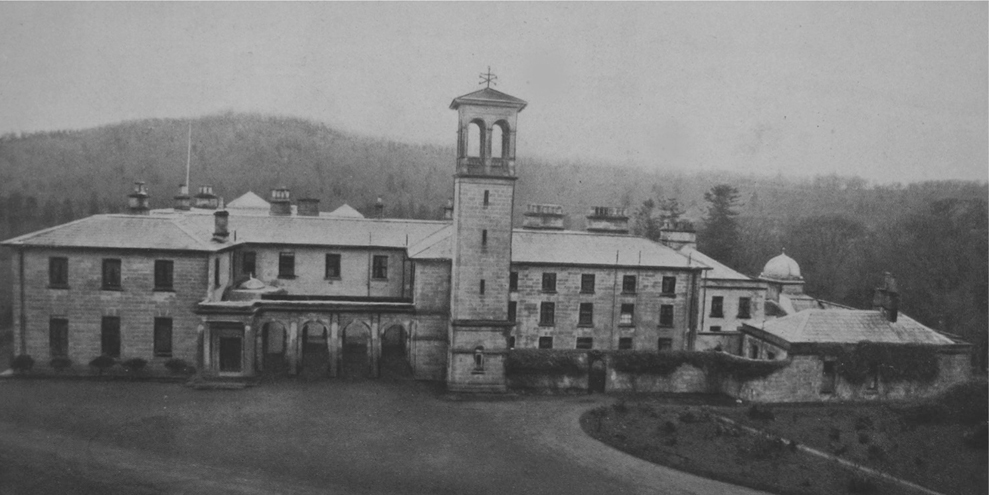
5.3 Ravensdale Park, Co Louth, burned in June 1921.
In neighbouring Monaghan, in March 1921, Gola House, the residence of William Black, was burned by the local IRA. Said to be one of the oldest (c.1703) and finest of Co Monaghan’s houses, it was architecturally unusual in that it was a five-bay Palladian design with an attic tower rising from the apex of the roof and single storey-wings. There was a rumour that the military intended to occupy it.63 This is substantiated in a handwritten IRA report in Monaghan County Museum that simply states: ‘Burning of Gola mansion by order of brigade OC’ (who at the time was probably Patrick McKenna).64 The burning had an afterlife. Black’s politics had made him unpopular with his Nationalist neighbours. He was a staunch Unionist and vice-president of the North Monaghan Unionist Association during the third Home Rule crisis. His grand-nephew believed that Gola was not burned because of possible occupation by the crown forces but because William ‘was a typical target of oppositional violence’.65 A great-grandson was more forthright: ‘It’s hard not to think that this [the burning of Gola] was political retribution for their Unionism rather than for their economic advantage over their neighbours.’66 His mention of ‘economic advantage over their neighbours’ may also have been instructive. This advantage was historically linked to the confiscation of Catholic lands in the county in the seventeenth century, and long held resentments played out after the burning when Black decided to sell his lands.
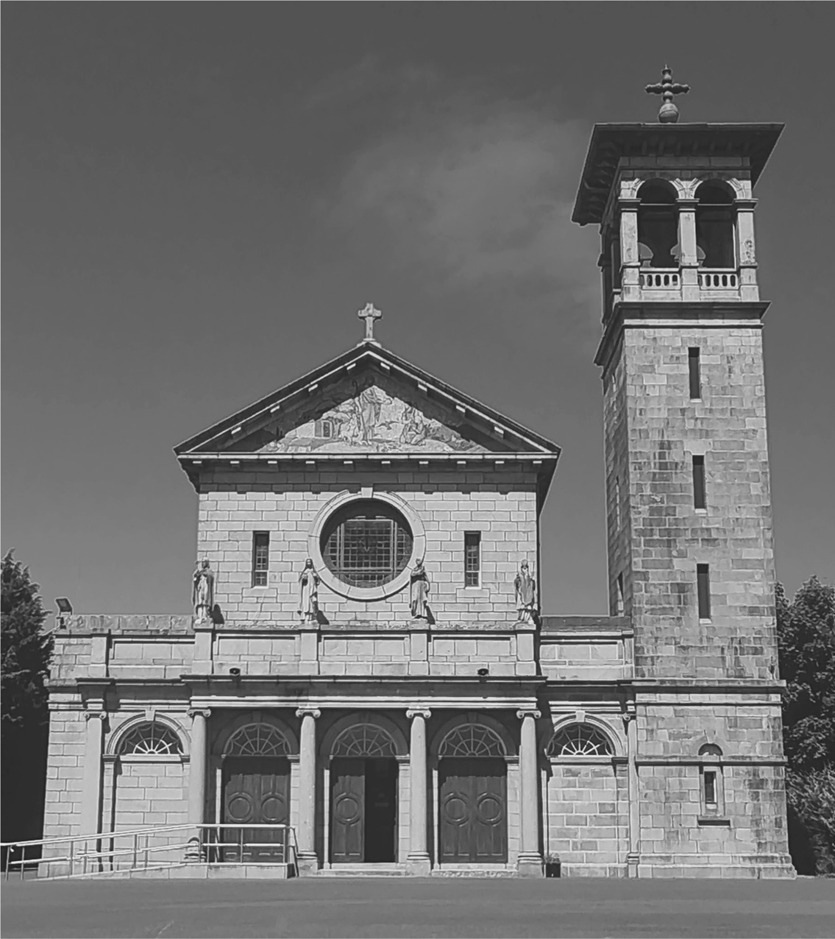
5.4 The salvage from Ravensdale Park was later used to build Glassdrummond Roman Catholic Church, a short distance away in Co Armagh. The architectural style of the original house was clearly replicated in the new church.
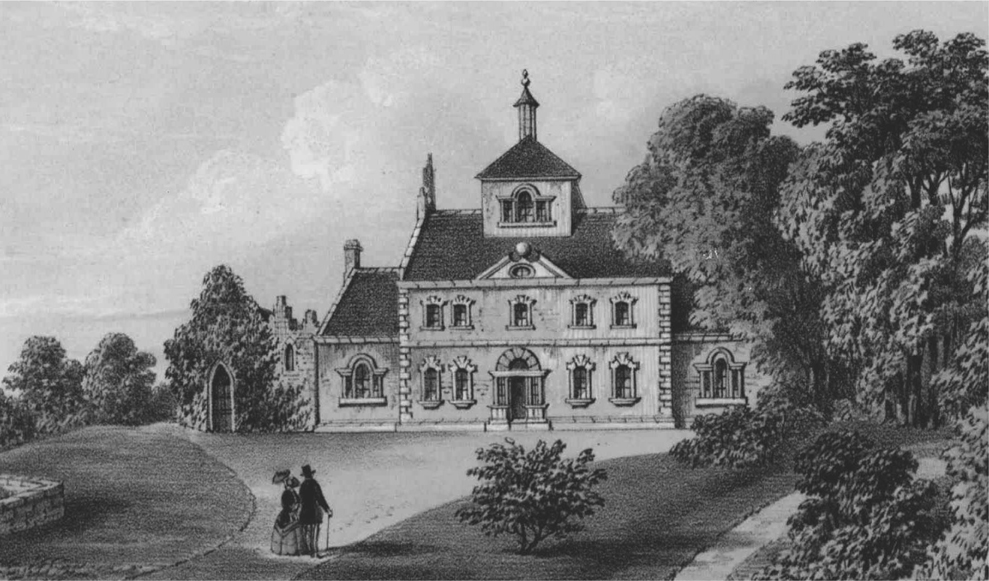
5.5 Gola House, Co Monaghan, one of the area’s most impressive and architecturally unusual country houses, burned by the IRA in March 1921, allegedly because the crown forces were about to take it over. Subsequent events also suggested a local agrarian motive.
On 11 September 1921, John Murray, the chairman of the Scotstown Sinn Féin club, brought the proposed sale of the estate to the attention of its members and proposed that ‘It should be divided into small farms and sold at a [?reasonable] price so that men in the neighbourhood or men who had sons in jail could have a chance, and that no strangers should be allowed to come in and give an unreasonable price.’67 Those with sons in jail were republicans; in all probability the dreaded ‘strangers’ were wealthy Protestants prepared to keep Protestant lands in Protestant hands. (Patrick Duffy in his monumental survey of landownership in Monaghan showed that ‘Vacated Protestant farms in the main were consolidated by neighbouring Protestant farmers. Thus, landownership did not reflect the upheavals which occurred in the Protestant community.’68) For the next twelve months, there was a good deal of local tension and anyone defying Sinn Féin law was intimidated: one man who took part of the Gola demesne for grazing had his cattle driven away, he was assaulted and ‘cow dung was forced into his mouth’. In the summer of 1922 Protestant demesne workers were warned to leave the district ‘or the coffins will be your lot’.69
Eventually, in 1924, by which time William Black had decided to leave Ireland and return to the Umtata region of South Africa, Father Philip Mulligan, the local parish priest, had purchased the demesne for redistribution amongst local farmers.70 How did this transaction take place? Did the Irish Land Commission officially sanction this land divide? The point needs to be made that the Irish revolution in all its complexities cannot be understood until the records of that state body are made available.
On the night of 25 April 1919, Oakgrove, Co Cork, the ancestral home of Captain John Bowen-Colthurst, was burned. During the Easter Rebellion Bowen-Colthurst had taken the pacifist and women’s suffrage-campaigner Francis Sheehy Skeffington as hostage when doing a tour of duty in Rathmines. Sheehy Skeffington witnessed Bowen-Colthurst’s murder of a young man named Coade that night and the following morning he and two other prisoners were shot in Portobello barracks. A court-martial followed but the plea was accepted that Bowen-Colthurst had been of unsound mind at the time of the murders. His actions undoubtedly explain the intimidation of his landed family in Cork that began as early as September 1916 when the police reported that both his mother and sister-in-law were being boycotted by Sinn Féiners.71 During 1919, the intimidation increased and culminated in the burning of Oakgrove in June 1920. A few days later, Drumgowna House, belonging to Bowen-Colthurst’s sister, Peggy, and Dripsey House, belonging to his mother, were burned within hours of each other.72 Donnelly points out that almost exactly a year later, raiders came back and burned what remained of the three houses.73 Revenge was undoubtedly present; as Donnelly points out Bowen-Colthurst’s atrocity was ‘seared . . . into the Irish nationalist consciousness’.74 But the return of the arsonists to finish the destruction of the houses also meant there were people who were determined to ensure that the three houses would not be reinhabited, and for good reason, to ensure the redistribution of the demesne lands.75 In January 1920, Oakgrove demesne was put on the market with a reserve of £10,000. No one would give the asking price – local nationalist communities were sending out clear messages of solidarity just as they had done during the Land War. It was eventually purchased by the Land Commission for just £4,000.76
In summation: what is evident from all these cases is that the burning of Big Houses such as Moydrum or Summerhill or Kilmorna, for whatever loose political or military reason, simultaneously ended centuries of landlord presence in an area and provided access to a sizeable amount of productive agricultural land to be divided amongst locals: in essence, micro social revolutions took place across the country. The inevitability of enquiry leading back to land issues was, as others have found, even more true of the Civil War period.
2. ‘This place is just sheer hell’
During the Civil War, the main theatre of political violence was much the same as during the War of Independence, the southern province of Munster. There, forty-nine houses were burned in 1922–23, accounting for just over 31 per cent of the total. Several counties, including Galway, Longford, Westmeath, Offaly, Kildare, Kilkenny, Monaghan, Meath, Cavan, Leitrim, Roscommon and Donegal, ‘saw hardly any fighting’.77 Yet in those counties seventy-three houses were burned, almost 47 per cent of the total, so there must have been factors other than militarism at play. Existing analyses of revolutionary violence across the 1920–23 period have their shortcomings, most especially because they ignore social or agrarian crimes. Thus, there is validity in Gavin Foster’s questioning of Peter Hart’s ‘narrow conception’ of revolutionary violence as exclusively IRA violence measured in ‘casualties per 10,000 people’, because it ignores, as Foster puts it, ‘the victims of labour, agrarian, sectarian, and criminal violence whose perpetrators do not appear to have been volunteers’. It fails to capture the much wider picture in which people’s everyday lives were disrupted as much by social and agrarian crimes as political crimes.78 The burning of country houses is a case in point.
J.C. Davies in his seminal paper, ‘Towards a Theory of Revolution’, put forward the argument that ‘Revolutions are most likely to occur when a prolonged period of objective economic and social development is followed by a short period of sharp reversal. People then subjectively fear that ground gained with great effort will be quite lost; their mood becomes revolutionary.’79 As well as people who do not want to lose what they have gained, there are, of course, many others who strive for a more equitable share of those gains. Davies’s theory, summarised as the revolution of rising expectations, was later employed to good effect by James S. Donnelly Jr in his examination of the Land War in Ireland when the economic downturn of the late 1870s, following upon a period of sustained economic growth, gave rise to the Land League, an organisation which the aristocracy regarded as revolutionary in composition and intent.80 One should not, therefore, overlook the parallels with the post-war era and the fact that the Civil War was fought amidst an economic depression that followed the unprecedented economic boom of 1914–18.
In the aftermath of the war, the British and home markets were flooded with wheat, meat, wool and other agricultural products from the trans-oceanic countries and, as had happened in the late 1870s, the price of agricultural produce dropped dramatically, and the farmer was once again badly hit. According to a report of the Department of Agriculture and Technical Instruction, 1922–23 was a ‘a year of anxiety and struggle’.81 In 1923, an unusually late spring characterised by heavy rains, followed by harsh winds and night frost in April and May and a cold, sunless summer badly affected the harvest.82 Because of global depression, the agricultural price index (1911–13 = 100) which had stood at 288 in 1920 slumped to 160 in 1924.83 There was continued rationing, food shortages, growing inflation and the exploitation of market shortages as greedy shopkeepers and merchants breached price regulations. The less well-off faced a daily struggle, which, as we shall see in chapter seven, explains to some extent the widespread looting of demesne vegetable gardens during the Civil War.
Agrarian agitation during the Civil War followed a well-worn historical path, beginning in the western counties, where socioeconomic conditions were so bad that the Irish White Cross set aside £25,000 for the relief of distress there in the spring of 1922.84 It has been stated that the IRA in the west went predominantly anti-Treaty; according to David Seth Jones, they drew the bulk of their support from the small farmers and agrarian radicals.85 In May 1922, Colonel Maurice Moore, whose brother owned Moore Hall in Mayo (burned 1 February 1923), wrote to the Minister for Defence: ‘The anti-Treaty politicians and IRA, finding themselves in a hopeless minority, have adopted a policy very dangerous to the country and to the present ministry, though it has not been openly avowed. They are now making a bid for support through an agrarian movement.’86 In what had become a tradition in Irish politics, anti-Treatyite leaders looked to the timeless slogan of ‘the land for the people’ to popularise their continuation of the struggle, which did have an agrarian agenda that very much focused on the aristocracy and their Big Houses.
On 1 May 1922, the anti-Treatyite Four Courts garrison issued a circular to divisional commandants informing them that the IRA Army Council had sanctioned ‘that certain lands and properties in this country shall forthwith [be] seized and controlled . . . on behalf of the army council in trust for the Irish people’. These were to include the demesne lands and mansions of absentee landlords and ‘transient landlords’ (those who resided in Ireland only for brief periods) and ‘whose records show hostility to the National interest’. Notably, landlords who resided permanently were to be left in possession of their mansion houses but only with sufficient land to provide them with adequate means of subsistence. The ‘favourable national record of a landlord’, whether, for example, he or she provided employment, was also to be considered (as it would be after the passing of the 1923 Land Act). Socialist republicans such as Liam Mellows, who was amongst the Four Courts garrison, and Peadar O’Donnell, who came under Mellows’s influence when they were both in Mountjoy gaol, both strongly advocated the confiscation of all the large demesnes and estates and their distribution among the landless and agricultural labourers.87 In their 1923 propaganda pamphlet, the Irish Claims Compensation Association drew attention to Mellows’s teachings when setting out what it regarded as the main reasons for the burning of country houses.88
The Anglo-Irish treaty did not deliver a thirty-two county Irish republic but that was not necessarily the most important consideration on the minds of small farmers, the landless and agrarian radicals, including former members of the IRA.89 O’Donnell was later condemnatory of the fact that: ‘All the leadership wanted was a change from British to Irish government; they wanted no change in the basis of society.’90 Rank and file IRA disappointment was eloquently expressed by a Monaghan Volunteer, Tom Carragher:
During the period of the Truce, the politicians and respectables took over. It was they who interpreted our dream, the dream we fought for. It was they would decide the terms to which we must agree. In the mind of every soldier was a little republic of his own in which he was the hero. But his dream was shattered. The process-server that he once made easy talk to was back in business, the same gripper, the same sheriff with the same old laws while the little hero was back at his plough.91
The lines between agrarian agitators and the anti-Treaty IRA became blurred. At the beginning of March 1922, a report appeared in the Tipperary Star under the heading ‘Land for the IRA’ in which ‘A landless, penniless soldier of Ireland’ pleaded:
Hundreds of us have not a perch of land nor a peep at the prospect of an individual livelihood in the country we fought for. We cannot all become clerks, police, or soldiers. There are many other ranches besides the Clanwilliam areas for distribution. What about the areas around Dundrum and Cappawhite and lands elsewhere in Tipperary?92
While in the Mansion House in Dublin politicians debated forsaken principles and fealty to the British crown, in rural Ireland ordinary people waited for the sanctioned transfer of their farms and many more for the redistribution of untenanted and demesne lands. Some became impatient. At the beginning of the truce period, the County Inspector of Tipperary reported: ‘The hunger for land is great, those who are landowners want more, while those who have none and who have been gunmen believe that the estates of Loyalists such as Kilboy once cleared will be divided up amongst them.’93 There was a suggestion here that a confusion of people were involved in the campaign for land redistribution, but also that those who fought in the IRA felt they deserved some material reward. Kilboy was burned a year later. It will probably never be established who was responsible, but the motive was clear enough.
Kilboy was owned by Henry O’Callaghan Prittie (1851–1927), 4th Baron Dunalley. In the 1880s, his north Tipperary estate covered just over 21,000 acres. The bulk of it was sold under the land acts but in 1906 he still retained around 2,500 acres, including a 550-acre demesne, and large tracts of untenanted lands in townlands such as Cooleen (370 acres), Curryquin (320 acres), Lahid (400 acres) and Templederry (215 acres). That area of north Tipperary witnessed large scale IRA violence during the War of Independence, bitter strife during the Civil War and agrarianism throughout both. Kilboy’s tale of woe began shortly after the Anglo-Irish truce, at a time when no local markets were being held, food prices were soaring and socioeconomic and political chaos fomented criminality.
On 13 November 1921, the first in a series of raids on the mansion resulted in the theft of silver pots, cuff links, overcoats, a silk muffler valued at almost £137, brass finger bowls, a razor, torches and other household items valued at over £400.94 These seemed clearly to be thefts of valuables for profit. In the spring and summer of 1922, there was a change in orientation: raiders focused on farm machinery, livestock and timber, they stole a horse and cart, tools from the outbuildings, ploughs, harrows, 40 head of cattle (valued at £800) and 50 sheep (£50), while outside almost 800 trees were either cut down or damaged, and 400 yards of fencing, including stakes and wire netting, were stolen. In total almost £6,000 worth of looting and damage.95 It could be said that these materials were all stolen because they were all useful to local farmers, but it should also be considered that their theft made Dunalley’s ability to farm impossible. If he could not work it, what purpose did his demesne farm serve?
Evidently, Dunalley did not get the intended message, so his assailants went a step further. On 28 May 1922, a volley of shots was fired at him as he was on his way to church.96 Four more attempts followed, including shots fired at himself and his wife as they stood on the steps of Kilboy itself.97 Years later, their grandson Henry Cornelius Prittie claimed that he spoke to one of the men involved, who was then working as a porter at Nenagh railway station: ‘He told me there was no ill feeling and they had nothing against my grandparents but their orders were to drive them out.’98 By the summer of 1922, the Dunalleys felt ‘so persecuted’ that they decided to leave for England.99 While a certain political hostility existed towards Dunalley, land redistribution issues were more central to the intimidation. On 19 July 1922, Howard Dudley, the family solicitor, reported to Dunalley that the fences on the Kilboy demesne ‘were completely down’ and that locals had driven their own cattle onto the lands to graze.100 The estate steward, Samuel Doupe, was visited by nocturnal raiders who threatened to shoot him if he did not leave the locality within the month. He wrote to Dunalley: ‘This place is just sheer hell. With the [farm] machinery gone I don’t see how we can carry on.’101 On the night of 2 August, Kilboy was burned. Towards the end of the month, Dunalley, whose income stream had dried up, instructed Dudley to let the meadows at Dolla and Cooleen on conacre, but anonymous warning notices were soon posted throughout the area threatening anyone who would take these lands. Dudley told Dunalley it was useless trying to proceed because any prospective purchasers would be targeted by the ‘local mountainy men’.102 One of these, Jim ‘the Ginnett’ Murphy, is said to have boasted that, in time, ‘Dunalley will be thinning turnips for me’.103

5.6 Kilboy House, Co Tipperary. Subjected to a number of raids and robberies during the War of Independence, the house was burned in August 1922 because of local agrarian tensions.
On 1 May 1923, as a new Land Bill was about to be introduced in the Dáil (chapter nine), Dudley predicted to Dunalley: ‘I do not think that the present government have the money to finance Land Purchase on any large scale . . . I don’t see where the money is to come from to buy up large tracts of land for division, and even if they attempted this it would be at a very low price.’104 On 18 May, Dudley again warned Dunalley of the difficulties in letting the lands on conacre: ‘Though there are several prospective purchasers who could put down the money they will not be allowed to do so by other more turbulent spirits, particularly the men in the mountain area who will not allow anyone to touch their lands at present.’105 Moreover, there was now a fear that if the lands were let the new occupiers would hold on to them ‘permanently no matter what agreement they sign’ and then, as ‘tenants’, attempt to avail of the new legislation.106 Dudley suggested selling to ‘outside committees’ for cash rather than wait for a Land Bill to deal with the untenanted estate; cash, he told the estate agent, was still king.107 And there was a final consideration, and an important one: Dudley believed that if Dunalley sold the greater portion of his estate voluntarily, ‘this would help to ensure his safety and give him a better prospect of living there in peace’. At that stage, Dunalley had made his intentions clear that he was going to rebuild Kilboy.108
For the next eighteen months, local political representatives lobbied for the purchase and redistribution of Dunalley’s lands. On 30 October 1924, Domhnall O’Muirgheasa TD asked Patrick Hogan in the Dáil whether ‘the Land Commission had or propose to acquire the lands at the Dunalley estate, the progress made if any and when they would be in a position to parcel out the lands between uneconomic holders and labourers’, to which Hogan replied that ‘steps were being taken’ and ‘when the lands are acquired they will be allotted as expeditiously as possible’.109 Two months later, the Land Commission offered £16,000 to Dunalley for his untenanted lands, which he accepted.110 Dunalley managed to hold on to his demesne and to rebuild Kilboy, but the burning of the house had ultimately expedited the sale of his untenanted lands. The available sources do not reveal who burned Kilboy, or whether they had any IRA connections at all. The extent to which this really mattered probably played itself out in a local power struggle with the Irish Land Commission in the years after as the land was being divided; it is a great shame, therefore, that the Land Commission inspectors’ reports are not available to illuminate that struggle!
The burning of Lord Lansdowne’s Derreen in Kerry had a similar context and outcome. During the Civil War, the new government found it difficult to establish any semblance of authority in that county, where again the IRA went predominantly anti-Treaty.111 On the Lansdowne estate, in 1922, conditions were described as ‘anarchic’ as boathouses were burned, poaching became the order of the day, and robberies from Derreen House and the demesne became ‘frequent’, culminating in the burning of the house on 20 September 1922. This was a particularly high-profile case. Henry Petty-Fitzmaurice, 5th Marquess of Lansdowne, had been Governor-General of Canada, Viceroy of India, Secretary of State for Foreign Affairs, leader of the Unionists in the House of Lords, and by 1922 a senator in the Irish Free State. Until the 1880s, he owned 122,000 acres in Ireland. His reputation as a landlord was tarnished during the Plan of Campaign of the mid-1880s, when landlord–tenant relations on his estates deteriorated badly, accentuated by his removal of thousands of tenants in emigration schemes.112 He himself fell from grace in British political circles at the end of 1917 when he publicly declared that Britain could not win the war, but he still remained a public figure of some note.113
Arguably, the destruction of Derreen could have been to rid the area of a strong colonial presence; this was certainly the way it was presented by the Irish Compensation Claims Bureau in London, who used the burning of Derreen to bolster their propagandist argument: ‘The process of destruction which has been applied to Lord Lansdowne’s residence is only part of a well organised system which is being applied at the present moment all over Ireland for the murder and expulsion of the Irish gentry, their dependents, and all those who have in the past shown any British sympathy.’114 Lansdowne’s name also appeared on the list of senators’ homes to be destroyed in reprisal for the execution of anti-Treatyite prisoners. However, the local rector, Reverend Almoner, made a telling disclosure to the Minister for Home Affairs regarding who he thought was responsible for the burning: ‘The offenders were Republicans and Free Staters in about equal proportions and acting on no mandate but their own.’115 In other words, the destruction had nothing to do with civil war politics. Before he died in 1927, Lansdowne sold his estates to the Irish Land Commission, the primary outcome desired by those who wreaked havoc on the estate in 1922–23.
In early June 1922, Sir John Keane, also a senator in the Irish Free State government, recorded in his diary that he and his wife and two servants were the only people at Cappoquin House, commenting: ‘The country is in a state of anarchy and we’re preparing for a siege,’ and that, for them, ‘Times are nerve racking. Every day one or more problems arising out of lawlessness. It may be good for the wits, but it is trying to the nerves.’116 A few months later, at the beginning of January 1923, as the burning of houses escalated and those of senators were being targeted as reprisals for the execution of anti-Treatyites, Keane wrote: ‘As a senator I am warned to be discreet in my movements and I find I look around when crossing from the club to see if anybody is watching me. Similarly, I take careful notice of people who follow me.’117 On 5 February, two weeks before his house was burned, he observed: ‘Daily reports from Ireland of burning houses: ours must go in time.’118 By then, like so many others, he had begun to take precautions by removing valuable contents.119
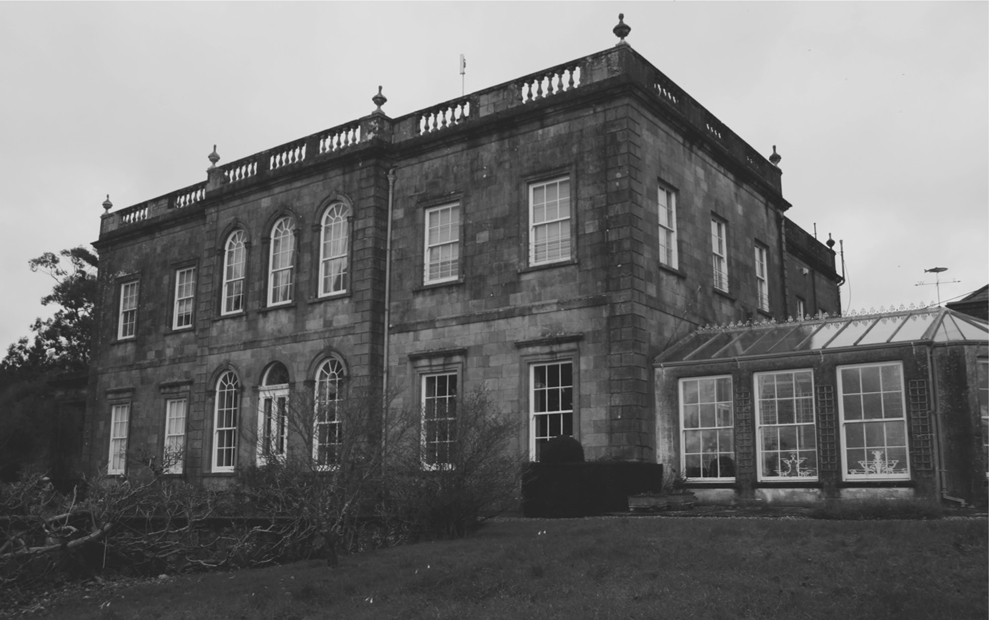

5.7 and 5.8 Cappoquin House, home of Sir John Keane, and the telegram he received informing him of its destruction. Cappoquin epitomised a country house where a variety of factors possibly fed into its destruction. The house was rebuilt a few years later and is still owned by the Keane family.
It would be easy to attribute the burning of Cappoquin to the fact that Keane was a senator. But, while it played a role, Glascott Symes’s study has shown that it was not all-important. During the Civil War, Keane had feared that ‘a bitter class war’ was inevitable.120 At the time, he was chairman of the Waterford branch of the Irish Farmers Union, which had established a national network in the aftermath of the First World War, its leaders drawn predominantly from the old landlord class, the same men who had led the Irish Landowners’ Convention. Simultaneously, the ITGWU formed a branch in Cappoquin. In the agricultural downturn of 1922–23, both organisations came into conflict as the farmers of the Blackwater Valley wanted to reduce wages by up to 30 per cent, while the labourers stood firm. Cappoquin demesne found itself at the centre. In June 1922, Keane’s estate employees went on strike. Conditions in the area deteriorated and, while it cannot be certain that his employees were involved, his cattle were driven from the demesne (though later retrieved), and like many other former landlords he was forced to go to Dublin to speak with Patrick Hogan, whom he found ‘sympathetic and angry’ about the way rural Ireland had deteriorated into social anarchy.121
Over the next year, the Blackwater Valley became embroiled in further labour disputes: Keane received threatening letters, the ‘Sinn Féin flag’ was flying over neighbouring Lismore Castle, which had been commandeered, demands were being made for the redistribution of lands and, on 23 June 1923, 500 men of the Special Infantry Corps, established in March by the Free State government to tackle agrarian crime, were drafted into the county.122 The labour strike was resolved on the Keane demesne, but it left a bitter taste amongst trade unionists. On 12 August 1923, an article entitled ‘Keane’s Battered Halo’ appeared in Voice of Labour, deploring his employees for returning to work at reduced wages and concluded: ‘We have less contempt for them than we have for Keane. For his feat in humiliating his men to this degradation, he is now welcome to all the glory that he is due in this world and the next. The end is not yet, Sir John.’ As Glascott Symes concludes, Keane’s role as a senator is not enough in itself to explain the destruction of Cappoquin by anti-Treatyites; the climate of bitter hostility towards him because he had ‘taken a strong line during the farm workers’ strike in support of landowners’ may have been just as pertinent.123
3. ‘Give the land back to the rightful owners’
On 1 March 1923, President W.T. Cosgrave addressed the Dáil informing its members that there had been cases ‘in which mansions have been destroyed for the very express purpose . . . [of] making it compulsory upon the owner of a demesne or other land to have it distributed amongst certain people’, but, he warned, ‘We are going to see in such cases, as far as the resources at our disposal permit, that no such distribution of land will take place to persons who have practised the destruction in order to gain their ends. I think it is the duty of the State to do something of that sort.’124 More broadly speaking, the government had to get a grip on rural Ireland and ease the tensions around land issues. On 1 April 1922, representatives of ninety-five unpurchased Ulster estates had attended a conference in the town hall in Cavan where they resolved that no rents would be paid pending a successful land purchase scheme.125 That same month, at the far end of the country, the unpurchased tenants in Bantry in Cork held a large meeting where it was agreed to demand 50 to 60 per cent reductions on rents until purchase took place.126
Shortly after, the regional movements came together in Dublin to form a national organisation. A representative from Tullamore in Offaly told those gathered that ‘The lands had been unjustly acquired by force from their rightful owners by the landlords, and it was for the Republican government, now that the British force was gone, to do what lay in their power to give the land back to the rightful owners.’127 At that stage, Patrick Hogan estimated that there were only 10 to 15 per cent of estates in Ireland where rents were paid up to date; otherwise some were up to three years in arrears.128 Moreover, annuitants were not making their annual payments to the Land Commission, in anticipation of independence doing away with them completely. This was a situation that had to be addressed in the interests of future national prosperity and international credibility. When Cosgrave addressed the Dáil in March 1923 the government was in the process of preparing a suite of legislation to achieve stability. The Compensation Ireland (Act) was passed in May (chapter 7) and the Irish Land Act and the Public Safety (Emergency Powers) Act were both passed in August.129 All three would work in tandem to facilitate the state in restoring law and order, to garner support from the democratic majority and to show the new state’s resolve to punish its enemies, past and present (chapter 9).
There are many international parallels to what happened in Ireland as evidenced in Stathis Kalyvas’s influential work The Logic of Violence, which demonstrates how the privitisation of the politics of civil war, personal conflicts, selective violence, the denunciation of targeted civilians and so on can come to the fore. While considerable work needs to be done on these issues in Ireland, this work has indicated that the burning of Big Houses is as good a place as any to begin. In the final analysis, while a Big House owner may have been a Protestant and a Unionist/Loyalist, a spy or informer, it was their traditional role as landlord that explained the lingering resentment in many localities, especially amongst those who had agrarian as opposed to political agendas, and it is arguable that the former were in the majority.130 Thus, as we have seen in this chapter, the burning of Big Houses, and more widespread intimidation of their owners, was an effective stratagem to drive the owner away, leaving lands available for redistribution.131 Hence, when the exiled Herbert Sullivan applied for compensation for the burning of his home, Curramore House (August 1922), his representatives claimed: ‘But for the driving of Applicant out of the country and keeping him out, these lands would not have been acquired under the . . . 1923 Act in Ireland.’132 While countrywide agitation affected farmers as well as Big House owners in 1920–23, the large holdings of the aristocracy were the most prized of all and, as it turned out, not just by the smallholders and landless who demanded land, but also by the Free State government, who saw in compulsory acquisition and redistribution a political expedient to restore social stability in the countryside (chapter 9).