
The colonization of the night met with sustained resistance from the urban night’s traditional inhabitants: patrons of public houses, young people (servants, apprentices, and students), and lackeys, prostitutes, and criminals. In the struggle for the urban night estate, age, and gender were deployed to mark the shifting lines between respectable and prohibited night life.
With the introduction of public lighting and the improvement of the night watch, the streets of Paris, London, and other European cities seemed safer and more convenient to use, while the evening became a more important part of the respectable social day. The ability to free the night from its darkness testified to the power and authority of the sovereign: “so much do great spirits please themselves in striving with nature and seeming to give a law to it,” as an English officer noted in his description of the projects of Louis XIV in Paris and Versailles.17 The lighting evoked both security and sovereignty.
But did lighting the night truly provide security or glory? Whatever the benefits of street lighting in the early evening, they faded as one ventured deeper into the night. After enthusing about the superiority of Parisian street lighting over that of London, the English author of A View of Paris (1701) contrasted the policing of the night in the two cities:
The Streets [of Paris] are secured by Night, not by a Watch with a Lantern, as in London; but by a Guard of Soldiers, called le Guet, both Horse and Foot; the first sit … ready to start upon the least Squabble that happens; the Foot Soldiers are Distributed about … and Walk their Rounds every Hour of the Night.
Paris comes off favorably in this account, but the author immediately adds:
Yet for all this, ’tis not safe being in the Streets at Paris, after Eleven of the Clock, for ne’re a Day passes, but we have an account of some Body or other being either stripped or Murdered the Night before.18
The popular Paris guide of Joachim Christoph Nemeitz (first edition, 1718) warned the traveler:
[I]f he wants to go out in the evening, it should not be too late and he should avoid finding himself alone on the streets. If, despite his intentions, he has lingered somewhere, let him send for a hackney coach or a sedan chair; if he can’t get one, let him be preceded on the street by a valet holding a torch. In the evening he should avoid crossing the Pont-Neuf, the Pont-Royal, the narrow perpendicular streets, cemeteries, and the church and convent squares: these places are at night extremely dangerous.19
The limitations of the lighting were clear to all.
Nor did the lighting protect the image of the sovereign who established it: in the hungry winter of 1709, Saint-Simon noted that “at night” the two statues of Louis XIV in Paris (at the place des Victoires and the place de Vendôme) were “defiled in various ways which were discovered in the morning” despite the unique measure of lighting the statues themselves at night.20 The night remained a preferred time to undermine established authority. Anthony Wood chronicled its use by supporters of William of Orange in May 1686, noting that “divers scandalous papers were on Sunday night last dropt about Whitehall and St. James,” and by supporters of James II, who used the night in the same way after the Revolution of 1688:
[1693] May 23, Tuesd., at night, some of the Fl. [i.e., Fr.(ench)] king’s declarations dispersed in Oxford streets … On Saturday night (20 May) a great number of King James II’s declarations were scattered about the street in all parts of London, as also in Whitehall; many were also laid on shopkeepers’ stalls wrapped in brown paper; some at gentlemen’s doors.21
Wood found the anonymity and impunity of these addresses to the political nation especially disturbing, but the urban night resisted all attempts to make it a silent, passive backdrop for political display. Despite the new lighting, the night still offered boundless opportunities to challenge authority and commit crimes. Resistance to nocturnalization was everywhere.
We can categorize this resistance as traditional, criminal, or political. The traditional “nocturnal disturbances” issuing primarily from young people, including serenading and charivaris, and their de facto access to the night reflect long-standing uses of the night that all had some popular sanction. Nocturnalization sought to reduce violent crime as well – the endless succession of assaults and robberies with no public sanction. Finally, in some cases, city authorities themselves slowed nocturnalization by resisting the establishment of street lighting itself, underscoring the political stakes of illuminating the urban night.22 While keeping in mind the inherently unbounded, ambiguous nature of night life, we can use these three categories to understand the struggle over nocturnalization in the period from the mid seventeenth century to the end of the Old Regime.
All three forms of resistance intersect in the ubiquitous problem of lantern-smashing, the most salient aspect of the conflict over the urban night. As Wolfgang Schivelbusch has noted, the Foucauldian irony is clear: a measure intended to reduce nocturnal crime immediately created a new offense.23 A 1669 ordinance in Paris sought to protect the lanterns against “pages, lackeys and all other persons of bad life and disturbers of public peace and security who would maliciously break any lanterns.”24 In Berlin a 1702 edict, repeated five times in the next thirty years, referred to numerous attacks on lanterns and forbade all such vandalism; similar edicts were issued in Lille (1692, 1698, 1710), Frankfurt am Main (1711), and Dublin (1716).25 In Vienna in 1688, authorities threatened to cut off the right hand of anyone caught damaging a street lantern.26 Martin Lister, an English visitor to Paris in 1698, was impressed by the severe punishment of lantern-smashers there:
As to these Lights, if any Man break them, he is forthwith sent to the Galleys; and there were three young Gentlemen of good families, who were in Prison for having done it in a Frolic, and could not be released thence in some Months; and that not without the diligent Application of good Friends at Court.27
In Leipzig in 1701, the city council feared that the street lanterns “might very easily be damaged through the depravity of wicked persons.”28 The council suspected that students would be among these “wicked persons,” and arranged – even before the lanterns had been put up – for the university to issue a special warning to its “academic citizens, students and their families.” The mandate promised severe – some said excessive – punishment for those who damaged lanterns, and set off a minor dispute between the Saxon privy council (on the city’s behalf) and the Leipzig consistory (in support of the university’s privileges). Ultimately the mandate was issued as requested by the city council.29 Beyond their practical benefits, the lanterns were, no less than spectacular fireworks or radiant opera halls, a display of power and authority in themselves.30 “The first and foremost law regarding the night lanterns,” according to Paul Jacob Marperger’s 1722 treatise on street lighting, “is their inviolability.”31 Marperger even reported that Louis XIV had had a page beheaded for smashing a lantern.32
Of course, the threats of draconian punishment for those who damaged street lights were not easily enforced, especially when crowds acted. On January 17, 1706 students in Vienna rioted in the streets against the Jews of the city and the court which protected them. Beginning at about 5 in the evening, they destroyed more than 300 lanterns near the Imperial Residence (the Hofburg) as other Viennese joined in, targeting the street lighting established by and for the court to show their displeasure. As evening turned to night, the mob gathered in front of the house of the court Jew Samuel Oppenheimer (the site of a similar riot in 1700). The riot ended only when soldiers and the city watch opened fire on the crowd, killing seven people and wounding many more.33
6.2.1 Resistance from traditional youth cultures
The association of students with the destruction of street lighting in Leipzig and Vienna calls to our attention the resistance of young people to nocturnalization. Unruly and often violent, university students stood at the intersection of noble privilege and male youth culture, which gave them an especially uninhibited relationship to the night. The custom of serenading was less objectionable (see Figure 6.1), but student drinking, gambling, brawling, and sexual license created nocturnal disorder in every city that housed them. While traveling in 1611, the English Catholic Charles Somerset commented on the nocturnal violence in Liège: “there is never a night lightly, but some one or other is killed; the town is a very ill town to live in, especially in respect of the unruliness of the students.”34
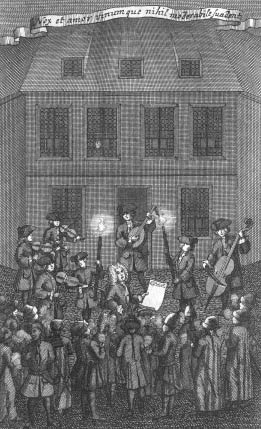
Figure 6.1 German students serenading, 1727, from Christian Friedrich Henrici, Picanders Ernst-schertzhaffte und satyrische Gedichte (Leipzig, 1727), vol. I, p. 498. University of Illinois, Urbana-Champaign, Rare Books and Manuscripts Library.
The students of Padua enjoyed the worst reputation in Europe, at least with travelers. John Evelyn complained in 1645 that “the students themselves take a barbarous liberty in the Evenings, when they go to their strumpets, to stop all that go by the house, where any of their Companions in folly, are with them … so as the streets are very dangerous, when the Evenings grow dark.”35 The situation was apparently no better when Andrew Balfour visited in the late 1670s – again, the “Privileges” of Padua’s students allowed a relationship to the night increasingly criminalized by nocturnalization:
the Scholars here have large Privileges, and many times abuse them, and become very insolent, insomuch that they have been sometimes known to threaten the Podesta himself or Governour of the Town; they have likewise a beastly custom of carrying Arms in the Night, insomuch that it is never safe to be abroad after it begins to be Dark, for many are this way unhappily Murdered without any Offence given or taken, but only by wantonness, or rather Wickedness of the Scholars.36
When Peter Tolstoi visited the city in 1697, he warned that “the traveling foreigner who happens to be in Padua must live cautiously, and must not walk alone late at night from house to house, because the traveler will be injured and at times even killed by a student; however, those who must walk late should do so with weapons.”37 Ultramontane visitors criticized the “barbarous liberty” students held to consider themselves masters of the night, focusing on a specific relationship to the night challenged by nocturnalization.
Padua was an eminent international university, the second oldest in Italy, but even at German Reformed universities of modest size, such as those in Herborn and Bremen, students appear as would-be masters of the urban night in a series of court records and city ordinances. All of the twenty-four students expelled from the tiny University of Herborn between 1585 and 1712 were involved in some sort of mischief at night; university records refer to specific acts of traditional student nocturnal disorder, such as fighting with the night watch and disturbing the peace at night, in seven cases.38 In 1681 the Bremen city council singled out “the youth studying here,” who numbered about 400, as the source of “wild, dissolute life and ways … in the evening, as soon as it grows dark” in an ordinance.39 In statute of 1607 the parlement of Toulouse forbade students to walk the streets of the city after nine at night, and to carry arms at any time; both prohibitions were oft-repeated but with little effect. The same was true in Strasbourg, where the “student-youths” and lackeys were forbidden to carry weapons in 1650.40 Peter Heylyn complained in 1625 that the students of Paris had “regulated their villainous practices into a Common-wealth; and have their captains and other officers who command them in their night-walks.”41 Students could read about their traditional privileges in the night in Latin and dog-Latin plays and verses, such as Albert Wichgrev’s comedy Cornelius Expelled (1600), in which a nightwatchman complains:
My lord rector, they were three
Who in the market place did scream,
As the watchmen three o’clock did keep,
And the good people would rather sleep.42
In late medieval and early modern Vienna students’ nightly excesses were a part of daily life despite all prohibitions.43 The immediate association of students with lantern-smashing in Leipzig anticipates their resistance to the policing of a time and place in which they had been traditionally enjoyed “large Privileges.” As the evidence on student life shows, there was plenty of nocturnal activity and night life before nocturnalization (going back at least to the time of François Villon), but this youthful night of transgression was colonized to transform it into a more orderly, safe, and respectable place and time.
“And when night / Darkens the streets, then wander forth the sons Of Belial, flown with insolence and wine.”44 Milton captured concisely the relationship to the night displayed by the young sons of wealthy or noble families, and by youthful apprentices, pages, footmen, and lackeys. The night watch of Paris clashed regularly with “cliques of sons of the upper class who passed through the city at night, usually armed – in the sources they are simply referred to as jeunes gens.”45 In October 1697 a patrol encountered a group of well-born young men as they emerged from a tavern with weapons drawn, drunk, with prostitutes in tow. The sergeant of the watch, one Le Guay, asked them politely to put away their weapons. The young men – members of the elite royal guards and a few from the most esteemed families of Paris – refused, and the watch patrol withdrew cautiously. Despite this show of deference, the jeunes gens attacked the watch. In the ensuing struggle the son of a high-ranking official was killed by the watch, and another arrested (only to be released the next morning). In the end, the patrol was rebuked for overstepping its authority by challenging the elite young men – policing the night had its social limits.46
The Paris police director d’Argenson included in his disciplinary ambit young men just below the status of the jeunes gens described above. In 1700 d’Argenson commented on the youth of “some of the bourgeois, and even a few merchants among the most distinguished.” He explained:
Recently I encountered a well-born son, aged eighteen, who for more than fifteen months lodged in a house with women of public prostitution and among villains without a single effort by his father to remove him from such disorder. This discovery obliged me to issue a general ordinance urging fathers to report to the magistrate their libertine and vagabond children, under the penalty of being responsible in civil court for all the misdeeds that they may commit, and with a fine proportional to their negligence.47
In the colonization of the urban night, the threat to punish fathers for the crimes of their dissolute sons created a new point of leverage.48
6.2.2 Crime as resistance / resistance as crime
Beyond the license of apprentices, students, and servants, violent crime in general set clear limits on urban nocturnalization. In the earliest accounts of public street lighting, fantasies of controlling nocturnal crime were shadowed by persistent violence. Street lighting gave some sense of security, but violent crime at night continued to undermine the project of nocturnalization until at least the mid eighteenth century.49
Early modern street crime at night can serve as an index of traditional urban night life, as scholars have observed that cities faced more nocturnal crime than rural communities. In his study of crime in Cologne, one of the largest cities in the Empire, in the late sixteenth and early seventeenth centuries, Gerd Schwerhoff established a clear connection between the time of day and violent crime. Only about a quarter of all violent crimes took place before 5 p.m.; over half occurred between 5 p.m. and 10 p.m., with the remaining 20 percent in the night hours after 10 p.m.50 The Cologne evidence is corroborated by studies of Douai (Flanders), Paris, Siegen, and Frankfurt: in these cities active traditional night life led to significant proportions of interpersonal violent crime at night.51 Studies of crime in early modern rural regions, on the other hand, record more violent crime during the day and less in the evening or at night.52 As Schwerhoff concludes, the social life of the early modern city continued well past sundown.
Nocturnalization meant making this part of the urban day safer for respectable people. The nocturnalization of the seventeenth century sought to pacify the urban night, but the watchmen who formed the first line of defense against nocturnal crime were often its victims. A study of homicide in Vienna reveals dozens of violent deaths by night, including about a dozen nightwatchmen killed while on duty in the period 1649–1720.53 The street lighting established in 1687 does not seem to have had any immediate effect on the risks for watchmen in Vienna. A case from London’s Old Bailey gives us a sense of the social dynamics of violence against nightwatchmen in the colonization of the night. On January 14, 1687 “after a long hearing on both sides,” two accused men identified only as “J. W—.” and “J. P—.” were found guilty of manslaughter “for Killing one Peter Penrose Bell-man in the Parish of St. Giles’s in the Fields, on the 30th. day of November last.” The removal of the names of the defendants from the published record of the trial indicated their elevated status. The incident began as the nightwatchman Penrose was “ringing his Bell, and saying his Verses, on St. Andrews day, above one or two a Clock in the Morning,” when he met the two accused “in the street.” The two accused men “bid him not keep such a Noise, and gave him ill Language” – one imagines them “flown with insolence and wine.” At this point “two other Bellmen, that came accidentally into the deceased’s company, being upon the Watch not far off,” tried to assist Penrose but the two accused “making up towards them with their Swords Drawn” killed him.
In their defense the accused argued that “they were abused by the Bell men and the Watch, and that they were very highly provoked to do what was done; and that the Bell man set his Dog upon them, and Knocked one of them down.” They insisted that “they were set upon by the Bell men and others in the Night, and taken for Thieves, and very much abused.” The accused men called well-born character witnesses who claimed that “J. W—.” and “J. P—.” were respectable and peaceable: “The Prisoners … called several persons of very great Quality to Evidence on their sides, that they had never been wont to quarrel, nor to keep any unseasonable hours.” As the recorder of the Sessions Papers emphasized, they paid lip service to the norms of the respectable urban night, keeping no “unseasonable hours” (except on the night in question, it seems). The jury ruled the death accidental. Despite their conviction for manslaughter, no punishment is recorded.54 The low status of the watchmen contrasts here with the “persons of very great Quality” who testified for the accused. In the very different system of law and policing in Paris, the low status of the archers of the night watch meant that the jeunes gens they apprehended were usually set free unpunished. In both cities, privileges of birth and estate protected the night life of these young men.55
In Paris, Vienna, London, and other large cities across Northern Europe, the traditional night watch was augmented or reformed in the period from the end of the seventeenth through the early eighteenth century, but its principal dimensions would remain unchanged until the end of the Old Regime: a decentralized force of low-status semi-professional watchmen, often unarmed, began their rounds at sundown or at the curfew hour.56 The most decisive expansion of policing at night occurred in Paris, where in 1701 d’Argenson created a new brigade of the watch that began their rounds at midnight and patrolled until dawn. At the end of the year he reported, “I myself cannot praise enough this new order; everyday the people testify to their satisfaction with it.” The patrols lifted the cover of darkness from all manner of actions: “few nights go by without it [the midnight patrol] capturing or surprising some tenant who is moving out to cheat his landlord.”57 By December 1701 several watchmen of this patrol had been wounded on duty (considered a sign of their effectiveness); d’Argenson concluded that “the brigade that rises only at midnight and goes off duty at daybreak does more by itself than any of the others.”58 By early modern standards the midnight patrols were a major step in the colonization of the night.
As scholarship on the history of crime has shown, early modern commentators assessed the dangers of the urban night in lurid terms.59 They saw urban illumination as holding back dangers ready to spring forth the moment lighting failed. This was the case in London, where street lighting first appeared in 1684. The “Great Frost” of 1683–84 froze the Thames solid, so that booths and stalls were set up and regular traffic in coaches and sleds passed between the banks. One newsletter described “a perfect street quite Cross the Thames at Temple stairs.” The frozen Thames became a public way, but one without any street lighting. As a result “Several persons going over the Ice in the night from Westminster market were set upon and robbed near Lambeth,” as another newsletter reported, eager to show that the equation of “street and night” with crime still held true.60 The entirely decentralized lighting of early modern cities was not susceptible to the power failures or blackouts first seen in the twentieth century, but early modern street lighting too could be suddenly and disturbingly absent. John Evelyn described a heavy fog that settled on London on November 8, 1699:
There happened this Week so thick a Mist & fog; that people lost their way in the streets, it being so exceedingly intense, as no light of Candle, Torches or Lanterns, yielded any or very little direction … At the Thames they beat drums, to direct the Watermen to shore, no lights being bright enough to penetrate the fog.61
The fog appeared around sunset and lasted until 8 p.m. By obscuring the street lighting the fog revealed, in Evelyn’s account, the lurking dangers of the urban night:
I was myself in it, and in extraordinary danger, robberies were committed between the very lights which were fixed between Lond[on] & K[e]nsington on both sides, and whilst Coaches & passengers were traveling.
This sense of “extraordinary danger” evokes a night whose threats are only barely contained by the street lighting and reappear the moment it is unexpectedly extinguished. These accounts acknowledged setbacks in the struggle to colonize the urban night while reminding readers of the dangers of an uncolonized night.
To expand the legitimate social and symbolic uses of the night in early modern cities, urban elites had to actively claim the dark hours of the day and make it their own. But for whom was the urban night colonized? And how would the new terrain be used? These questions lead us to examine age, estate, gender, and sexuality in the formation of a new nocturnal “public.”