
Nocturnalization redefined what was “public” in the cities of early modern Europe. The streets seemed safer and more convenient to use, while the evening became a more important and more respectable part of the social day. The night watch and “night lanterns” helped bring together a public of individuals acting privately: street lighting was never described as facilitating either religious observance or daily manual labor.
How does the colonization of the urban night described here relate to the development of a bourgeois public sphere in the eighteenth century? Defined by Habermas as a public of private individuals who join in debate on questions of politics and letters,62the concept of the public sphere has proven especially stimulating because Habermas discussed it in historically specific terms, linking its development to the relations between the household, capitalism, and the state in the seventeenth and eighteenth centuries.63His argument contrasts the bourgeois public sphere with “representative publicness” (repräsentative Öffentlichkeit), the display of power or majesty to a public constituted as an audience, which he considers characteristic of the princely courts of medieval and early modern Europe.64 Habermas’s analysis of the formation of the public sphere is certainly more suggestive than historical, and he has revised his conclusions over the years,65 but the concept of “publicness” (Öffentlichkeit) continues to stimulate useful research on early modern Europe.66 In chapter 4 we saw how important the night was to early modern “representative publicness”; here I will explore the connections between the night, bourgeois publicness, and daily life in Northern Europe.
6.3.1 The rise of the coffeehouse
A sphere exists in space. From the first introduction of the concept by Habermas, the abstract space of the bourgeois public sphere has been associated with specific places like the salon, coffeehouse, or tavern. But when in everyday life did the discussions, debates, and exchanges of the bourgeois public sphere occur? In general, nocturnalization facilitated the evening gatherings in private homes, public houses, or clubs that Habermas thought fundamental to the formation of a public sphere composed of “private people engaged in productive work.”67 Among these meeting spaces, recent scholarship has made the coffeehouse emblematic of the public sphere.68 This intense emphasis on the coffeehouse has been balanced by studies of the public role of taverns and other traditional public houses,69 but the focus on public space seems to have pre-empted any thorough examination of the changing uses of daily time. Coffeehouses emerged in the second half of the seventeenth century as distinctly nocturnal spaces in urban daily life.
Commentators frequently emphasized the night in their accounts of the coffeehouse or café. As a Viennese jurist noted with concern in 1718: “The authorities should not allow the court-licensed coffee-, lemonade-, and such shops to stay open past 10 p.m. But as … such shops do stay open, many suspicious conventicles are held in them, with highly disturbing discourses and every sort of dangerous conversation, late into the night, frequented by all sorts of suspect Nations.”70 One of the first coffeehouses associated with private citizens “grown states-men” was the Turk’s Head at New Palace Yard in Westminster.71 It was here that James Harrington’s Rota Club met nightly in 1659–60 to discuss the future of the Commonwealth in England. Participants included William Petty and John Aubrey, Samuel Pepys and Sir William Poulteney. These discussions took place only in the evening: as Markman Ellis has noted, “meeting in the evening, it was reckoned, allowed those in employment or charged with affairs of state to attend.”72 This was exactly the case with Pepys, for example, who came to the Rota Club after work on the evenings of January 10 and 17, 1660.73 Coffeehouses were open all day, of course, but their late hours attracted special attention. One of the first English publications on the new institution, the 1661 pamphlet on the Character of Coffee and Coffee-Houses, claimed that “the day sufficeth not some Persons to drink 3 or 4 dishes of Coffee in. They borrow of the night, though they are sure, that this drink taken so late, will not let them close their Eyes all night.” Coffeehouse patrons were marked by a sort of late-night hyper-sociability (“these men are either afraid to be alone with themselves, or they to excess love Company, so that they never set apart any time to converse with themselves”) which threatened Christian introspection at night.74
In Paris public order at night was the main concern. By the 1690s many of the city’s cafés stayed open all night, marked by a lighted lantern at the door.75 These establishments, licensed through the guild of limonadiers, were singled out in an ordinance of February 16, 1695 as “places of assembly and refuge for thieves, rogues, and malicious and dissolute people; this happens all the more easily because they are designated and distinguished from other houses by their private lanterns, out on the street, that are lit every evening and serve as signals.”76 Lieutenant-general of police La Reynie ordered that henceforth all limonadiers shops must close at 5 p.m. from November 1 to March 31 and at 9 p.m. from April 1 to October 31. After these hours it was “forbidden to admit any person of one or the other sex, whatever age or profession they might be.” In the case of the cafés of Paris, the colonization of the night meant the elimination of private lighting at night: the 1695 ordinance required all café proprietors “who have placed private lanterns on the street in front of their homes and shops to remove them within twenty-four hours.”77 The sharp restriction of the cafés’ evening hours was quickly relaxed: less than a month later the closing hours were extended to 6 p.m. (December and January), 7 p.m. (November and February–March), and 10 p.m. from April to November. In October 1695 they were extended again to 7 p.m. in the winter and 10 p.m. in the summer.78
By the end of the seventeenth century, coffeehouses were an established part of urban life for the well-born. The finer establishments resembled the private parlors of aristocrats’ homes, transplanting an aristocratic space into bourgeois life.79 It was in coffeehouses that many burghers first encountered billiards, for example, as well as chocolate, tea, and fine porcelain. But coffeehouses taught the aristocratic consumption of time as well, leading respectable men into late hours. A letter of Mary Jepp Clarke (1656?–1705), wife of the Whig MP Edward Clarke and lifelong friend and correspondent of John Locke, describes evening leisure for “young gentlemen” in London. Writing to her sister-in-law Ursula Clarke Venner in March 1691, Mary agreed that her young male cousin Venner “should lodge as near us as he can” because the young man is “a perfect stranger here and to the tricks of the town which many times young gentlemen fall into at first.” The risk, Clarke notes, lies in the typical use of the night by young men in London:
for want of a friend to go to when the evening draws on, [they] … so get to a coffee [“coughfy”!] house or tavern or worse to spend their time, but to prevent that necessity in my cousin while I am here at least, I will get a lodging for him in the same house where we are.80
Clarke considered socializing in the evening a “necessity” for young gentlemen but sought a more domestic, feminine setting for her cousin’s evenings in London. Writing for young gentlemen visiting Paris in 1718, Joachim Christoph Nemeitz noted that “I approve that a young traveler goes from time to time to coffeehouses, in the late afternoon or around evening time, to listen to the conversation of the news-bearers.”81 In his Introduction to the Knowledge of Ceremony of Private Persons (Einleitung zur Ceremoniel-Wissenschaft der Privat-Personen, 1728), Julius Bernhard von Rohr advised his readers that “among the ways of passing the time that one finds in large cities, especially in the winter and in the long evenings, it might happen that a young person visits the coffeehouses.”82 The key, Rohr cautioned, was in the choice of coffeehouse, as not all were respectable.
In texts and images coffeehouses are always represented at night, suggesting that evening gatherings were the most salient part of this new institution. One of the best-known images from London, probably from the 1690s, shows numerous candles on the tables and a man illuminating a picture or notice on the wall (Figure 6.2). The cafés of Paris, with their distinctive décor and clientele, are recorded by the frontispiece of the Chevalier de Mailly’s Les entretiens des cafés de Paris et les diferens qui y surviennent of 1702, which shows well-dressed men and women enjoying conversation and games by candlelight while served by a boy in Armenian garb (Figure 6.3).83 An engraving by Casper Luyken (1699) published widely in the early eighteenth century shows a candlelit scene with a maid bringing a dish of coffee (Figure 6.4).84 These two images and the Dutch illustration of ’t Koffyhuis (Figure 6.5) are each centered on the candles that illuminate the dark space of the coffeehouse. The earliest representations of the coffeehouse on stage were also nocturnal. In London a play called Knavery in all trades, or, The coffeehouse a comedy, performed and printed in 1664, presented a scene of “The Coffeehouse discovered; three or four Tables set forth, on which are placed small Wax-Lights, Pipes, and Diurnals.”85 In his play Le Caffé (1694), Jean-Baptiste Rousseau sets much of the action at night in the Paris café of Madame Jérosme, who at midnight asks her male customers to leave because “it is the hour when women replace men in the cafés.” As we will see below, this claim that women arrive at midnight includes some dramatic license, but the association of café life with the night is clear. When Madame Jérosme is asked “Do you agree with this nocturnal recreation?” She replies “Oh, certainly – if one had no other income than the expenditures made here by day, without the fortuitous income of the night, it would be foolish to aim very high.”86 The frontispiece of the play ’t Koffyhuis, published in Amsterdam in 1712, presents a similar scene illuminated by candlesticks and a chandelier.87
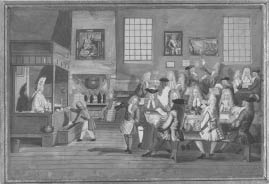
Figure 6.2 A London coffeehouse with a woman behind the counter, left; mid or late 1690s (the inscription “A.S. 1668” is false). © Trustees of the British Museum, 1931,0613.2.
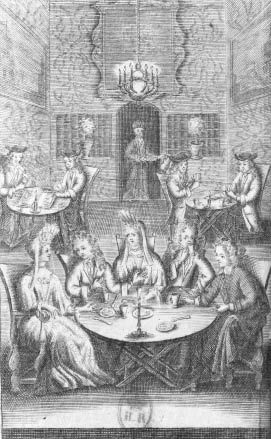
Figure 6.3 Paris café scene with well-dressed women patrons; frontispiece of Chevalier de Mailly, Les entretiens des cafés de Paris (Trevoux, 1702). Bibliothèque nationale de France.
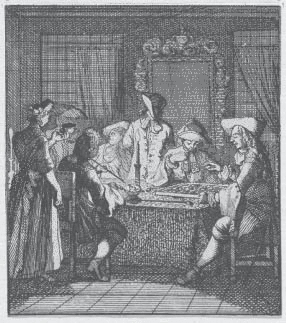
Figure 6.4 Dutch / German coffeehouse scene with a maid serving a dish of coffee. Engraving by Casper Luyken, 1699. Amsterdams Historisch Museum.
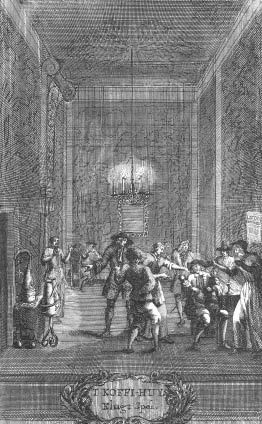
Figure 6.5 Dutch coffeehouse scene from the frontispiece of Willem Van Der Hoeven, ’t Koffyhuis: kluchtspel (Amsterdam, 1712). Bibliothèque nationale de France.
Across Europe, authorities were concerned about late hours and political conversations at coffeehouses. The attempt by Charles II to close “the Multitude of Coffee-houses” in England in 1675 is well known. His proclamation described them as “the great resort of Idle and disaffected persons” which “have produced very evil and dangerous effects; as well for that many Tradesmen and others, do therein misspend much of their time,” although there is no mention of the night or late hours in the proclamation or any of the official discussions leading up to their suppression.88 As mentioned above, La Reynie imposed closing hours on the cafés of Paris in 1695; a decade earlier, a minister of Louis XIV wrote to La Reynie, explaining “The king has been informed that, in several places where coffee is served, there are assemblies of all sorts of people, and especially foreigners. Upon which His Majesty ordered me to ask whether you do not think it would be appropriate to prevent them from assembling in the future.”89 No action was taken – apparently it was not considered opportune to close these cafés in Paris.
Vienna authorities imposed a 10 p.m. closing time on coffeehouses in summer and winter in 1703; in 1706 several coffeehouses were cited for violations, and in 1707 the closing time in winter was moved to 9 p.m.90 In his guide to the imperial court and Vienna the French Benedictine Casimir Freschot also remarked on the city’s night life and on the discussion of “the conduct of generals, ministers, and even the Emperor himself” in the cafés of Vienna.91 In Leipzig the city council was concerned to regulate coffeehouses from their first establishment in 1694. A flurry of regulation began in 1697, when the council noted that “especially in the new and unauthorized tea- and coffee-rooms … guests are kept after the hour set in the Electoral Saxon ordinance.” Gambling, luxury, and “the company of suspicious women” are mentioned. Later that year and in 1701 the council issued further ordinances regulating young people on the streets at night.92 The council’s regulation of coffeehouses escalated in 1704, when it threatened to reduce number of coffeehouses in the city or forbid them entirely.93
The fate of the coffeehouses of Frankfurt am Main in 1703–05 reveals just how much anxiety their late hours and political associations could cause. In 1702 the Frankfurt Rechenmeister “ordered the owners of the coffee houses … that they … should not keep their guests longer than 9 o’clock in the evening in the winter, and in the summer only until 10 o’clock” – as we have seen, a typical regulation of the hours of coffeehouses and other public houses. There were in fact only three coffeehouses in Frankfurt at this time, but they greatly concerned the city council. The following year the council’s regulation of the coffeehouses went much further. On November 20, 1703 the Frankfurt city council, citing “disturbing and dangerous times,” ordered that “we shall three months from today entirely abolish the coffeehouses.” In the meantime, the coffeehouse proprietors were threatened with “immediate prohibition” of their trade if they failed to close their establishments promptly at the curfew bell and further ordered “not to re-open for anyone, whomever it might be” after closing time. In the three months they would be allowed to remain open, the proprietors of the coffeehouses were warned to “set aside no special rooms for any guests other than the ordinary main room, eliminate all gaming, and serve nothing other than coffee, tea, and chocolate.”94
Three months later, on February 21, 1704, the council reported that:
the deadline for closing the coffeehouses has passed … so today the coffeehouse keepers shall be sent to the office of the Rechneiamt and informed that they must immediately take in their coffee signs and serve no guests coffee or other drinks, on pain of severe punishment. And the honorable Rechneiamt shall be reminded to take care that none of the taverns serve any coffee or other warm drinks.95
The office that enforced the abolition, the Rechneiamt, reported on the same day that “the coffee-men have been informed by a servant of this office that the coffeehouses shall now be abolished and cease; nor shall they serve tea or chocolate any more.” The coffeehouse owners were ordered “today to take down the coffee signs from their premises and be coffee-men no longer.”96 The coffeehouses remained closed for over a year. On March 24, 1705 two former coffeehouse owners were allowed to reopen under several conditions, including new closing hours of 9 p.m., summer and winter.
The city council’s decision to close Frankfurt’s coffeehouses in 1703 was political. Among dozens of taverns, inns, and other public houses, the city’s three coffeehouses stood out as gathering places for wealthy merchants, military officers, and diplomats involved with the War of the Spanish Succession. The city’s troops had just shared in the defeat of imperial forces at the Battle of Speyerbach on November 15 when the plan to close the coffeehouses was announced. Long-standing tensions between the patrician oligarchy ruling Frankfurt and the merchants and craftsmen who formed its economic base threatened to boil over, and the council saw the coffeehouses as a threat to their rule.97 Despite scholars’ concerns about an overemphasis on coffeehouses in the history of early modern public life, in the Frankfurt case the coffeehouses were singled out for closure because of the political connections of their customers.98 In 1705 thirty-six established merchants petitioned the Frankfurt council for approval of a private club they had established. It met only in the evenings and served as a replacement for the prohibited coffeehouses, underscoring the importance of nocturnal sociability in bourgeois and coffeehouse culture.99 In larger cities across Northern Europe these private clubs, described by Joseph Addison matter-of-factly as “nocturnal assemblies,” flourished in the eighteenth century.100
The evidence here shows that the hours after sunset were fundamental to the sites and practices of the public sphere at the end of the seventeenth century. In a valuable intervention in the discussion of the formation of a public sphere in early modern Europe, Brian Cowan contrasted a public focused on “the magisterial realm of state power and high politics” with “the world of commercialized leisure that developed independently of the state.”101 Together, ministers of state and consumers of leisure colonized the night and created the time and space in which the bourgeois public sphere formed.102 The process was anything but linear, of course: young people resisted the discipline that was the cutting edge of the colonization of the night, and political authorities struggled to control the “highly disturbing discourses and every sort of dangerous conversation, late into the night” that seemed an unavoidable corollary of nocturnalization.
This back-and-forth process of nocturnalization is the analogue in daily life to the rise of the bourgeois public sphere itself. The ambiguous relationship between the urban night and the state seen here mirrors a key aspect of the formation of the bourgeois public sphere:
Bourgeois publicness may be grasped first as the sphere of private people come together as a public; these [people] quickly claimed the public sphere regulated by the authorities against the public authorities themselves.103
Private persons used the night which the authorities had helped secure as a time to test the limits of these same authorities, and city authorities found themselves policing and restricting the very nocturnal sociability they facilitated through their colonization of the night. Seeing the bourgeois public sphere as an aspect of nocturnalization (both in its sites and practices, as discussed here, and in its intellectual predilections, as will be discussed in chapter 8) further historicizes Habermas’s arguments. At present, the most trenchant historical analysis of the rise of a public sphere has come from scholars of gender in early modern culture.104 How does using the night as a category of analysis shape our understanding of gender and the public sphere in the seventeenth and early eighteenth centuries?
6.3.2 Gender, the night, and the public sphere
Looking back, Friedrich Justin Bertuch sought to explain the nocturnalization of early modern daily life in his 1786 essay on “the uses and divisions of the day and the night in various ages, and among various peoples.” After noting that “the pleasures of the evening and night … are the ruling fashion in France and England, and in every large city, where luxury and the need for entertainment are always on the rise,”105 he began his analysis with the observation that “the day invites movement and the night rest.” The entertainments of the daylight hours, such as tourneys, the hunt, horse-racing, and the like, he then contrasts with the pleasures of the night, such as the theater, cards, and conversation. The predominance of the nocturnal pursuits reflects, in Bertuch’s understanding, the feminization of European culture: “In the past, when most nations of Europe were somewhat rawer, but also stronger and more manly, they more loved strenuous bodily exercises; now as they become more polite and refined, the calmer and more thoughtful pastimes replace the physical ones.”106
Bertuch’s connection of night life and feminization was first voiced in England and France in the second half of the seventeenth century. An early English broadside on the coffeehouse, the News from the Coffe-House of 1674, claimed that the culture of the coffeehouses confused gender roles:
Here Men do talk of every Thing,
With large and Liberal lungs,
Like women at a Gossiping,
With a double tyre of Tongues.107
Fears of feminization shaped elite culture in France and England at the end of the seventeenth century: concerns about the emasculating effects of absolute monarchy in France ran parallel to worries about politeness, commerce, and luxury in England.108But these concerns about feminization should not obscure a broader question: how did nocturnalization affect women’s place in public and daily life? To go beyond generalizations and assess how early modern women used and experienced the urban night requires precise attention to a range of sites, from the court and the theater to the coffeehouse, salon, and street.
At court, we saw women and men together extending the day into the evening and night. Neither the favorable nor the critical descriptions of night life at court examined in chapter 4 of this book make any distinction between women and men – both are the new denizens of the night, for better or for worse (recall Faramond’s “Clorinde and Cleomenes”). The aristocratic use of daily time could be seen “in the lives of the courtiers of both sexes, who make night into day and day into night.”109 No sources on the night at court suggest that there is any time for men to be active when women should not be, or vice versa.
How did the gender order of daily time at court look in the light of the street lamps? In urban spaces that served as extensions of the court, for example in Vienna or Paris, aristocratic women used the night freely to socialize and maintain social networks. Not long after street lighting was introduced in Paris, Madame de Sévigné described an evening spent chatting with her friends until midnight “chez Mme De Coulanges” – the date was December 4, 1673. Madame de Sévigné decided to escort one of their number home, although it meant a trip across Paris: “We found it pleasant to be able to go, after midnight, to the far end of the faubourg Saint-Germain.” The new street lighting made this possible: “We returned merrily, thanks to the lanterns and safe from thieves.”110One detects no sense of danger to her safety or reputation in this account. This relationship to the night was summarized by the writer Gregorio Leti in a letter to the marquise de Courcelles of 1679. Leti observed that the domestic occupations of women “constitute a state of servitude, as we have observed in all lands of the earth, in times ancient and modern.” But recently the aristocratic relationship to the night had changed all this: “However, one can say that French ladies have put this state of things into good order, since three parts of the night out of four, and two out of the four parts of the day are spent in strolls, visits, late evenings, balls, and games.”111 Leti’s slightly critical tone underscores the novelty of this night life.
A contemporary of Madame de Sévigné, the Austrian countess Johanna Theresia Harrach (1639–1716), made and received countless evening social visits in Vienna and spent time at the imperial court and its theater on long winter nights from about 1665 on. As the wife of the imperial ambassador to Spain, she maintained a wide social network and presence at court, especially during her husband’s absences in Spain. Her detailed daily letters show that she usually returned home between nine and ten at night: when the court was in Vienna from November through April, this schedule meant regularly traveling through the city by carriage long after dark.112 In similar terms, in a letter written from London on February 13, 1710 Lady Mary Wortley Montagu considered herself to be “the only young woman in town … in my own house at ten o’clock to-night.” It was “the night of Count Turrucca’s ball,” a “Splendid … entertainment” hosted by the Portuguese ambassador. Lady Mary’s narrow conception of “the town” gives us a clear indication of which women were out after 10 p.m. with their reputations intact.113 John Vanbrugh’s unfinished play A Journey to London (written in the early 1720s) satirized the night life of aristocratic women in a lively exchange between “Lord Loverule” and his wife, Lady Arabella:
LORD LOVERULE: But, madam, can you think it a reasonable thing to be abroad till two o’clock in the morning, when you know I go to bed at eleven?
LADY ARABELLA: And can you think it a wise thing (to talk your own way now) to go to bed at eleven, when you know I am likely to disturb you by coming there at three?
LORD LOVERULE: Well, the manner of women’s living of late is insupportable, and some way or other –
LADY ARABELLA: It’s to be mended, I suppose. – Pray, my lord, one word of fair argument. You complain of my late hours; I of your early ones; so far we are even, you’ll allow. But which gives us the best figure in the eye of the polite world? My two o’clock speaks life, activity, spirit, and vigour; your eleven has a dull, drowsy, stupid, good-for-nothing sound with it. It savours much of a mechanic, who must get to bed betimes that he may rise early to open his shop, faugh!
LORD LOVERULE: I thought to go to bed early and rise so, was ever esteemed a right practice for all people.
LADY ARABELLA: Beasts do it.
After comparing her husband to a low “mechanic,” Lady Arabella responds to her husband’s concerns about her late-night companions: “I’ll have you to know I keep company with the politest people in the town, and the assemblies I frequent are full of such.”114
The daily rhythms of a well-born couple in London emerge from the diary of James Brydges (1674–1744; made first duke of Chandos, 1719). Brydges and his wife Mary maintained a busy social life in London, recorded in Brydges’s diary for the years 1697 to 1702. Coffeehouses were fundamental to James Brydges’s daily life; he records visiting them during the day and at night, traveling across London with his wife by coach. As Brian Cowan has noted, Mary Brydges never accompanied her husband into any of the coffeehouses. Her evenings were spent in domestic visits, which were no less important for the socially aspiring couple. They make similar use of the evening and night for socializing and leisure, but the public houses visited by the husband contrast with the domestic socializing of the wife.115
The purported freedom of “French ladies” over “three parts of the night out of four” carried over into the first cafés of Paris as well. As historians of coffee have established, the cafés of Paris presented a distinctly aristocratic décor which contrasted with the more utilitarian furnishings of English coffeehouses. The first truly successful café in Paris, the Procope, opened in a former Turkish bath in the rue des Fossés-Saint-Germain in 1686. The proprietor kept the mirrors, chandeliers, and marble table-tops of the bathhouse, and these “well-furnished rooms” quickly attracted a well-to-do clientele.116 As noted above, Jean-Baptiste Rousseau’s play Le Caffé (1694) revolves around the presence of women as customers at night in the café of Madame Jérosme.117 An ephemeral style journal, Le porte-feuille galant, explained in 1700 that “cafes are places frequented by honest people of both sexes.” The social variety mentioned so often in accounts of coffeehouses and cafés appears here as well. “You can see all sorts of characters,” including
gallant men, coquettish women, polite abbots and others who are not, soldiers, news-mongers, officers, provincials, foreigners, lawyers, drinkers and professional gamblers, parasites, adventurers, knights of industry, wealthy young men, amorous old women, Gascons, and sham heroes, demi-beaux esprits, and many other figures whose varied portraits could be multiplied infinitely.118
The variety reflects a distinct Parisian gender order, as women are clearly part of the clientele. The frontispiece of the Chevalier de Mailly’s Les entretiens des cafés de Paris et les diferens qui y surviennent of 1702 (see Figure 6.3.) emphasizes (like Rousseau’s play of a few years earlier) women in cafés at night. The interlocutors in the Entretiens visit the cafes between the evening and the late night and mention the dangers of the streets at night, suggesting the cafés were oases of relative safety. The last conversation in Mailly’s collection is narrated by a woman, suggesting their active place in elite café culture. The author explains that “It may be said that it is improper to introduce a woman in a café; however, I have seen there … women who were quite pretty and spiritual.”119 In France, where the social life of the nobility was most integrated by gender, nocturnalization brought well-born women access to urban sites such as balls, theater and opera, and cafés (which were themselves more closely aligned with aristocratic culture than in Britain).120 In Figure 6.6 we see the new association of a “woman of quality” with the evening and night.
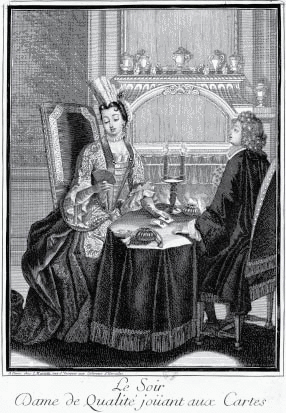
Figure 6.6 Pierre-Jean Mariette, “Le Soir: Dame de Qualité jouant aux Cartes” (Paris: chez J. Mariette, rue St Jacques aux Colonnes d’Hercules, c. 1690). Bibliothèque nationale de France.
But Paris and London, as well as Vienna and Leipzig, were also shaped by citizens and their values. The bourgeois gender order of the night contrasted sharply with the freedoms of elite women to use the night as they wished. Non-noble women active at night in the city, for work or leisure, were suspect – and increasingly so – in the seventeenth century. For England, the development has been examined by Paul Griffiths in his work on the prosecution of nightwalking in the sixteenth and seventeenth centuries.121 In seventeenth-century London arrests and prosecutions for nightwalking began to focus almost exclusively on women: a crime overwhelmingly associated with men in the late Middle Ages had become feminized and sexualized. Griffiths’s work underscores the intricate relationships between estate and gender that shaped access to the urban night. As the trials recorded in the Sessions Papers of the Old Bailey show, the reputation of being “a common nightwalker” had lost none of its force in the second half of the seventeenth century: in 1687, for example, Dorothy Hall was charged with theft: her claims of innocence notwithstanding, “being known to be a common Night-walker, she was found Guilty.”122 The career of one Jane King is instructive. She was described as “a notorious Night-walker” when charged with the robbery of Hilkiah Osmonton in May 1688. Acquitted on that charge, she was tried again at the same session along with Mary Batters for the robbery of Richard Beale, who testified that “as he was going over Holborn Bridge about Eleven a Clock at Night, as he was making Water against the Wall, the Prisoners with some other Women Assaulted him, and took away the above said Moneys.” Beale cried out for help and the watch appeared and arrested some of the women, including King and Batters. The sessions recorder explained that “The Prisoners made a very slight Defence for themselves; and being known in Court to be old and Notorious Night-walkers and Debauched Livers, they were found Guilty.” King was tried again in December 1688 for picking the pocket of “one Mr. Church.” According to the sessions account:
the Proof against the Prisoner was, That being one that practiced the Trade of Night walking, she invited him to a Tavern in St. Martins le Grand, in order to partake of a Bottle of Wine, But they had scarcely begun to grow familiar, before she had dived into his Pocket, and getting his Purse of Gold, she gave him the slip.
She was caught soon afterwards. At trial she claimed never to have seen Mr. Church and alleged that “some Common Women that had been abroad that Night described him to her, saying, That a whole Cluster of them had been with him in an Alley” and had robbed him. Church was “positive she was the very Woman, the Jury found her guilty of the Felony.”123
The trends uncovered by Griffiths were fully developed by the first half of the eighteenth century, as seen for example in the comments of Bernard Mandeville on crime and its prevention. Mandeville and his contemporaries assumed that the victims of nocturnal crime were men; Mandeville was happy to blame them for their carelessness, describing them as “unthinking” because they “never mind what companies they thrust themselves into.” Such men included “such as will be drunk, [or] go home late in the dark unattended.” In Mandeville’s accounts, women were either perpetrators of, or accomplices to, nocturnal crime. Foolish victims “scruple not to talk and converse with lewd women, as they meet them; or that are careless of themselves as well as of the securing and fastening of their houses.”124 Safest from urban crime, Mandeville explained, was a man “temperate in his liquor; [who] avoids, as much as is possible, unseasonable hours; never gives ear to night-walkers; a man that abroad is always watchful over himself, and every thing about him.”125 Mandeville makes no reference to women as victims of nocturnal crime in this pamphlet.
Operating with a subtle set of indicators of age, marital status, dress, and familiarity, the bourgeois order of the night cast renewed suspicion on women outside the home at night. This suspicion had an important function: given the emphasis on respectable nocturnal sociability in coffeehouses, one might assume that women could participate in coffeehouse culture, thereby benefiting from better access to respectable night life that nocturnalization provided. Indeed, several scholars have argued that women did share in English coffeehouse life.126 But the work of scholars such as Brian Cowan and Markman Ellis indicates otherwise – women were excluded from coffeehouse sociability in London and, as we will see below, in German-speaking Europe as well.127 Suspicion helped create new times and spaces for men to gather from which women of their own class were excluded. The aristocratic women of Paris were a significant exception that warrants further research.
The bourgeois and moralizing approach to nocturnalization should not, however, obscure the women who were part of coffeehouse culture: not as customers and interlocutors, but as coffeehouse-keepers, servants, prostitutes, and pamphlet-hawkers. In London, women coffeehouse keepers were relatively common but subject to satire and accusations of prostitution.128 Gallant pamphlet-writers were happy to maintain the association of prostitution with coffeehouses, claiming for example that “There being scarce a Coffee-Hut but affords a Tawdry Woman, a wanton Daughter, or a Buxom Maid, to accommodate Customers.”129 Visitors to London tended to confirm this association.130
Female pamphlet-hawkers supported the circulation of news and rumor vital to coffeehouse culture, and they sold their wares day and night on the streets and in coffeehouses: in 1684 Judith Jones was described as “a hawker that serves the Amsterdam coffee-house.”131 When John Roberts walked along Bow Lane at about 10 p.m. on October 2, 1722, he encountered two women crying pamphlets. The first announced “a full and true Account of a horrid barbarous and bloody Plot, against the King and Government”; the second, Sarah Turbat, was selling a different pamphlet and responded “Damn ye there’s no Plot, who should be the Author of it, George? Damn him, who made him King? The Devil: For he’s his Uncle.” Another witness confirmed this outburst and added that Turbat “used several other vile and scandalous Expressions against His Majesty not fit to be repeated.”132 These “mercury-women” or pamphlet- hawkers, among the poorest of London’s poor, supported the public sphere – and were, as Paula McDowell has shown, “anything but the passive purveyors of others’ ideas,” as Sarah Turbat’s words above show. Still, as Cowan has noted, one cannot characterize these women as participants in the respectable public sphere of their city.
Attitudes toward women and coffeehouses in the Empire follow the associations and exclusions seen in Britain and can serve as an index of the place of women in urban nocturnalization. The unknown author of the Caffée- und Thée-Logia (Hamburg, 1691) praised the coffeehouses of Germany and claimed that “in England, Holland, and Italy I have seen … women dressed in men’s clothing in the coffeehouses; in some the owner keeps a gallant lady for the amorous pleasures of his guests.”133 A critic wrote in 1701 that the coffeehouses led young men astray and that “in the winter during the long nights, many poor whores wait in these houses in such quantity, as if they displayed themselves in a formal procession.”134 In his Useful, Fashionable, and Novel Ladies’ Lexicon of 1715, Gottlieb Siegmund Corvinus discussed coffee in the domestic sphere in a dozen entries but provided no entry for “coffeehouse.” The reason becomes clear under the entry for “Caffe-Menscher,” defined as “those suspicious and disorderly painted women who wait upon the men present in coffeehouses and render them all services willingly.”135 Corvinus informed his female audience in no uncertain terms that all women in coffeehouses were morally suspect. The Leipzig city council in 1704 ordered that “all visits to and work in coffeehouses by female persons, whether preparing beverages, waiting tables, or under any other pretext … are forbidden.” Women were simply banned from coffeehouses, as customers and as servants.136 Enforcement of this was another matter, but the Leipzig ordinance reflects an extreme expression of Cowan’s conclusion that it is “difficult to conceive of a role for women in the ideal coffeehouse society that did not fit into the existing stereotypes of either the virtuous servant or the vicious prostitute.”137
How does attention to daily time deepen our understanding of the gendering of the public sphere in the seventeenth and early eighteenth centuries? The evidence examined here reveals a changing gender order at night in Europe’s cities, but nocturnalization did not affect all women in the same way. On the one hand, unattached women out on the streets at night were seen at the looser end of the scale of sexual morality by authorities and by men seeking sex. Women in coffeehouses and taverns might face the same assumptions, depending on their age, dress, and company: evidence of respectable women entering coffeehouses alone and at night is very rare.138 On the other hand, elite women passed freely through the urban night on their way to or from domestic sociability, including the rarified world of the salons. Estate or social rank were fundamental to access to nocturnal spaces: when Madame de Sévigné and her friends rode across Paris from the home of Madame Coulanges to the home of Madame LaFayette after midnight in December 1673, their transport, lighting, servants, and destination made it clear that they were honorable women of the highest rank. Elite women participated in the nocturnalization radiating out from the court and the haute bourgeoisie, but for middling women, respectable access to the “public night” did not expand with nocturnalization.
Writing in 1988, Joan Landes was the first to consider the history of the modern public sphere in terms of gender. She concluded that “the bourgeois public is essentially, not just contingently, masculinist.” In his Introduction to the 1990 edition ofStrukturwandel der Offentlichkeit [The Structural Transformation of the Public Sphere], Habermas agreed. He asked if women were excluded from bourgeois publicness “in the same way as workers, peasants, and the ‘crowd,’ i.e., the ‘dependent’ men.”139 Citing Carol Pateman and Landes, Habermas concluded that the exclusion of women from the political public sphere “has also been constitutive” because their relegation to the “private core of the nuclear family’s interior space” (“privaten Kernbereich des kleinfamilialen Binnenraumes”) is fundamental to the private subjectivity that constitutes the public sphere.140 Their exclusion differs from that of men excluded by class because their exclusion creates a specific form of family and private sphere which is the essential, suppressed counterpart of the public sphere.
How, historically speaking, did this exclusion occur? This is the question Landes sets out to answer in Women and the Public Sphere. The line of inquiry is all the more intriguing because in the French case, which is Landes’s focus, aristocratic women played crucial (though sometimes exaggerated) roles in the culture and politics of the Old Regime, for example in the conversational gatherings known then as “le monde,” i.e., the salon. Landes sees the salon as the most traditional of the new practices and institutions that arose between civil society and the state, such as the coffeehouse, the literary club, and the periodical press; it was certainly the most domestic of these. Significantly, contemporaries emphasized the “pronounced feminine character” of salon culture in contrast with the other public sites, suggesting to Landes “an implicit gender dynamic within the institutional and cultural geography of the oppositional bourgeois public sphere.”141 Landes then pursues this gender dynamic on the level of the symbolic politics of the emerging bourgeois public sphere – a rich line of inquiry, to be sure, but not the only way to trace the exclusion of women from the public sphere in the last century of the Old Regime. Given the importance of the family and private life in the formation of the bourgeois public, daily life would be a logical approach. By using daily life as a category of analysis, we can see how nocturnalization served to exclude women from the times and places fundamental to the formation of the bourgeois public – especially those outside the home.
The rise of the coffeehouse can serve as an index of bourgeois publicness and nocturnalization. The varying place of women in coffeehouse or café culture, ranging from aristocratic inclusion in Paris to legal and de facto exclusion in Leipzig, reveals the importance of the night in the formation of a bourgeois public sphere that was regularly nocturnal.
The night was the setting for many of the institutions and practices that formed bourgeois publicness. Indeed, the night appears as a visible analogue to bourgeois or polite publicness on the level of daily life. The new urban nights of respectable sociability after dark were, to quote historians of the public sphere, “the contingent products of a process of exclusion and containment in which members of alternate ‘impolite’ publics were shut out from the reconstructed ‘public sphere as a polite zone’.”142 The colonization of the night described here redefined the long-standing youth cultures of the night as “impolite” and often criminal, revealing, to paraphrase Paula McDowell, “a whole host of overlapping relationships to the night, some of which had to be shut down to create the established order” of the polite urban night.143 All means, from the most violent to the most subtle, were used to carve out a night that would serve “as a polite zone” for some men while eliminating the traditional relationship with the night exemplified by apprentices, servants, and students. This colonization of the urban night reshaped youth, gender, and the public sphere in the last century of the Old Regime.144 The successes and limitations of this colonization of the urban night leads us consider similar attempts to colonize the rural night (chapter 7), and the cultural and intellectual implications of a new urban night for the early Enlightenment (chapter 8).