
Across Christian confessions, the confrontation with lasting division, uncertainty, and persecution in the wake of the Reformation was a painful reality. Yet in this period the few and circumscribed positive associations of the night described in chapter 1 gave way to much broader and more complex associations of darkness and the night with the Divine as Christians used the night to think about God in unprecedented and powerful ways. In this section I argue that the night became more sacred and more meaningful as an unintended consequence of the persecution and clandestine worship attendant to confessional formation. The connection between confessional division, persecution, and a new appreciation of the night is especially apparent in the new relationship with darkness and the night seen among sixteenth-century Anabaptists and Mennonites, in the mystic theology of John of the Cross, and in the complex and all-encompassing theosophy of Jacob Böhme. Their experiences and writings reveal a central set of metaphorical uses of the night that will allow us to survey the hidden terrain of darkness and devotion in the late sixteenth and seventeenth centuries.
As territorial churches established themselves in the sixteenth century, each prohibited and persecuted the others. Turbulent dynastic politics hurled kingdoms from one confession to another, and Christians of all confessions found themselves estranged from the established church of their ruler. Some chose to gather and worship in secret. For those driven “underground” by confessional conflict, the night was indispensable. Catholic, Lutheran, Anglican, and Reformed Christians all worshiped secretly at night at some point in the century after the Reformation. More importantly, members of each confessional retold and published stories of meeting at night as part of their narratives of persecution and steadfastness, faith and martyrdom. By the early seventeenth century, scattered accounts of “underground” worship at night had entered the literature of every church, subtly shifting the associations of secret services at night. As the Anglican preacher (later bishop of Norwich) Edward Reynolds (1599–1676) explained in 1632, even “in the worst times … wherein the Church was most oppressed … God found out in the wilderness a place of refuge, defence, and feeding for his Church.” The faithful “did defend his truth, and … preserve his Church, though they were driven into solitary places, and forced to avoid the assemblies of Heretical and Antichristian Teachers.” For Reynolds the lesson of persecution was clear: “We learn likewise not to censure persons, places or times … Nicodemus came to Christ by night, and yet even then Christ did not reject him.”4 The experience of persecution and reports of it taught this age that the persons, places, and times established by the authorities for worship might be false, and that the faithful might have to accept “persons, places or times” far from the traditional in order to worship as God intended.
Reynolds supported his point by reference to Nicodemus in the Gospel of John (3:1–3), “a man of the Pharisees, named Nicodemus, a ruler of the Jews: The same came to Jesus by night, and said unto him, Rabbi, we know that thou art a teacher come from God.” Twice more identified with the night (John 7:50–51; 19:39), tradition explained that Nicodemus, like Joseph of Arimathea, came by night “secretly, for fear of the Jews” (John 19:38). In the sixteenth century this obscure figure became the exemplar for Christians forced to seek the Lord at night.
Writing in the mid 1520s, the poet Euricius Cordus was one of the first of this era to describe himself as a seeker in the night. A supporter of Luther, he felt himself “among people who persecute with … hate every Nicodemus who seeks Christ in this night.” Supporters of church reform in Hildesheim were described in 1528 as “finding their way secretly to Christ according to the example of Nicodemus.” And in the town of Veere in the Netherlands in 1530 we hear of a Protestant “school” or conventicle held nightly in a home. One evening an itinerant Dutchman preached there on “how Nicodemus came at night to our Lord to be taught,” combining the nocturnal meeting time with a discussion of its apostolic precedent.5 From Catholic Albertine Saxony the redoubtable Georg Witzel, writing in 1538, compared his fellow Catholics in the surrounding Lutheran territories to Nicodemus: “they attend church at night, they sing at night, they come into their own at night; in the light of day they hide, speak under their breath, and dissimulate.” In the same years Luther preached on John 3, praising Nicodemus for coming to the Lord at night.6
In the 1540s Calvin coined the term “Nicodemite” to rebuke Protestants in France who still attended Mass and failed to profess their faith openly.7 He used the term figuratively, with no reference to any actual nocturnal gatherings.8 The writings of Calvin, Farel, and Viret succeeded in giving Nicodemus a bad name, and in the second half of the sixteenth century fewer individuals identified themselves with him directly (though Calvin himself moderated his tone, later referring to Nicodemus as a true disciple).
Despite the pejorative use of “Nicodemite,” the biblical scene in which Nicodemus comes to Christ by night appears in the devotional imagery of all confessions, growing in popularity well into the seventeenth century.9 Figures 3.1 and 3.2 suggest the wide resonance of this night scene, from its use on a ceiling panel in the Carmelite convent of Himmelspforten, Würzburg (1613, Figure 3.1) to numerous prints, including one in Matthaeus Merian’s engravings of biblical scenes in 1627 (Figure 3.2).
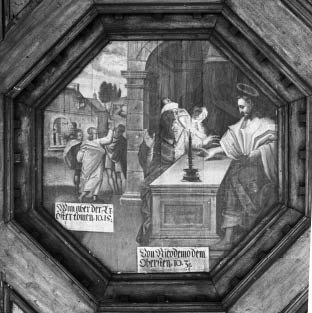
Figure 3.1 “Von Nicodemo dem Obersten. JO[hannes] 3,” ceiling panel in the Carmelite convent of Himmelspforten, Würzburg, 1613, showing Nicodemus by candlelight.
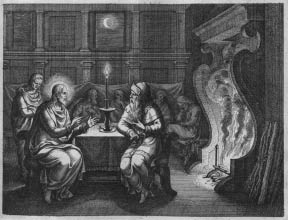
Figure 3.2 Matthaeus Merian, “Meeting of Christ and Nicodemus by Night,” engraving in Noui Testamenti D.N. Iesu Christi … Des Newen Testaments vnsers Herren Jesu Christi fürnembste Historien vnd Offenbarungen in fleissigen und geschichtmesigen Figuren abgebildet, aufs Kupffer gebracht … Durch Mattheum Merian von Basel (Frankfurt, 1627). Photograph courtesy of the Newberry Library.
Accounts of Christians of all confessions meeting at night to avoid persecution abound in the second half of the sixteenth century. In England during the reign of Mary, Protestant congregations met in secret. Looking back from the third year of Elizabeth’s reign, William Ramsey of Devon wrote to the Protestant congregation he served during the time of Marian persecution, reminding them that he ministered “Early and late, privately and openly, as cause required and occasion served.”10 A London congregation led by Thomas Rose held a Protestant service on New Year’s night, 1555, and in the remote Lancashire village of Shakerly a layman named Jeffrey Hurst organized regular gatherings at his home “by night … bringing with him some preacher or other, who used to preach unto them so long as the time would serve, and so departed by night again … every time they came thither they were about 20 or 24 sometimes, but 16 at least, who had there also sometimes a Communion [service].”11 In his Ecclesiastical HistoryTheodore Beza described a Reformed congregation meeting at night in Tours in 1560:
[O]n the last day of September of the said year, the Holy Supper was celebrated by night with such a multitude of people that not being able to find a room large enough, they had to make do with an old temple of St. Lawrence that was not used for anything any longer … Since then, the exhortations continued in this temple, by night, until about the twelfth of October, [when] the Church was entirely dispersed.12
After the accession of Elizabeth, English Catholics tended to continue to attend services in their parish church; Catholic noblemen conformed as an act of political obedience. The papal bull of 1570 deposing Elizabeth sharpened the line between English Catholics and Anglicans, and Catholic recusants began to avoid the established church and hear Mass in private or in secret, as in the county of Denbigh in Wales in 1578, where a Lady Throgmorton and others heard Mass in the house of John Edwards. Later, “upon St. Winifrid’s day, Mrs. Edwards went to Halliwell by night, and there heard Mass in the night season.” The recusants “carried thither with them by night, in mails and cloak-bags, all things pertaining to the saying of Mass. And … these Mass-sayers used their audience to receive holy water, and come to confession.”13 In the same years the so-called Godly or Puritans were accused of setting up “night conventicles.”14 For Christians of all confessions, persecution or word of it showed that the true church might be driven into the night. Was it reassuring to note that “this Son of God did instruct his timorous Disciple Nicodemus, who came to him by night, more fully, than he did such as were his daily followers”?15
3.2.1 Anabaptists
Members of these other religious communities were sometimes forced to meet in darkness, but the Anabaptists faced a much broader exile into the night. For the persecuted Anabaptist communities of the sixteenth century, the confrontation with darkness and the night was literal. From the 1530s on, Anabaptist and Mennonite communities began to meet regularly at night, seeking in the darkness the freedom to assemble and preach denied to them during the day. They found toleration only in Moravia in the mid sixteenth century, and in the Dutch Republic from the late sixteenth century.
In the sixteenth century and for scholars today “Anabaptist” refers to Protestant radicals marked by their insistence on believer’s baptism, their denial of infant baptism, their pacifism, and their understanding of their sect as the separate, “true” church.16From their origins in the Zurich Reformation, four Anabaptist groups emerged by the middle of the sixteenth century: the Swiss Brethren (direct successors of the first Anabaptists of Zurich), South German groups, the Hutterian or Moravian communities, and the Mennonites of northern Germany and the Low Countries. These groups sought to live a biblicist theology as a tiny minority suffering sporadic but violent persecution. The Hutterian or Moravian communities found refuge at the far eastern edge of the Holy Roman Empire in territories still controlled by the local nobility. They enjoyed a golden age in the second half of the sixteenth century before the Habsburg imposition of the Catholic Reformation forced them eastward into Hungary and Russia.17
The earliest reports of Anabaptist worship mention early morning services and meetings, but by the 1530s these had become too dangerous in most regions.18 Sources from Flanders, the Rhineland, Alsace, Switzerland, Württemberg, Hesse, and Tirol document dozens of nocturnal gatherings of Anabaptists and Mennonites, including those planned around visits by Moravian/Hutterian missionaries.19 The Strasbourg city archives, for example, describe specific gatherings at night outside the city in 1545, 1557, and 1576 and refer to at least thirty-four other nocturnal meetings in the Strasbourg area in the period before 1601.20 The accounts came from town officials, pastors, and the simply curious who found their way into nocturnal gatherings of Anabaptists.21 Reports of hundreds of participants are not uncommon. For example, the Lutheran pastor Elias Schad reported to the Strasbourg city council about a gathering he had infiltrated in 1576. Judging from the accents he heard, Schad thought those assembled came from across the Empire – from “Switzerland, Breisgau, Westerich [?], Württemberg, Upper and Lower Alsace, perhaps even from Moravia.”22 The intrepid Lutheran pastor described a system of passwords and sentries used to protect the gathering, evidence of practical experience built up over decades of meeting at night.23 After Schad revealed himself to the group and initiated a lengthy theological debate over baptism and the nature of the church, he was escorted out by the Anabaptists, without whose help, he notes, he would never have found his way out of the forest at night.
Living in a state of confessional siege, the Anabaptists and Mennonites gained a new appreciation of the night in both practical and spiritual terms. A 1538 apology for Anabaptism in Hesse written by Georg Schnabel explains that their “secret gatherings in the woods, in the wilderness, or in houses” followed biblical precedents, citing among other passages “Acts 20 [verse 9], where Paul preached in the night.”24 Evidence of the re-evaluation of the night appears in one of the earliest accounts of a nocturnal gathering. As Anabaptists met outside Strasbourg on the night of July 24–25, 1545, two youths, the Lutheran pastor’s son Jeremias Steinle and his friend Murwolf, snuck into the gathering “for fun” (“aus fürwitz”) and described it to the city council shortly afterward. The young men reported hearing a sermon on the liberation of the children of Israel from their bondage in Egypt, and another sermon on Revelation 11.25 The Anabaptist preaching, which lasted from about 10 p.m. until 1 a.m., contrasted the false “church of stone” established by the authorities with the true church of the spirit.26 The assembled were told to shun their parish church and meet with their fellow believers whenever they could. The leaders of the service then explained that “one cannot find God except in the wilderness and in the darkness.”27 For those who gathered regularly in the night, the point was clear.28
By the middle of the sixteenth century, Anabaptists and their persecutors alike associated the movement with secret meetings at night.29 The imperial warrant issued for the arrest of Menno Simons in December 1542 accused him of “deceiving the simple people with his false teaching during secret, nocturnal meetings.”30 Simons himself took up this accusation in his “A Humble and Christian Apology and Reply concerning the Bitter, Vicious Lies and False Accusations” of 1552. “In the seventh place,” he explained, “they slander us and say that we are vagabonds, sneak-thieves, seducers … an ungodly sect and conspiracy.” Simons used the charge to address the association of Anabaptist and Mennonite communities with the night:
As to the ugly and vicious slander of being sneak-thieves: sneak-thieves are thieves and murderers who secretly enter houses for the purpose of taking the property or lives of others, also adulterers and seducers who are intent upon defiling the houses of their neighbors. Such wait for the darkness, says Job, and say “No eye shall see me.” In the dark they break into houses.31
“But we are not of that kind,” Simons explained. Because in these troubled times “one cannot publicly let out a peep about the word of the Lord,” the faithful must gather in secret at night. Simons justifies this with biblical authorities:
Moreover we learn from the Scriptures that Moses and all Israel ate the Passover at night [Ex. 12]; that Jesus admonished Nicodemus at night [John 3:2]; that the church assembled at night to pray [Acts 12:12]; that Paul taught the Word of the Lord all night [Acts 20]; and that the first church assembled at night to break the bread of the Lord, as the historians report.
His experience with the night led him to argue that “therefore, we confess that we must practice and promote the Word of the Lord at night as well as in the daytime, to the praise of the Lord.” Acknowledging Anabaptist/Mennonite practice, he continued “And so we assemble … in the fear of God, without hindrance or harm to any man, the Lord knows, at night as well as in the daytime, in a Christian manner, to teach the Word of the Lord and to admonish and reprove in all godliness; also to pray and administer the sacraments as the word of the Lord teaches us.”32 Simons’s collection of authoritative biblical accounts of gathering, teaching, and worship at night is especially significant when contrasted with the uncompromising “darkness-vs.-light” imagery of earlier Anabaptist writings.33 In the second half of the sixteenth century, we see further evidence of a much more nuanced Anabaptist view of the night and its darkness.
A Hessian account of 1578 provides an especially clear example of Anabaptist identification with Nicodemus and the night. The Lutheran pastor Tilemann Nolte (a former priest from Fulda) accepted an invitation from a peasant named Hen Klint to go and hear the Anabaptists preach.34 Nolte attended a gathering of about 300 people on the night of May 19, 1578 (Pentecost Monday) in a forest near the village of Schwarz. Two leaders of the group approached him and asked for his help in avoiding the authorities. They explained to Nolte that
they were poor people and they, like Nicodemus, had sought the Lord at night. Although they would well like to teach and preach openly, the authorities would not permit it.35
This reference to Nicodemus is especially significant. Through their deep biblicism, these Anabaptists found a scriptural reference point for lives spent “underground” avoiding persecution. Menno Simons cited John 3:1–3 in his defense of clandestine worship at night, and these Anabaptists chose to identify with Nicodemus because they “had sought the Lord at night.”
The authorities did not intervene at the Hessian meeting described above, but a similar gathering in a forest outside Zurich on September 5, 1574 was encircled and broken up by the Zurich city guard: the two missionaries from Moravia who led the service were arrested. A Zurich report of the incident included a hand-colored drawing of the Moravians preaching by candlelight at a table in the forest (Figure 3.3).36 The image of reading or preaching by candlelight in the forest recurs in other accounts.
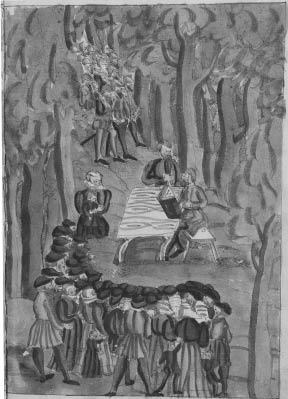
Figure 3.3 Contemporary chronicle illustration of Moravian missionaries preaching by candlelight in the forest outside Zurich, 1574. Zentralbibliothek Zurich, ms F 23, s 393v/394r.
The Hutterites of Moravia lived in relative safety and worshipped only during the day. But the Moravian Anabaptist communities sent out hundreds of missionaries in the sixteenth century, and these men moved by night, met and preached by night, and risked imprisonment, torture, and death. The authors of the Hutterite Chronicle described them as “hunted and driven from place to place and from land to land. They had to be like owls and night ravens, not daring to appear by day, hiding … in the wild woods.”37Setting out from their havens, the Hutterite settlements in Moravia, these missionaries anticipated a nocturnal life. When the missionaries Hans Arbeiter and Heinrich Schister were captured at Hainbach in the bishopric of Speyer in 1568, Arbeiter sent an account of their captivity and interrogation to his brethren in Moravia. He noted that “when we got to Kirrweiler Castle … I, with many threats and insults, was shut into a dark dungeon deprived of all daylight, an experience familiar to many believers.”38Describing the captivity and martyrdom of Hans Mändel in Tirol in 1560–61, the Hutterian chronicle related that while he was imprisoned in the Vellenburg, “the spirits whom God sends to terrify the ungodly at night were now sent to serve and help him,” explaining that “the Lord forewarned him through such a spirit when the noblemen were coming to question him. It called him by name and told him to prepare himself and to be ready to suffer.”39 We have seen in the previous chapter the ubiquitous fear of “the spirits whom God sends to terrify the ungodly at night”; here the Moravian Chronicle records triumph over these nocturnal spirits and a sense that, with God’s grace, the night and its spirits instead serve the persecuted Brethren.
The earliest writings of the Anabaptist communities, such as the Schleitheim Confession of 1527, resound with the light–darkness opposition typical of Reformation polemics: “For truly all creatures are in but two classes, good and bad … darkness and light.” These early texts encouraged Anabaptists to stand firm, “so we shall not walk in darkness.”40 The transformation of the associations of darkness and the night among Anabaptists in the second half of the sixteenth century anticipates and reflects a broader appreciation of darkness across Western Europe by the start of the seventeenth century.41 Persecution forced small groups within each confession to worship at night; for Anabaptists outside of the Dutch Republic and Moravia, this experience transformed their appreciation of darkness and the night.
3.2.2 John of the Cross
As Anabaptist communities from Flanders to the Austrian Alps gathered together at night, Juan de Yepes y Alvarez lay in a dark prison cell in Toledo. His daring escape, illuminated by a full moon during the night of August 15–16, 1578 symbolized a new kind of night, a night that liberated the soul to seek the Divine.42 Following his escape John of the Cross (1542–91), as he has been known since he became a reformed Carmelite friar 1568, produced the deepest and most complex engagement with the “dark night of contemplation” in the early modern centuries.43 His writings on darkness and the night “transformed the night into the central principle of mystic theology,” crystallizing the nocturnalization of faith and piety under discussion here.44 The works of John of the Cross epitomize the use of the night to approach and understand the Divine in the seventeenth century.
Scholars agree that the actual experience of the physical night shaped profoundly the development and expression of John’s mystic theology.45 In fact two very different aspects of John’s relationship to the night emerge in his biography. Reports of his appreciation of serene nocturnal devotion (both in church before the tabernacle and outside, under the stars) contrast with the darkness of his abduction, captivity, and escape from a prison cell in the monastery of his brother Carmelites in Toledo. John’s references to “the tranquil night, / at the time of the rising of the dawn, / the silent music and sounding solitude” reflect the many accounts of his excursions outside in the middle of the night with his companions to pray and observe the beauty of the heavens, as well as many nights spent in solitary prayer.46 In violent contrast, his abduction on the night of December 2, 1577 began nine months of imprisonment in a nearly lightless cell in the fortress-like Carmelite monastery in Toledo. The period of hope and despair ended with John’s daring escape on an August night in 1578. John processed the Toledo experience in several ways, writing of the sense of being kidnapped and led away in the dark, of the dark nights of imprisonment with their attendant spiritual sorrows and joys, and of the liberation of the night of August 15–16. We can examine each in turn.
By the late 1570s the movement to reform the Carmelite order led by Teresa of Avila and John of the Cross met with increasing hostility from the unreformed (“Calced”) friars. The seizure of John by Calced fathers and armed men in Avila on the night of December 2, 1577 was not the first such abduction: in early 1576 John and another reformed Carmelite friar were taken from Avila to Medina del Campo by force at the instigation of the prior of the Calced friars in Avila. The two men were released after a short time – perhaps a few days. This first abduction may be reflected in one of his earliest poems, “I entered in – I knew not where,” dated prior to his imprisonment in Toledo. This work speaks of a “cloud of unknowing” with the power to illuminate: “however darksome was its shroud / It illuminated all the gloomy night.”47 John might have encountered this sense of “the darkness that illuminates” in a range of authors from Denys the Areopagite to Francisco de Osuna, as discussed above in chapter 1.48
The abduction in December 1577 led to a much longer imprisonment. All accounts of John’s cell in the Calced Carmelite monastery in Toledo stress its darkness, lit by one narrow window high above. Physical darkness, combined with the psychological pressures exerted by the unreformed Carmelites who were his jailors, informed the works John composed there and shortly after his escape. His prison works include the poems “For I Know Well the Spring” (with its refrain “Although it is the night”), the first thirty-one stanzas of The Spiritual Canticle, and the Romances. The poem “Dark Night” was written just after his nocturnal escape.49 In eight stanzas “Dark Night” presents an account of John’s escape through the words of a secular love poem. These verses also served to describe, as John explained, “the method followed by the soul in its journey upon the spiritual road to the attainment of the perfect union with God, to the extent that it is possible in this life.”50 The first five stanzas narrate a nocturnal flight that unites beloved and lover:
1. On a dark night, Kindled in love with yearnings …
I went forth without being discovered, My house being now at rest.
2. In darkness and secure, By the secret ladder, disguised …
In darkness and in concealment, My house being now at rest.
3. In the happy night, In secret, when none saw me,
Nor I beheld anything, Without light or guide, save that which burned in my heart.
4. This light guided me – More surely than the light of noonday …
5. Oh, night that guided me, Oh, night more lovely than the dawn,
Oh, night that joined Beloved with lover, Lover transformed in the Beloved!
These and other poems from the Toledo period were revised and expanded in the following years, then glossed by John in extensive prose commentaries for the benefit of reformed Carmelite nuns and monks. In these commentaries John became the theologian of his own experience of the night. His encounter with darkness, real and spiritual, led to a deep engagement with the night, expressed in this series of devotional writings and practices. John built his theology upon a set of terms, especially the “dark night of the soul” and the “dark night of the spirit,” which resonate with the ascetic, apophatic, and mystic metaphors of the night articulated across early modern Europe in this period.
This engagement emerges in the two separate commentaries on the poem “Dark Night” written by John: The Ascent of Mount Carmel (1579–85) and Dark Night of the Soul (1582–85). In these complementary treatises John consolidated and refined his new use of the night as Ursymbol for the mystic path to union with God. The Spanish Carmelite introduced Ascent of Mount Carmel by outlining its use of the metaphor of night: “We may say that there are three reasons for which this journey made by the soul to union with God is called night.” First, John notes that “denial and deprivation are, as it were, night to all the desires and senses of man.” Second, faith, “the road along which the soul must travel to this union” is called “as dark as night to the understanding.” Third, the destination of the soul’s journey is “God, who, equally, is dark night to the soul in this life.”51 John’s works consistently outline a threefold night: an ascetic night of purgation, an inexpressible or apophatic night, and a mystic union with God likened to the night. John elaborated this tripartite metaphor by aligning it with the lived experience of the actual night:
These three parts of the night are all one night; but, after the manner of night, it has three parts. For the first part, which is that of sense, is comparable to the beginning of the night, the point at which things begin to fade from sight. And the second part, which is faith, is comparable to midnight, which is total darkness. And the third part is like the close of night, which is God, the part which is now near to the light of day.52
In this metaphor the first part of the night, the “dark night of the soul” or “dark night of the senses,” purges the soul of its connection to the worldly aspects of devotion. In John’s experience, this could be devastating.53 The second part of the night metaphor, the dark night of the spirit, is described by John as even more profound and disturbing than the night of the senses. That dark night of the spirit, “total darkness,” serves to separate the soul from its own memory, reason, and desire so that it can be united with God.54The third part of this night is the mystic union of the soul and the Divine. To apply the night metaphor to the mystic path, John brought together the devotional, metaphorical, and mystical uses of the night in the Christian tradition. He retained the traditional mystic sequence (purgatio, illuminatio, unio) in the commentaries Ascent of Mount Carmel and Dark Night of the Soul by describing a twofold purging of the human soul (i.e., sensual nature) and spirit, moving through an ascetic night and an apophatic night to reach a mystic night of union. John’s innovation is simple and powerful: the night becomes the element common to each step of the mystic’s path.55 In this way the night becomes, as Jean Baruzi has noted, the fundamental element of John’s theology.56
Supplementing each of these metaphors of night – ascetic, apophatic, and mystic – is a deeper principle articulated by John not in direct reference to the structure and language of his work, but frequently and allusively, as for example in chapter 13 of book 1 ofDark Night of the Soul. Discussing the relationship between self-knowledge and knowledge of God in the night, John noted that, “As the philosophers say, one extreme can be well known by the other.” With these words John cited a principle central to the philosophical, pedagogical, and rhetorical culture of the sixteenth and seventeenth centuries: contrariety, which has been so richly described by Stuart Clark in his work on the intellectual history of witchcraft.57 The general concept of opposition in Western thought, reflected in “polarity, duality, antithesis, and contrariety” served innumerable purposes in thought and expression. Clark examines the deeply rooted “language of contraries” in early modern discourses on physics, natural magic, and medicine. Because, as Clark observes, “contrariety was thought to characterize the logic of the Creator’s own thinking,” it was used to understand and discuss “all natural, intellectual, and social phenomena” from cosmology and ethics to literature, rhetoric, and religion. John of the Cross’s use of the todo–nada theme in the Ascent of Mount Carmel is one of countless examples.58 In the “discovery of night” John of the Cross and his seventeenth-century successors relied on an epistemological night which illuminated through contrariety. As we will see below, Jacob Böhme elevated this device – primarily through its implications for the relationship between light and darkness – to the guiding principle of his cosmology.
Studies of John’s predecessors underscore the new role the night plays in his mystic theology.59 Although John refers to the thought of John Baconthorpe, John Tauler, and Jan van Ruysbroeck throughout his works, John’s use of darkness and the night differs from these late medieval mystics.60 Georges Tavard argues that terms similar to John’s vocabulary of the night appear in the Cloud of Unknowing and in Walter Hilton (vernacular English writers whom John could not have known) and among the Rhenish mystics (translated into Latin by Lorenzo Surius in the mid sixteenth century), but that their conception of night “seems to diverge notably from his.”61 The key comparison is with Nicolas of Cusa, who placed the complementarity and inseparability of darkness and light near the center of his thought. The logical or conceptual value of darkness in Cusa contrasts with the place of the night, experiential and concrete, at the center of John’s theology, in which it is more than merely a symbol or concept. In similar terms, Cusa’s fundamental understanding of God as the “coincidentia oppositorum” in which all contradictions, including darkness and light, become one, contrasts with the irreducibility of todo and nada for John. This irreducible night seems as existential and fundamental as John’s experiences of it.62 And this night – profound and irreducible, taken without any reference to the dawn – informs a dynamic range of early modern thought and expression in the generations after John’s death.
This reading of several of the major works of John of the Cross alerts us to four kinds of night – the ascetic, apophatic, mystic, and epistemological – evoked in early modern culture. The Carmelite’s theology of the night allows us to understand the uses of the night in early modern culture in terms more precise and revealing than a simple contrast between positive and negative views of the night. As we will see, each of these four ways of thinking with the night resonated widely across European culture in the seventeenth century as never before. This resonance goes far beyond any question of influence by the relatively unknown Spanish Carmelite author, whose works were not published until 1618.
3.2.3 Jacob Böhme: contrariety as cosmos
“Nothing can be revealed to itself except through contrariety [Wiederwärtigkeit].” So proclaimed Jacob Böhme in his “On the Vision of the Divine” (“Von Göttlicher Beschaulichkeit”) in book 6 of the Christosophia (1624), one of his last writings.63 Contrariety was fundamental to early modern thought and expression, but the German philosopher-mystic elevated this principle to the essence of divine and created nature. In his expansive theosophy, developed in a flood of prose between 1619 and 1624, Böhme envisioned contrariety as a dynamic force that shaped God, the process of creation, and all aspects of human existence. No contrariety was more important to Böhme’s thought than the pair light–darkness, and a systematic, detailed cosmology of light and darkness permeates his work. In his last major work, the Mysterium magnum of 1623, a commentary on Genesis that elucidated “the kingdom of nature and the kingdom of grace,” Böhme emphasized the power of contrariety to create and reveal:
The darkness is the greatest enemy of the light, yet it is the means by which the light is revealed. If there were no black, then the white would not be revealed; and if there were no suffering, so also joy would not be revealed.64
A few pages later Böhme returns to this principle: “in the darkness the light is recognized, otherwise it would not be revealed,” noting that “the basest must be the origin of the best.”65 The discussion of darkness and light in the works of the shoemaker (and later cloth merchant) of Görlitz is one of the most complex and influential of the early modern period. Böhme sought no followers and remained in outward conformity with the Lutheran church all his life. Only one of his works was published during his lifetime, but his writings circulated in manuscript copies and were quickly published in German and in translation after his death. They found admirers far and wide. In 1646 Charles I of England, after reading Böhme’s Answers to Forty Questions (Vierzig Fragen von der Seelen) allegedly exclaimed, “God be praised that there are still men in existence who are able to give from their own experience a living testimony of God and His Word!”; in 1649 Oliver Cromwell’s chaplain, Peter Sterry (1613–72), influenced by Böhme, preached in Behemist terms that “Darkness, and light, are both in God; not only Representatively, but really; not in their ideas only, but their Identities.”66 Böhme’s life and work were shaped decisively by the confessional age into which he was born. His native region, Silesia, stood on the frontlines of religious and political conflict. As a cloth merchant he traveled across the region; he witnessed the royal entry of Frederick of the Palatinate into Prague as king of Bohemia in 1619 and saw the outbreak of what would become the Thirty Years War. In his writings he consistently sought to transcend the confessional struggles raging around him.
Böhme took the principle of contrariety, widespread in early modern culture, and elevated it to a cosmology understood through day and night, light and darkness. These pairs become inseparable and complementary. He explained his fundamental principle especially clearly in his Quaestiones Theosophicae (1624). In response to a question about the coexistence of God’s love and wrath, Böhme began:
The reader should understand that all things consist in Yes and No, be they divine, diabolic, terrestrial, or however they may be named. The One, as the Yes, is pure power and life, and is the truth of God or God himself. He would in himself be unknowable, and in him would be neither joy nor elevation, nor feeling, without the No.67
The Divine manifests itself through its creation of contraries: “The No is a counterstroke of the Yes or the truth, in order that the truth may be manifest and be a something, in which there may be a contrarium.” This is not, however, any simple dualism:
And yet it cannot be said that the Yes is separated from the No, and that they are two different things side by side. They are only one thing, but they separate themselves into two beginnings [principia], and make two centers, each of which works and wills in itself.
Böhme chose night and day to explain this reciprocity: “Just as day in relation to night, and night in relation to day, form two centers, and yet are not separated, or separated only in will and desire,” so too is the relationship between the Yes and the No, which forms the basis of all existence. Continuing in reference to day and night as expressed by heat and cold, Böhme explains that:
Neither would be manifest or operative without the other … Without these two, which are in continual conflict, all things would be a nothing, and would stand still without movement. The same is to be understood regarding the eternal unity of the Divine power.68
For light to exist, there must be darkness; and to know light, one must know darkness, because they are coexistent, not in a relationship of presence and absence, but as complements to one another. Böhme’s polarized cosmos comes into being and is known through contrariety.69
Böhme sought to describe the dynamic relationships between God, man, and nature in images as well. In his Answers to Forty Questions, composed around 1620, he advises the reader to visualize his thought by contrasting darkness and light in a geometric figure: “Put the Grimm [a manifestation of darkness] on the left, and the light on the right …; there is no other way of drawing it, but it is a sphere.”70 The first illustration of this “Philosophische Kugel oder … Wunder = Auge der Ewigkeit” appeared in a 1632 Latin edition of the Answers to Forty Questions printed in Amsterdam, and the image appeared in later editions of his works in Latin, English, Dutch, and German, again showing the breadth of the reception of Böhme in the century after his death. The English adaptation of the image (1647) appears as Figure 3.4. The contrariety of light and darkness is the dominant theme of the image: one sees the “two centers,” one dark and one light, as referenced above in the Quaestiones Theosophicae. The sixty-five specific Behemist terms brought together in the 1632 image suggest the complexity of Böhme’s theosophy; at the same time, the fundamental connection between the spheres of darkness and light is apparent. In words and in images, Böhme thus presented a theology in which light and darkness are balanced and interdependent; this contrasts sharply with the imagery of light and darkness in the Lutheran and radical traditions from which he issued.71 Given the distance of his thought from even his closest predecessors, such as Valentin Weigel and Johann Arndt, how should we assess the sources of his ideas?
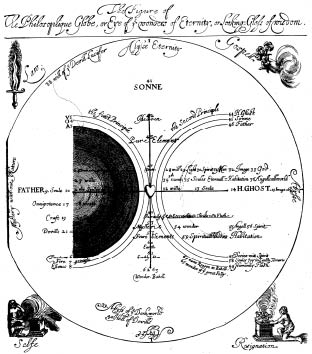
Figure 3.4 Representing light and darkness in Jacob Böhme’s thought. Engraving from Jacob Böhme, XL. questions concerning the soule (London, 1647), pp. 22–23. University of Chicago Library, Special Collections Research Center.
Like the Anabaptists and the Carmelite reformers, Böhme knew intra- and inter-confessional strife and persecution first hand. But his experiences allow us to glimpse deeper crises and more profound solutions formed in the crucible of the confessional age. Histheosophy, which he saw as a divine revelation, can also be understood through its personal, existential origins, and in the rich, relatively open cultural-intellectual milieu of Silesia at the end of the sixteenth century. From his first writing, the unfinished Rising Dawn (Morgenröthe im Aufgang, later referred to as Aurora) of 1612 to his last works in 1624, Böhme sought to explain the relationship between God and humankind in terms of the physical world, which he understood as fundamental material reality and as allegory.
The decentering of the earth by the new astronomy seems to have started Böhme’s search. By his own account, Böhme’s revelations followed a period of “hard melancholy and sadness” caused, as he related in chapter 19 of the Aurora, when he “contemplated in [his] spirit the vast Creation of this World.” By the time he wrote Aurora in 1612, Böhme held firmly to the new astronomy, stating “the earth turns and courses with the other planets around the sun as in a wheel.”72 Böhme seems to have first learned of this heliocentric view sometime before 1600: he related in the Aurora that he was suddenly and deeply disturbed by his first encounter with heliocentric or polycentric astronomy, and wondered what “the little spark of humanity” could mean to God, lost among his “great works of heaven and earth.” He described in poignant terms the loss of his medieval Christian world view:
Before this … I myself held that the true Heaven formed a round circle, quite sky-blue, high above the stars, in the opinion that God had therein his specific being, and ruled in this world solely through the power of his holy spirit.
This view was given “quite a few hard blows (“gar manchen harten Stoß”) by word of a heliocentric (or perhaps polycentric and infinite) universe.73
Secure in an Aristotelian-geocentric world view, John of the Cross contemplated the night sky with a sense of divine order that located humankind and nature within concentric spheres of planets and fixed stars encompassed by the celestial realm of angels, saints, and God. Böhme looked at the same night sky with fear, “very melancholy and intensely saddened” by the implications of the new astronomy. He explained that as a result of his heliocentric understanding of the cosmos, the Devil would “often send pagan thoughts” (a circumlocution for atheist conclusions about the absence of God?) to him.74 Where was God in this “new” universe? Infinitely distant from the earth and humankind?75
Böhme feared that the absence of God was confirmed by the world around him: “I found that good and evil were in all things, in the elements and in the creatures, and that in this world the godless fare as well as the pious, and that the barbarian peoples have the best lands, and that they enjoy more happiness than the godly.”76 His crisis combined the disorientation of the new, infinite, universe with the age-old question of theodicy. Böhme attested that “no writings, even among those I knew so well, could console me.” The cobbler-turned-theologian described the confusion of a new, vast universe alongside the apparent predominance of evil in the world. Böhme’s contemporary John Donne evoked the same confusion at the same time in his Anniversaries (1611):
And new Philosophy calls all in doubt,
The Element of fire is quite put out;
The Sunne is lost, and th’earth, and no mans wit
Can well direct him where to looke for it.
And freely men confesse that this world’s spent,
When in the Planets, and the Firmament
They seeke so many new; they see that this
Is crumbled out againe to his Atomis.
‘Tis all in pieces, all coherence gone;
All just supply, and all Relation:
Prince, Subject, Father, Sonne, are things forgot,
For every man alone thinkes he hath got
To be a Phoenix, and that then can be
None of that kinde, of which he is, but he.77
In this passage Donne, like Böhme, fuses the “new Philosophy” with a sense of moral or social disorder, as the proper relations between princes and subjects, and fathers and sons have lost “All just supply, and all Relation.” With “all coherence gone,” restoring order would not be easy.78 The solution Böhme fashioned transformed him from troubled cobbler to influential theosopher.
The breakthrough came around 1600, as described in chapter 19 of the Aurora, titled “On the created Heaven and the form of the earth and the water, also on the light and the darkness.”79
In a word, the solution to Böhme’s crisis was immanence. God dwelt in this world, in everything, not in a distant Heaven. This immanence meant a new embrace of all of the natural world, both as material and as symbol, especially – as the title of the chaptersuggests – its light and its darkness. This “awareness [Erkenntnis] and revelation from God” came after “wrestling with the love and mercy of God,” a reference to Böhme’s namesake Jacob wrestling at night with an angel.80
Immanence also shaped his new understanding of evil. Through his entire oeuvre, the question of evil and redemption remained central to Böhme’s theosophy, as did the imagery of darkness and light. Böhme developed an understanding of evil unique within the Christian tradition, describing its generation through the unfolding of the potential within the Ungrund – the undifferentiated Divinity as it existed before creation. This view made evil, Satan, Hell (understood untopologically), and darkness fundamental and necessary aspects of creation. Böhme broke decisively with the traditional Christian view of evil and darkness as deficiency or privation. Contra Augustine, evil was in Böhme’s cosmos more than the mere absence of good, and darkness more than the privation of light. Both became real in their own right as necessary aspects of creation. This cosmos and the place of evil in it stands in startling contrast to all orthodox Christian views of his age.81
The revelations first received around 1600 and first outlined in the unfinished Aurora (1612) ended the depression and confusion prompted by the new astronomy and by the seeming triumph of evil in the world. But the circulation of Böhme’s ideas in manuscript marked a second turning point in the artisan’s life as he faced conflict with the local Lutheran clergy over his startling, heterodox ideas. In the late sixteenth century, Böhme’s Görlitz was a crossroads of heterodox ideas and beliefs where pastors, city councilors, artisans, travelers, and local nobles discussed the diverse intellectual and cultural offerings of the time: Calvinism, Lutheran mysticism, Paracelsan alchemy, the new astronomy, Catholic reform, Schwenkfeldian ideas, and more. Kepler visited the city in 1607; the city councilor Bartholomäus Scultetus and Böhme’s pastor Martin Moeller (1547–1606) were among the city’s leading intellectuals.
This lively, relatively open cultural-intellectual milieu was fundamental to the development of Böhme’s ideas. But Görlitz was becoming less tolerant and more tied to Lutheran orthodoxy just as his writings began to circulate in 1612–13. A local nobleman, Carl Ender von Sercha, made copies of the unfinished Aurora manuscript. In July 1613 a copy reached the new senior Lutheran pastor of Görlitz, Gregor Richter. He immediately informed city councilor Scultetus of the cobbler’s heretical work. Böhme was brought before Scultetus and questioned about his “enthusiastic beliefs.” While Böhme was held briefly at the Rathaus, the Aurora manuscript was confiscated from his home. Böhme was warned not to dabble in theology any further and released; the manuscript was locked away. Scultetus handled Böhme fairly gently, but pastor Richter was more forceful. The following Sunday, July 28, 1613, he denounced false prophets such as Böhme from the pulpit; the cobbler-cloth merchant was then questioned by Richter and the clerical council of Görlitz on July 30. The meeting concluded with Böhme’s agreement to cease writing about theological and spiritual matters. This public censure left a lasting mark on Böhme’s life.82
In the years between his silencing in 1613 and the resumption of his writing in 1619 Böhme reflected deeply on confessional strife and war. He returned to writing with a manuscript titled The Three Principles (Beschreibung der Drey Principien Göttliches Wesens); like all his writings after 1612, it is entirely critical of the established churches and their clergy. In the theosopher’s view, the world was “under the sway of a fratricidal Church of Cain.”83 Böhme now saw the revelations he received as specific to the confessional age in which he lived. All around he saw that “contention and strife in faith is arisen, that men talk much of faith, one pulling this way, another that way, making a multitude of opinions, which are altogether worse than the heathen views.”84Confessional conflict, doctrinal rigidity, and religious persecution had emptied Christendom of true understanding of God and nature: “today titulary Christendom is full of such magi who have no natural understanding of God or nature, but only empty babbling.” By reneging on his agreement to cease writing on matters of theology and faith, Böhme drew censure from the Lutheran clergy of his city. His ongoing conflict with the Lutheran churchmen of Görlitz echoes in his conclusion that through such clergy “the world is thus made stone-blind.”85
The revelations vouchsafed to Böhme and the theosophical program he expounded were intended to illuminate a world blinded by ecclesiastical authorities and confessional strife. He placed his age in contrast with early Christianity in relation to “natural magia,” i.e. the direct and allegorical understanding of the natural world: “as it was highly necessary and good that the natural magia was discontinued amongst the Christians, where the faith of Christ was manifest: so now at present it is much more necessary that the natural magia be again revealed.” For Böhme “natural magia” meant a turn to the observed phenomena of the natural world, including (as described above) a new appreciation of the complementarity of darkness and light. He echoed other programs of spiritual and natural renewal circulating at this time, such as the Rosicrucian and utopian writings of Johann Valentin Andreä. The return to “natural magia” would have immense consequences:
the self-fashioned idols of titulary Christendom will be revealed and made known through nature, so that man might recognize in nature the articulated and formed Word of God, as well as the new rebirth, and the fall and perdition.86
Alchemy, physical and spiritual, might serve as midwife to this rebirth, which would embrace darkness as complementary to light, and night alongside day. As Böhme exhorted in his Signatura Rerum of 1622, here in the English translation of 1651: “Now wilt thou be a Magus? then thou must understand how to change the Night again into the Day,” emphasizing that “the Day and Night lie in each other as one Essence.”87 Böhme saw his own age as ready to accept a new relationship between light and darkness, day and night. He would be a prophet of this nocturnalization.
The stories of the Anabaptists, John of the Cross, and Jacob Böhme alert us to a broader set of experiences across Europe in the confessional era. In each of these cases confessional conflict and ongoing persecution – from within one’s own confession or across confessional lines – led to a new relationship with the night in daily life and in spiritual expression. The encounters with darkness and the night examined here show an increasing integration of the night into spiritual life and thought. The Anabaptists sought scriptural validation of their nocturnal position outside the established churches of the princes. In the midst of the brutal struggle to reform the Carmelite order, John of the Cross developed a profound theology of the night by nocturnalizing the three stages of the classic mystic sequence of purgation, illumination, and union. For Jacob Böhme, the balance between light and darkness became the basis of the cosmos: his abstract understanding of the meaning and reality of darkness and the night seeks its equal in the early modern era. Referring directly to the confessional strife around him, Böhme also presented a theory of history in which his era would see a return to “natural magia” in order to truly understand God’s creation, light and dark. Böhme’s writings (1612; 1619–24) take us into a period of intense occupation with the night as a path to God in Western Christendom. To chart this phenomenon in the next section, we will draw on the examples of John of the Cross and Jacob Böhme to focus on the search for God in the night in ascetic, apophatic, mystic, and epistemological terms.