
“Dark texts need notes,” John Donne observed in a verse epistle to his patroness Lucy, countess of Bedford, in 1608. As creator of the English noun “nocturnal” to refer to a poem about the night, Donne joined unlettered Anabaptists, doctors of mystical theology, poets, and alchemical philosophers in using the night to think about God in new ways and with new intensity.88 Each of the conceptual/metaphorical uses of the night – ascetic, apophatic, mystic, and epistemological – epitomized in the works of John of the Cross and Jacob Böhme found new or renewed expression across European culture in first half of the seventeenth century. This “discovery of the night” went far beyond the reception of the vocabulary of its most focused exponent, John of the Cross, forming a broad but distinct cultural and “spiritual undercurrent” in the period 1550–1650.89
Many chose poetry as the genre in which to express this new relationship with the night; John of the Cross was the forerunner in form as well as content. As Michel de Certeau observed regarding the discourse of mysticism in the period from Teresa of Avila to Angelus Silesius: “For a while, this science was sustained only by the poem (or its equivalents: the dream, the rapture, etc.). The poem was the substitute for its scientific object.”90 Much of the “discovery of the night” explicitly evoked “mystic darkness,” and these “dark texts” reveal Europeans using the night to think about God in an unprecedented variety of ways. By 1640, when the Jesuit theologian Maximilian Sandaeus published an alphabetical guide to the key terms of mystic theology, the night was firmly established in the vocabulary of mysticism.91 Under the entry for “Nox” Sandaeus presents each of the senses of the night elucidated by John of the Cross, beginning with a reference to the significance of the term: “Night. Numerous metaphors of the night can be found among the mystics; they are used most frequently by John of the Cross, distinguished mystic of our time, from whom are the books on the ascent of Mount Carmel.” Sandaeus’s guide also has entries for “dusk,” “midnight,” and “lantern,” but no entry for “day.”92
The new role of the night in devotion and theology was celebrated in verse by Richard Crashaw in the “Hymn in the Glorious Epiphanie” of his Steps to the Temple (1648). This English Catholic, writing in exile in Paris, brought English metaphysical poetry together with early modern Catholic mysticism.93 He proclaimed “a most wise and well-abused Night” which he identified as the via negativa of John of the Cross, “the frugal negative Light.” This “more close way” to the Divine is taught by the newborn “Child of light,” whom Crashaw thanks for a night that allows us “To read more legible thine original Ray, / And make our darkness serve thy day.” The poem is spoken by the three magi:
(1.) Thus shall that reverend Child of light,
(2.) By being Scholar first of that new night,
Come forth Great Master of the mistick day;
(3.) And teach obscure Mankind a more close way
By the frugal negative Light
Of a most wise and well-abused Night,
To read more legible thine original Ray,
(Chorus) And make our darkness serve thy day;
Maintaining ’twixt thy World and ours
A commerce of contrary pow’rs,
A mutual Trade
’Twixt Sun and Shade,
By confederate Black and White
Borrowing Day and lending Night.
In this section we will follow the undercurrent of “that new night” identified by Sandaeus and Crashaw across Europe, with a focus on its breadth in the first half of the seventeenth century, the critical period in this discovery of the night as path to the Divine.
3.3.1 The ascetic night
The “night to all the desires and senses” had a venerable place in the Christian tradition. An ascetic life of nocturnal prayer remains a fundamental aspect of Benedictine and other monastic observance. Waking in darkness for the office of nocturns held practical and eschatological significance but was foremost a physical act of self-denial.94 This ascetic darkness is deployed by Ignatius of Loyola in the Spiritual Exercises (1548): in the first week of the Exercises, the author proposes “to deprive myself of all light … shutting the doors and windows while I stay, except when I am to read or eat.”95 In contrast with earlier observance, however, Loyola imagines the solitary use of ascetic darkness, marking the key common feature of early modern nocturnal paths to the Divine. From Loyola it is a short step to the ascetic night, in which darkness serves as a metaphor for self-denial. Teresa of Avila’s Interior Castle (1577–80) presents its first three sections or “mansions” as a descent into darkness (“the light which comes from the palace occupied by the King hardly reaches these first mansions at all”), signifying the sin the soul must overcome. At the end of the description of the second mansion Teresa reviews the ascetic value of the confrontation with darkness in a famous passage: “It is absurd to think that we can enter Heaven without first entering our own souls – without getting to know ourselves, and reflecting upon the wretchedness of our nature.”96 In darkness, self-denial leads to self-knowledge. This insight can carry a penitential tone, as in the poetry of Jesuit martyr Robert Southwell (c. 1561–95), whose “The Prodigal Chylde’s Soule Wracke” (c. 1595) proclaimed:
I, plungèd in this heavye plyght,
Founde in my faltes just Cause of feare;
By darkness taught to knowe my light,
The loss thereof enforcèd teares.
The ascetic night echoes across the sacred writings of John Donne. In his “Hymn to Christ, at the Author’s last going into Germany” (1619) Donne takes his approaching travel as the moment to rededicate himself to God, shunning the distractions of daylight in favor of the darkness and night, which allow a clearer vision of the Divine.97
Seal then this bill of my divorce to all,
On whom those fainter beams of love did fall;
Marry those loves, which in youth scatter’d be
On fame, wit, hopes – false mistresses – to Thee.
Churches are best for prayer, that have least light;
To see God only, I go out of sight:
And to ’scape stormy days, I choose
An everlasting night.
This night is intensely introspective, but Donne also considered the power of the ascetic night from his perspective as a preacher. In a 1629 sermon given “In the Evening” Donne addressed “atheists” and asked his listeners to look ahead to midnight:
I respite thee but a few hours, but six hours, but till midnight. Wake then; and then dark and alone, Hear God ask thee then, remember that I asked thee now, Is there a God? and if thou darest, say No.98
Stripped of the distractions of the daylight, alone at midnight, the “atheist” or libertine would recognize the God he scorned during the day. Donne’s reference to the tolling of a “passing bell” in another sermon also evokes the shock of midnight: “A man wakes at midnight full of unclean thoughts, and hears a passing bell; this is an occasional mercy.”99 The popular English emblem book of the poet Francis Quarles (1635; many editions through the nineteenth century) took a gentler approach to the same kind of night:
My soule, cheare up: What if night be long?
Heav’n finds an eare, when sinners find a tongue:
Thy teares are Morning show’rs: Heaven bids me say,
When Peter’s Cock begins to crow, ’tis Day.100
The Lutheran pastor, poet, and hymnist Paul Gerhardt (1607–76) looked toward an ascetic night in his “Evensong” (“Abendlied,” 1667):
Rest now all forests,
Beasts, men, cities and fields,
The whole world sleeps
But you, my thoughts,
Up, up you must begin
What pleases your creator most.101
In each stanza Gerhard presents a different theme of nocturnal meditation including Jesus as “another sun” and the stars, the body, and the bed as memento mori.102
There is no better way to visualize this ascetic night than in the devotional candlelight scenes of Georges de La Tour, especially the Repentance of Mary Magdalene – a popular theme, judging from the many versions and copies painted from the 1630s on.103La Tour’s penitent Magdalene (Figure 3.5) captures the solitary nature of the ascetic night: there is no space or place in the scene into which another figure could intrude, and no light enters from outside the scene.104 The devotional context of the night scenes produced by artists active in the duchy of Lorraine such as Jacques Bellange, Jean Le Clerc, Jacques Callot, and Georges de La Tour has been examined closely by Paulette Choné.105 Arguing for a more careful approach to connections between painting and literature, she has identified the works of John of the Cross (which circulated in manuscript among the Discalced Carmelites of the region before their publication in 1618) and the Franciscans André de L’Auge (who preached at the ducal court of Lorraine) and Juan de Los Angeles as specific channels that brought the verbal imagery of the sacred night, ascetic and apophatic, into the visual arts of the Lorraine region.
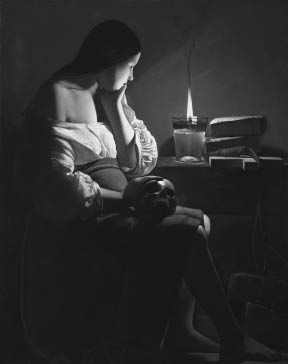
Figure 3.5 Georges de La Tour (1593–1652), The Magdalene with the Smoking Flame, c. 1638–40. Los Angeles County Museum of Art.
Of course, the specific Lorraine context does not preclude a broader set of connections. Among the manuscripts of the English Benedictine Sisters in Cambrai (Flanders), we find an anonymous devotional poem of the seventeenth century that seems to gloss the solitary, ascetic night of La Tour’s Magdalene:
Alone retired within my native cell,
At home within myself, all noyse shut out
In silent mourning I resolve to dwell,
With thoughts of death Ile hang my walls about;
All windows close, Faith shall my taper be,
At whose dim flame Ile Hell and Judgment see.
…
All windows close, Faith shall my Taper be,
On Hope Ile rest, and sleep in Charity.106
The abbey of Our Lady of Consolation at Cambrai was founded in 1623 by Cresacre More, great-grandson of Thomas More, and had longstanding ties to English recusant families. His daughter Dame Agnes (Grace) More (1591–1655 or 1656) and several other sisters at Cambrai were cousins of John Donne.107 The literary works of the sisters of Cambrai use themes familiar from English metaphysical poetry, such as the contrast and reciprocity of light and darkness, “the four seasons of mankind,” and the microcosm/macrocosm parallel. The sisters also drew on Spanish and French mysticism; as “Sister M.S.” noted in a collection of writings “for her spiritual comfort in her several necessities”: “John of the Cross. There is no better or more powerful way to increase the virtue of the mind, than … to shut fast the door of the senses, by solitude and forgetfulness of all creatures and human events.”108 She reveals a clear understanding of the “dark night of the senses” as described by John. At Cambrai, the English Benedictine sisters received and contributed to the latest currents in Western spirituality across national and confessional boundaries. The night became a key time and symbol in these currents: it could reveal sin and, by removing the temptations of the day, offer a path away from it. As Pascal observed in his Pensées (c. 1660): “If there were no obscurity, man would not feel his own corruption.”109
3.3.2 The apophatic night
As the midpoint of the soul’s dark night, faith “is compared to midnight,” the darkest part of the night. “The more the soul is darkened,” John explained, “the greater is the light that comes into it.”110 In his discussion of the Divine, John explained that “in order to reach Him, a soul must rather proceed by not understanding … and by blinding itself and setting itself in darkness, rather than by opening its eyes.”111 Empowered by the sense that the path to God is as dark as night to the understanding, mystic authors made darkness and the night key apophatic terms across genres and confessions in the seventeenth century. Darkness figured in many of the oxymora and paradoxes used to express the inexpressibility of the Divine, seen for example in George Herbert’s “Evensong” (c. 1620; the earlier of two poems with this title). Herbert begins with the more traditional negative view of “Night, earth’s gloomy shade, / fouling her nest, my earth invade,” but then corrects himself, noting that it is wrong to write “as if shades knew not Thee.” The night is also a divine time, as he immediately asserts in apophatic terms:
But Thou art Light and Darkness both together:
If that be dark we cannot see:
The sun is darker than a tree,
And thou more dark than either.
Yet Thou art not so dark, since I know this,
But that my darkness may touch thine:
And hope, that may teach it to shine,
Since Light thy Darkness is.112
No one explored this theme more deeply than the French devotional poet Claude Hopil. The Parisian wrote extensively on this theme in his The Piercings of Divine Love Expressed in One Hundred Canticles Made in Honor of the Most Holy Trinity (Les divins eslancemens d’amour exprimez en cent cantiques faits en l’honneur de la très saincte Trinité) of 1629.113 Apophatic themes and expressions from Denys the Areopagite and John of the Cross are woven into one hundred canticles in praise of the Trinity:
In the night of faith, the ray of darkness
of the beautiful Trinity
Suffices for salvation.114
Paradoxes of night and darkness are Hopil’s primary theme:
My spirit rises to the dungeon magnificent
In the divine ray of mystic darkness
All confused and ravished
I saw what one cannot think, let alone write
Thus I tell you all without being able to say anything
Of all that I saw.115
Hopil described clearly the apophatic voice: “If I speak here only of shadow and fog, / of silence and of horror, / of dungeons and dark clouds,” he explained, it is only so that “one sees the failure / that the Father causes in us through his wisdom.” This failure is a “learned ignorance … ravishing and beautiful,” a “sacred darkness which reveals to us a Sun / to the heart, not to the eye.”116 Revealed to the saints by “his eternal word,” the Divine is “hidden for us in the mystic night.”117 Many times Hopil refers to his own meditation “in the night not dark but mystic,” suggesting that he considered the night a time of actual prayer as well as an apophatic metaphor.118
Despite their necessary obscurity, Hopil composed his devotional verses as canticles, meant to be sung to the tunes of popular secular chansons in the home. Scholars have noted that “individual readers were considered capable of choosing music themselves for pious chanson texts” such as those of Hopil, suggestion some circulation of his sense of the apophatic and mystic night among laypeople.119
Oxymora and paradoxes abounded in the popular poetry of the spiritual night. The Lutheran baroque poet Andreas Gryphius (1616–64) often wrote of the bleak shadows of the Thirty Years War, but he also chose an apophatic night in his “On the Birth of Jesus” (“Uber die Geburt Jesu”):
Night / more than bright night! Night / brighter than the day /
Night (brighter than the sun) / in which the light was born.
…
O night, which can thwart all nights and days!120
Other poets celebrated the night in broader terms not limited to the single, unique night of the birth of the Christian savior. As Henry Vaughan concluded his poem “The Night”:
There is in God – some say –
A deep, but dazzling darkness; as men here
Say it is late and dusky, because they
See not all clear.
O for that Night! where I in Him
Might live invisible and dim.
Another of the Benedictine sisters at Cambrai, Dame Clementina Carey (d. 1671), wrote of flight from God in the night, reversing the terms of the paradox:
If I say Darkness, and the Night,
Which shut out all, shall bar Thy sight
That Darkness, which is so to me, to Thee is Light.121
These baroque expressions of the inexpressible were drawn to the night as they sought to fuse the quotidian with the sublime.
Similar insights appeared in natural philosophy, as in the alchemical treatise of Blaise de Vigenère (1523–96), A Discovery of Fire and Salt (English translation, 1649).122 Vigenère asserts that “Divinity is so wrapped in darkness, that you cannot see day through it,” citing Psalm 17, Orpheus, and Deuteronomy 4. His comments reveal the reception of the negative theology of Denys the Areopagite: “for in regard of God towards us, light and darkness, are but one thing: as is his darkness, such is his light.” He adds in apophatic terms:
by … that which is equivalent to darkness, we may better apprehend something of the Divine Essence, but not by … that which relates to light … For the Divine light is insupportable above all to all his Creatures, even down to the most perfect, following that which the Apostle sets down in I. of Tim. 6. God dwells in the light inaccessible, that no man can see. So that it is to us instead of darkness, as the brightness of the Sun is to Moles, Owls, and other night birds.123
The need for darkness in the ineffable human encounter with the Divine was a significant theme in the seventeenth century.124 The engravings forming the frontispiece of Daniel Cudmore’s A prayer-song; being sacred poems on the history of the birth and passion of our blessed Saviour (Figure 3.6, 1655) juxtapose the sun hidden in darkness with the soldiers at Christ’s tomb, blinded by the light of the Resurrection.125 The texts chosen place the images in an apophatic frame. On the left “Behold the man” refers to a cloud of darkness before the sun; on the right “He is not here but is risen” captions the blinding physical presence of the risen Christ. The darkness that covers the sun and the dazzling force that pushes back the soldiers both have their counterparts in Milton’sParadise Lost. Surveying their new lot in Hell, the fallen angel Mammon reminds his fellows that darkness is not confined to the infernal depths:
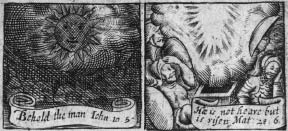
Figure 3.6 Detail, frontispiece of Daniel Cudmore, A prayer-song; being sacred poems on the history of the birth and passion of our blessed Saviour (London, 1655). University of Illinois, Urbana-Champaign, Rare Books and Manuscripts Library.
This deep world
Of darkness do we dread? How oft amidst
Thick clouds and dark doth Heaven’s all-ruling sire
Choose to reside, his glory unobscured,
And with the majesty of darkness round
Covers his throne, from whence deep thunders roar
Mustering their rage, and Heaven resembles hell?126
Mammon fundamentally misunderstands the origins and meaning of divine darkness, of course, describing it as a material obstacle rather than as a reflection of unconditional divine majesty.127 Milton evokes the apophatic through Mammon’s failure to understand it. Raphael’s description of God is more perceptive, with its apophatic flourish:
Fountain of light, thyself invisible
Amidst the glorious brightness where thou sit’st
Thron’d inaccessible, but when thou shad’st
The full blaze of thy beams, and through a cloud
Drawn round thee like a radiant shrine
Dark with excessive bright thy skirts appear.128
As we will see below in chapter 4, the image of light blazing through a cloud was deployed by Milton’s royalist contemporaries to praise earthly sovereigns as well.
3.3.3 The mystic night
“Although this happy night brings darkness to the spirit, it does so only to give it light in everything.”129 With these words John of the Cross opened the most advanced section of his extended nocturnal metaphor to describe the mystic union of the soul with God as night in the second book of Dark Night of the Soul. “On this night God … [has] put to sleep … all the faculties, passions, affections and desires which live in the soul, both sensually and spiritually.” John presents the liberation of the soul through night:
It is not to be supposed that, because in this night and darkness it has passed through so many tempests of afflictions, doubts, fears, and horrors, as has been said, it has for that reason run any risk of being lost. On the contrary … in the darkness of this night it has gained itself.130
For John and his successors, this mystic night built upon the ascetic nights of despair and purgation, and could be expressed only in the apophatic terms outlined above. As Jeanne de Cambry, an Augustinian canoness, wrote in her mystic Ruin of Self-Love and Building of Divine Love (1623): “But indeed they cannot be explicated by any human tongue! Nevertheless, serving myself of a similitude, I will describe this as best I can.” Later in the treatise she describes a soul in mystic union: “For she will be, as it were, wrapped up in a wonderful kind of interior darkness.”131 By the early seventeenth century, more spiritual authors used similitudes of darkness and the night to describe the encounter with God.132 Writing in 1610, the Lutheran theologian and devotional author Johann Arndt (1555–1621) described a dark night of mystical union in terms remarkably similar to those of John of the Cross:
When the heart is still, when all senses are turned inward, in peace, and recollected in God; when no earthly light appears in the understanding, and the wisdom of the flesh is swallowed up in a night or divine darkness, then the divine light rises and gives a flash, a ray of itself, and shines in the darkness. That is the darkness in which the Lord dwells, and the night in which the will sleeps and is in union with God. In this [state] one’s memory has forgotten the world and time.133
The theme of darkening the self to admit the divine light is not common in Arndt’s writings, but it is unmistakable. Again, it is significant that Arndt developed this metaphor of darkness without access to the works of John of the Cross, which were first printed in Spanish in 1618 and in French in 1622–23.
The writings of John of the Cross did clearly influence Claude Hopil’s Divins eslancemens d’amour of 1629. Hopil described the divine union in shadowy terms: “One night in the midst of the cloud / in a superabundance of spirit / my soul was alienated of its senses.” He continued: “No, I have neither heart, nor mind, nor memory / since the happy night in which I glimpsed the glory / of the King of love / a night in front of which my days are but a vain shadow / night clearer than a day.”134 In Hopil’s case there is little discussion of purgation before the mystic union. As he wrote: “I like only nights and mystic clouds / To sing in silence to my God my canticles.” Hopil imagines finding God “In the ray of shadow where the Essence hides, / In the clair-obscur where silence resides.”135 Hopil’s use of phrases such as “claire obscurité” underscores the links with “clair-obscur” as key concept emerging in painting in the first half of the seventeenth century.136
Images of divine union in the dark night traveled across confessions. The Lutheran convert to Roman Catholicism Johannes Scheffler (1624–77), who after conversion wrote devotional poetry under the name Angelus Silesius, united the powerful sense of immanence from the heterodox spiritualist and Behemist traditions with the Catholic baroque. In his “The Blessed Silence of the Night” (1657), Scheffler provided a concise and eloquent description of the mystic night:
Note, in the silent night, God as a man is born
To compensate thereby for what Adam had done
If your soul can be still as night to the created
God becomes man in you, retrieves what’s violated.137
Nativity, Original Sin, and mystic redemption all coincide in Scheffler’s blessed night.
In all of these evocations of an ascetic “dark night of the senses” and a mystic “happy night in which I glimpsed the glory / of the King of love,” the night is a solitary time in which an individual can be utterly subjected to God – but also to the Devil. The isolated figure at night, such as La Tour’s Magdalene, is fundamental to contemporary narratives of diabolical temptation on stage or in witch trials. Thousands of accused witches, almost all women, inculpated themselves by describing, under torture or its threat, how they encountered the Devil alone at night and surrendered themselves to him, body and soul, in a diabolical parody of mystic union. The early modern night opened up greater heights and lower depths for the Christian soul, epitomizing the formation of the early modern Christian subject.138
3.3.4 The epistemological night
The fundamental reliance on contrariety in rhetoric and literature, in religious discourse, in sacred history, and in philosophy created an epistemological night in which “the contrary makes known the contrary, as … the daylight by the darkness.” This general understanding of contraries could shift into a sense of the value of darkness and the night, as when an author notes that “the obscurity of darkness commends the clearness of light.”139 Joshua Sylvester added this insight when he translated the Semaines of Huguenot poet Guillaume de Saluste Du Bartas:
Swans seem whiter if swart crowes be by
(For Contraries each other best discry)
Th’All’s-Architect, alternately decreed
That Night the Day, the Day should Night succeed.140
Two German Catholic opponents of witchcraft persecutions, Michael Stapirius (Stappert) and Hermann Löher, produced an extraordinary print to illustrate the need to see by night and by day, i.e., to consider both guilt and innocence, in witchcraft trials (Figure 3.7). The “Brillen-Marter-Traktat” of Stappert, written around 1630 and first published with the eyeglass image by Löher in 1676, explained that judges must see with both lenses “to be able to distinguish and separate the false from the true and the true from the false” (“quo Falsum a Vero et Verum a Falso disjungi et Separari posses”). Note that the night lens allows the “Bonis Liberationem Honorem et Virtutem” while the day lens is associated with the “imprisonment, torture, and death” of the witch (“Veneficis”).141
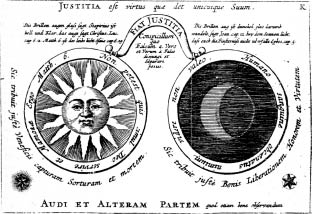
Figure 3.7 Illustrating the need to see both sides in witchcraft trials: Hermann Löher, Hochnötige Unterthanige Wemütige Klage der Frommen Unschültigen (Amsterdam, 1676). Jesuitenbibliothek of the St. Michael-Gymnasium, Bad Münstereifel, Germany.
The French Protestant theologian Lambert Daneau, author of a widely cited witchcraft treatise, placed day and night among the “contrary virtues and natures” in his Physica Christiana of 1576, translated as The Wonderfull Workmanship of the World (1578). This Calvinist treatise recognized the value of all the contraries in creation:
For God made not all things at the first of one quality, colour, and greatness, neither of one kind and nature. But he made some high some low, some moist some dry, some warm some cold, the day to be one thing and the night another. Yet God made nothing that was evil.
This mode of creation served several purposes:
The power and wisdom of God is thereby more apparent: and also the things themselves by this repugnancy of contrary virtues and natures … For what manner [?] state of things would there have bin, if all things had bin hot? what numbness, if all things had bin cold? what misery, if all ways there had bin darkness; what wearisomness, if it had always bin day? And therefore when God had created the natures of this world, and of the things contained therein, he thought it convenient to refresh and ease them with change and course.142
This pattern of contrariety also structured the relations between God and humankind. In his hymn on the Epiphany, Crashaw proclaimed “a most wise and well-abused Night” that will teach “obscure Mankind … To read more legible thine original Ray / And make our darkness serve thy day.” The Lutheran poet Daniel Czepko (1605–60) captured this sense in an epigram:
Each through the other:
Eternity through time; life through death.
Through the night to light, and through men I see God.143
By using the night to express contrariety, self-denial, and their ineffable encounters with the Divine, these seventeenth-century authors and artists profoundly enriched the scope of representation of their age, while presenting and fostering new attitudes toward the night.