
CHAPTER FOUR

For the law to be in essence law, it has to be honest, just, possible, appropriate to the time and place, necessary, useful, and clear, so as not to induce error for its obscurity, and made not for private convenience but for the common good of all.
—ISIDORE OF SEVILLE, EARLY SEVENTH CENTURY
 FRANCISCO XAVIER DE GAMBOA ARRIVED IN SPAIN IN 1755 AS AN unknown novohispano lawyer entrusted with the task of representing the Consulado of Mexico before the royal court; he returned to Mexico City in 1764 a royal magistrate on the Real Audiencia of Mexico. This advance in his career was largely due to the book he published while in Madrid, Comentarios a las Ordenanzas de Minas. It was recognized immediately, by such influential crown officials as Pedro Rodríguez de Campomanes, the rising star of the government of Charles III, as the best available guide to the silver-mining industry of New Spain. As Gamboa put it, his intention in writing the Comentarios was “to uncover the roots of the problems that afflict the working of the mines, as well as to set out the practical remedies and new methods for its advancement, which my long experience handling such matters has allowed me to acquire.”1 Gamboa presented an exaggeratedly bleak picture of the industry in New Spain, drawing attention to its flooded mines, financial difficulties, and technical shortcomings. He proposed a number of reforms, such as a more scientific approach to surveying and the establishment of a merchant-run mining bank. The primary purpose of the book, however, was to slice through the thickets of the complicated mass of legislation and custom that governed silver mining. Most problems, he assured his readers, could be solved simply by a better understanding of the law. Gamboa rejected the need for legal reform; he defended the existing framework based on the Royal Mining Ordinances of 1584 and supplemented by subsequent laws and local customs. He also strongly supported the jurisdiction the ordinary courts, headed by the audiencias, exercised over mining lawsuits. The Comentarios captured Gamboa’s distinctive blend of Enlightenment rationalism and legal conservatism. As a statement of his legal philosophy, the book helps to explain the stands he would take later as an audiencia magistrate.
An Eighteenth-Century Legal Commentary
After he had completed his main tasks for the consulado, such as presenting the body’s position on trade and tax issues, Gamboa devoted himself to a more personal endeavor, a commentary on the laws governing silver mining in New Spain. He settled down to work in the library of the Colegio Imperial, the most important Jesuit college in Spain.2 He discovered there valuable manuscripts, including a report on mercury mining in New Spain by José de Zaragoza, the college’s professor of mathematics in the mid-seventeenth century and cosmographer of the Indies, the crown’s chief scientific advisor.3 Gamboa received help from Christian Rieger, the professor of mathematics at the college and also cosmographer of the Indies. The Austrian Jesuit brought to Gamboa’s attention a number of German works on mining and metallurgy. These included Abraham von Schönberg’s 1693 report on Saxon mining; Nicolaus Voigtel’s 1714 work on subterranean geometry; Christopher Andre Schluter’s 1738 treatise on metallurgy (translated into French by Jean Hellot in 1750); Johann Gottfried Jugel’s 1744 overview of mining and smelting; a 1749 book by Friedrich Wilhelm Von Oppel, one of the founders of the celebrated Freiberg academy of mines; and the 1753 treatise on mineralogy and metallurgy by Johann Gottlieb Lehman (translated into French in 1759).4 No one else in the Spanish world at the time had access to this German literature on mining and metallurgy. He wanted to share it with miners back in New Spain who were not even familiar, he claimed, with such classic texts as Georgius Agricola’s De re metallica of 1556 or Alvaro Alonso Barba’s Arte de los metales of 1640. Gamboa did not just want to explain the laws; he also wanted to publicize the latest technical innovations. This was a classic Enlightenment move, especially in Spain, with its gnawing sense of backwardness compared to northern Europe.
A commentary on the laws was one of the oldest genres of juridical literature, fundamental in the formation of the ius commune. Commentaries were typically showcases of erudition, packed with references to legal, theological, and historical authorities. Gamboa lived up to this tradition.5 In just one paragraph, in which he described the ancient silver mines of Spain, Gamboa cited the Book of Maccabees of the Old Testament; the Greek writers Aristotle, Herodotus, Posidonius, Polybius, Diodorus Siculus and Strabo; and the Roman writers Gaius Julius Solinus, Lucio Anneo Floro, and Pliny the Elder.6 Throughout the book, he especially demonstrated his knowledge of European juridical literature of the previous two or three centuries. He referenced the English lord chancellor Francis Bacon’s De Justitia Universali and the Italian canon lawyer Giovanni Battista de Luca, who collected the judicial decisions of the Roman Rota, the chief appellate court of the Catholic Church. He relied heavily on Spanish jurists, such respected authors as Diego de Covarrubias, Francisco Salgado de Somoza, Juan Larrea Batista, Antonio Gómez, Jerónimo Castillo de Bobadilla and Juan Hevía de Bolaño, to help him untangle the knots of Spanish legislation. Particularly valuable to him were texts that tackled legal issues in America, such as Solórzano’s Política Indiana, Juan de Matienzo’s Gobierno de Peru, and Gaspar de Escalona y Aguero’s Gazophilacio Regium Perubicum, which included the mining legislation the Viceroy Francisco de Toledo approved for Peru in 1574.7
Gamboa needed to draw upon all of these authorities to make sense of the perplexing field of mining law. The main statue was the Royal Mining Ordinances of 1584, also known as the Nuevo cuadro. Its enactment, however, did not automatically abrogate the previous mining statute, the Viejo cuadro of 1569. Both remained in the books, and the new law only prevailed where there was direct conflict with the old; in situations in which the Nuevo cuadro was silent, the Viejo cuadro still applied. Gamboa also had to take into account the hundreds of orders, decrees, decisions, and other specific legislative acts issued since 1584. The 1680 Recopilación de las leyes de Indias contained just a portion of this material. Gamboa had to comb through cedularios, compilations of royal orders, like the one rescued from the fire that almost destroyed the viceregal palace in Mexico City in 1692.8 Gamboa referred frequently to the separate Peruvian mining code of 1574. As legislation of a sister viceroyalty, Toledo’s code, he said, was particularly useful in interpreting the mining law of New Spain. The challenge of Gamboa’s analytical task epitomized why state law in the eighteenth century could not monopolize legality: it was still too messy and unsystematic. An external set of principles, like those elaborated by the authors of the ius commune, was needed just to make state legislation coherent.
A basic problem was that lawmakers in Spain never had all the information necessary about conditions in America to legislate comprehensively. The crown recognized this limitation from the start and advised its officials to use their best judgment in applying royal law. In 1602, for instance, Philip III told his viceroys in America that they should consult with local experts before deciding which provisions of the 1584 ordinances to apply and which ones to set aside.9 The crown accepted that a one-size-fits-all approach was not feasible in a diverse and constantly changing empire. Solórzano captured this understanding in Política Indiana when he wrote, “each province needs its own laws and customs suited to it, as justice always teaches us.”10
On the crucial question of jurisdiction, rules had been worked out in New Spain that differed markedly from the 1584 statute, which had mandated the creation of a special tribunal with exclusive jurisdiction over mining. According to Gamboa, “this ordinance is not observed in the Indies, nor could it be enforced without great damage to the public, particularly to the miners, who would have to maintain at their own expense a mining administrator general and particular administrators in each department and in each mining district.”11 Instead, as he noted approvingly, from the start mining fell into the ordinary jurisdiction overseen by the audiencias. At first instance, mining cases were heard by alcaldes mayores and corregidores, local crown officials. The audiencias of Mexico and Guadalajara supervised their judicial work and handled appeals. Leaving mining within ordinary jurisdiction saved the crown the expense of running a separate mining tribunal while guaranteeing miners the fundamental right of appeal to the high courts of royal justice. This expansion of the jurisdiction of the audiencias beyond what written law mandated was common in America. To deliver justice, the preeminent goal of the Spanish legal system, required flexibility beyond what state law stipulated.12
As much as Gamboa agreed that mining should fall within the ordinary jurisdiction, he knew the local administration of justice left much to be desired. Few alcaldes mayores had sufficient knowledge about the industry or the laws to adjudicate complicated mining cases. In addition, many treated their positions as moneymaking opportunities, typically by contracting to distribute goods and credit to people in their districts on behalf of city merchants. Their impartiality, therefore, could easily be compromised. But rather than strip them of jurisdiction, as an exclusive mining tribunal would, Gamboa proposed that the crown just take better care to appoint men in mining districts with prior knowledge of the industry and its laws. They could also be assisted by technical experts, licensed by the government, who would handle such difficult matters as boundary surveys and the design of mines and drainage works.13 At the audiencia level, Gamboa insisted, the administration of justice was solid. Magistrates, he wrote, “complied, for their part, with the expeditious dispatching of mining cases, in conformity with the Law.”14 More than a decade before the idea of specialized mining tribunal was revived during the visita of José de Gálvez, Gamboa laid out in the Comentarios a strong case against it. Justice would best be served by keeping mining within the ordinary jurisdiction overseen by the audiencias.15
The Economics of Mining Law
Gamboa may have cited a mountain of old juridical authorities but his analysis was guided primarily by what he perceived as the economic logic of the 1584 ordinances. This is perhaps the most strikingly modern part of the Comentarios a las Ordenanzas de Minas. It was less about finding the consensus of opinion on a legal question, the basic methodology of the ius commune, than following the underlying economic rationale of the law. And this was, he declared, “to encourage the labor of the mines, and to excite the vassals to make discoveries for the benefit of the public, the royal treasury, and themselves.”16 Long before Adam Smith coined the term the “invisible hand,” people clearly understood the potential social benefits of the private pursuit of profit.17 The legislation had evidently lived up to its purpose: silver mining in New Spain had flourished since the late sixteenth century, driven by risk-taking entrepreneurs and technical innovators. Gamboa might rhetorically have highlighted the shortcomings of the industry, but he also explained why it was prospering. The historian John Tutino argues that, thanks to its silver mines, New Spain became an engine of global capitalism.18 Largely because the existing legal treatment of mining, with its bewildering mix of old statutes, new cédulas, local customs, and ius commune, had worked, Gamboa saw no reason to change it.
Did Spanish law neglect the protection of property rights? Not on the evidence of the 1584 ordinances, the most important piece of economic legislation for Spain’s most valuable American viceroyalty.19 The second ordinance stated:
In order to benefit and favor our subjects, and the natives of these kingdoms, and all other persons whatsoever, though foreigners to these our kingdoms, who shall work or discover any silver mines whatsoever, discovered or to be discovered, it is our will and command that they shall have them, and they shall be their own, in possession and property, and that they may deal with them as anything of their own.20
The protection of property rights began with the registry, which the crown maintained in each mining district. According to ordinance seven, prospectors had twenty days to register new claims. They had to provide specific information on the location of the claim and the proposed name of the mine. They then had another ten days to post visible stakes to demarcate the boundaries. This registration was essential, according to Gamboa, since “the mine that is worked without being registered is not a mine nor deserves such a name, even if it yields good metals.” 21 To be sure, the registry was far from infallible. Miners were often careless in registering claims, which led to unnecessary disputes over boundaries. But the definition and protection of private property rights was fundamental to the legal regime established by the Royal Mining Ordinances.
The ordinances and local custom also encouraged private enterprise. One way was by limiting the size of mining claims. The discoverer of a deposit could register parcels measuring 160-by-80 varas (about a meter), but all subsequent registrants were limited to 120-by-60 varas. According to Gamboa, “the value and rarity of the material requires that mines be distributed with this economy, and even less for gold mines because of their greater value, in order that more vassals can benefit.”22 Despite the attention paid to big operations like the Valenciana mine in Guanajuato or Real del Monte, the majority of New Spain’s three thousand or so mines were relatively small scale. Particular customs in New Spain broadened access to the industry even more. For example, Native Americans who found precious metal deposits would be exempt from tribute, the poll tax they paid to the crown. Even their descendants would enjoy this privilege. Although the ordinances prohibited priests from owning mines, in New Spain custom allowed it, as long as clerics refrained from exploiting the labor of their Native parishioners. The ordinances stipulated that the crown operate refining facilities, but in New Spain, private persons did the work of turning ore into silver. The crown just maintained the treasury offices in each district to assay and stamp the metal and collect royalties. This privatization of refining allowed for the development of an important sector of stand-alone refiners, who purchased ore from either small miners or workers who received partidos. Local custom also did away with superfluous privileges inscribed in the law, such as preferential water, grazing, and hunting rights. Gamboa called these unnecessary, “since the only thing that encourages mining, with its immense challenges, is the hope, usually futile, of wealth.”23
Novohispano custom also vastly simplified the system of collecting royalties. The 1584 law required government inspectors, posted in each mining district, to assess a number of factors, such as the age of the mine and the quality of the ore, in order to calculate the specific amount charged to each miner. Instead, in New Spain all miners were charged the same rate, first 20 percent of production, the quinto, and by the early eighteenth century, 10 percent, the diezmo. This reduction in the main tax paid by miners illustrated how much the Spanish crown wanted to encourage private enterprise in the mining industry. Gamboa said that the reduction in royalties had worked as intended and had boosted production, in part just by making the temptation to underreport output less enticing.24
The legal regime did not protect private property rights for their own sake but as a means to encourage silver production. This meant that in certain instances private rights could be circumvented if they would impede mining activity. Most conspicuously, according to ordinance sixteen, one could “look for veins of metal in other people’s land, even against the will of the owner.”25 Gamboa pointed out that this provision went well beyond the ius commune, which, quite sensibly it would seem, required prospectors to seek the permission of property owners before tramping through their land in search of gold and silver. But this curtailment of private property rights made logical sense in a couple of ways. First, the crown still maintained title to subsurface minerals, and thus its right trumped the private rights of surface landowners. In addition, the provision created a strong incentive on landowners to scour their properties diligently for minerals before any outsider could take advantage. In like manner, the 1584 statute allowed miners to follow veins even if they crossed into another’s property. The more enterprising miner was rewarded, and society benefited from the increased production. Only when the tunnels of neighboring mines intersected would the miner working the vein have to retreat to his side of the property line.
The government was an active but supportive player in the industry. It maintained the registries for mine claims in each district; operated treasury offices to assay, stamp and tax raw silver; distributed blasting powder and mercury via crown monopolies; and ran the mint in Mexico City, the world’s biggest manufacturer of silver currency. The crown’s support for innovation—again contrary to the common assumption of Spanish backwardness—was demonstrated in the steps it took to promote mercury amalgamation. The process was pioneered in the 1550s by Bartolomé de Medina, a Spanish cloth merchant and amateur metallurgist, who received crown backing to experiment at Real del Monte. Medina blended finely ground silver ore with mercury, salt, water, and a chemical reagent, like copper sulfate. Piles of the mixture were then allowed to steep in the open air on a stone surface. Workers periodically stirred the mounds to speed up the chemical reaction. Within a few weeks, silver chloride, the main silver compound in the ores, decomposed and bonded with the mercury.26 Workers then shoveled the piles into vats of water to separate the chunks of silvermercury amalgam from the rest of the material. The mercury was then vaporized with heat and was recaptured by an ingenious hooded device, a capellina, invented by Juan Capellín in Taxco in the 1570s.27 The whole process, which in New Spain took a month or so, could recover up to 99.99 percent of the silver in ores of just 3 percent silver content. The Spanish government actively supported this innovative new technique. It sponsored Medina’s early experiments, rewarded him a patent to collect royalties from those using his invention, and immediately notified Francisco de Toledo, the viceroy of Peru, of the usefulness of this new technique. In chilly Potosí, as Barba described in his 1640 book, innovative miners learned to heat the mixture in cauldrons rather than laying it out on patios in the open air as in New Spain. In mining, far from discouraging innovative practices, the crown promoted them with subsidies and even basic intellectual property protection.
In chapter 22 of the Comentarios, Gamboa described the variety of techniques invented in Spanish America to beneficiate minerals, including the many forms of mercury amalgamation. This was presumably a key reason for the book’s translation into English seventy years later. Although he made it clear that the crown encouraged research and development, he admitted that there had been lapses. For instance, in the 1640s Pedro González de Tapia and Pedro de Mendoza Meléndez received support from the viceroy of New Spain, Conde de Salvatierra, to test a promising twenty-four-hour process to refine silver in Taxco. Luis Berrio de Montalvo, an audiencia magistrate, was sent to observe the experiments. Gamboa only learned about this episode in Madrid, after he unearthed Berrio’s report in the archives. He described the report as “a rare and exquisite work, of singular erudition and clarity, which should be in the hands of all those for whose benefit it was written.”28 Very often, the concern for state secrecy prevailed over the desire to spread the news about useful science; valuable reports sometimes ended up gathering dust in state archives.29
The Three Enemies of Miners
Gamboa had a decidedly jaundiced view of miners as a group. “Generally speaking,” he wrote, the typical miner “is prodigal, unlimited in his indulgence in expense, luxuries, superfluities and even vices.”30 The Comentarios is full of such disparaging words against miners. “More than just prodigious spendthrifts, they lack application. They are happy telling stories of their great pasts and their present troubles but don’t follow what the law clearly stipulates.”31 He stereotyped miners as fundamentally irresponsible. “If the miners were capable of overcoming their lethargy, their wastefulness, their spending and adopting a moderate frugality and economy, it would cause admiration and envy, and allow them to undertake larger projects.” 32 Gamboa contrasted miners to the hardworking and honorable merchants he knew from the Consulado of Mexico. He could name only a couple of miners who truly deserved the public’s acclaim, above all Pedro Romero Terreros, who had saved Real del Monte from ruin and bankrolled missions to the Apache, and José de la Borda, who used the fortune he made in Taxco to build the ornate Santa Prisca Church, for decades the tallest building in New Spain.33
Most miners, however, were reckless and irresponsible, according to Gamboa. This was what filled the courts with lawsuits. It started with their failure to survey their mines properly. “Because of negligence or sloth, greed or malice, mines are not measured,” Gamboa wrote, even though the “one hundred and twenty varas of each ordinary mine deserves to be measured with greater care and exactitude than one hundred and twenty varas of the finest lace or most expensive cloth.”34 Miners employed no rational excavation method. They followed what has been called the sistema del rato, optimizing short-term gains over long-term sustainability. In the evocative words of historian Clement Motten, miners in New Spain followed mineral veins “like a terrier after a rat, they wound and twisted, even corkscrewed, up and down until either they or the veins were played out.”35 Because of the initial failure to measure and stake claims properly, miners were constantly burrowing into each other’s properties. Fights would then erupt over where to place underground barriers to delineate boundaries.36 Miners also dug shafts, so-called bocas ladronas, just to access the ore of their neighbors. Partnerships inevitably collapsed in rancor “since the order of business of many is disorder and confusion.”37
Gamboa did admit that miners faced enemies other than themselves. They had to deal with aviadores. Gamboa colorfully called them “the bloodsuckers of the miners, who don’t let go until they have sucked them dry and satiated themselves, leaving the poor miners to go in search of new veins, to produce more blood.”38 He claimed they refused to extend credit when it was most needed and charged exorbitant interest rates. There were less than a dozen miners in all of New Spain, he said, who had the financial wherewithal to avoid these petty financiers.39 Gamboa did not explain why aviadores should willingly lend more money to men he had damned as untrustworthy. And how could he blame miners for prioritizing short term gains if aviadores left them no choice?
Gamboa had greater sympathy for those whom he identified as the third enemy of miners: ordinary workers. These were not, except in rare circumstances, coerced Natives or African slaves, but rather free and mobile men of mixed racial origins. They roamed the mining districts of New Spain looking for opportunity. They could be as heedless in their spending as their employers. As Gamboa described it, “the workmen drink, game and spend all they make; they have no notion of economy, but live for the present moment. They attire themselves in rich cloth or fine linen, and the next day descend into the mine, where their fancy dress serves for wadding or to ease the blow of a pick.”40 They also had a proclivity for thievery. “Against the poor mine owner, already troubled by aviadores and burdened by debt, they conjugate in all its modalities the verb ‘to steal.’”41 Since all mine workers stole anyways, Gamboa suggested that the authorities should send more convicts to labor at mines. Yet in the end, Gamboa believed mineworkers deserved more sympathy than disdain. They risked their lives toiling in caverns that were “damp, suffocating, and dark, where noxious fumes were the only air and the dangers in ascending and descending” were terrifying. Aboveground “the poor smelter workers suffer infinitely in this immensely tiring task, because the oven is hot as hell, the iron bar used is very heavy, and the incrusted matter difficult to dislodge.”42 Those involved in mercury amalgamation ingested poison and only found relief by drinking a tea made from the San Pedro plant. “Mining in short,” Gamboa stated, “is attended, according to the grave description of Plautus, by every pain that hell itself can inflict.”43
A Commentary on Mining Technology
Gamboa was obviously fascinated by the technical processes of mining and used the Comentarios a las Ordenanzas de Minas to disseminate what he considered the best practices in the industry. He included several purely technical sections, including a list of all the mining districts in New Spain and a glossary of unique mining terms used in New Spain. In chapter 12, he explained in meticulous detail the proper way to measure and survey mines. He drew upon an unpublished 1706 manuscript by a fellow novohispano lawyer, José Saenz de Escobar, Geometría práctica y mecánica, which set out the principles on how to survey land, mines, and water.44 It was a great pity, Gamboa said, that this work, “a treatise of small size, but great force and substance,” had not been published and distributed to the mining camps of New Spain.45 He also included in this chapter trigonometry tables used by German surveyors to calculate underground dimensions as well as illustrations of tools and methods prepared by Juan Minguet, a young Spanish printmaker and graduate of the fine art academy of San Fernando in Madrid. Gamboa did not expect that miners themselves would master the fine art of measurement; rather he proposed that the crown license a corps of technicians to help them. To qualify, candidates would have to pass “a rigorous examination before one or two magistrates of the Audiencia on the Ordinances and principles of Geometry.”46 Even in scientific matters, it seemed, Gamboa trusted the authority of audiencia judges above all else.
In chapter 22 he described all the different methods used in New Spain and Peru to turn ore into metal.47 He explained how to construct and operate smelting ovens. He explained the patio method of mercury amalgamation of New Spain and the cauldron method of Peru. The key to success in both operations was to employ an experienced azoguero, or mercury mixer, to oversee the amalgamation process. Gamboa thought these skilled technicians should be examined and licensed just like mine surveyors.48 He gave credit to recent innovators in Spanish America, like Lorenzo Felipe de la Torre Barrio y Lima, who wrote a book, Arte del nuevo beneficio de la plata, to describe the use of copper sulfites in the mercury amalgamation process.49 This book caught the eye of Benito Feijóo, who wrote, “what Spaniard would not feel the same pleasure I do in seeing printed the news of an invention so extraordinarily useful for all of Spain?”50 Gamboa also mentioned the mercury experiments of Juan Ordóñez Montalvo, the director of mines for the Valle Ameno family in Real del Monte. Ordóñez published his book in 1758, although Gamboa might have learned of his experiments before leaving New Spain in 1755, thanks to his legal work on behalf of the family.
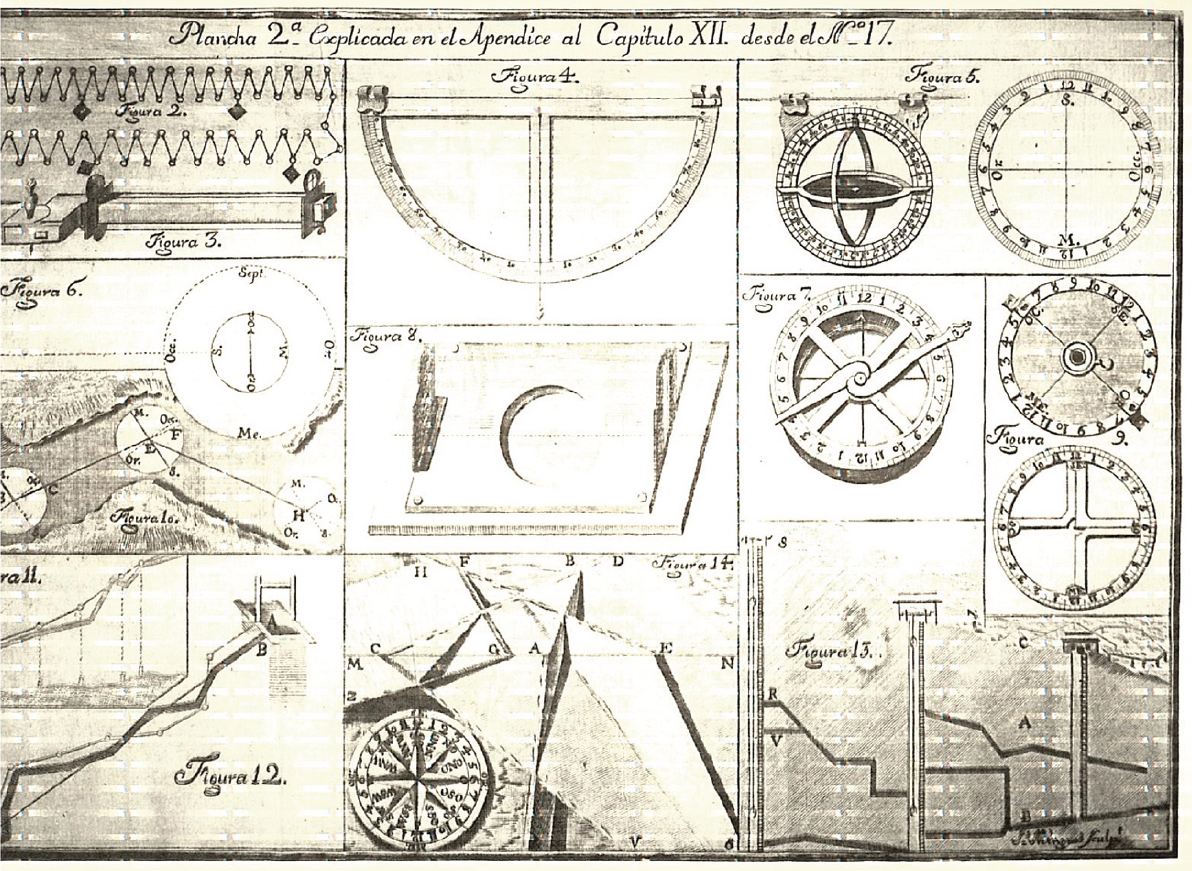
Figure 5.Gamboa included in the Comentarios a las Ordenanzas de Minas mathematical tables and illustrations of instruments to help miners survey their mines better. The illustrations were prepared by Juan Minguet, a graduate of the San Fernando academy of fine arts in Madrid.
Gamboa stressed that the greatest technical challenge facing operators was keeping water out of their mines.51 The basic instrument they used was the malacate, a mechanical winch usually powered by horses or mules that extracted water from the depths of the mines in buckets or leather bags. These devices were slow and cumbersome, especially when employed at deep mines. Nor surprisingly, miners in New Spain were always looking for new ways to fight flooding. Gamboa knew of the efforts made in the late 1720s by mining entrepreneur Isidro Rodríguez de Madrid to import an English steam pump, the Newcomen fire engine, to drain his mines at Real del Monte.52 Invented by Thomas Newcomen around 1712, this pump was already installed in many coal and tin mines in Britain. Rodríguez de Madrid sent an agent to Britain to investigate. After visiting mines throughout England and Wales, the agent concluded, however, that Newcomen’s pump would not work in New Spain. It was too heavy to ship across the ocean; it could not be assembled from a blueprint since New Spain lacked the steel fabrication facilities; and, in any case, the pump lacked the power to draw water from the exceptionally deep novohispano mines.53 The only sure way to drain mines, where possible, was to excavate adits or drainage tunnels beneath the working galleries. This is what Pedro Romero Terreros accomplished, after immense expense and toil, at Real del Monte in the late 1750s. The cost of digging adits was generally so high that Gamboa thought the crown should provide financial assistance to miners engaged in such projects.
Gamboa also addressed the problem of ventilating mines. He mentioned the mechanical bellows invented by the English scientist Stephen Hales in the early eighteenth century. “But of all the inventions and contrivances for renewing the air and extracting the foul vapors from the mines,” Gamboa pronounced, “none is comparable to the Fire Engine.”54 This was not Newcomen’s fire engine, of course, but an invention he learned from reading the French translation of Johann Gottlob Lehmann’s mining text. It consisted of an oven located aboveground connected to tubes that sucked noxious air from below.
Even in the 1790s, thirty years after its publication, the technical sections of the Comentarios continued to circulate in manuscript form in the mining camps of New Spain.55 In 1794 Alzate said Gamboa’s book allowed one to understand all the technical processes of mining “without having to go down into the terrifying caverns of the mines, without having to face the insufferable heat of the smelting ovens, without having to breath in the poisonous vapors of mercury.”56 And it was the technical content in the Comentarios that most attracted the attention of the English lawyer Richard Heathfield, who translated the book in 1830 for British miners arriving in newly independent Mexico.
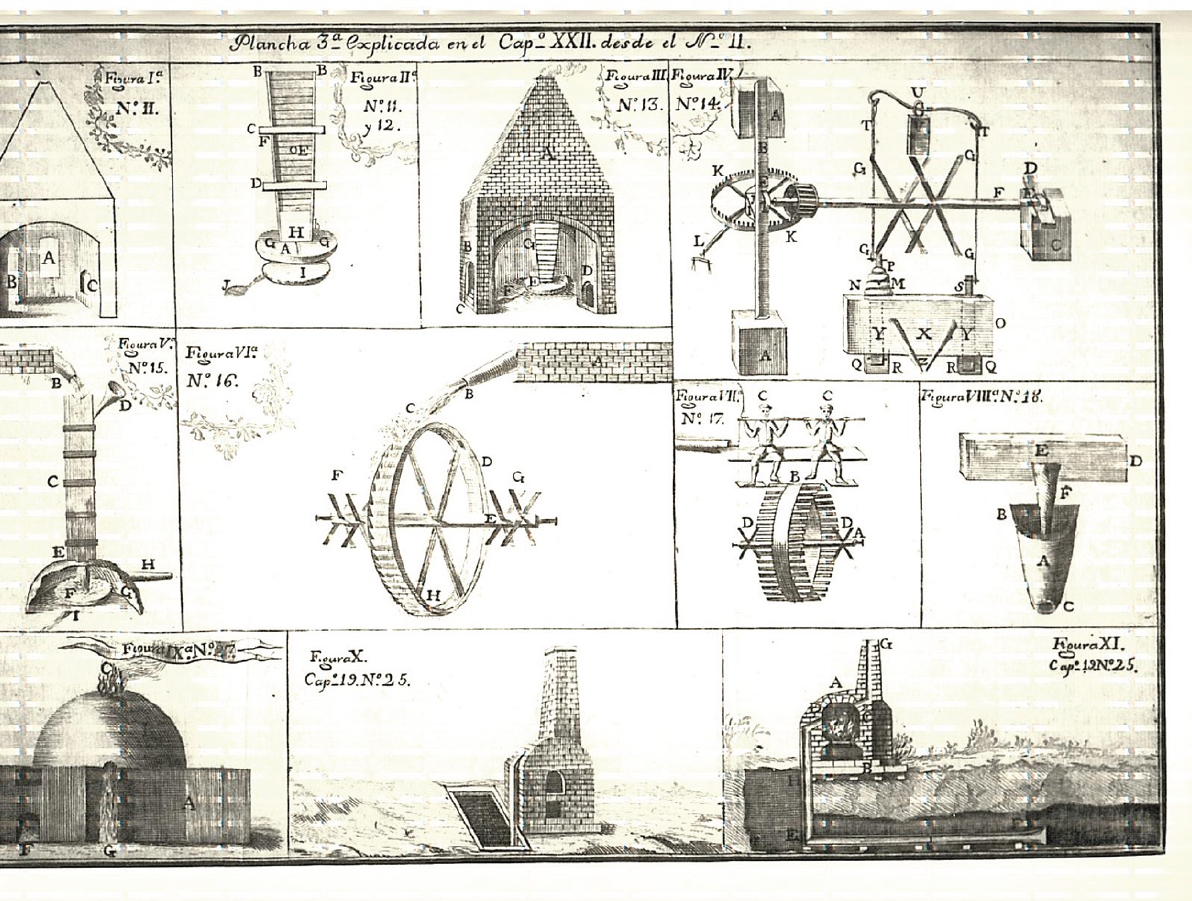
Figure 6.Gamboa described in the Comentarios a las Ordenanzas de Minas various useful devices used in mining, including systems to ventilate mines, with illustrations by Spanish artist Juan Minguet.
Silver Mining and the Economic Autonomy of New Spain
Consistent with his submissions on behalf of the consulado, the Comentarios a las Ordenanzas de Minas served Gamboa’s agenda to expand New Spain’s economic autonomy within the Spanish Empire. He argued that silver mining deserved the crown’s support primarily because it anchored the economy of New Spain, not because it enhanced the splendor of the Spanish monarchy. As he wrote, “mineral districts of gold and silver give rise to towns, which then promote the civilization and settlement of the Indians; from there follow consumption, agriculture, and taxes, as well as many other consequences, of the greatest importance to religion and the state.”57 But he had to contend with the feeling in Spain that American precious metal mines had been more of a curse than a blessing. As early as 1600, the arbitrista Martín González de Cellorigo declared that “if all the gold and silver that the natives of the New World have found, and go on finding, were to come to [Spain], they would not make it as rich or powerful as it would be without them.”58 Gamboa also quoted the famous condemnation of Feijóo:
The gold of the Indies makes us poor. But this is not the worst of it, as the gold enriches our enemies. For having mistreated the Indians, we Spaniards are now the Indians of the Europeans. For them we dig our mines and for them we bring our treasures to Cadiz.59
Many eighteenth-century Spaniards shared this view. They believed the silver and gold of America caused emigration, ruined Spanish factories, and benefitted Spain’s rivals. Gamboa countered that if Spain had squandered the precious metals of America, it was hardly the fault of Americans.60
Gamboa made three specific policy proposals to advance this vision. First, as already covered in the previous chapter, he proposed the creation of a mining bank chartered by the crown and controlled by the merchants of the consulado to finance large-scale mining projects.61 In stark contrast to the scorn he showed miners and aviadores, he heaped praise on the big merchants of Mexico City. “The management of the consulado is beyond the hint of suspicion, from being made up of subjects with intelligence, judgment, maturity, and capital, the last of which they have known how to earn through prudent and well-governed economy.”62 He said they already enjoyed the trust of outside investors, like religious communities and landowners, and thus would easily be able to raise millions of pesos in capital to pour into expensive rehabilitation projects beyond the capacity of individual miners or private silver banks. This was not just, as historians have portrayed it, Gamboa’s bid to please his employers, the merchants of the consulado and especially Manuel Aldaco, his old Basque patron and a leading silver banker.63 This was a serious and practical plan that remained under consideration in Mexico City and Madrid until the early 1790s.
Gamboa’s second proposal was even more overtly autonomist. He recommended the abolition of the Spanish monopoly on the supply of mercury. The Almadén mine had been worked since Roman times, mainly to produce vermillion from its cinnabar ore. In the sixteenth century, driven by demand from refiners in New Spain, workers at Almadén began to process the cinnabar to produce mercury. Special ships then ferried this valuable material to New Spain. In Peru mercury came from the government-owned Huancavelica mine in the mountains north of Potosí. Gamboa argued strongly that the crown should permit mercury mining in New Spain. This was consistent, he said, with the spirit of the 1584 ordinances to promote the liberty of mining. He mentioned two known deposits in northern New Spain, el Carro and Picacho. They “are not only high-grade, abundant, easy to work, and sufficient to supply the entire kingdom of New Spain, but would only cost twenty-two to twenty-three pesos for every hundredweight,” one quarter of the price the crown charged novohispano miners and refiners.64 Gamboa accepted that the crown should still control the distribution of mercury through treasury offices. He did not even think it was necessary to lower the official price, as both the 1727 Casafuerte committee and Manuel Aldaco himself had recommended in 1743.65 More important was assuring a stable supply, and mercury mines in New Spain would do the job better than Almadén. Gamboa’s plan, if it had come about, would have severed one of the most important economic links between New Spain and Spain: the mercury supply from Almadén.
Thirdly, Gamboa proposed the establishment of a second mint in New Spain in Guadalajara. He claimed he was “only considering the public good, not motivated by my passion for my hometown.”66 A new mint in Guadalajara would help alleviate a chronic problem in New Spain, identified in his 1756 filing for the consulado: the country might be full of silver mines, but it lacked silver currency. Gamboa had argued in favor of the fleet system over registros sueltos because he said it would allow money to circulate longer in New Spain. Building a second mint closer to Zacatecas, Bolaños, and other northern mining districts would increase the supply of legal tender and thus deter the use of unminted silver in transactions. It would boost commerce and economic activity in areas still vulnerable to attacks by hostile Natives. A second mint in New Spain had been the subject of discussion for decades. In 1727 the Audiencia of Guadalajara had endorsed the idea, as had Matías de la Mota, a crown official in Guadalajara and the author of a 1742 history of New Galicia. More recently, Tomás Ortiz de Landázuri, an experienced Spanish official in New Spain who later became the accountant-general of the Council of the Indies, had proposed the establishment of a Guadalajara mint to the crown.67 Gamboa added that the government need not fear that a second mint would detract from the preeminence of the Mexico City mint; there was plenty of silver for both to process.
The Arrival of Charles III
In the spring of 1761, Gamboa presented his manuscript to the crown. The Council of Castile vouchsafed it for the king, assuring that it did not propose anything contrary to royal laws. Charles III gave his official consent for publication on September 19, 1761. The church also reviewed the book, not finding anything in it offensive to religion. Gamboa contracted Madrid’s finest printer, Joaquín Ibarra, to publish it in a single volume of 534 pages.68 A notice appeared in the Gaceta de Madrid on May 25, 1762—right beside an advertisement for a new open course on experimental physics at the Jesuit Imperial College—announcing that the Comentarios a las Ordenanzas de Minas by Don Francisco Xavier de Gamboa was now available for purchase at Angel Corradi’s bookstore on the Calle de las Carretas.
Since Gamboa began work on the Comentarios in the late 1750s, much had changed in Madrid. King Ferdinand VI died in August 1759. He was succeeded by his half-brother, Charles, who had already served a long apprenticeship as the king of the Two Sicilies. He arrived in Madrid in early 1760, eager to implement administrative reforms already rolled out in Naples. He brought with him two Italians to head his government, Pablo Jerónimo Grimaldi, ennobled as the Duke of Grimaldi, and Leopoldo de Gregorio, the Marqués de Esquilache. He put another Italian, the architect Francesco Sabatini, to work modernizing his new capital city. Gamboa probably applauded the new government’s efforts to pave the streets, erect streetlights, lay out new parks, and collect the garbage regularly. But as a former student of the Jesuits, he must have shared their concern over the new king’s well-known hostility towards the order.69 Portugal had expelled the Jesuits from its territories, including Brazil, in 1759, and Charles seemed to be considering the same drastic action in the Spanish Empire. He had signaled his attitude towards the Society of Jesus by breaking with royal tradition by choosing a Franciscan rather than a Jesuit as his personal confessor. He also supported the publication of the writings of Juan de Palafox, the seventeenth-century bishop of Puebla and famous enemy of the Jesuits.
The biggest stir in the political scene came in foreign policy. Charles broke decisively with Ferdinand’s policy of neutrality between Britain and France. On August 15, 1761, he signed the Third Family Compact, swinging Spain into alliance with France against Britain in the midst of the conflict later known as the Seven Years’ War. Britain retaliated immediately. It declared war on Spain in January 1762 and attacked and occupied Havana and Manila a few months later. After peace was restored in 1763, the Spanish crown did recover its territories and even won Louisiana from France. But it remained shocked by the ease with which Britain had seized Havana, arguably its most important American port. Long gestating plans to strengthen Spain’s grip on its American territories thus moved to the top of the government’s agenda. In such a climate, Gamboa’s argument in favor of more relaxed links between Spain and New Spain did not stand much of a chance in Madrid.
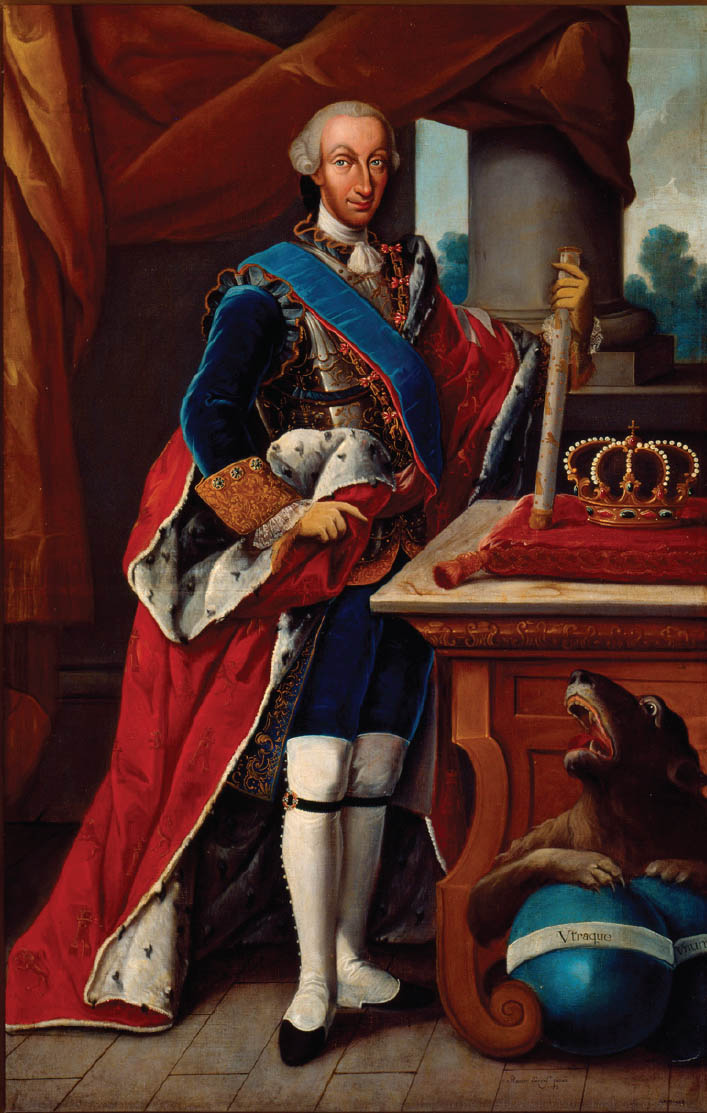
Figure 7.Painting of Charles III by Ramón Torres, ca. 1762. Charles III brought his experience as monarch of the Two Sicilies and his reformist inclinations to the throne of Spain in 1759. Reproduced by permission of the Instituto Nacional de Antropología e Historia.
The Appointment to the Bench
Gamboa wrote the Comentarios a las Ordenanzas de Minas not just to help make the novohispano silver-mining industry stronger but also to impress the ministers of the Council of the Indies responsible for judicial appointments. Writing a useful juridical text was a tried-and-tested way to gain official favor. Gamboa had in fact launched his candidacy in 1757 when he first submitted to the crown his relación de méritos, along with letters of recommendation from the top authorities of New Spain, including the former Viceroy Revillagigedo, the audiencia, the consulado, and the college of canons of the metropolitan cathedral. Very likely members of Congregation of San Ignacio, who were bound by honor to assist their Basque brothers from New Spain at court, also lobbied for his appointment. Still, it was not until April 1764, almost seven years after he first put his name forward and more than two years after the publication of the Comentarios, that the Council of the Indies finally awarded him a judicial posting. He would be returning to Mexico City to sit on the Sala de Crimen, the criminal law chamber of the Real Audiencia of Mexico, as an alcalde del crimen.70 He would be taking the place of his former mentor, José Mesía de la Cerda, who had died in 1760. Gamboa was the first local lawyer to be appointed directly to his home bench, without having to purchase the seat, since 1705.71
Gamboa left Cadiz in September 1764. Accompanying him were three young Basques, the brothers Manuel and Antonio de Perón and José de Ayarzagoitia, the young nephew of Gamboa’s good friend, Ambrosio de Meave.72 The party also included Gamboa’s two servants, his black slave Nicolás Márques, who had spent the entire decade with Gamboa in Madrid, and an Asturian cook, Juan Antonio Fernández Mastache. They crossed the Atlantic without incident in the fall of 1764. From the port of Veracruz, Gamboa and his entourage set off for Mexico City. They passed through Jalapa, crossed over the Sierra Madre Oriental, and descended into the central plateau. From Puebla, they climbed again, near the snow-covered volcanoes of Popocatepetl and Iztaccihuatl, and reached the edge of the Valley of Mexico. From there, Gamboa and his travel companions could look down at last on Mexico City, still partially surrounded by lakes.73
We can imagine a jubilant reception for Gamboa when he stepped into his house for the first time in over nine years. His wife Maria Manuela was now thirty-five years old. Juan José, his eldest son, was studying at his father’s old school, the Jesuit college of San Ildefonso. His four daughters ranged in age from ten to seventeen. At least the family had not suffered financially in his absence. The consulado had advanced his wife a share of his salary as deputy and Gamboa himself had invested wisely in the trading house of the Conde de San Pedro del Alamo, which yielded an annual income of around 700 pesos. He was now ready to assume a new set of tasks, no longer representing private clients at the bar or rich merchants at the royal court but rather working to keep the streets of Mexico City safe from criminal riffraff.