
As noted in the previous chapter, some 5,000 slaves fought for American independence and many thereby gained their freedom. Yet far more slaves obtained liberty from the British. Lord Dunmore’s proclamation of 1775, and the Phillipsburgh Proclamation of General Henry Clinton issued four years later, offered sanctuary to slaves who escaped to British lines. Numerous signers of the Declaration of Independence lost slaves as a result. Thirty of Thomas Jefferson’s slaves ran away to the British, as did slaves owned by Patrick Henry and James Madison. All told, nearly 100,000 slaves, including one-quarter of all the slaves in South Carolina and one-third of those in Georgia, deserted their owners and fled to British lines. This was by far the largest exodus from the plantations until the outbreak of the Civil War.
Some of these escaped slaves were recaptured as the tide of battle termed in the patriots’ favor. But at the war’s end, some 20,000 were living in three enclaves of British control—New York, Charleston, and Savannah. George Washington insisted they must be returned. Sir Guy Carleton, the British commander in New York, replied that to do so would be “a dishonorable violation of the public faith,” since they had been promised their freedom. In the end, more than 15,000 black men, women, and children accompanied the British out of the country. They ended up in Nova Scotia, England, and Sierra Leone, a settlement for former slaves from the United States established by the British on the coast of West Africa. Some were re-enslaved in the West Indies. A number of their stories were indeed remarkable. Harry Washington, an African-born slave of George Washington, had run away from Mount Vernon in 1771 but was recaptured. In 1775, he fled to join Lord Dunmore and eventually became a corporal in a black British regiment, the Black Pioneers. He eventually ended up in Sierra Leone, where in 1800 he took part in an unsuccessful uprising by black settlers against the British-appointed government.
The issue of compensation for the slaves who departed with the British poisoned relations between Britain and the new United States for decades to come. Finally, in 1827, Britain agreed to make payments to 1,100 Americans who claimed they had been improperly deprived of their slave property.
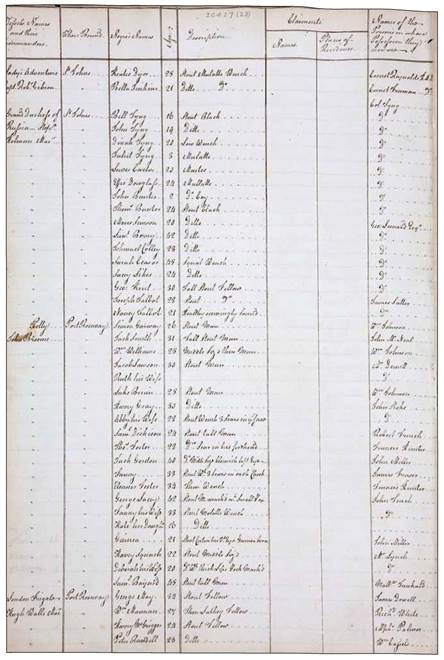
The Book of Negroes, compiled by British commanders when they evacuated New York City in 1781, lists some 3,000 African-Americans who had sought their freedom behind British lines and departed with the British army. Many ended up in Nova Scotia; some eventually made their way to Sierra Leone in West Africa. This page includes an entry for Deborah, formerly a slave of George Washington (sixth from bottom).