
By the 1830s, the time of Andrew Jackson’s presidency, the axiom that “the people” ruled had become a universally accepted part of American politics. Those who opposed this principle, wrote Tocqueville, “hide their heads.” But the very centrality of democracy to the definition of both freedom and nationality made it all the more necessary to define the boundaries of the political nation. As older economic exclusions fell away, others survived and new ones were added. The vigorous public life of antebellum America was simultaneously expansive and exclusive, and its limits were as essential to its nature as its broad scope. Democracy in America could absorb native-born poor white men as well as waves of immigrants, yet it erected impenetrable barriers to the participation of women and non-white men— groups also excluded, as noted in the previous chapter, from full participation in the market revolution.
The “principle of universal suffrage,” declared the United States Magazine and Democratic Review in 1851, meant that “white males of age constituted the political nation.” How could the word “universal” be reconciled with barring blacks and women from political participation? As democracy triumphed, the intellectual grounds for exclusion shifted from economic dependency to natural incapacity. Gender and racial differences were widely understood as part of a single, natural hierarchy of innate endowments. A boundary drawn by nature itself was not really exclusion at all. “How did woman first become subject to man, as she now is all over the world?” asked the New York Herald in 1852. “By her nature, her sex, just as the negro is and always will be, to the end of time, inferior to the white race, and, therefore, doomed to subjection.” Paradoxically, therefore, while freedom for white men involved an open-ended process of personal transformation, developing to the fullest the potential inherent within each human being, the limits of American democracy rested on the belief that the character and abilities of non-whites and women were forever fixed by nature.
The debate over which people are and are not qualified to take part in American democracy lasted well into the twentieth century. Not until 1920 was the Constitution amended to require states to allow women to vote. The Voting Rights Act of 1965 swept away restrictions on black voting imposed by many southern states. Even today, controversy persists over the voting rights of immigrants, persons who have served prison terms, and the poor.
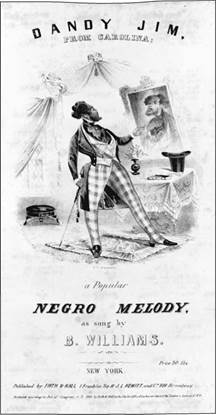
“Dandy Jim,” a piece of sheet music from 1843. Minstrel shows were a form of nineteenth-century entertainment in which white actors impersonated blacks. Here, the actor makes fun of a black man attempting to adopt the style of middle-class white Americans.
The political world of the nineteenth century, so crucial an arena for the exercise of American freedom, was in part defined in contrast to the feminine sphere of the home. Freedom in the public realm in no way implied freedom in private life. The “most rabid Radical,” Ralph Waldo Emerson remarked in his journal in 1841, was likely to be conservative “in relation to the theory of Marriage.” Beyond the right to “decent treatment” by her husband and to whatever property the law allowed her to control, declared the New York Herald, a woman had “no rights... with which the public have any concern.”