
The market revolution and political democracy produced a large expansion of the public sphere and an explosion in printing sometimes called the “information revolution.” The application of steam power to newspaper printing led to a great increase in output and the rise of the mass-circulation “penny press,” priced at one cent per issue instead of the traditional six. Newspapers like the New York Sun and New York Herald introduced a new style of journalism, appealing to a mass audience by emphasizing sensationalism, crime stories, and exposes of official misconduct. By 1840, according to one estimate, the total weekly circulation of newspapers in the United States, whose population was 17 million, exceeded that of Europe, with 233 million people.
Thanks to low postal rates, many newspapers circulated far beyond their places of publication. Indeed, by the 1830s, newspapers accounted for most postal traffic, outstripping private letters. The emergence of organized political parties also spurred newspaper publication. Each major party needed to have newspapers supporting its views in every part of the country, and government printing contracts were essential to most newspapers’ survival. The publication of all sorts of magazines, travel guides, advice manuals, religious titles, and other reading materials rose dramatically.
The reduction in the cost of printing also made possible the appearance of “alternative” newspapers in the late 1820s and early 1830s, including Freedom’s Journal (the first black newspaper), Philadelphia Mechanic’s Advocate and other labor publications, the abolitionist weekly The Liberator, and Cherokee Phoenix, the first Native American newspaper.
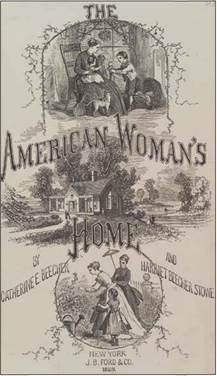
The American Woman’s Home, a guide to domestic life by the sisters Catharine Beecher and Harriet Beecher Stowe. Even though works like this were meant to instruct middle-class women on how to meet their domestic responsibilities, their popularity allowed talented women to take on a new public role as writers.
The growth of the reading public, yet another facet of the democratization of American life, opened the door for the rise of a new generation of women writers. Lydia Maria Child, Catharine Maria Sedgwick, Catharine Beecher, and others published stories, poetry, essays, and guides to domestic life. By the 1830s, moreover, through participation in religious and reform movements, thousands of women would establish a public presence, as will be described in Chapter 12. Nonetheless, once New Jersey added the word “male” to its voting requirements in 1807, women everywhere, whether married or single, propertied or dependent, were denied the right to vote.