
Slavery has existed for nearly the entire span of human history. It was central to the societies of ancient Greece and Rome. Slavery survived for centuries in northern Europe after the collapse of the Roman Empire. Germans, Vikings, and Anglo-Saxons all held slaves. Slavery persisted even longer in the Mediterranean world, where a slave trade in Slavic peoples survived into the fifteenth century. (The English word “slavery” derives from “Slav.”) Pirates from the Barbary Coast of North Africa regularly seized Christians from ships and enslaved them. In West Africa, as noted in Chapter i, slavery and a slave trade predated the coming of Europeans, and small-scale slavery existed among Native Americans. But slavery in nearly all these instances differed greatly from the institution that developed in the New World.
In the Americas, slavery was based on the plantation, an agricultural enterprise that brought together large numbers of workers under the control of a single owner. This imbalance magnified the possibility of slave resistance and made it necessary to police the system rigidly. It encouraged the creation of a sharp boundary between slavery and freedom. Labor on slave plantations was far more demanding than in the household slavery common in Africa, and the death rate among slaves much higher. In the New World, slavery would come to be associated with race, a concept that drew a permanent line between whites and blacks. Unlike in Africa, slaves who became free always carried with them in their skin color the mark of bondage—a visible sign of being considered unworthy of incorporation as equals into free society.
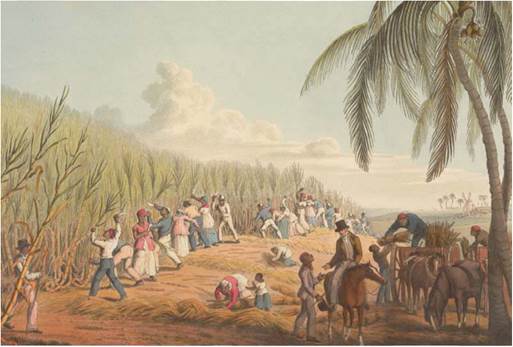
Cutting Sugar Cane an engraving from Ten Views in Antigua, published in 1823. Male and female slaves harvest and load the sugar crop while an overseer on horseback addresses a slave. During the eighteenth century, sugar was the chief crop produced by Western Hemisphere slaves.