
FIVE
From the peak of the cycle in the summer of 1929 to the bottom of the depression in March 1933, the stock of money—currency and demand deposits—fell by 28 percent and industrial production fell by 50 percent. The sizable declines in the two series merit attention not only because the social consequences of the decline in output were large and pervasive, but because the policies pursued during the period and the justification of them provide considerable evidence about the framework that guided Federal Reserve policy and the response of the Federal Reserve to a crisis.
This chapter gives special attention to the Federal Reserve’s response to the contraction, considers some previous explanations of its actions and inaction, and uses the history of the periods and the statements of participants to discriminate among alternative explanations of Federal Reserve behavior. Inevitably, this leads to a central issue about the 1929–33 decline: why the decline was so severe. There is no doubt that early in the decline the Federal Reserve knew a major contraction was under way. Whatever its causes, monetary policy could have lessened the decline. At issue here is why it failed to do so.1
The chapter does not attempt to resolve the more difficult problem of assessing the relative contribution of nonmonetary factors to the start of the Great Depression. It is now generally accepted that the depth of the depression, its duration, and its spread through the world economy are mainly the result of monetary actions or inactions. Warburton (1966), Friedman and Schwartz (1963), and at an earlier date Currie (1934) highlighted the role of monetary forces in the United States. More recent work by Eichengreen (1992) and Bernanke (1994) accepts the role of money and concentrates on the international character of the decline and the influence of the international gold standard. Agreement is limited, however. There are several different, and at times conflicting, explanations of the severity of the decline.
DIFFERENT INTERPRETATIONS
Following Bernanke (1994) and Mishkin (1976), several authors have revived a version of Irving Fisher’s (1933) debt-deflation explanation of the severity of the Great Depression.2 These authors supplement the monetary explanation by highlighting the role of capital market imperfections resulting from differences in borrowers’ net worth. Borrowers with relatively low net worth face more restricted opportunities to borrow, so they depend more on banks. As firms’ net worth fell during the depression, banks refused additional loans. Also, bank failures removed the principal lenders for businesses with moderate net worth. On this explanation, bank failures contributed to the depression not only by reducing the money stock, as claimed by Currie (1934), Warburton (1966), and Friedman and Schwartz (1963), but by raising the cost and availability of loans more than would have occurred based on the monetary and credit contraction resulting from Federal Reserve policies.
Friedman and Schwartz (1963, 407–19) attributed the Federal Reserve’s behavior in the early thirties to the death of Benjamin Strong in 1928 and the shift of power from the Federal Reserve Bank of New York to other parts of the System. George L. Harrison, who replaced Strong as governor of the New York bank, lacked Strong’s ability to organize and lead other members of the open market committee. In this interpretation, the period is unique not only because of the severity of the contraction but because the Federal Reserve behaved as it had not behaved earlier and should not be expected to behave again.
In his history of the interwar gold standard, Barry Eichengreen (1992) revived the idea that lack of central bank cooperation, the workings of the interwar gold exchange standard, and the requirement that Federal Reserve notes be backed 40 percent by gold produced and prolonged the decline. Lack of cooperation weakened the operation of the interwar gold standard Eichengreen (1992, 213). Cooperation would have enhanced the credibility of the System by encouraging speculators to believe that gold parities would be defended with the help of foreign central banks (xi, 257, 390). Monetary contraction in the United States and a decline in its international lending in 1928 put unsupportable strain on a fragile system, necessitated contraction in many countries, and “set the stage for the 1929 downturn” (392).3 Gold stocks were most heavily concentrated at the Bank of France and the Federal Reserve, but even these banks “had very limited room for maneuver” (393).
Elmus Wicker (1966, ix, 155, 195) attributed the Federal Reserve’s failure to its incomplete understanding of how monetary policy influenced economic activity and the price level. The Federal Reserve Board and the governors of the reserve banks were confused and misled by their interpretation of the events they watched. Power within the System was so diffused that leadership from New York or Washington was not possible (195). Even if there had been strong leadership, the uniqueness of the events of 1932 and 1933 immobilized the policymakers.
Wicker argues that Federal Reserve policy in 1929–33 was consistent with its actions in the 1923–24 and 1926–27 recessions. The Federal Reserve followed the practices laid down by Governor Benjamin Strong: use open market operations to reduce member bank borrowing below $500 million and reduce borrowing by New York banks commensurately. Once this was done, policy would be “easy.” Wicker added that international cooperation motivated open market purchases in 1924 and 1927, specifically to help Britain return to and remain on the gold standard.
A problem with some of these explanations is that the Federal Reserve was not entirely passive for the three and a half years of the decline. More than once it purchased securities or lowered the rediscount rate. It actively responded to events such as the departure of Britain from the gold standard in October 1931 by raising the rediscount rate to stem a gold outflow, as gold standard rules required. Although disputes persisted about the locus of power within the System and there were clashes between personalities, these are overtones that do not adequately explain the dismal record. If the crisis was largely due to an absence of leadership, more effective action would have been taken later, after the System reorganized, given additional authority and a strong chairman. But in the middle and late thirties, just as in the early thirties, the Federal Reserve did next to nothing to foster recovery. In a period of prolonged and widespread unemployment, the Federal Reserve’s principal policy action was the 1937–38 series of deflationary and contractive increases in reserve requirement ratios taken to forestall a possible future inflation.
Although Friedman and Schwartz offered an interpretive history based on what might have happened if Governor Strong had lived, a main point of their explanation is of doubtful validity. It is true that W. Randolph Burgess, and others at the New York bank, proposed expansive policies, and at times Harrison suggested purchases. In fact, Harrison argued vigorously for open market purchases at times, but at other times he was a leading proponent of open market sales. The timing of Harrison’s decisions to purchase or sell can be explained (approximately) by the conjunction of the Riefler-Burgess and real bills doctrines. These ideas or beliefs misled Harrison and others in the Federal Reserve at critical points in the early thirties and thereafter. As noted by Wicker (1966), Brunner and Meltzer (1968b), and Wheelock (1990, 1992), Federal Reserve officials behaved consistently in the 1923–24, 1926–27, and 1929–33 declines.4
The difficult issue to resolve is whether Strong’s colleagues on the Open Market Policy Conference (OMPC) would have supported expansive policies had he proposed them.5 Many of his fellow governors had been persuaded to go along but were not convinced that his arguments were correct in 1924 and 1927. Moreover, member bank borrowing remained high in 1924 and 1927, so domestic concerns (and the desire for earnings) reinforced international reasons for purchasing government securities. During most of 1929–33, member bank borrowing remained low; on Riefler-Burgess views, domestic policy was easy. Further, Adolph Miller and others at the Board blamed Strong’s policies for the depression. They interpreted the depression as the inevitable consequence of the preceding growth of bank credit and asset prices that followed the 1927 policy actions Strong had urged. Because credit expansion had increased without equivalent purchases of real bills, this policy was inflationary. Deflationary policy should have followed in 1928. That mistake had to be corrected.
Several governors agreed with this interpretation. Although the price level had fallen, Strong’s policy had violated the rules of the real bills doctrine. The violation had to be purged.6
Eichengreen’s claim that the gold standard prevented action is difficult to reconcile with the System’s responses in the 1923–24 and 1926–27 recessions. These actions had received praise at the time and encouraged the belief that the System had taken countercyclical action to lessen the downturn. If the Federal Reserve had risked the temporary loss of gold on these occasions, why would it fail to run the same risk in the much steeper decline after August 1929?
The Federal Reserve was in no danger of abrogating its gold reserve requirements in 1929, 1930, or early 1931. In fact, the System experienced a gold inflow in 1930 and early 1931. By June 1931, the monetary gold stock was almost 15 percent above the August 1929 level, whereas gold collateral required for notes had increased no more than 2 percent and collateral for bank reserves had increased only $40 million—less than 2 percent.
Eichengreen (1992, 297–98) accepts the argument in the Federal Reserve’s 1932 annual report that its response in 1931 was limited by the decline in the gold stock and the requirement to use gold as backing for Federal Reserve notes, the so-called free gold problem.7 Although there is some dispute about the relevance of the problem, any relevance is limited to the period following Britain’s departure from gold on September 20, 1931, and the passage of the Glass-Steagall Act on February 27, 1932. During the rest of the decline, gold cover for the notes was not an issue.8 The Federal Reserve did not use government securities as collateral for notes until May 1932, after increasing its holdings of governments more than $650 million between February and May.
Stripped of its technical details, the free gold explanation asserts that System open market purchases would have reduced the ratio of gold to notes and deposits below the required ratios of 40 percent and 35 percent. Technical restrictions seem a weak explanation for the lack of response. Bagehot’s well-known writings had instructed the Bank of England that it could not protect its gold reserve by failing to expand. On several occasions in the nineteenth century, the Bank of England had suspended the gold reserve requirement and relaxed restrictions on eligible paper for discounts when required to stop a panic. When necessary, the government had indemnified the bank against claims arising as a result of the suspension. This history was known within the Federal Reserve and referred to on more than one occasion.
Charles S. Hamlin, a member of the Federal Reserve Board from 1914 to 1936, discussed the loss of gold at a meeting in Boston on November 20, 1931, two months after Britain had suspended convertibility (Federal Reserve Bank of Boston 1931, 13–16). Hamlin began by summarizing the main movements of gold into and out of the United States since 1914. He described the $750 million outflow from September 17 to October 30, 1931, as “the largest ever sustained by any country in such a short space of time” (15). Nevertheless, the Federal Reserve, he said, held more than $1 billion of gold reserves above the amounts required for Federal Reserve notes and member bank balances. Then he added: “In addition, there is about $1,000,000,000 in gold certificates in circulation in this country, a considerable part of which could if desired be replaced with other forms of currency. We not only have ample gold to cover the legal requirements but our monetary gold stocks, even after the heavy withdrawals, are only slightly below the prosperous years of 1928 and 1929” (16).
Hamlin next commented on the reason for protecting the gold reserve: “The experience of recent weeks brings home to Federal Reserve officials their heavy responsibility, the necessity for keeping their powder dry, so that in these troublous times they may remain the rock that can withstand all storms and upon which world confidence may once more be reconstructed” (ibid.; emphasis added).9
Eichengreen correctly points out that before and during the world economic decline, France contributed to the onset and the severity of the world depression by sterilizing much of its gold inflow. From June 1928 to September 1929, the French bought $2.6 billion in gold and, in the same period, reduced their foreign exchange reserves by an equal amount.10 From September 1929 to March 1933, the Bank of France acquired an additional $1.6 billion in gold while reducing foreign exchange reserves by $800 million. For the period September 1928 to March 1933 as a whole, French gold reserves increased by 2.8 times while French holdings of gold and foreign exchange increased only 30 percent.
The French money stock rose 18 percent in the two years 1930 and 1931. Greater expansion and less sterilization by the Bank of France would have lessened the severity and scope of the world decline. At issue is whether the failure to expand more resulted from a lack of coordination. The Bank of France was not obliged to sterilize much of the gold inflow. The United States was not obliged to contract as France sterilized.
The critical flaw was not the absence of international coordination but domestic decisions at critical times to not interfere with the contraction of money and credit and the resulting deflation. Protecting the United States gold reserve was at most a secondary effect of the principal decision. Leading central bankers and their advisers believed that credit expansion to finance stock market speculation in 1928–29 was a misuse of credit that had to be eliminated. Bankers, economists, and others stated this view repeatedly during the contraction.
Writing at the time, Oliver M. W. Sprague explicitly rejected both the idea that monetary expansion was desirable and the idea that absence of international cooperation contributed to or exacerbated the depression. Sprague was an expert on banking crises and a close adviser to the Federal Reserve. He also served as economic adviser to the Bank of England from 1930 to 1933.11 In a May 1931 speech in London, Sprague discussed the causes of the depression and the role of international coordination (Board of Governors of the Federal Reserve System, Weekly Review of Periodicals, June 2, 1931, 1–2).12 He began by noting that the depression had become more acute. There was no agreement on its causes or on appropriate remedies. He summarized two divergent views. The “monetary school” wanted the leading central banks to “flood the market with a great amount of additional credit and currency.” The “industrial or economic equilibrium school included all the responsible [sic] people connected with the great central banks of the world.” This school held that falling prices were a symptom, not a cause: “When prices did advance, more currency and credit would be employed, but they did not believe that simply by injecting more currency and credit into the situation they could certainly bring about the desirable rise in prices and business activity.”
The problem was not lack of agreement between the principal central bankers: “It was not because of any difficulty of securing agreement among the three banks, (France, U.K., U.S.) but because none of them harbored the belief that it was the appropriate remedy” (ibid., 1–2).
Sprague, like the central bankers in France, England, and the United States that he described, accepted the “industrial equilibrium” explanation. The world’s economies would reach a new equilibrium at lower prices and wages. It would take time, they recognized, but they believed deflation was the correct solution to the mistakes of 1928–29.
In a speech to the Royal Statistical Society a few weeks later, Sprague explained why the deflationary solution was proper. There had been overproduction particularly in the American automobile industry. Further, there had been a speculative boom. He blamed Federal Reserve policy in 1928, when it would have been “possible to check the speculative wave on the New York Stock Exchange” (Weekly Review, June 24, 1931, 1).
Paul Warburg wrote in the American Banker for January 20, 1931, “The way to avoid a depression (or lessen its severity and duration) is to ‘sit on the bulge’ during an excessive upward swing. Once acute over-expansion has taken place, acute overcontraction must follow with inexorable certainty. Unfortunately, it would seem politically impossible for any government to use its influence toward checking a wave of prosperity, even though it was clearly a fake prosperity destined to end in a crash” (Weekly Review, January 27, 1931, 5).
These were not the only views, but they were common views of central bankers. M. H. deKock of the South African Reserve Bank thought that the “maintenance of pronounced monetary ease for any length of time almost inevitably leads to inflation and speculation in one form or another” (Weekly Review, February 3, 1931). In the same report, the noted British economist Lionel Robbins argued against the view that there was a worldwide shortage of gold. Like most others, he failed to distinguish between real and nominal interest rates: “If insufficiency of gold is the main cause of depression, why is there a depression in America. And with a 2 percent discount rate in New York, it is hard to contend that credit conditions are stringent” (2–3).
Robbins also mentioned the maldistribution of the gold stock, a common complaint at the time. However, he assigned more importance to the unhealthy character of the boom in 1928. Money rates had been held too low for too long.13
Charles S. Hamlin shared the view that speculative excesses had to be purged from the financial system and the economy. On November 8, 1929, shortly after the 1929 stock market break, he told a group of New England bankers:
The present crisis through which we are passing is typical of the kind of crisis that the framers of the Federal Reserve Act had in mind. The Act was designed to prevent the close dependence or interdependence of American industry upon speculative activity throughout the community. ... The Federal Reserve System was designed to break up the vicious circle under which a speculative orgy accompanied every forward step of industry....
The success of the Federal Reserve System is apparent today.... These events [losses] are deplorable, but they were of course inevitable and could not have been avoided. (Federal Reserve Bank of Boston 1929, 28)
The opinions of bankers and central bankers at the time are similar to the statement of Federal Reserve policy in the tenth annual report (Board of Governors of the Federal Reserve System, Annual Report, 1923). As Friedman and Schwartz note, the statement was compatible with two interpretations. One, the “real bills” or “productive credit” view of policy, required the Federal Reserve to provide “credit” for the “needs of trade” but not for “speculative” uses. The second interpretation is that the Federal Reserve would attempt to counteract inflation and deflation by countercyclical open market operations.
Only the first interpretation, the real bills view, appears in the minutes of the Open Market Policy Conference for the early thirties and in the statements of bankers and central bankers above. It is possible that the references to statements in the tenth annual report were made to justify views that were held for other reasons. Even if this was true, however, it is striking that none of the governors objected to the interpretation or presented an alternative. Even more striking is the absence, at most of the meetings of the OMPC, of any statement favoring an expansive policy. Even those governors who occasionally pressed for open market purchases and reductions in the discount rate expressed doubt that monetary (or credit) policy alone would have much effect on output. They too appear to have been greatly influenced by the notion that the prevalence of low nominal interest rates and low borrowing showed that policy was “easy.”
Benjamin Strong shared many of these interpretations. He often relied on the volume of member bank borrowing as a measure of ease or restraint.14 Nothing in either the Riefler-Burgess doctrine or the real bills doctrine distinguished between real and nominal rates of interest or recognized that the level of borrowing depends on anticipated income and inflation.
The minutes of the Open Market Investment Committee, the Federal Reserve Board, and the Conference of Governors of the Reserve Banks, considered below, show that most of the policy decisions remained consistent with the Riefler-Burgess and real bills frameworks. This should not suggest that everyone slavishly followed a formula. Many other inherited notions, mentioned in the minutes, contributed to the Federal Reserve’s failure to act or justified inaction. Concerns about “redundant reserves” or “excessive liquidity in the banking system” are variations on the real bills theme but may have other origins. Whatever the source of these ideas, many of the policymakers opposed expansive policy action because they believed that expansive action was inappropriate. Concern about future inflation caused several governors to hesitate to act, to regard deflation as the inevitable consequence of previous speculative excesses, for much the same reasons that Strong and others had viewed the severe deflation of 1920–21 as a consequence of inflationary wartime policies and a necessary prelude to the price stability of the middle twenties. Speculative credit and nonreal bills had to be purged. This was the message of Hamlin, Warburg, Robbins, Sprague, and many other bankers and central bankers.
Once borrowing and short-term market rates had fallen below the range familiar to governors and commercial bankers, policy was “easy.”15 They saw no reason for further additions to reserves and further reductions in market rates. Expansive policy would finance speculative credit and become the source of a future inflation that, once under way, would be difficult to stop. The System’s holdings of government securities were much smaller than the level of member bank borrowing during much of the twenties and were not substantially larger than the level of borrowings in the early thirties. Not having enough securities on hand to prevent a future inflation had been a recurring concern since the start of the Federal Reserve System. The concern seems a ludicrous reason for not expanding, but it appeared very real to several of the governors at the time. Since nominal interest rates had been reduced to levels that were comparatively low by the historical standards or experience the governors and members relied on, they saw little reason to increase speculative credit and accept the risk of inflation.
Some officials either did not fully share the dominant view or differed about particular events. At times some showed clear understanding of the role the System might play, although they did little to promote their views against the dominant view in the System. Included in this group are two members of the Federal Reserve Board—Eugene Meyer and Adolph Miller—who at times questioned Harrison and the other members of the open market committee about their reasons for not pursuing a more expansive policy. W. Randolph Burgess at the Federal Reserve Bank of New York urged more expansive policies at critical times, with support from the directors of the New York bank.
The policy problems of the early thirties were not unique. Books discussing the appropriate means of handling these problems were known to some of the members of the open market committee or their staffs. The effect of changes in the quantity of money had been discussed for more than a century, and many outstanding economists had contributed to the analysis. Some, like Henry Thornton (1965) and Walter Bagehot (1962), whose works are discussed in chapter 2, had described the appropriate response of a central bank to a crisis. Both Thornton and Bagehot suggested some of the principal reasons for large-scale currency withdrawals, and both had indicated that during a currency drain the central bank should expand.
Three of Thornton’s recommendations to the Bank of England are particularly relevant to—and contrast sharply with—the behavior of the Federal Reserve during the thirties. First, he argued repeatedly that there was rarely any reason for reducing the quantity of money (Thornton 1965, 259). Second, he urged the governors of the bank to meet an increase in the demand for currency by temporarily increasing the bank’s liabilities (259). Third, he recommended that the bank use the quantity of money—and not the volume of commercial bank borrowing from the central bank or of private borrowing from commercial banks—as a measure of its policy and the influence it would have on prices and output (271).
It is possible, but unlikely, that Thornton’s work was entirely unknown.16 However, there is no doubt that officials knew Bagehot’s work, since references to his book, Lombard Street, appear in the OMPC minutes. Bagehot had demanded repeatedly that the Bank of England acknowledge publicly that it served as lender of last resort, and subsequently the bank had done so. And Bagehot had discussed fully why it was a mistake for a central bank to seek to protect its gold reserve by failing to lend during a run on commercial banks.
Numerous other writers had analyzed the effects of changes in the quantity of money and the responsibilities of central banks in a crisis. Two of the most able monetary economists of all time, Irving Fisher (1920, esp. chap. 4) and John Maynard Keynes (1930, 1931), had argued in scholarly books, in pamphlets, and in newspaper articles of the period that a decline in the quantity of money would first affect the level of output and employment and only later affect the price level.17 Neither the absence of relatively simple, comprehensible alternative theories, nor the absence of facts about developments in the economy, nor the absence of strong leadership can explain the dismal record. The main reason for the failure of monetary policy in the depression was the reliance on an inappropriate set of beliefs about speculative excesses and real bills. This set of beliefs, embodied in the Riefler-Burgess framework, directed attention to short-term market interest rates and member bank borrowing and encouraged their use as indicators of the magnitude and direction of monetary stimulus.
THE FIRST YEAR OF DECLINE: POLICY FROM AUGUST 1929 TO SEPTEMBER 1930
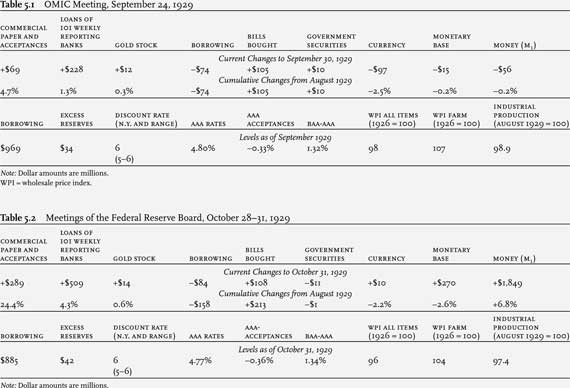
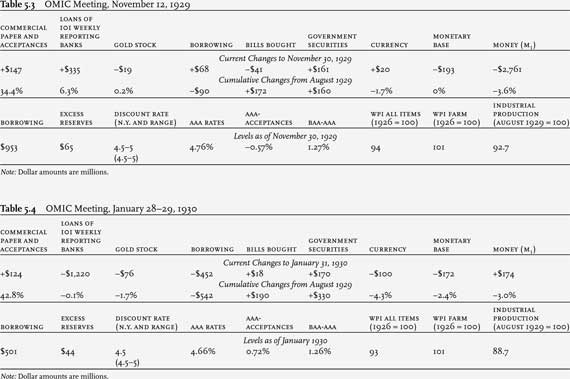
To show how policy responded to the economic decline, the discussion comments on each meeting of the Open Market Investment Committee and its successor the Open Market Policy Conference, or their executive committees, between the peak of the expansion in August 1929 and the trough of the recession in March 1933. A series of twenty tables shows some of the information available at each meeting. Three types of data suggest the direction of monetary policy and the levels or changes in other variables that the committee discussed from time to time at its meetings or that influenced its decisions. One type of data shows cumulative change from the peak of the expansion to the nearest month. A second type, called “recent changes,” shows the change in various measures between meetings. The third group shows the levels of variables that are of interest, again dated to the nearest month.18 Data for the money supply were not available at the time, but currency and demand deposits were available separately.
Responses to the Financial Panic
At the peak of the cycle in August 1929, the level of member bank borrowing exceeded $1 billion, the highest level reached since 1921. The interest rate on new stock exchange call loans was 8.15 percent, more than 1.5 percent below the high for the year in March. Other short-term market rates had passed their peak, while long-term rates were generally at the highest levels of the expansion. The seasonally adjusted monetary base was 1 percent below the peak reached more than a year earlier.
In the first six weeks the policy, agreed on in August, worked as planned; the System provided seasonal credit expansion by lowering the acceptance rate while raising the discount rate. Harrison told the Board that the total seasonal increase was about average. The acceptance portfolio increased $162 million, more than offsetting the $130 million decline in discounts. In addition the System purchased $20 million in the open market. Harrison asked for an OMIC meeting in September to consider open market purchases to supplement acceptance purchases (Board of Governors File, box 1435, November 12, 1929; these are minutes of the September meeting).
Brokers’ loans continued to increase. Banks used all the reserves obtained from sales of acceptances to the reserve banks to repay discounts, so total bank credit remained unchanged. Interest rates changed little.19
At the September 24 meeting, the governors expressed concern about the levels of discounts and rates of interest. To reduce both while acting against an impending recession, the committee voted to purchase up to $25 million of government securities weekly, if acceptances could not be obtained at the posted buying rates of 5.125 percent. When presenting the proposal to the Board, Harrison, the chairman of the OMIC, noted that “some reduction in this [member bank] indebtedness would be a necessary prerequisite to any further easing of interest rates,” as implied by Riefler-Burgess. The Board delayed accepting the proposal until its members returned from vacation. On September 30 Harrison wrote to Governor Roy A. Young at the Board to report the favorable response of the New York directors to the purchase program and again stressed the importance of reducing interest rates.
The Board approved the committee’s recommendations on October 1. In his reply to Harrison, however, Young noted that the Board’s approval was mainly for seasonal reasons, not a reversal of prevailing policy. There was no suggestion in the monetary indicators the Board and the committee watched, and no recognition in their discussions or letters, that the financial system was about to experience the first of a series of shocks in the following weeks. The committee made no open market purchases until the week of October 30.
The indexes of prices on the New York Stock Exchange reached peaks in September and plummeted in the last week of October. The Federal Reserve lowered the buying rate on banker’s acceptances by 0.125 percent (to 5 percent) on October 25. By October 28, with the decline on the stock exchange continuing, the members of the Board were of the opinion that “no further easing of the bill rate should be made at this time as the easing program of the system seems to be progressing satisfactorily.” The next day the market plunged downward on volume in excess of 16 million shares, nearly five times the average daily volume.
The following day Governor Young reported on his conversation with Harrison. Harrison informed him that the directors of the New York bank had given him authority to purchase government securities for the bank’s account without any stated limit, and he had used this authority to purchase $50 million. Inasmuch as the purchases had been completed, Young concluded: “There was nothing before the Board at that time requiring immediate action.”
The Board was piqued at Harrison and the New York bank for undertaking purchases without prior approval (as was customary), but decided to defer discussion of Harrison’s assumption of responsibility until later. Instead, the discussion turned to action that “might appropriately [sic] be taken.” Cunningham suggested, and the majority agreed, that it would be best to reduce the discount rate at the New York Bank from 6 to 5 percent, “with the understanding that the System will suspend, for the time being, any purchases of government securities, pending further developments in the credit situation as a result of the rate reduction, and further consideration and approval by the Federal Reserve Board.”
Harrison then called to inform the Board that he had purchased an additional $65 million, a total of $115 million for the day. There was no further discussion of policy at the Board meeting.
On the following day, October 30, Young reported to the Board on his conversations with Harrison and James B. McDougal (Chicago). Young’s position was classical; the System should encourage discounting by member banks, and he had told McDougal that “while he could not commit his board, he thought loans should be made freely and liberally.” The conversation with Harrison had apparently been lengthy, owing to a difference of opinion between New York and Washington on the policy that was appropriate for the day. Harrison informed Young that he was planning further purchases of securities. Young reported to the Board that he had advised Harrison that further purchases would “probably lead to the eventual promulgation of a regulation on the subject” by the Board.
The difference of opinion between New York and Washington was another round in the dispute about who had responsibility for decisions. Young reported that he had “advised Governor Harrison that he would not hesitate about lending to a member bank.” He told the Board that “he would go farther and purchase government securities liberally using any resource that the System has in an attempt to minimize the effects of conditions that may develop.” Other members of the Board—Edmund Platt, Hamlin, and Miller—agreed with Young’s position and urged him to communicate these views to the reserve banks.
Young informed Harrison on October 31 that the Board was in favor of reducing the discount rate at New York from 6 to 5 percent and that the “majority appeared to have changed their views with respect to coupling the reduction in the discount rate with an agreement to suspend purchases of government securities for the time being, feeling that the Federal Reserve banks should be prepared to pursue a liberal policy.”
The positions now reversed. Banks had reduced their discounts by more than $150 billion since the cyclic peak. The gold stock had increased, and banks continued to lend on commercial paper, real bills, with only modest changes in interest rates. Harrison told the Board that he had made no purchases on October 30, that he did not plan to make any purchases that day, and that he could see no reason for additional purchases, “although it might become necessary to take on additional amounts later.” His directors had adopted a resolution, unanimously, “that, in the interest of maintaining business and employment, the policy ... for the coming weeks should be to keep a plentiful supply of money in the market ... in order that discounts of the Federal Reserve System may be reduced and at the proper time a further reduction of the discount rate effected with the objective of securing lower interest rates for business throughout the country.”
The prompt and rapid response by the New York bank undoubtedly prevented the rapid decline in stock prices from affecting interest rates in the money market. The monthly data show a slight rise in the interest rates on short-term Treasury notes and longer-term corporate bonds and a substantial decline in the rate charged for new stock exchange call loans. Weekly data on open market rates for the last week of October 1929 show a slight rise in the rate on new stock exchange call loans and a decline in other quoted market rates. Commercial banks in New York made the largest volume of new loans to brokers and dealers shown in any week up to that time and offset to a large extent the reduction in call loans by banks outside New York. Although the average of daily figures in table 5.2 shows the Federal Reserve as a net seller of government securities for the month as a whole, the System purchased $157 million of government securities during the last week of the month, more than doubling the size of its portfolio of governments. In addition, the discounts of member banks with the System increased by $200 million for the week.
Although the Board was in favor of continuing the policy Harrison had started, the committee made no purchases in the following week. On November 1, New York reduced its discount rate to 5 percent and also reduced the buying rate on banker’s acceptances. The monetary base declined by $50 million, almost one-sixth of the increase in the previous week. Open market rates changed very little, and both the market and the System appear to have decided that the crisis had passed. The Board did not press New York to make further purchases. During the rest of 1929, the Board met almost every day, generally discussed routine matters, and rarely mentioned open market policy.
The Board’s minutes for the week of the crisis make it clear that the members were slower than the New York bank to recognize the desirability of large-scale open market purchases. But the lag, or delay, was at most two days. By October 31, Governor Young and most of the Board members wanted further purchases to offset rising discounts, while Harrison and the directors of the New York bank, knowing that the panic had not affected the money market, favored a less aggressive approach.
Part of the dispute about whether the System should act through open market operations or by discounting reflects the entrenched “real bills” doctrine. Those who favored discounting as a means of supplying reserves generally wanted to leave the initiative with the member banks and favored using the “needs of trade” as a guide to appropriate policy. Even in periods of crisis, their discussion contains repeated references to the “demand for Reserve bank credit,” in contexts suggesting that the Federal Reserve should supply the quantity of reserves demanded to meet the “needs of trade” but should avoid using open market operations to supply “redundant reserves” that would generate “speculative excesses.”
The reactions in New York and Washington are consistent with the Riefler-Burgess view. The pressure on the commercial banks in New York became intense at the time of the stock market decline, in large part because banks outside New York reduced their loans to the call money market. The security purchases by the New York bank undoubtedly prevented both a sharp rise in interest rates during the week and additional borrowing from the Federal Reserve by banks in New York and other large cities. Since the Open Market Investment Committee had decided at the September 24 meeting to reduce borrowing, by open market purchases if necessary, the response by the New York bank is not a deviation from the prevailing policy or from the concentration on interest rates and money market conditions. The reluctance to continue purchasing once borrowing and upward pressure on interest rates declined is further evidence that its behavior at the time was consistent with the Riefler-Burgess framework.20
Friedman and Schwartz (1963, 367) offer a different interpretation of these events. Their discussion, based on Harrison’s papers, makes no mention of the change in responses by Washington and New York after October 29. In their view, New York stopped purchasing securities because of the strong reaction at the Board. More important, they suggest that this episode had a permanent effect on Harrison and that thereafter he was reluctant to engage in open market operations without the consent of the Board or the Open Market Investment Committee. The Board’s records suggest, on the other hand, that the Board members conceded Harrison had been correct in making large-scale purchases of government securities and in encouraging the additional discounts that the Board had urged from the start as a means of meeting the crisis. They disliked New York’s decision to act alone.
The dispute was mainly about procedure, not about substance. Nor was the procedural issue a new one. The Board and the New York bank had differed about the division of responsibility and particularly about the Board’s role in open market policy from the very first years of the System and particularly after 1923, when the importance of open market operations increased. The Board had discussed reorganization of the committee responsible for policy recommendations at meetings in 1928 and 1929.
Harrison wrote to Young on November 7. The New York directors had voted that day to purchase government securities if they did not acquire sufficient acceptances. Their aim was to provide a seasonal increase in reserves while reducing the volume of discounts and open market rates. His letter mentions the directors’ concern “that there may be a greater danger of recession in business with consequent depression and unemployment, which we should do all in our power to prevent” (Open Market, Board of Governors File, box 1435, November 7, 1929).
No purchases were made. Between September 24 and November 8, the System account increased $80 million, by purchases of $30 million and acquisition of $50 million purchased by New York during late October. New York increased its holdings (net) by $108.8 million. Only seven reserve banks participated in the purchases.21
John U. Calkins, president of the San Francisco reserve bank, explained his reasons for not participating in open market purchases.22 He was not “in entire sympathy with the course of open market policy.” He was opposed to the view that “artificial conditions should be created for the purpose of promoting a bond market.... We can not see that this policy can be continuously followed without unfavorable results” (Letter Calkins to Harrison, Board of Governors File, box 1435, January 7, 1930).
Calkins then commented on Strong’s 1927 purchases: “We are unable to see that the 1927 experiment, now quite generally... admitted to have been disastrous, contributed very materially to the welfare of this country by providing or supporting a market for our exports.... [T]he purpose of the Federal Reserve System is to provide and assure adequate finance for trade ... at a cost conducive to stability” (ibid., 2; emphasis added).
This letter, written within a few months of a major financial panic and at a time of deepening recession, represented a substantial body of opinion within and outside the Federal Reserve System. To these real bills advocates, Strong’s 1927 policy had failed on the narrow grounds of expanding exports, on which it had been offered, but it also had been a main cause of the increase in stock prices and brokers’ loans. They wanted no more. They believed that crises and recession were inevitable after speculative lending; they had to be endured to reestablish a sound basis for expansion.23
The data in table 5.3 are for the end of November, hence they overstate somewhat the changes that had taken place at the time the committee met. The sizable reduction in the money supply is a reversal of the very large rise in deposits in the last week of October. At the time of the meeting, industrial production was 5 percent below its level at the peak, and by month’s end it was more than 7 percent below the August peak. Short-term interest rates and wholesale prices had continued to decline, but member bank borrowing was higher on average than in the preceding month.
The committee noted that a turning point had occurred and that there had been a “severe liquidation of credit against securities under circumstances which constitute a serious threat to business stability at a time when there were already indications of a business recession.” The time had come for the Federal Reserve System to “do all within its power toward assuring the ready availability of money for business, at reasonable rates.” In the Riefler-Burgess framework, the committee’s statement meant that the discounts of member banks should be reduced. The governors voted to do just that by purchasing bills (acceptances) and, if necessary, by purchasing government securities. At Harrison’s suggestion, the committee changed the limit on purchases from $25 million per week to a total of $200 million between the November and January meetings.
This meeting, within three months of the turning point, showed little disagreement about the interpretation to be placed on the events that had occurred or on the proper means of meeting the expected recession. The committee clearly regarded the fall in security prices and the decline in the public’s wealth as factors intensifying a recession that was already under way. The record in 1929, as at the start of most subsequent recessions, is inconsistent with the often-repeated view that the Federal Reserve is slow to take countercyclical action because it is slow to recognize the onset of a recession. The reluctance to take expansive action that many of the governors showed at subsequent meetings of the committee cannot be explained as a misinterpretation of the then current economic conditions or a failure to recognize that the economy had turned from expansion to recession.
At first the Board refused to approve the committee’s decision. Young wrote to Harrison on November 13 that the Board was willing to authorize purchases for emergencies but would not grant authority to purchase up to the $200 million approved by the committee. Harrison’s memo, recording his subsequent conversation with Young, makes it clear that he viewed the Board’s objection as an opposition to the grant of discretion, not to the purchase policy. He accused Young of wanting to have a central bank operating in Washington and was surprised when Young agreed (Harrison Papers, Conversations, vol. 1, November 15, 1929).
To obtain approval of the purchase program, Harrison offered a temporary solution to the procedural issue. New York agreed to stop purchasing for its own account if the Board approved the committee’s decision without qualification. The Board accepted on November 25. In the first three weeks of December, the System purchased $207 million of securities and $52 million in acceptances. In the remaining weeks of December, market rates fell, acceptances came to the bank at a faster rate, and the System sold nearly $50 million of government securities. The initial crisis was over.
Response to Recession
Changes in many of the monetary variables at the time of the January meeting are not markedly different from the changes that characterize other recessions.24 Gold and bank loans had fallen, the latter partly a reflection of the reduction in stock exchange credit. The monetary base had fallen also, but more of the base was held as bank reserves, so the money supply had increased. Short-term interest rates were below the levels reached at the peak and had declined since the previous meeting; the term structure sloped up. (The term premium between Aaa rates and ninety-day acceptances had increased from 0.57 to 0.72.) Member bank borrowing was 50 percent below its peak, the lowest level since early 1928.
The January meeting was the first meeting after issuance of the Board’s order replacing the OMIC with a new Open Market Policy Conference (OMPC) on which all reserve banks would serve. Although all governors participated in the January meeting, there was substantial disagreement about the new procedure, and it was not adopted until March 31.25
The new committee recognized that “a business recession has taken place, the extent or duration of which is not yet possible to determine” and that “liquidation is progressing in an orderly fashion.” However, the members were divided about the policy that should be pursued in the coming months. Governor Eugene R. Black (Atlanta) “desired a continuation of credit ease,” arguing that neither business nor the mental attitude of businessmen in his district was conducive to expansion. At the other pole, “Governor McDougal (Chicago) indicated that an easing policy would be worth considering if it would benefit business, but he felt present rates were not restrictive.” “Governor Norris (Philadelphia) believed that open market operations had been carried far enough, that the object of the November policy had been achieved, and he would rather see lower interest rates come of their own accord than as a result of Federal Reserve interference.”
Governors Lynn P. Talley (Dallas), William McChesney Martin Sr. (St. Louis), and John Calkins (San Francisco) joined Norris and McDougal. Calkins noted that there had been “more than the usual liquidation in his district,” but he could see no reason for further changes in interest rates. Others took intermediate positions, several favoring Harrison’s proposed reduction in the buying rate for acceptances.26 No one argued for a program of substantial or even moderate open market purchases. It was “the judgment of the Committee that no open market operations in government securities are necessary at this time either to halt or expedite the present trend of credit.”
Although the committee recognized that changes in loans and investments of reporting member banks were smaller “than the usual growth of credit required by the country’s business,” it voted only to “avoid the hardening of rates which might result from a seasonal demand for additional reserve credit.” Its statement urged caution and restraint. The reasons that prompted most members to proceed cautiously are developed more fully in the committee’s policy statement:
The majority opinion was that what had already been done has set in motion a trend which should result in lower rates. Between a reduction of discounts and large purchases of securities and a reduction of rates to business there is always a lag and that lag is likely to be greater at this time because the appetite of the bankers has been whetted during recent months, and they are slower about coming down. There is every reason to anticipate that the reduction will occur, so that it is believed that the current is set in the direction of easier rates.
We feel we should not interfere in that movement either in the direction of halting it or attempting to expedite it. ... [It] is inexpedient to exhaust at the present time any part of our ammunition in an attempt to stimulate business when it is perhaps on a downward curve ... in a vain attempt to stem an inevitable recession... . The majority of the Committee is not in favor of any radical reduction in the bill rate or radical buying of bills which would create an artificial ease or necessitate a reduction in the discount rate. (Open Market, Board of Governors File, box 1436, January 30, 1930)
The empirical basis for the committee’s conclusions is more clearly set forth in a memo that Harrison had read to the Governors Conference more than a month earlier.27 The memo contained two charts. One showed the relation between member bank borrowing and market interest rates. The other compared the rate of increase in bank credit with the volume of member bank borrowing. Harrison interpreted the charts as showing that “generally speaking the trade and business of the country require an increase in bank credit somewhere in the neighborhood of 4 to 5% a year, and the chart indicates that the rate of increase in bank credit has usually exceeded this rate when the Federal Reserve discounts were under 400 to 500 million dollars, and usually falls under this rate when discounts are over 500 to 600 million dollars.” The memo goes on to spell out these central notions of the Riefler-Burgess framework and, after mentioning some qualifications, concludes that “these charts show in general that under conditions that have prevailed in recent years an amount of member bank borrowing somewhere in the neighborhood of 500 million dollars [the level then current] may be considered a normal at which commercial paper rates have tended to average 4½% and at which the volume of bank credit has tended to increase at the rate generally proportionate to the needs of business.” Since the volume of member bank borrowing had been reduced by $450 million in less than two months and was now within the range Harrison spoke of, it is not surprising that he did not favor or propose an aggressive policy of open market purchases.
When the Board met the next day to discuss the committee’s recommendations, Treasury Secretary Andrew Mellon repeated several of the arguments that had been made in the policy statement. The Board voted to carry out the policy recommendation and approved a minimum effective buying rate of 3.875 percent for any Federal Reserve bank wishing to establish that rate. By a tie vote, the Board followed the OMIC majority and refused to reduce the discount rate at the New York bank to 4 percent. The reasons for the Board’s refusal are not clearly stated in the report, although there is some indication that it regarded the request as premature.
The governors’ statements at this meeting provide a clear indication of their reasons for failing to take more expansive action at the time and throughout the period. Since short-term market interest rates had fallen and were expected to fall further as member bank discounts declined, most governors saw little reason for the Federal Reserve to “interfere” or to hasten the decline in rates. Words like “artificial stimulus” and “inevitable decline” reflect the dominant view that speculative excesses had to be purged. Once that happened, the economy would recover, and the System would be able to expand based on rediscounting of real bills.
Virtually all the governors used the level of market interest rates as an indicator of current policy. Differences between them at the meeting were largely matters of detail. Some opposed the 0.125 percent reduction in the buying rate for bills on the grounds that the reduction would cause the System to acquire bills in much larger quantities temporarily and thus cause market rates to fall faster than they believed desirable. Others opposed the reduction on the similar grounds that the reduction in the buying rate for bills would “force” a decline in the discount rate by contracting the amount of member bank discounts (reducing the demand for reserve bank credit). Only Governor Black advocated a policy of open market purchases.28
After the January meeting the Board approved reductions in the minimum buying rate for bills on February 11 and 24 and on March 5, 6, 11, 14, 17, 19, and 20. By the March meeting, the buying rate was 3 percent. The Board also approved further reductions in the discount rate to 3.5 percent at New York and to 4 or 4.5 percent at the other banks. These changes did not receive the unanimous support of the Board members, and those who voted for the reductions often expressed doubt about the efficacy of a “cheap money” policy.29 No one mentioned that wholesale prices had fallen 7 percent in seven months or that real rates had increased more than nominal rates had fallen.
Despite the nominal rate reductions, the System’s holdings of acceptances had declined since the January meeting, and the volume of member bank discounts was at the lowest level since early in World War I. Long- and short-term interest rates continued to decline, as shown in table 5.5. Although nominal short- and long-term rates had fallen to the levels reached in the recessions of 1924 and 1927, the term spread between short- and long-rates had doubled in the two months to March.
This was the last meeting of the committee for more than two years at which the seasonally adjusted money supply showed a rise from the previous meeting. The increase in money from January to March was largely the result of a gold inflow from Brazil and Japan and the higher base money multiplier produced by the continued decline in the public’s demand for currency in both nominal and real terms.
Much of the discussion at the meeting was about New York’s decision to purchase $50 million of government securities early in March. Although the committee had voted against further purchases at the January meeting, New York explained, as it had in a letter earlier in the month, that the purchases had been made, after consultation with the Federal Reserve Board, because it had been “impossible to maintain the bill portfolio” in the face of an increasing demand for bills by banks and financial institutions. The “unfavorable business situation” was also mentioned as a factor in the decision to purchase.30
The discussion makes it clear that the main reason for the purchases was to correct a problem that the members regarded as technical. An inflow of gold—from Japan and South America according to the minutes— had increased the reserves of the New York banks. The banks used the new reserves to purchase acceptances, forcing the Board to lower the buying rate for acceptances or allow the acceptance portfolio to decline. At first the Board reduced the acceptance rate, but the acceptance portfolio continued to fall in early March because the gold imports continued and the Treasury’s balance at the reserve banks declined. The falling acceptance rate was regarded as a technical reaction because a rise in the rate on other short-term instruments—for example, stock exchange collateral loans, particularly brokers’ and dealers’ loans—accompanied the decline.31
The preliminary memorandum prepared for the meeting noted that the recession was probably more severe than the recessions of 1924 or 1927 and that unemployment had increased. However, it also observed that “the effects of easy money and freely available credit have been, in the first place, to stimulate a vigorous recovery in the bond market. Bond prices have risen to the highest points in more than a year.” This was a particularly important piece of information within the framework that most of the members used. The rise in bond prices and the reduction in member bank borrowing seem to have provided the entire basis for the decision to make no further purchases of government securities. In the committee’s words, “The steps already taken by the Federal Reserve System in easing the money market through open market operations have gone as far in providing the stimulus of easy money for business use as seems desirable at this time.”
With hindsight, it is clear that this was an important meeting. The decision to avoid further expansive action because monetary policy was judged to be “easy” came just as there were signs of a turning point or a bottom of the recession. The preliminary memorandum prepared for the meeting noted a slight improvement in “business and trade” between December and January and further slight improvement from January to February. The data now available partly confirm the observations made at the time. Industrial production, seasonally adjusted, rose in January and declined very little in February. More important, there was a slight drop in industrial production from March to April and larger declines in May and June. The index of common stock prices had restored approximately 25 percent of the October decline in the value of common stocks by the end of March, but the rise in stock prices ended in April.
If the governors of the Federal Reserve had used the stock of money instead of interest rates as an indicator of monetary policy, they would not have concluded that monetary policy was “easy.” Additional open market purchases at this time would have contributed to the expansion. Instead, the further contraction of money contributed to the decline in output and to the bank failures that came with increased frequency after this meeting.
The striking fact about the meeting is that although there was little dissent about the size of the recession, there was little support for a policy of monetary expansion. The committee’s main recommendations were designed to prevent a further reduction in bills: it voted to reduce the buying rate for bills to 2.5 percent, but not to purchase below 3 percent except in an emergency, and to engage in no open market purchases. A memo prepared for the meeting and made part of the record showed that the System’s earning assets were lower than in the previous year, largely as a result of the fall in member bank discounts.
The discussion at the meeting showed no evidence of disagreement between New York and Washington. On March 14 New York reduced its discount rate to 3.5 percent, with Board approval. Other banks remained at 4 to 4.5 percent. In a letter to Governor Young, J. Herbert Case described the 3.5 percent rate as a possible danger, but he urged the Board to approve the step “in the hope that business may be benefited” (Board of Governors File, box 1435, March 17, 1930). He hoped that the System would act promptly to prevent excessive credit expansion.
Outside New York, reserve banks remained skeptical about additional ease. Although he saw “plenty of evidence ... that what had appeared to be an upturn in January has not held,” Governor Talley (Dallas) wrote opposing any additional expansive actions.32 “Everyone seems to want to keep business jazzed up all the time and have it run along at boom figures.... [T]he sounder course to pursue ... is to catch up and let the public pay some of its debts or at least acquire larger equities in its automobiles, radios, and real estate (Talley to Case, Board of Governors File, box 1435, March 13, 1930, 3).33
Between the March and May meetings of the Open Market Policy Conference, the Board considered a request from New York to lower the discount rate from 3.5 percent to 3 percent. At first the Board unanimously disapproved. The Board’s minutes for April 24 record a “considerable variance of opinion between the New York Bank and the Federal Reserve Board with regard to Federal Reserve policy.” The Board favored “the maintenance of stability rather than further easing through Federal Reserve action.” Within a week, however, Governor Young changed his mind and announced that he favored reducing the discount rate and the buying rate for bills. On May 2 the Board approved New York’s request, and in the following weeks the effective buying rate for bills declined to 2.5 percent, below the rate that the March conference had suggested as a minimum.
New York’s request was a response to the deteriorating economy. At a meeting on April 24, Harrison reported to his directors that production and trade had declined in March and that preliminary figures for April, covering building contract awards and railroad car loadings, showed a further decline. Harrison also reported that commodity prices had fallen, that foreign trade had declined during the first quarter, and that gold continued to flow in. He recommended a reduction in the discount rate as a means of improving the bond and mortgage markets, which “historically and logically appear to be a precedent or a necessary accompaniment of recovery in business and prices after a period of depression.” The following week Harrison again discussed a discount rate reduction with the directors. This time the Board approved.34
The data for this meeting, in table 5.6, show the renewed decline in industrial production and the fall in wholesale and farm prices. Although bank lending (at weekly reporting banks) had increased since March, commercial paper and banker’s acceptances had fallen. The data also show that standard policy actions were not having their expected effect. Lowering short rates had not reduced long rates. Rates on Aaa bonds were only twenty-four basis points below the August 1929 peak, while prime banker’s acceptances had been reduced by 2.625 percent. The term premium had increased by a factor of three, from 0.7 to 2.1 percent since the end of January.

Some of the New York directors continued to press for expansive action. They instructed Harrison to inform the Board that they wished to purchase government securities. Governor Young suggested a meeting of the conference so that “all Federal Reserve Banks may be informed of the program which the New York Bank seems to have in mind” (Board Minutes, May 15, 1930).
New York was not the only bank dissatisfied with the conduct and achievements of open market policy. At the May meeting, Governor Young presented five suggestions that had come before the Board. Two called for open market sales; two called for purchases; and one bank wanted to maintain the prevailing policy but provide from $350 million to $400 million for seasonal requirements through open market purchases and increases in bill holdings during the fall.
Several features of the Federal Reserve’s approach to policymaking are mentioned to support or justify the three proposals. Some governors, following one aspect of the real bills doctrine, regarded the end use of credit as the most useful guide to appropriate policy. They believed open market sales would “check speculation” and help the banks to liquidate security loans. Their main evidence of speculation at this time was the increased volume of brokers’ and dealers’ loans that had accompanied the increased volume of security purchases and rising stock prices in the months before the meeting. Others, concerned about the distribution of the Federal Reserve’s earning assets, wanted to sell $200 million of securities and reduce discount rates “so that rediscounts might be approximately equal to the total of government securities and bankers acceptances held.” This proposal reflected a different aspect of the real bills doctrine, the view that a main purpose of monetary policy was to respond to changes in the demand for reserve bank credit. Some governors believed that open market sales would ease credit by encouraging banks to reduce interest rates and force them to borrow on real bills. The proper policy, they claimed, was to lower discount rates and sell securities.
Poor timing was one reason the proposal for open market sales and lower discount rates did not receive more widespread support. The provision of the Federal Reserve Act calling for an “elastic currency” was interpreted as a requirement to meet the seasonal “needs of trade.” One governor who favored seasonal expansion in the fall expected the seasonal demand for bank credit to be larger than the current (May) demand. He expressed the view of several governors when he suggested that open market purchases would have more effect if they were made at a time of increased demand for bank credit and for reserve bank credit.35
Of the two banks proposing purchases, one favored monetary expansion and the other had the traditional concern about reserve bank earnings. Since interest rates had fallen and member bank borrowing had not been fully offset by an increase in bills and securities, the reserve banks’ income had fallen. Some of the banks faced losses. The conference agreed that supplementing the income of a reserve bank was not a “proper reason for the purchase of government securities,” and the matter ended. This issue arose again in the middle thirties.
The committee could not find any “proper reason” for engaging in either purchases or sales at the time. It was too early to provide for a seasonal demand that would not arise until fall. The only agreement reached was the empty statement that “conditions merit continuous careful observation of the Federal Reserve System in order that the System will be prepared to act promptly in the event that conditions further develop in such a way as to make actions seem advisable.”
No one attempted to set out the conditions that would make open market purchases advisable. Nevertheless, Harrison’s advocacy of purchases contrasts with the views expressed by several others. He believed that the “possible necessity for the purchase of government securities might be imminent at any time.” Another member called for immediate purchases “to remove every possible restraint from business as far as credit was concerned.” Still another suggested that the conference agree on a formula for the total amount of reserve bank credit as a guide to the desirable volume of purchases. None of these suggestions received much attention.
The minutes described money conditions as slightly “easier” because of the inflow of gold, the further decline in the amount of currency in circulation, and the reduction in member bank borrowing. But no one mentioned or appears to have noticed that the money supply (or demand deposits) had declined by more than $1 billion in the previous two months. Since most of the decline was in deposits, there must have been some recognition of the decline at major banks.
The governors not only were aware of the worldwide scope of the depression, they sensed that there was a connection between the depression and the New York money market. Harrison gave the standard explanation of the economic decline and the central role of real bills. There had been overproduction of “certain principal commodities,” accompanied by a “shortage of working capital and thus a restriction of purchasing power.” In the previous year, funds had been used for speculation, mainly in New York but in other markets as well. The recovery of world trade appeared to depend “in no small degree on a restoration of purchasing power through the medium of foreign borrowers on the New York money market, just as the recent recovery of domestic trade appeared to be much dependent on the new financing for domestic enterprise in the United States.”
This statement places Harrison well within the mainstream of Federal Reserve thinking and accounts for his failure to mention the substantial decline in demand deposits. However, within the common framework there are two main differences between New York and other parts of the System.
One is the minor point that New York developed more information and expressed more concern about current money market conditions and was more eager to take action to correct or offset money market changes. The second and more important difference within the committee concerns the interpretation of changes in member bank borrowing and interest rates and the System’s responsibility for bringing about further reductions in both. Some governors argued that the Federal Reserve should attempt to lower interest rates further by reducing discount rates and, if that failed, to lower interest rates and encourage member bank borrowing by engaging in open market purchases. Others—McDougal of Chicago and Norris of Philadelphia were leaders of this group—wanted to wait for the member banks to demand more reserve bank credit. In their view, the decline in borrowing meant that the System should sell securities to force an increase in member bank borrowing. With the possible exception of Governor Black, none of the governors argued for an aggressive purchase policy, and none professed a belief that such a policy would succeed.
Although the Board’s minutes indicate that the meeting was called to discuss New York’s program, Harrison did not present a program and, at the meeting, seemed most concerned about matters of timing and procedure, particularly the Board’s failure to agree quickly to requests for reductions in the buying rate on acceptances and discount rate changes. Young told the committee that “he had hesitated to vote favorably on the New York application for a three percent discount rate because of the position of the governors at the OMPC meeting on March 25.” This reopened a continuing disagreement. Harrison replied that decisions about discount rates were primarily the responsibility of the individual reserve banks and that “he did not believe the action of the Open Market Policy Conference should be regarded as in any way restricting freedom of action on discount rates.” Several governors agreed with Harrison, and the conference voted that discount rates “were not within its proper province and that the directors of any Federal Reserve Bank must feel free at any time to change the discount rate of their bank subject only to the review and determination of the Federal Reserve Board.”
This was a partial victory for New York. It removed any control that McDougal, Norris, or other governors might have had over the decisions about the discount rate at New York. Since New York’s 3 percent rate was one percentage point lower than the rates at ten of the eleven other banks, the banks with higher rates could not press New York to raise its rate by a formal vote of the conference. But it left New York, as before, dependent on the decisions of the Board.
To further strengthen New York’s position, Harrison argued for greater control of the acceptance rate by the reserve banks. The Board’s delays in approving applications for lower bill buying rates had left New York without “downward flexibility.” The committee voted to support Harrison, and after the meeting the Board sent a letter to all the reserve banks accepting the conference’s decision.
Although most of the decisions at the May meetings concerned operating procedures, they show that New York was no more isolated from the rest of the System in regard to procedure than in regard to policy. The conference was willing to support New York on day-to-day policy and to provide discretionary “flexibility” in managing the account. The Board and the conference were unwilling to allow New York to purchase and sell government securities on its own initiative and for its own account, but it is not clear that most would have opposed a program of open market purchases for the System if Harrison had supported the program vigorously. In fact, the members responded to Harrison’s statement that “the possible necessity for the purchase of government securities might be imminent at any time” by voting to reconvene or to act promptly on the recommendations of its five-man executive committee, which Harrison headed. When Harrison proposed open market purchases only ten days later, a majority of the conference voted in favor.
New York Seeks Expansion
Harrison’s approach to policy comes out clearly in the decision to purchase $50 million of securities early in June 1930. The discussions leading to the decision show the importance he attached to short-term factors affecting interest rates and money market conditions and his failure to develop a long-term program.36 They also show Harrison as a broker trying to reconcile differences between opposing groups. Three points stand out. First, Harrison twice changed his mind about the desirability of purchases. Both changes coincide with changes in the technical position of the money market. Second, Harrison did not suggest a program of steady expansion. In fact, he did not propose as expansive a policy as some of the New York directors urged on him. Third, Harrison never answered, and at times appears to have accepted, the main criticisms of the policy of expansion made by Norris and other opponents.
The first suggestion that purchases should be made came at the May 8 meeting of the directors of the New York Federal Reserve bank. Several of the directors spoke in favor, but others opposed on grounds that recovery in bond prices had been delayed by the floating of a large foreign loan— the $300 million German annuities loan. The directors who opposed purchases expected interest rates to resume their decline once the offering was sold. The directive recommended that Harrison discuss the possibility that open market purchases “may become desirable” with other governors and the Board. On May 19, two days before the Governors Conference, the executive committee of the New York directors remained divided. Most agreed that purchases of open market securities would be “inflationary” (which to them often meant that bond prices would rise), but some believed this danger should be faced “to check a decline in commodity prices.”
The following week, Harrison reported on the results of the Governors Conference to the executive committee of the New York directors. One of the directors remarked that there had been a net withdrawal of Federal Reserve funds from the money market during the preceding six months.37 He urged that these funds should “now be restored to the market by the purchase of government securities,” and he suggested that if this were done bankers would be encouraged to make loans to business borrowers. Then, in a statement that is considerably at variance with the real bills and Riefler-Burgess doctrines, a director pointed out that “if government securities should now be purchased in sufficient amount so that member banks would no longer be able to use the funds thus made available to pay off advances and rediscounts, expansion of bank investments would be forced and business would perhaps be stimulated.”
Support for purchases was rising in New York. Harrison reminded the directors that the governors had considered purchases but had voted not to take any action. Some of the directors disagreed with this policy. In their opinion, “it would be unfortunate if the banking system would not be used to facilitate recovery.” Three days later, on May 29, the full meeting of New York’s directors unanimously approved the report of the Open Market Policy Conference, then seized on the section that permitted the committee’s decision about open market policy to be reopened. Although only a week had passed, they voted that “it now seems desirable to undertake the purchase of government securities in moderate amounts.”
During the next few days, Harrison and Burgess telephoned the other governors to discuss their directors’ recommendation. Frederic H. Curtiss (Boston) believed that the situation had “retrogressed,” so he favored purchases of $20 million to $25 million for the next few weeks to test out the situation, “feeling that no harm would result and some good might be accomplished.” E.R. Fancher (Cleveland) also favored purchases, “believing that it might possibly help and that in any event it would be preferable to err on the side of ease rather than on the other side.” McDougal (Chicago) believed purchases would “do little or no good,” so he preferred not to purchase. Black (Atlanta) was very much in favor; Norris and Calkins were opposed.
Early in June, Harrison telegraphed the results of the canvass to the Board. Seven of the governors favored purchases if limited in magnitude and duration, four were opposed, and one “interposed no objection.” On a divided vote, the Board approved purchases of not more than $25 million per week for two weeks, the first open market purchases since the middle of March.38 New York began purchasing almost at once.
Four main reasons tipped the balance in favor of limited purchases. First, some long-term bond yields, particularly on lower-rated bonds, had risen at the time the German annuity was announced and had not returned to the April level. Second, discounts show a sharp increase during the week ending May 28. On the Riefler-Burgess interpretation, the rise in discounts meant that demand for reserve bank credit had increased, so open market purchases were justified as a means of providing “productive credit” and preventing an increase in short-term rates. Third, as Harrison explained to the Board on June 16, the directors at New York believed recovery would not occur for several months and perhaps not for a year, but they “are particularly concerned about the export trade which has such a direct effect upon commodity prices and feel that a revival of our foreign trade depends largely upon the bond market and that hopes of getting a strong bond market rest upon the continued ease in the short time money market more than anything else.” Fourth, and possibly most important, none of the opponents of expansion believed that the purchases, if limited, would be “inflationary” in the circumstances then prevailing in the money market, that is, the increased volume of member bank borrowing.
Harrison’s reasons for supporting a limited program of purchases and his opposition to a more expansive program came out clearly at a June 5 meeting with the New York directors. To a director who urged a reduction in the discount rate to 2.5 percent as a means of encouraging banks to reduce the rates charged on bank loans, Harrison replied that banks already had “sufficient reasons for lowering rates.” To another who pointed out that the decline in the New York bank’s bill portfolio in the most recent week more than nullified the $50 million purchase of securities, Harrison gave the standard Riefler-Burgess argument that the banks had been “placed in the position to pay off a substantial part of their borrowings, .. .the money market is definitely easier than it was before our purchases.” He reminded the directors that the quarterly Treasury financing and the German loan made the timing unfavorable.
At least one of the directors was dissatisfied with the policy of delay and hesitation. He urged purchases of at least $100 million, and in a prophetic statement he made it clear that Harrison’s was not the only view.39 “Unless the banks take initiative in affording the relief of very cheap money, however, he foresaw a relatively long period of business depression and severe unemployment. The first step in the program, as he viewed it, might be to get the call money rate down to a dramatically low level.”
The decline in short-term market rates and the return of borrowing to the level of mid-May helped to convince the Boston and Cleveland banks that no further purchases should be made. They now sided with Philadelphia and Chicago, so the vote in the executive committee on June 23 was four to one against the purchase program. Harrison was the lone dissenter, arguing as before that there was a maldistribution of credit between short -and long-term markets and that further purchases of securities would lower long-term rates, increase loans to foreigners, and thus stimulate exports. Harrison’s argument—which he attributed to the directors of the New York bank—repeated the directors’ earlier statements about “lack of purchasing power in various parts of the world.” Prices had fallen because countries “are not in a position to purchase commodities.” Reversing the position he had taken at the directors’ meeting, he now argued that the effect of recent purchases of securities had been offset by a decline in the System’s bill holdings (see table 5.7).

Unfortunately, Harrison failed to respond to the main points raised by some of the other members on the committee. They argued that “easy money” and the low interest rates on the short-term markets had not had any effect on longer-term markets. The term spread had continued to widen. Some now interpreted the purchases in early June as an experiment that had failed to lower long-term rates. Harrison agreed that the short-term money market was “easy.” He told the group “that he did not want to leave the thought that there is any feeling in New York different from that expressed by the other members of the Committee that there is an adequate supply of short-term credit available for business. This is not the difficulty today,... and it has not been for months” (Board Minutes, June 23, 1930).
Governor Fancher (Cleveland) pointed out that since short-term rates had fallen, there was very little more that the System could do. Money would flow from the short-term market to the bond market as soon as banks attempted to increase their earnings. This would revive the bond market and lower long-term rates. Early in June he had favored a purchase program (to reduce short-term rates), but he now believed that additional purchases would accomplish little.
McDougal and Norris led the opposition to purchases in the executive committee with support from a letter that Governor Calkins wrote to Governor Young explaining why San Francisco did not share in the June purchases. The basis of their position was that “credit is cheap” and that nothing could be gained by making it cheaper. Further increases would not stimulate production, but a large security portfolio would make the committee hesitant to purchase when an opportune time came.
Harrison’s opponents agreed on one point—no further purchases should be made. McDougal wanted to sell securities and allow the acceptance portfolio to run off. Norris told the executive committee that he opposed the purchase program because the recession was due to excess capacity and overproduction that had caused a fall in the price of commodities. His examination showed that “the commodities on which the reduction of prices had been most marked disclosed in almost every case a specific reason which has nothing to do with credit.” Easier money, by which he meant lower interest rates, “might lead to further increases in productive capacity and further overproduction.” On the same day, he told the Board that he opposed a reduction in the discount rate at the Philadelphia bank because the only effect of a reduction would be “to increase the margin of profit for those banks which are chronic borrowers .. . and make it more difficult for the well managed bank to show any earnings at all.” As for open market purchases, Norris said that he and other members of the executive committee “cannot bring themselves to believe that a further purchase of government securities would help, but feel that such purchases would be an interference with the natural effect at this time and would not be productive of any good, and might be embarrassing at the time when business starts to pick up, at which time this System would find itself with a large amount of government securities and low discount rates.” The majority of the executive committee could not see any benefit to be derived from “affirmative action” (Harrison Papers, Office Memoranda, vol. 2, June 1930).
Harrison consistently evaded the question of how or why the policy of relatively small weekly purchases would work. He agreed that short-term funds must be regarded as “abundant,” since short-term rates were in the lowest ranges reached in previous recessions.40 Several of the other members—despite their differences—believed that recovery would not come until there was an increase in member bank borrowing and an increased demand for bank loans to finance trade and other productive activities. Harrison appears to have shared large parts of this real bills view. He made no effort to present an alternative.
Three days later, on June 26, Harrison discussed the response to the OMPC’s decision with the New York directors. They could wait for a change in sentiment at the other banks; withdraw from the OMPC and purchase for their own bank; or attempt to persuade the boards at other reserve banks by circulating a statement of their position. The bank’s officers favored the third proposal. The directors were reluctant to agree because they believed delay was “tantamount to retarding business recovery. ... [T]hey indicated their belief in the power of credit to bring about a revival in the bond market and, through it, to bring about an improvement in business” (Minutes, New York Directors, June 26, 1930).
Harrison put the issue sharply. Was the bank “so firmly convinced of the soundness of its position as to be willing to withdraw from the System Open Market Policy Conference?” He preferred delay. He was not convinced of “the power of cheap and abundant credit, alone, to bring about improvement in business” (ibid., 2). New York either had to act alone or had to persuade other banks to change their position. He was unwilling to do the first, unable to do the other.
Those who argue that Harrison saw the need for more expansive policy but was prevented from carrying it out by the other members of the conference and by the Board point to the events of this period to support their position. The claim is more true of the New York directors than of Harrison. Harrison seems pushed and pulled by the opposing views of his directors and his colleagues on the OMPC. He showed no intention of seeking a sustained rate of increase in money or bank credit. He had the much more limited aim of offsetting an increase in short-term rates and planned to stop purchases once he achieved this objective.
After the June 26 meeting, he wrote to the other governors suggesting that the Federal Reserve resume purchases of $25 million a week. The letter described the situation in the economy and in the money and bond markets in enough detail to convince even the most skeptical that the failure to act cannot be explained by lack of information. Commodity prices had suffered the most severe and rapid decline since 1921. These prices, he said, were now 12 percent below the previous year, and the decline had accelerated (see table 5.7). Profit margins and purchasing power had fallen, and many people were facing unemployment and distress. Although money market rates had come down, the long-term bond market had not eased sufficiently: “Purchases of securities which had been made thus far have aided in relieving the member banks from a pressure of indebtedness at the Reserve banks and in a measure had provided the market with surplus funds available for use on the bond and mortgage market. But to a large extent these purchases .. . had been offset by declines in rediscounts and in the bill portfolios of the Federal Reserve Banks so that the total Federal Reserve credit has shown a net decline, even making allowance for gold imports.” Emphasizing that the opinions he expressed were those of his directors, Harrison recommended that the System resume purchases and concluded, “While there may be no definite assurance that the market operations and government securities will of themselves promote any immediate recovery, we cannot foresee any appreciable harm that can result from such a policy” (Harrison Papers, Correspondence, July 3, 1930).
This weak proposal brought some strong responses. Calkins (San Francisco) wrote that his bank’s executive committee believed that “the volume of credit forcibly fed to the market up to this time has had no considerable good effect.… [E]very time we inject further credit without appreciable effect, we diminish the probable advantage of feeding more to the market at an opportune moment which may come” (Harrison Papers, Correspondence, July 10, 1930, 2).
At the July 10 New York directors’ meeting, Harrison discussed the Board’s response to New York’s proposal. At first Vice Governor Platt indicated that the Board would approve a recommendation by the New York directors to purchase $50 million for the bank’s own account. Later Platt suggested that New York should wait until it received replies from the other governors. Harrison said he agreed with Platt’s suggestion to await replies from the other banks because they had been able to accomplish at least part of what they hoped to achieve by their operations in the acceptance market.41
A week later Harrison told the directors that an unanticipated increase in the offering of acceptances had enabled the bank to increase reserves by approximately $70 million: “This increase in the System’s holding of bills had, in considerable measure, accomplished what we had hoped to accomplish by further purchase of government securities.” He did not believe New York would be justified in “forcing further funds upon the market.” Then Harrison made a clear statement of the Riefler-Burgess doctrine to explain his reason for first favoring and now opposing purchases: “If the program of purchases of government securities advocated by this bank at the beginning of July had been approved by the Federal Reserve System, that approval would not have resulted in further purchases of government securities in view of the money market conditions which later developed” (emphasis added).
The next day, Harrison sent a letter to all the other governors repeating this position.
Since the end of June, even since my letter of July 3, conditions in the money market have changed with rapidity.... The principal New York City banks have paid off all their discounts here and at present have a surplus of reserves. Thus, the condition which we have desired, and for the attainment of which we believed purchases of government securities might be necessary, has been achieved during the past ten days in the natural course of developments in the bill market which could hardly have been anticipated.... As we pointed out in our letter of July 3, we believe that the important thing to be achieved in present circumstances is that the money center banks should be substantially out of debt and that there should now be some surplus funds available. As just stated, this condition now exists largely as a result of the increase in the System bill portfolio. (Minutes, New York Directors, July 17, 1930)
The committee did not meet again during the summer of 1930. On August 7 the executive committee and the conference agreed by telephone, without much dissent, to purchase $25 million so as to offset part of the gold export. At the end of August it approved $50 million of additional purchases by telephone to reverse the money market effect of a seasonal increase in member bank borrowing or a further decline in the gold stock if these should occur.
The Board granted the authority but, still concerned about prerogatives, noted that the Open Market Policy Conference had not held a meeting as required by the resolutions it operated under. Harrison replied that the purchase program had been entirely for seasonal purposes. He had consulted members of the executive committee of the conference, and “we are all in agreement that at the moment there does not appear any need to purchase government securities.” He explained that the demand for currency and credit for the Labor Day weekend had subsided; the New York City banks had reduced their indebtedness to $8 million; reserves were in excess of requirements. “Money” was easy.
On August 30 Governor Young expressed the same opinion in a letter to President Hoover tendering his resignation as governor of the Federal Reserve Board to accept appointment as governor of the Boston bank: “Now, however, it is clearly evident that the credit structure of the country is in an easy and exceptionally strong position” (Young to Hoover, Board Minutes, August 30, 1930).
Young did not give the basis for this claim. The data show a further decline in June for the sum of banker’s acceptances and commercial paper. In fact, both had fallen, while loans at reporting member banks had increased. Although table 5.7 shows commercial paper and banker’s acceptances outstanding above the August 1929 level, the peak occurred in January 1930. By June, acceptances and commercial paper were 13 percent below the January total, while bank lending had increased 1.3 percent since January and was slightly above the level at the cyclic peak in August 1929. However, member bank borrowing and short-term market rates were in the range considered easy.
Bernanke (1983, 1994) and Calomiris (1993) claim the decline in bank lending was an independent cause of the economic decline that supplemented the decline in the money stock. They argue that small firms that depended most on banks for credit were forced to contract by the decline in bank lending. Bank failures increased the costs of intermediation, making credit more difficult to obtain for borrowers too small or too risky to use open credit markets.
A cursory examination of the data in table 5.7 seems to support this claim. Bank loans, acceptances, and commercial paper increased in the first ten months of recession, but the cumulative increase in open market lending far exceeds the increase in bank loans. This is misleading. Most of the increase in open market lending occurred from August to November 1929. Loans at weekly reporting banks also rose in this period, but by a smaller amount. In the first half of 1930, Bernanke’s hypothesis fails. From January 31 to June 30, commercial paper outstanding fell by 12.6 percent, while loans at weekly reporting banks rose by 1.3 percent. Weekly reporting member banks are above average size and lend to larger customers. For all member banks, call data on December 31, 1929, and June 30, 1930, show a decline of 3.6 percent in total loans, much less than the decline in commercial paper.
Changing Character of the Decline
By the next OMPC meeting, more than a year had passed since the cyclical peak. Industrial production had fallen 25 percent, and the stock of money and the monetary base had fallen 4 to 5 percent. Member bank borrowing had fallen $850 million from the peak and was at a comparatively low level, and short-term interest rates were less than half the levels of the previous year. Long-term interest rates on Aaa bonds had fallen much less, as is typical in a cyclical downswing (table 5.8).
A new element appeared for the first time in the September data: the spread between Aaa and Baa rates widened. Baa rates rose while Aaa fell, so the risk premium increased from both ends, suggesting flight to quality. In June the risk spread was the same as at the August 1929 peak; in September it was wider by 0.27 percent.
A comparison of the decline in money, output, and prices during the first year with the changes in later years shows how the character of the contraction changed. At first, industrial production declined by a much larger percentage than the stock of money or the price level. After the first year of contraction, industrial production was midway between peak and ultimate trough; the stock of money and the price deflator were no more than a quarter of the way from peak to trough. A severe deflation now combined with a severe contraction. Even on the Federal Reserve’s interpretation that the contraction was brought on by the speculative excesses of the late twenties, it is clear that the speculative excesses had been obliterated after one year by the precipitous decline in output. From this point on, output declined at a slower rate; money and prices declined faster. During the next thirty months, the average percentage declines in money, industrial production, and prices were more nearly the same.
Most of the policymakers regarded the substantial decline in short-term market interest rates and the attendant decline in member bank borrowing as the main—and perhaps the only important—indicators of the current position of the monetary system. On the Riefler-Burgess view, policy was “easy” and had never been easier in the experience of the policymakers or of the Federal Reserve System. However, table 5.8 makes clear that the decline in interest rates was not principally a result of Federal Reserve operations. The Federal Reserve had partially offset the decline in interest rates resulting from the reduction in the public’s currency holdings, the demand for loans and other forms of bank credit, and deflation.
There can be no doubt that the Federal Reserve was aware of the severity of the depression. The preliminary memorandum prepared for the September meeting compared the then current depression to the depression of the 1880s, described it as one of the worst in the country’s history, and named lack of purchasing power as a main cause. The memorandum also referred to the cautious approach being taken by the banks, particularly banks in New York, a reference to the fact that member banks’ borrowing had fallen.
At the September meeting, Harrison again described the monetary and economic situation, called attention to the fact that most central banks had increased their gold reserves during the year, and for the first time mentioned the reduction in the monetary base. The ratio of gold to central bank liabilities had increased because of the “very substantial” decline in note and deposit liabilities.42

Traditionally, the committee devoted much of its attention in the early fall to the seasonal increase in bank credit and bank reserves. This year, however, member bank borrowing and short-term interest rates had fallen, contrary to the seasonal pattern, so the governors considered selling securities. After some discussion, the committee approved Harrison’s motion that “it should be the policy of the System to maintain the present easy money rate position in the principal money centers ... that... no further easing of such money rates would be advisable and that no firming of rates would be desirable whether because of seasonal requirements, gold exports, or other causes.” The OMPC approved this motion nine to two with one abstention.43
The minutes then refer to a general discussion between the members of the OMPC and the Board at which members of the Board asked why the conference had not requested authority to engage in substantial purchases so as to force more credit on the country.44
Governor McDougal restated his position at length. He was opposed to maintaining the present low rates that prevailed in the market because they were “artificial,” “too low.” Banks were now unwilling to pay a 2 percent rate to buy new Treasury issues on credit because money was not worth 2 percent. In an apparent reference to the open market purchase of $50 million the previous spring, which he had opposed, he reminded the governors that easy money had been tried, and while it could not be said that the policy had achieved nothing, “it has not done what we hoped.” And he added, “We are all in agreement that nothing should be done to make things easier.”
Governor Calkins explained that he had voted against the resolution for reasons he described as “trivial.” He had written the background memorandum, but he opposed the section, added at the meeting, authorizing purchases or sales of $100 million instead of $50 million. He did not want any action to ease the money market, but he could not agree with Governor McDougal that this was an opportune time to “firm the money market.” “We have every reason to anticipate the usual seasonal increase, and I think we should go through that period, the remainder of this year, before we take any action to bring about a less sloppy condition.”
Governor Norris voiced an opinion similar to McDougal’s: “I think the large majority felt that money conditions were unduly and unwholesomely easy and that there might be some little hardening in some rates without doing any harm and possibly doing some good.” He had voted for the resolution as Harrison presented it, because he did not want to take responsibility for a firmer policy at that time in view of the seasonal problem. His views were more fully expressed in a memorandum from the directors and officers in Philadelphia that he had read to the conference. The memo restated the dangers of low interest rates and argued that low interest rates could not bring about recovery. The problem, as they saw it, was one of excess capacity and not one of underconsumption.
The Philadelphia memo appealed to the real bills doctrine that most of the governors regarded as their guiding principle:
We have always believed that the proper function of the System was well expressed in the phrase used in the Tenth Annual Report of the Federal Reserve Board—“The Federal Reserve supplies needed additions to credit and takes up the slack in times of business recession.” We have, therefore, necessarily found ourselves out of harmony with the policy recently followed of supplying unneeded additions to credit in a time of business recession, which is the exact antithesis of the rules stated above.
The suggestion has been made that we should be prompt to “go into reverse” and dispose of these governments when business picks up. This is a complete and literal reversal of the policies stated in the Board’s Tenth Annual Report, already quoted. We have been putting out credit in a period of depression, when it is not wanted and cannot be used, and we will have to withdraw credit when it is wanted and can be used. (Open Market Policy Conference, Board of Governors File, September 25, 1930)
Norris and his directors believed that “correction must come about through reduced production, reduced inventories,... and the accumulation of savings through the exercise of thrift.” The burden was on those who wished to deviate from the established principles of policymaking to show that some benefit would result. None of the members of the Open Market Policy Conference openly disagreed with Norris’s interpretation of the policy statement in the Board’s tenth annual report. None of them offered an alternative interpretation or argued that he had misinterpreted that report, as Chandler (1958) has suggested.
Adolph Miller of the Board urged the members of the committee to consider a more expansive policy and stated the case for countercyclical policy as clearly as it was ever done in the minutes for the period. He began by asking whether the governors’ recommendations related to the economic situation and to the depressing conditions the System faced. He questioned whether they misinterpreted money market conditions because they relied on a faulty indicator:
Is this your program for handling whatever problems of a financial or credit character that originate in this present condition of depression? I ask that because in times of depression, particularly, a money rate is a very imperfect indicator of the true state of credit... . You have lower rates precisely because business is stagnant.... I expected the Committee might come along with a proposal not to maintain the existing program, but to alter the situation by a bold buying away from the public or banks 50 million or 100 million dollars of bonds and make them turn around and look for some other avenue of investment.
After an exchange with Harrison, Miller continued:
The fellow who sells me his corporate bonds which I buy with the money the Reserve bank has given me in exchange for my government bonds turns around and eventually has got to find something in the field of some new undertaking. I think the real meat of this matter is that in a condition of this kind the fellow who is tempted to sell a security, a government bond in the first instance, does it because he sees somewhere an opportunity where he can replace his investment to his own advantage. In the meantime you have started a movement which causes a revision of the relative scale of investment desirability and values which may work some benefit in a stagnant situation. (Open Market Policy Conference, Board of Governors File, September 25, 1930)
In reply, Harrison argued that Miller’s policy was the policy of deliberate inflation, a policy that was “fraught with a great many dangers.” There were “some in the organization of the New York bank,” who wanted to pursue the policy Miller now urged upon them, but the governors had not considered this alternative. One of the great dangers in this policy was that it would fail to generate much expansion but would instead cause a gold outflow. After they used all their reserve bank credit, they “would be stumped.”
Harrison’s reference to “some in the organization of the New York Bank” is to two officers of the New York bank, Carl Snyder and W. Randolph Burgess, and perhaps to some of the directors. At a meeting of the officers’ council on September 17, Snyder urged Harrison to support an aggressive policy of expansion.45 Snyder pointed out that the call report data for June 30 showed that the volume of bank credit at all member banks was the same as in 1928, and that credit had actually declined compared with 1929. The city member banks had reported an increase during this period so, he reasoned, the approximately eight thousand nonreporting member banks must have curtailed the amount of credit outstanding. In his opinion this was deflationary. He favored an aggressive policy of purchases to stimulate business and avoid the winter of depression that now seemed likely.
Harrison replied that since the banks borrowed only minimum amounts from the Federal Reserve, additional purchases would force them to invest in securities instead of real bills. The dangers of such an inflationary policy were “great” and the advantages “doubtful.”
Burgess argued that the attempt to correct a previous deflation was not inflationary. He believed that New York should favor a policy that involved more than merely maintaining easy money rates and keeping the New York City banks out of debt. By increasing the pressure on the banks to employ their surplus funds, open market policy could give a little impetus to business recovery. Later, if inflation developed, there would be ample opportunity to slow it down.
Harrison replied that the present economic difficulties could no more be remedied by a “heavy dose of easy credit” than by the small dose that had already been administered. He repeated the stock argument: when the New York City banks are continuously out of debt to the reserve bank over any considerable period of time, it means a very easy reserve position. Harrison added that most of the other Federal Reserve Banks would not agree to additional purchases (Harrison Papers, Discussion Notes, “Credit Policy in the Business Situation”).
At the OMPC, Governor Meyer agreed with Harrison that any increase in reserve bank credit beyond what he called the “status quo” would lead to a gold outflow. Miller then urged that they at least consider an exploratory operation, but he was unable to counter the arguments of Harrison and Meyer that the proposed policy was inflationary, that the conference felt it had “gone too far.”
Norris closed the discussion with the type of argument that often appeals to “practical men.” He had talked to a partner of Morgan and Company, who assured him they had “no trouble at all in selling high grade bonds but that there was difficulty in selling second grade bonds, because buying was institutional.” Further purchases by the Federal Reserve would succeed in marking bond prices up only temporarily; as soon as the purchases stopped, prices would fall, and the customers would be disgruntled.
Summary: Policy in the First Year
The September meeting was the last scheduled meeting of the full Open Market Policy Conference in 1930 and the last opportunity the Federal Reserve had to prevent the wave of bank failures and currency drains that started late in the year. With the exception of Miller’s plea for a more expansionist policy and the Snyder-Burgess suggestions a few weeks earlier, there had been no serious consideration of an alternative to the existing policy. Of those present at the OMPC meeting, only Miller appears to have dissented from the view that “ease” was best measured by member bank borrowing and short-term market interest rates, and only Miller questioned the notion that policy could do nothing more until there was an increase in the demand for credit. No one suggested that the severe deflation had increased real rates.46
As usual, the quixotic Miller did not convert others to his view. It seems unlikely, however, that the more persuasive Strong would have succeeded if he had lived. The dominant view among the governors was that open market purchases and easy money had failed to revive the economy. The System had purchased more than $500 million of securities and acceptances in the previous twelve months. Short-term rates were at historical lows. The Riefler-Burgess doctrine suggested that policy was easy. The real bills doctrine implied that the correct policy was a passive one. Most governors had always held these views; Harrison shared many of them.
The economies of the United States and much of the rest of the world became victims of the Federal Reserve’s adherence to an inappropriate theory and the absence of basic economic understanding such as that developed by Thornton and Fisher (chapter 2 above). The alternative interpretation, that monetary policy failed because no one suggested the appropriate action to take, is contradicted by the arguments that Miller, Burgess, and Snyder advanced at the September meetings in New York and Washington and by the arguments of several New York directors in May and June.
Although Harrison mentioned a future loss of gold as a reason for not expanding, gold movements had little impact on policy decisions and actions. In the year to September, bank reserves had increased by less than the increase in gold stocks and the monetary base had declined, so gold standard reasoning supported expansion.47
The discussion at the September 1930 meeting shows that the Federal Reserve’s decisions followed the real bills doctrine, as expressed in the tenth annual report, and failed to distinguish between real and nominal interest rates. Consumer and wholesale prices had fallen 14 to 15 percent in the year to September, so the 3.25 percent reduction in acceptance rates, the 3.5 percent reduction in the discount rates at New York, and other rate reductions left short-term real interest rates more than ten percentage points above the level of the earlier year.
Eichengreen’s (1992) claim that lack of international coordination prevented expansion finds no mention in the discussion. With few exceptions, the governors, members, and officers of the Federal Reserve believed they had acted appropriately—that any additional purchases would fuel speculative growth. They did not look to foreign central banks for guidance or leadership, and they did not consider coordination necessary for expansion.
In the year since the peak, the Federal Reserve had purchased $442 million of government securities and acquired $73 million of acceptances. Borrowing had declined $854 million and was well below the minimum levels reached in the 1923–24 and 1926–27 recessions. To a modern observer, these changes suggest that the Federal Reserve had failed to offset the decline in borrowing. The Riefler-Burgess doctrine provided a different interpretation: Federal Reserve purchases had permitted the banks to repay borrowings. The financial system was in a position to expand if the private sector wanted to borrow.
Two months after the September meeting, Charles S. Hamlin of the Board talked about changes needed in the Federal Reserve Act. The proposed changes were modest and, Hamlin said, were considered nonparti-san by the Board and Congress. Hamlin talked about the Board’s cordial relations with Congress. He made no mention of changes in gold reserves or requirements as a restriction the Board wanted removed.
Hamlin’s speech showed no evidence of the need for stimulus. He accurately described the magnitude of the decline in industrial production and prices in the first year of recession. The decline in bank credit was the usual occurrence in a recession. He noted the reduction in bank borrowing and in the ratio of loans to deposits (Federal Reserve Bank of Boston 1928–31, 1930, 19). After discussing quantitative changes in the distribution of credit between New York and the rest of the country, Hamlin concluded by comparing 1929–30 and 1920–21. “The Federal Reserve Banks are not now, as they were then, close to the limits of their lending power. On the contrary, they have ample reserves and stand ready to finance a growing volume of business as soon as signs of recovery express themselves in an increasing demand for credit. That day cannot arrive too soon to please any of us” (21).
WATCHING AND WAITING: POLICY IN THE SECOND YEAR
By November–December 1930, a radically new element had emerged. The eruption of serious bank failures shifted the balance of relative advantage toward increased currency holdings. The risk attached to holding demand deposits increased substantially, lowering the relative inconvenience of holding currency. With Federal Reserve policy unchanged, the public’s increased demand for currency forced a further contraction in the money supply and in the banks’ demand for earning assets. But until mid-December, member bank borrowing remained virtually unchanged, and short-term interest rates did not rise, so the executive committee did not meet and made no purchases of securities for seasonal or other reasons.
Bank failures began in the Southeast after the collapse in November 1930 of Caldwell and Company, a large Tennessee investment bank (Wicker 1996). Runs on 120 banks followed the collapse, but most were small. Wicker (1996, 32) concluded that the effect of the failures did not spread beyond the region, and Calomiris and Mason (2000) support this conclusion. Since money market interest rates did not rise, the Federal Reserve took no action.
On December 11 the New York State superintendent of banking closed the Bank of the United States, a New York City member bank. More than half a million depositors found their deposits unavailable.48 The proximate reason for closing the bank was failure to merge the bank with two others—the Public National Bank and the Manufacturers’ Trust Company. Neither of the latter banks closed. All three banks had Jewish owners, and each lent to small and medium-sized clothing and textile manufacturers. None was a member of the New York clearinghouse at the time.
After two weeks of late-night meetings, a group including J. Herbert Case, chairman of the New York reserve bank, Leslie Rounds, Federal Reserve officer responsible for banking, and Mortimer Buckner, head of the New York Trust Company and chairman of the relevant clearinghouse committee, agreed to merge the three banks with Case as chairman of the new board. The agreement required the clearinghouse banks to advance $20 million: “The Public was in fine shape, the Manufacturers’ was in good shape, and the Bank of the United States was generally supposed to be in pretty poor shape” (CHFRS, Rounds, May 2, 1955, 15).
Rounds and Case give different explanations of the failure to merge. According to Rounds, Harrison returned from Europe just as the agreement was reached. Harrison was cool to the idea. The Manufacturers’ Trust was hesitant and would agree only if the clearinghouse banks would guarantee up to $20 million of Bank of the United States assets: “Quite a few of those representing the clearinghouse banks cooled off and George [Harrison] was not disposed to warm them up any, so it all fell through; at about 5:30 that morning it was decided to close the bank” (ibid., 16).49
Case’s version has Harrison in Europe throughout.50 Case attributed the failure of the merger to a decision by the Public National Bank to withdraw from the merger. The governor, Franklin Roosevelt, “sent Lehman down to plead that the consolidation should go through. One of the distinguished bankers [a clearinghouse member] shook his head and said ‘let it fail, draw a ring around it, so that the infection will not spread.’ Obviously any such idea was impossible” (CHFRS, Case, February 26, 1954, 7).51
To ease the burden of the closing of a medium-sized member bank and to slow the currency drain, the New York clearinghouse admitted the Manufacturers’ Trust and the Public National Bank to membership. The owners of the Manufacturers’ Trust sold controlling shares to a non-Jewish banker (CHFRS, Rounds, May 2, 1955, 21).52
The December 1930 OMPC meeting was one of the briefest on record. The minutes cover only two pages. Harrison reported on the closing of the Bank of the United States nine days earlier and informed the conference that he had made some emergency purchases of securities from particular banks in New York after the failure. In fact, New York had purchased $100 million of securities and $75 million of acceptances between November 30 and December 17; the System’s discounts and the monetary base increased by $80 million and $250 million, respectively. Most of the increase in the base reflected the currency drain, a subject discussed at length in the preliminary memorandum prepared for the meeting and all but completely ignored by the governors.53
Borrowing, currency, and the base continued to rise to the end of the month but, contrary to the normal seasonal increase, loans at weekly reporting banks fell $500 million in two months (see table 5.9). The risk spread between higher- and lower-rated bonds rose 0.67 to 2.19 in the same period and was almost one percentage point above the August 1929 level by the end of the year.
The conference was willing to leave any decision about further purchases to Harrison but stipulated that the purchases would have to remain within the $100 million limit set by the OMPC in September. It is not clear whether this was intended as a vote of confidence in New York’s ability to handle the crisis or whether the governors were aware that New York had purchased most of the $100 million for its own account before the meeting and had little remaining authority. During the week of the meeting, discounts rose more than $100 million to the highest level since the start of the year. New York sold $50 million, and at the end of the week it reduced its discount and acceptance rates. When the pressure increased in the last week of the year, New York temporarily exceeded its authority by purchasing more securities than the conference had authorized.54
Before December, most failed banks were rural nonmember banks. The Bank of the United States was a medium-sized member bank in the country’s main financial center. After calm returned to the markets, evidence of concern remained. Risk spreads between Baa and Aaa bonds remained above the levels customary before the failure, and currency outstanding continued to increase absolutely and relative to the money stock.
The background memo prepared for the December meeting painted a gloomy picture. Industrial production had declined “to the lowest level relative to normal ever reached”; factory employment had declined further; agricultural prices had fallen; the autumn expansion was below average. The memo mentions a decline from 92 to 85 between August and November in the seasonally adjusted production index and a decline in the price index from 85 to 81. Yet these facts had no apparent effect on the OMPC’s decision. Member bank borrowing remained below $500 million; on Riefler-Burgess grounds, the market did not require further support.
Once the money market disturbance subsided, the System began to sell securities and to reduce its acceptance portfolio, following the usual seasonal pattern. Bank loans had declined by almost $1 billion, nearly 6 percent, in the four months to January 31. Industrial production, prices, and the stock of money continued to decline. Currency held by the public rose from December to January, reversing the standard seasonal movement and suggesting public concern about the financial system. A new element appeared for the first time: member bank excess reserves were above $100 million, twice the average level of the preceding year.
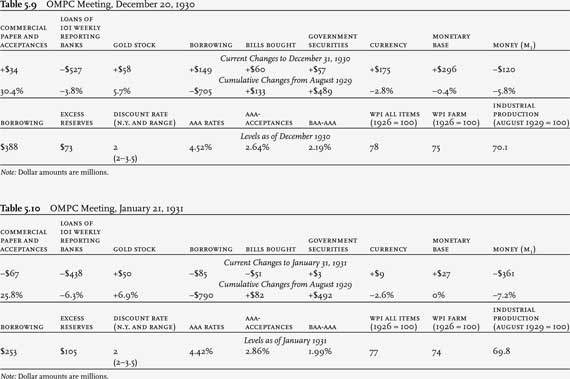
The rise in excess reserves could have been a signal to the members of the Open Market Policy Conference or to their staffs. In their analysis, excess reserves were small and approximately constant, so the relatively large increase from December to January was inconsistent with the Riefler-Burgess framework. Miller was aware of the inconsistency. He asked why the banks were acquiring surplus reserves and how widespread the practice had become. Harrison replied that excess reserves were most likely a sign of lack of demand by borrowers and of banks’ reluctance to use funds; McDougal and Young replied that most of the banks in Chicago and Boston did not have surplus reserves but that the banks were “very liquid.” Miller pressed his point, suggesting that the “banking system might be suffering just now from excessive caution and excessive desire for liquidity.” Harrison replied that “that was one reason why our easy money policy [sic] has not proved more effective.” No one suggested that the excess reserves could be eliminated by an aggressive policy of monetary expansion or that the banks’ “desire for liquidity” should be satisfied by the System.55
Although borrowing was only $250 million, the main discussion at the meeting was not, as in September, about whether there should be sales but about how much should be sold. McDougal suggested they sell $100 million; George Seay (Richmond) suggested they sell $200 million; Harrison reported that the directors at New York wanted to sell $35 million.56 Only Meyer suggested that sales might be interpreted as a change to a more restrictive policy. And Meyer added, “The Reserve System has been accused in a number of quarters of pursuing a deflationary policy in the past year.” In the end, the governors did not decide on the amount to be sold, but they agreed unanimously that it “would be desirable to dispose of some of the System holdings of government securities.”
The tone of the minutes was more pessimistic than it had been at previous meetings. For the first time there was a lengthy discussion of gold, but the problem was an inflow, not an outflow. Harrison had returned from Europe in December. He reported that the European countries were planning to reduce imports from the United States because they could not afford to pay $600 million in gold each year. Britain, Germany, and Italy had experienced a decline in gold reserves during 1930. With the decline in exports, these countries reduced borrowing. The Smoot-Hawley Tariff had added to the decline in world trade and particularly to reduced exports and imports by the United States.
International cooperation continued. The New York bank purchased sterling bills during the fall because of the “weakness in sterling.” Harrison added that in December he had “been urged from many quarters to make a reassuring statement which might aid in quieting the banking situation,” but he had declined to do so for fear it might be contradicted by any small bank failure that occurred. McDougal noted that the recent reduction of the discount rate at Chicago had been made without any belief that it would encourage business activity.
Despite these gloomy prospects, the meeting had no recommendation or even discussion of expansive Federal Reserve action. All the members believed that policy was easy. There was only one type of evidence to support this belief at the time. Between December and January, member bank borrowing had declined and short-term interest rates had fallen to the lowest point recorded up to that time. To the governors of the Federal Reserve System, nothing was more indicative of the direction of policy and its effect.
Again, an alternative view was presented and rejected. W. Randolph Burgess told the New York directors at their meeting on January 15 that selling securities meant reversing current policy and suggested that they delay the change. Two of the directors recommended that Harrison continue the “easy money policy,” but they were unable to persuade him that selling securities would have an adverse effect. However, when the sale of only $20 million was followed by a much larger decline of excess reserves, sales were suspended.
A week later, Burgess reported to the directors that Harrison suggested resumption of selling, but “a majority of the Officers Council was of the opinion that it would be better to defer further sales.” One of the directors again urged a policy of expansion; as a compromise, they postponed further sales.
Between the end of January and the end of April, the risk spread on long-term bonds increased by 0.875 percent, but excess reserves declined and the index of industrial production rose by almost two percentage points. The minutes note the rise as early as the February 26 meeting of the New York directors.
The Federal Reserve never discussed using monetary policy to support the modest recovery. On March 5, Harrison advised “maintaining the status quo,” which at the time meant no change in the discount rate, in the buying rate on acceptances, or in open market policy. Meyer, who was present, agreed that it was unwise to take any small steps that might be interpreted as a change in policy when none was intended.
Nor did the rise in industrial production receive much attention at the OMPC meeting. The committee focused on three changes in the data for the monetary system—the continued gold inflow, the decline in the System’s acceptances, and the decline in member bank excess reserves.57 At the time of the meeting, the gold stock had increased nearly 5 percent since the previous August, and the rate of increase had quickened during the winter.
The governors were concerned because the gold imports were not having “their normal and natural effect on the loans and investments of member banks.” The banks were bidding for acceptances in the market and were offering a higher price (lower yield) than the System. There is no mention of the System’s open market sales. Table 5.11 shows that, between January and April, the expansive effect of a gold inflow was balanced by a reduction in acceptances (bills bought) and open market sales of government securities. Despite the increase in currency, the base fell as the banks reduced their discounts. The money stock continued to fall.
Harrison’s report to the Governors Conference argued again that recovery would not occur without an increase in borrowing by foreigners. His analysis of the monetary situation at this meeting differed substantially from those he had offered previously. He noted that the Federal Reserve’s policy between October 1929 and August 1930 had not provided a “vigorous stimulant” to the market and that, although recently “money rates have been at very low levels, there has not been over a period of months any consistent surplus of Federal Reserve funds pressing for use upon the market” (Governors Conference, April 23, 1931).
Friedman and Schwartz (1963, 378) interpret this passage as evidence that Harrison’s understanding of the effects of open market operations was superior to that of the other governors and as an indication that he was not bemused by the decline in short-term market interest rates. There is at best a tenuous basis for this interpretation. The statement probably refers to the failure of long-term interest rates to decline. First, Harrison’s analysis at most of the previous meetings—and particularly at the meeting in September 1930—differed little from the analyses offered by most of the other governors. Second, he did not press for large-scale open market purchases at the time of his statement but argued for open market purchases only if necessary and as a last resort. Third, between April and June he did not use existing authority to purchase securities, despite a renewal of the currency drain and a new wave of bank failures. Fourth, the proposal to purchase appears to have originated with Meyer and Miller. Both had come to the April 23 meeting of the New York directors and had argued for a change in policy. Miller said that a reduction in interest rates in New York would force a redistribution of reserves between New York and the rest of the country, thereby lowering rates generally. Meyer made a more forceful statement urging the bank to reduce rates “no matter how low rates already seem to be.” To the standard plaint that rates were “very low,” Meyer replied, “The whole history of investment showed that money would go from short-term into long-term channels at a price. The problem is to find the price.” Harrison expressed a supporting view only after Meyer’s strong statement and, characteristically, favored a cautious policy of reducing the buying rate on acceptances by 0.125 percent and observing its effect.58
Harrison had no difficulty obtaining approval for the proposed purchases. Because of the gold inflow, several governors spoke in favor of expansion. Governor Fancher stated that the “System can lend its efforts to make money so cheap as to put it to work.” Governor Talley said that he still had “confidence that gold will finally express itself in an expansion of bank credit” and that Harrison’s program would help to bring this about. Even McDougal supported the motion to purchase up to $100 million in the open market.
Why could the governors agree to purchase bills and securities at this meeting when they had been unwilling to consider purchases at earlier meetings? The minutes furnish a very clear and simple answer. The gold inflow was a “real” force that should have the effect of lowering market interest rates. Since the expected effect had not occurred, most of the governors were willing to help bring it about. Harrison summarized the widely shared belief. If the banks could be discouraged from acquiring acceptances from the System, they would make loans or acquire securities in the market and thus expand bank credit. Like the others, he regarded an expansion of bank credit and a reduction of interest rates as a “natural” response to the gold inflow, with different consequences than a reduction of interest rates brought about solely by open market purchases. Under gold standard rules, countries were expected to allow interest rates to fall and to encourage expansion in response to gold inflows. To do otherwise was a violation of the accepted rules.
Early in May, New York reduced the buying rate on acceptances, and during the month ten of the twelve reserve banks reduced their discount rates. The Philadelphia and Chicago banks, which had been most strongly opposed to expansive actions or to further reductions in interest rates, were among the first to approve reductions. Nevertheless, member bank borrowing remained virtually unchanged throughout May; the market’s acceptance rate fell below the Federal Reserve’s buying rate, and the System’s holdings of acceptances continued to decline. Although the gold inflow continued, the executive committee did not meet to discuss open market purchases until late in June.
One puzzling aspect of the discussion that took place during the spring concerns the relation of the currency drain, the deposit rates, and bank failures. The New York directors discussed several proposals aimed at reducing the interest rates New York banks paid on deposits. Most agreed on the desirability of reducing deposit rates, but there is no indication in the minutes that the probable reason the New York banks maintained deposit rates was to hold deposits in the face of a renewed wave of bank failures and a renewed currency drain. Nor is there evidence that the directors saw the relation between the public’s rising demand for currency, bank failures, and the growing spread between higher- and lower-quality bonds. By May, yields on Baa bonds were much higher than they had been at the peak of the expansion in August 1929, whereas Aaa yields were lower. Throughout the winter the two yields had moved in opposite directions until they differed by 2.78 percent (table 5.11).
At their March 5 meeting the New York directors considered the increased number of bank failures. Many banks had been forced to close because the decline in the market value of their bond portfolios made them insolvent. Among the proposals made to reduce or prevent failures, none involved open market purchases or monetary expansion.
From April to June $230 million in gold flowed into the Federal Reserve banks. Half of the increase in the base produced by the rise in gold holdings was taken as currency. Borrowing increased and excess reserves of member banks rose by $73 million. The rising demand for currency by the public had a contractive effect, so the money stock declined. The rise in currency holdings and in excess reserves are related. Both reflect the increased number of bank failures during the period.

Interest rate changes also show the effect of the currency drain and the series of bank failures during the period. Rates on short-term securities fell to the lowest levels of the contraction. The rate on prime banker’s acceptances reached a level (0.88 percent) more than four percentage points below the rate prevailing at the NBER peak in August 1929. Yields on bonds rated less than Aaa continued to show the relatively large risk premiums that first appeared in the April 1931 data.59
Despite the decline in nominal rates on short-term loans, real rates continued to rise. Wholesale prices had fallen at an annualized rate of nearly 25 percent in two months and a 20 percent annual rate since the start of the year. Farm prices had fallen faster. In response to the high real rates and the declining economy, bank lending fell at an annualized 20 percent rate in the first six months of 1931.
At the June meeting, members of the executive committee commented on the changes that had occurred since the previous meeting. Harrison referred to the currency withdrawals, and several governors referred to the “banking situation.” Governor Meyer reported that the Board’s staff estimated that from $300 million to $375 million of currency “was now hoarded.”60 Moreover, none of the governors disagreed with Harrison’s appraisal of the economic situation or with his judgment that the prospects for a revival were now poorer than they had been only a few weeks before.
A new element was the “threat of a general moratorium and a possible breakdown of capitalism in Europe,” a reference to the series of coups in Eastern Europe and the rise of the Nazi Party in Germany.61 There was also a possible moratorium on payments by some South American countries. These comments, and other more explicit statements, show that the governors recognized that the gold inflows were not solely the result of short-term capital movements in response to interest rate differences but were indications of a flight of capital from foreign countries and signs of a possible breakdown in the international payments mechanism.62
Harrison proposed purchases up to $50 million to his directors on June 18, hoping that lower interest rates would slow the gold inflow.63 During May and the first half of June, the United States received $170 million in gold, with more on the way. The directors agreed that the gold inflow had not been put to work. They differed over whether additional purchases would help, but they voted their support.
When the OMPC executive committee met in June, governors were divided about the action to be taken. Neither Black nor Meyer was a member of the executive committee, but both were present at the meeting and advocated purchases in the strongest terms. Meyer stated that the Board would be sympathetic to the purchase of governments and added that he personally favored a larger program than the $50 million Harrison proposed. Black regarded the purchase program as a “logical continuation of the affirmative policy” adopted at the April meeting. Harrison took an intermediate position. Although he had proposed the program of purchases and supported it at the meeting, he was doubtful about buying governments unless there was at least an informal understanding with the principal member banks concerning “the employment of excess reserves.” He hoped the banks would place bids for lower-quality bonds to prevent price quotations from falling.64 Talley supported Harrison’s proposal in the hope that the banks would be encouraged to “use their funds courageously.” Mc-Dougal, Norris, and Young believed that money was easy and that further purchases would make it even easier. All three agreed that something should be done in support of the president’s proposal for a one-year moratorium on reparations and intergovernment repayments of debt and interest. They did not believe further reductions in interest rates would accomplish much. McDougal voted to support the purchases because he believed positive action would have a beneficial effect on the public’s state of mind. Norris abstained, and Young (Boston) opposed the purchase program because he “believed that (gold) sterilization had been and was natural and inevitable under the operation of the Federal Reserve System” (Open Market Policy Conference, Board of Governors File, June 22, 1931).
On the same day, the New York directors agreed to make advances to the central banks of Hungary and Germany as part of an international central bank consortium. New York provided $2 million of the $10 million loan to Hungary and $25 million of the $100 million loan to the Reichsbank. Late in May and again in June, New York agreed to participate in two $14 million credits to the Credit Anstalt, a private Austrian bank with large foreign liabilities, and lent $1.08 million to the Austrian National Bank. The loans were less than 10 percent of Germany’s short-term liabilities. The assistance proved insufficient to stem the flight of capital from any of the countries for more than a few days or weeks or to prevent these countries, and later the British, from suspending convertibility.65
Although Eichengreen (1992) repeats the argument that international cooperation failed, there is a remarkable difference between the flurry of activity set off by the foreign exchange crisis and the continuing failure to respond to the domestic crisis.66 Harrison was willing to risk having some of the New York bank’s assets “frozen” in Central Europe to maintain the prevailing exchange rates and the gold exchange standard, but he had been unwilling to offer assistance to prevent bank failures at home (Harrison Papers, Conversation with Meyer, June 23, 1931). In the fall he refused to offer rediscounts to banks that were willing to participate in a lending pool designed to prevent the spread of domestic bank failures. The difference was not ignored at the time. One of the directors questioned Harrison about the difference in approach to domestic and international crises, but there is no record of an explicit reply (Harrison Papers, Meeting of the Executive Committee, June 22, 1931).
The contrast between domestic and international policy was particularly sharp during the summer. Although the executive committee of the OMPC approved purchases of up to $50 million on July 6, the System purchased only $30 million. Harrison favored delaying further purchases, at first because the international monetary system had deteriorated and he believed the timing was poor, later because the banks held excess reserves. Although he fully discussed the rising rate of failure and insolvency among New York banks, he never mentioned the relation between rising excess reserves and rising failure rates. He believed that open market purchases would be useful only if the banks acquiring reserves used them to acquire lower-quality bonds, and he attributed the increased bank insolvency to bad management and more careful examination.67 He favored open market purchases to relieve a sudden change in pressure on the New York money market only after the Bank of France withdrew $50 million from the money market and only to the amount of $50 million (Harrison Papers, Open Market II, August 10, 1931).
The decision to purchase $50 million, made at the June meeting of the executive committee, went into effect at once. The System made additional purchases of $30 million after Harrison conferred with other members of the executive committee. In July excess reserves stopped rising, and member bank borrowing declined. Both long- and short-term interest rates fell during the month. By the usual money market indicators, the money market was easier during July than in June, and no purchases were made between July 8 and early August.
Harrison told his directors that Meyer wanted to make additional purchases. Harrison opposed because the System was likely to extend additional credit to foreigners. He favored waiting (Minutes, New York Directors, July 23, 1931). The following week the directors approved purchase of $125 million of prime commercial bills, endorsed or guaranteed by the Bank of England, for three months.68
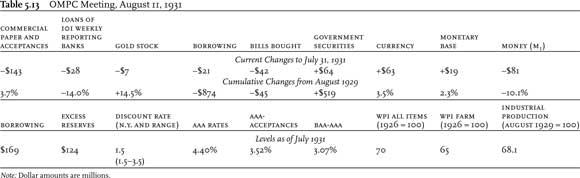
Purchases resumed early in August. Harrison explained the August purchases by first noting that the banks in New York had held excess reserves of $60 million to $80 million during the past two months: “In the past few days, due to currency withdrawals and the action of the Bank of France in allowing Treasury bills and bankers bills to run off, this excess had been wiped out and the banks had been obliged to borrow at the Reserve bank from $40 to $80 million.... In view of this sudden and unusual change, and to avoid a disturbance to the money situation, the New York Reserve Bank had made purchases on August 10 and 11, for its own account, of $50 million of government securities.”69
The Open Market Policy Conference held a lengthy discussion of open market policy. Harrison described the economic situation and talked of the prospect of economic, social, and political upheavals and of the high rate of unemployment expected in the winter. He introduced a motion to authorize the executive committee to buy up to $300 million “when they thought it was necessary,” but he indicated that the time for purchases had not yet come because “the attitude of the banks and the investors was such that funds thus made available” would be held idle. Authority to purchase up to the larger amount was necessary he thought, because of the currency drains and the recent action of the Bank of France.70 Calkins introduced an amendment reducing the authorization to $120 million, an amount equal to the estimated autumn seasonal. Harrison and Young (Boston) opposed the amendment, the latter because he opposed further purchases. The amended motion passed, Governor Young dissenting.
A preliminary memorandum prepared for the meeting explained that in the typical seasonal pattern currency reached a low point near the end of July. The memo noted that the increase in currency during the autumn months would be superimposed on the estimated hoarding, $500 million in currency, and that there would be further increases in the demand for currency. Harrison, Meyer, and Black wanted authority to offset the currency drain and the seasonal movement if it developed. The other governors raised two related arguments, both of which were answered to no avail.
Governor Calkins argued that not all the reserve banks could participate in the purchase program, hence not all would benefit from the higher earnings if the System undertook large-scale purchases. Gold holdings were not distributed in the same proportion as the liabilities of the System, so not every bank had reserves to cover its share of the additional deposits and currency. The second argument was about the System’s volume of “free gold.” Governor Meyer presented a detailed analysis showing over $800 million of “free gold” was available and that the key problem was not gold but currency hoarding and bank failures.71
Once again the Board favored a more expansive policy than the Governors Conference. Meyer and other Board members expressed disappointment at the small volume of purchases authorized and urged the members to undertake an effective program of purchases. This discussion was in vain. Money market pressures did not increase during the month, the System’s holdings of acceptances increased slightly, and the inflow of gold slowed. Despite the continued increase in currency held by the public, the System did not use its authority to purchase securities.
Although Harrison argued for a more expansive policy than the OMPC approved, he made it clear that he did not plan to put the purchase program into effect even if approved. His argument for standby authority is very similar to the statements he made in his discussion with Governor Miller of the Board almost a year earlier. A program of purchases would not be effective, in his view, if it added to the excess reserves of the member banks. He did not see any prospect that reserves would be used to purchase securities or to expand credit, and he did not urge the executive committee to make the limited volume of purchases that the OMPC authorized.
Friedman and Schwartz gave considerable attention to this meeting. On their interpretation, Harrison desired a more expansive policy but was unable to convince the other members to support his position and therefore failed to carry out the expansive policy that Governor Strong would have followed had he lived. In fact, Governor Meyer made the case for expansion.72 Harrison’s statements at the meeting and his actions during the summer show little interest in an expansive policy. He told the other governors that he did not intend to undertake large-scale purchases based on the increased authority to purchase; he desired standby authority to offset the effect of larger than usual demands for currency and renewed gold flows that he expected because of the weakened position of many of the banks and the repeated crises in the markets for foreign currencies.
When Harrison discussed the OMPC report with the New York directors on August 20, he complained only about procedure. The Board and the OMPC had agreed to a procedure under which the Board approved a general program proposed by the governors, and the executive committee of the Governors Conference decided on the timing and amount of purchases or sales. This time the Board had not approved the program but had delegated to Governor Meyer the right to approve purchases (but not sales) recommended by the executive committee. Meyer was present in New York and replied that the OMPC had not presented a program. The Board would have approved a “real program” of purchases but was opposed to sales and did not approve the OMPC report because it permitted the executive committee to buy or sell at its own discretion without limit as to time. Harrison’s complaints about the difficulty of obtaining the agreement of the other governors seem hollow in view of his failure to carry out or even recommend a regular program of monetary expansion.
Why did Harrison fail to press for purchases under the August decision? He told the executive committee of his directors on September 1 that he expected the seasonal requirements for credit to be small, but he anticipated a continued demand for currency. In keeping with Riefler-Burgess doctrine, he saw no advantage in making purchases unless an expansion of member bank credit would result; he had discussed the matter with bankers, and they indicated that any increase in excess reserves would remain idle. There would be no increase in real bills, hence no reason to provide reserves.
In fact, Federal Reserve credit increased $200 million during August as banks sold bills to obtain currency. Harrison at first favored purchases to offset any increase in market rates, but after listening to several directors argue that higher rates might be interpreted as a sign of recovery, he concluded—inconsistently—that “no action should be taken ... to prevent such a seasonal firming of money rates.”
At the next two directors’ meetings, attention shifted to the prospects for selling the $50 million in securities that the New York bank had acquired early in August. Both Harrison and Meyer opposed the sale, fearing misinterpretation of any move toward tightness. Meyer added, “The opinion was being expressed by substantial people that the System had not taken sufficiently aggressive action to maintain the volume of credit as a support for the commodity price level,” an indication of congressional attention that introduced a new element, fear of “inflationary legislation,” into the Federal Reserve’s discussions during the winter of 1932.
FROM THE BRITISH DEVALUATION TO THE BANKING HOLIDAY
Two years had passed since the cyclical peak, but the end of the decline was not in sight. Two events were about to happen that permanently changed beliefs and attitudes. First came the British decision to leave the gold standard. In less than two years, most gold standard countries followed.73 In retrospect, these decisions led a majority of the public, economists, and eventually central bankers to reconsider the alleged virtues of the gold standard, by first questioning the gold exchange standard and later the gold standard in its various forms.
Second, in many countries, including the United States, government took more responsibility for managing the economy through regulation and controls. In the United States the first steps came within a few weeks of the British devaluation. Concerned about a renewed wave of bank failures, President Hoover pressed for the formation of a public-private partnership, the National Credit Corporation, to support the banks by supporting the bond market. This was a forerunner of the Reconstruction Finance Corporation.
Britain Leaves the Gold Standard
Britain had remained on the gold standard for most of the preceding two hundred years. The Bank of England had suspended specie payments in crises but had always returned to convertibility at the former gold price. After the Napoleonic Wars and again after World War I, the government and the bank engineered socially costly deflations to restore gold parity. The decision to suspend gold payments and allow the pound to float was therefore a climactic event for Britain and, given Britain’s important international role in lending and borrowing, a major event for the world economy.
Conventional opinion at the time criticized the government and the bank for offering only a weak defense. Bank rate had remained at 4.5 percent. In many previous crises the bank had raised the discount rate to 10 percent to attract gold.74 Many of these comments reflected the prevailing orthodoxy—suspension was evidence of failure to follow proper policies. The freedom to end deflation, gained by suspension, represented the choice of inflation over sound, proper policies.75
Although the Bank of England did not raise its discount rate, Britain had not been idle. The British announcement on September 20 came after six months of recurrent payments difficulties that started in Austria and Hungary, then shifted to Germany and later to London. Resort to exchange controls and blocked balances on the Continent increased the magnitude of the problem confronting the Bank of England by freezing British balances abroad.
During the two months from July 23 to September 19, Britain paid out $972 million of reserves. To finance the reserve loss, the Bank of England borrowed $650 million in New York and Paris during July and September. The Federal Reserve, with the approval of the Board, agreed to lend $125 million on July 30, and the Bank of France lent a similar amount. Throughout August and into September, Harrison negotiated with the Bank of France and acted as intermediary for the Bank of England with the New York bankers to find a set of terms for a one-year private loan (Clarke 1967, 201–8).
The Federal Reserve’s assistance to the Bank of England and its earlier assistance to the Austrian, German, and Hungarian central banks showed an ability to respond promptly to events it understood.76 Treasury Secretary Andrew Mellon, who served ex officio as chairman of the Federal Reserve, at first opposed aid to European banks, but he changed his views as the crisis spread from Austria and Hungary to Germany (Todd 1994, 8). Perhaps as a result, policy toward international and domestic troubled banks differed markedly. Harrison and other central bankers lent money to support Credit Anstalt, a private Austrian bank. Under the leadership of Gates McGarrah, a former chairman of the New York bank who had become president of the Bank for International Settlements, central banks in June had made available a second $14 million credit to the Austrian National Bank contingent on an agreement by the Austrian government to negotiate a $21 million, two- to three-year foreign loan to strengthen the position of Credit Anstalt. Yet the Federal Reserve was unwilling to take any new steps to prevent the failure of United States banks.
The Federal Reserve’s first response to the international monetary crisis was to raise the buying rate on acceptances to 1.25 percent on September 25 and to purchase $14 million in the open market. On October 8 the New York directors approved an increase in the discount rate of 1 percent (to 2.5 percent).77
Harrison gave two reasons. First was the gold export. Second was his conversation with Governor Clement Moret of the Bank of France. Moret complained that rates were too low; this contributed to a lack of confidence.78 Harrison explicitly dismissed a shortage of “free gold,” the argument subsequently used by Federal Reserve officials to explain policy inaction. He “pointed out that the amount of free gold held by the System had not been materially affected by the recent loss of gold, so that there was still considerable leeway for purchases of Government securities (Discount Rate Advance, Minutes, New York Directors, October 8, 1931). A week later the bank set the rate at 3.5 percent and the System sold the purchased securities.79 Before the second increase, New York’s rate had been the lowest in the System. Once New York put its rate at 3.5 percent, the other reserve banks followed. Table 5.14 shows some of the principal money market changes during the period.
The Federal Reserve responded to the gold outflow by increasing interest rates. It ignored the currency drain and the banking failures. Again, a main reason for the difference is that the gold stock fell, market interest rates rose, and the money market indicators the governors relied on revealed the changes accompanying the gold and currency movements. As table 5.14 shows and as Harrison’s comment made clear, market interest rates rose slowly at first. Not until late October did the market rate on banker’s acceptances rise above the posted acceptance rate. The increase in the market rate forced the System to buy bills or raise its buying rate.
Start of the Reconstruction Finance Corporation
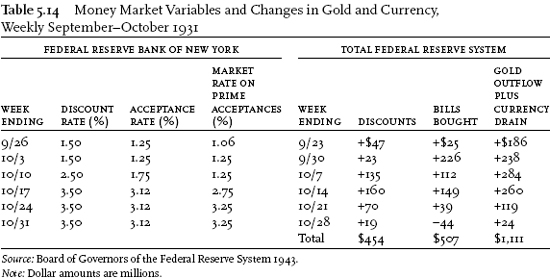
Alarmed by spreading failures and continued declines, President Hoover called a meeting of nineteen bankers at Secretary Mellon’s apartment in Washington on October 4 to discuss steps that might be taken to prevent bank failures. A memo read at the meeting noted that 1,215 banks with $967 million in deposits had failed in the first nine months of the year, most of them during the summer. The memo interpreted these and other data on currency hoarding and bank failures as showing that bankers and the public had lost confidence in the banking system. Then Hoover’s memo continued: “Prior to the establishment of the Federal Reserve Bank System, it [the banks’ demand for liquidity] would probably have been met through the relationship between the banks in the principal centers and their out of town correspondents, but, with the establishment of the Federal Reserve System, there grew up a tendency to feel that it was to the Federal Reserve System rather than to the banks in central reserve cities that all other banks should look” (Harrison Papers, Miscellaneous Letters and Reports). President Hoover then proposed a central organization, the National Credit Corporation (NCC), to rediscount assets not legally eligible for discount at the Federal Reserve banks and purchase marketable assets of insolvent banks.80 To provide capital, commercial banks would subscribe $500 million. The corporation would have the power to borrow an additional $1 billion.
The New York clearinghouse bankers agreed on the following day to subscribe $150 million of the $500 million. Harrison notified the president on October 7 that “there was quite general and enthusiastic support throughout New York for your proposal, not merely to the formation of a $500 million corporation but also to the enlargement of the rediscount facilities of the Reserve System.” Support in the Federal Reserve was more restrained. Harrison’s report on Hoover’s proposal to the executive committee of his directors on October 5 mentions his own proposal to increase the market value of railroad bonds by raising railroad freight rates or reducing railroad wages but does not record his opposition to broader lending powers for Federal Reserve banks. However, he had made his opposition to such proposals clear on October 1, and at an October 26 meeting he firmly opposed any plan that allowed Federal Reserve banks to acquire assets that were not self-liquidating (Harrison Papers, Miscellaneous Letters and Reports, October 5, 1931). The NCC was organized without a Federal Reserve commitment.81
Hoover proposed the NCC as a temporary measure during the emergency.82 Once Congress reconvened in December, he intended to ask it to broaden the powers of the Federal Reserve to discount paper secured by government securities (Hoover 1952, 84–88). In January Congress passed the Reconstruction Finance Corporation Act, and in February it extended Federal Reserve powers to discount in the first Glass-Steagall Act.83 The Treasury provided $500 million as capital for the Reconstruction Finance Corporation. The RFC could borrow $1.5 billion either from the Treasury or from private sources. In July 1932 Congress increased the borrowing line to $3 billion.
Return to Inaction
Monetary and economic conditions deteriorated considerably between the July OMPC meeting and the executive committee meeting on October 26 (table 5.15). Industrial production fell 12 percent, the index of stock prices more than 25 percent. Bank loans and money also fell by $1 billion. The risk spread was one percentage point higher than in July as bank failures and the currency drain returned.
In the five weeks following the British suspension, new member bank borrowing offset 85 percent of the direct effect of the gold outflow. Although the OMPC had approved purchases of up to $120 million, Harrison saw no reason to undertake any large volume of purchases, and none was made. McDougal, supported by a telegram from Calkins, favored sales.
The preliminary memorandum prepared for the October 26 meeting and the minutes of the meeting pay far less attention to the British decision than to the renewed bank failures and currency “hoarding.” Harrison noted that four hundred banks closed during the first three weeks of October. Banking problems are described as “the most important” problems facing the System, and the preliminary memorandum suggested that all actions be considered in terms of their effect on bank failures.84
What action was appropriate? The consensus of the meeting was that “everything should be done to persuade the (city) banks to adopt a liberal policy” of lending to banks in difficulty and rediscounting at the Federal Reserve banks. Despite the references to bank failures in the minutes, the Federal Reserve gave less assistance to the banking system than it had arranged for the Bank of England. Nor did it contribute the type of support for the commercial banks that it and other central bankers had urged the Austrian government to give to Credit Anstalt.

Within a month, the Federal Reserve allowed acceptances to run off. The preliminary memorandum prepared for the November meeting conveyed the sense of satisfaction about the System’s response to the “largest gold export… and a heavy domestic withdrawal of currency continuing a movement of almost a year’s duration.” The memorandum described the response as “classic” and, to reinforce the point, quoted heavily from Bagehot. By lending freely at an increased discount rate, the System had followed Bagehot’s advice for central banks confronting a crisis. The preliminary memorandum referred to the fact that Federal Reserve credit had expanded by $1 billion during the weeks of the crisis. The maximum amount outstanding, more than $2 billion in the week ending October 14, was the largest total in more than ten years, and the rate of increase— doubling in less than two months—was the largest change in Federal Reserve credit in any two-month period up to that time. Bank failures and currency movements received little attention.
The immediate crisis had passed without reliance on open market purchases, and the governors expressed little interest in a purchase program during the following months. Miller’s suggestion that they start a bold program received very little support. The data on member bank borrowing show that at last an increase in real bills could be used to justify open market purchases. Harrison argued for delay, although he recognized that the volume of borrowing had increased substantially and expected the New York banks to borrow heavily during December. Others saw no reason to keep New York and Chicago banks out of debt.
The OMPC gave the executive committee authority to purchase up to $200 million in securities during December to be sold after the start of the year. Clearly intended as a seasonal adjustment, the authority was used in precisely that way. The weekly figures show changes ranging from +$200 million to −$150 million during December and early January and a net increase of less than $50 million during the month.
Why was the increased borrowing ignored? Harrison made his position clear at meetings with his directors in November and December. His first argument opposed purchases because the gold flow had reversed. Gold had come into the country during November, but the reduction in Federal Reserve credit exceeded the gain in gold mainly because acceptances had run off and had not been replaced. This showed “disinclination on the part of member banks to use Federal Reserve credit for the purpose of extending credit to their customers.” Several of the directors urged purchases; Owen Young pointed out that it was the end of the year and a “bad time to impose any further load of indebtedness on member banks.” Harrison dismissed this argument, and when Young persisted in urging purchases, Harrison offered a whole catalog of arguments purporting to show that the purchases would be badly timed and would do no good.
A month later, on December 24, Harrison showed the directors a chart of the relation between bank credit, business activity, and the price level. Based on past relations, he predicted a further deflation and “commented on the serious aspects of any further deflation of prices.” Still, he urged no purchases because of the “present free gold position and the potential demands which may be made on us at home and abroad.” Some of the directors pointed out that the New York City bankers were almost unanimous in opposing purchases. After a brief discussion, the directors agreed to wait until after the first of the year and to observe the progress of the bill to replace the privately financed National Credit Corporation with a publicly financed Reconstruction Finance Corporation (RFC).
Again, Harrison’s discussion shows that he knew the crisis had deepened. He referred to the decline in bank credit as the largest in the history of the country and reported that his staff had estimated its size at $5 billion in the first two years of contraction. Further, he noted that the rate of decline had increased during the fall.85 He was aware, also, that the effect of a further decline would be a further contraction in business activity and further deflation, and he discussed these problems with his directors. Moreover, he had received a confidential memo in early December showing the position of the banks in the New York Federal Reserve district (Harrison Papers, Memoranda, December 24, 1931). Table 5.17, taken from the memo, points up that he knew, in considerable detail, how much the position of the banking system had deteriorated between November and the first week of December. However, yields on lower-rated bonds increased during the autumn, as shown by the yield spread in table 5.16. The estimated “shrinkage” of capital funds in table 5.17 is the amount the banks lost mainly as a result of the decline in the market value of their bond portfolios. The memo notes that 300 of the approximately 800 banks had losses nearly equal to their capital funds and that an additional 150 to 200 had some capital impairment. The table included all banks in the New York district except 23 money market banks.
On January 4, Harrison again discussed purchases with his directors. He believed the time had come for the Federal Reserve to consider substantial purchases of government bonds: “His only hesitation in recommending such a program... [was] ... the relatively small amount of‘free gold’” (Minutes, New York Directors, January 4, 1932).86 Congress was considering legislation that would permit the Federal Reserve to pledge all of its assets as collateral for the note issue. Once the legislation passed, it would be able to supplement the legislative program by taking action in the open market.
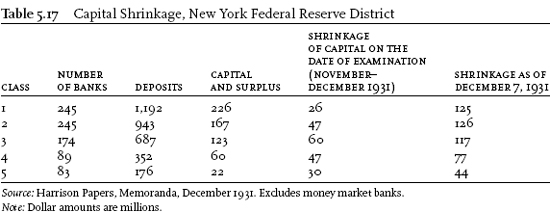
One of the directors (Clarence M. Woolley) asked Harrison whether there was nothing that so great an organization could do to stem the tide of disaster. He was not satisfied with the usual answer that the banks would not make use of the reserves created by the purchase of government securities. Harrison pointed to the “free gold” position. “We must,” said Harrison, “be on relatively safe ground before we embark on a program of government security purchases, which is not the case at the moment when banks are failing by the score, the renewal of currency hoarding is a probability, and substantial gold withdrawals by foreign holders of dollars are quite possible.”
The directors did not accept Harrison’s answer. But Harrison held firm and urged delay so that actions could be synchronized with the passage of Reconstruction Finance Corporation legislation (passed at the end of January), the (downward) adjustment of railroad wages, and other pending changes. Then they could reduce the discount rate to encourage borrowing and begin open market operations.
Delay during the fall allowed a large part of the banking system to fail. In two months, September and October 1931, the deposits of suspended banks rose to $705 million, as much as in the entire year 1932 yet to come. Nearly 30 percent of the bank suspensions between August 1929 and February 1933 came in the last four months of 1931.
Member bank borrowing had fallen at the time of the January meeting from the seasonal peak at the end of December, and short-term open market rates had fallen also. As borrowing fell, the Federal Reserve sold some of the securities acquired in December. The amount of borrowed reserves and market rates on both short- and long-term securities remained high relative to the recent past. The money stock continued to decline, reflecting the additional increase in demand for currency and the contractive policy of the Federal Reserve.
In the six months between June and December 1931, the money stock fell about 6 percent and industrial production about 14 percent. The risk premium on bonds rose nearly four percentage points above their level at the peak of the expansion in 1929, and even rates on Aaa bonds were above the August 1929 level. With wholesale prices 11 percent below the December 1930 level, real yields on Baa bonds were above 20 percent. The risk spread was above five percentage points.
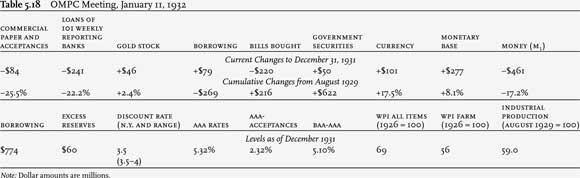
The gold outflow stopped in November and reversed in December. The Open Market Policy Conference decided that the time had come for a reduction in bill rates and in discount rates. Much of the discussion at the meeting concerned the government’s budget and the desirability of a balanced budget as a means of reducing pressure on market interest rates. The members apparently continued to favor a reduction in member bank borrowing brought about by a continuation of gold inflows. They hoped the currency drain would reverse.
Despite his statements at the directors’ meetings earlier in the month, Harrison neither urged open market purchases on the other governors nor advocated any other expansive action. Nor did he urge the directors to reduce the discount rate when he returned to New York. When two of the directors, Clarence M. Woolley and Theodore F. Whitmarsh, pressed for immediate action at the January 14 meeting, Harrison advocated caution and delay. Again, on January 21, Whitmarsh urged Harrison to reduce the discount rate, and again Harrison urged delay and caution. The following week Owen Young joined Whitmarsh and Woolley in urging Harrison to take some expansive action, but Harrison pointed to the “free gold” position as a reason for delay. Young was not deterred and pressed Harrison to purchase $50 million while maintaining the discount rate unchanged to stem any outflow of gold. The only concessions Harrison made were an agreement that purchases would be considered in an emergency and that a change in the discount rate would be reconsidered the following week. At the next meeting, February 4, the gold outflow had stopped temporarily, and the “foreign situation” was no longer an excuse for inaction. Harrison now cited a “bad banking situation on the Pacific Coast” as a reason for delaying any decision to reduce the discount rate.
At each weekly meeting with his directors, Harrison urged delay. Before Congress passed the RFC legislation, he argued for an expansive program to accompany congressional approval of the RFC. Later he wanted to wait for the Glass-Steagall Act, or similar legislation removing the restrictions on the assets eligible for discount and the use of government securities as collateral for the note issue. Once such legislation appeared likely to pass, he favored delay because the proposed legislation might alarm foreigners. When Owen Young pointed out that Harrison had offered a variety of reasons for postponing action and urged an end to the “ruinous” decline in bank credit, Harrison modified his position and agreed that, once the Glass-Steagall Act passed, they could both reduce the discount rate and buy government securities.
Free Gold
One of the reasons given for delay was that the System either lacked free gold or was at risk of doing so.87 The Board made this argument in its 1932 annual report, and Goldenweiser (1951), Thomas (1941), Burgess (1964), and other Federal Reserve officials used the argument later to explain delay and inaction.88 As noted earlier, Eichengreen (1992) accepted the System’s argument, but Friedman and Schwartz (1963) rejected it. The next two sections present the case for and against the importance of free gold as a reason for delaying open market purchases.
THE CASE FOR FREE GOLD Harrison cited the free gold position several times in the four months between the British suspension and the passage in February 1932 of the Glass-Steagall Act, removing the free gold problem. Most of these citations are in months with relatively large gold outflows, October 1931 and January 1932.89 Taken alone, these statements support the Federal Reserve’s explanation of its inaction.
With the benefit of hindsight, Harrison rejected the argument he made at the time. A year later he told Gates McGarrah that when the Glass-Steagall Act passed, the System “had around $350 million of excess gold; that even if there had been a further drain, the $350 million did not represent the maximum of our capacity to export gold since additional borrowings would have been forced upon the banks which would have given us additional collateral which would have released gold”90 (Harrison Papers, Confidential Files, Telephone Conversation with Mr. McGarrah, October 10, 1932).
To reconcile these contradictory statements, note that Harrison made the last statement months after the event. His expressions of concern about free gold came when the gold outflow was large, and no one could predict how long the outflow would last or how large it would be. These were real concerns at the time. Between late September and late February, the Federal Reserve’s gold stock declined by 8.7 percent, reversing the entire inflow received since the August 1929 peak.
The free gold problem affected New York, Chicago, Boston, and Philadelphia. By November 1931, reserve banks in Richmond, Atlanta, Dallas, Minneapolis, and Kansas City together had sold almost $50 million of securities to other reserve banks to meet gold reserve requirements.91 In addition, several of the regional banks stopped participating in the System’s acceptance (bill) purchases, thereby shifting purchases to the other reserve banks.
THE CASE AGAINST FREE GOLD Section 10c of the Federal Reserve Act permitted the Board to suspend any reserve requirement for thirty days followed by an additional fifteen days if needed. Suspension of the gold reserve against note issues required the reserve bank to pay a small tax; for reductions from 40 to 32.5 percent, the tax rate was 1.5 percent. Miller (1925a) referred to this provision.
This was not the only recourse. The System could have reduced the discount rate on acceptances to increase its holdings of the $1 billion of acceptances outstanding in November 1931 (Board of Governors of the Federal Reserve System 1943, 465). It could have canceled currency in its vaults to save a 5 percent gold reserve against unissued notes. It could have speeded the return of notes issued by other reserve banks.92 It could have issued other currency not subject to a gold reserve. It could have asked Congress to suspend gold reserve requirements, as Britain often did in the nineteenth century.
More important, free gold can explain inaction for only a very short period, October 1931 to March 1932. The Federal Reserve had ample gold to support expansion before the British suspension, and the constraint was not binding after February. Further, the Federal Reserve did not find it necessary to invoke the Glass-Steagall Act when it began large-scale purchases in March.
Did the free gold problem delay open market purchases? The answer is certainly yes. Harrison gave several reasons for delay, and several governors opposed purchases generally, so the System might have delayed in any case. Nevertheless, the many references to free gold as a reason for delay, and the initiation of purchases as soon as the Glass-Steagall Act passed, support the case if only in the limited sense that passage of Glass-Steagall put the administration and Congress, including Senator Carter Glass, on record as favoring purchases. The System could not ignore the message in this action.93
THE 1932 PURCHASE PROGRAM
Passage of Glass-Steagall temporarily suspended the collateral requirement for notes by permitting reserve banks to substitute government securities for commercial paper or real bills.94 Though intended to be temporary, this was a major retreat from the principles underlying the Federal Reserve Act. Passage of the 1932 legislation recognized that the real bills doctrine did not provide the flexibility (elasticity) to expand the note issue or prevent the crisis from deepening.95
Despite worsening business and financial conditions, only two banks reduced discount rates between the meetings on January 11 and February 24. In late January, Richmond and Dallas lowered their rates from 4 percent to 3.5 percent. The system took no other expansive action despite a 20 percent decline in loans of member banks, a 35 percent decline in open market paper outstanding, and a 15 percent increase in the public’s currency holdings during the last six months of 1931. The buying rate on acceptances remained below the market rate, so the bill portfolio declined.
The Glass-Steagall Act
The Glass-Steagall Act relaxed Federal Reserve collateral requirements in three ways. First, government securities became eligible as collateral for note issues, as discussed previously. Second, reserve banks could lend on previously ineligible commercial paper at a rate 1 percent above the discount rate. This provision permitted banks to borrow against a much broader range of assets. Third, groups of five or more banks could borrow on the group’s credit. This provision permitted clearinghouses to borrow directly and encouraged the formation of county clearinghouses in rural areas.
Exchange rates and bond yields responded almost at once to the new provisions and the start of the RFC. The dollar weakened against the pound, falling 5 percent between December and February and an additional 8 percent by its trough in April. Yields on government bonds rose between December and February, but yields on corporate bonds fell, particularly on lower-rated bonds, as perceived risks declined. Both changes suggest that markets interpreted the change as a less deflationary policy.
Glass-Steagall was a temporary change, scheduled to last a year. Several New York directors criticized the one-year limit. Some noted that if the gold outflow continued, the System would be in crisis at year end, unable to replace government securities with gold or commercial paper. Harrison responded that he hoped hoarded currency would return to the banks, releasing gold reserves (Minutes, New York Directors, February 11, 1932).
Permitting banks to borrow on ineligible paper alarmed the governors: “A number of governors pointed out the dangers in the Federal Reserve System’s becoming loaded down with loans of this sort” (Governors Conference, February 24, 1932, 2). Talk shifted to ways of limiting the volume of ineligible paper. Governor Meyer suggested a 5.5 percent rate, the rate charged by the RFC (4); Governor Black (Atlanta) warned against thwarting the will of Congress.
Purchases Begin
By the time the Open Market Policy Conference met late in February, it had become clear that neither a decline in the demand for currency nor an inflow of gold could be counted on to reduce the level of member bank borrowing and short-term market interest rates. As table 5.19 shows, gold flowed out during January and February, and the demand for currency again increased. In fact Harrison told the members of the OMPC to expect additional reductions in the gold stock of about $50 million a month. Further, he thought “it seemed unnecessary for the banking position to be subjected to severe strain” because of the hoarding of currency. The Glass-Steagall Act, which Congress was about to pass, gave them the power “to purchase government securities to relieve the banks of some of their indebtedness to the Reserve banks.”
As on most previous occasions, the OMPC followed Harrison’s recommendation. By a vote of ten to two, it approved purchases of $250 million; the executive committee, three to two, authorized purchases at the rate of $25 million a week. The Board approved immediately. The magnitude of the operation, though small compared with the decline in money, bank loans, output, or prices, should not be underrated. At the time the decision was taken, the Federal Reserve held $741 million in securities, so the decision permitted the System’s security holding to increase by one-third. The addition to the security portfolio during the next few weeks was equal to 50 percent of the securities purchased during the two and one-half years since the August 1929 peak in economic activity.
Many of the banks that voted to purchase did not take part in the program. Only four banks—New York, Philadelphia, Cleveland, and Kansas City—participated in the initial purchases, with New York taking 80 percent of the first $70 million.96 Some banks had sold part of their portfolio to others, but Chicago and Boston did not participate because they opposed purchases. James B. McDougal (Chicago) said the new legislation encouraged borrowing, so there was no reason for purchases. George W. Norris (Philadelphia) preferred to wait until “all serious troubles are behind us.... [H]e feared further possible bank failures, further commercial failures and possible municipal defaults” (Harrison Papers, Open Market, February 24, 1932, 6). He voted for purchases after being assured that New York would buy most of the securities but that the money would flow all over the country. If he had voted against, a majority of the five-person executive committee would not have supported purchases.
Why did the System finally decide to act in a way that, at the time, seemed bold? There are at least three reasons. First, the action was consistent with the Riefler-Burgess framework. Member bank borrowing and short-term rates had not declined. Borrowing was well above the $500 million range considered high in an ordinary recession and was almost back to the 1929 peak. A program to reduce the volume of borrowing by undertaking purchases was consistent with the dominant view that credit markets could be eased by forcing a reduction in the System’s portfolio of real bills. The preliminary memorandum prepared for the meeting talks about the deflationary effect of the large volume of member bank borrowing and compares the borrowings of banks outside principal money market cities with the amount borrowed in 1929 when the “Reserve System was exerting the maximum pressure for deflation.” Gold flows to the United States or a return of currency to banks had not occurred, so borrowing had remained high. System action would not be seen as inflationary.
Second was passage of the Glass-Steagall Act on February 27, 1932, and the start of Reconstruction Finance Corporation purchases on February 2, 1932. Third was the threat of additional legislation, particularly the passage of two bills that had been introduced in Congress, one calling for a soldiers’ bonus, the other for an issue of paper currency, or “greenbacks.” When some directors expressed concern about the inflationary effect of the purchase program, Harrison replied that “the only way to forestall some sort of radical financial legislation by Congress” was an expanded program of purchases.
The New York directors had urged Harrison to purchase for weeks. Woolley was enthusiastic and urged purchases of $100 million a week instead of $25 million. Roy A. Young (Boston) expressed fears that an inflationary policy would drive the country off the gold standard, but after receiving assurances from Treasury Secretary Ogden Mills that the next budget would be balanced unless Congress passed the bonus bill, Young conceded that “by working toward controlled inflation we would be working against uncontrolled inflation by the Congress.” He then shifted his position and urged Harrison to double the weekly rate of purchase and get an agreement from the other governors to purchase $500 million at a rate not less than $50 million a week. “If we are going into this program,” he said, “the more vigorously and promptly we act, the less we shall have to do.”97
Harrison’s principal concern was that Congress would approve “inflationary policies” before Federal Reserve purchases could help the economy. During the Coolidge administration, the government had promised a bonus to World War I veterans, payable in 1945. One group in Congress wanted to pay the soldiers’ bonus at once. Another group, led by Senator Thomas, wanted to print $2.4 billion of Federal Reserve banknotes, collateralized by 2 percent government bonds sold to the Federal Reserve banks. Neither group could get its bill passed, but the two groups had started to work together. Their plan was to use Federal Reserve banknotes to pay the bonus. This would stimulate spending. Senator Elmer Thomas, author of the bonus bill, told Harrison that “if his bill is not favorably received, even more radical proposals will be forthcoming from Congress” (Minutes, New York Directors, April 4, 1932).
Political concerns accomplished what economic disaster could not. The Thomas bill, and the threat of other legislation, aroused Harrison to action. He told his directors, “The only way to forestall some sort of radical financial legislation ... is to go further and faster with our own program” (ibid., 2).98 He proposed purchasing $500 million in the next month, an extraordinary amount and rate of purchase and completely out of character for Harrison.
Although the purchase program had been in effect for five weeks when the OMPC met in April, System policy had not yet become expansive. The money supply fell during March, as table 5.20 shows. The preliminary memorandum prepared for the April 5 meeting of the executive committee noted, on Riefler-Burgess grounds, that the “program of security purchases has been even more successful than had been hoped ... as member bank indebtedness has been reduced by more than $200 million.” The memorandum correctly noted the contribution made by the reversal of the currency flow and by the small gold inflow. Moreover, the risk premium had fallen two percentage points since the end of 1931.
On April 5, the OMPC’s executive committee unanimously approved continuing the purchase program. Even McDougal and Young, who had opposed the program when it started in February, voted to continue purchasing because they did not believe that the executive committee should stop a program adopted by the full Open Market Policy Conference. But the executive committee did not accept Harrison’s argument to expand the program. It deferred action pending a meeting of the full OMPC the following week.


The New York directors wanted a more aggressive program. At their meeting on April 7, they talked about a “race against time” and urged Harrison to take “dramatic action,” to make “emergency purchases” for their own account immediately, and to “go it alone” without waiting for the other reserve banks. When Harrison reported that Senator Thomas had told him he “might be satisfied not to press for congressional action [on the bonus bill] if the System would proceed more vigorously,” one of the directors urged an immediate purchase of $100 million.
Thus prodded by Senator Thomas and his directors, Harrison introduced a resolution at the April 12 OMPC meeting calling for purchases of up to $500 million in addition to the unexpired authority under the February 24 decision. Purchases were to be made as rapidly as practicable with at least $100 million purchased in the current week. The OMPC approved the program ten to one, and the Board added its approval on the same day.
Governor Young of Boston was the main opponent. His argument was very similar to the argument made by Governor Norris eighteen months earlier. A purchase program could not be successful unless the commercial bankers approved. Previous programs had failed; he saw little point in continuing the program.
Meyer replied to each of Young’s arguments. The country was not in a favorable position to take advantage of the funds made available. He believed the program would inspire confidence and would not be opposed by the banks. Governor Harrison reinforced this view: “The uncertainty as to the budget and bonus legislation had constituted obstacles,” but it was not necessary to wait for these questions to be resolved. He believed the success of the program depended on the use member banks made of their excess reserves, but he thought the wisest course was vigorous action by the Federal Reserve.
Several governors said they regarded the purchase program as a success, supporting their statements with references to various measures. The minutes note that open market rates had fallen, that government security prices had fallen markedly, and that banks had reduced borrowing and accumulated excess reserves. Some hoped that the decline in member bank loans and investments had ended, as suggested by the data for weekly reporting banks early in May.99
Purchases Slow
The signs of improvement quickly disappeared. The data in table 5.21 show that by the end of May the risk premium had risen to the highest level experienced in the depression. Despite open market purchases of more than $100 million a week, Aaa rates were back to the December level, and Baa rates were at a new high. The gold outflow to Europe, mainly to France, increased during the spring. The gold stock was now below the level at the previous peak in 1929, one of the few times this had occurred during the downswing. Perhaps influenced by the new rules for collateral or fear of congressional action, the members of the OMPC paid little attention to the gold movement and authorized additional purchases of $500 million, at a reduced weekly rate.
Bank lending, commercial paper, and acceptances continued to fall. Industrial production fell five percentage points in May to a level nine percentage points (15 percent) below the December 1931 level and 50 percent below its value at the 1929 peak. Wholesale and consumer prices continued to decline; the wholesale price index reached 64 (base 100 in 1926). The index of farm prices was 16 percent below the previous December level, a 38 percent annual rate of decline.
Governors Young and Martin could find no beneficial effect of the past purchases. Both thought that the Reconstruction Finance Corporation had helped but that open market purchases had had no effect. Adolph Miller also believed the purchase program had failed. McDougal favored slowing the program down until the large excess reserves were put to work.100 He hoped there would be no specified amount of security purchases fixed in advance, and he expressed his fears that the System would dissipate its resources and not be in a position to meet a crisis.
Pulled in different directions by opposition within the OMPC, concerns about congressional and public reaction, and his characteristic indecisiveness, Harrison took a position midway between McDougal and the New York directors. On May 5 he opposed the proposal by one of his directors, supported by Burgess, that the System buy longer-term securities. A week later he talked about setting an objective, a terminal point such as a specific level of member bank reserves. He again opposed proposals to purchase longer-term securities and a suggestion that New York reduce its discount rate from 3 percent to 2.5 percent. On May 16, with Harrison absent, Burgess told the executive committee of the directors that the System was trying to find an objective for the purchase policy, perhaps by tying the volume of purchases to the volume of reserves. He expressed his own view that after a long period of credit contraction, credit expansion required larger reserves than in normal times.
Bank reserves had increased by $725 million between February and May, mainly as a result of System purchases. Member banks had reduced borrowing or increased excess reserves by almost $600 million. When Harrison reported to his directors on May 26, he favored a slower rate of purchase. He reasoned that the “best policy would be to keep our program alive for a considerable period rather than to fire all of our ammunition at once.” In the previous two weeks, the rate of purchase had declined from $100 million to $86 million and then to $58 million. Currently, he thought, $50 million to $60 million was sufficient to offset gold exports, month-end and holiday currency withdrawals, and other demands for reserve bank credit. On June 9 he opposed the proposal by one of the directors to increase the rate of purchase, again stressing the importance of stretching out the program instead of using up “ammunition.”
The rate of purchase continued to slow after the May meeting. By the June meeting of the executive committee purchases had fallen to about $40 million a week. Some governors claimed they had achieved the aims of the purchase program. The volume of member bank borrowing was $350 million below the late February level. Although the risk premium had risen to more than six percentage points, short-term market interest rates had fallen. At the end of June, loans at weekly reporting member banks were 13.5 percent lower than at the start of the year. Late in June the Federal Reserve lowered the buying rate on acceptances from 2.5 percent to 1 percent and set the discount rate at New York at 2.5 percent. The Federal Reserve’s discount on acceptances remained above the market’s discount, so the System did not expect acceptance holding to increase.
All the accustomed indicators of Federal Reserve policy showed that policy was “easy” and suggested to the governors that the time had come for a less active policy. At the June meeting of the executive committee, Governor Meyer noted that the weekly telephone discussion about the volume of purchases could be avoided by agreeing on a policy target. He suggested that member bank excess reserves be kept between $250 million and $300 million, approximately the amount held by banks at the time of the meeting. The committee decided that the System should continue to purchase securities so as to avoid any indication that policy had changed. The purchases, however, were to be as small as required to maintain the volume of excess reserves.

Another reason for slowing purchases was the absence of a System policy. Most of the reserve banks did not accept their allotment of securities, and some did not participate at all. New York took more than half, at times 75 to 80 percent of purchases. Gold exports to Europe drained New York’s gold reserves disproportionately, and banking problems in the country drained correspondent balances of New York banks. With his gold reserves falling, Harrison became reluctant to continue purchases without more support from other reserve banks, particularly large banks such as Boston and Chicago: “Given the comparative reserve positions of the two banks, he said, it is difficult to see why we should pump funds into the market which will then be siphoned off to Chicago” (Minutes, New York Directors, June 23, 1932, 2).101 A new round of bank failures in Chicago made him hesitant to stop purchases entirely, so the directors agreed to purchase up to $30 million in the last week of June.
The following week, Owen Young described the purchase program as having “served to check a contraction of credit rather than stimulate an expansion of credit. We have been clearing away for action, rather than taking action.”102 Harrison agreed, citing the decline in borrowing “to a minimum” and the withdrawal of gold by France and other large holders. He added that “our program is only now getting a real test as an agency for recovery” (Minutes, New York Directors, June 30, 1932).
That test did not come. Harrison favored continued purchases, possibly at a higher rate, only if “the program be made a real system program and that the Federal Reserve banks of Boston and Chicago, in particular, give it their affirmative support” (ibid.). Further, he wanted to transfer securities to these banks to acquire gold, and he wanted the Federal Reserve Board to get Chicago and Boston to agree.103 In response to a director’s question, he proposed a $250 million to $300 million target for excess reserves, as much as $80 million above the prevailing level.
Chicago Banking Problems
Bank failures continued in the Chicago district throughout June, rising to a peak in the last full week of June, when twenty-six banks failed (Calomiris and Mason 1997). Fearing that the crisis would spread, the public withdrew deposits from some of the leading banks that held relatively large portfolios of municipal warrants, real estate mortgages, or loans to electric utilities, particularly those associated with Samuel Insull’s collapsed holding company. The City of Chicago had stopped paying interest on its bonds, paid wages and salaries intermittently, and sold illiquid tax warrants to local banks to finance payments to suppliers and some creditors (ibid.).
The Central Republic Bank was one of the threatened banks.104 On Sunday, June 26, Harrison, Burgess, and Meyer talked with Treasury and RFC officials. These officials reported that the bank was insolvent, an assessment some Chicago bankers did not share. Afraid to close the bank for fear of additional runs, the RFC lent $90 million (and Chicago banks lent $5 million), sufficient to cover all the Central Republic Bank’s deposits. This was the largest loan by the RFC to that time. It permitted the bank to pay its depositors and go into voluntary liquidation (see Upham and Lamke 1934, 158–60).105
Purchases End
In the month following the June meeting of its executive committee, the System purchased less than $150 million. The July meeting of the Open Market Policy Conference authorized purchases of at least $5 million a week for four weeks and no more than $15 million per week until the time of the next meeting. The OMPC agreed unanimously to hold excess reserves at approximately $200 million and limit total purchases between July and January to the $207 million remaining from the authorization given at the May meeting.
Harrison supported the recommendation and argued against a proposal to sell $150 million provided excess reserves did not fall below $250 million. No strong support for sales developed, so the committee postponed discussion of sales until the next meeting, scheduled for January 1933.
In the last two weeks of July and the first weeks of August the System made its maximum authorized purchase ($15 million) when discounts increased and its minimum required purchase ($5 million) when discounts fell. After mid-August, the requirement to purchase expired. Since member bank discounts were near the level of the previous autumn and continued to decline, the Riefler-Burgess framework suggested that the market had returned to the “degree of ease” prevailing before Britain left the gold standard. After mid-August, the acceptance portfolio remained unchanged. The System did not undertake any additional purchases even though the executive committee had not yet made all the purchases authorized in May. Short-term open market rates remained below the levels of summer 1931. On the Riefler-Burgess interpretation, there was no reason to purchase.
Riefler-Burgess reasoning was not the only motivation for ending purchases. As is often the case in committee decisions, no single argument appealed to all the members. That the program did not trigger a rapid expansion in bank credit, however, strengthened the opponents and weakened the supporters. Governor Young of Boston had opposed the program from the start, and Norris of Philadelphia had voted for the program without any belief that it would succeed. Boston and Chicago refused to participate in further purchases. Although Harrison recognized that purchases had offset a gold outflow, permitted member banks to repay borrowing, and greatly reduced the rate of decline in bank credit, the demand for credit had not increased. Foreign governments had sold their United States securities and taken gold. Continued purchases would have a more expansive effect. Harrison told his directors that he was willing to continue purchasing provided that other banks, particularly Boston and Chicago, participated and that the RFC liberalized its operations so as to stop further bank closings (Minutes, New York Directors, July 7, 1932). Since Harrison knew neither condition would be met, his proposal seems disingenuous, more an effort to placate some of his directors than a program for open market purchases.
Harrison wanted to protect New York’s gold reserve. The New York bank had taken 55 percent of the System’s purchases between April 13 and July 13, slightly more than twice its standard allotment. Boston, Richmond, Kansas City, and Dallas had taken much less than their standard allotment. One result was that New York had the second smallest gold reserve ratio in the System even after selling securities worth more than $164 million to other reserve banks for gold. Table 5.23 shows these data.
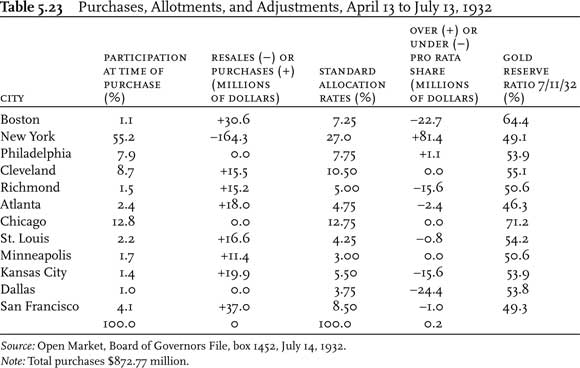
On July 9 McDougal wrote to Harrison to explain his bank’s decision not to purchase. He noted that between February and June, Chicago and New York had taken a much larger share of the securities than required by the allotment formula. This was particularly difficult for the Chicago bank, which had an “abnormally large amount of circulation... over 25 percent of the entire [currency] circulation of all the Reserve banks.”106 McDougal then expressed concern about the integrity of the note issue and the dangers that might arise because of reliance on the provisions of the Glass-Steagall Act permitting the reserve banks to use government securities as collateral.
The Chicago bank had faced an increased demand for currency after the Chicago bank failures. The failures may have convinced a skeptical and reluctant McDougal to stop participating in the purchase program. Harrison told his directors on July 25 that McDougal feared the newly issued currency would later return to the banks, producing excess reserves that would flow to New York. Chicago would have to settle the balance with New York in gold. McDougal did not want to further reduce Chicago’s gold reserve by increasing currency (Harrison Papers, Memoranda, New York Executive Committee, July 25, 1932).
Concern at the New York and Chicago banks about their gold reserves represents another failure of the Federal Reserve Act. Chicago acted as banks had acted before the act. The Federal Reserve Board did not force banks to pool their reserves, as the act intended. Knowing that it could not rely on support from other banks, New York also acted to protect its gold reserve by first limiting, then ending, open market purchases.
By late June, Harrison’s interest in purchases had become conditional on actions by Chicago and Boston and more aggressive efforts by the RFC. On July 11 he reported to his directors on his conversation with Meyer.107 Meyer agreed that the RFC had been “defensive” but made no commitment about future policies. Meyer wanted the System to continue the purchase program: “If for no other reason, it is politically impossible to stop at this particular time.... If the program were terminated just as Congress adjourned, we would be crucified next winter.”108
A decline in excess reserves early in July proved to be temporary. By late July, excess reserves were again above $250 million. With the rise in excess reserves, Harrison’s interest in the purchase program disappeared. He told the executive committee of his directors that the “need for further purchases is subsiding.” Purchases ended in early August.
The rise in excess reserves reflected the return flow of gold during July, a flow that continued throughout the fall. After August, excess reserves generally remained above $400 million, member bank borrowing was less than excess reserves, and short-term interest rates remained below the discount rate and in the range traditionally regarded as “low.”
Results of the Purchase Program
In the year following the British decision to suspend gold payments— from September 1931 through August 1932—the System’s balance sheet showed the following changes: Expressed in terms of a change in the monetary base, the data show that the monetary base increased approximately $400 million. The sources of the increase were the excess of security purchases over the gold outflow ($213 million) and the change in “other,” mainly a decline in deposits of nonmember banks at Federal Reserve banks.

Chart 5.1 shows that the gold outflow followed open market purchases after a brief lag. This was the classical reaction, substitution of domestic assets for gold on the central bank’s balance sheet. Substitution was incomplete, however. During March, gold flows were small and positive. From March 30 to early July, the period of large-scale open market purchases, gold losses were more than half the size of open market purchases. The gold flow reversed before purchases ended. By mid-January 1933, the Federal Reserve’s gold holdings had returned to the level reached before the British devaluation.
Gold losses did not force an end to the purchases program. The System’s gold reserve ratio did not fall below 56 percent, well above the minimum requirement. To a limited extent, individual reserve banks transferred security holdings to others to meet the gold reserve requirement.
Reductions in discounts and advances were the other main offset to purchases. These also remained far below the volume of open market purchases. During the peak purchase period, from March to July, member bank discounts declined $133 million, 14 percent of open market purchases. Together gold and discounts offset 64 percent of purchases. With discounts reduced and many foreign balances withdrawn, the offset would have fallen had purchases continued. Economic recovery would have reversed the gold flow and the reduction in member bank borrowing.
As these comparisons suggest, seasonally adjusted data show that the stock of money—currency and demand deposits—increased during the summer and fall (Friedman and Schwartz 1963, table A-1). Output responded to the increase in money. After falling to 47 in July, the seasonally adjusted index of industrial production (August 1929 = 100) rose to 53 in October, an increase of more than 12 percent.109 It seems likely that had purchases continued, the collapse of the monetary system during the winter of 1933 might have been avoided.110
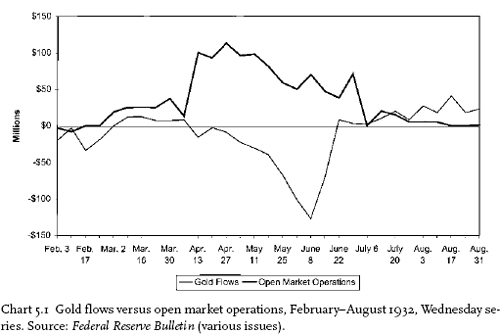
The Federal Reserve recognized the improvement at the time. At the August 11 meeting of the New York directors, Meyer described the rise in commodity and security prices as the best in nearly three years. He then dismissed “those who think things are going too fast; they are not going fast enough.” Meyer saw a continued rise in commodity prices as the chief hope for banks and the economy.111
The Federal Reserve’s purchase program was not the only factor working toward improvement in the financial system and the economy. From the date of its inception, January 22, 1932, to the end of August, the Reconstruction Finance Corporation authorized loans of $784 million to more than 4,000 banks as compared with only $155 million lent to 575 banks by the National Credit Corporation in the three months ending January 1932. Under the impact of monetary expansion and RFC lending, the bank failure rate declined markedly. The improvement was so great that by October 1932, repayments to RFC exceeded new loans. The improvement did not last, however. In December the number and deposits of suspended banks rose once again.112
At the July 1932 meeting, a majority of the reserve banks were in favor of continuing the purchase program on a limited scale. Only one governor, George Seay of Richmond, joined Young and McDougal in opposing purchases.113 It seems likely that if Harrison had urged continued expansion, he would have had the support of the smaller banks and the Board. Harrison failed to continue the program, ostensibly because he did not have the support of two banks that had taken less than 20 percent of the previous purchases. To protect New York’s reserve, he did precisely what Bagehot had warned central bankers to avoid.
THE FINAL COLLAPSE
The standard seasonal pattern called for an increase in reserves to prevent a seasonal increase in interest rates. With little upward pressure on interest rates and declines in November and December, the System was inactive throughout the fall. The main discussion was the timing of sales.
Gold continued to flow in, adding to excess reserves. The System remained passive despite a resumption of banking failures, the beginning of state or area bank closures, and the renewed gold outflow during the winter. Despite requests for assistance from President Hoover, it remained almost passive as the financial system collapsed, stirring itself only at the very last moment.
Open Market Policy Discussions
Once the purchase program ended in August, Harrison showed no interest in a new program. Burgess spoke in favor of continuing the purchase program in early August, but Harrison preferred to rely on the gold inflow to maintain excess reserves and talked about the prospects for reducing System holdings of government securities by allowing Treasury bills to run off. In September and October, Burgess proposed additional purchases; Harrison discussed the appropriate time for sales.114 Governor Norris expressed the view of many when he told the New York directors on September 13, “The only question to be decided is when and how we shall reduce our portfolio.” Harrison agreed that securities should be sold but was uncertain about the appropriate timing. He was concerned that “too large an amount of excess reserves would mean that the credit situation might get out of control” (Harrison Papers, Meeting of the Officers’ Council, September 13, 1932). His discussion presages the deflationary policy action later in the decade, when the System raised reserve requirements.
Burgess responded, opposed sales, and argued for additional purchases. The Federal Reserve should “keep on all possible upward pressure in order to stimulate business improvement.” There was “plenty of time for us to turn around” because there would be no sudden upsurge that would restore employment and output. He thought recovery would take months and perhaps years, so he favored continued purchases.115 Governor Norris was present at the New York meeting and expressed the dominant opinion. He could not “see that it would be worthwhile to burden the city banks much longer with large accumulations of excess reserves.”
The November meeting of the Open Market Policy Conference considered a proposal to sell up to $150 million of securities provided that excess reserves remained above $250 million. There was general agreement that the recent election, the choice of a new Congress, and other uncertainties made it appropriate to delay sales. The OMPC voted to reopen the question during the first week of January after defeating a motion by Governor Seay, supported by McDougal, to reconvene in December. The only action was to ask Congress to extend the Glass-Steagall provisions for a second year.
Harrison and Meyer stated the prevalent arguments for and against sales at a meeting of the New York directors on December 22. Harrison rested the case for selling on two main points. In both, he treated excess reserves as a redundant surplus and ignored Burgess’s earlier argument. (1) The purchase program had accomplished the objective of stopping a “drastic deflation” but not the secondary and “unavowed objective” of stimulating business recovery. However, it was unclear whether the $700 million to $800 million of excess reserves was any more effective in stimulating recovery than $400 million. (2) The accumulation of excess reserves created a risk: “We do not have real control as contrasted with psychological control until member banks are forced to borrow at the reserve banks. If excess reserves pile up, … we must remember that we are relinquishing a lever of immediate control.”
Meyer’s response emphasized political as well as economic factors. The inflationists in Congress were looking for a reason to inflate. Sales would be interpreted as deflationary and would fly in the face of predominant congressional sentiment. Also, sales would attract a gold inflow by raising interest rates. The present inflow was “embarrassing”; a further inflow generated by a deliberate policy of raising interest rates was hard to justify to foreign governments.116
It is impossible to reconcile Meyer’s statement that sales would raise interest rates with Harrison’s treatment of excess reserves as a redundant surplus. Meyer’s comments on the level of excess reserves correctly interpret the increase as a response to expected System policy. He suggested that the variability of excess reserves was as important as the level and that the banks had failed to use the excess reserves as a basis for expansion of deposits and earning assets because of uncertainty about future Federal Reserve policy.117 The banks expected sales, and Meyer did not strongly oppose selling. He believed that if sales were to be made, the time for it would be January, when currency would return to the banks.
The background memo for the January 4, 1933, OMPC meeting showed that bank credit (loans and investments) was 2 to 3 percent above the July low point, but growth had stopped in October. Loans at weekly reporting banks were below the July level (table 5.24). Member bank borrowing had fallen about $600 million. Excess reserves, mainly at New York and Chicago banks, continued to increase. Most of these funds came from regional and rural banks seeking investment in the New York and Chicago markets. The memo noted also that the rise in commodity prices and industrial production during the spring and summer had reversed.118
The OMPC members had different interpretations of excess reserves, but there was general agreement on a policy of purchases or sales to maintain the level of excess reserves no higher than $500 million, slightly less than the amount that prevailed at the time of the meeting. Seay and Mc-Dougal wanted the System to reduce excess reserves by $125 million at once, but they voted for the resolution and it passed unanimously.
During the next few weeks New York followed the instructions almost to the letter. It sold approximately $60 million and maintained the banks’ excess reserves close to $500 million. By early February, currency drains had reduced excess reserves below the target. Burgess wanted to return to the target, but Harrison was cautious and limited purchases to $25 million. After February 8, the committee ignored the instructions. Purchases failed to offset the increase in currency, so excess reserves fell. Between mid-February and the banking “holiday” of early March, weekly purchases did not exceed $25 million. On February 16, New York reduced its acceptance rate to 0.5 percent and purchased $27 million.
The final bank runs had started. Harrison told his directors on February 16 that the OMPC could not meet because reserve bank governors could not leave their districts. New York might have to purchase securities for its own account, offering participation to other reserve banks later. He reported increased gold withdrawals by domestic residents and foreigners. In the second half of February, Michigan, New Jersey, Missouri, Maryland, Ohio, Pennsylvania, Indiana, and Kentucky either authorized banks to close as required or declared bank holidays.119

Once again, the Federal Reserve watched events take place and failed to respond as long as the level of market interest rates remained low. Once again, when market interest rates rose the System responded by discounting “freely” at a higher rate, by raising the acceptance rate at the New York bank, and by purchasing very little in the open market. Even Governor Meyer shared the dominant view. He told the Board on February 27 to follow gold standard rules: “Continued purchases of government securities at the present time would be inconsistent from a monetary standpoint … the New York money market should protect itself against the higher rates abroad by increased rates and not through open market purchases of governments by the Federal Reserve Banks… . Any reasonable amount of open market purchases at this time would prove to be ineffective and appear to be a vain attempt to prevent a readjustment of rates which is inevitable.”
Renewed currency demand, “hoarding of gold coins in aggravated form,” weakness in the foreign exchanges, and foreign demand for gold produced almost no response.120 During February, reserve bank credit increased only $284 million, mainly by bill purchases in the last week. In the same period, currency circulation increased by almost $400 million. Table 5.25 shows some principal financial measures at the end of February and the changes from the August 1929 peak.
Final Currency and Gold Drains
The banking crisis was not a sudden, unanticipated event. It developed over months, spreading from state to state, and when it was left unattended, spread fear throughout the country. Failure to stop the growing crisis arose at many levels. Boston and Chicago would not participate in purchases, so New York did not ask for a System policy. The Board would not insist on a Systemwide program. It watched passively while its staff prepared for a financial collapse. The political system was in transition from Hoover to Roosevelt. Without Roosevelt’s agreement, Hoover would not take responsibility for actions whose legality he suspected. Roosevelt would not accept responsibility until he was inaugurated and had authority to act. Clearinghouse banks would not issue currency substitutes, scrip or clearinghouse certificates, because they believed the crisis differed from the crises in the 1890s or 1907, when they had last issued clearinghouse certificates.121

Roosevelt was elected without commitment to a specific program. His advisers included people with known views, but these views covered several different policies. Roosevelt would not commit to balance the budget or maintain the gold value of the dollar during the four months between his election and inauguration on March 4, 1933. Several senators and congressmen proposed legislation to raise prices by increasing money. The proposals, if enacted, would have made devaluation a likely outcome.122 These proposals, speculation about Roosevelt’s plans and intentions, a congressional mandate requiring the RFC to publish the names of banks it assisted, and the long delay between election and inauguration heightened uncertainty, adding to the crisis.
Between February 1 and March 4, the demand for Federal Reserve notes and gold increased $1.43 billion and $320 million respectively. In the same period, foreigners moved $300 million in gold into earmarked accounts, $200 million in the week before the inauguration (Eccles 1951, 115).123 The public’s increase in note and gold holdings was about one-third of the outstanding stock at the end of December 1932, the gold loss, 6 percent of the December 1932 stock.
These data suggest that most of the gold purchases were made by foreigners, including foreign central banks. If we attribute all or most of the currency drain to domestic demand, foreigners account for about 10 percent to 20 percent of the run on the monetary system in early 1933 and about the same percentage in the climactic two weeks from February 22 to March 8, when currency outstanding increased $1.55 billion and the gold stock fell $2.7 million (Board of Governors of the Federal Reserve System 1943, 387).
Bagehot (1962) describes the remedy for an internal and external drain as lending freely at a high rate. The Federal Reserve continued to ignore this advice. Banks therefore could not meet demands for currency and gold. In the four months between election and inauguration, the Hoover administration tried unsuccessfully both to activate the Federal Reserve and to cooperate with the incoming administration.
Burdened by its history of crises, a lame duck administration, Federal Reserve inaction, and Roosevelt’s silence, the financial system collapsed. By inauguration day, thirty-five states had declared bank holidays, closing all banks. Closings typically were for limited periods, but some were indefinite. In the states without declared holidays, withdrawals were severely restricted; often no more than 5 percent of deposits could be withdrawn (Board of Governors File, box 2166, March 1933).
The final crisis did not come suddenly. In November, Harrison and Secretary Mills discussed a likely December default on intergovernmental debt payments. Greece had defaulted earlier in the month; Britain wanted an international meeting to discuss intergovernmental debt payments and had asked to postpone its December payment. Harrison and Mills thought Roosevelt would probably not accept a private invitation to discuss problems with President Hoover. The best available course was an open letter, discussing the problems and inviting cooperation. The letter appeared on November 3, 1932. Roosevelt accepted the invitation the following day, but the meeting achieved nothing.124
In late November, Harrison warned Mills about the beginning of flight from the dollar. Although the gold stock continued to increase, Harrison explained that Britain had stopped buying dollars and started using them to strengthen its exchange rate against the French franc. This involved selling dollars for francs in Paris and selling francs for pounds in London.
By December the staff began informing the New York directors about the number of banks in the United States that had closed since the previous week. In mid-February Michigan joined the several states that had declared banking holidays, closing all banks. Michigan’s action closed the Detroit banks.125 To avoid loss of deposits, corporations moved their balances to New York banks, thereby draining reserves from small and medium-sized cities. New York made a feeble effort to relieve the pressure by lowering the buying rate for bills to 0.5 percent on February 16. The directors approved purchases of $20 billion to $25 billion of government securities a week during February and bought $350 million in commercial bills for the month.
In mid-February, President Hoover wrote to Roosevelt to inform him about capital flight, currency drains, and the threat to the exchange rate and the gold standard. Hoover’s letter blamed the problem on agitation to tinker with the financial system, publication of RFC loans, and the like. The letter asked Roosevelt to commit to a policy based on the gold standard and a balanced budget and to reassure the public that the country would recover if the government followed sound policies. Roosevelt replied that “mere statements” would do nothing to stop the runs (Moley 1939, 141–42).126
Hoover next wrote to the Board on February 22, referring to capital flight and to the “hoarding of currency, and to some minor extent of gold, [that] has now risen to unprecedented dimensions,” and asked whether there was a need for some action, or some additional powers (Hoover to the Board, Board of Governors File, box 2158, February 22, 1933). The Board replied on Saturday, February 25, that it was watching the situation develop but “did not desire to make any specific proposals for additional measures or authority” (Meyer to Hoover, Board of Governors File, box 2158, February 25, 1933).
The following Monday the Board met with Ogden Mills present.127 Mills referred to the pressures in the market and on the Treasury arising from the Treasury’s debt sales to finance the Reconstruction Finance Corporation’s assistance to failed banks. He urged the Board to arrange for open market purchases of up to $100 million that week.
Governor Meyer saw no reason for purchases. The rise in bond yields was a “necessary readjustment in a market which has been too high” for current conditions. The proper response was for the New York market to increase money rates and for the Federal Reserve to increase bill rates to protect against higher rates abroad: “Purchases of Government securities at the present time would be inconsistent from a monetary standpoint,” although the Treasury might wish to purchase some long-term securities for the postal savings account. A readjustment of rates was “inevitable,” so it was wrong for the Federal Reserve to try to prevent it (Minutes, Board of Governors File, box 2158, February 27, 1933, 2–3).
President Hoover wrote again on February 28. This time the letter was more urgent. He noted that the Board was not an adviser to the president, but he wanted its advice on three proposals in the “emergency”: federal guarantee of bank deposits; issuance of clearinghouse certificates by established clearinghouses in the affected areas; and “allow[ing] the situation to drift along under the sporadic state and community solutions now in progress” (Hoover to Board, Board of Governors File, box 2158, February 28, 1933).
The Board did not reply until March 2, two days later. It was “not at this time prepared to recommend any form of Federal guarantee of banking deposits.”128 Clearinghouse certificates present “a number of complications from the standpoint of practical operation.” The Board discussed the actions under consideration in several cities but made no recommendation. As to Hoover’s third suggestion, “the question is not whether the situation should be allowed to drift along under the sporadic state and community solutions now in progress,” but whether there was something better to be done: “No additional measures or authority have developed in concrete form which … the Board feels it would be justified in urging” (Board to Hoover, Board of Governors File, box 2158, February 28, 1933).129
Soon after the letter was delivered, the situation changed. The attorney general had met with the Treasury and Board counsels and now opined that section 5 of the (World War I) Trading with the Enemy Act justified declaring a national bank holiday if the president believed the emergency justified it.130 Secretary Mills told the Board that “the matter was not free from doubt and he did not feel that he should advise the President to do so without the consent and approval of the incoming administration.” Nevertheless the Board voted unanimously that a banking holiday be declared for March 3, 4, and 6 and recommended that Congress be called into session to pass legislation supporting the president’s order. The president had gone to bed by the time the decision was reached, so the meeting adjourned (Board of Governors File, box 2158, March 2, 1933).131
At its March 3 meeting the Federal Reserve Board discussed the growing number of states with bank holidays. Miller advocated the use of clearinghouse certificates, but he opposed any plan to guarantee bank deposits.132 Others proposed legislation. No one suggested additional open market purchases to provide reserves that banks could exchange for currency. The only decision was that Governor Meyer should talk to the president and recommend a nationwide bank holiday.
Earlier in the evening, Hoover actively considered plans for a holiday. Meyer reported to the Board that Hoover agreed to the holiday provided Roosevelt would approve the action (Board of Governors File, box 2158, March 3, 1933, afternoon meeting).133
At a special meeting of the New York directors in the afternoon and evening of March 3, Harrison reported that the overall gold reserve ratio for the system remained above 40 percent, but the New York reserve bank’s ratio had fallen to about 24 percent.134 Normally the deficiency could be covered by rediscounting with other reserve banks, but an internal drain of gold now supplemented the external drain.135 Harrison told Governor Meyer that “he would not take the responsibility of running this bank with deficient reserves” (Special Meeting, Minutes, New York Directors, March 3, 1933, 2).
The Board suspended the gold reserve requirement. That action removed the legal issue, but the bank was open, so the gold drain continued. Harrison told Meyer and Mills that at current rates of loss the gold reserve would be depleted. There were three courses of action: declare a bank holiday; suspend specie payments; or suspend reserve requirements for the entire System.136 Harrison considered suspension of reserve requirements least attractive, since it would continue payments to speculators and hoarders. Suspension of specie payments was “almost equally unattractive … [H]ysteria and panic might result, and there probably would be a run on the banks” (ibid., 3).
That left a national bank holiday. He gave this recommendation to Meyer and Mills. They had suggested instead that Governor Herbert Lehman of New York declare a holiday for the state, but Harrison was not sure a state bank holiday was sufficient basis for refusing to pay out gold to foreigners. He was reluctant to continue losing gold, but he saw no alternative without a holiday.137 After further discussion, the directors learned that both Hoover and Roosevelt had retired for the night. Secretary Mills called to say that President Hoover would not declare a national holiday. Harrison went to meet with Governor Lehman to discuss a state holiday.138 Later he phoned the meeting to report that the clearinghouse banks and the state superintendent had asked for a state holiday. Governor Lehman wanted a request by the Federal Reserve also. The directors voted the recommendation, and the governor declared the holiday.139 Illinois, Pennsylvania, Massachusetts, and New Jersey also declared holidays.
Finally, after midnight the Federal Reserve Board voted to recommend a three-day banking holiday. Aides woke Hoover, but he did not act. One of his last acts in office was an angry letter to the Board, on March 4, stating that he had received their letter at half past one in the morning. He was “at a loss to understand why such a communication should have been sent to me in the last few hours of this administration.” The Board’s letter, Hoover said, had been written after the Board was aware that Roosevelt “did not wish such a proclamation issued” and while the states of New York and Illinois were in process of declaring state holidays, “thus accomplishing the major purpose which the Board apparently had in mind” (Hoover to Meyer, Board of Governors File, box 2158, March 4, 1933).140
The Board remained in session until after 3:00 A.M. Before adjourning, it received word of the decisions by the governors of Illinois and New York to close banks in those states. The Board could not decide whether to order Federal Reserve banks to close, so in a final lack of decision, it voted not to object if the directors voted to close.
On his first day in office, Sunday, March 5, President Roosevelt declared an emergency to meet “heavy and unwarranted withdrawals of gold and currency” and “increasingly extensive speculative activity.” His proclamation used the recommendation the Board had made to President Hoover the day before, citing the 1917 Trading with the Enemy Act as authority to prevent the export, hoarding, or earmarking of gold or silver.141 The proclamation closed all banks first from March 6 to March 9, then later for two additional days. On March 9 Congress approved the holiday, and strengthened its legal foundation, by passing the Emergency Banking Act.142
The act extended and broadened the president’s powers to close, liquidate, license, and reopen banks under the Trading with the Enemy Act, removing any possible challenge to the legality of his proclamation. The act also strengthened the Reconstruction Finance Corporation, authorized national banks to issue preferred stock, and permitted the RFC to purchase shares in national and state banks. And it prepared for the nationalization of gold holdings by empowering the secretary of the treasury to order all domestic gold owners to sell their holdings to the Treasury.
The bank holiday was a climax to the depression because it forced the government and the Federal Reserve System to respond to the domestic financial and economic collapse. Actions that had seemed beyond consideration were no longer unthinkable. In the next few months the administration chose domestic expansion over fixed exchange rates and dismissed the opportunity to return to the gold standard. Employment, agricultural prices, and other domestic concerns replaced the gold price and real bills as guides to economic policy.
EMPIRICAL STUDIES: THE ROLE OF MONEY
The Great Depression was mainly a monetary event in two senses. Monetary policy could have mitigated or prevented the decline but failed to do so. A different set of Federal Reserve policy actions could have avoided the severe deflation and reduced the depth and severity of the economic decline. In this sense the Great Depression was a response to monetary policy.
There is another sense in which the depression was a monetary event. The initial decline could have been a response to a negative monetary impulse or sequence of impulses. A few writers have taken this view (Anderson, Shugart, and Tollison 1988). Other students of the period suggest that monetary forces had no role (Temin 1976).
The extreme positions—that monetary policy was the only cause or that monetary policy played no role—are difficult to sustain.143 A more plausible explanation is that the depth and severity of the Great Depression were the consequence of a series of shocks that the Federal Reserve neglected or failed to offset completely. The shocks include French gold policy, banking panics, increased demand for currency, departure of Britain from the gold standard, the stock market decline, failure of banks in Austria and Germany, collapse of United States export markets in Latin America, the effects of tariffs and retaliation on prices and thus on gold movements, and other events. Some of these events are both the effect of prior changes and the proximate cause of subsequent changes. We are unlikely to develop a complete list of “true” causes that operated independently of other events.
One alternative is to look for outliers, or large changes, in output and the money stock. A Kalman filter, developed by Bomhoff (1983), uses the past history of a series to predict future values. The difference between predicted and actual values is a measure of changes that could not have been foreseen from the history of the series. Using quarterly data reported in Balke and Gordon (1986) from 1890 or 1915 through 1984, the filter predicts each quarterly observation, then uses the error to revise subsequent predictions. Predictions of GNP, money, and prices are made independently, so it is possible to check on the consistency of the predictions of GNP by summing the errors in predicting real output and prices. For 1928–33, these sums are generally in the same direction and have similar magnitude as the error in GNP. Table 5.26 shows all errors in M1 and errors in GNP and prices greater than or equal to 1 percent for this period.
The data support five principal implications. First, the depression was caused by a series of unanticipated changes or shocks, not by a single event. There were large shocks to nominal and real GNP, both positive and negative, throughout the period. Despite the reversals in sign, the cumulative sum of the shocks to nominal GNP from the peak in third quarter 1929 to the trough in first quarter 1933 (17.4 percent) represents about one-third of the decline in nominal GNP.144
Second, most of the large shocks to nominal GNP were also large shocks to real GNP in the same direction. There are fewer large shocks to the price level, suggesting that price changes were mainly the result of system response to current and past shocks acting on output and spending. Large price-level shocks typically have the opposite sign from contemporary output shocks, suggesting that the shock affected supply. Since most of the supply shocks are positive, they cannot explain the long and deep decline in output.

Third, shocks to money either are contemporaneous or lead shocks to GNP by a quarter or more. The largest monetary shock comes early in 1930, when M1 fell II percent (annual rate), the largest decline in any quarter since 1921. Negative shocks to money dominate 1931, particularly following the Federal Reserve’s response to the British devaluation. The monetary shocks change sign in 1932 following (or accompanying) the relatively large open market purchases in second and third quarter 1932. Positive shocks to real and nominal GNP follow. Although the money stock continued to fall during most of that year, the rate of decline slowed for a time and money stock rose in the fourth quarter. Industrial production and stock prices rose in fall 1932. These data suggest that, contrary to some Federal Reserve interpretations, the 1932 open market purchases did not fail. Continuation of the positive shocks by more expansive actions in 1931 and 1932 or earlier would likely have changed the course of the depression.
Fourth, some periods show negative shocks to output that are large relative to current or past shocks to money. Fourth quarter 1929 and third quarter 1931 are prominent examples. In both quarters there was some prominent event: for third and fourth quarter 1929 we have the peak in the economy in August 1929, the spread of recession abroad, and the fall in United States stock prices in October 1929; in third quarter 1931 there were banking problems in Germany and the suspension of gold payments by the Bank of England in September 1931. These changes may have affected monetary velocity.145 Waves of bank failures and suspensions in 1930.4, 1931.2, 1931.3, 1931.4, and 1932.1 had mixed effects. Shocks to money and nominal GDP were positive in 1930.4, relatively small but positive for nominal GDP in 1931.2, commingled with the effect of the British suspension of gold payments in 1931.3, and accompanied by a large negative shock to money and nominal GDP in 1931.4. Only the bank closings in 1932.1 are accompanied by negative shocks to output and a positive monetary shock that would support a major role for nonmonetary factors associated with bank suspensions. None of this evidence rules out a nonmonetary channel, but it does not suggest a dominant effect of nonmonetary shocks.
Fifth, there is not much evidence of a decisive monetary surprise, or series of surprises, in the year preceding the start of the depression. The cumulated monetary shocks in the year ending 1929.2 is a small negative value. Price data show a sequence of small deflationary shocks (or errors) for the year ending 1929.2. Nonmonetary factors may have contributed to the deflation and the start of the depression.
An alternative for investigating nonmonetary shocks uses errors computed from a demand function for money to see if there were large unexplained increases in the demand for money as suggested by Temin (1976). Table 5.27 shows the percentage errors from a demand function in which the logarithm of real money balances depends on the logarithms of interest rates and wealth or expected income. The equation is estimated separately for the logarithms of levels and changes of real money balances, using annual data for 1902 or 1903 to 1958. An appendix shows the equations. Errors are actual values minus estimates from the equation.
For both equations, most of the errors are comparatively small. These data give no evidence of a sudden large, unexplained desire to accumulate real money balances. Most of the errors in log levels are negative, suggesting that real money balances fell below predicted values. This typically occurs when money growth falls more than anticipated. The years 1928 and 1930 are notable in that regard.

The years 1928 and 1932 are the only ones before the middle 1930s with relatively large errors in the change in real balances. Chart 5.2 shows that real balances fell much more in 1928, and rose much more in 1932, than anticipated by the demand equation. The negative error in 1928, for both levels and changes, suggests that before the recession demand for real balances fell more than actual balances.146 Factors other than income, wealth, and interest rates played a role in reducing growth of desired real money balances. In 1932 actual growth of real balances is 6 percent above the growth expected at a time of increased nominal money following several years of falling nominal money. Chart 5.2 shows the prediction errors for 1922–40.
Gandolfi and Lothian (1977) estimated a demand for money equation using data for a cross section of states for the years 1929–68. Their findings also suggest that the demand function for money remained relatively stable during the Great Depression. They reject the presence of a liquidity trap. Their measure of the interest elasticity declined as interest rates fell, contrary to the liquidity trap. (See also Brunner and Meltzer 1968a.)
Would a more expansive monetary policy have prevented the Great Depression or reduced it to a typical recession? McCallum (1990) simulated the response of nominal GNP assuming the Federal Reserve followed a monetary base rule from 1923 to 1941.147 McCallum’s rule is activist but not discretionary. The Federal Reserve adjusts the growth of the monetary base each quarter to reflect past changes in base velocity and deviations from a 3 percent growth rate.148
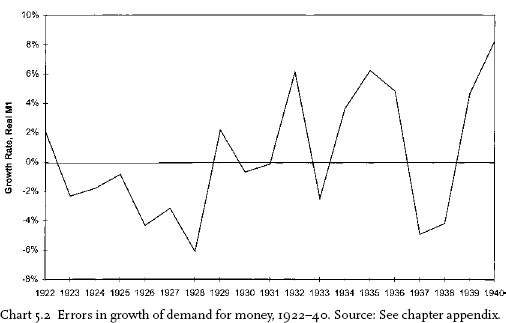
The simulations by McCallum (1990) and by Bordo, Chaudri, and Schwartz (1993) support two propositions. First, the Federal Reserve’s inaction converted a modest or possibly moderate recession into the Great Depression. In this limited sense, the depression was caused by monetary policy. Second, nonmonetary events contributed to the decline. All of Mc-Callum’s simulations, and most of the simulations by Bordo, Chaudri, and Schwartz, show a recession in 1929 and 1930.
Taken together, the estimates of the role of money in 1929–33 point to a relatively large role for money growth both as a factor deepening the recession and, at times, reversing the fall in output. There is no evidence that money was the unique cause of the decline. Systematic effects of other factors, including tax increases or expenditure reductions to balance the budget or tariff increases and retaliation abroad, have not been ruled out.
Sweden avoided severe deflation. Its central bank, the Riksbank, followed the policy advocated by some members of Congress in the 1920s and at the time; acting under parliamentary guidance, the Riksbank worked to stabilize the domestic price level. Sweden could not offset the real effects of an international decline, but after leaving the gold standard in 1931, the country avoided the deflation and its effects on output, financial institutions, firms, and households (Berg and Jonung 1998). The Swedish recession was comparatively mild.
Bernanke (1983, 1994), Bernanke and James (1991), and others link monetary and nonmonetary factors in the Great Depression and at other times. These authors accept that bank failures and suspensions during the depression reduced the money stock. They propose, in addition, that bank failures and suspensions reduced bank lending. Since small and medium-sized firms depend disproportionately on bank loans to produce and finance output or sales, reductions in bank lending have a large impact. Further, during the depression, these authors claim, deflation had a nonneutral effect on debtors by forcing contraction, lowering net worth, and reducing access to bank credit. The last of these effects, debt deflation, requires borrowers to be affected more, or more quickly, than creditors.

Bernanke does not dispute the monetary effect of the Federal Reserve’s failure to stop the bank runs by open market operations. That bank loans declined with bank deposits is an expected consequence of monetary contraction. The extraordinary real rates of interest and high-risk premiums on Baa bonds after late 1930 testify to a general reluctance to extend credit to any borrowers, particularly lower-rated or unrated borrowers.
More problematic is the particular, nonneutral effect of the decline in bank loans on smaller firms. For this effect to have aggregate consequences, bank loans must decline relative to open market lending by non-bank firms. The data for the second half of the depression show the opposite. Short-term open market lending fell relative to bank lending. Table 5.28 shows the ratio of commercial paper plus banker’s acceptances to loans at 101 weekly reporting member banks at each three-month interval from the peak in August 1929 to February 1933.
The data show a relative expansion of open market lending during the early months of the decline. The ratio reached a peak in the first six months; thereafter open market lending declined relative to bank lending. The relative decline accelerated when suspensions (measured by deposits of suspended banks) rose beginning in November 1930. During the peak period of bank suspensions in second half 1931, the ratio fell below its value in August 1929.149
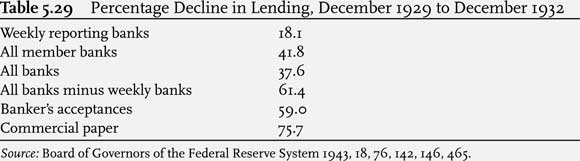
Table 5.28 gives little support to the argument that the decline in bank lending had a nonneutral effect that augmented the monetary effect. The common decline in lending by banks and nonbanks suggests a reduction in desired borrowing in response to poor opportunities and widespread beliefs that the recession would continue. These beliefs are documented in the minutes of the Federal Reserve.
Table 5.29 compares the percentage decline in lending for different groups of banks to the decline in external finance. Weekly reporting banks show the smallest percentage decline. To get a better measure of small banks, subtract weekly reporting banks from all banks. Line 4 of the table shows that this class declined by about the same percentage as banker’s acceptances and less than commercial paper.
The relative share of credit by large banks rose despite the sharp decline in acceptances and commercial paper. These markets were much smaller than the bank loan market in absolute size. If we assume that large banks lend mainly to large firms, the evidence suggests that credit to large firms declined less than credit to other firms. This conclusion is tempered, however, by the comparison of all member banks and all banks. These groups declined in the same proportion.
These data do not separate a decline in the demand for loans from restrictions on supply to small firms. The data are entirely consistent with a relative decline in loans demanded by small firms. Data are not available on sales by size of firm, so an examination of the proposition is incomplete.
Chart 5.3 shows, however, that total loan volume declined with GNP. Predicted loans are estimated from a simple regression in which loans depend only on nominal GNP. The decline in loans differed little from the decline in GNP. It seems fanciful to suggest that the decline in loans caused an immediate decline in GNP in each period. The more likely explanation is that households and businesses reduced borrowing as their incomes fell. Falling demand explains most of the decline in loans. Given the real return to lending, banks should have been eager to lend to solvent borrowers.
Haubrich (1990) tested Bernanke’s nonneutrality hypothesis for Canada. Canada had no bank failures, but banks closed many of their branches, probably disrupting lending arrangements. Canada also had a smaller share of interest payments on loans past due, but Canadian commercial failures were a larger fraction of GNP. Canada was effectively off the gold standard after January 1929. Haubrich finds no support for bank closings and commercial failures in Canada as a reason for decline.
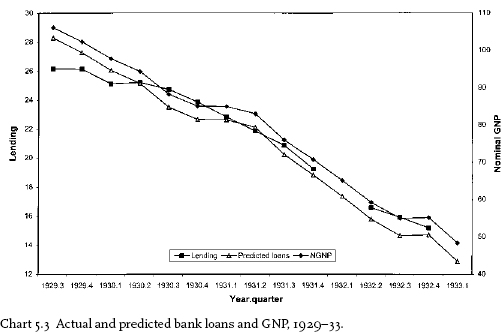
The United States was not the only country experiencing bank runs and failures. The public in many countries expressed its fear of bank failures by withdrawing deposits and holding currency. Spain and the Netherlands experienced large increases in the ratio of currency to deposits. Austria, France, Norway, and Canada had smaller, but not negligible, increases. A central bank can offset the effect on the economy of an increased demand for currency by expanding the monetary base by more than the increase in currency demand. Under the gold standard, the government may have to temporarily suspend convertibility, as Britain did in such circumstances several times in the nineteenth century.
To study the effect of currency drains (or bank runs) on real income during the decline, 1929–32, I regressed percentage changes in the real value of the monetary base, the ratio of currency to deposits, and base velocity on the percentage change in real income for twenty countries in Europe, North America, and South America. The twenty countries for which data are available report very different experiences. Denmark, Greece, Hungary, Norway, and Spain show a rise in real income for the period as a whole. The United States, Canada, Brazil, Mexico, Austria, France, and Germany show double-digit declines in real income for the three-year period. Estimates and a list of the countries are given in appendix B.
The data attribute about half of the decline in real income in these countries to the combined effects of the change in the real value of the country’s monetary base and the change in base velocity. The change in base velocity includes changes in the demand for currency per unit of income. The larger the currency drain, other things equal, the larger the decline in base velocity. Currency drains and bank runs do not appear to have had any significant effects through a lending channel or other channel, independent of their effects on the real value of the monetary base and base velocity. The statistical results again suggest that monetary factors had an important role in the decline, but other factors affecting the demand for money were also significant for the twenty countries. I return to the role of gold in the concluding section.
Federal Reserve records suggest that the real bills or Riefler-Burgess doctrine is the main reason for the Federal Reserve’s response, or lack of response, to the depression. With few exceptions, the Federal Reserve governors accepted this framework as a guide to decisions. They believed that a low level of member bank borrowing and low nominal interest rates suggested there was no reason to make additional purchases. Additional purchases of government securities would expand credit based on speculative assets, which was inconsistent with the real bills doctrine and the gold standard.
Federal Reserve purchases at the start of the 1929 recession were much larger than at the start of previous recessions. One reason is that New York started to purchase at the time of the stock market break. Also, member bank borrowing was over $1 billion, far above the range that the Federal Reserve regarded as restrictive. At a March 1926 meeting of the Governors Conference, Strong restated the Riefler-Burgess doctrine and described how it would be applied at the start of a recession: “ Should we go into a business recession while the member banks were continuing to borrow directly $500 or $600 million (if bills are included nearly $800 million) we should consider taking steps to relieve some of the pressure which the borrowing induces by purchasing government securities and thus enabling member banks to reduce their indebtedness” (quoted in Chandler 1958, 239).
Table 5.30 compares member bank borrowing and interest rates at the beginning and one year after the start of three recessions. The 1929–33 recession started with more member bank borrowing and higher interest rates than the others. By the end of the first year, the Federal Reserve had purchased $350 million to $400 million more than in the two previous recessions. In the 1923–24 recession, the Federal Reserve made seasonal securities purchases in December, seven months after the peak, but sold in January. Sustained purchases did not begin until February 1924, nine months after the cyclical peak. In 1926–27 the System made small-scale securities purchases at once, partly for seasonal reasons, since the recession started in October. Sustained purchases began in February, four months after the cyclical peak.

The earlier recessions reached a trough after thirteen or fourteen months. Eighteen months after the peak, the levels of borrowing or borrowing plus acceptances on the Federal Reserve balance sheet were very different after 1929 than after the earlier recessions. Interest rates on ninety-day acceptances are highest in the October 1926 cycle, lowest in the August 1929 cycle. Securities purchased show the same ordering. Judged by the measures that Riefler, Burgess, and Strong emphasized, Federal Reserve policy shifted from restraint to ease and back to restraint in the 1923–24 and 1926–27 cycles. In 1929–30 these measures indicated that credit conditions had eased substantially.
The monetary base shows a different pattern, largely unrelated to the Federal Reserve’s measures of credit conditions. In 1923–24 the base started to rise six months after the cyclical peak and continued to rise through the first six months of the recovery. Three months after the 1929 peak, the base was below the level reached at the August peak, and it continued to fall through the spring and summer of 1930, as shown in tables 5.5 to 5.8 above.150
CONCLUSION
People see most clearly what they are trained or disposed to see. The Riefler-Burgess version of the real bills doctrine was not a mechanical formula directing Federal Reserve policy, but it directed attention to member bank borrowing and market interest rates as measures of tightness and ease. In 1929–30, most members of the Federal Reserve Board and governors of the reserve banks accepted this framework. They believed they had acted decisively to ease credit conditions, and on their measures they had.
The real bills doctrine taught that central bank credit should finance self-liquidating commercial loans. Government paper, stock market loans, and real estate mortgages were “speculative” investments that had no place on a central bank’s balance sheet. Since speculative loans were not self-liquidating, they were considered inflationary finance.
To a modern reader, fear of inflation seems a strange concern after a year or more of falling prices. Yet there are surprisingly few proposals to restore the price level. The comments of W. Randolph Burgess, occasional comments by Governor Meyer or some New York directors, and the efforts of a few members of Congress are the only official comments to that effect that I have found.
Eichengreen (1992, 251–53) contrasts the Riefler-Burgess emphasis on borrowing and interest rates with the “liquidationist view,” so called because Treasury Secretary Mellon is said to have advised President Hoover to “liquidate labor, liquidate stocks, liquidate the farmers, liquidate real estate” (251). Mellon’s advice is entirely consistent with the real bills doctrine and the firm belief that Federal Reserve policy had financed speculative lending; its effects had to be purged (liquidated). An increased demand for borrowing to finance real bills would, on this view, show that liquidation was complete and that recovery could occur without inflation. That is why the most extreme proponents of the real bills doctrine—Governors Mc-Dougal, Norris, and Young—typically opposed purchases. These men, and many others, repeatedly referred to the contraction as “inevitable”—the inevitable consequence of providing speculative credit.151 In 1929–33 their principles told them that deflation was both necessary and inevitable. For much the same reason, the Federal Reserve deflated in 1920–21 to eliminate the credit expansion based on war finance.
The volume of loans on securities by banks in New York and in the rest of the country did not increase disproportionately during the stock market boom. The main evidence of expanding stock market lending is the relatively large increase in loans to brokers and dealers, not to the public. At its peak, in the week ending October 2, 1929, total lending of this kind was $6.8 billion; the volume had nearly doubled since the end of 1927. Table 5.31 shows these data.

Eichengreen and Bernanke correctly emphasize the transmission of deflationary impulses by the gold exchange standard. Falling gold stocks in many countries reduced the monetary base in countries that lost gold. Appendix B recognizes the importance of the decline in the real stock of base money as a factor reducing real income, but it also recognizes that the gold did not disappear. Some countries, including the United States and several members of the gold bloc, acquired gold reserves.
The United States experienced a gold inflow in the first year of the decline. Under gold standard rules, the increase in gold should have increased the monetary base. If the Federal Reserve had followed the rules, the money stock would have expanded by 14.6 percent from August 1929 to June 1930. This, of course, overstates the amount of gold inflow that would have occurred. However, an expansive monetary policy would have prevented at least some of the deflation and recession, so falling prices and fears of collapse would have been absent. The world would have been spared much of what followed.
The principles of the Federal Reserve Act called for passive policies. The founders intended the System mainly to respond to gold movements and offers of real bills. No one discussed what the System should do if the two signals gave conflicting commands, as in 1930 when gold flowed in and real bills declined. The Federal Reserve had abandoned strict adherence to the gold standard in World War I and in the 1920s. It followed the real bills guide. Policy was deflationary in 1930 when adherence to gold standard rules called for expansion.152
Eichengreen (1992, table 8.6) compared the behavior of surplus and deficit countries from 1929 to 1931. He showed that in 1929 and 1930 the twenty-six countries losing gold contracted reserves as they paid out gold. Surplus countries like the United States contracted also, so the well-known stabilizing process did not work. We can only speculate on why deficit countries followed deflationary policies instead of leaving the gold standard. One reason is that most policymakers, economists, and businessmen in these countries also believed that deflation was an inevitable consequence of the previous speculative boom in the United States. The world economic system could not return to stability until these “excesses” had been purged. Also, many countries attempted to protect their gold reserves by deflating, contrary to the advice of Bagehot and Thornton.
The data suggest that the United States economy and its monetary system experienced not one but a series of monetary and nonmonetary shocks in the forty-two months following the August 1929 peak in economic activity. Seasonally adjusted industrial production declined more than 50 percent, and the money supply declined by over 25 percent. Of the banks operating at the time of the peak, more than 25 percent—6,704 banks—failed or were merged into other banks.153
One long-popular belief is that the fall in output and the financial collapse were caused by a prior decline in stock prices. The decline in money and the waves of bank failures are attributed to the decline in loan demand. To be more than an example of the post hoc, ergo propter hoc fallacy, there must be some connection between the initial decline in stock prices and the series of shocks to the United States economy.

Prices of industrial shares had declined by percentages similar to the 1929 decline in the recessions of 1906–7 and 1919–20 without producing depressions of the same length and magnitude, although the earlier declines in the stock prices had been spread over a longer time. Following the October–November decline, stock prices rose in winter 1930 and summer 1932. By April 1930 the Standard and Poor’s index was only 3 percent below April 1929. It had recovered almost 40 percent of the decline from the September 1929 peak. Stock prices rose again in the summer of 1932 following the expansive monetary policy and despite an increase in tax rates during the spring.
Banking data show little evidence of a prolonged effect of the October decline in stock prices. The data in table 5.32, and similar data on bank loans or loans and investments, show that in the first two years of the contraction, demand deposits in the larger New York banks rose approximately 10 percent, while deposits in all other banks rose about 1 percent. For the decline in money to result from the fall in stock prices, New York banks would have to have experienced a large loss of deposits. In fact, New York banks increased loans and deposits absolutely and relative to other banks for more than a year following the stock market break.
The data in the table support an alternative explanation. During the first two years of the contraction, gold flows and currency movements dominated the behavior of the monetary system. Deflation in the United States and risks abroad brought gold to the United States, as in 1920–21. The gold flows supplied relatively more reserves to the New York banks than to the small or regional banks in the interior. In part for this reason, the internal currency drains and rates of bank failures were much larger in the midwestern Federal Reserve districts than in others. Approximating the regional impact of the currency drains by the changes in the note issue of the various reserve banks shows that between December 1930 and December 1931 the total note issue of the reserve banks increased approximately 60 percent while the note issue of the Federal Reserve Bank of Chicago increased 275 percent and the note issue of the Federal Reserve Bank of Atlanta declined (Board of Governors of the Federal Reserve System 1943, 338).154
On the alternative explanation, the absolute and relative increase in deposits at large New York banks was mainly the result of the Federal Reserve’s contractive policy and the gold and currency movements of the period. When the gold flow reversed and the currency drains resumed after August 1931, deposits at New York banks declined, and the experience of the New York banks was more like the experience of banks in the interior.
Stock prices are one among many measures of asset prices. Since shares are traded on open securities markets, share prices respond promptly to changes in anticipated future earnings and dividends. Suitably deflated by current output prices, share prices offer an approximate measure of the cost of available assets relative to the production cost of new assets.
Standard and Poor’s index of stock prices deflated by the GNP deflator reached a peak in third quarter 1929. The deflated stock price index was only 23 percent below its peak in second quarter 1930. If the decline had stopped there, deflated stock prices would have been more than twice their level four years earlier. Three quarters after the cyclical peak, stock prices showed no evidence that asset owners believed a further decline was inevitable, to use the term central bankers overworked so much at the time.
The decline in deflated stock prices is not a uniform or even a unidirectional movement that would characterize transmission of a single shock. Like the data on money and GNP, the movement of stock prices suggests a sequence of shocks. In addition to the initial 24.3 percent decline in fourth quarter 1929, three other quarters show declines of 20 percent or more—fourth quarter 1930, fourth quarter 1931, and a decline of nearly 38 percent in second quarter 1932, when bank failures reached a temporary peak. The last of these shocks brought the deflated index to its lowest point of the depression, three calendar quarters before the bank holiday. The earlier chronology identifies these quarters as periods of financial stress.
A second explanation attributes the decline in money to the operation of the gold standard, to the desire to maintain the gold reserve, or to the desire to maintain convertibility of foreign currencies. This argument takes various forms. One claim is that under the conditions of the period, gold and international reserves flowed toward the countries with surpluses on current account of the balance of payments, principally the United States and France. This forced contraction in the deficit countries without producing expansion in the surplus countries.
Eichengreen (1992) makes this argument forcefully. His descriptive statement is correct, but it does not explain why both deficit and surplus countries behaved as they did. Temporary or long-lasting suspension of gold convertibility had occurred under the gold standard many times and in many countries. Great Britain had suspended convertibility several times in the nineteenth century. Yet most deficit countries chose to deflate and protect their gold reserves rather than suspend convertibility. One reason is that policymakers in many of these countries also believed that contraction and deflation were the inevitable consequences of the speculative excesses that had gone before.
The French government was not immune to this view. Far more important, it disliked the gold exchange standard. The French preferred to hold gold rather than foreign exchange as an international reserve, an attitude and policy that reappeared under the Bretton Woods system in the late 1960s. Eichengreen and others point out that the Bank of France was prohibited from undertaking open market operations. This claim fails to recognize that the bank engaged in open market sales of foreign exchange as part of its policy of holding only gold reserves. Under this policy, France sterilized a large part of its gold inflows.
The Federal Reserve did not depend on foreign central banks and governments and did not follow gold standard rules. The large inflow of gold in spring and summer 1930 did not expand bank reserves or the monetary base. With a few exceptions, such as the British suspension, gold flows received little attention in the minutes for the period.155
Concern about the size of the gold reserve relative to the reserve requirements for currency and bank reserves—the problem of “free gold”— has limited applicability. Goldenweiser (1951) argued that the Federal Reserve “could not proceed to buy securities in the market because member banks were likely to use the proceeds to reduce their indebtedness to the Federal Reserve Banks. These banks would then have to put up more gold as collateral against notes and there would soon not be enough gold to meet the requirements against deposits.”156 Harrison and others mentioned free gold at times during summer and fall 1931, but after the fact Harrison recognized that free gold had not constrained action. Nevertheless, the Open Market Policy Conference waited for the passage of the Glass-Steagall Act in 1932, permitting government securities to serve as collateral for notes, before beginning large-scale purchases. However, the argument is not credible as an explanation of the System’s inaction between January 1930 and October 1931. During these months the System’s reserve ratio never fell below 75 percent, was always above the average for the decade of the twenties, and generally was more than twice the required ratio. Open market purchases had been made in 1924 and again in 1927 when the reserve ratio was similar to or lower than that in 1930 and most of 1931.
The greater puzzle about the reserve ratio or alleged “free gold” problem is that traditionally countries suspended the reserve ratio whenever a fall in the ratio would have prevented a central bank from acting against an internal drain. Bagehot’s dictum, “lend freely at a high rate,” had been the unstated policy of the Bank of England through most of the nineteenth century. The bank had suspended its gold reserve requirement rather than force contraction. The Federal Reserve followed a similar policy in 1920, suspending reserve requirements for the New York bank rather than forcing the System into a more contractive policy. Other reserve banks had avoided suspension during and after the war only by selling acceptances and rediscounting commercial paper with other reserve banks.157 This option remained open throughout the period. Although Boston and Chicago refused to participate in open market purchases, Boston had offered to rediscount for New York during the summer of 1932 if New York continued the purchase policy of the previous spring.
Even if “free gold” had prevented purchases of government securities, it did not prevent monetary expansion. An aggressive policy of acquiring some of the outstanding commercial paper and acceptances would have provided eligible paper and freed up gold for use as a reserve against currency issues. Nor does the free gold argument account for the failure to redefine eligible paper to include notes secured by high-grade corporate bonds or even the bonds themselves or to press for a change in legal requirements.158
The most that can be said for the “free gold” argument is that it was one of a number of reasons Harrison and others used to delay the start of the purchase program in January and February 1932. The “free gold” position cannot explain the System’s failures to pursue expansive policies during 1930 and most of 1931 or during the fall of 1932. To explain these we must look elsewhere.
The third explanation of Federal Reserve inaction is lack of knowledge. Bach (1967, 346–56) and Stein (1969, 15) suggest that the System either lacked information about contemporary movements or acquired information too slowly to act in time to prevent a catastrophe. The discussion and tables in the chapter give only a few of many examples showing that the members knew about gold movements, currency changes, interest rate movements, changes in bank earning assets, industrial production, and employment. The minutes and memos of the time frequently contain accurate estimates of current gold flows, the volume of currency “hoarded” by the public, changes in industrial production, and commodity prices. The severity of the crisis would have been lessened if the governors had allowed the monetary base to rise by the full amount of their estimate of the increased demand for currency. Information on output, employment, prices, and lending is available in the minutes, in the Federal Reserve Bulletin, in the Board’s annual reports, and in speeches by officials at the time. Intelligence gathered within the System and available at the time was entirely adequate for the improvement in policy that would have substantially reduced the severity of the contraction or eliminated it entirely. Much the same can be said for the available theories. Indeed, if the System had done no more than follow the principles established in the nineteenth century, it would have prevented the internal drain and the greater part of the monetary crisis.
There can be no doubt that most of these principles were known at the time. Some of the governors refer to Bagehot’s work. Keynes (1930, 2:225–26) describes as the “first necessity of a Central Bank” the control of the deposits created by the member banks. The way to control the deposits, he said, was to control the total stock of money, currency and deposits, by controlling the monetary base. Within the system, several of the New York directors, W. Randolph Burgess, and Eugene Meyer often favored purchases, opposed sales, and at times pointed out the consequences of the System’s policies for employment, prices, and production. Outside the System, Seymour Harris (1933, 2:175–92) criticized the central relation of the Riefler-Burgess analysis—that the Federal Reserve controlled member bank borrowing by open market operations—and pointed out that the analysis neglected changes in currency, Treasury operations, and gold movements. From his detailed examination of various periods during the twenties, Harris concluded that the inverse relation between borrowing and open market operations was much weaker than Riefler, Burgess, and Strong claimed.159
A fourth explanation is that the monetary system collapsed because the Federal Reserve lacked leadership. With the death of Benjamin Strong, leadership of the Federal Reserve Bank of New York passed to George Harrison. According to Friedman and Schwartz (1963, 411–19), Harrison lacked Strong’s ability to lead and was unable to get other members of the Open Market Policy Conference to follow his suggestions.160
There is ample reason to believe that Strong would have regarded the policy action from August 1929 to the summer of 1931 as an “easy policy.”161 His statements on open market operations repeatedly emphasized the importance of the volume of member bank borrowing as the most important indicator of the desirability of purchases and sales. His March 1926 statement, quoted earlier, uses $500 million to $600 million as a tight policy at the start of a recession.
Strong approved of the policy of selling securities during the winter of 1928 and the increases in the discount rate during the spring, despite the very slow rate of increase in money and the slow decline in the monetary base during the recovery from the 1927 recession. We know that Strong approved of the deflationary policy of 1920–21, but this decision antedates his understanding of the role of open market operations.
Burgess changed his views after 1930, arguing for expansion. Burgess was a main proponent of continued expansion in summer and fall 1932. Clearly, Burgess put aside the Riefler-Burgess framework. It seems probable that Strong would have done the same. On this point, Fisher and Friedman and Schwartz seem correct. Strong was by far the most knowledgeable and thoughtful of the governors or Board members.
Would Strong have succeeded in persuading a majority of the committee? After April 1930, the five-member executive committee included a majority—McDougal, Norris, and Young—who insisted that deflation was an inevitable consequence of the speculative boom that had gone before. These governors, and others, blamed Strong for the expansive purchases in the fall of 1927 when member banks were only $400 million in debt. And they repeatedly cited the real bills interpretation of the tenth annual report to support their position. Some of them had opposed Strong’s policies in 1927. McDougal in particular was hostile to Strong’s policy of reducing the discount rate and acted only after the Board forced the reduction.
The recalcitrant governors made an internally consistent argument. Moreover, they could appeal to the intent of the Federal Reserve Act. Carter Glass, who never tired of pointing out that he had written the act, shared their view. Even Eugene Meyer believed that “the New York bank had built up its power entirely out of proportion with the intent of the Act” (CHFRS, Meyer, February 16, 1954, 4).162
Even when the OMPC voted to purchase, Boston and Chicago did not always participate in purchase programs. One reason New York stopped purchases in 1932 was that it lost gold reserves to other banks. Unless Strong could have persuaded McDougal and Young to participate, or convinced the Board it should force other banks to sell gold to New York, Strong would have faced a loss of gold and a fall in the gold reserve ratio. Although Meyer at times favored continuing purchases, he was unable to get the Board to insist on a System program. Miller, often joined by Hamlin, opposed purchases. Strong would have faced the same resistance.
Many of the other governors and Board members blamed Strong’s policies in 1924 and 1927 for starting the speculative expansion. The contraction was an “inevitable consequence” of the expansion. When speculative credit expansion produced a boom, a collapse must follow. Despite a falling price level before the collapse and an accelerating price decline after, there is far more concern about potential inflation than about deflation. Strong would have had to convince his colleagues that another round of speculative credit expansion could succeed.
Quite independent of the role Strong might have played, there is little evidence that Harrison generally favored an expansive policy. The two strongest pieces of evidence Friedman and Schwartz present to suggest that Harrison favored such a policy fail to support that interpretation when examined more closely. Although Harrison received little support for his proposal to purchase, sent to all the governors in July 1930, there is no evidence that he intended to steadily expand the portfolio or the stock of money. In a reply written to the governors of the other reserve banks in mid-July, Harrison noted that there had been an unanticipated increase of $100 million in the bill portfolio and that the money market banks had reduced their borrowing from the reserve banks. This, he said, removed the necessity for purchases. In summer 1931 Harrison, urged on by Meyer and his directors, again tried to persuade the other governors to expand the executive committee’s authority to purchase $300 million. Other members of the Open Market Policy Conference opposed and authorized purchases of $120 million. Another improvement in money market conditions occurred shortly after the meeting, and Harrison failed to use the more limited authority given to the executive committee.
In September 1930 W. Randolph Burgess, Carl Snyder, and several members of the Board supported purchases; Harrison opposed.163 In January 1931 Harrison favored a policy of sales. In January and February 1932 he talked about the need for delay and the danger of wasting ammunition. On these and other occasions, Harrison’s views do not differ from the views of the other governors. The minutes provide some evidence that the majority of the committee would not have opposed Harrison if he had encouraged them to continue the purchase program during summer and fall 1932, as Burgess wished. But those who opposed strongly would not have taken their share of the securities. The sample of his views, quoted throughout the chapter, does not show Harrison as repeatedly rebuffed. More often, Governor Meyer of the Board, or some of the New York directors, urged a cautious Harrison to expand.
Harrison’s behavior, and the behavior of most of the other governors, is consistent with their understanding of the Riefler-Burgess framework. If, on the Federal Reserve interpretation, the market was “easy,” purchases were not authorized or made. Because the governors believed monetary policy was best judged by money market variables, most of them believed they had done all that could be done to prevent a collapse of the monetary system. They did not regard the declines in money and bank credit as consequences of their actions. On their interpretation, the demand for credit had fallen as a “natural” result of the previous speculative boom. This reduced the demand for reserve bank credit. In 1932 they tried a policy that many of them described as credit inflation, and it failed to revive the economy, as several of them expected it would.
Later statements of the reasons for the failure of the 1932 purchase policy differ little from the reasons given in fall 1932 to justify ending the program of open market purchases: “The success of the enlarged open market program (in 1932) depended on the use of excess reserves by member banks” (Anderson 1965, 71). “In October [1933], there was a full-scale review of policy. Excess reserves were about $760 million, member bank indebtedness to the Reserve banks was at the lowest level since August, 1917, and short-term interest rates were at an all-time low. There was general agreement that additional purchases were not needed for monetary reasons” (73).
Federal Reserve officials were not alone in their acceptance of the real bills doctrine. Seymour Harris (1933, 1:365) describes “the heroic efforts made by the Reserve banks in the years 1929–32 to stimulate the expansion of bank credit and (later) to stop the decline.” Mints (1945, 264) quotes a 1935 statement by sixty-nine members of the Economists’ National Committee on Monetary Policy opposing liberalization of the rediscount provisions of the Federal Reserve Act. The statement expresses concern about illiquidity and inelasticity if the Federal Reserve issues “notes against frozen or illiquid assets.” The committee argued that “the supply of noncommercial paper eligible for rediscount should be further restricted, not enlarged.”
Looking back on the experience at the end of the 1930s, a Federal Reserve Bulletin described the 1929–33 collapse as caused by the speculative situation that developed between 1921 and 1929. The experience also showed that the price level does not respond to the cost of money: “When the cost of money was so drastically cut, prices went down by about one-fourth” (quoted in Mints 1945, 273–74, from the 1939 Federal Reserve Bulletin, 363–64).
Wicker (1966) concluded that Federal Reserve officials were ignorant of the proper role of a central bank. This is correct but incomplete. A more complete statement is that most of the governors accepted the real bills doctrine, failed to function as lender of last resort, and failed to distinguish between nominal and real rates of interest.

Ex post real interest rates rose in 1930 and 1931 and remained at historically high levels in 1932. Chart 5.4 compares real interest rates to growth of the real money stock.164 In the previous deflation, 1920–21, falling prices raised real balances and stimulated spending despite relatively high real interest rates. Falling prices also attracted gold, increasing money balances. (See chart 3.1.)165
The principal difference in 1929–33 is that the falling money stock more than offset the expansive effect of falling prices on real balances. If the Federal Reserve had prevented the decline in money, falling prices would have raised real balances, created an excess supply of money, stimulated spending, and limited or ended the decline when the economy began to recover in spring 1930; rising real balances and an excess supply of money would have increased aggregate spending. Or if the Federal Reserve had followed gold standard rules, the gold inflow would have increased nominal and real money balances from 1927 to 1929 and from 1929 to the British devaluation in the fall of 1931.
The minutes of the period, statements by Federal Reserve officials, and outside commentary by economists and others do not distinguish between real and nominal interest rates. Surprisingly, even Irving Fisher did not insist on this distinction. Although Fisher pointed to the decline in demand deposits in conversation with Meyer, his preferred explanation of the prolonged decline was the asymmetric effect of deflation on debtors.
Not every official of the Federal Reserve slavishly followed the real bills doctrine or the Riefler-Burgess version of that doctrine. Nor did they all interpret the doctrine in precisely the same way. Some would have preferred a more deflationary policy. Some believed the time for expansion would come in the future, when credit increased and banks offered discounts to the reserve banks. All could agree, much of the time, that purchases should not be made.
In his memoirs many years later, President Hoover expressed his frustration and anger. The Federal Reserve, he wrote, “was indeed a weak reed for a nation to lean on in time of trouble” (Hoover 1952, 212). This was not the accepted view at the time. So certain was the System about the correctness of its actions and its lack of responsibility for the collapse that I have found no evidence the Board undertook an official study of the reasons for the policy failure. Legislative action expanded and centralized the Board’s authority. The Riefler-Burgess framework continued as a general guide to policy action and interpretation for many years, and return to the gold standard remained the accepted goal of governments everywhere.
APPENDIX A: DEMAND FOR MONEY
The equations for In M/p and Δ In M/p are from Meltzer and Rasche 1994.

APPENDIX B: CROSS-SECTION RESPONSE OF REAL INCOME GROWTH TO GROWTH OF REAL BASE, BASE VELOCITY, AND CURRENCY-DEPOSIT RATIO, 1929–32
The twenty countries are Austria, France, Germany, Italy, Netherlands, Norway, Sweden, United Kingdom, United States, Bulgaria, Czechoslovakia, Denmark, Finland, Greece, Hungary, Spain, Yugoslavia, Mexico, Brazil, Canada. Data are from Mitchell 1992, 1993. Canada appears to be an outlier in the sample, so estimates were made with and without Canadian data. All data are percentage changes for the period. The wholesale price index is the available deflator. Standard errors are in parentheses.

1. There are several nonmonetary changes that supplement the monetary forces. The papers in Brunner 1981 discuss many of these explanations.
2. Calomiris (1993) surveys this literature, and Bernanke (1994) refers explicitly to Fisher’s debt-deflation theory.
3. Clarke (1967) surveys experience with central bank cooperation in the interwar period. Clarke too concludes that cooperation failed after 1928, but he describes the failure differently. “The failure stemmed not so much from the deficiencies of central bank cooperation itself as from the inability of the authorities—including particularly those in the United States—to manage their domestic economies successfully” (220).
4. Wheelock (1990) estimates an equation for borrowing by member banks. He shows that increases in nonborrowed reserves, (through gold inflows or Federal Reserve purchases) reduce borrowing, but the reduction is approximately 0.5, not 1 as in Riefler-Burgess. See also the appendix A to chapter 4.
5. Strong was more persuasive than Harrison and more convinced by the logic of his arguments. Harrison seems more of a diplomat, without strongly held views. Moreover, the OMPC included all twelve governors instead of the five members that Strong dealt with. A serious problem, discussed below, was that Harrison could not persuade the Boston and Chicago reserve banks to participate in open market purchases.
6. The same reasoning applied to wartime inflation. Wartime inflation had to be followed by deflation, and it was until World War II.
7. Federal Reserve notes were backed by a minimum of 40 percent in gold. Eligible paper made up the remainder. The decline in eligible paper at the Federal Reserve required the reserve banks to substitute gold for eligible paper. Government securities could not be used as collateral until the passage of the Glass-Steagall Act in February 1932. All notes issued, including notes held at other Federal Reserve banks, required gold and eligible paper as backing. The collateral requirements applied to each reserve bank separately, so the distribution of notes and gold affected free gold—the gold that was not used as collateral for notes and deposits at reserve banks. Friedman and Schwartz (1963, 400–404) argue that free gold was never a problem and suggest several ways any problem could have been relieved. For example, the reserve banks could have lowered the acceptance rate to acquire eligible paper and free gold for expansion of the note issue.
8. The Federal Reserve Bulletin for 1932 shows notes outstanding and collateral for each reserve bank on February 28, 1932. Gold was used as collateral for 71 percent of the total note issue. Chicago was at the extreme position with 88 percent gold and 14 percent commercial paper. The largest issuer, New York, had 75 percent gold and 25 percent commercial paper. The third largest bank, Cleveland, had 63 percent gold and 40 percent commercial paper. Open market purchases could have been made by the banks with sufficient gold to issue notes. Since there was no requirement at the time for all reserve banks to participate in an open market purchase, some abstained at times.
9. Eichengreen’s figure 4.4 (1992, 119) shows that free gold in late 1931 remained well above the levels of 1920–21. Bordo (1994) notes that Eichengreen misstates the amount of open market operations necessary to restore the money stock.
10. Data on French gold stocks and reserves are from Banking and Monetary Statistics (Board of Governors of the Federal Reserve System 1943, 641–42). Data are converted from francs to dollars using 3.92 francs per dollar. Sterilization of the gold in flow was similar to the policy followed by the Federal Reserve in 1921–22. See Strong 1927.
11. Sprague was a professor at Harvard from 1913 to 1941. He had written an influential study for the National Monetary Commission and was active in policy discussions throughout his career.
12. The Federal Reserve staff prepared a summary of press discussion. It included the Economist, other financial journals, market letters, and foreign and domestic newspapers. The 1931 Weekly Reviews are available in the Widener Library at Harvard.
13. J. M. Keynes is quotedin the February 3, 1931, Weekly Review as opposing reductions in money wages. Keynes blamed low investment, which he attributed to uncertainty high interest rates, high-risk premiums, and borrowers’ fears. Keynes also noted that falling prices increased the burden of outstanding debts.
14. “As a guide to the timing and extent of any purchase which might appear desirable, one of our best guides would be the amount of borrowing by member banks” quoted in Chandler 1958, 239–40.
15. The range usually mentioned for the United States was aggregate member bank borrowing of $500 million to $600 million in recession. During the deflation after 1870, the Bank of England never adjusted the discount rate to prevent continued deflation once the discount rate reached 2 percent.
16. Jacob Viner, a distinguished economist of the period, had paid considerable attention to Thornton’s work. See Viner 1924.
17. In the Treatise, Keynes argued for sizable open market operations in the United States. See Keynes 1931, 2:371–74 and 304–37. Charles Rist (1940, 404–6) points out that by 1840 the Bank of France had recognized the responsibility of a central bank to act as lender of last resort.
18. Most of the data are taken from Banking and Monetary Statistics (Board of Governors of the Federal Reserve System 1943). An index of industrial production is available in the Federal Reserve Bulletins at the time, but I have used the revised index of industrial production from Industrial Production 1957–59 Base (Board of Governors of the Federal Reserve System [1962?], 5–149). These data are seasonally adjusted. Data on money supply are from Friedman and Schwartz 1963. The money supply is the sum of currency and demand deposits of the public. The monetary base is from Anderson and Rasche 1999. The base is the sum of total currency and reserves outstanding adjusted for changes in reserve requirement ratios. In addition to the changes in the monetary base, I present data on changes in some of the principal sources of the base: changes in government securities held in the Federal Reserve portfolio, changes in bills bought (acceptances), and changes in the gold stock. These data are from Banking and Monetary Statistics. Data on wholesale prices are from various issues of the Federal Reserve Bulletin for the period. Other data that were available regularly include department store sales and inventories, money rates abroad, and a breakdown of member bank loans and investments. See data sources, pp. 761–64.
19. The report notes that England continued to lose gold reserves to France and Germany. Pressure from high rates “is becoming constantly more intense and is tending to retard industrial and business developments” (Open Market, Board of Governors File, box 1435, November 12, 1929, 7). The report (written for the September 24 meeting) also notes a more than seasonal drop in exports and declines in several basic industries.
20. Harrison made a very similar point on November 13 in a letter to Governor Black of the Atlanta Federal Reserve bank. “We had only commenced operations at the rate of $25 million a week in accordance with the recommendation of the Open Market Investment Committee, when the severe collapse in stock prices at the end of October and the consequent immense shifting in loans to the New York City banks made it imperative that we purchase very substantial sums of Governments to minimize the risk of an up-swingin rates.” He now (mid-November) favored a policy of continuing the “purchases of Governments as rapidly as opportunity offers in order that we may avoid any further large increase in the total volume of discounts in the System and, if possible, to facilitate the reduction of those discounts” (Harrison Papers, Letters and Reports, vol. 1, November 13, 1929).
21. Cleveland, Richmond, Minneapolis, Kansas City, and San Francisco did not participate. These banks had lower gold reserve ratios than several of the participating banks, but the ratios ranged from 52 percent to 66 percent (Board of Governors File, box 1436, November 12, 1929).
22. Calkins served as governor of the San Francisco bank from May 1919 to February 1936, when he was required to retire after passage of the Banking Act of 1935. Governor Seay (Richmond) expressed similar views. At the December meetings of the Governors Conference, the governors voted on whether they agreed with the OMIC’s policies. Governor Talley (Dallas) voted no, and Norris and Calkins abstained.
23. Calkins’s letter suggested a $150 million (16 percent) reduction in the open market portfolio.
24. See Cagan 1965. An exception is the decline in currency, which began earlier than the average for the cycles up to 1960 that Cagan studied.
25. The Board’s March order differs from the January order by recognizing that the OMPC was a voluntary association, that banks could withdraw or refuse to participate in purchases and sales, and that members of the OMPC would be appointed by each bank’s board of directors (Board of Governors File, box 1452, March 31, 1930). These were the conditions New York had demanded earlier.
26. Harrison’s position at this meeting does not fit well with the view that he recognized the need for expansion at an early date but was hampered by the Board. The minutes state: “Governor Harrison stated that the proposal for a reduction in the buying rate for bills was made by the Federal Reserve Bank of New York in order to prevent a decrease in the bill portfolio and an increase in rediscounts such as might lead to a firming of money rates or at least an interruption to the natural downward trend of interest rates. It was not suggested as a program which would artificially force a more rapid easing of credit conditions, although it seemed likely that the directors of the New York bank might also wish soon to reduce the discount rate” (italics added). The italicized statements might be interpreted as an attempt to win support from those governors who viewed the contraction as a “natural” reaction. But Harrison did not couple his statement with a proposal for purchases after he obtained the support of the committee for the proposed reduction in the buying rate on acceptances. In January Harrison had written to one of the governors that “in view of the progress we have already made and in view of the uncertainties ... there is no need at this time for any further purchases” (Harrison to Governor Seay [Richmond; copy sent to all Governors], Harrison Papers, Letters and Reports, vol. 1, January 10, 1930).
27. Report of the Chairman of the Open Market Committee to the Governors Conference, December 11, 1929. The memo dated December 4 is in Governors Conference, vol. 1, December 11, 1929. Here as elsewhere, Harrison does not distinguish real and nominal rates.
28. The new OMPC overrepresented the smaller banks in the System, but it is not clear that it was more or less inclined toward expansion. Black (Atlanta) was the most expansionist of the new members, but the new committee also included Calkins and Talley, who usually opposed purchases as “artificial” stimulus. At the time, the seven new members held only 25 percent of the System’s portfolio.
29. For example, one Board member, Cunningham, stated that he voted aye but had hesitated to do so because at 4 percent “money is cheap.”
30. In fact, the Board proposed the purchases on the grounds that “no harm and some good might be accomplished” (Case to Young, Board of Governors File, box 1435, March 7, 1930). J. Herbert Case replaced Gates McGarrah as chairman at New York on February 28. Case had long been an officer of the New York bank.
31. Total bank credit had risen by $300 million from the end of February to the date of the meeting. Loans to brokers and dealers had risen to the level of the previous November, but more of the loans were held by New York banks. The rise in brokers’ loans was accompanied by a rise in stock prices. Standard and Poor’s Index (1935–39 = 100) increased from 159.6 in November to 182.0 in March. Data on total bank credit are from the minutes; other data are from Board of Governors of the Federal Reserve System 1943, 498, 481.
32. “Frankly, we were very much disappointed over your reduction [of discount rate] to 3.5 percent last Thursday. We feel a little bit better about it today, because the stock market has regarded the action as an unfavorable symptom and seems to recognize it as a panacea for business depression (Talley to Case, board of Governors File, box 1435, March 13, 1930, 2).
33. Talley also refers to governors who vote for open market purchases, then refuse to participate in the purchase. (Only eight of the twelve banks participated in the purchase of $50 million in March.) His bank participated fully. As a result, they had taken 7 percent of the allocation instead of their usual 3.3 percent. He withdrew from his pro rata share of the non-participating banks acquisition by limiting Dallas’s purchases to its standard 3.3 percent (Talley to Case, Board of Governors File, box 1435, March 13, 1930, 3).
34. At a May 1 meeting with his directors, Harrison discussed an ambiguity in the (March) agreement with the Board. The agreement did not make clear whether the new procedure applied to bill purchases (acceptances). This oversight is surprising given previous disputes about whether the Board’s approval must be secured before an announcement could be made.
35. By fall the contraction had become more severe. The System’s purchases were smaller than the $350 million to $400 million estimate of seasonal demand. They were made mainly in response to the bank failures that came late in the year.
36. My interpretation of this episode is based on the minutes of the New York directors for May 8, 19, and 26 and June 5, the Board’s minutes for June 3, 1930, and a telegram on June 5 from Harrison to the Board that is part of the Board’s minutes.
37. Member bank borrowing had fallen $800 million since August. See table 5.6. These and similar remarks suggest that some directors did not equate low borrowing with monetary ease.
38. The original vote, three to three with Vice Governor Platt abstaining, would have defeated the motion. After further discussion, Platt voted in favor. The executive committee of governors was more evenly divided than the full committee, since two of the opponents, McDougal of Chicago and Norris of Philadelphia, were members of the five-man executive committee. Another opponent of the purchase program, Governor Calkins of San Francisco, refused to participate, so the San Francisco bank did not accept a pro rata share of securities. The positions taken by the individual governors and their reasons are taken from a memo Harrison wrote to his files on June 30 (Harrison Papers, Office Memoranda, vol. 2).
39. Adolph Miller was present at the June 5 meeting in New York. He favored a reduction in the discount rate in lieu of additional purchases. He viewed the current recession as part of a long-term postwar readjustment to lower prices following wartime inflation.
40. By June the wholesale price index used by the Board had fallen 11 percent since August 1929, a 13 percent annual rate of decline. Ex post, short-term real rates were approximately 15 percent.
41. The bill purchases reflected mainly changes in market rates relative to the posted acceptance rate. Harrison summarized the governors’ replies in a memo included as part of the minutes of the directors’ meeting of July 17. An example of the importance given to real bills and the need to avoid “speculative” credit is the letter Harrison received from Governor Talley of Dallas (Harrison Papers, Letters and Reports, vol. 1). Talley wrote that “if rediscount rates are reduced beyond their natural point and open market transactions are used to force the rediscount rate below that point to which it would naturally fall, then reserve credit would be forced into illegitimate channels and the total amount of credit, based upon the excess reserve credit released, would find its way into a long-term investment where it does not belong, and the tendency would be for another period of inflation to ensue without stopping at the natural point of readjustment from which recovery would proceed in the natural way.”
42. “For the past year, this country has been in a business recession. At first it was hoped that the recession would be relatively brief reflecting the temporary disturbance of the stock market inflation and decline. But in recent months the recession was extended until, even if the bottom has now been reached, it will rank as one of the country’s major business recessions both in extent and duration. The duration of the recession has already been as long as any recession since the 1880s. The causes of the recession are deep seated and broad in their scope and involved, in part at least, a serious shortage or working capital and curtailment of purchasing power in a number of countries and some over-production in basic world industries accompanying under-consumption. ... The end of the recession does not yet appear by any concrete evidence to be definitely in sight though there have been of late some indications of a check in the downward movement. Generally speaking the banks have pursued an extremely cautious lending and investment policy seeking to keep themselves in the most liquid position” (Harrison Papers, Open Market, September 25, 1930).
43. The conference also voted to raise the limit on purchases and sales by the executive committee from $5omillionto $100 million without further approval of the conference. Governor Calkins believed this would be interpreted as a move to greater ease, so he voted against the resolution. Governor McDougal gave the other negative vote. He explained that “he thought some firming of rates might be advisable.”
44. The details of this discussion are not contained in the minutes, but they are available from the Board’s correspondence. They reveal most clearly the positions, beliefs, and attitudes held by leading members of the System. The quotations and source material that follow in the text are from a letter to Eugene Meyer, dated September 30. Meyer had replaced Young as governor of the Federal Reserve Board. He served from 1930 to 1933. The memo notes that the remarks are not verbatim.
45. At the New York directors’ meeting on October 23, Harrison mentioned again that a majority of the officers of the New York bank favored additional purchases. Harrison opposed on grounds that the market was easy and the OMPC would not agree (Minutes, New York Directors, October 23, 1930).
46. Snyder and Burgess continued their efforts. At the October 23 meeting of the New York directors, Harrison reported that the officers were in favor of further purchases. One of the directors urged Harrison to make these views known to the Board. Harrison again referred to the very low level of member bank borrowing but now argued that “he was doubtful of the advisability of forcing more funds into the market where they might back up and cause an unwise inflation of credit.” In a letter to Governor McDougal written at about this time, Harrison interprets the 1928–29 experience as “speculative excess” with insufficient credit restraint, the view taken by Strong’s critics.
47. On both October 9 and October 30, New York voted to purchase $25 million of sterling bills for its own account. New York acted to strengthen the pound, but discussion of the assistance to cotton exports may have influenced some directors (Minutes, New York Directors, October 9 and 30, 1930).
48. Two smaller banks closed also—the Chelsea Bank in New York and the Binghamton State Bank.
49. Rounds had looked over the bank’s records for several days and nights. He claimed the bank was solvent at the time it closed. “We had discounted the doubtful items very heavily. They had a pretty good bond account, they had $35 or $40 million of capital to be exhausted before they became insolvent” (CHFRS, Rounds, May 2, 1955, 17). Friedman and Schwartz (1963, 311) report that the Bank of the United States paid out 83.5 percent of its adjusted liabilities despite declining asset prices in the following two years.
50. Case described a conversation with Harrison in Germany in which Harrison agreed that Case should be chairman of the merged bank (Case, CHFRS, February 26, 1954, 7). The conversation must have occurred earlier. Harrison was in New York on December 4 for the New York directors’ meeting.
51. The issue of Harrison’s presence or absence aside, Case’s story emphasizes a different side of a very similar story. Both the Manufacturers’ and the Public National demanded the clearinghouse guarantee. Failure to get the guarantee caused them to withdraw. One reason the clearinghouse banks were unwilling to guarantee the $20 million was that they had lost heavily when they guaranteed the Harrison National Bank. The Harrison bank went bankrupt, and stockholders lost most of their equity. Another reason, offered by Friedman and Schwartz (1963, 309–10), is that the Jewish ownership of these banks played a role in the clearinghouse decision. Earlier, Rounds denied the story in a way that suggests it was a consideration. “I don’t think anti-Jewish feeling was too important so far as the clearinghouse banks were concerned. Of course, it contributed to the feeling that they all had of doubt about how bad the situation was.… There was a definite feeling in the minds of the public regarding banks that was anti-Jewish. As far as the clearinghouse banks were concerned, I don’t think they thought in terms of race. ... There was a certain amount of feeling about the Jewish banks but I don’t think it was based on race. I do think that in the public mind there was a strong aversion to Jewish banks and that many of the Jewish bankers felt that the public had made that decision” (CHFRS, Rounds, May 2, 1955, 19).
52. “The feeling of the Clearinghouse was that the bank could not survive as a Jewish bank” (CHFRS, Rounds, May 2, 1955, 22).
53. Case reported that in the single week ending December 13, 1930, the New York Federal Reserve Bank supplied $170 billion in currency, 4 percent of the total stock outstanding. For the country as a whole, currency increased $300 million, about 7.5 percent of the outstanding stock. Part of the increase was seasonal (testimony of J. H. Case, Senate Committee on Banking and Currency 1931, 108–9).
54. During the week ending December 24, a fortuitous increase of $50 million in float eased the money market and offset the System’s open market sales. In the following week, float declined and the pressure on the money market increased. New York purchased more than $100 million of acceptances and $85 million in securities during the week; at $729 million in securities and $364 in acceptances, the account was more than $300 million higher than at the time of the OMPC meeting. All of the increase came in December. These figures are higher than those shown by the change in securities in table 5.9, which are based on monthly averages of daily figures. Approximately $45 million of the purchases were made (net) by New York for its own account.
55. Harrison’s response neglected to mention his officers’ discussion earlier in the month. At that meeting, one of the officers described the excess reserves as “a result of a period of country-wide apprehension concerning the banking situation” (Harrison Papers, Meeting of Officers Council, January 14, 1931).
56. He did not explain that he proposed selling $45 million but some of the directors objected that they should not sell (Minutes, New York Directors, January 15, 1931).
57. Much of the gold now came from France. Meyer asked why the Bank of France sold gold. Harrison responded that it probably had more than it needed. Meyer urged that the increased gold be allowed to lower interest rates and expand credit (Minutes, New York Directors, April 23, 1931).
58. The first hint that a policy of purchasing securities was being considered came at the New York directors’ meeting of April 9. Harrison was opposed. He noted that he had opposed purchases in the fall because of his fear of a gold drain to France; he now opposed purchases because member banks would not be able to use the reserves to retire indebtedness (a reference to the low level of indebtedness). Moreover, he viewed the risk of “inflation” as a serious danger: “In the absence of an ability to quickly reverse our position, inflation would probably do more harm than good.” Meeting with the officers of the New York bank on April 15, Harrison again opposed purchases of government securities but favored purchases of bills because they could be more quickly reversed.
Harrison’s argument for open market purchases of $100 million at the April meeting was based on the decline in the bill (acceptance) portfolio to about $175 billion at the time of the meeting. Harrison noted that “it was the purpose of the New York bank, if necessary, to reduce its bill rate as low as one percent in the hope of accomplishing its objectives of maintaining or even increasing the bill portfolio in the face of gold imports.... It was felt that this policy sooner or later would necessarily [sic], because of its effect upon the short time money rates, encourage banks and depositors, in spite of their present liquidity, to employ their money, which is now becoming relatively so unprofitable.” He repeated this argument to the New York directors on May 14, but as late as May 26 he opposed using the authority to purchase because of the danger of inflation.
59. Bank failures were so severe that the Governors Conference voted to seek legislation permitting Federal Reserve banks to make advances in emergencies against securities of Federal Intermediate Credit Banks. Governors Calkins, Martin, and Talley voted against.
60. This is approximately the result one would get by assuming a constant ratio of currency to money stock and measuring the decline from the peak in August 1929. Currency had increased by $75 million since the peak instead of declining as the money stock declined.
61. On June 4, Harrison discussed the problem of Credit Anstalt in Austria and its likely effect on Germany. He favored a loan to Germany (Harrison Papers, Memoranda, New York Executive Committee, June 4, 1931).
62. During 1930 Brazil lost its entire gold holding, more than $150 million when valued at $20.67 per ounce. From early 1929 to June 1931, Argentina lost $300 million in gold, half of its gold holdings. The outflow of gold from Germany during June had reduced the German stock by 40 percent, more than $200 million, and had prompted President Hoover on June 20 to propose a moratorium on intergovernmental payments for reparations and war debts.
63. Harrison said that “we should not heedlessly embark upon a program of purchasing Government securities .. .he thought that the arguments in favor of such purchases now out weighed the arguments against them.… [T]he Board was of the opinion that now is the time to purchase Government securities” (Minutes, New York Directors, June 18, 1931).
64. Harrison thought the problem of falling bond prices on lower-quality bonds might be solved if the banks placed bids in the market. The difficulty, as he saw it, was not so much that bonds were “being pressed for sale as that in many cases, there are no bids whatsoever.” Meyer assured him that a program of open market purchases would “be more effective in preventing losses by the banks than anything that could be done to improve their income.” Meyer continued, “There is a question whether the Reserve System can be said to have done everything within its power, until it has tried that policy [purchases of securities] more vigorously.”
65. Clarke (1967, 182–219) reports on the series of crises discussed in the minutes and the Harrison Papers. Eichengreen (1992, 265) lists public and private short-term debts of these countries. Central banks in Hungary, Germany, and Austria owed $25 million, $194 million, and $122 million. The Austrian figure includes banks, of which the Credit Anstalt amount was $100 million (Clarke 1967, 187). In his memoirs, President Hoover is critical of the Federal Reserve for being unhelpful and even obstructionist in arranging the moratorium on intergovernment debt payments (Hoover 1952, 73–80; Todd 1994, 9).
66. It is, of course, true that the United States, France, and Britain did not lend the $1 billion that Germany requested in July, but as Eichengreen notes (1992, 276), domestic German firms would not lend half that amount.
67. The lower-quality bonds were mainly railroad bonds that banks held. At the time, banks’ bond portfolios were marked to market value under examination rules. As railroad earnings fell, many railroad bonds became ineligible for bank portfolios. In anticipation of the ineligibility expected to occur when railroads released their 1931 earnings reports, the banks sold bonds, lowering their price. Bank examiners, using the market value of the bonds to value the bank’s assets, found many banks insolvent. The minutes record that 222 banks were threatened with insolvency. Harrison favored methods of revaluing the bonds and changes in the examination procedures used by the state and the Comptroller of the Currency.
Harrison’s response to the domestic banking crisis was very different from the response of Owen Young, one of his directors. At the August 10 meeting, Young noted that “the country looked to the Federal Reserve System and not to the Comptroller of the Currency to assume leadership in banking crises.” His suggestion for a series of strong measures to assist the banks appears to have been ignored. On August 13, Harrison told his directors that “the events of the past year have made bank examiners much more critical and have brought to light weaknesses in management and in assets which previously were not so apparent.”
Contrast with insurance companies suggests what might have been done. The National Association of Insurance Administrators agreed not to revalue the bonds in life insurance portfolios by the full decline in price if the bonds were not in default. As a result, many fewer insurance companies failed.
68. The Bank of France made an identical purchase, so in total the Bank of England received $250 million. Owen Young, a New York director, urged making a larger purchase. He argued that the larger the credit, the more effective it would be because announcement of a large credit would deter speculation. Harrison then talked to Meyer. Meyer doubted the Board would approve more than $125 million. He “thought that England’s present difficulties were so fundamental that much of the help needed should be obtained through a Government loan in this market” (Minutes, New York Directors, July 30, 1931).
69. These purchases are not shown in table 5.13 because they came after the end of July. On August 6, Leslie Rounds reported on bank failures in the district. Owen Young asked: “Must we stand by and see these banks fail?” Harrison replied that “there is no alternative” (Minutes, New York Directors, August 6, 1931).
70. The memo prepared for the August 11 meeting refers to 166 bank failures in the country in June, the largest number since January. Total deposits in failed banks reached $218 million, the largest since December 1930. A table showed the number of suspended banks and their deposits from January 1930 through July 1931. The big months are November and December 1930, January and June 1931. Totals for 1930 were 273 and $865 million, and for 1931 through July, 773 and $498 million. The memo concluded, however, that financial difficulties abroad were more severe than the difficulties at home. The principal concerns abroad were the loss of $150 million in gold from the London market and the suspension of debt payments by South American countries.
71. The Federal Reserve defined free gold in terms of the excess gold reserves of the reserve banks. Two definitions were sent to all the reserve banks in 1930. “Excess reserves: deduct from cash reserves the thirty-five percent required reserves against deposits and the forty percent against Federal reserve notes in circulation. Free gold: deduct from excess reserves the amount by which gold required as collateral against outstanding notes and for the Gold Redemption Fund exceeds forty percent of the notes in circulation.”
On August 21, Harrison followed up Meyer’s discussion of “free gold” in a letter to Mc-Dougal. With the letter, Harrison sent a memo showing the effect of $300 million in purchases on the ability of the System to maintain gold reserves sufficient for the additional note issue. The memo showed that after the purchase, there would be $600 million of “free gold” and that the amount could be increased to $900 million by reducing the amount of Federal Reserve notes issued but not in circulation. (These notes were held at reserve banks and could be canceled.) The memo argued that with the increased demand for currency, the banks would discount eligible paper that could replace gold as collateral for outstanding notes.
The “free gold” problem is similar to the problem the Bank of England periodically encountered during the nineteenth century. Friedman and Schwartz’s useful discussion of the “free gold” problem in 1931–32 suggests that the problem had not been discussed before the thirties. Traditional central bank concern with the gold reserve ratio and with the effect of monetary expansion on the demand for currency shows that the issue was an old one. During the twenties, the Board used the “free gold” position to argue against expansion in 1928, and Burgess had discussed the “free gold” position in a published paper. For references to these discussions, see Harris 1933, 1:377–81. See also Friedman and Schwartz 1963, 399–406.
72. Charles Hamlin, a member of the Board, testified about the August dedsion: “Governor Meyer ... went before the committee for 2 hours explaining that under existing conditions nothing but a major stroke would help the situation, and perhaps that would not; but that it was vitally important that the System should make a bold stroke and buy, say, 300 millions or 400 millions of Government securities hoping that might turn the tide. For 2 hours he discussed the math with the governors. We then came together in a conference and we found, after their meeting by themselves,... [they] cut the power from $300,000,000 to $120,000,000. The $20,000,000 was an unexpended balance.... [This] naturally would destroy the effect because it would cease to be a major operation” (Senate Committee on Banking and Currency 1935, 945–46). In September Meyer told the New York directors they should raise interest rates but purchase securities to show that policy had not changed (Harrison Papers, Memorandum, September 3, 1931).
73. The British Empire and all British dominions except South Africa followed Britain. Three Scandinavian countries also suspended gold payments immediately. By the end of the year, they were joined by Portugal, Egypt, Bolivia, Finland, and Japan. Several South American countries had suspended gold payments in 1929 and 1930.
74. Harrison reported a comment by officers of the Bank of France, who described “tremendous feeling in Paris” against the weak British action (Harrison Papers, Memoranda, September 3, 1931); memo, Consequences of the British Suspension of Gold Payments, Minutes, New York Directors, October 15, 1931). There was no mention of the severe deflation or the very high real interest rate then in effect.
75. Kindleberger (1986, tables 12 and 19) permits comparison of the depreciation of the pound (relative to the French franc) and the change in French and British prices as recorded during this period. Between August and December, the pound exchange rate in France fell 31 percent, and British prices rose 37 percent relative to French prices. These data suggest that Britain did not “beggar its neighbor.” It was able to lower its interest rate and stop deflation.
76. Harrison remained cautious toward countries with structural problems. “Governor Harrison raised the question as to what this bank could best do.... He expressed the opinion that this bank should not dissipate its resources by making loans to various countries to help them stay on the gold standard when it appeared doubtful whether such loans would be adequate for the purpose” (Consequence of the British Suspension of Gold Payments, Minutes, New York Directors, September 24, 1931). The countries mentioned are Uruguay, Bolivia, and Colombia. These central banks needed more than short-term credits so, Harrison said, they should borrow from commercial banks.
77. A comparison of the loans made to the United Kingdom in the weeks before suspension and open market operations casts doubt on Eichengreen’s argument about lack of cooperation. In July the Federal Reserve and the Bank of France each lent £25 million (approximately $120 million). Later J. P. Morgan and a French bank each lent $200 million additional, a total of $640 million. Federal Reserve open market purchases for the two years following the August 1929 peak were only $519 million (table 5.13).
78. From England, W. Randolph Burgess cabled recommending against any action to increase rates. Harrison read the cable to the directors, but it had no effect.
79. Meyer was at the meeting. He said that “the advance in the rate was called for by every known rule, and believed foreigners would regard it as lack of courage if the rate were not advanced.... [H]e did not see how it could affect depositors in this country” (Discount Rate Advance, Minutes, New York Directors, October 15, 1931, 2).
80. Railroad bonds posed the main problem. During the 1920s, small banks with insufficient local loan demand bought railroad bonds to increase earnings. Also, many banks invested savings deposits in bonds (CHFRS, Rounds, May 2, 1944, 20). Interest payments became uncertain as railroad earnings declined, so bond prices fell. Examiners priced the bonds according to a scale based on bond ratings. If the average (dollar weighted) rating fell below 80 (a BBB bond), the bank could be declared insolvent (ibid.). The examiner closed the bank and sold the bonds, depressing their prices. At the October 4 meeting, Harrison proposed raising freight rates to increase earnings. President Hoover dismissed that proposal as not likely to help. Railroad unions opposed wage reductions on the grounds that employed workers contributed 20 percent of their income for relief of unemployed members. The president then suggested that the NCC buy bonds from solvent but illiquid banks and pay depositors of insolvent banks. He proposed also making NCC obligations eligible for discount at the reserve banks and increasing the capital of the Farm Loan banks (Minutes, New York Directors, October 5, 1931).
81. Todd (1994, 11-13) reports that Eugene Meyer was one of the principal proponents of the NCC and later of the Reconstruction Finance Corporation. Todd credits Meyer with obtaining the support of the commercial bankers. Meyer became chairman of the new organization while remaining governor of the Board. The only other instance of a Federal Reserve chairman accepting an administration position while remaining chairman came with Arthur Burns in the 1970s.
82. The NCC advanced only $15 million between October and mid-December, an inconsequential amount in relation to the shrinkage of capital values (see table 5.17, p. 352) The data on advances are from a cable Harrison sent to Governor Moret of the Bank of France. The French feared that Congress was about to pass “inflationary legislation.” The cable restates Harrison’s opposition to making obligations of the National Credit Corporation or the proposed Reconstruction Finance Corporation eligible for discount at the reserve banks.
83. Hoover’s report of the meeting with congressional leaders recalls a past era. “The group seemed stunned. Only Garner [Speaker of the House] and Borah [Senate majority leader] voiced approval. The others seemed shocked at the revelation that our government for the first time in peacetime history might have to intervene to support private enterprise” (Hoover 1952, 90, as quoted in Todd 1995, 7).
84. Harrison explained that the receivers of closed banks liquidate marketable assets quickly, depressing the bond market. The Comptroller had proposed that certificates backed by the assets of closed banks be eligible for rediscount. Harrison opposed because the assets were not self-liquidating (memo, Executive Committee, Minutes, OMPC, October 26, 1931).
85. Banking and Monetary Statistics (Board of Governors of the Federal Reserve System 1943) shows the decline at weekly reporting banks as more than $3.7 billion (20 percent) from August 1929 to December 1931 and an additional $374 million (20 percent) in commercial paper and acceptances. Call reports show nearly $7 billion (26 percent) decline in total loans at all member banks from October 4, 1929, to December 31, 1931. Weekly reporting banks gained relatively, no doubt influenced by fewer failures.
86. Harrison later revised this view. See below.
87. Free gold was the amount of gold held by reserve banks that was not required as a reserve against outstanding base money. Note issues required 40 percent gold and 60 percent eligible paper as backing. In addition, reserve banks had to hold 5 percent of the difference between notes outstanding and notes in circulation (Harris 1933, 2:770). The decline in borrowing and the rise in currency more than exhausted the stock of eligible paper, so reserve banks substituted gold as backing. This reduced free gold. As noted earlier, each reserve bank met the requirement from its own resources (but could borrow gold from other banks). For the System, the ratio on February 28, 1932, was 71 percent, implying free gold of about $300 million. This number is approximate because each reserve bank had its own free gold. As noted in the text below, Federal Reserve banks could have increased the amount by canceling notes in their vaults.
88. Thomas’s statement is ambiguous (1941, 33): “Had the Reserve banks bought Government securities... then it would have been necessary to substitute gold as collateral, and there might not have been sufficient gold.”
89. Harrison Papers, Open Market, October 5, 1931: “He considered the gold position of the System paramount at this time, and on that account would not be inclined to purchase government securities.” Ibid., January 4, 1932: “His only hesitancy in recommending such a program at the moment, he said, was on account of the relatively small amount of free gold.” January 28, 1932: Governor Harrison pointed out that our free gold position must still be considered in relation to further purchases of Government securities.” All references are to Harrison’s statements to the New York directors.
90. The commercial banks would lose reserves, so they would borrow from the reserve banks, increasing eligible paper (real bills).
91. New York took more than half of the acceptances. Its relative size was about 30 percent at the time.
92. Until 1954, a reserve bank paid a tax for reissuing notes of other reserve banks, so it returned these notes. The notes in transit were considered outstanding, thus subject to the 40 percent gold reserve requirement and, under prevailing conditions, the substitution of gold for eligible paper.
93. Harrison gave three reasons for not using the authority to purchase that had been agreed on at the January OMPC meeting: “various elements in the domestic situation had developed more slowly than had been anticipated, ... gold withdrawals to Europe, and ... the limited amount of free gold held by the System” (Harrison Papers, Open Market, February 24, 1932).
94. Congress renewed the temporary provision several times before making it permanent.
95. Glass recognized what had happened. He told Burgess: “You tell George Harrison that I am now just a corn-tassel Greenbacker” (Burgess 1964, 226). The act was prepared mainly by Walter Wyatt, the Board’s general counsel.
96. At the time, New York owned 33 percent of the System portfolio and was expected to buy 27 percent under the formula used to allocate System securities to individual reserve banks (Board of Governors File, box 1452, March 16, 1932).
97. Both Young’s use of “we” and his demand for a more expansive program contrast with his bank’s failure to participate in the purchase program.
98. He seemed to describe himself. “There will always be some reason for postponing action, and we shall never do the courageous thing if we wait for absolutely clear skies” (Board of Governors File, box 1452, March 16, 1932, 2). He then described four difficulties: System approval would be needed; New York might have to buy most of the securities; New York would have to invoke the Glass-Steagall provision; and the critics would call New York’s policy inflationary. He did not mention the loss of gold, a major offset to the expansion. France held approximately $80 million in short-term acceptances. By late March it had adopted a policy of withdrawing $12.5 million in gold each week. Governor Moret of the Bank of France wanted to increase the rate. Harrison told him that the New York bank did not object to any gold purchase and export program he chose.
99. Seasonally unadjusted data show a small increase in loans and investments for the week ending May 4. Loans declined at a slower rate (Board of Governors of the Federal Reserve System 1943, 145).
100. More than one-third of the $600 million purchased in April and May was held as additions to excess reserves at the end of May.
101. New York had a 50 percent gold reserve ratio compared with 58 percent for the System and 75 percent for Chicago. Excess reserves of the Chicago reserve bank were now larger than New York’s (Minutes, New York Directors, June 23, 1932).
102. He based his statements on a report showing that $1 billion of purchases had offset a gold loss of $500 million, reduced discounts by $400 million, and increased reserve bank credit by $100 million.
103. It is difficult to know whether this was a serious recommendation or simply a response to those New York directors (and Burgess) who wanted to continue or expand the purchase program. Harrison knew that Young and McDougal opposed the program and that Boston (Young) had not participated at all. Harrison then added the condition that the RFC become more active in stopping bank failures. He accused it of being too cautious. On the other hand, Charles Hamlin probably described this meeting in testimony several years later: “The Governor delivered an oration worthy of Demosthenes. He nearly drew tears to my eyes, when he told us it was the duty of the Board to force Boston and Chicago into line. I agreed with him entirely.” Hamlin promised to try to get the Board to either force the two banks to purchase or rediscount for New York (Senate Committee on Banking and Currency 1935, 948). Hamlin gives the date as the fall of 1933, but that is clearly incorrect.
104. The bank’s head was General Charles G. Dawes, author of the Dawes Plan for German reparations and vice president of the United States in the Coolidge administration. Dawes was a prominent citizen who received the Nobel Peace Prize for his work on German reparations. But Dawes had been administrative head of the RFC until June 1932. A few days after leaving the RFC, the RFC made its largest loan to Dawes’s bank. To embarrass Hoover and Dawes, the Democrats in Congress forced the RFC to publish the names of banks that received assistance to show that Dawes’s bank received the largest loan up to that time. Publication of names weakened the listed banks and made banks reluctant to apply for RFC assistance.
105. Hoover had asked Congress to appropriate $500 million and permit the RFC to borrow an additional $3 billion. Congress set initial borrowing authority at $1.5 billion. After the Chicago failures, on July 21, 1932, it increased borrowing authority to $3.3 billion. In March 1933, Congress increased the RFC’s powers and permitted it to acquire preferred stock in weak or failing banks.
106. Letter dated July 9, 1932, from McDougal to Harrison. McDougal supported his argument with data showing that in the Chicago district, member bank reserves were only about one-third of the note issue, whereas in New York, member bank reserves were more than 1.4 times currency outstanding. The implicit point was that his bank was more vulnerable because the demand for currency was much greater in his district. In fact, Chicago also had a much higher ratio of gold to monetary liabilities than New York. The Glass-Steagall Act had removed the requirement that currency had to be backed by real bills and gold, but as noted in the text, McDougal did not want to use government securities as backing for the note issue. Epstein and Ferguson (1984) argue that commercial banks wanted purchases to end because lower interest rates reduced their profits. Coelho and Santoni (1991) dispute this claim by showing that Federal Reserve purchases did not contribute to lower bank profits.
107. Eugene Meyer, governor of the Federal Reserve Board, served ex officio as first director of the Reconstruction Finance Corporation until July 1932, when he asked to be replaced at the RFC for health reasons. This is one of several examples of a Federal Reserve governor or (later) chairman taking an active role in economic policy. Federal Reserve directors also served on regional branches of the RFC (Todd 1994, 16).
108. Congress had considered, but not passed, legislation to reflate, principally the Goldsborough bill mandating a return to the 1920s average price level. The Federal Reserve opposed it, as it had opposed similar efforts by Congressmen T. Alan Goldsborough and James A. Strong to stabilize the price level in the 1920s. Congress approved issuance of $500 million in Federal Reserve banknotes (greenbacks) at the discretion of the president.
109. The index went from a 20 to 30 percent annualized rate of decline in the winter and spring to a 50 percent annualized rate of increase from July to October. Growth stopped in November, and decline resumed in December.
110. A memo prepared for the July 14 meeting of the OMPC compared the current recession with previous deep recessions. Previous deep declines in industrial activity, 1873–78, 1892–94, 1920–21, and 1923–24, measured 24 to 34 percent from peak to trough. The current decline was 56 percent from June 1929 to June 1932. Payrolls had fallen by more than two-thirds in several durable goods industries, where employment had fallen by 50 percent or more. Unemployment had increased to 10 million, a rise of 3 to 4 million in a year. The memo mentions the threat of social disturbance and radical legislation. It also recognizes some signs of improvement—the nearly complete withdrawal of foreign short-term balances, an end to domestic gold hoarding, passage of tax increases to balance the budget (sic), and expanded powers for the RFC. Banks had stopped reducing credit, “since the Reserve System began its policy of vigorous purchases of government securities” (Open Market, Board of Governors File, box 1452, July 14, 1932). The OMPC did not use this analysis as a reason for continuing purchases.
111. The index of common stock prices (base 100 in 1935–39) confirms Meyer’s statement. The low point of the index is 35.9 in June 1932. By August the index reached 56.3, more than 50 percent above its low point. The performance of the index of railroad stocks is even more dramatic. After reaching a low of 37.5 in June, the index rose to 91.5 in September. None of the common stock indexes ever returned to the June 1932 low point. Bond yields also reversed direction. Moody’s corporate bond yields reached 8.01 in June, then declined to 6.45 in August and 6.08 in September. Yields on lower-quality Baa bonds declined more than one-third, from 11.63 in May to 7.61 in September, in part a result of Reconstruction Finance Corporation activities.
112. In the four months through January 1932, deposits of suspended banks exceeded $1 billion. In the remaining eleven months of 1932 deposits of suspended banks declined to just under $500 million. See Federal Reserve Bulletin, December 1933, 664.
113. The vote differs from Harrison’s report to the executive committee of his directors (July 9) that the majority of the executive committee of the OMPC would like to stop purchases but that they were not able to do so without a vote of the full committee. At the time, he described McDougal and Young as opposed to further purchases and Norris (Philadelphia) as “lukewarm.” The other members of the committee were Fancher (Cleveland) and Harrison. Philadelphia voted with the majority in mid-July.
114. Harrison called a meeting of the principal New York officers on September 13 to discuss when sales should begin. He said that the traditional indicator of the monetary situation, the rate of increase in bank credit relative to business activity, did not suggest the need for sales. Some of the officers challenged the use of that indicator, suggesting that it had misled them. Burgess defended it. “If we had acted in the light of the bank credit-business activity index in the past, we would have acted promptly enough for our purposes and in the right direction” (Harrison Papers, Meeting of the Officers’ Council, September 13, 1932, 2). Harrison expressed concern about the risk of inflation. Burgess pleaded for an expansive policy, citing “the fact that we are approaching a terrible winter from the standpoint of unemployment and widespread social distress” (3).
115. A month later, Burgess expressed very similar views at a meeting of the New York directors. He declared that “the time has not yet come for a reversal of our System open market policy.” He then analyzed the policy of the previous year as one that had encouraged people to switch from cash or liquid assets to short-term securities. By continuing to purchase, they could now force a switch from short- to long-term securities. This would lead to the employment of men and machinery.
116. Owen Young, a director, offered a succinct statement of a major problem. “There is deflation in the country which loses the gold and no inflation in the country which receives it” (Minutes, New York Directors, December 22, 1932, 2).
117. Meyer’s statement is in the minutes of the directors’ meeting. At the time, Treasury bill yields had been driven almost to zero—an average of 0.085 percent for the month. “Concerning the most effective pressure of excess reserves, Governor Meyer said that if the banks knew that there is going to be a constant amount of excess reserves over a long period, the amount can be relatively small and still be more effective than a much larger but uncertain amount. To be effective, he said, the pressure of excess reserves has to enter into the calculations of people who are going to use the money over a period of time. We have not obtained the full effect of recent large excess reserves because of uncertainty as to our future policy” (Minutes, New York Directors, December 22, 1932).
118. A table in the memo compared levels of excess reserves in previous deep recessions back to 1884–85. The table showed that in previous recessions excess reserves had been larger relative to requirements, that business activity lagged six to eighteen months behind the increase in excess reserves, and that there was little risk of a sudden rise in commodity prices.
119. Rockoff (1993, table 2) lists the restrictions by date and state beginning in October 1932. He notes that restrictions had begun earlier. His data are from the Commercial and Financial Chronicle (1933). See also his table 3, showing the restrictions in place on Sunday, March 5, just before the national bank holiday.
120. The only major action discussed in the minutes was purchase of Treasury securities to prevent “violent price fluctuations” when the Treasury had to borrow $350 million and refinance $650 million on March 15. Harrison urged his directors to agree to support the Treasury market during the sale if needed. One director dissented but changed his vote to make the decision unanimous (Harrison Papers, New York Executive Committee, February 27, 1933).
121. The three main arguments were that the crisis was not caused by a shortage of currency (as in the past) but by insolvent banks; that scrip would exchange at a discount against Federal Reserve notes; and that checks payable in scrip could not be transferred through Federal Reserve banks. At best such checks would be noncash items, but only if they contained the words “payable in scrip” on their face (Memorandum re: Proposed Plan for the Issuance of Secured or Unsecured Bank Scrip, Board of Governors File, box 2222, February 15, 1933). The source contains analyses of the programs used in 1890, 1893, and 1907 and for the possible use of scrip in 1907 and 1914.
122. Eichengreen (1992, 327) cites press accounts at the time showing recognition of the threat to the dollar’s gold value. The proposals included calls for stabilizing the price level at the 1920s level and for printing greenbacks. See discussion of the Thomas amendment in chapter 6. Federal Reserve discussions did not distinguish between proposals to raise the price level and to print fiat money.
123. These data are not entirely consistent, as is shown by the comparisons of Eccles’s and the board’s estimates of currency withdrawals. Combining the end of January data and weekly data ending March 8, official figures show a $310 million fall in the gold stock and a $41.9 billion increase in “money in circulation” (Board of Governors of the Federal Reserve System 1943, 376, 387). The latter figure includes vault cash. Gold sales are close to Eccles’s claim, so I use his numbers with Federal Reserve data for Federal Reserve notes, gold coin, and gold certificates (412). These items show a combined increase of $850 million in the month of February, suggesting that the demand for Federal Reserve notes, gold coins, and currency increased $580 million in the critical days of early March. New York reserve bank estimates show an increase of $162 million in gold coin between January 11 and March 4 and $172 million in gold certificates from February 8 to March 4 (Sproul Files, memo E. Despres to Burgess, March 18, 1933).
Weekly data on earmarked gold are not available. Monthly data show transfers to earmarked gold in early 1933.
January: $91.5 million
February: $178.3
March: $100.1
---------------------------
Total: $369.9
124. The campaign had been bitter, so there was not much spirit of cooperation. Mills’s discussion shows that the administration believed the election repudiated its program, so it was reluctant to act alone and uncertain about how a Democratic-controlled Congress would receive its proposals (Harrison Papers, Conversations with Ogden Mills, November 11, 13, 14, 1932).
125. Awalt (1969) describes negotiations with Henry Ford before the failure of one of the large Detroit banks. Ford’s company was a large depositor, and members of the Ford family were principal stockholders in one of the banks. Ford believed the collapse was “inevitable” (354). He refused to subordinate his deposit liability in exchange for additional capital from the RFC. Instead he threatened to withdraw $7.5 million in deposits from the trust company, forcing it to close, and $25 million from one of the banks, putting it at risk. The secretary of commerce warned him that his actions would cause a run on other Michigan banks, force bank closures, and cause great distress. Ford persisted, so the governor of Michigan closed the banks before they opened on February 14, 1933. Awalt was the acting comptroller of the currency in 1932–33. He participated in meetings in Detroit with Henry Ford, Secretary Roy D. Chapin, and others.
126. The reply was not sent for eleven days. Raymond Moley (1939, 142 n. 5) blames an oversight by one of Roosevelt’s secretaries. Hoover’s letter reached Roosevelt when he returned to New York, after an attempted assassination killed Chicago’s Mayor Anton Cermak, who was riding beside Roosevelt. Moley comments on Roosevelt’s calm following the attempted assassination. He spent the evening discussing the financial crisis and his response to Hoover. “I detected nothing but the most complete confidence in his own ability to deal with any situation” (142).
127. Mills had replaced Andrew Mellon as secretary of the treasury and ex officio chairman of the Federal Reserve Board a year earlier.
128. Once the banks had closed, Harrison favored deposit guarantees to get them reopened. Roosevelt opposed the plan.
129. At the same meeting, the Board approved an increase in the New York discount rate to 3.5 percent. Miller voted no. On March 2, New York sold $142 million of its portfolio to Boston and $95 million to Chicago to keep its gold reserve ratio above 40 percent (Minutes, New York Directors, March 2, 1933, 142). Meyer reported to the Board meeting that he had talked to all governors except San Francisco. They reported that “the situation on the whole is comparatively quiet” (Board Minutes, February 28, 1933, 1).
130. Awalt (1969, 357) was present at the meeting after 10 P.M. on March 2. Hoover asked the Board whether he should declare a bank holiday and, if so, requested it to draft a proclamation. Mills and Meyer favored a three-day holiday, from March 3 to 5, followed by congressional approval of emergency legislation. Miller and Hamlin opposed the holiday (357–58).
131. Mills’s desire to have Roosevelt agree to the bank holiday was not a new idea and was not likely to succeed. Governor Harrison had approached Roosevelt’s adviser, William Woodin, in mid-February with an offer to brief the president-elect on the banking and monetary situation. Roosevelt declined to meet Harrison. Woodin became secretary of the treasury at the start of the Roosevelt administration. He had been president of American Locomotive Company. He had served as a director of the New York bank, so he was acquainted with Harrison. Harrison also met with Raymond Moley, one of Roosevelt’s advisers from Columbia University, to urge a balanced budget. Woodin urged Harrison to persuade Carter Glass to accept appointment as treasury secretary, a position he held after World War I. Glass wanted Roosevelt to commit to a balanced budget and the gold standard. Roosevelt had campaigned on both issues, but he would not commit to either for the long term (Harrison Papers, New York Federal Reserve Bank, file 2010.2. Moley (1939, 118–21) handled the negotiations with Glass after Roosevelt offered the appointment. When Glass asked for assurance about Roosevelt’s policy on the gold standard, Moley delivered Roosevelt’s reply: “We’re not going to throw ideas out of the window simply because they’re labeled inflation.” Glass then mentioned his health problems and, after a few days, declined. Moley believed it was unlikely that Roosevelt and Glass would have gotten along. He did not know Roosevelt’s monetary plans at the time, but he described Roosevelt as “experimental, tentative, and unorthodox,” the very opposite of Glass (1939, 121). Moley served as an assistant secretary of state early in the administration, with principal duties as presidential policy adviser. He resigned within a few months.
132. The New York Clearinghouse also considered issuing clearinghouse certificates, as it had done in 1907. Leslie Rounds, a deputy governor of the New York reserve bank, dismissed the proposal because it was impossible to substitute clearinghouse certificates for the entire stock of bank deposits. The earlier use of certificates to substitute for banknotes required many fewer certificates. This argument presumes that most of the stock of deposits would be exchanged for certificates. No further discussion is reported (Minutes, New York Directors, March 4, 1933, 154).
133. Moley’s account (1939, 145–47) of the March 3 meeting with Hoover, at which Meyer and Mills were present, is somewhat different. Roosevelt came to pay a courtesy call on President Hoover but was warned at the last minute by a White House staff member that substance would be discussed. He sent for Moley. Hoover proposed a proclamation giving government control of foreign exchange withdrawals but leaving the banks open. Hoover reported that his attorney general doubted the legality of closing banks, so he was concerned that Congress would challenge the closure. He wanted Roosevelt’s assurance to prevent this challenge. Roosevelt replied that his designated attorney general believed the president had adequate authority. He told Hoover to declare a holiday for his remaining term if he wished. Roosevelt would decide once he was in office (Awalt 1969, 359). That was as far as Roosevelt would go. The meeting ended with Roosevelt telling Hoover: “I shall be waiting at my hotel, Mr. President, to learn what you decide” (Moley 1939, 146). The source of the problem was doubt about whether the 1917 act expired at the end of World War I.
134. The estimates are from Burgess’s statements to the New York directors (March 7, 1933, 160). Awalt (1969, 358) reports that New York sold $200 million of gold on March 3. It was short about $250 million. Chicago also faced a run. It had orders for $100 million of gold from banks in its district. Awalt claims that part of the demand in Chicago was an effort to prevent the New York reserve bank from borrowing in Chicago.
The New York directors met for about ten hours between 3:00 P.M. and 2:40 A.M. on the morning of March 4. Herbert Lehman, who replaced Roosevelt as governor, considered declaring a bank holiday for New York. As usual, Harrison was indecisive. A holiday “would not solve the problem in other parts of the country nor with respect to foreign countries where the Federal Reserve Bank of New York acts … for the whole Federal Reserve System” (Minutes, New York Directors, March 3, 1933, 146). Deputy Governor Case informed them that the Chicago board had voted that a national holiday should be called but, failing that, holidays should be declared in New York and Illinois. Harrison explained that New York could not declare an embargo on gold. That would be a “usurpation of a government function” (147). The directors agreed. The directors then voted in favor of immediate passage by Congress of legislation remedying banking problems; if that could not be done, they favored a national holiday and suspension of specie payments if a holiday was not declared. Harrison telephoned this decision to the Board. The Board explained that banking legislation was impossible.
135. Most of the speculation against the dollar in London and Paris came from London and included the Bank of England. The bank sold sterling and bought francs in New York, sold francs for dollars in Paris “in fairly substantial amounts,” and used the dollars to buy gold in London. Harrison learned about these transactions from bankers in New York who executed some of them (Harrison Papers, Memo Crane to files, file 2610.1, February 28, 1933). He mentioned these operations to Montagu Norman of the Bank of England in late February and urged him to let the pound rise (from about 3.4 to the dollar). Norman was noncommittal about his purchase and sale operations but “emphatically … said that it was their intention to continue their present policy and to keep the sterling rate about its present level” (Harrison Papers, Conversations with Norman, file 3115.4, March 1, 1933, 1–2). (From December to March the pound appreciated about 4.5 percent against the dollar.) Norman also did not respond to Harrison’s suggestion that he seek to lower the rate London banks were offering for dollar deposits. Robbins (1934, 221) shows the Bank of England’s gold reserve rising from a low of £120.6 million in December 1932 to £172.7 million in March 1933, a 43 percent increase, somewhat less than the £253 million reported in Board of Governors of the Federal Reserve System (1943, 551). The December value is the lowest since the early 1920s; the March value is exceeded only by values for a few months in 1928. France and Germany show modest reductions in official holdings from December to March.
136. Although one of the main purposes of the Federal Reserve Act was to permit gold reserves to be pooled in an emergency, New York had difficulty borrowing from Chicago. On March 3, Chicago refused to purchase $410 million of government securities from New York in exchange for gold. On March 4, Harrison asked Governor Meyer for help, specifically to use the interdistrict settlement fund to transfer gold to New York against securities. Under section 11a, this required the votes of five Board members and, Meyer later reported, the Board did not agree. The transfer was finally agreed to on March 7, after the New York directors adopted a resolution requesting the Board to require other reserve banks to rediscount for New York (Minutes, New York Directors, March 7, 1933, 160–62). The same day, the Board instructed Boston, Cleveland, Richmond, Chicago, and St. Louis to rediscount for New York at 3.5 percent. This was the first time since 1922 that the System used interbank rediscounts. In all, New York made $210 million in rediscounts, $150 million with Chicago. New York raised an additional $230 million by selling government securities and acceptances to the five banks plus San Francisco. Philadelphia also required assistance. New York paid a $10,000 tax for its reserve deficiencies. Data are from McCalmont 1963, 76–77. On March 9 the reserve banks reopened. New York’s gold reserve ratio was 41.3 percent, including $245 million obtained from other reserve banks (Minutes, New York Directors, March 9, 1933, 168). The Board later waived penalties on member banks that were unable to meet reserve requirements on deposits, but it collected the penalty from the reserve banks (Board Minutes, April 1, 1933, 4).
137. At this point in the meeting, Deputy Governor Case told the meeting that the Chicago bank directors had voted to ask the Board to recommend a national holiday. The New York banking superintendent announced a sixty-day notice of withdrawal at savings banks.
138. Governor Lehman wanted the Clearinghouse Association or the Federal Reserve or both to request the bank holiday. The clearinghouse bankers did not want to request the holiday, because they were solvent and still liquid. They told the governor they would cooperate if he acted. Harrison was also reluctant to ask for the holiday without a request by the banks.
139. Early in the morning of March 4, Governor Lehman, acting “on the request of the New York Clearinghouse banks and with the advice and recommendation of the Federal Reserve of New York” declared a state bank holiday for March 4 and 6. Federal Reserve banks closed along with commercial banks. This posed a problem. Ohio had not declared a holiday on March 4, so the Cleveland reserve bank remained open. Dallas also remained open until it received a wire from a bank in Pittsburgh asking for $10 million in cash. Told that a plane was on its way, Dallas closed (CHFRS, interview with Joseph P. Dreibilbis, March 9, 1954). Dreibilbis was counsel to the Dallas bank.
140. Hoover’s letter also said that the “authorities on which you were relying were inadequate unless supported by the incoming administration.” This point had been made forcefully by Secretary Mills on many occasions, most recently at the midnight meeting of the Board. Mills reported that the attorney general had advised the president not to issue the proclamation. Todd (1995, 21–22) reports a conversation between Glass and Roosevelt in Roosevelt’s hotel room at 11:30 P.M. on March 3. Roosevelt told Glass he had rejected Hoover’s request that they act jointly. Glass then asked Roosevelt what he planned to do. Roosevelt replied: “Planning to close them, of course.” Glass pointed out that Roosevelt lacked the authority to close any banks and especially state banks, but Roosevelt insisted he would have the authority as president.
141. There were few legal challenges. South Carolina’s decision to close its banks was upheld by the Supreme Court in December 1933 (Board of Governors File, box 2165, December 5, 1933).
142. Walter Wyatt, the Board’s legal counsel, prepared the act. According to Joseph Dreibilbis, one of the Federal Reserve attorneys, there was only one copy of the act when it passed (CHFRS, Dreibilbis, March 9, 1954).
143. After a thorough examination of several types of data, Hamilton (1987) draws a similar conclusion. He interprets much of the deflation as unanticipated based on commodity prices, interest rates, and newspaper accounts.
144. This calculation excludes the continuing effects of the shocks in subsequent quarters, hence it understates their impact. Ohanian (2001) attempted a nonmonetary explanation of the decline in productivity. He concludes that nonmonetary factors explain only one-third of the decline.
145. Since monetary velocity is measured by GNP/M1, the numerator reflects the fall in nominal GNP. It is not possible to measure velocity shocks independently using the Kalman filter. An alternative procedure is discussed below.
146. This finding contradicts Field’s (1984) claim that stock market speculation increased the demand for money. A more likely explanation is the unanticipated decline in money growth following the French stabilization. Typically in periods of unanticipated decline in money growth, velocity (the ratio of income to money) rises. Consequently, the demand for money (per unit of income) falls.
147. Bordo, Chaudri, and Schwartz (1995) take a similar approach using a rule that keeps growth of M2 constant. In some of their simulations, there is no depression. In others, as in McCallum’s, a typical recession would have occurred.
148. McCallum adjusts his rule to allow for differences between the growth rates of M1 and the monetary base arising from currency drains and bank failures and suspensions.
149. Commenting on this section in oral discussion, Bernanke attributed the result to a change in the commercial paper market. This does not explain banker’s acceptances. Further, as shown in Greef 1938, most of the change occurred before the 1930s.
150. In 1926–27, the base changed very little in the recession and in the early months of recovery.
151. Senator Carter Glass held this view firmly. In hearings before his subcommittee, he attributed the financial collapse to neglect of the real bills principles (Senate Committee on Banking and Currency 1931).
152. Fremling (1985) notes that the United States was not the only country that did not follow gold standard rules. As noted above, France sterilized much of its inflow. Fremling’s conclusion that the rest of the world increased its holdings of foreign reserves and gold does not separate France from other countries, many of which were forced to deflate.
153. During the entire period 1864 to 1896, there were 1,562 bank failures—328 national and 1,234 state banks. In the worst year, 1893, 326 banks—approximately 4 percent of the total—failed. During the banking panic of 1907–8 there were 172 failures; fewer than 1 percent of the banks in existence on June 30, 1907, closed in the next two years. The number of active banks increased from 16,266 in 1906 to 17,891 in 1907 and 19,620 in 1908.
The number of suspensions per one hundred active banks during the early thirties was: 5.61 in 1930; 10.48 in 1931; 7.75 in 1932; and 12.86 in 1933. Banks that suspended operations between December 1929 and March 1933 had gross deposits of $5.5 billion, approximately one-third of the decline in total deposits for the period. All data are from Upham and Lamke 1934, 245, 247, and 250.
154. For the four years December 1929 to December 1933, the total note issue increased $1.17 billion. Currency held by the public increased $1.04 billion. The Chicago district had by far the largest absolute and percentage increase.
155. Much the same can be said about the failure of international cooperation. Earlier in the chapter, Oliver M. W. Sprague, an adviser to the Bank of England, is quoted as saying that when cooperation was desirable, central banks could agree (Board of Governors of the Federal Reserve System, Weekly Review of Periodicals, June 2, 1931, 1–2). Clarke (1967, 42) makes a more accurate statement. “Monetary policy could be brought into play [for international cooperation] only when the central bank’s international aims happened to coincide, or at least not conflict, with its domestic ones.” Eichengreen (1992, 247 ff.) also uses “deflationist” views as an explanation of Federal Reserve actions in 1929–31. As discussed earlier, “deflationist” views arose because the Federal Reserve permitted an expansion based on speculative credit.
156. Emanuel Goldenweiser was director of research at the Board of Governors. Anderson (1965, 67–69) repeats this argument.
157. Chandler (1958, 184–85) shows that in October 1920 eight of the Reserve banks remained below the required reserve ratio, some by more than twenty percentage points.
158. In spring 1930, W. P. G. Harding, governor of the Boston bank until April 1930, proposed redefinition of eligible paper to permit discounts secured by high-grade bonds. See Harris 1933, 1:304. There is no record of a System response.
159. Harris comes close to recognizing that the Federal Reserve must control the monetary base. His criticism of Keynes (Harris 1933, 2:192–95) for insisting that a central bank must control the stock of money, however, shows that he did not fully understand this point. Instead, he reached a conclusion that the System was only too willing to adopt later; the Board members and governors had less control than they claimed. Harris had access to the Board’s files and internal memorandums, and his discussion gives an excellent account of the changing views of the Board members.
160. Wheelock (1992) notes that this view goes back at least to Irving Fisher. He quotes Fisher’s testimony in hearings on the Banking Act of 1935 that if Strong had lived, “we would have had a different situation”—stable prices (12). Fisher (1946) repeated his view in a letter to Clark Warburton, dated July 23, 1946, 3. I am grateful to Wayne Angell for providing a copy of the letter.
161. We know that Strong used the Riefler-Burgess framework and paid no attention to monetary aggregates in conducting policy during the 1923–24 and 1926–27 recessions. See table 5.30 above. In his 1926 testimony to the House Committee on Banking and Currency, reprinted in Strong 1930, 257–58, Strong described the elimination of indebtedness of the New York banks as the main objective of the 1924 purchase policy. He listed six aims of monetary actions including, as number five, assisting when possible “the recovery of sterling and the resumption of gold payment by Great Britain.” Then he added, “I think the guide, looking back now, was whether the New York banks were completely out of debt or not, or whether they still owed us a small amount as a regulator.”
162. Meyer refers to “ill feeling between the Board, New York and Chicago,” no doubt a contributing factor in the inability to reach agreement (CHFRS, Meyer, February 16, 1954, 4).
163. In a revised edition of his book, published in 1946, Burgess comments that during the depression borrowing, interest rates, and bank lending responded to Federal Reserve actions but the economy didn’t respond. See Wheelock 1990, 415.
164. The rate of inflation is common to both series. Ex post real rates are computed using long-term bond yield minus four-quarter moving average inflation. Growth of real money balance is a four-quarter moving average using M1 as the measure of money. The large currency drain makes the monetary base misleading for this period.
165. The same mechanism, deflation, worked subsequently in the deflation of 1937–38 and 1947–48 to raise real balances.