
3
Commentary
Thomas, Lord Howard, Sir Edward’s elder brother, succeeded him as Lord Admiral on 4 May 1513, and was immediately posted to Plymouth to take up his responsibilities. The weeks which followed are the most intensely documented of the whole war, and since Howard also established his flag in the Mary Rose, are the most heavily represented here. The fleet had actually returned on 30 April, and a letter expressing the King’s acute displeasure had preceded the Admiral to Dartmouth, making his task infinitely more difficult. Morale was at rock bottom; there was no food; many soldiers and seamen had deserted, and the discipline of those who remained had disintegrated, so that they were plundering and terrorizing the country round about. Howard set about his task with energy and good sense. He appointed a new captain for his flagship, Edward Bray (19), mobilized the local magistrates to round up his deserters, and erected a pair of gallows on the dockside, although it is not recorded that he executed anyone. More important, he summoned the officers to a council aboard the Mary Rose, and listened to what they had to say. They were, of course, full of excuses and good reasons for their precipitate flight. Their supplies were exhausted, the weather was threatening, the galleys had proved far more dangerous than they had supposed, and so on. In the process they provided the Admiral with a blow-by-blow account of his brother’s last fight, but because their main objective was to demonstrate their own impeccable behaviour, this is probably less useful than it might have been (17). When writing to Wolsey on the same day that he reported these things to the King (his normal practice), he indicated that he might have found two scapegoats for his brother’s death (18). Two men who were sufficiently humble to be vulnerable ‘did their part very ill’ that day, and he proposed to punish them if the accusation was upheld. We do not know what happened.
Henry’s first instruction was that his fleet should return to the Trade (off Brittany) as soon as it could be revictualled, but fortunately Howard was spared the need to carry out such an unpopular (and unreasonable) order. Instead, the King instructed him to stay where he was, revictual, and await reinforcements. This was better, but not much, as Plymouth harbour was too cramped for so large a fleet, and too difficult to get in and out of. On 13 May he announced his intention to move to Southampton Water, which would be more convenient, both as an anchorage and as a departure point (21). Meanwhile, the revictualling was, at last, proceeding satisfactorily. For about ten days Howard struggled to carry out this decision, but was constantly blown back by adverse winds (22–5). On the 20th he was still desperately trying to warp his way out of the Cattewater into Plymouth Sound (26), and it seems to have been about the 23rd before he finally made it to the Solent. For the moment Howard was doing his best to monitor the activities of the French, using both his own scouts and whatever casual information came his way. He concluded that if they heard about Henry’s intention to return to the charge, they would take countermeasures, particularly to safeguard the coast south of Ushant, but otherwise they were not likely to do anything. In the meantime the reinforcements did not arrive, and on 4 June the King countermanded his orders for a fresh assault on Brittany (28).
The reason for this was that he had changed his strategic priority and decided to put his main effort into a campaign in Picardy. By 8 June the Mary Rose was at Portsmouth (30), and by the 22nd at Sandwich, preparing with the rest of the fleet, to escort the King’s ‘Army Royal’ across to Calais (33). This was accomplished by 30 June, but the fleet seems to have remained at Sandwich. On 4 July the Mary Rose was revictualled until 28 August, but it is not clear what she was doing by the latter date. Most of the soldiers and some of the ships intended for the Brittany campaign seem to have been paid off, but the King’s own ships remained on active service. This may have been partly because there were persistent rumours that Scottish and Danish ships were about to join the French fleet (27–31). There was some truth in this. Scottish ships left Leith on 25 July, and joined forces with the French in early September. A few days later (9 September) James IV was killed at Flodden and Scotland effectively dropped out of the war, but the ships remained under the command of Louis de Rouville, who was appointed on 17 September. The Breton and Norman ships were revictualled for two months in early August, and Prégent’s galleys were refurbished and re-equipped. At the same time, running repairs were also being carried out to the English warships. All this action seems to have been focused on Henry’s anticipated return from Picardy, but when the time came in early October the Franco-Scottish fleet was scattered by a storm, and Henry returned in triumph without the slightest impediment. The Mary Rose seems to have been brought specially from Harwich to form part of the escorting fleet, which presumably survived the gale (38). With the exception of three which remained in Louis’s pay, the Scottish ships returned to Edinburgh early in November; and on the 7th Hopton noted that the Mary Rose, and other ships, had been laid up for the winter, but he did not say where. It was probably at Woolwich or Erith.
By the beginning of 1514 the war cries were diminishing on both sides. Louis had kept some warships in service through the winter, as though he intended to steal a march on his rival, and French privateers were active in the Channel. There were also persistent rumours that Louis would send a large force to Scotland, but the Scots had no stomach to continue the fight under their new (and very young) King. Mobilization seems to have begun as usual, and the Mary Rose was moved to Blackwall (presumably to load ordnance), and then to Portsmouth. At some point, probably at the beginning of March, she was at Newcastle; a move obviously related to the Scottish rumours (37). On the 2nd of that month John Browne took over the duties of master from Thomas Sperte. Shortly afterwards a truce was signed, and although it was not very strictly observed on either side, there seems to have been no appetite for large-scale campaigning. At the end of May the Lord Admiral, who had become Earl of Surrey on 1 February when his father was created Duke of Norfolk, was on his flagship the Mary Rose at Dover, apparently expecting action against Prégent and his galleys (39–40). Instead, on 14 June he was able to report a successful raid on the French coast, but it was the last fighting of the war (41–2). Within a few days Henry ordered a ceasefire, and in July the fleet began to be demobilized. Peace was finally concluded in early August.
Documents
17. Thomas, Lord Howard, Lord Admiral, to the King, 7 May 1513.
Howard’s patent of office, in place of his younger brother, had passed the Great Seal three days before. This letter was written as soon as he had arrived to take up his command.
Please it your most noble grace to understand, yesternight I came unto Dartmouth at 9 of the clock, and this day at one of the clock I came hither, as weary a man of riding as ever was any. At which time I assembled in the Mary Rose my Lord Ferrers and all other noblemen and captains and most expert masters of your army, and there rehearsed unto them your commandment given unto me, and after that I enquired of them the cause of their coming from the parts of Brittany without your commandment. Unto which they answered with one whole voice and in one tale they did it upon divers and reasonable grounds. One was they had great default of victual, and had not in their board for 3 days, notwithstanding that Sabyne brought with him nine crayers laden with victual. And such victuallers as were appointed for them came from London hither and to Dartmouth, and here remained till the coming hither of your army, without coming to them. One other cause was all your captains and masters generally say that, and [if] they had continued there and one day of calm had come, if the galleys being within 3 mile of them would have done their worst unto them, as it is to suppose they would have done, they should not a-failed to have sunk such of your ships as they list to have shot their ordnance unto; which ordnance, if it be such as they report, is a thing marvellous. Without that your said army could in any wise have annoyed them, Whereupon [I] reasoned with your masters, saying if the galleys had come forth and that your two galleys and two rowbarges, with the help of the boats, had set on them, what they thought they had been able to have done to the said galleys. And with one accord they answered me that one of the galleys in a calm would distress your two galleys and rowbarges, and to drown with their oars as many boats as came within the reach of them. And also all the masters say that if the wind had blown strainably at South-West or West-South-West, or West and by South, there had been no remedy [and by] force they must have run into Crozon bay, where they should have lye […] near, the shores of both sides being already sore bulwarked, that without [they] had been able to have beaten the Frenchmen from the land, the said French [men with] their ordnance might have destroyed all your fleet lying there. And as [according] to the actual feats of all such noblemen and gentlemen as were pr[esent], my brother the Admiral was drowned (whom Jesus pardon). I assure your [grace] hereforth as I can by any wise understand, they handled themselves as [well as ever] men did to obtain their master’s pleasure and favour.
Sir, there w[ere with my brother] 175 men, of whom were left on life but 56, and of those [being] my Lord Ferrers’ men, 25 slain and 20 hurt; and may […] my galley had not fallen on ground, being near the shore, then the ot[her in like] wise boarded as the other did, and of likelihood few had escaped. [Sir Henry] Sherborne and Sir William Sidney boarded a galley, they being in a sma[ll crayer], and yet by fortune had but three men slain and seven hurt. [ … ] [Thomas] Cheyne and [John] Wallop, being in a little crayer, boarded in like wise, and yet [they] had no man slain nor hurt. William Tolly and his brother Sir Robert, b[est] of all men, and had 12 men slain and above 20 hurt. [Edmund] Wiseman m[…] boarded not, but he had all his men slain or hurt. Sir Wystan Bro[wne had] three men slain, and divers other boats had many men slain and hurt. [Please] your grace that, as far as I can understand by any man’s report, [it was] the most dangerful enterprise that ever I heard of, and the most manly handled of the setters on, insomuch that I see no likelihoood [nor] possibility to bring the mariners to row the galleys or boats to s[hore without] other bargain. Sir, I had forgotten two men that did as well as was possible: [one] was [Thomas] Gurney, being in the Jenet Purwyn and good Lewes [Southern] with the one […] in the Elizabeth of Newcastle, as well appeared by the slaughter of […] and bouging of their ships. And all other gentlemen which had [part] of the enterprise are the most angry men in the world, that they ha[ve … ] thereof.
Also, Sir, please your grace to understand I have declared […] unto all the captains and masters how your grace would I should w[ith the] army return unto the Trade, demanding of them what service t[here] shall be possible for us to do your grace there. And as well the captains [as the] masters have answered me that, considering the great fortification out [ . . . ] the great danger of the galleys if a calm come, the great danger of [the] winds afore rehearsed, if they fortune to blow strainably, they all be[ing of one] mind say precisely they see no likelihood nor possibility but that o[ur return] there shall rather turn to our great reproach, loss of ships and [men than] otherwise. And also they all think it not possible, the premises consi[dered], anything that may redound to the honour of your grace, your re[alm and] our poor honesties, unless that your grace would so furnish us with[al, that] we might be able both to keep our ships and also to defend th[em against] your enemies for five or six days; which done, all the expert cap[tains and] masters think verily your grace shall not only cause us to d[estroy the ships] of France with the galleys, but also put your enemies to the […] that ever they had in Brittany.
Sir, I have not written unto [your grace] the premises but that the noblemen and captains of [the army] signed with their hands the copy of the same. And now, Sir, in my most humble w[ise], I beseech your grace that with all possible diligence I may know how your pleasure shall be that I shall order myself, and that I may have answer from your grace by Wednesday at night, before which time it shall not be possible for me to depart hence, considering that your army would not have their victual in before that time, and also a great part of your army is sparkled abroad on the land, and slain, and departed from the army I am not sure so few as 500. At which time, if I he[ar] no word from your grace, the wind serving with God’s grace, I shall see the Trade. And if I can perceive any thing that may be done, I shall accomplish the same to the best of my power; and if it may stand with your pleasure that I shall seek alo[ng] the coast of Brittany beyond the Trade how I may most annoy your enemies, I beseech your grace I may be advertised thereof. For, Sir, if your pleasure shall be to send us no greater number of men, as far as I can perceive by all your masters, the greater displeasures that we may do your enemies shall be beyond the Trade to Rochelle-ward, where if your grace will that we shall meddle with the isles ‘patessed’, as they have done with yours, I doubt not to do them great hurt. And as touching the fleet that lieth at Brest, they dare not come forth toward the west parts of your realm for, and they did, that wind that should serve them should serve me to clap between them and home, which I pray God to give me grace once to see. And as for victual, your servants from Hampton being come to me, I doubt not to be well furnished [for] two months. And if they would go to Normandy-ward, then I would trust your grace should shortly have your pleasure of them. Sir, I can say no more unto your grace. Mine poor advice shall be, hearing so much as I have heard, that either your grace shall send us a sufficient company to land, or else to let us seek our best ad[vantage], for in the Trade, if your masters may be trusted, is nothing to be done; and in [the] letter which I send Master Almoner, your grace shall understand m[ore]. And thus Our Lord preserve your most noble grace.
Written in the M[ary] Rose in Plymouth haven, the 7 day of May, at 11 a’clock at night.
Your most [bounden servant, Thomas Howard].
Endorsed: To the King’s grace. Delivered the post at midnight. My lord Admiral.
18. Thomas, Lord Howard, to Wolsey, 7 May 1513.
Written immediately after the previous letter (which took half an hour to write). It gives a more detailed account of his brother’s last action: the term ‘ferse’ is obscure, but might be ‘farce[d]’, meaning tightly closed, and therefore explaining that Sir Edward’s ship was too close to the enemy to risk an incendiary attack.
My own good Master Almoner, all such matters as I have written to the King’s grace of, I will leave unwritten to you, assuring you that I have here found the worst ordered army and furthest out of rule that ever I saw. This day, when I came hither, I am sure there were more than half the army on land, and I fear me, by hearing say, there is a great number stolen away. At my coming to Exeter I heard of their departing, and so have sent through all the country to bring them again. Never man saw men in greater fear than all the masters and mariners be of the galleys, in so much that in a manner they had as lief [rather] go into Purgatory as to the Trade. But that notwithstanding, if the King’s grace send me not contrary commandment, I trust to be there by Friday [13 May] at the furthest. Also, the King’s letter sent unto the captains hath greatly troubled and discouraged them, for they had trusted to have had great thanks, and undoubted, as many gentlemen as were warned thereof did as valiantly as was possible. And as for the galleys might have been burnt, but my brother (whom God pardon) was so ‘ferse’ that he would suffer no man to cast in wildfire, and the said galleys did our men but little hurt. But both the shores were so well bulwarked, and so innumerable ordnance therein, that it is too wonderful to hear the report of them that saw it.
Good Master Almoner, cause the King’s grace to write unto the captains some favourable letter, for I assure you it is needful, and if any of them would make labour to await on his grace when her goeth over sea, for God’s sake stop it, for and [if] one should go, all the residue would desire the same.
Here is two men that, as I hear say, did their part very ill that day my brother was lost; the one was [William] Coke, the Queen’s servant, in a rowbarge, and the other Freman, my said brother’s household servant. If it be of truth, I shall punish them that all other shall take example, I assuring you that I see very few or none, great nor small, that with their wills would go again to the Trade; what the cause is, as yet I cannot say, but shortly I trust to see if the danger be so great as I am informed of. Beseeching you that the King’s grace take no displeasure with me that I tarry here so long, for I assure you no man is so weary thereof as I, and before Thursday it shall not be possible for us to depart, what for taking in of victual, whereof a great part as yet is uncome, and also I fear we shall much ado to get our soldiers aboard, but and they come not, you shall hear of sharp justice. Also the Anne Gallant is in such case that she shall not be able to go to the sea this year; she lieth here on dry ground, and in her stead I have taken another.
I would write to you of many other causes, but that I will not tarry the post no longer; and if the King’s letters come to Plymouth when I am gone, I shall leave one to bring them after, with God’s grace, who keep you. Scribbled in great haste in the Mary Rose at Plymouth, half hour after 11 at night, the 7 day of May.
Your own, Thomas Howard.
19. Lord Admiral’s warrant for payment of wages to the newly appointed captain of the Mary Rose, with effect from 9 May 1513.
Cousin Wyndham, whereas I have appointed Edward Bray to be captain in the Mary Rose, I will that you pay him for 2 months’ wages after the rate of 18d the day, the first month beginning the 9th day of May, and the other the 6th day of June then next after, in the 5th year of King Henry VIII. And this my writing signed with my hand the 18 of June the year aforesaid shall be your warrant for payment of the same.
Thomas Howard.
20. Lord Admiral’s warrant for wages of soldiers aboard the Mary Rose, with effect from 9 May 1513.
Cousin Wyndham, whereas I was commanded by the King’s grace to bring down to the sea 200 soldiers to serve his grace in his wars there, whereof 111 could not conveniently be put nor bestowed in the Mary Rose nor elsewhere until such time as a great part of the retinue of my brother Sir Edward Howard, late Admiral, were despatched, which was by the space of one month beginning the 9th day of May in the 5th year of King Henry VIII, for the wages of which month I will that you pay to every of the said 111 soldiers 5s, which amounted to – £27 15s. And this my writing signed with my hand the 18 day of June the year abovesaid shall be your warrant for payment of the same.
Thomas Howard.
21. Thomas, Lord Howard, to the King, 13 May 1513.
There was as yet no naval establishment at Plymouth, and Howard’s disparagement of the anchorage (repeated in the two following letters) should not be interpreted as lacking in foresight.
Pleaseth it your most noble grace to understand this day at 11 before noon I received your most gracious letters, with undeserved thanks on my behalf, but only of your great goodness, beseeching Almighty Jesus that I may once do your grace’s service worthy thanks. And whereas I understand by your said letters bearing date the 12 day of May that your grace intendeth with all haste to send my cousin Sir Charles with many other noble men to us; Sir, I doubt not, God and the wind serving, your grace shall obtain your desire touching the destruction of the French navy, and beside that to the destruction of a great part of Brittany about the sea coast. And where your grace willeth me to remain here till my said cousin Sir Charles’ coming hither; Sir, under your correction, it is not to be done, for divers causes. One is we lie here in the most dangerous haven of England for so many ships, and lie moored together in strait room, and divers of your ships hath been in great danger, and nightly fall together; howbeit, God be thanked, there is no hurt done. Also, the wind blowing any part off the South, it is unpossible to get hence. Whereupon I have called to me the most expert masters of your army and have asked their opinions; and they all say that, considering your grace will send a more company from Hampton, it should be most convenient for us to draw thither and so to come all whole together, for that wind that will bear us in here will bring us from Hampton to Brittany.
Also Sir, under your correction, methink of our lying here can ensue no good; and seeing your grace will not that I shall draw to the parts of Brittany till my cousin Sir Charles’ coming, I being in Hampton Water shall be as ready to depart thence as he with his company. And for him being at Hampton, this is clean out of his course to come hither; and in his coming hither, if the wind blew anything off the South, he should be forced to draw in to harbour, where he might fortune remain till his victual were spent, which might be occasion of breaking of your noble pretended enterprise. And therefore, Sir, the premises considered, if wind will serve, I intend to draw to the Isle of Wight, there to ride beside Portsmouth, and doubt not your grace that my being there shall be any ways but profitable and setting forward of your enterprise. Beseeching your highness to call unto you some expert men, and I doubt not they will say the same.
And where I understand your pleasure is that my Lord Broke and Sir Piers Edgecombe shall come in this company with my said cousin; Sir, in eschewing of the charges that your grace should bear in their going unto Hampton, and also the wearying of the men, I have taken on me to cause them to take shipping here, and shall provide victuals and ships for them, and shall leave sufficient wafters [escorts] for them. And also, Sir, if your said company that cometh with my said cousin should have too skant shipping for their men, we will make shift to take some good number of them into our ships for the season; and at our coming to Hampton, I undertake that none of our company shall come on land.
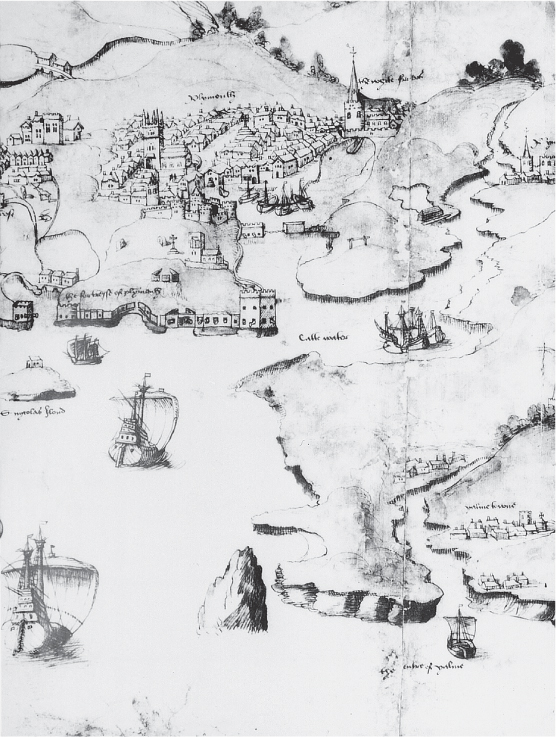
Plymouth harbour. Part of a panoramic map of the south coast of Cornwall and Devon, made in about 1540. Cattewater appears in the centre of this detail, and St Nicholas Island centre left. From British Library Cotton MS Augustus I, i, 35, 36, 38, 39. (British Library)
Also, Sir, considering the unlikelihood of the coming forth of the French army, as I wrote to your grace yesterday, I see not in [more deleted] my poor reason what good might ensue of our remaining here, but rather many hurts; and therefore, unless that I have contrary commandment from your grace before the wind serve me to go hence, with God’s grace I will not fail to draw to Hampton-ward. Also, pleaseth it your noble grace to understand your gracious letters directed to my Lord Ferrers and other your servants and captains here hath marvellously rejoiced them, and they all most humbly thank your grace for the same, trusting shortly to show what mind they be of to serve your grace. Also, according to your commandment, I have sent [William] Fitzwilliam, which is right sore against his mind to have departed till he had done you some other service; and, Sir, most humbly I beseech your grace to be good lord unto him. And, Sir, I am sure at all times when your grace shall command him he shall do you hardy service. Also, Sir, while I was writing this letter, I had word that 20 sail of Spaniards with 6,000 men should be come to Falmouth, but I know it not for a truth; and if it be so, your grace shall know it shortly. And thus Our Lord send your highness the accomplishment of your most noble heart’s desires. Scribbled in the Mary Rose at Plymouth, the 13 day of May at noon.
Your most humble subject and Admiral, Thomas Howard.
22. Thomas, Lord Howard, to Wolsey, 14 May 1513.
Master Awmner I hertly recommande me unto you. And wher I wrote
yesterday to the Kynges grace that as sone as the wynd wold serve
me I wold come with all the navie men off war and vitellers
God and the wynd serving [to Hampton] I entend kepe the same purpose
onles that I have contrarie commandment. Assewryng you
that we ly here in the worst havyn in Inglond to gett out off
for our armye lieth in iij parties and all within Plymmouth Sownd
so that no wynd save onely north can bryng us all forth
without warpyng. I pray God bryng the wynd
out off the south or els none of us can get forth. Here we
ly vitellers and men off war I am sewer above C sayle, and
Gonstone is yet at Dertmouth, and yet he went hens before
my commyng, and in no wise can get to Hampton. Sir the
cause of my wryting to you is to advertise you that none of the
shippes ye named in Dalaber is bill, nor none of the vitellers ar
departed yet hens. And yet they and we be redy to depart as
sone as God shall send wynd. And therfor consideryng it woll
aske a tract off tyme after the seid vitellers be come to Hampton
and after their commyng or their vitell can be shipped me thynk
it wer [well] done ye shuld cause all souldiors that shall come with
Sir charles to tary aboute Salysbury Wynchester and other places
without commyng to Hampton tyll the shippes be come and their
vitelles in, for in my mynd their abode there shuld be the cause
of wastyng of suche provysion as shuld serve the armye, and
doute ye not I shall not lose one oure off tyme when the wynd
shalbe possible to serve. And thus Our Lord kepe you and send
me onys hens. Scrybled in the Mary Rose at Plymmouth the
xiiij day of May.
Assewredy yours
Thomas Howard.
Master Almoner, I heartily recommend me unto you. And where I wrote yesterday to the King’s grace that as soon as the wind would serve me I would come with all the navy, men-of-war and victuallers, God and the wind serving, [to Hampton inserted], I intend to keep the same purpose unless that I have contrary commandment, assuring you that we lie here in the worst haven in England to get out of, for our army lieth in three parts, and all within Plymouth Sound, so that no wind save only North can bring us all forth without warping. I pray God bring the wind out of the South, or else none of us can get forth. Here we lie, victuallers and men-of-war, I am sure above 100 sail, and [William] Gonson is yet at Dartmouth; and yet he went hence before my coming, and in no wise can get to Hampton. Sir, the cause of my writing to you is to advertise you that none of the ships you named in [James] Delabere’s bill, nor none of the victuallers, are departed yet hence; and yet they and we be ready to depart as soon as God shall send wind. And therefore, considering it will ask a tract of time after the said victuallers be come to Hampton, and after their coming or [before] their victual can be shipped, me think it were well done you should cause all soldiers that shall come with Sir Charles to tarry about Salisbury, Winchester and other places, without coming to Hampton till the ships be come and their victuals in. For in my mind their abode there should be the cause of wasting of such provision as should serve the army. And doubt you not I shall not lose one hour of time when the wind shall be possible to serve. And thus Our Lord keep you, and send me once hence. Scribbled in the Mary Rose at Plymouth, the 14 day of May.
Assuredly yours, Thomas Howard.
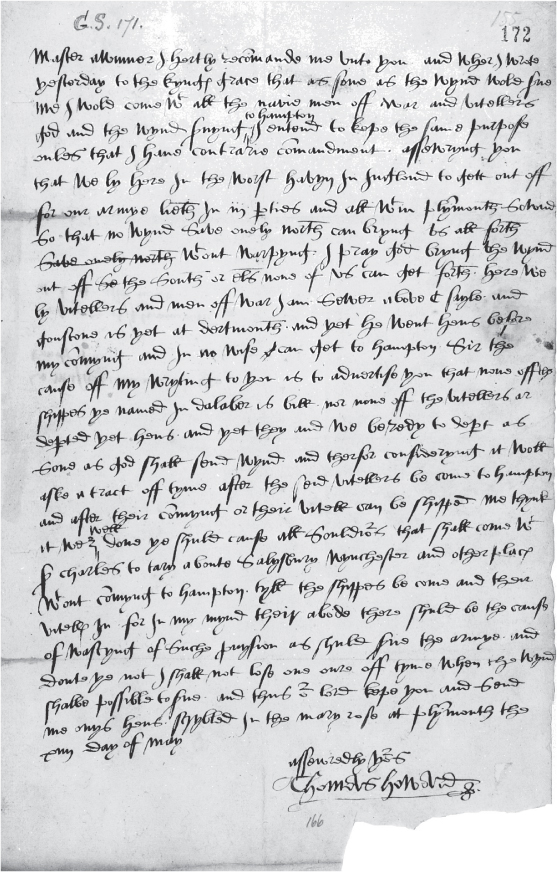
Lord Admiral Howard to Thomas Wolsey, 14 May 1513. The original spelling is transcribed in Letter 22. (Public Record Office)
23. Thomas, Lord Howard, to Wolsey, 15 May 1513.
Master Almoner, I heartily recommend me unto you. And, thanked be God, the wind is where I would wish it, howbeit it bloweth so sore that I with the Peter and divers great ships cannot get out of this water called Cattewater; also, here be many small men of victuallers that cannot get out, the wind blowing thus strainable. But I trust against night this West-North-West wind will lie, and then we will forth with warping, and otherwise we cannot, for till we be past the point [of the castle inserted], the wind is full in our way, as every shipman can show you. Wherefore I heartily desire you to call unto you some mariner that knoweth this coast, and then I doubt not you shall know there is nothing undone that may be done here.
In following the King’s pleasure, also the Sovereign and all the carracks and all the great ships ride under St Nicholas’ Island, and with this wind may go where they will; and so I have commanded them to go forth and ride in the Sound, and as soon as this letter is written I shall go myself into Ash water and send all the victuallers there forth to Hampton [water deleted]-ward, and with them Anthony Pointz, Wiseman and Draper, for wafters. And if it be possible that the wind be anything peaceable, this night with all the residue of men-of-war and victuallers, I will to Hampton[-war]d. At which time I require you I may have a [strait inserted] letter directed to m[e comma]nding me to suffer no man, captain nor other, to go on [land, al]so another to the captains not to go on land without [licence]. Sir, I am loath to complain, and also it is no ti[me with]al, howbeit I assure you I am deceived […] wind came westerly and I had […] to bring them to their ships, which be sparkled 12 [miles] abroad in the country, I have given no longer day but to […] to be aboard, and I have made a pair of gallows at [the] waterside, where I fear some will totter tomorrow, [for I would] rather hang half a dozen knaves than any oftener to […] this displeasure, all [men deleted] captains do not amiss, but I assure you […] most part in this behalf. Wherefore I require you to cause these sharp [letters] to be directed, and make your ground that the King is [infor]med that the soldiers be abroad in the country and rob [and] steal and do much hurt. Touching this matter I say [no] more: sapienti pauca.
Also I send you a writing of […] Spanish which a merchant of [Bristol inserted] gave me this day and [came] hither this night, and was at Cadiz [in Spain inserted] 10 days past, and [heard] the same proclaimed, and for his safeguard if he h[ad] to meet with Frenchmen brought the same with him. I [think] the King shall speed the better if [the King inserted] trust his own [people].
Also, Sir, I am surely informed by Sabyne that at the [same] time Brest castle was won by Mons. de Rohan and M[ons.] de Shamperons, the French King’s lieutenant, then […] obtained it by these ways. There was many Bretons [in] the castle which had their lands lying in the country adjoining, and the said French captains gave warning that, unless they yielded them, the[y would] burn and destroy the whole country and [cut] their timber trees by the midst. W[…] especial felling of their trees […] they yielded the keys with […] send us 2 or 300 axes.
Also I beseech you that, at my coming and Sir Charles to Hampton, we may find there my lord of Winchester, to debate with him such enterprises as we have to do; and I trust to rip him well in every cause, for, when I am not occupied, it is my most business to be instructed of them that can skill, most heartily desiring you to beseech the King’s grace not to think no laxness in me for our long abode here with the victuallers, for I assure you the fault is in the wind and not in me, as I am sure every skilled man can show you. And whereas I write unto you often, and peradventure every cause I write of be not of great gravity, yet I require you ascribe not the same to my default, for I assure you I had rather the posts took pain in sparing their horses than I should be found too slow in writing or working when time shall require; and till I see you I shall not forget your words ad captandam benevolentiam [of timely goodwill]. And Our Lord hold the wind where he is, and on Tuesday at night you shall not fail then to have the victuallers [there deleted] at Hampton, and the men-of-war about the Row and the Wight. And thus Our Lord keep you. Scribbled [in] haste in the Mary Rose at one at after [noon], when the w[ind … ] too sore if God would otherwise.
[I have] appointed ships here for [my Lord] Broke and Sir Piers Edgecombe […] for a month of provision […]tre and wafters for [ … Lord] Broke will keep his […] not, he is to blame.
Yours assuredly, Thomas Howard.
Endorsed: To Master Almoner with the King’s grace. Delivered at Plymouth, this Whitsunday before 2 at afternoon.
24. Thomas, Lord Howard, to Wolsey, 16 May 1513.
Master Almoner, I heartily recommend me unto you. And whereas I wrote to you yesterday of our departure hence to Hampton, this day at 10 a’clock, when all men were ready to depart and the most part of the ships ready in the Sound to weigh their anchors, the wind, being at West, shot southerly and blew so rudely that all the ships, victuallers and other, were forced to come in again; and so God knoweth it is unpossible for any ship to depart hence till God send fair weather. And because you should not look for us at Hampton so shortly as I had trusted to have be there, I write to you to certify you how misfortunately the wind serveth us, not doubting but you will look wisely on the matter of the wasting of victual that Sir Charles’s company should do if they came to Hampton before the ships were ready for them. Also I send you now the Spanish letter which I wrote to you of, which my servant that closed your letter forgot. Sir, this day be come hither two ships of Flanders from the Rochelle, saying that they hear the peace proclaimed between France and Spain, and that five ships of Spain be lading wines at Rochelle toward Flanders, and nine other at Bordeaux. I require you to send me word, if any of this navy meet with them or with any Flemings laden with wine, whether you think I should send them to London, Hampton, or elsewhere into England, or else let them freely go; and if I shall make a price thereof or not, and what price I should set, as well Gascony as Rochelle. At this time I write no more unto you, fearing you be weary of my often writing; but I had rather to be judged too quick than too slow. And thus Our Lord send you that your heart most desireth. In haste, at 2 a’clock, in the Mary Rose the 16 day of May.
Yours assuredly, Thomas Howard.
25. Thomas, Lord Howard, to the King, 18 May 1513.
Pleaseth it your most noble grace to understand the 17 day at 10 a’clock before noon, I received your letters of the 15 day, by the which I perceive your pleasure is to have certain ships to come into the Narrow Sea. And according to your highness’s commandment I have sufficiently victualled them as much as they can bestow. And beside that, I have appointed the Peter of Fowey, which hath a great substance of victual in her, to go with them in the Mary of Brixham’s stead, for she is as good with a sail as the other, and in her I have put 40 tall men and two gentlemen of mine for captains. Beseeching your grace to take no displeasure that they, the victuallers, nor the residue of your army, departeth not hence, for I assure your grace, as yet it is not possible. We be all ready, and have been these six days; and now these two or three days past, the wind blowing at West-South-West, which is the best wind possible to bring us to Hampton, hath and yet doth blow so strainable that we have been forced every man to lay out shot, anchors and all, and have broken many anchors and cables. Assuring your grace that whosoever bought your new cables hath done you shrewd service, for they be made of the worst stuff that ever man saw, as at my coming to Hampton your grace shall well perceive by an example I shall send you of the same. Sir, your grace may make a sure reckoning, God willing, within one day and a night after this great tempest is done, to have all your victuallers at Hampton, and the ships by your grace appointed shall come into the Narrow Sea as shortly as shall be possible. And I with the whole army will come along the coast of Normandy, which me think shall cause them to think that we intend no more to come in Brittany, they seeing us draw from thenceward toward England. And, Sir, at our coming again thither, I trust it shall cause them to be the more unprovided. Sir, I beseech God that your pretended enterprise be not known by your enemies, for and it be, I fear they shall draw all their ships from Brest unto Rochelle or Bordeaux. For, Sir, I assure your grace I have so debated here with them that knoweth Brest everything what we may do, as well by land as water, and what resistance your enemies may make, that I think, God willing, it shall not be possible for them to save their ships nor galleys if we find them at Brest. And thus I beseech Almighty God to send your grace the accomplishment of all your most noble heart’s desires. Scribbled in the Mary Rose the 18 day of May, at Plymouth, where I pray God defend me for ever coming again with such a small army.
Your most humble subject and Admiral, Thomas Howard.
26. Thomas, Lord Howard, to Wolsey, 20 May 1513.
Master Almoner, with all mine heart I recommend me unto you. I send here enclosed a letter which was sent me yesterday, and I have examined him that brought it, who was in Guernsey this day seven-night. He saith that there came from Brittany-ward and went toward Normandy the 11 day of May 60 sails and above, and also there came in like wise [18 then 13 sail deleted] 18 sails from Brittany to Normandy-ward the 13 day. Also he saith that there is divers ships of Brittany laden with wine and linen cloth come into Guernsey, and the Bretons of the said ships say that they have taken their ordnance out of their ships and had it into the castle, and will no more meddle on the sea this year, but will defend the land; for on the sea they be not able to compare with the King’s army, but against the next year they will make ships enough to defend the sea. Also he saith that the Bretons say that Frere Barnardyne is looked for in Brittany with 10 galleys, which I believe not to be true, for I never heard he had more than one galley and one foist. Also he saith that the Normans bring their goods fast into Guernsey for fear of the King’s landing there, and the said Normans say that, and the Englishmen come thither and burn not, the country will yield to them. In base Normandy here be all the sayings of this man. Also I have a Breton here which came [thence deleted] with English prisoners the [17 corrected to] 7 day of May from St Pol de Leon. And I have straitly examined him; who saith that the mariners that came from Brest by stealth, having no will now longer to serve in the ships of war, say that the ships of war were come forth from the castle and would return to their countries; and that the hulks that were at Brest said they would go homeward and convey the Admiral to Honfleur, where he intended to lay up his ship for this year. I asked him further and if the French King’s mind were to have his army come forth, and for how long he thought it would be or they might be victualled; and he said it was not possible for them to be victualled in two months. Also he saith that the ships of Brittany that be at home be haled up into creeks and digged in pits, not thinking to come to the sea this year. Also he hath showed many other things which be of no great weight. Master Almoner, I write unto you the premises because, you being informed thereof, may debate among my lords of the Council what is to be done every way. I mean thus, if it so be that the navy of France be sparkled every ship to his port, and few or none left at Brest, methink the enterprise pretended there should be greatly chargeable to the King, and small profit should ensue thereof; the certainty whereof I doubt not to certify you as shortly as wind and weather will serve, for I have appointed three good barks to go along the coast of Brittany only to take me some fisherman or other that may ascertain me of the truth of the premises. And if they can take none such, yet shall they go to Guernsey where [Sir Richard] Weston shall certify me if any of the men-of-war be gone to Normandy-ward, which he knoweth as well by report of Bretons that daily resort thither, as also in seeing them that do pass by the isles; not doubting by this means at my coming to Hampton to have perfect knowledge of all their doing. Desiring you most humbly to have me recommended to the King’s grace and the Queen’s, to my lord my father and all such as you know my friends; beseeching his grace to think no default in me of our long abode here, which is to me the most sorrow that might have come to my heart. But against the wind I cannot make ships sail, and if I might, I had been hence nine days past, as God knoweth, who have you in his tuition.
Scribbled at Plymouth, the 20 day of May, warping with much pain from Cattewater to the Sound.
Yours assuredly, Thomas Howard.
27. Thomas, Lord Howard, to the King, 28 May [1513].
Pleaseth your most noble grace to understand this morning at 5 a’clock came unto me Sabyne, whom with two other ships I had sent to the coast of Brittany. Sir, they have taken 13 sails laden with salt, and are in the Needles. Sir, [the otiose] Sabyne saith that Weston sent one out of Alderney to Normandy to know tidings, and he saith that on Thursday last he left the Lewis, the ship of La Bouille and the ship of Dieppe, and divers others ships without Honfleur in the road, and Sir, I think it shall not be possible for them to get in these neap tides. Wherefore, with God’s grace, I will forth this day so that I may be with them in the morning by day. I pray God I may find them there; and then I trust to do your grace some service. Also, Sir, the prisoners taken say that all the men-of-war were coming to Normandy to revictual, and at [St] Brieuc took their counsel, and so [the galleys with deleted] the ship of Bordeaux, the ship of Rochelle, the ship of Rouen with 12 sails returned to Brest and the rest went toward Normandy. Also they say that the Queen is come to Nantes and hath sent money to pay wages for three months, and also a ship of 60 laden with powder and ordnance to Brest. Also they say that the French King hath sent Mons. de la Motte into Scotland with money to pay the wages of five Scottish ships and 18 of Denmark, and with him two ships laden with flour, and be gone by the west parts of Ireland. Sir, other news here be none, but shortly I trust your grace shall have others. With God’s grace, who send the accomplishment of your most heart’s desires. Scribbled in great haste, the 28 day of May at 6 a’clock in the morning.
Your most humble subject and Admiral, Thomas Howard.
Endorsed: To the King’s most noble grace, and in his absence to my lords of his most honourable Council. Haste, post. On thy life.
28. Thomas, Lord Howard, to Wolsey, 5 June [1513].
The King had been at Southampton, but was now on his way back to London. No text survives of instructions cancelling a further assault on Brittany; the order seems to have been given verbally to the Admiral on 4 June, as explained here.
Master Almoner, with all my heart I recommend me unto you. Good Master Almoner, I have found you so kind unto me that methink I can do no less than to write unto you from time to time of all my causes. So it is, though I be unable therefor, it hath pleased the King’s grace to give this great room and authority more meet for a wise, expert man than me. But since it hath pleased his grace to admit me thereunto, as far as my poor wit can extend, I shall endeavour myself from time to time to do all manner of service where I shall think to deserve his most desired favour. And, good Master Almoner, as my most singular trust is in you, send me both now and at all other times your good advice and counsel, assuring you that never poor gentleman was in greater fear to take rebuke and ill report than I am of such as knoweth not what may be done, which generally be the greatest number, and for many causes, of which I shall rehearse a part.
First, I well perceive what reports both this year and the last was made of my brother (whom Jesus pardon) because there was none other service done, considering what great charges the King was at in keeping so great a navy on the sea. And I well know that I nor no man hath better will nor more hardly durst serve his master than he, as the proof hath showed; and as for experience, I am yet far from that he had, [which deleted] and yet his fortune was not to have at all times the best report, many men putting fear what he durst do, which opinions the day of his death he well proved untrue. Alas, Master Almoner, I see not now how I shall escape such reports, for I cannot see how I may do any pleasant service to my master, for I see no ways but one of the two.
The one is that, at my going to Brittany, my fortune might have been so good that, either I might have burned the ships at Brest castle, or else to have destroyed the haven there with drowning of ships, as I have before written unto you. Which enterprises being debated before his grace, and such dangers as I thought might thereof ensue by me declared before his grace, I showed his grace I durst not enterprise the said feats unless that his grace would discharge me if any misfortune fell by the same. And then his grace bade me not spare to adventure the same, and to go with his army into the great water of Brest. And now, since his departure hence, my lord of Winchester and my Lord Lisle have devised upon the said enterprises, and yesterday called me unto them and commanded me in the King’s name not to enter the water of Brest till I knew further of the King’s pleasure, for great causes which they would advertise the King and his Council of.
And so, this matter taking none effect, I see no way how I shall deserve thank unless the Scots and Danes join with the Frenchmen, without whom I never think we shall find the Frenchmen abroad. And therefore I beseech God that shortly they may join, which only may be the safeguard of my good name. And, good Master Almoner, if you see surely that the Scots and Danes come not, let me have licence to discharge all this army, save only the King’s ships, with whom the navy of France will not fight this year. And as for the Spaniards here, I assure you [they] would fain be at home ever since they heard of the truce.
And thus most heartily I beseech you, if my misfortune shall be to do no acceptable service, to be means for me to the King and his Council to consider that never man endured more pain than I shall do to see all other where they may do good service if they will, and I can do none but his enemies will adventure as well as I. And, for God’s sake, let his grace and his Council command me to some hard enterprise to see if I will follow the same, being in despair save only of the Scots and Danes coming.
Master Almoner, all the premises and all other my causes I remit to your wisdom, fully trusting that you will not only from time to time give me your good advice and counsel, but also with your friendly words withstand all ill reports undeserved made [of me inserted], as my singular trust is in you. And thus Our Lord have you in his tuition. Scribbled at Hampton, the 5 day of June.
Yours assuredly, Thomas Howard.
29. Thomas, Lord Howard, to Wolsey, 6 June 1513.
Master Almoner, with all my heart I recommend me unto you. This morning at 8 a’clock came to me [Richard] Calthrop and Harper, whom I had sent to the Normandy coast to know some tidings, and they have taken a fisherman with seven men and brought unto me the master, whom I have straitly examined; and he saith that there came 15 or 16 days past 18 ships out of Brittany to Honfleur, and be all laid up under the town, and all the mariners and soldiers returned to their houses, saying they will no more go to the sea this year without the Scots and Danes come, whom they look daily for. I asked him if they made any preparation for new revictualling, and he saith nay, save that Hob a Barton hath already mustered men to furnish a new ship that he hath made and a bark that shall go with her, with whom he will go toward the north parts. Also, he saith that it was said that a great power of Englishmen would land in Normandy, and that all the country was in great fear, and if any such came, would gladly yield themselves English, so that their country were not robbed nor burned. The French King had so pilled them with more larger tailles by the third part than ever he had done, that they would gladly be English and to be out of his thraldom, saying that, and [if] the war continue one year, Normandy shall be utterly destroyed. Also, Wiseman being in company with Calthrop and Harper, hath brought with him a hulk which came laden long ago with wines from Bordeaux, and she was attached and brought unto Dieppe, and her wines taken from her. Because an Englishman of long time dwelling in Flanders was master of her, who now of late was suffered to depart with the ship and is come with Wiseman, and as yet is not come to me; but Calthrop and Harper saith that he saith in everything as the other Frenchman doth, saving he saith Hob a Barton is already departed northward with 12 sails of small ships, intending to seek his profit northward. I pray God he meet not with the Iceland fleet. Also the Englishman saith that a ship of more than 200 of those that came out of Brittany fell on a leak and was brought to Harfleur; and in bringing her on ground watered on the one side and is perished. Which premises heard, I took horses and rode to my lord of Winchester and to my Lord Lisle hither, to show them the premises, and forthwith will return to the ships. As for news out of Brittany, yet I have none, but I look hourly to hear, for I have three ships on that coast. And when my departure shall be I cannot yet certify you, for there is slow lading of beer at Portsmouth, and tomorrow I will take the musters, and with as much haste as may be possible I will depart to Brittany-ward, with God’s grace, who have you in his tuition. Scribbled at Winchester, the 6 day of June at one at afternoon.
[Postscript]: Sir, as yet I hear no word of anchors nor cables from you.
Yours assuredly, Thomas Howard,
Endorsed: To Master Almoner with the King’s grace. Delivered at one at Winchester the 6 day of June.
30. Thomas, Lord Howard, to the Council, 8 June 1513.
Pleaseth it your good lordships to understand the 7 day of June I received your letters at midnight of the 6 day, and where it pleased you in your first article to answer that I wrote to you touching my return to Brest; my lords, I assure you there can no man be more joyful than I am to go thither, for no creature alive would more gladly do some acceptable service than I. And without it be done there, I see not where I shall do it, unless the Scots and Danes come, and you may be sure I shall do the best I can to do the pretended enterprises with as good policy as I can use to save the King’s navy. But without some adventure none exploit of war will be achieved, trusting your good lordships shall well perceive there shall lack no good will in me.
And as touching the receiving of bows and arrows, I shall see them as little wasted as shall be possible. And where your lordships write that it is greatly marvelled where so great a number of bows and arrows be brought to so small a number, I have enquired the causes thereof; and as far as I can see, the greatest number were witch bows, of whom few would abide the bending. But as for that was done before my time, I cannot call again, but from henceforth, if I do not the best I can to keep everything from waste, I am worthy blame, which I trust I shall not deserve.
And as touching the safe keeping of foists, assuredly, before my coming was great waste, and since my coming I trust few or never one hath been wasted, nor shall be.
And where your lordships write for the discharging of victuallers not necessary, my lord of Winchester and my Lord Lisle can inform you how I have ordered that, for of 140 and more I have taken under 30, and would not have had more than 14 save only to bring the foists again hither as they be emptied.
And as touching divers other causes which your lordships hath made me now answer of, I shall not need to touch the same, but other causes requisite here.
Yesterday I began to take the musters, and this day and tomorrow by noon I trust to make an end. I fear there is a great number gone without licence. My Lord Ferrers’ men mustered yesterday, and were but 300 and 11. He saith he is sure he wanteth above 100, and is as angry therewith as ever was man, and hath delivered me two that were going away; whom, if I can prove that they were departed, I shall not fail to cause to be hanged tomorrow. Also he showeth me that the gaol of Hereford is full of his men that be run away. Wherefore methink it were well done that the King’s grace should command some of them to be put to execution, which shall put others in fear; and if some might be brought hither against my return, to be put to execution here, methink it should be well done.
And as touching my departure hence, I assure your lordships I tarry for nothing save only for lading of beer, which is the slowest work that ever man saw. There is but two cranes, and the crayers that shall be laden with them must come in at a full sea, and at a full sea go out. Wherefore, if your lordships see not another provision for lading of beer against the next revictualling, I fear me we shall spend half or we get hence. Wherein I have communed with William Pawne and Palshide, and we see no remedy so good as to do it with lighters, as we do in the Thames, and in this country is none. Wherefore, if it would please your lordships to send hither out of the Thames two or three of the greatest, and to be towed hither with crayers, we think it should be the most profitable way for the King’s grace. And with making them higher with a strake of board, we doubt not they shall come safe hither. [Hither corrected to] Here is the goodliest sort of [bows deleted] brewhouses that ever I saw, and already do brew 100 ton a day, and great pity it were that there should not provision be made shortly to ship the same. Also, when the beer is put in the vessels, there is no houses to lay it in, but are fain to lay it abroad in the streets, where now the hot weather coming on, it shall shortly be destroyed. Wherefore I have commanded William Pawne to cause great trenches to be digged and to be covered with some boards, turves, sedges, and such stuff as may be gotten, to keep the heat therefrom. Also, the beer that came hither for my Lord Lisle is such as no man may drink for the most part. I have assayed the most part of it, and the Treasurer and the Clerk Comptroller the rest, and as much as may be drunk is delivered to the ships; and the rest I shall send again to London, for Heron’s servants that hath the delivery of it here saith that the brewers be bound to take as much as is unable stuff. I know not what the King payeth, but I assure your lordships, much of it is as small as penny ale, and as sour as a crab. I doubt not your lordships will see the brewers punished.
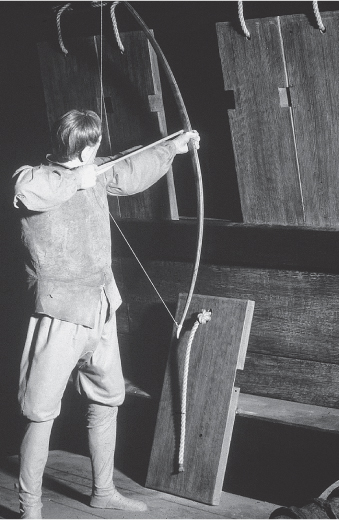
A reconstruction of the aiming of a longbow through one of the removable blinds on the museum reconstruction of the upper deck. (Mary Rose Trust)
Also I send your lordships a charter party which I have received of a master of an hulk laden with woad. I have put him under arrest till I know your pleasure. If it be a prize it is worth £3,000 or better, and if the truth be well tried, I think it will prove Frenchmen’s goods. I beseech your lordships I may know your pleasures therein, and whether you will I shall deliver the goods to Dawtrey or no till the trial be made. If it be laid on land, at the least the King shall have the custom.
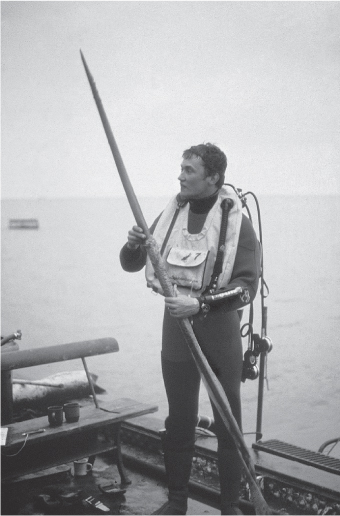
Christopher Dobbs holds one of the 137 complete yew longbows recovered. (Mary Rose Trust)
Also, the King’s grace promised me to send me certain hackbuts in exchange for such as I shall send his grace. I beseech your lordships they may be shortly sent hither by land. And with all possible haste I shall depart forward, with God’s grace, who have you in his blessed tuition. Scribbled at Portsmouth, the 8 day of June.
Thomas Howard.
Endorsed: To my lords of the King’s most honourable Council. Delivered at Portsmouth at 11 before noon. Haste, post, haste, haste.
31. Thomas, Lord Howard, to the Bishop of Winchester, the Earl of Surrey, and Wolsey, 13 June 1513.
Pleaseth it your lordships to understand this day at 3 after noon I received your letters of the 12 day of June, and by the same I perceive your pleasures touching the wages of the ships in the Narrow Seas, and so shall follow your pleasures therein; but before your letters came, the Carrack of Savona [alias Santa Maria de Loretto], the Katherine Fortileza, and the Mary George were gone out of sight toward the Narrow Seas, and with them many small men, some with the King’s mounts of the New Forest, and some with other necessaries sent from Hampton which I know not what they carry, and many to convey the King’s army over, and I doubt not will be in the Downs or [before] you shall have this letter. And where your lordships write to me of the being of the ship of Denmark in Flanders, and also of the galleys in Dieppe, I have sent three small ships after the said carracks with a letter to advertise them thereof, and also if the galleys come forth, to meet with them; without which small ships, if the galleys meet with our ships, little good would be done, and peradventure if a calm came, much danger might ensue. And therefore, to provide for the worst, I have sent them; and yet, thanked be God and the King’s grace, we be strong enough here to encounter with the whole fleet of France. And if the wind had served, I had been well onward toward Brest or now, as knoweth Our Lord, who have your good lordships in his tuition. Scribbled in the Mary Rose before Quarr Abbey, abiding to know the King’s pleasure; beseeching your good lordships to command me shortly what shall be your pleasures.
Yours assuredly, Thomas Howard.
Endorsed: Delivered at Portsmouth at 4 at afternoon the 13 day of June.
32. Lord Admiral’s warrant for oars, 18 June 1513.
Cousin Wyndham, I will that you pay to the purser of the Mary Rose 20s for 2 dozen oars. And this my writing signed with my hand the 18 day of June in the 5th year of King Henry VIIIth shall be your warrant for payment of the same.
Thomas Howard.
33. Miscellaneous expenses of the ship, 14 March–16 July 1513.
The charges of the good ship called the Mary Rose from the 14 day of March unto the 16 day of July.
[Jesus at the head of each page]
Item paid for a lighter the 18 day of March for carrying of 2 great curtals to Woolwich – sum 2s 6d.
Item paid to Hoberd dwelling at the Queenhithe the 21 day of March for a small rope weighing 82lb, thelb at 1½d – sum 10s 3d.
Item paid for an axe and 2 great garnets the 21 day of March – 2s 8d.
Item paid for 10 ells of fine Normandy canvas, the ell 7½d – 6s 3d.
Item paid the 25 day of March to William Hallyngberry dwelling in Sandwich for 2 small ropes weighing 272lb the 100 [cwt] at 13s 4d – 36s 1d.
Item paid for 2 small lines – 16d.
Item paid at Sandwich 26 day of March for 12lb of sail twine, thelb at 6d – 6s.
Item paid at Dartmouth for a 100 spikings – 2s 6d.
Item paid at Plymouth for making of the cat [hook deleted] – 2s 8d.
Item paid for 2 gallons of vinegar for Nicholas Kyng to make fine powder for hand guns – 8d.
Item paid the 20 day of April for mending of the standard and the flags and streamers – 8d.
Item paid for thread for the foresaid business – 3d.
Item paid the 10 day of May at Plymouth to William Randdale for a small rope weighing 36lb, thelb ½d – 4s 6d.
Item paid the 10 day of May at Plymouth to John Pounde for 2 small lines – 2s.
Item paid the 11 day of May at Plymouth to John Pounde for half a 1,000 of 10-penny nail, the 100, 10d – 4s 3d.
Paid for half a 1,000 of 5-penny nail, the 100 at 6d – 2s 1d.
Item paid the 11 day of May at Plymouth to John Boene for a great elm for the stock of a brazen piece – 3s 4d.
Paid to the said man for 6 small elms, 4 of them to make axle-trees for falcons and the other two for the bumkin – 3s 4d.
Item paid the 12 day of May at Plymouth to Richard Koke for 2 boat hooks – 13d.
Item paid to William Edzskome at Plymouth the 12 day of May for ironwork that went to the stocking of the brazen pieces, weighing net 120lb, thelb 1¾d – sum 14s 7d.
Item paid at Plymouth the 19 day of May to Nicholas Elles of Topsham for 3 small hawsers weighing 300 quarters, price the 100 [cwt] 12s 4d – sum 40s 1d.
Item paid at Plymouth the 23 day of May to the vicar for a piece of timber for the cock’s wale – 16d.
Item paid to Richard Chalfer of Plymouth the 23 day of May for a 100 rough and clench nail – 16d.
Paid to the same man for making of a chief of iron for the cock’s head – 10d.
Paid to the same man for half a 100 of spikings, weighing 14 lb – 2s 4d.
Item paid the 4 day of June to Robert Myle of Southampton for 4lb and a half of marline – 12d.
Item paid the 8 day of June at Plymouth to John Johnson for 2 bands and 2 bolts of iron for a great piece of brass, the which weighed net 34lb, thelb at 2d – sum 5s 8d.
Item paid to the same man for 2 boat hooks – 12d.
Item paid to John Byrd the 18 day of June for 2lb of sail twine, thelb at 6d – 12d.
Item paid at Sandwich the 22 day of June for ironwork for the boat’s rudder and the cock’s rudder, weighing 14lb, thelb at 2d – 2s 4d.
Item paid at Sandwich the 10 day of July to Thomas Balze for 300 6-penny nails – 18d.
Item paid at Sandwich the 12 day of July to John Messyng for a hook to fetch the anchor with, weighing 32lb – 5s 4d.
Item paid to the same man for 2 boat hooks – 12d.
Item paid at Sandwich the 15 day of July for 2 small masts for the making of the deck, to France Sketto – 5s 4d.
Item paid the 15 day of July at Sandwich to William Hallyngberry for 6 small ropes weighing 88lb, the which ropes shall be occupied for the net in their upper deck – sum 11s 9d.
Sum total – £9 8s 10d
Received by a warrant of my lord Admiral of Master Treasurer – £8.
So rest unto me – 28s 10d.
Minuted by the lord Admiral: Cousin Wyndham, I pray you pay him the said 28s 10d.
Thomas Howard.
34. Ordnance charges authorized by the Lord Admiral aboard the Mary Rose, 12 July 1513.
These be the parcels which I Sir William Sidney have laid out in making ports and other things necessary in the Great Carrack in time of the King’s going over.
Item, for boards and planks which was [?] fetched from Rye to the Downs – 30s.
Item for a crayer hired to bring the same stuff – 10s.
Item for 4 great trees and 8 spars which was bought at Deal – 14s 6d.
Item for iron and coal to make joints, spikes, clenches for making of the ports, to smiths working upon the same – £3 5s.
Item for nails great and small – 8s
Item for tallow to tallow the ship with – 20s.
Item for reed and broom – 5s.
Item paid to 6 carpenters for working upon the said ship – 20s.
Item for a new stock to the great gun – 8s.
Item for the hire of a gear to wind up the piece – 12d.
Item in meat and drink for the carpenters working upon the same gun – 4s 10d.
Item for iron and the workmanship thereof upon great bolts and breeches to the said gun – 12s.
Item to the carpenters working upon the same gun – 6s 8d.
Item for ironwork and plate for 2 serpentines – 4s 4d.
Item for a man that rode in post from Flushing to Calais – 20s.
Sum – £11 9s 4d.
Minuted by the lord Admiral: Cousin Wyndham, I pray you allow these parcels above written, and this shall be your discharge. Written in the Mary Rose the 12 day of July.
Thomas Howard.
35. Lord Admiral’s warrant for payment of wages to the master surgeon and his assistant, 20 May 1513; with entry in the accounts of Sir Thomas Wyndham, treasurer of the army, for payments made by authority of the King’s letters missive for the month beginning 13 July following.
Cousin Wyndham, where Robert Symson was appointed by my brother Sir Edward Howard, whom God pardon, to be the master surgeon within the Mary Rose, and is not expressed within your letter missive to you directed from the King’s grace to receive the wages of a master surgeon, that notwithstanding, my said brother’s promise considered, I will you pay him the wages of a master surgeon every month from the 14th day of March during the time that he shall continue in the said Mary Rose, and his servant’s wages after the rate of another surgeon, being no master, for the said time. And this my writing shall be your discharge in this behalf. Written at Plymouth the 20th day of May in the 5th year of the reign of our sovereign lord King Henry the VIIIth,
Thomas Howard.
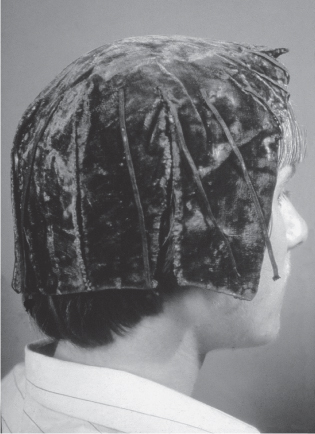
Cap of silk velvet, found in the barber surgeon’s cabin. Similar coifs are seen in a contemporary painting of the Barber Surgeons’ Company. This one was probably worn by Robert Symson’s successor in 1545. (Mary Rose Trust)
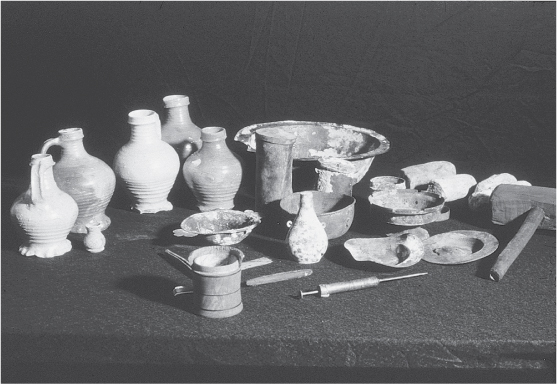
Items recovered from the barber surgeon’s cabin which reflect his multiple functions: razors, whetstones, bowls for shaving, medicine bottles and a pewter bleeding bowl. (C.T.C. Dobbs/Mary Rose Trust)
[The warrant attached to the following entry in the account.]
To the Mary Rose. To Robert Symson, [master inserted] surgeon assigned and appointed to the Mary Rose, for his wages at [10s deleted] 13s 4d by the month, by my Lord Admiral’s warrant hereunto annexed, which surgeon remaineth unpaid for 5 months as in the said warrant appeareth, which amounteth to – 66s 8d.
To Henry Yonge his servant, surgeon assigned and appointed to the Mary Rose, for his wages at 10s a month, being unpaid for the foresaid 5 months as in the said warrant doth appear, which amounteth to – [20 deleted] 50s.
36. Lord Admiral’s warrant for compensation to a wounded gunner [after 1 February 1514, when Howard was created Earl of Surrey].
Cousin Wyndham, I will that you pay to Andrew Fysch, one of the gunners of the Mary Rose, by the way of reward to heal him of his hurts – 13s 4d. And this my warrant shall be your discharge.
T. Surrey.
37. Lord Admiral’s disbursements for a fortnight at sea, 1514.
Money that I Thomas, Earl of Surrey, Admiral of England, doth ask allowance of for such charges as I [replacing he] and my [replacing his] company were at from the time we [replacing he] landed at Newcastle into the time we [replacing he] took the sea again, [by the space of 16 days inserted].
The Mary Rose. First for the wages of the footmen at 6d a day a man, by the space of 16 days, of which number the captains and every captain’s number hereafter ensueth.
Item Edward Bray, Captain of the Mary Rose, for his wages for the said 16 days, at 4s a day – 64s.
Item for 201 soldiers and mariners brought with the said Edward Bray out of the Mary Rose for the said 16 days, after 6d a day a man – £80 8s.
Item for 12 gunners of Danzig taken out of an hull to serve for the said journey by land, for their wages and in reward to 7 of them that were hurt – £13 6s 8d.
38. Petition from John Wodlas, pilot, to the Council, received 2 May 1514.
Asking for his expenses in conducting the Mary Rose through the North Sea, and on another occasion attending the Salvator of Lübeck (alias Great Elizabeth).
Pleaseth it your good lordships to understand that I, John Wodlas of Harwich, have given his attendance upon the conveying of the King’s ships as hereafter ensueth.
First the said John conveyed the Mary Rose out of Harwich haven over a danger in the sea called the Naze, and incontinent after, continued to conduct and bring the same ship over again into Harwich haven; and within five days was commanded to conduct and convey the said ship out of the said haven through a place in the sea called the Slade to meet with the King’s grace coming from Calais-ward, and so did. And then incontinent after, conveyed her out of the Downs through the Black Deeps into Thames, which was in the whole by the space of three weeks, and three men at his charges, with his boat by the same space.
Item the said John Wodlas received the said Mary Rose now last at Blackwall, and conducted and brought the same within the haven of Portsmouth, and then returned himself to London by land.
Item then incontinent was commanded by your lordships to go unto the North Foreland to give attendance upon the King’s ship called the Lübeck, and so [to otiose] conveyed the same unto [Portsmouth deleted] London, and by force of weather a storm ‘but’ [? brought] her to the Camber, and there she came to an anchor; and as soon as I heard thereof took my boat and went thither, and before my coming she made sail and went to Portsmouth. Which attendance given unto these said last journeys hath been since the first beginning of Lent past [1 March].
In consideration whereof, it may please your same good lordships to allow unto him his reasonable costs and allowances for the same. And besides all this I have lost in ‘bewyons’ in the Black Deeps and iron chains which were not possible to be lost by tempest of weather, which amounted to the sum of £4.
Minuted by Wolsey [now bishop of Lincoln]: Fellow Daunce, you must pay to Woodeles for conveyance of the King’s ships as is before expressed through the Black Deeps and other places, twenty marks. T. Lincoln.
Endorsed: Received by me John Woodeles of Sir John Daunce, knight, by the King’s commandment, twenty marks sterling, for the conveyance of the King’s ships through the Black Deeps as within expressed, the second day of May in the 6th year of King Henry VIIIth.
Per me John Wodlas.
39. The Earl of Surrey, Lord Admiral, to the Council, 27 May [1514].
[Pleaseth it] your lordships to understand I came yesterday unto Sandwich, [suppo]sing to have found the ships in the Downs, but they were [not] there. And so by 7 a’clock I came unto Dover; and before my coming, about noon, the Vice-Admiral, by the advice of the most expert captains and masters on the coast of Boulogne, sent over Sir Henry Sherborne and Sir Stephen Bull with 10 sails of small men and the rowbarges, galleys and other, well manned, and this was their order, which was as good in my mind as was possible. The wind was at North-North-East, and was so great an haze that skant o[ne] might see a mile; and so upon the flood they drew over with Escalles cliffs, and then with the ebb they came with a good blower towards St John’s road, and sent before them 4 or 5 miles [Sir] Stephen Bull, Thomas Vaughan and three other small men, to the in[tent] to have gotten between the galleys and Boulogne haven, and the r[est] of our ships kept them out of sight; and so our five sail made as much as they might toward the haven. And Prior John [Prégent de Bidoux] with five galleys, three foists and two barks road at the point of St John’s road toward Calais, 5 miles from Boulogne, and as [soon] as our men were in sight, which were but five sail, away went all the Frenchmen with sails and oars all that they might, and won the point of the haven under the bulwark. Which our men perceiving, and that it was unpossible to come unto [them] there without utter confusion, shot at them their ordnance and […] at them. And then our men, perceiving the wind drew northward, they haled out into the road and came to […] anchor before the galleys, without that the said galleys saw [no] more of our ships but those five, and would never weigh to come [with] them. And then about midnight the wind was so […] our men might no longer abide there, but came their w[ay …] and none of them but two might recover Dover road, but w[ent] as far as Camber. And my cousin Wyndham in like […] 20 sails with him, and at this hour I see him with them […] coming again unto us.
My lords, I have written at [length] unto you hereof, because I would you should perceive as well [the] good handling of our men, as also to consider what Pri[or John] intendeth, which after my mind is to make a train […] within the danger of their bulwarks, supposing t[hey might do what] they did the last year, or else to watch for a ca[lm … ] to do some displeasure to some passenger if he can […] for the best I can, and have written unto Master […] he shall suffer no passenger to come over in no calm w[…] them to go over seaboard Goodwin, which is as short way […] within 4 miles and out of danger.
My lords, all this day h[as been] as calm as was possible, so that I might send no ship [over]. This night before midnight, if there blow any wind, I [have] appointed Sir Henry Sherborne with 10 sails, and Wiseman [and] Wallop with other 10 sails, to go over. Sir Henry shall dra[w] by West Boulogne, and if the wind will serve him to get between Boulogne and the galleys, if they be abroad in the [sea] as they were yesterday, and Wiseman shall come from Cal[ais]-ward along that shore to essay what he can do in like [wise].
And if this way will not serve, I can see no ways how t[o get] unto them without likelihood of extreme danger and peril, [unless] that I might have 2 or 3,000 of such soldiers as be now [in] Calais shipped in the haven there and so sent unto me, and to set other 3,000 on land within 2 miles of Boulogne. With which company I think without danger the said galleys would [be] put in great danger to be had. Which I remit to be deb[ated] and ordered after your wisdoms, beseeching you to advertise [me] of your further minds in the premises and I shall gladly follow the same.
Also Sir Thomas West is as Sandwich w[…] and I have commanded him to remain there till he k[nows your] further pleasures. May it therefore please you to certify him how he shall be ordered. Also I have sent two good ships [unto] Zeeland to waft the fleet there. I have also appointed and [ordered] to depart, when wind shall serve, nine good ships to go n[orthward], which be sufficient if the Frenchmen b[…] sails. With God’s grace, who keep you. Written in the Ma[ry Rose] in Dover road, the 27ty day of May at 7 at night.
Yours, T. Surrey.
40. Lord Admiral Surrey to the Duke of Norfolk (his father), Wolsey, and Richard Fox, Bishop of Winchester, Councillors.
The ‘bill’ said to be enclosed does not survive. The words here printed in bold are at the foot of the recto in the MS; the secret part of the dispatch can be read by simply turning the page.
My lords, pleaseth it you to understand, whereas I wrote unto you yesterday how I had appointed certain ships to have essayed an enterprise against the galleys [39], this morning the wind came unto North-West, so that we dare not adventure within St John’s road, for it were not possible to come out of that road, the wind being there. And because I would be assured that nothing should be omitted that may be feasible, with God’s grace with the next fair wind that may possibly serve to go and come, I will go over in the King’s Less Bark with such company with me of small ships as with God’s grace shall do that is possible to be done. And if they abide without the bulwark, I doubt not to displease them without great loss; and if they go within the bulwark, as far as I can understand it is as dangerous as it were to enter within Rysbank tower, which is not to be adventured with none but with them that will cast themselves away wilfully. And my lords, if this enterprise will not take effect, under your corrections, methink it were not honourable that all the army should remain here for fear of the said galleys. And notwithstanding that I know well your lordships can more substantially determine this matter than I can advise you, yet I shall be so bold to advertise you of my poor advice; which is, first considering that it should not be honourable for so royal an army as this to lie here for fear of the said galleys, and also that they cannot long abide here, but must draw to the Wight for their victualling, methink that such ships as be named in a bill here enclosed should suffice to defend the passage, and also sufficient to encounter with the said galleys if they would come abroad. And that Sir Wystan Browne should be most meet man to have the conduct of the said ships; and that the rest of the army should draw Westward to do the most annoyance to the Frenchmen they can.
This side of the leaf the most part of the captains have seen, and desired me so to write. But none is privy to the other side.
My lords, one other matter is, I shall be bold to put you in mind of. If this Frenchman that now is come should conclude a peace with the King’s grace shortly, and then the great ships should be gone westward, the wind might come so that it should cost his grace £2,000 more to bring them into Thames from thence than it should do, they being now here. Wherefore of the premises I beseech you to advertise me of your pleasures, not doubting but you will, as you shall see the case require, either shortly stop or else haste forward as well the King’s great ship with her victuals, as also such victuals as John Dawtrey shall prepare more for this army. In looking whereupon shortly, much money may be saved if the peace conclude. And after my mind, if you think the matter will be concluded within a fortnight, it were better the great ships abode here than to go any further West, [considering the King will have them in to Thames inserted], and small ships may be sent thither. And the ships here be now sufficiently victualled for a fortnight and more, and those that go northward for a month. And of the premises I beseech your lordships to advertise me by post, and also how long you would I should remain here, to the intent that, and [if] I should tarry here, I might send for more of my servants, for I have not here passing 18 with me, which is too few. And thus Our Lord have you in his assured tuition. Scribbled in the Mary Rose in Dover road.
[Postscript]: My lords, yesterday in the calm, Preer John with his galleys and foists chased a small balinger of ours, but he would never come 2 mile from the shore.
Yours, T. Surrey.