
CHAPTER 7
–
‘I loved it when Bush came out and said we’re losing the war against drugs.
You know what that implies?
There’s a war being fought, and the people on drugs are winning it.’
–
Bill Hicks
ICONFESSED IN CHAPTER 6 that I had taken … wait for it … a drug that is illegal in Ireland: cannabis. Gulp. Will the Garda come knocking? I am not alone. (Isn’t that nice?) In 2019 the United Nations Office on Drugs and Crime released the latest on illegal drug use in the world:1 271 million people had used illegal drugs in the previous year. This represented a 30 per cent increase since 2009. The report also revealed that the global illicit manufacture of cocaine had reached an all-time high (so to speak). The US government spends around $50 billion per year trying to eradicate drug abuse, resulting in less than 10 per cent of illegal drugs being seized.2 If drugs were available legally, they could be regulated and taxed. It is estimated that this could generate an income of $58 billion,3 a net gain of $108 billion for the American government. Meanwhile, in Europe, €30 billion is spent on illegal drugs each year.4 Legalising drugs is predicted to hugely reduce the crime rate. The fact that drugs are illegal leads to murder, violence and theft. These crimes are widespread and endemic, and one reason why is the illegality of drugs. The war on drugs has been deemed a failure in report after report. The Cato Institute in the US, which examined the issue closely, has stated: ‘We conclude that prohibition is not only ineffective, but counterproductive, at achieving the goals of policymakers both domestically and abroad. The war on drugs has contributed to an increase in drug overdoses and fostered and sustained the creation of powerful drug cartels.’5

WHEN ELVIS PRESLEY VISITED THE WHITE HOUSE TO ASK NIXON TO MAKE HIM A ‘FEDERAL AGENT AT LARGE’ FOR THE BUREAU OF NARCOTICS AND DANGEROUS DRUGS (PRETTY INAPPROPRIATE, GIVEN THAT ELVIS HAD A DRUG ADDICTION).
Why then is the use of drugs by adults not legal and controlled? Drugs obviously have dangers and can cause much suffering, so is banning them simply a matter of the lesser of two evils? Or is it literally high time to do something radical to deal with a growing problem? Might a rational grown-up response to this issue actually benefit society in the long run?
The term ‘war on drugs’ was coined by the US media shortly after a press conference on 18 June 1971 by Tricky Dicky himself, president of the USA, Richard Nixon. He declared drug abuse ‘public enemy number one’. His passionate advocacy has since been interpreted as racism.6 The theory goes that he knew the war on drugs would disproportionately attack black communities. It has continued ever since then, although the term ‘war on drugs’ is now seen as counterproductive.
Attempts to control recreational drug use have been going on since the nineteenth century. The first modern law in Europe for regulating drugs was the Pharmacy Act, which was established in the UK in 1868. The act set controls on the distribution of drugs and decreed that opium-based products should only be bought from a seller known to the purchaser and only in sealed containers with the seller’s name and address. British traders had long sold opium to the Chinese as a way of balancing trade with China, since there were a lot of Chinese imports coming into the UK, comprising silk, porcelain and tea. Protestant missionaries in China objected to the trade and produced the first-ever scientific analysis on the dangers of opiate addiction in a publication entitled Opinions of Over 100 Physicians on the Use of Opium in China.7 Several nations eventually signed a treaty to control the use of opiates, which was even incorporated into the Treaty of Versailles.
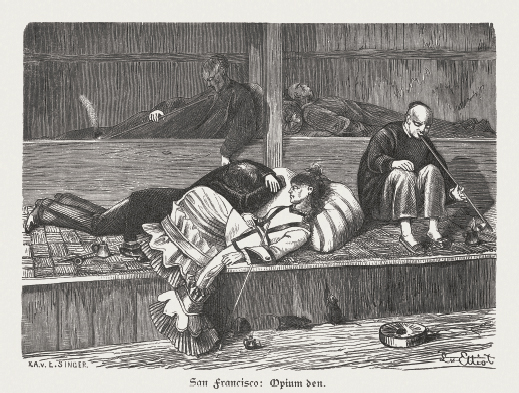
NO, NOT AN IMAGE OF A TYPICAL STUDENT APARTMENT. AN ENGRAVING OF AN OPIUM DEN FROM THE 19TH CENTURY.
In 1914 a US law was passed to restrict the distribution and use of certain drugs, under the Harrison Narcotic Tax Act. The first evidence for morphine addiction in the US was during the American Civil War, when wounded soldiers were treated with morphine, which was seen as a new-fangled wonder drug. It relieved pain, asthma, headaches and menstrual cramps. Doctors loved it, as it worked quickly and the patient went away happy. The Union army in the Civil War issued almost ten million opium pills to its soldiers.8 Many soldiers returned from the war addicted. By the 1880s medical journals in the US began reporting extensively on the danger of morphine addiction. A campaign was launched to ban opiates. This was in part driven by the view that smoking opium was an evil practised by Chinese immigrants, but also by gamblers and prostitutes, and so should be stamped out. In 1875 San Francisco banned smoking of opium in Chinese opium-smoking dens because ‘many women and young girls were being induced to visit the Chinese opium den, where they were ruined morally’.9 The law only banned Chinese people from selling opium.
Until 1912 drugs such as heroin were actually sold in over-the-counter cough syrups. Doctors could also prescribe heroin for irritable babies (it certainly calmed them down), insomnia and ‘nervous conditions’. Then in 1914 the law banned the use of opiates like opium, morphine and heroin. This was followed in 1919 by the Eighteenth Amendment to the United States Constitution, which banned the sale, manufacture and transportation of alcohol, and so began the era of prohibition. This was repealed in 1933, having failed spectacularly. Heroin and cocaine joined the list of banned drugs in 1920.
In 1937 the Marihuana Tax Act was passed to ban cannabis. It has been hypothesised that the motivation for this was to ban hemp, a strain of the cannabis plant that is grown for industrial uses, which could be used to make various products, including paper and fibre for textiles. The pressure to ban it came from the DuPont corporation, who had invented nylon and wanted to kill off the competition. Andrew Mellon, who was Secretary of the Treasury in the US government, had himself invested heavily in Du Pont because of the promise of nylon, and lobbied for hemp to be banned.10
In China, Mao Zedong almost eradicated the opium trade in the 1950s: ten million addicts were forced into compulsory treatment and dealers were executed.11 But the Vietnam War led to a surge in demand, with 20 per cent of US soldiers regarding themselves as addicts in 1971.12 By 2003, in spite of severe penalties, China was estimated to have four million regular heroin users.13
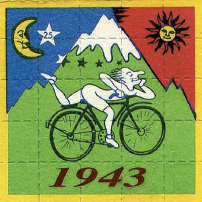
A STAMP COMMEMORATING ‘BICYCLE DAY’ IN APRIL 1943, WHEN CHEMIST ALBERT HOFMANN TOOK THE PSYCHEDELIC DRUG LSD AND THEN CYCLED HOME.
From the 1960s onwards the war on drugs was ramped up significantly and LSD joined the list of banned drugs in 1966. LSD has an interesting history: it was first made in a lab in 1938 by chemist Albert Hofmann, who worked for the drug company Sandoz.14 He was trying to make a drug to stimulate breathing and blood circulation. It took another five years for Hofmann to inadvertently sample some and take the first trip. He then took some on purpose (at ten times the dose needed to have an effect) and had a psychedelic experience, cycling home on his bicycle on what is now known to aficionados of psychedelic drugs as ‘Bicycle Day’. He never thought it would be used recreationally and instead felt that it might have uses in psychiatry. In the US in the 1950s LSD was tested on undergraduate psychology students and Time magazine published a number of positive reports on LSD use in 1954 and 1959. Psychoanalyst Sidney Cohen became a strong advocate and began promoting the drug as a treatment for alcoholism and also to stimulate creativity. He also gave some to writer Aldous Huxley whose book The Doors of Perception was inspired by LSD use (and from which title The Doors got their name). In one trial, LSD was given to alcoholics and showed impressive results: after one year 50 per cent had not had an alcoholic drink.15
By the 1960s over 40,000 patients had been given LSD, mainly for psychiatric disorders. Many psychiatrists began taking it recreationally. Then, in 1965, Sandoz stopped making it, because of growing government protests over its use by the general public. In 1966 LSD was deemed illegal in most countries but continued to be used by artists to inspire creativity. To quote comedian Bill Hicks again (the patron saint of liberalising drug laws): ‘If you don’t believe drugs have done good things for us, do me a favour. Go home tonight. Take all your albums, all your tapes and all your CDs and burn them. Because you know what, the musicians that made all that great music that’s enhanced your lives throughout the years were rrreal fucking high on drugs. The Beatles were so fucking high they let Ringo sing a few tunes.’

COVER OF THE BEATLES 1966 ALBUM REVOLVER. MANY SONGS REFLECT THE BAND’S INTEREST IN LSD.
From 1969 drugs in the US were classified under the Controlled Substances Act.16 In Ireland, the Misuse of Drugs Act 2015 is the main law concerning drug use.17 Schedule 1 drugs are deemed to have no medicinal use and to have a high likelihood of being abused. They include cannabis and LSD. Schedule 2 drugs have a high likelihood of being abused but have medicinal use and include cocaine (which can be used as an anaesthetic), the opiates fentanyl, heroin, methadone, oxycodone (which can all be used in pain relief) and amphetamine (which can be used for narcolepsy). Schedule 3 drugs are frequently prescribed to the public for common ailments, but also carry the risk of abuse and comprise many prescribed drugs. Schedule 4 drugs contain a wide range of medicinal products with limited risk of abuse. In 2010, in response to the threat posed by new psychoactive substances being sold in so-called head shops, 200 new substances were classed as illegal. New drugs are invented all the time, sometimes making it difficult for legislation to keep up. In the past ten years, 700 new psychoactive substances have been made which mimic cannabis or cocaine.18
In Ireland, possession of drugs without a prescription that falls under the Misuse of Drugs Act is illegal and carries various penalties under the law. In 2017 there were 12,211 offences for use or possession and 4,175 offences for supply.19 The penalties applied vary depending on the drug. The majority of European countries carry a penalty of incarceration (as opposed to just a fine) for possession. Spain, Italy and Switzerland do not impose a custodial sentence for minor drug possession for any drug. Drug trafficking carries the highest penalty in Europe as a whole. In Ireland, possession of drugs with a market value of at least €13,000 carries a ten-year sentence.
The legal situation of cannabis, in Ireland and globally, is interesting. Laws are changing and overall there is a general loosening up when it comes to cannabis. In Ireland it’s still illegal, and possession carries a penalty of up to €1,000 for a first offence and €2,540 for a second offence. Third and subsequent offences are punishable with a sentence of up to three years. Possession of any other illegal drug carries a prison sentence of up to one year for a first offence or a community service order. The legality of cannabis for medical and recreational use varies by country in terms of possession, distribution and cultivation. The use of cannabis recreationally in most countries, including Ireland, is illegal, but many countries have decriminalised it. Asian and Middle Eastern countries still have severe penalties for possession. Four countries have legalised its recreational use: Canada, Georgia, South Africa and Uruguay. To many people’s surprise, given how puritanical many Americans are, 11 states in the US have made cannabis legal, although federally it remains illegal. A policy of ‘limited enforcement’ has been adopted in Spain and the Netherlands, where sale of cannabis is tolerated in licensed establishments.
Why was cannabis legalised in the US, at least in some states? From the late twentieth century, there was a move towards legalising cannabis. In 1996 California relented first, decriminalising it for medical use (which effectively meant anyone could use it if they saw fit). Then, in 2012, Washington and Colorado legalised recreational use. By early 2019 more than 30 states permitted some use: then, on 20 November 2019, a judiciary committee in the House of Representatives passed a landmark bill, legalising cannabis at the federal level and removing it from Schedule 1 of the Controlled Substance Act. The bill has yet to be passed in the Senate, and there is concern that it might be blocked, since Republican majority leader Mitch McConnell opposes cannabis legislation.
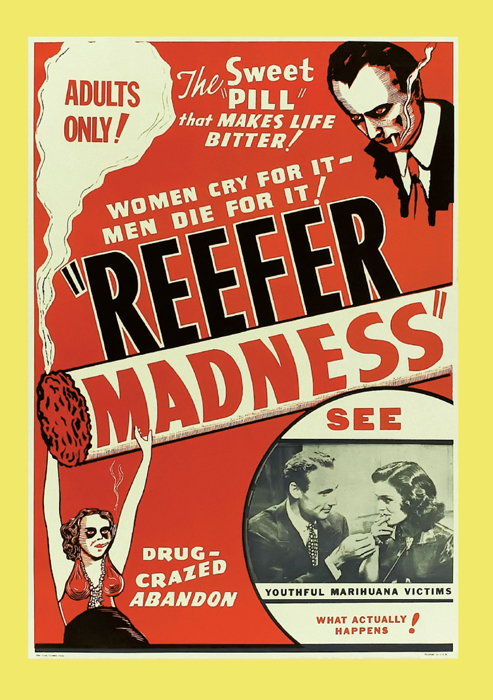
The ongoing debate on legalisation in the US reopened the question as to why cannabis was made illegal in the first place. As with Nixon’s war on drugs, the uncomfortable answer that emerged was racism.20 Close analysis revealed that in the early twentieth century cannabis was hardly used at all. Then Mexican immigrants brought cannabis with them and fears began to be stoked that it created a ‘lust for blood’ in immigrants – the term ‘cannabis’ was then increasingly replaced with ‘marijuana’, which was a way to convey its foreignness and promote xenophobia. Marijuana and cannabis are used interchangeably, although cannabis generally refers to the actual plant and marijuana refers to a drug preparation from it. The word marijuana originated in Mexican Spanish. It may have come from ‘marjoram’ (another herb) or from the name Mary Jane. There are of course many names for cannabis or drug preparations from it, including pot, weed, dope, grass, herb, skunk and ganja. One has to wonder if cannabis users are like the Irish, who rated seaweed so highly that they have an estimated 31 words for it.
In the 1920s many states banned cannabis. In the 1930s Harry Anslinger, the then head of the Federal Bureau of Narcotics, imposed a federal ban in spite of the majority of scientists who were surveyed at that time stating that cannabis was not dangerous. Anslinger claimed the majority of cannabis users were African Americans and that it had a negative effect on what he called ‘degenerate races’. He is on record as saying ‘Reefer makes darkies think they’re as good as white men.’ Anslinger was also of the view that smoking cannabis would result in white women having sex with black men. Remember, he was Director of the Federal Bureau of Narcotics. By the time we get to the early twenty-first century, African Americans were shown to be almost four times more likely than Caucasians to be arrested for cannabis possession, despite both groups having similar usage rates.21 According to the American Civil Liberties Union, marijuana arrests currently account for more than half of all drug arrests in the US.22 More importantly, the impact on minority communities is much greater than others. And there is the three-strikes rule: the third time you’re caught with cannabis, you receive a mandatory life sentence. Again, this disproportionately affects minority communities, particularly African Americans. Arguments to protect these minorities were put forward during the debate, and the bill that was passed also allowed for a 5 per cent tax to be put on sales of cannabis. Slowly, the US is moving towards legalising cannabis for reasons to do with its overall safety profile, the racist nature of the legalisation, the burden its illegality places on policing, as well as the costs involved in keeping offenders in prison. And of course, the chance to tax it and raise revenue.
Legislators in Europe are closely watching what’s been happening in the US in relation to cannabis. Many countries have legalised the medical use of cannabis: cannabis or its extracts bring substantial benefits, including relief of nausea and vomiting during chemotherapy, improved appetite for people with AIDS and other diseases, and pain and spasm relief in MS. As regards legalising it for recreational use, unlike the US, no European country (with the exception of Switzerland) has provisions that allow voters to directly change laws, although referendums can be held to advise lawmakers. Nearly all the changes that have happened in the US have come about as a result of popular votes in different states. For Europe, lobbying of politicians is the main method of bringing about change, as well as providing the media with evidence to support change. Perhaps Europe will always lag behind the US when it comes to cannabis. It was the US who first made it illegal, and this spread to Europe. The US may be the first country to lift the ban, and Europe may then follow suit.
Other countries employ a variety of approaches to drug legalisation. The Dutch have always taken a pragmatic view of what other countries called ‘vice’. Prostitution has been legal and regulated in the Netherlands for decades and has been subjected to taxation since 2011. In the twentieth century the Dutch were of the view that a drug-free Dutch society was unrealistic and impossible to achieve, and that the effort should be put into minimising harm.23 They adopted a policy of gedoogbeleid meaning ‘tolerance policy’. We all need some gedoogbeleid in our lives. Distinction is made between ‘soft drugs’, which include cannabis, sleeping pills and sedatives, and ‘hard drugs’, which include heroin, cocaine, amphetamine, LSD and MDMA. Soft drugs are tolerated whereas hard drugs are definitely illegal. So-called Coffeeshops (one word, to distinguish them from regular cafés) are allowed sell soft drugs. This somewhat lax attitude has had an unintended consequence: drug trafficking in the Netherlands is rampant. The country is a major transit point for drugs entering Europe, including cannabis, heroin, cocaine and amphetamines. Despite efforts from Interpol, the Netherlands in the late 1990s became a major exporter of the sedative temazepam.24 Laws were passed in 2005 that make it illegal for coffeeshops to sell cannabis to non-Dutch people, to prevent cannabis users from other countries flocking to the Netherlands.
A study into the level of cannabis, cocaine, MDMA and methamphetamine (or by-products of these) in waste water revealed that out of 42 major cities, Amsterdam came near the top of the list.25 ‘Notorious party cities’ as the report said, were all in the top ten. The Serbian city of Novi Sad topped the list for cannabis, with Amsterdam second and Paris coming in third. Cocaine levels were high in Amsterdam, Antwerp, London and Zurich (bankers like cocaine …). MDMA levels were highest in Amsterdam and in Switzerland, with MDMA spiking on Sundays, presumably because of weekend use. The Netherlands spends more that €130m annually on facilities for people with drug addiction. Its so-called ‘demand reduction programme’ reaches 90 per cent of the country’s hard-drug users, the number of which has stabilised in recent years with the average user age rising to 38, indicating that young people are less likely to use hard drugs. Might the Netherlands be an example for the rest of the world to follow?
Australia is another interesting country to consider when it comes to drug policies.26 In 1985 it came up with a National Drug Strategy, whose aim was to move drug use from prohibition to harm reduction, in addition to demand reduction (prevention and treatment) and supply reduction (customs and policing). But when examined closely it turns out that only 2 per cent of funding goes towards harm reduction, while 66 per cent goes to law enforcement. Some 30 years ago Australia removed criminal penalties for possessing cannabis for personal use. The ban on MDMA in Australia led to its illegal manufacture, with the subsequent preparations having unknown potency and contaminants of unknown toxicity.27 The numbers in Australia in relation to crime continue to stoke debate on what to do about the issue; in 2016–17 there were 113,533 illicit drug seizures and 154,650 drug-related arrests.28
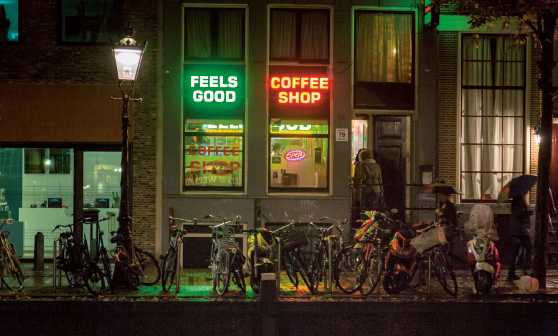
THE DUTCH HAVE ALWAYS BEEN OF THE VIEW THAT A DRUG-FREE SOCIETY IS UNREALISTIC AND IMPOSSIBLE TO ACHIEVE. SOFT DRUGS CAN BE BOUGHT BY DUTCH CITIZENS IN SO-CALLED ‘COFFEESHOPS’.
The Portuguese have perhaps the most enlightened system when it comes to illegal drugs, and policies there appear to be working.29 In 2001 a new law was enacted, which maintained the status of illegality for use or possession for personal use. However, the offence was no longer criminal, meaning it may not lead to a jail sentence for those found guilty. A major expansion in harm-reduction efforts followed, with the level of public investment in drug treatment and drug prevention doubling. Has this shift in policy worked? Numbers suggest that it has. There has been a significant reduction in drug-related deaths. Drug use among adolescents and ‘problematic’ users has declined and HIV rates are down, presumably because of needle-exchange programmes and there being fewer heroin users.30 Drug-related criminal justice workloads have also decreased.
An obvious and major reason as to why drugs remain illegal in most countries is concern about the risk to health and well-being, especially in young people. In 2010 a group of experts ranked 20 legal and illegal drugs on 16 measures of harm to the user themselves, and to the wider society.31 Alcohol was easily the most harmful, coming in with a score of over 70/100: next came heroin at 55/100, followed by crack cocaine at 53/100, methamphetamine (also called crystal meth) at 32/100 and cocaine at 27/100. Next came tobacco at 26/100 and amphetamine at 23/100. Cannabis was next at 20/100. MDMA (also called ecstasy), LSD and mushrooms all scored below 10/100. Based on these criteria, alcohol should definitely be made illegal for everyone (not just the sale of it to minors) – although we have seen how that can go badly wrong during Prohibition in the US.
Detractors of the legalisation of drugs raise a number of valid concerns.32 It might encourage experimentation in those who have a predisposition to addiction. Prices will fall, which might lead to increased use. It’s likely that there would be a need for more treatment centres for people with addiction, which will come at a financial cost. But there is also a list of advantages to society should drugs be legalised, which includes an actual decrease in addiction and substance-abuse rates, as seen in Portugal. One reason for this is that, because people with drug addiction aren’t being jailed, they are treated more effectively and as a result there are higher rates of recovery. Legalisation also allows people who are addicts and who recover to remain in society – they can gain meaningful employment, have less of a need to turn to drugs and are no longer labelled as criminals. Also, when drugs are illegal, a counter-culture arises that actually celebrates drug use.
Most importantly, there is a strong argument that legalisation would allow the criminal justice system to focus on what it does best: keeping the general public free from harm. Drug enforcement takes up vast amounts of resources in many countries. Obviously, laws against drug use are designed to stop people from using harmful substances, but advocates of reform are of the view that this would be better served through counselling and treatment facilities. Where might the money come from to support such facilities, but also educate the public on the dangers of drug use? Substantial savings will be made from policing and revenue will be generated from taxing drugs. These funds can be reinvested in programmes to help people with addiction but also provide information to the general public on the dangers of drug misuse (including alcohol). Regulation of the drugs being sold would ensure that they are safer, free of toxic contaminants. It all looks like a no-brainer, doesn’t it?
Perhaps the biggest concern from drug legalisation is that children and teenagers would have more access to them. This of course also applies to alcohol (which teenagers have no trouble in getting, it seems). Drugs are especially dangerous to the developing brain. Because their brains are still developing, probably up to the age of 25, young people are at a higher risk of addiction than adults.33 Drugs have a much more intense effect on the younger brain, than on people who are over 25. Addiction to drugs or alcohol can slow brain development, with effects evident in the frontal cortex and limbic systems.34 Studies in animals have shown that brain circuits which affect decision-making can be particularly affected, especially in response to cannabis, cocaine and MDMA.35 In humans, chronic use of MDMA has been shown to have toxic effects on several brain regions,36 which might lead to problems with concentration and mood stability. There is also evidence that long-term use of MDMA decreases empathy.37
The changes may be irreversible. Drug or alcohol use can lead to a variety of mental health disorders including depression, personality disorders and even psychosis. One study concluded that among 23,317 young people studied, cannabis use was associated with an increased risk of depression, although the increased risk was relatively low at 7 per cent.38 This didn’t mean cannabis promotes depression; it was an association. Yet given the numbers who use cannabis, this represents a relatively large number of people. Teenage brains also adapt more quickly to repeated drug use, leading to higher levels of craving and dependence. Ninety per cent of people with drug or alcohol addiction begin substance abuse before the age of 18,39 although there is only limited evidence that starting on cannabis can lead to using harder drugs (the so-called ‘gateway’ effect).40 Given that campaigns to encourage teenagers to say ‘no’ to drugs have failed, the advice now is to tell them to say ‘not yet’ and wait until they are older.

AN AUSTRALIAN POSTER WARNING OF THE DANGERS OF TAKING ECSTASY. WHO WOULD WANT ‘LOSS OF MEMORY, DEPRESSION, ANXIETY, BRAIN INJURY AND SCARRING’?
Whatever about safety aspects, another concern is that legalisation will increase use among teenagers; yet several recent reports have found that in the majority of states that have approved use of recreational cannabis, use among teenagers actually decreased.41 One study showed that there was a drop of 8 per cent in use in teenagers who said they had used cannabis in the past 30 days. The study analysed data from 1993 to 2017 in 1.4 million high school students. The reasons for this may be a reduction in the ‘forbidden fruit’ effect as well as decreased access as cannabis moved from the streets to licensed dispensaries where you need to be over 21 to purchase it. Another study has recently shown that the rate of ‘cannabis use disorder’ has risen in people over 26.42 Researchers examined surveys completed by 505,796 people between 2008 and 2016 in states where cannabis was legalised – Colorado, Washington, Alaska and Oregon. Cannabis use disorder is where a person’s use of cannabis affects their lives in a negative way – for example, they find it hard to cut down, or cannabis affects their working life or relationships. Problematic cannabis use rose, from 0.9 per cent to 1.23 per cent. Not a massive number, but still significant for those affected. There was no increase in those aged between 18 and 25. The issue appears to be one of heavy use, as it is well known that this is linked to a range of problems, with long-term health, economic and social consequences. The authors concluded that the study shouldn’t imply that cannabis remain illegal. Legalisation efforts should coincide with educational measures to promote prevention as well as support for problem users.
It seems highly likely that cannabis will be legalised in many other countries, and available to adults, just like alcohol, as is already the case in many US states. But what about other drugs? There are clearly pros and cons to legalising drugs, whether they be soft or hard. The case for legalising hard drugs such as heroin seems a long way off, given the risk of addiction: no one wants to see a continuation of the opioid crisis in America, which was started by a prescribed opiate, Oxycontin. If heroin were to be legalised the situation would be different as there are now strict controls on the use of Oxycontin. Should we turn again to Bill Hicks, who said: ‘What business is it of yours what I do, read, buy, see, or take into my body as long as I do not harm another human being on this planet? And for those who are having a little moral dilemma in your head about how to answer that question, I’ll answer it for you. NONE of your fucking business. It’s not a war on drugs, it’s a war on personal freedom.’ Do we need laws to protect us from ourselves?
Rich and famous people have always been able to get whatever drugs they want, and it often ended badly. When Elvis died at the criminally young age of 42, a post-mortem revealed that he had extremely high levels of four prescription opiates in his blood.43 Constipation is a common side effect of opiate use and sadly Elvis died of a heart attack while on the toilet. His personal physician, ‘Dr Nick’, began prescribing opiates for Elvis in 1967. He said he gave Elvis what he wanted to stop him turning to the street. This information wasn’t released until some years after his death, as it was seen as something of an embarrassment since Nixon had given Elvis a badge making him an honorary ‘Federal Agent at Large’ for the Bureau of Narcotics and Dangerous Drugs. At the time of his death, Michael Jackson had six drugs in his system, the most damaging being Propofol: this is only supposed to be used in hospitals as a general anaesthetic during surgery.44 Jackson had used an anaesthesiologist while on tour in Germany in 1996 and 1997 to ‘take him down’ at night with Propofol, and ‘bring him back up’ in the morning, because of chronic insomnia. Jackson’s insomnia returned most likely because of a commitment he made to play 100 shows in London to help pay off his debts. His doctor, Conrad Murray, administered the fatal dose on the night Jackson died. He was found guilty of involuntary manslaughter and jailed for four years. The other drugs in his body included the benzodiazepine alprazolam (for anxiety) and the antidepressant sertraline.
It’s likely that Prince was addicted to opioids for chronic pain and died of an accidental overdose of the opiate fentanyl.45 This is a powerful painkiller, usually used in patients with severe chronic pain. It’s not known where he obtained it, but it’s likely to have been from an illegal source. Amy Winehouse died of alcoholic poisoning, with a blood alcohol level five times over the legal driving limit.46 All these people were addicted to various substances, both legal and illegal, or at least prescribed contrary to guidelines.
How many of us would be like them if we could? How many of us would succumb if drugs were freely available? We can obtain alcohol freely, but would the easy availability of other drugs lead some of us to unwise decisions in relation to their use? The debate on this issue will continue. Clearly illegality has a limited impact on use by the 43 million people using marijuana, 5.5 million people using cocaine, 2.5 million people using ecstasy and almost 1 million using heroin in the US in 2018.47 The bottom line: perhaps one day we will reach a point where society will have obtained a level of maturity where we can make up our own minds as to what we put in our bodies, with safeguards and supports in place to protect the young and those who are vulnerable to addiction. How likely is that, I wonder?