
Section 3
The first years of the new decade were filled with optimism. In April 1961, Yuri Gagarin became world famous for his voyage into outer space on Vostok-1 (Figure 5.1). The paper’s journalists pronounced themselves very satisfied with the paper’s coverage, which disproved the idea that the post-war era couldn’t produce heroes and showed ‘the victory of Leninism and socialism over the capitalist system’.1 Half a year later, the Bratsk Hydro-Electric Power Station (GES) came into operation, an achievement greeted by the press as a continuation of the heroic legacy of the 1930s.2 Between those two achievements, the Party proclaimed its new programme at the Twenty-Second Party Congress in October. It made the startling claim that the Soviet economy would overtake the United States by the start of the 1970s and, within two decades, would build communism.
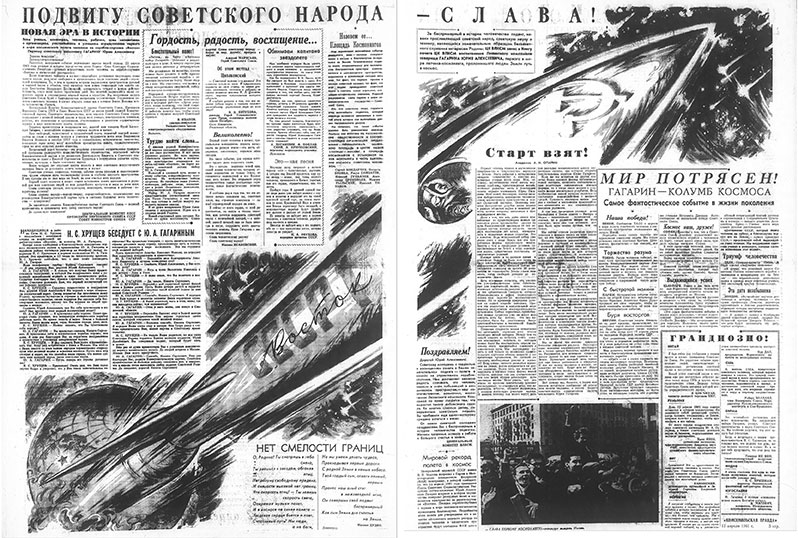
Figure 5.1 Glory to the Soviet People’s Great Feat! Komsomol’skaia pravda celebrates Yuri Gagarin’s space flight, 13 April 1961, pp. 2–3
Although the paper proclaimed that the current generation of readers would ‘live under communism’, the Soviet people could not simply lie idle and wait for the future. Journalists had to speak out against waste, promote higher levels of production, highlight new methods in industry, and promote worker initiative.3 Such tasks were not new; what had changed, however, was the Party’s belief that the old forms of encouragement were out of date. Its crucial resolution on ‘Party Propaganda in Contemporary Conditions’ (1960), discussed in the next chapter, argued that propaganda spoke too abstractly to be effective and had become ‘estranged from life and from the practice of communist construction’.4 Journalists needed to offer concrete examples of ‘leading experience’ in agriculture and industry for their readers to emulate.5 The resolution also took the highly significant step of asking the media to strike up a relationship with social scientists, arguing that propaganda could only be ‘truly deep and effective’ if it drew on the latest research.6 This demand fostered a new relationship between experts and journalists, as newspapers began to cover specialist topics in economics, science, and technology, while journalists began to rethink the way they represented Soviet reality. The next two chapters show this dynamic at work across the Khrushchev and Brezhnev years, focusing on the paper’s role in the birth of Soviet opinion polling in the next chapter, before analysing the Brezhnev regime’s technocratic turn in Chapter 6.
In the wake of the Twenty-Second Party Congress in 1961, newspapers devoted ever-increasing attention to technical progress and the social transformations required to accomplish it. Pravda, Izvestiia and Ekonomicheskaia gazeta let the way in these discussions, the former publishing an essay by Evsei Liberman on the implementation of wage scales for industry which became a lightning rod for economic reform.7 But those discussions took place in an atmosphere far removed from the pageantry of the Party Congress. No sooner had Khrushchev given his speech in October 1961 than it became apparent that that year’s harvest would be disappointing. The resulting price rises on meat and dairy products led to widespread protests, the worst of which took place in the town of Novocherkassk in the North Caucasus, in which at least twenty-one people were killed.8 The press’s response was to become more reflective, as if further introspection would be able to solve the deep-rooted problems of agriculture and industry. Newspapers created new rubrics to discuss the country’s economic issues, which involved economists, planners, cyberneticians, and sociologists. In this respect, Khrushchev’s ouster in 1964, and the technocratic wave it set in motion, produced a change in degree rather than quality: Brezhnev-era discussions of industry and agriculture built on ideas circulating in Soviet media since the early 1960s, rather than inaugurating a new era.9
Changes in newspaper content were accompanied by a transformation of journalists’ self-image. As well as seeing themselves as propagandists, activists, and moral guides, journalists began to fancy themselves as researchers too. They increasingly spoke of the need to leave the confines of the offices and dive into the world: ‘We’re looking at life through the window’, lamented one Pravda journalist, ‘when we should be in the thick of life’.10 The image of the journalist as a roving student of reality rested on the idea that they possessed a unique sensitivity to the ‘subtle movements of the human soul’.11 Vasilii Peskov, the paper’s eminent correspondent, offered advice to a young correspondent: ‘he researches machines well, but he lacks an element of human research [chelovekovedeniia]’.12 This idea of the journalist as researcher became more prevalent as the 1960s progressed.13 Editorial meetings, discussions at the Union of Journalists and in professional publications all lauded the importance of the essay [ocherk] as a privileged genre for capturing the Soviet Union’s changing social tapestry.14
By delving into reality as an academic might, journalists would not only bring their newspapers closer to life but transform the reader’s psyche. The journalist L. Barustin argued that the emergence of essayistic writing would ‘inculcate[e] in the reader the qualities of a fighter and a researcher of life’, and ‘nurture a feeling of civic responsibility’.15 In this reading, the journalist’s research into Soviet life would prompt a new, more questioning relationship between readers and their reality, which would change society for the better. For Boris Grushin, a journalist in the Department of Propaganda at Komsomol’skaia pravda, that shift in civic consciousness would come about by asking readers for their views on issues of public concern and acquainting the public with the opinions of their contemporaries.16 It is to this initiative, which turned journalists into pollsters, to which we now turn.
1 24 Apr. 1961, d.299, ll.172, 175.
2 ‘Prazdnik na Angare’, 29 Nov. 1961, 1.
3 ‘Tsel’ iasna. Za rabotu!’, Sovetskaia pechat’, 11 (1961), 2–7 [5]; P. Satiukov, ‘Istoricheskie resheniia XII s’’ezda KPSS i zadachi sovetskikh zhurnalistov’, Sovetskaia pechat’, 1 (1962), 5–12.
4 ‘O zadachakh partiinoi propagandy v sovremennykh usloviiakh’, 10 Jan. 1960 in Sovetskaia pechat’ v dokumentakh’ (Moscow: Gospolitizdat, 1961), 481–503.
5 Ibid., 490.
6 Ibid., 501–2.
7 E. Liberman, ‘Plan, pribyl’, premiia’, Pravda, 9 Sep. 1962, 3.
8 Samuel Baron, Bloody Saturday in the Soviet Union: Novocherkassk, 1962 (Stanford: Stanford University Press, 2002); Vladimir A. Kozlov, Mass Uprisings in the USSR: Protest and Rebellion in the Post-Stalin Years, trans. Elaine McClarnand MacKinnon (Armonk: M.E. Sharpe, 2002), 224–87.
9 On continuities between Khrushchev and Brezhnev’s reforms see Mark Sandle, ‘Brezhnev and Developed Socialism: The Ideology of Zastoi?’, in Brezhnev Reconsidered, ed. by Edwin Bacon, Mark Sandle (Basingstoke: Macmillan, 2002), 165–87.
10 Pravda Party Meeting, 10 Jul. 1964, TsGAM, f.3226, op.1, d.72, l.136.
11 M. Borisov, ‘Geroi nashikh dnei’, Sovetskaia pechat’, 2 (1960), 16–19 [18].
12 Party Bureau Meeting, 31 Mar. 1961, TsGAM, f.1968, op.1, d.36, l.23.
13 Aleksei Adzhubei, ‘Boevoe oruzhie partii’, Sovetskaia pechat’, 5 (1963), 1–10 [3]. On changing conceptions of the journalist see Mary-Catherine French, ‘Reporting Socialism: Soviet Journalism and the Journalists’ Union, 1955–1966’, Unpublished PhD Dissertation, University of Pennsylvania, 2014, esp. 317–34.
14 On publitsistika and Thaw journalism see Thomas C. Wolfe, Governing Soviet Journalism: The Press and the Socialist Person after Stalin (Bloomington: Indiana University Press, 2005), 71–103.
15 L. Barustin, ‘Chelovek v gazetnoi publitsistike’, Sovetskaia pechat’, 9 (1963), 24–8 [27].
16 Boris Grushin, Chetyre zhizni Rossii. Zhizn’ 2-aia: Epokha Brzhneva. Tom 1 (Moscow: Progress-Traditsiia, 2003), 18.
5
In May 1960, following the collapse of talks between Khrushchev and Eisenhower on a de-escalation of Cold War hostilities, Komsomol’skaia pravda devoted its front-page editorial to an unusual message. It spoke, as editorials of the time often did, of the Soviet people’s ‘unprecedented participation in everyday life’ and praised the ‘energetic reaction of a mass of millions to worldwide political events’. But it continued by talking of a growing tendency towards discussion within Soviet society as individuals debated questions of politics and labour.
The old saying that ‘speech is silver, but silence is golden’ doesn’t bother [the Soviet public]. They know that the speech of Soviet toilers has weight, that it is studied by the party’s leaders and the state. What they say is listened to by those in power; it influences the government’s policies. The ever-growing role of public opinion [obshchestvennost’] in the economic, political, and ideological life of the country is the main law and tendency in the development of a contemporary socialist society.1
This article formed the preamble to the announcement of a new initiative which would allow the paper to ‘study and discuss the opinions of Soviet people on the most pressing questions of the USSR’s domestic and foreign policy, and on the communist education of workers.’ Known as the Institute of Public Opinion [Institut obshchestvennogo mneniia, or ‘IOM’], this new enterprise functioned as an in-house polling organisation which would carry out surveys on themes ranging from the family to industrial reform.
The Institute was a notable innovation in Soviet life. After many decades in which sociology was effectively banned, the IOM became the country’s first ever polling institute, crystallising a crucial shift in official attitudes towards the discipline. Over the course of its eight-year existence, the IOM received more than 150,000 responses to its surveys, and was feted by journalists and officials—including Nikita Khrushchev. This chapter, which narrates the IOM’s troubled history between its triumphant opening in 1960 and its closure in 1968, describes a crucial disciplinary transformation in Soviet journalism—and in the social sciences. It describes journalists’ attempts to use the IOM to measure and understand public opinion, but also discusses their diverging notions of how that knowledge should be harnessed. In telling the story of the IOM, we see a complex interaction between experts, politicians, and journalists, in which disagreements over the goals of the Institute rapidly caused conflict.
What does the emergence of polling tell us about the changing relationship between political elites and citizens? On the surface, the Institute was a powerful vehicle for social change. It not only gave readers an unprecedented opportunity to speak their mind, but its surveys also revealed rifts between the media’s portrayal of Soviet society and the views of its citizens. In a country where empirical sociological research had long been repressed, and in a context where mass media insisted upon the unanimity of its citizens’ opinions, the shift towards researching the diversity of public views was significant. Polling was a sign that the codes of political legitimacy were changing, creating a state of affairs where the Party at least nodded to public opinion and felt obliged to offer justifications of its policies. It changed modes of governance, by presenting public opinion as a force to be studied, understood, and managed. And it reflected and accelerated a significant change in the social imaginary, from a monolithic, class-based, conception of the social body towards a more variegated understanding of social stratification.
The IOM’s novelty was not lost on international observers: visitors from around the world came to meet the Institute’s founders, seeing it as a symbol of democratisation, while western media cited it as proof of significant change. For The Observer’s Edward Crankshaw, it meant that journalists were now ‘asking the young what their problems are, rather than telling them’.2 However, the editorial cited earlier offered a sign that the Institute was not merely an organ of technocratic governance. The opinions it would discuss should, the editorial stated, ‘be important for the practice of propaganda work’; its reference to a ‘mass of millions’, reacting to world events in ways that ‘hastened our movement towards communism’ offered a vision of unanimity rather than diversity. Though sociology created a picture of social heterogeneity, the goal of Soviet mass media was to produce an image of unity: the Institute’s institutional position within the paper’s Department of Propaganda clashed with the goal of ‘studying and disseminating’ information on the Soviet public’s diverse views. This conflict led its founders to ‘discipline’ rogue respondents so that gaps between ‘incorrect’ and ‘correct’ viewpoints could be identified and vigorously challenged. By narrating the IOM’s history, this chapter brings to the fore a tension between two opposed notions of public opinion: one which saw it a force to be measured and managed, and another that viewed it as a problem to be disciplined and reworked. Though polling challenged prevailing visions of social homogeneity, the IOM’s polls also lent themselves to a ritualistic form of plebiscitary acclamation.3 The opinion polling of the 1960s, I argue, was new and old: it offered a demonstrably novel picture of social difference, but its use as a barometer of social unanimity looked to the past.
How Sociology Became Soviet (Again)
The creation of an Institute for Public Opinion at Komsomol’skaia pravda was yet another kink in sociology’s long and complicated path in the Soviet Union. In the Revolution’s first decade, Soviet leaders envisaged an important role for sociological research. When the Socialist Academy was founded in 1918, Lenin placed ‘social researches’ at the centre of his conception.4 Despite the early Bolshevik regime’s pursuit of non-conformist intellectuals, which included leading sociologists, empirical studies offered sociologists a chance to research the attitudes of the Soviet population in depth.5 Though much of this research was limited in scope, it helped the Soviet leadership to ascertain the views of the masses and legitimated the idea that effective rule needed accurate information. The disappearance of such research by the mid-1930s can be connected to Stalin’s mistrust of so-called ‘bourgeois experts’ and to the country’s nationalist turn. Sociological research presented a challenge to the dominant social imaginary, offering an image of social heterogeneity at odds with the harmonious vision Stalin wanted to convey. The discipline was also suspicious from a patriotic point of view: sociology had its roots in German and French scholarship and was therefore seen as a ‘bourgeois science’.6 The purging of the ranks in the 1930s was so thorough that young sociologists in the 1960s gave survivors the affectionate moniker ‘last of the Mohicans’.7
Attitudes to sociology began to change, albeit slowly, after World War II as a nascent public opinion emerged from the ruins of battle.8 While the Stalin cult still exerted a hold over minds, young people, workers, and peasants grew tired of sacrifice, and began to voice ideas that differed from those expressed in official forums. Young intellectuals, frustrated by the limitations of official discourse, were particularly invested in these discussions.9 One of them was Boris Grushin, a young philosopher enrolled at Moscow State University, who would later become one of the country’s most respected sociologists. Together with fellow philosophers Georgii Shchedrovitskii, Merab Mamardashvili, and Aleksandr Zinoviev (who would later become a controversial novelist), Grushin formed an intellectual kruzhok that began its activity informally in the late Stalin period, and became known after 1953 as the ‘Moscow Methodological Circle’.10 The movement’s re-reading of Marx was a reflection of the intellectual context in which they were moored; their desire to challenge the limitations of official ideas all the more so. While the Circle’s discussions were not strictly sociological, the desire to understand the psychological mechanisms that lay behind human thought demanded empirical research.11 By the early 1950s, the term ‘sociology’ was being heard more often in the public sphere, albeit negatively: critiques of bourgeois sociology (often a crucial means of keeping abreast of western ideas) appeared in the authoritative theoretical journal Bol’shevik.12 But despite this negative colouring, articles in scholarly journals began to advocate the use of ‘real-life examples in the building of communism’.13 While researchers did not, by and large, heed this plea for empirical research, recent scholarship shows that small-scale researches were carried out before 1953.14
Though Stalin’s death removed the main obstacle to reform, conservatives still held powerful institutional positions, meaning that advocates of empirical research had to tread carefully. Increased contact with the west under conditions of ‘peaceful coexistence’ helped their cause, since officials were embarrassed by the inability of Soviet participants to participate in international discussions. Sociology served as a marker, if not of modernity, then certainly of the Soviet Union’s ability to ‘keep up’ with the rest of the world. An organisation like the Soviet Sociological Association, founded in 1958, may have initially acted as a Potemkin organisation, designed to show the world that Soviet sociology existed on the same level as the rest of the world, but its formation validated the discipline’s right to exist.15
Orthodox scholars remained convinced, however, that empirical sociological research was impermissible outside historical materialist parameters.16 An influential article of 1957 by the East German historian and economist Jürgen Kuczynski attempted to legitimate empirical study by arguing that historical materialism was a theory of the universal.17 For an understanding of ‘everyday life’, Kuczynski argued, Marxist ideas needed to be harnessed to specific examples, which could only be delivered through empirical research. In this way, historical materialism was elevated to the lofty position of sacred universal, while sociology did the dirty work of social inquiry.18 Kuczynski’s article illustrates the importance of Eastern European scholarly thought to the rebirth of Soviet sociology, as the Secret Speech allowed for the re-emergence of sociological ideas in the socialist bloc.19 The article’s appearance was a symptom of, and a catalyst for, new ideas about empirical research. Its most important innovation was to present an acceptable fudge that allowed Marxist–Leninist doctrine to be squared with empirical practices; the fact that this and several other articles on sociology had appeared in the Soviet Union’s leading philosophy journal attests to a growing acceptance of empirical sociology among the academic elite. By the end of the decade, three centres of empirical sociological research had been established in Moscow, Leningrad, and Sverdlovsk, investigating questions ranging from the structure of Soviet society, families, and labour, to refining the nascent discipline’s methodologies.20 Though their sphere of investigation remained somewhat limited, Soviet sociologists at last had the institutional base and official approval they needed to propagate the discipline and conduct empirical research.
Both intellectuals and politicians benefited from the emergence of sociology. For the former, sociological research offered a more profound understanding of the society in which they lived. For the latter, it presented the possibility of more informed governance. Having renounced violence, and lessened its reliance on surveillance, the government sought a new means to ascertain the public mood. While the Soviet leadership retained a residual attachment to letters as a measure of public opinion, and surveillance remained a pervasive part of communist rule, sociology offered a more scientific—and perhaps more comprehensive—form of knowledge. While so much public discourse was characterised by a romantic Prometheanism, built on the faith that enthusiasm would conquer all, there was a countervailing trend, which saw scientific rationality playing a crucial role in governance. The press’s role in this process was ambiguous: newspapers, radio, television, and cinema were key propagators of the Soviet Union’s romantic impulse, and advanced the notion that self-sacrifice and conviction were sufficient to conquer any obstacle. By the end of the 1950s, however, Soviet socialism began to speak a more rational, evidence-based language, with media professionals called upon to think about Soviet reality with efficiency and logic.
In January 1960, Aleksei Romanov, the Deputy Head of the Central Committee’s Department of Propaganda, gave a speech in support of the Party’s recent resolution on ‘the Tasks of Party Propaganda in Contemporary Conditions’.21 In its demands for an overhaul of Soviet mass media and its calls for professionals to respond to changing social conditions and consumption habits, the 1960 resolution was probably the most important—and certainly the most comprehensive—Party resolution on the mass media since the war, and would remain so until the Gorbachev era. It marked the point where the Soviet Union intensified its construction of a ‘media empire’ to compete with its Cold War rivals.22 To do so, Soviet media needed to overhaul its propaganda techniques, with empirical data playing an increasingly pivotal role. In an address to an audience of editors, journalists, and media professionals, Romanov argued that to hasten the country’s political and economic development, newspapers needed to orient their propaganda towards social description based on facts, using philosophy, economics, and sociology.23
Romanov did not necessarily have polling in mind when he made his speech. He praised an article by Aleksandr Gur’ianov that used statistics to show how economic growth transformed the daily lives of a rural family, seeing it as an example of how journalists might ‘unite theory with life’.24 The article, printed by Komsomol’skaia pravda only a few weeks before, had been produced as part of a drive by the paper’s Department of Propaganda to revitalise its offering to readers. The Department’s primary function had always been to print good-news stories about the country’s triumphant march towards communism. Breathless tales of the opening of a new Palace of Culture, the feats of exemplary workers or, more prosaically, celebration of the words and actions of the country’s leaders, were staples of its output. Data-driven articles like Gur’ianov’s were part of that Department’s attempt, particularly marked after 1956, to revitalise propaganda by offering objective data that showed how socialism was making a difference in people’s everyday lives.
Given that Romanov made an explicit connection between sociology and propaganda, and praised the one of the Department’s articles, it was natural that editor Iurii Voronov would turn to the Department of Propaganda to carry out the new policy. In doing so, Voronov cited the Narodnik writer Gleb Uspenskii’s ‘A Quarter of a Horse’ (1888) as a ‘splendid’ exemplar of sociological research.25 His Living Numbers, of which the essay formed a part, was an attempt to discuss the living conditions of the Russian citizenry by showing the lives and practices that stood behind statistics.26 Bearing this in mind, it is likely that Voronov had expected another data-driven celebration of the country’s path forward in the manner of Gur’ianov’s article. However, in a fashion rather typical of the era, Romanov did not give prescriptive guidelines, but instead pointed at positive exemplars, leaving the floor open to the Department’s journalists to interpret the Party’s requirements creatively.
At the Head of the Department sat Boris Grushin, whose membership of the Moscow Methodological Circle had seen him fail his doctoral dissertation at Moscow State University.27 Unable to find suitable intellectual work, Grushin’s friends advised him to submit an article to the paper, and his piece impressed Voronov enough to offer him a job. Within four years, he had risen rapidly through the ranks to head one of the paper’s most prestigious departments.28 Grushin’s own reminiscences do not explain how he dreamed up the idea for an Institute of Public Opinion, but the study of public opinion chimed with his philosophical interest in the mechanisms influencing individual cognition. Though he had no disciplinary training, given the pervasive lack of discipline-specific education Grushin was probably little worse off than any other scholar. The first Russian article to discuss polling methodologies was not published until 1961, alongside a translation of a textbook from the United States.29 This translation illustrates the importance of international connections in an era of ‘peaceful coexistence’: Grushin was aware of polling institutions overseas, including the Gallup Institute in the United States, the Centre for Research on Public Opinion run by Polish State Radio and Television, and the French Institute of Public Opinion on the Market, and used them as a model.30 Like most Soviet sociologists, Grushin was making it up as he went along; his creative improvisation would nonetheless change the face of Soviet social science.
Sociology as Plebiscite
A chance occurrence lay behind the Institute’s first poll. On May Day 1960, a plane was shot down over Sverdlovsk. Though US officials initially insisted it was a weather plane, analysis of the wreckage revealed the presence of photography equipment.31 After a long hiatus while Soviet authorities calculated how to exploit the incident, the press, Komsomol’skaia pravda included, leapt into action with headlines warning ‘Mr Aggressor’ not to ‘play with fire’ alongside indignant letters from readers.32 A fortnight later, the Paris Summit broke down in acrimony after Eisenhower refused to apologise to his counterpart. It was in this febrile atmosphere that Grushin’s ‘Institute of Public Opinion’ arrived. Alongside a transcript of a press conference in which Khrushchev denounced the United States, a notice on the front page announced the arrival of a new organisation, which had chosen to start its work with ‘Problem No.1…the problem of peace’. ‘Will mankind succeed in averting war?’ asked the paper’s headline. ‘Yes!’ came the resounding answer.
The survey was clearly designed to achieve an affirmative response, underlining the Soviet people’s desire for peace against a backdrop of US provocations. The Institute’s researchers interviewed 1000 individuals who lived along the thirtieth meridian, from Nikel’ in northern Russia to the town of Gaivoron in Ukraine, asking three questions about war and peace. The first two asked whether humanity would ‘succeed in averting war’ and why, while the third question asked: ‘what should be done to consolidate peace?’33 When 96.8 percent of respondents replied that humanity would indeed avert war, journalists interpreted this result as a clear endorsement of the Party’s foreign policy. ‘This number says a lot’, wrote Grushin and his deputy, Valentin Chikin, in their conclusions, ‘The Soviet people, regardless of sex, age, or profession, are confirmed optimists, and lovers of life’. They noted that 89.4 percent of those surveyed had suffered losses in the war, and argued that their faith in peace was doubly significant: ‘What strength of spirit a people must possess, how human and noble its morals must be if despite all this, its soul is filled with such certainty in the radiant future of humanity!’34 Hence the conclusions to the IOM’s first survey presented the results as an endorsement for the Party, and as an occasion to celebrate the spirit of the Soviet collective. The high-flown words of Grushin and Chikin also suggest that in its early days, the IOM’s founders were content to allow the demands of propaganda to predominate over social science.
The conclusions to the Institute’s next two surveys, one on living standards, published in autumn 1960, and another on youth, published in January 1961, followed a similar pattern. Both presented results pointing to high levels of satisfaction in the current policies of the Party and Komsomol, offered interpretations that corresponded to the paper’s broader propaganda line, and breezily explained away problematic figures. The survey on youth portrayed Soviet young people as a generation worthy of carrying the revolutionary baton into the future. A collection of responses from older readers, for instance, offered an overwhelmingly positive vision, in which prominent cultural, political, and military figures gave young people ‘the very highest assessment’, praising their ‘elevated sense of responsibility for the fate of the Fatherland, their labour heroism, their preparedness for great feats, their collectivism and their camaraderie’.35 According to Grushin and Chikin, the survey on living standards showed that, ‘from day to day the life of the Soviet individual is becoming better, becoming richer’, in language that recalled an earlier formulation by Stalin.36 Unconscious echoes of an earlier time could be heard elsewhere, as the authors claimed that respondents connected rising living standards to the Party, adding that ‘in dozens and hundreds of questionnaire we encounter words which express the strongest gratitude to the Party and leadership.’37 A language of welfare came up against the language of a decade earlier, in which the Party was the bearer of gifts.38
The IOM’s early activity dovetailed with the paper’s overall propaganda line. With their carefully chosen questions and the festive tone in which results were reported, the Institute’s first three surveys remind us that the IOM’s original function was not so much to identify and discuss the diversity of public opinion, but to prove public support for the Party. Indeed, the methodologies of the early surveys, which I will discuss later in the chapter, were hardly state of the art. Just like the paper’s festive coverage of Supreme Soviet elections, which continued into the Thaw era, one of the main functions of the Thaw-era public sphere was to find ways of affirming public support in the absence of genuinely competitive practices. By giving citizens the freedom to express their own views, the Institute was arguably more effective in doing this than the democratic façade of the Soviet election. As Iurii Voronov said of the IOM’s first survey: ‘When we put out an article, they say to us “that’s the author’s opinion”, the opinion of our collective. But when we say “Five thousand people replied to this question,” then that’s public opinion [obshchestvennoe mnenie].’39 Framed as a referendum on the leadership’s conduct, these surveys suggested an overwhelming popular mandate for Soviet rule; they showed, as one journalist remarked in an editorial meeting, that ‘Soviet people approve of the Party’s policies’.40 Yet there was always a problematic element in these surveys: Supreme Soviet elections offered 99.8 percent approval rates, but even at their most celebratory, the IOM’s polls never achieved such dizzying figures. Take, for example, a contribution from a young Muscovite, who brushed off the country’s achievements and claimed: ‘money is everything’.41 To deal with these opinions, which deviated fundamentally from the orthodoxy, required a rather different approach.
Disciplining Public Opinion
Polling exerts significant effects on a society’s political imaginary. By reporting the views of the ‘average’ person, polls change the terrain of political participation: they produce normality and challenge it.42 Media reporting of poll results allows individuals to observe themselves in relation to others, creating a novel form of self-understanding: one becomes an individual taking up a particular position within a world of opinions.43 As the Institute’s activity evolved, presentation of results became increasingly detailed, and though the IOM never systematically published cross-tables of results, later surveys, such as a study of free time from 1963, presented detailed statistics which allowed readers to gauge opinions on a diverse range of matters.44 The Institute’s position as an adjunct to the Department of Propaganda complicated the IOM’s position, however. While Grushin and a few others in the Department came to see the Institute as a path to scientific governance, most endorsed the Institute only to the extent that it allowed for the celebration of public unity.
In Russian, where both obshchestvennost’ and obshchestvennoe mnenie can be translated as ‘public opinion’, a split between activism and measurement is written into the language. Both terms had been employed since the late-eighteenth century, though historians have tended to root obshchestvennost’ in the nineteenth century’s conceptual landscape.45 As individuals from the middle class and intelligentsia allied themselves to progressive causes, they formed collective associations and publicised their ideas in the expanding commercial press. The term obshchestvennost’ referred to the carriers of public opinion (the public, often synonymous with the intelligentsia), the space in which these ideas were discussed (a public sphere), and to the progressive values they possessed.46 After the Revolution, political figures attempted to harness the power of obshchestvennost’ by involving a wider public in political activities as figures like Nikolai Bukharin and sociologist Pitirim Sorokin developed their notions of civic activity in dialogue with ‘Anglo-Saxon’ ideas.47 However, Bolshevik leaders soon tried to circumscribe the term’s meanings, limiting obshchestvennost’ to activity carried out by Bolsheviks in state-approved contexts.48 The aim was to replicate the institutions of the public sphere, while replacing its ‘disturbing heterogeneity’ with Party-minded ‘harmony and unity’.49 As a result, Soviet public culture became increasingly ritualised by the end of the 1920s.50 Staged shows of unity, such as demonstrations and ceremonies, became characteristic of Stalinist obshchestvennost’ as the cut and thrust of public debate was replaced by manufactured unanimity.51
At the time of Stalin’s death, obshchestvennost’ retained its predominance as a concept for describing public opinion, as is shown by its presence in the second edition of the Great Soviet Encyclopedia (1950–1958):
Obshchestvennost’—1) Aggregate of individuals taking an active part in social life; 2) Social organisations of a country, town, enterprise, institution, educational institute, etc. (USSR, Moscow, the Party, trade union, scientific, literary, pedagogical, etc.); 3) A people, society; 4) Public opinion [obshchestvennoe mnenie]. The word obshchestvennost’ was introduced into Russian literary language by N.M. Karamzin (1766–1826). The word came into widespread use in literature from the 1860s in the works of writers from the revolutionary-democratic camp.52
This definition underlines the fact that ‘public opinion’ remained intertwined with activist ideas of collective participation and social membership. However, the separate definition given to obshchestvennoe mnenie suggests that a notion of public opinion as an aggregate of individual thoughts was already present in the Russian language by the early 1950s. The entry also demonstrates a high level of interpenetration between the two terms. Indeed, the closer we look at everyday usage of the terms, it becomes clearer that ‘public opinion’ never possessed a single, fixed, meaning: the notion of obshchestvennost’ was tinted with individualist ideas, while the notion of obshchestvennoe mnenie could often take on an activist colouring.
This conceptual interpenetration is evident in the first Soviet monograph on public opinion, published in 1963 by the social psychologist Aleksandr Uledov. He argued that a personal opinion [chastnoe mnenie] or the sum of personal opinions could not be considered to be obshchestvennoe mnenie, ‘because personal opinions refer to the sphere of individual consciousness, whereas public opinion refers to public consciousness’.53 Uledov thus opposed the individualist connotations of obshchestvennoe mnenie, and instead suggested that in a socialist society, the term constituted a ‘unanimous judgement of the people on questions of social life, touching on the common interest and demanding practical solution’.54 Responding to Uledov’s work in 1967, Grushin argued that empirical research showed that public opinion was never unanimous. Rather, it was collective and individual, both obshchestvennoe mnenie and obshchestvennost’—a view best captured in Grushin’s statement that: ‘An aggregate, groups of individuals, are the subject of obshchestvennoe mnenie, obshchestvennost’’.55
Grushin’s position is telling, since the IOM’s earlier surveys had been used to suggest the opposite. But while the IOM’s first surveys provided an argument for seeing the two as synonymous, even these surveys lacked complete unanimity. Early surveys allowed for open-ended answers in ways that challenged journalists’ own conception of the social. Allan Starodub, discussing the IOM’s first survey, told colleagues:
When this column first started, we often found that when many of our colleagues read the responses they said ‘That’s not true’, ‘It’s not like that’ or ‘I don’t agree with that’. Today we need to change our ways and immediately conduct a debate on the same sincere and critical level, and understand that our opinions don’t always coincide with the opinions of our readers. If we’ve ventured to set up this Institute, then we should, within sensible limits, allow for free expression of our readers’ opinions.56
By revealing the heterogeneity of Soviet public opinion, initiatives like the IOM forced journalists to face the gap between their opinions and those of readers. As a result, the Institute pushed journalists to reflect its audience’s opinions, rather than disregarding their views as unimportant. Starodub’s comments ended with a warning: ‘Because the opinions expressed are very diverse, it would only need us to try to “level” [nivelirovat’] them, to foolishly try to hide them somehow, for our Institute to come to an unhappy end.’57
Scholars of polling suggest, however, that polls’ levelling effects are part of the deal. The reporting of poll results in the media is akin to a performative act, bringing into being a new state of political affairs that prompts citizens to reassess their own position in relation to others.58 Such polls have a paradoxical effect on those in the margins. On the one hand, they provide visibility for unfashionable viewpoints, which can be of particular importance in situations where such views are denied a hearing in the public sphere; on the other, the majority view often exercises a plebiscitary force, casting doubt—implicit or explicit—on the wisdom of the minority.
This dynamic was evident in 1961, when the paper printed readers’ responses to its survey on attitudes to Soviet youth. While the majority expressed palatable sentiments that evinced a belief in the ‘great power of our generation’, there remained conspicuous exceptions.59 One 19-year-old Komsomol member from Moscow wrote of her ‘apathy and indifference to everything’.60 She talked of her love of money and expressed ‘envy’ towards those who didn’t work: ‘they’re making the most of life—we only live once!’ Her goal in life was to find a husband who would enable her to marry into wealth. Such sentiments were in the minority, but far from isolated (2.3 percent of readers—around 400 respondents—said they wanted to marry into money; 0.1 percent—around 120 respondents—said that their goals in life were money and hedonism).61 Despite the small number of similar responses, the figure was worrying for journalists: these were individuals who derived no inspiration from Komsomols’ heroic feats, claimed that ‘money is everything’, and were prepared to say as much in public.
Journalists’ responses reveal the press’s power to discipline wayward viewpoints. To do so, they turned the reader’s letter into a cry for help, ending with a plea: ‘persuade me of the error of my opinions on life…I’d like to believe that I’m wrong’. When Grushin reprinted the letter in his 2001 monograph, however, those words had disappeared, ending with a defiant: ‘If I want something, I get it’.62 Whether or not the letter was doctored (the final sentences probably were) journalists surely knew what they were doing by printing it: the paper received more than a thousand replies, a selection of which were printed a month later. Such discussions, which invoked the power of obshchestvennost’ to resolve social issues, were particularly suited to a Khrushchev era where grass-roots collectives, such as comrades’ courts and house committees, imposed rigid behavioural norms on citizens.63 Some readers took on the tone of a friend; another angrily exclaimed that her letter had ‘offended’ him. One printed reply from A. Rudenko, a kolkhoz electrician from Kirovgrad, took the form of a microcosmic socialist realist narrative, in which his father died in the war, his sister became seriously ill, his girlfriend died and he became an alcoholic. However, after a short period of crisis, he retained a ‘belief in life’, which was confirmed one autumn, when he and his Komsomol colleagues collected the harvest in the rain every day: ‘would a girl striving only for good company, for a life without cares have been able to tolerate it? I don’t think so!’64 Work, and the cause of communism, it was suggested, provided a kind of salvation: ‘Devote yourself to the common cause, and you’ll understand happiness and the meaning of life’, wrote two readers in a collectively-written letter.65 These letters, then, constituted an attempt to restore a wayward sheep to the Soviet flock or, to express it another way, to turn a member of the minority into a member of the majority.
Komsomol’skaia pravda printed discussions of this kind all the time. Seen as part of the paper’s commitment to ‘moral and ethical’ themes, the debate over the Muscovite’s loss of faith was not out of the ordinary. However, viewed within the context of polling, the discussion illustrates the Institute of Public Opinion’s paradoxical function. The IOM’s purpose, as understood by journalists, was not simply to collect and analyse the views of the public, but also to discipline and normalise them.66 Polling data serve to ‘characterise, classify, and specialize; distribute along a scale, around a norm, hierarchize individuals in relation to one another and, if necessary, disqualify and invalidate’.67 In the Soviet context, the ability of polling to ‘distribute [individuals] around a norm’ was particularly useful: polls guided public opinion towards a pre-determined norm of behaviour, regulating difference in the name of unity. The presentation of survey results showed this through the printing of detailed excerpts from respondents’ answers which made it clear which ones were acceptable, and which were not.
This normalising function was not a specifically Soviet invention; it is a feature of the relationship between polling and mass media more generally.68 What is notable in the Soviet case is the eagerness with which journalists and academics identified and tried to harness this regulating function. A 1964 book by the Leningrad-based academic Boris Erunov argued that the IOM’s polls would help those who ‘adhere to the majority opinion’ to ‘feel that the correctness of their judgement has been upheld’, while those in the minority would feel pressure to ‘correct’ their ideas, ‘forc[ing] them to think and rethink many of their views’.69 That same year, the IOM’s second-in-command, Valentin Chikin, told an audience at the Union of Journalists that the IOM’s articles helped not only to identify public opinion but also to ‘form’ it. ‘When people have the full results in front of them, and analyse genuine public opinion, then people can correct themselves’, he argued, adding that the Institute had received many letters from individuals who had ‘renounce[d] their views’ after seeing the results of its surveys.70 Evidence from readers’ unpublished letters demonstrates respondents’ desire to possess this ‘correct’ point of view. A 23-year-old engineer from Moscow claimed that ‘The IOM helps us to understand the most important thing at a given moment; what it is necessary to say and what it is possible to say, and helps us to feel like the masters of our futures and to feel responsible for that future’.71 A Foreman from Zaporozh’e said of it: ‘Here we can share our thoughts, and read about the opinion of other comrades. That’s very valuable. That’s the only way we can examine the correctness or incorrectness of our thoughts and ideals.’72 It is clear, then, that at least some respondents understood the IOM’s polls as an opportunity to learn about others’ views—and to adjust their own ideas accordingly.
There is, however, substantial evidence that the paper’s ability to ‘discipline’ hindered some respondents from expressing their true views. Individuals who submitted their opinions to the Institute were aware they were on display, and this is likely to have had the effect of reducing the volume of dissenting views. In a country emerging from the shadow of Stalinism, it is highly likely that some citizens—particularly in face-to-face questionnaires—would be inclined to offer affirmative or ‘don’t know’ answers. When, as we will discuss below, the Institute’s methodology shifted to face-to-face interviews, questioners were advised that: ‘The respondent needs to be made to understand that their selection was completely by chance, that the anonymity of their statements is completely guaranteed (their surname is not required, etc.).’73 This was a marked change from earlier surveys, where respondents who filled in the paper’s questionnaire were asked to supply their name and location, both of which were printed in the paper. The use of readers’ names surely added to readers’ reluctance to respond candidly: one reader who had written in with a ‘minority’ opinion implicitly acknowledged the IOM’s stigmatising impact by writing a follow-up letter: ‘Without thinking I put my surname on the questionnaire but I don’t want my family’s name to appear in the paper’.74 Those with outspoken opinions generally responded anonymously. Our knowledge of the newspapers’ disciplinary functions cannot but colour our interpretation of the Institute’s positive results. By applying pressure to conform to orthodox ideas, it was apparent that the newspaper’s journalists were seeking results that affirmed prevailing ideas rather than challenging them.
That said, answering a summons from the IOM was not (as with elections) a compulsory act, but a choice: surveys provided a space for self-expression. Responses to a far-reaching 1962 study of Soviet families illustrate this dynamic.75 One is struck by the diversity of answers, which ranged from ringing endorsements of the Party line to the grumbling of middle-aged Soviet citizens about their inability to find housing. Readers did not dutifully send the required answers to the newspaper, but approached the survey creatively: they gave their responses titles, and their answers flowed outside the lines of the questionnaire, or were written on fresh sheets of paper, illustrating the ways that readers adapted the survey for their own purposes.
Anatoly K., a pensioner from Dnepropetrovsk, entitled his response ‘I can’t forgive myself!’ and urged the paper’s editors to publish it as a lesson to young men (they didn’t). The writer established his credentials as a worker and a veteran—‘everything a citizen of our homeland ought to do’—but then spoke of his shame at having abandoned his wife and children three decades before. He concluded: ‘I am ashamed and pained to tears for the thoughtlessness I gave in to; I am ashamed that I didn’t help, that I didn’t support my friend and the mother of my child when they were in distress. Don’t allow yourself to do the same.’76 The correspondent failed to answer the IOM’s questions, but nevertheless responded to them by unburdening himself of his sorrow over his past infidelities, seeing his story as instructive for Soviet youth. A typewritten letter signed by seven students from the Kuban ‘Red Army’ Medical Institute in Krasnodar indicated another use. They scrawled ‘PLEASE HELP!’ at the top of the page, and detailed the marital infidelities of three members of staff. The students called on the paper to ‘help us get rid of such educators. Please understand that when we look at such people our lives seem foul and vulgar, and we want to look at the shining, happy, and joyful future’.77 It is evident, then, that other practices of letter-writing, including denunciation, were overlaid upon the IOM. This made the Institute’s surveys an extension of the paper’s role as a moral and ethical compass, and offered a means of attacking others or ensuring investigation of readers’ complaints.
The fact that many readers’ responses, like that of Anatoly, were given titles by their authors, suggests that respondents hoped they would be published. Betti, a 40-year-old writer from Riazan’ oblast’, was another who hoped her (untitled) entry would be published. She praised the Institute, calling it a ‘new, wise, and genuinely democratic initiative’ and suggesting that its founder should be given an award.78 She contributed an essay reminiscent of the utopian visions of the 1920s, in which she denounced the family as a ‘prison’, and claimed that it would be transformed in revolutionary fashion as the nation approached communism. She also stated her belief that the happiness of the future would make the present day seem unspeakable and reiterated the old revolutionary belief that the present generation would act as the ‘manure of history, preparing the ground for the wonderful future.’ She ended by expressing her wish that others might share her point of view: ‘I hope that it’s not just me who expresses an opinion of this kind’.
Judging by the published results, few readers agreed with Betti in her desire to abolish the family, but her thoughtful and original response illustrates how by writing to the IOM, Soviet citizens were engaged in a form of dialogue, the parameters of which were not fully controlled by the newspaper.79 Readers were able to colour outside the lines by using the Institute for purposes that diverged from, but did not necessarily contradict, the aims of the paper’s journalists. It was, of course, the editors of the Department of Propaganda who decided whose views would appear on the pages of the newspaper. By circumscribing the frame of debate and stigmatising certain opinions, they limited the civic role of the Institute and made the most of their ability to shape public opinion in the desired direction. But even as they did so, the Institute implicitly endorsed the need to possess an opinion and the right to differ from others. By publicising the results, the newspaper suggested that Soviet ‘public opinion’ was less like the purposeful, unanimous obshchestvennost’ that it usually depicted, but something significantly more diverse: obshchestvennoe mnenie.
Decline and Fall
The IOM’s early surveys offered something genuinely new in Soviet journalism. They were endorsed by the country’s leading newspaper, Pravda, and Iurii Voronov was able to pass on congratulations from top journalists such as Iurii Zhukov.80 The Party’s ruling elite was similarly impressed. Grushin described a scene of editor Iurii Voronov waiting on the phone for the assessment of the Party’s ruling elite, to be eventually told that Khrushchev thought the Institute’s first survey was ‘wonderful’.81 Grushin’s account conveys a vivid sense that the IOM had captured the attention, not just of colleagues at other papers, but at the highest echelons of power. In a nation where officials measured the press’s quality by its party-mindedness more than its innovation, the approval of the Party’s most powerful figure represented the highest marker of social capital, an endorsement which would sustain the Institute through the many years of criticism to come.
It may seem strange to talk about criticism, given the whirlwind success of the Institute’s early years, but Grushin and his colleagues spent much of their time defending themselves from attacks from within and without. Why, after such dazzling successes, did the Institute’s stock fall so rapidly? For journalists at the paper, the Institute’s charm resided in its ability to prove the superiority of the Soviet system through science, and in its capacity, discussed in the previous section, to help them shape public opinion. The subject matter and design of the Institute’s early surveys made it easy to do so. The high-water mark of the Institute’s popularity coincided with two surveys which offered much scope for positive messages. The first, published in 1963, asked children the meanings of words which represented the so-called ‘survivals of the past’. By showing that children no longer knew the meaning of words like ‘Virgin Mary’, ‘down-and-out’, ‘profiteer’, and ‘bribe’, the paper could argue that foolish habits, and antiquated models had been ‘expunged’ from Soviet reality.82 A year later, ‘To Mars with What?’ asked respondents which exemplars of world culture would accompany them to Mars. The survey tapped into Soviet feelings of superiority after the Gagarin space flight, and made the familiar argument that only the Soviet Union could lay claim to have ‘inherited the fruits of man’s millennia-long battle for happiness—from the right not to be born a slave to the wonderful right to live in a society of human dreams: in Communism’.83 Both surveys constituted an enormous critical success: journalists at the paper excitedly reported on the flurry of conversation they prompted on Moscow’s streets.84 And, as with the IOM’s earliest surveys, the reporting of results took on a celebratory tone, which befitted their plebiscitary function as a means of performing public consent.
However, as the years passed, colleagues began to criticise the IOM’s work for being too complex and for revealing uncomfortable truths. A 1961 survey on one of Khrushchev’s industrial initiatives, the ‘Movement for Communist Labour’ revealed a surprising disjuncture between the inflated rhetoric and the rather more prosaic realities. The movement sought to promote progressive working practices, including modern techniques, moral education [vospitanie], creating a worker who was ‘constantly looking forward, daring, thinking, and creating’.85 But from the survey results, it seemed that the vast majority of workers had little interest in one of Khrushchev’s flagship policies.86 The survey was a major disappointment for staff members who had grown accustomed to the booming headlines of the Institute’s earlier surveys. There is no sense from editorial transcripts that journalists felt that this information might help them target their propaganda articles more effectively. Instead, they excoriated the study for being too complex for the newspaper, with one staff member complaining that it was ‘extremely academic [with] difficult phraseology’ and not written ‘in a newspaper style’ [po-gazetnomu].87 The Institute’s findings, which concluded with a request for further research by experts, stifled the all-important campaign to promote the movement, and were a shock for journalists who had become accustomed to the propaganda bonanza of previous surveys.88
References to the Institute’s ‘difficult phraseology’ suggest that Grushin no longer wanted to play the dual role of propagandist and social scientist. While his earlier articles fit snugly into the paper’s propaganda line, later ones were far more analytical. The results of his 1963 survey on free time, for instance, was published as a three-part article, running to several thousand words, and printed over six pages.89 In a later survey of his work at Komsomol’skaia pravda, Grushin suggested that this change in direction was a conscious decision.90 It is unlikely to be a coincidence that it took place after Grushin’s secondment to Prague. Between 1962 and 1966, Grushin ceded his place on the editorial board and instead moved to the Czechoslovak capital to work at the journal Problems of Peace and Socialism, edited by the reformist Aleksei Rumiantsev. There, Grushin began a lifelong love affair with the city (he even wrote a study of beer culture in Prague’s pubs) where he forged friendships with leading scholars, organised conferences, and made use of his greater academic freedom.91 According to Grushin, during his time in Prague he began to view the IOM in a new way: as a means to create a new civic consciousness, in which the Soviet public would begin to see polling as a ‘norm of public life’ and in which officials would be expected to respond to survey results.92 Not only would the IOM’s founder refuse to sugar-coat results, but he also tried to avoid the methodological pitfalls of his previous surveys—most notably through the use of neutral questions and representative sampling.93
This tension between methodological accuracy and reader accessibility grew more intractable over time. The Institute’s earliest surveys employed primitive data-collection methods and lacked any sort of demographic weighting.94 Party and Komsomol leaders, whose instincts were not entirely geared towards scientific neutrality, were involved in the data collection, which obviously skewed responses: in one town, the Party Secretary even tore up answers that were not ‘as required’.95 Later surveys relied on readers returning questionnaires printed in the paper, which made data-collection simpler and increased the number of respondents, but created a distorted picture of the population. As one reader pointed out, these self-selecting samples omitted ‘a backward section of young people who don’t read newspapers, don’t take part in any discussions and don’t express their opinions.’96 The high level of response to surveys increased the size of the paper’s postbag, boosting the paper’s prestige in the eyes of Central Committee bean-counters. But this rapid rise in reader engagement soon overwhelmed the IOM’s meagre resources. For the Institute’s staff of three, reading, analysing, and tabulating 1000 responses was manageable, but 20,000 responses was a challenge of a different order. The anketa for the survey on youth was printed in January 1961, but sorting through responses and drafting conclusions took until July; the results of the longer and more open-ended survey on free time took three years.
With three of the Department of Propaganda’s six staff members working more-or-less full time on the IOM, the Institute became a drain on the resources of a Department which was expected to produce far more than just polls. One staff member argued that the Institute should be shut down if it was ‘weighing down’ the Department’s work, adding that the paper should not ‘substitute all propaganda, all questions of ideological work for the work of the Institute of Public Opinion’.97 More than this, one gets the sense that the fashion for all things sociological rapidly waned. Without Grushin to defend the Institute, attacks on the IOM became a frequent part of editorial meetings. Staff members moaned that the Institute’s workers were dizzy with success, and wondered why the ‘Institute of Public Opinion’ was written with capital letters, when other departments were written in lower case. David Novoplianskii, the paper’s most senior journalist, accused the Institute’s founders of being more interested in scientific recognition than the needs of the paper: ‘Now there are considerations of a prestigious publication, a striving to become a “classic”, to sit on the bookshelf. They don’t really consider how to use the newspaper, how to aim [the Institute] at a newspaper audience.’98
The ambition of Grushin and his colleagues was not the only problem. At an editorial meeting in April 1963, Sof’ia Finger, another of the paper’s senior figures and head of its Party Organisation, read out a reader complaint, entitled ‘Aren’t there too many questionnaires?’ Its writer argued that the paper was once ‘one of the best’ but had ‘started to decline’. She concluded that the paper had ‘become bureaucratised. Because the questionnaires are dreamt up by none other than a bureaucrat. But Komsomolka is a youth newspaper and the fewer questionnaires the better.’99 Finger’s conclusion was that the paper was asking too many questions, and not giving enough ‘food for thought’ in guiding readers towards new ideas.100 In her view, the Institute needed to do more than simply report on the state of public opinion—it also had to discipline it by offering respondents an authoritative picture of reality. But as the Institute’s work began to focus on more complex questions—the family, free time, holidays—such guidance was more difficult to offer. Early surveys offered simple propaganda recipes: war—bad; Soviet youth—good; living standards—improving, but later surveys demanded detailed answers to neutrally-formulated questions. It was difficult for journalists to know what to do with surveys that posed many questions and gave few answers.
For a long time, the IOM’s founders had a simple defence against criticisms: the Party supported it. In defending the IOM’s work, editor Iurii Voronov spoke in 1963 of the importance of its ‘state approval’ [gosudarstvennost’], pointing out that its work had been evaluated positively by Leonid Il’ichev at the Ideological Commission and Sergei Pavlov, the Komsomol’s First Secretary, as well as being discussed in the Party’s authoritative theoretical journal, Kommunist.101 The Party took an ever-greater interest in the Institute’s work, and devoted particular attention to its comprehensive surveys on free time and customer service. The IOM even took part in tentative experiments in market research—which was followed soon after by the announcement of the creation of the nation’s first—short lived—market research institute.102
After Khrushchev’s fall in October 1964, the IOM’s new direction dovetailed with Brezhnev and Kosygin’s call for sobriety and seriousness in the press. As the next chapter shows, the paper’s journalists responded to this summons by including technocracy-friendly new rubrics on economics and industry; the IOM’s surveys were an important part of that shift. Nevertheless, the argument that the IOM was ‘weighing down’ the Department was difficult to deny, and from 1966, the Institute became self-financing and semi-independent, splitting into a ‘science’ section, headed by Grushin, which dealt with survey design, data collection, and analysis; and a ‘newspaper’ section, headed by Ervant Grigoriants, which focused on producing articles. The newspaper now only partially financed the IOM’s work, with the majority of funding coming from contracted work for government agencies and ministries.103
The IOM’s emergence as a semi-independent institute, no longer attached to the Department of Propaganda, came at an auspicious moment. In 1966, Brezhnev affirmed the Party’s support for sociological research, and announced the opening of a new research centre at the Academy of Sciences.104 But with the opening of the centre still two years away, for the time being the Institute possessed a monopoly on public opinion research. The vast majority of the IOM’s commissions came from a broad cross-section of the Party, with clients ranging from the Central Committee to the KGB, and covering subjects as diverse as the quality of customer service, child and teenage crime, and the national anthem. Problematically, however, many of these surveys were produced for ‘internal use only’, and could not be discussed in the press.105 Between 1965 and 1967, the IOM conducted nine surveys, which produced only eleven articles (for comparison, the ten surveys conducted between 1960 and 1964 yielded 57). Such meagre returns enraged Grushin’s colleagues. The few articles that came from the Institute were often passed over in silence at editorial meetings, even though the Institute’s large volume of postal traffic suggested readers’ continued willingness to engage with its surveys. Thus, the Institute found itself in a paradoxical position: it had won the support of the Party and maintained reader interest, but its position at the paper had become exceedingly fragile.
The main reason for that fragility was the fact that the Institute’s surveys no longer served journalists’ purposes. Though it is easy to class the IOM’s work alongside the serious-minded round-tables on economic administration that the paper printed after Khrushchev’s ouster, sociology did not so much suggest paths forward as identify problems in the present. In that respect, it was dangerous in a way that a round-table was not. As the IOM’s methodologies became more rigorous, their subject matter more sober, it became impossible to argue that Soviet citizens were unified in their views and much more difficult to extract a positive message. In fact, surveys often raised fundamental questions that needed answers. Among the articles for a 1964 survey on customer service was a series of interviews with the Minister of Trade, the Minister of Light Industry, and the Minister of Transport and Highways, which used survey results to pose tough questions about shortages, early closing times, poor customer service, and queues.106 Just as the early surveys had used surveys to prove public satisfaction, in this case there was objective data to demonstrate its frustration. Journalists’ questions did not touch the highest levels of political power, of course, and controversial texts were probably approved by ministers. Nevertheless, the notion that ministers needed to respond to public opinion suggested a shift in the terms of political discussion: politicians now needed to explain their policies to the public and admit shortcomings.107 This, however, was not what Grushin’s colleagues expected when they greeted the Institute four years earlier; they continued to demand grandiose themes that would serve a unifying purpose.
One such opportunity was presented by a survey on the Komsomol, to be carried out in the run-up to the Fifteenth Komsomol Congress in May 1966. The Komsomol had long been interested in the use of survey data to study the attitudes of Soviet young people. A June 1964 meeting called for closer study of youth questions, and criticised the piecemeal nature of existing research.108 A year later, the First Secretary of the Komsomol, Sergei Pavlov, stated that Komsomol officials needed ‘to know the true opinions of youth on concrete questions’, and to ‘work on the basis of their interests, desires, and demands’ to avoid shortcomings in Komsomol work.109 In his pitch to the Komsomol, Grushin used strikingly similar terms, talking of the importance of sociological research in ‘study[ing] objective processes occurring among youth’ and eliminating ‘decisions taken by guesswork’.110 As such, the IOM’s survey appeared to be in tune with the Komsomol’s desire to foreground empirical research.
But while the IOM’s survey presented an opportunity to connect research with practice, the results made for grim reading. They revealed that, for all the talk of reinvigorating the Komsomol’s work over the previous decade, the same flaws—dull meetings, splits between the aktiv and the rank-and-file, and a lack of ideological direction—continued to plague the organisation. In fact, the dominant image to emerge from the survey was of an organisation that constituted an unwanted imposition on the lives of young people. Barely a quarter of respondents thought the Komsomol played a role in determining their life goals; only a third thought it dealt with their suggestions satisfactorily. Almost three quarters claimed that the Komsomol was of no help to them in achieving their aims, while more than half believed the organisation needed to change its admission procedures to maintain its ideological coherence.111 One 26-year-old engineer-constructor from Moscow complained in misogynistic terms that
The main principle in the organisation is numbers [massovost’] and nothing more…As a result a dumb seventeen-year-old girl and a twenty year-old parent turn up in the same organisation. They don’t have any of the same interests, both are politically illiterate. What unites us? We all pay our membership fees on time.112
In part, the strikingly negative results can be explained by the greater methodological acuity that Grushin had developed in Prague. He abandoned the Institute’s commitment to self-selecting samples, and instead constructed face-to-face interviews using a stratified sample of the population. In order to ‘orient Komsomol respondents to a conversation that would be as practical and honest as possible, without false pathos’ the preamble to the survey was left as ‘dry’ as possible to avoid influencing respondents’ answers.113 While previous surveys had given an artificially rosy image of Soviet reality because of the identity of respondents and the survey design, this survey gave an unvarnished picture of negative attitudes.
Reaction to the survey, both within the paper and from the Komsomol, was fierce. Both journalists and officials had counted on the fanfares that greeted the IOM’s 1961 survey on Soviet youth. When Komsomol officials instead received an eight-page summary of the results without commentary, it regarded them, Grushin later recalled, as a ‘blackening of reality’.114 Coming at a time when the paper was already on the Komsomol’s hit list for having criticised a hero of socialist labour, the survey was doubly unwelcome for new editor Boris Pankin.115 Brezhnev had recently denounced a ‘Komsomol opposition’, forcing the disbanding of the Communard movement; within a few months, Secretary Sergei Pavlov (no liberal himself) was replaced with the arch conservative Evgenii Tiazhel’nikov.116 The decision to conduct this politically sensitive survey on the Komsomol seriously damaged the newspaper’s relationship with its Komsomol overseers, and, as a consequence, the Institute’s relationship with colleagues. By the beginning of 1967, the editorial collective reached the conclusion that the Institute’s work was ‘unsatisfactory’ and the ‘sociologists’ (meaning Grushin) were to blame.117 Plans for a regular sociologist’s column were cancelled, and, with the paper taking fright after the enforced departure of Iurii Voronov, a planned series of articles to greet the survey was similarly dropped.118 The full findings of the survey would not be published for another quarter of a century: according to Grushin’s account, the paper’s editors were so fearful of prosecution that they attempted to destroy the survey data.119 The Institute’s journalists did manage to sum up the survey’s findings (providing no tables and little detail), but several months after the Congress. The article argued that the survey’s findings showed the need for members to be better informed about the work of the organisation, and admitted that the results suggested ‘many serious problems connected with the life of today’s Komsomol’, offering by way of balance a few perfunctory quotations from Komsomol members who remained satisfied with its work.120
Perhaps surprisingly, then, the year after saw the Institute at its busiest, conducting seven separate surveys for various branches of the ruling apparatus. Given the negative reaction to the Komsomol survey, the Party apparatus’s continued patronage may be surprising, but it stands as testament to a need for sociological data and a lack of organisations qualified to undertake it. Put simply, the Party needed the Institute of Public Opinion, but it was not so clear that Komsomol’skaia pravda journalists felt the same—especially as the Institute continued to skirt the boundaries of acceptability at a time when the margin for error had grown narrower.
The endgame for the Institute began in September 1966, only a few months after the Komsomol survey. It was then that a journalist in the Department of Worker Youth, Aleksandr Iurkov, wrote an article discussing an unusual experiment at a factory in Krasnoiarsk.121 Workers in one of the divisions, members of the Komsomol, had decided to launch an experiment in direct ‘democracy’ (the article used the term) to elect their brigade’s senior supervisor. According to Iurkov’s article, the experiment led to greater worker engagement in the everyday running of the factory, allowed for the promotion of better-qualified workers to executive positions, and created stronger workplace ties. The article struck a resonant chord with readers, whose approving replies were published in the paper in October.122 As a result of this positive response, staff at the IOM, alongside sociologists in the Philosophy Section of the Academy of Sciences, decided to conduct further research to gauge respondents’ support for elections to elect foremen, led by the young researcher Iakov Kapeliush, who conducted the survey as his doctoral project.123
The Institute’s research was risky, however. Even though the paper’s article had made it into print, and members of the Academy of Sciences were on board, the article was highly controversial. Iurkov’s report, which collected opinions from a number of workers involved in the experiment, contained opinions about the necessity of democratisation that cut close to the bone. One engineer, a Secretary of the enterprise’s Party Bureau, complained that ‘the collective’s right to choose its leaders is actually no greater than it was decades ago’ and added that ‘The management take practically no notice of the collective, which is wrong if you take into account changes in education, and the growing political consciousness of workers that has taken place in recent years’.124 It was not much of a leap to extend these ideas to a national context, and ask why an educated and politically conscious population was not allowed to choose its political leaders too.
Once published, Iurkov’s article on elections in Krasnoiarsk met with an enthusiastic reader response and discussions about the continuing the experiment elsewhere.125 Kapeliush’s research similarly suggested that the level of support for elections within enterprises was overwhelming, and that workers wanted it applied more widely. Responses to the survey again skirted the boundaries of acceptability. One steelworker argued that ‘The country’s rulers are the people. The people chose the leaders of the government. Workers should have the right to choose and to change their production leaders.’ Similarly, a worker in personnel argued that ‘Everybody who rules people should be elected’.126 While those comments were not published, in a political context where leaders were looking nervously at currents from Eastern Europe, the idea was politically incendiary. One question in the survey suggests that Kapeliush was aware of this: it asked whether Komsomol’skaia pravda had done the right thing in reporting on the Krasnoiarsk experiment (the results suggested that around 90 percent of those surveyed were in favour).127 However, workers’ support proved no defence. Newly-installed editor Boris Pankin—who had long been a supporter of the IOM—was not foolish enough to test the limits at so early a stage in his editorial career, and prevented publication of any material relating to the survey. Kapeliush’s candidate dissertation, written in 1968 could only be defended in 1973; the manuscript of his book on the topic was condemned as ‘ideologically mistaken’ and destroyed, and he was threatened with the loss of his Party card.128 The paper, too, was reprimanded, both for the appearance of the original article, and for allowing the IOM to conduct research on the topic.129
The surveys on the Komsomol and elections in industry were the logical culmination of the Institute of Public Opinion’s shift from producing propaganda-friendly surveys to more complex social research. As it did so, its position at the paper grew ever-more precarious as its surveys brought arguments from the authorities rather than admiration. It is telling that, in a last-ditch bid to save the Institute from closure, Grushin attempted to turn the clock back to the early 1960s, with a light-hearted survey on parents’ reasons for choosing children’s names. By this time, however, interest both from the public and the editorial collective had waned: the survey managed barely 4000 replies and Aleksei Ivkin, one of the pioneers of the paper’s ‘Scarlet Sail’ rubric, condemned the tediousness of the survey’s conclusions.130 Ivkin proceeded to read the IOM its last rites, arguing that the Institute had once played a ‘progressive role’ in Soviet society, but in an era where ‘sociology and social psychology are already in every corner of our lives’, it was simply an embarrassing ‘dilettante’, working with ‘amateurish’ methods in an era of professionalisation.131 The criticisms were somewhat unfair given the greater methodological acuity of later researches, but Ivkin’s comments sum up Grushin’s failure to navigate between the conflicting requirements of the newspaper and social science. The collision seemed inevitable the longer Grushin maintained the illusion that the IOM could continue to undertake social research at a large newspaper without producing the sort of material that would justify its existence. Polling was expensive, it produced precious little material, and it brought problems from the Party, making Pankin’s decision to close the Institute understandable, even though Grushin bitterly objected.132
As Ivkin’s comments hinted, the situation for sociology was changing. As planned, the Institute of Concrete Social Research (IKSI) at the Academy of Sciences opened in 1968, followed in 1969 by the Centre for the Study of Public Opinion (TsIOM). Headed by Grushin, the TsIOM’s prestigious connections allowed Grushin to venture into socially uncharted territory, with the Centre surveying areas such as drunkenness, political education, the work of local party organs, physical culture, and personal finance.133 Even after the Prague Spring, the Brezhnev leadership remained committed to using the ‘Scientific-Technological Revolution’ to improve governance. Indeed, the Institute was so popular that Grushin was unable to satisfy demand: forty-two different institutes and ministries made enquiries to the new Centre.134 Indicative of the TsIOM’s influence was the fact that the most persistent enquirers were near the top of the state hierarchy: the Ministry of Internal Affairs and the Ministry of Culture.135 In this respect, the Centre’s work marked a continuation of the IOM’s later research; indeed, Grushin appears to have met with more understanding at the Academy of Sciences than at Komsomol’skaia pravda. But once the Institute left the paper, its results were available only to a circle of specialists, without significant press publicity. As sociologist Vladimir Shlapentokh suggested, press coverage of polls has a ‘magnifying’ effect, ‘enhanc[ing] their critical orientation’ among the general public.136 Away from Komsomol’skaia pravda, Grushin’s surveys could measure public opinion but no longer create it. Instead, contrary to his intentions, Grushin’s surveys became a tool for rational-bureaucratic governance in service of the Party—and even that commitment had waned by the early 1970s.137 The time for experiment had passed, but the hoped-for era of scientific governance never arrived.
Conclusion: Polling and the Thaw Public
The emergence of the IOM once again demonstrates the possibilities of creating initiatives ‘from the middle’ during the Thaw. While the initial impetus came from the Party, the IOM was Grushin’s idea, and he had considerable leeway to shape its direction. Journalists at the paper were considerably more sympathetic to the IOM as a source of good-news messages than as a vehicle of social transformation, however. One might, with some justification, make the argument that this proves that Soviet journalists were more concerned with Party-mindedness than social change. Only, in their mistrust of sociology, journalists at the paper were often more suspicious than figures within the Party and Komsomol, who frequently extolled its virtues. While it is certainly the case that angry official reactions to certain IOM projects were a factor in its closure, it is equally the case that officials assigned sociology an important role in Soviet governance. For all that professional publications talked about journalists being ‘researchers’, for many journalists at the paper, professional excellence meant producing high-quality propaganda affirming the Soviet social and political structure. Journalists grew exasperated that key figures within the Institute—and especially Boris Grushin—were not considering the paper’s needs, and that surveys were failing to produce edifying newspaper material.
In the introduction to his 2001 work, Russia’s Four Lives, Grushin argued that one of the goals of his Institute of Public Opinion was to ‘form public opinion [obshchestvennost’], and to set into motion its connection with other political institutions, including decision-making institutions of power’.138 He lamented that his Institute was unable to clear the way for democracy in the Soviet Union, but nevertheless argued that the IOM’s activity had succeeded in ‘inculcating the habit of participating in public discussion, creating and using a language of civil society that differed from official language.’139 Based on the evidence presented in this chapter, the creation of such a civil society, at least of the liberal-democratic kind that Grushin is suggesting, seems fanciful, but perhaps less so in the experimental climate of the early 1960s. Nevertheless, his comments raise important questions about the nature of the public sphere and the ambiguous relationship between press, public opinion, and the Party in the Soviet sixties.
The Institute of Public Opinion emerged at the conjunction of two historical moments and, accordingly, two visions of public opinion. Social unanimity was the cornerstone of the Stalinist understanding of public opinion: obshchestvennost’ was expected to be—and depicted as being—unanimous in support of the Party and its goals. After Stalin’s death, a new understanding of public opinion emerged, where social accord was no longer assumed. As the older, simplistic class boundaries—workers, peasants, intellectuals—began to dissolve into finer-grained distinctions, so too did the notion of a monolithic public opinion thinking and acting in unison. In this respect, the Party found itself in uncharted territory, and was willing to countenance sociological research as a way of identifying patterns of social change and ensuring that it had the information to direct that change. But even though Grushin decisively abandoned it, the older notion of public opinion as a unanimous activist force never disappeared. Colleagues sought a return to the plebiscitary aims of the IOM’s early polls, where the goal was less the collection of pertinent social data, and much more the celebration of great Soviet feats. Ultimately, however, the tendency of polls to disaggregate and fracture the social body would clash with journalists’ desire to present a united face to the world.
The IOM’s surveys offered respondents a novel opportunity to express their views without explicit guidance on how to respond, marking a crucial change from the prescriptiveness of Stalinism. Though the scientific value of early surveys can be disputed, the polls’ revelation of social heterogeneity marked a crucial shift in the Soviet social imaginary. All the same, closer study of the work of the Institute—particularly in its close but strained relationship with the newspaper that housed it—calls into question what Soviet public opinion was and what it was for. Statistical aggregation of individual opinions was never the dominant understanding of public opinion; instead, the term was synonymous with the creation of a social force. This split between obshchestvennoe mnenie as an aggregation of individual opinions, and obshchestvennost’ as a single activist body, gave rise to practices that exposed the Thaw public sphere’s illiberal core. In a society without democratic mechanisms, journalists rarely understood polling as a means of serving the public, or of providing readers with information about the varied viewpoints that comprised Soviet public opinion. Instead, they used it to perform and celebrate unity. In journalists’ quest to depict and create a unified social body, they placed considerable pressure on poll respondents to rethink their heterodox views, both by ridiculing opinions that deviated from the majority, but also by targeting certain ideas as problematic. As Grushin’s research deviated from those core functions—celebrating public opinion and moulding it—journalists grew increasingly dissatisfied, seeing his divergence from propaganda as something akin to a betrayal. In the end, the IOM overlaid a vision of sociology as a vehicle of modernisation with a more traditional approach that prized its ability to shape individual opinions and assert unanimity. By 1968, as the next chapter shows, those two visions would be revealed as incompatible.
News from Moscow: Soviet Journalism and the Limits of Postwar Reform. Simon Huxtable, Oxford University Press. © Simon Huxtable 2022. DOI: 10.1093/oso/9780192857699.003.0006
1 ‘Institut obshchestvennogo mneniia “Komsomol’skoi pravdy”’, 19 May 1960, 1.
2 Galina Ronina, ‘My zhili ideiami obnovleniia’, in Bol’she, chem gazeta ed. by Liudmila Semina (Moscow: PoRog, 2006), 47–9; Edward Crankshaw, ‘Soviet Youth Gets a Chance to Speak’ The Observer, 15 Jan. 1961, 7.
3 Jürgen Habermas, The Structural Transformation of the Public Sphere: An Inquiry into a Category of Bourgeois Society, trans. Thomas Burger (Cambridge, MA: MIT Press, 1989 [1962]), xviii–xix.
4 See V.I. Lenin, ‘The Socialist Academy of Social Sciences’, 25 May 1918, in Collected Works. Vol. 27 (Moscow: Progress, 1972), 404.
5 Martine Mespoulet, ‘La “renaissance” de la sociologie en URSS (1958–1972). Une voie étroite entre matérialisme historique et “recherches sociales concretes”’, Revue d’Histoire des Sciences Humaines, 16 (2007), 58–9; Elizabeth A. Weinberg, Sociology in the Soviet Union and Beyond: Social Enquiry and Social Change (Aldershot: Ashgate, 2004), 3.
6 Boris Firsov, Istoriia sovetskoi sotsiologii. 1950–1980-e gody (St. Petersburg: Izd. Evropeiskogo universiteta v Sankt-Peterburge, 2012), 81–2.
7 Alex Simirenko, ‘The Development of Soviet Social Science’, in Professionalization of Soviet Society, ed. by Alex Simirenko, C.A. Kern Simirenko (New Brunswick: Transaction, 1982), 67–81. See also Nikolai Novikov, ‘The Sociological Movement in the USSR (1960–1970) and the Institutionalization of Soviet Sociology’, Studies in Soviet Thought, 23 (1982), 97; Weinberg, Sociology, 7–8.
8 Elena Zubkova, Russia After the War: Hopes, Illusions and Disappointments, 1945–1957, trans. Hugh Ragsdale (Armonk: M.E. Sharpe, 1998), 88–98, 139–48.
9 Novikov, ‘Sociological Movement’, 98.
10 Svetlana Tabatchnikova, Le Cercle de méthodologie de Moscou (1954–1989). Une pensée, une pratique (Paris: EHESS, 2007).
11 Vadim M. Rozin, ‘The Moscow Methodological Circle: Its Main Ideas and Evolution’, Social Epistemology, 31.1 (2017), 78–92.
12 Weinberg, Sociology, 8.
13 Gennady S. Batygin, Inna F. Deviatko, ‘The Metamorphoses of Russian Sociology’, in Eastern Europe in Transformation: The Impact on Sociology, ed. by Mike Forrest Keen and Janusz Mucha (Westport, CT: Greenwood Press, 1994), 13–15; Weinberg, Sociology, 8.
14 Anna Toropova, ‘Probing the Heart and Mind of the Viewer: Scientific Studies of Film and Theatre Audiences in the Soviet Union, 1917–1938’, Paper given at the UCL-SSEES Russian Studies Seminar, 11 Jan. 2016.
15 I.A. Butenko, ‘The Russian Sociological Association: Actors and Scenery on a Revolving Stage’, International Sociology, 17.2 (2002), 237.
16 T. Oizerman, A. Okulov, ‘Ob itogakh IV Vsemirnogo sotsiologicheskogo kongressa’, Voprosy filosofii 13/12 (1959), 72–86.
17 Iurgen Kuchinskii [Kuczynski], ‘Sotsiologicheskie zakony’, Voprosy filosofii 5 (1957), 95–100.
18 Batygin, Deviatko, ‘Metamorphoses’, 18. On the squaring of Marxism-Leninism with empirical research see A.I. Verbin, V.Zh. Kelle, M.Ia. Koval’zon, ‘Istoricheskii materializm i sotsiologiia’, Voprosy filosofii 5 (1958), 151–5. On this process see also Mespoulet, ‘La “renaissance” de la sociologie’, 65.
19 On the emergence of sociology in Eastern Europe see Michael Voříšek, ‘Antagonist, Type, or Deviation? A Comparative View on Sociology in Post-War Soviet Europe’, Revue d’Histoire des Sciences Humaines, 18 (2008), 85–113; Social Sciences in the Other Europe Since 1945, ed. by Adela Hîncu, Victor Karady (Budapest: CEU Press, 2018); Firsov, Istoriia sovetskoi sotsiologii, 270–8.
20 Mespoulet, ‘La “renaissance” de la sociologie’, 66–9; D.V. Ivanov, ‘Sotsiologiia v Rossii: Institutional’naia i kontseptual’naia struktura’, in Rosiiskaia sotsiologiia: istoriia i sovremenennye problemy, ed. by N.G. Skvortsov, V.D. Vinogradov, N.A. Golovin (St. Petersburg: Izd. S.Peterburgskogo gosudarstvennogo universiteta, 2007), 108.
21 ‘O zadachakh partiinoi propagandy v sovremennikh usloviakh’, 10 Jan. 1960, in Sovetskaia pechat’ v dokumentakh (Moscow: Gospolitizdat, 1961), 481–503.
22 Kristen Roth-Ey, Moscow Prime Time: How the Soviet Union Built the Media Empire that Lost the Cultural Cold War (Ithaca: Cornell University Press, 2011).
23 Aleksei Romanov, ‘Vysokaia ideinost’ pechati i zhurnalistskoe masterstvo’, Sovetskaia pechat’, 1 (1960), 4–10.
24 A. Gur’ianov, ‘Arifmetika socializma v dome Savinovykh’, 5 Nov. 1959, 2.
25 11 Jan. 1960, d.268, l.81.
26 On Uspensky’s Living Numbers see Anna Schur, ‘“Maria Ivanovna was Reclining on a Settee” Gleb Uspensky’s Search for a New Optics’, Slavic Review, 75.4 (2016), 843–5.
27 Tabatchnikova, Le cercle de méthodologie, 61; Vladimir Shlapentokh, An Autobiographical Narration on the Role of Fear and Friendship in the Soviet Union (Lewiston, NY: Edwin Mellen Press, 2004), 69.
28 Grushin also regained his place at MGU, whose Dean is said to have commented: ‘Grushin is Editor of Komsomol’skaia pravda’s Department of Propaganda. How can we call him a revisionist?’ B.A. Grushin, ‘Gor’kii vkus nevostrebovannoisti’, in Rossiiskaia sotsiologiia shestdesiatykh godov v vospominaniiakh i dokumentakh, ed. G.S.Batygin, S.F. Iarmoliuk (Saint Petersburg: Russkii khristianskii gumanitarnyi institut, 1999), 205–28 [207–8].
29 M.N. Rutkevich, L.N. Kogan, ‘O metodakh konkretno-sotsiologicheskogo issledovaniia’, Voprosy filosofii 3 (1961); G. Bekker [Becker], A. Boskov [Boskoff], Sovremennaia sotsiologicheskaia teoriia v ee preemstvennosti i izmenenii (Moscow: Izd. inostrannoi literatury, 1961).
30 Boris Grushin, Chetyre zhizni Rossii v zerkale oprosov obshchestvennogo mneniia. Zhizn’ 1-aia: Epokha Khrushcheva [henceforth: Grushin, Khrushchev] (Moscow: Progress-Traditsiia, 2001), 59.
31 William Taubman, Khrushchev: The Man and His Era (London: Simon & Schuster, 2004), 442–79.
32 ‘Ne igraite s ognem, gospoda agressory!’, 8 May 1960, 1.
33 Boris Grushin, Valentin Chikin, ‘Udastsia li chelovechestvu predotvratit’ voinu?’, 19 May 1960, 3.
34 Ibid.
35 ‘Starshee pokolenie o nashei molodezhi’, 24 Feb. 1961, 2.
36 B. Grushin, V. Chikin, ‘Kak izmenilsia uroven’ vashei zhizni?’, 7 Oct. 1960, 2.
37 Ibid., 4.
38 Jeffrey Brooks, Thank You Comrade Stalin: Soviet Public Culture from Revolution to Cold War (Princeton: Princeton University Press, 2000), 83–105.
39 23 May 1960, d.272, ll.134–5. See also Voronov’s similar comments on the second survey at the meeting of 10 Oct. 1960, d.277, ll.115–16.
40 10 Oct. 1960, d.277, l.89.
41 ‘Molodoe pokolenie o samom sebe’, 26 Jan. 1961, 2.
42 Anja Kruke, ‘Opinion Polls’, in Reading Primary Sources: The Interpretation of Texts from Nineteenth- and Twentieth-Century History, ed. by Miriam Dobson, Benjamin Ziemann (London: Routledge, 2009), 109–10.
43 Susan Igo, The Averaged American: Surveys, Citizens and the Making of a Mass Public (Cambridge, MA: Harvard University Press, 2006).
44 B. Grushin, ‘Kak vy provodite svobodnoe vremia’, 24–6 Feb. 1966.
45 I.S. Rozental’, I vot obshchestvennoe mnenie! Kluby i istorii rossiiskoi obshchestvennosti. Konets XVIII—nachalo XX vv. (Moscow: Novyi khronograf, 2007).
46 Vadim Volkov, ‘Obshchestvennost’: An Indigenous Concept of Civil Society’, in Civil Society in the European North: Concept and Context. Materials of International Seminar (St. Petersburg, 18–19 January 1996), ed. by E. Zdravomyslova, K. Heikkinen. Available online at https://cisr.pro/en/publications/working-papers-3/ [Accessed: 20 Dec. 2021]; Stuart Finkel, On the Ideological Front: Intelligentsia and the Making of the Soviet Public Sphere (New Haven: Yale University Press, 2007), 4.
47 Zenji Asaoka, ‘Nikolai Bukharin and the Rabsel’kor Movement: Soviet Obshchestvennost’ under the “Dictatorship of the Proletariat”’, in Obshchestvennost’ and Civic Agency in Late Imperial and Soviet Russia: Interface Between State and Society, ed. by Yasuhiro Matsui (Basingstoke: Palgrave Macmillan, 2015), 82–108; Finkel, On the Ideological Front, 4.
48 Finkel, On the Ideological Front, 3.
49 Ibid., 12.
50 Brooks, Thank You, 54–82.
51 Finkel argues for 1923 as the turning point (On the Ideological Front, 4), but others see the shift occurring later, e.g. Gabór T. Rittersporn, Malte Rolf, Jan C. Behrends, ‘Open Spaces and Public Realm: Thoughts on the Public Sphere in Soviet-Type Systems’, in Sphären von Öffentlichkeit in Gesellschaften sowetischen Typs, ed. by Gabór T. Rittersporn, Malte Rolf, Jan C. Behrends (Frankfurt: Peter Lang), 423–52, Brooks, Thank You, 37–53; Serhy Yekelchyk, Stalin’s Citizens: Everyday Politics in the Wake of Total War (Oxford: Oxford University Press, 2014), 1–6 and passim.
52 Bol’shaia Sovetskaia entsiklopediia. 2-e izd. Tom 30. (Moscow, 1954), 418. There is no entry for either term in the first edition.
53 A.K. Uledov, Obshchestvennoe mnenie Sovetskogo obshchestvo (Moscow: Sotsdetgiz, 1963), 66.
54 Ibid., 89, see also 79–81.
55 Boris Grushin, Mneniia o mire i mir mnenie. Problemy metodologii issledovaniia obshchestvennogo mneniia (Moscow: Politizdat, 1967), 171.
56 23 May 1960, d.272, l.133.
57 Ibid., l.145.
58 Pierre Bourdieu, ‘L’opinion publique n’existe pas’, in Questions de sociologie (Paris: Éditions de Minuit, 1984), 222–35.
59 Grushin, Khrushchev, 164.
60 ‘Molodoe pokolenie o samom sebe’, 26 Jan. 1961, 2.
61 Grushin, Khrushchev, 185.
62 Ibid., 172–3.
63 Oleg Kharkhordin, The Collective and the Individual in Russia: A Study of Practices (Berkeley, CA: University of California Press, 1999); Deborah Field, Private Life and Communist Morality in Khrushchev’s Russia (New York: Peter Lang, 2007).
64 Grushin, Khrushchev, 185.
65 Ibid.
66 See A. Egorov, ‘Podnimite perchatku, Il’ia Il’ich!’, 24 Nov. 1963, 2–3 for another example.
67 Limor Peer, ‘The Practice of Opinion Polling as a Disciplinary Mechanism: A Foucauldian Perspective’, International Journal of Public Opinion Research, 4.3 (1992), 238.
68 See Stanley Cohen, Jock Young, eds., The Manufacture of News. Deviance, Social Problems & The Mass Media (London: Constable, 1973).
69 B.A. Erunov, Sila obshchestvennogo mneniia (Leningrad: Lenizdat, 1964), 49–50.
70 ‘Stenogramma vsesoiuznogo tvorcheskogo soveshchaniia publitsistov. Tom II’, 4 Jun. 1964, GARF, f.10124, op.1, d.243, l. 109.
71 HIA, Boris Andreevich Grushin Papers, Box 1, Folder 2 (emphasis in original).
72 Ibid.
73 ‘Instruktsiia anketeru’, April 1967, HIA, Box 4, Folder 21.
74 ‘Kak vy provodite svobodnoe vremia?’, 11 Jan. 1963, 4.
75 The following discussion relies on twenty responses held in the Hoover Institution Archives. None of them have been published and are the only original replies to the Institute’s surveys available to researchers. The criteria for retention are unclear, so no statistical inferences can be drawn. Nonetheless, the selection offers an insight into how readers responded to the IOM, and that is the angle developed in this discussion. An edited selection of responses is contained in Grushin, Khrushchev, 283–92.
76 HIA, Box 2, Folder 6, Letter 8184.
77 Ibid., Letter 11,600.
78 Ibid., Letter 8015.
79 B. Grushin, ‘“Poeziia” i ‘proza’ semeinoi zhizni’, 9 Jul. 1964, 4.
80 On support from other newspapers see 23 May 1960, d.272, ll.117, 133; 10 Oct. 1960, d.277, ll.89–91. For Pravda‘s response see: ‘Iz poslednei pochty: Da! – otvechaet tridtsatyi meridian’, Pravda, 20 May 1960, 2; ‘Iz poslednei pochty: O chem rasskazali ankety’, Pravda, 8 Oct. 1960, 2.
81 Grushin, ‘Gor’kii vkus’, 213.
82 ‘Ot deviati do desiati’, 1 Sep. 1962, 4.
83 G. Oganov, V. Chikin, ‘Na mars s chem? O vremeni i sebe’, 20 Oct. 1963, 1.
84 4 Aug. 1964, d.365, ll.38.
85 ‘Privetstviia TsK KPSS uchastnikam Vsesoiuznogo soveshchaniia peredovikov sorevnoavniia brigad i udarnikov kommunistiheskogo truda’, Pravda, 28 May 1960, 1.
86 Some workers were enthusiastic about the movement, however: Galina Orlova, ‘Modal’nost i ideologicheskaia vozgonka dushi: dvishenie za kommunisticheskii trud v 1960-e gody’, Neprikosnovenyyi zapas 4, 108 (2016).
87 17 Sep. 1962, d.325, l.55.
88 B. Grushin, V. Chikin, ‘Razvedka i nastuplenie’, 14 Sep. 1962, 1–3.
89 B. Grushin, ‘Kak vy provodite svobodnoe vremia?’, 24–6 Feb. 1966, 2–3.
90 Boris Grushin, Chetyre zhizni Rossii v zerkale obshchestvennogo mneniia. Zhizn’ 2-aia. Epokha Brezhneva. Tom 1 [Henceforth: Grushin, Brezhnev] (Moscow: Progress-Traditsiia, 2003), 18.
91 I. Shul’ts, ‘Desiataia zhizni, ili Prazhskoe nasledie Borisa Grushina’, Monitoring obshchestvennogo mneniia: Ekonomicheskie i sotsial’nye peremeny, 1 (2020), 436–54.
92 Grushin, Brezhneva, 18.
93 Ibid., 19–20.
94 Grushin, Khrushchev, 113–15.
95 Ibid., 75.
96 HIA, Box 1, Folder 2.
97 8 Jan. 1962, d.317, l.31.
98 17 Sep. 1962, d.325, l.55–6.
99 22 Apr. 1963, d.342, l.16. Staff members worried that the paper was becoming a ‘dry organ of accounting’ (l.21).
100 Ibid.
101 Ibid., l.30.
102 Grushin, Brezhnev, 17 n.1.
103 Ibid., 21–2, 423.
104 Mespoulet, ‘La “renaissance” de la sociologie’, 70.
105 They are not discussed in Grushin’s four-volume study of Soviet public opinion because the paper, fearing possible reprisals from the KGB, destroyed the data (Grushin, Brezhnev, 30–1).
106 A.I. Struev ‘10 voprosov o prilavke’, 14 Dec. 1965. 1.
107 See also N. Shelomov, ‘Industriia otdykha’, 27 Sep. 1966, 2.
108 ‘Zapiska o sotsiologicheskikh issledovaniiakh molodezhnykh problem’, 14 Jun. 1964, RGASPI, f.1M, op.31, d.144, ll.1–12.
109 S. Pavlov, ‘Raboty komsomola—vroven’ s vremenem’, 16 Jun. 1965, 2.
110 ‘K programme…’ HIA, Box 3, Folder 27.
111 For full details see Grushin, Brezhnev, 59–135.
112 ‘Komsomol’tsy o komsomole’, 26 Apr. 1966, 2.
113 Grushin, Brezhnev, 59.
114 Ibid., 28; Grushin, ‘Gor’kii vkus’, 210. For the original report see Grushin to Pavlov, ‘Spravka po rezul’tatam anketnogo oprosa “Komsomol’tsy o komsomole”’ HIA, Box 3, Folder 17. In 1968 a similar research project commissioned for the Sixth Komsomol Plenum was also suppressed. See Steven L. Solnick, Stealing the State: Control and Collapse in Soviet Institutions (Cambridge, MA: Harvard University Press, 1998), 81–2.
115 This affair is discussed in the next chapter.
116 Solnick, Stealing the State, 81–2.
117 Grushin, Brezhnev, 26. The transcript of this meeting is not available, and there is no trace of the survey in the Komsomol archive, so we are relying on Grushin’s account here.
118 Ibid., 28.
119 Solnick, Stealing the State, 80. Grushin claimed they were saved from destruction by IOM employee Iakob Kapeliush in a daring rescue from the Pravda publishing complex (Grushin, Brezhnev, 30–1).
120 G. Ronina, ‘Slishkom malo znaiu’, 13 Sep. 1966, 2.
121 A. Iurkov, ‘Komu byt’ prorabom?’, 24 Sep. 1966, 2.
122 ‘Komu byt’ prorabom—chitatel’ zainteresovan’, 8 Oct. 1966, 2.
123 Grushin, Brezhnev, 28.
124 Iurkov, ‘Komu byt’ prorabom’.
125 Boris Doktorov, Sovremennaia rosiiskaia sotsiologiia. Tom 3 (Moscow: TsSPiM, 2012), 152.
126 Grushin, Brezhnev, 263, 264.
127 Ibid., 277.
128 Ibid., 303; Doktorov, Sovremennaia rossiiskaia sotsiologiia, 149.
129 Grushin, Brezhnev, 28–9.
130 8 Jan. 1968, d.470, l.13.
131 Ibid.
132 Grushin, Brezhnev, 30; ‘Gor’kii vkus’, 210.
133 On these surveys see Grushin, Brezhnev, and the second volume Chetyre zhizni Rossii v zerkale obshchestvennogo mneniia. Zhizn’ 2-aia. Epokha Brezhneva. Tom 2 (Moscow: Progress-Traditsiia, 2006).
134 Grushin, Brezhnev, 433–4.
135 Ibid.
136 Vladimir Shlapentokh, The Politics of Sociology in the Soviet Union (Boulder, CO: Westview Press, 1987), 109–10.
137 Mespoulet, ‘La “renaissance” de la sociologie’, 72. On conditions for sociologists in the 1970s see Shlapentokh, Politics of Sociology, 123–4 and passim.
138 Grushin, Khrushchev, 53.
139 Ibid., 54.