
8
If the Civil War was indeed America’s most pivotal historic event as usually portrayed, then surely the Southern Reconstruction that followed the war had to be among its most defining. Amid the residue left over from four years of sectional strife, President Andrew Johnson inserted himself confidently into the breach. And why not? After all, he was a Southerner who had rejected secession, loyally served the Union, and was suddenly positioned to take ownership of reconstituting the country in what he considered the quickest, least offensive, most historically accurate, and constitutionally appropriate manner possible. As president after the assassinated Abraham Lincoln, he would make every effort to put the country back together as his great predecessor would have wanted, but as it turned out, with his own South-condoning twist.1
While assuming leadership and attempting to reassure the nation during the earliest weeks of his administration, Johnson held off on policy, saying just enough to keep the Republican Congress on board, but not enough to raise red flags among its more assertive Radical leadership. The new President hoped the Radicals would accept the need for the most painless reunification process possible without inserting themselves into the mix any more than necessary. To his way of thinking, it should be a process his fellow Southerners could also accept, with slavery gone, fealty to the nation renewed, and states’ rights restored, the Confederate States could return to their rightful place in the federal government as before—without further restrictions or needless retribution.2
All very neat and tidy as possible was how Johnson envisioned Reconstruction—something along the lines of what his deceased predecessor had hoped for before he was murdered, but with one important difference. That difference would be Johnson’s abiding racism, which has since caused political pundits to claim, “he abandoned Lincoln’s agenda,” as was published in late 2019 in the magazine The Week. As re-quoted there, Johnson rather infamously once said, “America is a country for White men and will remain so as long as I am president.” What more could the Radical Republicans have possibly needed to hear before having serious doubts about the man who had assumed “The Great Emancipator’s” place at the head of Reconstruction?3
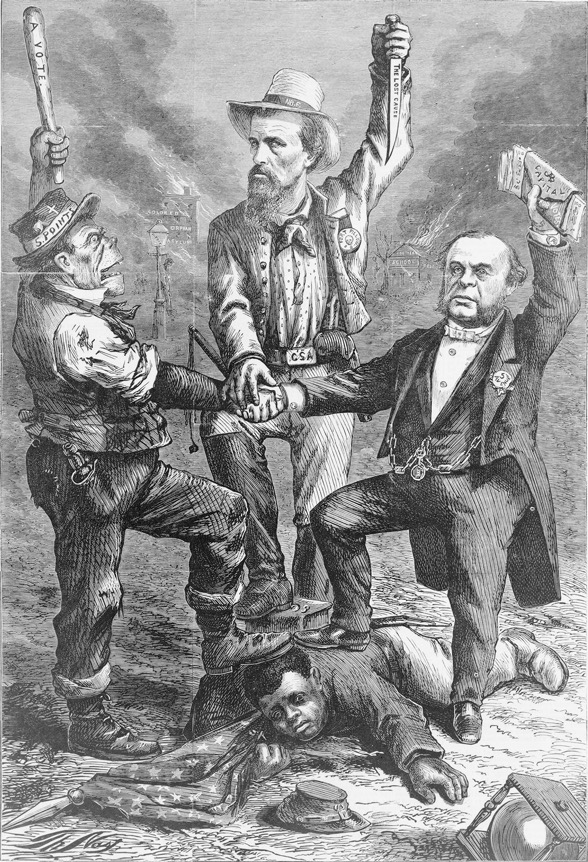
Proclaiming this “a country for White men as long as I am president,” then President Andrew Johnson’s efforts to restore the defeated South to the Union after the Civil War with few if any safeguards for the newly freed slaves was the subject of numerous political cartoons like this one, as Reconstruction became a very contentious political period in post-war America (Library of Congress Prints and Photographs Division—Reproduction Number LC-USZ62-121735).
Apparently gone was the leader who had said “treason must be made odious” and “traitors must be punished and impoverished” as Johnson had done as vice president in 1864—the same man who had once offered himself as a would-be “Moses” to lead African Americans to a promised land of freedom once the war was over and Lincoln’s emancipation policy and Reconstruction took over in the defeated South, including confiscation of large Southern estates and their division among “small freeholders.”4 Instead, according to Trefousse, Johnson whiffed as president on the opportunity to inaugurate a policy that would have “protected minimum rights of the freedmen,” when he ignored the “admonitions” of advisers by deciding to leave voting restrictions up to the states, where, in his estimation, they had always resided; by appointing provisional governors and laying down his own terms for reunion; by beginning to reunify Southern states as they met his previously specified requirements, both constitutionally and by their citizens taking a loyalty oath; and most of all, when he vetoed a bill that would have strengthened the Freedmen’s Bureau started by President Lincoln in March 1865.5 Originally established to ease the transition of the emancipated slaves to post-war, emancipation reality in the South, its start was a rocky one as the defeated states began enacting their own, earliest “Black Codes,” restricting the movement of the former slaves and conditions of labor. In other words, ways to approximate the servitude African Americans in the South had supposedly just been freed from.6 Johnson vetoed the new Freedmen’s Bureau Bill, which would have expanded the agency’s functions, and one other civil rights measure designed to counteract Black Codes on February 19, 1866, with a strongly worded message to the Senate. The President objected to the legislation because it would substitute military jurisdiction in the South for civilian law, something he doubted the need or rationale for with the country in the midst of restoring peace.7
As a Democrat at heart and a Southerner, he had no qualms whatsoever when it came to reversing his tough, earlier stance once he became president and actually dictating policy. That’s when he shifted back to his lifelong conviction that the federal government had no business usurping the rights of individual states. Johnson also came to believe that states’ rights offered the best and easiest way to reconstruct his still divided country regardless of what that might portend for the South’s suddenly free mass of unschooled Negroes, who would be left to fend for themselves in a very different world.8
Some historians have maintained that Johnson tried to “counteract” the image of being totally indifferent to the freedmen’s plight by suggesting to his newly appointed governors that they at least extend voting rights to their “most literate and propertied Blacks,” certainly a minuscule number of all the African Americans in the South in the 1860s. What he never wavered from, however, were his twin beliefs that the federal government did not have the authority to impose total Black enfranchisement on individual states and that the newly freed Negroes should not be made an impediment “to the speedy completion of Reconstruction.”9 If anything, he hoped to use Reconstruction as a means of assisting what he considered the “yeomanry” of the South, the majority poor White population whose ranks he had risen from and the people he hoped would lead the way in establishing new state governments no longer beholden to the plantation-owning gentry, who he held responsible for secession and war. The poor Whites were the ones he wished to elevate—not the African Americans of whom he once said: “The subjugation of the states to Negro domination would be worse that military despotism,” and “they possess less capacity for government than any other race of people.” Ultimately, such deeply felt racial prejudices would explain his stubborn Reconstruction resolve every bit as much as the constitutional principles he professed.10
Meanwhile, Charles Sumner was among the Radical Republicans who were initially duped by the President. Along with others during early meetings at the White House, Sumner heard the President assert his inclination to punish “traitors.” He also heard him say on more than one occasion, “There is no difference between us,” when their discussions turned to equality before the law in regard to skin color. Like his Radical colleagues, he had taken those kinds of comments as presidential nods in support of civil rights in the reconstructed South, even though the President felt such breakthroughs could be achieved without the presence of occupying federal troops. Also, Eric Foner indicated in his book Reconstruction that Sumner was easily the most persistent of the Radicals, the one who “waited upon” Johnson almost daily during the first month of his administration, reiterating constantly the theme around which his whole political career would be built—“justice [for] the colored race.”11
Sumner remained optimistic that even though the Lincoln assassination had been a stunning setback. Perhaps this new president, who he admittedly barely knew despite having served together in the Senate for five years and more recently with Johnson briefly overseeing the Senate as vice president, might prove more amenable to Radical aims than his revered predecessor. Unfortunately, soon enough that would become a baseless hope.12
According to Donald, it did not occur to Sumner at the time “that he had all along allowed his hopes to deceive him as to Johnson’s [true] policy,” but by May 29, 1865, Johnson’s appointment of William Holden as provisional governor of North Carolina and his call for the election of a (state) constitutional convention “to be chosen by loyal White voters” spoke volumes about his actual objectives. At first, Sumner could not believe the President had decided to exclude Negroes from the polls, given all he had previously said or at least signaled, but as Johnson’s repeated proclamations calling one Southern state after another to reorganize on the basis of their same old White supremacy, he was forced to accept the “change” as renunciation of the good faith he and other Senate Republicans had placed in him. Of this change, Donald would write:
More perceptive observers had all along been aware that there were real differences in the Reconstruction policies of the President and the Senator. British Minister Sir Frederick Bruce had alerted his government as early as May 5 to the probability of a quarrel between the two men. When Johnson recognized the [Governor Francis] Pierpont government in Virginia and failed to use his [home state] influence to secure impartial suffrage in Tennessee, a number of [other] Radical Republicans began to feel that he had betrayed them, and it took Sumner and [Ohio’s Ben] Wade to convince the rest at a caucus held at the National Hotel on May 12 that “the President [really] was in favor of Negro suffrage.” Despite such assurances, the Springfield Republican announced nine days before Johnson issued his North Carolina proclamation that Sumner’s theory of Reconstruction was not the theory of the administration.13
Sumner could not help but feel betrayed. He attributed Johnson’s about-face to political pressure. In truth, the President was being influenced in three directions at once—by Sumner and his fellow Radicals; by Seward and more moderate Republicans hoping to lead a new Union Party; and by prominent Democrats, who hoped the President might rejoin their ranks—but on their terms. As a result, Sumner was forced to revert to his familiar role as crusader for African American rights by seeking to delay the Reconstruction process of the President, or at least prevent the readmission of Southern states until Congress reassembled in December while at the same time mobilizing public opinion against Johnson’s program.14
Meanwhile, the Southern provisional governors put in place by Johnson had begun to initiate his Reconstruction desires by calling state conventions to officially abolish slavery within their borders; to nullify or repeal their previous secession ordinances; and to repudiate all Confederate debts. What the President refrained from doing, for some reason, was apply extra pressure to get those things done as quickly as possible. In not doing so, perhaps he felt restricted by his strong state sovereignty beliefs, but regardless of the reason, his reluctance to do so would prove disastrous to his hopes of installing new blood in the positions of Southern leadership, as voters in those states turned to the same conservatives who had been consumed in the South’s “Lost Cause”—the same ones primarily responsible for the already mentioned Black Codes that all but renewed slavery. As a result, Sumner and the other Radicals had even more reason to be alarmed.15
Their fears would only intensify over the next several months, as Johnson became obstinate and unwilling to compromise. Although hard to understand given his extensive political experience, the President often chose the more difficult political path of my-way or no-way during his long career when it came to compromise, and Trefousse makes clear he definitely did so once again when it came to Reconstruction. The reason, his biographer maintained, was either his hope of returning soon to his previous lifelong affiliation with the Democratic Party or his hope of rallying enough conservatives to assemble a new party with him at its head. Either way, it rapidly became apparent that he could not embrace the brand of Republicanism the Radicals of that party were preaching and although the course he chose would be “strewn with political pitfalls,” he was not about to reverse course, exhibiting the same, uncompromising demeanor that led Trefousse to title one of his chapters “Pugnacious President.”16
When it came to Johnson’s shortsighted political point of view, the newly freed African Americans were to remain “outside the bounds of citizenship”—maybe forever, but certainly for the foreseeable future, according to Eric Foner in Reconstruction: America’s Unfinished Revolution. He also wrote of Johnson’s tongue-in-cheek suggestion that absent presidential directives, the individual Southern states might take the initiative to give Blacks the vote, a very “disingenuous” assertion, to be sure, especially given the fact no Southern state since the founding had ever contemplated extending such political rights to Negroes … and absolutely no American alive could have conceived the possibility of any former state of the Confederacy willingly doing so in 1866. As Foner deduced, using a not-so politically correct dialect of the time: “For the freedmen, it already seemed clear that they had been hurt by ‘Mr. Lincoln gettin’ kilt.’”17
Such sentiments were further magnified when President Johnson not only did not severely punish Rebel leaders as he initially hypothesized, but reinforced his suddenly emerging image as the South’s Reconstruction champion by pardoning more than 7,000 Confederates, who had first been excluded from the nation’s general amnesty because of a $20,000 wealth clause. Instead, this largely landed Southern gentry had their property restored by Johnson minus, of course, their slaves. No mass arrests followed the Confederate collapse and only Henry Wirtz, the commandant of the South’s most notorious prison camp, Andersonville (in Southwest Georgia), and Tennessee guerrilla fighter Champ Ferguson were the only two Confederates hung for war crimes. Otherwise, Confederate President Jefferson Davis of Mississippi would be freed after just two years of prison time and his vice president, Georgia’s Alexander Stephens, would return to Congress and even serve as governor of his home state before dying in 1883. Why Johnson so quickly abandoned the idea of depriving the prewar Southern elite that he had always disdained, allowing them to regain much of their economic and political ascendency, has been an oft debated question. One obviously hostile congressman of the time referenced this presidential change of heart when he commented: “The President is no poor White trash now. They [wealthy planters] have taken him on their platform at last and he is wonderfully elevated and elated by their flattery and shared White supremacy.” If Johnson was to have any chance at a second term, he knew he would need the Southern elite and their remaining influence in the post-war South. And so, Southern leaders began predicting a coming breach between the Southern-born president, who had suddenly become their protector, and the Radical Republicans in Congress. For that break, they would not have to wait long.18
After presiding over the Massachusetts Republican State Convention, where he began openly challenging “presuppositions” of the President’s Reconstruction program, Sumner rallied New England businessmen and bond holders by warning them “not a single ex–Rebel will vote to pay interest on the national debt,” while also rallying his past anti-slavery partners to the threat of Johnson’s adherence to a pro–Southern process that would speed reunification but deliberately impede African American opportunity and development. He also did what he could to educate as many legislators as he could to the inherent danger in the President’s course. Donald reported his message to each as the same: “Johnson had broken his promises” and “the Rebels are springing into old life.” Furthermore, he argued, “The President’s policy was illegal and flagrantly unconstitutional because it set up a discrimination of color.” It was, he added, “against common sense, common humanity, and openly against God.”19
Nevertheless, the response to Sumner’s entreaties was initially discouraging, as most Republicans, weary of his war of words in addition to four years of actual warfare, worked to simply bring their state parties in line with the President’s policy in hopes of just moving on. Even the handful of Radical congressmen most disturbed by the President’s fast-tracking and back-tracking on Reconstruction, including normally aggressive anti-slavery co-conspirator Thaddeus Stevens of Pennsylvania, felt powerless to do anything about it. At the time, Stevens reportedly posed questions like “Is there no way to arrest the insane course of this President?” “Is it possible to devise a plan to stop this government in its ruinous course?” To which another Radical leader in the Senate, the irascible Wade, reputedly answered: “The colored people of the South will be compelled to hew out their own way to liberty by the power of their own right arm … if by insurrection they could slay one half of their oppressors, the other half would hold them in respect and no doubt finally treat them with justice.”20
Although discouraged by this lack of opposition and consensus, Sumner nonetheless determined to make one more face-to-face appeal to Johnson. On Saturday, December 2, 1865, two days before Congress was to reconvene, Sumner returned to Washington early and went to the White House to see the President. “Ostensibly,” according to Donald, he was prepared to beg Johnson to change course, “but believing him irreclaimable” and his “rupture” with the Radicals inevitable, he wanted to make sure that it was the President making the break and not something he could later claim was the other way around. Johnson, from his perspective, was also anticipating a clash and hoped to provoke Sumner “into firing the first shot.” Donald reported their meeting lasted for two and a half hours. “Both were on guard and both were vulnerable.” After earlier approving of Johnson’s apparent direction on Reconstruction, Sumner was in no position to claim the President had usurped power by acting without waiting on Congress or by not calling it back into special session. At the same time, Johnson’s position was equally awkward. After repeatedly declaring his support for Negro suffrage, he was ultimately permitting each Southern state to decide for itself, knowing full well they would all fall back on White supremacy they had always known. As host, Johnson coyly went on the defensive, forcing Sumner to eventually erupt into an angry accusation that the President “had thrown away the fruits of the victories of the Union Army,” to which Johnson called his bluff by asking him to be more specific. Following is their supposed dialogue in that moment:
Sumner: The poor freedmen in Georgia and Alabama are frequently insulted by the Rebels.
Johnson: Mr. Sumner, do murders ever occur in Massachusetts?
Sumner: Unhappily yes, Mr. President, sometimes.
Johnson: Would you consent that Massachusetts should be excluded from the Union on this account?
Sumner: No, Mr. President, surely not.
From this type of inane cross-examination, irreconcilable differences between the two emerged. Johnson considered Sumner’s manner “arrogant and dictatorial,” and realizing he represented the entire Radical group, the President knew he could expect “open war.” On the other hand, Sumner left believing Johnson “ignorant, pig-headed, and perverse.” He also decided that Congress must do whatever it could to alter the President’s course—one he was obviously determined to take regardless of concerns on Capitol Hill and one without compromise.21
In partnership with Stevens in the House, Sumner immediately went to work. Donald stated he “seized” the Senate floor as the new session began two days later and introduced “a barrage of resolutions, bills, and constitutional amendments” that would come to make up the bulk of the Reconstruction program preferred by Congress instead of the one introduced months earlier by the President. At the same time, Stevens introduced a motion in the House calling for the creation of a Joint Committee to which all measures on Reconstruction must be automatically referred. The different techniques they employed would characterize their distinct roles in the coming battle with the White House. While Stevens, who was in his 70s, would be the behind-the-scenes organizational man, the much younger Sumner would assume his customary, out-front role as spokesperson for the Radical approach—a very different Reconstruction agenda than what the President had previously unveiled—one that called for sweeping change in the defeated South.22
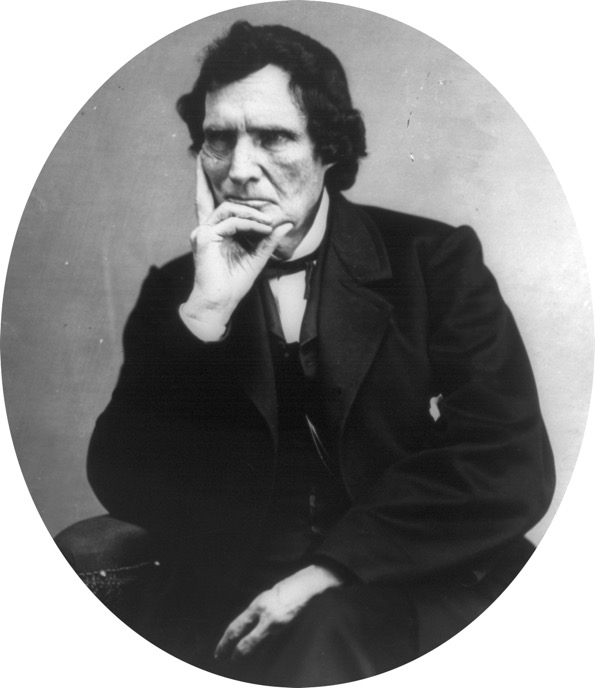
The Radical Republican leader of the anti-slavery and pro-civil rights movement in the U.S. House of Representatives before, during, and after the Civil War, Thaddeus Stevens of Pennsylvania was the primary partner of Charles Sumner in setting the congressional Reconstruction agenda after the war. He also led the House during the impeachment of President Andrew Johnson (Library of Congress Prints and Photographs Division—Reproduction Number LC-USZ62-63640).
With Congress in charge of approving each state’s constitution, Donald described how the Radical approach would wipe away the regimes already set up by the President and ensure “all persons” regardless of race or color “would be equal before the law” with “no denial of rights, civil or political, in the courtroom or at the ballot box.” And to further ensure this goal, each provisional governor would be required to register all male citizens of his state, requiring them to take an oath repudiating secession, upholding the national debt, and most telling of all, pledging them to always “discontinue and resist any laws making distinction on race or color.” Once a majority of males in each Southern state had adhered to this oath, then and only then would a state be eligible to hold a constitutional convention, but with no former officer or even soldier of the former Confederacy allowed to serve as a delegate to those conventions. Also, the new state constitutions would be expected to “disavow secession, prohibit slavery, permanently disqualify high-ranking Confederate officers or officials from holding government office, and pledge henceforth that there would be ‘no distinction among inhabitants founded on race, former condition, or color.’” When each state’s male majority ratified these constitutions, they would be eligible to apply for readmission and representation in Congress. Under Sumner’s plan, Negro males would be included but most ex–Confederates would not; terms he had to know were bound to be summarily rejected by Whites in every Southern state, especially given that Johnson’s original plan had been far more generous.23
In anticipation of that happening, Sumner’s plans, if rejected, would leave a state as a provisional government with Negro rights protected by an occupying military force. Donald surmised these occupations were what the Senator actually preferred in order to provide federal protection for the newly freed African Americans until they had been given a chance “to grow in independence; in knowledge; and in political wisdom.” Not surprisingly, Sumner’s new Reconstruction program was met with derision in the Senate, even by many Republicans, who labeled it “absurd” and too “visionary.” Johnson’s initial messages, on the other hand, were greeted warmly as the session opened. It was the President’s already operational plan that set the tone in early debates and not the Senator’s resolutions. For instance, when Sumner denounced the President’s report of peaceful conditions throughout the South as a “whitewashing” of the mischief and mayhem bound to occur in Dixie if his Reconstruction was allowed to proceed unchanged, his reasoning was rebuked by many of his Senate colleagues. It was certainly not the first time, however, that the senator from Massachusetts had assumed what his primary biographer described as an “uncomfortable and lonely role,” and one that was the subject of heated protests. While Stevens’ committee approach in the House proved more acceptable and a Joint Committee of 15 on Reconstruction was established, Sumner, as a result of his verbal onslaught, would not be included.24
Increasingly under political pressure (even in his home state) from Johnson’s quicker plan for Southern reunification and from overwhelming resistance to political interference in the South, Sumner nonetheless introduced a stopgap amendment that would have made congressional representation in the House based on the number of voters rather than total population. Conspiratorially, its passage would have actually made African American voters advantageous to Southern interests in Congress, but at the same time it made Massachusetts interests question their own senator’s logic and what exactly he was trying to do. In the meantime, Stevens’ Joint Committee had also found time to introduce a constitutional amendment, the Fourteenth, that would continue representative apportionment on the basis of total population, but one that also declared “whenever the elective franchise shall be denied or abridged in any state on account of race or color, all persons of such race or color shall be excluded from the basis of representation,” accomplishing what Sumner had set out to do with his amendment without the attendant cost to his or any other Northern state. Having painted himself into a political corner versus his instate rivals, Sumner had no choice but to come out in opposition to that one even though it was entirely similar to his own.25 At the time, he would claim he had chosen “the high road of morality” while his colleagues “had fallen into the slough of compromise with slavery.”26
Again, according to Donald, that was the ironic and unfamiliar political place the nation’s foremost advocate of African American civil rights found himself in when, in June of 1866, “Congress approved the Fourteenth Amendment granting citizenship to all those born in the United States” while also “prohibiting states from depriving ‘any person of life, liberty, or property without due process of law’ or from denying any person ‘equal protection of the laws.’” Also known as the “Reconstruction Amendment,” it did not address Black voting rights, a disappointment to Stevens as well as Sumner, but almost all the other Radical Republicans in Congress voted for it along with their more moderate partisan colleagues.27
Although far from the voting rights protection preferred for the new freedmen by Sumner and Stevens, it was something—a start for civil rights in a reconstituted country. Johnson, however, remained opposed to anything that amended the U.S. Constitution until all new Southern senators and representatives had been selected and seated, and until that happened, he chose to use the influence of the presidency to stop ratification. According to Trefousse, the President believed the Fourteenth Amendment to be in direct opposition by Congress to his expressed (and already commenced) Reconstruction program and he was not about to yield, either to compromise or the will of his congressional opponents. As a result, Reconstruction became a far more contentious proposition. “To Johnson,” Trefousse would confirm, “as long as Congress was ‘in the hands of the Radicals,’ bringing the Southern states back in and returning all the states to their proper relationship would be impossible.”28
His biographer also revealed that once the amendment received the necessary two-thirds vote in Congress at about the same time the Joint Commission issued a report containing the President’s assertion that the Southern states were ready for re-entry and representation, Johnson rebuked the legislation and the process on the basis that no one in his administration had even been forwarded a copy of the resolution before it was voted on. Nevertheless, as stipulated by federal law, he instructed Secretary of State Seward to officially transmit the amendment to the states for their consideration. Following Seward’s transmission, however, he described that step as “merely ministerial,” while continuing his tirade that “the people” had not been consulted and there being “no precedent for such a course.”29
Made to look irrelevant by the congressional action, Johnson vetoed another version of the Freedmen’s bill. Suddenly weakened by the amendment and his reaction to it, however, that veto was overridden with even moderates voting against him. On that point, Trefousse concluded: “By the summer of 1866, it had become evident that Johnson’s effort to restore the Southern states by executive fiat without any significant conditions or safeguards [for African Americans] was in deep trouble.”30
Because of his political quarrels with Republicans during the first half of 1866, the President’s interest in a new political party intensified. Along with Seward, Congressman Henry Raymond of New York, a co-founder of the New York Times, and Secretary of the Navy Gideon Welles (like Johnson a former Democrat), the President initiated calls for a National Union Convention in an attempt to bring together all those who had approved of the administration’s Reconstruction policy. Johnson even asked his Cabinet to back the convention en masse, a presumptive request that resulted in three Cabinet members, all Republicans, resigning. Other than Seward and Welles, the only Cabinet members remaining after Johnson’s politically motivated request were Secretary of the Treasury Hugh McCullough and Secretary of War Edwin Stanton, who openly sided with the Radical Republicans even though he refused to resign. Stanton’s decision to remain at that time and Johnson’s decision to allow him to stay would foreshadow confrontation—the kind that has reverberated in American political history.31
During this presidentially induced Cabinet shakeup, meanwhile, Sumner’s own political irony played out about as well as possible for him, as the Reconstruction Amendment that had passed Congress even without his support survived yet another Johnson veto. He rationalized his position by claiming the amendment did not go far enough in its civil rights protections for Southern Blacks and would thus leave them still vulnerable to Southern Whites and their Black Codes. This however, according to Donald, was regarded by most of his congressional colleagues as totally inconsistent with his lifelong advocacy of African American civil rights “to the point of indecency.” Before its passage, Stevens even “begged” that if the amendment his Joint Committee had fashioned “was to be slain, that it not be by the votes of friends,” with everyone in both chambers knowing that comment was directed at his longtime anti-slavery partner more than anyone else. And Sumner was acutely aware of the frustration his surprising stance had caused among Republican colleagues, many of whom supposed his obstinacy on the issue had to do with a full-blown hatred of the President. Equally ironic, however, in the ongoing Reconstruction saga would be what Johnson did next that actually got Sumner off the hook, relieving the ostracism the Massachusetts Senator was suddenly experiencing within his own party.32
That summer, through the combination of centrist politicians like Seward, Edgar Cowan of Pennsylvania, James Doolittle of Wisconsin, and influential political gurus like Thurlow Weed, a Republican from New York, and Montgomery Blair, a Democrat from Maryland, the President’s coveted political convention did come off in mid–August in Philadelphia, with delegates attending from across the country and across party lines. With the expressed goal being the formation of a new Union Party, many Republicans in Congress reacted angrily to this bipartisan effort at party reconstruction. At the same time, race riots erupted in Memphis and New Orleans, resulting in the deaths of at least 98 people and the President blaming the Radicals and their new amendment for inciting the violence. Obviously, the riots in the South also contradicted Johnson’s earlier claims of calm in the Southern states, so Congress and its new amendment offered convenient scapegoats. Shortly thereafter, the first presidential impeachment rumblings were heard in the House of Representatives. Despite the racial turmoil and ongoing Washington squabbles, however, Johnson’s hoped-for bipartisan convention did come off in Philly and did feature such gestures at unity as Massachusetts and South Carolina delegations entering the hall arm-in-arm, with everything aimed at providing the President a public relations coup. In its wake, participant reports proclaimed it “the most important proceeding since 1787,” the year of the U.S. constitutional convention, and an emerging resolution was even billed as “a second Declaration of Independence.” Continuing the PR campaign, Johnson next embarked on a series of presidential speeches designed to make his case to the Northern people for Reconstruction his way. Included were the cities of Baltimore, Philadelphia, New York City, Albany, Buffalo, Cleveland, Toledo, Detroit, Chicago, Springfield, St. Louis, Indianapolis, Louisville, Cincinnati, Columbus, and Pittsburgh in what was called the “Swing Around the Circle” between August 27 and September 15, 1886. It was an unprecedented presidential speaking tour for that era, but also one that would destroy any conceivable possibility for peace between the Johnson administration and the Radical Republicans.33
Speaking in the same, direct, confrontational manner he had always used during his decades on the Tennessee stump, Johnson castigated his opponents in Congress and repeatedly responded irrationally to hecklers in his crowds. During one stop in St. Louis about halfway through the tour, Trefousse acknowledged he even became “blasphemous,” and somewhat incoherently so, when he stated:
I know I have been abused and traduced. I have been slandered. I have been maligned. I have been called Judas Iscariot. There was a Judas, and he was one of 12 apostles. Oh yes, the 12 apostles had a Christ. The 12 apostles had a Christ and he never would have a Judas unless he had 12 apostles. If I have played Judas, who has been my Christ? Was it Thad Stevens? Was it Charles Sumner? These are the men that stop and compare themselves to the Savior—and everybody that differs with them—and to try and stay and arrest their diabolical and nefarious policy, is to be denounced as a Judas.
Quoting what the Chicago Tribune had to say afterwards, his biographer confirmed this harangue as “the crowning disgrace of a disreputable series.” And once his tour concluded, the New York Independent pretty well summed up how the Northern media as a whole felt about it by reporting: “For the first time in the history of our country, the people have been witness to the mortifying spectacle of a president going from town to town denouncing his opponents, bandying epithets with men in the crowd, praising himself and his policies. Such a humiliating exhibition has never been seen.”
Casting himself as the only thing standing between Whites and “Negro domination,” according to the previously referenced magazine The Week in 2019, Johnson’s speeches provided ammunition for his opponents. Having already labeled Sumner and Stevens traitors, he may have actually been relying on Northern racism to sway moderates to his side in the Reconstruction argument, but the fact Republicans carried most elections for the House of Representatives that fall by overwhelming majorities portended major problems ahead for Tennessee’s third president (after Jackson and Polk).34
Following those midterms, Seward advised Johnson to strike a more conciliatory and compromising tone. The secretary of state even drafted an annual message for the President that would have had him accepting the Fourteenth Amendment after all, if only Congress would admit the Southern representatives still pending from Johnson’s original Reconstruction plan. The President, however, rejected Seward’s attempted overtures, stubbornly persisting in his my-way or no-way attitude towards the Reconstruction process. With three Border States having already voted against ratification and the former states of the Confederacy all but certain to follow suit, it was Johnson’s political calculation that compromise would be unnecessary since the amendment would not secure the necessary votes of three-fourths of all the states to become law unless Congress resorted to harsher measures to coerce the South. In other words, long-term military rule. He was basically gambling that neither the House nor the Senate would ever go that far and if they did, he believed that could also work to his advantage in time for the 1868 presidential election.35
This would prove an ill-conceived calculation on his part because he had unwittingly relieved Senator Sumner’s ostracized position within his own party and reunified the Radicals with his speaking tour. Johnson hoped for a coalition of Northern Democrats, moderate Republicans, and the White Southerners he hoped to merge into his new Union Party once all the states regained statehood and the opportunity to vote, especially after his Philadelphia convention had been orchestrated from the White House. Only the most well-to-do Southern “traitors” were ultimately targeted by Johnson for retribution (example: Confederate President Jefferson Davis, who was imprisoned at Fortress Monroe on the Virginia coast), including estates worth more than $20,000 as he sought to reposition and repatriate less fortunate Southern Whites in his sphere of influence.36
Despite his original opposition to the Fourteenth Amendment, Sumner had found time to propose a number of supplementary bills to strengthen the milestone legislation; enough so, in fact, that he would eventually vote for it after all. Following its passage, he almost immediately renewed his efforts to win even more precise legislation for African Americans, a nearly decades long campaign that he would carry through to the Fifteenth Amendment in 1870, which more specifically addressed minority voting rights, and the even more landmark Civil Rights Act of 1875, which guaranteed equal access to public accommodations. Even though he died in 1874, a year before its passage, that 1875 bill would become Sumner’s lasting legacy, according to Barry Goldenberg, the last meaningful civil rights legislation until the 1960s. In defining his renewed effort on behalf of African Americans, Sumner once orated:
Show me a creature with lifted countenance looking to heaven, made in the image of God, and I will show you a man who, of whatever country or race, whether browned by equatorial sun or blanched by northern cold, is with you a child of the heavenly father, and equal with you in all the rights of human nature. You cannot deny these rights without peril to the republic … by the same title that we claim liberty do we claim equality also. One cannot be denied without the other. What is equality without liberty? What is liberty without equality? One is the compliment of the other. The two are necessary to begin and complete the circle of American citizenship. They are inseparable organs through which the people have their national life.37
This excerpt from an 1871 Senate debate on what Sumner termed the “equality of man” helped explain the new chapter of his career that he entered into in 1866. By the second half of the 1860s, he had regained his political balance and purpose following the Lincoln assassination. The new president had proven a disappointment and their paths had diverged sharply; enough, in fact, to shed light on what his new resolve needed to be.38
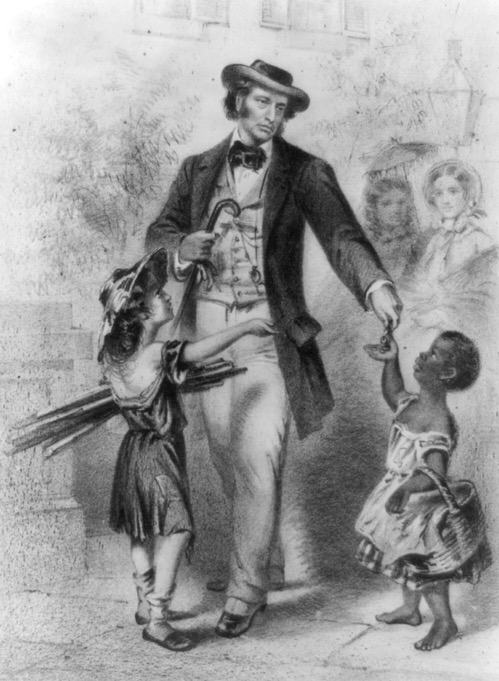
As perhaps the leading anti-slavery agitator in the U.S. Senate before the Civil War, Charles Sumner was regularly portrayed as a patron of Black civil rights in both the North and South, as exemplified by this political cartoon of the time with the Massachusetts senator shown favoring a needy Negro child over an equally needy White child (Library of Congress Prints and Photographs Division—Reproduction Number LC-USZ62-12771).
Following Sumner’s speech, the President immediately sought to divide and conquer given the Senator’s remarks. Before Sumner’s renewed attack had time to spread, Johnson hoped to nip it in the bud by inviting other leading Republicans to the White House, hoping to profit from their initial hesitancy over what Sumner and Stevens (in the House) were suddenly preaching. Johnson, by then, was resigned to full-scale war with the two leading Radicals, so manipulating a truce with the majority party’s other leaders seemed a good idea to the embattled chief executive.39
Gradually during the fall of 1866, Sumner’s political fortunes began to change for the better, in large part because of Johnson’s intrusion into the Republican ranks, seeking possible inroads to displace his most aggressive opponents. Largely through his own blunders, including being baited into rash accusations and name calling at political events, the President had painted himself into a corner without benefit of an existing political organization to call his own, much less one to which he could look for loyalty. About the only group he could increasingly turn to were Southern Democrats and they were still waiting on congressional approval of their new state constitutions just to re-enter the Halls of Congress. Only Tennessee, his home state, which had the head start of being under Union control since 1862, was the only Confederate state to re-enter by 1866. As for the others, Alabama, South Carolina, Florida, Louisiana, Arkansas, and North Carolina would be denied return until 1868, and the last three, Texas, Virginia, and Georgia, until 1870.40
Given the President’s own self-destructive tendencies and increasing political isolation, Republican candidates largely swept to victory in the 1866 mid-term elections with the vast majority of those being of the Radical persuasion, a further boon to Sumner and Stevens in the Reconstruction debate. That’s when Congress stole a page from the Johnson playbook, becoming increasingly more inflexible. With more senators and representatives feeling the return of the Southern states could not be completed as long as Johnson opted not to work with the congressional majority, they began to look for ways to ensure their influence over the process. One of those ways was the 1867 Tenure of Office Act by which all authorized administration officials approved via the Senate were henceforth required to remain in their office until the Upper Chamber had also approved any successor. According to Eric Foner in his history of Reconstruction, this was “intended primarily to protect lower level patronage functionaries [and] also barred the removal, without Senate approval, of Cabinet members during the term of the president who appointed them. It remained uncertain, however, whether this [new law] applied to Secretary of War Edwin Stanton, who [as previously noted] had been named to his post by Lincoln and had retained it even when most of the other Lincoln-appointed, Republican-leaning Cabinet members had resigned in protest earlier in the Johnson administration.”41
And within a day of that legislation, Congress had also passed its own Reconstruction Act of 1867. In its final form, again according to Foner, the former states of the Confederacy, minus already readmitted Tennessee, were divided into “five military districts under commanders empowered to employ the U.S. Army to protect life and property. And without immediately replacing the Johnson governors, it laid out the steps by which new state governments could be created and recognized by Congress.” The steps included the writing of new constitutions to include universal manhood suffrage; the approval of each constitution by a majority of the state’s eligible voters; and ratification of the recently passed Fourteenth Amendment. Ratification of this other Reconstruction amendment would also qualify returning states for representation in Congress as before the Civil War. The military commanders in each district would then be authorized to register voters and hold elections.42
What Foner termed the congressional “evolution” away from Johnson’s Reconstruction policy to the policy endorsed by Sumner and Stevens that followed passage of the Fourteenth Amendment was rapid and the result of not only the President’s obstinacy when it came to states’ rights and Black suffrage, but also the obvious obstinacy of the White South. Military rule was deemed necessary but temporary as long as the new civil rights and new political orders became established. Just as obviously, however, what could not be legislated into submission would be the deeply held beliefs, prejudices, resentments, and animosity of a mandatorily reconstructed Southern White population. No two-thirds vote of the then all–Northern Congress was going to change that and therein lay the essence of the Reconstruction dilemma.43
Perhaps Johnson’s original plan had merit when considered from the standpoint of a chief executive trying to put the country back together after one of the most massive internal bloodlettings in recorded history and the assassination of the one man with the understanding and proven leadership qualities to (perhaps) pull off a less contentious Reconstruction process. Even the revered Lincoln’s presence, however, might have not been enough to rein in the politics that ensued. What is certain is that Johnson’s plan was dead almost on arrival when Congress was not included from the outset; when large Southern race riots with lots of fatalities began occurring; and especially when the South’s reluctance to accept the new freedmen and their suddenly equal rights after generations of slavery became increasingly manifest … the “better angels of our nature” that Lincoln talked about in his first inaugural address be damned.44
“The landmark advances in the wake of Lincoln’s assassination would largely come about in spite of [Andrew] Johnson, not because of him.” So wrote Pulitzer Prize–winning historian Jon Meacham in one of his latest offerings, The Soul of America. “The presidency which under Lincoln had been a tool of transformation had become under Johnson, a refuge from modernity.”45 Into this breach and opportunity lost by our 17th president, Sumner inserted himself to try and achieve the African American suffrage he had always dreamed about along with their freedom. He believed the question of Black voting rights had to be resolved or “every state and village between Washington and the Rio Grande River [border with Mexico] would be agitated by it.”46
Donald acknowledged: “Washington was a lot pleasanter place for Sumner in the winter of 1866–67 than it had been in years.” With the President leaning towards Democrats as his last resort for support, the Republicans in their congressional caucuses were becoming more and more sympathetic to the plight of Southern freedmen and once again receptive to the senior senator from Massachusetts and his more radical way of thinking. Although he had nothing to do with the Tenure of Office Act, Sumner enthusiastically endorsed its attempt to rein-in the President by limiting his power to remove subordinates. He liked it so much, in fact, he wanted its restrictions made stronger to include the power of appointing and removing Cabinet members, a power he said should “more properly reside with the Senate as the more fixed branch of government rather than individual presidents who came and went more frequently.” Sumner also believed “the Senate was less likely to become depraved and base than the President.”47
Also, according to Donald, Sumner had privately “made up his mind” that Johnson must not only be contained, “but removed.” With enough executive power, still, to frustrate Radical Republican efforts to reconstitute the South with its racist social fabric, especially in the way he could be expected to exercise his presidential veto—something Johnson would do 29 times, 15 of which Congress would override (still a record). Even with a dependable Republican majority to provide overrides, however, his repeated vetoes had the power to needlessly encourage obstinacy and noncompliance in the South. And worst of all, as president he possessed the power to virtually negate congressional Reconstruction policies through non-enforcement whenever he so desired. All the while, Sumner said, “If we go forward and supersede the sham governments set up in the Rebel states, we [will still] encounter the appointing power of the President, who would put in office only men who sympathize with him. It is this consideration which makes ardent representatives say he must be removed.”48
With another Stevens’ led committee in the House already investigating the President, the Lower House was in a position to bring charges. That would cast Sumner and his fellow senators as jurors in an impeachment court, but for the time being he refrained from urging what he termed “the full remedy” of presidential removal. But by early 1867, with Southern states still taking Johnson’s lead by refusing to ratify the Fourteenth Amendment, Sumner’s constraint was vindicated as more and more Republicans began to express hostility to any measure or presidential pronouncement that openly recognized the White race as superior to the Black. In the months since passage of the Fourteenth, they had begun to understand how astute Democratic lawyers could (and would) “exploit every concession made to Northern racism,” as Donald explained it, and use that as a precedent for Southern actions and prejudice. A prime example of that occurred in the final days of the previous congressional session, when Tennessee had been readmitted to the Union without the required Negro suffrage component by exploiting what Donald termed “an awkward fact” in the amendment that “seemed to give states the right to exclude citizens from the polls” if that state also agreed to reduced representation in Congress. Almost alone, Sumner had voted against that loophole ever since Tennessee’s early re-entry, and his consistent stance on the subject started reaping benefits when reluctant senators began to follow his lead, voting nearly verbatim as he did. Donald confirmed “by mid–January he could boast that the Senate had adopted his views” and in one of his letters his biographer found the quote: “It cannot be said now that the Republican Party is not fully committed to Negro suffrage.”49
Being able to write that must have been a very gratifying moment for a lawmaker who had devoted his political career to equality for America’s Black population. While Presidents Lincoln and Lyndon Johnson a century apart have always been credited with getting African American civil rights started and finally complete, there’s no doubt that Charles Sumner was one of the most important catalysts between the two on an issue that has unfortunately always defined American history. And as Goldenberg related in his book on early architects of civil rights, “to justify past racism would be to wash away the efforts of men like Stevens and Sumner, who were responsible for the first major legislation that advanced Black equality.”50
Thus, by the 40th Congress of 1867–68, what could be considered “the unmaking” of a president had begun. By then, Sumner had denounced Johnson as “the defender of slavery, the arch enemy of country, and the betrayer of liberty,” strong accusations that Donald indicated set in motion the Senator’s expressed remedy—“removal from office” of the nation’s chief executive. As talk of impeachment began to filter through both congressional chambers, especially whenever a caucusing of Radical Republicans occurred, Sumner tried to remain above the fray publicly, while keeping abreast of anti–Johnson feeling in the House and undoubtedly “egging” it on despite the fact that chamber’s Judiciary Committee had yet to establish the presidential high crimes and misdemeanors required by the Constitution. In August of 1867, however, that abruptly changed when the President finally saw fit to suspend his secretary of war. Actually, no one in the Johnson administration was surprised when the suspension was announced, as many had been advocating for a replacement atop the War Department ever since those three earlier Cabinet resignations occurred. After all, Secretary Stanton shared a likeminded affection for Radical Republican ideology with those earlier Cabinet defections and an obvious difference of opinion when it came to the Johnson’s plan for Reconstruction. Obviously reluctant to remove the Lincoln appointee who had played a major role in the Union’s military turnaround and mostly winning final years of the war, the President was either still indebted to Stanton for his support while military governor of Tennessee; was hesitant to remove someone so connected and important to Grant, still the commanding general of the Army; or because of his fear that Congress would never confirm a replacement given its current state of conflict with the administration. Perhaps that last reason, as acknowledged by Johnson biographer Hans Trefousse, had the most validity when borne out by America’s first impeachment proceeding over the next nine months.51
“Relations between Johnson and Stanton had been worsening steadily,” Trefousse confirmed, and despite the undoubtedly targeted Tenure of Office Act hanging over any personnel moves the President hoped to make, he was prepared to go out on that limb anyway while Congress was adjourned and remove Sumner by the summer of 1867. With his stubborn streak ultimately consuming any better judgment he might have entertained in open defiance of Congress and its Tenure Act, Johnson finally sent a curt letter to Lincoln’s trusted man at the War Department, asking him to vacate his office, with Grant to be put in charge of his duties for the immediate future. Grant, who did not wish to take on the added role and responsibilities or see his benefactor and colleague so summarily dismissed, reminded the President that the Tenure Act prohibited such a decision. Undeterred a week later, however, following charges and counter charges in the press, Johnson officially suspended Stanton as secretary of war, with all his duties indeed transferred to General Grant.52
Along with Stanton, Johnson also set about getting rid of the Radical-preferred military district commanders in the South, including General Phil Sheridan in the Louisiana-Texas district, but Grant rejected this removal of one of his most trusted Civil War subordinates. Also, the President’s choice to replace Sheridan was Winfield Scott Hancock, a Democrat and future presidential nominee, who naturally aroused suspicion in the Republican ranks as a perceived threat to congressional Reconstruction. Trefousse reported “Johnson was furious” and fearing Grant was also siding with the Radicals, he even sought to replace him with another Union hero, William Tecumseh Sherman, who, not surprisingly, refused the post in deference to Grant, his wartime commander and colleague.53
Not to be quelled, however, Johnson continued his aggressive and defiant tactics heading into the 1868 elections by issuing a proclamation requiring the Army to “sustain law and order as expounded in the civil courts” of the South and by ordaining “a general amnesty for all but the most prominent Confederates.” It was a calculated presidential provocation based on the fact Johnson felt Democratic gains in elections that fall in state after state would sustain him, and initially that seemed a wise bet as November’s elections did indeed favor Democrats even before the Democratic South had been restored. To the President’s way of thinking, it had become all about “rescuing the South from ‘Negro rule,’” according to Trefousse, and he flagrantly incorporated a constituent’s wish for the “restoration to the White men of the South the Constitution as it was” in his annual message to Congress.54
Meanwhile, complaints Republicans in Congress were receiving from Southern Unionists made manifest the effect the President’s opposition to the Reconstruction Amendment was having among rank and file Southerners, and that, along with his obvious disregard for the Tenure of Office Act, prompted many of them to ultimately accept the impeachment mode of their Radical brethren as the only realistic solution.55 There’s no doubt, in fact, that Southern intransigence encouraged by the President and Johnson’s stubborn resolve to challenge the very Tenure Act that had been put in place to curb his autocratic tendencies “played right into Radical hands,” as both Donald and Foner attested. Sumner and company had their issue, repressive as it was of executive privilege, and their one fear was that Stanton would eventually accept the President’s wishes and resign. So, to prevent that happening, the Senate rushed through a resolution denying Johnson’s right to oust the War secretary, whose selection under Lincoln and retention by the sitting president had nullified his ability to remove him from office of his own volition. It was a controversial bill when it passed over Johnson’s veto and it was still controversial a year later, especially once it was established that Stanton would abide by the Senate Radicals’ wishes and remain at his post in the War Department, relinquishing nothing to Grant or the President’s demands.56
“Stick” is the term Donald indicated Senate Radicals used to implore Stanton to remain on the job no matter what, and stick is exactly what he did, barricading himself in his office for approximately two months, beginning February 21, 1868. Three days later, the Stevens-led House of Representatives voted to impeach Johnson by a vote of 126–47 for high crimes and misdemeanors related mostly to his breach of the Tenure of Office Act.57
Ardently, Sumner began to push for the start of a Senate trial, what would become the first of a sitting U.S. president. He argued that all other public business should be suspended, and a prompt conclusion and verdict rendered once a jury of all the senators had been sworn in and the evidence presented. Throughout the legal proceedings in the Senate chamber with Chief Justice Salmon P. Chase presiding, Sumner sat close to Stevens and the other House managers. He would argue that the Senate trial was not really a courtroom trial at all, but “a political proceeding before a political body with a political purpose.” Also, since the trial was, in his view, a political proceeding, he urged all evidence, no matter how minute or based on hearsay be allowed, but when it came to permitting Cabinet members to testify on the President’s behalf as to his intent in removing Secretary Stanton, that was another matter altogether. As his biographer noted, consistency for him was “no hobglobin” in that moment as intent as he was on “ridding the country of Johnson.”58
When William Evarts, one of the President’s attorneys, defended his client’s right to interpret the Constitution for himself “just as President Andrew Jackson had done in a previous day,” and “just like Senator Sumner in 1852, when he had defied court and Congress by calling the new Fugitive Slave law unconstitutional”—that same senator did not blink. Instead, according to Donald, he “impatiently brushed aside all technicalities and legal quibbles” when a few Republicans were troubled by the fact Johnson had not actually removed Stanton, who still occupied his office; when discussion centered on the intolerability of keeping someone in the Cabinet against the president’s wishes; and when the validity of the Tenure Act even applying to Stanton was questioned due to the fact he had been appointed by Lincoln and had never received a formal commission from Johnson. To Sumner, all this legalese was irrelevant. Disgustedly, he voiced regret that the House had brought articles on “such narrow ground,” since, he felt, there were other transgressions by the President that also warranted impeachment.59
Desiring impeachment to save Reconstruction in the South regardless of any specific crime the President may have committed, Sumner was, in fact, infuriated when Johnson was acquitted by a single, surprising vote—that of Republican Edmund Ross of Kansas, one of the senators John F. Kennedy would feature in his book, Profiles in Courage for exactly that reason. Although representing one of the most anti–Johnson, pro-civil rights states in in the country, his unexpected vote to acquit on the first article of impeachment on May 16, 1866, along with fellow Republicans William Fessenden of Maine, John B. Henderson of Missouri, Peter Van Winkle of West Virginia, Lyman Trumbull of Illinois, Josiah Fowler of Tennessee, and James W. Grimes of Iowa, “saved a president,” according to JFK. By the time Ross was called on to cast his vote, 24 “guilties” had been pronounced, with 10 more certain and one practically certain, rendering the newly elected Kansas senator’s vote decisive to the final tally. In describing that moment, Kennedy dramatically wrote: “Every voice was still; every eye was upon the [young, 39-year-old] freshman senator. The hopes and fears, the hatred and bitterness of past decades were entered upon [that] one man. Then came the answer in a voice that could not be misunderstood—full, final, definite, unhesitating, and unmistakable, ‘Not guilty.’” Presidential historian William DeGregorio credited the resulting acquittal as “owing to the courage of seven senators who risked their political careers to bolt party ranks.”60
Those seven previously mentioned Republicans plus 12 Democrats made the final margin 35–19—oh so close to the required two-thirds necessary for conviction and removal. Ten days later, Johnson would be acquitted again of two more articles of impeachment by the same count. Sumner would never forgive the seven “recusant Republicans” and would go to his grave believing Ross had been bribed.61 Johnson, meanwhile, got word of his acquittal that same day and was so delighted with the verdict that he had the White House thrown open to well-wishers. While Democrats publicly hailed the trial’s result, privately they would have preferred a more lasting condemnation of the Radicals for having foisted it upon the country.62
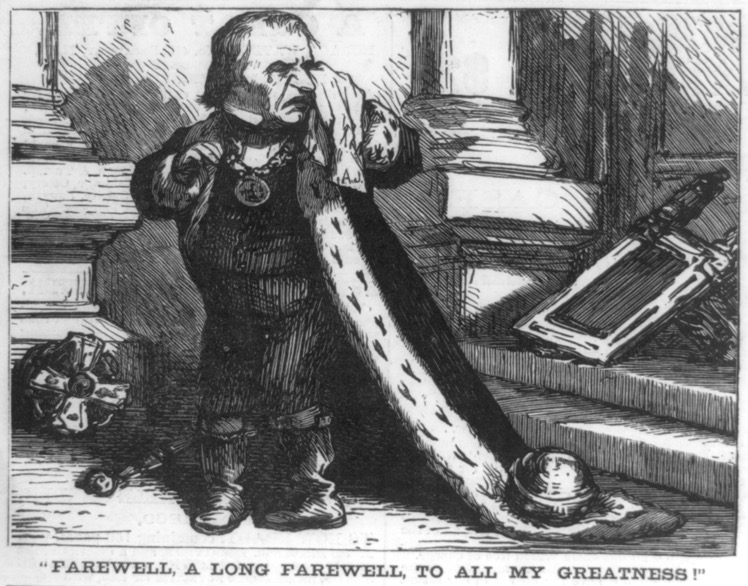
Shown crying his eyes out in this political cartoon during his final, inglorious days as an impeached president, Andrew Johnson would go down in history as one of our worst chief executives largely because of the stubborn, uncompromising approach he took to Reconstruction and his racist Southern roots, both of which became evident during his four years in the White House (Library of Congress Prints and Photographs Division—Reproduction Number LC-USZ61-2017).
Ten days later, the Republicans nominated the immensely popular but initially reluctant Grant for president. The Democrats would nominate former New York Governor Horatio Seymour, who would win just eight of the 34 eligible states, including two of the initial eight Southern states to ratify the Fourteenth Amendment, the result of so many Southern Whites being disenfranchised by the ongoing Reconstruction process while the many former slaves in those states, with their first chance at the polls, voted overwhelmingly for Grant.63
Having narrowly survived impeachment, Johnson would never realize his hope of founding and leading a new Union Party, and would finish a distant memory at the Democratic National Convention, where he somehow got 65 votes on the first ballot—less than a third of what was needed for nomination—before dropping out. Thus denied re-nomination by both major parties, he would finish out his final nine months in office as the lamest of lame duck presidents, except during his last annual message to Congress in December of 1868, when he “minced” no words, according to Trefousse, in assailing the “military dependencies” that Congress had put in place in the South and the “attempt to place the White population under the domination of persons of color.” A White supremacist to the bitter end, Johnson would not attend the inauguration of his successor, Grant, but would retire a hero in his home state, where his Reconstruction efforts on behalf of the defeated South had not gone unnoticed and where he would end up regarded as a patriot after all.64
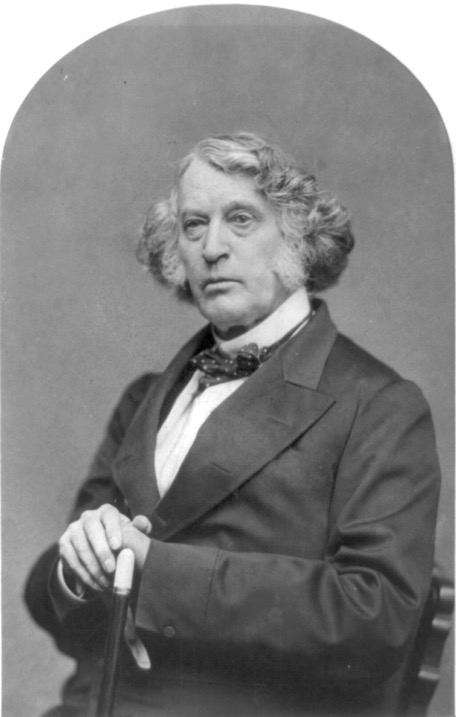
Pictured here later in life, Charles Sumner of Massachusetts was the foremost advocate of African American equality and civil rights before, during, and after the Civil War. His efforts on behalf of the first American civil rights legislation in the 1860s and 1870s earned him folk hero status among Blacks, North and South, as the architect of modern legislation that resulted during America’s Civil Rights Movement a century later (Library of Congress Prints and Photographs Division—Reproduction Number LC-US762-66840).
At the same time, Sumner would go on to serve in the Senate for eight more years and continue to battle for Black suffrage in a prejudiced country and still hostile political environment. Seven years after the Reconstruction Act of 1867, he would attempt to pass another civil rights bill—the kind that would finally get done almost a century later (1964), during the previously mentioned administration of Lyndon Johnson. Aimed at granting full citizenship and social equality to African Americans—almost unthinkable in those days in both North and South—Goldenberg indicated that amendment was struck down twice in committee in 1872 and again in 1874. But barely a month later after Sumner’s death on March 11, 1874, the bill that had only survived due to his tireless advocacy was passed in a watered-down version that, among other things, did not include his visionary goal of school desegregation.
Nevertheless, when it was finally signed into law on March 1, 1875, it would be another milestone in the long struggle of African American civil rights due primarily to the senator honored in death just a year earlier like Henry Clay—by lying in state in the U.S. Capitol Rotunda. At Sumner’s burial in the Boston area’s prestigious Mount Auburn Cemetery, his pallbearers included lifelong friend Longfellow, Supreme Court Justice Oliver Wendell Holmes, renowned New England essayist Ralph Waldo Emerson, and the great American poet John Greenleaf Whittier, a star-studded sendoff for the man to whom “more than any” (including Lincoln), according to another friend and biographer, Moorfield Story, “the colored race owed its emancipation and such measure of equal rights as it could enjoy” in the aftermath of Reconstruction.65
1. Philip Dray, Capitol Men: The Epic History of Reconstruction Through the Lives of the First Black Congressmen, x; Eric Foner, Reconstruction: America’s Unfinished Revolution, 1863–1877, xix, xx.
2. Hans L. Trefousse, Andrew Johnson, 197, 207, 215, 216, 218–219, 220, 229, 230.
3. Ibid., 223, 225; “The Impeachment of Andrew Johnson,” The Week, October 25, 2019.
4. Eric Foner, Reconstruction, 177, 183.
5. Hans Trefousse, Andrew Johnson, 215.
6. Eric Foner, Reconstruction, 69, 199.
7. Hans L. Trefousse, Andrew Johnson, 241–242.
8. Ibid., 165–166, 196, 219–223, 235, 238, 242–243; Eric Foner, Reconstruction, 179–180.
9. Eric Foner, Reconstruction, 180; Hans L. Trefousse, Andrew Johnson, 223–224.
10. Hans. L. Trefousse, Andrew Johnson, 299; Eric Foner, Reconstruction, 176–181, 217, 219–220, 223, 379.
11. Eric Foner, Reconstruction, 178; Hans L. Trefousse, Andrew Johnson, 237.
12. David Herbert Donald, Charles Sumner and The Rights of Man, 218–223.
13. Ibid., 224.
14. Ibid., 225–226.
15. F. Martin Harmon, Presidents by Fate, 88.
16. Hans L. Trefousse, Andrew Johnson, 234–237.
17. Eric Foner, Reconstruction, 178.
18. Ibid., 190–192; “The Impeachment of Andrew Johnson,” The Week, October 25, 2019.
19. David Herbert Donald, Charles Sumner and The Rights of Man, 226, 228–229.
20. Ibid., 229–230.
21. Ibid., 237–238.
22. Ibid., 238.
23. Ibid., 239.
24. Ibid., 240–241.
25. Ibid., 242, 243, 244–245.
26. Barry M. Goldberg, The Unknown Architects of Civil Rights, 83–84.
27. David Herbert Donald, Charles Sumner and The Rights of Man, 245; Walter Stahr, Seward, 468.
28. Walter Stahr, Seward, 468; F. Martin Harmon, Presidents by Fate, 89; Hans L. Trefousse, Andrew Johnson, 252–253.
29. Hans L. Trefousse, Andrew Johnson, 252; Walter Stahr, Seward, 468.
30. Hans L. Trefousse, Andrew Johnson, 252–253, 254.
31. Ibid., 255; Walter Stahr, Seward, 468–469; William DeGregorio, The Complete Book of U.S. Presidents, 252–253.
32. David Herbert Donald, Charles Sumner and The Rights of Man, 247, 248.
33. Hans L. Trefousse, Andrew Johnson, 256, 257, 258, 259, 262.
34. Ibid., 265, 266, 267; “The Impeachment of Andrew Johnson,” The Week, October 25, 2019.
35. Walter Stahr, Seward, 477.
36. Ibid.; David Herbert Donald, Charles Sumner and The Rights of Man, 254–255.
37. Barry M. Goldenberg, The Unknown Architects of Civil Rights, 83, 84; “Civil War and Reconstruction, 1861–1877,” loc.gov.
38. David Herbert Donald, Charles Sumner and The Rights of Man, 255.
39. Ibid.
40. Ibid., 268; F. Martin Harmon, Presidents by Fate, 84, 177; “The Confederate States of America,” infoplease.com; Doc Halliday, “Georgia’s Readmission to The Union,” Marshall News Messenger, July 15, 2015.
41. David Herbert Donald, Charles Sumner and The Rights of Man, 267–268; F. Martin Harmon, Presidents by Fate, 91; Eric Foner, Reconstruction, 276–277, 333.
42. Eric Foner, Reconstruction, 277.
43. Ibid.
44. Kenneth C. Davis, Don’t Know Much About the U.S. Presidents, 274, 275; Jon Meacham, The Soul of America: The Battle for Our Better Angels, 3.
45. Jon Meacham, The Soul of America, 62–63.
46. Eric Foner, Reconstruction, 275.
47. David Herbert Donald, Charles Sumner and The Rights of Man, 277–278.
48. Ibid., 280–281; Jason Silverstein, “Presidential Vetoes: How They Work, Who Issued the Most, and How Congress Stops Them,” cbsnews.com, March 5, 2019.
49. David Herbert Donald, Charles Sumner and The Rights of Man, 284.
50. Robert A. Caro, The Passage of Power: The Years of Lyndon Johnson, 569–570; Barry M. Goldenberg, The Unknown Architects of Civil Rights, xv, xvii.
51. David Herbert Donald, Charles Sumner and The Rights of Man, 330–331; Hans L. Trefousse, Andrew Johnson, 150, 257–258, 291.
52. Hans L. Trefousse, Andrew Johnson, 291–292, 293–295.
53. Ibid., 296–298.
54. Ibid., 298–299.
55. Eric Foner, Reconstruction, 269–271.
56. Walter Stahr, Seward, 479–480.
57. Kenneth C. Davis, Don’t Know Much About the American Presidents, 277; David Herbert Donald, Charles Sumner and The Rights of Man, 332.
58. David Herbert Donald, Charles Sumner and The Rights of Man, 333–334.
59. Ibid., 334–335.
60. Ibid., 336–337; John F. Kennedy, Profiles in Courage, 126, 138, 139; William DeGregorio, The Complete Book of U.S. Presidents, 254.
61. William DeGregorio, The Complete Book of U.S. Presidents, 254; David Herbert Donald, Charles Sumner and The Rights of Man, 337.
62. Hans L. Trefousse, Andrew Johnson, 327.
63. Ibid.; Barry M. Goldenberg, The Unknown Architects of Civil Rights, 51, 53; William DeGregorio, The Complete Book of U.S. Presidents, 266.
64. William DeGregorio, The Complete Book of U.S. Presidents, 255, 265; Hans L. Trefousse, Andrew Johnson, 345.
65. Barry M. Goldenberg, The Unknown Architects of Civil Rights, 85, 87, 89, 94.