
2
When Henry Clay urged Nicholas Biddle to inject the re-charter of the Second Bank of the United States into the presidential campaign of 1832, it seemed a gamble worth taking. Faced with trying to take down the immensely popular Andrew Jackson, the anointed “Hero of New Orleans” following his landmark generalship in the War of 1812, was going to be an onerous, uphill climb, even for a political pro like Clay. But it was an issue with a chance to succeed based on the increasingly influential stature of Biddle’s 15-year-old Bank.1
Knowledge of Jackson’s well-established contempt for the Bank and its expanding footprint on the national landscape were at the heart of Clay’s prodding and Biddle’s early re-charter request. Putting Jackson on the spot for his acknowledged plan to stop the Bank’s re-charter whenever it came up was in essence a political plot designed to trap the autocratically prone President, something that should he follow through on might prove manifestly offensive to a majority of American businessmen and breadwinners—White males, who in those days were the only voters. As a by then mostly accepted and relied-upon part of the fledgling U.S. financial system, the Clay-Biddle assumption was that forcing Jackson’s hand on the early re-charter with his re-election looming would compel him to either back down on his veto intention or face electoral judgment on what would surely seem unnecessary overreach. In other words, if the American financial system wasn’t broken and in need of fixing, why go there?2
Clay had Biddle convinced that to wait on his re-charter request until after the election, without the threat of Jackson facing electoral backlash, was to court veto and disaster. On the other hand, to go ahead and have the re-charter bill submitted and passed in Congress might ensure reluctance by the President to act on his previously stated opposition to the Bank. As a matter of survival, Biddle was an easy convert.3
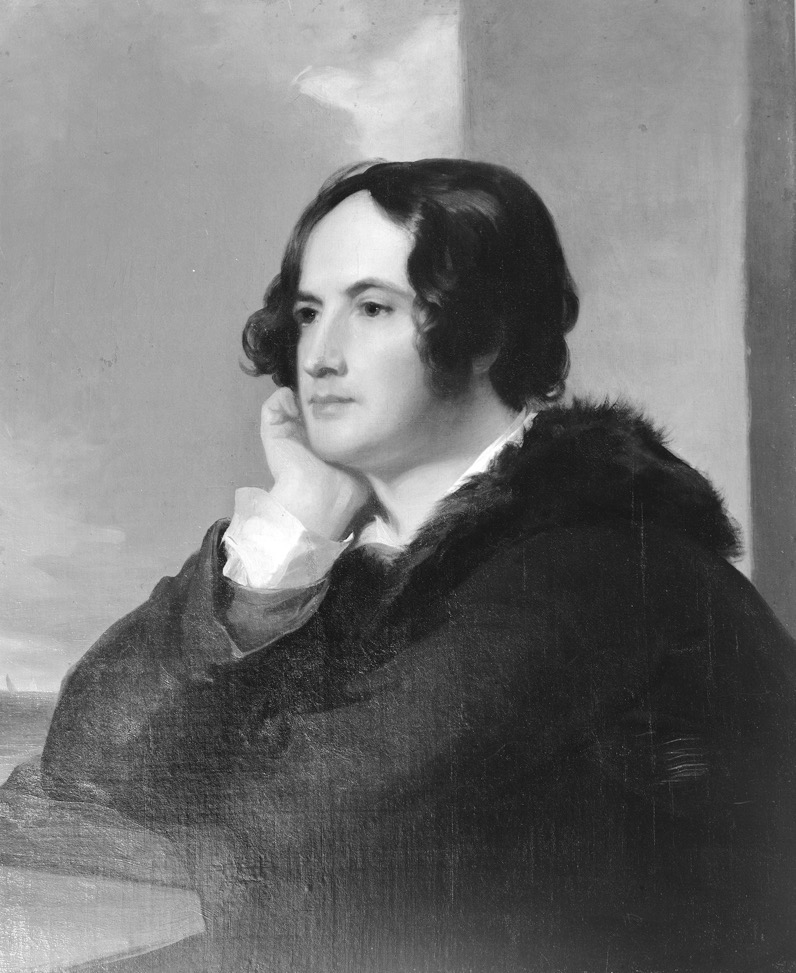
Perhaps contemplating the uncertain status of his Second Bank of the U.S., a young and very pensive Nicholas Biddle was at the center of the National Bank controversy as its president. His 1832 request for re-charter four years early became the main issue in the presidential campaign that year, fueling the already intense rivalry of Senator Henry Clay and President Andrew Jackson (Library of Congress Prints and Photographs Division—Reproduction Number HABS PA,9-ANDA,134).
Obviously, this ploy held potential advantages for the Clay campaign, and especially so should Jackson go ahead with his pre-determined Bank intentions. According to Robert Remini, a principal biographer of both, “He [Clay] was certain he could defeat Jackson on the issue if the President dared veto a re-charter bill.” To his way of thinking, that would constitute “a blatant act of political self-interest” and as stated in The American Senate, Clay was always “willing to take high political risks to achieve his purposes.”4
Meanwhile, Biddle anticipated the President wouldn’t dare veto re-charter in an election year for fear of reducing what he hoped would be his huge re-election turnout and majority. Also, Biddle could not afford to offend Clay, whose support seemed necessary for the continued life of his Bank.5 And as late as December 1831, Jackson was still sending mixed signals about his intentions on the Bank based on his third annual message to Congress. Clay even said, “The President is playing a deep game to avoid at this session [of Congress] the responsibility of any decision on the Bank question.” Any retreat from his earlier veto indications, however, were quickly put to rest when Biddle responded to Clay’s call for action by following through on his petition to Congress in January 1832, an act Jackson proclaimed was instituted with “treachery and malice” and one he vowed to stop.6
Almost immediately, Jackson’s advisers assured him his worst intuitions were correct and that Biddle’s early re-charter request was indeed a political ploy to intrude on the immediate electoral process on behalf of Henry Clay. Attorney General Roger B. Taney told the President what it meant in plain English: “Your next election is at hand—if you re-charter, all’s well and good—if not, beware your power.”7
Equally compelling evidence of Senator Clay’s subterfuge came in the way the Bank re-charter was to be combined with the protective tariff question and the distribution of public lands, other major issues that, at least in Clay’s politically astute way of thinking, had the power “to blow the old man out of the White House.” Returning to Washington via the then state legislature-appointed Senate, in fact, following over 10 years as Speaker of the House, was proof of Clay’s desire (and expectation) to dominate the legislative process from a different congressional platform. He was looking to secure campaign momentum from any presidential missteps on the tariff, public lands, or Bank issues, and especially so if a Jackson veto happened to be issued on the last one.8
Sure enough, on January 20, 1832, the bill for the Bank’s re-charter came up for debate on the Senate floor.9 It was brought there not by Clay, who it had been agreed would concentrate on the tariff issue, but by his National Republican (and soon to be Whig) colleagues, George Dallas of Pennsylvania, the Bank’s home state, and the iconic Webster. For optic reasons, it had been agreed this arrangement would work better, with Clay shepherding the tariff, which meant much to Webster’s New England, while “Godlike Dan,” who would also be immortalized as “Black Dan” in the 1936 Saturday Evening Post short story “The Devil and Daniel Webster,” argued for the Bank. This would relieve Clay, the party nominee, from direct initiation of the issue and wishfully, at least some political suspicion.10
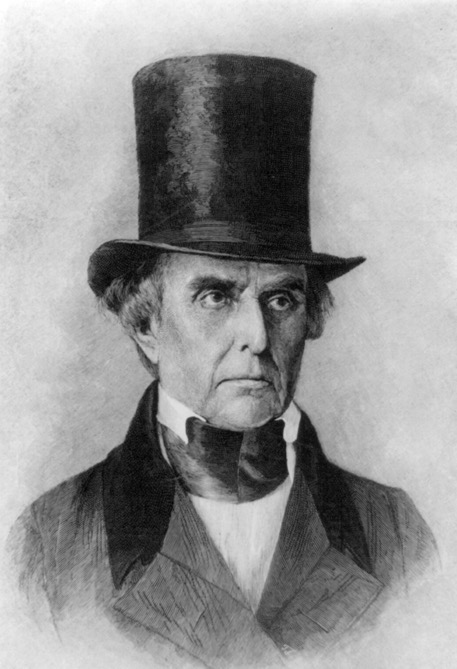
One of America’s greatest orators, Senator Daniel Webster of Massachusetts argued the case for re-chartering the Second Bank of the United States. Making the case for his National Republican colleague and presidential nominee Henry Clay, the words and performance of Godlike Dan were deemed major drawing cards when the Senate opened debate on January 20, 1832 (Library of Congress Prints and Photographs Division—Reproduction Number LC-US762-8231).
Opposing Webster and speaking for the Jackson administration would be Thomas Hart Benton of Missouri. Nearly as eloquent as the oratorically renowned Webster, Benton based his attack on the Bank on what he labeled illegal bank drafts issued by different branches of the institution in various cities throughout the country. His attack preceded a surprise maneuver by Webster and Dallas, as they requested a committee of five Senators, including Thomas Ewing of Ohio, Robert Hayne of South Carolina, and Josiah Johnston of Louisiana, all of whom were pro–Bank, to be set up to examine the re-charter issue, something the Jacksonians in the Senate were unable to block. As a result (and before any more charges could be levied by Benton or any other Democrats), that select committee was formed and returned a recommendation for re-charter by March 13.11
Although recommended with new restrictions, including limiting the National Bank’s right to hold real estate and establish branches; the prohibition of bank drafts; the reinforcement of Congress’ power to forbid issuance of certain small bank notes; and a requirement of presidential authorization for any new member of the Bank’s board of directors—all minor compromises designed to speed passage—the Jacksonians still sought delay. At least one third of the Democrats in Congress favored its passage, so congressional opposition was mostly sectional from the South and West, Jackson strongholds. Nevertheless, the forces of Webster and Clay managed to push it through by votes of 28–20 in the Senate and 107–85 in the House. Only four Northern senators voted nay, reinforcing the final tallies along sectional rather than party lines.12
Clay, Webster, and their backers were jubilant. Clay even said: “The congressional session has indeed been one of glorious triumph for the country and our cause.” Biddle, too, expressed delight, congratulating “our friends most cordially upon this satisfactory result” before adding that he still expected the President to veto the bill. As to that possibility, Clay remarked, “Should Jackson veto it, I will veto him.”13
In other words, the trap had been laid and “Prince Hal,” as Clay was sometimes called, was eager for the sitting president, whom he truly detested, to fall into it. Perhaps his best (or only) hope of unseating the popular incumbent, it at least provided a possible path to the White House and fulfillment of his lifelong ambition—a burning ambition that had already been denied once and would ultimately be again (and again). It was a gamble for both him and Biddle, but a gamble they both felt worth taking as the election of 1832 and the Bank’s future hung in the balance. Fully in the crosshairs of an unforgiving political enemy, they braced themselves for his next move.14
At the same time, “Washington readied for political war.” So stated Brands again in American Lion.15 “Old Hickory knew what he meant to do,” accorded earlier Jacksonian historian Glyndon VanDeusen. “The Bank is trying to kill me, but I will kill it,” he reportedly told Martin Van Buren, the New York Democrat who had become his most trusted Cabinet confidant as secretary of state, soon-to-be second vice president, and eventual White House successor. Relying on a trio of political advisers—newspaper magnate Amos Kendall, Attorney General Taney, and Secretary of the Navy Levi Woodbury—Jackson carefully prepared his response, a ringing veto that would characterize the National Bank as a “monster” with far-reaching tentacles and political friends that influenced and infected American democracy. His veto message, also in VanDeusen’s words, “pilloried” the Bank as “a dangerous centralization of power at the expense of the states” and “its proposed capital [assets] of $35 million was declared to be far in excess of what was necessary.”16
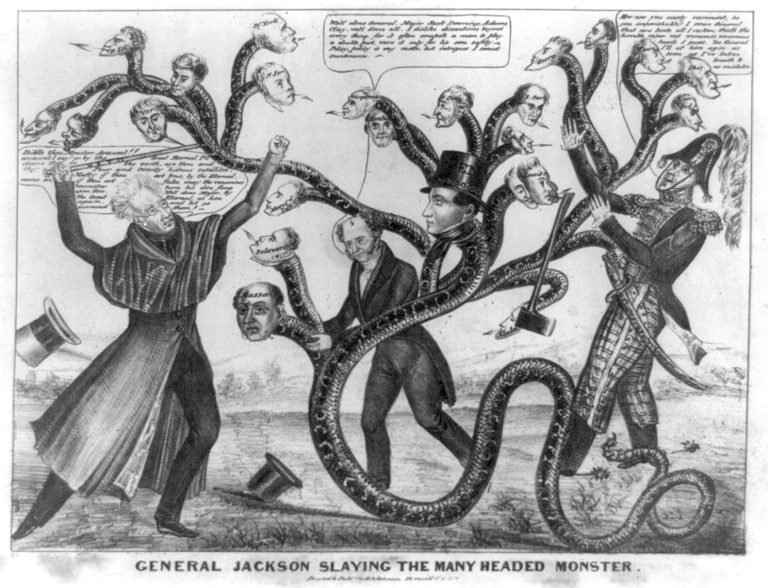
Using evocative imagery to make a point, President Andrew Jackson described the National Bank in 1832 as a “monster” with far-reaching tentacles aimed at killing him if he didn’t kill it first, prompting this political cartoon. In it, he was portrayed attempting to slay the multi-headed monster he considered an elitist threat to the nation (Library of Congress Prints and Photographs Division—Reproduction Number LC-USz62-1575).
Taking the rhetoric to another level, Jackson also declared the Bank unconstitutional despite an earlier Supreme Court ruling (McCullough vs. Maryland) that had deemed it otherwise. To the contrary, Jackson argued that each public official was bound to the Constitution only as he understood it, not as actually interpreted by the Supreme Court, a “highly questionable thesis” to be sure, as again, rightly interpreted by VanDeusen in his 1959 book, The Jacksonian Era.17
One thing for sure, “to differ with Old Hickory or his policies guaranteed retaliation” and because of his popularity with the electorate, most Democratic politicians found it safer to toe the presidential line. To disagree would be to exit the party, as Jackson assumed tighter and tighter control of the Dems … and the government as a whole.18 That according to Remini in his biography of Clay, while adding in a later entry: “Not only did the President ‘vilify’ the Bank, but he repeatedly asserted presidential authority and privilege” over it. As an agent of the executive branch, at least to his way of thinking, the re-charter would renew (or confirm) powers for the institution that were “unnecessary and dangerous to the nation.” He ended his veto with a “flourish” and a glimpse of what he planned to do. To paraphrase, it read:
It is regrettable that the rich and powerful too often bend the acts of government to their selfish purposes so that when laws are enacted that make the rich richer and the potent more powerful, the humble members of society have a right to complain of the injustice of their government. The true strength of the government consists in leaving individuals and states as much as possible to themselves—in making [government] felt, not in its power, but in its beneficence; not in its control, but its protection; not in binding the states more closely to the center, but in leaving each to move unobstructed in its proper orbit.19
Not at all surprised by the veto, but totally appalled by the President’s tone and content, Biddle compared it to “the fury of a chained panther biting the bars of its cage.” Clay also called it “a manifesto of anarchy,” but neither imagined the propaganda benefits Jackson’s words would have in the upcoming campaign.20
With his veto, Jackson basically began to accuse the nation’s rich of stealing from the poor with the Second Bank of the United States as the instrument of their theft. Soon thereafter, Webster rose in the Senate to denounce the President for “seeking to inflame the poor against the rich” and Clay’s reputation as a political fighter quickly came to the forefront when he gave voice to his own contempt for Jackson’s “verbiage.” He called it “a perversion of the veto power established by the founders and only to be used in extraordinary circumstances” and not as President Jackson had already done four times in three years. Clay also accused the President of “invading the legislative process by seeking to impose his own will upon Congress, an act hardly reconcilable with the genius of representative government, if not downright revolutionary.” Candidate Clay then warned of potential economic and social consequences to be incurred from President Jackson’s action, hinting at possible “catastrophe,” which drew rousing cheers and applause from Bank partisans in the Senate gallery.21
A short time later, Benton rose again to confront both Clay and Webster on behalf of the administration. He chided them for speech lacking in courtesy, “indecorous and disrespectful to the President of the United States,” and he feigned shock at things that had been said in response to the chief executive’s exercise of veto power as defined in the Constitution.
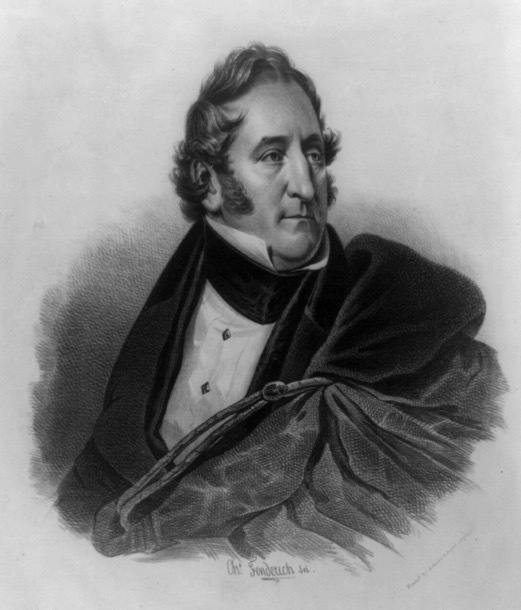
Opposing Daniel Webster and Henry Clay on the Senate floor over re-chartering the Second Bank of the United States, Senator Thomas Hart Benton was a powerful voice for the Jackson administration and its intention to contain the National Bank. Ironically, the big man from Missouri had once dueled with the President during their younger, frontier days before becoming a stalwart Jacksonian Democrat (Library of Congress Prints and Photographs Division—Reproduction Number LC-US762-1112).
Upon hearing that, Clay literally jumped to his feet in response, chastising his big rival from Missouri as a “ruffian and street brawler,” and unqualified to offer anyone “etiquette” lessons. Resurrecting circumstances surrounding a confrontation and duel between Benton and the President when they were not on such friendly terms years before, he also sought to embarrass his Border State colleague with knowledge and exposure of that 1813 incident (even though Clay, too, had previously dueled), when he said, “At least I never had any personal rencontre [meeting] with the President; I never complained of the President beating a brother of mine after he was prostrated and lying apparently lifeless.”
“False, false, false,” Benton screamed in retaliation, and in his biography of Clay, Remini recounted how everyone in the chamber “steeled” themselves in anticipation of the fight that now seemed inevitable between the two Senate leaders. But with the Chair frantically gaveling and calling for order, cooler heads prevailed, and decorum was eventually restored. The two storied combatants apologized to the Senate, though not to each other, and “on [that] low note, debate over Jackson’s misuse of power ended.”22
What followed was the failure of the Clay-Webster forces to override the veto by a close 22–19 margin. What remained was for the American people to have final say on the issue’s ultimate winner and loser in the upcoming presidential election, and towards that result the campaign battle intensified throughout the spring and early summer of 1832.23
The remaining fight over the Bank would take place amidst other political grievances and confrontations during one of the Senate’s most bellicose eras. Making these matters worse for the aging President was a severe bout of influenza early in the year, an improper fitting of his artificial teeth, and removal of a festering bullet that was lodged in his left arm 19 years earlier following one of several previous duels he had survived.24 Added to these acute, physical challenges, Jackson also suffered through some difficult confirmation proceedings for his nominees to several Cabinet and diplomatic posts, an unusual presidential nuisance in the days before organized partisan opposition became commonplace.25
Amazingly (at least to modern Americans used to a vice president being chosen as part of his party’s ticket and in total homage to his or her presidential running mate), Jackson’s original and separately elected VP was the previously mentioned John C. Calhoun, who had criticized then General Jackson’s controversial invasion of Florida in pursuit of Seminoles in 1818 while secretary of war, and who, as a future South Carolina senator, would openly clash with Jackson over the idea of a state’s right to reject (or nullify) and not enforce any federal law it disagreed with. Needless to say, Calhoun would prove nearly as much a Jackson foe as Clay and was delighted as vice president in 1832 to cast a tie-breaking Senate vote rejecting Jackson’s nomination of New York’s Martin Van Buren for minister to Great Britain. “By the eternal, I’ll smash them,” Jackson was reportedly heard to say upon learning of Calhoun’s vote to defeat Van Buren, something he considered a personal affront and ironically something that would hasten his choice of Van Buren as Calhoun’s VP replacement and his own presidential successor in 1836. Indeed, Remini termed the diplomatic rejection the best thing that could have happened to Van Buren and his political career, as it only served to solidify the little New Yorker’s place as a Jackson favorite.26
At the same time, Clay’s highly anticipated call to arms soon came from the Senate floor, when he said, “We are in the midst of a revolution, hitherto bloodless, but rapidly tending towards a total change of the pure republican character of the government, and to the concentration of all power in the hands of one man.” He also argued that Jackson was “destroying” the America the Founding Fathers had created by turning the (federal) government into “an elective monarchy—the worst of all forms of government.”27
It was at this point that the wily Kentuckian called on Congress to “apply an instantaneous remedy” for the good of the American people. Otherwise, in his words, “fatal collapse … abject slavery … scorn and contempt [would] be heaped upon mankind,” a warning he issued to applause and cheers so continuous that the Senate galleries had to be cleared. According to Meacham in American Lion, this was Clay “striking at what Jackson cherished most: his power and his honor … and in response, Jackson ‘took joy in the fight.’”28
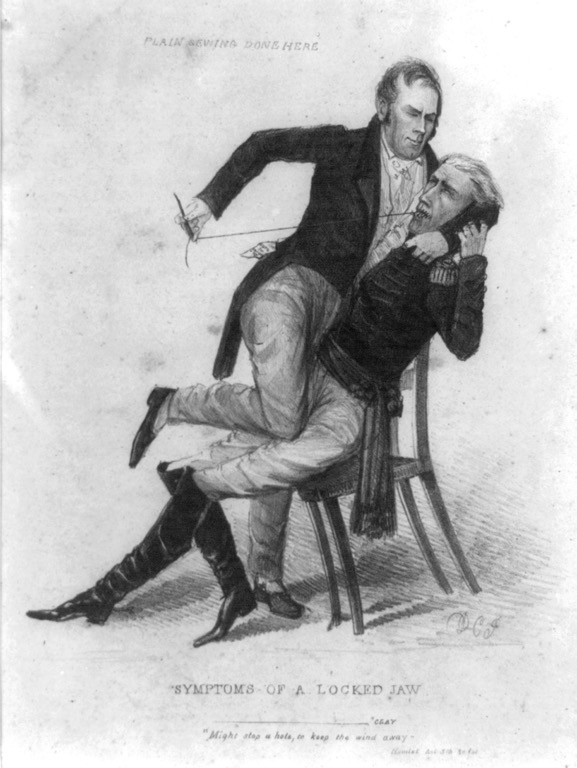
Political satirists of the day were quick to draw attention to Henry Clay’s gamble to hamstring President Jackson by injecting the National Bank issue into their 1832 campaign. This cartoon was typical, showing Clay aggressively attempting to shut his rival’s mouth by forcibly sewing it up (Library of Congress Prints and Photographs Division—Reproduction Number LC-USZ62-92612).
To his Cabinet, the President had already shared his belief that “the people wanted—and expected—the Bank to die,” and to accomplish this financial makeover, he made known his plans to remove all federal deposits from the Second Bank of the United States and re-deposit them in a series of state banks throughout the country.29 Accepting the challenge, Jackson was equally ready for the Bank to become the defining campaign issue. As Michael Holt stated in the early pages of his American Whig Party, he would use it to “bludgeon” Clay.30
According to Francis Preston Blair, a pro–Jackson editor of the time who had been brought east by the administration to head the Washington Globe, “The sublimity of [a] moral spectacle” had been “presented to the American people in the person of Andrew Jackson” and as a result, the President had thrown down the gauntlet, challenging the “moneyed aristocracy,” an “insidious enemy and creeping poison,” and a “germ of American nobility.”31 Comments like those would be part of what Holt termed “a masterpiece of political propaganda aimed directly at voters.” Jackson denounced the Bank as unconstitutional and an excess of national authority; as “a monstrous concentration of private power that threatened popular liberty”; and as an aristocratic privilege that inherently “favored the rich at the expense of the poor.” Such proclamations were aimed at enhancing the President’s reputation as the champion of republicanism, and the enemy of the corrupt and entrenched political establishment found in Congress.32
Despite such idealistic pronouncements, however, “the veto’s reasoning remained weak.” So, admitted VanDeusen in the Jacksonian Era, adding:
[The] argument that a national bank in the 1830s needed no more capital than the one that had existed 30 years before betrayed reluctance to face realistically the problems of a rapidly developing economy that was characteristic of the Jacksonians. The veto repeatedly stated that the Bank was a monopoly, which was true only if monopoly were defined in such a way as to divest the word of its real meaning. It ignored the Bank’s enormous services to the national economy. Neither then, nor later did the President offer an effective substitute.33
Along with Webster and his other backers, Clay hoped to take full advantage of the anticipated concern this financial void might create, or at least hoped the American people would be smart enough to recognize the unnecessary disruption an end to the Bank could cause. As with so many political debates, feasibility and believability were critical components of the argument to alter the developing nation’s financial system without economic chaos.34
Clay warned of economic consequences and social ones as well. “It would bring catastrophe,” his biographer, Remini, repeated, amplifying the Kentuckian’s dire warnings from the summer of 1832. Included would be a lengthy, high-profile layover for him at society-conscious White Sulphur Springs (still known as “America’s Resort”) in present day West Virginia, while en route to his “old Kentucky home”—Ashland. Once back in the “Blue Grass,” Clay confidently awaited the voters’ verdict, secure in his belief that he had engendered an issue with the power to upset the incumbent, whose autocratic tendencies had finally and sufficiently been exposed.35
Over the next three months (from the end of July through October), Clay remained heartened by the reception he received wherever he went. “I believe the redemption of our country from an arbitrary administration is at hand,” he stated on more than one occasion, while also predicting President Jackson would not receive over 100 electoral votes. In the meantime, only the defeat of his party’s candidate in the Kentucky governor’s race by a Jacksonian gave him pause to reconsider his own chances in November.36 Although it seemed a bad sign, Clay indulged in what Remini termed “his old propensity for self-delusion” and “kept asserting his own victory was assured.” To his way of thinking, the governor’s race was merely a bi-product of Jackson’s popularity in the Upper South and not indicative of the popular will in the rest of the country.37
Biddle further buoyed Clay’s “unrealistic interpretations” of recent events with comments like “You are destined to be the instrument of the nation’s deliverance,” while polling reports from New York, Pennsylvania, Louisiana, Ohio, Missouri and New England all remained positive.38 In addition, the four-year-old Anti-Masonic Party (1828), the nation’s first third party, had emerged in Upstate New York primarily as an alternative to Jackson’s Democrats with former Attorney General William Wirt of Maryland as its reluctant nominee, and Clay assumed this new voting bloc would most likely take votes away from the man who had recently vetoed the already proven National Bank and much needed internal improvements like the Maysville Road.39
But even with other domestic and foreign policy issues crowding his calendar during the summer months and early fall of 1832, Jackson also remained resolute in keeping the Bank issue front and center on the minds of voters as election day approached. The issue, in fact, was rarely absent from his thoughts. Many pundits and politicians wrote to him at his Tennessee home outside of Nashville, the Hermitage, currying favor by lauding his Bank veto, praising its message as Remini recorded, “a document worthy of the purest days of our republic” and one that would “bring us nearer the original principles and spirit of our founders.” Not since Jefferson, many enunciated, had the nation’s chief executive stood so solidly for “the people.”40
Unlike Clay and his National Republicans, however, Jackson’s Democrats were counting on much more than the Bank issue to make the difference. In an age of advancing professionalism, they already understood the importance of political organization to any election cycle and they had been working for years to build majorities for the President in virtually every section of the country. Local committees called “Hickory Clubs” were established and active, generating support for the Dems’ national ticket at spontaneous rallies, especially in the West, where patriotic pride and Jacksonian spirit were considered one and the same. In addition, barbecues involving whole communities became an important Jacksonian technique and opportunity for political propaganda, with the President himself even appearing at a few in cities where his calendar and travels allowed it. And partisan newspapers like the previously mentioned Globe, were relied on to trumpet the Dems’ party line message in perhaps the nation’s first partisan media campaign. Earlier portraits of General Jackson in his military attire or later ones as a gentleman farmer with his famous cane began to appear everywhere during the campaign’s final months, with the Jacksonian blitz consuming town halls throughout the country.41
It all became too much for Clay and his congressional allies to overcome, as most so-called “common men” applauded Jackson’s characterization of the Bank “as a symbol of special privilege and manipulation.” Presidential historians also confirmed the Democratic press’s promotion of Clay as an irredeemable “gambler” capable of immoral behavior, a reputation that dogged the Kentucky legend whenever compared to the heroic, military image of the President. So, despite the Anti-Masonic addition to the race, Jackson still dominated voting in the West and South and even improved his anticipated support in New England. The final popular vote tally was 687,502 for Jackson (55 percent), 530,189 for Clay (37 percent), and 100,715 (eight percent) for Wirt. The Electoral College count was even more one-sided with Jackson claiming 16 states to Clay’s six—a final judgment that left little doubt the political gamble that caused the battle over the Bank had failed dramatically.42
Nevertheless, while still preaching the virtues of his American System amidst yet another losing presidential campaign over a decade later, Clay would again look for political traction from the idea of a restored National Bank. In 1844 he would actually use it as a diversionary tactic, seeking to distract from the major issue that was by then Texas annexation and westward expansion (Clay being on the wrong side of history for that one as well), but once again it failed to move the public opinion needle in any significant way and certainly not enough to aid his never-ending quest for the White House. Finally admitting defeat and the fact his career goal was beyond reach, the aging Kentuckian said at the time, “My duty now is that of resignation and submission, cherishing the hope that some others more fortunate than myself may yet arise to accomplish that which I have not been allowed to effect.”43
1. Robert Remini, Henry Clay, 379–380; H.W. Brands, Heirs of the Founders, 189–191; Glyndon G. VanDeusen, The Jacksonian Era, 65–66; William DeGregorio, The Complete Book of U.S. Presidents, 112; Michael F. Holt, The Rise and Fall of the American Whig Party, 15–16.
2. H.W. Brands, American Lion, 53, 75, 76, 103–104, 121; Glyndon G. VanDeusen, The Jacksonian Era, 62–64; Robert Remini, Henry Clay, 139–140, 379; Andrew T. Hill, “The Second Bank of the United States,” federalreservehistory.org, December 5, 2015; H.W. Brands, Heirs of the Founders, 186–190.
3. H.W. Brands, Heirs of the Founders, 190, 195.
4. Robert Remini, Henry Clay, 379; Richard A. Baker and Neil MacNeil, The American Senate, 281.
5. Michael F. Holt, The Rise and Fall of the American Whig Party, 14–15; Robert Remini, Henry Clay, 379–380.
6. Robert Remini, Henry Clay, 380–381.
7. Ibid., 381.
8. Ibid., 382.
9. Glyndon G. VanDeusen, The Jacksonian Era, 65.
10. Robert Remini, Daniel Webster, 29, 360–361; “The Devil and Daniel Webster,” en.wikipedia.org.
11. Robert Remini, Andrew Jackson, 303–304; Robert Remini, Daniel Webster, 361; H.W. Brands, Heirs of the Founders, 191; Glyndon G. VanDeusen, The Jacksonian Era, 65.
12. Glyndon G. VanDeusen, The Jacksonian Era, 65; H.W. Brands, Heirs of the Founders, 192.
13. Robert Remini, Henry Clay, 398.
14. Robert Remini, Henry Clay, 1; H.W. Brands, Heirs of the Founders, 186–194, 195.
15. H.W. Brands, American Lion, 275.
16. Glyndon G. VanDeusen, The Jacksonian Era, 66.
17. Ibid.
18. Robert Remini, Andrew Jackson, 323.
19. Robert Remini, Henry Clay, 398.
20. Robert Remini, Henry Clay, 398–399; Glyndon G. VanDeusen, The Jacksonian Era, 66.
21. Glyndon G. VanDeusen, The Jacksonian Era, 66; Robert Remini, Daniel Webster, 367; Robert Remini, Henry Clay, 399.
22. Robert Remini, Henry Clay, 400.
23. Robert Remini, Daniel Webster, 368.
24. Robert Remini, Andrew Jackson, 346–349.
25. Ibid., 347.
26. Ibid., 348–349.
27. Jon Meacham, American Lion, 275.
28. Ibid., 276.
29. Kenneth C. Davis, Don’t Know Much About the American Presidents, 164; Glyndon G. VanDeusen, The Jacksonian Era, 66.
30. Michael F. Holt, The Rise and Fall of the American Whig Party, 16.
31. Glyndon G. VanDeusen, The Jacksonian Era, 66.
32. Michael F. Holt, The Rise and Fall of the American Whig Party, 16.
33. Glyndon G. VanDeusen, The Jacksonian Era, 67.
34. Ibid.; Robert Remini, Daniel Webster, 370–371; Michael F. Holt, The Rise and Fall of the American Whig Party, 16.
35. Robert Remini, Henry Clay, 399–402.
36. Robert Remini, Henry Clay, 403.
37. Ibid.
38. Ibid.
39. Robert Remini, Henry Clay, 373–374, 403; Glyndon G. VanDeusen, The Jacksonian Era, 56; H.W. Brands, Heirs of the Founders, 185.
40. Robert Remini, Andrew Jackson, 382.
41. Robert Remini, Andrew Jackson, 382–384; H.W. Brands, American Lion, 219.
42. William DeGregorio, The Complete Book of U.S. Presidents, 112; Kenneth C. Davis, Don’t Know Much About the American Presidents, 164.
43. Robert Remini, Henry Clay, 662; H.W. Brands, Heirs of the Founders, 300–301.