
{33} SECTION IV
Minamoto no Yoritomo successfully established the right of jitō, and a modicum of recognition of his position as a leader in the east, but his regime remained precarious. Yoritomo died in 1199, and both of his sons were killed by 1219, leaving Kamakura without anyone being invested with the office of Sei-i-tai shōgun. This meant that precious little rationale remained for this regime to exist. The Retired Emperor Go-Toba decided that it was high time to assert control over the office of jitō and destroy Kamakura (see Go-Toba’s Order to Chastise Hōjō Yoshitoki, p. 34). The Hōjō, by contrast, being veterans of the wars of the 1180s, realized that decisive action mattered more than elaborate justification (see Hōjō Yoshitoki’s Letter to the Shimazu of Satsuma Province, p. 36; and A Directive from Hōjō Yoshitoki to Ichikawa Rokurō, p. 36). They moved their armies quickly and defeated Go-Toba within six weeks of his declaration of war. Just as he surrendered, some warriors belatedly joined his cause, showing the precariousness of the Hōjō position and their realization that their survival depended upon a quick and decisive war.
This section begins with sources related to the Jōkyū War of 1221. These are followed by Kamakura’s 1232 laws, translated here in their entirety for the first time since 1906 (see The Formulary of Adjudication, p. 42), as well as amendments to the code concerning marriage and letters and precepts written by Hōjō leaders (see Letter from Hōjō Yasutoki Concerning the Formulary, p. 60; Kamakura Amendments, p. 61; and Hōjō Shigetoki’s Letter to His Son Nagatoki, p. 69).
The next series of sources focus on Japan’s defenses when the Mongols attempted to invade Japan in 1274 and 1281 (see Suenaga’s Audience with Adachi Yasumori, p. 85; Tōgan Ean’s Statement of Opinion, p. 87; Summons of the Chinzei Eastern Administrator, p. 88; Kamakura’s Attempt to Dispatch Forces to Korea, p. 88; Petition for Reward by Shami Shukumyō Ōkami Korechika, p. 91; and Letter by Shōni Kagesuke, p. 92). Later law codes, amended in 1285 (see The New Laws of Adachi Yasumori, p. 93), and a remarkable assassination attempt by a flamboyant warrior named Asahara Tameyori reveal the increasing turmoil (see “The Light and Shadows of the Day,” The Clear Mirror, p. 100; and Kamakura’s {34} Response to the Asahara Assassination Attempt, p. 102). This incident in particular reveals the intensity of the political struggles at the court, which would destabilize Japan. A passage from a visiting court lady describes Kamakura as a small, densely packed outpost, and recounts when the Hōjō ousted their shōgun and sent him back to the capital (see The Confessions of Lady Nijō, p. 96). Local histories reveal the resistance to Kamakura rule and increasing turmoil in the provinces (see Mine’aiki, p. 103). Finally, an edict by Prince Moriyoshi (1308–35) indicates that court officials did not forgive the Hōjō for their role in defeating the court in 1221 (see Command of Prince Moriyoshi, p. 112).
1. Go-Toba’s Order to Chastise Hōjō Yoshitoki1
Go-Toba declared war on Kamakura in 1221. At this time, Kamakura was vulnerable—it had no Sei-i-tai shōgun and as its administrative offices were derivative of this post the regime technically had no reason to exist. Go-Toba criticized the Hōjō for their arrogance because they, as shogunal administrators, continued to govern even without a shōgun. He also asserted control over the posts of jitō and shugo. Go-Toba succeeded in attracting some support, but he required time to cobble his supporters into an army drawn from the Capital Police (kebiishi) as well as the jitō and shugo who joined his cause.
From the Ministry of the Right: Ordered to the Various Provinces of the Five Circuits—
Tōkai, Tōzan, Hokuriku, San’in, Sanyō, as well as Nanyō and Dazaifu
To the protectors (shugonin) of the estates of various provinces and jitō, respond with haste to this Imperial Summons. Report to the Office of the Retired Emperor (In no chō) and chastise Taira Yoshitoki, the Governor of Mutsu.
An imperial edict (choku) has been received and conveyed by the Controller of the Palace Minister (Koga Michimitsu). It states: “Recently the judgments of Kamakura (literally Kantō, ‘the eight provinces of the east’) have disturbed the governance of the realm. Although they claim to be acting in the name of the Shōgun, he is but an infant. Nevertheless, this Yoshitoki treats [the young Shōgun’s pronouncements] as if they are an Imperial Prince’s edict (kyōmei ni kari) and makes judgments in the affairs of both the capital and the provinces. His authority {35} increases and he has apparently forgotten the nature of imperial rule. Those who speak of his ‘governance’ are advocating treason! All residing in the Five Circuits and Seven Roads and various provinces should immediately chastise him. In addition, if the various protectors (shugonin) and jitō of the provinces have disputes, they should appear before the Office of the Retired Emperor (In no chō) for judgment. Provincial Governors and Court Proprietors (ryōke) must not use this edict to create troubles. Nothing is to be at variance with this command.” All of the various provinces shall abide by this order. This edict is thus.
Third year of Jōkyū [1221] fifth month, fifteenth day
Daishi Miyoshi ason2
The Controller (daiben) Fujiwara ason
2. The Will (yuzurijō) of Nejime Kiyoshige3
One reason why Kamakura defeated Go-Toba so quickly in a stunning six-week campaign was because they had long trained for war. Rumors of a rebellion in Ōmi Province, near the capital, appear in the Azuma Kagami, as well as a reference to a brief uprising in Suruga in 1220.4 The following document provides some more information about the situation in Ōmi and shows that Kamakura armies were mobilized just to the east of the capital in 1220.
The head of Nejime-in5 and novice (nyūdō) Kiyoshige renounces his rights and bestows to Kenbu Bōmaru this inshi and jitō office. Hereditarily transmitted documents are appended.
The above offices belong to Kiyoshige. Nevertheless, they had been encroached upon by others and fell into abeyance. When Kiyoshige appealed to the Shōgun regarding this, he was reappointed because our rights are manifest in our records. {36} Nevertheless, because the world is in disorder, these documents were entrusted to Kenbu Kiyotada. He had these records in his possession, but on the sixth day of the eleventh month of Jōkyū 2 (1220), when Kantō6 forces neared the capital, enemies at Ōmi killed him in a night attack. Nevertheless, as Kenbu Bōmaru is his heir (chakushi), I Kiyoshige bestow the office of Nejime (inshi) and the jitō rights (shiki) to him. Thus, for future reference, this testament is thus.
Third year of Jōkyū [1221], third month, twenty-third day
The inshi of Nejime (monogram)
3. Hōjō Yoshitoki’s Letter to the Shimazu of Satsuma Province7
This document suggests that Kamakura had almost immediately decided to attack the capital. However, this document is a copy of an original and it is possible the copyist misread the date.
I understand that the Honorable Saburō hyōe8 will travel with the Musashi Governor9 to the capital. This is most wonderful. Respectfully.
(Monogram copy) (arihan)10
(Third year of Jōkyū [1221]) fifth month, nineteenth day
4. A Directive (mikyōjo) from Hōjō Yoshitoki to Ichikawa Rokurō11
Ichikawa Rokurō was a member of a gokenin family from Shinano Province. The term gokenin refers to warrior householders who received recognition as having a status (or “house”) and were responsible for helping shugo apprehend {37} criminals and providing order in the provinces, but they did not necessarily possess the coveted office of jitō. At times this term is translated as “vassal,” but such a characterization is misleading. In writing to him, Yoshitoki recounted the difficulties encountered by the northernmost of Kamakura’s three armies, led by Hōjō Tomotoki. Tomotoki’s army defeated the enemy forces allied to Go-Toba at Noto on 6.8.1221, but Yoshitoki remained unaware of this victory. To the contrary, he encouraged Shinano warriors to join Tomotoki, who was delayed when passing through narrow passes. This informative document reveals much about this brief conflict while it was being fought, but it has been ignored because Tomotoki’s forces did not significantly affect the outcome. They arrived in Kyoto on 6.20.1221, six days after Go-Toba’s decisive defeat by the forces of Hōjō Yasutoki.
(Monogram)12
Your letter, written at the hour of the dog [7–9 p.m.] on the thirtieth day of the fifth month arrived today, the sixth of the sixth month at the hour of the monkey [3–5 p.m.]. On the last day of the fifth month our forces attacked and defeated Kanbara.13 On the same day, at the hour of the monkey, I heard a report that our forces had taken Miyazaki.
Numerous reports stated the attack began before Shikibu no jō14 arrived. Even though Shinano Jirō set off with a force of three hundred horse, what can he do? Help the Honorable Shikibu [Hōjō Tomotoki] hurry along.I have heard that the forces of Miyazaki no saemon, Nishina no Jirō [Moritō],Kasaya no Arihisa saemon, Kuwasa no in tō Tōsaemon, and one more—a Genji from Shinano—approached [Tomotoki] on the Hokuroku highway.15
We must ensure that we can prevent even a single enemy from escaping. If we force the enemy into the mountains, where they will be forced to wander aimlessly, then we should be able to capture them. If we force the enemy into the mountains, then nearly all of the warriors (mono) from the provinces of Echū, Kaga, Noto, and Echizen will ally with us. If we can secure local support, we will gain local knowledge of the nearby mountains [and passes], which will allow us to capture the {38} enemy. Don’t pursue the defeated enemy in haste, abandon our positions, or rush to the capital unnecessarily.
I know of many cases where gokenin have fought and defeated the enemy, performing outstanding service and being recommended for rewards. I repeatedly heard that Shintaka’s younger brother, Shirō saemon, and you, Rokurō, together performed exhaustive military service. In addition, all the gokenin who fought most devotedly (kokoro mo irete), traipsed through the mountains, and tried to smite the enemy shall be witnessed and rewarded. This should be made known. Respectfully.
Sixth month, sixth day at the time of the monkey Fujiwara Kanesuke, humbly received16
A reply to the Honorable Ichikawa Rokurō gyōbu
5. A Rokuhara Order (gechijō)17
On the fourteenth day of the sixth month of 1221, Hōjō Yasutoki’s army won a decisive battle against Go-Toba and entered the capital (Kyoto) the following day. Yasutoki’s victory was so swift that warriors late to the battle, such as Kōno Michinobu, joined Go-Toba’s opposing forces only after Go-Toba had been decisively defeated.
Claiming that he carries a Retired Emperor’s edict (inzen), Kōno Shirō Michinobu of Iyo Province, led his family, along with brave warriors from that province, in fighting battles [against Kamakura forces]. Since Kōno Shirō Michinobu is the ringleader of these forces, you must quickly unite your forces and perform battle service against him, advancing without delay. Military forces will be dispatched to put down those traitorous rebels (kyōto). Thus, it is decreed by the Kamakura lord.
Third year of Jōkyū [1221], sixth month, twenty-eighth day
Musashi no kami (copy of seal)
[To: Kōno Michihisa]
{39} 6. A Kantō Order (gechijō)18
Few documentary descriptions of the battles of 1221 are extant. But we do have Kamakura’s rosters of participants. In addition, confirmations of the holdings of Gotō Motoshige’s widow reveal that her husband perished in the conflict and that Kamakura then gave her his lands.
Gotō Rokurō hyōe no jō Motoshige fought for our forces at the Battle of Uji River. It has been reported that his widow now lives in Yasuda Estate, Harima Province. She should be confirmed [in these holdings]. It is so decreed.
Third year of Jōkyū [1221], seventh month, twenty-fourth day
Musashi no kami Taira (monogram)
Sagami no kami Taira (monogram)
7. Excerpt from The Chronicle of Jōkyū19
The Chronicle of Jōkyū reveals that authority over the post of jitō, or land steward, served as a crucial source of contention. Go-Toba attempted to assert the authority over this office. Although he most likely bestowed the office on members of the imperial guards, he was portrayed in this chronicle as giving it to his favorite dancing girl (shirabyoshi) “Chrysanthemum Turtle” (Kamegiku).
The world did not generally approve of Go-Toba’s ways. From morning to evening he devoted himself not only to hunting small birds or racing horses, but also to swimming, acrobatics, sumō wrestling, archery, and, above all, to practicing the arts of war. He spent his time day and night readying weapons and planning an armed uprising. Irascible as he was, he visited instant, arbitrary punishment on anyone who crossed him. Whenever he liked a minister’s or a senior noble’s home, or villa, he had the place designated an imperial residence. There were six {40} such establishments in the capital and many more in the countryside. Such was the scope of his amusements that he summoned shirabyōshi dancers from hither and yon, and favored them one after another. The way he invited them up into the headquarters of the Eight Bureaus, there to trample and soil the brocade cushions spread on the floor, suggested, to the observer’s horror, the imminent collapse of the Sovereign’s Way and of all imperial authority. He readily took over the hereditary property of senior nobles and privy gentlemen, appropriated shrine and temple paddy fields, merged ten holdings into five, and gave everything away to his shirabyōshi favorites. Perhaps it was the mounting distress of venerable shrine and temple priests, who had seen their institutional lands confiscated, that finally provoked Go-Toba to initiate an armed disturbance that led to his banishment. This was a terrible thing.
How did it all start? Apparently with a dancer named Kamegiku, who lived at Sameushi and Nishi-no-tōin. Go-Toba was so mad about her that he appointed her father to a post in the Bureau of Justice. Finding the compensation for the post insufficient, he then issued a decree granting Kamegiku, for as long as he himself should live, the more than three hundred chō of the Nagae estate in Settsu. Kamegiku’s father received this document, pressed it reverently to his forehead, and rushed down to the estate, where he announced that he was now in charge.
The Kamakura-appointed steward ignored him. “Lord Yoshitoki was granted this estate by the late Lord Yoritomo,” he said, “and imperial decree or not, I will not have you claim it without a formal order ceding it to you and bearing Yoshitoki’s seal.” He sent the man packing.
Kamegiku’s father complained to Go-Toba, who was not at all pleased. He summoned Fujiwara no Yoshimochi. “Go down to the Nagae estate,” he commanded, “get rid of that steward, and deliver him to me. Yoshimochi hastened there and ordered the steward out, but the steward ignored him, too.
Yoshimochi returned to the capital and reported the outcome to Go-Toba. “If that is the way even the lowest of the low are talking,” Go-Toba declared, “then naturally Yoshitoki would have only contempt for a retired emperor’s decree.”
When Go-Toba heard what Yoshitoki himself had to say on the subject, he issued another decree. It said, “Yoshitoki may well own a hundred or a thousand other estates, and if so, he is welcome to them all. However, he is to give up the Nagae estate in Settsu.”
Yoshitoki read it. “How can the retired emperor possibly issue such a decree?” he said. “Let him claim, if he wishes, a hundred or a thousand other estates. Nagae, however, was granted me in recognition of my services by the late Lord Yoritomo. He will have to execute me to get it.” So it was that for a third time he rejected Go-Toba’s decree.
{41} 8. Excerpt from the Baishōron Account of the Jōkyū War20
Japanese Emperors, known as the Lord of the Ten Good Acts, were thought to rule through moral suasion. The conversation between Hōjō Yoshitoki and Yasutoki is at variance with the sentiments expressed by Yoshitoki in his 1221 directive (see A Directive from Hōjō Yoshitoki to Ichikawa Rokurō, p. 36), but it reflects a later concern with how warriors could take up arms against the emperor.
Meanwhile Yasutoki and his deputy, Tokifusa, conducted affairs of state. In the summer of Jōkyū 3 [1221], Retired Emperor Go-Toba decided to destroy the Kantō Bakufu. First, he had Miura Heikurō Taneyoshi, and Sasaki Yatarō Takashige and his son Tsunetaka, and others,21 executed by Iga Tarō Mitsusue and others. On the nineteenth of the fifth month, Kamakura learned that an imperial army was to set out immediately for the Kantō.
Accordingly the nun Lady Masako summoned her younger brother and the shogun’s retainers. Weeping, she said, “I would be very sorry to live to see the graves of the three Shoguns trampled by the horses of western warriors. There is no reason for me to go on living. Kill me first, then go to join the Emperor.”22
The retainers replied: “We are all deeply indebted to the Shoguns. Must we not treasure their remains? We will die in the west.”
On the twenty-first of the same month—even though the day was so unlucky that the odds against survival were ten to one—Yasutoki and Tokifusa therefore left Kamakura at the head of an army.23
However, before his departure, Yasutoki told his father Yoshitoki: “The whole country has always been the imperial domain. Therefore, both in ancient times and in our own day, in this land and in China, no one who defied an imperial command has ever escaped retribution. For example, the former prime minister and lay priest Taira no Kiyomori harassed Retired Emperor Go-Shirakawa. As {42} a result, the late Shogun Yoritomo secretly received an imperial order, initiated a punitive expedition against the Heike, and was fully rewarded for his service with offices and lands. And of course there is our house, beginning with my grandfather Tokimasa, whose rewards were greatest of all. This is why it would be all the more regrettable if I were subjected now to imperial censure. However, it is impossible to escape Heaven’s decree, and we should therefore give up the idea of fighting and surrender.”
After a short while, Yoshitoki replied to Yasutoki’s earnest appeal. “You have spoken admirably,” he said. “However, your words apply only when the ruler’s government is righteous. When I look at what has been done in the country in recent years, I see that imperial governance has lost its substance and is no longer what it was in ancient times. For example, an imperial ordinance will be issued in the morning and repealed in the evening, and there is unrest everywhere because the imperial government appoints more than one governor to a province. The places that are still free from misfortune may owe their condition to being under Bakufu administration. Order and disorder are as incompatible as fire and water. Because things have come to such a pass, and because, after all, we would be acting to restore peace in the land, we should fight and put our trust in Heaven. If we eastern warriors gain victory, the rebellious subjects who influenced the Retired Emperor will be in our hands, and we should punish them severely. As for the throne, one of the Retired Emperor’s descendants should be appointed Emperor. If he himself resists, then doff your helmet, unstring your bow, bow your head, and surrender. This point of view also has something to be said for it.”
9. The Formulary of Adjudication/Jōei Code (Goseibai shikimoku) (1232)24
These edicts were crafted in the aftermath of Jōkyū and attempted to establish how the post of jitō could be inherited, and what constituted the bounds of individual responsibility. Great freedom was given to jitō in passing the lands {43} to whomever they saw fit, and women enjoyed strong rights to the lands. This document established strong rights to the lands and led to the rise of a transcendent notion of right.
Fifty-one clauses.
Eighth month of the first year of Jōei (1232)
Item (1). Shrines must be kept in repair; and their worship performed with the greatest attention.
The majesty of the gods is augmented by the veneration of men, and the fortunes of men are fulfilled by the virtue of the gods. Established rituals to them must therefore not be allowed to deteriorate; and one must not be remiss in honoring them as if (nyozai) they are present.25 Accordingly, throughout the provinces of the east (Kantō) and likewise on estates (shōen), jitō managers, shrine attendants (kannushi) must bear this in mind and carry out their duties. Moreover, in the case of shrines endowed with households (ufu) from ancient times, in accordance with deeds granted to them for generations, minor repairs are to be executed from time to time as prescribed therein. If a shrine should suffer serious damage, a full report of the circumstances is to be made, and directions will be given as the exigencies of the case may require.
Item (2). Temples and pagodas must be kept in repair; and Buddhist services diligently celebrated.
Although temples are different from shrines, both are alike as regards to worship and veneration. The merit of maintaining them both in good order and the duty of keeping up the established services is thus the same in both cases. Let no one bring trouble on himself through negligence herein. In cases where the incumbent does what he pleases with the income of the temple benefice or covetously misappropriates it, or if the duties of the clergy are not diligently fulfilled, the offender shall be promptly dismissed and another incumbent appointed.
Item (3). On the responsibilities of protectors (shugo) in the various provinces.
During the time of Yoritomo, the Great Captain of the Right (utaishō)26 it was settled that those duties should be the mobilizing and dispatching of guards for service at the capital; the suppression of conspiracies and rebellion; and the punishment of murder and violence, which include night attacks, robbery, banditry, {44} and piracy. In recent years, however, delegated representatives (daikan) have been appointed over the districts (gun) and counties (kōri), and they have been imposing taxes on public and private (estate) lands. Not being governors of the provinces, they yet hinder the affairs of the province: not being jitō they are yet greedy of the profits of the land. Such proceedings and schemes are utterly unprincipled. Even members of a family known to be householders (gokenin) for generations cannot be mobilized for guard duty if they have no current possessions. On the other hand, it has been reported that various estate managers (shōkan) and officials (gesu) make use of the name “gokenin” as a pretext for ignoring the orders of provincial governors (kokushi) or estate proprietors (ryōke).27 Such persons, even if they desire to be taken into the service of a shugo, must not under any circumstances be enrolled for service on guard duty.28 In short, conforming to the precedents of the time of Yoritomo, the shugo must cease all actions save for mobilizing gokenin for guard duty, and the suppression of plots, rebellion, murder, and violence. In the event of a shugo disobeying this article and meddling in affairs other than those herein named, if a complaint is instituted against him by a provincial governor or an estate (shōen) proprietor (ryōke), or if the jitō or people of the land (domin) petition for redress, this lawlessness being thus brought to light, he shall be divested of his office and a person of good character appointed in his stead. As regards to deputy (daikan), only one is to be appointed by a shugo.
Item (4). On shugo failing to report crimes and confiscating land holdings.
When persons are found committing serious offenses, the shugo should make a detailed report of the case and follow such directions as may be given them in relation thereto; yet there are some who, without ascertaining the truth of falsehood of an accusation, or investigating whether the offense committed was serious or trifling, arbitrarily pronounce the escheat of the criminal’s hereditary lands and selfishly cause them to be confiscated. Such unjust judgments represent willful artifice and evil scheming. Let a report be promptly made to us of the circumstances of each case and our decision upon the matter be respectfully asked for, any further persistence in transgressions of this kind will be dealt with criminally. Next, with regard to a culprit’s paddies and fields, his dwelling (zaike), his wife and children, and other articles of property. In serious cases, the offenders are to be handed over to the shugo’s office; but it is not necessary to take in charge their fields, houses, wives, children, and miscellaneous gear along with them. Furthermore, even if the criminal should in his statement implicate others as being accomplices {45} or accessories, such are not to be included in the scope of the shugo’s judgment, unless they are found in possession of stolen goods.
Item (5). Of jitō in the provinces detaining a portion of assessed taxes (nengu).
If an estate proprietor (ryōke) instigates a complaint alleging that a jitō is withholding the land-tax payable to him, the jitō should pay it at once (kechige) and have his payment audited (kanjō). If the jitō were judged to be in default, and has no valid plea to urge in justification, he will be required to make compensation in full. If the amount is small, judgment will be given for immediate payment. If the amount be greater than the jitō is able to pay at once, he will be allowed three years within which to completely discharge his liability. Any jitō who, after such delay was granted, shall make further delays and difficulties contrary to the intention of this article shall be deprived of his post.
Item (6). Provincial governors and shōen proprietors (ryōke) exercise their authority without referring to the intercession of Kamakura.29
In cases where provincial governors, shōen proprietors, shrines, or Buddhist temples exercised jurisdiction as a proprietor (honjo), we shall not intervene. Even if they wish to bring a suit before us, they are not permitted to do so. Next, as regards to direct appeals, the proper procedure in bringing a suit is for the parties to come provided with letters of recommendation from their own administrative offices, whether it be that of a provincial governor, a shōen proprietor, a shrine, or a Buddhist temple. Hence, persons who come without such letters have already committed a breach of principle (ri) and henceforth their suits will not be received.
Item (7). Whether the land holdings (shoryō) which have been granted since the time of Yoritomo by the successive Shoguns and by Her Ladyship of the Second Rank (Masako) are to be revoked in consequence of suits being brought by the original owners (honshu).30
Such lands having been granted as rewards for distinguished merit in the field, or for valuable services in official employment, have not been acquired without reason. And if judgment were to be given in favor of one who alleged that such lands were the original holdings (honryō) of his ancestors, his face would beam with joy, but other comrades (bōhai) could assuredly feel no sense of security. Such spurious suits {46} (ranso) must be prohibited. In case, however, one of the current grantees (kyūnin) should commit a crime, the dispossessed original owner (honshu), taking advantage of this opportunity, cannot well be prohibited from bringing a suit for recovery.
Next, it is a serious offense for persons to scheme after an interval of years has elapsed to cause a disturbance by scheming falsely, having already found lacking in principle after repeated judgments have been issued. Henceforth, should anyone disregard previous adjudications and wantonly institute spurious suits, the claim shall invariably be judged as being invalid, and this shall be recorded at length of the title and deeds in the possession of the plaintiff.
Item (8). Of land holdings (ryōsho) that have not been held (chigyō) for several years, even though deeds of investiture exist.
With respect to the above, if possession (chigyō) has continued after more than twenty years have elapsed, the rights are not to be inquired into and no change can be made. This follows the precedent of Yoritomo’s time. And if anyone falsely lays claim to possession (chigyō) and deceitfully obtains an investiture (onkudashibumi), this document, even if it is in his possession, will not be recognized as having validity.
Item (9). On plotters of treason (muhonnin).
The provisions of the formulary relating to such persons cannot well be determined beforehand.
In some cases, precedent is to be followed; in others, such action should be taken as the particular circumstances may require.
Item (10). On the crimes of killing, maiming, and wounding: furthermore, whether parents and children are to be held mutually responsible for each other’s guilt.
One who is guilty of killing accidentally, as in a chance altercation or in the intoxication of a festive party, shall be punished by death or else by banishment or by confiscation of his investiture; but his father, or his son, unless they have actually been accomplices, shall not be held responsible. Next, the offense of cutting or wounding must be dealt with in the same way, the culprit alone being responsible. Next, in case a son or a grandson slays the enemy of his father or grandfather, the father or grandfather, even if they were not privy to the offense, are nevertheless to be punished for it. The reason is that the gratification of the father’s or grandfather’s rage incited this deed. Next, in the case of a son who attempts to kill another for the purpose of appropriating that other’s post or seizing his property or valuables, if the fact of the father’s innocence is clearly proven by the evidence, he is not to be held responsible.
Item (11). Whether or not the estate of the wife is to be confiscated because of a husband’s crime.
{47} In cases of serious crimes, such as treason, murder, banditry (sanzoku), piracy (kaizoku), night attacks, robbery, and the like, the guilt of the husband also extends to his wife. Nevertheless, in cases of murder, cutting, or wounding that arise out of sudden disputes, she is not to be held responsible.
Item (12). On abusive language.
Abusive and insulting language causes quarrels and murders. In grave cases the offender shall be sent into banishment, in minor cases, ordered into confinement. If during the course of a judicial hearing one of the parties gives vent to abuse or insults, the lands in dispute shall be granted to the other party. However, in cases where the confiscation of land holdings of the offender in dispute is inappropriate (ri), some other land holdings of the offender shall be confiscated. Those with no land holdings (shoryō) shall be punished by banishment.
Item (13). On the offense of beating a person.
In such cases the person who receives the beating is sure to want to kill or maim the other in order to wipe out the insult so the offense of beating a person is by no means a trivial one. Accordingly, if the offender is a samurai, his lands (shoryō) shall be confiscated; one with no land holdings shall be sent into banishment: retainers (rōjū) and persons of lower rank shall be placed in confinement.
Item (14). Whether or not a lord (shujin) is responsible for crimes or offenses caused by his deputy (daikan).
When a deputy is guilty of murder or any lesser serious crime, his lord (shujin) shall not be held responsible if he arrests him and sends him to trial. But if the lord defends his deputy, stating that he is not to blame, and incriminating evidence is later uncovered, the lord cannot escape responsibility and accordingly his land holdings (shoryō) shall be confiscated. In such cases the deputy shall be imprisoned. If a deputy withholds a portion of the tax to a proprietor (honjo), or contravenes precedents regarding assessed taxes, his lord shall nevertheless be held responsible, even though this action was committed by the representative alone. Moreover, whenever a representative receives a summons from Kamakura (the Kantō) or is sent for from Rokuhara regarding a suit instigated by a proprietor (honjo), or in connection with matters of fact alleged in a plaintiff’s petition, if he does not appear in court and continues to be disobedient (chōgyō), his lord’s investiture shall be revoked. Extenuating circumstances may, however, be taken into consideration.
Item (15). On the crime of forgery.
If a samurai commits the above, his land holdings shall be confiscated; if he has no investiture, he shall be sent into exile. If one of the base (bonge) commits it, he {48} shall be branded on the face.31 The scribe shall receive the same punishment. Next, if it is persistently alleged in suits that the document in the defendant’s possession is a forgery, and when the document is opened and inspected, and is found to be indeed a forgery, then the punishment shall be as stated above; but if it be found to be without flaw, then the false accuser shall be required to repair shrines and temples. Those lacking the means to do so shall be cast out (tsuihō).
Item (16). Of the lands that were confiscated at the time of the Jōkyū Disturbance (1221).
Regarding those who had their lands confiscated as a result of reports that they fought for Capital forces but now claim that they were innocent of such wrongdoing.32 Where the proof is full and clear, other lands will be assigned to the current grantees of the confiscated estates, which will be restored to the original holders (honshu). The reason for taking such measures is that the current grantees have performed meritorious services and shown merit in war. Next, there were some who, although they received rewards from Kamakura (the Kantō), later fought for the capital. Their crime is especially severe. Accordingly, they were themselves put to death and their holdings were confiscated. Of late years, however, it has come to our knowledge that some have, through force of circumstances, had the luck to escape punishment. Seeing that the time for severity has now passed, in their case the utmost generosity will be exercised, and a slice of their land holdings, amounting to one-fifth, is to be confiscated. However, for those estate officials (gesu and shōkan), save from those who are otherwise gokenin, it is to be understood that it is not now practicable to call them to account, even if it should come to be found out that they were guilty of siding with the capital. The case of these men was discussed in the Council last year and settled in this sense. No one contested this decision.
Next as to whether suits may be brought by those claiming to be original owners of confiscated lands. It was in consequence of the guilt of the then holders that those lands were confiscated and assigned to those who rendered meritorious service. We hear that there are many who now petition and request that those who held lands then (at the time of the Jōkyū Disturbance) were unworthy holders, so, in accordance with the principle of heredity, the lands may be allowed to revert to {49} them. All lands that were confiscated were based on ownership in 1221 (whether legitimate or not). Is it possible for us to put aside the present holders and inquire into historical claims to the land? Henceforth a stop must be put to these disorderly expectations.
Item (17). A distinction is to be made between fathers and sons regarding the guilt of those who fought at the same time in battle.
Regarding cases whereby the father took the side of the capital and the son nevertheless fought with Kamakura (the Kantō) and likewise those in which although the son took the side of the capital the father fought with Kamakura (the Kantō), rewards and punishment have been decided already by the difference in their treatment. Why should one generation be confused with the other regarding guilt? As regards cases of this kind occurring among residents (jūnin) in the western provinces, if one went to the capital, whether he was the father or the son, then the son or the father who remained at home cannot be held blameless. Although he may not have accompanied his guilty kinsman, he was his accomplice. Nevertheless, in cases where owing to their being separated by long distances or boundaries it was impossible for them to have had communication with one another or to be cognizant of the circumstances, they are not to be regarded as being reciprocally guilty.
Item (18). Whether, after transferring land holdings to a daughter, parents may revoke the transfer on account of a subsequent estrangement.33
Although men and women are distinct, there is no difference between them as regards parental benefactions. That is a saying (rin) of experts of law (hōke).34 If, however, the deed of assignment to a daughter were held to be irrevocable, she would be able to depend upon it and would not refrain from unfilial (fukō), reprehensive (zaigyō) deeds.
And fathers and mothers, on the other hand, aware of the possibility of conflicts arising, must beware of assigning landholdings to a daughter. Once the relation of parent and child begins to sever, the foundation for a violation of the law is laid. In case a daughter shows any unsteadiness of behavior, the parents ought to be able to exercise their own discretion accordingly. When the question is understood to rest on this foundation, the daughter, induced by the hope of a bequest, will be on her best behavior and punctilious in the discharge of her filial duty; and the parents, impelled by the desire of completing their fostering care, will find the course of their affection uniform and even throughout.
{50} Item (19). When those under obligation, whether intimate or estranged, who having been reared and supported, afterward ignore the descendants of their original lords (honshu).
Of persons who were dependent for their upbringing, some were treated on a footing of affectionate intimacy as if they were children; otherwise, they were just retainers. When such persons rendered some service to their lords, the latter, in their great appreciation, have in some cases handed them an allocation note and in other cases have willed them lands. Nevertheless, those who had been dependent disobey to the descendants of the original lords by inappropriately insisting that the lands were given to them as gifts (wayo)35 (and were not an inheritance). For a while these persons will act deceitfully, behaving as if they were sons or acting as (if they were) retainers and then, after disobeying, they either claim to be nonrelatives (tanin no gō), or to feel enmity and so forget the previous rewards of their lord, and in doing so, disobey his descendants. In such cases, the land holdings that were so assigned to them are to be confiscated and transferred to descendants of the original lord.
Item (20). On the land holdings granted to children who, after succeeding to them, predecease their parents.
Even when the child is alive, what is to hinder the parents from revoking the assignment? How much more, then, are they free to dispose of the land holdings after the child has died; the thing must be left entirely to the discretion of the father or the grandfather.
Item (21). Whether a wife or consort who has received an inheritance from her husband can retain her tenure of land holdings (ryōchi) separating from her husband.
If the wife in question has been repudiated in consequence of having committed some serious transgression, even if she holds a written promise, it is difficult for her to possess (chigyō) the land holdings (shoryō) of her former husband. On the other hand, if the wife in question has merit and was innocent of any fault, abandoned by reason of the husband’s preference for novelty, her land holdings cannot be revoked.
Item (22). Regarding adult heirs who have not been disowned, but who have not been willed any holdings by their parents.
When a son who has been raised by their parents to be diligent and deserving, but through a stepmother’s slanders or through favoritism of a later-born child, is left with no inheritance for no good reason, represents the epitome of arbitrariness. {51} Accordingly, one-fifth of the main heir’s (chakushi) holdings are to be granted to any landless (musoku) elder brother. However small this grant may be, it should depend on the proofs given, regardless of whether the recipient is the son of a wife or of a consort. A son of a wife who has shown no particular service or who has been unfilial does not come within the scope of the rule.
Item (23). Of the adoption of heirs by women.
Although the laws of old do not allow of adoption by women, it has been customary for women who had no children of their own to adopt an heir and so transmit land holdings from the time of Yoritomo down to the present day. In addition, in the capital as well as in the provinces, this practice is exceedingly common and is hereby confirmed.
Item (24). Whether a widow who has inherited her husband’s land holdings can continue to possess them after remarrying.
Widows who have inherited the land holdings of their deceased husband should give up all else and devote themselves to praying for their husband’s afterlife. Those who disregard the formulary cannot be held blameless. Hence, if any should soon forget their conjugal constancy and remarry, the land holdings held by their late husband are to be granted to the husband’s son. If the deceased husband had no son, the land holdings should be disposed of in some other way.
Item (25). Concerning Kamakura (Kantō) gokenin who marry their daughters to court nobles and assign land holdings to their sons-in-law causing public service to be diminished.
Such land holdings were assigned to daughters, so as to allow them some autonomy (kakubetsu seshimuru), nevertheless the assessment for public services must be imposed in accordance with the holders’ rank and standing. When the father was alive, the service required based on these land holdings may have been, as a matter of favor, exempted, but after the father’s death, service must be insisted upon. If, presuming on the authority of his position, the holders of such land holdings fail to perform service, they should resign their land holdings (shoryō). Even women (nyobō) who serve at the shogunal palace in Kamakura (the Kantō) should not ignore public services that are equally imposed. If anyone has difficulties with this, they are not to possess (chigyō) land holdings (shoryō).
Item (26). On revoking an inheritance that has been promised one son and already confirmed by an edict of confirmation (ando no kudashibumi) and granting these lands to another.
That matters of this kind are best left to the discretion of the parents has been already practically laid down in a preceding section. Hence, even a confirmation {52} exists for an earlier testament; if the father changes his mind and decides to assign the land holdings to another child, it is the subsequent will that is to take effect and must be confirmed by adjudication.
Item (27). Concerning land holdings with no clearly designated successor.
These lands are to be distributed considering the circumstances and according to the degree of service rendered, and the varied abilities (of the claimants).
Item (28). On trumping up false statements and instigating slanderous suits.
Those who beguile with soothing words and artful innuendo prejudice their lord’s mind in order to ruin innocent others. Such examples appear often in records of old. For the sake of all people, and the current age, they must be rebuked. If a slanderous accusation is made in order to procure lands, the slanderer must give his holdings to some third party. If the slanderer has no investiture, he must be banished. If, on the other hand, the slander has been concocted in order to mar another’s career, the offender must be disqualified from ever holding office again.
Item (29). Concerning those who bypass a proper official and plot to take their appeal to another person.
In cases where one concocts an appeal and presents it to someone other than the proper magistrate, a clash of judgments is inevitable, even when nothing of the kind is intended. In such cases the plaintiff must therefore be debarred from bringing his action for some time, while intermediaries (torimōsu hito) must be prohibited. If a magistrate is neglectful when a suit is brought before him and allows twenty days to pass without taking any action in the matter, the parties may mention this directly to the Court of Appeals (teichū).
Item (30). Concerning parties of a pending suit who, instead of awaiting a judgment, send in a document from a person of powerful houses (kenmon).36
In such cases, the successful party exults in winning the case by the strength of his powerful connection, while the losing side grieves over the influence wielded by those high in office and position. Hence, one vaunts his obligation to his powerful patronage, while the other distrusts the judgments of the established legal tribunals. It is mainly in this way that the course of government administration is polluted. Accordingly, this practice must henceforth be peremptorily ended. Suitors must either have recourse to officials or the case must be referred directly to the Court of Appeals (teichū).
{53} Item (31). Concerning those who lack justice (dōri) and fail in their suits and then accuse officials of partiality.
It is extremely reckless and reprehensible for a person whose cause lacks justice and whose suit has been defeated to then trump up a charge of partiality. Henceforth, any such people who, after making false allegations, make up groundless accusations shall be punished by the confiscation of one-third of their land holdings. If the offender has no investiture, he or she is to be expelled from the locality. If, again, an official has been guilty of some mistake in the matter, he is to be disqualified from ever holding office again.
Item (32). Of harboring brigands and bands of evildoers (akutō) within one’s lands.
It is clear that if rumors exist that such persons are being harbored but have not actually been discovered, it is impossible to punish the culprits, and those suspected of harboring them will not be rebuked. When men of the provinces (kokujin) point out the places of hiding of brigands and evildoers (akutō) and they are arrested and summoned to Kamakura, the province becomes peaceful; if they remain at large, then provinces (enpen) descend into a state of outrage (rōzeki) and suppressive measures must be taken accordingly. In addition, if jitō are found allowing gangs of brigands to find refuge, they will be held to be equally guilty. First of all, when the information received gives ground for suspicion, the jitō will be summoned to Kamakura and detained. This jitō is not allowed to return to his province so long as it remains disturbed. When such gangs of evil men (akutō) are found to reside within localities into which a shugo’s representative is prohibited from entering, these men must be arrested without delay and handed over to the shugo’s office. If the deputy jitō fails to hand over the miscreants, the shugo’s deputy will be authorized to enter into the domain to apprehend those so arrested, and the jitō’s deputy (daikan) must be replaced. If the daikan remains, the jitō will be dismissed, and the shugo’s representative will have the authority to enter the said lands.
Item (33). Concerning the two types of stealing: armed robbery, and theft, as well as arsonists. The punishment [of death] is already established through precedent. How could a reconsideration (shingi) of that point arise? Next, arsonists are to be treated as brigands, and they should be outlawed.
Item (34). On the crime of illicit intercourse with another’s wife.
Whoever embraces another man’s wife is to be deprived of half of his land holdings and to be forbidden from rendering further service, regardless of whether it was a case of rape or adultery. Those who have no investiture must be banished. Women who commit adultery shall likewise be deprived of their land holdings, and those with no holdings will suffer banishment. Next, for those who abduct {54} (tsujitori) women on the roadways, if gokenin they will not serve for a hundred days, but if a retainer (rōjū) or those below, the custom that has been in place since the time of Yoritomo will be in effect and they will have half of their hair (binpatsu) shaved off. Nevertheless, if the culprit is a monk (hōshi) the punishment for the crime will be dealt with accordingly (shinshaku).
Item (35). The penalty for those who refused to obey repeated summons (meshibumi).
When a defendant has been thrice served with a summons to appear and plead in a case, but does not come and abide judgment, the plaintiff, he shall forthwith obtain judgment in his favor if his case has merit (ri); if he has not right (ri) on his side, the property in dispute shall be awarded to some third party. In cases where the object of dispute consists of items such as dependent persons, horses, cattle, or sundry items, they shall be restored exactly according to the inventory or description furnished. Otherwise, they shall be appropriated for the repair of the temples and shrines.
Item (36). Concerning those who alter old boundary markers and engender disputes.
Some people transgress the ancient boundaries of their lands and trump up some new pretext for a rival claim, while others disregard recent precedent and submit some old document and found a claim on it. The judiciary is overly burdened with unnecessary trouble because nefarious people (mōaku no tomogara) lightly concoct and instigate frivolous lawsuits that cause them no particular harm even if they are unsuccessful in their claims. In the future, when such suits are brought forward, a surveyor must be sent to the locality in question to investigate accurately the boundaries and proofs; and if the claim of the plaintiff is found to be baseless, the extent of the land that he wrongfully sought to obtain by his suit shall be measured, and a portion of like extent shall be subtracted from his land holdings and added to that of the defendant.
Item (37). Concerning Kamakura (Kantō) gokenin who, on the side, apply to Kyōto for lands (shoryō) in possession of comrades (bōhai), and higher management office than them (jōshi).37
This practice was strictly forbidden in the time of Yoritomo. Recently, however, some have followed the bent of their own ambitions and not only disregarded this prohibition but quarreled with others. Henceforth, those found indulging in such ambition will be punished with the confiscation of one of their land holdings.
{55} Item (38). Concerning over-jitō (sōjitō) who encroach on the rights of lords of the land (myōshu) living within their land holdings.38
It is difficult for an over-jitō (sōjitō) who has encroached upon separate villages to escape punishment, particularly when he claims his authority over land holdings as the pretext for his actions. Regarding an edict (onkudashibumi) issued in the past: even if it regards the office (shiki) of a myōshu, if the over-jitō takes advantage of a difficult situation and tries to unlawfully absorb rights beyond those specifically allocated to him, a new edict will accordingly be issued to the myōshu empowering him to pay taxes directly and bypass the sōjitō. On the other hand, if a myōshu disregards established precedents in disobeying the jitō, his office will be revoked.
Item (39). Those wishing to obtain court office or rank must have a written recommendation from Kamakura (the Kantō).
It is an established custom that those who desire ranks and offices39 should be recommended to the court by Kamakura. Consequently, there is no need to prescribe regulations about it. It is strictly prohibited for those who desire to advance (in another way), be they of high or low status, to apply to Kamakura for recommendations to the court. Nevertheless, those who desire to be invested with the office of the Capital Police (kebiishi) or provincial governor (zuryō) are permitted to do so without a letter of recommendation from Kamakura. If they are suited to receive the imperial permission, they may be directly appointed to office or rank. Those who are slated to be regularly promoted at the court or who are newly appointed to the junior fifth court rank, but then are due to be promoted to the post of provincial governor, are excluded from the above restriction.
Item (40). Concerning disputes by Buddhist priests in Kamakura regarding monastic positions and rank.
The practice of applying at will for advancement to high monastic rank is a source of disorder and furthermore entails an undue increase of the number of high-ranking ecclesiastical figures. Mature clerics of great learning are passed over for younger men of slight ability, and the ecclesiastical hierarchy is undermined, and the teachings of the sutras and contravened. Henceforth, if anyone should in the future apply for preferment without first having received our permission, if he be the incumbent of a temple or shrine, he shall be deprived of his benefice. Even {56} if he is a specially favored member of the clergy, he shall nevertheless be dismissed. Should, however, one from a Zen sect make such an application, an influential member of the same sect will be directed to administer an admonition.
Item (41). Concerning slaves and miscellaneous persons.40
The precedent established by Yoritomo must be adhered to; that is to say, if more than ten years have elapsed without a lawsuit (regarding competing claims of ownership) there shall be no discussion as to the merits of the case and the possession of the present owner is not to be interfered with. Likewise, concerning children born from such people, the purport of the law is different, the precedent from the time of Yoritomo is clear: boys are to be with their father and girls with their mother.41
Item (42). Concerning damages inflicted under the pretext of punishing absconding (nigekobochi) commoners (hyakushō) when they run away.42
When people living in the provinces run away and escape, lords of the lands (ryōshu) and others, proclaiming that runaways must be punished, may detain their wives and children and confiscate their property. Such behavior is quite the reverse of benevolent government (jinsei). If it is found that the absconded commoner (hyakushō) is in arrears as regards payment of his land tax and levies, he shall be compelled to make good the deficiency. If he is found not to be in arrears, the property seized from him shall be forthwith restored. Nevertheless, it shall be entirely at the discretion of the hyakushō to decide whether to continue to live on certain lands or to go elsewhere.
Item (43). Concerning those who falsely pretend that another’s land holdings are their own and who greedily appropriate the produce thereof.
To covertly gain possession of land holdings under false pretext is a crime that goes against the formulary (shikijō no osu tokoro); punishment cannot be avoided.43 Those goods that have been wrongfully appropriated must be promptly accounted for and restored. If the perpetrator has lands, he shall have his holdings confiscated. If he has no lands, he must be banished. Next, as regards the practice of obtaining a confirmation edict (ando no onkudashibumi) for lands that the applicant actually holds, without there being any special ground for making such a request, it is open {57} to the suspicion that some sinister motive underlies it. Henceforth, the practice must be stopped.
Item (44). Concerning competition over lands belonging to comrades (bōhai) under threat of forfeiture because they had been charged with a crime in a case that has not yet been decided.
It goes without saying that those who have piled up meritorious services should desire rewards. Nevertheless, it is not right for some to condemn one in question and request his lands when only a rumor exists of offense having been committed and before any degree of guilt has been ascertained. Those desiring such land holdings will slander that person, and their actions will not be just (seigi ni arazu). If their petitions are looked upon favorably, slander will become rampant and unceasing. However reasonable they may be, requests made before judgment (for contested lands) shall be ignored.44
Item (45). When a report is made of some offense having been committed, of relieving one of their post or possessions without investigating the matter.
If judicial action is taken in such cases without fully adjudicating the matter, regardless of whether or not the offense was committed, feelings of grievance and resentment will invariably arise. Consequently, a prompt and thorough investigation is required in such cases.
Item (46). Concerning the authority of the incoming and outgoing jitō during times of succession.
Concerning the annual tax (nengu), the new jitō should assess it. Nevertheless, he should not confiscate the private gear, retainers (shojū), horses, and cattle of the previous jitō. It goes without saying that any slights offered to the previous jitō shall be severely punished. Nevertheless, in cases where lands were confiscated (from the old jitō) on account of serious offenses, this provision shall not apply.
Item (47). Concerning the act of giving documents to another person, even though the said lands are not in actual possession. Furthermore, concerning the commendation of myōshu shiki to powerful houses (kenmon) without notifying the proprietor (honjo).
Henceforth, those who make such commendations shall be banished; those who receive them shall be required to repair temples and shrines. Next, those myōshu who commend their post without the knowledge of the proprietor shall of course {58} be divested of their post, and this will be added to the jitō’s lands. In places where there is no jitō, it shall be added to the proprietor’s share.
Item (48). Concerning the buying and selling of land holdings (shoryō).
It is a set custom (jōhō) that those who have inherited a private estate from their ancestors may dispose of it by sale in times of need.45 But as for those persons who either in consequence of accumulated merit or on account of their personal exertions have been granted rewards (go’on), then to buy and sell such lands at their own pleasure is a crime. Henceforth, it certainly must be stopped. If, nevertheless, anyone disregards this prohibition and disposes of such land holdings by sale, both the sellers and the buyers shall be equally dealt with as guilty.
Item (49). On holding a formal trial in a suit when it is quite clear from the documents that one of the parties has no case.
When the documents sent in by both sides disclose with perfect clearness the right or wrong of a claim, adjudication may be given at once without confronting the parties at a formal hearing.
Item (50). Concerning those who proceed to the scene of an affray without knowing the particulars when an outrage (rōzeki) occurs.
Regarding those who, in such cases, rush in to offer aid as partisans, it is needless to say that they should be punished. As regards the gravity of their offense, it is impossible to lay down a rule beforehand. The circumstances of each case must be taken into consideration. It is not necessary to regard as culpable those who are not privy to the cause, but who proceed to the scene of an affray in order to ascertain the facts.
Item (51). Of outrages (rōzeki) by those holding a decree of summons (toijō) in a suit.
It is established practice that when a complaint is instituted, a writ of summons should be issued. But if the writ causes outrages (rōzeki) or malicious plots (kanran o kuwadatete), culpability is obvious. If it is shown quite clearly that the claims are unreasonable or petty, the granting of summons will be altogether stopped.
The Seventh Month of Jōei 1 (1232)
Oath: Questions of right or wrong shall be decided at Council meetings.
An individual is liable to make mistakes through defect of judgment, even when the mind is unbiased. They can also, out of prejudice or partiality, reach an erroneous {59} decision while believing they are right. Furthermore, they can claim that proof exists, even in cases where there are no facts to be found. Or, even when being cognizant of the facts, they might be unwilling to expose another’s shortcomings and therefore refrain from reporting the truth of the matter. When intention and facts are not aligned, catastrophe ensues. Therefore, at meetings of Council, whenever questions of right or wrong arise, there shall be no regard for ties of relationship. None shall give in to likes or dislikes, but rather all shall speak out in whatever direction reason pushes and the inmost thought of the mind leads, without regard for companions or fear of powerful houses (kenmon). Even when a decision given in a case is perfectly just, it shall be agreed upon by the whole Council in session. The entire Council shall be held accountable for misguided actions taken on the basis of faulty information. Council members will never say to litigants and their supporters, “Although I personally had the right understanding of the matter, so-and-so among my colleagues of the Council dissented, and caused confusion.” Should such things be said, the solidarity of the Council would be fractured, and we would be ridiculed. Were an individual Council member to agree to support the appeal of a plaintiff who, because they do not have a legal leg to stand on, was denied a trial by the full Council, such an act would be tantamount to the single Council member declaring that all the others are wrong. Such are the reasons for these articles. If even in a single instance we swerve from them either to bend or to break them, may the gods—Bonten, Taishaku, the four great Kings of the Sky, and all the gods great and little, celestial and terrestrial of the sixty-odd provinces of Japan (Nihon), and especially the two avatars (gongen)46 of Izu and Hakone, the Mishima Daimyōjin, Hachiman Daibosatsu and Temman Daijizai Tenjin—divinely punish us. So may it be, accordingly we swear a solemn oath as above.
The Seventh Month, Tenth Day of the First Year of Jōei (1232)47
Shami Jō’en
Sagami no daijō Fujiwara Naritoki
Genba no jō Miyoshi Yasutsura
Saemon no shōi Fujiwara no ason Mototsuna
Shami Gyōnen
San’i Miyoshi no ason Tomoshige
Kaga no kami Miyoshi no ason Yasunaga
{60} Shami Gyōsei
Saki no Dewa no kami Fujiwara no ason Ienaga
Saki no Suruga no kami Taira no ason Yoshimura
Settsu no kami Nakahara no ason Morokazu
Musashi no kami Taira no ason Yasutoki
Sagami no kami Taira no ason Tokifusa
10. Letter from Hōjō Yasutoki Concerning the Formulary48
The following letter from Hōjō Yasutoki (1183–1242) concerning the Formulary (shikimoku) was often copied along with the codes themselves as they were transmitted and explains why he crafted this code.
Eighth day of the Eight Month of the First Year of Jōei (1232)
Concerning the adjudication of various affairs, even over the same type of case (onajiki tei), the arguments of the strong are upheld and the weak overturned. However carefully we consider (the need for fairness in) cases, unjust decisions are invariably made based on the relative strength and weakness of parties, so in order to prevent this, we created this law, a copy of which is appended here.
Indeed, most important law codes need to be known, but in rural areas, it is likely that there is not one in a thousand, or perhaps ten thousand, who understand them.49 The crimes of thieves or night robbers deserve to be punished instantly, but nevertheless, there are many who make such plots and hurt themselves. Even common acts done by those not knowing the details of the law are to be punished by that very law they do not know for their infraction. They are like deer who climb a mountain, unbeknownst to them full of pitfalls, and fall into them.
It was for this reason that Yoritomo did not base his judgments on the text of laws. The shōguns since then also did not refer to them, and their precedent remains in effect.
{61} In short, if retainers serve their lord faithfully; if children are filial to their parents, if wives obey their husbands, then we will be able to aid the honest and thwart the evil. I thought that I could put people at peace by proclaiming this Formulary. I hesitate to do so, however, because people in the capital could ridicule it, saying that it is just the haphazard writings of ignorant barbarians, which would be shameful. However, without a clear standard, unjust decisions based on the relative strength and weakness of parties could be made, so I proclaim this Formulary.
Have this code known, as people should know its core principles. Copy the regulations and distribute them to jitō and shugo offices, so that throughout the land, every single jitō and gokenin shall know them. If something escapes the codes, it should later be appended. Respectfully.
Eighth day of the eight month of the first year of Jōei (1232) Musashi no kami (gohan)50
To: Suruga no kami51
11. Kamakura Amendments (Tsuikahō)52
Kamakura’s laws were frequently amended. Included here are three of its approximately 750 amendments concerning remarriage, showing how Kamakura honed its judgments and referred to the provisions of the earlier codes.
Item (121) Regarding remarriage (9.30.1239 [Enō 1])53
Whether a woman should manage (seibai) her landholdings (shoryō) or perform various household duties, if [the remarriage] becomes manifest, she should be definitely admonished (and her lands from the former husband confiscated). Nevertheless, secret acts committed in private, even if there are rumors, are not to be acted upon. Next, nuns who return to the laity and remarry are subject (to this law) but the Council has determined that (such punishments) will not be recorded.
{62} Item (435). Whether divorced wives or concubines can possess (chigyō) landholdings (shoryō) of their previous husbands (12.26.1267 [Bun’ei 4])
If the wife or concubine has merit and was innocent of any fault, even if she has divorced from her husband, she should not be dispossessed of landholdings that she had received from her previous husband. It is so written in the Formulary (shikimoku). Nevertheless, after divorcing, if she marries another man, and possesses his landholdings, it is unjust. Henceforth, if a divorced woman remarries, then she will have landholdings that she had received (from the former husband) immediately confiscated.
Item (597). Concerning the remarriage of widows (7.25.1286 [Kōan 9])
Concerning secret acts committed in private, even if there are rumors, they are not to be acted upon. So states an Amendment to the Formulary (shikimoku no tsuika).54 As a result of this, some claim that the (remarriage) is secret and (the laws) do not apply, even though these (remarriages) have become manifest. Henceforth, even if the woman does not manage (seibai) her landholdings (shoryō) or perform various household duties, rumors of impropriety will result in her punishment in accordance with the fundamental laws (hon shikimoku).
12. Bakufu Justice: A Case Study55
Kamakura’s frequent amendments concerning marriage stemmed from the fact that it proved difficult to determine if remarriage had taken place, as no paperwork was generated with such matches, which were often duolocal and difficult to trace because couples did not commonly combine their assets. The following documents, introduced and curated by Jeffrey Mass, offer a remarkable case study, showing how widows could serve on guard duty and convey their deceased husband’s possessions, even if doing so was in variance with this final testament. In his study, Mass translates gokenin, or householder, as vassal, which is at variance with the practice of this book. Mass’s introduction follows below.
As we have seen, the Bakufu’s eagerness to uncover the truth (or at least to provide equitable settlements) could sometimes reach extraordinary lengths. {63} Often this led to productive results, though on other occasions the outcome was simply extravagance. Modern judicial systems are no different in this regard. In the case presented here, a competent judgment by Rokuhara was ignored by the unsuccessful plaintiff, who took her grievance to Kamakura in a slightly altered form. Thus commenced a laborious proceeding that yielded nothing at all in the way of new evidence. Along the way, however, we are afforded valuable insights into the Bakufu’s thinking about different modes of proof. We are also introduced to several of the principles around which inheritance practices developed.
Rokuhara Attempts to Resolve an Inheritance Dispute Between a Widow and Her Disinherited Daughter 1238, 123956
138
Concerning the dispute between the daughter, named Minamoto,57 and the widow, the nun Hō-Amidabutsu, of the late vassal Yamashiro Saburō Katashi of Hizen Province, over his property [shoryō] and other wealth.
On the occasion of a trial confrontation between the daughter and Hō-Amidabutsu’s representative, Minamoto Hiroshi, the statements [mōshijō-tō] presented contained numerous details. In brief, however, the daughter did not dispute that Katashi’s testament [yuzurijō], submitted by Hiroshi, was in his own hand. [By contrast,] Hiroshi argued that Katashi’s private letter [shojō], submitted by the daughter, was not an actual will, was not in [Katashi’s] hand, and bore an incorrect seal. Although the daughter rejoined that the seal was authentic, she acknowledged that [the letter] was not personally written [by Katashi]. Moreover, a private letter in the daughter’s hand, submitted by Hiroshi, included a request that [the daughter’s] disinheritance be overturned. Proof that this was ever done, however, is unclear. [Finally,] Hiroshi did not dispute that the daughter’s son, Michihiro (original name, Daigūji58), had his coming of age ceremony [shufuku] at the house of his grandfather Katashi; nor {64} that Michihiro’s younger brothers also came and went [freely] at Katashi’s residence. However, is it not a regular practice for grandchildren to be supported, even when progeny [shisoku] have been disinherited? It therefore seems difficult to use this as proof that the daughter is not disinherited. Moreover, even if the daughter had never been disinherited, it is [still] the widow who possesses the testament, and this cannot be disputed. In consequence, the property and other wealth of Katashi shall be held by the widow, Hō-Amidabutsu. It is [commanded] thus.
Fourth year of Katei [1238], tenth month, twenty-seventh day
Echigo no kami, Taira (monogram)
Sagami no kami, Taira (monogram)
139
Concerning the dispute between the widow and daughter of the vassal Yamashiro Saburō Katashi of Hizen Province, over his property and wealth. This past year a trial confrontation took place, and a decree59 was handed down in response to the spoken and written evidence and to an instruction [from Kamakura]. Nevertheless, when the widow was in the capital to take part in the palace guard service [ōban’yaku],60 a summons was issued in response to a [renewed] suit by the daughter.61 In consequence, the widow is proceeding [to Kamakura]. We beg that this be announced.
Respectfully.
Second year of Ryakunin [1239], first month, twenty-seventh day
Echigo no kami,
Tokimori (monogram)
Sagami no kami,
Shigetoki (monogram)
To: Saitō hyōe nyūdō dono62
{65} Kamakura Rejects a Suit Renewal Alleging a Widow’s Remarriage, 123963
140
That the false suit [ranso] of Minamoto no uji,64 the daughter of Yamashiro Saburō Katashi, shall be terminated, and that, in accordance with Katashi’s testament, Minamoto Hiroshi, Katashi’s adopted son [yūshi], shall enjoy hereditary possession, after the life tenure of [Katashi’s] widow, the nun [Hō-Amidabutsu].65
On the occasion of a trial confrontation regarding the above, the statements of the two sides were very detailed. In brief, however, of the four documents of Katashi submitted by Minamoto no uji-dated the twelfth month, seventh day, first year of Jōei [1232] affixed; the tenth month, eighth day; the tenth month, thirteenth day, second year of Jōei [1233] affixed; and the twelfth month, fifth day, second year of Katei [1236] affixed—three dealt with other matters.66 The single [relevant] document contained many details, but said nothing about the disposal of land rights. [By contrast,] the testament of the late Katashi, dated the third year of Antei [1228], first month, twenty-fifth day,67 submitted by the widow, is in Katashi’s own hand. Even though the names of the holdings [shoryō] are recorded [in the daughter’s document], we can hardly hesitate [in deciding] between a testament and a private letter. Nevertheless, because the suit lodged by Minamoto no uji claimed that the widow had remarried, a summons to trial was immediately issued. However, the arguments [mondo] of the two sides were contradictory, and thus an instruction was given for a sworn oath [kishōmon] to be recorded and submitted. As a result, the document offered by the widow revealed the [daughter’s] lie. In consequence of this, the false suit of Minamoto no uji is terminated, and, in accordance with Katashi’s testament, hereditary possession shall lie with Hiroshi after the life tenure of the nun-widow. By command of the Kamakura lord, it is so decreed.
{66} First year of En’ō [1239], fifth month, twenty-fifth day
saki no Musashi no kami,
Taira (monogram)
shuri gon no daibu,
Taira (monogram)
The Bakufu Disposes of a Dispute Regarding Movable Wealth, 123968
141
Concerning the movable wealth [izai] and private servants [shojū] of Yamashiro Saburō Katashi. A decree has already been issued that rights in land [shoryō] shall be hereditary with Hiroshi after the life tenure of the widow. In regard to movable property, although the daughter, Minamoto no uji, refers to this in her testimony, she possesses no actual will. Therefore, this matter cannot be taken up. By this command, it is so conveyed.
First year of En’ō [1239], fifth month, twenty-fifth day
saki no Musashi no kami
(monogram)
shuri gon no daibu (monogram)
[To:] the Yamashiro widow
142
Concerning the movable wealth and private servants of Yamashiro Saburō Katashi. We have taken note of a Kantō directive of the fifth month of this year, twenty-fifth day.69 In accordance with this, let matters be so understood. It is [commanded] thus.
{67} First year of En’ō [1239], sixth month, sixteenth day
Echigo no kami (monogram)
Sagami no kami (monogram)
[To:] the Yamashiro widow
143
Ordered: to Mikuriya Estate.70
That the property rights of Yamashiro Saburō Minamoto Katashi shall be [held] in accordance with the Kantō order [onkudashibumi] and the Rokuhara edict [ongechijō].71
Details concerning the above appear in the Kantō order. Forthwith, Minamoto no uji’s false suit is terminated, and in accordance with the testament of Katashi, hereditary possession shall lie with Minamoto Hiroshi, the adopted son of Katashi, after the life tenure of the widow. It is [commanded] thus.
First year of En’ō [1239], sixth month, eighteenth day72
azukari dokoro (monogram)
The Bakufu Interrogates Witnesses in a Final Rehearing of a Remarriage Charge, 124473
144
Concerning the dispute between the vassal Michihiro of Hizen Province, son of Masuda Rokurō nyūdō,74 and the nun-widow of Yamashiro Saburō Katashi over [her alleged] remarriage.
{68} On the occasion of a trial confrontation regarding the above, many details were presented by both sides. In brief, however, Michihiro charged that Katashi’s widow had remarried, citing as witnesses [shōnin] Fuku, a daughter of Izumi and the wife of the estate financial officer; Daigūji Suetoki; Fuji daibu letsugu . . . ;75 Jibefusa Nagaari; Genzō Hiroshi; and Arita Saburō Kiwamu.76 The nun-widow defended herself by arguing that this was not the first time that such a charge had been brought: previously a similar suit had been lodged and considered, and she had been awarded a settlement edict.77 Therefore, there were no grounds for relying on [the present charge].
At this point, the persons listed by Michihiro were interrogated; and though Jibefusa Nagaari’s deposition appeared to contain particulars, his earlier and later remarks were contradictory. Moreover, none of the other depositions contained any specific proof. Most importantly of all, when vassals from this province came to be queried,78 two cosigned affidavits [kishōmon] were submitted for examination. The first of these, from the first year of Kangen [1243], fourth month, twenty-ninth day, bore the signatures of nine persons. Mine Saburō nyūdō, Mine Gentōji Tamotsu, Mine Yajirō Katsu, and sakon no shōgen Nami, a total of four persons, gave some acknowledgment [of the charge], citing the opinion of the estate’s deputy [mokudai] Yoshihiro; but they admitted that they knew nothing specific. [In contrast,] Shigyō Meguri, Shisa Rokurō Sada, Shijiki gūji Ieyasu, Aikamiura Saburō Ietada . . . ,79 and Osaza Tarō Shigetaka, a total of five persons, were aware of the rumor, but stated that they did not know whose opinion was accurate.
The [second] affidavit, of the fifth month, eleventh day, contained the signatures of five persons. Among these, Hata Genjirō nyūdō and lsshi Shijirō Kiramu had questioned certain personal servants [ge’nin],80 but claimed that they did not know whose opinion might be correct. [The remaining three,] Sashi Genjirō Gyō, Chiga Yozō Takeru, and Yoshitomi ukon Tarō Sukenari, asserted that they had no knowledge owing to the long distances involved.81
{69} In response to Michihiro’s petition, numerous witnesses were interrogated, but not one possessed any proof. Therefore, the charge cannot be acted upon.82 Forthwith, Michihiro’s false suit is terminated. By this command, it is so decreed.
Second year of Kangen [1244], fourth month, twenty-third day83
Musashi no kami,
Taira ason (monogram)
13. Hōjō Shigetoki’s Letter to His Son Nagatoki84
Hōjō Yasutoki’s younger brother Shigetoki (1198–1261) wrote two letters to his son, which reveal attitudes regarding family, status, pride, the nature of good and evil, and how officials should behave. A comparison of his letters, one of which is reproduced here, with his brother’s laws reveals the mindset of the Hōjō and much about the social and intellectual world of the warriors of thirteenth-century Japan. His second letter, “The Gokurakuji Letter,” written by Shigetoki later in life, is not included here but has been published in Monumenta Nipponica.
Letter of Instruction from [the Lord of] Rokuhara and Governor of Sagami to his son—Penname (gō) “Gokurakuji Shigetoki.”
[Preamble]
As the minds of men are so different, it is preposterous—and might invite ridicule—to tell others how they should behave and think. Yet, a son tends not to exceed his father, even when his father is dull (otoru oya). For this reason, I have here outlined for your benefit some observations I have made.
{70} You had better not swerve from my teachings: for even if they were of a nature to make you behave badly, people would think, “Why blame the son, one had rather blame the father for not teaching him better!”
To impart my precepts by word of mouth would be inadequate; that is why I have put them in writing. Never show them to a stranger; but in your spare time you should get someone in whom you can have complete trust to read them aloud to you while you listen carefully to every detail.85
1
Fear the Buddhas, the Gods, your lord, and your father.86 Being aware of the law of retribution (inga no kotowari o shiri) you should out of regard for your posterity be humane towards everybody and not even treat the incompetent harshly; you should be tolerant [toward others’ faults], but strive to be praised [for your own conduct].
You should act with imperturbable courage, and you must never be considered a coward; you should constantly train in the bow and arrow.
On every occasion, try to be charming; when facing others, see to it that they come to think well of you; therefore, talk with all of them equally graciously; have pity on the poor; and towards your wife, children, and household members, too, you should always show a jovial and never an angry face.
When you employ knights,87 labor soldiers, foot soldiers (samurai, zōshiki, chūgen) etc., you should never take on those who are querulous or obstreperous. Or you may lose instead, to your great disadvantage, many good servants.
2
Do not discuss important affairs with an unintelligent servant, even though he is faithful and his status (hereditary). Grave matters you should deliberate with those of your staff who have experience and wisdom. If the problem still baffles you, say to your advisors, “I’ll lay the matter before my father in writing.” If you rashly decide on important matters without taking advice, you will run into troubles afterwards.
3
However profitable an undertaking might be, desist from it, though the gain be huge, if your reputation is at stake; stick to your respectability.
{71} 4
Never pass a death [sentence] in anger. When you feel that indignation is warping your judgment, remand the accused person to the custody of others; after you have calmed down completely, impose the appropriate punishment. Do not decide a case on the spot. If you pass sentence before your anger has subsided, you will afterwards regret what you have done. If you cannot suppress your emotions, close your eyes and concentrate upon calming down.
5
When otherwise well-behaving retainers or foot-soldiers commit some minor fault, calm down, and let them off with a scolding, but do not be so strict as to punish them. If you fall into the habit of getting angry with and punishing your men, those who hear about it will not want to become your close retainers. Avoid humiliating them if they already have a sense of shame.88
Similarly, towards ordinary servants, no matter how young or lowly they are; if they have a sense of shame, you can be gentle towards them. Remember that if you think, “They are mere serving-men,” and speak scathingly to them, you may leave them (resentful). You should talk to them in such a way that they realize their own mistakes. When someone points out to them that you [deliberately spared them from punishment], they will feel deep gratitude towards you.
6
Never show men to their faces that you regard some of them with more sympathy than others. Speak in the same manner to all of them. Those who hear that you treat even the very incompetent just like the others will appreciate you [as a good leader]. Yet, for all that, you must never lose sight of the real differences between men’s ability levels.
7
Never think big of yourself. You should always consider, “What do others think of the things I do?” Deliberately take a low posture. Be polite even to persons of no consequence.
8
At banquets, you should also talk to poor-looking guests, no matter whether they sit higher or lower [than you]; in the latter case, make a point of inviting them to move up.
{72} You should not seat guests according to their exterior only. Of course you must pay proper respect to those who have high status. But you should also take good care of those who are poor but have fine characters. In short, you must not lose sight of the true qualities of other people. Thus you will win the appreciation of those who can judge character. [In cases of doubt, however,] status considerations must prevail.89
Besides observing the two criteria I have already outlined [—status and worth—] you will also be obliged to treat those whom you know well [with particular attention]. But do so in an inconspicuous way! For your behavior must not offend anybody.
9
When men who depend on you for their livelihood and men who only occasionally work for you (waga on shitaran to sanjo no hito) are together in your presence, you should show more attention to the latter. For the former, though they sometimes, within your household, grumble against you, are easy to manipulate (nadameyasushi). But when people outside your control [such as the latter] complains against you, it is only by chance that you may hear about it, and are able to do something [to win them back]. Therefore, you had better see to it that people outside your control get no reason to think ill of you.
10
When someone accuses another of a crime, you must never pass judgment on the spot after having heard only the accuser’s story. No matter how abominably the accused person appears to have acted, you must first calm down; then consider that the accused person may, after all, have justice on his side; compare the statements of both parties; then pass judgment according to who is right and who is not. Never heed whether you know the party well or not. Let reason be your only guide (tada dōri ni yorubeki nari).
11
When you have received a letter—even when you think that you need no advice—you should discuss with someone90 how to answer. Only when the letter comes from a man in your service or from a trusted friend is it correct for you to reply on your own. But when transacting business for the bakufu—even if it is a matter of {73} no particular importance—you should always call in men who know precedents well and discuss thoroughly the case with them. So much the more if the case is an important one!
12
Never drink sake, even a single jar, alone. Whenever you have any sake, you should invite all friends of your own status who are able to attend, and have them drink the sake with you. To do so will create an attachment to you.
13
Never visit a woman in her home. If it is awkward to have her come to your house, ask her to meet you in the house of some young knight whom you can trust. With greater reason, never stay overnight in a woman’s home.91
14
[When asked to show your] skill in the polite arts, even if it is something you can do easily, it is best to say that you cannot, because you lack such skill, and to comply only when they insist. Even then, never allow yourself to be puffed up by success, so that you come to angle for applause and expressions of personal popularity. You, a warrior, should, [on the contrary,] excel in the skillful handling of public affairs, in possessing sound judgment, and above all, in specializing and excelling in the way of the bow and arrow. What lies beyond these fields is of secondary importance.92 Never immerse yourself unduly in the pursuit of polite accomplishments! Yet, when you are in a party with good friends, and they are in the mood for having some relaxed fun together, you should not refuse too steadfastly [their pleas that you, too, contribute to the common pleasure by performing], or they will come to dislike you as a stand-offish person. Remember that you must, on every occasion, strive to be well thought of by others!
15
When you are in the company of a group of friendly gentlemen, and there is even one among them whose attitude you do not know well, you must never say anything {74} critical of others. In general, you should not speak of other people’s affairs. And you should forbid your young knights, too, to do so.
16
Morning and evening when you are at home, you should test out on the members of your household the behavior you intend to use towards people at large, with a view to finding out how the latter will respond; but you must never show even the young knights in your immediate surroundings what you really think. When you observe these two rules, people will say that you have good qualities, and thus you will be able to excel over them. Keep this enclosed within your heart, though you feel elated by success!93
If someone sends a clumsy letter to you, you should make a point of observing the proper letter forms when answering. It is never out of place to be polite towards others. To answer impolitely, or, because you do not know the other person’s circumstances well, to be overpolite: of these alternatives the latter one is always the safer! In letter writing as in all other matters, nothing is as useful as politeness.
17
If a person who is not in your service, but in mine, presents a gift to you, you should answer that you are very happy for the gift.94 When you do so, the giver will feel attached to you. Whereas, if you give an indifferent answer, he will feel rejected. Further, if you let the giver know that for the time being it is inconvenient for you to receive him, he will suspect that he will get nothing for his trouble (mashite tadaima wa bengi ashikute genzan ni irezu nando henji shitsureba kokoroezu omou nari). He will think that you will not receive him, because you despise his gift, and he will feel resentment against you. Thinking that he has given in vain, he will say to himself, “To serve that lord (i.e., you) would surely be effort wasted”; and in secret, he will speak disparagingly about you.
18
You must never disregard what I say, no matter how unreasonable my words may appear to you. If you think of thwarting me, do not hope to become my {75} heir!95 Show total obedience if you want to inherit. Do you think anyone who wants something from another dares disobey him? A hand wishing to grasp must keep its fingers intact!
19
If you receive a horse as a gift from your superior (oyakata), then you should step down from the house, take hold of the bit, and then ask some of your men to lead the animal away. You must not order some servant to lead it out of your courtyard; still less you should deal with the matter by answering from behind a bamboo blind. A person who does so is what I would call a yokel! You must, however, act according to the circumstances of the superior who gave you the horse. If he is young, has no particular prestige, and you stand in no previous obligation to him, and yet you behave with such great respect, the onlookers will think, “Why does he do that?”; the impression will be that you have fussed too much. In such a case you should have made some young knight of suitable rank take the bit of the horse, and not have it done yourself.
20
If someone has given you a horse, you must not immediately pass it on to somebody else for keeping. Even less should you [immediately] give it away to another person. At least for one day you must leave it standing in your own stables: on the second or the third day you may pass it on to someone else. When the giver, having returned to his own place, hears that the horse he gave you was put into your own stables, he will be very pleased. Further, you must not have a presented horse led away without looking at it. If your giver asks, “Was the lord pleased with the horse I gave him?” and gets the answer, “It was immediately given away to somebody,” the giver will feel disappointed, and think, “This lord does not seem to feel any gratitude in respect of my gift”: you have left the giver resentful.96
21
When you are on horseback, you should have a foot soldier or a labor soldier walk beside the horse. But if the occasion is not particularly important, and men {76} of these classes are not available, it is all right if you take a stalwart servant of a young knight with you. Yet, if you are out at night, you must have a young knight with you; and you should not be out at night unless it is absolutely necessary. If you have to be out at night, and you think there is the slightest risk involved, the accompanying young knight should carry a sword and be adept at using it; under no circumstances whatever should you permit a [mere] foot-soldier to carry a sword.97
22
Let no person of discernment—not even a servant—ever see you with a loosened topknot or in underwear; nor should you sit on the nageshi98 with your legs spread out. If you permit yourself such informal behavior, people will think ill of you. Should your topknot come loose of itself, put on your cap quickly. Remember that if you sometimes display slovenly behavior, people will notice for whom you dress up and for whom you don’t; and they will go home and make comments about you to their wives and children.99
23
When you enter a room where many persons have already taken their seats, you should neither take a too prominent, nor a too lowly seat, but one according with your status. Do not seat yourself below people of low rank; they will make a commotion [trying to come to sit lower than you;] and you will feel very embarrassed.
24
You must under no circumstances seat yourself on the same level as your superior; you must sit in a lower seat. If a party develops into an informal drinking bout, you should still—even when invited to move up—ask your superior to sit higher than you, whereas you take for yourself the second place downwards from his seat.
{77} 25
Do not in front of other people eat simple food such as wheat with a self-satisfied air.100 Eat in a manner not inviting comment. However, in your close family circle you can do as you like.
26
Do not drink water in a room where many people are assembled.101 If you want water, drink it where there are no others around. But when many others drink, or when whole groups drink together at a spring from a cup going round, then you, too, may drink a little. Even there, drink with moderation; or you will appear boorish.
27
When fish or fowl are set before you to eat, do not daintily divide the food up too small. On the other hand, you should not bite off the wings of fowl with your teeth, or lick or tear the food: it is ill-mannered. Try to find a proper medium.
28
It is foolish to wedge yourself into a throng of people attending a superior in a crowded room. It is quite another matter if there is plenty of space. When a room is overcrowded, unless you have something important to do there, stay out.
29
(When visiting somebody’s house, do not roam about, eventually hitting upon some dirty spot: your host will be angry when you next time appear before him. Such behavior is foolish: yet, at drinking parties maybe nobody cares).102
30
You must not let your short sword get rusty. If your lord or your father should order you to draw it, and it is rusty, you will be despised. [Even less] should you, being a {78} warrior, let the long sword get rusty. Always remember that you may be called upon to draw it when you do not expect it!
31
When others are present, and you want to spit, keep your mouth shut, turn away, and spit into a piece of tissue paper. Long-distance spitting is bad, because it shows disrespect of others. It is also utterly vulgar and will make others look down upon you. Avoid loud laughing, the habit of lounging with legs spread, and inconsiderate pranks, or you will create the impression of being an undisciplined person.103 And those who know character well will consider you a nobody. Whereas, if you avoid such behavior you will be regarded as a “mature young man.”
32
Before you go to see other people, look carefully into a mirror, make sure that your clothes sit well, straighten the front of your robe, and take the necessary time for these things. After having entered into the presence of others, you must not at all rearrange your figure, or your sitting posture, or pose relaxedly. If you do such things, people in general will think that you are a person of slight importance, and men of strict manners will deride and despise you. All forms of dressing-up should take place in your home, never when you are among other people.
33
When in service, (do not criticize others),104 and do not (speak) lengthily on trivial matters.
34
While others are merrymaking together, it is wrong of a guest to think, “I am a serious person” and not join the fun. When people have come together to relax in each other’s company, then a guest who stays aloof from the merriment will [simply] be thought of as a puffed-up person who disrupts the joviality of the party. On such an occasion you should make a point of being even more immersed in the merrymaking than the others. You should follow the trend of the situation, and behave in conformity with the others.
{79} 35
Never at a party imprudently say something vulgar: others may hear it. In your elated frame of mind you may intend nothing serious, but people who can judge character may overhear you.
36
As for clothes, wear what people normally wear. If you wear unusual clothes, people will stare at you, and ask themselves, “Why does he do that?” Regard this situation as a bad one. Do not wear fancy clothes: they make people stare. It is bad, too, for a young man to wear clothes fit for older men, and vice versa. Do not wear the [ostentatious] clothes preferred by the pages and acolytes of Buddhist temples, and by foot soldiers. Wear only what is normal. Even men of rank ought not to wear [gorgeous colors like] dapple dyes, polychrome dyes, or cord-patterned dyes (makizome); however, as such clothes are [now] common, I will not forbid you to wear them. But beware of wearing clothes only fit for old men, such as long gowns in light-blue patterns, or in white; or clothes dyed auburn or brownish yellow (kōzome).105
37
(Do not wear a cap different from what is normal).106 Neither its height, nor the quantity of material should be excessive. People will stare if your cap is too elegant, or too plain. Your cap should correspond to your status.
38
No matter how disorderly a party gets, you should not snatch sake, appetizers, etc. standing in front of other guests.
39
If your servants happen to meet other men’s servants [on the street], you must be careful to prevent them from (quarreling, fighting, etc.).107
{80} 40
Do not without urgent reason visit the house of a knight who is not in your service. He will politely invite you in, but he may actually resent your visit (and say so to others). (When having to deal with such a man,) you should discuss the matter with experienced men and [send them] to deal with him [instead of going yourself].
41
When you are drunk, and your face is flushed, you should not walk the streets; go home when it gets dark, or call your carriage, except when the distance is very short.108
42
Do not practice archery on dogs (inu-ou-mono) which happen to be in front of any persons.109
43
Do not trample people’s crops. It is against the law (muhō).110
[Copyist’s note:]
On the sixth day of the ninth lunar month of the third year of the Jōwa era [1347], with the cyclical characters “Hinoto-i,” in the monk’s cottage Chishunbō belonging to Daigo temple, I finished copying the original. Its title read, “Excerpts of Precepts by the Lay Priest of Mutsu (Ōshū Zenmon gikyōshō).” From the general impression I got of the text I hit upon [an additional] title for it, “The Precepts of the Night Crane.”
{81} 14. Excerpt from Takezaki Suenaga’s Scrolls of the Mongol Invasions111
An account by Takezaki Suenaga (1246–?) recounting a warrior’s attempt to be rewarded by official Adachi Yasumori (?–1285) for his performance in battle against the Mongols. Accompanying this translation is a later illustration of the Mongol invasion scrolls illustrating Suenaga’s audience with the Hōjō administrators and Yasumori himself.
The following is an excerpt from Takezaki Suenaga’s account of his arrival in Kamakura, where he had an audience with Adachi Yasumori, shugo of his province and a powerful figure within the Kamakura regime. In Suenaga’s record of their meeting, one can see how legal thinking influenced the process of assessing military action and granting rewards. The official format of military affairs reports was being revised at this time, causing great confusion. Suenaga wanted to be rewarded for being the first mentioned in a roster of participants, while Yasumori wanted to reward only those who had performed noteworthy, verifiable deeds—such as being the first to charge into battle. In the end, Yasumori relented and awarded Suenaga a horse and lands. Suenaga would later praise Yasumori posthumously.
On the twelfth day of the eighth month, I arrived in Kamakura. In the spirit of my purification at Mishima Shrine, I bathed in the saltwater of Yuinohama, and then, even before stopping at the inn, I went to the Tsuruoka Hachiman Shrine and had an offering presented, praying with all my heart for success of the bow and arrow.
Afterward I visited any number of officials (bugyō) and told them my tale, but they ignored me because I appeared to be a petty warrior with only a single low-ranking follower (chūgen). Since no officials would see me, I realized that I could rely only upon the support of the gods (shinmei no kago). So once again I visited Hachiman and prayed with all of my heart. On the third day of the tenth month, I had the opportunity to speak at the Court of Appeals (teichū) that was administered at that time by Akita no Jō no suke Adachi Yasumori.
[There I said:] “I, Takezaki Gorō hyōei Suenaga, a gokenin of Higo Province, state my case. Last year on the twentieth day of the tenth month, during the battle with the Mongols, I set off toward the harbor of Hakozaki and heard reports the pirates (zokuto) were going to attack Hakata. As I left for Hakata, the general {82} (taishō) of the day, Dazai no Shōni Saburō saemon Kagesuke, who had fortified his encampment at Hakata’s Okinohama, said that [we should] fight together. Because of this, most of the members of my clan remained behind in camp. I went before Kagesuke, faced him, and explained: “Because my dispute (honso) [with my relatives] has not been settled, I have only five mounted warriors. Therefore, I have no choice but to fight against the enemy. I have nothing to live for save for advancing and having my deeds known. I want to lead the charge and have this reported to the lord.” Kagesuke replied: “I don’t expect to survive tomorrow’s battle but if I do, I will speak of your deeds.” After that I set off from the Hakata encampment and made my way to Shiohikata of Torikai, where I led the charge. My horse and my bannerman’s horse were shot and killed and I, Suenaga, Mii Saburō, and one other mounted retainer (wakatō) were wounded. Shiroishi Rokurō Michiyasu, a houseman (gokenin) of Hizen Province, stood as my witness. Kagesuke recorded me as being the first. I then asked Tsunesuke to note in his document (kakikudashi) that [my deeds] should appear in a battle report (onchūshin), and he wrote ‘If you have any questions regarding the first, then I will explain the particulars,’ and left it at that.112 If these documents are not shown to the lord, then I lose the honor of the bow and arrow.”
Lord Adachi Jō no suke said: “You have spoken of Tsunesuke’s report. Do you know your deeds are not worthy of mention in a battle report (onchūshin no bun)?”
“How could I possibly know?”
“Then tell me precisely what you do know. If you don’t know [everything], then how can you possibly say that Kamakura’s response has been insufficient?”
“Tsunesuke wrote that if you have any questions regarding the first then he would fully examine the particulars if so ordered. I thought what he wrote in his document (kakikudashi) was worthy of being recorded in a battle report (onchūshin no bun), but my being first [in battle] is omitted from the report (onchūshin).” As I spoke, I took Tsunesuke’s document (kakikudashi) and looked at it.
“Did you take any enemy heads? Were any of your men killed?” Yasumori asked.
“No heads taken. None were killed,” I replied.
“If that’s the case, then you have not performed sufficient battle service (kassen no chū). Other than being wounded, you did nothing at all. How can our response be insufficient?” Yasumori countered.
“So I can’t have an audience with the lord because my being first in battle was not recorded in the battle report? But if you have any doubts about my truthfulness {83} and need proof, why don’t you dispatch a directive (mikyōjo) to Kagesuke and ask him about it? If he writes an oath (kishōmon) declaring that my statements are false, then not only can you ignore my military deeds, you can also take my head!”
“There is no precedent (hikake) for issuing an edict questioning Kagesuke. There is nothing I can do.”
“I don’t think that precedent matters here, for there is something that you have not considered.”
“What is it? Tell me what it is I haven’t considered,” [replied Yasumori].
“If this concerned disputes over land rights (shomu sōron) or if it were a battle involving only Japan (honchō), I know that I could not make such an unprecedented request. But this is a battle involving a foreign court (ichō). Precedent does not apply. It seems that I can’t be questioned or have [my reports] viewed by the lord for lack of precedent! How then can I maintain my martial valor?”
“What you say is true, but the law (onsata no hō) is perfectly clear. Without precedent, nothing can be done.”
“With apologies for my rudeness, let me make myself perfectly clear. This is not a legal dispute. I want to receive rewards. And, as I said before, if my assertion of being first to charge turns out to be false, then I revoke my claims for rewards and ask you to take my head. If what I say is true, then show [my battle report] to the lord in order to prove my valor in battle. If you ignore my request, it is as bad as [ignoring] a lament from a past life. What could exceed that?”
When I countered Yasumori for the third time, he relented. “Very well. I acknowledge your deeds in battle. I will state that your deeds should be seen [by higher authorities] and am sure that rewards shall be directly granted as you wish. Return now to your province at once and prepare to perform military service once again.”
“As you will show [my report] to the lord, I will abide by your command. Nevertheless, since a judgment has not been reached regarding my disputed holdings, I am landless (musoku no mi). I don’t know where to go to live. I know many men well enough to enter their service as a retainer, but I want to plant my own little flag [and do things my way]. There is no one to help me (fuchi suru), so I don’t know where to go or what to do while waiting for the next great event.”
“Your situation,” Yasumori reflected, “is most difficult indeed. I now must immediately report to the Yamanouchi lord. He will hear of your battle deeds.”
On the fourth day of the same month, as I was reporting to Yasumori’s Amanawa residence, the servant (kogirimono) Noto Jirō, a gokenin of Hizen Province came up to me and asked: “What happened yesterday at Yasumori’s Court of Appeals (teichū)?”
“I repeatedly explained the situation to the administrators (onbugyō) but they would not take up my case so I appealed directly [to Yasumori].”
{84} “Yasumori told the high-ranking followers (miuchi) of the Hōjō that a warrior of unusual strength of will appeared in his Court of Appeals. This man declared that his rewards should be confiscated, and his head should be chopped off if, after being questioned, Saburō saemon were to say his account was false. In a time of crisis, remember this man, Yasumori told Tamamura, [adding that] he liked men from Tsukushi (Kyushu) because they speak of honor (onmenboku) even though [their documents] have not yet been reviewed. He recommended that this man [Suenaga] should be granted rewards.” So Noto Jirō informed me. From then on, we spoke as usual.
On the first day of the eleventh month, at the hour of the sheep [1–3 p.m.], I, Suenaga was worshiping at Hachiman Shrine when Tamamura Uma no Tarō Yasukiyo came up and summoned me alone to an audience hall.
“This edict (onkudashibumi) confirming your land holdings has been granted from above as a reward for your battle service. Here.”
Responding to his summons, I left the chamber (ima futama) and approached Yasukiyo. [Bowing deeply, I] respectfully looked to Yasukiyo and received the document. As I was taking the document, Yasukiyo also said, “Yasumori personally requested that you be directly rewarded. Here.” Again I respectfully received Yasumori’s edict (onkudashibumi).
“Now will you finally leave?”
Believing that Yasukiyo thought that I had spoken as I had done solely to receive more rewards, I said: “As I said before, if I gain recognition from the Kamakura lord and am granted rewards then I will go back [to Kyushu] the following day and will wait for the next crisis. If that is not the case, then notify Kagesuke immediately [and have him punish me].”
“As a result of your complaint you have personally received your own edict (onkudashibumi). Now, one hundred and twenty others have been rewarded by Dazaifu. Since you have had an audience, go back and be prepared to perform military service again. Here is a fully equipped horse. How about returning now?”
I was speechless at having been so honored. Respectfully I received a chestnut horse with a saddle decorated with a small, comma-shaped heraldic device (kotomoe). Saeda Gorō, master of the stables, provided the horse’s bridle and other well-made accoutrements. It was the first day of the eleventh month, at the hour of the sheep [1–3 p.m.].
Of Adachi Yasumori.
I speak of how I feel toward him. . . . Well over one hundred [and twenty] men received praise but only I received an edict (onkudashibumi) and a horse. What could exceed my honor of the bow and arrow? [During the Bun’ei battles . . .]. How could I ever [repay] this? You shall be filial sons if [you] are always first in leading the charge during times of great importance for the lord.
{85} The first year of Einin [1293], ninth day, second month113
When I went to the Kantō, I had a dream (gomusō) . . . [text missing]. On 5.23 [1275], the deity of the Kōsa Shrine appeared, flew over the shrine, and settled in a cherry tree to the east. I went to the Eastern Barrier (Kantō) and thus received the lands of Eastern Sea (Kaitō)—these are the same characters as those of the shrine where I worshipped . . . [text missing]. It was the . . . virtue of the deity that allowed Suenaga’s honor of the bow and arrow to flourish once I entered the Kaitō. This can be known, for I saw the deity in a cherry tree. Because of that, I received an edict (onkudashibumi) on the first day of the eleventh month of the same year, returned to Takezaki on the fourth day of the first month of the new year, and entered my Kaitō lands on the sixth day of the same month. Reflecting upon this, I knew that I had to praise the deity. Thus it is recorded.
15. Legal Amendment (Tsuikahō) Concerning Rewards114
In 1281, Kamakura prohibited warriors like Takezaki Suenaga from traveling long distances to the capital, instead ordering them to remain in Kyushu.
Item (486). Concerning pirate ships (zokusen) (9.16.1281 [Kōan 4])
While it is true that they should be defeated and dispersed, one should not, of one’s will, travel to the capital or commence long journeys. If there is special need, state the particulars and abide by instructions.
16. Suenaga’s Audience with Adachi Yasumori
A scene depicting Takezaki Suenaga’s audience with Adachi Yasumori. This image comes from a nineteenth-century copy of Suenaga’s scrolls. Particularly noteworthy, one can see a Hōjō official with their triangular crest embossed on their robes.
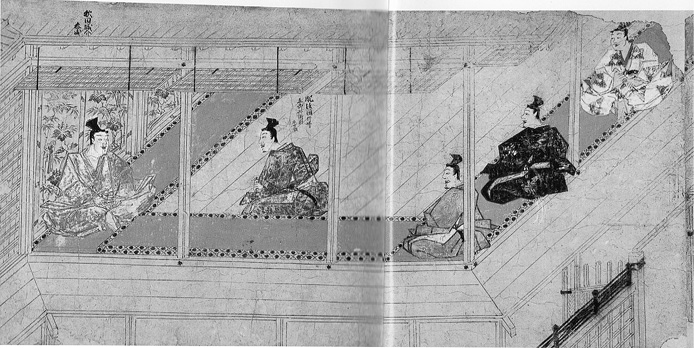
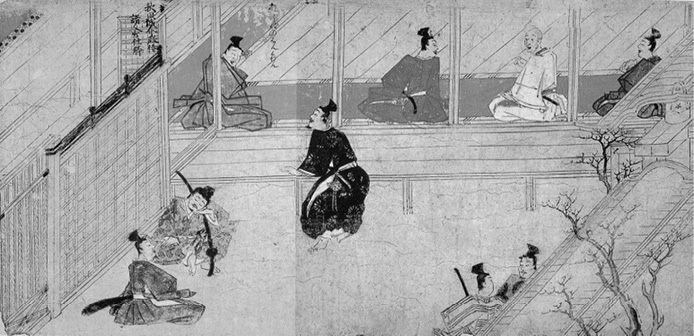
{86} A scene from the Mongol Invasion Scrolls depicting Takezaki Suenaga’s audience with Adachi Yasumori. To the left of the upper panel, Suenaga (center) faces Adachi Yasumori (to the far left), while a Kamakura official with the triangular familial crest of the Hōjō appears on the far right.
The lower panel, a continuation of the scene, shows one named official, Ashina no hangan, and guards, who are described as samurai.
{87} 17. Excerpts from Tōgan Ean’s Statement of Opinion (ikenjō)115
Japan struggled to mobilize their warriors and organize their forces in response to the Mongol invasions. The Mongols’ appreciation for the Japanese warriors’ skills is evident in the first document below (Tōgan Ean’s Statement of Opinion). The next document (Summons of the Chinzei Eastern Administrator, p. 88) illustrates the ways in which Kamakura tried to verify warriors’ services in battle. Other documents in this section show how the Japanese attempted to “liberate” Korea from Mongol rule. Though this campaign came to naught, these documents reveal how Kamakura tried to mobilize an army and prepare for an amphibious attack. Finally, two documents (Petition for Reward by Shami Shukumyō Ōkami Korechika, p. 91; and Letter by Shōni Kagesuke, p. 92) recount the invasions of 1281 and reflect the formalization of the format used for recording battle service.116
An excerpt from a letter written in 1270 by the Zen monk Tōgan Ean, who believed that the Mongols desired to incorporate Japanese warriors into their armies because of their martial prowess.
Because Japan’s military skills (Nihon koku no bugei) supersede those of all other nations, because our bows and arrows [are used with] peerless skill, and because our armor makes even the gods tremble, . . . the Mongols desire to conquer Japan. Once Japan’s warriors are under their control, they will be able to conquer China (Karado) and India (Tenjiku). The country of the Mongols would direct strategy while Japan would fight in the field for their victory. With the strength [of Japan and the Mongols] combined, no country could resist. That is why the Mongols now desire to subjugate Japan.
{88} 18. Summons (meshibumi) of the Chinzei Eastern Administrator117
A summons written by Odawara Kageyasu, one of Ōtomo Yoriyasu’s retainers, requesting that three warriors report to Yoriyasu so that he could question them, write a report, and forward it to Kamakura. Such an investigation was required to satisfy the Kamakura’s lingering doubts about their military service.
There has been a further inquiry [from Kamakura] regarding the battle service (kunkō) of those who fought against the Mongols. [In order for the shugo Ōtomo Yoriyasu to create] a report (onchūshin), you shall dispatch a representative (ondaikan) prior to the tenth of this month. By [Yoriyasu’s] authority (onsata). Respectfully.
(The first year of Kenji [1275]), sixth day, eleventh month
[Odawara] Kageyasu (monogram)
[To:] The Honorable Matama Matajirō
The Honorable Imi Hyōe Jirō
The Honorable Togō Saemon Gorō
19. Kamakura’s Attempt to Dispatch Forces to Korea
These documents, issued by the Kamakura Shogunate, represent an attempt to shore up the authority of Shōni Tsunesuke and to mobilize more sailors and oarsmen for the invasion of Korea. Plans for an invasion had progressed to the point that a provisional date for launching an attack, the third month of 1276, had been determined.
Copy of a Kantō Directive (mikyōjo an)118
The subjugation of foreign countries (ikoku) is planned for the third month of the next year. If oarsmen and sailors from Kyushu (Chinzei) are insufficient, Dazai Shōni Tsunesuke has ordered the mobilization of men from the San’in, San’yō, and {89} Nankai districts. Those jitō gokenin and men with complete administrative authority over lands in Aki Province must mobilize sailors and oarsmen. Please report the allotted numbers [of men and boats] and dispatch them to Hakata. Thus it is ordered and conveyed.
The first year of Kenji [1275], eighth day, twelfth month
Musashi no kami [Hōjō Yoshimasa] (arihan)
Sagami no kami [Hōjō Tokimune] (arihan)
To: The Honorable Takeda Gorōjirō [Nobutoki]
Copy of a Document (kakikudashi) of Shimazu Hisatoki119
In order to conquer Koryŏ [Korea], warriors have been dispatched. It has been ordered that you are to cross over [the ocean]. Respectfully
[Shimazu] Hisatoki (seal)
The second year of Kenji [1276], fifth day, later third month
[To:] The Honorable Ōsumi Gorō
An Acknowledgment (ukebumi) by Jōyū, a Priest and Estate Manager120
Here, Jōyū, the manager (azukari dokoro) of Kubota estate in Higo Province, has recorded the men, equipment, and horses he could muster for the invasions of Korea. The defensive tone of Jōyū’s reply suggests that a response was expected prior to the tenth day of the third month of 1276.
Hashiuragaki: A reply from the Kubota azukari dokoro. An acknowledgment of orders (ukebumi) by the priest and azukari dokoro of Kubota estate in Higo Province, Jōyū.
On the twenty-ninth day of this month, an order, written on the twenty-fifth, was received [stating that] in order to conquer foreign lands, we should submit a list of forces, weapons, and horses.
{90} In accordance with previous orders, I had already counted the number of troops and weapons in my own forces (gushinsei) and reported them to the military envoy (ōryōshi) Kawajiri hyōe no jō, on the past tenth day. Since I received a second notification, I personally have recorded this again. This purport should be made known. Respectfully, Jōyū.
The second year of Kenji [1276], thirtieth day, third month
The priest and azukari dokoro of Kubota estate Jōyū
Jōyū’s List of Followers, Weapons, and Horses121
The followers, weapons, and horses of the priest and azukari dokoro of Kubota estate in Higo Province.
1. Myself, age thirty-five.
One retainer (rōjū), three followers (shojū), and one horse.
2. Weapons:
One suit of full armor (yoroi), one suit of simplified armor (haramaki), two bows, two quivers of war arrows (ōya), and one sword (tachi).
Thus it is recorded in accordance with the command.
The second year of Kenji [1276], thirtieth day, third month
The priest and azukari dokoro of Kubota estate Jōyū
A Document (kakikudashi) of Ōtomo Yoriyasu122
Ōtomo Yoriyasu dispatched the following document to his representative, the Bungo gokenin Nokami Sukenao. Each gokenin was responsible for overseeing the mobilization of troops and sailors from within his domains for the invasion of Korea and for reporting the composition of these forces to the shugo. These efforts came to naught, and no force was ever dispatched to Korea.
Preparations for the advance into foreign countries:
—Submit a list of large and small boats within your holdings and the names and ages of sailors and oarsmen. You shall make preparations to dispatch these men to Hakata by the middle of next month.
{91} —When crossing into foreign lands, record the names and ages of upper and lower [status] men, their arms, and their armor (hyōgu).
The preparations mentioned above should be completed prior to the twentieth day of this month and a report dispatched. You have the authority to severely punish those who flee. This is so conveyed.
The second year of Kenji [1276], fifth day, third month
The former Dewa no kami (monogram)
[To:] The Honorable Nokami Tarō
20. Petition for Reward (gunchūjō) by Shami Shukumyō Ōkami Korechika123
Togō Korechika submitted the following petition to Kamakura in an attempt to receive rewards after the second Mongol invasions of 1281. His account describes the battle of Takashima and reveals that Korechika did not even know the first name of one of his witnesses, the novice (nyūdō) Kazusa Saburō.
The Bungo gokenin Togō Saemon Gorō Ōkami Korechika hōshi (holy name Shukumyō) respectfully states:
I desire to receive immediately a [Kamakura] battle report (onchūshin) [that mentions my deeds], and to be singled out for rewards, as is customary [for service in] battles against the Mongols at Takashima, in Hizen Province, on the seventh day of the seventh intercalary month of the past year of 1281.
Concerning the above, when the Mongol rebels (Mōko kyōto) arrived on the shores of Takashima, in Hizen Province, Shukumyō galloped to Hoshika, of the same province, and on the seventh day, at the hour of the serpent [9–11 a.m.], crossed over to this island and performed battle service on its eastern beaches. Shukumyō’s son, Shirō Koretō, managed to decapitate (buntori) the enemy. In addition, my retainer (rōjū) Saburōjirō Shigetō was wounded. The bannerman, one of the base (genin), Yaroku Suemori, was [also] wounded. These actions were witnessed by Shite Chikugo no bō Enhan, of the same province, and the novice (nyūdō) Kazusa {92} Saburō. Shukumyō desires to receive a [Kamakura] report [chronicling his deeds], and to be singled out for rewards with due haste. Respectfully stated thus.
The ninth year of Kōan [1286], third month
Shami Shukumyō (monogram)
21. Copy of a Letter by Shōni Kagesuke124
The following copy (utsushi) of a letter, dispatched by Shōni Kagesuke to Kamiyama Shirō, a witness for Kasai Norikage, shows that witnesses’ statements had to be recorded under oath in order to be considered as “proof” of battle service. This document also reveals how battles were fought on the high seas before the typhoons slammed into the Mongol fleet.
The jitō Kasai Kotarō Norikage of Kigoya, Chikugo Province, states that on the fifth day of the seventh intercalary month of 1281, in the seas off the coast of Mizushizaki in Hizen Province, he managed to pursue a large vessel, one of three Mongol pirate vessels (zokusen), and do battle. [After] boarding [that] enemy ship, Norikage decapitated [the enemy], while his younger brother, Hironori, pursued the foreign pirates (izoku) into the sea. Some relatives and followers (hikan) were wounded, while [other] retainers (rōjū) were either killed, wounded, or managed to decapitate the enemy. Witnesses have stood [for Norikage] attesting that they saw [his actions]. Nevertheless, an oath should be written [by these witnesses] that verify the truth of Norikage’s battle service. [Respectfully].
The seventh year of Kōan [1284], twelfth day, fourth month
Kagesuke ([ari]han)
[To:] The Honorable Kamiyama Shirō
{93} 22. The New Laws (Shin-shikimoku) of Adachi Yasumori (1284–85)125
On 3.28.1284, the shogunal chief of staff (shikken) Hōjō Tokimune suddenly died. His death was a surprise; he was signing documents not two days before. Tokimune’s young son Sadatoki became the next Kamakura chief of staff (shikken). Nevertheless, Sadatoki’s uncle, Adachi Yasumori, issued over ninety legal clauses from the fifth month of 1284 through the eleventh month of 1285. These laws, which have attracted considerable scholarly attention, represent an especially intense legislative period. As the subject is omitted from these clauses, it is most difficult to know if they were mostly designed for the shōgun, or Yasumori’s nephew Hōjō Sadatoki.
Yasumori’s laws advocate the restoration of lands to shrines and temples because the transfer of land, through sale and inheritance, was thought to be a source of disorder. This well-intentioned edict served to undermine one of the bedrock clauses of the 1232 Kamakura law: that possession and use of lands for a period of twenty years established irrevocable ownership. Yasumori also advocated more frugality and better governance from the Hōjō. Ever suspicious, the Hōjō assassinated Yasumori.
The New Shikimoku (5.20.1284 [Kōan 7]). 38 clauses.126
Item (1) (491). The lands of temples and shrines shall be restored as of old; and their worship of the gods and Buddhas performed with the greatest attention. The construction of new temples and shrines shall cease, and old temples and shrines shall be restored.
Item (2) (492). For prayers, choose monks of ability, and reduce their number. Perform rituals in accordance with the law (hō) and do not be remiss regarding funds for them.
Item (3) (493). There should be tutoring (gogakumon).127
Item (4) (494). The martial way shall be promoted so as to ensure that it does not end.
{94} Item (5) (495). Three cases shall be discussed for each internal deliberation session (naidan).128
Item (6) (496). Intermediaries (mōshitsugi banshū) shall be appointed. When important people (shikaru beki no hitobito) call [Hōjō Sadatoki] they shall have a personal audience, while others will receive a response [from Hōjō Sadatoki] through other means.
Item (7) (497). The people staffing the [Hōjō] residence (denchū) should serve daily.
Item (8) (498). Women and monks should not intercede.
Item (9) (499). Frugality is encouraged in all things.129
Item (10) (500). Decorum and behavior (reigi reihō) at the [Hōjō] residence (denchū) shall be corrected.
Item (11) (501). Gifts from those who reside in the capital or dispatched as messengers throughout the land shall cease. Gifts from other people shall be prohibited if excessive.
Item (12) (502). Entertainment (zasshō) shall be prohibited.
Item (13) (503). Excessive, elaborate construction (zōsa) shall be prohibited.
Item (14) (504). Save for ceremonial visits for the New Year and directional taboos, [Hōjō Sadatoki] should not visit others lightly.130
Item (15) (505). People of the [Hōjō] residence (denchū) shall not dispatch messengers to the administrators (bugyōnin) regarding various affairs.
Item (16) (506). [Hōjō Sadatoki] should appoint and promote administrators who are straightforward (renchoku).
Item (17) (507). Provisional public levies should hereby cease.
Item (18) (508). Concerning levies of [Hōjō] territories. Every year accounts shall be sent and all the special taxes (tokubun) shall be paid.
{95} Clauses concerning the Kubō (lord).131
Item (19) (509). Kyūshū Shrine lands shall not be purchased by the hoi polloi (kō-otsunin). As of old, they shall be administered by shrines.
Item (20) (510). From now on, the construction of new temples and shrines shall cease, and the provincial temples (Kokubunji) and the First Shrines (Ichinomiya) of each of the provinces shall be restored.
Item (21) (511). Frugality shall be practiced.
Item (22) (512). If landholdings are classified as being appropriable (kessho),132 compensatory lands shall be granted;133 rewards from the shōgun (jun’on) and benefices (kyū’onrō) shall be made in accordance with their previous service.
Item (23) (513). The administrators (bugyōnin) for appeals shall be decided.
Item (24) (514). “Lords of the land” (myōshu) of the nine provinces of the Chinzei (Kyushu) shall receive Kamakura edicts (onkudashibumi) [confirming their status].
Item (25) (515). Those that reside in the capital or who are dispatched as messengers throughout Japan shall be exempt from paddy taxes (nengu) levied on their holdings.
Item (26) (516). Yearly tax levies (onnengu) [of shogunal lands] shall be determined within a specific period of time. If this period is extended, then the land holdings [of the perpetrators] shall be confiscated.
Item (27) (517). Gokenin shall not be assessed with provisional public levies.
Item (28) (518). The great stable (ōmaya) shall be abolished.
Item (29) (519). Save for the provinces of Dewa and Mutsu, the eastern horse pastures (maki) shall be abolished.
Item (30) (520). Levies of roadside porters [from gokenin] shall cease.
{96} Item (31) (521). New Year Banquets (ōban) should be limited to three days; otherwise, they are prohibited.
Item (32) (522). Dress for the first ceremonial day of the Council (gohyōjo) on the fifth day [of the first month] shall consist of regular robes (hitatare) and a folded (ori) cap (eboshi).
Item (33) (523). Dress for the first archery practice of the year, on the seventh [of the first month] shall consist of regular robes (hitatare) and a standing cap.
Item (34) (524). Illustrations decorating screens (byōbu) and papered lattice windows (shoji) are prohibited.
Item (35) (525). Pictures on clothing shall be prohibited.
Item (36) (526). Ladies of the [shogunal] Palace (gosho) shall wear two layers of clothes while low-ranking women shall wear a thin robe.
Item (37) (527). Materials for side dishes (okazu) to be provided to the lord’s pantry (niedono)134 shall not be taken in the various places or harbors.
Item (38) (528). Those who chant the nenbutsu or who have taken religious vows (tonseisha) and the base (bonge) shall cease riding horses throughout Kamakura.
23. Excerpts from The Confessions of Lady Nijō135
The Confessions of Lady Nijō (Towazugatari) survived as a single manuscript, discovered only during the mid-twentieth century in the imperial archives. Lady Nijō visited Kamakura in 1289, after she had taken Buddhist vows, and describes the city of Kamakura, as well as the moment when Kamakura’s titular leader, Prince Koreyasu (1264–1326; shōgun 1266–89), the Shōgun, was deposed by his nominal chief of staff, the Hōjō. At this time, Kamakura’s Sei-i-tai shōgun was an imperial prince, for scions of the Fujiwara Regent family, or imperial princes themselves, staffed this office after the death of Minamoto no Yoritomo’s male descendants. The ever-suspicious Hōjō deposed these leaders at the first hint of their acting against Hōjō interests. Finally, Lady Nijō mentions seeing Ashikaga Sadauji (1273–1331) along with {97} the Hōjō leader, which suggests that already the Ashikaga had a special social position in Kamakura not reflected by their receipt of any particularly notable offices within the Kamakura regime.
I set off for Kamakura at dawn. I first stopped by the temple called Gokurakuji (The Temple of Paradise). The monks acted no differently from those in Kyoto, and I watched them nostalgically. On crossing the mountain pass at Kewaizaka, I could look down over the city of Kamakura. It was so different from Higashiyama!136 Houses clung to the hills in rows and looked like stacks of parcels in little bags. It all seemed so wretched that it left me feeling uncomfortable. When I went to the beach, Yuigahama, I saw a large shrine gate (torii). It was the Wakamiya [Hachiman] Shrine. I reflected on the karmic bond that I had, for I was born into a lineage, the Minamoto, protected by this deity. . . .
On the morning of the fifteenth of that month, Lady Komachi told me, “Today is the day of the Liberation of Living Creatures Rites (hōjōe).137 What do you remember of them?” I replied: “I have no use for them! The waters of the Iwashimizu Hachiman line no longer flow through me.” She responded, “The gods show compassion on those who rely on them.” Since Kamakura’s Tsuraoka Hachiman had its own Hōjōe Festival, I was curious and decided to go there and take a look. Considering the place, the appearance of the Shōgun and his attendants was pretty impressive. The lords (daimyō) wore formal hunting robes (kariginu) while others wore regular robes (hitatare) with swords. It was all most remarkable. Nevertheless, at a place called Akahashi, the Shōgun alighted from his cart, and the appearance of the nobles and courtiers in attendance was shabby and pathetic. Taira Jirō saemon, heir to the Taira saemon novice (nyūdō), attended. He was head of the board of retainers for the Shōgun, but he looked as if he were an Imperial Regent (kanpaku).138 He was most impressive. I was not interested in archery competitions (yabusame) or other festival events and returned home.
{98} The Fall of the Shōgun Prince Koreyasu
Shortly after this, after not too many days had passed, we heard rumors of something that had happened in Kamakura. As we were wondering what it could possibly be, there were reports that the Shōgun would return to the capital immediately. I went to his palace and saw a strange and shabby simplified palanquin on the veranda. A lieutenant (hangan) named Tango Jirō was in charge until Taira saemon Jirō arrived.139 Claiming that he was a representative of the Hōjō lord [Sadatoki], Jirō stated that there was precedent for the palanquin to be carried backward.140 Even before the Prince left the palace, coarse servants walked into the mansion still wearing their straw sandals and started tearing down the bamboo blinds and other things. It was a terrible sight.
A while after the shogunal palanquin departed, groups of his ladies came out, but there were no palanquins waiting for them. They stood there with nothing to hide themselves from the gaze of others. Some sobbed, and others wondered where the Shōgun had been taken. Some lords (daimyō) felt sympathy with their plight and sent some young followers (wakatō) to escort them and see them off at dusk. The sight of them all going their separate ways was too sad for words. . . .
Although Koreyasu141 was called the Shōgun, it is not as if he gained his power by quelling barbarians (ebisu) or anything like that. His father, Munetaka, was known as the second son of Emperor Go-Saga and was a few months or a year older than Go-Fukakusa.142 Munetaka would have ascended the throne, but his mother was of insufficient status, so this did not happen.143 Munetaka became Shōgun, and was no mere commoner, but was known as the Prince of the Central Affairs Ministry. His son Koreyasu was a worthy Prince as well, and rumors of his {99} illegitimacy were unfounded, as his mother was a daughter of the illustrious Fujiwara Regent family.144 Tears came to my eyes when I thought of his magnificent lineage and his fall from grace. . . .
Soon word was out that Retired Emperor Go-Fukakusa’s sixth son would come to Kamakura as the next Shōgun. . . . On the day of the new Shōgun’s arrival, people lined Wakamiya Avenue. Many had gone to the toll barrier at the pass to welcome the new Shōgun, and the first of their party returned. Twenty or thirty horsemen, then forty or fifty, passed by in imposing procession, and next imperial attendants (meshitsugi) and servants (kotoneri), twenty in all, went by. Then came a procession of lords (daimyō), all crowded together and smartly dressed, which extended on and on, for seven hundred yards, and then there was a palanquin with its blinds rolled up. The Shōgun wore an embossed yellow robe (ominaeshi oriamimono). Later Iinuma shinsaemon,145 wearing dark green hunting robes, accompanied the Shōgun. It was all most solemn. At the palace, the Provincial Governor (Hōjō Sadatoki),146 and Ashikaga147 and all the important people wore robes without crests. There was a splendid viewing of a parade of horses.148 On the third day after his arrival, the Shōgun visited the Governor of Sagami’s home, at a place called Yamanouchi.149 He was entertained with a lavish banquet. I was moved, and remembered my earlier life at court.
{100} 24. Excerpt from “The Light and Shadows of the Day,” The Clear Mirror (Masukagami)150
In 1290, tensions generated by turmoil in the court and the rise of two competing imperial lineages culminated in a remarkable assassination attempt by a retired emperor against his reigning rival. A flamboyant warrior named Asahara Tameyori (?–1290) was ordered to carry out the assassination but proved spectacularly unsuited for such a delicate mission. Wearing brightly colored armor, he charged into the palace, whereupon the Emperor—the target of the assassination attempt—fled. Tameyori and his fellow marauders were killed (or forced to kill themselves).
This remarkable history, of unknown authorship, was written by a prominent courtier. Probable candidates include members of the Fujiwara Regent line, most likely a member of the Ichijō or Nijō families. This chronicle recounts the attempt of Retired Emperor Kameyama (1249–1305; r. 1260–74) to assassinate his rival, Emperor Fushimi (1265–1317; r. 1287–98). This account reveals that the warriors of thirteenth-century Japan did not rely on stealth when called on to assassinate someone. Rokuhara, the branch office of the Kamakura Shogunate, kept order in the capital and apprehended these would-be assassins, who certainly did not act like ninja! This episode is significant because it reveals that courtiers and emperors, in their factional disputes, were willing to use violence to achieve their ends, and their actions would ultimately bring down the Kamakura Bakufu.
At around the fourth or fifth day of the third month of Shō-ō 3 [1290], the statues of lions and guard dogs at the palace split down the middle. Surprised, the Emperor [Fushimi] consulted his diviners, who predicted that blood would flow. This caused great consternation. On the evening of the ninth, three or four ferocious mounted warriors (bushi) rode in from the western palace gate (uemon no jin) and entered the palace proper (kokonoe no uchi). One entered an outlying palace building. A handmaiden, standing nearby, heard someone say, “Hey!”; when she looked up, she saw a towering (jō takaku) formidable warrior wearing red-laced armor over red brocade, with the face of a red demon. “Where is the Emperor (Mikado)?” he asked. “In {101} the bed chamber,” she replied. Then he asked, “Where is that?” “At the northeast corner of the Main Palace.”
While the warriors rode southward, the woman ran to alert the Provisional Grand Councilor’s handmaiden and the new Mistress of Staff. The Emperor, who was with the Empress at the time, fled from one of the wings of the palace to the Kasuga Mansion; he was disguised most peculiarly as if he were a palace lady. The Dame of Staff took the sword and jewel, and a palace woman took the lutes Genjō and Suzuka; both women fled.151 Lady Azechi, who attended the Empress, carried the Crown Prince to the Tokiwa Mansion. Words cannot describe how they all felt! Nearly everyone had fled by the time the red-faced, red-armored warrior—who was known as Asahara Whatever—reached the imperial bed chamber, hardly anyone remained. One of the empress’s chief attendants, a man named Nagamasa, roared his own name in challenge, and fought well, but eventually he was wounded and withdrew.
After a while, the head of the Nijō Kyōgoku guard post galloped in, leading fifty odd horsemen and shouting battle cries. At first they were met with only a feeble response, and they were confident as they entered the palace grounds, violently smashing into buildings and destroying chairs in the palace. Hearing this, Asahara realized his situation was hopeless and killed himself in the imperial bed chambers. His son Tarō killed himself in the curtained dais. His younger brother Hachirō, just nineteen, crawled under a bench and slashed at the legs of his adversaries. But, knowing that he would be captured in the end, he eventually killed himself by pulling out his own entrails and holding them in his hands. All of the warriors’ bodies were carted off to Rokuhara.
With the light of dawn, the Emperor and Crown Prince [Go-Fushimi (1288–1336, r. 1298–1301)] returned stealthily by cart to the palace. At noon, they then went to the Kasuga Mansion. Since the palace was defiled, a palanquin was brought to the Empress’s sitting room, and the Emperor departed for the western palace gate. The Crown Prince traveled to the Tokiwa Mansion in a tasseled cart. The Empress also went to the Kasuga Mansion. Words cannot describe the chaos of the time.
As Rokuhara pursued their investigation of this incident, they arrested Sanjō Consultant Captain Sanemori. That was because “Catfish tail” (Namazu-o), an heirloom of the Sanjō house, which had been in Sanemori’s possession, was used by this Asahara to kill himself. There were rumors to that the Retired Emperor Kameyama knew of these plans.152 It all was most distressing.
{102} 25. Kamakura’s Response to the Asahara Assassination Attempt
In contrast to the vivid account of the Asahara assassination attempt, documents issued by Rokuhara are much more laconic. Rokuhara mobilized western warriors, including both gokenin who came to the capital in haste, and jitō who resided farther afield and who arrived in the capital weeks later.
Hiromine Chōyū’s Report of Arrival (chakutōjō)153
The gokenin Hiromine Jibu Hōgan Chōyū of Harima Province has galloped here because of Asahara Hachirō. Let this be known without fail. Respectfully.
Tenth day of the fourth month of the third year of Shōō 3 [1290]. Hōgan Chōyū submitted
To: The magistrate’s office
Received (monogram)
Shibuya Shigemura’s Report of Arrival154
The jitō Shibuya Gorō Shirō Shigemura, of Kawakura district, Mimasaka Province, has arrived in the capital because of Asahara Hachirō. Let this be known without fail. Respectfully.
Twenty-first day of the fourth month
Taira Shigemura
To: The magistrate’s office
Received (monogram)
{103} 26. Excerpts from Mine’aiki155
This account, a local history, was written in 1348 by an itinerant monk who visited Keisokuji, a temple near the mountain of Mine’ai, in Harima Province. There, he met an old monk, who told him the history of Harima. The passages here describe past events, and the old monk carefully distinguishes between what he read about in old histories, such as the Nihongi, with things that he viewed “with his own eyes.” Four passages are translated here. First, the history of a seventh-century Dog Temple at Awaga has been backed up by archaeological excavations, but the particulars of the narrative suggest a Kamakura era context. Although the story is purportedly of an earlier era, it does reveal the principle of warrior latitude in determining inheritance. The second passage reveals how ambitious warriors tried to profit from increasing trade by building harbors. The third selection, by far the most famous of this work, describes the rise of “evil bands,” or akutō, and shows how these “bandits” went from being peripheral members of society to full-fledged warriors. The final passage, which by contrast is not widely known, describes rising animosity against Kamakura, a brief history of the age, and the events leading to the fall of Kamakura.
Then there is the Dog Temple of Awaga.156 The original lord of that area was a man known as Shūfu, a famous hunter. One of his followers violated Shūfu’s wife, and on top of that he planned to kill Shūfu and marry her. Shūfu’s wife and the follower had a secret pact. Out on their hunting ground in the mountains, the follower drew his bow against Shūfu and was about to loose an arrow. The moment had come. However, Shūfu had two faithful dogs, Big Black (Ōguro) and Little Black (Koguro). They launched themselves at the follower and seized both his arms in their jaws. Shūfu drew his dagger, rushed at the man, and demanded an explanation. The man confessed everything. Shūfu killed him, dismissed his wife, conceived aspiration to enlightenment, and renounced the world. At his death, since he had no children, he left his property to his two dogs. After the dogs died, the proprietor (ryōke) decided to build a temple (in) on his land, dedicated to the enlightenment of Shūfu and his dogs: halls, a pagoda, and monks’ quarters. Buddhist practice flourished there. When the temple burned, the sacred statue of {104} Eleven-headed (Jūichimen) Kannon, together with those of Shūfu and his dogs, flew to the mountain to the north. They were worshipped there at a temple named Hōrakuji. A small hall was built on the site of the original temple.
The following passage reveals how warriors attempted to take advantage of increased trade by constructing harbors which, in this case, failed. Although the Mine’aki states that Andō Renshō completed this project, as early as 1293, the monk Gyō-en was soliciting contributions for the construction of this harbor of Fukutomari Island.157 Andō Renshō himself participated in the capture of akutō bandits.
In Kangen 1 [1302], the novice (nyūdō) Andō Taira uemon Renshō (dubbed Tamenaga) constructed the Fukutomari harbor. He heaped up large rocks, spent several hundred kan of coin (senzai) and built a protected harbor of six acres (two chō) into the sea. It promised to be just as good as [the prosperous harbors of] Ura-tomari or Hyōgo Island. Wealthy merchants built many houses on it, and a great many ships, large and small, moored there. However, it was overwhelmed by silt from the mouth of the Kakogawa, which covered the interior of the island. Large ships no longer stopped there, and the island failed.158
The most famous passage of this account describes the rise of akutō, or “evil bands.” Some historians have seen this as a sign of an incipient class struggle, while others argue that it represents the rise of judicial violence among land managers.
Question: Much the same things go on in all the provinces, but I gather that in this one [of Harima] akutō uprisings have been particularly prominent. When did they start being so severe?
Answer: Indeed, disputes over authority (shomu sōron) used to occur at Kamioka, Takaie, and elsewhere, but they were not that serious. After the eras of Shōan [1299–1302] and Kengen [1302–3] one saw or heard of little else. Violence everywhere, piracy up and down the coast, abductions, theft, banditry, and ruthless robbery occurred in varying forms and violated every norm of human behavior. In persimmon-dyed tunics and six-sided (roppō) hats,159 or caps (eboshi) and trousers (hakama), they kept out of sight and snuck around with broken bamboo quivers on their backs, swords with battered hilts and sheaths at their waists, {105} bamboo spears, and balance-pole staffs. Not one of them wore great armor (ōyoroi) or a corselet (haramaki).160 Ten or twenty such men, banded together, would seek refuge in a stronghold,161 then join the attackers, or else turn around and fight for their opponents’ commander, in total disregard of any agreement reached with anyone. They enjoyed gambling and secretly engaged in petty thievery. Despite the efforts of military authorities, and despite the shugo’s orders to restrain them,162 they increased in number daily. Under these circumstances, in the spring of Gen’ō 1 [1319], messengers were dispatched to twelve provinces in the San’yō and Nankai regions. In this province, Hyōe-no-taifu Tameyori, Shibuya Saburō saemon-no-jō, Kasuya Jirō saemon-no-jō, and the deputy shugo the Andō novice (nyūdō),163 supported by oaths (kishō) from jitō and householders (gokenin), destroyed over twenty akutō bases and strongholds. Current criminals were executed. Fifty-one akutō were reported, and a bakufu directive (mikyōjo) was issued ordering the jitō and householders who had gone up to the capital from all over the province to pursue them relentlessly and arrest them. However, nothing came of it. In addition, two well-known men were appointed as envoys. A roster of jitō and housemen was drawn up, to assure turn-by-turn guards for Akashi and Nageishi. All was then calm for two or three years. However, after [Hōjō/Osaragi] Koresada164 became the Mutsu Governor [and returned to Kamakura], the uprisings began again, increasing in frequency, until in Shōchū [1324–26] and Karyaku [1326–29] eras, to the astonishment of the entire realm, they surpassed anything seen in earlier years.
[These later akutō] rode good steeds in bands of fifty or a hundred, with spare mounts hauling chests165 full of gear, bows and arrows, gold- and silver-inlaid weapons, great armor (ōyoroi), and corselets (haramaki) all glittering and gleaming. Claiming to represent the [rightful] proprietor, the akutō seized land the ownership of which had never been in dispute; formed leagues bound together by oaths; relied on groups of followers (yoriki) styled as their “guests,” who built castles or captured {106} them; built strongholds; constructed proper earthen walls; put up archery towers (yagura); set up an abatis (hashiriki); showered attackers with stones; erected watchtowers; employed shields in screen-like or box-like fashion; and covered them with leather hides or crushed bamboo. They readied themselves in various ways and contrived countless devices. Since most of the akutō came from Tajima, Tanba, Inaba, and Hōki Provinces [across the mountains from Harima to the north or northwest], they referred to their bribes as “fees for crossing the mountains” (yama koshi) and later they promised to ally with those who paid them.
The akutō showed no sign at all of wishing to go unnoticed or of feeling the least twinge of shame. Even warriors who were [willing to commit] seppuku (seppuku ka tō) when they felt shame praised them166 as being “beyond the pale” (sata no hoka) in battle camp (gunjin) [and refused to attack].
For this reason, even shugo protectors stood in awe of their might, and warriors sent to suppress them turned back in apprehension. So it is that, in the end, hardly a single estate could escape the [depredations]—abductions, pursuit, riot, [illegal] harvesting of paddy and dry fields, break-ins, and robbery—of the bands. It seemed unlikely that any estate would be spared. It was as though [the akutō] walked with tigers and wolves and mingled with dragons and snakes. The authorities’ judicial decisions (jōsai) were no doubt well-intentioned, but they seemed to lack either resources or courage. Failure to carry out orders from above resulted in no consequences; urgings from the bakufu mobilization directives (mikyōjo saisoku) just slipped through the cracks.167 Since most people throughout the province, high or low, were in sympathy with [the akutō], honest and talented men, and those of good will, covered their ears and closed their eyes; so that the passage of time led in the end to the grave events of Genkō [1331–34]. However, such conduct constituted a lapse in warrior governance (buke seidō) [of Kamakura].
The closing passage of the Mine’aiki, which directly follows the passage on akutō, reveals historical attitudes about the Kamakura regime in the fourteenth century and how some in Harima perceived its later leaders to be arrogant. This province would be a hotbed of resistance to Kamakura during the Genkō era [1331–34]. This text ends with an account of the initiation of a rebellion against the Kamakura Bakufu. Other documents, which confirm the historical record, describe the crucial role of Harima Province warriors in the uprising.
Question: Everyone knows how it went in Kyoto, Kamakura, and the provinces after Genkō [1331–34]. What happened in this province?
{107} Answer: I need hardly remind you that the term warrior house (buke)168 is a new one, but during Angen [1175–77] and Jishō [1177–81], the Taira Grand Minister (Taira Shōkoku) [Kiyomori] seized military power and ruled the realm as he pleased. He dismissed the Minamoto as chief of the Palace Guards (buei) and destroyed the Minamoto’s entire house. Then the Genji seized power once more, and their head [Minamoto no Yoritomo] was appointed as the General of the Right (utaishō) and awarded the offices of Chief Envoy for pursuit and capture (sōtsuibushi) and over-jitō (sōjitō). They say that, as the protector (kōken) of the imperial house, he comported himself wisely in all circumstances and practiced virtuous government. However, after the child Shōgun [Fujiwara Yoritsuna] had gone down [to Kamakura], following the third Shōgun’s [Sanetomo’s] death, the Hōjō family, as shogunal chief of staff (shikken),169 seized control of the realm. The Imperial Way was lost, and government followed the will of the buke.170
This led to the extraordinary developments of Jōkyū.171 Then there came the Sovereign’s abdication, and conflict between the two imperial lineages. [Kamakura] appointed regents (sesshō, kanpaku), ministers, top court officials, empress, heirs apparent, and generals of the left and right. In addition, starting with Mt. Hiei and Nara, among other temples, and Ise and Iwashimizu among other shrines, the east172 governed succession to the office of head priest, or temple chief (zasu) or intendants (bettō); appointed head shrine priests (saishu) [at Ise] and shrine administrators (kannushi no shikken); and controlled even the junior offices in the noble houses, as well as the ministers, provincial governors, and the Capital Police (kebiishi). All followed the will of the east. The entire realm submitted to the buke.173 Therefore, the treasures of the imperial and the Retired Emperor’s palaces, the valuables owned by the noble houses and the Princely Priests (monzeki), all went to support the buke, which became immensely wealthy—far more so than the richest houses—until gold, silver, pearls, and precious stones filled their storehouses. In the provinces, they generally monopolized the offices of shugo or of estate and local district headships, so that these houses prospered. {108} The incumbents inhabited rows of mansions, markets grew up at their gates, their saddled mounts crowded the roads, and ancient houses of hereditary distinction insinuated themselves into their company. They held every worthy man—whether Confucian scholar or master in another line—to be beneath them, so that the etiquette of each encounter on the road, each judgment about a seating precedence, became even stricter than the proper comportment between lord and follower, to the point where even their household servants and retainers claimed exalted standing, and prided themselves on their influence. Everyone performed the seven rites of filial piety, the various houses fully acknowledged their service; therefore, acceptance or rejection of every opinion, judgment, or policy conformed to Kamakura’s orders and followed their will. Each shogunal chief of staff (shikken) in succession acted with probity, gave first priority to loyal service, revered the Buddhas and Gods, and respected the nobility; wherefore the calm of the Four Seas obtained throughout the world, and the people took pride in orderly government (kensei). Plants and trees awaited no wind to yield but bent to authority; flying birds spread their wings in deference to wise counsel. In the same way, the current incumbent followed the example of earlier shōguns and upheld their precedents. Or so they claimed.
However, such had been their excesses that they seemed to have forgotten the way of military strategy and abandoned the art of war. Their officials were still aware of established precedent, in outer and inner deportment, and their accoutrements surpassed those of any minister or great lord—indeed, they were hardly inferior to the palaces of the Empress or the Retired Emperor. However, in the present time of Genkō [1331–34] they have met their fate, and all five hundred and more of them have perished in an instant. In the historical records of the Other Realm, there appears the principle that the power of subject’s lineage over the realm does not last more than three generations. However, the rewards of a succession of eight generations had proved great indeed. On the twenty-fifth day of the eighth month of last year, Genkō 1 [1331], half-way through the hour of the bird [5–7 p.m.], a messenger from the shugo raced here, opened a bakufu directive (mikyōjo), and read, “To the jitō and to the householders (gokenin): During the night of the twenty-third just past, the Emperor traveled elsewhere. You are to come up to the capital immediately.” This was the start of disorder in the realm.
{109} 27. Excerpt from “The Dayflower,” The Clear Mirror (Masukagami)174
This passage describes the uprising—led by Akamatsu Enshin (1277–1350), a disgruntled gokenin warrior, and carried out by the combined forces of the army of Ashikaga Takauji and the forces of Prince Itsuji Moriyoshi (a son of Emperor Kameyama)—that destroyed Kamakura’s branch office in Rokuhara. By this time, the emperor Go-Daigo had already staged a revolt, been captured, and escaped from Oki Island. Resistance was also led by a son of Go-Daigo, also known as Prince Moriyoshi (1308–35).
Soon after the tenth day of the third month, the world became disordered. Akamatsu Enshin, so he was called, a novice (nyūdō) from Harima Province, decided to obey the previous emperor Go-Daigo’s edict to attack the capital. The capital was plunged into confusion and, as was customary in such cases, Emperor Kōgon and both Retired Emperors fled from there to Rokuhara. Those of high and low status alike scrambled, horses and carts dashed in all different directions, and shouting warriors swarmed the streets. It was all most frightful!
Nevertheless, the Rokuhara forces were strong and the Akamatsu men retreated during that night. Though the fighting subsided, the situation remained chaotic and the emperors stayed in Rokuhara. On the twenty-sixth, the Crown Prince was sent to Rokuhara in order to be close to the Retired Emperors and Emperor. . . .
Imperial priests arrived in order to perform invocations.175 There were reports of battles being fought here and there, and as the days passed, the Retired Emperors ordered even senior nobles and courtiers to muster warriors in a manner commensurate with their status. Accordingly, many warriors were mobilized, including even young samurai who could not easily wield a bow. It was now a world where one might deliberately break their elbow [to avoid military service]. So ended the rumor-filled third month.
On the tenth day of the fourth month, a great number of warriors arrived from the east. Many of them, including Ashikaga jibu no taifu Takauji, had attacked Kasagi two years before [during Go-Daigo’s initial rebellion]. Retired Emperor Go-Fushimi was impressed with Takauji and dispatched an edict (inzen) ordering him to attack Go-Daigo.
When Takauji had departed from the east, he wrote an oath stating that he had undivided allegiance to Kamakura. But there were doubts about what he really {110} thought. This Takauji was a descendant of Yoriyoshi of old, and although he was a warrior of impeccable lineage, his Genji lineage had not been influential since the time of Jōkyū [1219–22].176 Although [the Ashikaga were] obscure, a number of branch families had been established, and their influence extended far and wide. They gained the support of many in the provinces. Some people wondered if, during this time of crisis, Takauji would rise up in the world [through rebellion] and their suspicions proved to be correct.
Stating that he had been commanded to depart for the province of Hōki, Takauji stopped at Nishiyama Ōhara for a night, and then on the seventh day of the fifth month, just at the light of dawn, he broke through the barricades at Ōmiya Avenue. Dividing his forces into seven units, he then headed east on seven roads from Nijō, in the north, to Shichijō in the south. With their banners, he and his men, as thick as fog and clouds, headed toward Rokuhara. They encountered no opposition along the way. Having already received an edict from the previous emperor Go-Daigo, Jibu no taiyū Takauji had thus turned to conquer the capital.
Takauji and his men raised thunderous battle cries; the ground shook, and the Heavenly King Brahma (Bonten) must have been surprised in his palace. All who heard them were rattled by the clamor. It goes without saying that Emperor Kōgon, the Crown Prince, and the Retired Emperors Hanazono and Go-Fushimi were distraught. Accustomed more to beautiful melodies, they were shocked to hear such strange sounds.
Half of Rokuhara’s warriors had been dispatched to Mt. Kongō; those who remained resolved to stay in the capital for as long as they lived. It was a ferocious battle, fought with reckless abandon. Many died in front of their comrades, brought down by arrows that fell like heavy rain. They fought day and night. Both Rokuhara leaders resisted until their forces were no more. But in the end their defenses collapsed, and the end appeared near.
The emperors, nobles, and courtiers could not have fled, even if they believed this day would be their last. Of course, none could have imagined the previous day’s betrayal by Takauji, a man honored with a Retired Emperor’s edict. All huddled together in fear.
Throughout the day, the sun was darkened by black smoke billowing from fires at Hachiman, Yamazaki, Takeda, Uji, Seta, Fukakusa, and Hosshōji. By nightfall, the sky was dark as ink. As the fires approached Rokuhara, and the situation became dire. Against the odds, the defenders somehow managed to break through the rear of Takauji’s encampment, and their majesties escaped as if in a dream. Kōgon adopted the bizarre garb of a man too poor to afford decent clothes. Both Retired Emperors fled, hand in hand, with the help of others. Nobles and Grand Ministers fled in all directions, to the east and west of the river, and were too dazed to notice when they lost their caps.
{111} The two Rokuhara leaders, Nakatoki and Tokimasa, resolved to flee east, and the Emperor and Retired Emperors went with them. . . . When they were in Ōmi Province, at a place called Ibuki, there was some prince, who was a monk, with some skill in battle, who had allied with the former Emperor Go-Daigo. He ambushed them, shooting them with arrows. Hearing reports of a pursuing force from the capital, the northern Rokuhara leader Nakatoki took the Emperor [Kōgon], Crown Prince [Sukō], and both Retired Emperors [Go-Fushimi and Hanazono] into the hills at a place called Banba. A number of their warriors remained, but they could not attack; instead, they committed seppuku in these hills. The southern Rokuhara leader Tokimasa did not make it so far as Banba. Instead, we heard that he was lost in the vicinity of Moriyama. Words cannot express the wretchedness of it all. Of those who had accompanied the Emperor, only the Grand Councilor Toshizane, the Middle Councilors Tsuneaki and Yorisada, the Grand Councilor Sukena, the Consultant Sukeaki, and Takakage did not flee. Toshizane, Sukena, and Yorisada cut their hair [and took Buddhist vows]. Retired Emperor Go-Fushimi sent a letter to the Emperor suggesting that he, too, renounce the world, but Kōgon, who had never considered doing this, firmly refused.
28. Kanesawa Sadamasa Letter (Fragment)177
Kamakura easily quelled Go-Daigo’s initial rebellion in 1331 and banished the emperor to Oki Island. Kanesawa Sadamasa (1302–33), son of powerful Kamakura official Kanesawa Sadaaki (1278–1333), penned the following letter in the tenth month of 1331. It was later recycled and survives in one of the few Kamakura temples not destroyed in 1333. The most notable general commanding this reinforcing army was Ashikaga Takauji, who was instrumental in bringing down the destruction of the Kamakura Bakufu.
Kusunoki Masashige has fortified a castle in Kawachi Province, the location of the previous Tendai chief of Nashimoto [Prince Moriyoshi].178 I have learned that the {112} vast majority of Kamakura’s military forces179 departed on the past sixteenth day of the tenth month [of 1331]. From now, most assuredly we will be able to smite them. In addition, although my request is improper,180 there is one type of tea.
29. Command (ryōji) of Prince Moriyoshi181
Several documents attest to the validity of the Clear Mirror narrative (see “The Dayflower,” The Clear Mirror, p. 109). First, Prince Moriyoshi dispatched an edict to the monks of Taisanji, who fought under the command of Akamatsu Enshin.
The eastern barbarian descendants of Hōjō Tokimasa, a former Governor of Tōtōmi province and a petty local official of Izu Province (zaichō kanjin), have since the time of Jōkyū (1221) controlled the four seas, and disdained the imperial house (chōke). Particularly in recent years Takatoki, the Sagami novice (nyūdō), and his family have not only relied on military force and stratagems but have also belittled imperial authority (chō-i) and degraded (sasen tatematsuri) the current Emperor by banishing him to Oki Province and bothering him greatly (shinkin o nayamasu). This disturbance in the country is the epitome of “the lower overcoming the higher” (gekokujō). This is all most strange (kikai); chastise them and return the Emperor. Mobilize forces in the western highways and fifteen provinces. This will allow for the return of imperial virtue for all. Assemble, gather, and lead your (ichimon) military forces, and immediately hasten to the battlefield. Hence, the edict of the Prince of the Second Rank of the Great Pagoda is thus.
Third year of Genkō 3 [1333], second month, twenty-first day
From: The Lieutenant of the Left Palace Guards (sashōshō) [Yoshida] Sadatsune
To: The Monks of Taisanji
{113} P.S.:182 At the time (itten) of the hour of the tiger [4–6 a.m.] on the twenty-fifth day of this month, you led your forces and galloped to Akamatsu castle in this province [of Harima]. From that time, you have adorned yourself in high honor. You should state what you would like for rewards. It has been so commanded again.
30. Petition for Reward (gunchūjō) by the Monks of Taisanji, Harima Province183
After receiving the above document, the Taisanji monks went to war, committing acts of physical violence, wounding other monks, and performing Buddhist rituals. This record recounts their early campaigns. They started early in 1333 and had advanced as far as the capital by the third month of that year. Their petition for reward reveals that Akamatsu Enshin’s forces were fighting in the capital during the same period as the events described in The Clear Mirror (see “The Dayflower,” p. 109).
Witnessed [monogram]184
Report:
At the will of the Prince of the Second Rank of the Great Pagoda,185 the monks of Harima’s Taisanji have performed battle service since the fifteenth day of the second intercalary month. Our prayers have also been outstanding.
The temple held unceasing Yakushiji Nyorai memorial rites.
We first fought in Settsu, Kohirano, and Hyōgo Island. It started on the fifteenth day of the second intercalary month. On the twenty-third day we fought in Amagasaki. The person named Tokinori Taiyū was wounded. On the twenty-fourth day we fought in Sakabe village, and Gyōbu Jirō, real name Yasushige, died. On the first day of the third month, we fought on Mount Maya, and Hyōe Saburō (real name Tomoshige) died. On the twelfth day of the same month, they fought {114} in Kyoto, and Taifubō Taishō Genshin and Higo, whose real name is Yūkyō, died. On the same day, Minbu, whose real name is Chōshun; Hyōbu, whose real name is Ryōgen; Shōyu, whose real name is Enpan; and Tango, whose real name is Shinzen were wounded.
The castle on Mt. Maya is still being guarded.
The aforementioned occurred after we received the princely edict (ryōji) on the twenty-first day of the second month of this year. We fought first at Akamatsu castle, and then repeatedly at other places. This report is thus conveyed.
Genkō 3 [1333], fifth month, tenth day.
Presented to the magistrate’s office.
31. Document of Praise (kanjō), Aso Harutoki186
The Clear Mirror (see “The Dayflower,” p. 110) mentions that half of Kamakura’s forces had been dispatched to Mt. Kongō. The following is a document of praise written by Aso Harutoki (1318–34), the general of these forces to a member of the Mikita family of Izumi Province. Harutoki’s army survived the destruction of Kamakura and later surrendered to Go-Daigo. Harutoki is here using Shōkei, the era name of Emperor Kōgon (1313–64; r. 1331–33), instead of the era name of Genkō, which suggested allegiance to Go-Daigo after 1331 (Genkō 1).
In the mountains to the north of Chihaya Castle, you skirmished and took a head. This is most excellent. Therefore, [this report] shall be conveyed.
The second year of Shōkei [1333], fourth month, twenty-first day
Harutoki (Monogram)
To: The Honorable Mikita Nakatsugi [Sukehide]
{115} 32. Document of Damages (funshitsujō) by the Nun Jikai (Excerpts)187
The following excerpt, drawn from a long list of damages (funshitsujō) written by Jikai, a nun living in Kyoto, confirms the desperate nature of battles that were fought at Shichijō in Kyoto on the sixth and seventh days of the fifth month of 1333, when Ashikaga Takauji attacked Rokuhara. This document survived only as two separate pieces among the thousands of documents in the Tōji temple archives. In 2015, scholars determined that these two pieces were part of the same document, which dates from the eleventh month of 1333 (Genkō 3). As the list of damages is long, only the passage describing the battles is translated here.
The aforementioned areas are the hereditarily transmitted property of Jikai. Nevertheless, on both the sixth and seventh days of the past fifth month, Rokuhara’s powerful forces entered Jikai’s residence to the south of the Seventh Avenue, and when they stole my valuables, my documents were lost.
33. Copy of Mino Washimi Tadayasu’s Petition for Reward (gunchūjō an)188
The following document reveals how Kamakura’s gokenin relied upon imperial decrees to turn against the Rokuhara tandai forces and destroy them in the fifth month of 1333 (Genkō 3).
The gokenin Washimi Tōsaburō Tadayasu, of Mino Province, Kujō district, received an imperial edict, and on the eighth day of the fifth month galloped forth to the mountain in front of Banba, in Ōmi, where we fought in battle. My retainer (wakatō) {116} Mori Rokurō Tadashige was killed; and his brother Shichirō Shigenobu was wounded. Left knee shot. This was inspected and I received a monogram. I desire to let this be known for posterity. Let this be known without fail. Respectfully.
Twelfth day of the fifth month of Genkō 3 (1333)
Fujiwara Tadayasu submitted
To: Presented to the magistrate’s office
Seen. Monogram copy
34. Command (ryōji) of the Fifth Prince (Moriyoshi)189
The author of The Clear Mirror (see “The Dayflower,” p. 111) correctly identifies Moriyoshi, the commander of the forces that annihilated Rokuhara. His name was a homonym of the eldest son of Go-Daigo, who initiated the uprisings of 1332–33, but he was in fact the fifth son of Emperor Kameyama. The Fifth Prince Moriyoshi is an obscure figure, but we know he commended lands to Taga Shrine shortly after Rokuhara’s destruction. This is one of the few records of this victorious commander and indicates he saw his victory as being divinely preordained. Rokuhara’s destruction has at times been inaccurately described as being caused by an akutō uprising, but this document reveals that Moriyoshi was ultimately responsible.
Monogram
Commended: To Taga Shrine.
Total: Half of one place within the Taga Shrine estates190
Located in Ōmi province
I have heard that here, in an outer shrine, the grandson of the Sun Deity Amaterasu and his descendants reside in the Outer Shrine of Takamiya.191 He is the ruling {117} god of the realm and this shrine is a place where the country is pacified and the people prosper. Here, on the days of shrine rites on the nineteenth day of the fourth month, I prayed for the chastisement of the enemies of the court (chōteki). I secretly (hisoka ni) worshipped at the shrine, day and night, and with my sincere belief, I saw remarkable mysterious signs (reizui kechien). My belief was unsurpassed and as a result, on this past ninth day, while the previous Emperor and both Retired Emperors were protected,192 the eastern barbarians; the northern head of Rokuhara; Echigo no kami Nakatoki, the Eastern Messenger; the Ise novice (nyūdō) Gyō’i; and Sasaki Kiyotaka, the former governor of Oki—a force of several hundred horses in all—were annihilated here.193 Now that the western capital is at peace, I pray to revitalize this shrine. Thus, I commend half of Taga Shrine’s estate. From today onward, may this day of the ox be known. Hence, the Fifth Imperial Prince’s edict (ryōji) and this commendation is thus.
The fourteenth day of the fifth month of Genkō 3 (1333)
From: The Lord Chamberlain (jijū) Noritada
1. Takeuchi Rizō, comp., Kamakura ibun, vol. 5, doc. 2746, 5.15.1221 (Jōkyū 3) Kansenji an, 14–15. Translated by Thomas Conlan.
2. The term ason was originally an inherited noble title, but by the time of this document, merely refers to its recipient as having social status.
3. Kamakura ibun, vol. 5, document 2731, 3.23.1221 (Jōkyū 3) Nejime Kiyoshige yuzurijō, 10–11. Translated by Thomas Conlan.
4. See Mass, The Development of Kamakura Rule, 15.
5. The old district name of Nejime, in Ōsumi Province, was later identified by temple names. Hence, it came to be referred to as Nejime-in, and the title of inshi denoted that one was the head of one of three plots of land. In the case of the Nejime, this title fused with a jitō post.
6. A synonym for the Kamakura Bakufu.
7. Kamakura ibun, vol. 5, doc. 2747, 5.19 Hōjō Yoshitoki shojō an, 15. Translated by Thomas Conlan.
8. Shimazu Tadatoki.
9. Hōjō Yasutoki, the Governor of Musashi and Yoshitoki’s son and heir.
10. This means “a copy.” Yoshitoki’s monogram would have been located here in the original document.
11. Kamakura ibun, vol. 5, doc. 2753, 6. 6 [1221] Hōjō Yoshitoki sodehan mikyōjo, 16–17. Translated by Thomas Conlan.
12. Hōjō Yoshitoki.
13. Name of a warrior from Suruga province, located midway between Kamakura and Kyoto. Other members of the Kanbara fought for Kamakura.
14. Hōjō Tomotoki, who led one of Kamakura’s armies.
15. The Hokurokutō, the “northern road,” one of the seven major roads of Japan created in the seventh-eighth century linking the provinces of Wakasa, Echizen, Kaga, Noto, Echū, Echigo, and Sado.
16. He was the scribe who recorded the spoken words of Yoshitoki.
17. Kamakura ibun, vol. 5, document 2762, 6.28.1221 (Jōkyū 3) Rokuhara gechijō, 20. Translated by Thomas Conlan. For more on Kōno Michinobu and Michihisa, see Mass, The Development of Kamakura Rule, 20–21, and Conlan, “Warfare in Japan 1200–1550,” 528. This document was translated by Mass, The Development of Kamakura Rule, 183–84.
18. Kamakura ibun, vol. 5, doc. 2782, 7.24.1221 (Jōkyū 3) Kantō gechijō, 27. Translated by Thomas Conlan. This same document has been translated sligtly differently in Mass, The Development of Kamakura Rule, 173–74.
19. The following translation is excerpted from Tyler, Before Heike and After, 211–13.
20. Tyler and Uyenaka, Fourteenth-Century Voices II, 32–34.
21. Neither Takashige nor Tsunetaka appears in the Jōkyūki account of Mitsusue’s death. Takashige figures only in a list of warriors summoned to the trap prepared for Mitsusue at the palace. Jōkyūki does not mention Tsunetaka.
22. The opposite of Masako’s defiant and much longer speech in Jōkyūki. This change probably reflects a growing tendency during the fourteenth century to glorify imperial power.
23. According to the almanac, an extremely unlucky day to start a military campaign. Jōkyūki, to the contrary, has Yasutoki exclaim, “Gentlemen, set out with all speed along the Tōkaidō behind your commander, Tokifusa, as soon as I have selected an auspicious day. Yes, the twenty-first of the fifth month is a day to begin a great undertaking. Go then, go!”
24. This translation is indebted to, and extensively revised from John Cary Hall, “Japanese Feudal Law: The Institutes of Judicature: being a translation of ‘Go Seibai Shikimoku’; the Magisterial Code of the Hojo Power-Holder.” Text was also drawn from Satō Shin’ichi and Ikeuchi Yoshisuke, comp., Chūsei hōsei shiryōshū vol. 1. Translated by Thomas Conlan with great help from Horikawa Yasufumi.
25. Famously, Confucius purportedly stated that when attending ceremonies, one should behave as if the spirits are present. For more on this term in Japan, see Conlan, From Sovereign to Symbol, 15–16.
26. The office that Yoritomo held for a month in 1190. He coveted this more than that of Sei-i-tai shōgun. This phrasing is a more general reference to Yoritomo rather than that single month of his life.
27. Ryōke were proprietors of shōen. Their rights (shiki) were status-based and, until the onset of the fourteenth century, were confined to court nobles.
28. For this would ipso facto make them gokenin.
29. Literally the Kantō, a term describing the eight provinces of the east and the Kamakura regime itself. This term will be hereafter translated as Kamakura.
30. The three successive shōguns of the Minamoto line were Yoritomo (1192–99), and his two sons Yoriie (1199–1203) and Sanetomo (1204–19). Yoriie was deposed and soon after killed. Sanetomo was assassinated by his nephew, a son of Yoriie, and Fujiwara Yoritsune became the shōgun after a gap of seven years (1226). Masako was the wife of Yoritomo and mother of Yoriie and Sanetomo. She achieved the second rank.
31. Bonge consists of a low status that had specific legal meaning. Such individuals did not possess surnames and were incapable of autonomy. If granted a surname, they could be considered samurai. Samurai in this context refers to warriors with surnames, but they remained dependent followers of gokenin or myōshu.
32. Capital forces refers to the army of Go-Toba, the sovereign who fought against Kamakura and was defeated in a brief war.
33. For an alternate recent translation of this clause, see Adolphson, “Weighing in on Evidence,” 311.
34. The implication here is that a grant to a daughter would be as irrevocable as that to a son.
35. Originally wayo meant to give something as a gift and not a compromise, which later became a common meaning of the term. The act of such a gift to nonrelatives was thought to be irrevocable because they were outside the scope of rights based on heredity.
36. Often described as a “power bloc,” this term designates an individual of the third rank or above, or other privileged institutions (e.g., temples) which, by having this high status, could open a chancellery (mandokoro) and issue edicts concerning the governance of their territories.
37. In another reading, this passage could also refer to a person who would be responsible for the management of the estate, serving as its delegated representative (azukari dokoro) in the capital without residing there. The term jōshi can also be read as uwazukasa.
38. Sōjitō had broad authority over larger regions, but this did not preclude others, myōshu, from asserting that they were “lords of the land” over regions nominally within the purview of the sōjitō. The institution of sōjitō was confined to the island of Kyushu and led to tensions between them and smaller warriors who attempted to assert autonomy. For more on myōshu, see Conlan, State of War, 114–16.
39. Jōgyō here refers to the practice of paying for appointment to court office, particularly that of the junior fifth rank, the most prestigious court title available to warriors in the provinces.
40. The term zōnin refers to low-ranking persons.
41. The purport of the law referred to here would be the Yoro and earlier codes, where this clause is stipulated.
42. The term hyakushō best describes commoners, not peasants, some of whom had surnames and were capable of owning and riding horses.
43. This refers to item 3 of the formulary. See above.
44. Literally, even if it is a case of claiming a redress of fortune (e.g., a suit of recovery). An indirect reference to item 7 of the Formulary. The term riun no soshō would refer to original owners or their relations recovering lands.
45. According to Ishii Susumu and the other editors of Chūsei seiji shakai shisō, vol. 1, 439, the set law mentioned here refers to a Karoku 2 (1226) judgment (ongechijō) that was quoted in a 7.7 1250 (Kenchō 2) Kantō gechijō an, Kamakura ibun, vol. 10, doc. 7211, 166–67.
46. Gongen were manifestations of buddhas as Japanese gods (kami).
47. Names as depicted in Chūsei hōsei shiryōshū, vol. 1, 30–31.
48. Kamakura ibun, vol. 6, doc. 4357, 8.8.1232 (Jōei 1) Hōjō Yasutoki shojō, 391; Chūsei seiji shakai shisō, vol. 1, 39–40; and Chūsei hōsei shiryōshū, vol. 1, 56–57. Translated by Thomas Conlan with Horikawa Yasufumi.
49. The term for laws here, hōrei, designates both the ancient codes and court (kuge) law.
50. Hōjō Yasutoki.
51. Hōjō Shigetoki.
52. Translated by Thomas Conlan with Horikawa Yasufumi.
53. The item numbers denote the numbering of these clauses in Satō Shin’ichi and Ikeuchi Yoshisuke, comp., Chūsei hōsei shiryōshū vol. 1.
54. See Kamakura Amendments, Item (121) above.
55. Mass, “Bakufu Justice.” The numbering of these documents (138–44) follows Mass. Primary sources exclusive to this article will not be included in the bibliography.
56. Doc. 138, Yamashiro monjo 1238/10/27 Rokuhara gechijō, Matsuura tō shoke monjo, 61–62, doc. 5 (KI, 7: 415, doc. 5,316). Doc. 139: ibid., 1239/1/27 Rokuhara rensho shojō, Matsuura tō shoke monjo, 63–64, doc. 7 (Kl, 8: 18, doc. 5,375).
57. Literally, “Minamoto no uji.” In testamentary matters women are invariably referred to by their clan names, presumably as a protection against the takeover of property by their husbands. In the present case the daughter’s father, Yamashiro Saburō Katashi, was of Minamoto stock: see Yamashiro monjo, 1192/6/2 saki no utaishō ke mandokoro kudashibumi, Matsuura tō shoke monjo, p. 59, doc. 1 (Kl, 2: 18, doc. 593).
58. I.e., his name as a child.
59. I.e., Document 138.
60. This reference provides a valuable insight into the status of women during the Kamakura period. The ōban’yaku was incumbent on all Kamakura vassals.
61. Kamakura’s readiness to accept a matter already adjudicated by Rokuhara is explained in Document 140. As we will see, the daughter had charged that her mother had remarried, thereby invalidating the original testament (see Goseibai shikimoku, art. 24).
62. A member of the hyōjōshū in Kamakura. This marks the document as a report to the Kantō.
63. SOURCE: Yamashiro monjo, 1239/5/25 Kantō gechijō, Matsuura tō shake monjo, pp. 64-65, doc. 8 (KI, 8: 46, doc. 5,434).
64. See n. 1, Document 138.
65. Here we learn for the first time that Hiroshi, the widow’s representative in the Rokuhara phase of the dispute (Document 138) was heir-designate after her death. This explains the opposition of Minamoto no uji, who was the true daughter. Normally sons adopted under the designation yūshi were not entitled to inherit property; that privilege was limited to sons adopted as yōshi.
66. I.e., irrelevant matters. None of these documents is extant.
67. Not extant.
68. Sources: Document 141: Yamashiro monjo, 1239/5/25 Kantō migyōsho, Matsuura tō shake monjo, pp. 65, doc. 9 (KI, 8: 46, doc. 5,435). Document 142: ibid., 1239/6/16 Rokuhara shigyōjō, Matsuura tō shake monjo, pp. 65-66, doc. 10 (Kl, 8: 50, doc. 5,440). Document 143: ibid., 12 39/6/18 Mikuriya-no-shō azukari dokoro kudashibumi, Matsuura tō shake monjo, p 66, doc. 11 (KI, 8:50, doc. 5,441).
69. This Rokuhara document, then, is in response to Kamakura’s edict refusing to hear Minamoto no uji’s suit claiming her father’s movable wealth and servants. Either Rokuhara’s enforcement of the main settlement is not extant, or the deputyship failed to issue a shigyōjō for a matter it had previously settled.
70. The site of the Yamashiro family’s homelands in Hizen Province.
71. I.e., Documents 140 and 138. (Note the apparent confusion here between okudashibumi and gechijō.) This endorsement was for the main suit, not the secondary matter, though the rationale for the present document (a custodian’s confirmation) is not clear.
72. A further validation of the main suit was issued by the dazaifu: see Yamashiro monjo, 1239/9/20 dazaifu shugosho kudashibumi, Matsuura tō shake monjo, pp. 67–68, doc. 13 (KI, 8: 65–66, doc. 5,476).
73. Source: Yamashiro monjo, 1244/4/23 Kantō gechijō, Matsuura tō shake monjo, pp. 68–69, doc. 14 (KI, 9: 76–77, doc. 6,308)
74. Masuda Rokurō was the husband of Minamoto no uji, the loser in the 1239 litigation. Note that both the widow (Document 139) and her grandson Michihiro are listed as Kamakura vassals.
75. The character “tsugu” is half-size, followed by a phrase meaning “character omitted.” Thus, literally, “Ie-character for tsugu omitted.” This construction occurs again in the document.
76. The transliteration of the personal names given here and later in the document is speculative. Moreover, the various printed transcriptions separate the characters differently.
77. I.e., Document 140.
78. Presumably at the shugo headquarters or by agents of the shugo. The Bakufu, as a final recourse, was evidently turning to its own vassals in hopes of establishing the truth in this matter.
79. The construction here is the same as that described in n. 87.
80. Are these the servants (shojū) referred to in Document 141 (i.e., those awarded to the widow)?
81. I.e., because they lived too far away.
82. What remains puzzling is why an alleged remarriage could not have been confirmed or denied more easily. Why were the various local persons questioned not able to give a more definitive answer?
83. Enforcement edicts were subsequently issued by Rokuhara and by the dazaifu: see Yamashiro monjo, 1244/7/27 Rokuhara shigyōjō, Matsuura tō shake monjo, pp. 69–70, doc. 15 (KI, 9: 103, doc. 6,351); ibid., 1244/8/18 dazaifu shugosho kudashibumi, Matsuura tō shake monjo, pp. 70–72, doc. 16 (Kl, 9: 107–8, doc. 6,363).
84. Steenstrup, “Letter to Nagatoki,” in Hōjō Shigetoki (1198–1261), 143–57. Primary sources exclusive to this article will not be included in the bibliography.
85. How old Nagatoki was when Shigetoki told him this is a disputed question.
86. Steenstrup’s uses the term feudal lord in his translation, but this may cause confusion and so feudal is omitted here. [TDC]
87. Steenstrup unorthodoxly translates samurai as knights. In this case, he is referring to dependent warrior followers. [TDC]
88. To have a sense of shame defined the warrior.
89. The status criterion is repeated in a way which makes it likely that it was meant as a guideline for decision in situations where “status” and “intrinsic worth” pointed to different solutions. But possibly the author simply left the dilemma for consideration. Ishii Susumu, in Chūsei seiji shakai shisō, 312n8, thinks that the repetition is due to scribal error.
90. That is, with experienced retainers. The Hōjō experimented with establishing deliberative councils.
91. Courtiers, too, often did what Shigetoki here advises; see Ivan Morris, The World of the Shining Prince, pp. 234 and 240–41.
92. The polite arts in which a warrior ought not to excel were such skills as dancing, singing, calligraphy, and verse-capping. The idea that a warrior ought to master the arts of culture in addition to those of war arose about 1250, and spread rapidly in the Kyoto-influenced shogunal court. But the idea did not become a commonly accepted part of warrior ideology until during the Ashikaga era, when the warrior government ruled from Kyoto.
93. One may see in this precept a Machiavelian mastermind at work, or just a perceptive use of a given system of situational, outer-directed ethics; at any rate, the statement is remarkable for its undisguised utilitarianism. The second half of the Article deals with the unrelated subject of letter-writing, and was probably originally an independent Article.
94. The underlying idea of this Article seems to be: “Treat the members of my staff with consideration; one day when you take over the tandai office you will need their assistance.”
95. The succession laws of the period gave the father considerable freedom of testamentary disposition.
96. The notion is reminiscent of a modern Japanese family’s “present-box” where courtesy gifts are stored until one can safely present these to someone else. The ritualization and formalization of gift-giving was an important part of what warriors learned from Kyoto.
97. The sword had more prestige than any other weapon, because a sword-fighter met his opponent in close combat. Even in Tokugawa times, swordsmen had higher rank and salary than the militarily more efficient musketeers. Strangely enough, nothing sneaky was seen in the use of the silent, long-distance weapon, the bow; but the naginata or halberd . . . met the warriors’ opprobrium.
98. The frame timbers mentioned are the nageshi, that is visible, horizontal beams keeping wall and floor together, and likewise wall and ceiling, see s.v. nageshi in Nihon kokugo daijiten and in Kogo jiten (Tokyo: ōbunsha, 1972), p. 1270. The lower nageshi was a favorite, but improper seat.
99. Conjectural reading; the original text is very faded.
100. The purpose is not to warn a warrior against flaunting his frugality; but that he should not invite guests to share, or otherwise show pride in food which he regards as delicacies, but which the courtiers consider as rustic fare. What we have here is advice for a warrior stationed in Kyoto; in Kamakura the utmost simplicity in matters of diet was part of the image which Hōjō leaders studiously cultivated.
101. He might slurp, and the courtiers would laugh; or they might feel that he spoiled the fun of the occasion, drinking water while they quaffed sake.
102. Conjectural reading. Original text partially illegible because of discoloring.
103. Conjectural reading. Original text badly faded.
104. Conjectural reading. Original text partly illegible because of discoloring.
105. Makizome, i.e., a process of dyeing in which some parts, that are to be kept the color of the ground, are wound with cord and dyed in the skein. Kōzome, the word which I have, for lack of a better English term, translated as ‘auburn’ is the color of fabrics dyed in the red-yellow-brown juice of the clove tree. Clothes dyed thus made the wearer look like a monk. ‘Brownish yellow’ translates kaki or persimmon. The juice of its fruits dyes fabrics brownish-yellow; such fabrics were worn by old men.
106. Conjectural reading. Original text badly faded.
107. Warriors’ servants were lusty rustic roughs from northern and eastern Japan, prone to quarrel and fight, e.g., over right of way, on the slightest occasion.
108. The warriors’ attitude toward alcohol was ambivalent. On the one hand, alcohol provided escape, conviviality, and emotional outlets (see Articles 12, 14, 34). On the other hand, warriors were afraid of falling into the traps of alcoholic indulgence, and committing indiscretions, gaffes, or crimes of violence, the latter a particular danger because warriors went about armed; see Articles 24, 35, 38, and 42.
109. Target shooting on dogs from horsebacks (inu-ou-mono) was part of the warriors’ archery practice routine. The arrows used in inu-ou-mono were blunt, but the impact of the longbow, particularly at short range, was considerable. The rule warns against such archery practice under the circumstances where others may be hit and quarrels ensue.
110. There were statutory legal provisions against such behavior by warriors; their horseback hunting parties damaged crops, and the hunt itself outraged Buddhist sentiment in the temple-studded Kyoto environment. The term which I translate as ‘against the law’ is muhō; it may refer to law, to Buddhist principles, or to Kyoto sentiment in general.
111. Translated by Thomas Conlan. For the full translation of Takezaki Suenaga’s scrolls, as well as sixty-seven documents pertaining to the Mongol Invasions, see Conlan, In Little Need of Divine Intervention. For visual depictions of the scrolls and an animated map, see http://digital.princeton.edu/mongol-invasions/; for an annotated version, see http://digital.princeton.edu/annotatedscrolls/.
112. Suenaga thinks it is significant that he was mentioned first in the document, but Adachi Yasumori was more concerned with Suenaga’s actions on the battlefield as opposed to when he was mentioned in the battle report.
113. The era name did not change for Einin until the eighth month. Suenaga wrote this document after 1293 but predated it to the time when Yasumori’s murderer, Taira Yoritsuna, lived. In fact, he wrote it sometime after Yoritsuna’s death. For more on Yoritsuna, see The Confessions of Lady Nijō, p. 96.
114. Text from Chūsei hōsei shiryōshū, vol. 1. Translated by Thomas Conlan.
115. Kamakura ibun, vol. 14, doc. 10559, Tōgan Ean ikenjō, 112–13. Translated by Thomas Conlan. See also Conlan, In Little Need of Divine Intervention, document 1, p. 201.
116. Copy of a Kantō Directive (mikyōjo an), Copy of a Document (kakikudashi) of Shimazu Hisatoki, and Kamakura’s Attempt to Dispatch Forces to Korea are translated here for the first time. All other documents pertaining to the Mongol invasions appear in Conlan, In Little Need of Divine Intervention, although some (particularly Copy of a Letter by Shōni Kagesuke) have been revised.
117. Kamakura ibun, vol. 16, doc. 12107, Chinzei higashikata bugyō meshibumi, 154. Translated by Thomas Conlan. See also Conlan, In Little Need of Divine Intervention, document 9, p. 208.
118. Kamakura ibun, vol. 16, doc. 12170, 12.8.1275 (Kenji 1) Kantō mikyōjo an, 171. Translated by Thomas Conlan.
119. Kamakura ibun, vol. 16, doc. 12293, urū 3.5.1276 (Kenji 2) Shimazu Hisatoki kakikudashi an, 238. Translated by Thomas Conlan.
120. Kamakura ibun, vol. 16, doc. 12271, 3.30.1276 (Kenji 2) Higo Kubota no shō Sō Jōyū ukebumi, 227. Translated by Thomas Conlan. See also Conlan, In Little Need of Divine Intervention, document 17, 215–16.
121. Kamakura ibun, vol. 16, doc. 12275, 3.30.1276 (Kenji 2) Higo Kubota no shō Sō Jōyū chūshinjō, 229. Translated by Thomas Conlan. See also Conlan, In Little Need of Divine Intervention, document 18, 216.
122. Kamakura ibun, vol. 16, doc. 12252, 3.5.1276 (Kenji 2) Ōtomo Yoriyasu kakikudashi, 220–21. Translated by Thomas Conlan. See also Conlan, In Little Need of Divine Intervention, document 16, 214–15.
123. Kamakura ibun, vol. 21, doc. 15867, 3.1286 (Kōan 9) Shami Shukumyō Ōkami Korechika gunchūjō, 91–92. Translated by Thomas Conlan. See also Conlan, In Little Need of Divine Intervention, document 23, 220–21.
124. Kamakura ibun, vol. 20, doc. 15150, 4.12.1284 (Kōan 7) Shōni Kagesuke shojō utsushi, 161. Translated by Thomas Conlan. See also Conlan, In Little Need of Divine Intervention, document 24, 221–22.
125. Translated by Thomas Conlan with Horikawa Yasufumi.
126. The numbers appearing after “item” denote the numbering of these clauses in Satō Shin’ichi and Ikeuchi Yoshisuke, comp., Chūsei hōsei shiryōshū, vol. 1.
127. It is not clear if this refers to educating Hōjō Sadatoki, the young head of the Hōjō house, or Minamoto Koreyasu (age twenty-one) the shōgun and also an imperial prince or both. For one view, see Hosokawa Shigeo, Kamakura Seiken tokusō senseiron, 248–51.
128. Naidan were private consultations held by the Hōjō and their crucial administrators. According to the Sata mirenshō, “the important men of the hyōjōshū form the yoriai [Council]. They discuss policy in secret (naidan)” (Hyōjōshū-chū ni mune no hitobito onyoriai ari, himitsu no on-naidan kore aru nari). See Steenstrup, “Sata Mirensho,” 416. Nevertheless, this could represent an attempt to restore shogunal authority, and because the subject is omitted, it is not necessarily clear whether these clauses apply to the shōgun or the Hōjō leader.
129. The likely subject here is Hōjō Sadatoki, the head of the Hōjō, and Adachi Yasumori’s nephew.
130. The language here applies more to the shōgun rather than the Hōjō leader.
131. The following clauses refer to the shōgun, who was after all an imperial prince. This language could have been added later, probably during the fourteenth century. Most likely, the name “The New Shikimoku” dates from this later time as well. Although the latter clauses mostly apply to the Shōgun, some of the earlier ones could apply to him as well.
132. This applied to lands confiscated from rebels, those who ran afoul of the law, or those whose properties were determined to actually be the legitimate possession of others.
133. Shoryō no kae or kaechi were cases in which lands granted were found to belong to others and were exchanged for other lands.
134. Here most likely refers to the pantry of the shogunal residence.
135. Tamai Kōsuke, ed., Towazugatari, 198–207. Translated by Thomas Conlan.
136. The eastern hills of Kyoto, which was (and still is) devoid of houses.
137. This is where animals, most generally fish, were released at Iwashimizu Hachiman Shrine.
138. Taira Yoritsuna, who was responsible for killing Adachi Yasumori in the eleventh month of 1285. A trusted heir to the Hōjō, he in turn, along with his son, was assassinated in 1293 for plotting to make one of his sons as shōgun. Yoritsuna’s heir was Munetsuna, but the fact that the person here was named Jirō, or the second son, has caused some translators to assume that Lady Nijō was referring to another son named Sukemune. See Brazell, The Confessions of Lady Nijō, 189. Both Munetsuna and Sukemune were killed with Yoritsuna in 1293. For contemporaries voicing their fear of Yoritsuna, see Sanemi kyōki, 4.26.1293 (Shō-ō 6). The Hōrakukanki claims that Yoritsuna was killed for wanting to make his son Sukemune shōgun.
139. A son of Taira Yoritsuna. Because Sukemune, another son, is referred to as Iinuma Shinsaemon in this text, this son of Yoritsuna named Jirō was in fact Taira Munetsuna.
140. Kamakura officials attempted to abide by precedent in their actions. Here, Koreyasu was treated in the same manner as his predecessor, Munetaka. Ranking officials accused of crimes were transported with the palanquin reversed like this.
141. Often people are referred to indirectly in the original, but they will be explicitly identified in this translation so as to avoid confusion.
142. Both Go-Saga and Go-Fukakusa reigned as emperors of Japan. Munetaka was the elder brother of Go-Fukakusa.
143. His mother had an honorary rank of jugō, but this implied that she was of non-imperial rank and thus relatively low status. The passage states that Koreyasu would have become “Lord of the Ten Good Acts,” which was a euphemism for becoming emperor. It was assumed that one who ascended to the throne had to have been a Buddhist exemplar (who mastered the “ten good acts”) in a past life.
144. Konoe Saishi, a daughter of Konoe Kanetsune. The rumors were understandable, for Saishi had an affair with her Protector Priest Ryōki, but this was after Koreyasu had been born. Ironically, when the Shōgun Munetaka discovered the affair, he wrote many missives to his father, Emperor Saga, but suspicious Kamakura officials thought he was plotting a rebellion and so divested him of the post and sent the hapless prince unceremoniously back to Kyoto. See Conlan, From Sovereign to Symbol, 25.
145. Taira Sukemune. Notably, he is referred to as shinsaemon, or the newly appointed saemon, and so a different person than the Saemon Jirō that she mentioned earlier.
146. The most important Hōjō leaders were invested with the office of governor of the provinces of Sagami, where Kamakura was located, and neighboring Musashi. Sadatoki was repeatedly invested as the governor of Sagami and is referred to by this office and not his name.
147. Ashikaga Sadauji, Takauji’s father. That he would be mentioned by name shows that the Ashikaga were quite socially important, although they did not hold important offices within the Kamakura regime, even though Sadauji was the protector (shugo) of Kazusa Province late in life.
148. This sentence’s translation is indebted to the approach offered by Karen Brazell, The Confessions of Lady Nijō, 195.
149. Hōjō Sadatoki sponsored a banquet at his home in honor of the new Shōgun’s appointment.
150. Translated by Thomas Conlan. This translation is based on Wada Hidematsu’s annotated transcription of the Masukagami; George Perkin’s translation of this text was consulted as well. Wada Hidematsu, ed., Shūtei Masukagami shōkai (Meiji shoin, 1910), 437–69. In Perkins, The Clear Mirror, it appears in chapter 11, “Ornamental Combs,” 141–42.
151. These lutes were considered to be regalia of the emperor. See Conlan, From Sovereign to Symbol, 63, for more on their fate and ultimate loss in the fourteenth century.
152. Sanemori was a close confidant of the Retired Emperor Kameyama. He did not have the abilities to organize this assassination on his own but was, rather, perceived as acting on behest of his lord, Kameyama.
153. Kamakura ibun, vol. 22, doc. 17311, 4.10.1290 (Shōō 3) Hiromine Chōyū chakutōjō, 381. Translated by Thomas Conlan.
154. Kamakura ibun, vol. 22, doc. 17321, 4.21.1290 (Shōō 3) Shibuya Shigemura chakutōjō, 384. Translated by Thomas Conlan.
155. Hyōgo kenshi shiryōhen Chūsei 4, 36-68. Translated by Royall Tyler with Thomas Conlan.
156. Recent excavations reveal that a seventh-century temple was founded there. See Kamikawa chō kyōiku iinkai, Kyōto furitsu daigaku bungakubu kokōgaku kenkyūshitsu comp. Fukumoto Dōyashiki ni okeru hakkutsu chōsa no seika (March 2017).
157. Kamakura ibun, vol. 22, doc. 16682, Kurōdodokoro sahō tōro kugyōnin kasanete Tōdaiji imojira kasanete mōshijō, 78. The document, classified as dating from 1288 in this volume, more likely dates from 1293.
158. For an overview, see Wakita Haruko, “Ports, Markets and Medieval Urbanism in the Ōsaka Region,” 31–32.
159. The color orange, or literally the color of persimmons, was a sign of the lowest status, while a six-sided hat was normally worn by women and obscured the face.
160. The most expensive style of armor, reserved for only the wealthiest of mounted warriors, was known as ōyoroi while haramaki represented a more simplified style, but still something that could only be worn by a warrior of means.
161. This shows that they were at times allied with powerful locals capable of building fortifications.
162. The shugo were “protectors” designed to provide order in their province.
163. The same Andō who built the harbor at Fukutomari.
164. Hōjō Koresada, also known as Osaragi Koresada, served as the “southern” Rokuhara tandai from 9.2.1315, until 8.17.1324, and as rensho, or cosigner, for the Kamakura regime from 4.24.1326, until 1327. The reference to hi as Mutsu, or the Governor of Mutsu, means that he became a cosigner for the Kamakura regime and returned there. Mutsu was a proprietary province of Kamakura.
165. Literally, karabitsu, or Chinese style chests.
166. Akutō.
167. Literally, like a fish escaping from a net.
168. A synonym for the Kamakura Bakufu.
169. Technically, the head of the administrative office (mandokoro) of a shōgun; it is best translated as “chief of staff.” Some scholars refer to the Hōjō as “regents” for Kamakura as a result of their ability to depose shoguns.
170. Buke refers to the Kamakura Bakufu, as well as the Hōjō.
171. The Jōkyū War of 1221, where the court forces of Go-Toba were soundly defeated by Kamakura.
172. A synonym for Kamakura.
173. Kamakura Shogunate.
174. Wada Hidematsu, Shūtei Masukagami shōkai, 738–52. Translated by Thomas Conlan. For a variant translation, see Perkins, The Clear Mirror, chapter 17, “The Dayflower,” 215–18.
175. Priests of the imperial family.
176. At this time, Sanetomo, the last son of Minamoto no Yoritomo was assassinated and his line was eclipsed.
177. For a transcription of most of the document, see Kamakura ibun, vol. 40, doc. 31594, Kanesawa Sadamasa shojō, 307. For the discovery of a surviving separate fragment, Kanazawa kenritsu Kanazawa bunko, comp., Kamakura Hōjōshi no kōbō (Kanazawa, October 2007), 75. The rest of the letter has been lost, although the addressee was the head of Shōmyōji temple. Translated by Thomas Conlan.
178. This refers to Prince Moriyoshi, who renounced his vows and position as the head of the Tendai order. Nashimoto was a subtemple at Sanzenin, where Princely monks (monzeki) resided.
179. They are actually referred to as the “Eastern Provinces” or the Kantō, a common name for the Kamakura Shogunate.
180. Literally, the left-handed path (sadō).
181. Kamakura ibun, vol. 41, doc. 31996, 2.21.1333 (Genkō 3) Ōtōnomiya Moriyoshi shinnō ryōji 192–93. Translated by Thomas Conlan. This language closely mirrors that of Go-Toba when he rebelled against Kamakura.
182. Unusually, this was written on an extra sheet of paper (raishi 礼紙), usually blank, that would be attached to such edicts.
183. Kamakura ibun, vol. 41, doc. 32148, 5.10.1333 (Genkō 3) Harima Taisanji shūto gunchūjō, 261. Translated by Joseph Henares and Thomas Conlan.
184. Akamatsu Enshin.
185. Prince Moriyoshi. See the above Command (ryōji) of Prince Moriyoshi of 2.21.1333 (Genkō 3).
186. Translated by Thomas Conlan and revised by the students of Sources in Ancient and Medieval Japanese History. For an image, transcription, and translation of the document, see https://komonjo.princeton.edu/migita-04/. Accessed August 26, 2021.
187. Documents of loss (funshitsujō) from the nun Jikai, dating from the eleventh month of 1333 (Genkō 3) Ama Jikai denchi monjo funshitsujō), box E 92-8 and box Se 11-1, accessible online at http://hyakugo.kyoto.jp/contents/detail.php?id=15694 and http://hyakugo.kyoto.jp/contents/images/043_10706_0016.jpg. Accessed August 26, 2021. Translated by Thomas Conlan.
For the discovery and analysis of these documents, see the 2015 (Heisei 27) Tōji hyakugō monjoten kaisetsubun, http://hyakugo.pref.kyoto.lg.jp/wordpress_jp/wp-content/uploads/exhib_2015.pdf, accessed March 21, 2020. These records do not appear in the published Kamaura ibun series, although they can be searched on the Tokyo Historiographical Institute’s Kamakura ibun database.
188. Kamakura ibun, vol. 41, doc. 32159, 5.12.1333 (Genkō 3) Mino Washimi Tadayasu gunchūjō an, 264. Translated by Thomas Conlan.
189. This prince was the fifth son of Emperor Kameyama, not the eldest son of Go-Daigo, who shared a homonym name. Kamakura ibun, vol. 41, doc. 32160, 5.14.1333 (Genkō 3) Itsunomiya Moriyoshi shinnō ryōji, 264–65. Translated by Thomas Conlan.
190. This presumably constituted lands that previously had been divested.
191. Ninigi, the grandson of the Sun Goddess Amaterasu, descended from the Plains of the High Heavens, and was the first to rule the territories of Japan. Takamiya is located near Taga Shrine.
192. Emperor Kōgon, who was “abolished” by Go-Daigo, as well as the Retired Emperors Hanazono and Go-Fushimi. The document states “within a castle” for protection, but no such structure existed.
193. In fact, 432 perished. Sasaki Kiyotaka was an important figure in the 1331 rebellion; the southern head of Rokuhara was killed before he could reach Banba.