
CHAPTER 10
____________________________
John Symons
During the closing decades of the seventeenth century the tin mining industry in Cornwall and Devon was in a state of deep depression. Economic and social conditions were such that the industry’s governing body, the Stannaries, petitioned King James II in 1687 to exercise his right of pre-emption. Successful negotiations came to naught following his abdication in 1688. William III took no interest in the well-being of the industry and further dialogue had to await the reign of Queen Anne, who, as an outcome of the influence of Sydney, earl of Godolphin, her Lord High Treasurer, acknowledged the need for intervention in the industry in the West. Godolphin’s role in the negotiations is unclear. He had a vested interest; there were numerous tin deposits on his estate at Godolphin, near Helston, and a buoyant industry would have improved his dues. On the other hand he was noted for his fair and honest dealings and loyalty to the queen. Burnet noted: ‘The Earl of Godolphin’s unblemished integrity was such, that no imputation of any sort could be fashioned on him.’1
In 1703 the Lord Warden of the Stannaries was directed by the Privy Council that:
You shall settle an Agreement with the respective Parliament or Convocation of Tinners of Cornwall and Devon for Sixteen Hundred Tuns of Tin yearly, at the rate of Three Pounds Ten Shillings per Cent. Stannary Weight, . . . for a Term of Seven Years.2
The queen’s terms were presented to the Convocation of Tinners at Truro on 18 September 1703. Following various procedural matters the contract was agreed on 22 September. These were extremely generous terms, tin between 1690 and 1703 fetching no more than 50s to 60s per cwt with an annual output varying between 1,250 and 1,098 tons.3 Little has been written about this period in Cornish mining history, and in particular this final instance of royal pre-emption.4 Such pre-emption or contract would normally be agreed with the Duke of Cornwall, but as Anne’s only son died at an early age income from tin sales devolved onto the monarch.5 The queen’s interests were entrusted to three local Cornishmen, agents for the Tin Contract, Robert Corker, Richard Enys and John Mountsteven (or Mountstephen).
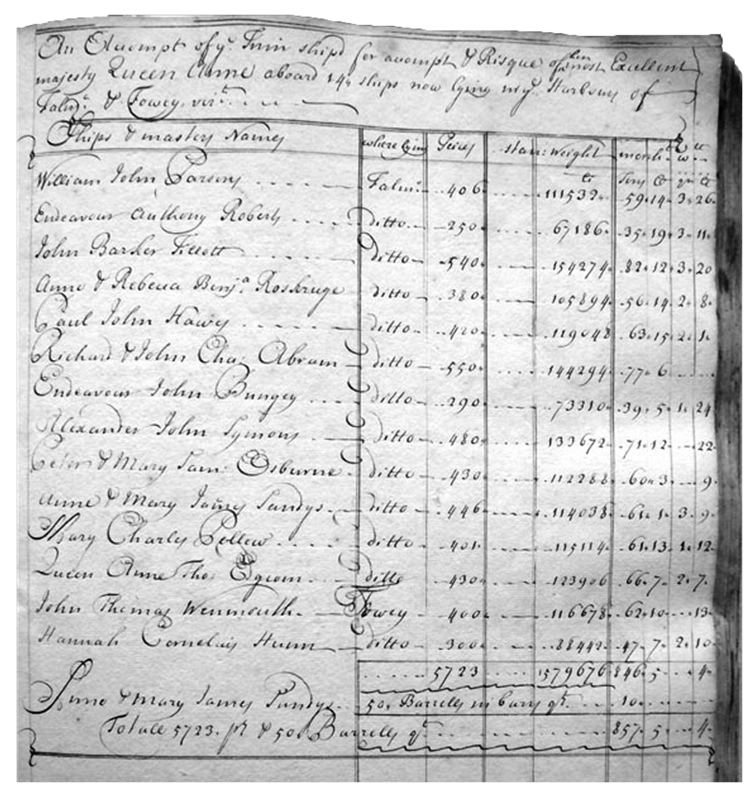
10.1 Extract from the Tin Convoy letterbook
(John Symons)
Correspondence relating to the contract was recorded in a Letter Book. Its content remained unknown to historians until revealed to A.K. Hamilton-Jenkin by a private source prior to the publication of his The Cornish Miner. As it was peripheral to his main theme he made little more than passing reference to its content.6 The book has recently resurfaced and its content has been evaluated. It comprises some 400 letters dealing with, among other subjects, the shipment of tin from Cornwall to the Royal Mint in the Tower of London,7 and is the primary source for this chapter. The correspondence deals with the routine requirements of any shipment: availability of suitable ships and crews, arrangements for loading and procurement of bills of lading. In addition, the agents were also required to liaise with the Admiralty for the provision of escorts and protections for the crews against taking by the pressgangs. The Admiralty had been encouraged to improve its administration of convoys by better communications with the ports.8 Throughout the seven years of the contract England was at war and the English Channel a hostile environment, subject to the continuous ravages of French privateers. Shipping sailed under the protection of the Royal Navy, which was under considerable pressure to secure the safety of commercial shipping.9
Tin was sold following the conclusion of the quarterly coinages held at Liskeard, Lostwithiel, Truro, Helston and Penzance.10 In theory this should have resulted in four convoys per annum, each one conveying an average of 400 tons of tin. With the inherent complexities and the eventualities of war, it should come as no surprise that such a routine operation was never achieved. The tin was transferred to the ports at Gweek, Malpas11 and Fowey, where it was loaded onto the waiting vessels. Tin purchased at Penzance and Helston was embarked at Gweek, that at Truro at Malpas and the Liskeard and Lostwithiel tin at Fowey, having been brought down by barge from Lostwithiel. In peace time the tin coined at Penzance would have been shipped from that port, but the activities of the French privateers justified the additional cost of land transport to Gweek.12 The tin ships departing Malpas and Gweek assembled at Falmouth, those from Gweek being escorted by the Royal Navy to Falmouth as protection against French cutting-out expeditions. The escorts collected those loaded at Fowey either following departure of the main convoy from Falmouth or on their initial passage to Falmouth.
Although the first tin was purchased in December 1703 shipment had to wait until the following year. As late as 10 February 1703/4 the tin ships had still not returned from taking the previous pre-contract shipment to London.13 On 23 February directions were received from the Treasury to make all necessary arrangements to ship the first consignment to the Royal Mint in the Tower of London. Appropriate instructions were sent to the local agents. The tin at Penzance was sent overland to Helston and, together with that at Helston, on to Gweek. Similarly, the tin at Liskeard was to be sent to Lostwithiel, from where, with that from the latter place, it was transferred to Fowey.14 At Gweek 530 blocks of tin were loaded onto the Anne and Mary (70 tons burthen). At Malpas the Mary and Sarah (55 tons) took on board 272 blocks, the Patience (120 tons) 600 blocks and the Endeavour (40 tons) 280 blocks. At Fowey the newly chartered John (60 tons) shipped 310 blocks. The shipment amounted to 1,992 blocks with a total weight of approximately 293 tons. On 26 February the agents requested an escort for the Anne and Mary for the transit between Gweek and Falmouth for her protection:
Wee think it maybe for Her Majesty’s Service that wee recommend it to the commander of the lesser man of war to stand off towards the mouth of Helford Harbour (which is about four leagues to the westward of Falmouth) to secure the vessels that are to bring the Tinn from Gweege, who may otherwise run the hazard of being cut off by small picqueroons who frequently lie under the land undiscovered.15
The convoy had assembled, with the exception of the John, at Falmouth by early March. There was considerable nervousness about the effectiveness of the French privateers:
These coasts being much infested wth small ffrench Privateers wee are apprehensive ye ships at Helford doe not lye quite out of reach of danger tho: wee gave the masters strict orders to lye as farr up as they can & keep Watch to prevent any surprise by boats if the enemy should make any such attempt . . .16
On 17 March 1704 the convoy, escorted by HM ships Southampton and Lizard, departed for London. They stopped over at Plymouth, meeting up with the John off Fowey. By 3 April the agents were advising the Treasury that ‘they were arrived with their convoy at Cowes & Spithead’ under a new escort of HM ships Gloucester, Bridgwater and two unnamed fifth rates.17 No information as to when this convoy reached London was forthcoming. The next indication of the location of the tin ships was contained in a letter of 15 July 1704 stating that HMS Hastings was instructed on 13 July to proceed from Falmouth to Plymouth to escort the returning tin ships back to Fowey and Falmouth.18 Thus this first convoy took just under four months to make the round voyage between Falmouth and the Mint in London.
The duration of this first convoy was typical for the majority of the ensuing departures. It became clear at this early stage of the contract that there would not be any routine shipment coincident with the coinages. By the time of the tin ships’ return two further coinages had been completed and a considerable quantity of tin was awaiting shipment. Seven ships had initially been chartered and this was clearly an inadequate provision, as borne out by the second convoy.
A second convoy was being assembled in Falmouth. The tin remaining from the Christmas coinages at Penzance and Helston, laden onto the Endeavour at Gweek, had been brought under escort to Falmouth. By 29 July 1704 twelve ships were loaded with 6,091 blocks of tin, amounting to approximately 840 tons, and at 70s per cwt valued at some £63,000.19 It was no wonder the agents were insisting on an adequate escort, a matter never satisfactorily resolved between the agents, the Treasury and the Admiralty. This was later revised to a total of 5,423 blocks and 50 barrels of bar tin, tin purchased at the Lady Day and Midsummer coinages as well as that outstanding from the previous Christmas.
Still the agents awaited an indication of the arrival of the final escort, HMS Greenwich. Protections for two of the tin ships were still outstanding.
Which two last ships (Richard and John) as yet have no protections, but having made it a condition in our bargain with the masters were to procure the protections above in order to secure their men as well when at London as until the return home, we presume to make it our humble request to you to move my Lord Treasurer that his Lordship will be pleased to order them protections accordingly upon their arrival, and making application for the same, and in the meantime we have thought it for the present service to give said two masters our certificate setting forth that we have employed them to carry Her Majesty’s Tin to London, which we humbly conceived may be sufficient to secure it and their men till they shall arrive with the Tin at London.20
The situation was not improved when, sometime around 18 July 1704, one of the two escorts then in port, HMS Falmouth, upped anchor and departed, the agents only becoming aware of this the following morning, upon discovering an empty mooring.21 By 9 August 1704 all the masters of the tin ships had received their sailing orders.22 The escort’s duty was to conduct the convoy only so far as the Downs, where they would be required to await new escorts to complete the voyage to London, producing a strong protest from the agents.23 Further concern was being expressed by the agents regarding protections which would expire before the completion of the current voyage.24 Finally, an escort arrived from a surprising source. On 1 October 1704 a convoy of seven East India Company ships dropped anchor in Falmouth bound for London.25 Captain Tolat RN, commanding the escorts, agreed, subject to Admiralty approval, to take the tin ships under his protection. Approval was received by 14 October 1704, but the convoy remained in Falmouth, unable to depart owing to contrary winds.26 The convoy finally sailed on 21 October 1704.27 Nothing more was heard of the convoy until 31 October 1704, when the Treasury notified the agents of the loss of the Endeavour (master Anthony Roberts). Their letter also contained a report from Tolat implying criticism of the Endeavour’s seaworthiness. This brought a robust defence from the agents, detailing the care taken in ensuring the fitness of the tin ships for the task and their instructions to keep the load well within the vessel’s capacity. The response was also critical of Tolat:
Captain Tolat expressing an easiness when I recommended the Tinn ships to his care, that he should be directed to take them under his convoy, & talking slighting of them, I thought it my duty to tell him twas as much his duty to take care of the Tinn fleet as the East India ships etc, which soured him, & I do believe that he would insinuate something if he could to our prejudice on that account.28
It would seem from the same letter that, while the Endeavour was lost, the cargo was saved.
I presume he must provide the ship to bring the Tinn to London, & then receive his freight (after he has rendered it at the place his Bill of Loading obliged him to, at his own charge) that is according to the custom of merchants.
There is further corroboration of Roberts’ diligence in delivering his cargo safely. An entry in the Calendar of Treasury Papers reads:
Report . . . on the petition of Anthony Roberts, master of the ship Endeavour of Truro. Petitioner’s ship had been cast away near Margate, but he saved all Her Majesty’s tin which was on board, and at his own charge took it to the Tower.29
What the outcome was is not stated, but it would seem that Roberts could not have acted more conscientiously, not receiving any credit for his actions, concern only being expressed for advances made:
I am very glad Roberts’ Tinn is at last safe brought up. Be pleased to observe my £5 was for the sake of the service advanced to him to subsist his men without which he & his people must have starved.30
Whether he continued in the coasting trade with a new vessel is not clear, but his name does not appear again in the Letter Book. Again, there is no specific acknowledgement of the convoy’s arrival in London.
In the first year only two convoys completed the voyage to London, transferring 1,097 tons out of the 1,600 tons bought at the coinages. Thus the first two convoys took four months and three months approximately to accomplish their respective round trips, combined with just over three months in port between the two convoys to load the tin, obtain protections and await the arrival of escorts and fair weather. While the latter was out of the agents’ control, the Admiralty was not overly diligent in providing timely escorts. This situation largely prevailed for the remaining convoys of the contract and attention will concentrate on the more significant events which occurred during the remaining convoys. In all there were some twenty convoys, comprising from one to seventeen ships with an average burthen of forty-seven tons approximately. In all, forty-four vessels were involved in taking the tin to London, escorted at the most by five naval ships out of a total of forty detailed for convoy duty.
At the beginning of 1705 there remained in Cornwall the tin outstanding from the Michaelmas and Christmas coinages. By the latter half of January a number of the tin ships were back in Falmouth and were, with three additional vessels, loading the tin outstanding from the previous coinages.31 This convoy departed sometime prior to 23 March and by 9 April the convoy had reached Portsmouth.32 The date of its arrival in London is uncertain, but by early June a number of the tin ships were back in Cornwall loading for the next convoy. As late as July an unknown number of tin ships were still anchored at Spithead,33 where they experienced a severe storm resulting in:
3 of ye Tynn ships homeward bound were lost . . . here they lay a long time & all ye men were drowned but wch has made severall miserable families . . ..34
The vessels lost were not named, but it is believed that two were the Susannah & Bridgett (Owen Hughes) and the John (Samuel Clies). One other was driven ashore, the Tynn Contract (Anthony Jenkins), ‘but she has been gott off’.35 Thus it is assumed that the remaining ships from this convoy, which had left Falmouth in late March, did not return until sometime in late September or early October. This made the time for the round trip some seven months, a duration due in no small part to a lack of escorts.
The delay in their return resulted in a further backlog and an attempt was made in July to reduce it by hiring an additional vessel, the Felicity (William Cranway) of Penzance, which was ‘to goe to Fowey & take in her Loading against ye Convoys arrival’.36 The Felicity joined the convoy which had departed Falmouth for London in early November, but failed to arrive.37 Nothing was heard of her until the agents in late November informed the Treasury that ‘Wee are concerned at the misfortune happened to the Felicity at Portland but hope ye Tinn will be saved.’38 It would appear that she had been driven ashore, for the agents wrote to Thomas Seward, Deputy Vice Admiral of Dorsetshire, requesting his best endeavours to recover the tin and any other salvage; a particular plea was made on behalf of William Cranway’s widow for the recovery of his sea chest.39 In a second letter the agents wrote:
I am glad you have soe fair a prospect of saving the whole Tinn the same lying between 2 rocks soe that the sea cannot move it pray God send a little fair weather for doing it. The Vessell was above 30 tons. Mr Hall thanks you for securing the small Cable and Anchor and prays continuance of your care of what also may be saved of the said Vessell or her Materialls.40
It would appear from these two letters she was driven onto the rocks on Portland. Part of Felicity’s cargo was recovered early in 1705/06.41 Her crew of ten was lost.42
The following year was little better. A convoy of six tin ships departed Falmouth on 18 February 1705/06 escorted by three Royal Navy frigates, the Moderate, Nottingham and Chatham. In March the agents received notification that two of the six, the Tynn Contract and the Friends Adventurer, were missing,43 the vessels having been taken by French privateers into Dunkirk.44 Dunkirk was the base of one of the most successful French privateers, Saint-Pol.45 From there the masters wrote to the Treasury of the ineptitude of the escort captains. The Admiralty, on being informed, ordered a court martial to inquire into their conduct.46 The trial took place sometime around the turn of the year, by which time the captains of the tin ships and their crews had been repatriated. The escort captains were acquitted as a result of conflicting testimony.47
The final convoy to be described departed late 1708. It comprised ten ships and, although ready by mid-August, protections having been received by 19 August,48 and fully laden by 20 August,49 the convoy again had to undergo the long wait for escorts. It eventually departed Falmouth at the end of September, for on 2 October the agents were advising the Treasury that the convoy had arrived at Plymouth.50 It would appear that the onward passage was not without incident, for the agents, in response to a letter from the Treasury, wrote:
Wee are favour’d with yours of the 11th instant enclosing the Tinn Ma’s Petition to the Lord Treasu’r & refference to us there upon. Wee think wee cannot well make our report till wee see the said Ma’s and receive from them some Vouchers of the Damage & Losses they sustayned to Justifie our report and opinion. . .51
It can be assumed that the convoy had reached London by 11 November 1708, but there was no respite for them on their return. Following their departure sometime late in 1708 they were forced to wait over Christmas in the Downs for an escort, where they encountered a major storm and were scattered. Three ships, the Valentine (John Whaley), the Anne and Mary (James Sandys) and the Tynn Contract, went missing and a further three, the Paul (John Hawes), the Mary and John (Charles Pellew) and the James (John Michell), were taken by the French.52 In late February news was received that the three missing vessels were safe,53 although they did not reach Falmouth until the second week of March 1708/09. The crews and ships were in a miserable state.54 It was anticipated that the captured seamen would ultimately be repatriated following representations by the Treasury to the ‘Sick and Wounded Office’. This proved correct, as a year later both Pellew and Hawes were again carrying tin to London, although in new vessels. Overall, from loading to return the voyage took all of seven months. The winter of 1708/09 had been one of the worst on record and, as a result, it became accepted practice that there would be no further shipments during the winter months, notwithstanding the timing of the coinages.

10.2 Carclaze Tin Mine, St Austell
Engraving by T. Allom, published in 1832
The tin contract must have been of inestimable value to the tinners of Cornwall but a headache for the Cornish agents, particularly regarding the arrangements for the transportation of the tin to the Royal Mint in the Tower of London. Faced with the twin hazards of the weather and war, it is not altogether surprising that losses were significant. Delays in sailing, resulting in the autumn and winter departures, were the major cause of the losses, and it is suggested the Admiralty must shoulder much of the blame,55 although there can be no certainty that the agents would not have done the same in time of peace. However, the agents did ultimately recognise the undesirability of sailing at these times. Would the losses at Spithead in July 1705 have occurred in time of peace? It may well have been a possibility, though it does not fit precisely into the pattern of the coinages. Given a sensible approach by the agents and masters to the time of year any losses due to the weather could be considered only a hazard of the sea and losses an ‘act of God’. However, losses due to adverse weather during the winter months must, at least in part, be attributed to the delay on the part of the Admiralty in providing escorts. The delay was indicative of the severe strain on naval resources at this time.56
If the comments of Captain Tolat RN are typical, escorting the tin ships was perceived as a task of little significance, notwithstanding the Royal Navy’s prime responsibility to provide adequate escorts for maritime trade. This would surely be doubly important given that the cargo was the property of the queen. How much was the lack of concern attributable to the diminutive size of the tin ships? There can be little doubt that the captains of Royal Navy frigates would not want to spend their wartime service escorting a perceived ‘rag bag’ of small coastal traders between Falmouth and London.
The House of Lords on 19 November 1707 ordered a committee of enquiry to be convened to examine:
A Petition . . . of several Merchants on Behalf of themselves and others, Traders of the City of London; shewing, ‘That they have of late been great Sufferers, and sustained great Losses, by the ill Timing of Convoys, and Want of Cruizers;’ and praying, ‘That this House will take the present deplorable Condition of Trade into their serious Consideration, and apply such Remedies as shall be judged most effectual:’57
These complaints were the culmination of a gathering public concern over the damage wrought by the successful French privateers. The Spanish and Portuguese trades had been particularly badly hit as the French gained control of the Channel in the summer of 1707.58 The merchants’ words have an all too familiar ring, echoing as they do many of the complaints made to the Admiralty by the Cornish agents and the Treasury. Their first report was submitted on 17 December 1707, with a second on 17 February 1708. The findings of the second report are complex and comprehensive, yet critical of the Admiralty and its responsibility for the protection of maritime trade. The Admiralty admitted that an estimated 1,146 ships had been lost, a figure regarded as an understatement by some merchants. Davies estimated that the English losses between 1702 and 1712 were around 2,000 ships, of which the tin ships were one component.59 The outcome was ‘An Act for the better securing the Trade of this Kingdom, by Cruizers and Convoys’.60 This re-emphasised the Royal Navy’s primary responsibility for the protection of merchant shipping. Yet, if the tin ships’ later experience was any guide, the Act would seem to have had little impact.
In all, ten ships were lost out of a total of forty-four employed during the seven years that the contract was in force. Five were captured by French privateers and five were lost as a result of bad weather, three of them while awaiting an escort at Spithead. At least twenty-six lives were lost. It has to be concluded that the Admiralty must shoulder much of the responsibility for these losses.61 If the escorts had been provided in a timely fashion a number of convoys would not have sailed at such inappropriate times of the year.
Notes and References
1 W. Calvin Dickinson, ‘The Sword of Gold: Sidney Godolphin and War Finance, 1702–1710’, Albion: A Quarterly Journal Concerned with British Studies 6:1 (1974), pp. 12–25.
2 T. Pearce, The Laws and Customs of the Stannaries in the Counties of Cornwall and Devon (London: n.p., 1725), p. 113.
3 G.R. Lewis, The Stannaries (London: Archibald Constable, 1908), pp. 277 and 256.
4 For a discussion of the economic conditions of the period see A.K. Hamilton-Jenkin, The Cornish Miner (London: George Allen & Unwin, 1927), and J. Rowe, Cornwall in the Age of the Industrial Revolution (Liverpool: Liverpool University Press, 1953).
5 Craig also noted: ‘To secure a monopoly, it was also decided that she should buy, at the same price, the Devon output of 50 tons a year.’ J. Craig, Newton at the Mint (Cambridge: Cambridge University Press, 1946), p. 57.
6 Hamilton-Jenkin, The Cornish Miner, pp. 110–11, 112–14.
7 For Issac Newton’s opinion of the Tin Contract and his responsibilities for it as Master of the Mint see J. Craig, A. Rupert Hall and L. Tilling (eds), The Correspondence of Isaac Newton, vol. IV (Cambridge: Cambridge University Press, 1967).
8 Patrick Crowhurst, The Defence of British Trade, 1689–1815 (Folkestone: Dawson, 1977), pp. 47–48.
9 For a full discussion of this see Crowhurst, The Defence of British Trade, pp. 43–80.
10 It was at the coinages that the Duchy tax was levied, and the quality and quantity of tin determined. They were held on the four quarter days: Christmas on 25 December, Ladyday on 25 March, Midsummer on 24 June, and Michaelmas on 29 September.
11 Throughout the Letter Book the port of Gweek is spelt either Gweeg or Gweege and Malpas is frequently spelt Mopus.
12 J. Redington (ed), Calendar of Treasury Papers [hereafter CTP] (London: Longman, 1874), 61 (Sep 16, 1703), 252 (Apr 11, 1704), 51 (May 10, 1704).
13 Letter Book [hereafter LB], from Richard Ennys [hereafter RE], Robert Corker [hereafter RC] and Jonathan Mountstephen [hereafter JM], Tinn Office, Truro to William Lowndes [hereafter WL], Secretary to the Treasury, London, 10 February 1703/04. All subsequent letters were written by one or other of the three agents.
14 LB, Three letters all dated 23 February 1703/04: 1. To Daniel Hawkey, local representative. 2. To Richard Ley. 3. To Mayor of Fowey and collector of said place, Mr Jones.
15 LB to WL, 26 February 1703/04
16 LB to J. Anstis [hereafter JA], Receiver General of Monies arising by the Sale of Tin, Treasury, London 3 March 1704/5
17 LB to WL, 23 March 1704 and 3 April 1704.
18 LB to WL, 15 July 1704.
19 LB to WL, 29 July 1704.
20 Bar tin was that smelted at the time of coinage and resulting from block tin discovered to contain impurities at the time of assay. LB to WL, 10 August 1704.
21 LB to WL, 24 July 1704. On 4 August 1704 HMS Falmouth was captured by two French warships, her commander, Capt. Mitchell was killed during the action. J.H. Owen, War at Sea under Queen Anne 1702–1708 (Cambridge: Cambridge University Press, 1938), pp. 111–12.
22 LB to WL, 9 August 1704.
23 LB to Issac Newton [hereafter IN], Warden Master and Comptroller of her Majesty’s Mint, 7 September 1704.
24 LB to WL, 28 September 1704.
25 LB to WL, 2 October 1704.
26 LB to JA, 14 October 1704.
27 LB to WL, 23 October 1704.
28 LB to JA, 23 November 1704.
29 CTP (1874), 307 (Dec 13, 1704).
30 LB to JA, 4 December 1704.
31 LB to JA, 20 January 1704/05.
32 LB to Charles Pellew [hereafter CP], captain of the tinship Mary, acknowledging safe arrival at Portsmouth, 9 April 1705.
33 LB to JA, 16 July 1705.
34 LB to JA, 22 September 1705.
35 LB to JA, 26 September 1705.
36 LB to JA, 27 July 1705.
37 LB to JA, 10 November 1705.
38 LB to JA, 29 November 1705.
39 LB to Thomas Seward, 6 December 1705.
40 Mr Hall was Abraham Hall, owner of the Felicity. LB to Thomas Seward, 15 December 1705.
41 Eighty-five blocks were reported recovered in a letter to the Treasury dated 10 February 1705/06.
42 LB to John Borlase [hereafter JB] who replaced Mountstephen, 12 February 1708/09.
43 LB to JA, 25 March 1705/06.
44 LB to JA, 4 April 1706.
45 Crowhurst, The Defence of British Trade, p. 55.
46 LB both to JA, 29 April and 25 November 1706.
47 LB to JA, 18 January 1706/07.
48 LB to JA, 19 August 1708.
49 LB to CP, 20 August 1708.
50 LB to JA, 2 October 1708.
51 LB to JA, 25 November 1708.
52 LB to JA, 5 February 1708/09.
53 LB to JA, 24 February 1708/09.
54 LB to JB, 12 March 1708/09.
55 Crowhurst, The Defence of British Trade, p. 54.
56 Crowhurst, The Defence of British Trade, pp. 54–55.
57 Journal of the House of Lords 18, 1705–1709: http://www.british-history.ac.uk/source.asp?pubid=119 [accessed 30 May 2006].
58 Crowhurst, The Defence of British Trade, p. 55.
59 Ralph Davis, The Rise of the English Shipping Industry (Newton Abbot: David & Charles, 1962), p. 317.
60 Journal of the House of Lords 18, 1705–1709: http://www.british-history.ac.uk/source.asp?pubid=119 [accessed 30 May 2006].
61 Crowhurst, The Defence of British Trade, p. 54.
Table 10.1 Details of Tin Convoys 1703–1710
|
Depart |
Tin Ships |
Escorts |
Remarks |
|
17 March 1704 |
Ann & Mary Mary & Sarah Patience Endeavour John (Wennmouth) |
Southampton Lizard (to Plymouth) Gloucester Bridgwater and two 5th rates from thereon. |
No further information |
|
21 October 1704 |
Endeavour (Bungey) Ann & Mary John of Fowey Peter & Mary Paul Mary Queen Anne (Edgcumbe) Anne & Rebecca William Endeavour (Roberts) John John (Wennmouth) Alexander Richard & John Hannah |
Falmouth1 (departed prematurely) Hastings Greenwich Kingfisher Burlington Dartmouth (East India convoy escorts) |
The Endeavour Anthony Roberts lost off Margate |
|
23 March 1705 |
Peter & Mary Ann & Mary John (Peacock) James (Mitchell) Susannah & Bridgett John (Tillot) Tin Contract Queen Anne (Edgcumbe) Anne & Rebecca John (Clies) Alexander Endeavour (Bungey) Thomas (Whaley) |
Moderate |
9 April at Portsmouth (outbound). 16 July at Spithead (inbound). 26 September. Three vessels lost at Spithead, inc: Susannah & Bridgett, John (Clies), One unidentified |
|
27 May 1705 |
Thomas |
Rye |
No further information |
|
10 November 1705 |
Paul Mary (Pellew) Ann & Mary James (Michell) William John (Tillott) Alexander Queen Anne (Edgcumbe) Preotius Felicity Swallow |
Moderate Hazardous |
Felicity lost off Portland. Request to Dep. Vice Admrl of Dorsetshire for assistance in recovering tin. Letters dated 6/15 December 1705. Crew were lost. |
|
26 January 1706 |
James (Michell) |
Nonsuch |
Escort to take tin ships as far as the Downs |
|
18 February 1706 |
Tin Contract Friends Adventurer John & Thomas Two Brothers Richard & John Thomas (Martin) |
Moderate (to Plymouth) Nottingham Chatham (thereafter) |
Tin Contract Friends Adventurer reported missing. Taken by the French. Letters dated 4 April 1706. Captains of Nottingham and Chatham court martialled Acquitted. Letter dated 18 January 1707 |
|
25 March 1706 |
Valentine |
August |
No further information |
|
18 May 1706 |
Mary (Lugger) Queen Anne (Edgcumbe) Endeavour (Bungey) William Peter & Mary James (Michell) John (Ashton) Ann & Mary William & Sarah Two Brothers Alexander Patience Prosperity Anne & Rebecca Phoenix Mary (Pellew) Thomas (Whaley) |
Nassau Squirell |
Escort to take tin ships as far as the Downs |
|
15–20 June 1706 |
Mary (Bullock) |
— |
Penzance. 29 April 1706. Sailed by 22 June 1706, 15 July 1706: still at Penzance? By 20 July 1706 at Plymouth. |
|
17 November 1706 |
Paul Ann & Mary Anne & Rebecca Mary (Pellew) Peter & Mary Queen Anne (Edgcumbe) Phoenix Two Brothers |
Swiftsure |
Phoenix & Prosperity put back to Fowey. Remainder at Plymouth by 18 November. Letter dated 23 November 1706. |
|
26 April 1707 |
Paul Ann & Mary Peter & Mary John (Ashton) Anne & Rebecca Queen Anne (Rice) Valentine James (Michell) |
Cambridge Seaford |
Escort to take tin ships as far as Spithead or the Downs. Letter 26 April 1707. Arrived at London by 12 May. Letter of same date. |
|
16 May 1707 |
Alexander Endeavour (Bungey) Prosperity Phoenix |
Leopard |
No further information |
|
28 August 1707 |
Queen Anne Paul Anne & Rebecca John (Peacock) Peter & Mary Ann & Mary Phoenix Mary (Pellew) |
Roebuck (to Plymouth) Burford (from Plymouth to Portsmouth) |
Ship masters directed to proceed no further than Plymouth, escort being so unsatisfactory. Concern expressed re privateers. Letter 28 August 1707. Returned to Plymouth having sighted three unknown vessels. Letter 11 September 1707. Tin ships delayed at Portsmouth. Letter 13 October 1707. Convoy arrived by 6 December 1707. Letter of same date. Tin ships still not returned to Fowey and Falmouth. |
|
30 September 1708 |
Mary (Pellew) Phoenix Anne & Rebecca Paul Queen Anne Valentine Alexander Peter & Mary |
Dover (to Plymouth) |
Delayed at London. Left early in 1709, but had to wait for escort in the Downs. On departure encountered major storm and dispersed. Three ships taken by the French: Paul, Mary & John and James. Three others missing, Valentine, Anne & Mary and Tin Contract. These ships ultimately reached Falmouth in the spring. |
|
21 May 1709 |
Ann & Mary Queen Anne Anne & Rebecca Peter & Mary Alexander Valentine Patience Hannah Phoenix |
Southampton Lizard |
No further information |
|
27 June 1709 |
Mary (Pellew) John (Peacock) |
Salisbury Medway Romney |
The Mary is Charles Pellew’s new vessel following his release from French custody |
|
7 September 1709 |
Ann & Mary Alexander Queen Anne Anne & Rebecca Peter & Mary Falmouth Galley |
Northumberland |
Incorporated into a London bound convoy from Turkey and Lisbon. |
|
28 October 1709 |
Betty Mary (Mould) Hannah Phoenix Alexander Queen Anne Anne & Rebecca Contract Ann & Mary |
Lancaster (to Plymouth) |
No further information |
|
5 March 1709/10 |
Contract Anne & Rebecca Mary Queen Anne John (Peacock) Peter & Mary Ann & Mary Phoenix Mary (Mould) |
Southampton Lizard |
No further information |
|
2 June 1710 |
Ann & Mary William & Sarah Patience Eagle |
— |
No further information |
1 Falmouth, 58. 4th rate (1693 Deptford. Captured 1704)
1699 Capt. Thomas Mitchell (25 July 1699)
1703 Capt Thomas Kenney in the West Indies. On 4 August 1704 Falmouth in the Mediterranean, Capt. Mitchell was killed during the action. www.cronab.demon.co.uk/18f.htm
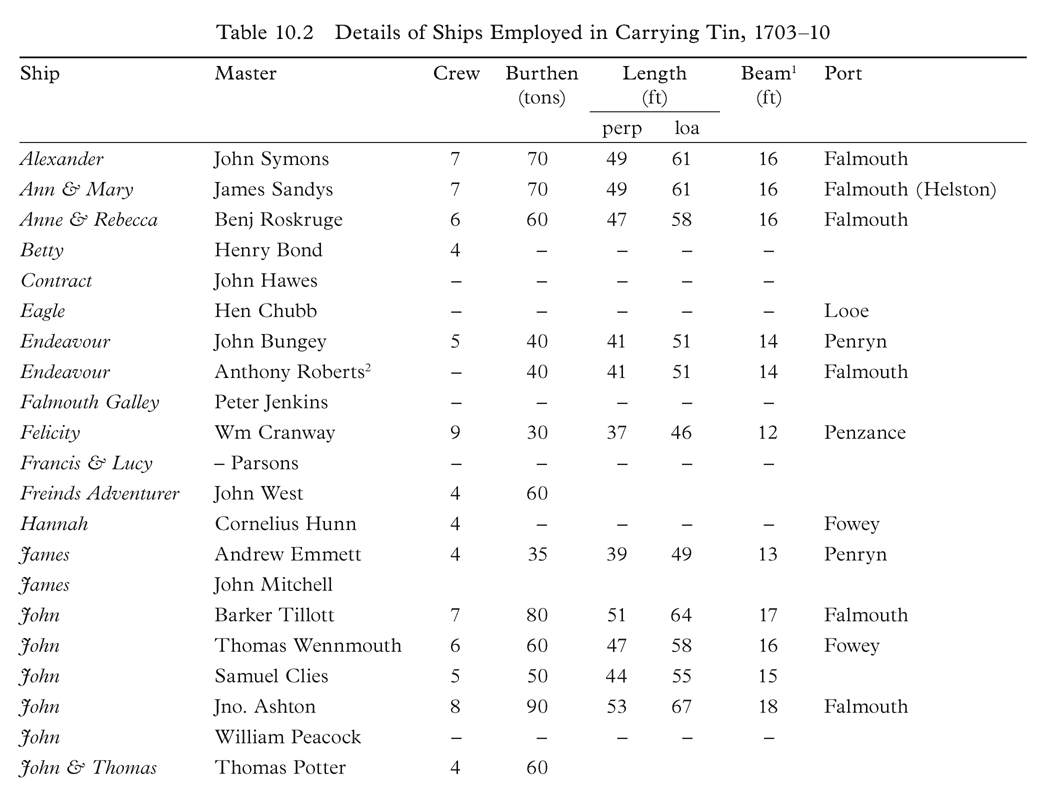
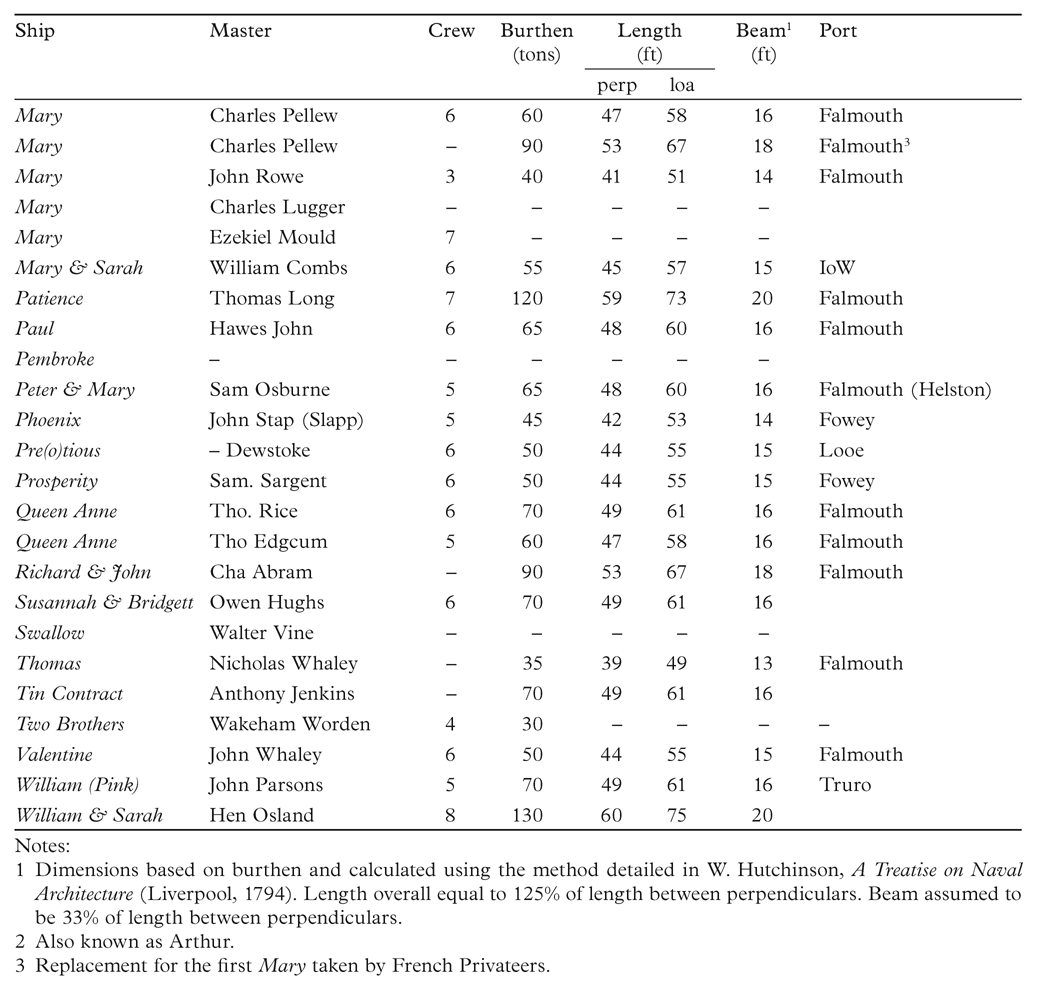
Table 10.3 Details of Royal Navy Escorts and other Royal Naval ships for Tin Convoys 1703–10
|
HM Ship |
Captain |
Rate |
Guns |
Built |
Demise |
|
|
August |
– |
4th |
60 |
1704, Brest. Prize |
1716, wrecked |
|
|
Breda |
– |
3rd |
70 |
1692, Woolwichrd |
– |
|
|
Bridgwater |
– |
5th |
32 |
1698, Sheerness |
1738, broken up |
|
|
Burford |
Evans RN |
3rd |
70 |
1679, Woolwich |
1719, wrecked |
|
|
Burlington |
– |
4th |
48 |
1695, Blackwall |
1733, broken up |
|
|
Cambridge |
– |
3rd |
80 |
1695, Deptford |
1750, broken up |
|
|
Chatham |
– |
4th |
50 |
1691, Chatham |
1762, broken up |
|
|
Dartmouth |
– |
4th |
48 |
1698, Southampton |
1736, broken up |
|
|
Dover |
Mathews RN |
4th |
50 |
1695, Portsmouth |
– |
|
|
Essex |
– |
3rd |
70 |
1679, Blackwall |
1759, wrecked |
|
|
Falmouth |
Thomas Kenny RN |
4th |
58 |
1693, Deptford |
1704, captured |
|
|
Gloucester |
– |
4th |
60 |
1695, Bristol |
– |
|
|
Grayhound |
– |
5th |
40 |
1703, Ipswich |
1711, wrecked |
|
|
Hastings |
Charles Parsons RN |
5th |
32 |
1698, Woodbridge |
1707, capsized |
|
|
Hazardous |
– |
4th |
54 |
1703, prize |
1706, lost off IoW |
|
|
Kin(g)sale |
– |
5th |
32 |
1700 Kinsale |
1741, broken up |
|
|
Kings Fisher |
Tolat RN |
4th |
46 |
1675, Woodbridge |
1728, broken up |
|
|
Lancaster |
– |
3rd |
80 |
1694, Burseldon |
– |
|
|
Le Firme |
– |
3rd |
70 |
1699, France |
1713, sold |
|
|
Leopard |
Moneypenny RN |
4th |
54 |
1703, Rotherhithe |
1796, foundered |
|
|
Lizard |
– |
6th |
24 |
1697, Deptford |
1714, sold |
|
|
Lowestoffe |
Fane RN |
5th |
28 |
1697, Chatham |
1744, sold |
|
|
Medway Prize |
– |
6th |
28 |
1704, captured |
1713, sold |
|
|
Moderate |
Lumley RN |
3rd |
64 |
1685, France |
1713, sold |
|
|
Nassau |
– |
3rd |
80 |
1699, Portsmouth |
1706, wrecked |
|
|
Newcastle |
– |
4th |
54 |
1694, Sheerness |
1746, broken up |
|
|
Newport |
– |
– |
– |
– |
– |
|
|
Nonsuch |
Boyce RN |
4th |
48 |
1696, Deptford |
1745, broken up |
|
|
Northumberland |
– |
3rd |
70 |
1705, Deptford |
1739, broken up |
|
|
Nottingham |
Culliford RN |
4th |
60 |
1703, Deptford |
– |
|
|
Pembroke |
Rumfey RN |
4th |
60 |
1694, Deptford |
1709, captured |
|
|
Roebuck |
Candler RN |
5th |
42 |
1704, Portsmouth |
1705, breakwater |
|
|
Rumney |
– |
4th |
48 |
1708, Deptford |
1757, sold |
|
|
Rye |
– |
5th |
32 |
1696, Sheerness |
1735, broken up |
|
|
Salisbury |
– |
4th |
54 |
1707, Chatham |
||
|
Seaford |
George Saunders RN (?) |
6th |
24 |
1697, Portsmouth |
1740, broken up |
|
|
Southampton |
– |
4th |
48 |
1693, Southampton |
1717, broken up |
|
|
Squirrel |
– |
– |
– |
– |
– |
|
|
Swiftsure |
Griffith RN |
3rd |
70 |
1696, Deptford |
– |
|
|
Tryton Prize |
Miles RN |
– |
30 |
1703/4, prize. |
– |
|