
CHAPTER 11
____________________________
N.A.M. Rodger
Though the waters around Cornwall were of great strategic significance for the maritime defence of England and English shipping, and the county had a long seafaring tradition, Cornwall itself was not closely connected with the Royal Navy in the Tudor and Stuart age. The Navy’s dockyards and bases all lay far to the eastward, on and around the Thames, and it recruited most of its seamen there.1 Even when Plymouth Dockyard was established in the 1690s, and ships started commissioning there, it is not clear that Cornishmen were particularly prominent among their companies. Quite possibly the social history of the modern Royal Navy will show, when it is written, that the manning port system established in the late nineteenth century made the Navy, or at least Devonport ships, more Cornish than ever before. Though many Cornishmen worked in the dockyard and its economic influence extended into the neighbouring parts of Cornwall it is hard to be sure to what extent Cornishmen were present in the Navy itself in the seventeenth and eighteenth centuries. There is, moreover, a particular difficulty with Cornwall, in which those who went to sea were very often part-timers; typically farmers and fishermen, or miners and fishermen, according to season and opportunity. The Navy’s administration distinguished able seamen, ordinary seamen and landmen, where able seamen were professional deep-sea square-rig men, able to ‘hand, reef and steer’, and ordinary seamen were in principle part-trained seamen, with perhaps a year’s experience. In practice ordinary seamen seem often to have been men accustomed to fishing and coasting in fore-and-aft rig, but not used to working aloft. Both categories were liable to impressment, which was limited to ‘seamen, seafaring men, and men whose occupation and calling is to work in boats upon rivers’.2 In the Cornish context, it was hard to tell who was really a seaman. A series of official surveys of seamen in Devon and Cornwall conducted between 1619 and 1635 illustrate the problem. In 1626 a survey of ‘mariners’ produced the figures given in Table 11.1.
Three years later, however, the totals of mariners, sailors, pilots, shipwrights, masters, trumpeters, gunners, carpenters, fishermen and bargemen in south Cornwall was 821, and on the north coast 173 – ostensibly a fall of one-third. By 1635 south Cornwall returned 731 seamen and 393 fishermen; north Cornwall 154 seamen and 88 fishermen.3 Comparison of the individual lists makes it clear that men mutated easily from seamen to fishermen and the fluctuating numbers suggest that there was at least as much movement between seamen and landmen. This obviously made it easy for men to evade the press when they chose. In 1653, during the First Dutch War, Colonel Anthony Rous, Vice-Admiral of Cornwall, pressed thirty-nine seamen and mariners from the county and estimated that there were already 150 in the Navy and the same number in privateers.4 In the same year Captain Richard Mill complained from Plymouth that
Table 11.1 Survey of Mariners, 1626
|
Number |
Per cent |
|
|
Penwith Hundred |
176 |
11% |
|
Powder Hundred |
343 |
22% |
|
Kerrier Hundred |
167 |
10% |
|
West Hundred |
200 |
13% |
|
East Hundred |
454 |
28% |
|
North coast |
254 |
16% |
|
Total |
1,594 |
|
Source: Todd Gray, Early-Stuart Mariners: The Maritime Surveys of Devon and Cornwall 1619–35 (Exeter: Devon and Cornwall Record Society, 1990), pp. xviii, 59–80.
I find little assistance from the justices of Cornwall and likewise in Devon, for I have not any from them! Mr. Trevill of Cornwall hath threatened me twice very highly before the view of the country, when I was in my business, came unexpected, and asked me whether that was the liberty of the subject to force men aboard, all that part of the country made very little appearance, and for the other of the justices, there is little appears from them. The constables act so slowly as they had counsel from the justices, for whereas there are in some places a considerable number of able men, sometimes they will bring in an old man or two. I have sent many hues and crys after men which have been imprest, but never a one at my knowledge taken, if any not above two.5
A few weeks later a pressmaster reported from East Looe that ‘I shall do very little service more in these Western parts for most will go under the notion of bargemen and seanors.’6 The ‘seiners’, who might work either from boats or the beach, introduce another ambiguous category. The general picture for the first half of the century is clear, even if the particular figures are shifting and vague: not less than a thousand Cornishmen, and probably two or three thousand, worked afloat at least from time to time, but only a few hundred were regular deep-sea sailors, identifiable as such to the authorities and of primary interest to the Navy. Given that there were few seaports in Cornwall with any long-distance trade, this is much what one would expect. Much the same impression is gained from a sample of professional seamen who engaged in litigation before the London courts in the closing years of the seventeenth century, of whom 2¾ per cent were Cornish.7 In 1693, 1694 and 1696 a series of Orders in Council instructed the Vice-Admirals of the maritime counties to raise a total of 8,100 men for the Navy, of which south Cornwall was to provide 250 and north Cornwall 100. This would give the county 4.3 per cent of English seamen – or rather, English seamen excluding London, by far the largest seaport, which was not levied.8 Unfortunately it is not clear on what basis the Privy Council had estimated the counties’ capacity to provide men for the Navy, nor how many men were actually recruited. Over the six years 1702–1707 the actual total received into the Navy from all Vice-Admirals and Lords Lieutenant together was only 1,675 men, plus a further 293 ‘alleged to be put aboard the ships but not proved to be delivered to them’, which would suggest that 8,100 had been a significant over-estimate of how many men could be raised in practice.9
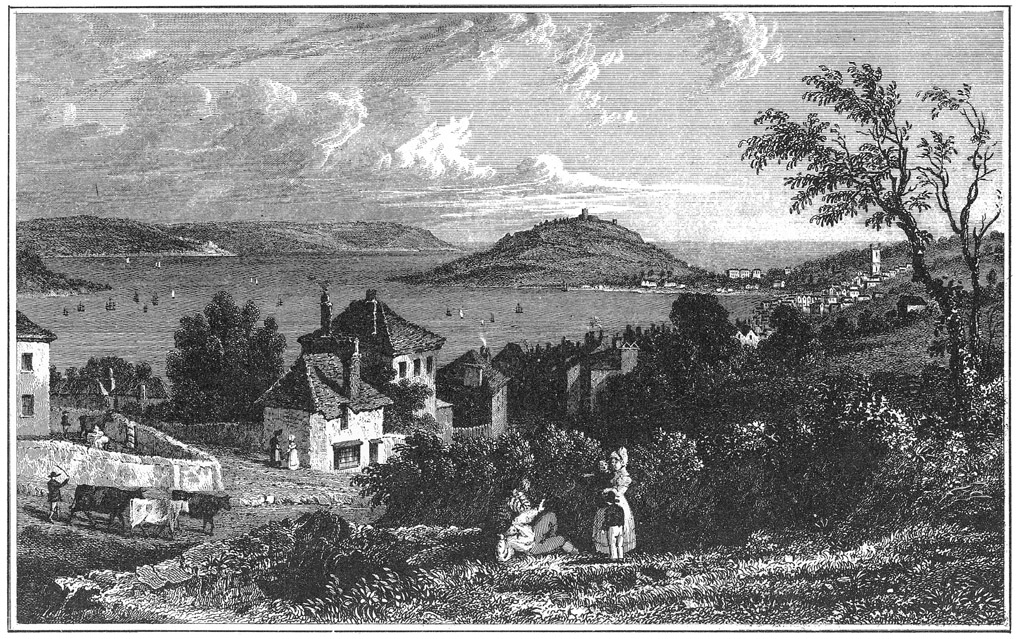
11.1 Falmouth Harbour Engraving by T. Allom, published in 1832
The patterns of naval recruitment are clearer from the mid-eighteenth century onward. From 1765 an additional column was added to warships’ muster books to record ratings’ place of birth and, although the information was not always very carefully or completely entered, and it seems that what was being recorded was in many cases place of residence rather than birth, it does allow for the first time analysis of the geographical origins of actual ships’ companies. There are also some figures for recruitment, largely from the Impress Service, the naval recruitment organisation on shore. In just over twelve months, from 1 October 1759 to 16 October 1760, it raised 4,344 men in England and forty-two in Ireland, of which total only thirty-seven, or 0.8 per cent, came from Cornwall.10 The Impress organisation at this date, however, was effectively confined to major seaports and there was only one pressgang in Cornwall, at Falmouth. Moreover, we know that the majority of impressment took place at sea and probably the majority of recruitment was of volunteers, so these figures give us only a very incomplete view of naval recruitment, even if they are accurate in themselves.11 Twenty years later, during the American War, a similar return gives 563 men pressed in Cornwall in a year, 8 per cent of a total of 6,441 in England and 640 in Ireland.12 By this time there were six gangs in Cornwall, at Falmouth, Saltash, St Austell, Penzance, Fowey and Padstow, but more than half the men (289) still came from Falmouth. These six gangs compare with about 100 in England, five in Ireland and forty-five afloat at the same period.13 A sample of twelve ships commissioning at Plymouth between 1770 and 1779 whose musters have been analysed had 327 men from Cornwall, which was 11 per cent of the total whose place of birth is stated, second only to Devon among the counties. Dublin was third and London fourth. It is hardly surprising that Plymouth ships should have a high proportion of Cornishmen and we can expect that the figure for the Navy as a whole would be lower. All but 6 per cent of the total recruitment was of volunteers – impressment had only just started in 1779 – and 62 per cent of the total were experienced men rated petty officer, able seaman or idler (meaning skilled non-seamen), with 38 per cent semi or unskilled, rated ordinary seaman, landman or servant. Among the Cornishmen, however, only 40 per cent were skilled men (Devon had 55 per cent), which reinforces the impression of a county with relatively few deep-sea professional seamen.14
Early in the French Revolutionary Wars the government made a renewed attempt to shift the burden of recruitment for the Navy from central to local government. In the political context of eighteenth-century Britain local authority had a strength and vigour which the central government could not match, and much of the difficulty of pressing men for the Navy ashore arose from the opposition of local powers resentful of what they took as an attack on their own authority. Where the Navy was able to secure the co-operation of local authorities, however, harmonious relations were invariably more successful as a basis of recruitment. The Quota Acts of 1795 and 1796 were an attempt to create a national system of local recruitment. There were five acts, which need to be distinguished.15 The three of 1795 imposed fixed quotas on, respectively, the counties of England and Wales, the seaports of Britain, and the counties, burghs and towns of Scotland (including seaports). It is not clear what the county assessments were based on, though they seem to be roughly proportional to population (insofar as it was then known, before the first national census), but the seaport quotas were apparently based on the shipping tonnage registered in each. In 1796 two Quota Acts were passed, one for England and Wales and one for Scotland, and the English Act was based on a new principle, levying each county for either the army or the Navy. It seems to be clear that most of the Quota Acts, obliging both coastal and inland counties to produce numbers of men probably more or less in proportional to their population, were expected to raise mainly unskilled men, and did so. The 1795 acts, falling in a year of poor harvests and rural unemployment, seem to have been successful, but those for the prosperous year of 1796 much less so.16 The 1795 Port Quota Act, however, laid the burden not on local authorities but on ad hoc committees of merchants in the main seaports, and allowed an able seaman to count for two men. Here it is clear that the basic idea was to oblige shipowners to find seamen for the Navy instead of bending their efforts to deprive it of men, as they usually did.17 Unfortunately, this act has scarcely been studied and it is difficult to say how well it worked. All that is certain is that the quota experiment was not repeated in 1797, the year of financial crisis and mutiny. Henry Dundas, Lord Melville, who became First Lord of the Admiralty in 1803, was planning to introduce a national system based on the Quota Acts, but fell from office before he could put his ideas into practice.18 The 1795 County Quota Act levied 194 men from Cornwall, which was seventeenth among the English counties. Yorkshire was at the head of the list with 1,081, while London – by far the largest seaport – was only just ahead of Cornwall with a quota of 198. This reinforces the impression that this act was directed at landmen rather than seamen. The 1796 County Act levied 252 men for the Navy from Cornwall. Many counties were levied partly or wholly for the army, but of the ‘naval’ counties Lancashire stood first, with 763.19 All these were the obligations imposed by the Acts, in default of which the counties had to pay fines; there are no reliable figures for the actual recruitment, but it seems likely that the 1796 quotas were not filled.20 It should be noted that the men raised by the County Acts seem to have been overwhelmingly respectable young working men in need of a job: there is no evidence whatever of the vagrants, rogues, political agitators, schoolmasters, trade unionists, Irish political prisoners or other undesirables beloved of various historians.21 The 1795 Port Quota Act might tell us more about the recruitment of seamen, but all we can say for certain is that the assessments for Cornwall were as presented in Table 11.2. These 224 men (or 112 able seamen) were 1.4 per cent of the total for England and compare with 5,704 expected from London, or over a thousand each from the ports of Yorkshire, Lancashire and Northumberland.22
Table 11.2 Numbers of Men in Port Quota Act, 1795
|
Port |
Mariners |
|
|
Falmouth |
21 |
|
|
Fowey |
70 |
|
|
Gweek |
7 |
|
|
Looe |
16 |
|
|
Padstow |
19 |
|
|
Penryn |
11 |
|
|
Penzance |
35 |
|
|
St Ives |
31 |
|
|
Scilly |
3 |
|
|
Truro |
11 |
|
Source: 35 Geo III c9, Port Quota Act, 1795
Two analyses of the manning of actual warships early in the Napoleonic Wars allow us to say something more definite about naval recruitment in Cornwall. A group of thirteen ships of various sizes which commissioned at Plymouth in 1804–5 had a total of 4,474 men whose place of birth was stated, of whom ninety-six (2 per cent) were from Cornwall, which was eighth among the counties – a sharp fall from thirty years before, both in rank and number. In the sample as a whole the proportions of skilled and unskilled had reversed since thirty years before, with only 35 per cent rated petty officer, able seaman or idler. Of the Cornish recruits forty-one were skilled men, which was actually a higher than average proportion.23 At nearly the same date, of 21,000 officers and men in the British fleet at Trafalgar, 511 seamen and 73 marines were born in Cornwall, which was 2.8 per cent of the fleet.24 This is probably a fair sample of the Navy as a whole, and it is notable that it yields a slightly higher proportion of Cornishmen than the ships commissioning at Plymouth. The most likely explanation for this, in the present state of knowledge, is that most men were now raised by the Impress Service for the Navy as a whole, so that the local character of much recruitment in former wars was diluted if not eliminated.
The local character of recruitment has everything to do with the personal mechanisms by which it operated, which brings us to consider Cornish officers. Certainly from the seventeenth century, and probably much earlier, captains of men-of-war were expected to do most if not all their own recruitment. The best way to do this was to exploit personal connections. Captains and their officers looked out for good seamen (and good junior officers) whom they knew: that is, for their former shipmates. The captain with a high reputation on the lower deck, both for humanity and for professional skill (which would bring the men home safe from the perils of the sea and put prize money in their pockets), enjoyed a considerable advantage. In a profession in which everything depended on teamwork, he would be able to man his ship better, and sooner, than others. These connections between officers and seamen were formed afloat and were more or less unconnected with geography (though in the era of the Dutch Wars captains with a mercantile background might raise seamen in their home ports).25 In wartime, however, the acute shortage of skilled manpower obliged all but the most popular and lucky captains to dilute the skilled men with a proportion of less skilled or unskilled men. This was perfectly possible because most of the physical work of the ship was in pulling and hauling, which was almost entirely done on deck. This called for discipline and teamwork, but no very high level of individual skill. So long as the ship had the necessary minimum of smart young topmen to work aloft and experienced older men to act as petty officers, most of the remainder could be made up of ordinary seamen or landmen. It was usually reckoned that the seaman part of the ship’s company (about two-thirds of the total in a ship of the line), could if necesssary be made up of only one-third able seamen, one-third ordinary and one-third landmen – that is to say, a ship of the line could manage with only a fifth of the ship’s company made up of real professional deep-sea sailors. In wartime, therefore, captains needed to recruit landmen. They wanted fit young men, willing to serve (because there was no impressment of landmen) for a wage of 19s a month all found – which seems to have been attractive mainly in the poorer parts of the British Isles, or those in which agricultural work was most insecure. Since so many officers came of the landed gentry they naturally tended to look first to their own estates – or very often, since sea officers were almost invariably younger sons who had gone to sea to make their fortunes, to the estates of their fathers and brothers. Contemporaries regarded it as natural that a ship should draw the unskilled part of her company from the home country of her captain. Even admirals were personally involved in manning their flagships. During the siege of the Morro Castle at Havana in 1762 the army requested the assistance of any former miners who might be among the warships’ crews to help driving the sap. It at once occurred to Augustus Keppel, commanding the inshore squadron, that Admiral Pocock’s flagship the Namur was the obvious place to look: ‘your own ship is the most likely to be able to furnish, as she did belong to a Cornish chief, Admiral Boscawen’.26 A noted Cornish admiral was bound to have Cornish followers and Cornishmen meant miners. Boscawen’s death the previous year at the early age of forty-nine was described as ‘an event that greatly affects this county, there being a vast number of Cornishmen whose bread, and hopes of preferment depended entirely on him’.27 Among them were the fifty-five men, ‘my Cornishmen’ the admiral calls them, whom he recruited from around Penzance for his then flagship the Torbay in 1755. He describes them as ‘stout fellows, but all landmen’, but in the flagship’s muster book they are mostly rated ordinary seamen, which might imply fishermen or part-time fishermen and miners. The admiral had interests in the mines of Penwith and Kerrier and used his agent in Penzance, Mr Veale, to send the men’s advance wages to their wives.28 All this suggests that it was mining which established the initial connection, and some of these men may have been among the thirty-seven miners whom Pocock sent ashore to assist the army.29
A very similar pattern appears in 1770 with a less famous officer, Captain John Stott, a former warrant officer and reputedly an old follower of Boscawen.30 When he was appointed to a command in the mobilisation of that year he applied for leave to go recruiting in Cornwall: ‘I have resided for a long time past near Penzance and St Ives in Cornwall, where by my acquaintance in the Fishery, I imagine I should gett a Number of Volunteers to enter with me for the Juno, who are good seamen.’ He was successful in bringing in ‘upwards of Thirty young fellows who were for the most part brought up in the Fisherys of this Country’.31 A month later he reported
I found by the great rains that most of the principal mines in the Western parts of that County were stopt, and many very usefull men might be had, was there a person acquainted in the Country appointed to receive them. I am very certain that Capt Jacob Lobb a Master and Commander in the Service who was born and resides in Penzance would be of great use in raising men there.32
By these means Stott eventually gained sixty Cornishmen, a quarter of those whose places of birth are given in the Juno’s muster, of whom fifty-two were rated ordinary seaman, and all but two came from places west of a line drawn from Helston to Camborne.33 All this strongly suggests that he too was recruiting from among part-time fishermen–miners, perhaps building on a former connection with Boscawen; Captain Lobb was certainly one of Boscawen’s Cornish protégés and had recruited in Mount’s Bay all his career.34
A generation later another noted Cornish officer, Edward Pellew (who had first gone to sea in the Juno in 1770), exhibits a rather different pattern of Cornish recruitment. In the early years of the French Revolutionary War he was in the unusual situation of commanding a semi-independent frigate squadron based not on one of the dockyard ports but on Falmouth, where his brother was Collector of Customs and the family had extensive interests.35 Victor of the first action of the war, already famous as a daring and brilliant frigate commander, he was in high favour at the Admiralty and was allowed not only to raise large numbers of volunteers in Cornwall when he commissioned the Nymphe in 1793 but to turn them over as he moved successively to the Arethusa and the Indefatigable.36 The Nymphe had 104 Cornishmen in her company, a third of the men whose places of birth are identified. They came from all over Cornwall and were divided about equally between able seamen, ordinary seamen and landmen.37 This shows a rather different pattern of recruitment from Boscawen’s, resulting in a much more Cornish ship’s company than he ever achieved. By the time the same ship’s company, or large parts of it, had been turned over successively to the Arethusa and the Indefatigable the Cornish were reduced to fifty-eight, or one-fifth, but with experience they had almost all become able seamen or petty officers.38 Pellew may have been the last Cornish officer to recruit a large personal following from his county. For a variety of reasons this style of personal recruitment was becoming less common and the ability to ‘turn over’ one’s followers on changing commands was now regarded by the Admiralty as a special privilege.39
How often ships’ companies had ever been recruited in this manner in Cornwall rather depends on what proportion of officers were from the country and the evidence, such as it is, suggests that Cornish officers were in fact not numerous. Of 334 lieutenants who passed their examinations between 1789 and 1791 (most of whom will have been around twenty years old), 11 (3.3 per cent) were born in Cornwall, to which one might possibly add a few of the 39 born in Middlesex, many of whom were undoubtedly the sons of county families up for the Parliamentary and social season.40 A similar analysis of lieutenants passing in 1816 and 1817 shows 18 out of 676 born in Cornwall, or 2.7 per cent.41 It is noteworthy that with the exception of London the officers came chiefly from counties with dockyard ports and disproportionately from the vicinity of the dockyards.42 This would suggest that Cornwall’s naval connection was chiefly a consequence of the influence of Plymouth. A survey conducted by Michael Lewis on the basis of the information in the biographical works of Marshall and O’Byrne records 54 Cornish officers out of 1,500, or 3.6 per cent. Cornwall was fifth among the counties in order of importance, after Devon, Kent, Hampshire and London.43 In the Complete Navy List of the Napoleonic Wars44 there are 213 Cornish officers, or officers with Cornish connections, which was 0.11 per cent of the population of the county in the 1801 census.45 This compares with 491 from Devon, or 0.14 per cent of the population.
Much remains obscure about the ways in which the seventeenth- and eighteenth-century Royal Navy recruited its officers and men, but in the present state of knowledge it looks as though Cornwall’s contribution, although by no means negligible, was not much more significant than one would expect of a county more prominent in fishing than overseas trade. It seems to have been chiefly the effect of the dockyard that made Cornwall somewhat more significant as a contributor of officers and men than its proportion of population and merchant shipping would suggest. If so, the Navy came to Cornwall as much or more than Cornwall came to the Navy.
Notes and References
1 On recruitment in the period of the Dutch Wars see N.A.M. Rodger, The Command of the Ocean: A Naval History of Britain, 1649–1815 (London: Allen Lane, 2004), pp. 126–29.
2 On the mechanics of impressment see N.A.M. Rodger, The Wooden World: An Anatomy of the Georgian Navy (London: Collins, 1986) pp. 164–82.
3 Todd Gray, Early-Stuart Mariners: The Maritime Surveys of Devon and Cornwall 1619–35 (Exeter: Devon and Cornwall Record Society, 1990), pp. 119–23. The 1635 survey appears to be that printed by M. Oppenheim, A History of the Administration of the Royal Navy and of Merchant Shipping in relation to the Navy . . . 1509 to 1660 (London: J. Lane, 1896), p. 244, but ascribed to 1628. As usual with this author the references are garbled, but his figures (at least for Cornwall) are in this case correct.
4 Rous to Admiralty Commission, 26 Feb OS 1652/3, in S.R. Gardiner and C.T. Atkinson (eds), Letters and Papers Relating to the First Dutch War, 1652–1654, Navy Records Society [hereafter NRS] Vols 13, 17, 30, 37, 41, 66 (London, 1899–1930) Vol. 37, p. 163.
5 Richard Mill to Admiralty Commission, 27 Jul 1653, in Gardiner and Atkinson, Letters and Papers . . . First Dutch War, V, p. 333.
6 Richard Mill to the Admiralty Commission, 16 Aug OS 1653, in Gardiner and Atkinson, Letters and Papers . . . First Dutch War, V, p. 406.
7 Peter Earle, ‘English Sailors, 1570–1775’, in Paul van Royen, Jaap Bruijn and Jan Lucassen (eds), ‘Those Emblems of Hell’? European Sailors and the Maritime Labour Market, 1570–1870, Research in Maritime History 13 (St John’s, Newfoundland: International Maritime Economic History Association, 1997) pp. 73–92, at p. 81.
8 N.A.M. Rodger, ‘Devon Men and the Navy, 1689–1815’, in Michael Duffy, Stephen Fisher, Basil Greenhill, David J. Starkey, and Joyce Youings (eds), The New Maritime History of Devon, Vol. I: From Early Times to the Late Eighteenth Century (London: Conway, 1992), pp. 209–15, at pp. 211–12.
9 W.L. Clements Library, Ann Arbor, Michigan: Shelburne MSS Vol. 139 No. 56.
10 W.L. Clements Library: Shelburne MSS Vol. 139 No. 64.
11 In the same return the Rendezvous at Hull is listed as raising 49 men, but its muster survives (The National Archives [hereafter TNA]: ADM 36/7158) and records a total of 198 pressed men and 115 volunteers in the 18 months between January 1759 and June 1760 – which seems to be a very large discrepancy.
12 W.L. Clements Library: Shelburne MSS Vol. 139 No. 62.
13 Roland G. Usher, ‘Royal Navy Impressment during the American Revolution’, Mississippi Valley Historical Review 37 (1950), pp. 673–88, at p. 676.
14 Rodger, ‘Devon Men and the Navy’, pp. 212–13.
15 The five acts were 35 Geo. III cc. 5, 9 & 29 and 37 Geo. III cc. 4 & 5, besides various amending and explaining acts.
16 Clive Emsley, A.M. Hill and M.Y. Ashcroft (eds), North Riding Naval Recruits: The Quota Acts and the Quota Men 1795–1797, North Yorkshire C.R.O. Publications 18 (Northallerton: North Yorkshire C.R.O. Publications, 1978). Christopher Oprey, ‘Schemes for the Reform of Naval Recruitment, 1793–1815’, MA thesis, University of Liverpool, 1961. F.W. Brooks, ‘Naval Recruiting in Lindsey, 1795–7’, English Historical Review 43 (1928), pp. 230–40. Sussex Enrolments under the Navy Acts 1795 and 1797 (Eastbourne: PBN Publications, 1992). J.S. Bromley (ed.), The Manning of the Royal Navy: Selected Public Pamphlets 1693–1873, NRS Vol. 119 (London, 1974), pp. 153–54.
17 R.W. Avery, ‘The Naval Protection of Britain’s Maritime Trade, 1793–1802’, D.Phil. thesis, Oxford University, 1983, pp. 49–51.
18 J.K. Laughton (ed.), Letters and Papers of Charles, Lord Barham, Admiral of the Red Squadron, 1758–1813, NRS Vols 32, 38, 39 (London, 1906–10), Vol. 39, pp. 59–66, 80–81.
19 Rodger, ‘Devon Men and the Navy’ p. 213, tabulates the county assessments.
20 This is the conclusion of Oprey, ‘Schemes for the Reform of Naval Recruitment’, the most detailed study, but it is based on only a few counties.
21 These claims are examined in N.A.M. Rodger, ‘Mutiny or Subversion? Spithead and the Nore’, in Thomas Bartlett, David Dickson, Dáire Keogh and Kevin Whelan (eds), 1798: A Bicentenary Perspective (Dublin: Four Courts Press, 2003), pp. 549–64.
22 Rodger, ‘Devon Men and the Navy’, Table 30.7.
23 Rodger, ‘Devon Men and the Navy’, p. 214, noting that Cornwall was accidentally omitted from Table 30.10.
24 P.D. Aylerford (comp.), The Ayshford Trafalgar Roll (CD, Brussels: SEFF, 2004). Note that places of birth are not usually recorded for officers.
25 Rodger, The Command of the Ocean, p. 55
26 David Syrett (ed.), The Siege and Capture of Havana 1762, NRS Vol. 114 (London, 1970) p. 255.
27 Sir Lewis Namier and John Brooke, The House of Commons 1754–90, 3 vols (London: HMSO, 1964) II, p. 103.
28 Peter K. Kemp (ed.), ‘Boscawen’s Letters to his Wife, 1755–1756’, in Christopher Lloyd (ed.), The Naval Miscellany IV, NRS Vol. 92 (London, 1952) pp. 163–256, at pp. 174, 177, 196–97. TNA: ADM 36/6187, Muster of Northumberland, 1755; SLVO. TNA: PROB 11/862 f.50, will of Edward Boscawen.
29 Syrett, The Siege and Capture of Havana, p. 257; they were not all from the flagship.
30 Edward Osler, The Life of Edward Viscount Exmouth (London: Smith, Elder and Co, 1841 edn), p. 8, but the claim cannot be substantiated; cf N.A.M. Rodger, ‘“A Little Navy of your own making”: Admiral Boscawen and the Cornish Connection in the Royal Navy’, in Michael Duffy (ed.), Parameters of British Naval Power 1650–1850 (Exeter: University of Exeter Press, 1992), pp. 82–92, at p. 87.
31 TNA: ADM 1/2481, Capt J. Stott to the Admiralty, 23 Oct and 17 Nov 1770.
32 TNA: ADM 1/2481, Capt J. Stott to Admiralty, 21 Dec 1770.
33 TNA: ADM 33/522, Pay Book of Juno, 1770–72. The places were: Marazion, 10; St Just, 9; Lelant and Ludgvan, 6; Breage and Penzance, 4; St Erth and St Hilary, 3; Gulval, Gwinear and St Ives, 2; Germoe, Gwennap, Madron, Paul, St Columb, St Leven, Sennen and Towednack, 1.
34 Kemp, ‘Boscawen’s Letters to his Wife’, p. 243. TNA: ADM 1/939, Vice-Admiral Francis Holburne to the Admiralty, 12 June 1763.
35 C. Northcote Parkinson, Edward Pellew, Viscount Exmouth, Admiral of the Red (London: Methuen, 1934), pp. 82–83, 104–5.
36 Parkinson, Edward Pellew, pp. 96, 115, 213.
37 TNA: ADM 35/1177, Pay Book of Nymphe, Jan–Dec 1793. The leading places were: Penzance, 15; Falmouth, 10; Truro, 7; St Anthony and St Just, 5; Flushing, 4; Camborne, Helston, Mevagissey, Probus, Redruth and Sennen, 3.
38 TNA: ADM 85/844, Pay Book of Indefatigable, Dec 1794–Feb 1796.
39 N.A.M. Rodger, ‘Shipboard Life in the Georgian Navy, 1750–1800: The Decline of the Old Order?’, in Lewis R. Fischer, Harald Hamre, Poul Holm and Jaap R. Bruijn (eds), The North Sea: Twelve Essays on Social History of Maritime Labour (Stavanger: Stavanger Maritime Museum/Association of North Sea Societies, 1992), pp. 29–39. Rodger, The Command of the Ocean, pp. 442, 497.
40 Baptismal certificates attached to lieutenants’ passing certificates in TNA: ADM 107/12–14.
41 Records of candidates for lieutenant passing in navigation at the Royal Naval College Portsmouth, in TNA: ADM 6/119.
42 Rodger, ‘Devon Men and the Navy’, pp. 210–211.
43 Michael Lewis, A Social History of the Navy 1793–1815 (London: Allen & Unwin, 1960), pp. 60–80, drawing on John Marshall, Royal Naval Biography, 11 vols (London: Longman, 1823–35) and W.R. O’Byrne, A Naval Biographical Dictionary (London: John Murray, 1849).
44 Patrick Marioné (ed.), Complete Navy List of the Napoleonic Wars (CD, Brussels: SEFF, 2003). Unfortunately this publication is so arranged that it is not possible to extract a total figure, nor consequently to express the Cornish officers as a percentage of the whole.
45 Most are ‘Cornish’ by birth or parentage, but in some cases by place of burial.