
CHAPTER 14
____________________________
Cathryn Pearce
On 27 December 1755 John Harvey, master of the pilchard sloop Mary and Alice, with his crew, made up of his sons John and Joseph, Thomas and John Sampson and three others, set out from Penzance pier to cast their nets. Shortly beyond the pier they discovered two casks of brandy floating in the sea, which were quickly pulled into their boat. They attempted to land the casks ‘for the use of Lord Arundell’. But, before they could do so, eight Customs officers ‘bore down upon ’em & order’d them to bring to’, and with
horrid Oaths and Imprecations declar’d they’d fire at ’em, & blow their Brains, and did discharge 2 volleys of Horse Pistols the Wadding of one of which scorch’d John Sampsons Wigg– & Thomas Campion [. . .] was wounded in the left Temple as suppos’d by a Shot from one of the Pistols.
The salvors, afraid for their lives, hurried towards the quay as fast as they could, but not before Customs officers reached Harvey’s sloop and, ‘having large Clubbs in their hands, violently assualted [sic] and wounded the Salvors, & threatening to throw them overboard, and, actually would have thrown one over, had not he held by the Shrouds’. The men were saved when Excise Surveyor Young intervened. Young seized the brandy ‘for the use of the King’, at the same time that Lord Arundell’s bailiff, John Treluddra, claimed it as a right of wreck. They agreed that the brandy should be secured until such time as legal ownership could be ascertained. However, when Young left the scene to consult with the Collector of Customs, ‘the Officers most cruelly beat James Lander, So that Blood run out at his Mouth, Nose &c, & almost Killed him & Mr Harvey’s Son, and then by Violence took the Brandy away’.1
This case contains several issues important to Cornish maritime history. It illustrates the conflicting legal entitlement between HM Customs, the Admiralty and the lord of the manor over unclaimed, possibly shipwrecked, goods. It shows competition between officers of HM Customs and HM Excise, at the time separate agencies, who were rivals for rewards for the seizure of smuggled goods. It also illustrates the ambiguity surrounding the goods: were they smuggled or were they ‘wreck’, and hence liable to be claimed by the owner of wreck rights?2 But the case also highlights a little-investigated aspect of wreck history – that of the relationship between the lord of the manor and his tenants, for the fishermen swore they had planned to hand over the brandy to ‘their lord Arundell’. This chapter will investigate the dynamics of that complex relationship between lords of the manor and their tenants who were involved in wrecking and wreck rights by focusing on the Arundells of Lanherne.

14.1 Map of Manorial Wreck Royalties in Western Cornwall (Robert Boyd)
The Arundells of Lanherne were one of the foremost gentry families in Cornwall. At one time they held great manors such as Connerton and the Hundred of Penwith, considered the largest manor in Cornwall from 1086 to the eighteenth century; Lanherne, near St Eval, their Cornish seat; and Carminowe, Winnianton and Methleigh on Mount’s Bay, among others. These lands, as Coulthard remarked poetically, came to the Arundells peacefully: ‘they moved forward rather to the music of wedding bells than to the brazen blast of the trumpet sounding the charge’.3 With these acquisitions the Arundell manorial rights extended along the Cornish coast from Mount’s Bay on the English Channel around the Penwith Peninsula and Land’s End to St Ives Bay on the north coast, thus, in geographical terms, encompassing some of the most dangerous and shipwreck-laden areas of Cornwall.
The Arundell right of wreck traces back to the original grant and letters patent of their title to the manor of Connerton and Hundred of Penwith, conferred by Henry II (r. 1154–1189). The grant laid out the borders of their territory, which extended ‘so far out into the Sea from any part of the Land as a Man may discern a Hamborough Barrell’, and granted manorial ‘liberties’, but those liberties were given in general terms, not explicitly, which would involve the Arundells in much litigation. Although their patent did not expressly state their rights to wreck, legal opinions and court cases from the medieval period to the eighteenth century verified their rights through the legal principle of ‘prescription’, which stipulated that rights to wreck had been practised throughout the manor and liberty of Connerton and Penwith continuously from ‘time immemorial’: that is, from 1189. The Arundells also kept manorial courts and held pleas in actions of trespass and trover – procedures necessary to maintain claim through prescription.4 Evidence of usage was also crucial in proving the Arundell’s right to wreck in the various legal challenges they experienced. Thus affidavits from manorial tenants and others who brought shipwrecked goods to the lords of the manor were essential.
Tenant Testimony and Customary Wreck Rights
The symbiotic relationship between manorial lords and their tenants regarding rights to wreck can be clarified by analysing manorial court records. Of interest are Connerton’s court presentments from 1704 to 1759. The manorial court was held every October and the steward duly recorded all presentments for the preceding year. Presentments included reports of tenants who had died or who were fined for such ‘misbehaviours’ as pulling down hedges, encroaching on one another’s lands or not utilising the manorial mill. But most enlightening are the presentments for wrecked items brought in by the tenants. Although there were years where no wreck was presented other years show a large amount of activity, which is in accordance with the overall capricious pattern of shipwreck. Indeed, during the fifty-seven-year period analysed, only twenty-five years showed some presentments and thus some income from wreck. There was no wreck presented at all for thirty-two years, and thus no income. Hence, it illustrates that profit from wreck, whether for the lord of the manor or for those who harvested wreck ‘for their own use’, was unpredictable because of the vagaries of weather and shipping activity.5
Figure 14.1 Wreck Activity, Manor of Connerton 1704–1759
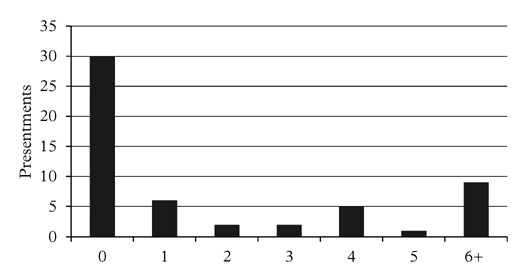
Source: Compiled from CRO, AR 15/68. Copies of Court Presentments, 1695–1759, manor of Connerton.
By far the most common items washing ashore were hogsheads of wine and brandy, followed by the paraphernalia of ships’ structure and fittings – the boats, sails, masts, yards, rigging, pumps, ropes, cables, anchors; and cargoes of butter, iron and beer. The presentments reveal that not only were the tenants turning over wrecked items to the bailiff in return for a moiety – 50 per cent – of the value or of the goods, but also that earnings could be substantial compared to their salary as labourers and fishermen, many who earned less than 2s. 6d. a day.6 Salvors were paid 3s. 4d. each for the burial of corpses, including one seaman in 1757, another in 1758, and the bodies of two women and a man in 1759.7 In 1721 a piece of mast and a small topyard was divided between Richard Bennetts, Isaac Carthew and a few others, while the other half of the moiety was retained for the lord of the manor; several casks of brandy salved by Richard Harry and Diggory Hannifer yielded £7 7s. in 1756; and a piece of timber found near Sennen was sold for salvor John Jenkins for 7s. 6d. in 1759. Records from the medieval and early modern period suggest that the custom of dividing the goods was a longstanding one and indicate that the relationship between manorial lords and their tenants over shipwrecked goods was not always adversarial. Indeed, as far back as the fourteenth century goods were divided between the finder and the owner of the wreck rights ‘according to the right and custom of maritime law used in the said county’.8 Hence, the finding of wreck could have major economic significance for the tenants, but it was not to be counted on.
Although the majority of presentments show that wreck was handed over to the steward salvors occasionally appropriated goods ‘for their own use’ or for rival manorial lords. A wreck near St Ives in November 1712 is a case in point. Part of a mast came ashore near Trenaling Cliffs and was salved by Andrew Stephens for the Arundells, the rightful claimant. However, four men, all of the parish of St Ives, ‘came to the place where the mast lay & with force & violence cut it up and carried it away’. St Ives fishermen were able to save five puncheons and one hogshead of white wine for Customs, but another hogshead of white wine that came ashore near Lamorna Cove was ‘seized and carryed away’ by Oliver Hoskyn and other tenants for Sir John St Aubyn, despite Arundell claims to wreck in the cove. A pipe of brandy and a hogshead of wine coming ashore near the St Just cliffs were ‘seized’ by the Gendalls and William Adams and ‘carryed away & converted for their own use & sold & disposed of a great deal afterwards’. A cask of white wine found washing ashore near St Just was divided into half on site by the salvors, who then proceeded to place the lord’s moiety on horseback for delivery to the steward, but five St Just men ‘came & took it off the horseback & carryed it away by force’.9
Although the Cornish had a reputation for plundering shipwrecks, and miners could ‘cut a large trading vessell to pieces in one tide and cut down everybody that offers to oppose them’, as George Borlase’s oft-repeated quote asserts, there is only one case of outright wrecking and plunder in the fifty-seven years of Connerton presentments.10 In 1726 Richard Thomas, George White and Gregory Stephens cut the cables of a ship stranded between Gwithian and Phillack and proceeded to plunder her. There is no mention of survivors, but the account gives a substantial list of all the plunderers and the approximate amount and value of the goods carried off. John Harris stole ten shillings’ worth of butter; Richard Hockin took three barrels of butter and two casks of candles; John Richards and Thomas Reynolds carried off two casks of ‘sandy’ butter and some candles; John Hockin took ‘severall parts of Goods’ worth ten pounds, while John and William Cock plundered goods to the value of forty pounds. Richard Bennetts took home ‘seven or eight hundred weight of beef and butter’. Thomas Carthew also took butter, ‘sixty weight’ worth. The list is extensive and for the plunderers it was a windfall, but the evidence shows that this kind of occurrence was rare.
In some cases individuals tried to straddle the fence between legality and illegality by handing over some wreck to the bailiff for salvage but appropriating other wreck, often the less damaged. In 1756 John Jacka, Peter Williams, Charles Pawley and others found ‘a piece of fforeign Brandy Brackish’ which they salved as wreck near St Michael’s Mount and carried into Newlyn, to hand over to the Arundell’s steward. They received £7 7s. for the brandy. But what they failed to inform the steward was that they had found two other ‘pieces’ that were not ‘brackish’ and were carried to the pier on the Mount, where they secreted them away.11
The activities of the commoners in carrying away wrecked goods for their own use constituted a form of wrecking, which has always been illegal. However, in 1753 Parliament passed an Act that defined various forms of wrecking as felonies punishable by death. Capital offences included the plunder, stealing, taking away or destroying of any goods or ‘Merchandize’ belonging to any ship that had been ‘wrecked, lost, stranded, or cast on shore’, including cargo or ‘any part of the Furniture, Tackle, Apparel, Provision, or Part of Such Ship or Vessel’. The penalty was also applied to anyone using violence against survivors or who obstructed any victims saving their lives. However, if goods were considered of small value and were stolen ‘without Cruelty or Violence’ the offender was guilty only of petty larceny.12
Both manorial and Customs records show that wreckers were not prosecuted by invoking the harsh statutory law. Lords of the manors, or more often their stewards, had their own ways of dealing with wreckers, either by fining them in manorial courts or by suing them for trespass and trover, a legal action that was used to recover the value of personal property that has been ‘found’, but which in law still belonged to the original owner. But, by the mid-eighteenth century, many manorial lords had lost their rights to hold manorial courts and were thus more dependent upon other courts of justice. Even so, they continued to maintain some control as to whether or not they would convict a wrecker for ‘detaining wreck’, for this action was seen as important in maintaining their wreck rights. In 1813 the dowager Lady Arundell, together with Agnes Wright, sued Samuel Gilbert of Trenance because he had taken eight large barrels of butter from the royalty of Lanherne ‘for his own use’.13 Although some lords of the manor wished to convict wreckers as an example to others to prevent wrecking they were not always successful. Either the wreckers were too poor to exact damages or they disposed of the goods before they could be caught.14 Those apprehended and charged with wrecking were dealt with not with gaol sentences, nor execution, nor transportation, as was required by statute, but with the administering of fines and public penance, such as an apology published in the local newspaper.15
Tenant Testimony and Rivalries between Manorial Lords
Tenants and other commoners were not just involved with salvage and wrecking activities. Their testimony played an important role in clarifying manorial boundaries and was especially crucial during litigation over wreck rights. The depositions suggest that tenants believed in their responsibility to ensure that wreck was delivered to the rightful lord of the manor. Mathew Jobe, a seventy-year-old labourer from Camborne, testified in 1684 that he found a barrel of butter on the west bank of the Gwithian River. Although he was a tenant on the Basset family’s manor of Tehidy he handed the butter to the Arundell’s steward, William Willyams. Zennet Wills, another Camborne labourer, testified in the same case that sixty years previously a ship was cast ashore, spewing tallow, butter and hides along both sides of the Gwithian River. He verified that Willyams and Stephen Pawley, the Arundell bailiff, informed the local people ‘not to meddle’ with any of the wreck on the east side of the river as it belonged to the manor of Tehidy and would not be claimed by the Arundells.16
John Rowe of Camborne testified in 1676 that he had been involved in the salvage of many wrecks and had brought the goods to either Sir Francis Basset or his son Sir John. He said that in one instance he had found some bacon in a cliff near the Gwithian River. He attempted to take it to his mother-in-law for her use, but she insisted that he deliver it to Sir Francis at Tehidy as wreck. This piece of evidence is particularly telling: Rowe claims that she would not even allow him to bring it into her house, ‘severall times’ telling him ‘that all wrecks between Portreath & Gwythian did belong to Tehidy Manor’.17 Thus tenants such as Rowe’s mother-in-law held the rights of lords of the manor as absolute and were essential in upholding the system. It also shows that country people did not always believe that wreck was theirs for the taking, as ‘Providence’.
In the mid-eighteenth century the Arundells found themselves involved in disputes with the new lord of the manor at Lanisley, Lt Gen Richard Onslow, who was beginning to assert his claims to wreck through his steward, George Borlase. The case illustrates that although the ‘country people’ were often accused of embezzling wreck from the lords of the manor, activities of the stewards of rival manors were seen as more threatening. Indeed, the testimony of the tenants was crucial for the Arundells to prove they held customary claims over that of the more recent claims of the Onslow–Borlase alliance.
In 1757 a piece of timber valued at 19s was found on the shore of Lanisley by Charles Lethan and William Jelbert. However, when William Andrews demanded half the moiety for Lady Arundell he testified that Lethan ‘beat and abused him’ over it, and insisted that it belonged to Borlase. Likewise, in 1759, a cask of brandy found near Chynadour was ‘carried off by Mr Borlase’ and a piece of timber salved at Morvah was claimed by Borlase’s servant.18 These actions were regarded as encroachments by the Arundells, who duly sought legal counsel and instituted proceedings against Borlase. Tenant testimony was on their side. Earlier affidavits indicated that the Arundells did, in fact, practice right of wreck at Lanisley prior to 1745. In that year Ralph Corin salved part of a mast, which was duly divided with the Arundell steward. Corin claimed that he had ‘never heard of any other claim [except the Arundells], until lately by Mr Borlase’.19
Depositions taken to prove the Arundell’s prescriptive rights in 1753 also indicate that the Borlase–Onslow claim was fairly recent. Thomas Gamon, eighty-six years old and from Long Rock in Mount’s Bay, swore that he ‘had made it his Business all his Life to follow Wrecks’ but ‘he had never heard of any Claim by Mr Onslow or any other Except the ffamily of the Arundells’. The depositions also made it clear that wreck was legally claimed by the Arundell stewards on other manors located on the coast of the Penwith peninsula, including Trevedson and Treen, held by Sir Richard Vyvyan, the Manor of Lelant and the manor of the Boscawens. As the Arundell’s counsel pointed out, ‘If the Lords of those Mannors were not Sensible of the Arundells right of Wreck Can it be Imagined these Gent would Suffer them to be Carried off as they were so well able to Control their right if they had any?’20
The crux of the wreck cases fought by the Arundells in the eighteenth century was, as their steward pointed out, that the Arundell rights of wreck extended beyond the boundaries of their own manors and into the territories of other manors on the Penwith, such as Lanisley. This situation originated from the Arundell’s sale of lands, though not the wreck rights, after the family married into that of the Arundells of Wardour in Wiltshire in 1739. This extremely complicated situation led to cases of infringement from new landlords attempting to claim wreck rights for themselves. Indeed, Lady Arundell was encouraged through numerous legal briefs to bring actions of trover against anyone who either she or her steward believed were wrongfully claiming wreck.21 In 1761 she filed suit against George Borlase and Henry Cowls, who had assisted him in taking wreck. Witnesses were brought to the Bodmin Assizes from parishes all around the Hundred of Penwith to give evidence. After hearing the witnesses and examining evidence, the defendants, Borlase and Cowls, were found guilty and fined.22
But what of the case that opened this chapter? The salvors filed complaints of abuse against the officers of the Customs at the same time as they filed evidence that the casks were wreck and not smuggled, and thus were legally the concern of Lord Arundell. Unfortunately, their actions exacerbated the conflict: the Customs officers would not be authorised a reward unless the brandy was smuggled and, therefore, ‘the Officers having declared they’d be reveng’d upon the Salvors, and being determined to deprive Lord Arundell of their Testimony, formed a scheme to get ‘em pressed.’ John and Thomas Sampson were unlucky; they were impressed on board HMS Saint Albans. The others escaped, too afraid to return to their families until after Lord Arundell gained their pardon from the Admiralty. Unfortunately, we do not know if the Sampsons ever returned, but they claimed they had sworn the truth.23
Although the lords of the manor occasionally had difficulties with tenants, local people and other gentry claiming rights of wreck, they did not ‘loathe each other’.24 Indeed, theirs was a complex, symbiotic relationship, based on mutuality and cooperation as well as antagonism. However, these dynamics underwent severe changes during the Victorian period, with the tightening of governmental control and bureaucratisation. By the time of the Merchant Shipping Act of 1854, the Board of Trade’s subsequent investigations into manorial rights of wreck and the resurgent claims of the Duchy of Cornwall the Arundells and other lords of the manor lost most of their control over wreck rights. Thereafter, their relationship with their tenants and other commoners in regard to wreck ceased to exist.
Notes and References
1 This chapter is based on earlier work that was subsequently incorporated into Chapter 7 of my book Cornish Wrecking, 1700–1860: Reality and Popular Myth (Woodbridge: The Boydell Press, 2010); Cornwall Record Office [hereafter CRO]: AR 15/175 The Case of Mr John Harvey master of a pilchard sloop called Mary and Alice, 27 December, 1755.
2 Lawful wreck was defined by Edward I’s Statute of Westminster, ‘where a man, a Dog or a Cat escape quick out of a Ship, that such Ship nor Barge, nor any Thing within them, shall be adjudged Wreck’, meaning there had to be no survivors. It also stipulated that goods were to be held for a ‘year and a day’ in case legal claimants appeared. If no one appeared, the goods would become the property of the owner of the rights of wreck where the goods were found. 3 Edward I, cap 4 (1275) The Statutes at Large, 1225–1340 (Cambridge, 1762), p. 79.
3 Hugh Robert Coulthard, The Story of an Ancient Parish, Breage, with Germoe, with Some Account of its Armigers, Worthies and Unworthies, Smugglers and Wreckers, its Traditions and Superstitions (Camborne: Camborne Printing & Stationary Co., 1913), p. 115.
4 CRO: X/112/151 Case Papers, right of wreck, manor of Conarton [sic], 1753.
5 CRO: AR 15/68 Copies of Court Presentments, 1695–1759, manor of Connerton [hereafter Court Presentments].
6 The National Archives [hereafter TNA]: CUST 68/21 Penzance Collector to Board, 5 March 1813.
7 CRO: AR 15/68 Court Presentments.
8 P.A.S. Pool (ed.), ‘The Penheleg Manuscript’, Journal of the Royal Institution of Cornwall NS 3 (1959); Duchy of Cornwall Office, 1344/45, in Maryanne Kowaleski (ed.), The Havener’s Accounts of the Earldom and Duchy of Cornwall, 1287–1356 (Exeter: Devon and Cornwall Record Society, 2001), p. 162.
9 CRO: AR 15/68 Court Presentments.
10 15 March 1753 in Thomas Cornish (ed.), ‘The Lanisley Letters: to Lt. Gen. Onslow from George Borlase, his agent at Penzance, 1750–53’, Journal of the Royal Institution of Cornwall 6:22 (1880), p. 379
11 CRO: AR 15/68 Court Presentments.
12 26 George II, c. 19 The Statutes at Large, 1753–56 (Cambridge, 1762), p. 54.
13 TNA: CUST 69/24 Agnes Wright, Lanherne, to John Buller, Custom House London, n.d. February 1813.
14 CRO: AR 15/189/4 Declaration: Basset v. Bryant, Hilary Term, 1728; W/43. H. Willyams to E. Coode, 11 November 1826.
15 CRO: W/43 Willyams to Coode, 26 December 1826; TNA: CUST 68/24 Penzance Customs Officers to Collector, 10 April 1818. Only on one occasion was 26 Geo II, c. 19 used to convict a wrecker. William Pearce of St Genny’s was executed for stealing rope off a wreck in 1767. (Calendar of Home Office Papers, 1767 (London: Longman, 1878), pp. 187–88; Sherborne Mercury, 19 October 1767).
16 Royal Institute of Cornwall [hereafter RIC]: HB/19/60 Basset Papers, Henderson Collection, Vol. 5.
17 RIC: HB/19/60 Basset Papers, Henderson Collection, Vol. 5.
18 CRO: AR 15/68 Court Presentments.
19 CRO: AR/15/98: 1745 Note regarding wreckage and claim by Mr. Borlase.
20 CRO: AR 15/147/3/8 Abstract of Mr Paynter, 1753.
21 CRO: AR 15/146, 3 November 1760 Opinion of R. Hussey at Temple, on Arundell Right to Wreck in Penwith.
22 CRO: AR 17/29/6 Action of Trover by Lady Arundell, 29 October 1761; AR 17/29/10, Papers regarding case of Arundell v. Borlase.
23 CRO: AR 15/175. The Case of Mr John Harvey, 27 December 1755.
24 Bella Bathurst, The Wreckers: A Story of Killing Seas, False Lights and Plundered Ships (London: Harper Collins, 2005), p. 232.