
CHAPTER 13
____________________________
John Rule
Smuggling and wrecking are among those illegal activities usually characterised by historians as ‘social crime’: that is, actions proscribed by the criminal law but not considered crimes in the communities in which they were committed.1 Both were prevalent in eighteenth- and nineteenth-century Cornwall, as they were around the coasts of Britain generally. Of the two, smuggling gave most concern to the authorities, for it amounted to a huge business depriving the revenue of vast sums through the evasion of duties. In the 1770s, of an estimated annual loss to the national revenue of £3,000,000 from contraband brandy and tea (taking no account of tobacco), Cornwall’s share was £150,000, a not insignificant proportion even if only around a fifth of the level contributed from the coasts of Kent and Sussex. Twenty-nine vessels of 30 to 100 tons were then known to be engaged in smuggling from Cornwall, a high proportion of all vessels of that size then registered at Cornish ports.2 Statistics of illicit trading cannot in the nature of things offer precision, depending as they do on contemporary estimates or on the evidence of seizures by the Customs, which have an unknown relationship to the total of cargoes successfully run. The value of seizures at St Ives in the 1770s was, at £11,000, almost treble the port’s gross legal revenues.3 Tea smuggling, a mainstay of the contraband business until the lowering of the tea duties by William Pitt in 1784, may have, until then, supplied as much of home consumption as did the legal imports through the East India Company’s monopoly. Much of that tea was sold in London and it was nearness to what was by far the country’s largest consuming centre, as much as the shortness of the Channel crossing, which made smuggling such big business along the coastline of the south-eastern counties. Here the scale of business was such that a division developed between those who organised the smuggling voyages and wealthy merchant middlemen who handled the finance and the inland distribution. Such merchants often assembled orders which took several trips across the Channel to complete.4 This division was not usual in Cornwall, where the smugglers seem to have undertaken both the venture and the distribution locally, although there is evidence of Cornish-run tea being sold as far away as Bristol and a notorious Cornish smuggler around the turn of the eighteenth century recalled landing several contraband cargoes on the south Wales coast.5 Contemporary opinion, too, was that Cornish smuggling vessels, if smaller, tended to a greater level of arming than did those from the south-east. Smuggling was thought to be on the increase through the 1780s. A Parliamentary report in 1783 described it as having done so ‘to a very alarming degree, and is carried on with the most open and daring violence in every accessible part of the coast of this kingdom’. As well as the three staples of tea, spirits and tobacco, the report mentioned wine, drugs, cambrics, laces and silks. It described attacks on revenue cruisers and the moving of cargoes when landed under the protection of large gangs armed with clubs and whips, to which the undermanned revenue officers could only be ‘quiet spectators’. The vessels in the trade were estimated at not less than 100 large armed craft and around 200 smaller ones with a size range of from 30 to 300 tons, mounting from 6 to 24 guns and carrying crews from 12 to 100 men. The large vessels were capable of carrying 3,000 half-ankers of spirits and ten or twelve tons of tea, and made seven or eight voyages a year.6 Unfortunately, for the local historian this important source of evidence is hardly ever regionally specific, but it affords an important national perspective against which local evidence can be assessed.
After 1784 the fall in profitability resulting from the reduction of tea duties – although it was still smuggled to some extent – seems to have been compensated for by increasing the volume of spirit and tobacco smuggling, for there was no decline in the overall level.7 The Cornish smuggling peak came during the end of the eighteenth and the beginning of the nineteenth centuries. After the extension of the anti-smuggling laws in 1805 and 1807 to cover the Channel Islands the Cornish smugglers found their supply bases were increasingly cut off. A professional smuggler, Dadson, wrote from Mevagissey in 1808: ‘the old trade I believe is nearly annihilated in this part’.8 In the first quarter of the nineteenth century there was an increasing incidence of armed confrontations between smuggling vessels and those of the preventative service, before a decline began in the 1830s.9 The sustained level of activity after the end of the long war in 1815 came in the face of significantly greater powers of prevention, a British navy firmly in control of the seas after Trafalgar, the setting up of the Preventive Waterguard in 1809 and the release of revenue cutters from naval war service after 1815. Further consolidation of the elements of prevention into a Coastguard improved things further in 1822. By then fifty-nine revenue cruisers nationally carried 1,738 crewmen.10
Smuggling took place along the length of Cornwall from Mount’s Bay to the Tamar, although some places, such as Mount’s Bay, Mevagissey and Polperro, were especially noted centres. Cawsand came to the fore from the beginning of the nineteenth century, favoured both for its proximity to Plymouth and the suitability of its half-decked fishing vessels for the crossings. Vessels of various styles and sizes were involved in the trade. The main places from which the Cornish smugglers loaded their contraband cargoes were Guernsey and, later and more importantly, the Breton port of Roscoff. According to an official Guernsey report in 1800 the spirits which were smuggled from both places were especially brought in for the Cornish vessels and consisted for the most part not of fine brandy but of cheap, poor-quality spirits, ‘mostly disposed of to some thousands of miners’.11 Trade was brisk. In Guernsey in the four months between November 1806 and February 1807 156 vessels cleared from the port carrying brandy, rum, Geneva and tobacco. Ostensibly their destinations were listed as Bergen, Madeira and other innocent ports, but after 1805 the authorities had better intelligence about the real destinations. The Jane of Fowey and the Bethiah & Hepzebath of Padstow headed for Fowey and several others planned to land near Rame Head or Bigbury Bay.12 Information from Roscoff supplied to the Customs in 1812 listed nine smuggling vessels from Cornish and Devon ports arriving there between 13 and 31 March. Those from Cornish ports (the Lizard, Fowey, Falmouth and Coverack) were respectively of thirteen, thirty-five, thirteen and twenty-six tons. The last of these, the Love from Coverack, was described as especially successful. It had sailed with 125 tubs of spirits on 27 March and had returned for another cargo on 31 March. Three more from Plymouth were most probably Cawsand vessels, two of which were of thirteen tons and the third of twelve.13 This information on size broadly supports that given in the autobiography of the west Cornish smuggler Harry Carter of Prussia Cove. Carter began smuggling with his brother, but took charge of his own vessels from 1773, beginning with a ‘small sloop’ of sixteen tons crewed by two besides himself. Even with such a small craft he had ‘great success’ and bought a better sloop, although it was little larger. A step-up came within a few years, when he began to sail a ‘small cutter’ of around fifty tons crewed by ten men. He used this boat for about a year and in 1777 acquired a sixty-ton cutter. Losing this vessel to the authorities, he recommenced activity with his previous craft. By the end of the 1780s he was using luggers of around 160 tons and armed with sixteen to twenty carriage guns.14
The notorious Lottery, from Polperro, carried and used a swivel gun as well. One of her crew was hanged following the shooting of a Customs officer off Cawsand beach in December 1798, one of the rare incidents of real violence in Cornish smuggling. The Lottery was described as a large and fast ‘sloop or cutter’ that, with a crew of fifteen, was capable of carrying a cargo of around 700 casks of spirits.15 James Dunn, a Mevagissey shipbuilder, built a range of smuggling craft between 1802 and 1807 averaging about eighty tons.16 Although the evidence suggests that most Cornish smuggling vessels were smaller than those given prominence in the report of 1783 there were some larger vessels operating in the late eighteenth century of around 250 tons burthen, capable of carrying a main lug sail of a thousand yards of canvas.17 In an encounter of revenue cutters with the lugger Happy Goodluck, from Cawsand, in Whitesand Bay in 1786, one of the cutter captains was killed, as were the lugger’s captain and five other smugglers. This Cawsand vessel had a crew of sixty and carried twenty-two four-pound guns.18 However, the greater number of Cornish contraband ‘runners’ were smaller, and such large vessels were hardly found by the nineteenth century. When a syndicate from Perranporth decided on a venture in the early nineteenth century they purchased a ‘fast sailing’ 100-ton vessel.19 But craft of the like of the sloop Calamity, whose cargo was seized at Marazion in 1731 and which was described as a ‘small runner’, were just as common a hundred years later. She was carrying around eighty ankers (around eight gallons) of brandy as well as some tobacco and soap.20
Smuggling was widespread in practice, enjoying strong community approval in Cornwall by the mid-eighteenth century, and grew with the enlarging consumption of its staples of tea, brandy and tobacco. From the far west Walter Borlase wrote in 1758:
The common people on the seacoast are, it must be owned, too much addicted to carry off our bullion to France, and bring back nothing but brandy, tea and some other luxuries of life.21
He complained that even the very poorest people consumed the three main contraband commodities. Smuggling certainly brought them within the popular reach. When in 1749 a cargo of confiscated brandy was offered at 5s 6d a gallon there were no takers because brandy from the smugglers was available at 3s 3d.22
Smuggling involved more of the population than the communities of fishermen and seamen who crewed vessels. The involvement of miners is well documented. One of the county’s best-known smugglers, Harry Carter, had been a child worker at the mines, as had the prominent Methodist writer Samuel Drew, who had engaged in smuggling at Cawsand in his youth.23 A letter from a Fowey Customs officer in 1766 describes large gangs of miners active some miles from their home villages:
of late the smugglers go in such large gangs that we are in danger of our lives by happening to meet with them; for whether we attack them or not, they seldom fail to attack us when their number and strength is so much superior . . . These men are all tinners, and don’t live within twenty-five miles of this neighbourhood, are seldom seen above ground in the daytime and are under no apprehension of being known by us.24
The mining community, along with the rural population generally, provided the smuggling trade with two of its essential needs besides those required for the sea ‘run’ itself: transport and places of concealment. The large numbers of pack animals used in and around the mines were available, while mine workings offered a honeycomb of hiding places for smuggled goods. A gentleman from St Columb reported in 1765 that his servants had seen sixty packhorses en route from Padstow, each carrying a hundredweight and a half of tea, while in 1766 the Fowey Customs were observing gangs of around thirty men, each leading a horseload of tea or brandy. Early March was described as the ‘time of harvest’, with cargoes being rushed into underground concealment to build up a stock before the longer hours of daylight increased the risk of smuggling vessels being intercepted by the revenue cutters.25
Popular support for smuggling, despite its official and religious condemnation, can be revealed in several ways. As well as being against the law, it was condemned by what was undoubtedly the most powerful cultural influence operating on the county’s lower orders: Methodism. John Wesley described smuggling as ‘that wickedness for which Cornwall stinks in the nostrils of all who fear God or love King George’. At the Methodist Conference in 1744 he had demanded its extirpation, referring especially to ‘Cornwall and in all seaport towns’. Yet nine years later he found that at St Ives ‘almost all of the society bought or sold uncustomed goods’ and in 1773 he was still instructing his superintendent in West Cornwall to ‘put an end to smuggling at all hazards’. It was a popular acceptance not susceptible to easy reform.26
Neither is evidence of support for smuggling lacking higher up the social scale. In 1770 the mayor of Penzance was himself bound over ‘not to be again guilty of smuggling’. The Cornish juries, from whom convictions were hard to secure, were from the solid middle ranks. In 1835, in a smuggling-related assault case, one jury in East Cornwall decided that sticks were not offensive weapons in a case relating to smugglers in Lantic Bay near Polruan, thereby letting off the smugglers. Participants in the financing of a smuggling venture put together in the 1830s included the vicar and the manager of a very large copper mine.27 Edward Giddy, a magistrate from near Marazion, complained to the Custom’s Board in 1778 that ‘as the Law now Stands, I fear a Criminal Prosecution would be useless at best, for a Reason which shocks one to Mention, that a Cornish Jury would certainly acquaint the Smuglers. . .’.28
While details are limited, shared venture was probably the commonest means of funding smuggling in Cornwall. Share ‘adventuring’ had long been the mainstay of the mining industry and was common in the ownership of merchant vessels, fishing boats, nets and seine fishing. The description of the Perranporth venture in the 1830s refers to the forming of a ‘syndicate’: ‘the well-to-do provided the necessary outfit for the trade . . . being rewarded pro-rata in the division of the accrued profits’.29 Twenty to thirty years previously Harry Carter gives little detail of how his very many voyages were financed. He preferred to give the impression that the Carters of Prussia Cove were a flourishing family concern. There is, however, a hint of external funding: ‘I was at home some time, riding about the country, getting freights, collecting money for the company, etc. etc.’ It has been suggested that the speed and ease with which the Carters acquired newer and larger vessels, and, when necessary, replacement ones, indicates significant financial backing.30 James Dunn in Mevagissey was clearly a major financier and organiser of local smuggling in his area, as was Zephaniah Job of Polperro.31 Other names of key organisers of the trade who were in correspondance with Guernsey merchants include James Randle of Cadgwith and Nicholas Lukey, on the north coast.32 Customs records concerning a Fowey publican well known as a smuggling venturer reveal that he had been sighted in suspicious circumstances, such as being in the vicinity of landings, hiring vessels, arranging cargoes and associating with known smugglers and smuggling craft no fewer than twenty-seven times between 1833 and 1850.33
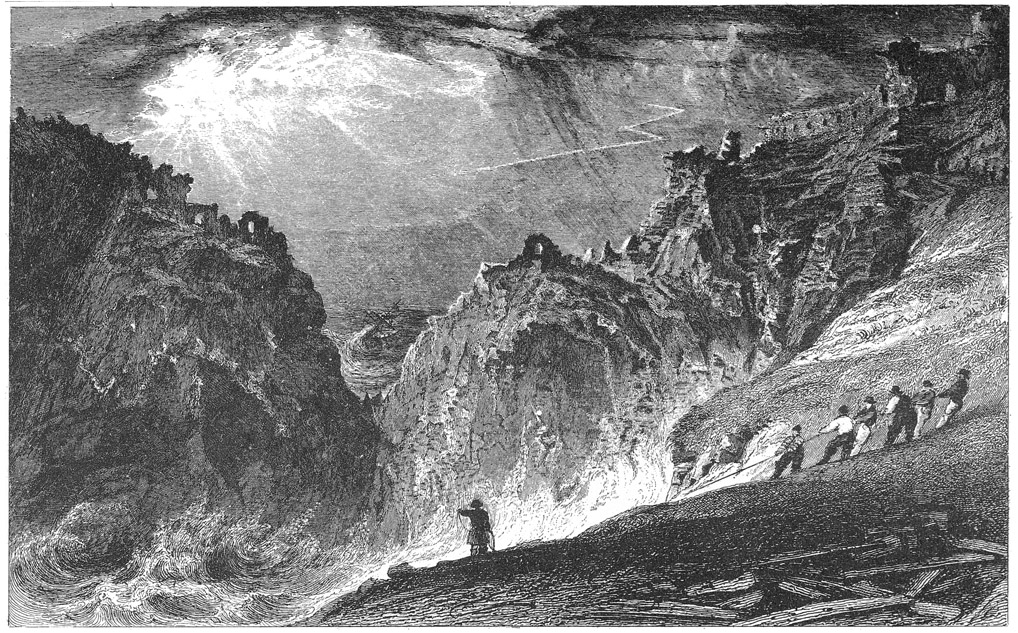
In the nature of things, wrecking, as opposed to smuggling ventures, hardly needed financing. Despite legends of the luring of vessels onto rocks by the display of false lights, shipwrecks were overwhelmingly the result of mischance, the weather, inadequate warning lights, poor seamanship, overloading, poor design and condition and drunken crews. They happened with a frequency around the coasts of Britain which, by the early nineteenth century, had become a national scandal. Sadly, around coastlines such as those of Cornwall, shipwrecks happened so often that they had hardly to be induced before the materials and cargoes of wrecked and stranded vessels could make a significant contribution to the make-shift economy of the local populace. ‘Wreckers’, according to a writer around 1820,
13.1 Wreckers or saviours on the cliffs at Tintagel? Engraving by T. Allom published in 1832
consider the stranded vessel as their property as soon as the waves have thrown it on their coast! Under this unhallowed impression they plunder all they can, although the owner should survive and protest against their proceedings, and implore them to refrain from thus ruining himself and his family.34
Two eighteenth-century statutes dealt specifically with such depredations nationally. The first, passed in 1713, was commanded to be read in ‘all the parish churches and chapels in every seaport town and upon the sea coast in this kingdom’, finding that ‘many ships of trade after all their dangers at sea escaped, have unfortunately near home run on shore . . . and that such ships have been barbarously plundered by Her Majesty’s subjects’, and reinforcing existing legislation by enumerating the penalties.35 The second Act of 1753 was more comprehensive, increasing penalties and making it a capital offence to ‘plunder, steal or take any cargo, tackle, provision or part’ of a wrecked vessel, to beat, wound or hinder the escape of any person trying to save his life or to ‘put out any false light or lights’ intending to bring a vessel into danger. The stealing of goods cast on shore without any aggravating circumstances was treated as petty larceny, while receiving and concealing wreck goods or materials was punishable with six months’ imprisonment.36
These statutes covered the various offences which came under the broad and somewhat loose name of ‘wrecking’ that accompanied the large expansion in British merchant shipping from the mid-eighteenth to the mid-nineteenth century. Wrecking has sometimes been presented as a peculiarly Cornish proclivity, but in fact it was prevalent around the coastline of Britain.37 Eighteenth-century accounts relate episodes on the coasts of north and south Wales, Devon, Dorset, the Isle of Wight and Kent which hardly differ from the activities for which Cornwall and Scilly had become notorious. A Royal Commission in 1839, making the case for the establishment of a rural police force, collected evidence on a printed pro forma from each Coastguard division. As well as from those places already mentioned, reports of wrecking came in from Lancashire and Cheshire, Sussex, Suffolk, Norfolk, Lincolnshire, Yorkshire and Durham.38 It was not equally prevalent in all these places; Cornwall, Kent, the Wirral peninsula and the Welsh coasts presented the worse cases. Cornwall was distinguished by the size of the crowds which gathered at the scene of wrecks, while Hoylake on the Wirral displayed the most professionalism, being described as inhabited by men who called themselves fishermen, but who ‘live by plundering wrecks’ and who had regular means of disposal through the marine-store dealers of Liverpool.39
Whatever happened elsewhere, the Cornish could hardly deny the frequency with which such depredations happened around their coastline and that of Scilly. To the coastal dwellers and the close-by miners materials from wrecks, and at times their cargoes, provided useful resources much in want in poor households:
The Good Samaritan came ashore;
To feed the hungry and clothe the poor . . .40
Wrecks which cast up such cargoes would indeed be long remembered, but the objects for which wreckers were convicted in the courts were hardly spectacular: a quantity of rope in 1812; a small amount of copper in 1829; two bars of iron in 1830; and a quantity of staves in 1837.41 An old man was sentenced to death in 1767 for a matter of a small quantity of rope as an exemplary hanging following an episode in which the crowd was adjudged to have behaved in a particularly defiant and disorderly way.42
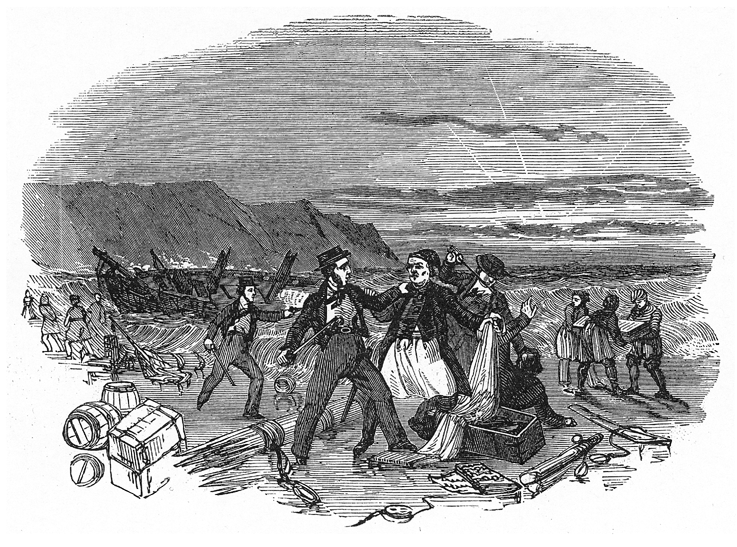
In Cornwall wrecking can be viewed as a form of crowd activity in which, by weight of numbers and with a sufficient sense of determination, wreckers could secure their object despite attempts to prevent them. In 1831 the Coastguard had been obliged to resort to firearms to deter a crowd of Illogan miners, while at Port Holland a month earlier plundering ceased only when a revenue cutter fired over the heads of the wreckers. In 1838 the crowd armed itself with pieces of timber from the wreck and threatened to destroy the Coastguard if they interfered.43 But the Customs officers and the Coastguard whose statutory duty it was to protect dutiable wrecked property were not the only recipients of rough treatment. Whatever the truth about the deliberate contrivance of wrecks there is no doubt that the crowd, in its haste for plunder, at times behaved inhumanely towards the victims of shipwrecks. A local magistrate claimed in 1753 to have seen survivors cast ashore ‘fallen upon and in a manner stripped naked by these villains, and if afterwards he saved his chest of anymore cloaths (sic) they have been taken from him’.44 In 1764 an episode involving the French vessel Marianne, wrecked at Perranzabuloe, came to the attention of the government after her crew were treated in this way.45 In contrast, when a Dutch vessel was wrecked near Coverack in 1792 a contemporary letter described the humanity and bravery of the men of that village in saving the crew and flatly claims that the account ‘in the papers’ of ‘their plundering the people of their cloaths (sic) as they came on shore’ was ‘totally destitute of truth’. However, once lives had been saved they ‘look[ed] upon all the rest as their property’ – an ‘idea they imbibe from their infancy’ – and hundreds of men and women from all around arrived and cut the vessel to pieces.46
For all its unsavoury aspects, wrecking too can be considered a ‘social crime’, in that those who practised it considered it no crime to appropriate materials and cargoes from wrecks, especially in the absence of the wrecked ship itself:
[there is] an opinion that they have a right to such spoils as the ocean may place within their reach, [and] many among the more enlightened inhabitants secure whatever they can seize without any remorse; and conclude without any hesitation, that nothing but injustice, supported by power and sanctioned by law, can wrench it from their hands.47
In 1842 Cyrus Redding, in his attack on privilege, suggested that the Cornish poor were following the example of some of more exalted social status:
The vulgar had a notion formerly that the property saved from shipwreck belonged to anyone who was on board that survived, and if no one survived to anyone who might pick it up from the beach. They were taught by the claim of some lord of the manor in former time, one no more just than their own; that the ship and cargo were not the property of the owners; and they thought that what they secured with labour, floating upon the sea, or strewed upon the rocks, sometimes on their own land, they might appropriate as justly as a claimant under feudal usage.48
A Quarter Sessions chairman in 1837 expressed his regret at sentencing a young man of good character after the wreck of a French vessel at St Just and his sorrow that wrecking in that neighbourhood ‘has not been sufficiently regarded as an offence of the blackest dye’.49
The issue is not a simple one. There were persons who possessed the legal right to wreck and who in turn entered into agreements with their tenants. There were also legitimate claims for salvage. But any right to wreck applied only to unclaimed wreck of which the rightful owners could not be identified. From the early statutes of Edward I in 1275 through to the Merchant Shipping Act of 1854, even this type of wreckage was first to be kept for a year and a day to allow original ownership to be proved. Ideas of manorial rights and customs may have played some part in the popular belief that wreck property was there for the taking, but, more basically, wreckers simply considered their actions to be no infringement of a natural or moral law any more than did poachers when they took wild game.50 They were certainly as adept at securing their quarry. Eighteenth-century miners were said to be able to ‘cut a large trading vessell to pieces in one tide’51 and speed of reaction is certainly indicated by an account of 1818:
13.2 Affray between Wreckers and Coast Guard (Illustrated London News, 28 January 1843)
When the news of a wreck flies round the coast, thousands of people are instantly collected near the fatal spot; pickaxes, hatchets and crowbars are their usual implements for breaking up and carrying off whatever they can. The moment the vessel touches the shore she is considered fair plunder, and men, women and children are working on her night and day.52
Even if a sound vessel came ashore, she might, unless she were immediately surrounded by an adequate Coastguard force, be quickly rendered incapable of refloating. The captain of a vessel which went ashore near Marazion in 1750 claimed he could have refloated had not a crowd arrived and cut down her masts, cables and rigging.53 A ship of 250 tons which came ashore at Mawgan in 1754 remained in good shape, but only until ‘a parcel of Cornish barbarians from St Agnes, lower St Columb, etc, who came to the place and demanded the whole as wreck’.54 As soon as tinners observed a distressed ship offshore they were said to ‘arm themselves with sharp axes, and hatchetts (sic) and leave their tynn (sic) works to follow those ships’.55
The Act of 1753 did refer to the practice of decoying with false lights. Such a strategy is part of the folklore of wrecking in all its various districts, as are tales of biting off fingers of wreck victims to secure rings. They are not substantiated in the historical record, although the captain of one ship wrecked off Anglesey in 1774 later attributed his fate to following false lights.56 At a lesser level of infamy it is attested that coastal inhabitants were not over-keen on the provision of genuine warning lights. When Sir John Killigrew erected the first Lizard light in 1619 the local populace complained that he took away ‘God’s grace from them, meaning that they shall receive no more benefit from shipwrecks’.57 It was suggested, too, that the warning light on St Agnes, Isles of Scilly, had in the early eighteenth century ‘been suffered to go out, or sometimes not lighted’.58 In 1708, when the East Indiaman Albemarle went ashore near Polperro, a request was sent to London for pilots to assist in her refloating for fear that local pilots would ‘run her aground or so some other mischief to make a wreck of her’.59
More than any other regional/occupational group, Cornish miners were associated in the popular mind with wrecking and were not undeserving of that reputation. When Commodore Walker was wrecked near St Ives in the 1740s he was so grateful that the local seamen risked their own lives in saving his crew that he remarked that the wrecking reputation of the Cornish was an ‘idle fame’. That night a crowd of miners arrived and were ‘setting about sharing the wreck amongst them’.60 In 1817, after the inhabitants of Gwithian had distinguished themselves in assisting the crew of a wreck, a party of miners arrived and plundered it, even to the extent of taking the seamen’s shirts, which had been hung out to dry.61 Similarly, when the men of St Ives saved a French crew from a wreck on the Hayle Bar in 1826 miners from the nearby villages later arrived to plunder its stores.62 Nowhere else did such dense populations of industrial workers live in such proximity to a dangerous coastline. As the Constabulary Commissioners remarked, while in other parts of the kingdom wreckers assembled in hundreds, in Cornwall they did so in thousands.63 A Coastguard officer claimed that 2,000 people assembled instantly at the wreck of Le Landais under Boscriggan Cliff near St Just in 1837, a number that in a short while increased to 4,000. The scene on this occasion has been recorded in detail. The cargo was especially desirable, consisting of casks of wine, brandy and tobacco and bales of cotton, and was strewn over a mile of the beach. Men and women were involved, with hundreds of the latter filling kettles and jars with the contents of the casks. The coastguard of twenty-five men, threatened by men armed with staves and pieces of iron from the wreck, had to fire over the heads of the wreckers and strike out with the flats of their swords after the reading of the Riot Act. Special constables arrived late and were unwilling to identify any of the wreckers. In the event, only two men from the crowd were charged with obstructing the officers and fifteen with being in possession of wreck plunder.64
Smuggling and wrecking had in common the fact of their acceptance by the general population. Both were social crimes, although both could involve vicious behaviour to the point of murder, particularly against the undermanned Customs officers whose duty it was to police both. Smuggling offered the lower orders both a measure of employment and the chance to afford commodities which over the eighteenth century became commonplace, but it was in essence a profession – and was considered as a huge and successful one at a national level. Wrecking, despite the occasional involvement of the better-off, was essentially part of the make-shift economy of the poor, and an opportunistic activity at that.
Notes and References
1 ‘Social crime’ is a difficult concept to define. For an attempt to develop it as a useful category of historical analysis, see: John Rule, ‘Social Crime in the Rural South in the Eighteenth and Early Nineteenth Centuries’, in John Rule and Roger Wells, Crime, Protest and Popular Politics in Southern England 1740–1850 (London: Hambledon, 1997) pp. 153–68.
2 Figures cited in John Rowe, Cornwall in the Age of the Industrial Revolution (Liverpool: Liverpool University Press, 1953) p. 276.
3 H. Atton and H. Holland, The King’s Customs (London: John Murray, 1908), p. 357.
4 For the contraband tea trade see: Hoh-Cheung and Lorna H. Mui, ‘Smuggling and the British Tea Trade before 1784’, American Historical Review 74 (1968), pp. 44–73.
5 Mui and Mui, ‘Smuggling and the British Tea Trade’, p. 66; J.B. Cornish (ed.), The Autobiography of a Cornish Smuggler: Captain Harry Carter of Prussia Cove, 1749–1809 (1884, rep. Truro: Bradford Barton, 1971), p. 9.
6 British Parliamentary Papers [hereafter BPP], First Report from the Committee appointed to enquire into the Illicit Practices used in Defrauding the Revenue, Reports from the Committees of the House of Commons, XI, 1783, p. 228; Ankers had a capacity of about 10 Imperial gallons.
7 Edward Carson, The Ancient and Rightful Customs (London: Faber and Faber, 1972), pp. 138–39.
8 A.G. Jamieson (ed.), A People of the Sea: The Maritime History of the Channel Islands (London: Methuen, 1986), p. 216.
9 Rowe, Cornwall in the Age of the Industrial Revolution, p. 285.
10 Carson, The Ancient and Rightful Customs, pp. 162–64.
11 Henry N. Shore, Old Foye Days: containing An Authentic Account of the Exploits of the Smugglers in and around the Port of Fowey (1907 rep. Newcastle: Frank Graham, 1966;), p. 56 footnote.
12 BPP, IV.85 (1807): Account of the number of vessels clearing Port of Guernsey; Transcript of letters from Revenue Board to Barnstaple Collectors 1806–7, Courtesy P. Ferguson.
13 This information from Customs records is cited in Shore, Old Foye Days, pp. 64–66. Cargoes were also taken up at Cherbourg, a French port which was probably preferred by the Devon/Dorset smugglers further up the south coast, who also seem to have favoured Alderney over Guernsey. See John Rattenbury of Beer, Memoirs of a Smuggler (Sidmouth: J. Harvey, 1837, rep. Newcastle: Frank Graham, 1964).
14 Cornish, The Autobiography of a Cornish Smuggler, pp. 3–13. These tonnages were presumably estimated by the 1773 method and would have been significantly less if measured by the post-1836 method, which became compulsory in 1855. Under the latter they would have been reckoned significantly smaller.
15 The saga of the Lottery has been told many times, and not left undistorted in the telling. The definitive reconstruction of the events is in Cyril Noall, Smuggling in Cornwall (Truro: Bradford Barton, 1971), pp. 84–96.
16 Helen Doe, ‘The Smugglers’ Shipbuilder’, Mariner’s Mirror 92:4 (2006), pp. 427–42, at p. 440.
17 A.K. Hamilton-Jenkin, Cornish Seafarers: The Smuggling, Wrecking and Fishing Life of Cornwall (London: J.M. Dent, 1932), p. 24.
18 Sherbourne Mercury, 17 April 1786.
19 William Roberts, Reminiscences of Perranporth from the Year 1833 (Truro: Oscar Blackford, 1939), p. 117.
20 Gentleman’s Magazine, I:2 (Feb. 1731), p. 71.
21 Walter Borlase, Natural History of Cornwall (Oxford: W. Jackson, 1758), p. 312
22 Hamilton-Jenkin, Cornish Seafarers, p. 18.
23 Cornish, The Autobiography of a Cornish Smuggler, p. 3; J.H. Drew, Samuel Drew, MA: The Self-Taught Cornishman (London: Ward and Co., 1861), p. 33.
24 The National Archives [hereafter TNA]: WO 1/989 f.333. From Customs Officer at Fowey, 15 March 1766.
25 Historical Manuscripts Commission, Fifteenth Report (1896) Appendix, ‘Manuscripts of the Earl of Dartmouth’, p. 177; TNA: WO 1/989 f.333.
26 John Wesley, Letters, edited by J. Telford, 8 vols (London: Epworth Press, 1931), III, p. 143, VI, p. 59; Minutes of the Methodist Conference 1744–1798 (London: The Methodist Conference, 1812), p. 13; John Wesley, Journal, 24 July 1753 and 18 Sept. 1762, edited by John Pearce as The Wesleys in Cornwall (Truro: Bradford Barton, 1964), pp. 114, 151.
27 Hamilton-Jenkin, Cornish Seafarers, p. 23; West Briton, 17 August 1835; Roberts, Reminiscences of Perranporth, p. 117.
28 TNA: CUST 68/42. Edward Giddy, JP to Commissioners of Customs, 4 March 1778.
29 Roberts, Reminiscences of Perranporth, p. 116.
30 Cornish, The Autobiography of a Cornish Smuggler, p. 10; Charles G. Harper, Smugglers: Picturesque Chapters in the Story of an Ancient Craft (London: Chapman and Hall, 1909, rep. Newcastle Frank Graham, 1966), p. 126.
31 Helen Doe, ‘Small Shipbuilding Businesses during the Napoleonic Wars: James Dunn of Mevagissey, 1799–1816’, unpublished MA thesis, University of Exeter, 2003. Martin Wilcox, ‘Maritime Business in Eighteenth-Century Cornwall: Zephaniah Job of Polperro’, Troze 2:2 (2010) www.nmmc.co.uk, online journal of the National Maritime Museum Cornwall.
32 Jamieson, A People of the Sea, p. 213
33 Shore, Old Foye Days, pp. 52–54.
34 Anon., The Wreckers, or a View of what sometimes passes on our Sea Coast, n.d. (c. 1820?), p. 2.
35 12 Anne st. 2, c. 18 (1713), Statutes at Large, Vol. 13, p. 121.
36 26 Geo. II c. 19 (1753).
37 For an account of wrecking around the British coastline see: John Rule, ‘Wrecking and Coastal Plunder’ in Douglas Hay, Peter Linebaugh, John G. Rule, E.P. Thompson, Cal Winslow (eds), Albion’s Fatal Tree: Crime and Society in Eighteenth Century England (London: Allen Lane, 1976), pp. 167–88; and Cathryn J. Pearce, Wrecking, 1700–1860: Reality and Popular Myth (London: Boydell and Brewer, 2010).
38 BPP, 1839, XIX, Report of the Constabulary Force Commissioners, pp. 61–62. The completed returns from the Coastguard districts can be found in the Home Office Papers in National Archives at HO 73/3. For an alternative assessment of the Constabulary Report, see Cathryn J. Pearce, ‘“So Barbarous a Practice”: Cornish Wrecking, ca. 1700–1860, and its Survival as Popular Myth’, unpublished Ph.D. thesis, University of Greenwich, 2007, Ch. 5: ‘Deterrence, Discretion, and the Law against Wrecking’ and Appendix 8.
39 BPP, 1839, Report of the Constabulary Force, pp. 53, 64.
40 Hamilton-Jenkin, Cornish Seafarers, p.116.
41 Sherborne Mercury, 6 April 1812; Cornwall Gazette, 10 January 1829; 11 December 1830; West Briton, 21 October 1837
42 Calendar of Home Office Papers of the Reign of George III, 1776–9 (London: Longman, c.1880), pp. 184, 251.
43 BPP, 1839, Report of the Constabulary Force, p. 64; Cornwall Gazette, 11 December 1830, 1 January 1831.
44 Hamilton-Jenkin, Cornish Seafarers, p. 90.
45 Calendar of Home Office Papers of the Reign of George III, 1760–5, entry no. 1460, 24 September 1764.
46 TNA: HO 43/4, Joseph Banfield to Knill, Falmouth, 28 February 1792. There are many cases where lives were saved before wrecking commenced, and the populace may have seen wrecking as a form of reward for services rendered, according to the popular custom of reciprocity. See Pearce, ‘Cornish Wrecking’ thesis, Ch. 2 ‘Cornwall and the Communal Practice of Wrecking’.
47 C.G. Smith, The Wreckers or a Tour of Benevolence from St Michael’s Mount to the Lizard Point (London: Whittemore, 1818), p. 13.
48 C. Redding, An Illustrated Itinerary of the County of Cornwall (London: How and Parsons, 1842), pp. 187–88.
49 West Briton, 27 October 1837.
50 The islanders of Scilly were defended by their historian in 1750 against, in particular, the condemnation of Daniel Defoe: ‘What is saved at the hazard of lives from the devouring of the sea, the salvors are, by right of nature, as well as by reason entitled to a share of.’ R. Heath, The Isles of Scilly (1750 rep. Newcastle: Frank Graham, 1967), pp. 53–56.
51 George Borlase to Lt General Richard Onslow, MP, 15 March 1753, quoted in Thomas Cornish (ed.), ‘The Lanisley Letters: To Lt. General Onslow from George Borlase, his Agent at Penzance, 1750–53’, Journal of the Royal Institution of Cornwall 6:22 (1880), p. 379.
52 Smith, The Wreckers, p. 8.
53 TNA: SP/44/85, Bedford to Mt Edgcumbe, 26 May 1750.
54 J. Vivian, Tales of the Cornish Wreckers (Truro: Tor Mark Press, 1969), p. 12.
55 Hamilton-Jenkin, Cornish Seafarers, p. 85; Borlase to Onslow, 1 February 1753, in Cornish, ‘The Lanisley Letters,’ p. 374.
56 Annual Register, XVII (London, 1774), pp. 113–14; Geoffrey Place traced the genesis of this story to find that the account had been falsified by over-zealous newspaper reporters in his ‘Wreckers: The Fate of the Charming Jenny’, Mariner’s Mirror 76:2 (1990), pp. 167–69.
57 Hamilton-Jenkin, Cornish Seafarers, p. 85. Sir John Killigrew to Sir D. Carleton, 29 June 1619, quoted in Howard Fox, “The Lizard Lighthouse”, Journal of the Royal Institution of Cornwall 6:14 (1879), p. 327.
58 Heath, The Isles of Scilly, p. 37. Heath was commenting about the negligence of the light-keepers rather than hinting at foul play. On St Agnes Light and wrecking, see Cathryn J. Pearce, ‘“Neglectful or Worse”: A Lurid Tale of a Lighthouse Keeper and Wrecking,’ Troze 1:1 (September 2008).
59 E. Cotton and C. Fawcett, East Indiamen: the East India Company’s Maritime Service (London: Batchworth, 1949), p. 129.
60 H.S. Vaughan (ed.), The Voyages and Cruises of Commodore Walker (London: Cassell, 1928), pp. 90–91.
61 West Briton, 28 March 1817.
62 West Briton, 14 April 1826.
63 BPP, 1839, Report of the Constabulary Force, p. 64. An analysis of the report shows that the crowds included ‘many out of curiosity’. TNA: HO 73/3, Padstow return.
64 TNA: HO 73/3. Alexander Shairp to Comptroller General of the Coast Guard, Penzance, 4 October 1837; Penzance Return (filled out by A. Shairp); West Briton, 27 October 1837 – probably 1837, as this is the wreck of the Le Landais. Customs records indicate that the wreckers were interfering with the Coastguard’s orders to destroy the wrecked property, as its sale would not cover the duties levied. See TNA: CUST 68/33, Penzance Collector to Board, 3 October 1837.