
PART IV
CHAPTER 16
____________________________
Helen Doe, Alston Kennerley, Philip Payton
The century-long period from the fall of Napoleon in 1815 to the outbreak of the Great War in 1914 was by no means devoid of international tension and conflict. But, in contrast to the eighteenth century, with its almost incessant struggles between the British, the French and the Spanish, this was a time of comparative peace at home, interrupted only in the popular memory by the distant wars with Russia at mid-century and in Africa at its end. The themes which now stood out were: technological advance and industrialisation, particularly the application of steam power; innovation in transport and communication, bringing massive reductions in travel time and speed of information transfer; the migration of the rapidly growing population to the towns and cities; the importance of manufactures and export in the British economy; the increasing reliance on imported raw materials and food; the creation of the new British Empire through colonisation and emigration and the dominance of Britain on the international stage, in particular in world shipping. During the nineteenth century British shipping expanded from one million tons to nearly nine million and carried most of the world’s trade. Cornish ships, shipbuilders and shipowners played their own, often distinctive, part in this expansion. Although, ultimately, Cornwall’s contribution to industrial expansion could not match the scale and economic diversification achieved in other industrial regions of the United Kingdom, it was nonetheless in the forefront of global technological advance in the first half of the nineteenth century, especially in the realms of deep hard-rock mining and associated steam engineering, with pride in industrial prowess a significant component of contemporary Cornish identity.1
Cornwall’s most conspicuous industrial activity, mining, long established and in the eighteenth century already benefiting from the application of steam as well as water power, rose to a peak in the 1850s and early 1860s, only to decline in the second half of the nineteenth century as the more accessible mineral-bearing lodes were worked out and competing sources were discovered overseas.2 Nevertheless, Cornish mining, which encompassed copper, tin, lead, arsenic, china clay and a variety of other minerals, led to significant developments in both land and maritime transport and was reliant on shipping serving both the coastal and international trades. Ultimately this was a global trade, the Atlantic by now well established as a thoroughfare for commerce, emigration and the assertion of political and military power. Cornish ships – and many other vessels sailing from or via Cornish harbours – routinely called at the ports of North and South America, Africa, Australasia, India and the Far East. And yet, as Bernard Deacon argues in his contribution, Cornwall’s maritime geography contributed in this period to the creation of what he terms an ‘inside-out’ region, playing a critical role in shaping Cornwall’s industrial experience from the 1750s until the 1860s. Here Cornwall’s maritime location both facilitated and limited industrialisation, on the one hand opening up Cornwall to global reach and yet on the other wedding it tightly into a close industrial–regional relationship with the smelting and other commercial interests of south Wales.
The Mineral Ports
The eighteenth-century port development sketched by Helen Doe (in her contribution in Part III) continued apace during the first part of this period. Typical of those ports owing its prosperity to mining was Hayle, on the north coast, near the industrial heartland of Camborne and Redruth. Tin and later copper smelting was established here in the late eighteenth century, complemented shortly by the foundation of a large foundry (Harvey’s) which built pumping, winding and stamping (ore-crushing) engines and other items for the mining industry. A new wharf constructed at Hayle in 1819 facilitated the export of tin and copper ingots as well as copper ore destined for the burgeoning smelting industry in Swansea and Neath, and allowed the import of large quantities of coal and timber for the mining industry. Later, Cornish engines manufactured at Harvey’s were exported from Hayle to destinations as far flung as the copper mines of South Australia, and in 1844 an enormous 144-inch cylinder – part of a giant pumping engine constructed by Harvey’s to drain the Haarlem Lake in the Netherlands – was shipped from the port aboard the Carnsew, a locally owned vessel engaged in this bustling commerce.3 Indeed, in 1843 Hayle led the field, ahead of Falmouth, in the number of vessels recorded entering Cornish ports (see Table 16.1).
Table 16.1 Number of Entries into Cornish Ports of Ships Paying Light Dues in 1843
|
Boscastle |
118 |
Looe |
152 |
Port Isaac |
72 |
|
Bude |
245 |
Newquay |
147 |
Portreath/St Agnes |
286 |
|
Calstock |
210 |
Padstow |
361 |
Scilly |
119 |
|
Charlestown |
154 |
Penryn |
406 |
St Ives |
202 |
|
Falmouth |
633 |
Pentewan/Mevagissey |
125 |
Truro |
395 |
|
Fowey |
289 |
Penzance |
790 |
Total Cornwall |
5,771 |
|
Hayle |
688 |
Point |
379 |
Total E & W |
129,368 |
Source: BPP, 1845, IX, Report of the Select Committee on Lighthouses, 1845, Appendix 5(s), 419.
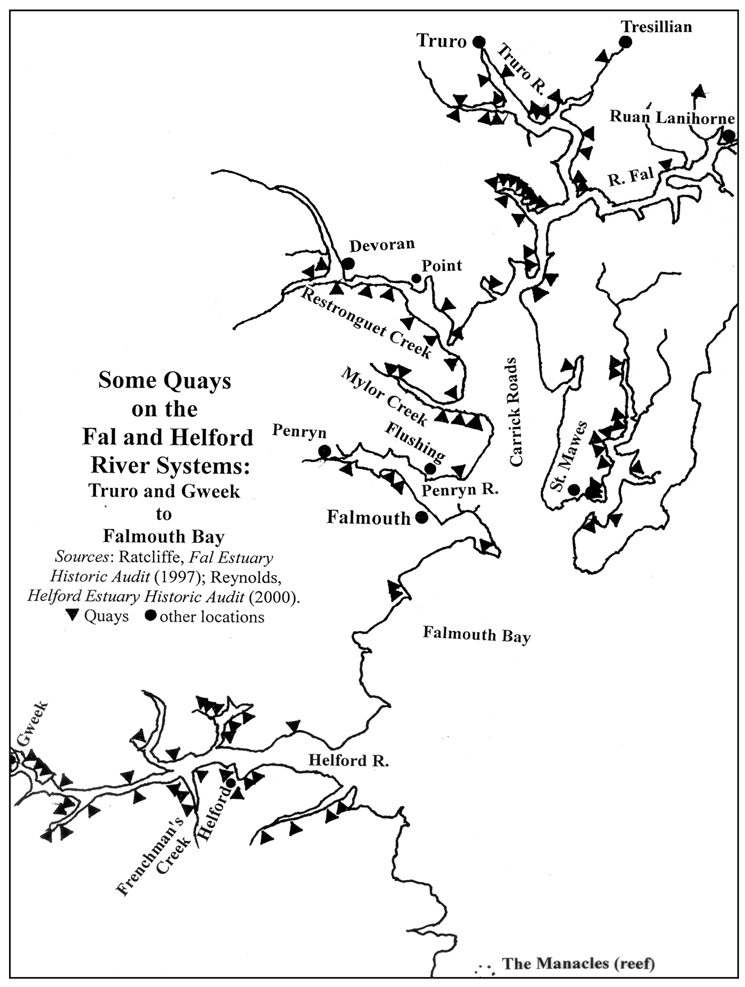
16.1 Quays on the Fal and Helford River (Alston Kennerley)
East of Hayle was Portreath, even closer to the mines of Camborne, Redruth and Gwennap. Construction of a pier to serve the mining industry had commenced as early as 1760, with a basin to harbour visiting vessels commenced in 1800. This was followed in 1809 by a tramroad linking Portreath with the famous copper mine of Poldice, deep in Gwennap parish. The first railway in Cornwall, this tramroad was operated at first by horse-power and played a major role in developing the symbiotic relationship with south Wales, allowing the export of copper ore and the import of coal.4 Among those vessels engaged in this two-way trade was the St Ives schooner Bristol, owned by the Trewhella family, which was a familiar sight at both Portreath and Swansea as it plied to and fro during the 1830s and 1840s. The harbour at Portreath was further improved in 1824 and 1846, and the railway was later upgraded and incorporated as a branch line in the Cornish railway system, which was eventually linked to the rest of Britain in 1859. Facing the restless Atlantic and with a narrow portal, Portreath demanded skilful seamanship even in fine weather; in stormy conditions it was positively harrowing – as in November 1839, when the sloop Harriet and Phoebe, from Llanelli, successfully effected a hazardous entrance in high seas, willed on by the local pilots and mariners who had gathered on the jetty to offer what help they could.5
Portreath’s main rival was Devoran, on one of the many creeks of the River Fal, on the opposite south coast of Cornwall. Also accessible to local copper and tin mines, Devoran and other creek-side locations were by the 1820s cornering much of the mineral trade that had hitherto gone further downstream to Penryn. In 1826 a mineral railway was constructed from Devoran to Redruth and Chasewater (as it was then spelt).6 Its effect was similar to that of the Portreath tramroad a decade or so before, providing an important new conduit for the still expanding output of the mines. By 1830 Devoran could boast ‘a Maritime Commerce . . . of 55,000 tons per annum’ from ‘this favoured site for quays, buildings and manufactories’, as it was termed in the local press.7 One of these ‘manufactories’, situated close by at Perran Wharf on the creek at Perranarworthal, was the Perran Foundry, which, like its counterpart at Hayle, built Cornish beam engines for export to Mexico, South Australia and other distant places across the globe. Nearby, too, was Point, on Restronguet Creek, where on any busy day in the 1840s one might encounter ships such as the Restless of Llanelli, the Elizabeth and Mary from Port Talbot or the Merton from Aberavon, all engaged in the lucrative south Wales trade. Like the Fal, the adjoining Helford also had its network of creeks and quays, such as that at Gweek, which was important for the shipping of ore from the Helston and Wendron mines, and that at Port Navas in Constantine parish, which, it was reported in August 1856, had been leased for many years by Richard Hosken, a local granite contactor, and could easily accommodate ships of up to 150 tons.8
In East Cornwall mining-related activity was evident in local ports and quays such as Saltash, long associated with the export of Dartmoor tin and now busy with both copper and tin from the Tamar Valley and Tavistock districts, and New Bridge Quay near Gunnislake. The latter, advertised for rent in December 1800, was situated conveniently on the Callington to Tavistock road, where it crossed the Tamar. It was ‘properly adapted’ for the ‘landing of Coal, Deals, &c. and for shipping of Corn, Slate, or any other Articles’, its lower section said to be ‘a very convenient Spot for laying Timber, Ore, Culm, Limestone, & c.’.9 Calstock, a mile or two downstream on the Cornish bank of the Tamar, also served the mines of Callington and Gunnislake, while Morwellham – on the Devon side – was the principal quay from which copper ore from Devon Great Consols and other local mines was shipped away. Cotehele Quay, downstream from Calstock, was likewise involved in the mineral trade, as was nearby Bohetherick Quay, which, in July 1862, was advertised for rent, complete with ore and timber yards, granary, manure store, lime-kiln and labourers’ cottages.10
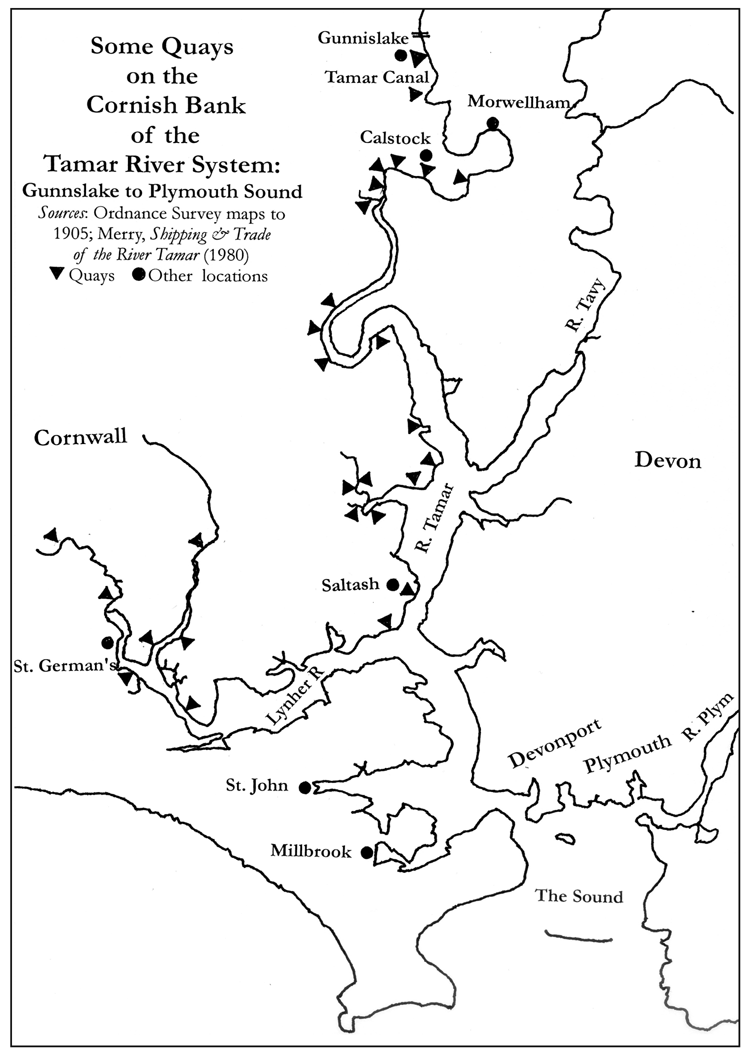
16.2 Map of Quays on the Tamar River (Alston Kennerley)
Additionally, there were the ports on Cornwall’s southern coast, developed initially to handle copper and tin, which increasingly turned their attentions to Cornwall’s newest mineral export – china clay. One of these was Charlestown, originally West Polmear but renamed after its builder, Charles Rashleigh, which by the 1820s was well established for the export of minerals and import of coal and went on to become a major china-clay port. Its narrow and rather awkward entrance, however, could be a hazard to shipping in poor weather, as in April 1850, when the schooner John and Henry, of Ipswich, left Falmouth in ballast to load china clay at Charlestown. A fresh wind was blowing and the ship’s captain was warned that he should make instead for Par or Fowey, either of which could be entered more easily in poor weather. But the Falmouth pilot, embarked in the schooner, insisted that safe entry could be made at Charlestown. Alas, he misjudged the task and the vessel foundered. According to one contemporary newspaper report, the John and Henry ‘in a short time began to break up and become a total wreck’.11 The safer port of Par was commenced in 1828 by J.T. Austen Treffry – the so-called ‘king of mid-Cornwall’, shipowner and mining adventurer of Fowey – who constructed a railroad from the harbour to the mines and clayworks of the hinterland.12 Although better appointed than Charlestown or neighbouring Pentewan (which also had its own light railway to the clay district but suffered increasingly from silting and sand inundation),13 it was not until the latter part of the nineteenth century that Par was able to rival and eventually overhaul its near neighbours. By then Fowey had also emerged as a major china-clay port. In 1869 a mineral branch connected Fowey with the mainline railway at Lostwithiel, facilitating the movement of china clay to a newly constructed pier at Carne Point, to which large ships could venture even at low tide. Together, as John Armstrong shows, the clay ports generated a considerable volume of shipping traffic, both coastal and international, as china clay moved by the end of the century to replace first copper and then tin as Cornwall’s principal mineral output.

16.3 Map of Quays on the Fowey River (Alston Kennerley)
Less prominent than mining, but perhaps as important economically in the long term, was farming. It too leaned on the maritime infrastructure, for the conditioning of the soil and for the movement of its produce. Sand from Cornish beaches, rich in lime, was carted inland to manure the notoriously acidic local soil, and in the years after 1819 a canal system was driven from Bude harbour into the hinterland of north Cornwall and north Devon with the expressed intention of delivering sea-sand to remote farming districts. First proposed in 1793 (as Helen Doe notes in Part III) and built partly with government money, the canal was designed to boost the faltering agricultural economy of the locality. It was also, strictly speaking, part-railway, for the canal tub-boats were fitted with wheels so that they could be placed on rails on the formidable inclined planes that moved the canal from one level to another. Inland from Bude the canal divided near Red Post, the northern arm making its way to Virworthy Wharf on the Tamar Lake, with a further branch striking eastwards to Blagdonmoor Wharf, north of Holsworthy in Devon. The southern arm, almost fifteen miles long, closely paralleled the Cornish bank of the (unnavigable) upper Tamar from Red Post to Druxton Wharf, south of Werrington, near Launceston. Although never a great money-spinner for its subscribers, the Bude canal succeeded in its aim of providing sand at a much cheaper price to local farmers. It survived until 1901, finally succumbing to competition from the railway.14
The Great Emigration
The varying fortunes of Cornwall’s mining and, to a lesser degree, agricultural industries was an important factor in determining the high level of emigration from Cornwall throughout the nineteenth century. In the years after the end of the Napoleonic Wars in 1815 European emigration developed apace. Some 50 million people left Europe for overseas destinations between 1815 and 1914. Of these, some 10 million had emigrated from Britain – with a further 7 million from neighbouring Ireland – at least a third of these arriving in the United States of America, the rest heading overwhelmingly for the British territories of Australia, Canada, New Zealand and South Africa.15 Cornwall was a major contributor of these emigrants. About a quarter of a million people left Cornwall for overseas during this period (with a similar number migrating to destinations within the British Isles), an extraordinarily large number given that the population of Cornwall at no time reached half a million during those years. As Dudley Baines concluded in his study of emigration from England and Wales, ‘Cornwall was probably an emigration region comparable with any in Europe.’16
There were various reasons for this large-scale emigration. Foremost among these was the rapid development of the international mining frontier after 1815 – initially in Latin America, then lead in Wisconsin and copper in Michigan by the 1840s, copper in South Australia in the 1840s and 1860s, the goldrushes to California and Victoria, diamonds and gold in South Africa towards the end of the century, and so on – in which highly skilled Cornish miners were much in demand. The potato famine hit Cornwall in the 1840s, a further impetus to emigration from both the mining and agricultural communities, while the catastrophic crash of Cornish copper in 1866 and the faltering of Cornish tin in the 1870s created a large body of miners and their families anxious to emigrate. Added to this was the radical Methodist mood of nineteenth-century Cornwall, where emigration was regarded as a means of self-improvement and the overseas destinations were seen as opportunities for achieving socio-economic mobility and civic and religious liberty.17
Early in this period an ‘emigration trade’ emerged in Cornwall to manage – and make money from – this mass movement of people.18 All manner of people and agencies were involved: government officials, mine managers, shipping agents, shipbuilders, local provisioners at ports and harbours, newspapers, publicans, coaching operators, clergymen, solicitors, learned societies and a host of other public and business interests. In the economic downturn after the Napoleonic Wars, for example, businessmen were anxious to diversify their interests when new opportunities emerged. When, in June 1820, it was reported that a party of emigrants had left Fowey, bound for Baltimore, it was also noted that the applications for the passage had been handled by Messrs Pomery & Walkom, drapers from St Austell who were busy diversifying at a time when business generally was dull.19 Similarly, shipping and legal interests were also keen to become involved in this potentially lucrative trade, as in March 1837 when it was advertised that the vessel Caroline of Gweek (a small harbour on a creek of the Helford River) was due to sail shortly for Philadelphia. For further details, enquiring passengers were requested to contact the Gweek offices of the Penzance solicitors Messrs Cornish & Borlase.20
Padstow, located strategically mid-way along the north coast of Cornwall, became an important centre of this emigration trade. Between 1831 and 1860, for example, 6,200 emigrants – many of them from Cornwall and Devon – sailed from the port for the eastern seaboard of Canada. Indeed, in 1841 Padstow was the third most important departure point for Canada, surpassed only by Liverpool and London.21 A distinctly Padstonian variant of the emigration trade had emerged by then, with emigrants ships sailing for Quebec or Prince Edward Island and returning two or three months later laden with North American timber.22 Ships such as the Clio, the Economist and the Springflower were then familiar sights in both Padstow harbour and the ports of maritime Canada. Some had been built in Padstow by local shipbuilders such as John Tredwen, but others had been constructed in Canada by emigrant north Cornishmen such as James Yeo from Kilkhampton. The Alchemyst, one such ship, was built in Prince Edward Island but registered in Padstow.23
Emigration agents, appointed to recruit emigrants for the emerging British colonies, gave an ‘official’, governmentally sanctioned dimension to this emigration trade. In March 1839, for example, Isaac Latimer – a journalist on the West Briton newspaper in Truro – was appointed as agent in Cornwall by the Commissioners for the newly proclaimed (in 1836) colony of South Australia. Latimer placed advertisements in newspapers – including the radical West Briton, which lent its editorial voice to the cause of emigration – and issued handbills and posters as well as organising public meetings up and down Cornwall. In a meeting in St Austell he read from ‘Many letters of the most pleasing nature . . . which had been received from Cornish emigrants, who all spoke in the most flattering terms of the province, and invited their friends to come over and join them’.24 To this ‘official’ emigration trade was added a further ‘unofficial’ dimension, the role played by Cornish mine captains (managers) in recruiting miners for new ventures overseas. In 1835 the Union Gold Mine in Virginia advertised for a number of miners, prospective applicants being advised to contact William Petherick at the Redmoor Mine, Callington, or William West at Fowey Consols mine.25 In March 1838 the West Briton announced: ‘Wanted to go to Mexico immediately, 2 pitmen, 4 engine-men and 5 sump-men. Apply to Mr Thomas Lean, Marazion.’26 The various strands of this emigration trade had coalesced by the 1850s to construct enduring conduits of emigration between Cornwall and overseas destinations. When, later in the nineteenth century, the collapse of Cornish mining created widespread unemployment, Cornish society was well placed to turn to emigration as a means of relieving distress at home.27
Cornish Coastal Communities
The Cornish coastal community has often been imagined as the ‘typical fishing village’, mainly owing to the activities of late Victorian and Edwardian painters, especially the Newlyn School. However, there were, in addition to the mineral ports, broadly three main types of coastal community in the nineteenth century: fishing, trading and mariner. Newlyn, Mevagissey and St Ives were obvious examples of the fishing community, where reliance was on the sea fisheries in the manner described by Tony Pawlyn. The larger ports, such as Falmouth, Fowey and Penzance, had a long tradition of foreign trade and, in the case of Fowey and Penzance, this overseas commercial contact went back many centuries. In these communities there was a wide range of businesses and occupations reflecting the interests of local merchants, as well as the associated activities that supported the incoming ships, such as brokerage, shipbuilding and repair, sailmaking, ropemaking, chandlery, victualling and seamen’s missions. The third type of coastal community, that of mariners, expanded for much of the nineteenth century, being an important source of professional seamen for the burgeoning British merchant fleet.
As Helen Doe shows in her discussion of ports and investment, local opportunities for foreign trade grew in this period, and Cornish investors were noticeably fast to gain their share of the booming shipping opportunities. However, despite this entrepreneurial spirit and attendant wealth creation, there could also be hardship and want in Cornish coastal communities, especially in periods of economic downturn such as those after the Napoleonic Wars or during the ‘Hungry Forties’. The poorest families, for example, scoured the cliffs and beaches for shellfish or other potential foodstuffs, sometimes for sale but often for their own survival, finding ready meals where otherwise there might be none. However, even this apparently innocuous activity had its dangers. In March 1818, for example, it was reported that on Good Friday two youths, about fourteen years old, had ventured onto cliffs north-west of St Teath to pick mussels. The lads, named Hodge and Hara, had not been seen since, ‘despite the most diligent search . . . made after them by their parents and friends’, the West Briton newspaper opining gravely that there ‘is not the least doubt of their being drowned’.28 Likewise, at Chapel Porth, near St Agnes, in October 1820, four children belonging to ‘a poor man named Cowling who lives in a miserable hut’ were sent to gather limpets for their dinner. Alas, they were overtaken by the tide. Three older children managed to escape but ‘the fourth, a child aged 7, was borne off by a wave and drowned’.29 Later, in April 1857, there was the melancholy case of eight-year-old John Philp, who was collecting greensauce (common sorrel) from the cliffs near Mevagissey. He slipped and fell into the sea from a height of about eighty feet. Nothing daunted, he clambered out of the water and proceeded to climb back up the cliff. He returned home ‘without apparent injury’ but ‘in the night . . . he complained of internal pain, and died the next day’.30
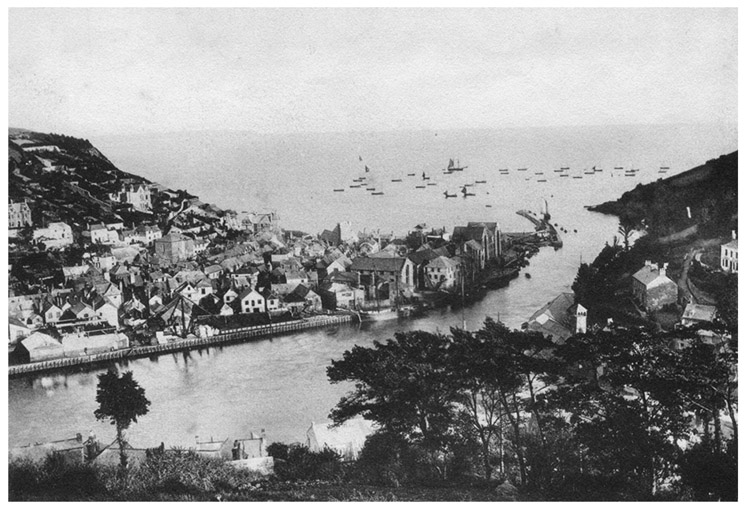
16.4 Looe and its Fishing fleet Postcard (Helen Doe)
To individual misfortune was added, on occasions, the wholesale suffering of communities. In fishing villages the sudden failure of a fishery or changes in demand for certain types of catch could cause widespread hardship. The Napoleonic Wars, for example, as Tony Pawlyn notes, closed off the important Mediterranean market for Cornish pilchards. Alternatives were sought and, in July 1810, the West Briton reported with satisfaction ‘our increased demand in the West Indies’, where pilchards had been sold as food for the slave population.31 Yet less than two months later the same newspaper was complaining that the pilchard season had been poor, with ‘no more than 100 hogsheads . . . at Mevagissey, and but 70 in Mount’s-bay’.32 In September 1813 the West Indies were again mentioned as an important export market, while it was reported, more with relief than in desperation, that unsold pilchards could, when mixed with earth, make fine manure for crops.33 In 1815, when there was another poor season, some superstitious local fishermen blamed the appearance of a sea-monster, which had allegedly frightened away the pilchard shoals.34 They were also aware that drift nets, whose use within three miles of the shore had been made illegal in the preceding century in order to protect the pilchard fishery, were sometimes in clandestine operation around the Cornish coast. In April 1819, for example, prosecution was threatened against Edward Scantlebery of Polruan and Nicholas Thomas of Mevagissey for having ‘taken pilchards with drift nets within the distance of one league and a half from shore’.35 Following the peace of 1815 the Mediterranean was restored as a destination for Cornish pilchards and as late as May 1868 – in the midst of a very successful season – it could be asked rhetorically and with glee: ‘Who consumes the myriads of these oily but relishing little fish?’36 The answer, it was explained, was Genoa, which had purchased 3,730 hogsheads; Leghorn, with 2,273; Civita Vechia, with 500; Naples with 4,888½; and the Adriatic coast, with 2,411. Cornish fishermen, mostly strong Methodists, were not unaware of the irony of the situation that their livelihood was reliant to a considerable degree on the demand from Catholic Europe. As a local rhyme had it:
Here’s health to the Pope
And may he repent,
And lengthen six months
The term of his Lent.
It’s always declared
Betwixt the two poles
There’s nothing like pilchards
For saving of souls.37
Community suffering of a yet more disastrous kind was that occasioned by infectious disease. There was a fatal outbreak of cholera in Newlyn in 1832, said to have been brought back from Ireland by a local fisherman.38 Later, in the summer of 1849, the cholera outbreak that had swept across Europe found its way to Mevagissey. Many succumbed – ‘On Friday there were seven deaths, on Saturday three, on Sunday three, on Monday none, on Tuesday five, and on Wednesday one’,39 reported the West Briton on 27 July 1849 – and up to half the population was evacuated to neighbouring Portmellon so that houses could be fumigated. There was a sensation when, a few weeks later, a Mevagissey man ‘poorly in his bowels’ was landed from a fishing boat at Fowey. He was refused accommodation in the town but was made comfortable in a boat alongside the quay. The poor man died during the night. It was learned, however, that the fishing boat that had brought him was still somewhere in the vicinity. It was found upstream and towed to the harbour’s mouth, where it was ‘ordered off, with a direction not to come again on pain of being fired into’.40
Smuggling, Wrecking and Riot
This was no idle threat. Cornish coastal communities were not above taking the law into their own hands, or ignoring the law altogether, as the long tradition of smuggling showed. Smuggling in Cornwall had reached its zenith in the eighteenth century and was much reduced after 1805. Nonetheless, certain stretches of the Cornish coast, such as Cawsand and Mount’s Bay, remained notorious for smuggling until approaching half-century, by which time the hard-pressed Preventive men had got the upper hand. Smuggling operations were still usually in the hands of individuals – such as the infamous ‘Captain’ Harry Carter (1749–1809), the so-called ‘King of Prussia [Cove], who wrote his own Autobiography of a Cornish Smuggler.41 The Preventive men generally had their work cut out, for smugglers might be anywhere, as in November 1821 when the Gerrans preventive boat encountered ‘a fine boat in Truro River’ carrying 112 tubs and six ankers of illicit spirits.42 Earlier, in May 1818, the preventive boats from Polperro and Portwrinkle had discovered a sunken raft of contraband off Looe Island, containing some 160 ankers.43 There were numerous similar encounters – at Fowey, Portreath, Porthpean, Falmouth, Cadgwith, Mullion and other localities around the Cornish coast – and on occasions there were violent confrontations between Preventive men and smugglers.44 In January 1816, for example, a band of smugglers made an audacious raid on St Ives, carrying off a large quantity of contraband that only recently had been confiscated.45 In December 1828 a party of smugglers, ‘armed with pistols, bludgeons and knives’, was intercepted near Constantine churchtown by two Preventive officers who discovered ‘several horses laden with spirits, which had been run on shore without payment of duties’. As they attempted to confiscate the contraband the two officers were badly beaten, so much so ‘that the life of one of them is despaired of’.46
‘Wrecking’, another survival from the eighteen century that lingered into the nineteenth, could be equally savage. Shipwrecks remained frequent all around the Cornish coast and for many of the local poor they represented significant windfalls, important opportunities to acquire the necessities of life as well as, sometimes, a momentary taste of luxury. As the Cornish rhyme put it, explaining the moral economy of such plunder:
The Eliza of Liverpool came on shore
To feed the hungry and clothe the poor.47
In April 1815, for example, the Neptune of Fishguard came ashore near Godrevy, on St Ives Bay. According to contemporary reports it was descended upon immediately by ‘swarms of plunderers’, who set about relieving the ship of its cargo and much else. As one outraged observer exclaimed: ‘It is scarcely credible, though unfortunately too true, that some of the ruffians who assembled under pretence of protecting the property, actually robbed the Captain of his watch and plundered all the unfortunate seamen of the clothes they endeavoured to save at the risk to their lives.’48 Similarly, in October of that year, the Russian galliot Flora, on passage from Bordeaux to Riga, was wrecked on Praa Sands and immediately set upon by ‘the barbarians of Breage and Germoe’.49 In April 1826, when the French ship Ocean was driven ashore on Hayle Bar, the local pilots and seamen of St Ives gathered to render assistance to the stricken vessel and, ‘at the imminent hazard to their lives, rescued the crew’. However, this gallant example did not prevent ‘a number of persons from the adjacent villages’ from congregating ‘with the view of plundering the stores’. Indeed, it was noted with distaste that ‘the greater part of these miscreants were women, who carried off whatever they could lay their hands on’.50 As time went on the authorities became more successful in their control of wrecks, while the behaviour of local people moderated. However, when the Good Samaritan was wrecked at Bedruthan Steps on 22 October 1846 (at the height of the ‘Hungry Forties’ in Cornwall), a new version of the old rhyme appeared:
The Good Samaritan came ashore
To feed the hungry and clothe the poor,
Barrels of beef and bales of linen,
No poor man shall want a shillin’.51
Methodism, with its abhorrence of violence and concern for respectability, steadfastly opposed wrecking, although those Methodists implicated in smuggling were apt to rationalise it as merely ‘free-trading’.52 They did, however, object to fishing on the Sabbath, a matter of conscience that edged Methodists at St Ives and Newlyn ever closer to violence in the latter part of the century. By the early 1870s the behavioural patterns of the pilchard shoals began to alter noticeably (possibly as a result of changes in the Gulf Stream) and soon they had disappeared from the entire coast between Cawsand and Mevagissey, leaving the rump of the pilchard fishery around Newlyn and St Ives. Local fishermen attached some of the blame for this shift to the ‘foreign’ east-coast drifters that were increasingly operating in Cornish waters. They were said to be breaking up the shoals offshore before the more modest Cornish seining boats had had a chance to intercept the fish. Many seiners decided to switch from pilchards to mackerel, an attractive prospect after 1859 when the newly arrived railway facilitated penetration of the London market by fresh Cornish fish. However, the mackerel were also sought by intruding east-coast steam trawlers, which – with their greater range, flexibility and endurance – threatened to eclipse the Cornish seine boats altogether.53 Moreover, the ‘Yorkies’ – as the Cornish called the east-coast men – had no objections about working on the Sabbath. As the West Briton observed in 1877: ‘The Cornish fishermen suspend work on Sundays, but the east country fishermen, who come to St Ives in the season have no such scruples.’ The result, it was explained, was that in the previous season ‘there was a disturbance, and this year the St Ives men have again prevented the others from landing at the St Ives pier fish caught on Saturday night or Sunday’.54 The simmering resentment between the two groups of fishermen bubbled on for years and came to a head at Newlyn in May 1896 in an extraordinary paroxysm of violence in which the Cornish destroyed the entire catch – some 100,000 mackerel, it was said – landed by Lowestoft boats. Serious rioting ensued, leading to the deployment of 350 soldiers to Newlyn and the swift arrival in Mount’s Bay of three warships, measures designed to restore the peace but also to warn against future disturbance. The situation was smoothed over. But the resentment remained, with the Cornish fishing fleet under continuing pressure from the dominant ‘Yorkies’.55

16.5 A group of Polperro fishermen, taken at Osprey Cottage, using crab pots and barrels as seats Fishermen from l–r: Charles Jolliff (1808–1887) one time landlord of the Three Pilchards Inn, Charles Jolliff Jnr (his eldest son), James Curtis (married to Emily Jolliff, daughter of C. Jolliff snr) holding his daughter Kate Curtis b. 1874 Photographer: Lewis Harding c. 1877 (With permission of the Royal Institution of Cornwall)
Despite these ‘Newlyn Riots’, as they were known, Cornish coastal communities by the second half of the century had acquired a reputation for sobriety and respectability, a considerable contrast to the early 1800s, when a propensity for violence and disorder was thought to be commonplace. Indeed, by the later nineteenth century smuggling and ‘wrecking’ were already the stuff of romantic tales, aimed in part at an embryonic tourist industry hungry for stories of a wild and restless Cornwall. Here, as Simon Trezise shows in his contribution, the smuggler and wrecker were elevated to heroic status by authors such as the clergymen Robert Stephen Hawker of Morwenstow and Sabine Baring-Gould of Lewtrenchard (just across the Devon border).
Mariner Communities
In these more sober times the mariner communities came into their own. For the career sailor in Cornish coastal communities going to sea as a mariner offered the possibility of eventual promotion to master mariner and then the possibility of shareholding. This upward mobility and increased income led to a minor house-building boom in coastal communities in the latter part of the century, as highly successful master mariners and shipowners took full advantage of the opportunities that came their way. The progression from master to owner was often eased by the percentage commission offered on the value of homeward freight. Soon, throughout Britain, in places as disparate as Appledore in Devon, Whitby and Robin Hood’s Bay in Yorkshire and Polruan and Fowey in Cornwall, such coastal communities would boast imposing new houses built by retired master mariners as retreats, but from which they could still keep an eye on their shipping investments. They might even purchase a yacht or other pleasure craft, participating in the growth of maritime leisure activity, as described by Janet Cusack in her contribution below. The author Leo Walmsley was a keen observer of maritime communities in the early twentieth century, living at both Fowey and Robin Hood’s Bay. In his story set in fictional Bramblewick, based on Robin Hood’s Bay, he described the upward mobility enjoyed by the master mariners and shipowners: ‘The families that made money in commercial shipping (into which they moved from the narrower horizons of the local fisheries) left the old village by the shore and moved “Up Bank” to new brick villas which became the badge of success and differentiation.’56
Table 16.2 Cornish Pilots and Mariners Giving Evidence on Seamarks to the Commission on Lights, Buoys and Beacons, 1861
|
Name |
Residence |
Time at sea(yrs) |
Vessels commanded & remarks |
|
Pilots |
|||
|
Thomas Pentreath |
Mousehole |
20 |
Pilot boat John Wesley, Penzance |
|
Richard Pezzark |
Mousehole |
55 (39 as pilot) |
Pilot boats Resolution, Witherall |
|
John Dash |
St Mawes |
6 |
|
|
Richard Andrew |
St Mawes |
4 |
Pilot boat Andrews, 50 tons |
|
Nicholas Jenking |
St Mawes |
32 |
Nicholas Jenking 36 tons |
|
Richard Green |
Falmouth |
20 |
Pilot cutter No. 10, 45 tons |
|
John Chard |
Falmouth |
49 |
Pilot cutter No. 4, 47 tons |
|
William Cullis |
Cawsand |
17 |
Not commanded |
|
Henry Tonkin |
Falmouth |
40 |
Pilot cutter No. 6, Water Nymph, 45 t. |
|
James James |
Falmouth |
7 (pilot appr) |
Pilot boat Alarm, 45 tons |
|
William Vincent |
St Mawes |
25 |
Pilot cutter Vincent, 43 tons |
|
Mariners |
|||
|
Thomas Kennetts |
St Ives |
44 |
Mary St.I.110 t. Albert Fal.160 t. Edith Fal.460t |
|
Wm Stephens |
St Ives |
44 |
Vessels in foreign & coastal trade, incl steamer |
|
T. Duff |
Scilly |
28 (17 as master) |
Yacht Ariadne, 86 tons; Little Western, screw |
|
John Gibson |
Scilly |
30 (20 as master) |
Schooner, Allegro, 100 tons |
|
John Hacking |
Scilly |
28 |
Margaret & Jane, Scilly, 324 tons |
|
W.P. Rowe |
Scilly |
20 |
Not presently in command |
|
Luke Love |
Penzance |
39 |
Duke of Cornwall , Penzance, 76 tons |
|
James Tregarthen |
Scilly |
35 |
Shipowner |
|
William Spray |
Hayle |
34 |
Queen, 160 hp steamer, St Ives |
|
Thomas Shugg |
Hayle |
24 |
Cornwall, St Ives (not yet measured) |
|
Joseph Green |
Penzance |
45 |
Prima Donna, Penzance, 95 tons |
|
Philip Jones |
Penzance |
44 |
Schooner Ann ,Penzance, 53 tons |
|
George Bawden |
Penzance |
42 |
Schooner Venus, Penzance, 99 tons |
|
John Christopher |
St Ives |
16 (13 as master) |
Schooner Hornet, St Ives |
|
John Vivian |
Hayle |
45 |
Secretary, Hayle & British Steam Packet Coy |
|
Edward Hayes |
Truro |
42 |
Kate, 59 tons |
|
William Smith |
Pelman, Fenny |
38 (now retired) |
Susan Plymouth, William & Amelia, Fenny, etc |
Source: BPP, 1861, XXV, Report of the Commissioners … [on] Lights, Buoys and Beacons, pp. 449–79.
As in Yorkshire so it was in Cornwall and Devon, where, in a typical mariner community, almost every man was closely linked to the shipping industry. In Appledore (Devon) in 1851 46 per cent of the households were headed by a mariner, master mariner or a related category. At Portscatho in Cornwall in the same year 47 per cent gave their occupation as mariner or master mariner and in Polruan the figure was 55 per cent.57 Yet, despite the presence of these mariners, what made these localities so different from the other types of maritime community in Cornwall was the relative absence of men, who were routinely at sea on long-distance voyages. The 1851 census shows the large numbers of females as heads of households in such localities (for example, 39 per cent in Polruan), of which half were married women.58
Generally, locally owned and operated vessels recruited their crews in the local labour market and seafarers would normally opt to stay with these vessels if they returned regularly to Cornish ports. This was especially likely in ships in the coastal trade. In 1861 Cornish pilots and ships’ masters gave evidence to the Commission on Light Buoys and Beacons. Although many had ample experience of overseas voyaging, what was noticeable (see Table 16.2) was their apparent rootedness in Cornish ships.
However, the many foreign-going vessels, trading wherever their cargo bookings demanded, could be absent from Cornish ports for extremely long periods. Cornish seafarers were also to be found in these ships, as indeed they were in vessels owned and operated in other parts of the British Isles, which rarely or never called at Cornish ports. In this way, many Cornish mariners were part of the growing international pool of seafarers from which British shipowners in the nineteenth century increasingly recruited their crews. They could be absent from Cornwall for many years, accounting for the relative absence of men in mariner communities. The career of Richard Behenna (1833–1898), a mariner from Veryan, neatly illustrates this experience. Initially, in the early 1850s, as his diary shows, he was engaged in coastal voyaging around Britain:
The next day we went on bord our new ship – or new to us – which was called ‘Little Lize’ of Plymouth. We left Plymouth on the third day after for teignmouth. Loaded machinery ther for Par. . . . We loaded china stone for glaskow. . . . We loaded in glaskow for Par with coal . . . took us a week to get to par. We loaded cooper oire in par for Swansea. We made several voyages between swansea and par and neath and britenferry. . . . I left the ‘Little Lize’ Then I shipped in a shonner called ‘truth’ of fowey, and sailed for levan in the furth fouth in Scotland. We loaded Potatoes their for London, and from London back to par, and from par to Midlesbrough, and from ther to Dundee. We discharged her but could not get loaded ther, so went to Levan to Load herins and Potatoes for London.59
Later, however, Behenna found himself en route to Malta and subsequently to India in ships sailing out of London or Liverpool with multi-national crews. He had moved decisively from the British coastal cycle, with its frequent returns to Cornwall, into foreign-going seafaring, taking him on long voyages to global destinations. In April 1857, for example, he was in London aboard the Irish ship Mary Hardy, registered in Cork, bound, as he put it, for ‘Barbodas in the west indies’.60 Loaded there with sugar, the Mary Hardy returned to London, where on arrival Behenna signed on in the troopship Surrey, bound shortly for Calcutta.
The extended absence of husbands, fathers and sons was perhaps a double-edged sword – women were given the necessary space to develop their capacities as heads of households and business managers, yet kinfolk and loved ones would be sorely missed by those left behind as well as those at sea. For some, this was as unsettling as it was stressful, a situation that contrasted strongly with Leo Walmsley’s benign image of snug mariner communities in which steady upward mobility culminated in financial security and the comfortable contentment of retirement. Here, too, was a reminder that, as in all coastal communities, earning a living from the sea continued to be fraught with uncertainty and sometimes loss. Being a mariner was a high-risk occupation. In Britain in 1878 alone 2,867 lives were lost from both steamers and sailing vessels. Many deaths were the result of shipwreck but, as the Registrar General pointed out in his 1858 report to Parliament, low standards of cleanliness, ventilation and diet also took their toll: ‘The mortality among this important body of men is higher than it should be among men of their ages and physical advantage.’61
Maritime Casualties and Rescue
That said, shipwrecks often involved catastrophic loss of life and were hugely destructive of property. Some localities, such as the Padstow Doom Bar (the great sand bar across the entrance to Padstow harbour, said to have been thrown up by an angry mermaid),62 were the scene of almost constant founderings. In the great storms of March 1869, for example, there was a procession of wrecks in and around Padstow. The schooner Pearce was driven onto the Doom Bar, while the Sarah Williams ran ashore in nearby Hell Bay and the Prussian barque Devitz was wrecked on Gull Rock. Other ships limped into Padstow harbour in a frightful state of disrepair, with sails ripped, boats smashed and jib-booms lost.63 The Manacles, a cluster of rocks (submerged at high tide) off the Lizard, was another notorious spot. On 3 May 1855 the emigrant ship John, bound for Canada, was wrecked on the Manacles, with 196 lives lost. Of the corpses washed ashore, 190 were interred in the local churchyard at St Keverne. Forty-three years later there was another mass loss of life at the same place, when the steamship Mohegan, en route from London to New York, went down on the Manacles. Most of the 113 casualties were buried at St Keverne.64
Such tragedies spurred coastal communities into action, increasingly as life-savers rather than the wreckers of earlier years. Local ad hoc response had led as early as 1840 to local committees providing lifeboats at St Ives and Bude, and to the Lifeboat Institution (later the RNLI) provision at St Mary’s (Scilly) and Padstow, all of course manned by volunteers. By 1896 the RNLI had boats at eighteen Cornish locations. Additionally, responding to the Report of the Select Committee on Shipwrecks, 1836, the Board of Trade had provided rescue equipment (including rocket apparatus) at locations all around the British coast, including many in Cornwall, manned by volunteer companies of men. One example of rescues performed by such groups was the assistance rendered to the American ship William Tapscott in 1888, as told by her master. ‘I sailed from Rio de Janeiro . . . on January 12’, he explained, and near Bude ‘on the night of March 29, in thick weather, with an unusually strong current running in-shore against an ebb tide, the vessel struck ground and finally remained fast about 11 o.clock’. Then, he added, ‘we at once sent up signals of distress’. He continued:

16.6 Siren Fog Horn
Source: Fredrick Whymper, The Sea: Its Stirring Story of Adventure, Peril and Heroism (London, Cassell, nd. 1880s), Vol. 4, p. 289
About twenty-five minutes after our signals were sent up, the Bude Bay Lifeboat Brigade sent up rockets to indicate to us that that our signals had been seen, and in a remarkably short time thereafter a line was fired to the ship, which unfortunately missed us; a second line was then fired, and fell right amidships; but being too high out of our reach we were unable to use that means of succour . . . we launched our best boat into which all hands got. Soon after we left the ship a third rocket line was sent out, and . . . arrived in the place required. . . . by means of the second line we were enabled to steady the boat and haul ourselves ashore. . . . As we neared the shore the lifeboatmen and the coastguardmen ran out into the waters as far as possible, and laid hold of the line to haul us through the rollers.65
The exhausted crew was helped ashore and the local agent of the Shipwrecked Mariners’ Society, William Rowe, arranged accommodation for the sailors in the Bude Hotel. The particularly serious year of 1867, when approaching 200 vessels were lost in Cornish waters, certainly justified such provision.66 But even lifeboats and coastguards were on occasion helpless in the face of the elements and could themselves become casualties. In February 1867, for example, in that fateful year, the Georgina of Boston was driven onto the Doom Bar. The Padstow lifeboat went to its assistance but, unable to reach the vessel, attempted to return to port. This proved impossible in the heavy seas, and so the lifeboat made instead for neighbouring Polzeath, where unfortunately it overturned in the surf, drowning five out of the thirteen crew. Meanwhile, the Georgina had been blown onto the rocks and was lost, with one crew member drowned and the remaining four saved.67
Even in the 1890s Cornwall was experiencing upward of fifty casualties a year.68 One of the most notorious and serious shipping disasters of the nineteenth century occurred in 1875, when the SS Schiller, bound for Plymouth from New York, ran aground in fog not far from Bishop Rock Lighthouse in the Isles of Scilly. It seems likely that the effect of poor weather had been exacerbated by indifferent navigation. Whatever the case, this catastrophe, dubbed the ‘Victorian Titanic’ by a recent writer, resulted in huge loss of life – about 340 out of about 380 on board – and raised levels of press comment and recrimination on both sides of the Atlantic similar to those that followed the 1912 disaster.69
By the 1880s the charitable response to seafarers in need was well established and co-ordinated.70 Earliest on the scene were the various seamen’s missions, dating from 1818, which provided religious and social support. These were promoted nationally by the Penzance-based Baptist minister the Revd George Charles Smith. At Newlyn there was a seamen’s chapel in 1820, while both Saltash and Torpoint had Seamen’s Bethel Union Societies in 1821. At Falmouth, the British & Foreign Sailors Society had a seamen’s chapel and institute facilities from 1849. The Missions to Seamen was active in Falmouth, Fowey and Par from the 1850s and the Seamen’s Christian Friend Society ran Fowey Sailors’ Home and Rest from 1890, its staff visiting other south Cornish ports in the mission smack. Perhaps most important, however, was the Royal Cornwall Sailors’ Home (1852) at Falmouth, which provided residential accommodation for seafarers and operated a seamen’s hospital which catered largely for men arriving in Falmouth from overseas voyages who were ill or had been injured. Men rescued in the open sea by other ships were often landed at Falmouth and were first cared for at the Sailor’s Home. Finance for temporary accommodation, food, clothing and eventual travel home was provided by the local agent of the Shipwrecked Mariners’ Society (1839), often associated with one of the organisations noted above.

16.7 Falmouth Seamen’s Bethel [BFSS]
Source: Chart & Compass Sailors Magazine 17 (1895), p. 277
The frequency of wreck around the Cornish coast emphasised the requirement for accurate navigation and for the speedy adoption of new navigational technologies as they became available. After all, in addition to the not inconsiderable coastal and international trade associated with Cornwall’s industries, much of Britain’s coastal shipping passed within sight of Cornish shores, as did the increasing number of oceanic vessels for which Cornwall was at the beginning and end of long global voyages. Advances in ship construction, and in the application of new materials and new methods of propulsion, were part of the pattern of improvement. There was an early iron steamship construction industry based in Hayle, that most go-ahead of Cornish ports, although, as Roy Fenton shows in his contribution, despite this early enterprise, Cornwall would become only a minor player in the developing steamship world.
Navigational safety was also improved through technological advance, which was generally international rather than local and followed a variety of paths during the nineteenth century. From the landward perspective, the most obvious features were the introduction or improvement in coastal marking in the form of unmanned and manned, unlit and lit devices (including fixed marks such as beacons and houses) and floating marks such as buoys and light vessels. Most prominent and significant in engineering and landfall terms were the headland and rock lighthouses. To those established in the eighteenth century were added by 1860 St Anthony’s Point (1830, Falmouth Harbour), Bishop Rock, Isles of Scilly (1858), Godrevy (1859), Trevose Head (1859, high and low lights), Lundy (1803, two lighthouses) and Seven Stones, Isles of Scilly (1826, light vessel).71 In addition, Smeaton’s Eddystone Lighthouse was replaced in 1882. Unlit beacons were provided at Scilly (1848, Woolpack and Crow Rock), Rundlestone Rock (1821, high and low), Lizard Point (1859, Vrogue), Falmouth Harbour (1838, Black Rock), Mount’s Bay (1850, Cressar and Raymond) and Gribbin Head (1832).72 All these coastal marks came under, or were established by, Trinity House, the lighthouse authority for England and Wales following the partial unification of provision in the 1830s.73 In addition, some harbour authorities improved local beacons and buoyage within their harbour limits, although by 1860 only Penzance, St Ives and Saltash had made any light provision.
Critical to coastal passages was the efficiency and reliability of the lights fitted to the marks.74 Oil fuel replaced candles and coal, mirrors and then fresnel lenses focused lights into beams, coloured shades allowed the dangerous sectors to be lit in red and safe sectors in green and mechanical apparatus rotated the lenses to create the coded flashes typifying modern lights, offering a means of distinguishing adjacent lights from each other. Further, a range of sound signals, essential in fog, including horns, whistles and explosive sound, was developed and installed at lighthouses and beacons. Buoys were fitted with bells or whistles sounded by wave action. In the 1860s the Seven Stones light vessel sounded a gong and at Godrevy a bell was rung mechanically. Time balls were visual signals to provide mariners with an accurate time by which to set their chronometers. Over 150 were established worldwide in the late nineteenth century and one eventually positioned in 1897 on top of the tower at Pendennis castle remained until it was overtaken by the telegraph signal in 1920.75
Following the formation of the Admiralty Hydrographic Office in 1795 further surveys in Cornish waters improved the accuracy of local charts. As the nineteenth century progressed the Office took responsibility for the systematic production of navigational data, including charts, tidal prediction tables and tidal stream data, lists of lights and marks, sailing directions and notices to mariners with the latest information, including corrections. By the end of the century Cornish waters and coastlines were thoroughly covered and shipping had no excuse for not accessing all the relevant information.
Marine Insurance
Despite these navigational improvements numbers of shipping casualties were not curtailed. Increased numbers of ship movements meant more ships collided, foundered or grounded, while better recording and public concern improved awareness of the numbers of incidents. Environmental factors, including visibility, gales and tidal factors, were ever present, as were human error, overloading and poor maintenance.76 Marine insurance, designed to ameliorate the worst effects of such misfortunes, is a largely unexplored, yet vital, component of the shipping industry that developed considerably during the nineteenth century.77 As we have seen, shipping was inherently a risky business. Mary Hicks Hayes of Fowey, for example, a managing owner, saw fifteen of her twenty-two ships wrecked or lost at sea before her death in 1908, with three being lost in one year, 1878.78 Between 1872 and 1878 the annual percentage of notifiable casualties to sea-going sailing vessels insured with Lloyd’s remained around 20 per cent.79 As the century continued sailing ship casualties increased and many were related to incidents involving steamships. Some risks could be reduced by taking out insurance. Lack of insurance could be financially disastrous and yet many shipowners took this risk. The men and women who owned the Thetis of Fowey took an early decision not to insure, with calamitous consequences when the vessel was wrecked only four years later.80
While Lloyd’s of London was the most prominent name in shipping insurance there were many other sources of insurance cover. A key development was mutual insurance. In the South West, and also in the North East of England, there was an aversion to Lloyd’s, as shipowners believed, in some cases rightly, that Lloyd’s was biased towards London-built ships. Lloyd’s was also seen as very expensive, and so many shipowners formed local mutual marine insurance clubs. Here shipowners came together to insure each others’ ships and share risks. Originally it was a practice confined to regular trades, such as coal and timber, and developed from ‘the confidence which shipowners entertained in each other’.81 The groups were small, everyone knew each other and an annual premium was paid, this pool becoming the fund out of which claims were settled – with further calls on members, should the need arise. Administration costs were kept low, often with just a part-time secretariat, and the Clubs operated on a non-profit basis. By the early nineteenth century there were many such Clubs based around the British coast.82 Basil Greenhill, in his Merchant Schooners, has explained the simple administration of the Appledore and Braunton clubs in Devon.83
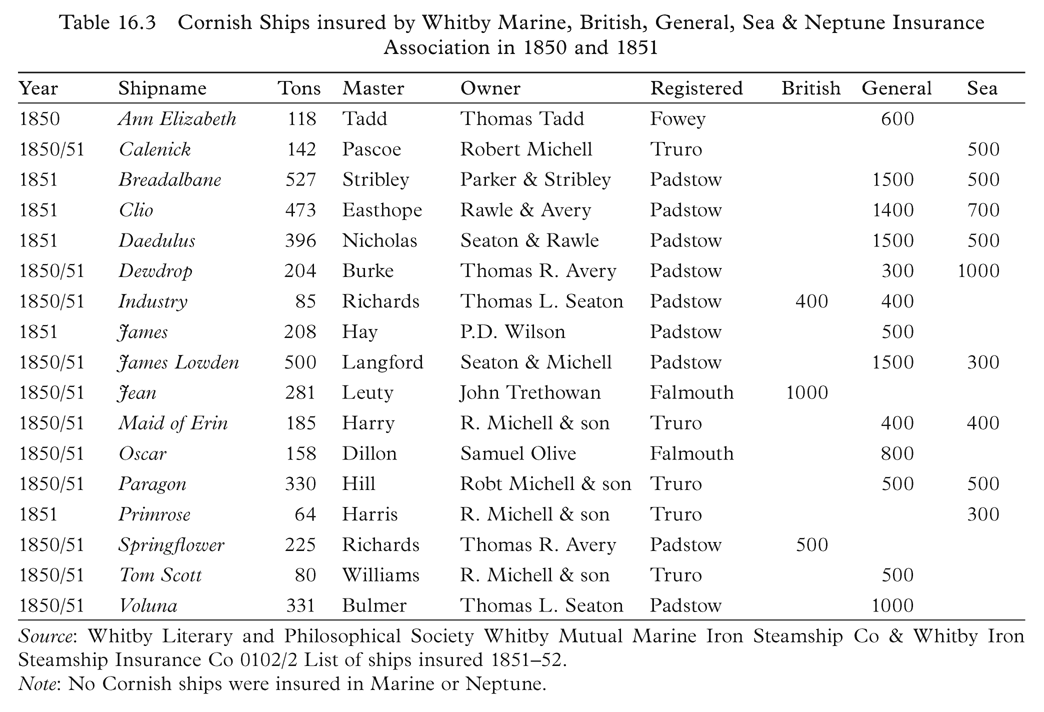
In the nineteenth century there were mutual clubs at Padstow and Newquay. The Newquay (Cornwall) Mutual Marine Insurance Association Limited was established in 1869. By 1892 it still insured 40 vessels in its A1 class and 128 in Class 3, their values ranging from £250 for Cornish Lass of St Agnes to £2,000 for Undine at Fowey and £2,200 for Ringleader of Portreath. Neither Falmouth nor Fowey had a local club and so James Hayes, a shipbroker and shipowner of Bodinnick, near Fowey, insured his ships with the Padstow Shipping Club. Likewise, in the early twentieth century John Hocken of Fowey was insuring with Samuel Allport & Son, who managed the Padstow Shipping Assurance Association Limited. Shipowners did not automatically join the nearest local club. The Newquay club had owners based in Devon, Monmouth, Southampton and even Jarrow-upon-Tyne and Glasgow.84 The Whitby Marine, British, General, Sea & Neptune Insurance Association in 1850 had members from other areas outside Whitby, including Liverpool, Gloucester, Carnarvon and Exeter, and with many from Cornwall (Table 16.3). In Cornwall in the 1870s more clubs were established in response to greater financial threats. There was a club in St Ives in 1876 and in 1877 the Truro Mutual Marine Insurance Association was set up ‘considering that merchant vessels of good classification might be insured mutually for much less rates than those current at Lloyd’s’. At a meeting held at the Truro Public rooms it was noted that seventy-four vessels were insured and that ‘several shipowners had signified their intention of joining the Association on 20 March next year’.85
Initially clubs insured only the hull of the ship, but during the nineteenth century public attitudes about risk began to change as a result of high-profile railway accidents. This led to calls for individuals or their relatives to be able to sue for damages. Liabilities increased, particularly at a time of increased numbers of emigrant ships. Additionally, with greater numbers of ships and the change to iron and steam and larger vessels, port authorities became increasingly concerned about damage to infrastructure and wreck removal. In 1855 the first Protection and Indemnity Clubs (P&I) were formed in the North East and at Topsham, Devon, to provide the cover that the hull clubs did not. Once again, these were mutual clubs.86
There is no evidence of any P&I clubs in Cornwall in the nineteenth century, but by the beginning of the twentieth century shipowner liabilities had become considerable. Employers’ liabilities for crews were included in the 1906 Workmen’s Compensation Act, although many shipowners (and their clubs) often paid compensation voluntarily. In addition, sailing ships were by now considered high risk from an insurance perspective. These developments made many small clubs unviable and their members joined larger national clubs. The Sailing Ship Mutual Association (later Steamship Mutual Underwriting Association) became a major insurer of some of the last Cornish sailing ships, and one Cornish shipowner, Theophilus William Couch, was a prominent member of the Committee.87 Couch hailed from the tiny china-clay port of Pentewan. He was the last in a family of shipbrokers and managed the Mary Miller, Polly & Emily and Conoid. He had been a member of the Association throughout the First World War and a Committee member from 1920, travelling to London for the meetings until his death in 1933.88
Maritime Education and Training
The emergence of marine insurance was one response to the risks inherent in the shipping business. Another was the insistence that standards of maritime education and training should be improved. The rapid expansion in the numbers of ships increased and exposed the impact of weaknesses in these areas. The problem was examined in a series of Parliamentary investigations of which perhaps the best known was the Select Committee on Shipwrecks, 1836, led by Cornish seaman–explorer and MP James Silk Buckingham (1786–1855), who was born in Flushing, across the harbour from Falmouth.89 All the main recommendations of this Committee were eventually adopted into the massive body of shipping safety legislation which came into force during the century.
From mid-century masters (such as those shown in Table 16.2) were required to hold government certificates to command foreign-going ships. But no location for sitting the examinations was provided in Cornwall, forcing candidates for the second mates, first mates and masters examinations (from 1851), and for first- and second-class engineers examinations (from 1862), to travel to Plymouth.90 The long-term effect was that the number of locations in Cornwall where navigation and seamanship was taught dwindled during the century and such specialist schooling became concentrated in the Plymouth School of Navigation, opened in 1862. However, despite this lapse in civilian provision, there was (in addition to certain charitable provision) an enduring connection between Cornwall and the training of boy seamen for the Royal Navy. This was enhanced in the 1850s, when the Navy adopted a structured approach to training its manpower, basing its provision in stationary training ships (hulked redundant naval vessels). Those moored in River Tamar, HMS Implacable (1855), HMS Impregnable (1862) and their successors, interacted principally with Devonport and Plymouth, although the Cornish bank of the river was by no means untouched by their presence.
More significant for Cornwall was the stationing of a further training ship, HMS Ganges, in Falmouth harbour, off St Mawes, between 1866 and 1899.91 Working to a national naval standard, Ganges provided a full training in seamanship for 500 boys. This encompassed every aspect of the structure, operation and maintenance of a sailing warship. Boys were admitted in their mid-teenage years, subject to a medical test and other criteria, and they were also provided with an elementary schooling, boat training and swimming instruction. From 1883, like all ratings in other training ships, they were educated according to the Navy’s own specialist training manual.92 Interaction with local communities was through sporting fixtures, shore leave and parades at events such as local fetes, often involving the ship’s volunteer band and other demonstrations. Ganges was moved to Harwich in 1899, but by then the Devon and Cornwall Training Ship Association (1877), a charity, had established its industrial training ship Mount Edgcumbe, a hulk lent by the Navy, moored in Saltash Passage.93 This was licensed by the Home Office for 250 boys under the Industrial Schools Acts and was mainly for homeless and destitute boys. It combined elementary schooling with the Royal Navy seamanship programme. Coming from deprived backgrounds, only a small proportion of its boys could reach the Navy’s medical standards and most found careers in the mercantile marine or the army. Mount Edgcumbe closed in 1920, the ship worn out and no funding being found to move to premises ashore. There was a similar ex-naval hulk moored in Falmouth harbour, TS Foudroyant (previously HMS Trincomalee), which was purchased for youth training in 1897 by the philanthropist George Wheatley Cobb. The ship remained at Falmouth until 1930, when it was moved to Milford Haven.
Marine Communications
Alongside navigational advances, the growth of marine insurance and improvements in maritime education and training, the professional management of shipping at sea was also enhanced by developments in communications. Commercial, diplomatic, military and other intelligence depended on the speed of information transfer, which was why the Post Office packet service linking Britain with her overseas interests came to be based at Falmouth from the late seventeenth century.94 This strategic provision was passed to the Royal Navy in 1823 but the use of increasingly obsolete naval brigs in the packet service proved less than satisfactory.95 Superior civilian steamship services were soon competing on packet routes and in 1840 the Post Office transferred the Atlantic mails to steamships sailing out of Liverpool. Thereafter, the viability of the Falmouth services was eroded and the packet station there was closed at the end of 1850.
However, despite this loss, Cornwall remained important in the international communications network. The networking of electric telegraph ashore from the 1840s linked Cornwall to a wider communications system, as did the development of sub-sea cable links.96 Although important submarine telegraph cables came ashore in Ireland, from mid-century Cornwall was linked by cables to the Mediterranean region as well as to North America. These Cornish cable links, in turn, became part of a global network, linking Britain with its Empire and other interests worldwide, the complexity of submarine cables all coming ashore ultimately at Porthcurno, near Land’s End, where a strategic electric telegraph station was established.97
Likewise, despite the loss of the packet service, Falmouth remained a leading British ‘orders port’ (though second behind Cork/Queenstown in Ireland) for ships bound for western European destinations and seeking instructions for their discharge arrangements.98 This remained the case until, in the twentieth century, merchant ships were widely fitted with wireless telegraphy equipment. Similarly, the establishment of the chain of Lloyd’s Signal Stations was significant in speeding the transmission of orders, those in Cornwall being located at the Isles of Scilly, Penzance and the Lizard, the last being by far the most important.99 Visual signalling (semaphore, commercial code flags and flashing morse code) remained important well into the twentieth century.100 Admiralty coastal signal stations had been set up at Land’s End (1812) and Newford Down, Scilly (1814) for wartime use and in mid-century storm signal stations were established by the Meteorological Office at Mevagissey, the Isles of Scilly, the Lizard, Falmouth and Pendennis Castle, this last location also providing a time signal at 1 pm GMT.101 At the end of the nineteenth century such locations were among the first to receive telephone connections. In 1901 Marconi opened a wireless telegraphy station at the Lizard and conducted his famous trans-Atlantic experiments. That station was taken over by the Post Office in 1908, and in 1913 moved to become Land’s End Radio, an iconic example known to merchant ships the world over.102 The little-known parallel to Marconi’s invention, wireless communications for naval use, developed by Captain Jackson in his stationary training ship, HMS Defiance, also took place in Cornish waters, the hulk being moored on the Cornish side of the River Tamar off Weard Quay, near Saltash.103
Conclusion
The ‘long nineteenth century’ had witnessed significant change in maritime Cornwall. The dramatic rise, faltering and eventual near demise of Cornish hard-rock mining, only partly ameliorated by the growth of china-clay extraction, had affected the pattern of coastal and international trade in minerals. One by one many of the minor quays were abandoned, while the larger ports turned to other activities. There were the first hints of what would soon become a booming maritime leisure industry, observable at first in the expansion of yachting. But more noticeable, and of greater immediate social and economic consequence, was the mass emigration from both mining and agricultural districts throughout the century. Ports and harbours, large and small, became the focus for a complex ‘emigration trade’ that managed this wholesale movement of Cornish men, women and children to destinations across the globe. Changes in the fishing industry, too, added to the difficulties experienced by some Cornish coastal communities, leading to the gradual decline of the pilchard fishery and, with it, the fading fortunes of the Cornish fishing fleet. But other communities prospered and Cornish mariners, master-mariners, shipowners and shipbuilders benefited from the general expansion of British shipping in this period, with Cornish seafarers finding a niche for themselves in the international pool of seamen from which the shipping industry selected its crews.
Social conditions in Cornish maritime communities gradually improved as the century wore on. But outbreaks of disease and the casual violence associated with the moral economy of smuggling and wrecking continued to make life dangerous and unpredictable, especially in the earlier years. However, the extension of the rule of law, together with the ‘improving’ influence of Methodism, ameliorated the worst excesses of human behaviour, while advances in hygiene and medical treatment kept epidemics in check. But the sea itself, in its varying moods, and the inhospitable coastline meant that shipwrecks and other hazards of the maritime environment were ever present. This was as true at the beginning of the twentieth century as it had been at the close of the eighteenth. However, in areas as disparate as lifeboat and coastguard provision, charitable responses to seafarers’ needs, advances in navigational and communications technology, the growth of marine insurance and improved standards of maritime education and training the risk inherent in maritime activity was eventually addressed. To that extent, maritime Cornwall had become a safer place.
Notes and References
1 Philip Payton, The Making of Modern Cornwall: Historical Experience and the Persistence of ‘Difference’ (Redruth: Dyllansow Truran, 1992).
2 John Rowe, Cornwall in the Age of the Industrial Revolution (Liverpool: University of Liverpool Press, 1953); D.B. Barton, A History of Copper Mining in Cornwall and Devon (Truro: Bradford Barton, 1961; 1968 rev. edn); D.B. Barton, The Cornish Beam Engine (Truro: Bradford Barton, 1965); D.B. Barton, A History of Tin Mining and Smelting in Cornwall (Truro: Bradford Barton, 1967); Ian Soulsby, A History of Cornwall (Chichester: Phillimore, 1986), pp. 91–101; Philip Payton, Cornwall: A History (Fowey: Cornwall Editions, 2004), pp. 180–236; Bernard Deacon, Cornwall: A Concise History (Cardiff: University of Wales Press, 2007), pp. 94–179.
3 Edmund Vale, The Harvey’s of Hayle (Truro: Bradford Barton, 1965); W.H. Pascoe, The History of the Cornish Copper Company (Redruth: Dyllansow Truran, 1981).
4 D.B. Barton ‘Portreath and its Tramroad’, in D.B. Barton, Essays in Cornish Mining History, Vol. 2 (Truro: Bradford Barton, 1970), pp. 126–58.
5 Cyril Noall, The Story of Cornwall’s Ports and Harbours (Truro: Tor Mark Press, 1970), p. 24.
6 D.B. Barton, The Redruth and Chasewater Railway, 1824–1915 (Truro: Bradford Barton, 1961; 1978 3rd edn).
7 Royal Cornwall Gazette, 5 June 1830.
8 West Briton, 8 August 1856.
9 Trewman’s Exeter Flying Post, 25 December 1800.
10 West Briton, 18 July 1862.
11 West Briton, 5 April 1850.
12 John Keast, The King of Mid-Cornwall: The Life of Joseph Thomas Treffry, 1782–1850 (Redruth: Dyllansow Truran, 1982).
13 West Briton, 28 February 1862.
14 Helen Harris and Monica Ellis, The Bude Canal (Newton Abbot: David & Charles, 1972).
15 Dudley Baines, Emigration from Europe, 1815–1930 (London: Macmillan, 1991), pp. 7–8.
16 Dudley Baines, Migration in a Mature Economy: Emigration and Internal Migration in England and Wales, 1861–1900 (Cambridge: Cambridge University Press, 1985), pp. 157–59.
17 See Philip Payton, The Cornish Overseas: A History of Cornwall’s Great Emigration (Fowey: Cornwall Editions, 2005).
18 Philip Payton, ‘“Reforming Thirties and Hungry Forties”: The Genesis of Cornwall’s Emigration Trade’, in Philip Payton (ed.), Cornish Studies: Four (Exeter: University of Exeter Press, 1996), pp. 107–27; see also for comparison Mark Brayshay, ‘The Emigration Trade in Nineteenth-Century Devon’, in Michael Duffy, Stephen Fisher, Basil Greenhill, David Starkey, Joyce Youings (eds), The New Maritime History of Devon, Vol. II: From the Late Eighteenth Century to the Present Day (London: Conway, 1994), pp. 108–18.
19 West Briton, 23 June 1820.
20 West Briton, 10 March 1837.
21 See Margaret James-Korany, ‘Blue Books as Sources for Cornish Emigration History’, in Philip Payton (ed.), Cornish Studies: One (Exeter: University of Exeter Press, 1993), pp. 33–36.
22 Basil Greenhill and Ann Giffard, Westcountrymen in Prince Edward’s Isle: A Fragment of the Great Migration (Newton Abbot: David & Charles, 1967).
23 John Bartlett, Ships of North Cornwall (Padstow: Tabb House, Padstow, 1996), pp. 84–90.
24 West Briton, 30 August 1839.
25 West Briton, 13 February 1835.
26 West Briton 23 March 1838.
27 See Philip Payton, ‘Cornish Emigration in Response to Changes in the International Copper Market in the 1860s’, in Philip Payton (ed.), Cornish Studies: Three (Exeter: University of Exeter Press, 1995), pp. 60–82.
28 West Briton, 27 March 1818.
29 West Briton, 13 October 1820.
30 West Briton, 24 April 1857.
31 West Briton, 20 July 1810.
32 West Briton, 14 September 1810.
33 West Briton, 2 September 1813.
34 West Briton, 20 October 1815.
35 West Briton, 30 April 1819.
36 West Briton, 7 May 1868.
37 Keith Harris, Hevva! Cornish Fishing in the Days of Sail (Redruth: Dyllansow Truran, 1983), p. 1.
38 West Briton, 5 October 1832.
39 West Briton, 27 July 1849.
40 West Briton, 17 August 1849.
41 J.B. Cornish (ed.), The Autobiography of a Cornish Smuggler: Captain Harry Carter of Prussia Cove, 1749–1809 (1884 rep. Truro: Bradford Barton, 1971).
42 West Briton, 2 November 1821.
43 West Briton, 15 May 1818.
44 West Briton, 2 January 1818, 7 April 1815, 10 July 1829, 2 April 1830, 3 April 1835, 22 May 1835, 24 May 1839.
45 West Briton, 5 January 1816.
46 West Briton, 5 December 1828.
47 John Vivian, Tales of the Cornish Wreckers (Truro: Tor Mark Press, 1969), p. 3.
48 West Briton, 21 April 1815.
49 West Briton, 7 October 1815.
50 West Briton, 14 April 1826.
51 A.K. Hamilton-Jenkin, Cornwall and its People (Newton Abbot: David & Charles, 1973), p. 66.
52 Cyril Noall, Smuggling in Cornwall (Truro: Bradford Barton, 1971), p. 12.
53 West Briton, 8 January 1891.
54 West Briton, 14 May 1877.
55 John Corin, Fishermen’s Conflict: The Story of Newlyn (Newton Abbot: Tops’l Books/David & Charles, 1988).
56 Loe Walmsley, The Phantom Lobster (London: Jonathan Cape, 1933; reprinted, Ottley 1992), pp.26–27.
57 See discussion on maritime communities in Helen Doe, Enterprising Women in Shipping in the Nineteenth Century (Woodbridge: Boydell and Brewer, 2009), pp. 33–51: See also Robin Craig, ‘Printed Guides for Master Mariners as a Source of Productivity Change in Shipping’, in Robin Craig (ed.), British Tramp Shipping, 1750–1914 (St John’s, Newfoundland: International Maritime Economic History Association, 2003), pp. 121–35, at p. 123; John K. Walton, ‘Fishing Communities, 1850–1950, in David J. Starkey, Chris Reid and Neil Ashcroft (eds), England’s Sea Fisheries: the Commercial Fisheries of England and Wales since 1300 (London: Chatham Publishing, 2000), pp. 127–37, at p. 131; Hilary Thompson, A History of the Parish of Gerrans, 1800–1914: Part 2, Mariners and Fishermen (Portscatho: Author, 1995), p. 5
58 Doe, Enterprising Women, p. 42
59 R.B. Behenna (ed.), A Victorian Sailor’s Diary: Richard Behenna of Veryan, 1833–1898 (Redruth, Institute of Cornish Studies, 1989), p. 12 (quotation is given as written).
60 Behenna, A Victorian Sailor’s Diary, p. 33.
61 Doe, Enterprising Women, pp. 42–45.
62 West Briton, 15 January 1847.
63 West Briton, 25 March 1869.
64 West Briton, 18 May 1855, 20 October 1898; see also Chris Holwill, ‘Mohegan’, the Cornish ‘Titanic’ (Plymouth, Tothill Publications, 2013).
65 The Shipwrecked Mariner 35 (July, 1888), pp. 179–80.
66 RNLI, Shipwreck Chart of the British Isles, 1867 (London: RNLI, 1868).
67 West Briton, 8 February 1867.
68 RNLI, Shipwreck Chart of the British Isles, 1895–96 (London: RNLI, 1897).
69 Keith Austin, The Victorian Titanic: The Loss of the S.S. Schiller in 1875 (Tiverton: Halsgrove, 2001).
70 This paragraph is drawn from Alston Kennerley, ‘Cornish Seamen’s Missions Since 1800’, an unpublished paper presented to the Cornish Maritime History Conference, Falmouth, 25 September 2004.
71 British Parliamentary Papers [hereafter BPP], 1861, XXV, Report of the Commissioners . . . [on] Lights, Buoys and Beacons, Volume II, pp. 88–94, 124.
72 Ibid., pp. 133–35
73 John Naish, Seamarks: their History and Development (London: Stanford Maritime, 1985), p. 127.
74 Naish, Seamarks, pp. 102–5. BPP, 1861, XXV, deals extensively with illumination.
75 Ronald S. Hawkins, ‘The Falmouth Timeball’, Troze 3:2 (April 2012), www.nmmc.co.uk, online journal of the National Maritime Museum Cornwall.
76 Alston Kennerley, ‘Maritime Casualties and Search and Rescue’, in Duffy et al (eds), The New Maritime History of Devon, Vol. II, pp. 20–24.
77 H.A.L. Cottrell and Edwin Green, The British Insurance Business (London: Heinemann, 1976); Sarah Palmer ‘The Indemnity in the London Marine Insurance Market, 1824–50’ in Oliver M. Westall (ed), The Historian and the Business of Insurance (Manchester: Manchester University Press, 1984), pp. 74–94.
78 Cornwall Record Office [hereafter CRO]: MSR/FOW Fowey Shipping Registers
79 Anon., ‘Lloyd’s Statistics of Marine Casualties for the Year 1878’, Journal of the Statistical Society of London 42 (1878), pp. 505–21, at p. 509.
80 Doe, ‘Waiting for her Ship to come in: The Female Investor in Nineteenth Century Shipping’, Economic History Review 63:1 (February 2010), p. 14.
81 BPP, Select Committee on Marine Insurance, 1810.
82 Palmer, ‘The Indemnity in the London Marine Insurance Market’, pp. 78–79.
83 Basil Jack Greenhill, the Younger, The Merchant Schooners, 2 vols (London: Percival Marshall 1951, 1957; repub Conway, 1988), pp. 126–27.
84 Newquay Mutual Marine Insurance Association Ltd, List of Ships insured March 1892; Bodmin Probate Office, Will of James Hayes, 1873; Account book of E S Hocken, private collection.
85 Royal Cornwall Gazette, 10 January 1879 (courtesy of Mr Mike Grose).
86 Takadata Imaizumi, ‘Transition of Shipowners’ Liability Laws and Changes of P & I Clubs in the UK (Part 1)’ Yokohama Business Review 10: 3 (1989), pp. 221–41.
87 Helen Doe, From Coastal Sail to Global Shipping: The History of Steamship Mutual Underwriting Association, 1909 to 2009 (London: Steamship Insure Management Services Ltd, 2009), pp. 3–12.
88 Ibid., p. 35.
89 BPP, 1836, XVII, Report of the Select Committee in Shipwrecks; David M. Williams, ‘James Silk Buckingham: Sailor, Explorer and Maritime Reformer’, in Stephen Fisher (ed.), Studies in British Privateering, Trading Enterprise and Seamen’s Welfare, 1775–1900 (Exeter: University of Exeter Press, 1987), pp. 99–119.
90 Alston Kennerley, ‘Education and Welfare of Merchant Seafarers’, in Duffy et al (eds), The New Maritime History of Devon, Vol. II, pp. 145–54.
91 D.L. Summers, HMS Ganges, 1866–1966: One Hundred Years of Training Boys in the Royal Navy (Shotley Gate, Suffolk, HMS Ganges, 1966); West Briton, 30 April 1888.
92 Lords Commissioners of the Admiralty, Manual of Seamanship for Boy’s Training Ships of the Royal Navy, 1883 (London, Lords Commissioners of the Admiralty, 1883).
93 Summers, HMS Ganges, p. 45; Kennerley, ‘Education and Welfare of Merchant Seafarers’.
94 Tony Pawlyn, The Falmouth Packets, 1889–1851 (Truro: Truran, 2003), p. 14.
95 Pawlyn, The Falmouth Packets, pp. 109–22.
96 Steven Roberts, The Universal Telegraph: the Lost Future of Telegraphy (2007) http://distantwriting.co.uk/privatetelegraphy.aspx [accessed 8 November 2007].
97 G.R.M. Garratt, One Hundred Years of Submarine Cables (London: HMSO, 1950), p. 31.
98 Alston Kennerley, ‘A North West European Shipping Communication and Servicing Hub: Falmouth for Orders, Repair and Supply, 1881–1935’, International Journal of Maritime History 22:1 (June 2010), pp. 111–38.
99 Lloyd’s Calendar, 1906 (London: Lloyd’s, 1905), p. 59.
100 See W.K. Stewart, Brown’s Signalling: How to Learn the International Code of Visual and Sound Signals (Glasgow: Brown Son & Ferguson, new edition 1947, reprinted 1950).
101 Geoffrey Wilson, The Old Telegraphs (Chichester: Phillimore, 1976), p. 66; Lloyd’s Calendar, 1906, pp. 66, 421.
102 www.coastal-radio.org.uk/landsend.htm [accessed 15 November 2007].
103 John Hooper, Captain Henry Jackson of HMS Defiance: Ship to Ship Communications Pioneer, Weard Quay, River Lynher and Other Wireless Contemporaries (Privately published, Cornwall 2007).