
CHAPTER 17
____________________________
Tony Pawlyn
In Cornwall, a predominantly coastal region, sea fisheries had always been important in the economy for domestic consumption, and well before the nineteenth century fishing was a distant water as well as a coastal water activity.1 Exporting processed fish was already an important dimension. The fishing fleet in Devon and Cornwall expanded during the century, reaching its height in 1891.2 As in other parts of the country there were innumerable locations, beaches and harbours in which fishing boats were based. Changes during the century would see the industry becoming concentrated in a few key fishing harbours. This chapter examines how the fishing industry developed in Cornwall through discussions of the four main sectors of fishing activity: pilchards, mackerel, white fish and shellfish.
The Pilchard Fishery
By the opening years of the nineteenth century the pilchard fishery was of national significance, as well as being the main commercial fishery of Cornwall.3 It was essentially an export fishery, to Italy and the Adriatic, and the ships involved in it returned with considerable Mediterranean trade. Despite the hiatus caused by the French Revolutionary and Napoleonic Wars, this branch of Mediterranean trade was never completely abandoned. In Mevagissey pilchard exports ranged from a low of 1,981 hogsheads to a high of 15,413 hogsheads between 1790 to 1803; the highest figure came in 1796, during the wars with France.4 Within a few years of the restoration of peace in 1815 exports had again almost resumed pre-war proportions. Much of the pre-war export trade had been in the hands of three Falmouth merchants, Fox, Carne and Groube. But, after the war, Carne and Groube drop out of the scene and the new exporting house of Thomas Bolitho & Sons, of Penzance, appears to rival G.C. Fox & Sons.
Pilchards were caught only by nets and two rival means of pilchard fishing were then in use: seine nets and drift, or driving, nets. The capital-intensive seine net fishery was mainly the preserve of prosperous merchants and wealthy landowners with longshore rights, although there were occasional communal seines set up from old gear and materials. The drift fishery, on the other hand, was entirely a poor men’s fishery, being composed of large numbers of small fishing boats, “pilchard drivers”, each manned by three or four men.5 Earning relatively low returns, this branch of the fishery attracted little capital investment and was financed co-operatively by small groups of fishermen, some of whom accrued modest financial reserves over time. A contemporary comment in 1845 was that the drift

17.1 Coiling the Warp: a St Ives Seine-boat crew preparing to take stem, c. 1890 (Tony Pawlyn collection)
is the poor man’s fishing, the seine is that of the capitalist. In the drift fishing one provides the boat, another a proportion for the nets, a third is too poor to provide either by himself but brings the nets of a party on shore, allowed for its use a proportion of share of the fish.6
These two branches of pilchard fishing differed in other respects. While the seine fishery was a passive shallow-water trapping process, the drift fishery was an active open-sea hunting occupation. During the pilchard season in Newlyn most of the seine crew were paid wages, but drift fishermen were self-employed. Seines operated for just a few months of the year and those months were a highly intensive but potentially lucrative period of activity. There were nineteen different seines in Mevagissey at this time, each with their own group of shareholders of up to seventeen people.7 Shareholders ranged from local individuals to big businesses, such as G.C. Fox of Falmouth. Each concern had its own boats, nets and cellars for processing the fish.8 In the nineteenth century there were many clashes between the seine proprietors and the drift fishermen, the former endeavouring to protect their vested interest, which was safeguarded by extensive legislation and promoted by influence, and of which the public were constantly reminded by prohibition notices and punitive court cases.9
The success or failure of the pilchard fishery was highly unpredictable for all parties, but especially for individual seining concerns.10 Each seine’s area of activity was closely confined and each was utterly reliant on the pilchards swimming into its patch of the sea. Allowing for the vagaries of shoal movements, sea temperature and weather conditions, the success or failure of each seining concern was more often a question of luck than judgement. The success or failure of one season had little or no bearing on the next. The fish might appear in an immense shoal, only for bad judgement or lubberly execution in shooting the seine to result in the loss of what might have been a sizeable enclosure of fish and, all too often, the one and only good chance of the whole season. Even so, the highly speculative nature of the seine fishery was in itself an attraction to adventurers inclined to gamble. Seining companies were induced to set up enterprises at almost every conceivable fishing station round the coast of Cornwall and a great many speculators were tempted to venture their capital in the seine fishery, so much so that by the 1870s more than 250 seine companies (each representing a claimed capital investment of about £1,000) were operating out of St Ives alone.11
Effective salt-curing took about five weeks and converted perishable fresh fish into a valuable preserved export product. So many colourful accounts of working conditions in the pilchard cellars and descriptions of the curing process having been published that it is unnecessary to cover these here, but the collective end result of all this frenetic activity was the production of thousands of hogsheads of pilchards each season, together with a by-product of many thousands of gallons of train oil, another highly saleable commodity.12
Exporting each season’s catch employed many vessels and, while a number of these were Cornish owned, the trade’s seasonal nature and unpredictability regarding volume year on year ruled against the accumulation of a large ‘home’ fleet of vessels. In the more productive seasons large numbers of vessels had to be chartered at short notice and many of these were foreign bottoms, particularly in time of war. Although cargoes of over 1,000 hogsheads were known, at five hogsheads to a ton (by volume), 500 or 600 hogsheads was considered a fair export cargo. Experience had also shown that such an amount would normally travel well, reduced risks of loss by wreck or seizure and would not glut a market on arrival. Accordingly, the most popular vessels for this trade were those of from 80 to 120 tons burthen, a characteristic which continued until the incursion of steamships in the 1860s.
Unfortunately there is very little data on the sale of fresh pilchards for private consumption in Cornwall. Traditionally quite large amounts were consumed, with most families salting away at least one bussa of pilchards for winter stock.13 Evidence given before a Parliamentary commission in 1866 suggested that fresh fish for local consumption came only from the drift fishermen.
Last year Mr Fox’s seines caught pilchards at Mevagissey, but he would not let his men sell one to the poor of the country. All of them were salted and exported, you will see therefore that if the drivers don’t catch fish to supply a quantity the poor people hereabout would starve.14
Fox’s records for the 1849–50 season suggest that about 10 per cent of the catch was being sold fresh, and there is no reason to suppose that this was not a typical year. In this period there was, outside of Cornwall, little or no domestic market for pilchards. Attempts were made in 1874 by G.C. Fox & Co. to break into new markets when they opened the first pilchard canning factory at Mevagissey, albeit under the label of the Cornish Sardine Co.
As indicated above, from the 1820s effective control of the Cornish pilchard export trade lay in the hands of two Cornish merchant houses, Fox of Falmouth and Bolitho of Penzance. Fox’s main sphere of influence lay to the east of the Lizard embracing Looe, Mevagissey, St Mawes and Falmouth, while that of the Bolithos lay to the west of the Lizard, covering Mount’s Bay, Sennen, St Ives and Newquay. Both acted mainly as commission agents, buying for other export/import houses and occasionally venturing small consignments of fish at their own risk. From the close of the 1822–3 season both houses issued ‘Pilchard Circulars,’ commercial newsletters to advise interested parties of the current market status. These circulars chronicled the season’s exports by individual vessels, their several destinations and prices ruling in Cornwall and at the various ports of import. While the earliest versions were simple manuscript lists by the 1847–8 season they had developed into comprehensive printed accounts.15 Circulars issued by one or other of the two houses have survived to leave a very full annual record of the pilchard export trade up to 1934–5. Of the two surviving archives that of the Fox family is the more extensive, covering the disposition of catches and merchants’ seasonal requests and also including a number of ‘fishery and market reports’ from Italian importers and others touching on Newfoundland and other cod shipments, North Sea herring, French and Spanish sardines and so on.16
During the 1859–60 season the SS Sicilian was listed as the first steamship employed in the pilchard trade, carrying 202 hogsheads from Liverpool to Venice, these having first been shipped to Liverpool by coastal steamer. This marked a significant shift in the dynamics of the trade. Whereas previously all exports had been in shiploads direct from Cornish ports to foreign ports of destination, now increasing amounts went by steamers via Liverpool or London. The dynamics soon shifted again when on 1 October 1864 the SS Macedon took the first pilchard shipments by steamer direct from Cornwall to Italy, carrying 300 hogsheads from Penzance to Genoa. A feeder line of coastal steamers plying between London and Liverpool now called regularly at Plymouth, Falmouth, Penzance and Hayle, enabling many small consignments to be dispatched for forwarding to Italian ports. A pattern soon emerged whereby these coastal steamers tended to carry small consignments of early and late season fish, while the steamers sailing direct from Penzance or Falmouth gradually took over the high-season bulk shipments. By the 1869–70 season over 52 per cent of all pilchard exports were consigned by steamers, with 38 per cent being shipped direct from Penzance.17
This trend towards steamers was interrupted during the 1871–2 season, when the immense amounts of fish taken and cured resulted in 45,779 hogsheads being exported. This was such a large quantity that merchants were forced to recourse to sailing vessels, particularly on account of 22,817½ hogsheads shipped direct from St Ives, virtually 50 per cent of the whole season’s catch. This alone employed thirty-one sailing vessels, while another 4,800 hogsheads were shipped in sailing craft from other ports. In all forty-two sailing vessels were employed that season, but, even so, more than 18,000 hogsheads were shipped to Italy by steamers. While the 1871–2 season was a good one for the fishermen and those employed on wages on the seines and in the curing cellars, and there was a lot of money circulating in the Cornish fishing ports, most of the seine companies and curers were unable to recover their costs. Masses of fish glutted the Italian markets, prices collapsed and the situation was so bad for at least one schooner master that after having hawked his cargo round the Mediterranean for some months he was forced to return with it to Cornwall to be dumped. But this recourse to sail was just a blip and from the 1874–5 season virtually all shipments were by steam ships, by one route or another. Only an occasional sailing vessel now appeared in the lists from time to time, and usually from one of the smaller ports. The last such recorded was the schooner, Little Pet, which shipped 478 hogsheads from St Ives to Bari in November 1888.
On the catching front both seiners and drivers were still very active, but the seine fishery, now heavily concentrated on St Ives, reached its zenith at the close of this decade. Seine numbers peaked at St Ives for the prolific season of 1871–2, when some 286 seining concerns had been registered as active, albeit they were loosely associated in six operating concerns. The commercial failure of that season sounded the death knell for seine adventuring. By 1892 there were only 142 seines left at St Ives, and of these only 70 were fitted out for the season. The decline continued remorselessly until by the mid 1920s virtually all had disappeared. The drift fishery continued well into the twentieth century and gave a new lease of life to many Cornish fishing families after the First World War, when the sheer power of the East Coast steam drifters had driven the local fishermen out of the remunerative mackerel fishery.
The Mackerel Fishery
Before 1800 the western mackerel fishery was insignificant in commercial terms. The fish were highly perishable and did not take to salt-curing very well, and so only met a limited local demand for fresh fish. Marketing fresh mackerel and other ‘fresh’ fish was then restricted to the immediate area surrounding the fishing ports and coves.18 Such places could be reached by ‘back jowsters,’ usually mature women, with heavily loaded fish-cowels19 perched on stooped shoulders, tramping the highways and byways of adjoining parishes hawking whichever species was in season.
The commercial mackerel fishery was a drift net fishery, requiring nets with a larger mesh than for pilchards. Nets were of a heavier gauge of twine and increasingly of greater length as the century progressed. Conducted further off shore in the uncertain weather of the Cornish spring, the mackerel fishery required larger boats than had hitherto worked the lighter pilchard driving nets. Accordingly these early mackerel drivers were fine craft of about thirty-six feet long on the keel, forty feet overall, by fifteen feet in the beam, many of which had been built for ‘free trade’ purposes. Full bodied, they were good sea-keeping boats, able to stay at sea in all but the most extreme weather, and even though they were completely open boats many made regular voyages to and from the French coast to supplement their meagre earnings from the fisheries. These large craft were still hauled onshore during the worst of the winter (when many fishermen looked to surface work at the mines for subsistence), only to be relaunched as soon as the weather allowed them to engage in the mackerel fishery. Occasionally this was as early as mid-January, but more frequently it was not until March. While the fish did school at times they did so in much smaller shoals than pilchards. Much later on, in addition to the large fleet of mackerel drivers, a small number of mackerel seines were worked in Mount’s Bay.
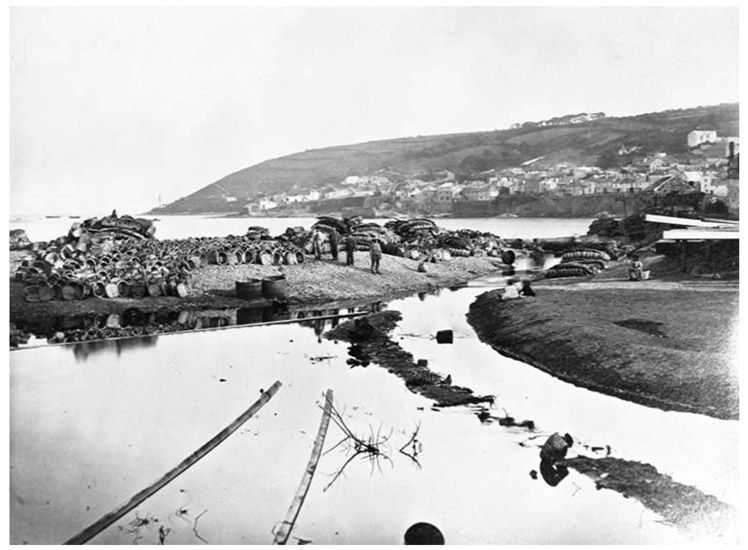
17.2 Waiting for the Fish: mackerel packing stations on the open beach at Newlyn in the early 1870s (Tony Pawlyn collection)
The domestic market for mackerel grew with the nineteenth century as improved means of transport to metropolitan England were introduced: first by fast sailing luggers, smacks and even pilot cutters; then by coastal paddle steamers; and finally by railway, when the Royal Albert Bridge across the River Tamar (1859) completed the railway link between Cornwall and the rest of Britain. All these developments helped expand the market for Cornish mackerel.20
Soon after the completion of the railway links a new class of superior luggers was built for the mackerel fishery. In the 1840s a forward half-deck had been fitted to the earlier open boats to form a cuddy beneath containing a few berths and a small iron stove. This was a build of boats noted for their sea-keeping abilities in the Washington Report of 1848–9.21 The 1851 census recorded 110 mackerel drivers employing 741 men and boys working out of Newlyn and Mousehole. From the mid-1850s fully decked luggers appeared, with an under-deck cabin aft. Coincidental with this was the abandonment of the third mast in their sailing rig. Thereafter the West Cornish luggers carried a distinctive two-masted rig with a dipping lug on the fore and a standing lug on the mizzen, setting to a long mizzen outrigger.22 Further improvements in hull shape and the cut of their sails enhanced their speed and between 1860 and 1872 over 126 of these superior luggers were built at St Ives, Porthleven, Newlyn and Mousehole, including four with iron hulls built at Hayle Foundry. Iron- and timber-built luggers of this class then cost around £150 each for the hull and spars and required a further £150 to equip them with a full set of sails, nets and gear. By 1869 the first-class luggers, the mackerel drivers, had developed from 35-foot craft to 45-foot boats on a 42-foot keel, measuring between fourteen and eighteen tons. The composition of the Cornish fishing fleet at the end of 1870, the first full year after the first exclusive registration of Sea Fishing Boats from September 1869, is given in Table 17.1. During the 1880s the larger luggers adopted steam capstans to haul their trains of nets, enabling them to work even longer fleets. Towards the end of the century, with the need to catch markets tied to train schedules, the boats adopted even finer underwater lines. The development of these fine sailing craft peaked with 20-ton 55-foot luggers in the 1890s, though by then some of their far-famed sea-keeping abilities had been sacrificed in favour of speed and they were now prone to throwing sheets of spray on deck.
Table 17.1 Cornish Sea Fishing Boats on the Register 31 December 1869
|
Registration Port |
Boats |
Crew |
||||
|
Name |
Letters |
No. |
Tonnage |
Men |
Boys |
Total |
|
Falmouth |
FH |
606 |
1659 |
1319 |
148 |
1467 |
|
Fowey |
FY |
541 |
2012 |
1557 |
168 |
1725 |
|
Hayle |
HE (SS) |
209 |
1629 |
945 |
79 |
1024 |
|
Padstow |
PW |
121 |
337 |
376 |
13 |
389 |
|
Penzance |
PZ |
550 |
3874 |
2212 |
313 |
2525 |
|
Scilly |
SC |
No return made |
||||
|
Truro |
TO |
135 |
328 |
183 |
4 |
187 |
|
Total |
2162 |
9839 |
6592 |
725 |
7317 |
|
Source: BPP, 1870, Return under the Sea Fisheries Act, 1868.
Notes: FH also includes Penryn & St Mawes; FY incl. Mevagissey & Polperro; HE (later SS) incl. St Ives; PW incl. Newquay; PZ incl. Newlyn, Mousehole, & Porthleven; TO covers R. Fal north of Pencarrow to Mezzack Point.
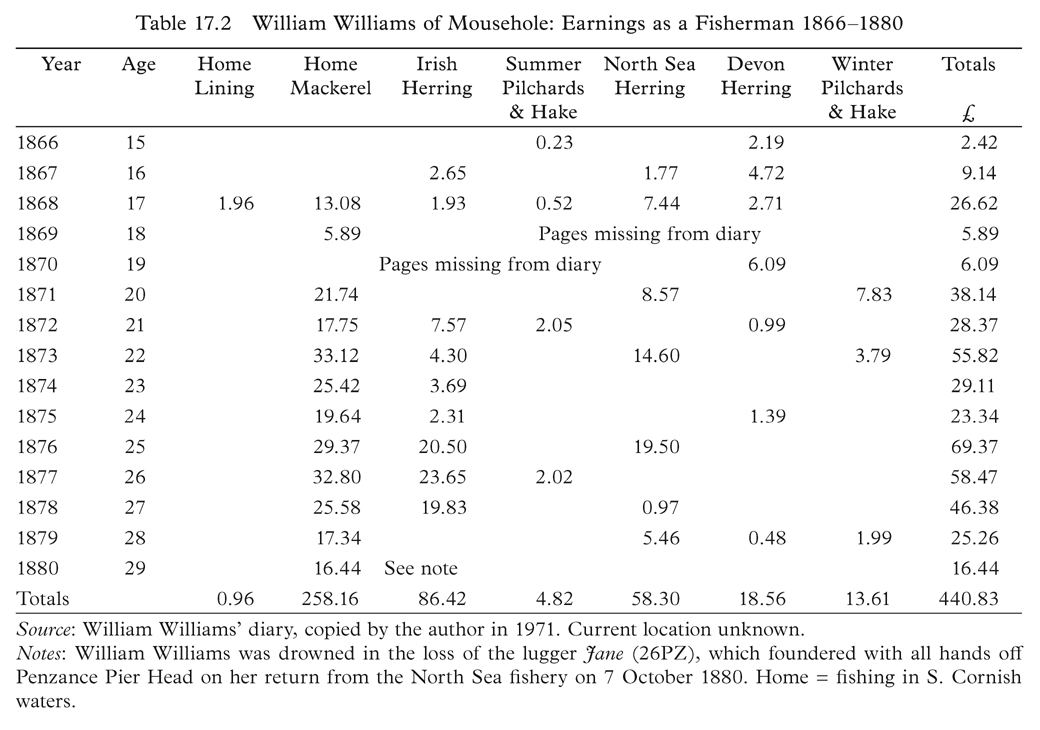
The 1860s were heady days: this branch of the fishery was on a roll and towards the end of the decade the arrival of the electric telegraph gave added impetus. Mackerel shoals were never as large as those of pilchards, though numerous schools would swim in close proximity, and thus mackerel driving was much more successful than seining, though a few of the latter were employed in Mount’s Bay. At the height of the season, which ran from February to June or thereabouts, the drivers caught mackerel by the hundreds and thousands. Very few boats ever took more than a few thousand mackerel at a time, and these were sold on the markets by the hundred, nominally 120 fish. The first fish of the season carried high premiums, often making 30–40s. per hundred, but an average price of 15s. per hundred was the norm. Few contemporary accounts of Cornish fishermen’s earnings survive, but that of William Williams of Mousehole (Table 17.2) covers this prosperous period in the fisheries and illustrates the relative value of the different seasons, serving as a poignant reminder of the true cost of fishing.23

17.3 Tiers of Pilchard and Mackerel Drivers at moorings in Mousehole harbour in the 1880s (Tony Pawlyn collection)
Despite Penzance being the port of registration for Mount’s Bay fishing craft (PZ) it was only a port of last resort for fishermen. Nearly all the ancillary activities associated with the mackerel fishery – landing, selling, buying, packing and transhipping – occurred on the open beach at Newlyn. The large harbour we know today was not built until the end of the 1880s–early 1890s and little investment for fishermen was found in other Cornish fishing ports. Those ports with good natural harbours and quays tended to focus on trade rather than the fisheries and it was not until the Government made public loans available for harbour works from the 1870s that the Cornish fishing harbours were significantly improved.24
Towards the end of the century, in Mount’s Bay and at St Ives, the local fishing boats working the spring mackerel found themselves increasingly in competition with visiting craft.25 In addition to the large number of trawl smacks that came down each spring from Plymouth there were now growing numbers of Lowestoft and Yarmouth luggers after ‘their’ mackerel. These craft first began venturing down west in the early 1850s, about the same time that the West Cornish fishermen first ventured into the North Sea herring fishery. Their numbers increased year on year. During 1869 some seventy of these seasonal visitors arrived in Mount’s Bay in early April: fourteen from Plymouth and thirty-eight from the East Coast, with the remainder hailing from Rye, Hastings and the French channel ports. By the mid 1880s these numbers had increased to over sixty-three from Plymouth and sixty-seven from Lowestoft and Yarmouth. Numbers of the latter peaked at about 150 in the decade leading up to the First World War.26
Improved boats, the arrival of the railways and the telegraph, visiting fishermen, salesmen and buyers and the introduction of ice all combined to boost the spring mackerel fishery, which expanded steadily during the 1860s, with seasonal catches of over 3,000 tons (worth about £90,000) being shipped away from Penzance and Hayle (the Great Western Railway stations for Newlyn and St Ives) by train in 1869. By 1879 this had increased to nearly 7,000 tons, only to fall back for a couple of years before advancing yet again to exceed 10,000 tons in 1892 and 27,500 tons in 1905.27
Unfortunately the great commercial success of the fishery was not shared by the Cornish fishermen. While Newlyn harbour prospered the local mackerel drivers were virtually driven from the fishery by the remorseless efficiency of the big East Coast steam drifters. After the turn of the century the local mackerel drivers enjoyed only limited success, usually in the short early period in each season prior to the arrival of the East Coast fleet. In the decade prior to the First World War many mackerel drivers were laid up or broken up. Boats which had cost £150–£200 only a few years previously could not be sold at any price, while mackerel-driving nets, warps and gear were left to rot. Some adopted long-line fishing and a very few overcame their scruples and went inshore trawling. As a further counter to the loss of market share in the mackerel fishery, many fishermen had new pilchard drivers built during this pre-war period.

17.4 The Order Changeth Lowestoft steam drifters take up the berths at the head of the North Pier, a Plymouth smack PH.340, holds centre stage across the harbour mouth, while a few Mount’s Bay luggers nestle against the South Pier, Newlyn harbour c. 1905 (Tony Pawlyn collection)
White Fish
The term ‘white fish’ is a relatively modern one covering a multitude of different species of demersal fish – that is, those feeding and living close to the sea bed. Little statistical information survives on the catches of white fish made prior to the twentieth century, especially as far as Cornwall is concerned. Catches of ‘white fish’ were made by hand-lines, boulters, spillers,28 trammel nets and, later, in trawl nets. Hand-lines were used for hake, pollack, whiting, mackerel and other lesser species. Boulters and spillers were used for ling, conger, ray, skate, turbot and the like. A few species of white fish, such as ling, conger and ray, were dry cured (as in ‘conger-dulce’), but most of the rest were sold fresh to local communities.29
In the pilchard season voracious packs of needle-toothed hake preyed on the pilchard shoals and played havoc with the pilchard nets. Thus, while the pilchard drivers drove to their nets over the starboard bow, the crew would work hand-lines over the port quarter. A good night’s fishing might consist of a few thousand pilchards and thirty ‘burn’30 of hake. The use of trammels tended to be confined to particular localities with a good sandy bottom, notably in St Ives bay. There are numerous references to their use, but no comprehensive records of their catches.
Throughout the nineteenth century trawling was an emotive subject in Cornish fishing communities, the heavy beam trawls then in use being considered highly destructive of spawning grounds and marine habitat. And, while a few small inshore trawlers were tolerated, the presence of the big Plymouth and Brixham trawl smacks was only grudgingly accepted. Even so, considerable numbers of the former made Penzance their base for spring trawling during the 1870s and 1880s. Despite a certain amount of local opposition to trawling it was not totally shunned by Cornish fishermen and photographs of Newlyn in the opening years of the twentieth century usually include a few luggers which had been adapted for inshore trawling. After the First World War the renowned Brixham smacks had taken over the western trawling grounds from their Plymouth counterparts and these continued to trawl under sail until the eve of the Second World War. But in the 1930s Newlyn was a seasonal base to increasing numbers of Belgian motor trawlers (working otter trawl gear), which set the pattern for the future.
Shellfish
While today the term shellfish covers a wide variety of prawns, scallops and queens, as well as more traditional varieties, in the nineteenth century it referred almost solely to edible crabs, lobsters and crawfish, all of which were caught in ‘crab-pots’. Withy pots made by the fishermen in the wild dark months of each winter, when it was asking for wholesale destruction and loss of gear to venture to sea and risk shooting a string of pots during an apparent lull. It tended to be a side fishery, prosecuted by covers and longshoremen working small boats out of the minor fishing havens and ports. Prior to the twentieth century the species concerned were rarely caught in sufficient quantities for them to be brought to market as such, but were usually kept alive locally in ‘stow-pots’ or ‘viviers.’ These slatted wooden crates were moored in sheltered tidal waters, as it did not matter if they dried out at low tide. In these the shellfish catch could be kept alive for many weeks, to be collected at more or less regular intervals by merchants touring the coves and havens. Usually working out of Southampton, these merchants’ cutters, with capacious wet-wells in their holds, would work their way along the coast, purchasing small parcels of shellfish as they went along. Their round completed, they would return to base and, while some of this produce did find its way onto the British market, the majority was run across the Channel to the French ports, where shellfish attracted a more ready sale and much higher prices.
Conclusion
As with fishing generally, the Cornish fisheries suffered significant variations in the size of the catch year by year. There were significant changes in the nature of the fishing activity during the nineteenth century and the trend away from multiple fishing bases was already apparent. In contrast to elsewhere in Britain trawling was not taken up in Cornwall. It must not be forgotten that Cornish fishermen did not restrict themselves to Cornish waters; many followed the fish to other British waters, some to the extent making their homes elsewhere. While fishing was never an easy occupation, Cornish fishermen would encounter many new difficulties in the twentieth century.
Notes and References
1 For a detailed contemporary description of Cornish fisheries see Henry Mayhew (ed.), ‘Labour and the Poor . . . the Fisheries and Fishers of Cornwall’, Morning Chronicle, 8 January 1850, Supplement, p. 24, and 11 January 1850, Supplement p. 1; for the wider English fisheries context see David Starkey, Chris Reid and Neil Ashcroft (eds), England’s Sea Fisheries: the Commercial Fisheries of England and Wales since 1300 (London: Chatham, 2000), in which pp. 85–87 address the South West fisheries between 1770 and 1850 and pp. 197–201 cover the period 1850–2000. Other studies include Frederick George Aflalo, The Sea Fishing Industry of England and Wales (London: E. Stanford, 1904), p. 305 et seq. and Cyril Noall, Cornish Seines and Seiners (Truro: Bradford Barton, 1972).
2 David J. Starkey, ‘Growth and transition in Britain’s maritime economy, 1870–1914: the case of south-west England’ in D.J. Starkey and A.G. Jamieson (eds), Exploiting the Sea: Aspects of Britain’s Maritime Economy since 1870 (Exeter: University of Exeter Press, 1998), pp. 7–36, at p. 14.
3 Tony Pawlyn, ‘The Cornish Pilchard Fishery’, in Starkey, et al. (eds), England’s Sea Fisheries, pp. 85–86.
4 Helen Doe, ‘The Smugglers’ Shipbuilder’, Mariner’s Mirror 92:4 (2006), pp. 427–42, at p. 430.
5 Driver – a term equally applicable to Cornish drift fishing boats, or the fishermen who worked them, and frequently linked to a species of fish; e.g. – mackerel driver, or pilchard. Derived from the drift fishermen’s fishing practise of lying to their train of nets with a ‘driver’ set. A small mizzen sail that generated just sufficient leeway to keep the train of nets well stretched out and fishing to greatest effect.
6 See D.M. Trethowen, ‘The Rise and Decline of Porthleven Harbour 1810–1960’, unpublished MA dissertation, University of Exeter, 1972, p. 26. Quoted in Doe, ‘The Smugglers’ Shipbuilder’, p. 431.
7 Courtney Library, Royal Institution of Cornwall [hereafter CL, RIC]: Mapplebeck notes Folio 8.
8 Doe, ‘The Smugglers’ Shipbuilder’, pp. 430–31.
9 Noall, Cornish Seines and Seiners, pp. 75–85.
10 Tony Pawlyn, ‘The Cornish Pilchard Fishery’, in Starkey, et al. (eds), England’s Sea Fisheries, pp. 197–98.
11 See Noall, Cornish Seines and Seiners, pp. 86–106 for more details of St Ives.
12 For a full description of the various curing stages and the contemporary fishery, see Tony Pawlyn, ‘The Cornish Pilchard Fishery in the Eighteenth Century’, Journal of the Royal Institution of Cornwall [hereafter JRIC], ns 3:1 (1998), pp. 67–90.
13 Bussa – a large earthenware jar or ‘great crock’, twelve inches in diameter (maximum), and eighteen inches deep.
14 John Rule, ‘The South Western Deep-Sea Fisheries and their Markets in the Nineteenth Century’, Southern History 22 (2000), p. 247.
15 Each pilchard fishery season ran from the first catches made in the mid to late summer of one year, to arrival and sale of the last consignments of export fish at their final port of destination in the following spring, when the closing remittances were made to the Cornwall. Hence the practice of linking two consecutive years in identifying each fishery season.
16 Fox and Sons archives remain in private (family) hands, but see Noall, Cornish Seines and Seiners. Surviving Bolitho records are held by Cornwall Record Office: BL/1/19.
17 G.C., & R.W. Fox & Co.’s Annual Pilchard Circulars.
18 Tony Pawlyn, ‘The Great Western Mackerel Fishery’, in Starkey, et al. (eds), England’s Sea Fisheries, pp. 86–87.
19 Cowels, or Cawls – wicker fish baskets designed to be carried high on the back and shoulders, and steadied by a plaited headband. Very similar to the creels used in Scotland – see ‘Glossary of Selected Fish Terms’, in Tony Pawlyn, ‘Maunds, Pads, Hogsheads and Hundreds: A Guide to Fish Measures and Terms’, Maritime South West 8 (1995).
20 Rule, ‘South Western Deep Sea Fisheries’, pp. 255–57.
21 Captain Washington, Report on the Loss of Life, and Damage Caused to Fishing Boats on the East Coast of Scotland in the Gale of 19 August 1848 (London: House of Commons, 1849). This recommended the decking of small boats.
22 For a fuller description of these and other fishing vessels see Basil Greenhill and Tony Pawlyn, ‘The Coasts of Devon and Cornwall’, in B. Greenhill and J. Mannering (eds), The Chatham Directory of Inshore Craft: Traditional Working Vessels of the British Isles (London: Chatham Publishing, 1997), pp. 128–85.
23 Morrab Library, Penzance: William Williams ‘Remarkable Occurrances’ Manuscript account of events in Mount’s Bay, 1713–1836.
24 For example, The Harbour Works and Piers Clauses Act 1870; An Act to Authorise the Construction of a Tidal Harbour dock and Other Works . . . at Newlyn, 1884.
25 Tony Pawlyn, ‘The Great Western Mackerel Fishery’ in Starkey, et al. (eds), England’s Sea Fisheries, pp. 200–1.
26 Cornwall Record Office, CRO: DC/PEN/805, Penzance Harbour Master’s Dock Diary.
27 British Parliamentary Papers, 1879–1902, Annual Returns of Fish Conveyed Inland by Railways.
28 Spillers, boulters and trots are all forms of long-line used by relatively small boats in inshore waters, and consisted of about 220 fathoms of line coiled in a basket. Spillers and boulters were very similar, with the main line laying on the bottom when fishing, spillers having smaller hooks for whiting, pollack and the like and boulters having larger hooks for conger, ling and cod. Trot lines floated clear of the bottom in fishing, with intermediate weighted lines attached. These were adjustable in length to allow the baited hooks on the nossils to float at the desired depth for fishing.
29 Sweet conger has been dry cured with a minimal use of salt.
30 See Pawlyn, ‘Maunds, Pads, Hogsheads and Hundreds’.