
CHAPTER 19
____________________________
John Armstrong
Although the coastal trade was crucial to the development of the Cornish economy Cornwall was never a particularly important component of the aggregate coastal trade of the United Kingdom. For the period 1873 to 1912, when reliable figures exist, Cornish coastal trade, as measured by number of entries and clearances, made up less than 3 per cent of the national total. In addition, whereas nationally there was sustained growth through the period, for Cornwall the peak came in 1903 and then declined to 1913.1 This suggests that the Cornish economy was not keeping up with that of the UK as a whole but, rather, growing at a slower rate. That the coastal trade was important to Cornwall is borne out by the natural assets of Cornwall, such as tin, copper ore, china clay and granite, which were bulky goods of low intrinsic value which needed long-distance transport to their main markets.2 The coastal ship was peculiarly suited to such transport, being able to operate at low cost over long distances.
The production of china clay in Cornwall was one of the few dynamic elements in the regional economy after the crash of copper in 1866 and the faltering of tin in the 1870s and beyond. This raw material was, however, rarely processed at the point of production but was in great demand in industrial centres such as the Potteries, London, Glasgow, Grimsby and Preston. These were a great distance from the producing areas and gave rise to long-haul traffic. China clay or stone was bulky and of low unit value when compared to, say, manufactured goods, and it needed a cheap form of long-distance transport, which suited the coastal ship. Although china clay was not produced solely in Cornwall the focus in this chapter will, of course, be on the Cornish dimension.
The production and shipping of china clay had important effects on the local economy in terms of employment, investment in associated infrastructure, shipowning and operating and in multiplier effects from these. Its impact was also less parochial than this. Because it was an important raw material in a number of industries – pottery, paper, textiles, later insulators and cosmetics – it created employment and wealth elsewhere in the country and the products of these industries were among Britain’s exports. So china clay could be exported as a raw material or, more advantageously, embodied in the higher-value commodities it helped make up. In this way china clay supported the national economy in terms of domestic output and contributed to export earnings.
By comparison with that great staple of the British coastal trade, coal, the china-clay trade was small beer, but it grew quickly, especially in the period 1860–1912. The clay trade from Cornwall in 1858 totalled about 86,000 tons; by 1885 this had risen to 295,000 tons and in 1912 to about 860,000 tons.3 This gives a growth rate of about 15 per cent per annum, well above that of the overall economy at this time. Thus china clay production in this period was a dynamic element in the British economy.
This chapter, addressing a neglected topic, endeavours to gather together what is known about the china-clay trade to suggest it was a significant trade employing especially coastal shipping from the middle eighteenth century to the mid-twentieth, and to look particularly at the ships involved and their trading activities.4
Foreign or Coastal Trade in Clay
For the Cornish ports coastal trade dominated initially. In 1876 coastal shipments from Par, Fowey, Pentewan and Falmouth amounted to about 116,000 tons, whereas only 42,000 tons went abroad.5 This meant that coastal shipments accounted for three-quarters of the total trade. By 1912, however, this had changed drastically, with 75 per cent of Cornish china clay being sent abroad.6 This dominance persisted, for in the 1920s over 70 per cent of all Cornish china clay was exported and in the 1930s the proportion was about two-thirds.7 After greater emphasis on the home trade in the Second World War by the late 1940s exports had risen again to 60 per cent of the total. Thus Cornish china clay was a truly international product, yet coastal trade continued to remain important.
Production Sites
The major Cornish source of china clay is in the St Austell region, which used the ports of Fowey, Par, Charlestown and Pentewan. A few other Cornish ports, such as Falmouth and, on the north coast, Newquay, Wadebridge and Boscastle, despatched small quantities of china clay.8 It looks as though the Cornish trade was always the largest of the three counties. In 1876, according to Rolt9 (and this figure is not consistent with those of Trump10 ), Teignmouth shipped 130,000 tons of ball clay. In the same year total Cornish production was about 230,000 tons,11 so the Cornish trade was twice the Devonian. In 1904 the shipments from Teignmouth amounted to only about 100,000 tons, which was the same as from Poole in 1900,12 whereas those from Cornwall had risen to 860,000 tons in 1912,13 thus reinforcing Cornwall’s number one position.
For the Cornish deposits there were a number of ports the relative importance of which changed over time. Charlestown took an early lead. In 1795 an artificial harbour was built there with an inner harbour protected by dock gates and, although the depth of water was rather low, the rocky coastline was a benefit as gravity feed of the clay was the quickest and cheapest means of loading.14 So successful was Charlestown that in the 1820s Pentewan, just along the coast, followed suit with a similar harbour with breakwaters.15 The dominance of Charlestown and Pentewan is shown in a return of 1858, when the two ports shipped the lion’s share of Cornish china clay, with about 65,000 tons.16 The next largest supplier was Par, with 15,000 tons. It had followed the same route as Charlestown and Pentewan, but a little later, when it built a harbour in the 1830s.17 The construction of such harbours, allowing ships to stay afloat even at low tide, was a great boost to the clay trade, for it speeded up loading and reduced the risk. Prior to this ships had to take the beach, sitting on the bottom at low tide and loading from carts that were drawn by horses on to the beach.18
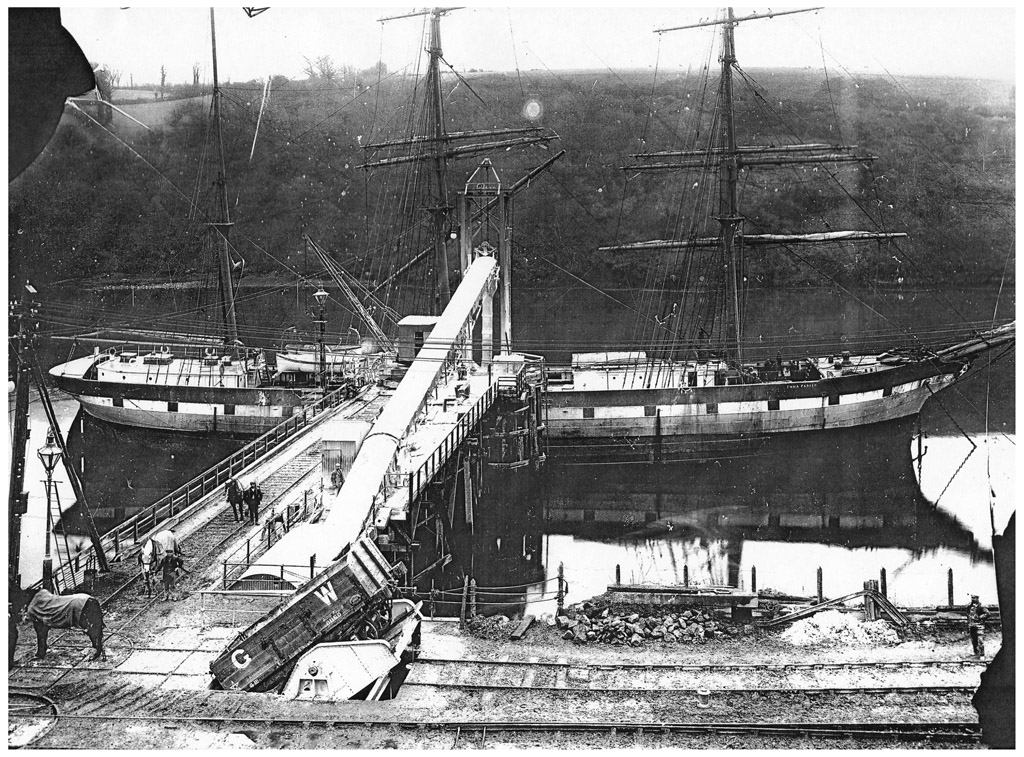
19.1 Ship loading clay at Fowey using horses (STEAM – Museum of the GWR, Swindon)
By the mid nineteenth century Fowey had come onto the scene. It enjoyed a natural deep-water harbour but was situated some way from the clay fields. The advent of the steam railway provided a cheap method of bringing china clay from the quarries to Fowey harbour and from the 1870s onward Fowey became the ‘principal Cornish clay port’.19 This is demonstrated by the figures for inflows into Runcorn of china clay. As early as 1852 Fowey topped the list, with 30,000 tons.20 Similarly, in 1875 the data in the Liverpool Bills of Entry suggest that Fowey again sent more china clay to Runcorn than any other single port.21 In 1891 Fowey remained the most important port to send china clay to Runcorn, with sixty-five shipments compared to Par’s forty-seven and Charlestown’s thirty-three.22 The dominance of Fowey is reinforced by figures giving a breakdown of the shipments of china clay from Cornwall. In 1876 Fowey despatched 76,000 tons of china clay, with Par second, with two-thirds of this amount, and Charlestown third, with half of it.23 Again in 1885 Fowey came top in the Cornish china clay stakes, sending over 110,000 tons, with Par sending three-quarters of that amount and Charlestown a little over half of Fowey’s total.24 Thus, thanks to its deep water and rail connections, Fowey became the premier china-clay despatching port in Cornwall. The importance of Fowey is highlighted by the behaviour of Richard Hughes, a Liverpool-based shipowner who was a pioneer in steamships for bulk trades such as china clay. Clay shipments from Fowey were so valuable to him that by 1918 he had an office in that port.25
The Main Receiving Ports
Knowing the main ports despatching china clay and calculating the average haul requires knowledge of which ports were receiving the china clay and their relative importance. The most important single port to receive china clay was Runcorn in Cheshire. Ships came up the Mersey to Runcorn and unloaded over the side into barges or lighters. These then took the clay via the River Weaver to be transhipped to Trent and Mersey narrow boats at Anderton, and thence into the Potteries district. It is very difficult to get comparative figures to ascertain Runcorn’s dominance, but there are many authorities stating it.26 Fenton, for instance, talking of the late nineteenth century, says ‘china clay from Cornish ports came mainly to Runcorn’.27 Hudson suggested Runcorn was the largest recipient of Cornish china clay in 1876, with over 60,000 tons, compared with a couple of thousand going to Worcester.28 In 1919, of ships clearing Fowey and Par, over one-third were destined for Runcorn.29 Nearby Ellesmere Port also invested in china-clay handling facilities and benefited from the trade.30 Liverpool itself received cargoes of china clay from a number of Cornish ports, mostly for William Thomas and Marwood & Co.31
If Runcorn dominated the clay receivers, there were many other ports which received shipments of china clay albeit on a less generous scale. Worcester was a significant recipient because of its local potteries and south-coast clay went via Gloucester and the canal to this destination.32 Wherever there was a local pottery or papermaking industry there was a significant demand for china clay. The Thames estuary remained an important destination for clay. The north-east, based on the Tyne river, was another important early recipient,33 although it too declined in relative significance. Other important destinations were Glasgow, Preston and Fleetwood.34 During the inter-war years Preston continued to be important. It was joined by Grimsby, which received regular shipments of Cornish china clay loaded at Fowey and carried by Coppack’s steamers. It was destined for Peter Dixon’s paper mills at Oughtibridge, just to the north-west of Sheffield,35 presumably via the Great Central Railway’s lines. Lancaster and Kirkaldy also became regular destinations for clay-carrying vessels between the wars.
None of these clay-receiving ports is close to where the mineral is mined. The distance by sea from Fowey to Runcorn is about 385 miles. The journey from Par or Fowey to London is around 360 miles and to Grimsby about 500. The trip from one of the ports in St Austell bay to Glasgow is about 485 miles. Thus it is clear that the minimum journey in the china-clay trade was about 300 miles, with maximums over 500 miles; the median journey was around 400 miles. The china-clay trade stands comparison to the coal trade in its average haul and was many times greater than the average haul on railways or canals at the same time.36
Ship Types and Back Cargoes
China clay was a bulky good of low unit value. It was not particularly perishable and did not need rapid transit. For these reasons cheapness of transport was more important than speed or reliability, and thus the sailing ship remained crucial to the carriage of china clay long after steam colliers had superseded the collier brig on the east coast.37 As late as 1919 sailing ships exceeded steamers loading china clay at Fowey and Par.38 By the later nineteenth century the preferred ship type in the china-clay trade was the schooner. Stammers refers to ‘hundreds of schooners’ coming up the Mersey carrying china clay for Runcorn and calculates that as late as 1900 thirty schooners per month on average were entering Runcorn.39 This figure is supported by Starkey, who claimed that 194 schooners entered Runcorn in the china-clay trade in six months in 1892, giving an average of about thirty-two per month.40
Schooners were not the only rig used in the china-clay trade. The Mary Wighton was a brigantine which in the 1880s carried china clay from Newquay and Fowey for delivery in Runcorn.41 Occasionally ketches were used. The Johann Carl was lost in 1917 when on a journey from Newquay to Bristol with a cargo of china clay.42 She did not start life as a ketch, as she was built in 1893 as a schooner and converted in the early years of the century. The schooner was more manoeuvrable than the brig or the brigantine, which was important when sailing to up-river ports such as Runcorn. Its rig could be worked by a smaller crew than ships carrying square sails, thus reducing operating costs. Its draught was not excessive for shallow harbours or upriver work and it could sit on its flat bottom on a sloping beach.
The use of sailing ships in the china-clay trade persisted well into the twentieth century. Latham claimed the trade was ‘one of the last havens for sailing ships in the inter-war period’.43 In the 1920s Captain Slade sailed the ketch Haldon from Bideford to Goole carrying 180 tons of china clay.44 At least one barquentine was still involved in the trade; the Waterwitch, captained by Henry Deacon, plied at least until 1934 in the clay and coal trade from Fowey.45 In 1927 the schooner Gauntlet carried clay from Charlestown to Kirkaldy and another, Mary Sinclair, was still in the clay trade to Runcorn as late as 1936.46 The middle years of the 1930s have been characterised by Starkey as ‘the last days of sail at Runcorn’.47 In part the schooner survived in the trade because mechanical propulsion was available as auxiliary engines were installed for river and harbour work. Where they were not fitted a tow from a passing steamer or use of a tug gave the schooners a little more flexibility. Above all, their operating costs were low and the inter-war years saw meagre freight rates on most routes. Ward-Jackson believes the killing the few remaining sailing ships in the clay trade may be attributed to a combination of the economic depression of 1929–32 and the advent of the Dutch motor coaster. With its large hold and shallow draught it was simply too cheap to operate.48
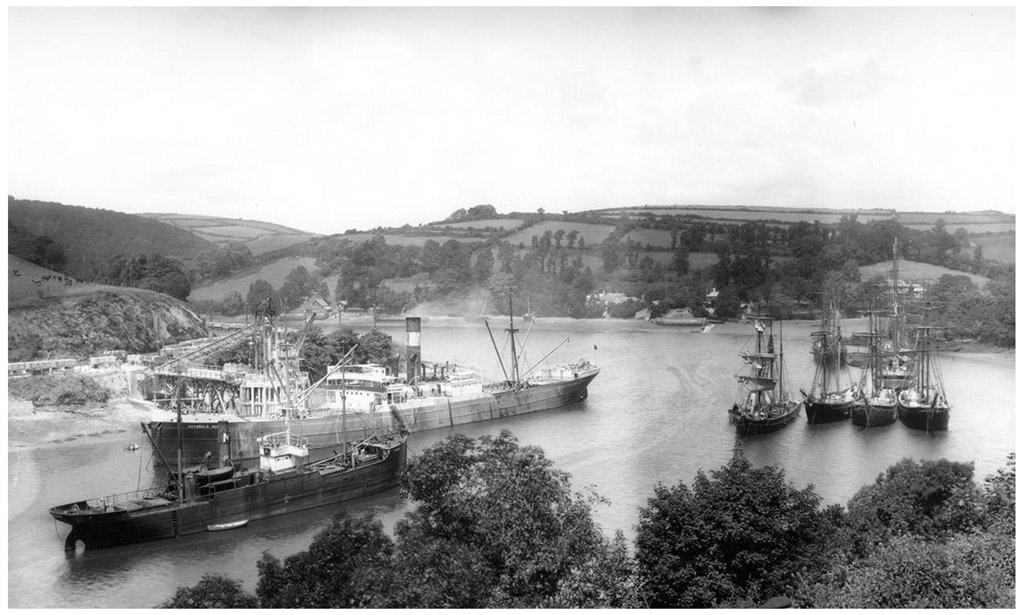
19.2 Sailing ships awaiting their turn in Fowey (Helen Doe)
Richard Hughes of Liverpool has been hailed as the pioneer in using steamships in the bulk trades to the Mersey. He built his first steamship, Primrose, in 1885, which, among other routes, carried china clay from Cornwall to Runcorn.49 The Primrose was followed by the Sarah Brough, a 370-ton deadweight steamer built in 1898 for the Zillah Shipping Co, which ran in the china-clay trade.50 Both Hughes and Zillah found their purchases sufficiently profitable to buy further steamers, which were soon engaged in the clay trade. In the 1890s Toyne Carter & Co. of Fowey managed locally owned ships. In 1902 they had Foy built, a 350-ton steamer which carried clay to Runcorn or Preston. She was soon followed by Torfrey and Par, which were engaged in the same trade.51 In the twentieth century a large number of firms employed steam coasters in the china-clay trades: Coppacks of Connah’s Quay, Everards of Gravesend and Potter & Son of Runcorn, as well as those firms already mentioned – Richard Hughes and the Zillah Shipping Co. Ltd. Some of the ships were remarkably long-lived. Coppack’s Fairfield delivered china clay from Fowey to Grimsby from 1921 to 1941 and their Mourne, a much smaller steamer, carried clay from Par to Runcorn from 1920 to 1933.52
In terms of carriage by sea, china clay was a trade dominated by sailing schooners in the final thirty years of the nineteenth century, the first steamers appearing in the final years of the century. The use of the sailing ship tailed off gradually, finally ending in the later 1930s.
Coastal ships in the china-clay trade were a cheap form of long-distance bulk transport, so freight rates were never generous. Although it is difficult to find many specific examples, in the 1880s and 1890s they appear to have been about 3s or 3s 6d per ton from any of the ports on the south coast of Cornwall,53 though in 1887 the brigantine Elizabeth carried 237 tons of clay from Charlestown to Runcorn at 4s 3d per ton54 and the trade paper suggested that the normal rate from any Cornish china-clay port to ports in the Mersey just before the First World War was 5s per ton plus a few pence extra for sailing ships.55 The nineteenth-century rate is low when compared to those of the east-coast coal trade. The distance from the Tyne to the Thames was sixty or seventy miles less than that from the Cornish clay ports to Runcorn, yet the freight rate for sailing ships was about 5s per ton in the 1880s,56 between 1s 6d and 2s extra. This suggests that the clay trade was not intrinsically highly profitable.
Crucial to the china-clay trade was the ready availability of a return cargo. The additional revenue from the return freight made all the difference to profitability. The most common back cargo was coal. Because there was no indigenous coal in Cornwall and given coal’s importance in the nineteenth century as almost the sole source of heat, light and power, there was always a ready market for coal in that region. In addition, the clay-using areas were often close to readily available supplies of coal. If the destination of the clay was Runcorn then coal could be collected at Garston or the Point of Ayr colliery on the River Dee.57 The coal might be for domestic hearths, but it was also needed for gasworks. For instance, Thomas Stevens, an agent for and shipper of china clay from Pentewan and Charlestown in the 1850s and 1860s, was also retained to supply coal to Plymouth gasworks,58 thus giving his ships a guaranteed return cargo. Coal continued as the most common back cargo in the inter-war period. When Slade delivered china clay to Goole in the early 1920s he loaded a return cargo of coal at Keadby on the River Trent for Appledore.59 Similarly, when the Coppacks’ steamer had delivered china clay to Grimsby for Dixon’s paper mill, it back-loaded coal on the River Ouse for a port in Cornwall.60 Everards also carried coal as a return cargo to ports on the south coast after delivering china clay to the north-west.61
If the china clay was intended for porcelain manufacture some residual coal dust was not a problem, as it burnt out in the firing. Clay intended to be used for paper did not want black marks in it and so the holds had to be scrupulously cleaned after a coal cargo. This became more necessary in the twentieth century, when paper manufacture took a rising share of china-clay output. Coppacks attributed their long association with Peter Dixon & Co. of Oughtibridge, paper makers, delivering all their clay requirements in the 1920s and 1930s, to their care in hosing down the holds thoroughly.62
If coal was the main return cargo it was not the only one. Runcorn had an abundant supply of salt thanks to the proximity of the Cheshire rock salt deposits and salt was in great demand for food preservation, particularly for the curing of fish. Salt was thus a useful return cargo to the south-coast fishing ports.63 Other commodities acted as a regular return cargo when coal was not available. In the inter-war period a fleet of auxiliary schooners that carried clay regularly from Fowey to London loaded cement as a return cargo, which was delivered at Penzance.64 If at all possible the coaster sought a return cargo to put the icing on the cake.
Ship Movements derived from Crew Agreements
A study of some of the crew agreements allows analysis of the pattern of ship movements in the Cornish china-clay trade. The agreements are very variable in terms of details relating to routes and cargoes, rarely mentioning the latter and not always the former.65 These are, at best, very tentative results. The first conclusion is that there is no evidence of ships devoted solely to the china-clay trade, as was the case with the east coast collier brigs and later steam colliers.66 These ships carried coal south and rarely bothered with back cargoes, taking on water ballast while heading down the Thames to minimise their time in port. There is no equivalent for the china-clay trade and thus the idea of regular traders devoted to one commodity is not relevant here. It was not a bi-lateral trade and indeed the patterns were more complex.
A number of the ships were engaged in the domestic and also the near continental trade. For example, Cicerone, a schooner registered in Falmouth in 1879, made trips from Fowey to Antwerp and Amsterdam in 1887, and in 1889 voyaged from Pentewan to Hamburg and Charlestown to Flushing, as well as from Fowey to Newcastle and Runcorn, and Falmouth to Runcorn.67 A ship capable of making long journeys from the south Cornish ports to Newcastle or Glasgow could easily manage the near continent.
Many of the ships in the Cornish china-clay trade were not specialists but carried clay as one of many cargoes – a true tramp. For example, the Glendorgal, most unusually, recorded in the first half of 1874 the cargoes it carried on each journey.68 In this period it made ten voyages, none of them in ballast. Only two carried china clay – one trip to Runcorn from Plymouth and the other from Charlestown to Runcorn. Of the other eight journeys two were carrying coal, one from Liverpool to Plymouth and the other from Newport to Newquay; two were made carrying iron, one from Ayr to Newport with pig iron and the other from Padstow to Liverpool in ‘iron’, probably scrap iron to be resmelted; and two had cargoes of manure, one from Truro to Padstow and the other from Runcorn to Cork. The ship also made one voyage from Runcorn to Ayr carrying salt and one from Cork to Truro with oats. This is a classical tramping pattern, with no two trips being identical and china-clay voyages comprising only 20 per cent of all passages.
This analysis can be carried a little further. By looking at a number of crew agreements of ships which carried china clay cargoes, inter alia, the proportion of voyages which were spent in china clay can be calculated.69 From twelve agreements discovered so far the average proportion of voyages made carrying china clay was 23 per cent. This suggests that china clay was a significant cargo but not a dominant one, as were the coal trade of the east coast or the pig-iron trade from Middlesborough to Grangemouth.
The Grimaldi offers a case study of a ship involved in the china-clay trade.70 It was built in 1841 in Liverpool by Bannister & Simpson. It was schooner rigged, about eighty feet long and 150 registered tons. It spent its first twenty years trading between Glasgow and Liverpool and in 1862 was sold to Cornish owners, Captain William Hill of Polruan near Fowey. In 1871 it was sold to John Merrifield of Plymouth. In that year a surviving crew agreement paints a picture of its trade. It made eighteen journeys, of which seven were out of Penzance. The destinations of these trips conform to the previous characterisation of long-distance hauls, namely Runcorn, Newcastle and Leith. The ship also made six passages from coal-exporting ports (Newcastle upon Tyne, Seaham and Cardiff) to Plymouth and Penzance. So, for that year, about 40 per cent of the trips were probably carrying china clay and 33 per cent were in coal. These are undoubtedly the two most important cargoes, but, even so, nearly 30 per cent of voyages were made with other cargoes or in ballast. To demonstrate the volatility of shipping deployment, in 1872 the schooner made only one voyage from a china-clay port – from Fowey to Runcorn – and no voyages from any north-eastern coal ports. The vessel made fourteen trips in all, so the one china-clay voyage represented about 7 per cent of all passages. Clearly in 1872 the clay trade was not the main focus of its activity.
The next crew agreement discovered for Grimaldi was for 1884, by which time it was over forty years old. The vessel made twelve voyages in the first half-year, of which four were from china-clay ports, mainly Fowey. The destinations were distant – Newcastle and Hull – and three return voyages were made from coal ports, specifically Newcastle and Cardiff. So in this half-year 33 per cent of all voyages were from china-clay ports and 25 per cent from coal ports. There is some evidence that the Grimaldi was under competitive pressure by this date: whereas in 1871 its crew had comprised six men and two boys, by 1884 it consisted of five men only; and whereas the total bill for the crew was £17 15s. per month in 1871, by 1884 it was £12 15s., representing a reduction of 26 per cent on the wage bill. Perhaps as a result of this and other cost-cutting measures the vessel continued to trade until July 1901, when she was in collision and sold as a hulk.
The aim of this chapter was to explore some aspects of the coastal trade in Cornish china clay, in particular the routes served, the ships used and the type of voyage patterns. Using crew agreements as a primary source allowed the analysis to be carried beyond secondary sources, but a significant caveat is to point out the small number of crew agreements used and hence the narrowness of the evidential base. Subsequent studies based on different, or a wider sample of, crew agreements might alter drastically the tentative conclusions drawn here.
Notes and References
1 David J. Starkey (ed.), Shipping Movements in the Ports of the United Kingdom 1871–1913 (Exeter: University of Exeter Press, 1999), pp. 122, 130, 144, 188, 190, 226.
2 Peter H. Stanier, ‘The Copper Ore Trade of South West England in the Nineteenth Century’, Journal of Transport History, 2nd ser. 5:1 (1979), pp. 18–35; Richard Pearse, The Ports and Harbours of Cornwall (St Austell: H.E. Warne, 1963), pp. 93, 95, 136.
3 Alan Kittridge, Cornwall’s Maritime Heritage (Truro: Twelveheads, 1989), pp. 16–17; Kenneth Hudson, The History of English China Clays: Fifty Years of Pioneering and Growth (Newton Abbot: David & Charles 1968), p. 29.
4 The only work devoted to the sea-trade in china clay is C. George Bainbridge, The Wooden Ships and Iron Men of the Cornish China Clay Trade (Charlestown: Charlestown Estates, 1980) is weak on chronology and sources. In addition to Hudson, The History of English China Clays, aspects of the industry are addressed by: R.M. Barton, A History of the Cornish China Clay Industry (Truro: Bradford Barton, 1966), and L.T.C. Rolt, The Potters’ Field: A History of the South Devon Ball Clay Industry (Newton Abbot: David & Charles, 1974). Passing mention of the industry is found in Michael Duffy, Stephen Fisher, Basil Greenhill, David Starkey, Joyce Youings (eds), The New Maritime History of Devon, Vol. II: From the Late Eighteenth Century to the Present Day (London: Conway, 1994), pp. 33, 35, 39, 41, 45, 71–72.
5 Hudson, The History of English China Clays, p. 24.
6 Ibid., p. 29.
7 Ibid., p. 76.
8 Pearse, The Ports and Harbours of Cornwall, pp. 127, 137, 144.
9 Rolt, The Potters’ Field, p. 129.
10 H.J. Trump, Teignmouth: A Maritime History (Chichester: Phillimore, 1986), p. 81.
11 James Quick, ‘Cornish China Clay’, Quarterly Journal of Science 14 (1877), p. 506; Hudson, The History of English China Clays, p. 24.
12 Trump, Teignmouth, p. 81; P.J. Perry, ‘The Dorset Ports and the Coming of the Railways’, Mariner’s Mirror 53:3 (1967), p. 248.
13 Hudson, The History of English China Clays, p. 29.
14 Gordon Jackson, The History and Archaeology of Ports (Tadworth: World’s Work, 1983), p. 37; Tim Latham, The Ashburner Schooners: The Story of the First Shipbuilders of Barrow-in-Furness (Manchester: Ready Rhino Publications, 1991), p. 74; Kittridge, Cornwall’s Maritime Heritage, pp. 15–16.
15 Jackson, The History and Archaeology of Ports, p. 37; Latham, The Ashburner Schooners, p. 74.
16 Kittridge, Cornwall’s Maritime Heritage, p. 16.
17 Latham. The Ashburner Schooners, p. 74; Kittridge, Cornwall’s Maritime Heritage, p. 16.
18 F. Hitchins and S. Drew, The History of Cornwall, 2 vols (London: n.p., 1824), vol. II, p. 50; Barton, A History of the Cornish China Clay Industry, p. 25; Bainbridge, The Wooden Ships and Iron Men, p. 2.
19 Latham, The Ashburner Schooners, p. 74
20 H.F. Starkey, Schooner Port: Two Centuries of Upper Mersey Sail (Ormskirk: Hesketh, 1983), p. 223.
21 Liverpool Bills of Entry, 1875.
22 Starkey, Schooner Port, p. 183.
23 Hudson, The History of English China Clays, p. 24.
24 Kittridge. Cornwall’s Maritime Heritage, p. 17.
25 Charles V. Waine, Steam Coasters and Short Sea Traders (Wolverhampton: Waine Research, 1980), p. 120.
26 R.S. Fenton, Mersey Rovers: The Coastal Tramp Ship Owners of Liverpool and the Mersey (Gravesend: World Ship Society, 1997), p. 11; Quick; ‘Cornish China Clay’, p. 506; Michael Stammers, Liverpool: the Port and its Ships (Stroud: Sutton, 1991), p. 128.
27 Fenton, Mersey Rovers, p. 11.
28 Hudson, The History of English China Clays, p. 29.
29 China Clay Trade Review (July 1919) p. 16; (October 1919), p. 152.
30 T.W. Roberts, Ellesmere Port 1795–1960 (Gisborne, NZ: n.p., 1962), pp. 42, 64, 74–75.
31 Merseyside Maritime Museum Archives & Library, Mersey Docks and Harbour Board (MDHB), Dock Register, Huskisson & Sandon Docks, 1871–75.
32 Quick, ‘Cornish China Clay’, p. 506
33 Duffy et al (eds), The New Maritime History of Devon, Vol. II, p. 41; Barton, A History of the Cornish China Clay Industry, p. 61.
34 Duffy et al (eds), The New Maritime History of Devon, Vol. II, p. 41; Fenton, Mersey Rovers, p. 87; W.J. Slade, Out of Appledore (London: Percival Marshall, 1959), p. 32.
35 Tom Coppack, A Lifetime with Ships (Prescot: Stephenson, 1973), p. 147; Waine, Steam Coasters, p. 76; R.S. Fenton, Cambrian Coasters: Steam and Motor Coaster Owners of North and West Wales (Kendal: World Ship Society, 1989), p. 70.
36 John Armstrong, ‘The Role of Coastal Shipping in UK Transport: An Estimate of Comparative Traffic Movements in 1910’, The Journal of Transport History 8:2 (1987), p. 176.
37 Waine, Steam Coasters, p. 10.
38 China Clay Trade Review (July 1919), p. 16: (October 1919), p. 152.
39 Stammers, Liverpool, p. 29.
40 Starkey, Schooner Port, p. 183.
41 Rita T. Pope (ed.), Down to the Sea in Ships: The Memoirs of James Henry Treloar Cliff (Redruth: Dyllansow Truran, 1983), pp. 48, 52.
42 W.J. Slade and Basil Greenhill, West Country Coasting Ketches (London: Conway, 1974), p. 73.
43 Latham, The Ashburner Schooners, p. 76.
44 Slade and Greenhill, West Country Coasting Ketches, p. 32.
45 C.H. Ward-Jackson, Ships and Shipbuilders of a West Country Seaport: Fowey 1786–1939 (Truro: Twelveheads, 1986), p. 95.
46 Starkey, Schooner Port, p. 203.
47 Ibid.
48 Ward-Jackson, Ships and Shipbuilders of a West Country Seaport, pp. 85–86.
49 Waine, Steam Coasters, p. 120.
50 Ibid., p. 122.
51 Ibid., p. 130.
52 Coppack, A Lifetime with Ships, pp. 147–49; Fenton, Cambrian Coasters, p. 70.
53 Latham; The Ashburner Schooners, p. 75; Stammers, Liverpool, p. 129.
54 Basil Greenhill, The Merchant Schooners (London: Conway, 1988), p. 302.
55 China Clay Trade Review (August 1919), p. 90.
56 John Armstrong, ‘Late Nineteenth-Century Freight Rates Revisited: Some Evidence from the British Coastal Coal Trade’, International Journal of Maritime History 6:2 (1994), p. 53.
57 Waine, Steam Coasters, p. 130; Fenton, Mersey Rovers, p. 230.
58 Duffy et al (eds), The New Maritime History of Devon, Vol. II, p. 102.
59 Slade and Greenhill, West Country Coasting Ketches, p. 32.
60 Fenton, Cambrian Coasters, p. 70.
61 K.S. Garrett, Everard of Greenhithe (Kendal: World Ship Society, 1991), p. 18.
62 Coppack, A Lifetime with Ships, p. 147–49.
63 Duffy et al (eds), The New Maritime History of Devon, Vol. II, pp. 71–72.
64 Latham, The Ashburner Schooners, p. 114–15.
65 Merchant ship ‘Agreement and Account of Crew’ (crew agreements) are held in a number of locations: the National Archive [hereafter TNA], the National Maritime Museum, local county record offices and predominantly the Maritime History Archive at Memorial University of Newfoundland [hereafter MUN, MHA].
66 Roger Finch, Coals from Newcastle (Lavenham: Dalton, 1973); Raymond Smith, Sea-Coal for London (London: Longmans, 1961); Armstrong, ‘Late Nineteenth-Century Freight Rates’.
67 MUN, MHA crew agreements for Cicerone, official number [hereafter ON] 43566, for 1887 and 1889.
68 MUN, MHA, crew agreements for Glendorgal, ON 17384, for 1874.
69 Based on crew agreements as above, plus Cicerone for 1890; Dorset, ON 60864, for 1874, 1876, 1877 and 1879; Lizzie May, ON 17383, for 1874 and 1876; Primrose, ON 91184, for 1887.
70 These paragraphs are based on TNA: BT99/725, BT99/814 and BT99/1407.