
CHAPTER 21
____________________________
Janet Cusack
Although the north coast of Cornwall offers few harbours to yachtsmen the southern shore, blessed with idyllic yacht havens such as the Fal, the Helford River and the Fowey estuary, a (usually) congenial climate and a maritime infrastructure of ship yards and skilled crew from Falmouth, Fowey and numerous fishing ports, would appear to be ideal for the development of yachting, both in the cruising and racing modes. Yacht cruising certainly flourished. Cornishmen cruised yachts from the eighteenth century and the Duchy ports were enjoyed by visiting yachtsmen from the sixteenth. However, serious yacht racing in Cornwall failed to develop before 1914. This was in startling contrast to neighbouring south Devon, where Torquay, Dartmouth and Plymouth became major nineteenth-century yachting stations whose regattas were important features of the national sporting and social calendars. This chapter will discuss yacht cruising in Cornwall, and will also attempt to explain why Cornwall differed from Devon with regard to yacht racing, although the two areas were very similar in coastline, climate and maritime infrastructure.
Cornish landowners, like their neighbours in Devon, used yachts for cruising from the eighteenth century. For instance, Sir John St Aubyn of St Michael’s Mount lost a ‘yott’ stranded in a gale in 1749 and replaced it by a yacht bought from Reginald Pole of Stoke Damerel. A bill has survived for repairs to a leaking yacht owned by the Rashleigh family in 1745 and family accounts show that John Buller of Morval bought a ‘Yatt’ in 1776 and spent a considerable amount of money on fitting her out. Also in 1808 the yacht Bagatelle (twenty-one tons), owned by Thomas and Allen Perring of Penzance, was sunk by the Irish brig Venus, whose captain believed that the yacht was a French privateer.1
Cornish gentlemen owned yachts of all types throughout the nineteenth and early twentieth centuries. The Royal Yacht Squadron lists include many Cornish landowners, among them the Dukes of Leeds, of Godolphin Park, near Marazion, who between 1835 and the 1920s owned a series of large sailing and steam yachts. The tenth duke was Vice-Commodore of the Squadron between 1901 and 1919 and Commodore in 1920. The Vivian family had a long association with the Royal Yacht squadron, with yachts on the list between 1829 and 1885. Other Cornish yacht-owners were also well known in national yachting circles. Examples included Mr Kennerley of St Mawes, a member of the Royal Western Yacht Club of England, Plymouth, and five other Royal yacht clubs. Between 1871 and 1880 he cruised in sailing boats, subsequently using steam vessels to 1900. Cornwall could also claim one of the most notable of early British yachtswomen in Mrs Turner-Farley, of Falmouth, who dominated the twenty-ton racing class in 1905 with her American cutter Sonya.2
Many Cornish owners were content to use local waters. Charles Treffry of Fowey cruised happily with a series of five steam yachts between 1883 and 1914. His contemporary, Pendaves Vivian of Boshan, Helford, owned the Ina, a 126-ton schooner-rigged screw steamer built in 1888. She was on the Royal Yacht Squadron list between 1891 and 1903, but the journal records only one visit to Cowes, made in 1902. The yacht had good sleeping accommodation, but the owner mainly engaged in day sailing with family and friends, steaming from Helford River to the Lizard or Falmouth, or very occasionally to Plymouth or Scilly. The Ina was also used for fishing with a thirty-foot beam trawl, and the crew always included a fisherman.3
There is also plentiful evidence of the use of small pleasure boats in Cornish waters. For instance, in 1803 six ladies and gentlemen sailed their small boat from Lostwithiel to Fowey and, beguiled by fine weather, decided to go on to Mevagissey. However, the wind rose and shifted north so that they were swept out to sea; they were fortunate to be picked up by a passing ship. Nearly a century later Laurence Carlyon, County Coroner of Truro, had a narrow escape when his small boat capsized and sank in Falmouth in a heavy squall.4
Some Cornishmen bought pleasure craft on the national market, but there was no shortage of local second-hand and new boats. A most attractive yacht was advertised in 1770:
Burthen between 30 and 40 tons, clench work, built with mast, boom and gaff, bowsprit, sails, etc. Compleat with four bed-places, copper stove, beasets in each side, and lockers round the cabin. A fire place forward with four cabins, a sail room, and many other conveniences. The reason for her being sold is that the gentleman for whose use it was kept, is lately deceased. Enquire of Mr Peter Simmons, shipwright, at Little Falmouth, near Falmouth, in the county of Cornwall.5
In 1846 Samuel Pidwell Esq. of Penzance advertised his yawl-rigged yacht Petrel, built of Cornish elm, three years old, copper fastened, twenty-six feet long by eight feet broad, while a year later, in 1847, a sale of ‘Household furniture, Globes, Barometer and stable gear at Mawnan, belonging to a gentleman who was leaving the County’, included an ‘excellent sailing boat, copper fastened, with gear complete’. Fifty years later, in 1894, the local racer Osprey was sold with ballast, sails and gear for £125.6 Cornishmen could also sometimes obtain good, fast, second-hand yachts by buying those confiscated by HM Customs, sometimes from fellow yachtsmen. In 1797 Peter Maingy of St Austell, gentleman, engaged in ‘free trading’ and paid the penalty of losing his boat. The eleven-ton sloop Fanny, seized, condemned and sold for smuggling in 1816, was bought from the Customs by Augustine Seller, a gentleman of Fowey. Mr Seller employed a captain for the first season, but thereafter acted as his own master.7
Cornish shipyards built yachts throughout the nineteenth century. In 1881 the yacht Sir Sydney Smith was built at Mevagissey by Henna and Dunn. The fourteen-ton hull was built for £6 per ton and the total cost of hull, spars and rigging, and a small boat, was £214. At the other end of the century, in 1894, the 58-foot yacht Airey Mouse, built by Mr Watty, was launched at Fowey. Mr Watty obviously built well, since Airey Mouse survived for over a century.8 By the end of the nineteenth century yachtsmen could go to Cornish shipyards for a wide variety of craft. Lloyd’s Register of Yachts 1898 listed a total of sixty-seven yachts designed or built by Cornish yards. The number had increased by 1913, when the Register listed a total of 128 yachts, total tonnage 2,150, built by twenty-six Cornish shipyards, with the majority of the building based on the ports of Fowey and Falmouth. The Cornish-built yachts listed included craft of all sizes and types, ranging from steam yachts, some over 100 tons, to motor yachts and sailing craft, some larger than 100 tons and many ten times smaller.9
Cornish waters, like those of Devon, were visited by a wide variety of cruising yachtsmen. The earliest visiting pleasure sailor who can be certainly identified is Richard Ferris, who in 1580 won a wager by sailing a purpose-built Thames wherry from London to Bristol, visiting Looe, St Mawes, Mount’s Bay, St Ives and Padstow en route.10 Nineteenth-century yachtsmen visited Cornwall from a variety of motives. Some were testing experimental craft, as in 1820 when William Owen’s yacht Gazelle, fitted with a swinging saloon designed by the owner, visited Fowey. Some yachtsmen engaged in political activity. John Teed lost the parliamentary election at Fowey in 1806, left the port in his ‘privateer’ yacht, Trafalgar, and suffered shipwreck almost immediately. Garibaldi (the great Italian patriot) was luckier in 1864 when he passed through Fowey to return to Italy in the duke of Sutherland’s yacht Undine. His welcome was tumultuous and young ladies strewed the path to the yacht with flowers. Many yachtsmen came for the fishing. In September 1879 Lord Exeter’s Queen of Palmyra made two calls, ‘the natural charm of the neighbourhood and the good fishing being the attraction’. Others were fishers of men. The evangelical peer Lord Cholmondeley sailed his yacht into Fowey in 1869 and preached from the deck to a large audience.11
Most yachtsmen, of course, made unobstrusive visits, enjoyed the Cornish scenery and paid calls on local acquaintances. Among others, Prince Henry of Battenburg frequently visited Fowey in his yacht Sheila and in 1892 stayed for a week of quiet country walking. Similarly, Mrs Watney called frequently at Falmouth and Scilly in her steam yacht Palatine between 1889 and 1905. In 1894 she enjoyed a visit to the Dorian Smiths at Tresco Abbey, went fishing with her hosts and noted in her journal that the party caught 271 fish on six lines in five hours and returned to Palatine with ‘splendid presents of vegetables and flowers from the gardens’.12
By the early twentieth century yachting had developed in Cornwall as a pleasant entertainment. Cornishmen, like their contemporaries in Devon, owned and cruised sailing, motor and steam yachts, Cornish shipyards produced and sold yachts of all types and sizes and Cornish ports attracted visiting yachtsmen. However, in contrast to Devon yachtsmen, Cornishmen were slow to institutionalise their sport. East of the River Tamar clubs proliferated. A short-lived ‘Western Sailing Club’ was based at Teignmouth in 1814 and the Port of Plymouth Royal Clarence Regatta Club, later the Royal Western Yacht Club of England, was established in 1827. The Royal Dart Yacht Club was founded in 1866, the Royal Torbay Yacht Club in 1870, the Royal Plymouth Corinthian Yacht Club in 1877 and the Royal Southwestern Yacht Club in 1890. These major clubs were later joined by a plethora of smaller yacht clubs and sailing clubs, based in Plymouth Sound, Salcombe, Dartmouth, Torbay and the River Exe. In the 1890s there were five yacht clubs in Dartmouth alone.13
Cornish clubs, on the other hand, were few and developed later. Many gentlemen who lived or had interests west of the River Tamar were, in fact, established and influential members of the Royal Western Yacht Club at Plymouth, considering this to be their ‘local’ club. At least five were on the 1833 club list, a dozen in 1845 and between 1890 and 1914 Cornishmen accounted for between 16 and 18 per cent of the Club’s boat owners. Some exerted great influence in Plymouth yachting. Successive earls of Mount Edgcumbe were Commodores of the Royal Western Yacht Club between 1846 and 1861 and again after 1901, while in the 1870s the earl’s heir, Lord Valletort, was Commodore of the Royal Plymouth Corinthian Yacht Club. Moreover, although the Prince of Wales, duke of Cornwall, gave his patronage to the first major Cornish club, he was not only patron, but Commodore of the Royal Western Yacht Club from 1875.14 It was not until 1872 that the Royal Cornwall Yacht Club was founded at Falmouth, and in 1894 the Yachtsman reported the birth of the Falmouth Boat-Sailing Association, which became an active centre for small boat sailing. The Royal Fowey Yacht Club was also founded in 1894. In the early years there was ‘some talk in the club of forming a small boat racing class, after the style of the Teignmouth class’, but many members were primarily interested in cruising.15
Regattas developed along very different lines in Devon and Cornwall. The first Devon yacht races took place on the River Exe between 1786 and 1802. The practice was continued from 1808 at the holiday resort of Teignmouth and spread to Dawlish, Exmouth and, in 1811, Torquay. From 1823 major regattas were staged at the deep-water ports of Torquay, Dartmouth and Plymouth, which, since the Royal Yacht Club (later Squadron) did not conduct its own races before 1826, attracted Cowes-based yachts. By the end of the century Devon not only had small regattas providing local holidays but the Plymouth, Torbay and Dartmouth regattas had developed into major national fixtures, where the two days of the town event often extended over a week with club regattas, and large prizes were offered which attracted spectacular vessels.
Cornish regattas were different. The Cornish certainly used the sea and rivers for communal recreation, but many of these events did not involve competition for sailing boats. Penzance Midsummer Revels were described in 1801 and 1859 as a two-day event where a traditional dance through the town was followed on the next day by short sea trips in hired boats ‘which have music on board’. Early Lostwithiel regattas were select junkets for the local gentry, who processed by water to Fowey. In 1819 the ‘assemblage of beauty and fashion’ travelled in ‘sixty pleasure boats . . . decorated in the most tasteful manner . . . and the delightful melody of music as it trembled across the water seemed to carry the imagination back to imposing descriptions of Oriental magnificence’.16 Cornishmen, like their Devon neighbours, rowed in competition from the end of the eighteenth century, and gig-racing was a feature of all regattas, providing opportunities for betting, but racing under sail was slower to develop. Only three Cornish regattas ever stood a chance of achieving the same status as those in the Devon resorts: those of Fowey, Mount’s Bay and Falmouth.
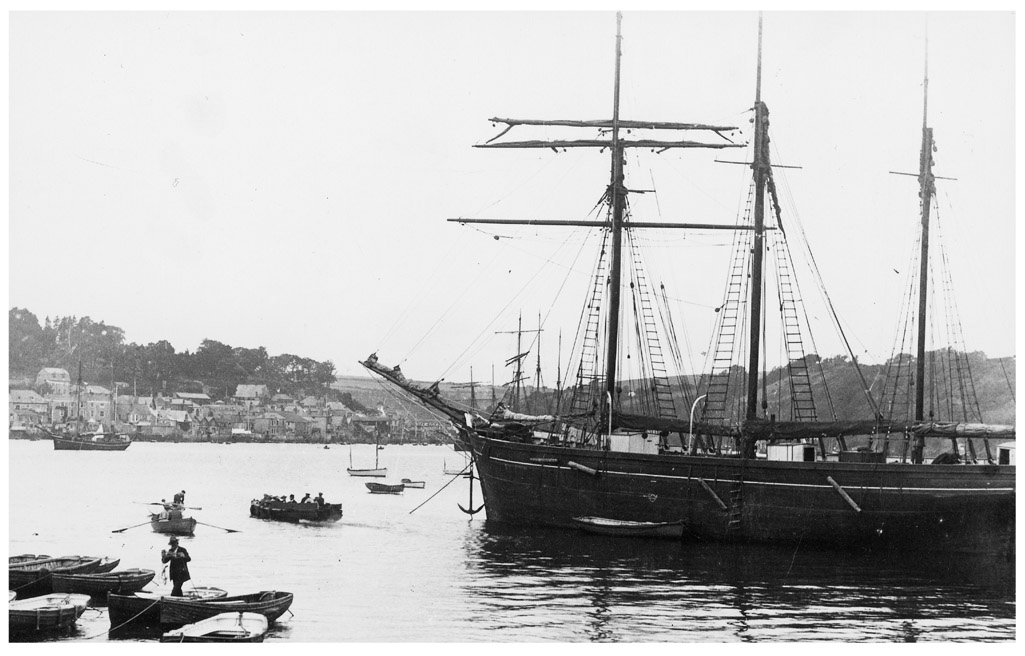
21.1 Jane Slade Fowey Regatta ship on 24 August 1893 (Helen Doe)
Newspaper reports indicate that Fowey Regatta developed through the nineteenth century as a happy local celebration, although occasional steamer-loads of spectators came down from Plymouth. Church bells were rung; the harbour was filled with ‘pleasure boats decked with flags and filled with ladies and gentlemen of the first respectability’; Mr Treffry opened his home, Place, to the public; the word ‘Victoria’ was set up in lamps in the harbour; there were fireworks and fire balloons, water carnivals and the Band of the Royal marines; gig races were rowed. However, there was very little sailing. Races were held in 1838 and 1866 for small sailing boats under fifteen feet, but both contests were ruined by bad weather.17 Some racing under sail developed at Fowey later, although the scale of programmes could not compare with the contemporary Devon events. In 1890 passage races were organised from Plymouth and Falmouth to encourage yachtsmen to attend Fowey Royal Regatta, but most visiting yachts could attend only as spectators as the regatta provided no sailing races for yachts larger than five tons. Some visitors could race in 1905, when Fowey Royal Regatta advertised handicap racing for small yachts and sailing boats and one race for yachts between three and twenty tons whose owners were not members of a Fowey yacht club. The regatta held by Fowey Yacht Club in the same year reflected the club composition, as racing was limited to cruiser handicap classes and dinghies.18
Penzance and Mount’s Bay regatta could offer good water and some events did provide excellent racing, as when the Royal Western Yacht Club visited Mount’s Bay in 1846 to race against Cornish yachtsmen. Two races were sailed in a strong wind, the prize for large yachts being won by a Plymouth yacht and the smaller classes by a Penzance boat. The races were followed by a convivial dinner at Marazion. Another very successful regatta was held in 1894, when the committee managed to attract large yachts including Britannia (152 tons), Corsair (40 tons), Vigilant (165 tons) and the 171-ton Satania, fresh from repair after her notorious collision with Valkyrie. In this year Mount’s Bay was also able to stage races for the twenty-ton and for five-ton craft.19
Falmouth was the strongest candidate to attract large yachts. The town was ideally placed geographically as the event could fit between the regattas at Cork and Cowes or after Plymouth. The port also had good sheltered water for racing in bad weather. Regattas had started on the Fal in the early nineteenth century. Four classes of small sailing boats drawn from Falmouth and Plymouth raced in 1829 and four classes raced again in 1837. In 1846 there was reasonable success, as Plymouth yachts which had raced in Mount’s Bay Regatta stayed on for the Falmouth races. Three second-class yachts raced and four first-class boats, including Lily of Devon and Grand Turk, with two other yachts from the Royal Thames Yacht Club. There were also races for sailing boats under twenty-five feet and fishing boats.20
There was a further regatta in 1872, the first year of the new Royal Cornwall Yacht Club. In spite of unfavourable weather, wind and rain on the original Regatta day and a dank mizzle when the cancelled races were resailed, a national standard programme was sailed. The first class was won by Oimara, then the largest cutter in England; the race for forty-tonners attracted such major yachts as Muriel, Foxhound and Myosotis; the twenty-ton class also had a good response and races were staged for pilot cutters and working sailing boats. Another good regatta, which attracted six yachts from the ‘big class’, all over 100 tons, nationally known forty-tonners including Coryphee, Bloodhound and Norman and nine twenty-tonners, took place in 1880. In 1894 the contestants not only included Satania and Britannia and well-known national racers such as the forty-raters Corsair and Carina and the twenty-raters Luna and Thelma, but the organising committee was given a spectacular bonus by the arrival in port of ‘ many large men-o-war . . . no fewer than twenty-one ironclads and ten torpedo catchers, comprising A group, Red Fleet’.21
These excellent events showed that Cornish waters were well suited to host major regattas. Some events in other years were marred by a combination of bad luck and administrative mistakes. Mount’s Bay was unlucky in 1837, when the regatta was postponed once for the King’s death and again for elections, and when a final date was fixed the weather was terrible. Falmouth regattas in 1885, 1895 and 1900 failed to attract visitors when the dates chosen clashed with other major events, and the Falmouth publicity was sometimes poor. In 1877, according to a newspaper report, ‘the public knew nothing about the regatta’, and in 1891 the Yachtsman was driven to comment that ‘the Royal Cornwall Yacht Club regatta is somewhat of a private affair’.22
However, a few administrative mistakes are not sufficient to explain the major differences in the development of organised and competitive yachting between Cornwall and south Devon. It is also unlikely that Cornish yachtsmen were less interested and efficient in the organisation of their sport than their Devon contemporaries, as in many cases the same yacht-owners belonged to both the Devon and the Cornish yacht clubs. The explanation lies in the faster development of the tourist industry in nineteenth-century Devon and the fact that Devon entrepreneurs fostered the growth of regattas and the major regional yacht clubs to provide tourist entertainment.
Devon was prosperous in the eighteenth century, drawing revenue from agriculture, wool cloth, coastal and foreign trade and fishing. When this economy was dislocated by war in the late eighteenth century local businessmen developed health and holiday resorts by the sea, hoping to profit from the restriction of foreign travel. The expansion of these resorts continued through the nineteenth century and between 1831 and 1881 those employed in the service section in Devon rose from 32 to 51 per cent of the population.23 Holiday resorts were eager to provide entertainment for resident holiday-makers and to attract day visitors. Trading centres, such as Plymouth, also saw the benefits of attracting country visitors. The regatta was viewed as one suitable form of entertainment. Originally financed by local subscription, by the latter half of the nineteenth century the major Devon regattas were heavily subsidised by town councils, both in cash and privileges. Thus in 1897 the subscription list for the Torquay Royal regatta produced £182 and race entries £50, but the Council gave a cash grant of £85, a cup as the direct gift of the Mayor and the right to collect ground rent from stall-holders at the Regatta Fair, worth over £200. The Council was assured by the Regatta Committee that the money would be spent ‘where the council would derive most from it’. Dartmouth Regatta had similar ‘Fair Rents’ privileges and enjoyed incomes of £616 in 1910 and £571 in 1913, while Plymouth usually managed regatta incomes of over £400.24 The large budgets administered by the subsidised Devon regatta committees enabled them to offer valuable prizes that attracted nationally known yacht-owners hungry for prize money.
Businessmen not only subsidised regattas but founded the major Devon Royal Yacht Clubs to provide social and organisational centres for yachtsmen. Thus the Port of Plymouth Royal Clarence Regatta Club (later the Royal Western Yacht Club) was founded in 1827 to manage the annual Plymouth regatta. The original list of over sixty members included the President of the Plymouth Chamber of Commerce, civic dignitaries, landowners, merchants and professional men. One of these can be shown to have owned a yacht. The Royal Dart Yacht Club was formed in 1866, when the railway arrived at Dartmouth and made it possible to develop the local regatta into a major event. The founders’ publicly stated aim was to ‘establish [the club] on such a footing as will afford an inducement to the owners of yachts frequenting the Channel to make this port and club their chief rendezvous during the summer’. The third major Devon club, the Royal Torbay Yacht Club, was established in 1870 by the owner and developer of Torquay, Sir Lawrence Palk, as part of a package (including a new harbour) designed to establish Torquay as a major yachting station.25
Cornwall, with a mining industry which flourished throughout most of the nineteenth century, did not develop tourism as early as its neighbour. The percentage of the Cornish population employed in services in fact fell from 47 per cent to 40 per cent between 1831 and 1881, and as late as 1901 the Census included only one Cornish resort, Newquay on the north coast, among the nation’s watering places.26
Only intrepid visitors ventured into Cornwall and accounts of nineteenth-century holiday-makers, including Turner, Tennyson and Thomas Hardy, reflect an ‘explorers’ attitude. Access to Cornwall was not easy. In 1836 the fast Royal Mail coach took eleven hours from Exeter to Falmouth via Okehampton and eight hours from Plymouth via Liskeard. Other hardy travellers could use steamboats to Falmouth and Penzance from Bristol, Southampton and Plymouth. As late as the 1850s the railway finished at Plymouth. Even after 1859, when the railway was established between Paddington and Penzance, towns off the main line were reached by often poor roads. Francis Kilvert visited friends at Perranwell in 1870 and, after leaving the railway at Truro, made all excursions by boat, foot or horse-drawn vehicle.
The Lostwithiel–Fowey railway was opened to passengers in 1883, but nineteenth-century Fowey offered few attractions for holiday-makers. A writer in 1857 claimed that the town was ‘the most downcast, neglected seaport in the west of England . . . we have no gas to enlighten us, though we have three church ministers, and no police to look after us, and no water, save what every woman in the place fetches from a well’. The town got a main sewer in 1877, although it was too small, and in the same year it was noted that the town did have a scavenger, but he was well advanced in age and not up to his job.27 It was reported in 1859 that Penzance, a market town of 10,000 inhabitants, exported potatoes and early vegetables and provided a pleasant social and cultural centre for surrounding local gentry, with an esplanade, baths, the Royal Geological Society of Cornwall and several museums. There were three inns, but few signs of tourism. A factory established to make ornamental goods from Lizard serpentine stone had just gone bankrupt.28 Falmouth was slow to develop tourism. When Beatrice Potter visited Falmouth in 1892 she considered it a ‘quiet, well conducted town’, although the ‘steep, narrow streets in the morning smelt of rotten fish and refuse’. Miss Potter described shipbuilding, local churches, shops and the three-strong police force, but no other tourists, and her comment that the local people stared inquisitively at the Potter family suggests that holiday-makers were rare.29

21.2 A smart gaff cutter in Fowey before the First World War (Helen Doe)
The absence of tourism and of the need to attract and entertain visitors kept Cornish regattas as local celebrations, with small budgets which relied on subscriptions and donations. In 1887 the Fowey regatta budget was £73 16s., of which £69 13s. came in through subscriptions and £4 3s. by entrance fees. £31 17s. 6d. was spent on prizes. In contrast, in 1887 Dartmouth offered £85 to the large yachts and £50 to forty-tonners, with numerous goblets, tankards and lesser prizes to small classes. Yachts over thirty tons raced for seventy guineas and sixty sovereigns on the two days of the 1887 Royal Torbay Regatta. At Plymouth in 1887 the big yacht prizes totalled £245 at the Royal Western Yacht Club Regatta and the Port of Plymouth Royal Regatta. Large yachts followed big prize money and it is interesting to note that when Mount’s Bay and Falmouth managed to offer £100 and £80 for the big class in 1894 they did attract the yachts, aided possibly by the example of the Prince of Wales, who did his duty as duke of Cornwall and sent Britannia to the race.30
The Cornish towns recognised the advantages of regatta sponsorship too late. In 1910 the Royal Cornwall Yacht Club doubted the viability of a regatta, but staged the event when they were joined by Falmouth town ‘Development Committee’.31 However, although ten classes were advertised, very few yachts attended. The opportunity to add Cornish ports to the major regatta circuit of Edwardian Britain had been missed many years before.
Notes and References
1 Penzance Customs House ‘The Collectors Letter Book to the Commissioners’, a letter dated 21 September 1749 giving an account of the stranding. Identification of the yacht rests on a letter sent on 15 April 1925 by the Earl of St Germans to the St Aubyn family regarding his recent purchase of the plans of the vessel, and a note on the plans themselves that the yacht was designed and built for Mr Pole. Cornwall Record Office [hereafter CRO], Anthony/PA/LIB/36/2: Mr Pole’s building and maintenance bills have survived for 1745 to 1752, and include the account for repairs to the Rashleigh yacht and the quantities of sail canvas, anchors, etc., in the bills are compatible with the dimensions of the plan; CRO: AU12, plans. CRO: BU336, Buller family, yacht accounts. Royal Cornwall Gazette, 21 May1808, 18 June 1808.
2 M. Guest and W. Boulton, Memorials of the Royal Yacht Squadron (Cowes: London: John Murray, 1903), list of yachts and owners; Ian Dear, The Royal Yacht Squadron, 1815–1985 (London: Stanley Paul, 1985); Lloyd’s Registers of Yachts, 1870–1905 (London: Lloyds Register of Shipping, 1870–1905 passim); The Yachtsman (compiler), British Yachts and Yachtsmen (London: Lloyds Register of Shipping, 1905).
3 Lloyd’s Registers of Yachts, 1870–1905; CRO: PV 27, journal of steam yacht Ina (unpublished).
4 Royal Cornwall Gazette, September 1803; Yachtsman, 31 May 1894.
5 Sherbourne Mercury, 8 October 1770.
6 Royal Cornwall Gazette, 21 August 1846, 24 September 1847; Yachtsman, 10 May 1894.
7 CRO: MSR/FOY Custom House registers, Fowey.
8 The National Archive [hereafter TNA]: C110/167, accounts of Henna & Dunn, Mevagissey; Royal Cornwall Gazette, 12 July 1894.
9 Lloyd’s Registers of Yachts, 1898, 1913.
10 Richard Ferris, ‘The most dangerous and memorable adventure of Richard Ferris, 1580’, in J.P. Collier (ed.), Illustrations of Early English Literature (New York and London: Benjamin Blom, 1863 and 1966).
11 Royal Cornwall Gazette, 22 July 1820, 8 November 1806, 26 September 1879, 28 August 1869; West Briton, 29 April 1864.
12 Royal Cornwall Gazette, 20 January 1896; Devon Record Office [hereafter DRO]: 2065 Madd/F309, journal of steam yacht Palatine, 1889–1902 (unpublished).
13 Western Luminary, 16 August 1814; Corydon Matthews, Chronicles of the Royal Western Yacht Club (Plymouth: RWYC, 1919); Hunt’s Universal Yacht Lists, 1851–1914; Lloyd’s Registers of Yachts, 1878–1914.
14 G.F. Bonner, The Yachtsman’s Annual and General Register (1845); Matthews, Chronicles of the Royal Western Yacht Club; see also Hunt’s Universal Yacht Lists, 1851–1914; Lloyd’s Registers of Yachts, 1878–1914.
15 Royal Cornwall Gazette, 14 September 1872, 10 March 1898, 11 August 1898; Yachtsman, 4 and 10 May 1894.
16 Royal Cornwall Gazette, 14 July 1801; J. Murray, Murray’s Handbook for Devon and Cornwall (London: John Murray, 1859), 185; West Briton, 16 July 1819.
17 For instance see Royal Cornwall Gazette, 4 May 1821, 5 July 1834, 27 July 1878, 9 August 1866.
18 Royal Cornwall Gazette, 14 August 1890, 10 August 1905.
19 Illustrated London News, 3 October 1846, 26 September 1894; Evening Tidings, 28 July 1894; Yachtsman, 7 June 1894, 2 August 1894.
20 Plymouth & Devonport Weekly Journal, 19 August 1829; Royal Cornwall Gazette, 18 August 1837, 4 September 1846.
21 Royal Cornwall Gazette, 14 September 1872, July 1880; Yachtsman, 2 August 1894.
22 Royal Cornwall Gazette, 21 July 1837, 11 and 18 August 1837, 27 July 1877, 10 July 1885, 22 August 1895, 16 August 1900; Yachtsman, 28 June 1891.
23 Stephen Fisher and Michael Havinden, ‘The Long-term Evolution of the Economy of South-west England’, in Michael Havinden, J. Queniart and J. Stanyer (eds), Centre and Periphery: Britanny and Cornwall & Devon Compared (Exeter: University of Exeter Press, 1991), pp. 76–85.
24 Torquay Directory, 1 August 1897; Dartmouth Chronicle, 26 April 1911, 15 May 1914.
25 Matthews, Chronicles of the Royal Western Yacht Club; Royal Dart Yacht Club Minute Book, Annual General meeting, 30 April 1867; Torquay Directory, 29 August 1900.
26 Anthony Hern, The Seaside Holiday: A History of the English Seaside Resort (London: Cresset Place, 1967).
27 See for example, Ida Procter, Visitors to Cornwall (Redruth: Dyllansow Truran, 1982); Alan Bates, Directory of Stage Coach Services 1836 (Newton Abbot: David & Charles, 1969); West Briton, 11 December 1857; Royal Cornwall Gazette, 11 May 1877.
28 Murray, Murray’s Handbook, pp. 182–88.
29 Procter, Visitors to Cornwall, pp. 132–38.
30 CRO: GRA/204, letters and accounts relating to Fowey Regatta, 1887 balance sheet; Western Daily Mercury, 22 and 27 July 1887, 27 August 1887, 30 August 1887; Torquay Directory, 24 August 1887, 31 August 1887; Yachtsman, 2 August 1894.
31 Royal Cornwall Gazette, 1 October 1910.