
PART II
CHAPTER 5
____________________________
Helen Doe, Alston Kennerley, Philip Payton
The history of Cornwall in the early modern period – the years of the Tudor and Stuart dynasties (1485–1714) and the Interregnum – is one of turbulence. Cornwall reacted against the centralising intrusion of the Tudor state – in the rebellions of 1497 and in the Prayer Book rising of 1549 against the Reformation – and, in supporting the Royalist cause in the Civil War, was likewise resisting interference from beyond the Tamar. But, even as Cornwall sought to oppose these influences, so it was drawn ever more tightly into the strategic designs of the state. War with France and Spain emphasised once again Cornwall’s strategic ‘front line’ maritime position and, despite its religious conservatism, Cornwall by the time of the Armada in 1588 had already become a bulwark of the Protestant realm against continental Catholicism. Yet Cornwall remained, until at least the 1620s, a region of ‘maritime disorder’, as John Appleby so aptly describes it below, with local figures taking full advantage of periods of war and international tension to blur the boundaries between privateering and piracy. And Cornwall also found itself at the mercy of pirates from elsewhere – from the cross-Channel raiders who participated in tit-for-tat operations against their Cornish counterparts to the much feared ‘Turkish pirates’, the ‘Moors’ and ‘corsairs’ who sailed periodically from the Barbary coast of North Africa in search of plunder and slaves.
But this was also the period when the internationalisation of maritime Cornwall through trade connections, already apparent in the medieval period, grew in scale and complexity. To facilitate this trade overseas merchants increasingly based themselves in Cornish ports, so that at Fowey in 1439, for example, there were some fifty-six resident aliens of various nationalities. Twenty-six of these were reported as householders, evidence that their presence was not fleeting.1 A later example was Inigo de Valderama, a notable Spanish merchant who appears to have moved from London to Padstow in 1559, perhaps viewing Cornwall as a safer place for a Spaniard after the accession of Elizabeth.2 He disappeared from the record after 1581, as war with Spain loomed, but other foreigners were content to remain in Cornwall, testament to the multiplicity of international links that had now been forged. Such was this complexity that Cornish ships were routinely engaged in ‘cross-trading’, moving from one overseas destination to another without revisiting home ports, as in those Cornish fishing vessels which made their ways directly from the Newfoundland cod fisheries to deliver their catches to the Mediterranean littoral.3 In this way, Cornwall’s paradoxical position was further reinforced – it was increasingly resistant to intrusion from the distant metropolis, but remained strategically in the ‘front line’, now with an additional array of international trading links that brought a degree of cosmopolitanism to Cornish ports and broadened the world view of Cornish merchants and mariners.
Rebellion and Maritime Disorder
The victory of Henry Tudor at Bosworth Field in 1485 ushered in the Tudor era. Like Richard III and Edward IV before him, Henry VII (as he had become) sought to rule his disparate territories through a series of alliances with local elites. But he also set in train what would become eventually the ‘Tudor revolution in government’, a growing intervention by the Tudor regime in the lives of people throughout the realm in issues as diverse as religious observance and the price of meat.4 Indeed, in the immediate aftermath of his triumph on the battlefield in 1485, Henry VII launched what was in effect a southern offensive against the English ‘North Parts’, nipping in the bud a dangerous northern independence and consolidating his authority there.5 Yet there were further northern risings in 1486, 1487 and 1489, in the latter year the people of Yorkshire rebelling in protest against taxes to finance a war against Brittany – a telling anticipation of Cornwall’s risings in 1497 against taxes to pay for a Scottish war. Henry moved to tighten his institutional grip on the North, laying the foundation for what would become the Council of the North, and he attempted to woo the old northern families directly into Crown service.
In Cornwall, at the other end of Henry’s realm, there was a similar lawlessness and incipient independence. In the 1480s, for example, there had been a series of maritime incidents in which Fowey was implicated, when foreign ships in local waters had been seized by Cornish pirates and taken into port to be plundered. As in the North, Henry attempted to woo Cornish notables. Cornishmen had fought alongside him at Bosworth and, in stressing his Welsh credentials as a Tudor, he likewise attempted to appeal to Cornish sentiment by stressing his ‘British’ – as opposed to ‘English’ – antecedents. He even named his first-born Arthur, asserting the legitimacy of his rule in these islands by careful co-option of the Celtic–Arthurian tradition. Prince Arthur was also Duke of Cornwall, and Henry used the Duchy as an institution for winning and rewarding the loyalty of local gentry. All this played well in Cornwall. But in 1495–6 this fragile accommodation began to fragment when the Duchy Council announced newer, stricter rules governing the recording of tin bounds and blowing houses and the marking of tin ingots. Such tightening of Tudor governance did not go down well in Cornwall, interfering as it did with the privileges and prerogatives of the Stannaries. The rules were resisted and in retaliation Henry confiscated the Stannary charters and suspended Stannary rule in Cornwall. Shortly after, in January 1497, the English parliament voted taxes to support a war against Scotland. The Cornish protested that such a conflict was no business of theirs and, already smarting from the Stannary interventions, rose in open rebellion. They marched as far as Blackheath, threatening the English government at its heart in Greenwich Palace, before their eventual defeat by superior numbers and weaponry.6
The Scots had been supporting the claims of Perkin Warbeck, a pretender to the English throne, and Warbeck lost no time in exploiting the discontent in Cornwall. He made his way from Scotland to Cornwall by way of Ireland, the time-honoured ‘Celtic sea-ways’ route, landing at Whitsand Bay, near Land’s End. Leaving his wife – the self-proclaimed ‘Duchess of Cornwall’ – in the safekeeping of St Michael’s Mount, he made his way to Bodmin, the chief town in Cornwall, where he was proclaimed Richard IV and placed at the head of a second rebel army. However, subsequent attempts to capture Exeter and then Taunton came to nought, Cornwall’s second rebellion of 1497 proving no more successful than the first. Warbeck’s nerve failed him. He fled the field, leaving the Cornish to surrender to the king’s forces.7
In the aftermath of 1497 Henry VII organised a punitive series of fines against those Cornish parishes implicated in the rebellions, while the ringleaders were executed and other leading figures outlawed by ‘attainder’, their property confiscated by the Crown. However, Henry was advised that the Cornish were ‘not yet cowed by catastrophe’, and by 1500 was already reversing the process. There was a spate of reversals of attainder, and in 1508 Henry VII in his Charter of Pardon restored the Stannaries, extending the privileges of the tinners and enhancing the legislative powers of the Stannary parliament. This was a determined attempt to regain the loyalty of Cornwall.8 Cornwall remained ‘quiet’ until the next ‘commotion’ – as the Tudors called them – in 1549, but a mood of truculent independence and discontent endured, evidenced most noticeably in continuing maritime disorder where, as John Appleby shows, Cornish pirates took full advantage of renewed Anglo-French rivalry to pursue their own particularist agendas. In 1528, for example, two ships from Looe plundered a Breton vessel from St Malo, while in 1546 a ship of the Hanseatic League was seized off the Cornish coast. Such incidents encouraged a general atmosphere of lawlessness in western waters, provoking other acts of piracy, such as an attack on a Spanish vessel near Fowey by a master from Rye in Sussex, or the more organised piratical groups – Cornish, English, Scots, French, Breton – that had began to operate in the Celtic Sea by the late 1540s and 1550s.
By then the mood in Cornwall itself had begun to turn hostile once more. In 1548 there had been disturbances in West Cornwall in response to the Reformation, especially attempts by Protestant commissioners to remove ‘popish’ images from parish churches. In January of the following year the Act of Uniformity was passed, introducing the Book of Common Prayer and English-language liturgy. The Cornish were outraged, protesting that many of them could speak no English (Latin, the traditional liturgical language, was at least familiar if not understood) and that the new Service was no more than ‘a Christmas game’. Once again, Cornwall was in open rebellion. Joining with west Devon rebels from Sampford Courtney, the Cornish laid siege to Exeter and then advanced eastwards to meet the king’s forces at Fenny Bridges. The fighting was fierce and brutal, with perhaps as much as 10 per cent of the Cornish population killed on the battlefield and in the aftermath as rebels were hunted down and Cornwall was subdued.9

5.1 Fowey in the time of Henry VIII
Source: Drawing based on a chart in Lyson’s Magna Britannia
The Cornish may have been defeated in 1549 but, as Appleby notes, disorder in Cornish waters mounted during the 1550s, not least as discontented local gentry turned increasingly to their own private wars of plunder and piracy. The 1550s were ostensibly a time of peace but in fact a vigorous unofficial war was being prosecuted against the Spanish by the privateers of Cornwall, notably the Killigrew family of Arwenack, near modern-day Falmouth. John Killigrew was captain of nearby Pendennis Castle, but devoted much of his time and energy to assisting his sons John (later Sir John), Peter and Thomas in the capture of Spanish ships. Intriguingly, among those who gave evidence against John Killigrew in 1557 for alleged piracy was Inigo de Valderama, the Spaniard who shortly moved to Padstow.10 Sir John succeeded to his father’s position at Pendennis in 1567, and in the following year the revolt of the Spanish Netherlands led to heightened tension with Spain and an increase in privateering in the Channel. A rumour that John Hawkins had been killed on the Spanish Main was an excuse for the seizure and plunder of Spanish vessels in Saltash and Fowey. In the fifteen-year stand-off with Spain that ensued, the Killigrews moved far beyond the accepted bounds of privateering, making a fortune from provisioning the pirate ships that operated from the Helford. The Killigrews were not alone: the Prideaux family encouraged piracy at Padstow, as did the Roscarrocks at Port Isaac. It suited the government to ignore much of this private-enterprise warfare against Spain but there were occasional interventions (such as that which imprisoned Sir John Killigrew briefly in the 1580s) to demonstrate that there were limits to this independence of action, although even then there were complaints that Cornish juries were reluctant to convict their own kind.11 Moreover, Cornish privateers continued to blur the indistinct boundary with piracy, as in the colourful career of Robert Colliver, born in Looe in 1666, who sailed with the notorious Captain Kidd and ravaged the East Indies before eventual capture and imprisonment in Newgate gaol.12
‘The Spanish Floating Babel’
Mindful of the Spanish threat, the government had also sought to woo those Cornish families not implicated in rebellion and disorder, co-opting a local collaborative elite in Cornwall as it had done before. Some of the Cornish gentry had in any case benefited from the dissolution of religious houses in the Reformation, or had acquired property confiscated from rebels, and on the basis of such new wealth new family seats were built or old ones extended: Trerice, Mount Edgcumbe, Port Eliot, Menabilly, Godolphin. Numerous town charters led to what would be eventually forty-four Cornish Members of Parliament, with the port of Looe boasting no fewer than four – two each for East and West – an almost extravagant way of winning the loyalty of Cornish gentlemen in this strategically vital outpost of the realm. Similarly, those gentry who had done well from the Reformation could be persuaded that Protestantism was in their own interests and that Catholicism was the mark of Spanish enmity. Although Cornish Catholicism endured long after the trauma of 1549 – the Arundell family of Lanherne, for example, or Nicholas Roscarrock, author of the Lives of the Saints, were notable recusants – an aggressive anti-Spanish Protestantism developed swiftly in Cornwall in the second half of the sixteenth century.13
The Spanish threat had also led to the construction in 1540 of two new ‘castles’ or fortresses at Pendennis and St Mawes, guarding the entrance to the Fal estuary and Falmouth Haven. This was part of the strengthening of defences throughout the South West peninsula, financed by the Crown, which included work as far east as Weymouth Bay.14 Designed to be complementary, Pendennis and St Mawes were able to offer a withering crossfire to any vessel foolhardy enough to try to force a passage between the heads. Pendennis dominated the high ground on the western promontory of that name, while St Mawes was almost on the water’s edge on the opposite side of the estuary. Built and equipped to the latest standards in fortifications, these castles were adjudged to be formidable military deterrents. At St Mawes patriotic inscriptions were built into the castle walls: GAUDEAT EDWARDO NUNC DUCE CORNUBIA FELIX (Let fortunate Cornwall rejoice that Edward is now her Duke) and EDWARDUS FAMA REFERAT FACTISQUE PARENTUM (May Edward resemble his father [Henry VIII] in fame and deeds).15 Likewise, at Fowey, St Catherine’s castle was built at the harbour entrance and the Scillies were fortified between 1548 and 1552.16
Sir John Killigrew died in 1584 and was succeeded as captain of Pendennis by his son John. By now the Spanish threat had reached new heights and in 1587 Philip II of Spain resolved to end Anglo-Spanish rivalry once and for all by undertaking an invasion of England. Later dismissed coolly by Richard Carew in his Survey of Cornwall of 1602 as that ‘Spanish floating Babel’,17 the great invasion Armada assembled by Philip II in 1588 struck terror throughout the realm. As Carew acknowledged, he was writing with the benefit of hindsight, and that at the time the Spanish fleet had seemed a mighty ‘heaven-threatening Armado’.18 Sir Richard Grenville and Sir Walter Raleigh had been appointed by Elizabeth I to plan the defence of Cornwall and the Devon, the ‘front line’, against the impending attack. Arms and equipment were prepared, and a series of fire Beacons was made ready to announce the Armada’s arrival. As Carew put it, ‘it pleased her Majestie, of her provident and gracious care, to furnish Cornwall with ordnance and ammunition from her own store’. There were guns of ‘cast iron’, he wrote, ‘well mounted upon carriages with wheels, shod with iron, with ladles, sponges and rammers, with all other accessories’, including plentiful supplies of powder and shot.19 Contingents of armed men were placed all along the southern Cornish coast, from Cape Cornwall in the west to the Tamar estuary.
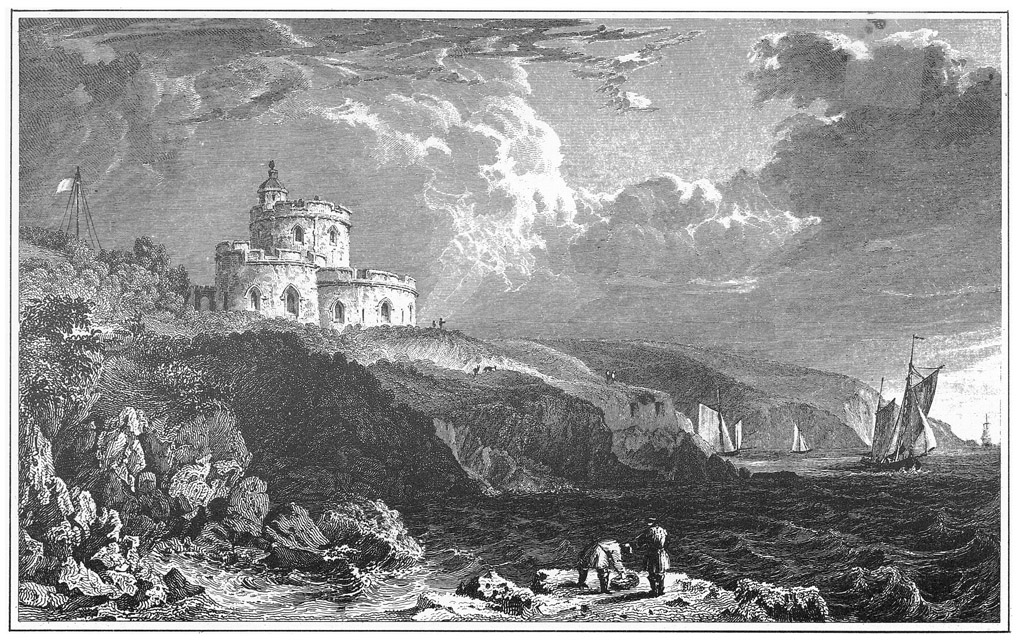
5.2 St Mawes Castle
Engraving by T. Allom, published in 1832
Invasion fever gripped Cornwall. It was rumoured, for example, that the duke of Medina Sidonia, captain-general of the Armada, had set his covetous eyes on the recently constructed Mount Edgcumbe – the splendid house erected on the Cornish banks of Plymouth Sound by the Edgcumbe family of Cotehele in 1547 – and that he had planned to make it his home after the successful conquest of England. But in the event the Armada passed Cornwall by. The Lizard was sighted by the Spanish at four o’clock in the afternoon on 19 July 1588, when the royal standard was raised on the flagship, the San Martin, together with a sacred banner depicting the Virgin Mary and St Mary Magdalene. The next day four fishermen from Falmouth Haven were captured with their boat and brought on board. With considerable presence of mind – or perhaps just reflecting popular rumour – they insisted that the English fleet had already set sail from Plymouth. In fact, the fleet was lying in Plymouth, ready and waiting. From the initial engagements off Plymouth the Armada was hounded up the Channel, with fire-ships scattering the Spanish. Thereafter, there was the nightmare attempt at escape, an epic journey up the east coast and around the top of Scotland, then southwards along the Irish coast and the final run for home. Many Spanish ships came to grief in the inhospitable waters off Scotland and Ireland, though, contrary to popular belief, none was wrecked on Cornwall’s rocky coast.20 Yet such was the significance of the Armada in the Cornish imagination that subsequent generations insisted that it was ship-wrecked Spanish sailors who accounted for the dark ‘looks’ of many Cornish people and their ‘Spanish-sounding’ surnames, such as Jago, Santo and Clemo.
At any rate, there was much relief in Cornwall that the Armada had been repulsed. The boastful Armada, Carew wrote triumphantly, had been ‘tainted with the shamefuller disgrace’, its destruction serving ‘to blaze our renown with the brighter lustre’.21 As he observed, the Spanish had ‘pretended the conquest of our island (which, like Joshua’s army [at Jericho], they compassed, but unlike him could not with their blasting threats overthrow our walls)’.22 But the threat to Cornwall was not yet over. In 1590 the Spanish occupied Brittany, on Cornwall’s doorstep, and Cornish ‘sea-dogs’ sailed in the Royal Navy squadrons which took the fight to the enemy and cruised as far as the Azores to intercept Spanish treasure ships. Among them was Sir Richard Grenville of Stowe, whose gallant fifteen-hour battle in 1591 in the ill-fated Revenge against an overwhelmingly superior Spanish force of fifty-three warships has gone down in historical memory as one of the epic events of the conflict.23
‘They shall land on the Rock of Merlin/Who shall burn Paul, Penzance and Newlyn’
In 1595 the war returned to Cornwall with a vengeance when, early on the morning of 23 July, four Spanish ships landed a raiding party at Mousehole, on Mount’s Bay. Sir Francis Godolphin, who attempted to organise an impromptu defence, gave an eye-witness account of the action to his friend, Richard Carew, who produced a summary in his Survey of Cornwall. As Carew explained:
soon after the run was risen and had chased a fog which before kept the sea out of sight, four galleys of the enemy presented themselves upon the coast over-against Mousehole; and there in a fair bay landed about two hundred men, pikes and shot, who forthwith sent their forlorn hope, consisting of their basest people, unto the straggled houses of the country about half a mile compass or more, by whom were burned not only the houses they went by but also the parish church of Paul, the force of the fire being such as it utterly ruined all the great stone pillars thereof. Others of them in that time burned that fisher town Mowshole [sic], the rest marched as a guard for defence of these firers.24
Local inhabitants, fearing for their lives, fled their homes, grabbing what weaponry they could as they left, and outside Penzance encountered Sir Francis Godolphin, ‘who that forenoon coming from his house [Godolphin] for pacifying some controversies in those western parts, and from the hills espying the fires in that town, church, and houses, hastened thither’. Godolphin sent word to Plymouth, raising the alarm and requesting reinforcements, and set about planning what defence he could. Marshalling his ragged body of defenders he made for Mousehole, only to be outflanked by the Spaniards, who had re-embarked in their galleys and sailed for the neighbouring ‘lesser fisher town’ of Newlyn. The full force of ‘about four hundred pikes and shot’ was landed, intent on further burnings, and, seeing that its way was clear, then set off towards Penzance. Sir Francis hastened to cut them off but the galleys aimed accurate shot at his small force, causing panic: ‘though none were hurt . . . yet many in a fearful manner, some fell flat on the ground and others ran away’. He decided to make a stand in the market-place in Penzance, but with his tiny force now reduced to ‘only two resolute shot [musketeers] who stood at his command, and some ten or twelve others that followed him, most of them his own servants’, he decided that discretion was the better part of valour and withdrew. Penzance burned. Later in the evening other Cornish forces arrived and they camped on the eastern green towards Marazion. Next morning, as the Spaniards again prepared to land, they were met with a stiffer resistance ‘by the shooting of bullets and arrows into their galleys where they rode at anchor, [and] they were forced to move them farther off’. Soon after, ships of the Royal Navy appeared off the Lizard, and ‘away pack the galleys with all the haste they could’.25
Carew found it embarrassing to have had to pen this ‘summary report of the Spaniards’ glorious enterprise and the Cornishmen’s infamous cowardice’, and he was careful to provide excuses for the poor performance of the locals. There was, he wrote, ‘the suddenness of the attempt, the narrowness of the country, the openness of the town, the advantage of the galleys’ ordnance on a people unprepared against such accidents’.26 In fact, the defence had not been as dispirited as Carew had imagined. In Mousehole Jenken [James] Keigwen, one of the town’s chief inhabitants, was killed by the Spanish and buried on 24 July, with the galleys still in the vicinity, and it is said that the musket ball that struck him dead was preserved for many years thereafter by his family. John Pearce Peyton, another victim of the raid, was buried at Paul on the same day. The parish register had been burned in the church but the vicar, John Tremearne, promptly provided a new one. The first four names recorded were of those killed in defence of Mousehole: Keigwen, Peyton and Jacobus [James] de Newlyn who ‘was killed by enemies and buried on 26 July’, together with Teck Cornall [Cornwall], who was interred on the same day.27
The events of July 1595 alarmed the government, reminding it of the vulnerability as well as strategic importance of Cornwall, and, as Carew noted, measures were taken to tighten security, with new commands of 4,000 men apiece allocated in Cornwall and Devon. There was also a survey undertaken of Falmouth, Fowey and Plymouth, an enterprise which took four and a half months to complete at a cost of £73 9s 9d.28 In 1599, ‘when the Spanish fleet was again expected’, the new arrangements worked smoothly: ‘the Cornish forces voluntarily assembled themselves, and made head at the entrance, middle and west part of their south coast’.29 In popular remembrance the Mousehole raid fused with the events of the Armada half-a-dozen or so years before. No doubt there had been Spaniards in 1595 intent upon rape as well as pillage, and perhaps they did contribute something to the Cornish gene pool after all, as the myth averred. But, as Daphne du Maurier once wrote of those supposed Armada survivors, ‘If so, the Spanish sailors had a genius for begetting, reproducing themselves a thousandfold’.30 A more intriguing myth, perhaps, was that recorded by Carew himself. There was, he said, ‘an ancient prophecy in their own [Cornish] language . . . how there should land upon the rock of Merlin those that would burn Paul’s church, Penzance, and Newlyn. And indeed so is the rock called where the enemy first stept on shore. The prophecy is this:
Ewra teyre a war meane Merlyn
Ara lesky Pawle Pensanz ha Newlyn.31
(They shall land on the rock of Merlin
Who shall burn Paul, Penzance and Newlyn)’.
‘Turkish Pirates’
Peace with Spain in 1604, two years after the publication of Carew’s Survey, did not mean the end of maritime disorder in Cornish waters. Cornish pirates continued to operate as they had done in the past and in the 1630s there was a major revival of Cornish privateering, a practice that continued throughout the seventeenth century. However, by the 1620s a new menace had appeared off the coast of Cornwall: the ‘Turkish pirates’ of North Africa.
Operating out of the Barbary ports of Algiers, Tunis, Tripoli and Sallee, these ‘Turks’ or ‘Moors’ had become a nuisance by the early 1600s, raiding along the Cornish coast and carrying off men, women and children for slavery or ransom. In 1607 the borough of Liskeard had given one Bernard Barrett three shillings towards ‘the ransoming of his Brother being taken by the Turks’,32 and there were similar contributions to ransom money at St Neot in 1613 and Camborne in 1617. By the 1620s, however, the problem had become more significant. In one week alone in April 1625 the Turks had seized three Cornish fishing boats, it was reported, and in the August the port of Looe complained that within a period of ten days it had lost eighty mariners to the Turkish pirates. Elsewhere in Cornish waters, it was claimed, the Turks had taken some twenty-seven ships and upwards of 200 souls over the same period. In the following year it was said that fishermen along Mount’s Bay were too frightened to put to sea because of the presence of Turkish vessels, and there were fears that Cornish trade might now be seriously disrupted. There was concern that the Newfoundland cod fleet could be intercepted on its return to Cornish waters and that there might be shortages of imported goods such as malt and salt.33
In May 1626 John Bonython, deputy governor of Pendennis, warned of Turkish pirates plying the waters between the Lizard and the Scillies, and in the same month there was great excitement when a Turkish ship was captured by a Cornish crew and brought into St Ives. In the late 1620s there were fewer Turkish incursions but by the mid-1630s they were back, capturing large numbers of ships and personnel from south-coast ports such as Looe. There were complaints that ‘These Turks daily show themselves at St Keverne, Mount’s Bay, and other places, that the poor fishermen are fearful, not only to go to the seas, but likewise less these Turks should come on shore, and take them out of their houses.’34 In June 1640 it was reported that four Turkish ships had appeared off Penzance, capturing nine vessels and sixty persons, and that evening taking a further three vessels between Mousehole and Land’s End. Later in the year the Turks landed near Penzance one night, carrying off some sixty people, including women and children.35
By 1637, however, the government had begun to take the Turkish threat seriously, mounting a naval expedition to Sallee on the Barbary coast, blockading and then capturing the town, with the release of 300 captives. Although this did not put an end to the problem anxieties were eased now that it was at last being addressed, and there was thereafter a fall-off in Turkish activity. Yet so traumatic had the experience been that for generations the maritime communities of Cornwall remembered with dread the marauding Turks. Over 100 years later, for example, in September 1760, there was widespread alarm when ‘a large vessel of strange appearance’ ran onto the beach near Newlyn. It was ‘obvious they were Moslems’, according to one account, ‘and a vague fear of Turkish ferocity, of massacre and plunder, seized the unarmed inhabitants’ of the locality. The Penzance Volunteers were promptly turned out but it soon became clear that the sudden appearance of this ‘Algerine corsair’ – an impressive ship of twenty-four guns – was a result of navigational error rather than evil intent. The master had been ‘in full conviction’ that he was in the open Atlantic and had been disconcerted to find himself in Mount’s Bay. Although ‘the dark complexion and harsh features of a piratical band, made them objects of terror and surprise’, there was curiosity rather than animosity, and eventually the Turks returned to Algiers unmolested.36
Although the raid on Sallee in 1637 was a success there had been widespread dissatisfaction that the government had been slow to react and anger that the lessons of 1595 had been forgotten already, with coastal fortifications – including Pendennis and St Mawes – by now neglected and ill-provisioned. This added to the general air of political discontent that had emerged in Cornwall and throughout the realm in the years before the Civil War. Although Cornwall would later declare resolutely for the Crown there was an influential body of Cornish ‘loan refusers’ (who would not pay the king’s Forced Loan of 1626) and religious Puritans – especially in south-east Cornwall – who were critical of Charles I and his policies. During the Long Parliament of 1640–42 they made their voices heard in Westminster.37 But most Cornish MPs were ‘constitution-alists’, anxious to find some middle way in the growing dispute between Crown and Parliament. By 1642 it was becoming apparent that such a compromise was not possible, and so the majority of Cornish gentry began to coalesce around the leading families – the Grenvilles of Stowe, the Vyvyans of Trelowarren, the Killigrews of Arwenack – pinning their colours to the king’s cause. It was an allegiance that was to prove hugely popular in Cornwall, the Cornish common folk stoutly resisting intrusions by Parliamentarian forces and often treating the conflict, as Mark Stoyle has argued, as a private war between Cornwall and England.38 As the Royalist journal Mercurius Aulicus put it so admiringly: ‘Cornwall (which is little Wales beyond England) proved themselves true Brittaines, when no English county stood intirely for his Majestie’.39
‘His Majesties Sea-Service’
The heroic exploits of the Cornish army in support of the Royalist cause in the Civil War are generally well known – the battles of Braddock Down and Stamford Hill on Cornish soil, the participation in the capture of Bristol, the great battle of Lansdowne (where Bevill Grenville was killed), the destruction of Essex’s army in the ‘Cornish mousetrap’ around Fowey and Lostwithiel – as is the defiant stand of Cornwall almost until the end. Royalist forces surrendered formally to Fairfax at Tresillian Bridge, near Truro, on 12 March 1646, though Pendennis held out until the August under the command of Sir John Arundell, so-called ‘Jack for the King’ whose ill, starving and ill-equipped soldiers marched proudly from the castle with colours flying, trumpets sounding and drums beating.40
Less well known is the maritime dimension of Cornish service in support of the Crown. As Mark Stoyle demonstrates below, the declaration of Cornwall for the king handed Charles I a priceless maritime prize. The majority of the Navy – and the ports from which it operated – having defected to Parliament, the king’s ability to communicate with the outside world had been almost closed down. The securing of Cornwall, however, gave him access to strategically placed ports such as Padstow on the north coast (well placed for communication with Ireland) and the Scillies, Falmouth Haven and Fowey in the south, opposite the continent. Throughout the war the Parliamentarians feared that the Royalists would bring in ‘foreign’ reinforcements through this Cornish backdoor. It never happened, but it remained a major headache for Parliamentarian planners. What did happen was a vigorous attempt to secure supplies for the Royalist effort. Sir Nicholas Slanning, governor of Pendennis, directed the systematic capture in Cornish waters of merchant shipping bound for Parliamentarian ports, while George Carteret – operating from St Malo and Jersey – organised a sophisticated continental supply of arms and ammunition, landing it in Cornwall.
The Royalist capture of south-west England, in which the Cornish played no small part, gave the king a string of new ports from which he might operate – Bristol, Bideford, Weymouth, Dartmouth – and in consequence Royalist privateering flourished. For the Parliamentarians, things seemed to go from bad to worse. They failed to prevent the escape from Cornwall to Brittany of Henrietta Maria, Charles’ queen, and when Essex attempted his disastrous invasion of Cornwall shortly after the limits of Parliamentarian sea-power were demonstrated once more. Royalist privateers further established their superiority in Cornish waters, but by the summer of 1645 the tide was turning against the Royalists elsewhere, especially after their stinging defeat at the battle of Naseby. Parliament’s ‘New Model Army’, under Fairfax’s command, pressed ever westwards thereafter, and as it did so Royalist resolve collapsed. On 2 March 1646, two weeks before Cornwall’s surrender, Prince Charles (later Charles II) joined a warship at Land’s End, fleeing into exile. Falmouth and the other Cornish ports were no longer a safe haven for Royalist privateers, who transferred their activities to south-west Ireland and elsewhere, and the Civil War in Cornwall was all but over.
The ensuing Cromwellian regime regarded Cornwall with suspicion. Mindful that ‘there was a common muttering among [the Cornish] that their country was never conquered’,41 and that even now ‘Cornwall was cavileerish enough’,42 Parliament ejected Royalist Cornish clergy from their livings, while some Cornish families (notably the Bassets, who lost St Michael’s Mount to the St Aubyns) were dispossessed or forced into exile. The Stannaries and Duchy were suspended. Yet much of this was undone at the Restoration in 1660, when Cornwall was remembered and rewarded for its staunch support of the Royalist cause. The imprisonment of Bishop Jonathan Trelawny in the Tower by (Catholic) James II in 1687 strained this relationship but for the most part Cornwall was seen now as supremely loyal to the Crown, a bulwark of Royalism.
The experiences of the Civil War had reminded both sides of the strategic importance of maritime Cornwall, and the lesson was not forgotten. As Falmouth expanded dramatically as a trading port in the second half of the seventeenth century, so it became a focus for naval activity and in 1688 was established as the centre for the new ‘Packet’ service, the Post Office’s point of departure for its far-flung maritime mail service to overseas destinations, a role that Falmouth was to keep until 1850. Indeed, despite the depredations of war, the economy of Cornwall had in many ways proved remarkably resilient. Although, as recent research by Mark Overton et al. has demonstrated, there was a decline in Cornish agriculture in the latter part of the seventeenth century, in other respects the economy had developed apace.43 In East Cornwall there was an important cloth industry, in many respects linked to that of Devon, and although the export of cloth was ostensibly banned there was an informal continental trade – as in 1661, when it was discovered that a St Malo vessel was regularly carrying illicit cargos of cloth and tin from Fowey to Brittany. Yet the cloth trade in Cornwall was never as important or lucrative as it was in Devon, a result of the poorer grazing that obtained west of the Tamar, and its contribution to maritime commerce and the expansion of shipping was likewise less significant than in Devon.44 The real impetus to development in Cornwall in this period was mining. As James Whetter has observed, ‘by the second half of the century . . . tin mining, in parts of the centre and west, was monopolising resources of labour and capital to a degree not known before’.45 As he concluded: ‘by the end of the century . . . tin mining had become the dynamic element in the economy, the main force for prosperity – or depression, as the case might be’.46
The Maritime Economy
As Overton has shown, this emphasis on tin had the effect of making the Cornish economy more specialised and less diverse than other apparently comparable maritime areas. For example, by the close of the seventeenth century the south-eastern county of ‘Kent had a diversified economic base, whereas Cornwall was becoming increasingly dominated by mining’.47 In this way, Overton has argued, ‘While Kent appears to have become fully integrated into a metropolitan economy, Cornwall experienced relative deprivation and exploitation more reminiscent of the Irish than the English experience in this period.’48 Yet, in response to the growth of tin – and, in the second half of the century, copper – in mid and west Cornwall, the population had expanded dramatically. Penwith, in the far west, had grown by an extraordinary 89 per cent between 1660 and 1750, while the neighbouring hundred of Kerrier was not far behind at 79 per cent. As Overton has admitted, however, his characterisation of the mino-centric Cornish economy may have been distorted by the random nature in which his primary research material was selected. Key fishing ports such as Newlyn and Mevagissey did not feature in his analysis, while the extremely important trading centres of Falmouth and Fowey were likewise overlooked.49 Fishing, then, was perhaps not so stagnant as he had imagined, while the maritime dimension generally may have contributed to a relative diversification that was not immediately apparent in the Overton analysis. Maritime activity, indeed, may well have contributed to the dramatic rise in population in mid and west Cornwall in this period, especially around Falmouth.
Extensive probate inventories have survived in Cornwall – the best sources for household economic activity in this period – and a number come from the several maritime localities on the south coast of Cornwall: Antony, Maker and St Stephens-by-Saltash on the Tamar estuary; the parishes of St Martin-by-Looe and Talland on either side of the Looe river; and Madron and Paul (which includes Newlyn and Mousehole) in Penwith. Not surprisingly, fishing was the principal maritime activity in these maritime communities, although its relative importance varied from place to place and over time. For example, with the sharp decline of line fishing from the mid-seventeenth century and the parallel growth of seine and drift (‘drove’) net fishing, especially in the west, the proportion of the population of Maker engaged in fishing dropped from 54 per cent to just 6 per cent after 1650. Likewise, some 87 per cent of the Penwith fishermen had nets, compared to only 39 per cent at Looe and 52 per cent in the Tamar estuary. Fish processing was also a significant activity, centred in Penwith, where Newlyn and Mousehole came to dominate the industry. Other maritime activity included ‘barging’ – especially important in the Tamar estuary – while some households held shares in local shipping and other individuals described themselves as ‘seamen’ or in naval service. There is also evidence of considerable ‘bi-employment’, of households and individuals in Cornish maritime communities spending part of their productive time in economic activity not connected with the sea. Some worked in agriculture, for example, or in various crafts or spinning.50
Complementary to the probate inventories as sources for seventeenth-century Cornish maritime communities are the maritime surveys of Cornwall conducted in 1626 and 1629, giving the number of ships and mariners in each of the Cornish ports and harbours.51 Although the data is inconsistent it shows a clear divide between the north and south coasts, with much of the activity concentrated on the latter. Compiled before the rise of Falmouth and the shift of economic resources from east to west Cornwall, the surveys indicate a predominance of mariners in the south-east. Maker parish, which included the important Tamar estuary town of Millbrook, had the greatest number: seventy-six designated as ‘sailors’, another fifteen given as ‘mariners’ and ten described as ‘fishermen’, along with six shipwrights, five gunners, eight pilots, two coopers, six sailors-and-servants and – curiously – one ‘trumpeter’, perhaps a ‘huer’ whose job it was to alert his colleagues to the approach of pilchard shoals. This made for a total of 107 seamen, compared to the Mount’s Bay communities of Mousehole, Newlyn, Penzance and Marazion, which together mustered 144 seamen. Fowey and Polruan had 108, East Looe 88 and Saltash 85, while even the parish of St Goran, with its tiny harbour at Gorran Haven, could boast 55 fishermen – of whom no fewer than 26 were listed as seinemen.52
The names of ships such as the True Dealing of Saltash, the Merchant Bonaventure of Penryn and the Fortune of Padstow revealed the earnest aspirations of their builders and owners. In all, there were some eighty-three ships recorded in Cornwall in 1626, no doubt a conservative figure (Padstow is shown with only three vessels, Mevagissey with one and Fowey with eight), and again the predominance of the south-east is demonstrated clearly: East Looe had twenty-six ships and Millbrook seventeen.53 Most were built locally, and recent research has discovered contracts that have survived for two such Cornish ships in the seventeenth century: John Rashleigh’s Success of 1606 at Fowey and the Three Brothers of Looe in 1686. The Success was constructed of local timber (from the Rashleigh estate at Menabilly but also from St Veep, Lerryn and Tywardreath) in the inlet at Caffa Mill, near Fowey, and seems to have taken only nineteen weeks to complete. The work provided employment for some thirty named individuals, mainly carpenters and shipwrights, with many others – blacksmiths, sailmakers, riggers, victuallers – engaged in equipping the ship for her maiden voyage.54
Such ships participated in both local and external trade, the Success being involved in the Newfoundland fisheries, sailing from there to the Mediterranean and then returning to Cornwall with cargos of alum and soap, wine and dried fruit. Earlier, in the Tudor period, when there was considerable house (and church) building, local coastal shipping had been critical in accessing necessary materials not available in Cornwall. When Edward Arundell built a new home on the north coast his steward, John Bennet, made two (possibly three) journeys from Padstow to Bristol to acquire a large variety of items. For the last voyage, in 1577, a detailed inventory survives, ranging from lime laths and lead to personal items such as tankards, crossbow twine and a skillet.55 Often ships ventured even further afield in search of household goods. In 1683, for example, customs officers at Fowey noted imports of Spanish wine, brandy and iron. From Brittany came soap, tallow, cork, pitch, hemp and canvas.56 The Atlantic islands were a major source of wine, and the Enys family of Penryn specialised in this Atlantic trade, importing sweet wine from the Canaries.57 In good years, when harvests allowed, exports from Cornwall included surplus corn, which went to destinations such as France, Spain and the Canaries, as well as Plymouth, Bristol and London. But, as Whetter has shown, Cornish exports – especially in the second half of the seventeenth century – were dominated by tin and pilchards. As he has observed, Cornwall ‘had a near monopoly of both tin and pilchards in Britain, and indeed, in Western Europe . . . tin mining and pilchard fishing were geared almost entirely to the export market’.58
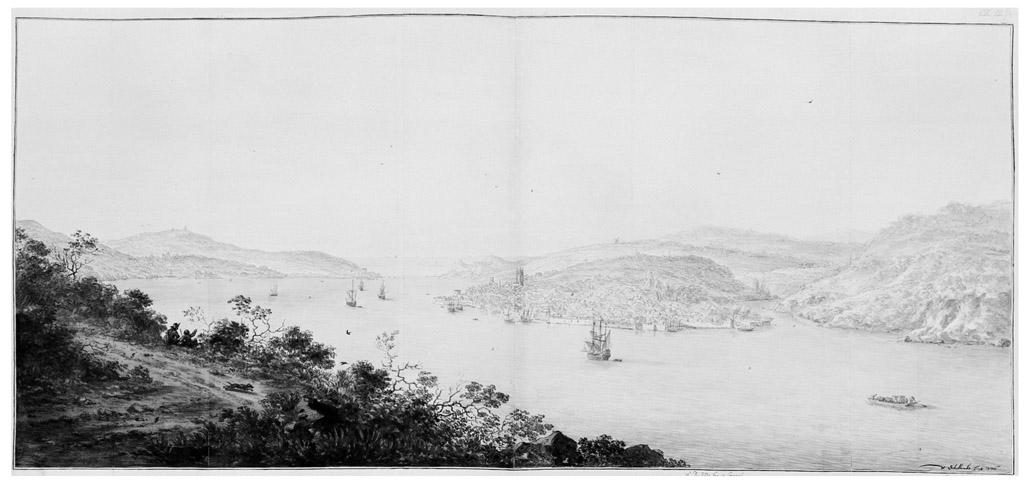
5.3 View of Fowey from Bodinnick showing Caffa Mill, by Dutch painter, Willem Schellinks, 1627–78
(Austrian National Library Vienna, Picture Archive Atlas Blaeu, 19:51)
In this period the populations of fishing ports such as St Ives and Mevagissey grew rapidly, associated especially with the rise of the pilchard fishery. During the course of the seventeenth century the fishery had become more concentrated in Cornish waters (fewer pilchard shoals ventured further east along the south Devon coast), while the pilchard season itself had expanded. Traditionally a summer harvest, pilchards were now almost as likely to be caught in winter months, as in January 1671 when a bumper catch was landed at Mevagissey. As Richard Carew explained, of all Cornish fish, the pilchard was most important: ‘the least fish in bigness, greatest for gain, and most in number, is the pilchard’.59 Some were caught by the process he described as ‘droving’, where the drovers hung ‘certain square nets athwart the tide, through which the shoal of pilchards passing, leave many behind entangled in the meshes’. Yet this method was increasingly criticised by ‘seiners’, who argued that the droving nets merely broke up and scattered the shoals, with ‘much prejudice to the commonwealth of fishermen’, while those fish ensnared in these nets were often so bruised that they were unmarketable. The seiners, by contrast, consisted of parties of three or four boats, each carrying about six men apiece, which waited for the pilchard shoal to come close. They were assisted in this by the ‘huer’, who stood on a nearby cliff and, by gesticulating, shouting, whistling or blowing a horn, indicated the size and direction of the shoal. ‘At his appointment’, Carew wrote, ‘they cast out their net, draw it to either hand as the shoel lieth or fareth, beat with their oars to keep in the fish, and at last close and tuck it up in the sea, or draw the same on land with more certain profit, if the ground be not rough with rocks.’60

5.4 Falmouth harbour from the north, by Dutch painter, Willem Schellinks, 1627–78
(Austrian National Library Vienna, Picture Archive Atlas Blaeu, 19:49)
Once landed, Carew explained, the pilchards were ‘greedily and speedily seized upon’ by merchants and taken to cellars to be cured. There were three methods of preservation, he said: fuming, pressing and pickling. The latter involved salting and piling up the pilchards in rows, a process known as ‘balking’, where they were left for some ten days before being packed into hogsheads and allowed to pickle in their own juices. Such pickled pilchards were destined for France. Those intended for hotter countries, such as Spain and Italy, had once been fumed – accounting for their name fumados – by being hung over a continuously smoking fire. Now, however, though the traditional name endured, such pilchards were pressed instead: after balking, they were pressed in leaky hogsheads under great weights, with the briny residue collected in vessels placed underneath. Once thoroughly pressed, they were ready for export.61
Carew went on to list the many other fish caught in Cornish waters. The herring fishery was important, and Fowey and Looe specialised in the catching of ray for export to Brittany. Hake and conger were exported to Spain and the Mediterranean. There was a thriving inshore fishery specialising in shellfish, including oysters, and in Cornish rivers salmon and peal were caught. The Cornish had also played an important role in the development of the Newfoundland cod fishery. Although not on the scale of the Devon operation, based in Bideford and Dartmouth, it routinely took Cornish fishermen to distant and often forbidding waters, further encouraging a world view in which Cornish seafarers sought ever distant horizons and more exotic landfalls, with a willingness to face the full fury of the ocean and to endure long periods away from home. Such an outlook is glimpsed in the journals of Peter Mundy (1597–1667), a member of a prosperous Penryn trading family, whose travels took him to the familiar destinations of France, Spain and Portugal but also far beyond: to Belgrade on the Danube, with its 2,000 households ‘whereof 60 or 70 are Jews, the rest Christians and Turks’, and cosmopolitan Constantinople, where he found Englishmen and Frenchmen living very comfortably alongside the local population.62 There were also voyages to India and the East Indies. At Surat, in India, in 1628, Mundy came across one John Leachland, an Englishman who had been in the service of the East India Company but who ‘For the love of an Indian woman, by whom he had sundry children he decided not to return to England when his time expired’. This he found intriguing; more shocking was an incident at Surat ‘whereof I was eye-witness, that is a Banian woman that voluntarily burned herself alive with the body of her dead husband, after getting leave from the Governor’.63
The Tudor period had been the dawn of this great era of journeying and exploration and, although there were no great names, such as Stephen Burough of North Devon, there were Cornishmen who participated in Drake’s adventures during Elizabeth I’s time.64 The Francis of Fowey, a Rashleigh ship, was with Frobisher in Greenland in 1578 and with Drake in the West Indies seven years later; the vessel later became the symbol on the town seal of Fowey. The rapid growth of Falmouth after 1660 further encouraged this global reach and, with it, contact with distant cultures, as well as facilitating Cornish participation in the settlement of the American colonies.65 In 1627 Sir John Killigrew estimated that the village of Smithick – from which Falmouth grew – had a population of over 300. The Poll Tax of 1660 indicated approximately 340 adults, which would have given Falmouth a total population of about 700 people. The Hearth Tax of 1664 recorded about 160 houses, which, again, would have indicated some 700 persons. By 1691 the number of dwellings had further expanded to 350, with an equivalent population of perhaps more than 1500 souls. In 1652 a customs collection point had been established in Falmouth and by 1688 the port possessed an impressive trading fleet of at least twenty-seven vessels, ranging in size from 10 to 250 tons.
By the end of the seventeenth century Falmouth had become the biggest maritime trading centre west of Plymouth, eclipsing even Fowey, and attracting a new business class in which Quakers were prominent. Larger, safer and easier to enter than Fowey, Falmouth as a harbour also benefited from the increasing concentration of commercial resources in west Cornwall rather than in the east. When William Schellinks visited Cornwall in August 1662 he noted the rapid rise of Falmouth, insisting that back in 1649 there ‘stood only two or three houses, namely our inn [the Seven Stars] and another tavern . . . crowded with sailors, jacktars etc [and] . . . the wenches or whores, who were after the travellers coming into the harbour’.66 Now pilchards from along the south coast were brought to Falmouth for export and tin was brought by horseback from mines all over mid and west Cornwall for shipping overseas. Imports were chiefly to support local industries, including charcoal for tin smelting and salt for pilchard curing.67 But the growth of Falmouth was not popular with everyone, notably the merchants of Penryn, who found themselves passed over as their port declined in importance. Nonetheless, the Killigrews were determined that Falmouth would prevail and in 1689 Sir Peter Killigrew petitioned the Customs Commissioners to protest at what he insisted were illegal landings at Penryn. He also proposed that there should be just one Customs landing quay in the locality – at Falmouth. As he explained: ‘Petitioner offers at his own charge and without salary to prevent the said great abuses if he be authorised to supervise and control the Customs of that harbour, not doubting of reward if he make a considerable increase in the Customs.’68
‘The Man with No Tongue Lost his Land’
However, despite this rapid growth and the burgeoning global contacts it encouraged, a good deal of the old ambience of maritime disorder remained, redolent not so much of the modern cosmopolitan commerce typified by Falmouth (or Fowey) as of peripheral isolation and independence from the metropolis. By the late seventeenth century this was especially noticeable in smuggling, where local operatives thought the evasion of customs duty merely good business practice, not in itself an activity much beyond the law. In August 1683 the Customs Commissioners, under the direction of the Treasury, sought to investigate malpractice in Cornish ports. As W.B. Stephens describes below, William Culliford was appointed in 1684 to probe the multiplicity of fraudulent activities among customs officers in Cornwall, exposing their corruption and inefficiency.69 He discovered widespread irregularities. In Fowey, for example, he found that tobacco arriving from Virginia in America was being under-reported to evade customs duties and was then promptly re-exported to the Netherlands. On another occasion at Fowey he impounded a cargo of pewter and tin which had evaded customs, only to find that it had shortly disappeared – an ‘insider job’ which led Culliford to press successfully for the dismissal of local officers and their replacement by more reliable individuals. All along the south coast he found similar deficiencies – at Polperro, Polruan and Lostwithiel there was insufficient monitoring, while Mevagissey, Par and Polkerris were notorious for the large quantities of goods that had been run without detection.
Mark Overton has stressed Cornwall’s lack of integration into the ‘metropolitan’ economy. This was in part, as he explained, a function of its over-specialised nature, with its attendant deprivation and exploitation. But there was also, he suggests, a strong cultural dimension to this distinctiveness, one which may go some way to explaining this enduring maritime disorder. In contrast to Kent, where, by the end of the seventeenth century, households had acquired more and varied material goods and demanded ever-higher standards of domestic comfort, in Cornwall there was little of this overt consumerism. Indeed, in Cornwall the ‘domestic environment became more impoverished’ as time went on, with an apparently deliberate rejection of material acquisitiveness. As Overton concludes: ‘It is tempting to see this rejection of material goods as a rejection of English cultural values as the Cornish became more self-conscious of their “otherness”.’70
The Civil War had further heightened this sense of ‘otherness’ and had created a new Cornwall-wide sense of territorial identity that was to shape ‘Cornishness’ in the industrial era that lay ahead.71 Yet the same period had witnessed the rapid retreat of the Cornish language, so that by the end of the seventeenth century it was – as the scholar Edward Lhuyd found – more or less restricted to some twenty-five coastal parishes from Land’s End to the Lizard. Newlyn, Carew’s ‘lesser fisher town’ of seiners and fumados, had been in the front-line during the Spanish and Turkish scares. Now it was a last stronghold of the Cornish language, a reservoir of native speakers but also the hub of an early ‘revivalist’ movement which set out to preserve the ancient tongue. Foremost among these champions was Nicholas Boson, who penned Nebbaz Gerriau dro tho Carnoack (‘A Few Words about Cornish’) and galvanised his kinsmen, Thomas and John Boson, and other local enthusiasts such as William Gwavas, encouraging them to correspond in Cornish and to collect words, phrases and proverbs. When Edward Lhuyd visited St Just-in-Penwith in 1700 he was given a telling rhyme by the parish clerk, one which reflected upon the turbulence, change and, indeed, loss, of the previous two centuries:
An lavar koth yw lavar gwir,
Na boz nevra doz vaz an tavaz re hir;
Bex den heb davaz a gollaz i dir.72
(The old saying is a true saying,
A tongue too long never did good:
But the man with no tongue lost his land).
And yet, as we know, this period of turbulence had also witnessed the further internationalisation of maritime Cornwall. Indeed, as William Scawen, the seventeenth-century Cornish patriot and Royalist, lamented, it was those increasing contacts with outsiders – especially merchants in the tin and fish trades – that had sped the decline of the Cornish language. Local fishermen in west Cornwall, such as those at Newlyn and Mousehole, might continue to converse in their native tongue, as they had always done. But for those traders and mariners who routinely came into contact with merchants from afar, and whose activities took them to distant ports and harbours, facility with the English language seemed an increasingly important economic asset. When Edward Lhuyd visited Cornwall he was struck by the retreat of the Cornish language. But when John Taylor, a Londoner, had visited Cornwall in 1649, it was not the language that had caught his attention but rather the multiplicity of international destinations for the large quantities of fish he had seen landed at Looe, Fowey and on the Lizard. As he put it, this ‘infinite number of pilchards, being salted and put up in cask, are bought a main by the Spanish, French, Dutch, Italian, and other merchants, and by them they are either eaten or sold, and transported to many other people and nations’.73 Such now were the routine contacts of maritime Cornwall.
Notes and References
1 John Keast, The Story of Fowey (Exeter: J. Townsend, 1950), p. 30.
2 John Scantlebury, ‘Inigo de Valderama: A Spanish merchant in Padstow in the 16th century’, Journal of the Royal Institution of Cornwall (2001), pp. 28–37.
3 Todd Gray, ‘Devon’s fisheries and early Stuart Northern New England’ in Michael Duffy, Stephen Fisher, Basil Greenhill, David J. Starkey, Joyce Youings (eds) The New Maritime History of Devon, Vol. I: From the Earliest Times to the Late Eighteenth Century (London: Conway, 1992), pp. 140–41.
4 C.S.L. Davies, ‘Government and Politics in England 1450–1553’, in Christopher Haigh (ed.), The Cambridge Historical Encyclopedia of Great Britain and Ireland (Cambridge: Cambridge University Press, 1985), p. 154.
5 Helen M. Jewell, The North–South Divide: The Origin of Northern Consciousness in England (Manchester: Manchester University Press, 1994), p. 57.
6 See Philip Payton, Cornwall: A History (Fowey: Cornwall Editions, 2005), pp. 101–10.
7 Ibid., pp. 111–12; see also Matthew Spriggs, ‘Who was the Duchess of Cornwall in Nicholas Boson’s (c. 1660–70) “The Duchesse of Cornwall’s Progresse to see the Land’s End . . .”’, in Philip Payton (ed.), Cornish Studies: Fourteen (Exeter: University of Exeter Press, 2006), pp. 56–69.
8 Payton, Cornwall: A History, pp. 112–19; see also Philip Payton, ‘“a . . . concealed envy against the English”: A Note on the Aftermath of the 1497 Rebellions in Cornwall’, in Philip Payton (ed.), Cornish Studies: One (Exeter: University of Exeter Press, 1993), pp. 4–13.
9 Bernard Deacon, Cornwall: A Concise History (Cardiff: University of Wales Press, 2007), pp. 68–79.
10 N.A.M. Rodger, Safeguard of the Sea (London: Penguin, 2004), pp. 3444–45; Scantlebury, ‘Inigo de Valderama: A Spanish merchant’, p. 30.
11 Payton, Cornwall: A History, p. 129; Helen Doe, The Maritime History of Cornwall: An Introduction (Redruth: Tor Mark Press, 2006), p. 18.
12 Jan Gendall and Rex Raddy, Robert Colliver: Looe’s Arch Pirate (Looe: Carrack Widn, 2001).
13 Payton, Cornwall: A History, pp. 128; Nicholas Orme (ed.), Nicholas Roscarrock’s Lives of the Saints: Cornwall and Devon (Exeter: Devon and Cornwall Record Society, 1992).
14 R.A. Erskine, ‘The Military Coast Defences of Devon, 1500–1956’ in Duffy et al (eds), The New Maritime History of Devon, Vol. I, p. 119.
15 Payton, Cornwall: A History, pp. 128–29.
16 Erskine, ‘The Military Coast Defences of Devon’, p. 119.
17 Richard Carew, The Survey of Cornwall 1602 (repub. Redruth: Tamar Books, 2000), p. 100. (This recent edition of Carew has the advantage of judiciously standardised spellings, which greatly assists the modern reader).
18 Ibid., p. 135.
19 Ibid., pp. 100–1.
20 James Mildren, The Incredible Armada (Exeter: Devon Books, 1988).
21 Carew, The Survey of Cornwall, p. 135.
22 Ibid., p. 100.
23 A.L. Rowse, Sir Richard Grenville of the ‘Revenge’ (London: Jonathan Cape, 1937).
24 Carew, The Survey of Cornwall, p. 188.
25 Ibid., pp. 188–91.
26 Ibid., p. 190.
27 P.A.S. Pool, The History of the Town and Borough of Penzance (Penzance: Corporation of Penzance, 1974), pp. 24–29; Anon, St Pol de Leon: Parish History (Paul: Paul Parish Church, n.d.), p. 3.
28 R.A. Roberts (ed.), Calendar of Manuscripts of Marquis of Salisbury, Vol. 8: 1859 (London: HMSO, 1899), p. 64.
29 Carew, The Survey of Cornwall, p. 101.
30 Daphne du Maurier, Vanishing Cornwall: The Spirit and History of Cornwall (London: Victor Gollancz, 1967), p. 11.
31 Carew, The Survey of Cornwall, p. 191.
32 Cited in Anne Duffin, Faction and Faith: Politics and Religion of the Cornish Gentry before the Civil War (Exeter: University of Exeter Press, 1996), p. 134.
33 Ibid., pp. 134–38; Pool, Penzance, pp. 43–44.
34 Cited in Duffin, Faction and Faith, p. 138.
35 Pool, Penzance, p. 44; D.D. Hebb, Piracy and English Government, 1616–1642 (Aldershot: Scholar, 1994).
36 Ibid., pp. 108–9.
37 See Duffin, Faction and Faith.
38 See Mark Stoyle, West Britons: Cornish Identities and the Early Modern British State (Exeter: University of Exeter Press, 2002).
39 Cited in Mark Stoyle, Loyalty and Locality: Popular Allegiance in Devon during the Civil War (Exeter: University of Exeter Press, 1994), p. 241.
40 See Stoyle, West Britons.
41 Cited in Stoyle, West Britons, p. 89.
42 Cited in Mary Coate, Cornwall and the Great Civil War and Interregnum (Oxford: Oxford University Press, 1933), p. 290.
43 Mark Overton, Jane Whittle, Darron Dean and Andrew Hann, Production and Consumption in English Household, 1600–1750 (London: Routlege, 2004), p. 41.
44 Joyce Youings, ‘Seafaring and Maritime Trade in Sixteenth-century Devon’ in Duffy et al (eds), The New Maritime History of Devon, Vol. I, pp. 101–2.
45 James Whetter, Cornwall in the Seventeenth Century: An Economic History of Kernow (Padstow: Lodenek Press, 1974), p. 172.
46 Ibid., p. 173.
47 Overton et al, Production and Consumption, p. 11.
48 Ibid., p. 177.
49 Ibid., pp. 38, 55.
50 Cornwall Record Office, probate inventories.
51 Todd Gray (ed.), Early Stuart Mariners and Shipping: The Maritime Surveys of Devon and Cornwall 1619–35 (Exeter: Devon and Cornwall Record Society, 1990).
52 Ibid., p. xviii.
53 Ibid., pp. xix–xx; p. xiii.
54 John Scantlebury, ‘John Rashleigh and the Building of his New Carvel the Success 1606’, Journal of the Royal Institution of Cornwall (1996), pp. 18–29.
55 John Scantlebury, ‘Edward Arundell and the Remodelling of Trebelzue’, Journal of the Royal Institution of Cornwall (2006), pp. 67–83, p. 79.
56 Doe, The Maritime History of Cornwall: An Introduction, p. 31; p. 27.
57 June Palmer (ed.), Cornwall, the Canaries and the Atlantic: The Letter Book of Valentine Enys 1704–1719 (Truro: Institute of Cornish Studies, 1997).
58 Whetter, Cornwall in the Seventeenth Century, p. 176.
59 Carew, The Survey of Cornwall, p. 51.
60 Ibid.
61 Ibid., p. 52.
62 John Keast (ed.), The Travels of Peter Mundy 1597–1667 (Redruth: Dyllansow Truran, 1984), pp. 6–8.
63 Ibid., p. 19.
64 Joyce Youings, ‘Three Devon-born Tudor Navigators’ in Duffy et al (eds), The New Maritime History of Devon, Vol. I, pp. 32–34.
65 See Philip Payton, The Cornish Overseas: A History of Cornwall’s Great Emigration (Fowey: Cornwall Editions, 2005), pp. 32–36 for discussion of early Cornish settlement in America.
66 Maurice Exwood and H.L. Lehmann (eds and trans.), The Journal of William Schellinks’ Travels in England 1661–1663 (London: Royal Historical Society, 1993), p. 125.
67 James Whetter, The History of Falmouth (Redruth: Dyllansow Truran, 1981), p. 21; p. 30.
68 ‘Entry Book: April 1680’, Calendar of Treasury Books, Volume 6: 1679–1680 (London: HMSO, 1913), pp. 807–10.
69 See also Doe, The Maritime History of Cornwall, pp. 33–35.
70 Overton et al, Production and Consumption, p. 116; p. 176.
71 Deacon, Cornwall: A Concise History, p. 89.
72 William Pryce, Archaeologia Cornu-Britannica (Redruth: W. Cruttwell, 1790), p. 229; for an introduction to Lhuyd’s visit to Cornwall see Derek Williams, Prying into Every Hole and Corner: Edward Lhuyd in Cornwall in 1700 (Redruth: Dyllansow Truran, 1993).
73 Todd Gray (ed.), Cornwall: The Travellers’ Tales, Vol. 1 (Exeter: The Mint Press, 2000), pp. 38–39.