
CHAPTER 6
____________________________
John C. Appleby
Maritime plunder was a major problem in north-west Europe during the sixteenth and seventeenth centuries. International conflict, sharpened by religious rivalry and commercial competition, created a fertile environment for the growth of piracy and privateering across a maritime region that stretched from the coasts of Spain and Portugal and through the Bay of Biscay and the Channel into the North Sea. During the sixteenth century there were few ports and harbours within this region which were not involved, to a greater or lesser extent, in the business of seaborne predation. Both piracy and privateering were nourished by irregular employment patterns among seafaring communities, which were particularly vulnerable to war and trade depression. But the presence of varying numbers of landsmen aboard privateers and pirate vessels suggests that social and economic pressures were complex and wide ranging. The limited capabilities and resources of European states during this period, compounded with vague and indistinct notions regarding international law that blurred the boundaries between piracy and privateering, enabled lawlessness at sea to become endemic, especially in remote regions such as Cornwall. Although the consolidation and expansion of state authority stemmed this tide of maritime disorder, leading to the marginalisation of piracy during the seventeenth century, legalised privateering continued to flourish, despite attempts to impose stricter regulations on its promoters.1
Cornwall played a significant role in the maritime disorder that plagued this region, especially during the period from the 1540s to the 1620s. Its situation at the western end of the Channel was close to some of the busiest shipping lanes in Europe; at the same time, its distance from London left the supervision of maritime affairs in the hands of a small group of unreliable admiralty officials, among whom were some of the leading supporters of piratical activity. Ports and harbours along the south coast, including Falmouth and Fowey, also provided secure refuges for sea-rovers. In a remote and poor region, moreover, there was no shortage of merchants or gentlemen who were willing to invest in the business of plunder. Such local and regional advantages were reinforced by a long tradition of involvement in piracy and privateering stretching back at least to the early thirteenth century. Indeed, it is possible that the problem of piracy during this period was less prevalent than in the past, though it assumed greater prominence because attempts to deal with it were pursued more vigorously.2
There is abundant evidence for the vitality of Cornish piracy during the sixteenth and early seventeenth centuries, which suggests that variations in its intensity were loosely linked to English foreign relations. Anglo-French rivalry during the early Tudor period encouraged cross-Channel raiding from south-coast ports in which the distinction between piracy and privateering often broke down owing to the lax control of the latter during war time. These rivalries were kept alive by the sporadic seizure of shipping; about 1528, for example, two small ships of Looe piratically robbed a vessel from St Malo.3 In 1546 another French vessel was plundered by pirates in Plymouth harbour. To the annoyance of the Privy Council, the townsmen refused to assist the master or his crew.4 Though opportunistic and usually small-scale in nature, such activity included attacks on vessels of other nationalities, provoking widespread diplomatic complaint. During 1546 a group of pirates seized a Hanseatic hulk along the coast of Cornwall, setting the master and mariners adrift in the ship’s boat.5
Anglo-French conflict during the 1540s generated a rash of maritime lawlessness, when the seas off Cornwall attracted a growing number of pirates from various backgrounds whose activities defy easy generalisation. On the one hand this includes individual acts of piracy, such as the attack on a Spanish vessel near Fowey in 1546 by a master from Rye or the alleged spoil of a Flemish ship by Richard Goodale of Penzance, who disposed of its cargo in Ireland.6 On the other, however, more organised pirate groups, apparently international in composition, were beginning to operate in western waters. A report from 1549 that the coast of Ireland was exposed to ‘a horde of pirates some 20 sail strong, composed of lawless men of all nations’, is supported by news of English, Scots and French rovers sailing off Devon and Cornwall in 1550.7
The disorder mounted during the 1550s, partly under the leadership of a group of discontented gentry, including Thomas and Peter Killigrew, who fled to France during the reign of Mary in order to pursue a private war of plunder that was uneasily related to protestant and patriotic interests. In 1556 the Killigrews were taking prizes at sea with a fleet of four or five ships, including one owned by the king of France.8 Their depredations raised a recurring issue concerning the legal status of English adventurers who operated under the authority of foreign commissions. At this stage, however, the English government faced more serious domestic difficulties in trying to combat the growing problem of piracy. In September 1556 the Privy Council authorised the port towns of Cornwall and Devon to set out ships to seize the pirate Jacob Tompson, who was cruising off the Scilly Isles with three vessels; though the pirates were taken, the council was outraged to discover that only Tompson and four others were condemned, the rest being acquitted through the ‘parcialitie of the jurye’.9
Although there appears to have been a lull in piratical activity during the late 1550s and early 1560s it was a temporary reprieve from a prolonged period of maritime predation that flourished with renewed vigour during the 1570s and 1580s. The seriousness of the situation is underlined by several initiatives of the Privy Council during the mid-1560s, including the nomination of coastal searchers for spoils committed on Spanish ships in September 1564 and the appointment of a special commission to deal with piracy in the county in November 1565.10 But the effectiveness of these measures was blunted by rising Anglo-Spanish tension which acted as a cover for piracy and illicit privateering until the outbreak of war with Spain in 1585.
The Killigrew family, from their base at Pendennis Castle, played a leading role in maintaining much of this activity. Throughout these years Sir John Killigrew and his sons Peter and John were deeply involved in a wide range of illicit enterprise, implicitly challenging the ability of the government in London to maintain law and order within the county.11 In January 1582 Sir John was ordered to appear before the Privy Council after a Spanish ship that had sought refuge in Falmouth during stormy weather was seized by a group of men which included several of his servants. The ship was taken to Ireland, where ‘most of the men (were) cast overbourde’.12 Although the pirates were captured, they were apparently allowed to escape by the constables. Killigrew’s brief imprisonment for his suspected involvement in this attack did little to deter the activities of other members of the family, who maintained close links with pirates operating from Helford, or Stealford as it was, according to Richard Carew in 1602, locally known.13
It became clear during the 1570s that the activities of the Killigrews were symptomatic of a wider problem in the south-west. Commissions of inquiry during these years demonstrated that there was extensive support for piracy among sections of local society which encouraged a flourishing trade in pirate booty. Although the receivers of plundered cargoes were regularly fined it seems that the profits from receiving outweighed the risks of detection. A case from 1579 provides some insight into the character of this business. It involved the seizure of a Scottish ship in Torbay by a band of pirates who disposed of its cargo in Helford. Among those who visited the pirates were a goldsmith from Penryn, a servant of the local admiralty official and an Irishman, who supplied them with provisions.14
While it is impossible to estimate the economic significance of the trade in pirate goods it undoubtedly enriched some sections of Cornwall’s coastal communities. By contrast, many pirates probably failed to derive much wealth from the business. The more successful, or notorious, leaders also ran the risk of capture and execution. Robert Hicks from Saltash was active for much of the 1570s, taking French and Spanish ships which were usually disposed of locally. However, in October 1577 he was arrested in Ireland and returned to England, where he was executed six months later.15 Another notorious pirate, John Piers of Padstow, whose elderly mother, reputedly a witch, apparently disposed of the goods he plundered at sea, was captured in Studland Bay in 1581. Though he escaped from Dorchester gaol with the assistance of one of his jailers, he was recaptured and executed in March 1582.16
The effectiveness of these measures was blunted by the outbreak of war with Spain during 1585. Although Cornwall played a limited part in the maritime conflict that lasted until 1603 the growth of privateering shrouded the activities of pirates in a veil of legality. Even so, piracy and piratical behaviour, which were increasingly confused with the plunder of neutral shipping by privateers, remained a serious problem, provoking widespread complaints during the 1580s and 1590s. During the period from 1587 to 1593, for example, the Privy Council was faced with petitions from Danish, Italian and French merchants concerning the seizure of vessels by Cornish adventurers or the illegal disposal of their cargoes in the county.17 These complaints included the activities of a vessel set out by the vice-admiral, Thomas Pyne, which returned with two French ships: suspiciously, one had no crew aboard, while the owners of the other ‘were threatened with a beating when they presented themselves’ in an attempt to recover their ship.18
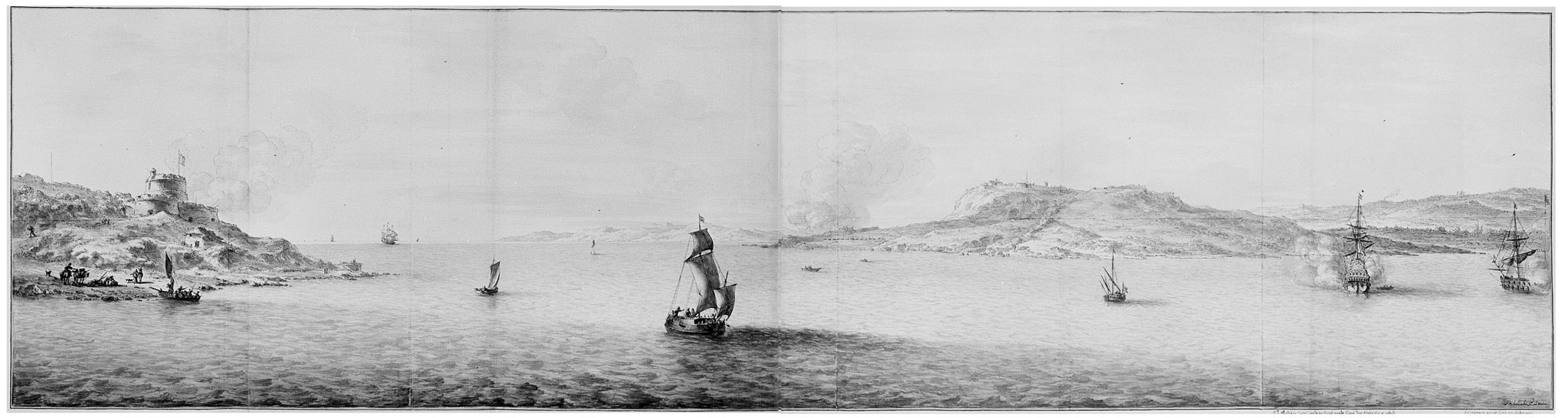
6.1 View of the entrance of the port of Falmouth, by Dutch painter, Willem Schellinks, 1627–78
(Austrian National Library Vienna, Picture Archive Atlas Blaeu, 19:50)
The peace with Spain in 1604 failed to bring the maritime disorder to an end; indeed, for the next decade or so English piracy flourished, developing an unprecedented degree of organisation which was dependent on secure havens in North Africa and south-west Ireland. Under the ambiguous protection of local officials pirates continued to dispose of plundered cargoes in Cornwall, although it appears that economic opportunities were narrowing.19 The emergence of deep-sea piracy, which attracted Cornish captains such as Peter Boniton, had a profound impact on the future of organised piracy in Cornwall and other parts of the South West, not least because it undermined the economic relationship between the maritime and land based communities. The relationship was further weakened by the appearance of Turkish pirates off the Cornish coast during the 1620s. Reports of a fleet of sixty Turkish pirates cruising off the Scilly Isles in 1625 aroused serious concern among vulnerable coastal communities, which were faced with the prospect of becoming the victims of pirate raids and attacks.20 In an attenuated form piracy continued to be a problem in Cornwall after the 1620s, but its changing character, linked with improvements to the policing of the Channel, reduced it to a marginal activity that lacked the support and backing it enjoyed in the past.
Throughout the sixteenth century piracy flourished in the shadow of legitimate privateering. During times of maritime war, loose regulation and control blurred the boundaries between the two, particularly in remote regions such as Cornwall, where central authority was weak. In August 1548 the lord admiral, Sir Edward Seymour, was authorised to commission privateers in Devon and Cornwall to plunder French ships and goods.21 Though justified by the seizure of English shipping at Boulogne, both the monarch and lord admiral, who had a vested interest in the business, were concerned to encourage privateering as a means of weakening the enemy. At times any pretence at regulation was removed to achieve this end. Proclamations of 1544 and 1557 allowed adventurers to set out ships against the French without commissions or bonds.22 While these regulations were tightened up subsequently, it remained impossible to control the activities of privateers once they left the coast of England. Moreover, as the experience of Cornwall indicates, communities which were willing to trade with pirates were also prepared to connive at the illicit activities of privateers.
Evidence for the scale and character of Cornish privateering is scattered, and needs to be interpreted cautiously given the problem of unrecorded or unlicenced activity. Cumulatively it suggests that privateering was a small-scale local business, concentrated in Falmouth, Fowey and Looe, which drew on a long tradition of cross-Channel raiding based on the seizure of small French fishing and trading vessels. At times it may have involved only a small number of ships. In 1558 four vessels, two from Looe and two from Fowey, were set out from Cornish ports as privateers.23 Figures for the early stages of the Anglo-Spanish war from 1585 to 1603 suggest a similar level of activity, with two vessels from Falmouth and one from Padstow involved in privateering from 1589 to 1591.24 However, licenced plunder throughout the South West tailed off during the later years of the conflict. By 1598 only one vessel from Penzance appears to have been set out as a privateer from Cornwall.
Although several prizes were taken during the war little evidence survives of their value.25 It is possible, however, that the sale of prize cargoes by crews of vessels operating out of other ports was more profitable to local merchants and traders. The illegal disposal of such cargoes was rife in parts of the South West and enabled shore based dealers to acquire a variety of commodities at low prices. Despite these economic benefits, English privateering during the 1580s and 1590s had several unintended consequences: it not only encouraged piracy but also provoked reprisals from Spanish and French raiders, particularly from Dunkirk, who began to appear off the coast of Cornwall during the closing years of the conflict.26
The wars with Spain and France from 1625 to 1630 witnessed a revival of Cornish privateering, probably on a scale rarely experienced since the later Middle Ages. During these years at least eighteen or nineteen vessels were set out from Cornwall, mainly from Falmouth and Fowey, on voyages of reprisal.27 About two- thirds of this total was made up of small ships, less than 100 tons in burden, which were armed with four to six pieces of heavy ordnance and manned with crews that varied in size from twenty to forty men. Among the largest vessels set out were the Concord and Mayflower of Falmouth, both of 160 tons, which carried fourteen and sixteen pieces of ordnance as well as crews of thirty-five and forty men respectively. A broad cross section of the maritime community was involved in the business, including merchants and shipowners, such as William Bird of Fowey, and a small number of local gentry and officials, such as Sir Robert Killigrew of Falmouth. Most of the privateers set out by these promoters were involved in the plunder of French shipping. Of twenty recorded prizes brought into Fowey and Falmouth at least seventeen were of French nationality, one was Dutch and two were unidentified. Many were small fishing and merchant vessels of limited value. Surviving appraisements for thirteen prizes indicate that just over half were valued at less than £100, while the two richest, which were brought into Falmouth, were appraised at £795 and £945. With the average value of each prize amounting to about £135, it seems unlikely that privateering was particularly profitable unless it was combined with trade or piracy.28
Cornwall continued to be involved in privateering at varying times after 1630. During the civil war Falmouth served as a base for royalist privateers in the west, who preyed on the cross-Channel and coastal trades of London and Plymouth. At its height between twenty and thirty vessels were employed at sea by the royalists, though they included old, formerly disused craft, such as a ship that ‘had lain long by the wall at Falmouth’, as well as a new frigate built at Fowey.29 The activities of these privateers, among whom were experienced captains such as John Van Haesdonck of Dunkirk, were wide ranging but essentially opportunistic in character. In June 1644, for example, one of them seized a ship in Aldborough harbour, apparently while the crew were ashore listening to a sermon.30 With the surrender of Pendennis Castle in August 1646 the ‘roaving and robberies’ of the ‘Arch-Pyrates’ came to an end, although a small group of survivors continued to disrupt local trades from a base on the Scilly Isles.31

6.2 View of the entrance of the port of Fowey, by Dutch painter, Willem Schellinks, 1627–78
(Austrian National Library Vienna, Picture Archive Atlas Blaeu, 19:52)
Privateering remained part of Cornish maritime enterprise during the Anglo-Dutch wars of the second half of the seventeenth century. Both Falmouth and Fowey were involved in setting out a small number of privateers, despite the risk of retaliation by larger fleets of Dutch vessels, maintaining a tradition that was to persist into the eighteenth century.32
Although the strength of this tradition was weakening, for much of the period covered by this brief survey piracy and privateering were interwoven into the maritime economy of Cornwall. Undoubtedly the patronage of gentry backers and the covert support of admiralty officials encouraged such disorder at sea, but it was sustained by the steady flow of recruits from many parts of the South West, whose combined activities had widespread ramifications for local economic and social structures. Many of those who served aboard privateers or pirate ships failed to make much profit. For the majority of recruits this was a strategy for survival, which may not have been carefully considered, though it was animated by the prospect of rich rewards. Ultimately it was ambitions of this nature that nourished the business of maritime plunder in Cornwall, providing encouragement for privateering long after the decline of piracy. But it was never a glamorous business; often it was tedious and occasionally it was highly dangerous. As a business, moreover, it left mariners to undertake most of the risks at sea, while shorebased backers or receivers reaped most of the rewards. The brief career of Henry Avery (or Every), a west country pirate captain who featured in Captain Johnson’s celebrated History of the Pyrates, encapsulates this contradiction, and in a manner which serves as a fitting conclusion to this chapter. After returning to England with a rich haul of treasure, some of which was buried in Cornwall, Avery died in poverty at Bideford, struggling to conceal his identity from the authorities and leaving his wealth in the hands of a group of Bristol merchants, who had treated him so badly that, in Johnson’s words, they ‘were as good Pyrates at Land as he was at Sea’.33
Notes and References
1 On these wider issues see Janice E. Thomson, Mercenaries, Pirates, and Sovereigns: State-Building and Extraterritorial Violence in Early Modem Europe (Princeton: Princeton University Press, chapters), 1994 2 and 3.
2 William Page (ed.), The Victoria History of the County of Cornwall, vol. I (London: A Constable, 1906) [hereafter VCH], pp. 477–79, 486.
3 Letters and Papers of the Reign of Henry VIII (London: HMSO, 1920), Addenda volume 1, part 1, p. 230.
4 Letters and Papers . . . 1546, part 1, pp. 203, 718.
5 Letters and Papers . . . 1546, part 1, pp. 538, 557; Acts of the Privy Council, 1542–47 (London: HMSO, 1870) [hereafter APC], pp. 459, 468–69.
6 APC, 1542–47, pp. 438, 460–61, 503, 507–8.
7 Calendar of State Papers Foreign, 1547–53 (London: Longman, 1869), pp. 31, 72.
8 Calendar of State Papers Foreign, 1553–58, pp. 229, 237, 261–63, 274. A.L. Rowse, Tudor Cornwall: Portrait of a Society (London: J. Cape, 1941), pp. 317–19, 329, 333, 412.
9 APC, 1554–56, pp. 336, 338, 362–3.
10 APC, 1558–70, pp. 151, 202, 283.
11 APC, 1558–70, pp. 225, 230, 292, 294–95 for complaints against the Killigrews. F.E. Halliday, A History of Cornwall (London: Duckworth, 1959), pp. 188, 191; D. Mathew, ‘The Cornish and Welsh Pirates’, in D. Mathew, The Celtic Peoples and Renaissance Europe (London: Sheed and Ward, 1933), pp. 293–306.
12 APC, 1581–82, pp. 315, 356–57, 397.
13 F.E. Halliday (ed.), Richard Carew of Antony: The Survey of Cornwall (London: Andrew Melrose, 1953), pp. 226–27; Rowse, Tudor Cornwall, p. 385.
14 APC, 1578–80, pp. 90–91; Rowse, Tudor Cornwall, pp. 390–92.
15 APC, 1575–77, p. 365; APC, 1577–78, pp. 14, 58, 70–71, 193.
16 APC, 1581–82, pp. 227–28, 232–33, 272, 355.
17 APC, 1586–87, pp. 74, 85, 152–53; APC, 1587–88, pp. 244–45, 273–74; APC, 1588, pp. 12–13; APC, 1590, pp. 45–46; APC, 1590–91, pp. 226–27; APC, 1592, pp. 36–37, 200–1; APC, 1592–93, pp. 156, 303–4.
18 Calendar of State Papers Foreign, 1591–92, p. 338.
19 C.M. Senior, A Nation of Pirates: English Piracy in its Heyday (Newton Abbot: David & Charles, 1976), pp. 126–27, 133–38.
20 APC, 1623–25, p. 348; APC, 1625–26, p. 80; Halliday, A History of Cornwall, pp. 210–11; Ambrose Sayer, a Cornish gentleman, became an Algerian corsair during the early seventeenth century, Senior, A Nation of Pirates, p. 98.
21 Calendar of State Papers Domestic [hereafter CSPD], 1547–80 (London: Longman, 1869), p. 10.
22 CSPD, 1553–58, p. 279.
23 VCH, p. 486.
24 Kenneth R. Andrews, Elizabethan Privateering: English Privateering during the Spanish War 1585–1603 (Cambridge: Cambridge University Press, 1964), pp. 32–33.
25 Andrews, Elizabethan Privateering, pp. 254–58, 270.
26 CSPD, 1598–1601, pp. 497–98.
27 John C. Appleby, ‘English Privateering during the Spanish and French Wars, 1625–1630’ (unpublished PhD thesis, University of Hull, 1983), vol. II, pp. 137–44, 177.
28 Appleby, ‘English Privateering, vol. II, pp. 262–65 (based on appraisements from The National Archives, High Court of Admiralty 4/1–3).
29 J.R. Powell and E.K. Timings (eds), Documents Relating to the Civil War 1642–1648 (London: Navy Records Society CV, 1963), pp. 212, 215–17; Mary Coate, Cornwall in the Great Civil War and Interregnum 1642–1660 (2nd edn, Truro: Bradford Barton, 1963), pp. 38–39, 99, 117–20, 185–86.
30 CSPD, 1644, pp. 258, 298.
31 Anon, The Sea-Mans Protestation (London: 1643); Certaine Informations From severall parts of the Kingdome, 1–8 May 1643.
32 CSPD, 1666–67, pp. 11, 379; CSPD, 1667, pp. 67, 72, 338; CSPD, 1672–73, p. 111.
33 Johnson/Daniel Defoe, A General History of the Pyrates, ed. Manuel Schonhorn (London: J.M. Dent, 1972), pp. 56–57; CSPD, 1700–02, pp. 216, 231, 243–45, 334.