
THREE
EMBODYING BOTH THE EIGHTEENTH-CENTURY PROMISE OF IMPERIAL RENEWAL AND the crown’s failure to remain neutral and protect Portugal, the transfer of the Portuguese court to Rio de Janeiro was at once a “providential” and “tragic” moment, a moment in which the nature of the monarchy, of the empire, and of the Portuguese nation were all called into question and then reconfigured as part of a quest to define a new and, according to many contemporaries, post-European era.1 The process was complex. In Portugal, as one historian of the Peninsular War has argued, following the prince regent’s departure from Lisbon, fear and incomprehension crystallized into “a durable sense of political orphanage.” In response to the French invasion, the creation of an imperial capital in America, and the less than favorable consequences of the subsequent negotiations at Vienna, an analysis of the causes of Portugal’s decadence served as a point of departure for reasserting the supremacy of peninsular interests within the Portuguese world. The Portuguese nation was revealed as a privileged community defined by history, lineage, and geography. This emerging “nationalist discourse,” as Valentim Alexandre has argued, then supplanted earlier pluralist visions of monarchy and empire in which the scope of political identity and public well-being transcended Europe’s borders.2
The other dimension of this reconfiguration of monarchy and empire—the meanings and consequences of the transfer of the court within the New World—will be examined throughout this book. Here, I begin by exploring the politics of royal exile in Rio de Janeiro as they were articulated by two groups: the Portuguese exiles and the city’s elite residents. The exiles, those who accompanied the prince regent to Rio or joined him there during the course of the Peninsular War, included members of the Portuguese nobility, royal advisors, confessors, servants, and attendants.3 The city’s elites, in turn, were similarly diverse: clerics, government officials, merchants, and landowners, some who were born in Rio, some who had made the city their long-term residence. The exiles and Rio’s residents shared cultural and political allegiances, cultivated, in some cases, through study in Portugal, royal service, and marriage.4 They were all distinguished vassals of the Portuguese crown and their appearance together at public commemorations in Rio was construed readily, as one observer noted, to be a perfect and transformative aggregation of power and prestige. Beginning in 1808, the observer explained, they formed “a Body so respectable that Rio de Janeiro seemed to be a New City.”5
Yet, in spite of sharing distinctions and honors within Rio de Janeiro, the exiles and residents represented both the royal exile and their experience in the new court in dramatically different ways.6 The exiles faced a tragic separation and an empathetic sense of the loss that their own departure had created in Europe. They lamented their life in Rio de Janeiro, judging Luiz da Cunha’s early eighteenth-century plan to establish the court in Brazil to be “a childish error.”7 The residents, in turn, hailed the transfer of the court as the beginning of a new era of happiness and prosperity ordained by Providence itself. These differences were at times expressed as the product of political identities. Even as they were all loyal to the Portuguese monarch, the exiles were his “European vassals” while the residents were his “American vassals.” Such divergent identities were not based as much on place of birth, as on the claim of distinct interests, defined and redefined within particular contexts. Indeed, both the exiles and Rio’s residents self-consciously represented themselves as European Portuguese and American Portuguese, respectively, as part of their quest to define the meaning of the transfer of the court and, consequently, the future of the Portuguese monarchy and empire. In other words, as Europeans and Americans they struggled to offer a definitive answer to the question: Should the prince regent’s residence in Rio, and the new empire it created, be permanent? As we shall see, although for both the exiles and the residents Portugal remained an important point of reference, ultimately it was the New World court that appeared to enable “national” renewal. Whether tragic or heroic, the royal exile redefined the imperial monarchy as American.
THE PENINSULAR WAR AND REIMAGINED COMMUNITY: EXILE, MORALITY, AND VICARIOUS PATRIOTISM ABROAD
By all accounts, the royal convoy’s departure from Lisbon was chaotic. It was only three days before that the prince regent had announced his decision to go to Brazil, advising that all those disposed to “share his reverse of fortune” had his royal permission to follow. News of the decision spread rapidly through the city and “the utmost confusion and distress prevailed.” As one eyewitness described the experience, hopes and fears gave way to “visions of horror and calamity.” A caravan of over seven hundred coaches brought the royal family and their effects from their residence outside the city to the quay, while thousands headed to the beach with hopes of joining them. Many were overwhelmed by panic and to secure a place aboard one of the departing ships some resorted to extreme measures. The struggle, as one observer noted, cut through rank and reduced the most illustrious members of Portuguese society to a pitiful state of desperation. “Ladies of distinction,” he recalled, drowned as they waded toward anchored boats. To add to the commotion, a restless crowd of those forced to stay behind filled the port area and Lisbon’s streets and hills.8
With boarding completed and weather permitting, the convoy of over thirty ships then departed Lisbon, sailing past the Tower of Belem to join a British naval escort for what proved to be a grueling transatlantic crossing. The difficult journey was made even more perilous, as those aboard complained, by the congestion, the lack of provisions, and the “total disarray” and “poor administration” that prevailed on most of the convoy’s ships.9 Along the way to Brazil, taking stock of precious objects left behind—“a much admired tea pot that made the best tea in the world” or “a trunk that contained many necessary things”—passengers also confronted the unexpected and now bitter nature of their exile. To make matters worse, less than two weeks after departing Lisbon, a storm left the fleet irreparably scattered; some sailed directly to Rio, and others, including the prince regent’s ship, in need of provisions and repairs, took a shorter course to northeastern Brazil. The consequent confusion and miserable conditions fueled criticism and, in some cases, panic. To stifle “the certain conclusion that the decision to make that journey was a very poor one” passengers were forbidden to complain or discuss “political affairs.” As one of those who joined the royal family explained, the only acceptable subject of conversation was “the sea.”10
Once ashore, the deprivation and deplorable conditions of the Atlantic crossing appeared to foreshadow the suffering and estrangement the exiles experienced in their new place of residence. With the rupture of family ties, a royal counselor assured his wife who remained in Lisbon, those in Brazil were beset by a “painful saudade” (nostalgic longing).11 This sense of loss and of sentimental fragility was joined by fears of physical exposure. “The illnesses,” complained one newcomer to Rio, were “innumerable.”12 Indeed, the toll of heavy rains, heat, and pestilence appeared to make the exiles’ presence untenable. The city’s churches “are continually announcing deaths,” lamented Luiz Marrócos, a royal archivist who arrived at Rio in 1811. “Only in the Church of the Misericórdia of this City,” he wrote to his father in Portugal, “they buried over 300 persons, natives of Lisbon.”13
These physical challenges were quickly construed as moral tribulations. A range of new experiences, the exiles found, was to be explained by appealing to a topos of physical and moral degeneration in America, inaugurated in the sixteenth-century Jesuit indictment of Portuguese settlers “gone native” in Brazil and rearticulated in eighteenth-century assertions that in the New World nature and humankind were inferior (due to immaturity or degeneracy) as well as in claims about the relationship between climate, customs, and law that equated the tropics with servitude and barbarism.14 As he complained in numerous letters to his father, in Rio Marrócos was overwhelmed by the dirt, the isolation, and the city’s “indignant, arrogant, vain and libertine residents.”15 For others, life in “a sad and sickly land” became a “degredo” (punitive banishment), akin to those dispensed by the Portuguese Inquisition and civil courts. Rio de Janeiro became an “inferno,” or, as one exile described it drawing on long-established images of Brazil as a land of vice, a modern day “Babylon,” where slavery corrupted both slaves and their owners and where “indecency” and other “amusements” led to perdition.16 “[T]his is a new world, but for the worst,” reported the Marquês de Borba to a son who stayed behind; a world of “abomination and scandal” attributable, he concluded, only to an absence of “religion and the fear of God.” Although he stopped short of such a withering indictment, the newly arrived bishop also joined in the exile lament, declaring that Rio de Janeiro was a place where the “infirmities of languor and weakness, from which few escape in a swampy country” precluded even the piety of Lent.17 In a moment when the empire and Portugal itself faced ruin, the exiles thus reacted by reconstructing the relationship between Portugal and Brazil as what Mary Louise Pratt has described as “an essentialized relationship of negativity,” one in which America necessarily defined Europe’s afflictions.18 Accordingly, lines of division were also dramatically drawn. As Marrócos vowed in a letter to his father, residing in Rio de Janeiro provoked in him such “hate and rage” that he suspected he cursed Brazil “even in his sleep.”19
The exiles’ disaffection and their self-representation as both apart from and threatened by the city in which they now lived sustained their overwhelming nostalgia for and loyalty to Portugal. And it was, above all, the moment of departure that marked this nostalgia and their exile, making them, as Amy Kaminsky has written of twentieth-century exile, “no longer present in the place departed, but not part of the new place either.” As they looked back, the royal exiles’ memories of sailing from Lisbon formed the basis for imagining the ordeal of those who remained on the peninsula to receive the French invasionary force: the leadership of the Regency, others who were physically unprepared for the transatlantic crossing, those unable to attain passage in the royal convoy, and Lisbon’s popular classes. Even during the initial celebrations of arrival at Rio, one exile recalled, both Portugal’s remembered past and its imagined present supplanted the newcomers’ immediate experience in Brazil. The fleet that brought the royal family, he noted, became a symbol not of what it encountered and the future it promised, but rather of what it left behind: the Europe that cried for the absent prince.20 Lisbonian scenes and displaced feelings of sorrow for the loss of the royal family similarly framed another account of the journey and arrival at Rio de Janeiro. As its author imagined the days following the prince’s departure, the “sadness of the people of Lisbon in those days was indescribable: tears streamed from the faces of all.” Because, he explained, the “person of the prince was extremely loved,” to everyone in Lisbon “it seemed as if along with his presence a great fortune was leaving them.”21 The image of a sorrowful, abandoned, violated Portugal was also memorialized in an elegy published in Rio shortly after the arrival of the court. “And who,” the author asked, “will dry the tearful, anguished eyes of the loving wife, / When suddenly they see their Father distant … Who will offer refuge to the innocent / Orphans, the progeny of Lusitania… ?”22
For the exiles this effort to reenact a presence in their absence depended, above all, on their ability to maintain current, and tangible, connections to Europe. Marró-cos, who had participated in the defense of Lisbon during the second French invasion (1809), closely followed the remainder of the Peninsular war from Rio.23 He eagerly awaited the arrival of ships, hoping for greetings from Portugal and “the political, military and rural news of the Continent” that letters might contain. Such interest, he further noted, was shared by others in the city who beheld the latest reports as “nuggets of gold.”24 As one resident reported, with similar hopes of news from Portugal “people of all classes” made their way to the post office, making it, as he complained, an increasingly crowded and at times disorderly place.25 Gazettes, broadsides, and what Marrócos referred to generally as “public papers” were another much sought after source of information, for they “offered those far from the Old World comfort, amusement, and pleasure.”26 As a royal archivist, Marrócos had easy and regular access to “all the Periodicals … from different parts of the world,” including those sent to Rio de Janeiro from expatriates in London, where more than one Portuguese-language newspaper was published.27 Beyond the palace, book dealers also offered a selection of the two thousand books, pamphlets, flyers, proclamations, and engravings published in Portugal, including translations of Spanish, French, and English works on the Napoleonic conflict and, according to police reports, unauthorized works that slipped by censors at the customs house.28 Engravings of Peninsular War heroes were particularly popular. As Marrócos wrote to his father in 1812, the arrival of a portrait of Beresford by the Portuguese Aguilar was eagerly awaited. The works of the Florentine engraver Bartolozzi, he also noted, “were also much esteemed,” and those he did of Wellesley in particular “commanded a high price.”29
In addition to materials from abroad, news of the state of affairs in Europe could be found in locally printed works. In 1808, for the first time in the history of Portuguese settlement in America, the crown reversed its ban against printing in Brazil and established the Impressão Régia on the Rua do Passeio, using presses that had been brought along from Lisbon. Although the Royal Press was founded “to print exclusively all legislation and diplomatic papers” generated by the crown, it also supplied news about the war. Twice a week in the Gazeta do Rio de Janeiro readers could find reports of battles and negotiations, translations from foreign newspapers, editorials, advertisements for pamphlets and engravings, and local letters and notices of patriotic Portuguese residing within and beyond the prince regent’s domain.30
In keeping the exiles apprised of the national struggle against Napoleon, of defeats, victories, changing strategies, and their political implications, pamphlets and letters from Portugal allowed them, in effect, to experience the Peninsular War. Such an experience could be both private and individual, as much of Marrócos’ personal correspondence with his family reveals, as well as public and collective. Posting pledges of support in the Gazeta, such as one announcement of November 1808 in which “a Sword of gold filigree” was offered to “the person who most distinguishes himself in the Restoration of Lisbon,” allowed one to display patriotism and contribute to the war effort.31 While the Gazeta provided a common forum for expression, just as pamphlets provided common reading, the act of procuring and reading these materials could also be collective. As was the case prior to the court’s arrival, both private homes and public spaces served as sites for discussions and exchanges about military defeats, victories, and their consequences. Marrócos’ own abundant supply of letters and “interesting papers” was “public” knowledge, he reported. Indeed, he wrote to his father in 1813, his house could “be called the second office of the Gazeta, for the intense interest with which I am sought.”32 “News about the French” also reportedly circulated at inns and shops. Such notices and reports could be read or, as the police intendant suggested, misread (mal avaliada) in a variety of ways. Indeed, talk of such disputable questions as treason, the legality of the transfer of the court, and the future place of the royal residence was, the intendant lamented, common. And, according to Marrócos, when reliable news from Europe was unavailable, those he referred to as “bar room politicians” filled the gap with rumor.33
The exiles’ vicarious Peninsular War experience, afforded by reading pamphlets and debating the news, also included a sense of living through a national ordeal of both historic and epic dimensions, the product of the French invasion as well as its more disturbing underlying moral causes and effects. A discourse of disaster and moral vulnerability, of apocalypse and a diluvian “general calamity,” featured in pamphlets, as well as in sermons and prayers preached and published in Rio, both recalled what one historian has called the “funereal memory” of the disastrous Lisbon earthquake of 1755, forged in Portuguese pamphlets in the second half of the eighteenth century, and described more recent misfortune. The punishing French occupation, critics in both Portugal and Brazil charged, followed from Portugal’s own corruption and decadence, just as in the 1750s Portuguese beheld “vanity, arrogance, rage, and lust” as “the four vices, that compelled Divine Justice to enact [that] lamentable devastation.”34
For the exiles in Rio, in particular, recalling this national history of physical peril and moral disorder not only sustained their solidarity, but also allowed them to see their own role in the ordeal. Just as the Portuguese in Europe struggled against “profane” conditions and the “impious politics” that had engendered, as the author of one pamphlet recalled, the “monstrous Portugueses afrancesados” (Frenchified Portuguese), they themselves contended with a similar threat to Portuguese political and moral integrity: Americanization. As Marrócos confirmed to both his own and his father’s dismay, there were exiles who had become “hybrids of America.”35 And their transgressions, the Marquês de Borba often noted along with oblique references to physical excesses, were as horrifying as those of the city’s long-standing residents.36 In other words, the national ordeal of the Peninsular War was experienced in both Portugal and Brazil with what Anne McClintock, writing of British colonial bureaucrats, has described as the “dread of catastrophic boundary loss,”37 fear of the loss of boundaries that once separated an allegiant Portugal from revolutionary France, Europe from America, and, as Borba suggested in a letter to his daughter-in-law in Portugal, moral integrity and selfhood from decadence and infantilization. Indeed, Borba insisted, that in Rio the Marquês de Alegrete was “swimming in happiness … with little decency” contradicted, and therefore threatened to undermine, “His Person.”38 Such examples of degeneration together with what Marrócos perceived as a condition of hybridity were at once products of the experience of empire—of the necessary physical presence of Portuguese in Brazil—and, as the exiles sustained, causes of the empire’s demise. The failure to reproduce metropolitan decorum and “ways of thinking,” they argued, undercut the restoration of Portugal’s and its empire’s political integrity as much as Napoleon and the French. As Marrócos explained, as long as “the Pseudo-Brazilians, commonly known as Janeiristas” promoted “the rumor that we will stay on here forever,” metropolitan Portugal remained a thing of the past.39
As the exiles considered their experience in Rio as part of the nation’s history of both physical and moral tribulation, however, they also discerned the possibility of redemption. Just as the people of Lisbon had begged for forgiveness following the earthquake’s destruction of their once opulent city,40 for the early nineteenth-century exiles, resistant moral rectitude promised to make living in Rio de Janeiro a brief purgatory. Recognized as a mode of suffering and atonement since the sixteenth century, the ordeal of the inferno Atlântico, displacement to the New World, provided, in this case, for a purification of Portuguese nationhood written as essentially pious, moral, and heroic.41 Within the discourse of disaster, the exiles’ renunciation of Rio and of its moral and physical infirmity thus became a political act; an act marked by what McClintock has called “an excess of boundary order.”42 Accordingly, the exile rejection of Brazil was not only justifiable, but also necessarily complete. As Marrócos dramatically pledged: “I am so scandalized by the Country, that I want nothing from it, and when I leave here I will not forget to wipe my boots on the edge of the docks so that I do not take back even the smallest vestige of this land.”43
For Marrócos and Borba, in particular, resisting Americanization and remaining an integrally “European” Portuguese was also achieved in the act of correspondence itself. “Each time I take up a pen to write to Vossa Mercê,” Marrócos wrote to his father in 1811, “I feel a new spirit within myself, which brings me happiness and enlivens me.” What Borba in turn described as “the relief of writing” restored sentimental connections on which a unified moral and political identity and the faith in a return to the status quo ante could be based. Correspondence, as Borba wrote, gave “hope that Portugal existed.”44 Writing also promised to restore the distance that once safely separated the metropolitan exiles from the American colony. It realized what Kaminsky has described as the exile discourse of desire, intended “to recuperate, repair and return.” Writing, Marrócos could assure both his father and himself that “no one is farther from America in customs and ways of thinking than I.”45
Correspondence, like reading, also reconnected a collective experience in Rio de Janeiro to the experience of those who remained in Europe. Writing, sharing in the sentimental and spiritual consequences of the “general calamity” in Portugal, the exiles could seek to minimize the consequences of their physical removal to the New World and reestablish connections severed by the French invasion. They could share with Portuguese in Portugal, their letters suggested, the experience of fear and despair for “the poor state of affairs in Europe” as well as in the “great satisfaction of the prodigious general Pacification.”46 Out of their initial estrangement, the exiles thus defined their experience in Rio as part of the political and moral challenge of the Peninsular War. Whether in defeat or victory, reading, writing, listening to sermons, or sharing news, they sought, above all, to make the Portuguese nation, divided and besieged, once again whole.
A “PÁTRIA MISERA”: THE LIMITS AND ALTERNATIVES TO PATRIOTIC EXILE
While letters to and from Portugal, pamphlets, and newspapers, restored connections and allowed for a common experience as well as for the reconstruction of a moral and political Portuguese identity in the New World, they also revealed differences and suggested the impossibility of a return to the former status quo. As months turned into years, the ideal of resistance to Americanization began to wither along with expectations of a prompt return to Portugal.47 The toll of living in Rio de Janeiro came to seem unavoidable. Having indicted certain newcomers for succumbing to the temptations of the New World, Marrócos himself recognized that, moral rectitude notwithstanding, simply living in a “land of vice and perdition” caused the Lisboetas (women native of Lisbon) to “degenerate.” After a few years in Rio, he noted ironically, they earned the poor reputation that in Lisbon was given to women from Brazil.48 Nor could he himself, he confessed, escape the consequences of the New World’s “dangers and deprivations.” Brazil, he wrote to his father, had “opened his eyes and taught him things not found in books,” transforming his “figure and constitution.” He was left, he despaired, “thin, tired, and old.”49
The exiles’ insistent bemoaning of Rio de Janeiro because it was dissimilar to Lisbon and despairing at the thought of remaining in Brazil, however, also had political-cultural limits. As they confronted their growing sense of the unavoidable and indelible nature of their experience in Rio, their peninsular correspondents proposed that it was for the very fact of the New World’s difference that the exiles should be thankful. Those who accompanied the royal family to Brazil, one letter from Portugal suggested, did not realize their fortune and happiness. To be in Rio, the author imagined, was to escape “a continuous restlessness of spirit provoked by scenes of misery … plunder, death, robbery, scorn and violence.” “Oh! my friend,” he concluded, “how much better to suffer storms at sea for a few days, and after live peacefully!”50 Furthermore, the exiles were reminded, having been delivered from the pillage of French soldiers, they also eluded the specter of collaboration, what Captain António Coutinho de Seabra e Souza characterized as the “suspicious” nature of his “reputation” and his subsequent misfortune that had resulted from the “sad” fact that he had not embarked with the prince regent.51
Indeed, Portugal’s suffering, the exiles became aware, established their own future in Brazil. As refugees fleeing the disasters of war and occupation continued to arrive, a return to Europe seemed not only improbable but also ill-advised.52 The marginal position of the Portuguese government in the war between the British and the French made any future in Europe seem bleak. As one Portuguese posed the problem to his correspondent in Rio, “after it is said what is happening in Europe, after [seeing] the total scorn with which the great powers deal with small states, is there anyone who can be persuaded that our prince should return to a corrupted Europe?”53 Such a rhetorical question both confronted the exiles with the limits to their attempts to reinscribe themselves into a European Peninsular War experience and suggested an alternative to their longing to return: the transfer of the court should be permanent. After all, as the exile Miguel José Barradas suggested to his family in Portugal, “the example of our beloved Prince and Holy Family” outshone the “Pátria misera, isolated by the French tyrants.”54
In this case, the exiles in Rio de Janeiro were not just far from the battlefields and the horrors of war, free from the desperation of abandonment and the stigma of collusion, but also close to the crown. In contrast to those who stayed behind, those in Rio confronted not the challenge of defending the besieged ancient court, but rather that of constructing a new one. These Portuguese were, in effect, custodians of the artifacts of governance, of what one historian has called “the paraphernalia of government” and “essential elements of a sovereign state”: the Royal Treasury, the royal chapel’s accouterments, the library, official documents, manuscripts, and a printing press. Although cast out from Europe, by having unpacked this most cumbersome cargo, the exiles were poised to broker royal power and patronage throughout the Portuguese empire.55
Indeed, as Marrócos’ correspondence reveals, letters to and from Lisbon incessantly addressed the maintenance of royal patronage for those who remained in Portugal, requests which, as Marrócos complained to his father, grew overwhelming. “Those who live in Lisbon” were mistaken, he wrote, if they supposed that “the residents of this court have … wealth, influence, and time to attend to others’ affairs.”56 Many Portuguese without family and reliable associates in the new court did perceive the limits of transatlantic brokerage and relocated to Rio to maintain their royal privileges. As one royal bureaucrat explained, living in Rio was appealing “because there payments are more prompt.”57 In other cases, “to remedy their misfortune” Portuguese in Portugal found themselves adopting strategies formerly reserved for residents of the ultramar: embarking on a costly journey “to present their petitions personally.”58
As the Portuguese in both Europe and America recognized Rio de Janeiro as the new center of royal power, they also reinforced a sense of the Portuguese monarchy’s renewal in the New World, a vision of a “Great Empire” in Brazil invoked by the exiled Portuguese statesmen Rodrigo de Souza Coutinho both before and after the transfer of the court.59 Indeed, asserted the newly arrived playwright António Leite, the transfer of the court had produced a new imperial ascendancy based on a “fortunate union.” The ancient Portuguese empire “given to [King] Afonso,” he proposed in a one-act musical drama performed in Rio in 1811, joined a newer American empire. This union, as Leite further claimed, then brought to fruition an older colonial project: the transplantation of Portuguese civilization to Brazil. “What glory!” the allegorical figure of America exclaims upon the arrival of the prince regent, “My children, now we are Lusos.” The indivisibility of the union, in turn, also appeared to enable its transcendence. Thus, as the drama ends, a tableaux of both Lusitanian and American figures ushers in a timeless period of peace, prosperity, and harmony.60
This ideal of imperial renewal and prosperity also framed a royal memorandum drafted during the transatlantic crossing by the Marquês de Bellas. Bellas argued that “to make the most of the disaster” the crown should renew the eighteenth-century project of imperial reform initiated by the Marquês de Pombal. The government of Brazil, he suggested, should be “simplified” and centralized, with expenditures efficiently limited to revenue. “Good economy,” he claimed, could also be established by curtailing the creation of new offices and by detaining revenue generated by royal monopolies on wood and diamonds formally remitted to the metropolis in Brazil. In addition, foregoing new taxes would encourage local production. Above all, the Marquês argued, the Portuguese crown would benefit from the opening of Brazil’s ports. “It is incredible,” he insisted, “the utility that can result from the good principles today better known as a new science, which seems to be reserved for Your Highness, just as the discovery of India was for King Dom Manuel.”61
For Bellas, recalling the monarchy’s glorious Asian empire inspired confidence in its renewal in America, where the prince regent would be in a position to “endear himself even more with his vassals on both sides of the Atlantic, to make himself loved by men, to be a model prince, to gain a great reputation in this manner.” A prosperous New World empire, he claimed, evoking arguments made before 1808, would also provide the firm base from which the crown could engage in continental negotiations. “It does not matter if the Kingdom [of Portugal] finds itself in need, [or] if it longs for your Royal Highness,” Bellas explained, “as long as Brazil has a great fortune, and this is noticed throughout Europe with envy and admiration.”62 In a pamphlet published in Rio in 1811, the magistrate Joaquim do Valle came to a similar conclusion. Once freely wielding his “Iron Scepter” in America, he sustained, echoing Souza Coutinho and others, the prince regent could punish the impieties of the revolutionary French.63
This promise of American prosperity and potency was also manifest in the construction of the new royal court, a project that will be examined in more detail in Chapter 4. The crown began to host grand dinner parties, “as it had in Mafra,” and sent for musicians and the rest of the royal library. The royal chapel was gilded and both a new Royal Theater and a private opera house for the princess regent were built.64 By 1814 the construction of new public buildings and of a larger palace for the prince regent at São Cristovão was in full swing. At considerable expense, the courtiers also built houses and estates, signs, according to Marrócos, of their “stronger roots in this Country.”65
Such affluence and vitality provided a stark contrast to what was increasingly construed in both Portugal and Brazil as the “undeniable fact that this Country [Portugal] is everyday more wretched.” Together, the possibility of renewal in the new court and the truth of Portugal’s demise led many newcomers to Rio to reconsider their initial understandings of the moral imperatives of their exile. As Marrócos explained, along with moral challenges, the city also presented an alternative to his own personal tribulations: celibacy and what he described as the “misanthropic” solitude and vulnerability to vice that followed such an option. The physiological nature of the experience of exile that Marrócos first lamented could be, he came to recognize, an opportunity for welcome transformation. “I came to this Court,” he wrote to his father in 1813, “and changing climate, I also modified earlier decisions.”66 Referring to his commitment to marry a carioca (a native of Rio de Janeiro), Marrócos justified his decision with allusions to the reinvigorated potency of a paterfamilias, claims of a shared culture and standards, and the promise of moral renewal. Indeed, Marrócos argued, his wife, Ana Maria de São Tiago Souza, embodied virtue itself. The daughter of a Brazilian-born woman and a Portuguese-born merchant, Ana came from a family that was, as Marrócos described it, “clean, honest and wealthy.” With her mother’s supervision, he explained to his sister, Ana had escaped the laziness and ignorance that characterized the daughters of other Brazilian families. Consequently, “although Brazilian” she was, Marrócos wrote, “better than many Portuguese women.” For her simplicity, he explained, freed her from the superficiality and decadence of European aristocrats who carelessly danced and played instruments or, “with a fan and handkerchief, served as window decorations.”67
Having thus envisioned his own regeneration in the arms of his innocent, American bride, Marrócos stood for a renewal of paternal authority writ large, an authority that was jeopardized in Portugal by the separation of fathers and sons in exile and in war, and by the absence of the political father-figure of Dom João. Like that of feminine virtue embodied in his wife, this renewal was identified not with Portugal, but rather with Brazil. Indeed, founding a family in Rio de Janeiro resulted in a transformation of son into father that paralleled Brazil’s own transformation from colony into the center of empire, what the city’s residents came to refer to as an “emancipation.” Although both transformations depended on a recognition of the cultural and moral authority of ancestry, they also implied a redefinition of allegiances and a repositioning of the locus of power. For Marrócos one such moment of redefinition and repositioning came in response to his father’s scathing charge that in marrying Ana he had behaved “as a stupid African, and presumptuous American.” Rather than resorting to his once defensively European identity, or his desperate pleas for reassuring news, Marrócos refused any compromise with his father’s disappointment and defended his decision as “very serious, politic, and resolute.”68
Marrócos’s claim that Rio de Janeiro was a place where personal honor and paternal authority could be reestablished corresponded with a larger vision of Rio de Janeiro as a place that the exiles themselves could make. Reenacting earlier efforts to colonize and civilize the New World, the exiles cast aside their initial rejection of American degeneration in favor of American innocence and potential and came to recognize that they could rebuild the city in their own image. The new court would be both a model of civility and morality, as were its European antecedents, and now, in the wake of the revolutionary and Napoleonic wars, a singular place within the Portuguese world in which a public and national virtue could be reasserted.69 After all, as one playwright claimed, the “fall of despotism” (of Napoleon) followed not only from victories on the battlefields, but also from a rededication to “industry” and “the arts”;70 from a restoration of a quotidian morality now as manifest in Rio as it was seemingly unattainable in Portugal. Indeed, Marrócos explained to his father in 1819, Rio de Janeiro afforded a “solid, satisfactory, peaceful” life, a more “decent, dignified, and splendorous” life than was available in postwar Lisbon. Portugal, on the contrary, the “Pátria” for which Marrócos once had longed so desperately, now seemed to be, as he described it, a “frivolous pretext of the senile” that offered nothing but ingratitude.71 And if, as Marrócos suggested in his letters, women marked the boundaries between civility and degeneration within the empire, the New World court of Rio de Janeiro then marked these same boundaries between the empire and beyond. It provided the Portuguese monarchy freedom from what the exiled bishop José Caetano da Silva Coutinho characterized as “the contagion that had debauched and lacerated Europe,” just as living in Rio de Janeiro allowed the exiles to escape what their Peninsular correspondents decried as the corruption of Portugal.72
This vision of the new court as sustaining the Portuguese nation’s regeneration and progress also drew on a new understanding of national character that had taken shape during the course of the eighteenth century. Within the Portuguese discourse of the nation, the idea that humankind was fundamentally equal had displaced the perception of national character as “natural.” Manifest in a distinct tradition, Portuguese critics sustained, national character nevertheless was shaped by education, laws, and government, what contemporaries also described as polícia. With polícia, virtues could be preserved, and vices which, many argued, had contributed to the empire’s decadence, could be amended. Accordingly, some years before the French invasion, in the interest of reform Portuguese statesmen set out to inventory the nation’s vices as part of what Soares and Hespanha describe as “an encounter with o estrangeiro” in this case, other European nations recognized by the Portuguese as more “refined and enlightened” (polidas e ilustradas).73
Together with others inhabiting the Atlantic world, the Portuguese also appreciated that an enlightened refinement, as well as a public morality, required an engagement with classical antiquity and its disciples. As the exiled Conde de Aguiar noted in 1810 in the preface to his translation of Alexander Pope’s An Essay on Criticism (1711), along with eighteenth-century translations of Horace and Aristotle, it was a “useful service” to make available Pope’s “rules and precepts” of both writing and judging verse. Although Pope did not emerge as a symbol of republican virtue, as was the case in British North America, for those in the new court of Rio de Janeiro he offered a guide, as Aguiar noted the following year in his translation of An Essay on Man (1733–34), to “particular ethics, or practical morality; considered in all circumstances, orders, professions and exercises of human life.”74
This recognition of “the origins of civilization in civility,” as Gordon Wood has noted, marked much of eighteenth-century political discourse.75 For the Portuguese exiles, in particular, the new court of Rio and the renewal of morality and civility that it was held to foster, also allowed for a reconciliation of their initial self-representation as “European” with what they increasingly construed to be the imperative of a post-European empire. Conceived as an endeavor to civilize Rio de Janeiro, to imbue the city with morality, their exile produced what Pratt has described as a “transatlantic appropriation” in which “European” was distinguished from “Europeanizing” in the quest to find “esthetic and ideological grounding” for a new imperial capital.76 In other words, while the exiles’ quest to restore the integrity of nationhood led to an initial rejection of the New World, their understanding of the nation’s boundaries as above all moral and political also allowed them then to reenvision nationhood within a transformation of the New World based on the ideals of civilization and civility. The “relocation and renegotiation of oppositions and boundaries” that characterized the European colonial project had allowed Europeans, in this case, to forego Europe itself.77 Once conceived of as a land of perdition, Brazil was now a haven from decrepitude; and America, as one exiled playwright proclaimed, would be the new “metropolis.”78
AN “EPOCH OF HAPPINESS”: THE TRIUMPH OF NEW WORLD EMPIRE
The Portuguese royal exiles were not alone in their quest to understand the consequences of the transfer of the court and the larger conflict of the Peninsular War. Those who received the prince regent and his court, natives of Rio de Janeiro, as well as others who had made the city their home before 1808, also sought to explain the meaning of the royal exile and to place their experience as residents of the new court within the history of the Portuguese empire and monarchy. The contrast between their representations of recent events and those offered by the newcomer-exiles is striking. Whereas for the exiles the transfer of the court initially produced a sentimental experience based on estrangement, for Rio’s residents “it opened a horizon of fortune and happiness.”79 It inaugurated a “golden age,” proclaimed Manuel Ignacio Silva Alvarenga, the former critic of royal government and target of Viceroy Resende’s investigation in the 1790s. Or, as the Brazilian-born cleric Luiz Gonçalves dos Santos declared in his Memórias, the “extraordinary” and “prodigious” disembarkation of Dom João, the royal family, and his “faithful European vassals” on the city’s beaches marked the beginning of “the Epoch of Happiness.” Indeed, the “ecstasy” he experienced as he viewed the royal family’s first procession through the city’s streets was so overwhelming that it led him to wonder whether he beheld “an illusion rather than a reality.”80
Such joy and “expressions of respect,” as Gonçalves dos Santos and other residents carefully explained, were the product of political loyalties.81 With the transfer of the court the crown’s “American vassals” were finally close to their sovereign, able to actively show their love and allegiance, they insisted, and receive the prince regent’s love in return. So preached Duarte Mendes São Payo, rector of one of the city’s seminaries. After 1808, he proclaimed, Brazil could sing of its “much desired Triumph” because its inhabitants now held in their arms their “legitimate, and indispensable Lord, beloved, caring Father, faithful and true Friend.”82 This ideal of loving reciprocity between the prince regent and the city’s residents then was translated from the realm of sentiment into a tangible monumentality shortly after the arrival of the court. Elias António Lopes, a Portuguese-born wholesaler on the Rua Direita, offered the prince regent the Quinta da Boa Vista, an estate located outside the city’s center in São Cristovão, so that the royal family could have a palace on a grander scale than the existing viceregal residence near the quay. The donation and Lopes’ “notorious disinterest and demonstration of faithful vassalage,” according to one chronicler, made manifest the love and generosity of the residents of the new royal court. The prince regent’s response, in turn, showed that such sentiment was not unrequited. On arriving for the first time at the estate, the chronicler reported, the prince regent exclaimed: “This here is a royal veranda! In Portugal I had nothing like this.” Indeed, the chronicler further reassured his correspondent in Portugal, “[a]ll of the Royal Family [was] doing well here” in Rio de Janeiro.
Evoking a permanence and therefore the possibility of transcending Europe itself, the Quinta thus stood for both the future that Rio de Janeiro could provide the royal family and the future that the royal family could provide the city; for the potential of New World vassalage and, above all, for the prince regent’s recognition of the greatness of his dominions in Brazil. Indeed, Lopes’ donation and the prince regent’s response showed that the transfer of the court both literally and figuratively ennobled Rio’s residents. Along with monetary compensation and a monthly allowance for continuing to administer the estate, Lopes received the proprietary office of scribe of the town council of the Village of Paratí. In the years following the arrival of the court, in spite of his reportedly illegitimate birth, Lopes was also granted the title of Fidalgo da Casa Real; he served as a deputy to the Royal Board of Commerce and Agriculture, as a broker in the Casa de Seguros [Insurance Commission], and as a royal counselor. And, when he died in 1815, he was buried in the distinguished habit of Cavaleiro da Ordem de Cristo [Knight of the Order of Christ].83
In the 1810s similar gestures of American vassalage and royal commendation then followed this monumental exchange between Lopes and Dom João. Rio’s residents provided the courtiers with food, lodging, and other necessities, as one of the exiled courtiers noted, and the prince regent responded to “these demonstrations with an extravagant offering of honors and compensations of which there was no previous example in the monarchy.”84 Indeed, to accommodate the burdens of both fighting a war and establishing a new court, Dom João dispensed more titles of nobility during the eight years of his residence in Rio than in the preceding one and one-half centuries of Braganza rule in Portugal, in addition to thousands of commissions in Portuguese military orders, titulos de conselho (titles of royal counselor) and ranking militia appointments.85 To further expand the possibilities for royal mercês (favors), he instituted the Ordem da Torre e Espada (Order of the Tower and Sword) in May 1808.86
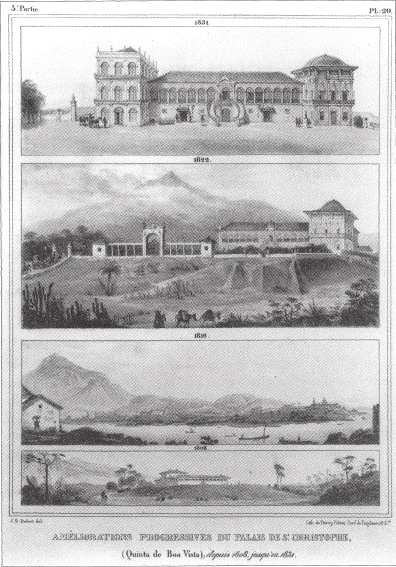
Figure 4: Jean Baptiste Debret, “Améliorations progressives du palais de S. Christophe,” from Debret, Voyage Pittoresque et Historique au Brésil, sejour d’un Artiste Français au Brésil v. 3 (Paris: Firmin Didot Fréres, 1839). Copy and permission obtained from the Print Collection, Miriam and Ira D. Wallach Division of Arts, Prints and Photographs, The New York Public Library, Astor, Lenox and Tilden Foundations. By 1816, Debret observed, a “simple, Brazilian country house” in a beautiful natural setting had been transformed by “European taste.”
As British resident John Luccock remarked snidely, this “welcome” that wealthy residents received at court depended, above all, on their ability to “repay an empty honor with solid benefits” for the crown.87 Yet, it was also the case that many of the honors themselves translated into “solid benefits” for the residents. The establishment of new and duplicated institutions in Rio de Janeiro, including the Desembargo do Paço (Tribunal of the High Court), the Casa de Suplicação do Brasil (Court of Appeals), the Junta de Comércio (Commercial Board), the Erário Real (Royal Treasury), and a Bank of Brazil facilitated the exercise of justice and commerce, brought the city prestige, and provided unprecedented opportunities for royal service. Although many exiles were given posts in recognition of the hardship of joining the prince regent in Brazil, the city’s residents too enjoyed the dividends of a growing royal bureaucracy as well as royal grants of land.88
For Gonçalves dos Santos the crown’s recognition of the city of Rio and its American vassals was part of what he described as a “new order of things” and a “new political system.” Within the first years of his residence in Brazil, he explained, the prince regent worked to amend the less than ideal circumstances he encountered. The “royal hand” “regenerated” America by opening Brazilian ports and, according to Gonçalves dos Santos, so ushered in a period of increased trade and prosperity. By ending the prohibition of manufactures, he also claimed, Dom João “broke the chains that bound Brazilians and impeded them from using their hands.” New royal academies, a school of medicine, the royal library, a military archive, and expanded “royal lessons” offered unprecedented opportunities for education and professional training in the city as well, while the establishment of the royal press, he further judged, “dissipated the darkness of ignorance, whose black and terrible clouds had covered all Brazil.”89 These gestures of royal “liberality” both showed that Dom João was “a true father of his vassals” in America90 and, with resonance in the exile embrace of New World potential, revealed the transfer of the court as an opportunity to cultivate virtue in the royal court. Indeed, writing on the establishment of a military academy and the “great benefits that the August Presence of His Royal Highness brought to Brazil,” Manuel Ferreira de Araújo Guimarães, the editor of the local periodical O Patriota imagined that morality, “upon which public happiness depends,” thus would be “refined.” The people of Brazil, “newly conquered” by the sovereign’s tenderness and love, he explained, would reap the rewards of a renewed effort to “propagate civilization.”91
Yet, what Guimarães described as “the pleasing object of the increase in enlightenment” in Brazil came as a result of the “bloody scenes of war” that “terrorized humanity” in Europe.92 In other words, the “happiness” justified by the material benefits of living in a royal court and by the recognition and the enhancement of status that royal grace implied was inevitably circumscribed by its undeniably unhappy origins. As one resident observed, as “[t]hose of the colonies” received the prince regent “with tender tears, those of Europe defend[ed] him with their lives.”93 The sanguine Gonçalves dos Santos himself similarly lamented that the intoxicating image of “the triumphant entry of the first European sovereign into the most fortunate city of the New World” was forever tarnished by the mournful memory of his departure from Portugal. Thus Rio’s residents found themselves celebrating a tragedy. They experienced at once, Gonçalves dos Santos despaired, tranquility and fear, flattery and sadness, happiness and mourning, the consolation of peace and the horror of war, and pride together with insecurity and affliction. Even the marriage of Dom João’s daughter, Infanta Maria Teresa to Spanish Prince Pedro Carlos, he explained, was marred by the knowledge that as “a proud and content Brazil celebrated the event with such happiness … Portugal cried out in agony.”94 Indeed, as one officer who attended the prince regent’s entry into the city suggested, the contrast of the residents’ feelings of “happiness and enthusiasm” with the “sadness and consternation of the People of Lisbon” formed the “indescribable” sentimental framework for the transfer of the court.95
To resolve these contradictions between a tragic royal exile and the joyous prospect of a New World court, Rio’s residents sought to depreciate the link between the potential and progress of America and the destitution of Portugal that the exiles had come to embrace. Writing to his counterpart in Lisbon to request that he send skilled laborers, Rio’s police intendant reassured him that “it was not because of the circumstances in Portugal” that he made such a request, for he and other residents of the new court had never had “better hopes.” Rather, he explained, the requisition simply reflected the “need to improve the police of this country in which our prince and his royal family now reside, at the same time perfecting and improving agriculture.”96 Patriotism, in turn, then sustained the residents’ less defensive efforts both to mend divisions and define their own place in the ordeal of war. Long-standing residents of the city joined the exiles in expressing their solidarity with the Portuguese who remained in Portugal, reading and writing about the war, pledging resources for its victims, listening to sermons, lamenting defeats, and, as the editor Guimarães pledged, feeling the joy of victory in “the tender expanses of [their hearts].”
On the one hand, Rio’s residents explained the threat posed by the war as a personal one. As Gonçalves dos Santos noted, like the exiles, some residents were anxious for the fate of “their parents, their relatives and their friends” living in Portugal. Others worried about their children, while many with commercial interests in Europe sadly “judged that all was lost.” On the other hand, Rio’s residents described the war as a larger political challenge to be met, as the police intendant claimed, by all “good patriots.” As vassals of the Portuguese monarchy they saw Napoleon’s threat to its sovereignty as a threat to their own political integrity and honor. They were, as were the exiles and the Portuguese in Portugal, part of the heroic and virtuous Portuguese nation, a nation of soldiers, wrote Guimarães, invested with “the spirit of the ancient conquerors of Asia and Africa, and discoverers of America” now besieged by Napoleon’s revolutionary impieties.97 “[E]ach Citizen is a warrior,” proclaimed the native royal preacher Januário da Cunha Barbosa in a commemorative sermon, “each warrior a Hero; each Hero a Distinguished Portuguese.” As it then followed from this analogy, Barbosa challenged listeners and, following the sermon’s publication, readers to consider, together with the valor of those fighting the French in Portugal and the virtue of the prince regent, Rio’s residents’ own patriotic interest formed a spiritual continuum that transcended diverse material experiences.98
Expressing the scope of this interest and wartime solidarity indeed became a privileged mission for Rio de Janeiro’s preachers. Between 1810 and 1815 commemorative sermons and prayers repeatedly explicated the meaning of the Napoleonic conflict by articulating certain events and local circumstances with larger imperial imperatives. Resident preachers offered, Frei Francisco de São Carlos explained, “the domestic history of the Nation, that should be transmitted from fathers to sons.”99 They showed, more specifically, how different ordeals converged in the unified destiny of the Portuguese nation revealed in Providential design. As Barbosa proclaimed, while the prince regent’s journey saved his Portuguese subjects from bloodshed, his absence then inspired the ultimately victorious popular resistence on the Peninsula. The Portuguese, he suggested, were like an angry lion who, on awakening to find an empty throne, defeated “the eagle” who usurped the prince regent’s legitimate authority. Having recognized and confronted Napoleon’s ambition, perversity, and illegitimacy, the end of the French occupation then came as a reward for their piety and faith.100 Providence, in this sense, had both ordained the transfer of the court and chosen the Peninsula as the birthplace of Europe’s freedom.101 Thus the Portuguese were saved from revolutionary evil, as the Israelites had been delivered from the bondage of Egypt.102 Or, as the royal chaplain João Pereira da Silva proposed with an apocalyptic flourish, as Napoleonic France appeared to be the monstrous Fourth Empire of Daniel’s dream (Book of Daniel, Chapter 7), the victorious Portuguese monarchy would emerge as its everlasting successor.103
These eschatological understandings of the French invasion and the transfer of the court contributed to a wave of messianic interpretations of monarchy that gained currency throughout the Portuguese world in the context of the Peninsular War.104 Like anti-Napoleonic pamphlets, prophetic sermons and prayers served to form a transatlantic discourse of nationhood that both explained the larger meanings of the transfer of the court and linked the experiences of Portuguese and American vassals. Yet, sermons and prayers in Rio also distinguished themselves from Peninsular visions of prophetic redemption and victory in important ways. While, in early nineteenth-century Portugal the prince regent was seen as having departed in order to return and usher in a new and glorious reign with Europe at the center of imperial transcendence, for the residents of Rio de Janeiro the end of the story was different. As São Payo explained, with reference to the diluvian ordeal, Dom João was saved from the turbulent waters that covered Portugal not to return, but rather to become “the Father of the new world.”
Indeed, for Rio’s preachers, the transfer of the court marked the beginning of the “great Empire of Brazil” that would stretch from “sea to sea … to the ends of the earth.” Within Providential design, Rio de Janeiro was the chosen imperial city. “Oh brilliant Capital of Portuguese America,” São Payo asked his listeners, “do you not know your great and boundless happiness?” You are the first in the New World, he reminded them, to experience “the glory of seeing a Sovereign Prince.”105 In coming to Brazil the prince regent had transformed both the empire and its new capital, João Pereira da Silva similarly suggested. Rio, he proclaimed, was not only “a new Court, a new Athens, a new Lisbon,” but also “a new Jerusalem, comparable to the one that John saw in his Apocalypse.”106
This celebration of the monarchy’s American destiny appeared to undermine the residents’ appeal to nationhood and the shared political and moral ordeal of the French invasion of Portugal. Yet, as resident memorialists pointed out, it could also serve as the basis for reasserting a now regenerated national unity and harmony. Invoking a cosmic “universal plan,” they defended the New World court not only as the source of local benefits in Brazil, but also as an inspired imperial imperative upon which rested the well-being of the Portuguese nation as a whole. As Gonçalves dos Santos explained, “the occupation of Portugal by the French was certainly a lamentable disaster, a general and public calamity; yet the salvation of His Royal Highness, his coming to Brazil to create a new Lusitanian Empire in America, was a joyous event for all Brazilians” and “for all Portuguese.”107 In other words, even as the transfer of the court was a tragedy for Portugal, on the larger scale of the monarchy, empire, and nation, it was a triumph. Unrestrained by narrow geographic boundaries, an American empire promised a new historical era for the monarchy and for all of its vassals, for all “true Portuguese,” who, as São Payo proclaimed, were “the same in all places.”108 Reflecting on the dimensions of “Brazilian Loyalty” and Dom João’s arrival at Brazil, the Brazilian-born statesman and political economist José da Silva Lisboa reached a similar conclusion. Even as the “sentiments of the residents of Brazil” regarding the transfer of the court were free from the “terror of invasion,” blessed with “the great benefit of the presence of their prince” and, Silva Lisboa surmised, therefore “better expressed,” they were also, he noted, “in unison with those of the mother country.” Like all good Portuguese, the residents not only reviled the injustice of Napoleon’s acts, but also recognized that the “salvation of the reigning dynasty” was cause for “National Happiness.”109
This ideal of national happiness rebuilt in the New World then was further bolstered by claims to history and political tradition. The transfer of the court to Rio de Janeiro was, as the resident preacher Pereira da Silva explained, a foundational act that both created something new and recalled something old, the Acclamation of Afonso, the first king of Portugal.110 This history that Afonso had begun, one poet publicized during the royal family’s disembarkation, then culminated with Dom João, “the sublime Founder of a new Empire” and in America, a place that guarded “Sacred Virtues” while “the rest of the world [was] all iniquities.”111 Indeed, as São Carlos imagined, Rio de Janeiro was the new Campo d’Ourique, site of the miraculous creation of Portuguese royal authority.112
As the residents’ celebration of a tragic royal exile thus culminated in a complete vision of imperial renewal based on national unity, history, and allegiance to the monarchy, this vision then converged with the promise of political and moral regeneration defined by the royal exiles. For the exiles conceiving of this promise had meant redefining Brazil as a virtuous haven from a corrupted Europe, a place where a besieged civility could thrive. The residents, in turn, began where the exiles ended, with the new court as a privileged location for a resurgence of national and monarchical power and prosperity. For both, the novelty of an American empire was circumscribed by tradition: vassalage and Portuguese nationhood. Although, as we shall see in Chapter 4, the crown would also contend with skepticism and dissident understandings of the war and the transfer of the court, in the 1810s the embrace of a moral Portuguese nationhood and the discourse of imperial renewal and New World virtue sustained efforts to make a new American empire and a new royal court in Rio de Janeiro a reality.
NOTES
1. See for example Domingos Sequeira’s allegory of the departure reproduced in José António Sá, Defeza dos Direitos Nacionaes e Reaes da Monarquia Portugueza (Lisbon: Impressão Régia, 1816) and here Figure 1. For a British rendition of the departure see [John Wolcot], The Fall of Portugal; or the Royal Exiles, A Tragedy in Five Acts (London: Longman, Hurst, Rees and Orme, 1808).
2. On the experience of the Peninsular War and the transfer of the court in Portugal see Ana Cristian Araújo,”As Invasões franceses e a afirmação das idéias liberais,” in História de Portugal: O Liberalismo v. 5, eds. Luiz Reis Torgal and João Lourenço (Lisbon: Estampa n.d.), 25–29; and Teresa Bernardino, Sociedade e atitudes mentais em Portugal (1777–1810) (Lisbon: Imprensa Nacional, n.d.). Raul Brandão, El-rei Junot (1912) (Lisbon: Imprensa Nacional/Casa da Moeda, 1982) provides both an impressionistic narrative and transcriptions of contemporary documents from the French invasion. For debates about Portugal’s decadence and nationalism see Valentim Alexandre, “O nacionalismo vintista e a questão brasileira: esboço de análise política,” in O liberalismo na península ibérica na primeira metade do século XIX v. 1, ed. Miriam Halpern Pereira (Lisbon: Sa da Costa, 1982), 287–307; and idem, Os sentidos do império: questão nacional e questão colonial na crise do antigo regime português (Porto: Afrontamento, 1993), 411–420. As Alexandre explains, the sense of discontent with the absence of the court was most acute after the war when the transfer of the court no longer appeared as a temporary wartime measure and as the negotiations at the Congress of Vienna did not result in substantial rewards for the Portuguese war effort.
3. “Relação dos Criados e mais Pessoas que Accompanhão Sua Alteza Real para o Rio de Janeiro,” ANRJ Códice 730, f12; “Mappa do Estado Actual da Guarnição, Fragata Minerva… ,” ANRJ Códice 730, f13. Those aboard included the Marqueses de Vagos, Angeja, Torres Nova, Lavradio, Bellas, Pombal, Alegrete, and the Viscondes de Barbacena and Anadia.
4. The relative lack of tension between colonial and peninsular elites within the Portuguese empire, especially compared with the Spanish empire, has been noted by a number of historians. On study in Portugal see José Murilo de Carvalho, “Political Elites and State Building: The Case of Nineteenth-Century Brazil” in Comparative Studies in Society and History 24, n. 3 (1982), 378–399; and Roderick Barman, Brazil: The Forging of a Nation, 1798–1852 (Stanford: Stanford University Press, 1988), 33, 76–80. Both argue that the Coimbra experience determined alliances and agendas before, during, and after Brazilian independence.
5. “Preparativos no Rio de Janeiro para receber a Família Real Portuguesa,” BNRJ Ms. II-35,4,1, f5.
6. On the discourse of nationhood and the practice of European self-representation and the New World see Richard Helgerson, Forms of Nationhood: the Elizabethan Writing of England (Chicago: University of Chicago Press, 1992).
7. Luiz Joaquim dos Santos Marrócos to his father [Francisco José dos Santos Marrócos], November 21, 1812, Cartas de Luiz Joaquim dos Santos Marrócos (Rio de Janeiro: Biblioteca Nacional/Ministério de Educação e Saude, 1939), 113.
8. Thomas O’Neill, A concise and accurate account of the proceedings of the squadron under the command of Real Admiral Sir William Sidney Smith … (London: R. Edwards, 1809), 19, 22–24; “Memórias de Eusebio Gomes, 1800–1832,” and Anonymous, [ca. 1807–08], in Ângelo Pereira, Os filhos de el-rei D. João VI (Lisbon: Empresa Nacional de Publicidade, 1946), 119n, 123–124. Pereira suggests that the latter was written by an officer aboard the ship Rainha Portugal. See also José Acúrsio das Neves, História geral da invasão dos franceses em Portugal e da restauração deste reino (1810) v. 1 (Porto: Afrontamento, n.d.), 218–219, 224–226; Alan Manchester, “The Transfer of the Portuguese Court to Brazil” in Conflict and Continuity in Brazilian Society, eds. Henry Keith and S.F. Edwards (Columbia, SC: University of South Carolina Press, 1969), 154; Araiújo, “Invasões,” 26; and David Francis, Portugal, 1715–1808, Joanine and Rococo Portugal as Seen by British Diplomats and Traders (London: Tamesis, 1985), 281. According to some reports, the crowd was openly hostile.
9. Dom Manuel Meneses to the Conde dos Arcos [Viceroy of Brazil], January 27, 1808, ANRJ Códice 730, fl 1; O’Neill, A concise and accurate account, 25, 37, 47.
10. For accounts of the crossing see António de Araújo de Azevedo [later Conde da Barca] to Prince Regent, n.d. [ca. 1808], transcribed in Pereira, Os filhos, 120–121; Anonymous, “Jornada do Sr. D. João 6° ao Brazil em 1807,” reportedly written in 1812 and transcribed in Os filhos, 113–115; Anonymous in Os filhos, 124–125; and letters to the Prince Regent from Azevedo and José Egidio Alvarez de Almeida in Ângelo Pereira, D. João VI, principe e rei v. 1 (Lisbon: Empresa Nacional de Publicidade, 1953), 183–185.
11. José Correa Picanço to Caterina Picanço, March 10, 1808, AHU Caixa 306 Documento 81. The AHU’s collection of passports contains numerous requests to rejoin family separated by the royal exile.
12. Marquês de Borba to the Condessa do Redondo [his daughter-in-law], Rio de Janeiro, February 20, 1809, in Os filhos, 140.
13. Marrócos to his father, February 27 and 29, 1812, Cartas, 60, 63–64.
14. The Jesuit Manuel da Nóbrega (1517–1570) was most prolific on this subject. See his Cartas do Brasil (1549–1560) (São Paulo/Belo Horizonte: EDUSP/Itatiaia, 1988). On eighteenth-century thought on America see Antonello Gerbi, The Dispute of the New World, The History of a Polemic (1955), trans. Jeremy Moyle (Pittsburgh: University of Pittsburgh Press, 1983).
15. Marrócos to his father, October 24, 1811, and Marrócos to his sister, March 31, 1812, Cartas, 38, 68.
16. Anonymous in Os filhos, 123; Borba to Condessa, in Os filhos, 140.
17. Borba to the Conde de Redondo [his son], [Rio de Janeiro], May 10, 1810, transcribed in Os filhos, 143. In a letter to his sister, March 31, 1812, Marrócos also complained of the residents’ failure to abstain from eating meat during Lent. See Cartas, 68. The Bishop’s dispensation, D. José Caetano da Silva Coutinho, Por Mercê de Deos … ([Rio de Janeiro]: Impressão Régia, [1811]), is cited in Ana Maria de Almeida Camargo and Rubens Borba de Moraes, Bibliografia da Impressão Régia do Rio de Janeiro v. 1 (São Paulo: EDUSP/Kosmos, 1993), 73–74.
18. Writing on eighteenth-century discourses on America, Mary Louise Pratt describes this relationship of negativity as “the pivot of colonial semantics.” See her Imperial Eyes: Travel Writing and Transculturation (New York: Routledge, 1992), 140.
19. Marrócos to his father, November 21, 1812, Cartas, 112–113.
20. Amy K. Kaminsky, Reading the Body Politic: Feminist Criticism and Latin American Women Writers (Minneapolis: University of Minnesota Press, 1993), 30. As Kaminsky explains, the experience of exile “carries something of the place departed and of the historical circumstance of that place at the moment of departure. …” On exile remembrance see Anonymous in Os filhos, 127. A “painting of the ship in which His Royal Highness came” is noted as well in Relação das festas que se fizerão no Rio de Janeiro quando o Principe Regente Nosso Senshor e toda a sua Real Familia chegarão pela primeira vez a’quella Capital … (Lisbon: Impressão Régia, 1810), 9.
21. “Jornada,” Os filhos, 114.
22. J.M., Elegia á Sempre Saudosa e Sentidissima Auzencia de Sua Alteza Real de Lisboa para os seus estados do Brazil … (Rio de Janeiro: Impressão Régia, 1808), 6: “E quem enxugará da esposa amante / Os olhos lacrimosos macerados, / Quando imprevista vir o Pai distante, / E os laços de Hymeneo em flor cortados?” “Quem abrigo dará aos innocentes / Orfãos sem Pai, renovos Lusitanos… ?” For images of exile and abandonment see also Gastão Fausto da Ca-mara Coutinho, Parabens ao Principe Regente Nosso Senhor, e ã Patria pelos Presagios Felices da Restauração de Portugal … (Rio de Janeiro: Impressão Régia, 1808), 6: “Dos Tropicos além, onde mais baixa / A gente misti-cor escalda, e cresta / Tocha Febrêa, que dissipa as sombras: / Pula em seus olhos cordial saudade / Dos ternos filhos, que sem Pai deplora.”
23. Rodolfo Garcia, “Explicação,” in Cartas, 7. On the invasion see David Gates, The Spanish Ulcer: A History of the Peninsular War (NewYork: Norton, 1986), 138–142.
24. Marrócos to his father, August 29 and November 21, 1812, Cartas, 97, 112.
25. Manuel Teodoro de Sa, March 15, 1813, ANRJ Ministério dos Negócios do Brasil (hereafter MNB) Caixa 6J 79.
26. Marrócos to his father, December 1, 1813, Cartas, 175.
27. Marrócos to his father, October 29, 1811, October 14, 1812, November 16, 1813, and July 2, 1814, Cartas, 42, 105, 172, 204. Portuguese language papers published in London included O Investigador Portuguez (1811–1819), O Portuguez (1814–1826), and the more well-known Correio Braziliense (1808–1822). See José Augusto dos Santos Alves, Ideologia e Política na Imprensa do Exilio, “O Portuguez” (1814–1826) (Lisbon: Imprensa Nacional/Casa da Moeda, 1992). O Investigador Portuguez was subsidized by the Portuguese crown to counter the initially more independent Correio Braziliense. By 1812, however, the Correio’s editor, Hipólito José da Costa, was also receiving a royal subsidy. See Barman, Brazil, 52, and Chapter 4 here.
28. On Peninsular War publications see Nuno Daupias D’Alcochete, “Les Pamphlets Portugais Anti-Napoléoniens,” Arquivos do Centro Cultural Português (Paris, Fundação Calouste Gulbenkian) 11 (1977); Araujo, “As Invasões,” 42. On the commercial and personal importation of pamphlets to Brazil, see Maria Beatriz Nizza da Silva, Cultura e sociedade no Rio de Janeiro (1808–1821) (São Paulo: Companhia Editora Nacional, 1977), 216–219; and Laurence Hallewell, Books in Brazil: A History of the Publishing Trade (Metuchen, NJ: Scarecrow, 1982), 25–28. Hallewell records eight book dealers working in Rio between 1808 and 1815. On printed works in Rio see also Delso Renault, O Rio antigo nos anúncios de jornais, 1808–1850 (Rio de Janeiro: Francisco Alves, 1984), 56–57; and Marrócos to his father, December 1, 1813, Cartas, 175. An 1810 shipment, for example, included 250 copies of Coleção de escritos selectos publicados em Espanha depois da invasão aleivosa dos francezes, traduzida em português and 250 copies of Epistola em verso heroico, quintilhas, decimas, e sonetos, cujo assumpto é a nação franceza. See packing list in ANRJ Antiga Seção Histórica Caixa 169, Doc. 112.
29. Marrócos to his father, March 7, 1812, November 8, 1812, and December 1, 1813, Cartas, 108, 130, 175. Manuel Marquês Aguilar (b. 1767), a Portuguese engraver, studied in Porto and London. Francesco Bartolozzi (1728–1815), a Florentine engraver, arrived at the Portuguese Court in 1802. See “biografias” in Museu Nacional de Belas Artes, Memória da independência 1808/1825 (Rio de Janeiro: Museu Nacional de Belas Artes, 1972). On engravings circulating in Rio, see also Nizza da Silva, Cultura, 151–152; and Renault, Rio antigo, 52.
30. “Decreto,” May 13, 1808, BNRJ Ms. I-46,8,14. The press was under the jurisdiction of the Ministério de Negócios Estrangeiros e de Guerra. On the Gazeta see Tereza Maria Rolo Fachada Levy Cardoso, “A Gazeta do Rio de Janeiro: subsídios para a história da cidade (1808–1821)” (M.A. thesis, Federal University of Rio de Janeiro, 1988), 96–115. In 1813, an additional gazette appeared called O Patriota, “a periodical,” as the editor Manuel Ferreira de Araújo Guimarães, a native of Bahia, announced, “which will avenge the accusations of our ineptness that foreign and, unfortunately, some national authors (nacionaes) make.” O Patri-ota featured articles on science, literature, politics, commerce, agriculture, laws, treaties, and diplomacy. See “Prospecto” (Rio de Janeiro: Impressão Regia, 1812) and its twelve issues published in 1813 by the Royal Press.
31. Gazeta do Rio de Janeiro, November 23, 1808, cited in Cardoso, “Gazeta,” 109.
32. Marrócos to his father, December 1, 1813, Cartas, 175.
33. The question of political debate and the police will be treated in more detail in Chapter 4. See “Auto de Perguntas feitas a Manuel Luiz da Veiga,” October 23, 1810, f3v, ANRJ Devassas Caixa 2754; Paulo Fernandes Viana [police intendant] to Aguiar [Ministro de Negócios do Reino], November 27, 1809, ANRJ MNB Caixa 6J 78; Viana, “Registro do Oficio expedido ao Juiz de Crime do Bairro de Santa Rita,” November 14, 1812, ANRJ Códice 329 v.2, f31; Marrócos to his father, December 1, 1813 and July 7, 1815, Cartas, 175, 234; and “Jornada,” Os filhos, 115–116. Marrócos also noted that the dissemination of rumor led to arrests.
34. See Frei Francisco de Santo Alberto, Estragos do terremoto (1757) cited in Ana Cristina Araújo, “Ruína e Morte em Portugal no Século XVIII,” RHI9 (1987), 351. On the Portuguese recognition of the 1755 earthquake as “the wrath of God,” see T.D. Kendrick, The Lisbon Earthquake (Philadelphia/New York: Lippincott, n.d. [1955]). As Kendrick notes, in the 1750s Portuguese preachers claimed that the earthquake was a moment of both punishment and redemption within the uniquely sacred destiny of Portugal first defined by the miraculous apparition of Christ that had led to the foundation of the Portuguese monarchy itself at Ourique in 1139. In the rest of Europe, preachers also propagated the idea that the earthquake was divine punishment. For associations between sacred foundations, decadence, and retribution as well as discourses of fear and repentance during the French invasion in Portugal and Brazil see Kendrick, Lisbon Earthquake, 129; and Bernardino, Sociedade, 220–222. For images of spiritual calamity and tribulation in sermons preached and published in Rio see Francisco de São Carlos, Oração de Acção de Graças … (Rio de Janeiro: Impressão Régia, 1809), 13; Duarte Mendes São Payo, Oração Sagrada … pelo feliz transito de Sua Alteza Real … (Rio de Janeiro: Impressão Régia, 1808), 12; Francisco de Paula de Santa Gertrudes Magna, Sermão em Memoria do Faustissimo Dia em que Sua Alteza Real Dezembarcou … (Rio de Janeiro: Impressão Régia, 1816); and Francisco Mãi dos Homens, Oração que na Real Capella desta Corte Celebrando-se as Acções de Graças pelas Noticias do Armisticio Geral … (Rio de Janeiro: Impressão Régia, 1814). Writing in Portugal in the 1810s, José Daniel Rodrigues da Costa also employed images of decadence to describe postwar Portugal. See his Portugal enfermo por vicios e abusos de ambos os sexos (Lisboa: Impressão Régia, 1819).
35. José de Goes, Vozes do Patriotismo, ou Falla aos Portuguezes (Rio de Janeiro: Impressão Régia, 1809), 26; Marrócos to his father, August 8, 1813, Cartas, 153. On Goes, a native of Pernambuco, see Augusto Victorino Alves Sacramento Blake, Diccionario bibliographico brazileiro (1883) (Nendeln, Liechtenstein: Krause reprint, 1969), v. 4, 440–441.
36. Borba to Condessa do Redondo in Os filhos, 140. See also Borba’s letter to his son in which he complained of the “most supreme acts of vulgarity” (bregerice), July 4, 181[0], in Os filhos, 146.
37. Anne McClintock, Imperial Leather: Race, Gender and Sexuality in the Colonial Contest (New York: Routledge, 1995), 24, 26.
38. Borba to Condessa do Redondo, in Os filhos, 140. On representations of exile as feminization, see also Kaminsky, Reading the Body Politic, 36.
39. Marrócos to his father, December 22, 1814, Cartas, 220.
40. Araújo, “Ruina,” 332, 346, 353; and Kendrick, Lisbon Earthquake.
41. On images of the transatlantic journey and Brazil as a purgatory see Laura de Mello e Souza, Inferno Atlântico: demonologia e colonização: séculos XVI–XVIII (São Paulo: Companhia das Letras, 1993), 89–101.
42. McClintock, Imperial Leather, 26.
43. Marrócos to his father, November 21, 1812, Cartas, 112–113.
44. Marrócos to his father, July 3, 1811, Cartas, 33; Borba to Condessa de Redondo in Os filhos, 139; Borba to his son, May 11, 1810, in Os filhos, 145.
45. Kaminsky, Reading the Body Politic, 33; Marrócos to his father, August 8, 1813, Cartas, 153.
46. Borba to his son in Os filhos, 143; Marrócos to his father, July 2, 1814, Cartas, 207. For further comments on the war, see also Cartas, 101, 112, 210–212, 229, 231.
47. See Marrócos to his father, August 29, 1812, May 16, 1814, November 1, 1814, December 22, 1814, Cartas, 97, 199–200, 215, 220.
48. Marrócos to his sister, January 31, 1818, Cartas, 313–314.
49. Marrócos to his father, June 2, 1814, Cartas, 204.
50. José Luiz, [functionary of the almoxarifado of Royal Palaces] to Joaquim José d’Azevedo [almoxarife of the Royal Palaces], Lisbon, October 1, 1808, transcribed in Ângelo Pereira, D. João VI, principe e rei v. 3 (Lisbon: Empresa Nacional de Publicidade, 1956), 118.
51. António Coutinho de Seabra e Souza, October 24, 1808, AHU Documentos Avulsos–Rio de Janeiro Passaportes Caixa 306 Documento 47.
52. Requests for passports often cited the miserable conditions in Portugal. See, for example, AHU Caixa 308 doc. 103; Caixa 309 docs. 52, 54; Caixa 245 docs. 28, 61. On the continuing “exodus of Portuguese” and their arrival at Rio see Viana to Sua Alteza Real, August 27, 1810, in Marcos Carneiro de Mendonça, Dom João VI e o Império no Brasil, a Independêntcia e a Missão Rio Maior (Rio de Janeiro: Biblioteca Reprográfica Xerox, 1984), 108. Within a year of the departure the Portuguese ambassador in London also expressed concern about the numerous Portuguese seeking refuge in England. See Domingos de Souza Coutinho to Rodrigo de Souza Coutinho, London, April 29, 1808 in Pereira, D. João VI v. 3, 50–51.
53. Manuel José Maria de Costa e Sá to José Anselmo Correa Henriques, n.p. [Lisbon], December 14, 1815, transcribed in Pereira, D. João VI v. 3, 221–222. Sá argued that those who wanted the prince regent to return to Portugal under any circumstances were only self-interested.
54. Miguel José Barradas to Joaquina Rosa [his sister], Rio de Janeiro, August 9, 1810, AHU Caixa 309 doc. 54.
55. Manchester, “Transfer,” 156, 158–159.
56. Marrócos to his father, November 16, 1813, Cartas, 171. The letters of Jacome Ratton (1736–1820) and his family to the Conde da Barca and other royal servants also reveal the efforts and frustrations of royal favor seekers living far from the court in Rio. See “Lettres de Jacques Ratton a António de Araújo de Azevedo, Comte da Barca (1812–1817),” Bulletin des Etudes Portugaises (nouvelle série) 25 (1964), 137–256; and Jacome Ratton, Recordações de Jacome Ratton, sobre occorrências do seu tempo em Portugal de Maio de 1747 a Setembro de 1810 (1813) (Lisbon: Fenda, 1992). The Ratton family arrived at Portugal from France in 1747 and in spite of success in commerce, agriculture, and manufacturing, as well as a record of royal service (Jacome Ratton was appointed to the Junta do Comércio in 1788), they were denounced for collaboration during the French invasion and exiled in London. Cleared of these apparently false accusations in 1816, Ratton’s sons pursued careers in commerce and royal service.
57. Passport request for Romão José Pedroso, Oficial da Secretaria de Estado dos Negócios do Reino, November 23, 1809, AHU Caixa 307 doc. 99. Alan Manchester further describes requests both to move to Brazil and to send for family members remaining in Portugal, often at the expense of the crown. See Manchester, “The Growth of Bureaucracy in Brazil, 1808–1821,” Journal of Latin American Studies 4, n. 1 (1972), 77–79. As one historian of Portuguese migration has noted, an estimated 24,000 Portuguese, including royal officials, merchants, laborers, and shopkeepers, arrived in Brazil between 1808 and 1817. See Maria Beatriz Rocha-Trinidade, “Portuguese Migration to Brazil in the Nineteenth and Twentieth Centuries: An International Cultural Exchange,” in Portuguese Migration in Global Perspective, ed. David Higgs (Toronto: Multicultural History Society of Toronto, 1990), 32–33.
58. Passport request, Filipe Neri de Freitas, June 15, 1808, AHU Caixa 308 doc. 68; and passport request, António Feliciano d’Albuquerque, October 17, 1809, Caixa 307 doc. 85. See also Caixa 306 doc. 47; Caixa 308 docs. 47, 75; Caixa 309 docs. 3, 12; Caixa 314 doc. 22.
59. Rodrigo de Souza Coutinho, “Quadro da Situação Política da Europa … (1803),” in Pereira, D. João VI v. 1, 131; idem, Manifesto, ou Exposição Fundada, e Justificativa do Procedimento da Corte de Portugal a respeito da França … (1808) in Souza Coutinho, Textos políticos, económicos e financeiros (1783–1811) t. 2 (Lisbon: Banco de Portugal, 1993), 335–343. For references to imperial renewal and recognition of American potential see also “Soneto aos annos de Sua Alteza Real o Principe Regente Nosso Senhor … Remettido ao Lisboa por D. Mariana Antónia Pimentel Maldonado,” in O Patriota 5 (May 1813), 44: “Foste do negro cahos arrancado, / Para esmalte de Lysia a ti foi dado / Fazer que a idade de ouro se renove”; and “Lettres de Jacques Ratton.” While Ratton defended the interests of merchants in Portugal, he recognized nevertheless the geopolitical expediency of a capital in the New World. See especially letters of January 10, 1815 and January 3, 1816, written in London, and his article in the Investigador Portuguez, “Pensamentos Patrioticos Império Luzo” (1816), included in “Lettres,” 219–228.
60. António B. Leite, A União Venturosa, Drama com Musica … (Rio de Janeiro: Impressão Régia, 1811), 10, 13, 18–19. For Leite’s biography see Blake, Diccionario, v. 1, 117. For another celebratory image of Brazil by a newcomer, see Paulino Joakim Leitão, Libambo. Metamorfose do Pão d’Assucar (Rio de Janeiro: Impressão Régia, 1811).
61. [José Vasconcellos e Souza], the Marquês de Bellas [parecer (plan for reforms)], n.d., transcribed in Pereira, D. JoãoVI v. 3, 38–40.
62. Bellas, [parecer], 38–39.
63. Joaquim Rafael do Valle, Manifesto Juridico, e Político, A favor da Conducta do Principe Regente N.S., e dos Direitos da Caza de Bragança, contra as usurpações Francezas desde a Epoca da injusta invasão de Portugal (Rio de Janeiro: Impressão Régia, 1811), 18. Here Valle cites William Pitt.
64. Anonymous in Os filhos, 128; Marrócos, Cartas, 160, 164. The new royal theater, modeled after Lisbon’s Teatro São Carlos, opened in 1813.
65. See Marrócos to his father, November 17, 1812, November 1, 1814, June 29, 1815, February 23, 1816; and to his sister, April 10, 1815, September 21, 1816, Cartas, 111, 216, 222, 232, 260–261, 289. Pianos were also imported from London. See Renault, Rio antigo, 49.
66. Marrócos to his father, August 24, 1819, Cartas, 376; and Marrócos to his father, December 23, 1813, Cartas, 177.
67. Marrócos to his father, November 1, 1814, Cartas, 217–219; and Marrócos to his sister, November 1, 1814, Cartas, 213.
68. Marrócos to his father, November 23, 1815, Cartas, 249–253. On a similar embrace of paternal power in the colonies as it was “withering in the European metropolis,” see Mc-Clintock, Imperial Leather, 70, 240.
69. That the royal court provided a civilizing process was recognized earlier, particularly in the seventeenth century as the Portuguese grappled with the absence of the royal court during the union of the Iberian crowns. As one contemporary observed: “no one can doubt that the nobility’s brutishness and coarseness are polished and refined with the presence of the kings. …” See Diogo Gomes Carneiro, Oração apodixica (1641), cited in Diogo Ramada Curto, “Ritos e cerimónias da monarquia em Portugal,” in A Memória da nação, eds. Francisco Bethencourt and Diogo Ramada Curto (Lisbon: Livraria Sá da Costa, 1991), 226. On the European court as civilizing, see Norbert Elias, The Civilizing Process: The History of Manners (New York: Pantheon, 1982).
70. See [Nuno Álvarez Pereira Pato Moniz], A Queda do Despotismo: Drama Dedicado a Sua Alteza Real o Principe Regent Nosso Senhor (Reprint) (Rio de Janeiro: Impressão Régia, 1810).
71. Marrócos to his father, August 24, 1819, Cartas, 377.
72. [José Caetano da Silva Coutinho], Memória Histórica da Invasão dos Francezes em Portugal no Anno de 1807 (Rio de Janeiro: Impressão Régia, 1808), 83–84.
73. See Ana Cristina Nogueira da Silva and António Manuel Hespanha, “A identidade portuguesa,” in Historia de Portugal: O Antigo Regime v. 4, ed. António Manuel Hespanha (Lisbon: Estampa, n.d.), 32. In the Portuguese-speaking world reformist thinking was akin to what Pagden has called the “defense of civilization” and in contrast to Rousseauian attacks on civilization as corrupting. See Anthony Pagden, “The ‘Defense of Civilization’ in Eighteenth-Century Social Theory” (1988), reprinted in Pagden, The Uncertainties of Empire (Norfolk, GB: Variorum, 1994). This defense, as Pagden notes, was grounded to a certain extent in the work of political economists which, as we shall see in Chapter 6, was embraced by statesmen in Rio de Janeiro following the transfer of the court in their quest to analyze the empire’s weaknesses and redefine its future. In Portugal a recognition that national character was not immutable is also evident in criticism of efforts at reform and change. The Marquês de Penalva, for example, argued that it was a vassal’s duty to preserve the integrity of national character defined in terms of customs, the “moral will of the Sovereign, and of the People,” “the result of much meditation,” and “the consequence of climate, Religion, and the nature of the great family of the State. …” See Fernando Teles da Silva Caminha e Meneses, Marquês de Penalva, Dissertação sôbre as obrigações do vassalo (Lisbon: Régia Offcina Tipographica, 1804), 134.
74. See Ensaio sobre a Critica de Alexandre Pope traduzido em Portuguez pelo Conde de Aguiar (Rio de Janeiro: Impressão Régia, 1810) and Ensaios Moraes de Alexandre Pope em Quatro Epistolas a Diversas Pessoas Traduzidos em Portuguez pelo Conde de Aguiar (Rio de Janeiro: Impressão Régia, 1811). The Conde de Aguiar, Fernando de Portugal, had served as governor of Bahia from 1788 to 1801. Pope, along with La Rochefoucauld and Bacon, also provided inspiration for a contemporary series of maxims published in a local periodical. See “Maximas, Pensamentos, e Reflexões Moraes Por hum Brazileiro,” O Patriota (January-March and August 1813). A similar concern with the cultivation of the arts and sciences, with the “reestablishment of discipline” and “the obligations of the Citizen, and of Man” can be seen in a funeral prayer for the Marquês de Pombal published in Rio and regarded as a model of eloquence. See [Frei Joaquim de Sancta Clara], Elogio do Illustrissimo e Excellentissimo Senhor Sebastião José de Carvalho e Mello … (Rio de Janeiro: Impressão Régia, 1811) and Camargo and Moraes, v. 1, 76. For an analysis of the neoclassical idiom in early nineteenth-century theater, see Jurandir Malerba, “A corte no exílio. Interpretação do Brasil joanino, 1808–1821” (Ph.D. dissertation, University of São Paulo, 1997), 72–78. On the cultivation of classical virtue and Pope in the eighteenth-century English-speaking world see Gordon S. Wood, The Radicalism of the American Revolution (New York: Vintage, 1993), 101, 103. On Pope see also Laura Brown, Alexander Pope (Oxford: Blackwell, 1985), especially Chapter 2, “The ‘New World’ of Augustan Humanism.” Brown’s reading pays close attention to the ways in which Pope, within ambivalent commentary on bourgeois culture, connected the arts with imperial expansion, a connection that would have reassured Aguiar.
75. Wood, Radicalism, 194; Pagden, “The ‘defense of civilization’.”
76. Pratt, Imperial Eyes, 175.
77. Gyan Prakash, “Introduction,” in Prakash, ed. After Colonialism, Imperial Histories and Postcolonial Displacements (Princeton: Princeton University Press, 1995), 3–4.
78. Gastão Fausto da Camara Coutinho, O Triunfo da America, Drama para se Recitar no Real Theatro do Rio de Janeiro (Rio de Janeiro: Impressão Régia, 1810). Coutinho was also a captain in the Portuguese navy. Although he was born and died in Lisbon, he apparently spent time in Rio during the 1810s. See Innocencio Francisco da Silva, Diccionario bibliographico portuguez v. 3 (Lisboa: Imprensa Nacional, 1860), 136 and J. Galante de Souza, O Teatro no Brasil t. 2 (Rio de Janeiro: Ministério de Educação, 1960), 197. Similar themes of monarchical power and tradition and redemption in the tropics can be found in Coutinho’s O Juramento dos Numes (Rio de Janeiro: Impressão Régia, 1813).
79. Viana, “Registro da Informação expedida ao Ministro de Estado dos Negócios do Reino,” November [18], 1818, ANRJ Códice 323 v. 5, f75v.
80. Manuel Ignacio Silva Alvarenga, [verses to commemorate the arrival of the court] transcribed in “Preparativos,” March 23, 1808, BNRJ Ms. II-35,4,1, f4v: “Vinde honrar a idade d’ouro / Pois é nosso este Thesouro / Que ninguem pode roubar”; Luiz Gonçalves dos Santos, Memórias para servir à História do Reino do Brasil (1825) t. 1 (Belo Horizonte/São Paulo: Itatiaia/EDUSP, 1981), 33, 178.
81. “Preparativos,” f3–4.
82. Duarte Mendes de São Payo, Oração Sagrada que em Acção de Graças pelo feliz transito de Sua Alteza Real, e Sua Serenissima Familia, da Europa Portugueza para os Seus Estados do Brazil, foi recitada na Santa Igreja Cathedral do Rio de Janeiro estando presente o mesmo Senhor (Rio de Janeiro: Impressão Régia, 1808), preface (no page number), 10, 12. Gonçalves dos Santos records hearing the prayer. See Memórias t. 1, 186.
83. Relação das festas, 12–14; Gonçalves dos Santos, Memórias t. 1, 196; and Rui Vieira da Cunha, “A vida do Rio de Janeiro através dos testamentos: 1815–1822,” RIHGB 282 (January-March 1969), 54.
84. “Jornada,” in Os filhos, 114.
85. According to Manchester, in 8 years Dom João awarded 20 titles of Marquês, 8 Counts, 16 Viscounts, and 21 Barons. Titles of nobility were not hereditary and carried no explicit material advantage. He also granted 4,084 knighthoods, commissions, and titles of the Grand Cross in the Order of Christ; 1,422 in the Order of Avis; 590 in the order of Santiago. See Manchester, “Transfer,” 171–172. For a historical perspective on the creation of titles of nobility see “Quadro 6: Casas titulares existentes em Portugal (1611–1820),” in Nuno Gonçalo Monteiro, “Poder senhorial, estatuto nobiliárquico e aristocracia,” in História de Portugal: O Antigo Regime v. 4, ed. Hespanha, 364. According to Monteiro, 58 noble houses were created between 1791 and 1820, while between 1641 and 1790 42 were created.
86. Gonçalves dos Santos, Memórias t. 1, 208, 223. On the Ordem da Torre e Espada see Álvaro da Veiga Coimbra, “Noções de Numismática. Condecorações (III),” Revista de História 26, n. 53, ano 14 (1963), 219–264. Earlier in 1801 the Princess Carlota Joaquina had sponsored the creation of the Real Ordem de Santa Isabel, which continued to honor elite women throughout Dom João’s Brazilian reign. See Coimbra, “Noções de Numismática. Condecorações (IV),” Revista de História 26, n. 56, ano 14 (1963), 457–471. Although these honors implied recognition of individual service, royal grace also acknowledged corporate deeds. Thus the city’s town council, as Maria de Fátima Silva Gouvêa has noted, was granted the honorific title of Senhoria because its members attended the Acclamation in 1818 and, most importantly, took “oaths of loyalty in the name of the people of the city.” Gouvêa’s research also shows that between 1790 and 1822 there was an increasing tendency among the city’s elite—os homens bons—to formally identify themselves, and justify their service in government, in terms of honorific titles, rather than, as they previously had, in terms of their commercial and proprietary concerns. See Maria de Fátima Silva Gouvêa, “Redes de Poder na América Portuguesa—O caso dos Homens Bons do Rio de Janeiro, ca. 1790–1822,” Revista Brasileira de História 18, n. 36 (1998), 313.
87. John Luccock, Notes on Rio de Janeiro and the southern parts of Brazil; taken during a residence of ten years in that country, from 1808–1818 (London: Samuel Leigh, 1820), 99, 246.
88. Gonçalves dos Santos, Memórias t. 1, 201–207, 219; Manchester, “Transfer,” 169–170; idem, “The Growth of Bureaucracy,” 77–83; Riva Gorenstein, “Comércio e Política: O Enraizamento de Interesses Mercantis Portugueses no Rio de Janeiro (1808–1830),” in Lenira Menezes Martinho and Riva Gorenstein. Negociantes e Caixeiros na Sociedade da Independência (Rio de Janeiro: Secretaria Muncipal de Cultura, 1992), 189–204; Jurandir Malerba, “Instituições da monarquia portuguesa decisivas na fundação do Império brasileiro,” Luso-Brazilian Review 36, n. 1 (Summer 1999), 33–48. Those formerly beheld with suspicion by the viceregal government apparently were not penalized. Mariano José Pereira da Fonseca, a target of the viceroy’s investigation and the future Marquês de Maricá, was appointed to be a director of the royal press. See Hallewell, 27. In some cases, Rio’s elite cultivated honor and royal patronage in marriage. Although marriages involving the nobility and the daughters of untitled vassals were rare, according to Riva Gorenstein, marriages of the daughters of local elite families and royal bureaucrats, as we have seen in the case of Marrócos, were common. For an overview of social status and occupation in Rio de Janeiro see Maria Beatriz Nizza da Silva, Análise de estratificação social (o Rio de Janeiro de 1808 a 1821) (São Paulo: Faculdade de Filosofia, Letras e Ciências Humanas da Universidade de São Paulo, 1975).
89. Gonçalves dos Santos, Memórias t. 1, 169, 194–195, 198–201, 229, 242. See also “Alvará [revogando a prohibição das Fabricas …],” April 1, 1808 ([Rio de Janeiro]: Impressão Régia, [1808]). The opening of ports was decreed from Bahia on January 28, 1808. Unlike neighboring colonies in Spanish America, colonial Brazil did not have a university. Although seminaries provided some degree of higher education, in the eighteenth century those who could not afford to study in Portugal relied on private tutoring and aulas régias [royal lessons]. Although the academies and schools founded after the arrival of the court helped to fill the gap, Brazil remained without a university. On education in eighteenth-century Brazil see Maria Beatriz Nizza da Silva, Vida Privada e Quotidiano no Brasil Na época de D. Maria e D. João VI (Lisbon: Estampa, 1993), 24–29; 92–94; and idem, “A cultura,” in Nova História da Expansão Portuguesa. O Império Luso-Brasileiro, 1750–1822, ed. Maria Beatriz Nizza da Silva (Lisbon: Estampa, 1986), 445–454.
90. Gonçalves dos Santos, Memórias t. 1, 184–185.
91. See O Patriota 1 (January 1813), 120–121; 4 (April 1813), 90; and 2 (August 1813), 66 (note that the periodical’s numeration recurs). Manuel Ferreira de Araujo Guimarães’ interest in promoting “moral” progress is evident throughout O Patriota. Along with “Maximas, Pensamentos, e Reflexões Moraes Por hum Brazileiro” (January–March and August 1813), he published, for example, an inquiry by the city’s town council from 1798 on public health that included observations on moral causes of illness. See 1 (January 1813), 58–67; 2 (February 1813), 56–63.
92. Guimarães, O Patriota 4 (April 1813), 89.
93. Francisco de São Carlos, Oração de Acção de Graças recitada no dia 7 de Março de 1809 na Capella Real, Dia Anniversario da Feliz Chegada de Sua Alteza Real a Esta Cidade (Rio de Janeiro: Impressão Régia, 1809), 12. For the biography of São Carlos, born in Rio in 1763, see Benjamin Franklin Ramiz Galvão, “O Pulpito no Brasil,” RIHGB 92, n. 146 (1922), 74–92; and “Fr. Francisco de S.Carlos,” RIHGB 10 (1848), 524–546.
94. Gonçalves dos Santos, Memórias t. 1, 168, 175, 180, 270. It seemed as if the sun, he wrote, wanted to see “the triumphant entrance of the first European sovereign into the most fortunate city of the New World” and “to participate in the joy and praise of a people drunk with the most poignant pleasure; when on the contrary everything mourned, and he hid, seeing this same sovereign on the verge of leaving his ancient Court and the consternation of Lisbon, so as not to witness such sadness and so many tears.”
95. “Jornada,” Os filhos, 114.
96. Viana, “Registro do Ofício expedido ao Ajudante da Intendência Geral da Polícia de Portugal,” December 29, 1810, ANRJ Códice 323 v. 2, f62.
97. [Guimarães], “Estado Político da Europa,” O Patriota 1 (January 1813), 112–113. See also his “Discurso sobre o Estado Político da Europa,” O Patriota 5 (May 1813), 112–124. As Jurandir Malerba notes, during the war the city’s merchants sponsored donations for war victims and for the rescue of prisoners of war. See Malerba, “A corte no exílio,” 209–211. Together with sermons and prayers cited, for public Peninsular War commemorations in Rio see Joaquim de São José, Sermão de Acção de Graças pela Feliz Restauração do Reino de Portugal Pregado em 21 de Dezembro de 1808 na Real Capella do Rio de Janeiro … (Rio de Janeiro: Impressão Régia, 1809); Eduardo José Moira, Oração que no dia 22 de janeiro do anno de 1809 recitou … Na solemne Acção de Graças pela feliz Restauração do Reino de Portugal… . (Rio de Janeiro: Impressão Régia, 1809); Guimarães, “Política,” O Patriota 2 (February 1813); Anonymous, in Os filhos, 128; Borba, in Os filhos, 147 (on victory at Badajoz); and Gonçalves dos Santos, Memórias t. 1, 168, 218–219, 224 (Vimeiro); 241, 279, 308 (Badajoz); 320, 324–325, 340–342 (arrival of Beresford).
98. Januário da Cunha Barbosa, Sermão de Acção de Graças pela Feliz Restauração do Reino de Portugal Pregado na Real Capella do Rio de Janeiro na Manhãa de 19 de Dezembro de 1808 (Rio de Janeiro: Impressão Régia, 1809), 13. Barbosa’s sermon was noted by Gonçalves dos Santos, Memórias t. 1, 226. For a short biography of Barbosa see Galvão, “O Pulpito no Brasil,” 104–114.
99. São Carlos, Oração de Acção de Graças, 14.
100. Barbosa, Sermão de Acção de Graças, 9–12, 16.
101. Januário da Cunha [Barbosa], Oração de Acção de Graças Recitada na Capella Real do Rio de Janeiro, Celebrando-se o Quinto Anniversario da Chegada de S.A.R. Com Toda a Sua Real Familia a Esta Cidade (Rio de Janeiro: Impressão Régia, 1813), 10. Gonçalves dos Santos similarly describes the transfer of the court as “one of the great effects of Divine Providence, through which … were raised new earthly empires.” See Memórias, t. 1, 33.
102. Barbosa’s Sermão begins with Exodus, chapter 15, verse 2, and the Oração with Leviticus, chapter 23, verses 41–43. He urged his audience both to recognize the role of Providence in providing for the end of bondage and to commemorate the liberation regularly.
103. João Pereira da Silva, Sermão de Acção de Graças, rendidas ao Ceo na Feliz Chegada de Sua Alteza Real … (Rio de Janeiro: Impressão Régia, 1809), 8. The published sermon identified Silva as a native of Rio and chaplain of the royal chapel. For readings of the war in terms of scripture see also São Payo, Oração Sagrada, 10, 12; and São Carlos, Oração de Acção de Graças, 6, 13.
104. Messianism was a persistent, albeit suspect, influence in early modem political discourse. Although in the eighteenth century expressions of messianism surfaced only occasionally, after the transfer of the court prophetic interpretations of the Portuguese monarchy were reasserted. Between 1808 and 1811 at least thirty messianic tracts were published. See, for example, Joaquim José Pereira Machado, Promessas feitas ao Magnanimo e Sempre Invicto Rei o Senhor D. Affonso Henriques no Campo de Qurique, Realizadas nas trez vezes em que os Francezes tem sido expulsados de Portugalpelo Exercito Anglo-Luso (Lisbon: Impressão Régia, 1811). See also Ana Cristina Araújo, “Revoltas e Ideologias em Conflito durante as Invasões Francesas,” RHI 7 (1985), 7–90; and Araújo, “Invasões,” 32–37, which includes reproductions of the Portuguese Peninsular War engravings: “O Grande Monstro de que trata S. João no Apoc-alipse” [The Great Monster that confronts St. John at the Apocalypse], in which a Napoleonic beast is about to be slain by a well-armed knight, protected by a shield bearing the Portuguese coat of arms and an image of the Virgin; and “Visão do profeta Daniel” [Vision of the Prophet Daniel], in which a departing ship, guided by angelic and Christ-like figures, evokes the messianic prophecy of the Book of Daniel. The appeal to Sebastianism was also scathingly criticized by José Agostinho de Macedo. See his Justa Defesa do Livro Intitulado os Sebastianistas … (Lisbon: 1810) (Rio de Janeiro: Impressão Régia, 1810). Sebastianists, Macedo argued, were “bad Vassals, bad Christians and big and great fools” because in passively waiting for a messianic kingdom they allowed the spread of revolutionary ideas. One subtle reference to the transfer of the court and Providential design was made by Bellas ca. 1808. See Os filhos, 133.
105. São Payo, Oração Sagrada, 3–4, 9, 12, 15, 17.
106. Pereira da Silva, Sermão de Acção de Graças, 13. This same vision of the transfer of the court as the foundation of a new empire was offered in commemorative texts preached or written outside Rio and then published and sold within the city. See Bento da Trinidade, Sermão de Acção de Graças pela feliz vinda do Principe … Pregado na Igreja do Sacramento do Recife de Pernambuco em 1808 … (Rio de Janeiro: Impressão Régia, 180[9]); and António José Vaz, A Sua Alteza Real, o Principe Regent, Nosso Senhor, em o Faustissimo dia 7 de Março de 1810 … (Rio de Janeiro: Impressâo Régia, [1810]). Trinidade was born in Bahia and educated in Coimbra, before beginning a career as an Augustinian in Pernambuco. See Blake, v. 1, 403–404. Vaz was a native of São Paulo. See Raimundo de Menezes, Dicionário Literário Brasileiro Ilustrado v. 5 (São Paulo: Saraiva, 1969), 1295.
107. Gonçalves dos Santos, Memórias t. 1, 168.
108. São Payo, Oração Sagrada, 15–16.
109. José da Silva Lisboa, Memoria dos beneficios politicos do governo de El-Rey Nosso Senhor D. João VI, pt. 1 (Rio de Janeiro: Impressâo Régia, 1818), 64–65.
110. Pereira da Silva, Sermão de Acção de Graças, 3, 13. The commemorative sermons and prayers properly echoed the slogans heard during the initial reception. As the royal family disembarked, the residents of Rio were said to have hailed not the prince regent of Portugal, but rather “the Emperor of Brazil.” See “Preparativos,” f3v; Relação, 8.
111. Relação, 9: “América feliz tens em teu seio / Do novo Império o Fundador Sublime: / Será este Paiz das Santas Virtudes, / Quando do resto do Mundo he todo crime. / Do grande Affonso a Descendencia Augusta, / Os Povos doutrinou do Mundo antigo: / Para a Gloria esmaltar do novo Mundo / Manda o Sexto João o Ceo amigo.”
112. São Carlos, Oração de Acção de Graças, 6, 11. On Ourique see Ana Isabel Buescu, “Um mito das origens da nacionalidade: o milagre de Ourique,” in A Memória da nação, eds. Francisco Bethencourt and Diogo Ramada Curto (Lisbon: Livraria Sá da Costa, 1991), 49–69.