
FOUR
BOTH RESIDENTS AND NEWLY ARRIVED COURTIERS, AS WE HAVE SEEN, CAME TO VIEW Rio de Janeiro as an alternative to an impious and decadent Europe, a site in which morality, civility, and the monarchy’s prestige could be restored. As exiles, residents, and royal officials then recognized, sustaining this vision of New World renewal required corresponding reforms. The greatness of an American monarchy would have to begin with the greatness of its new capital. Rio de Janeiro’s transformation into a royal court began just two months before the prince regent’s arrival when news of the royal exile, as “pleasurable” as it was “shocking,” was received.1 Although residents, the city’s memorialists insisted, viewed the prospect of serving as the new royal residence with happiness and pride, accommodating the prince regent, the royal family, and the other exiles was nevertheless a daunting task that required large-scale mobilization and extraordinary expenditures. Preparations were immediately commenced. To provide adequate quarters for the prince regent, the viceregal palace was enlarged by annexing the adjacent jail and a garage for carriages was created. The palace exterior was painted and the interior walls were lined with silk.2 The city’s churches were cleaned and their altars were polished, and a canopy of the finest cloth was erected near the docks.3 Further repairs and arrangements for a formal reception were authorized by the city’s town council. As a result, one resident wrote of viewing the city’s elite receive the prince regent and his retinue amid luxurious decorations and festive illumination, Rio de Janeiro became “a New City.”4
As the city’s residents discovered, however, their initial preparations to accommodate Dom João and the exiles marked only the beginning of Rio de Janeiro’s transformation into the royal court. For the project to construct a “new city” and imperial capital lasted throughout the prince regent’s Brazilian reign. This chapter examines the reconstruction of Rio de Janeiro following the prince regent’s arrival, the discourses and practices of the emerging project to remake the city into “the court.” The institution entrusted with much of this task was the general intendancy of police, created shortly after the prince regent’s arrival. On the one hand, the intendant and other royal officials sought to reconstruct Rio de Janeiro based on eighteenth-century experiences of urban renewal in Portugal and Brazil in which both the projection of absolute royal power and the establishment of an enlightened order had served as primary objectives. On the other hand, however, even as reforms following the transfer of the court provided continuities with these earlier experiences, what Gonçalves dos Santos described as Rio’s “political transformation” was also defined by the particular historical moment in which it occurred.5 Policing thus entailed ensuring that the city provided a peaceful haven of political loyalty amid the turmoil of Napoleonic Europe and insurgent Spanish America. And, unlike earlier reforms of Lisbon or Rio de Janeiro, the construction of a new court in America depended on an explicit metropolitanization of the city. In other words, royal officials and Rio’s residents recognized that because the transfer of the court undermined the dichotomy of metropolis/colony, the transformation of Rio de Janeiro into the royal court had to entail a marginalization of the aesthetics and the practices that failed to reflect this change. It was an undertaking that anticipated the paradox of post-Independence Latin America. To no longer be colonial meant embracing a colonial project: to “civilize.”
“GROWING SPLENDOR” AND “SECURITY”: MAKING RIO DE JANEIRO A ROYAL COURT
To construct a royal court was to construct an ideal city; a city in which both mundane and monumental architecture, together with its residents’ social and cultural practices, projected an unequivocally powerful and virtuous image of royal authority and government.6 Such an endeavor was undertaken by the eighteenth-century Portuguese on more than one occasion. During the reign of João V (1706–1750) the crown dedicated much of the revenue from the newly discovered Brazilian gold and diamond mines to what historian Russell-Wood has described as “an intellectual and cultural Europeanization” of the royal court. The society of courtiers and the city of Lisbon experienced an unprecedented opening to European manners and aesthetics. In an explicit emulation of both the court of Louis XIV and the Vatican, João V brought artists from France and Italy to serve in the creation of his own spectacle of royal power and piety. A royal palace-convent built outside Lisbon in Mafra and the sumptuous decoration of churches and chapels within Lisbon itself became emblems of what Portuguese historian António Pimentel has described as “the indissoluble connection of Royalty to God and of God to the Monarchy.” Lisbon, indeed, was likened to “a new Rome.”7
In the second half of the eighteenth century, the intimate correspondence between the Portuguese capital and the monarchy was sustained. During the reign of José I (1750–1777), however, Lisbon ceased to be a symbol of royal piety to become instead, as José Augusto França has described it, the stage on which the Prime Minister Pombal was to play out his drama of “reasoned” reform. While France continued to serve as a model of placing art in the service of politics and French architects provided the Portuguese crown with their expertise, the new reigning aesthetic was characterized, as França has noted, by a simplicity, proportion, and harmony that reflected what contemporaries perceived as a “modern” utilitarianism. Thus, Pombal’s reconstruction of the city of Lisbon following the devastating earthquake in 1755 evoked the same efficient, pragmatic administration and commercial exchange that the Prime Minister’s reforms sought to achieve.8 As we saw in Chapter 2, Pombaline urban reform was also extended to Rio de Janeiro, where new military and civilian infrastructure reflected the power of a distant yet imperial crown as well as the viceregal capital’s new political and economic preeminence.
The transformation of the city of Rio de Janeiro following the prince regent’s arrival was predicated on a similar quest to project an image of royal power and similar notions of the relationship between order, enlightenment, and progress. As royal officials argued, governance itself was expected to exhibit the decorum and propriety “compatible with the residence of His Royal Highness in this City.”9 What officials referred to as the city’s “perfection” also meant the creation and enforcement of an aesthetic and cultural uniformity and the redefinition of proper rules for public conduct for both elites and the popular classes that reflected hierarchy, virtue, and royal splendor. “The old Court dress was required,” the British merchant and resident of Rio John Luccock reported, and the city’s elites, those he described as “the private gentry,” became “more attentive to propriety and taste in their modes of dress” as well as in the decoration of their homes, while “state livries were introduced similar to those of Lisbon.” As Luccock also noted, however, it was not an absence of manners and deference among the colonial elite that the new courtly decorum supplanted, but rather a severity and austerity that evoked provincial isolation instead of the dynamic life of a royal residence. The “formality which had prevailed until then in the manners of the City,” he explained, gave way to “an air of bustle and importance.” Rio de Janeiro became, as he described it, “a showy and intrusive place.”10
After the end of the Napoleonic Wars, as fervid anti-French patriotism began to wane, the Portuguese crown and the city’s elite also began to look to France, as they had from Lisbon, for models of aesthetic refinement for the new court. French women’s fashion and hairstyles began to compete with the traditional Iberian mantilla, and the opening of Rio’s port also gave elites easier access to foreign luxuries, such as perfumes, fabrics, and, as one notice in the city’s Gazeta announced, “wine from Champagne.”11 In 1815, the crown then moved to consolidate Rio de Janeiro’s cosmopolitan elegance and “growing splendor” by recruiting and subsidizing a number of artists from France. Brazil, as the decree that formally announced these intentions explained, needed “great aesthetic assistance in order to take advantage of [its] resources, whose value and preciousness could come to make Brazil the richest and most opulent of Kingdoms.” What came to be known as the “French Cultural Mission” included over a dozen artists and artisans: painters, sculptors, engravers, a composer, an engineer, and an architect, Auguste Henri Victor Grandjean de Montigny. While, as historians have noted, the so-called mission came to fruition somewhat later, with the creation of a national museum and a national school of fine arts in the 1830s, during the Brazilian reign of João VI these artists and artisans provided the crown with a vision of civilization, progress, and order inspired by French neoclassicism. Grandjean de Montigny and the painter Jean Baptiste Debret were responsible for much of the festive ephemeral architecture constructed for Dom João’ s Acclamation. More generally, they came to be identified as arbiters of artistic and architectural expression, designing public buildings and monuments, such as the neoclassical merchants’ exchange building known as the praça do comércio.12
Beyond the implementation of current European aesthetic standards, the construction of a royal court in Rio de Janeiro also required the reestablishment of institutions identified with the particular culture of the Portuguese monarchy and its court in Lisbon. In 1808, for example, with the creation of a royal chapel near his own palace in Rio, the prince regent both reaffirmed a “most ancient custom” and the crown’s historic patronage of sacred music and re-created an important venue for court gatherings and the reception of foreign dignitaries.13 Two years later Dom João then provided for the construction of a new royal theater and appointed the well-established Portuguese composer Marcos Portugal as its director. As the royal decree explained, Rio needed “a decent theater proportionate to the population and greater degree of elevation and greatness” that Rio de Janeiro had come to enjoy “as a result of the [prince regent’s] residence within it, and of the foreigners and other persons who come from the vast provinces of all [the crown’s] States.” Indeed, while the city’s residents continued to frequent older, small-scale casas de espectàculos, the Real Teatro de São João, inaugurated in 1813 with the one-act drama entitled O Juramento dos Numes by the Portuguese playwright Gastão Fausto da Camara Coutinho, became an artistic and social focal point within the city. The inaugural drama itself sparked a lively debate in Rio’s press on aesthetic standards and, as Luccock noted, the prince regent’s patronage made “showing” oneself at the theater “fashionable for all, who wished to be thought persons of consequence.” The city’s popular classes, or, as Luccock remarked, “the multitude,” also joined the prince regent and the courtiers in attending the theater’s offerings.14
The institution entrusted with the supervision of the theater, and with public life in the court in general, was the intendência geral da polícia [general intendancy of the police], established in Rio shortly after the prince regent’s arrival.15 The general intendancy of Rio de Janeiro was modeled after the same institution created in Lisbon in 1760, which, in turn, resembled the lieutenance générale de police of Paris. Although the intendant’s jurisdiction extended to all of Brazil, his attentions were focused primarily on the city of Rio and nearby areas. As was the case in Lisbon, within Rio the intendant had a wide range of responsibilities that made him, as historians of the Brazilian police have argued, akin to a modern-day mayor; one who, the statesmen Souza Coutinho explained by invoking “the best definition of the police” of Louis XIV, ensured the city’s “cleanliness, abundance, security and [public] health.” In other words, as were his European counterparts, Rio’s intendant was responsible for the promotion of the “common good” and the city’s residents’ “well being.” In practice, this included not only sponsoring and regulating public entertainment, such as the theater, but also supervising public works intended to improve living conditions.16 To fulfill these duties, the crown chose the Coimbratrained magistrate Paulo Fernandes Viana, a native of Rio de Janeiro with ties and allegiances to the city’s most influential families that he then extended to the courtiers following the prince regent’s arrival.17
Viana, who often framed his reports and recommendations to the royal cabinet with references to his native knowledge of the city, zealously embraced the task of meeting the needs and demands of the newly arrived courtiers and, most importantly, in so doing recasting Rio de Janeiro as an imperial capital, promoting, as he himself explained, the “decorum and perfection of the Court.”18 To this effect, the intendant worked to ensure the supply of foodstuffs and initiated projects to provide sidewalks, landfills, street lighting, new public fountains, an efficient sewer system, and additional roads and bridges that connected the city’s center to nearby neighborhoods.19 Among the most immediate undertakings with which the intendancy was involved was the provision and regulation of residential housing. Much of this task was achieved using aposentadoria, a royal requisition of urban property for crown officials. As one resident reported, such requisitions had begun even before the prince regent’s arrival. “The ship that brought the news of the coming of His Royal Highness had barely arrived,” he recalled, “[when] many houses were taken for the Fidalgos who accompanied him.”20
Ensuring that the city’s infrastructure accommodated both the residents and the exiles required almost constant negotiation with local institutions, the crown, and the city’s residents; and, as Viana often complained, the realities of building a royal court were at times far from the circumstances envisioned in legislative precedent and by newly arrived cabinet ministers with less knowledge of the city.21 An orderly response to the need for housing with requisitions, in particular, was thwarted by the extraordinary growth of Rio de Janeiro’s population, which doubled to 80,000 between 1808 and 1821.22 While, as we saw in the previous chapter, memorialists rendered the residents’ accommodation of the exiles as acts of vassalage duly recognized by the crown, such emblematic loyalty and royal grace could not bear the costs of housing entirely. Within months the intendant was confronted with both the political and physical perils of the housing crisis and requisitions. Although owners were to receive rents for the houses they surrendered, many resented what they regarded to be the unsatisfactory terms of these rents. Aposentadoria was an oppressive and “feudal” regulation, charged the editor of the London-based Correio Braziliense in October 1808, a “direct attack on the sacred rights of property” that “could not but make the new Government of Brazil odious to the People.”23 Tenants, in turn, both residents and exiles alike, complained that accommodations were not only expensive but also poorly built.24 Indeed, according to the royal architect José Joaquim de Santa Anna, new houses haphazardly constructed on Rio’s mountains were improperly designed, failing to adequately allow for drainage.25
According to Luccock, resident property owners, some initially generous in providing housing, responded to the crisis and, more specifically, to the threat of requisition by developing strategies to minimize their losses. “A few,” he recalled, “foreseeing that the display of wealth would render them … objects of continued peculation, became prudently poor, and passed into voluntary seclusion.”26 The intendant, in turn, suspected that the residents’ resistance to the requisitions was even more elaborately designed. On the one hand, he reported, “frightened” by the possibility of having property requisitioned, Rio’s residents were abstaining from building houses, “leaving unfinished even those buildings that they had started.” On the other hand, those who proceeded to build not only ignored an earlier directive against the building of one-story houses, but they also “made public that they do so because such buildings were not of a nature as to be [subject] to aposentadoria.” The situation was particularly lamentable, Viana explained, because “being now a Court” Rio de Janeiro needed “properties of another order, that ennoble and beautify it.”27 In other words, a concerted lack of compliance threatened to displace the official joyousness and happiness of the reception, and both undermine the prince regent’s authority and jeopardize the creation of an imperial capital that his presence demanded.
In March 1811, after the crown had dismissed his earlier requests for exemptions and as refugees from Portugal continued to arrive, Viana proposed that a solution to the crisis could be found by focusing attention on an area outside the city’s center known as the Cidade Nova (New City). Although rights to use the “beautiful” plots had been granted, the swamps that covered most of the area had kept building to a minimum. The residents, he suggested, should be encouraged to dry and fill the area and build houses. Thus, the city would be “beautified,” more housing would be available, and rents would decrease. The enforcement of standards for building in the area, Viana further explained, could be mitigated, or “disguised,” by exemptions. Most importantly, he argued, the crown’s intervention would also bring to an end the “mistaken liberty” to build as one pleased and therefore reinforce the authority of the prince regent.28 The plan apparently appealed to other members of the royal cabinet as well, for on April 26 a royal decree established that, while in the Cidade Nova the building of one-story houses was prohibited, all two-story houses there and in any other previously swampy areas built within two years would be exempt from the décima dos prédios urbanos (a tax on urban property) for 10 to 20 years depending on their size.29 Subsequently, building in the new neighborhood expanded. Speculation followed, however, and caused other problems including, as Viana complained in 1818, property disputes. Amid what the intendant characterized as generalized “disturbances,” the crown finally abrogated the practice of aposentadoria in the city that same year.30
For Viana and other royal officials, the housing crisis, and the growing population that produced the crisis, thus showed that with the transfer of the court what one royal alvará described obliquely as “former circumstances” had been displaced by not only new standards of public life but also new sources of social and political disorder produced, in part, by official efforts to reconcile these circumstances with new standards. Obstacles to courtliness, and to the “personal security and tranquility of loyal vassals,” however, also included older and ongoing sources of disorder, including a broad range of actions defined as criminal. Accordingly, Rio de Janeiro’s transformation into the court would be based on the first systematic effort at policing crime in Brazil. With a “broad and unlimited jurisdiction,” the intendancy gathered together formerly disparate and limited constabulary efforts under the leadership of a desembargador (magistrate) with legislative, executive, and judicial powers.31 Beginning in 1808, Viana routinely issued instructions on the enforcement and punishment of crime to juizes do crime dos bairros (neighborhood judges) in each of the city’s four parishes, Santa Rita, São José, Candelária, and Se, including a call for the compilation of registries of all establishments and residents within their jurisdiction.32 To eliminate public disorder and crime within the city, the intendant also had at his disposal the military division of the royal guard of the police, created in 1809.33 Its four companies, distributed throughout the city, made night rounds, dispersed nighttime gatherings, verified that cafes and gaming houses closed at the appropriate time, and arrested anyone suspected of vagrancy and criminal activity. The guard could also furnish a less visible and strategically unpredictable presence with patrols hidden “in inconspicuous places, and in silence, so that they might hear whatever row, or racket, and then suddenly appear at the location of the disturbance.”34
While relying upon the guard to repress disorderly acts on Rio’s streets, the intendant also embraced his responsibility, as the memorialist Gonçalves dos Santos explained, “to prevent evil, before [having to] punish evil doers” and to discourage both the disruption of “civil order and the tranquility of families” and the corruption of “political morals.” In practice, this meant attempts at transforming public life in Rio by defining through word and deed the standards of conduct, providing what Viana referred to as a “reflection” of “the good police that should be maintained.”35 The area around the palace in the city’s center was cleared of “indecorous” taverns and fish stands that were known to provide havens for noisy, “disorderly” gatherings.36 At the nearby docks, the guard was deployed to maintain “the public peace” following the disembarkation of crews,37 and at the city’s theaters troops were called on to curtail “the licentious liberty that the people had taken to clapping and whistling [during public spectacles] without decency and without any attention to the good order that they should maintain” and to publicize by way of posted edicts the “manner in which one should conduct oneself.”38 Gambling, displays of irreverence at local festivals, and other “lamentable spectacles that implied a lack of policing” were targeted for containment and eradication.39 Preventing such occasions for disorder also motivated Viana to rigorously enforce antivagrancy laws, arresting deserters and those to whom he referred using the equivocal categories of “suspicious men” and “scandalous women,” and to interdict “excessive prostitution.” Teresa dos Moleques and Mathildes de Jesus, a crioula (an African woman born in Brazil), known as Talavêra, thus found themselves facing the intendant’s charge that they had led husbands, fathers, and sons astray and, in the case of Mathildes de Jesus, expulsion from Rio de Janeiro.40
Yet, such responses to what Viana insisted were the daily challenges to the city’s “public tranquility” required resources that the intendant did not always enjoy. Although the guard was authorized at 218 men, in 1818 it had only 75 members.41 It was also the case that even when the guard could be deployed effectively, Viana continued to face, as he did in the provision of residential housing, conflicts between the ideals and realities of constructing a new royal court. Public commemorations and entertainments intended to promote well-being and to reflect Rio de Janeiro’s new status as a royal court, Viana anxiously complained, could just as easily become occasions for crime and disorderly obstacles to achieving the decorum required of a royal residence. And while, in the case of the conflicts over building standards or disturbances at the theater, it was the resident’s lack of obedience that jeopardized Rio’s ennoblement, at other times what Viana characterized as the recent decline in “good morals” appeared to stem not from the residents’ own shortcomings, but rather from living in the new city that Rio de Janeiro had become. Responding to the request of a recently arrived composer to stage a theatrical performance during Lent, for example, Viana explained that although the request seemed innocent enough, it represented a rupture of the city’s tradition of Lenten piety and propriety that anteceded the transfer of the court. As “the people of Brazil are not accustomed to seeing anything but the stations of the cross,” Viana wrote as he affirmed the prohibition of the production, “let it not be said that it was the arrival of the court that abolished such solitude, silence and privation.”42 In other words, the triumph of a courtly present over a provincial past, manifest in a more splendorous and expansive public life, could not corrupt the city and its residents and thus undermine the ideal of political and moral renewal that such a triumph was supposed to guarantee.
According to Viana, however, the moral dilemmas and perils of constructing a new royal court could be overcome by recognizing that “good police” was not limited to the enactment of a series of prohibitions and punishments. The splendor of a royal court, its larger population, and new public venues and entertainments could be reconciled with both security and virtue by providing what he referred to as “a moral education” for the city’s residents, a responsibility that, as José Subtil explains, had been a central and, to a certain extent, innovative feature of the institution of the intendancy since its creation in the context of Pombal’s enlightened reforms. To create what Gonçalves dos Santos and others referred to as “useful vassals,” Viana counseled the crown to direct particular attention and moral force toward the free urban poor. If the prince regent provided an “education” for those who had been led down the road to “perdition” by their “poverty and lack of resources,” Viana suggested, he would benefit from “vassals of all colors.”43 More specifically, he recommended that the crown intensify viceregal efforts to ensure that the free lower classes were dedicated to certain productive activities. “Poor boys,” including “whites, mulattos, mestizos and blacks” were rounded up, most often forcibly, and brought to the intendancy “so that they might be employed in workshops where they [would] be dressed and supported” and paid according to their performance.44 The incarcerated were sentenced to labor at public works and within the city and nearby region those accused of vagrancy or of leading lives devoid of moral rectitude were similarly targeted for “correction” and given “opportunities” for royal service in the army, the militia, and other activities deemed “useful to the State.” Soldiers found gambling with “black and brown people” on the city’s beaches, squares, and streets were removed from the city for service elsewhere. Recently arrived Portuguese with no prospects for productive activity were also relocated beyond Rio de Janeiro where, officials hoped, they would make their living in agriculture.45
These inclusions and exclusions both promoted the ideal of utility, which, as we will see in a subsequent chapter, was central to a new ethos of empire and provided expressions of royal authority as above all paternal. While “the people,” as Viana complained to Vila Nova Portugal in 1818, responded to the crown’s efforts to enforce standards of propriety like “children who cry when their parents wash them and correct them,” moral education, the intendant noted elsewhere, also cultivated their deference to and “love” for the king, their political father. Indeed, just as it led children to obey their parents, “giving both rewards and punishments at the proper time” led men “to act properly and respect the wishes of the Sovereign.”46 This quest to achieve political allegiance within a framework of social control attests to what historian António Manuel Hespanha describes as a shift in eighteenth-century Portuguese understandings of the nature of social order, crime, and punishment in which “within the realm of the guiding ideas for political action” discipline displaced a symbolic exercise of justice that functioned politically to defend the supremacy of the king. This shift was not clear cut and, as we saw in the case of the Minas conspiracy, the late eighteenth-century and early nineteenth-century monarchy continued to provide symbolically enacted justice. Indeed, in his own political education Dom João had been counseled that “Kings terrify more than they punish.”47 Yet, the crown’s sponsorship of a policing that sought to achieve social discipline on an increasingly broader scale, guided by the idea that, as the intendant argued in the case of prison labor especially, punishment would “correct” the particular subject of the sentence, signaled that it was not only the presence of the sovereign, the city’s beautification, and the amplification of services and of its built environment that made Rio de Janeiro a royal court. Occurring within a moment of enlightened optimism about the possibility of reform, the “new city” encompassed the quest to create, with both force and education, a practical social-cultural order.
THE “MOST PEACEFUL” OF CITIES: MAKING RIO DE JANEIRO LOYAL
The intendancy’s mission to guarantee order and loyalty corresponded to Rio de Janeiro’s duty to provide a haven for both the prince regent and the institution of monarchy itself. After all, the city’s almanac reported, “His Majesty and all of His Royal Family chose this famous country for their repose amid the agitations that shook Europe.”48 Yet, in a century in which, as royal minister Vila Nova Portugal decried in 1814, “diverse peoples” had been touched by “certain metaphysical words”—“liberty,” “pátria,” “humanity,”—that spread “with electric force” to cause “the misfortune of others,” formidable threats to this repose were never far from view.49 Consequently, for royal officials the challenge of rebuilding a royal court in the New World and of ensuring that Rio remained the “most peaceful” of cities included responding to “the question of all questions,” as one police informant described it, of how to maintain “a purely monarchical government” in an age of democratic revolutions.50
For Viana, this task of affirming “respect and vassalage” and diminishing “dislike and indifference for the government” was the “object” of what he called alta polícia (high police). Alta polícia, on the one hand, followed from the intendancy’s mission of guaranteeing the residents’ well-being. Along with promoting the idea that the sovereign attended to the needs of his vassals with good administration, it entailed the sponsorship of collective moments of allegiance, such as commemorations of the sovereign and his reign, in which “the people” were both “entertained” and instructed of their place in a political community founded on love and allegiance to Dom João. The maintenance of this political community, on the other hand, then depended on the repressive exclusion of anybody whose sentiments or conduct challenged established standards of propriety and loyalty. While, as we have seen, such persons could be those accused of violence, vagrancy, or indecency, officials perceived the greatest threat to be posed by the bearers of “revolutionary principles. “Accordingly, alta polícia also included concerted efforts at political surveillance and repression.51
The intendant assumed these duties formerly remitted to Rio’s viceroys who, as we saw in Chapter 2, sought to discover and eradicate political dissidence in the 1790s. By the 1810s, however, the political landscape of Rio de Janeiro had changed and Viana faced challenges that were quantitatively, if not qualitatively, greater. To begin with, the opening of Brazil’s ports meant that foreigners, once categorically suspected of subversive activity, no longer were discouraged from visiting and taking up residence in the city. The royal court was necessarily an international crossroads, where the presence of representatives of other nations signified recognition of the prince regent’s legitimate authority. Indeed, as we shall see in Chapter 6, the crown promoted European immigration and, together with ambassadors, foreign merchants, artisans, and artists in Rio were all identified with the city’s new political status and prosperity. By choosing to relocate to Brazil rather than to the United States or England, Viana reported, they “made this court more opulent.” Yet, Viana also warned, the presence of foreigners demanded a particular policing. While “the nations with the largest population owe this to an unlimited reception of all,” he wrote, it was also the case that these nations “keenly watched over them, punishing them and expelling them when they violated public tranquility and the laws of the country.” Consequently, the intendant instituted a series of safeguards, including a centralized inspection of passports and registries of all foreigners who visited or lived in the city.52 The surveillance of foreigners and, most importantly, of any contacts that they had with the city’s residents, was also accomplished through what the intendant characterized as counterespionage. For this task, Viana asserted in 1816, the intendancy needed trustworthy spies “who know [foreign] languages, frequent [foreigners’] dinner parties and accompany them on their strolls, to the theater and other public amusements.” Indeed, by the end of the decade he had recruited at least two Frenchmen for the task. Although Viana defined this policing of foreigners as “vigilance without oppression,” in practice it often led to arrest and indeterminant periods of incarceration.53
For the duration of the Peninsular War the primary goal of this policing was to discover the presence in Brazil of Napoleonic “emissaries” who sought to enlist Dom João’s own vassals to overthrow his legitimate authority. As Portuguese representatives abroad exchanged information on an apparent network of conspirators in France, the United States, and South America, where, it was reported, Napoleon hoped to foment an insurrection against Spanish and Portuguese royal authority, Viana set out to uncover evidence of “revolutionary correspondence” at home.54 This search for French spies was made difficult, however, by the fact that not everyone in Brazil knew that they would recognize a Frenchman when they saw him. “News spread that he was French,” Viana reported in 1811, writing of a man who was later, and more conclusively, identified with certain documentation as a “Spaniard from Louisiana.” However flippant, the accusation of being French could have irreparable effects nonetheless. As the intendant concluded in this case, the rumor, together with his origins in a territory once belonging to the French, and now within the domain of the United States, warranted that the Spaniard should continue to be surveiled.55 Even when investigations yielded only the itineraries of Frenchmen attempting to make their way and some sort of living outside France, avoiding, perhaps, conscription in Napoleon’s armies, Viana moved to deport them so that, as he explained, Brazil would be “cleaned of a race” that had “revealed itself” to be “very prejudicial.”56
Within a few years of the transfer of the court, royal officials also began to consider the possibility that insurgency would spread into Brazil and to the new royal court from Spanish America. By 1818, as the Conde dos Arcos, governor of Bahia (1810–1818) concluded, the impending circumstances were grim. “The Spanish colonies,” he predicted, “will end their business with Spain in the same way that the French and English colonies ended theirs with France and England, and then these neighbors naturally will be our enemies.”57 In the case of Rio de la Plata, in particular, while Viana both foresaw future diplomatic imperatives and recognized the region’s intense commercial ties with Rio de Janeiro, as the revolution in Buenos Aires gained momentum Spaniards residing in the city who “rejoiced in the conduct of those who figured in the scandalous cause of Buenos Aires” were detained and, in some cases in consultation with the Spanish crown’s representative, expelled from the city.58 Alternately, those who sought to travel to the region could be stopped from leaving Rio de Janeiro, where the intendancy could observe their activities and therefore prevent them from promoting insurgency. As Viana explained in the case of the Spaniard Ascencio Claudio, who had been in Paris and now wanted to go to Buenos Aires with a “suspicious” French colonel, the passport could not be granted because all efforts were needed to avoid “enlarging that faction.”59
Such fears that revolution, and the “bloodshed and devastation that in our days afflicted miserable France,” would spread into the Portuguese monarchy’s domain were then dramatically realized in 1817, as the province of Pernambuco and surrounding areas of the Brazilian northeast were engulfed by a republican insurrection that succeeded in displacing royal authority there for several months. The same year, across the Atlantic, in postwar Portugal, discontent with what one “good Portuguese” described as “the evils of his devastated pátria” led a group of officers to plot against the “tyranny” of the interim government of the British Marshal Beresford in favor of Portugal’s “independence” and a constitutional monarchy. Both movements were squarely defeated and those suspected of involvement were left facing years of imprisonment and, in some cases, execution.60 Yet, correspondence between the rebel government in Pernambuco and the United States, and news of a bizarre plan to launch a squadron from the Brazilian northeast to rescue Napoleon from Santa Helena, affirmed royal officials’ sense of being besieged by the potential for revolution, of living through a time when, as the Conde dos Arcos lamented, “the most vile of crimes perpetrated by a half a dozen bandits or revolutionaries” was regarded by other governments as a movement worthy of protection.61 Although the residents of Rio de Janeiro had remained allegiant, raising funds as well as troops to assist in the restoration of Dom João’s authority in the Brazilian northeast, and had celebrated the rebels’ defeat with fireworks, singing, and theatrical performances,62 they were not spared the crown’s vehement response. Two new army regiments were brought from Portugal and stationed in Rio de Janeiro, while Salvador and Recife received one each. Working with his moscas (flies), as he referred to his informants, Viana also moved to interdict masonic activities, linked to the insurgents on both sides of the Atlantic and then criminalized following the crown’s proscription of “secret societies” in 1818.63
Yet although republicans and masons, and the movements that they formed, remained the crown’s most dreaded opposition, in Rio de Janeiro in the 1810s political contestation more frequently appeared in less spectacular, if no less irksome, forms. As the intendancy’s logbooks record, the intendant confronted people such as Fortunato de Brito Correa e Melo and “the mulatto” Padre Leonardo de Correa de Sa, who “spoke of government” and of royal officials, in bars, pharmacies, and inns with “indiscretion and impudence”;64 who “analyzed,” as did one recently arrived lieutenant colonel in the royal navy, “different facts according to his opinion”;65 who, like the pardo tailor José Elisbão Ferreira, “had the custom of sending for gazettes and of reading them … making speeches and giving credit to the actions to which they referred”;66 and who, as the Conde de Aguiar fumed, drafted in purposefully disguised handwriting and then surreptitiously posted satirical pasquinades that circulated in subsequent transcriptions.67 Together, these practices formed a response to what Arlette Farge has described, writing of eighteenth-century France, as the “permanently truncated information” that characterized the old regime. They “put words in the very place where nothing was supposed to be said.”68 In this case, these words presented an alternative understanding of the meaning of the transfer of the court: decadence and disaffection in place of imperial and monarchical renewal. Elisbão Ferreira, for example, along with voicing his disgust with the corruption of the papacy and the clergy, and his skepticism about the crown’s granting of honors and offices to those “who didn’t deserve it” while others who did went unpaid, concluded that “these colonies of Brazil were in great decadence and weakness because there was no one who looked after them and the development of their happiness … and if Napoleon were here this would flourish with other greatness.”69 The lieutenant, an innkeeper testified, similarly declared before his fellow visitors at the inn, including a sympathetic Portuguese surgeon, that not only was “the intendant an ass and a great fool who sat out at his house emptying bottles of wine instead of solving problems,” but also that “all from this court was lost” and that the king “was a fool, that in Portugal they wanted a king even if he was made of wood and that if His Majesty did not return they wanted to make a republic, and that they did very well, and they were right.”70 Strikingly similar “expressions,” the intendant noted in his report, had been rendered in the form of a pasquinade posted on the Rua do Fogo only a few days before the lieutenant made his declarations:
The intendant in Andrahi
And the king at Santa Cruz
Only you, great Bonaparte
You may enjoy a nascent reign
and provide the needed measures
But you are imprisoned in Santa Helena!!71
In stark contrast to the vision of the crown acting to transform the city into the capital of a prosperous New World empire, the pasquinade, like Ferreira and the lieutenant, offered the image of indifference: an inattentive intendant and an indisposed monarch enjoying their respective retreats outside the city instead of attending to the needs of the crown’s vassals. At the heart of the satirical insult was the juxtaposition of the impotence of royal power and the rule of an enemy rendered powerless. Like Napoleon, the pasquinade proposed, the promise of an new empire languished.
To such acts of dissidence the crown responded, as it did in the case of foreigners, with arrests, incarceration, and banishment. The lieutenant and the surgeon, categorized as disgruntled seekers of royal favor, were sent back to Portugal, where the surgeon would have to reckon with Viana’s counterpart in Lisbon for an allegedly criminal past. Elisbão, in turn, repudiated by the intendant in his report as “a reader of gazettes, rumormonger (falador do governo) and enemy of priests,” “one of those mulattos who in this country are called petulant charlatans (capadócios pronós-ticos) … who want to say everything without knowing what they say, and who want to pass among their own as the cleverest,” was jailed until he could be banished to Angola.72 Contestation, and the political message of this contestation, thus were negated and punished at once. Indeed, the intendancy’s alta polícia was predicated on both the idea that the city’s popular classes could not have political ideas—instead they were merely dissatisfied petitioners or, in the case of Ferreira, members of what Viana called a “class” disposed to impertinence—and the practice of ascertaining what their ideas about politics were so as to prevent the further expression of these ideas. As a French baker living in Rio thus discovered after a street fight led to his arrest, although he was found to be of “an abject class without the education and circumstances that would make him suspect of [revolutionary activities],” he was deported nonetheless.73 This fundamental contradiction, as Farge has explained, meant that “popular speaking about current events dwelt in a kind of limbo; in politics it had no place, but its suspect nature was nothing if not a commonplace.”74
There were, however, limits to the contradictory repression of dissent that was “both existent and nonexistent” and of the individuals whose reportedly subversive expressions were brought to the intendant’s attention. As Viana and other royal officials came to recognize, expressions of contestation, like the potential for social disorder, were also associated with many of the innovations that made Rio de Janeiro a royal court, with what the intendant described in one report as the “frequent and easy communications” of the city’s open port75 and the unprecedented proliferation of print, realities that could not be denied or, as Viana often complained, completely controlled. With its small staff and reliance on overburdened and less exhaustive magistrates, he protested, the intendancy could scarcely provide for the inspection of all passports and the passenger lists from arriving ships. And as the lieutenant at the inn made clear, by the time a newcomer’s disposition to “speak of government” was known, the damage had already been done. At the same time, royal censors, faced with mounting manuscripts to review for publication by Rio’s Royal Press and an increasing number of pamphlets and books imported from abroad, had similar difficulties in fulfilling their duties. While, on the one hand, censorial zealousness meant that “because they [were] printed” a shipment of blank ledgers awaited dispensation alongside books on European philosophy and politics, on the other, a lack of personnel and an ad hoc application of standards left royal officials scrambling to interdict pamphlets whose “antipolitical” contents managed to go unnoticed in both Portugal and Brazil until after publication and distribution.76
Throughout the 1810s both censorship judges and the police intendant also struggled to contain one of the most bothersome inspirations for contestation in both Portugal and Brazil: the Portuguese-language press published outside the Portuguese empire, whose very existence was fueled, as the editor of the London-based Correio Braziliense noted, by the crown’s insistence on proscribing press freedoms within its territories.77 The crown’s ability to interdict these publications apparently was limited, for the city’s clerks read “pamphlets from London,” one of Rio’s residents observed, especially O Portuguêz, the periodical published in London between 1814 and 1826 and officially banned by the crown.78 From London there also came copies of the banned Campião, Ou Amigo do Rey e do Povo79 and the more well-known, and legal, Correio Braziliense, where readers could find the editor’s attacks on the intendant’s “despotism.”80 By the end of the decade, this unprecedented supply of oppositional printed matter showed signs of eroding, as Lisa Graham has observed of eighteenth-century France, the hierarchies on which political authority was based.81 Indeed, in newspapers imported from abroad residents read of imperial crisis, a possible separation of Brazil and Portugal, and, as Viana lamented, plans for “constitutions.”82
The knowledge that, as one observer warned, “conversations” were “founded upon what is read in the papers”83 also encompassed what contemporaries referred to as “public opinion.” Public opinion could be regarded, as it had been by Rousseau, as an expression of reason, a “collective judgment in matters of morality, reputation and taste” forged by the elite.84 Thus, the statesmen and political economist José da Silva Lisboa surmised, Dom João had championed the advancement of arts and sciences in Brazil out of respect for “the Tribunal of Public Opinion, which esteems England and France as the Eyes of Europe and as the seats of the instruction in Science and refined Arts.”85 What Silva Lisboa referred to as “the century’s opinions” could, however, also refer to a political force of elite and popular dimensions, the product of active discussion that deliberately countered, as Keith Michael Baker has argued, “the administrative secrecy and arbitrariness” of government of the old regime.86 As Hipólito José da Costa, the editor of the Correio Braziliense, explained, the “character of public men is an object of public observation because this serves as a check, and even if one could repress the publication of these opinions in the press, one can never suffocate the voices [that express them].” The process through which public opinion took shape was, therefore, liberating and empowering. “When a people act as flock of sheep,” Costa continued, “it is incapable of great things.” On the contrary, when “men reason for themselves, when they have the faculties and the opportunity to judge public affairs, they acquire an energy of spirit that makes them aspire to fame, and to do the services necessary to attain it.” And, he added, there was “nothing that is more conducive” to this process of reasoning than “reading of the successes that are occurring in the world.”87
In Rio de Janeiro, according to Lúcia Neves, this understanding of public opinion as the product of the proliferation of print, limited increases in literacy, and a broader use of forms of sociability associated with reading that also encompassed speech led to “a tenuous amplification of the sphere of power beyond the limited circles of the court.”88 In the 1810s, however, the salience of public opinion may have depended less on its ties to the formation of a “public sphere” in the sociological sense of the term, whose creation, Neves also argues, was ultimately “frustrated” by an official political, economic, and social traditionalism, than on its status as what Baker has called a “political invention.” Unable to stifle “the processes of political contestation,” Baker explains for the case of eighteenth-century France, the monarchy “found itself under increasing pressure to participate in them.” Consequently, by the last decades of the eighteenth century public opinion had become a “principle of legitimacy”; “an abstract category of authority” invoked by the monarchy as well as by its critics “to secure the legitimacy of claims that could no longer be made binding in the terms (and within the traditional institutional circuit) of an absolutist political order.”89
For the Portuguese crown its own subjection to the “tribunal of public opinion” was strikingly evident during the Peninsular War. As royal officials were acutely aware, the transfer of the court was a controversial move whose legitimacy required explanation to constituencies beyond the circle of courtiers, both within and outside the empire. In Rio de Janeiro, as we have seen both here and in the last chapter, exiles and residents shared an avid interest in the war and in the current state of affairs in the new royal court and Portugal and gathered together to exchange information and debate. For the Portuguese monarchy the danger in these debates was that those involved might consider, and then assume, French claims that the move to Brazil was an act of cowardice and, worse yet, that in departing Portugal the prince regent forfeited “his Sovereign Rights within the Kingdom.” As one of Junot’s proclamations publicized, in Portugal the House of Braganza had “ceased to reign.”90 By way of its editor’s criticism, readers of the Correio Braziliense were also apprised of additional arguments advanced by British pamphleteers, including one who claimed that the move to Brazil was designed by Bonaparte and dutifully executed by the Francophile ministers of the “feeble” Portuguese prince.91 Faced with these accusations, variously expressed in incidents of dissident speech in the city’s streets and shops, royal officials recognized, as had their counterparts in France, that a response had to entail not only the suppression of these tracts and the repression of those who dared to debate, but also a concerted, and more persuasive, rebuttal in kind: pamphlets that would, as the intendant suggested, contradict the “falsehoods and lies of the French.”92
For this task the crown had its Royal Press. Indeed, in the early 1810s the majority of Royal Press publications encompassed tracts that attacked Napoleon and affirmed the Portuguese crown’s position and alliances.93 These included the crown’s own official justification of its conduct, the Manifesto, ou Exposição Fundada, written by Souza Coutinho and published in 1808 in both Portuguese and French, which focused on French diplomatic treachery and belligerence. A year later, the Royal Press then made available similar arguments advanced by the first Portuguese historian of the Peninsular War, José Acúrsio das Neves, in his Manifesto da Razão Contra as Usurpações Francezas. Written in Portugal and first published there in 1808, the pamphlet asserted that the declaration of war and the departure from Lisbon were justified by recalling the captivity of the Spanish Fernando VII. For the Portuguese prince regent, a choice between a similar fate and removing the court to Brazil was, Acúrsio das Neves explained, no choice at all. Indeed, he argued, far from an act of cowardly abandonment, as the crown’s enemies had charged, the transfer of the court was a noble sacrifice, intended to spare the Portuguese from a bloody resistance to the invaders.94
Pithier accounts of present circumstances, including reprints of pamphlets published first in Portugal, were also issued by the Royal Press, such as the satirical Recipe for Making Napoleons: “a handful of corrupt dirt,” “a garden of refined lies” and “a barrel of impiety.” Together, these short, inexpensive pamphlets formed a transnational and transatlantic wartime genre in which, on the one hand, a Black Legend of Napoleon and the French was constructed through similarly concise and repeated references to opportunism, artifice, and perfidy, and on the other, Portuguese heroism and patriotism were celebrated. The prince regent and his vassals were revealed to be precisely what Napoleon and the French were not: God-fearing, moral, and heroic. To defend their independence, pamphleteers reminded their readers, the Portuguese defeated the Romans, the Moors, and the Castilians. Resistance to the French and loyalty to Dom João thus were additional examples of their deep-rooted willingness to defend the old regime; or, as one pamphleteer explained, “To defend our Fathers’ Homes, / To give one’s life for the King, / Is for the valiant Lusitanians, / Character, Custom and Law.”95
This effort to shape public opinion in the crown’s favor within the medium of print also extended beyond the Royal Press to London, where, as we have seen, many of the critical works that made their way to Rio de Janeiro were published. As Roderick Barman has noted, along with interdicting publications deemed offensive or seditious, the crown encouraged the publication of pamphlets that refuted arguments made in the expatriate press and subsidized the periodical O Investigador Portuguêz founded in London in 1811. More efficiently, the crown then went after the most influential source of attacks. By 1812 royal officials reached a secret agreement with Costa, the editor of the Correio, that included subsidies and compulsory purchase and distribution in exchange for less pointed commentary on royal officials and the crown’s affairs, the end of “dissertations on Cortes” and of comparisons of what Costa had repeatedly referred to as “the ancient Portuguese Constitution” to the “current English constitution,” as well as, one letter from Costa suggests, the publication of articles on subjects recommended by the intendant. Although there were royal counselors who criticized the crown’s dealings with the acerbic Costa, the arrangement apparently satisfied officials in the new court. As the intendant reported to Dom João in 1818, from Costa the crown “received good service” and could “expect even better.”96
The crown’s decision to meet printed criticism with printed praise and, more concretely, its financial support for this endeavor may have served, as Barman suggests, the unintended consequence of accelerating the emergence of a Portuguese-language periodical press; in the 1810s there were eight periodicals published in London, Lisbon, and Rio de Janeiro. These measures also attested to royal officials’ recognition of both the inevitability of contestation and the political function of public opinion. Consequently, they sustained what Farge has described as “an emerging sense of the right to know and to judge.”97 In Rio de Janeiro, such judgments focused on the meaning of the war and the removal of the royal family from Lisbon. They signaled that while Viana furthered his efforts at alta polícia, staging celebrations of approbation, guarding against conspiracy, and investigating dissidence, the transformation of Rio de Janeiro into the royal court was not, and could not be, based on passive consent. As royal officials themselves acknowledged, safeguarding the institution of the monarchy in a city that was open to foreigners and increasingly apprised of the politics of war and revolution on both sides of the Atlantic required engagement with opinions that now more than ever before in the city’s history were purposefully formed in public.
“PERFEITA CIVILIZAÇÃO”: MAKING RIO DE JANEIRO A METROPOLIS
Although the transformation of Rio de Janeiro into a royal court was inspired by an earlier urban reformism and by contemporary efforts at policing both actions and opinions in other national contexts, the project nevertheless, like the transfer of the court itself, was unprecedented. As the capital of what one diplomat called an império florescente, the new city of Rio de Janeiro could not be simply orderly, decorous, and politically allegiant. It also had to exhibit explicitly the demise of what the memorialist Gonçalves dos Santos referred to as “the old colonial system” and the penury that it produced.98 As the Portuguese physician Manuel Vieira da Silva argued in one of the first works published by the Royal Press, for the city of Rio de Janeiro the arrival of the royal family was a momentous break with the past, the beginning of “the joyous epoch, that made [the city’s residents] leave behind the misery that surrounded [them], and enter the history of policed Nations.”99 To be “policed,” in this sense, was both to transcend a past of European colonialism as well as, somewhat paradoxically, to embrace European origins. Making the city into the court, in other words, meant bringing to fruition an original imperial project that, as we saw in the last chapter, the new empire also embraced: civilizing the New World.
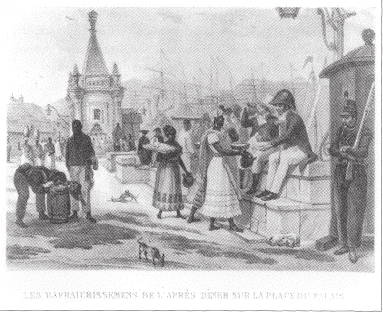
FIGURE 5: Jean Baptiste Debret, “Les rafraichissemens de l’après diner sur la place du palais,” from Debret, Voyage Pittoresque et Historique au Brésil, sejour d’un Artiste Français au Brésil v. 2 (Paris: Firmin Didot Fréres, 1835). Copy and permission obtained from the Print Collection, Miriam and Ira D. Wallach Division of Arts, Prints and Photographs, The New York Public Library, Astor, Lenox and Tilden Foundations. In the late afternoon, Debret reported, men of “modest means” gathered to take in fresh air, to chat, and to purchase sweets and refreshments from African and African-Brazilian street vendors.
Within Rio’s transformation into a civilized, metropolitan court, subtractions kept pace with additions to the cityscape and public life. While new palaces, public buildings, the theater, academies, courtly fashions, and cleaner and illuminated streets produced what Luccock described as the “resemblance of European magnificence,” the intendant, in turn, applied his resources toward ridding the city of its colonial attributes, including the use of lattices on residential buildings, features variously described by residents and visitors as gothic, deformed, and unhealthy. The removal of the lattice works, the intendant explained in the edict, would contribute to “the court’s decorum and perfection” and constitute “unequivocal proof” of the residents’ happiness that the royal family was among them, sweeping away “testimonies of [Rio’s] old condition of conquest and colony” thereby “ennobl[ing] the court and distinguish[ing] it before the eyes of foreign nations.” Indeed, as the edict more generally stated, “having elevated this city to the highest hierarchy of court of Brazil,” it was no longer possible to maintain “old customs that could be tolerated only when [Brazil] was reputed to be a colony,” customs that “populations of refinement and perfect civilization had not endured in a long time.”100 Thus, such intolerable old customs at cemeteries, hospitals, and pharmacies and lingering colonial “indecencies” were similarly targeted for reforms that complied with a “European standard,” and at the theater, as Luccock recalled, “the manners, vices, dialect and other peculiarities of the colony, were ridiculed; and the public taste, in consequence, amended.”101 As a whole, these explicitly Europeanizing, or metropolitanizing, measures allowed royal officials and resident memorialists to articulate the meaning of the transfer of the court: while the presence of the prince regent and the royal family undermined the established political and cultural hierarchies of empire, reproducing European appearances and practices in the new royal court then affirmed both the power and the virtue that had motivated European expansion in the first place.
Yet, for royal officials to “civilize” Rio de Janeiro, to make it metropolitan, was also to confront a more formidable colonial attribute than lattices, poorly administered hospitals, and provincial habits. Indeed, the most striking difference between the old court and the new one was not architecture or manners, but rather the fact that half of the population of the new court was enslaved. In the early nineteenth-century Portuguese world, after all, slavery was an exclusively colonial practice, since decrees in 1761 and 1773 guaranteed the freedom of slaves in Portugal.102 It was also a practice increasingly associated with not only immorality and cruelty, but also laziness and economic backwardness. If making Rio de Janeiro into a metropolitan court meant breaking with a colonial past, it thus appeared that the use of slave labor, like the lattices, would be foregone.
Indeed, there were memorialists and officials who argued that slavery presented obstacles to the new empire’s and its capital’s prosperity. In his treatise on how to improve Rio de Janeiro’s climate, Manuel Vieira da Silva argued that slaves undermined the city’s decorum. Many people, he explained, “come to possess one slave, or two” and so “living only from the work of these miserable men,” cast aside “industry” for “a life of idleness … affectionate mother of vice. …” If “blacks were more expensive, ” he advised, “there would not be so many wretched people in Brazil.” Yet Vieira da Silva’s critique of slavery was also highly affected. The real challenge to courtliness, he clarified, was the presence of Africans. Therefore, it was “in the prince regent’s interest,” he wrote, “to increase the number of whites, be they Brazilian, or European, rather than propagate [the population] of blacks.”103 Although Viana urged the crown to benefit from “vassals of all colors,” he shared this view and actively promoted “white” immigration through subsidies financed by the intendancy and endorsed the generally pessimistic view of color differences advanced, as we shall see in Chapter 6, by the political economist Silva Lisboa as well. As Viana explained to one of the city’s judges, “white or brown men found gambling” and “white, or freed people of mixed racial ancestry, not too dark” (pardos forros, não muito escuros) could make good soldiers, yet free “blacks” were to be discouraged from royal service.104 Calling for boys to work in manufacturing, the intendant also specified that they “should be mulattos or whites.”105
These attempts at segregation not only reflected the white elite’s persistent and, considering their dependence on slave labor, glaringly unfounded belief in Africans’ limited potential to acquire skills, but also responded to their fears of disruptive and unproductive divisions within the labor force and society as a whole. While slave owners, explained royal minister Vila Nova Portugal, were “always in a state of domestic war,”106 Viana further speculated that these conflicts outlasted changes in legal status. “Freed men,” he wrote of a militia regiment of men of color, “are better friends of other blacks, their partners, and from whom they come, and of mulattos with whom they live, than of whites.”107 Such ostensibly irreconcilable divisions and conflicts undermined the prospects for unity in a new American empire and royal court. Accordingly, it was not only a social, economic critique of slavery, but also an official racism that appeared to spell the end of forced African labor in Brazil.
Yet, elite reasoning against both slavery and the African and African-Brazilian population was overwhelmed by anxieties about the imagined impact of the immediate abolition of slavery on Brazilian society and the economy: the end of export agriculture and widespread vagrancy.108 Consequently, even as they lamented slavery’s evils, royal officials allowed the use of slave labor to expand. While most of the growing number of Africans forcibly brought to Rio’s port were sent south or to nearby plantations, many were retained in the city. In 1818 the intendant reported that to meet the demands of the “downpour” of 30,000 “whites” who arrived with the prince regent and the royal family, the city’s and its hinterland’s “black” population had increased between 60,000 and 80,000. Luccock, in turn, estimated that between 1808 and 1822 Rio’s slave population increased 200 percent. As a consequence, remaking Rio de Janeiro into the court meant reconciling the larger quest to metropolitanize the city with slavery and with the African and African-Brazilian residents who made up a majority of its population. While Europeanizing the city, in other words, officials had to account for the fact that the city was indeed more African and more enslaved.109
As a matter of “public security” and “tranquility,” the task of defining the place of slavery and slaves in the new court was of primary concern to the intendant. A tax on newly arrived slaves funded the intendancy’s efforts to provide this police and to supervise people whose daily tasks within the city often took them away from their owners’ domain.110 Following the same racist logic that informed the promotion of white immigration, Viana often emphasized the need for order among what he described as a hostile, or at least potentially disloyal, population. Brazil’s “population is black,” he explained in 1816, with “as many as ten times as many slaves as whites, and because of this [its population has] more propensity to be led astray, and [therefore] requires more police.”111 Within Rio de Janeiro, this supervision of slaves with public duties fell to the intendancy’s guard. Prison records reveal the extent to which slaves living in the city had to contend with its patrols. An average of 80 percent of those arrested by the guard and other members of the intendant’s staff, as Leila Mezan Algranti’s research shows, were slaves. All but one percent of the remaining arrests, in turn, were of free people of color. Reasons given for these detentions varied from theft, disturbing the peace, possession of a weapon, assault and homicide, and flight. Many of the detentions also involved attempts to repress the practice of capoeira, an African-Brazilian martial art that owners and officials intimately associated with violent disobedience. As one magistrate reported, “as the crimes perpetrated by individuals of this city, some freed and others enslaved, known as capoeiras, are frequent, the vigilant police has sought to capture them, and judges have sought to try them, and the casa de suplicação has sought to sentence them with exemplary zeal.”112 Arrests, however, did not fully account for the guard’s activity. As the intendant himself recognized, many confrontations between the guard’s members and people of color were both unwarranted and unreported. Indeed, in 1811, chastising the guard’s commander for the gratuitous beatings of black women selling sweets in the street, Viana found himself reminding his subordinate that the guard “was supposed to curtail disorder rather than create it.”113
When the guard did formally arrest a slave in most cases the consequences were summary punishment with a sentence of lashes, service in a chain gang, or both, while the sentences of free people were primarily limited to labor and, in some cases, banishment. As Viana explained in a report justifying the arrest and forced labor of a free French “black” named João Baptista, those accused of what he called “minor incidents” (pequenas desordems) lacking in evidence necessary to pursue the matter further were put to work on the construction of nearby roads. According to Algranti, after 1814 the intendancy also began to incarcerate slaves. Indeed, although the calabouço, a jail located in the area known as Castelo, held free and freed vagrants and deserters, it came to be associated almost exclusively with “the corrective punishments so necessary for slaves.”114 Incarceration, however, did not preclude labor at public works. Indeed, after the transfer of the court, as the intendancy embarked on a number of large projects to improve the city’s infrastructure, the prison population of slaves and free persons, became, in effect, its primary source of labor and the length of “corrections” was adjusted in order to meet the intendant’s needs.115
While in some cases sentencing a slave to work for the intendancy for an infraction committed while in public put the intendant at odds with the slave’s owner, who counted on exclusive access to his or her labor, the intendancy also assumed a major role in controlling the slave population by administering punishments upon the request of owners. In these cases, slaves were deposited at the calabouço and then assigned to a chain gang or whipped, for which owners compensated the intendancy at 160 réis per one hundred lashes. As Algranti has argued, this intervention into the quasi-private realm of relations between slaves and slave owners distinguished the experience of slaves in the city from those in rural settings, where punishments were typically administered on behalf of the owner by a feitor (plantation foreman).116
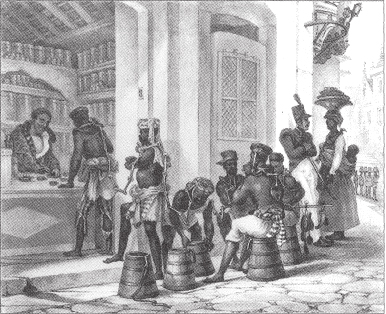
FIGURE 6: Jean Baptiste Debret, “Marchand du Tabac,” from Debret, Voyage Pittoresque et Historique au Brésil, sejour d’un Artiste Français au Brésil v. 2 (Paris: Firmin Didot Fréres, 1835). Copy and permission obtained from the Print Collection, Miriam and Ira D. Wallach Division of Arts, Prints and Photographs, The New York Public Library, Astor, Lenox and Tilden Foundations. Describing a chain gang of water carriers as they pause to buy tobacco, Debret explained that “the policemen who accompanies them always has a rod in his hand, with which he prods and separates them from the path of loquacious friends.”
Even as it reaffirmed the crown’s support of slave owners, the practice of officially administering punishment on their behalf also allowed the crown and the intendancy more opportunities to define the features of slavery in the city. What Viana described as the need to confirm “the certainty that owners have that the state will always ensure the punishment of slaves” was circumscribed by the crown’s will to maintain order. Consequently, as Viana commented on the case of slaves in nearby Irajá who, with their owner’s knowledge, had insulted a royal official and therefore, according to Viana, attacked royal authority itself, he was not about to tolerate the insolence of owners when it translated into the insolence of their slaves.117 At the same time, although sentences of corporal punishment appear to have become more severe, with slaves being sentenced to up to three hundred lashes after 1815, Viana also discouraged excessive punishment and in some cases refused to administer the number of lashes requested by the owner when he judged that it would generate further disturbances.
Indeed, although he left the threat of extreme and deadly punishment in tact, Viana questioned the expediency of the public punishment in general. He had “always been afraid to punish [blacks and common people] outside [the jail],” he claimed in 1818, “because whipping them in the streets and in the places of their infractions provokes uprisings.”118 In fact, although there was apparently no strict standard established for the punishment of slaves, by 1817, as one judge reported, “it was not practice to whip slaves at the pelourinho, the praça do rocio” or other public squares. Whereas freed people, he further noted, were whipped publicly, slaves were whipped in jail. In this particular case, however, the judge asked for an exception, hoping to make a “terrifying” example of two slave capoeira practitioners. The request was probably denied. For only one year later, when another judge proceeded to punish a slave with a public whipping at the pelourinho, the punishment was suspended and the officials administering the lashes were detained. Although the judge requested clarification on the proper manner to proceed, he himself recognized the pelourinho as the place “where whites are taken to be whipped on their backs.”119
Viana regarded this curtailment of the public punishment of slaves as a move that attenuated the “shocking” corruption that, as many contended, the presence of a large slave population promoted.120 It was “truly indecent within a court,” he insisted, “to have whippings in public squares in the way that in Brazil the slaves are punished.”121 Punishment, however, was not the only shocking or troublesome feature of slavery in the city. Indeed, for many royal officials its most insalubrious consequences were associated with the arrival of Africans at Brazil and their subsequent sale. “Blacks disembark, and they are immediately put up for sale,” the physician Vieira da Silva complained in 1808, “they enter different homes, and free exchange among them and the persons of the house is permitted, especially with children, as there are no other persons who care for them.”122 To ameliorate these conditions, new standards of hygiene were established for the slave market at Valongo. Although slave merchants complained of the fees charged, after 1810 the owners of intermediary warehouses near the market apparently were given the task of preparing slaves for sale, including a quarantine and clothing; in addition, Viana established standards for more orderly and sanitary burials at the “new slaves’” cemetery nearby.123
Such efforts to mitigate what officials construed to be the indecency of slavery also included ultimately futile attempts by owners to curtail the appearance of slave labor, even as they proceeded to rely on slaves in both commerce and at home. Visitors commented on the trend toward replacing African and African-Brazilian labor with Europeans in certain occupations. While the “mechanics were formerly all mulattoes,” reported the British Ellis in 1816, “the residence of the court … encouraged not only Portuguese, but other Europeans, to establish themselves as artificers.”124 Luccock noted the preference for European labor as well, particularly as a means to reflect one’s status. For formal processions, he explained, carriages were “drawn by horses instead of mules, and attended by white servants instead of slaves.” Other owners, recognizing that the use of slave labor could not be hidden, reportedly gave more consideration to the appearance of the slaves themselves. As Luccock further explained, while following the arrival of the court “white servants were more generally seen, … slaves for domestic occupations, though less numerous, were more carefully selected, furnished with better clothing and food.”125 This limited concern with the clothing and appearance of slaves anteceded the arrival of the court, however, as Silvia Lara has explained, in expressions of seignorial ostentation predicated on the notion that, as one eighteenth-century critic of slavery observed, “the body of a slave or domestic servant is like part of the master’s body.”126 Following the transfer of the court then, the dimensions of such ostentation grew as the city’s elites used slaves and slave retinues, along with their carriages and attire, to project their now more courtly appearance.
While royal intervention in the punishment and the sale of slaves and elite pretense to refinement sought to obscure from view and to sanitize the brutality of slavery and therefore create the appearance of a metropolitan court, such measures were also seen as providing the basis for a more effective control of the slave population. They followed from the notion that order had moral as well as physical dimensions, or, as Viana argued, that “moral force is always more powerful than physical force.” Indeed, in this sense, their initial treatment at Valongo market ideally marked the beginning of the slaves’ immersion into European society under the aegis of their owners’ paternal authority, a passage from what Viana and other elite residents regarded to be the slaves’ savage ways of life characterized by nakedness and violence. Measured, rather than excessive punishment, in turn, ostensibly introduced slaves to European justice.
Yet the intendant also raised concerns that such paternal ideals had been forgotten in Rio de Janeiro in the 1810s. Those owners who set decorous standards and cared for their slaves’ appearance, Viana lamented, were outnumbered by those who left them “barefoot and barely clothed” as well as ignorant of the “immortality of the soul and of eternal life.” As a result, Viana explained in one report, slaves were resentful, full of hate, and disobedient. Under these circumstances, punishment led only to further conflict and disorder. Although this critique recalled earlier denunciations of slave owners made before the transfer of the court, Viana indeed attributed the lack of attention to the slaves’ well-being to the expanded use of slavery in the city after 1808. “With the arrival of the court to this city,” he wrote, “we enjoyed the good effects of a larger population” and many of these newcomers to the city, in turn, “took possession of slaves in the manner of this country because of the difficulty in securing whites, as in Portugal, to serve them.” These new owners, the intendant continued, “wanting to earn a living, and capitalize on their wealth, took advantage of the practice of buying slaves to then bring them to work on public works, at the customs houses, and in services to the city.” Although this practice of renting out slaves for wages was theoretically sound, Viana noted, in practice the “desire to immediately profit” from the newly arrived slaves meant that these new owners both failed to provide religious instruction and further mistreated their slaves. As a result, Viana lamented, “the old equilibrium was lost.”127
Thus, the transformation of Rio de Janeiro into the New World court had resulted in profoundly contradictory approaches to slavery. On the one hand, the city’s residents, royal exiles, and officials together sought either to hide the practice of slavery or make it decorous. On the other hand, the intendant observed, as the quest for prosperity in the New World resulted in the growth of the city’s slave population, the process of metropolitanization was undermined. Just as Viana had encountered in the policing of public space and public life, in the culture of slavery the ideal of civilization embodied in morality, education, and manners, which, Viana nostalgically claimed, had been nurtured before Dom João’s arrival, was jeopardized. As “a son of this country,” Viana explained, he could recall “owners who called to their houses whites and blacks who earned a living teaching [religious] doctrine to their slaves.”128 Unfortunately, he then charged, newcomers to the city failed to appreciate this paternal dimension of ownership.
As a short-term solution to this problem Viana proposed that the intendancy, the church, and tribunals should assume a more direct role in ensuring that owners provided their slaves with a “moral education.” Just as the courtiers taught the city’s elites to be metropolitan, the city’s residents and officials would teach the courtiers to be, in effect, colonial; to recognize the means of preserving order and civility amid the brutal practice of slavery, and to be, as Viana described the local disposition, “less startled by these matters.”129 Making the new, metropolitan city of Rio, in other words, required the tolerance of old, unmetropolitan practices.
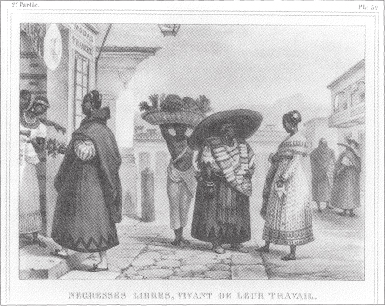
FIGURE 7: Jean Baptiste Debret, “Negresses libres, vivant de leur travail,” from Debret, Voyage Pittoresque et Historique au Brésil, sejour d’un Artiste Français au Brésil v. 2 (Paris: Firmin Didot Fréres, 1835). Copy and permission obtained from the Print Collection, Miriam and Ira D. Wallach Division of Arts, Prints and Photographs, The New York Public Library, Astor, Lenox and Tilden Foundations. Signs of empire and of the colony of Brazil—African cloth and a basket of bananas and pineapples—are juxtaposed to new standards of opulence, Modas Francez (French fashion). As Debret explained, free women of color worked as seamstresses for French tailors, acquiring profitable skills, exhibited in the “elegance and decency” of their own dress.
Indeed, while royal officials reserved the right to persecute African and African-Brazilians on Rio’s streets, they also acknowledged that as long as Brazil had the institution of slavery, the very public presence of slaves, their gatherings, and their ways of life were social and political, as well as economic, facts. As royal minister the Marquês de Aguiar conceded to the Conde dos Arcos, not only was it “impossible” to prohibit gatherings of slaves, “who … serve all of the families of Brazil, bring their owners to church, to the theater, and fetch water at the fountains,” but indeed the nature of these activities meant that slaves gathering together should be accepted as “inevitable even if such a [circumstance] could lead to some disturbance. …”130° Thus, the new city and New World court of Rio de Janeiro was a place where, as long as slaves did not participate in large-scale disorderly conduct, African and African-Brazilian brotherhoods gathered at the Campo de Santa Anna on Sundays and other feast days, securing, in the process, monetary contributions for their activities; and where, having secured the appropriate license from the intendant, African communities within the city and nearby region chose and celebrated their local leadership.131 These features of life in Rio distinguished the new court from the old one, where the African population was a smaller and less prominent feature of public life. Yet, social gatherings of Africans and African-Brazilians also could be construed as ensuring continuity between a colonial past and an imperial future. After all, as one royal order noted, “in all the policed cities of the world public entertainment is permitted to even the most inferior classes of the nation.”132 Policing slaves, in this sense, approximated policing the free lower classes. In both cases, Viana repeatedly insisted, the affirmation of hierarchy and royal authority was at stake.
These contemporary perceptions of an urgent need to police and control slaves with both physical repression and social discipline were also shaped by an awareness of a changing political landscape that now explicitly included slaves themselves. The choice facing the residents of Brazil, one official explained, was between “the ancient respect” that men of color “gave to the class of whites” and the “dangerous maxim of equality with which frenetic philosophes had sought to totally annihilate civilized societies.”133 Of course, whether or not slaves expressed their political aspirations in terms of the liberal agendas advanced elsewhere in the Atlantic, the brutality, inhumanity, and the absence of civilization in slavery always demanded insurrection. The struggles between and within European powers afforded opportunities. And one insurrection in particular provided a spectacular example of the potential of colonial protest within European crisis for both slaves and owners to behold. Brazilian slaves, their owners frantically reported to royal officials in 1814, “spoke and knew of the fatal events of the Island of São Domingos.”134
We have seen royal officials’ wariness of the inspiration that the Haitian Revolution provided slaves and people of color in Brazil before the transfer of the court. In the 1810s responding to the question, as Silvestre Pinheiro Ferreira put it, of how to prevent “the danger of a reaction of races” that had and continued to devastate “the unfortunate Antilles” acquired a new urgency.135 On the one hand, what Silva Lisboa described as “the horrid spectacle of the tremendous catastrophe of the Queen of the Antilles transformed into Madagascar” was a cautionary tale that supported arguments in favor of the need to displace people of color and the ostensibly unproductive and hostile slave population with European immigrants in the new American empire.136 The intendant, on the other hand, perceived the example of Haiti, and its possible influence on slaves in Brazil, as a more immediate matter of security. Rebellion was, of course, intolerable anytime and anywhere in Brazil. Yet, the war in Europe, Viana argued, made it particularly dangerous. The slave population formed a weak point in the political and cultural defense against Napoleon that Brazil was supposed to represent. A rebellion of slaves in the prince regent’s new court, he wrote in 1808, would surely encourage the Portuguese monarchy’s “well-known enemies.”137 Even after the end of the war, Viana insisted in 1816, having been informed “with certain exaggeration, that there has been a spirit of insubordination among Bahian slaves, they [Napoleon’s supporters] believe that there they will be well received.”138
For both Viana and royal minister Souza Coutinho, the solution to the problem of potential insurrection was the scrutiny and detainment of anyone, white or black, reported to have connections in the Caribbean as well as, not surprisingly, those who expressed abolitionist agendas.139 Thus, in 1816, “a black man” “of the French nation” named Carlos Romão found himself in the city’s jail so that the intendant could determine whether he was “from the Island of São Domingos, or from there had come,” whether there were “others, or mulattos, if he had been in Bahia, or if he knew of anyone who was there and had come from São Domingos, and their names and the marks by which they could be identified.”140 These actions, however, also carried a risk. As Viana commented to Souza Coutinho following his detainment of three “blacks from Martinique” so that he could verify their past and present occupations, “with these men I have always sought to avoid entering into judicial inquiries or investigations involving witnesses which always give body to formless things, and raise ideas unknown to the great part of the people.”141 Royal officials’ perceptions of the politics of slavery, slaves, and people of color thus rested, like those of the politics of the popular classes in general, on contradiction and ambivalence. Slaves and people of color were, at once, suspected of promoting insurrection and regarded as unaware of the politics of contestation. Owner’s claims that slaves were so “barbarous” that they were “not afraid to die” suggested limits to ideologically motivated organization and reassured them and royal officials that certain revolutionary agendas would remain, as Viana claimed, “unknown.” Yet, ideas of liberty and equality were also perceived to be “contagious” and the potential consequences seemed so inevitable precisely because owners and officials recognized the potential appeal of these ideas to people who had no stake in preserving the inequalities, the lack of liberty, and the hierarchies that served only to oppress them. The crown’s choice to maintain the institution of slavery in Brazil and its new American court meant, therefore, that the experiences of policing, governing, and living in Rio de Janeiro, and making the city a metropolis would be shaped by a colonial sense of vulnerability and the politics of elite fear.
The project to make Rio de Janeiro into the capital of the empire was a quest to make the city not only “splendorous” but also ordered, decorous, moral, and allegiant. Becoming the royal court, in this sense, the city became “policed.” Policing, in turn, meant not only guaranteeing “public security,” but also making Rio metropolitan, recognizing the difference between the metropolis and the colony so that those differences could be diminished. Such a project was sustained by eighteenth-century Europe’s enlightened embrace of “civilization” and its mission. Yet, even as officials sought to eradicate colonial “indecencies,” they also maintained a preeminent colonial institution: African slavery. Accordingly, while “perfecting” Rio entailed beautifying the city, improving its infrastructure, and disciplining vassals—making them “useful”—the city’s elevation “to the highest hierarchy of court of Brazil” also meant the production of what Stoler and Cooper have associated with “the most basic tension of empire”: the inevitable quest to define the status of difference amid a contingent and unstable “otherness.”142 Slavery, the intendant and other royal officials thus imagined, would be courtly and metropolitan if slaves were morally educated and their presence in the city was carefully controlled. The end of the “old colonial system” not withstanding, it would be an intensification of colonialism that made the “new city” of Rio de Janeiro imperial. This transformation of Rio de Janeiro into a royal court would, however, also require further negotiation of metropolitan imperatives and colonial realities; exchanges, as we shall see in the next chapter, with which the sovereign and his vassals, both free and slave, embarked on the task of reconstructing the practice of royal authority in the New World.
NOTE
1. The news, brought by the ship “Voador,” arrived at Rio de Janeiro on January 14, 1808. See Luiz Gonçalves dos Santos, Memórias para servir à História do Reino do Brasil t. 1 (1825) (Belo Horizonte/São Paulo: Itatiaia/EDUSP, 1981), 167.
2. Relação dasfestãs que se fizerão no Rio de Janeiro quando o Principe Regente Nosso Senhor e toda a sua Real Familia chegarão pela primeira vez a’quelk Capital … (Lisbon: Impressão Régia, 1810), 4–5, 6.
3. “Preparativos no Rio de Janeiro para receber a família real portuguesa,” January 16, 1808, BNRJ Ms. II–35, 4, 1.
4. [Report on reception], March 1808, BNRJ Ms. II–35, 4, 1, f5; Relação, 11–12;Gonçalves dos Santos, Memórias t. 1, 167–187; and Anonymous, [ca. 1807–08], in Ângelo Pereira, Os filhos de el-rei D. João VI (Lisbon: Empresa Nacional de Publicidade, 1946), 127–129.
5. Gonçalves dos Santos, Memórias t. 1, 335.
6. António Filipe Pimentel, “Absolutismo, Corte e Palácio Real—En torno dos palácios de D. João V,” in Arqueologia do Estado, Jornadas sobre Formas de Organização e Exercício dos Poderes na Europa do Sul, S.XVII-XVIII, special issue of História e Crítica (Lisbon) (1988), 685–686.
7. A.J.R. Russell-Wood, “Portugal and the World in the Age of Dom João V,” and Angela Delaforce, “Lisbon, ‘This New Rome’: Dom João V of Portugal and Relations Between Rome and Lisbon,” in The Age of the Baroque in Portugal, ed. Jay Levenson (Washington, DC/New Haven: National Gallery of Art/Yale University Press, 1993); and Pimentel, “Absolutismo,” 688–690, 706.
8. José Augusto França, Lisboa Pombalina e o Iluminismo (Lisbon: Livraria Bertrand, 1977); and idem, “Lisbon, the Enlightened City of the Marquês de Pombal,” in The Age of the Baroque, ed. Levenson, 133–137.
9. Here the police intendant claimed that the town council’s manner of conducting its affairs promoted the opposite. See Paulo Fernandes Viana [intendant] to the Marquês de Aguiar [Fernando José de Portugal e Castro, Ministro dos Negócios do Reino], September 6, 1811, ANRJ Ministério dos Negócios do Brasil (hereafter MNB) Caixa 6J 78.
10. John Luccock, Notes on Rio de Janeiro and the southern parts of Brazil; taken during a residence of ten years in that country, from 1808–1818 (London: Samuel Leigh, 1820), 245–246, 254, 548. For a discussion of the street and urban form in Joanine Rio de Janeiro see James Holston, The Modernist City: An Anthropological Critique of Brasilia (Chicago: University of Chicago Press, 1989), 109–119.
11. Marrócos both boasted of his aversion to the French and noted with interest the availability of new French wares in the city after the war. See Luiz Joaquim dos Santos Marrócos to his sister, April 10, 1815, and another undated letter, in Cartas de Luiz Joaquim dos Santos Marrocos (Rio de Janeiro: Biblioteca Nacional/Ministério de Educação e Saude, 1939), 223, 444. On imports see also the announcement in the Gazeta do Rio de Janeiro, March 2, 1816, in Delso Renault, O Rio antigo nos anúncios de jornais, 1808–1850 (Rio de Janeiro: Francisco Alves, 1984), 56–57. As signs of a new openness to foreign fashion and culture in Rio, Renault also notes a growing number of announcements for instruction in French as well as the suspension of an earlier prohibition (in 1802) against wearing clothes made from cloth that was not manufactured in Portugal at viceregal audiences. See Renault, Rio antigo, 39, 40–41, 44, 48, 52. On the “Europeanization” of manners and other social practices in the Rio court, see also Jurandir Malerba, “A corte no exílio. Interpretação do Brasil joanino” (Ph.D. dissertation, University of São Paulo, 1997), 121–122, 127.
12. The decree is cited in Afonso de E. Taunay, A Missão Artística de 1816 ([Rio de Janeiro]: Diretoria do Patrimônio Histórico e Artístico Nacional, 1956), 18. For examples of neoclassical design in Rio de Janeiro see Jean Baptiste Debret, Viagem Pitoresca e Histórica ao Brasil (1834) t. 3 (Belo Horizonte/São Paulo: Itatiaia/EDUSP, 1989), plate 41; and Clarival do Prado Valladares, Rio, análise iconográfica do barroco e neoclássico rémanentes no Rio de Janeiro v. 2 (Rio de Janeiro: Bloch, 1978), especially “Ato inaugural da praça do comércio … 1820,” plates 638–639, and “Primitiva câmara do comércio,” plates 640–641. On the mision sion and its members see also Mario Barata, “Manuscrito inédito de Lebreton,” Revista do Patrimônio Histórico e Artístico Nacional (Rio de Janeiro) 14 (1959), 283–307; Gean Maria Bittencourt, A missão artística francesa de 1816 (Petrópolis: Museo de Armas Ferreira da Cunha, 1967); Pontifícia Universidade Católica do Rio de Janeiro, Uma cidade em questão I: Grandjean de Montigny e o Rio de Janeiro (Rio de Janeiro: PUC, 1978); J.F. de Almeida Prado, D. João e o início da classe dirigente do Brasil (depoimento de um pintor austriaco no Rio de Janeiro) (São Paulo: Companhia Editora Nacional, 1968), 189–213, 285–316; Carmen Sylvia Sicoli Seoane, “Aquarelas do Brasil: estudo iconográfico e textual da natureza do índio em Debret e Rugendas (1816–1831)” (M.A. thesis, Fluminense Federal University, 1990); and an outstanding essay by Rodrigo Naves in his A forma difícil: ensaios sobre a arte brasileira (São Paulo: Editora Ática, 1996). For recent analysis of the legacy of the French Mission and the Portuguese and Brazilian monarchies see Caren Ann Meghreblian, “Art, Politics and Historical Perception in Imperial Brazil, 1854–1884” (Ph.D. dissertation, University of California, Los Angeles, 1990) and Iara Lis Carvalho Souza, Pátria Coroada: O Brasil como Corpo Politico Autônomo, 1780–1831 (São Paulo: Editora UNESP, 1998), Chapter 6.
13. See Alvará, June 15, 1808, in Código Brasiliense, Ou Collecção das Leis, Alvarás, Decretos, Cartas Régias, &c. Promulgadas no Brasil desde a feliz chegada de El Rey Nosso Senhor a Este Reino (Rio de Janeiro: [Impressão Régia, 1811–1822]). On the royal chapel see Alcingstone de Oliveira Cunha, “The Portuguese Royal Court and the Patronage of Sacred Music in Rio de Janeiro, 1808–1821” (Ph.D. dissertation, Southwestern Baptist Theological Seminary, Fort Worth, Texas, 1998).
14. The 1810 decree is transcribed in J. Galante de Souza, O Teatro no Brasil v. 1 (Rio de Janeiro: Ministério da Educaçaoão e Cultura/INL, I960), 138–140. Before the royal theater, Rio de Janeiro had smaller salas or casas de espectáculos, the most notable being Padre Ventura’s Casa da Ópera, which opened in 1767 and burned in 1769, according to Galante. By 1776, Ventura’s theater had been replaced by the Ópera Nova, built by Manuel Luiz de Almeida. On eighteenth-century theater see Galante de Souza, Teatro, 110–112; Adolfo Morales de Los Rios Filho, “História do teatro do Rio de Janeiro durante o século XVIII,” Anais do congresso comemorativo do bicentenario da transferencia da sede do governo v. 4 (1967), 319–354; Almeida Prado, D. João, 162–188; and Ariadna Gonçalves Moreira, “The Influence of the Portuguese Royal Court on the Development of Opera, The Opera Nova, and the Real Teatro São João in Rio de Janeiro from 1808–1824” (Doctoral Essay, Doctor of Musical Arts, University of Miami, 1998). O Juramento dos Numes was published by Rios Royal Press in 1813. The editor of the periodical O Patriota, Manuel Ferreira de Araújo Guimarães, attacked Coutinho’s work. Coutinho in turn issued Resposta Defensiva, e Analytica d Censura, also published in 1813. For the popular presence at the theater see Luccock, Notes on Rio de Janeiro, Viana, “Registro do Ofício expedido ao Juiz do Crime de São José,” May 15, 1809 and June 7, 1809 (including a reference to “spies” in the audience who could determine who was being disruptive), and Viana, “Registro do Ofício expedido ao Juiz do Crime do Bairro da Candelária,” May 15, June 7 and June 11, 1809, ANRJ Códice 323 v. 1, f53v, f81, f86; Viana, “Registro do Ofício expedido ao Inspector do Teatro,” August 4, 1814, ANRJ Códice 329 v. 2, f206v; Viana, “Registro do Ofício expedido ao Juiz do Crime do Bairro de Santa Rita,” April 18, 1818, ANRJ Códice 329 v. 4, f89v-90. The presence of “blacks” in the audience is analyzed in Malerba, “A corte no exílo,” 103–104.
15. “Alvará, porque Vossa Alteza Real he Servido Crear no Estado do Brasil hum Intendente Geral da Polícia, na forma acima declarada… ,” May 10, 1808 ([Rio de Janeiro]: Im-pressão Régia, [1808]).
16. The alvará of June 25, 1760 that created the intendancy in Portugal is transcribed in Mello Barreto Filho and Hermeto Lima, História da polícia do Rio de Janeiro, aspectos da cidade e da vida carioca, 1565–1831 v. 1 (Rio de Janeiro: S.A.A. Noite, n.d. [1939]), 165–176. For contemporary commentary on the intendancy and its responsibilities, see Viana to Marquês de Aguiar, August 22, 1815, ANRJ MNB Caixa 6J 79; Viana, “Abreviada demonstração dos trabalhos da polícia” (ca. 1821), RIHGB 55, pt. 1 (1892), 373–380; Viana to Sua Alteza Real, August 27, 1810, in Dom João VI e o Império no Brasil, a Independência e a Missão Rio Maior, ed. Marcos Carneiro de Mendonça (Rio de Janeiro: Biblioteca Reprográfïca Xerox, 1984), 188; and Rodrigo de Souza Coutinho, “Representação a Sua Alteza Real o Príncipe Regente sobre uma reforma da câmara do Rio de Janeiro” [no date, ca. 1808], in Rodrigo de Souza Coutinho, Textos políticos, económicos efinanceiros (1783–1811) v. 2 (Lisbon: Banco de Portugal, 1993), 347–348. For broader discussions of policing in Portugal and Brazil see José Subtil, “Os poderes do centro: governo e administração,” in História de Portugal: O Antigo Regime v. 4, ed. António Manuel Hespanha (Lisbon: Estampa, n.d.), 174–176; Thomas H. Holloway, Policing Rio de Janeiro: Repression and Resistance in a Nineteenth-Century City (Stanford: Stanford University Press, 1993), 28–33; José Luiz Werneck da Silva, “A polícia na corte e no distrito federal, 1831–1930,” Estudos PUC/RJ3 (1981), 23; and Maria Beatriz Nizza da Silva, “A Intendência-Geral da Polícia: 1808–1821,” Acervo 1, n. 2, (July-December 1986), 187–204.
17. Viana’s grandmother was from the well-established Nascentes Pinto family and he married the daughter of Brás Carneiro Leão, a wealthy merchant and landowner who died the year the prince regent arrived. His niece married the son of Rodrigo de Souza Coutinho. See Rui Vieira da Cunha, “A vida do Rio de Janeiro através dos testamentos: 1815–1822,” RIHGB 282 (January-March 1969), 53.
18. See Viana, “Registro do Ofício expedido ao Ministro e Secretário da Repartição de Guerra,” May 23, 1808, ANRJ Códice 318 f16v; and Viana to Aguiar, June 9, 1812, ANRJ MNB Caixa 6J 79.
19. See Viana, “Abreviada demonstração”; and Viana to Aguiar, August 22, 1815, ANRJ MNB Caixa 6J 79. The intendancy recruited street lighters and sweepers with announcements in the Gazeta. See citation from December 1, 1810, in Renault, Rio antigo, 42.
20. Relação, 7.
21. In Brazil, as in Portugal, the intendancy had numerous jurisdictional conflicts with the town council, especially regarding public works. See Viana, [parecer], September 1, 1810, f5v-f6, ANRJ MNB Caixa 6J 78. Although Souza Coutinho argued that these conflicts could be avoided by making the intendant a member of the council, the advice apparently went unheeded.
22. See Joaquim José de Queirós [ouvidor], “Mappa da população da côrte e província do Rio de Janeiro em 1821,” RIHGB 33, pt. 1 (1870), 135–142.
23. Correio Braziliense ou Armazem Literário 1 (October 1808), 420.
24. Marques de Borba to the Condessa do Redondo [his daughter-in-law], Rio de Janeiro, February 20, 1809; and Borba to the Conde de Redondo [his son], May 10, 1810, in Pereira, Osfilhos, 140, 143. John Mawe also noted that rents were as high as in London. See his Travels in the Interior of Brazil … (London: M. Carey/Boston: Wells and Lilly, 1816), 106.
25. José Joaquim de Santa Anna, Memória sobre o Enxugo Geral Desta Cidade do Rio de Janeiro … (Rio de Janeiro: Impressão Régia, 1815), 17.
26. Luccock, Notes on Rio de Janeiro, 100–101. For attempts to evade the imposition of aposentadoria see Vieira da Cunha, “A vida do Rio de Janeiro.” António Nascentes Pinto, for example, whose family had settled in Rio at the end of the seventeenth century, attempted to retain control of his property on the Rua Belas Noites by renting it to a royal official in need of accommodations before the crown could indiscriminately, and more permanently, assign it to someone else. In Pinto’s case, however, the scheme backfired when the official then asked the crown to confirm his right to reside in the house through aposentadoria. Numerous examples of the conflicts arising from aposentadoria can be found in the pareceres of D. Francisco de Almeida de Melo e Castro, Conde de Galveias, aposentador-mor da Corte e Reino no Rio de Janeiro, Arquivo Nacional Torre do Tombo, Arquivo da Casa dos Condes de Galveias, Maço 10. Colorful stories of tribulations related to aposentadoria are particularly popular in folkloric accounts of Joanine Rio de Janeiro. Several describe how the letters “PR.” used to designate that property had been requisitioned in the name of the prince regent were also understood to signify “ponha-se na rua” (get out on the street) or “predio roubado” (stolen building). See, for example, Edmundo Luiz, A côrte de D. João no Rio de Janeiro 3 v. (Rio de Janeiro: Imprensa Nacional, 1939).
27. See Viana, [parecer, ca. 1808], BNRJ Ms. I–34, 32, 31; Viana, “Registro do Edital,” June 11, 1808, ANRJ Códice 318, £26; Viana, “Registro da Representação… ,” August 1, 1808, ANRJ Códice 318, f47–47v; and Viana, “Registro do Ofício expedido ao Ministro de Estado dos Negócios do Brasil [José de Portugal e Castro],” November 17, 1808, ANRJ Códice 318, f112.
28. Viana, [parecer], March 20, 1811, ANRJ MNB Caixa 6J 78.
29. “Alvará [Imposição da Décima aos Prédios Urbanos], June 27, 1808” ([Rio de Janeiro]: Impressão Régia, [1808]); Gonçalves dos Santos, Memórias t. 1, 209, 277–278.
30. Gilberto Ferrez, O Paço da Cidade do Rio de Janeiro (Rio de Janeiro: Fundação Nacional Pró-Memória, 1985), 33. As Viana explained in a report, an alvará of February 6, 1818 granted aposentadoria passiva to all residents of Rio. See Viana, “Registro de uma informação dada ao Ministro de Estado dos Negócios do Reino,” October 23, 1818, ANRJ Códice 323 v. 5, f63; and Viana, “Registro da Informação expedida ao Ministro de Estado dos Negócios do Reino,” November 1[8], 1818, ANRJ Códice 323 v. 5, f75.
31. See Alvará, June 27, 1808 (creation of juizes do crime) and Alvará, June 25, 1760, transcribed in Barreto Filho and Lima, História da polícia v. 1, 165–176. The intendant’s jurisdiction extended to all crimes pertaining to the corregedores and juizes do crime dos bairros and allowed the intendant to deal summarily with cases or send them to the casa da suplicação when necessary. Before 1808, within Brazilian cities the duty to keep and restore the peace was entrusted to a variety of ad hoc functionaries: civilian guards contracted by the senado da câmara (town council), quadrilheiros (neighborhood inspectors) appointed by local judges and the town council, and, in cases of large scale disturbances, ordenanças (reserve militia units). The limited authority of these posts (guards and inspectors had no more powers of arrest than other residents) stood in contrast to the concerted powers of the intendant. See Holloway, Policing, 28–31.
32. Viana requested that the local judges furnish him with lists of residents in each of the city’s neighborhoods. See Viana, “Registro do Ofício expedido ao Juiz do Crime do Bairro da Se,” October 25, 1808, ANRJ Códice 318, f96–96v; Viana, “Registro do Ofício expedido ao Juiz do Crime do Bairro de São José,” March 15, 1809, ANRJ Códice 323 v.l; Viana, “Registro do Ofício expedido ao Juiz do Crime do Bairro da Se,” June 3, 1809, ANRJ Códice 323 v. I, f78v.
33. “Decreto,” May 13, 1809 ([Rio de Janeiro]: Impressão Régia [1809]). For Viana’s request for the creation of the guard see “Registro do Oficio expedido ao Ministro de Estado dos Negocios Estrangeiros e de Guerra,” March 1, 1808, ANRJ Códice 318, f187. The guard’s commander, the newcomer José Maria Rebelo, answered to both the city’s governor of arms and the intendant. Its rank and file were to be chosen from the best soldiers and would wear the same uniform as the guards in Lisbon.
34. Souza Coutinho, “Composição, e Regulação da Divizão Militar da Guarda Real da Polícia do Rio de Janeiro,” May 13, 1809 ([Rio de Janeiro]: Impressão Régia, [1809]), 7. On the guard see also Viana, “Registro do Ofício expedido ao Ministro de Estado dos Negócios Estrangeiros e de Guerra,” April 25, 1809, ANRJ Códice 323 v. 1, f 43v-50v.
35. Gonçalves dos Santos, Memórias t. 1, 203–204; Viana, “Registro do Ofício expedido ao Juiz do Crime do Bairro de Santa Rita,” April 18, 1818, ANRJ Códice 329 v. 4, f89v-90.
36. Viana, “Registro do Ofício expedido ao Juiz de Fora desta Cidade,” August 5, 1808 ANRJ Códice 318, f52v; Viana to Aguiar, August 22, 1814, and Viana to Aguiar, September 15, 1814, ANRJ MNB Caixa 6J 79.
37. Viana to Tomás António Vila Nova Portugal [Ministro dos Negócios do Reino], July 19, 1818, ANRJ MNB Caixa 5B 243. Among numerous reports of public disorder see Viana, “Registro do Ofício expedido ao Juiz do Crime do Bairro de Santa Rita,” February 11, 1809, ANRJ Códice 318, f148; Viana to Aguiar [Ministro dos Negócios do Reino], August 22, 1814, ANRJ MNB Caixa 6J 79; Viana, “Registro do Ofício expedido ao Juiz do Crime do Bairro da Se,” March 31, 1818, ANRJ Códice 329 v. 4, f82; and Souza Coutinho to João Baptista de Azeredo Coutinho [General das Tropas], n.d., BNRJ Ms. II–34, 27, 7 n. 5.
38. Viana, “Registro do Ofício ao General das Tropas” [João Baptista de Azeredo Coutinho], July 20, 1808, ANRJ Códice 318, f46v-47. On policing the theater and publicentertainment see also Viana, “Registro do Ofício expedido ao Commandante da GuardaReal,” December 29, 1810, ANRJ Códice 323 v. 2, f47v; “Registro do Oficio expedido aoJuiz do Crime do Bairro de São José,” July 11, 1812, ANRJ Códice 329 v. 1, fl 81; “Registrodo Oficio expedido ao Desembagador Duque Estrada,” February 10, 1814, ANRJ Codice329 v. 2, f153v; and an unsigned report, in Viana’s handwriting [ca. 1812], BNRJ Ms. I-33, 30, 43.
39. Viana, “Registro do Oficio expedido ao Juiz de Fora desta Cidade,” April 3, 1809, and “Registro do Ofício expedido ao Juiz do Crime do Bairro de Santa Rita,” April 5 and 11, 1809, in ANRJ Códice 323 v. 1; Viana, “Registro do Ofício expedido [aos Juizes do Crime dos Bairros],” July 28, 1813, ANRJ Códice 329 v. 2, f103v-104; Viana, “Registro do Ofício expedido ao [Ministro de Estado Vila Nova Portugal], August 11, 1819, ANRJ Códce 323 v. 5, f133.
40. Viana, “Registro[s] do[s] Ofício[s] expedido[s] ao[s] Juiz[es] do Crime do Bairro da Se e da Candelária,” May 1, 1809, and Viana, “Registro do Ofício expedido ao Juiz do Crime do Bairro da Candelária,” April 25, 1809, ANRJ Códice 323 v. 1; Viana, “Registro do Ofício ex-pedido ao Juiz do Crime do Bairro de S. José,” September 15, 1818, ANRJ Códice 329 v. 4, f125 (on Teresa dos Moleques); and Viana, “Registro do Oficio dirigido a Secretaria de Estado dos Negócios Estrangeiros e de Guerra,” June 7, 1815, ANRJ Códice 323 v. 4 (on Mathildes de Jesus). Moleque may refer to a young boy, especially a young boy of color, as well as someone of ill-repute. See António de Moraes e Silva, Grande Diciondário da Lingua Portuguesa (1789) (Lisbon: Confluencia, 1949).
41. See Viana, [parecer], September 1, 1810, and Viana to Aguiar, June 9, 1811, ANRJ MNB Caixa 6J 78; Holloway, Policing 34.
42. Viana to Vila Nova Portugal, February 7, 1820, ANRJ MNB Caixa 6J 86.
43. José Subtil, “Os Poderes do centro,” 176; Kenneth Maxwell, Pombal: Paradox of the Enlightenment (New York: Cambridge University Press, 1995), 88; Gonçalves dos Santos, Memórias t. 1, 273; Viana, [representação], November 24, 1816, f11, ANRJ MNB Caixa 6J 83.
44. Viana, “Registro do Oficio expedido ao Juiz do Crime de São José,” June 19, 1811, ANRJ Códice 329 v. I, f61.
45. Viana, “Registro do Oficio expedido ao Comandante do Districto de Macacú,” May 9, 1809, ANRJ Códice 323 v. 1, f42v-43v; Viana, [informe], November 17, 1810, ANRJ MNB Caixa 6J 78; Viana to Vila Nova Portugal, September 3, 1820, ANRJ Códice 323 v. 6, f20v. In 1809 Viana identified a series of categories to be targeted for “correction”: (1) single men who are not farmers and who are not the only son of a widow; (2) single men with the reputation of valentão and briguento even if they were only sons; (3) married men who had abandoned their wives and children to live with other women; (4) sons of farmers with many sons. In these cases, he added, “whites and mulattos will serve.” As Viana also reported, however, there were not enough vadios in the city to meet the demands for recruits. See Viana, “Registro do Ofício expedido ao Ministro de Estado dos Negócios Estrangeiros e de Guerra,” July 3, 1811, ANRJ Códice 323 v. 3, f57.
46. Viana to Vila Nova Portugal, May 27, 1818, ANRJ MNB Caixa 6J 81; Viana to Aguiar, February 7, 1813, ANRJ MNB Caixa 6J 79.
47. António Manuel Hespanha, “A punição e a graça,” in História de Portugal: O Antigo Regime v. 4, ed. António Manuel Hespanha (Lisbon: Editorial Estampa, n.d.); Francisco António de Novaes Campos, Principe Perfeito, Emblemas de D. João de Solórzano (1790) (Lisbon: Instituto de Cultura e Lingua Portuguesa, 1985), f153.
48. “Almanaque da cidade do Rio de Janeiro para o ano de 1817,” RIHGB 270 (January-March 1966), 217.
49. Vila Nova Portugal, “Sobre a questao da escravatura,” n.d. [ca. 1814], BNRJ Ms. I-32, 14, 22.
50. Geine de Cailhé, “Projet” and “Memoire et notes explicatives sur le projet,” Rio de Janeiro, December 15, 1820, BNRJ Ms. I–33, 29, 8 and 1–33, 29, 16; R.R. Palmer, The Age of Democratic Revolution: A Political History of Europe and America 2 v. (Princeton: Princeton University Press, 1959–64). Palmer’s understanding of the late eighteenth century as a critical moment in the history of “Atlantic Civilization” was shared by officials in the Rio court, although they despaired at signs of what Palmer called “a new feeling for a kind of equality.”
51. Viana to Aguiar, June 9, 1812, ANRJ MNB Caixa 6J 79. These responsibilities were delineated upon the creation of the intendancy in Lisbon. See “Instrucções conforme o alvará de 25 de Junho de 1760—A jurisdição do intendente geai da polícia da corte no reino,” in Barreto Filho and Lima, História da polícia, v. 1, 169–172. On strategies for al ta polícia see also Viana, “Registro do Ofício expedido ao [Ouvidor do Crime de Bahia],” June 28, 1808, ANRJ Códice 318, f35v; Viana, “Abreviada demonstração,” 379; and Viana to Sua Alteza Real, [parecer], September 1, 1810, f2, f5, ANRJ MNB Caixa 6J 78. Viana also claimed that the intendancy needed money “for an extraordinary case, or for a hidden expenditure which the sovereign orders. …” Alta polícia indeed was listed as the fourth largest expenditure (14:820$704 out of a total budget of 108:061$079) after infrastructure (roads, landfills, bridges), lighting and loan payments. See “Conta corrente da receita e dispeza que te[m] a In-tendência Geral da Polícia da Corte, e Reino do Brasil,” (1820) ANRJ MNB Caixa 6J 86.
52. Viana to Aguiar, July 24, 1815, ANRJ MNB Caixa 6J 79; Viana, “Registro do Offcio expedido ao Ministro do Estado dos Negócios Estrangeiros,” March 20, 1817, ANRJ Códice 323 v. 4. As Viana described in one report, the acquisition of a passport required an abono (guarantee) from the diplomatic representative of the applicant’s country of origin that affirmed his or her name and destination. The intendancy would then ratify this document with an inquiry into the person’s conduct in Rio and issue the passport. For the intendant’s understanding of policing foreigners and other new arrivals to Rio see also Viana, “Registro do Offcio expedido ao Intendente do Ouro,” April 5, 1811, ANRJ Códice 329 v. 1, £29; “Registro do Offcio expedido ao Intendente do Ouro,” August 31, 1815, ANRJ Códice 329 v. 3, f44v; Viana, “Registro do Offcio expedido ao Juiz do Bairro de São José,” September 22, 1815, ANRJ Códice 329 v. 3, f58v.
53. Viana to Vila Nova Portugal, November 24, 1816, f5, fl 1, ANRJ MNB Caixa 6J 83; Viana to Aguiar, July 24, 1815, £2, ANRJ MNB Caixa 6J 79. At the end of the decade Viana worked with Geine de Cailhé, who reportedly had served in the French army and, once in Rio, sought to open a casino. On another informant Tremeau, who Viana identified as a former secretary of a justice of the peace in Paris, see Arnold B. Clayton, “The Life of Tomás António Vilanova Portugal: A Study in the Government of Portugal and Brazil” (Ph.D. dissertation, Columbia University, 1977), 235. Tremeau’s activities included reporting to Vila Nova Portugal on the activities of Spanish Americans residing in Rio and their alleged allegiances to the freemasonry. In 1818 Tremeau provided the crown with a report on the English Alien Act and the policing of foreigners in Brazil. See ANRJ MNB Caixa 6J 80.
54. Domingos António de Souza Coutinho to Sua Alteza Real, London, June 30, 1808 and Ângelo Pereira, D. João VI, principe e rei v. 3 (Lisbon: Empresa Nacional de Publicidade, 1956), 52–53; Viana, “Registro do Ofício expedido ao Juiz do Crime do Bairro de Santa Rita,” March 4, 1811, ANRJ Códice 329 v. 1, f17v; Rodrigo de Souza Coutinho to Vossa Alteza Real, September 21, 1811, BNRJ Ms. I–33, 29, 32; Viana, “Registro do Offcio expedido ao Juiz do Crime da Candelária,” September 9, 1811, October 10, 1811, ANRJ Códice 329 v. 1, f89, f96v. For investigations into emissaries and their Portuguese contacts see Viana, “Registro do Offcio expedido ao Ministro de Estado dos Negócios do Brasil,” March 14, 1811, ANRJ Códice 323 v. 3, £28; Viana to Aguiar, May 22, 1810 and November 23, 1810, ANRJ MNB Caixa 6J 78 (on the royal official Francisco de Melo Manuel da Camara); and “Correspondência sobre João Pereira de Souza Caldas … e outros suspeitos de terem vindo de França como emissarios de Napoleão I,” BNRJ Ms. II–34, 18, 39. Spanish officials were also tracking this group, which included a Spanish vassal. See António Portalan to Marquês de Casa Irujo, March 2, 1811, AHI Lata 171 Maço 6 Pasta 10; Viana to Linhares, August 7, 1811, and “perguntas feitas,” in BNRJ Ms. I–3, 17, 10 and [Sousa Coutinho], “Prisão e interrogatório feito por ordem do Conde de Linhares a João Pereira de Sousa Caldas,” transcribed in Pereira, D. João VI v. 3, 276–277. On the question of emissaries see also Donatello Grieco, Napoleão e o Brasil (Rio de Janeiro: Civilização Brasileira, 1939).
55. Viana, “Registro do Oficio expedido ao Ministro de Estado dos Negócios Estrangeiros e de Guerra,”April 24, 1811, ANRJ Códice 323 v. 3, f42v. On mistaken identities see also “Sumário [Vitoriano José de Almeida Troam],” [1810–1811], ANRJ MNB Caixa 6J 78.
56. Viana, “Registro do Oficio expedido ao Ministro de Estado dos Negócios Estrangeiros e de Guerra,” July 30, 1811, ANRJ Códice 323 v. 3, f60.
57. Arcos to Vila Nova Portugal, March 31, 1818, AHI Lata 179, Maço 3.
58. Viana, “Registro do Oficio dirigido ao Ministro de Estado dos Negócios Estrangeiros e de Guerra,” June 7, 1808, ANRJ Códice 318, £21; Viana, “Registro do Oficio expedido ao Ministro de Estado dos Negócios Estrangeiros e de Guerra,” January 6, 1811, ANRJ Códice 323 v. 2, f7v; Viana, “Registro do Ofício dirigido ao Ministro de Estado dos Negócios Estrangeiros e de Guerra,” June 17, 1811, August [13], 1811, December 14, 1811, ANRJ Códice 323 v. 3, f54, f63v, f91v; Viana to Aguiar, March 10, 1813, ANRJ MNB Caixa 6J 79; Viana, “Registro do Oficio expedido ao Ministro de Estado dos Negócios do Ultramar,” June 4, 1813, ANRJ Códice 323 v. 3; Viana to Vila Nova Portugal, February 18, 1818, AHI Lata 180 Maço 5 Pasta 13; and correspondence between the Spanish crown’s representative Marquês de Casa Irujo, Souza Coutinho, Vila Nova Portugal, and Viana, AHI Lata 176 Maço 2 Pasta 1, Lata 183 Maço 2 Pasta 3–4, and Lata 181 Maço 2.
59. Viana to Vila Nova Portugal, July 21, 1818, ANRJ MNB Caixa 5B 243.
60. [Carta Régia, “Constando com toda a certeza, a existencia de huma conjuração …”], May 31, 1817 ([Rio de Janeiro]: Impressão Régia, [1817]); Carvalho Souza, Pátria Coroada, 57–74.
61. Arcos cited in Carlos Guilherme Mota, “Presença francesa em Recife em 1817,” Extrait des Cahiers du Monde Hispanique et Luso-Brésilien caravelle 15 (1970), 49. On the plan to recover Napoleon see Mota, and J.A. Costa, “Napoléon I au Brasil,” Revue de monde latin (Paris) v. 8 (1883–89), 205–216. On relations between the provisional government in Pernambuco and the United States see Moniz Bandeira, Presença dos Estados Unidos no Brasil (Dois séculos de história) (Rio de Janeiro: Civilização Brasileira, 1978), 32–37.
62. Gonçalves dos Santos, Memórias t. 2, 99–100.
63. On the freemasonry in Brazil and its role in the 1817 insurrections see Frei Amador da Santa Cruz to Sua Alteza Real, [Bahia], n.d. [ca. 1817] transcribed in Pereira, Os filhos, 251–253; Roderick Barman, Brazil: The Forging of a Nation, 1798–1852 (Stanford: Stanford University Press, 1988), 57–63; Manuel Rodrigues Ferreira and Tito Lívio Ferreira, A maçonaria na indepêndencia brasileira v. 1 (São Paulo: Gráfica Biblos, 1962), 196–216; Célia Galvão Quirino dos Santos, “As sociedades secretas e a formação do pensamento liberal,” Anais do Museu Paulista 19 (1965), 51–59; and Teixeira Pinto, A maçonaria na indepêndencia do Brasil (1812–1823) (Rio de Janeiro: Salogan, 1961). According to Barman, masonic activities existed in Brazil before but intensified after the transfer of the court. On proscription see alvará of March 30, 1818, in Código Brasiliense. José Albano Fragoso, a magistrate assigned to investigate the Pernambuco rebellion, was also given cases concerning masonic activities in Rio. Before the proscription Viana corresponded with cabinet members about information collected by his moscas in lodges in São Gonçalo and Praia Grande. See Viana to Vila Nova Portugal, December 2, 1817; Viana to [Fragoso?], December 9, 1817; Fragoso to [Vila Nova Portugal?], December 10 and 11, 1817; and Viana to [Vila Nova Portugal?], December 12, 1817, AHI Lata 183 Maço 2 Pasta 4; Viana, “Registro do Ofício expedido ao Ministro de Es-tado dos Negócios do Brasil,” February 9, 1821, ANRJ Códice 323 v. 6, f63 (on Luiz Prates de Almeida e Albuquerque, banished to Asia). Viana also reportedly targeted the crown-sponsored French artists for surveillance. See Arcos to Sua Alteza Real, July 1, 1818, AHI Lata 170 Maço 5 Pasta 4.
64. Viana, “Registro do Oficio expedido ao Ministro de Estado dos Negócios do Brasil,” March 14, 1811, ANRJ Códice 323 v. 3, £28; Viana, “Registro do Ofício expedido ao Juiz do Crime do Bairro de Santa Rita,” November 14, 1812, ANRJ Códice 329 v. 2, £31; Viana to Vila Nova Portugal, December 16, 1817, ANRJ ASH Desembargo do Paço Caixa 842 Pacotilha 2.
65. Manuel Ribeiro da Sa, Capitão da Forteleza de Santa Cruz, [report given at the Quar-tel do Campo de Santa Anna], August 23, 1816, ANRJ MNB Caixa 6J 83.
66. “Sumário” [1815–1816], ANRJ MNB Caixa 6J 79.
67. Conde de Aguiar [to the Conde dos Arcos?], Rio de Janeiro, January 21, 1813, BNRJ Ms. II–34, 5, 107. Police records and correspondence from early nineteenth-century Rio de Janeiro often note the appearance of pasquins (pasquinades). The word is derived from the Italian pasquinata, after Pasquino, a name given to a statue in Rome where lampoons were posted. For additional examples see Marrócos to his father, February 29, 1812, Cartas, 64. On the earlier history of the use of placards and pasquinades see Christian Jouhaud, “Readability and Persuasion: Political Handbills,” in The Culture of Print: Power and the Uses of Print in Early Modern Europe, ed. Roger Chartier (1987) (Princeton: Princeton University Press, 1989), 235–260.
68. Arlette Farge, Subversive Words: Public Opinion in Eighteenth-Century France (University Park: The Pennsylvania State University Press, 1995), 62–63.
69. “Sumário” [1815–1816], ANRJ MNB Caixa 6J 79.
70. Manuel Ribeiro da Sa, August 23, 1816, ANRJ MNB Caixa 6J 83.
71. Viana to Aguiar, September 26, 1816, ANRJ MNB Caixa 6J 83. The complete transcription of the pasquinade reads: “A cada canto um; A agua está no c. … em / A Polícia esta no. … tal parte / Providencia nenhuma / O Intendente em Andrahi / E El Rei em Santa Cruz / So tu, o Grande Bonaparte / Que para reinar nascente / E para providencias o primeiro / Estas em Santa Helena prisonado!!”
72. Viana to Aguiar, December 6, 1815 and October 12, 1816, “Sumário,” ANRJ MNB Caixa 6J 79. A priest with whom Ferreira had the altercation that set off Viana’s investigation was banished to Rio Grande for, as Ferreira had correctly denounced, the possession of forged documents. In 1819, at least four years following his initial sentence of banishment, Ferreira was still in Rio de Janeiro in jail, where he continued to attack royal officials, spread the word that “he was in jail because he was a freemason,” and, exhibiting what Viana dismissed as “the cunning characteristic of men of color,” petitioned the king to commute his sentence. See José da F. Ramos to Viana, Cadeia, September 18, 1816, “Sumário,” ANRJ MNB Caixa 6J 79; Viana, “Ofício expedido ao Ministro de Estado, Conde dos Arcos,” March 23, 1819, ANRJ Códice 323 v. 5, f108.
73. Viana to Souza Coutinho, January 20, 1810, ANRJ MNB Caixa 6J 78.
74. Farge, Subversive Words, 3–4.
75. Viana, “Registro do Oficio expedido ao Ministro de Estado dos Negócios do Brasil,” March 14, 1811, ANRJ Códice 323 v. 3, £28.
76. Viana, “Registro do Oficio expedido [aos Juizes do Crime dos Bairros],” July 22, 1817, ANRJ Códice 329 v.4, 82; [Carlos Manly], ANRJ Desembargo do Paço Caixa 169 Documento 5; and on the interdiction of the “antipolitical” pamphlet O Preto e o Bugio Ambos no Mato, Discorrendo sobre a Arte de Ter Dinheiro Sem Ir ao Brazil, Dialogo em que o Bugio com Evidentes Razões Convence o Preto sobre a Verdade desta Proposição (Lisbon: Impressão Régia, 1816) see Arcos to Barca, March 3, 1817, BNRJ Ms. I–28, 31, 34. On censorship see Lúcia Maria Bastos Pereira das Neves, “Comércio de livros e censura de ideias: A actividade dos livreiros franceses no Brasil e a vigilância da Mesa do Desembargo do Paço (1795–1822),” Ler História 23 (1992): 61–78. On the interdiction of pamphlets see also Viana, “Registro do ofício expedido ao Juiz da Alfandega,” May 8, 1809 and June 5, 1809, ANRJ Códice 323 v. 1, f71, f76; Viana, “Registro do Editai,” May 30, 1809, and “Registro do oficio expedido ao Ouvidor do Crime da Relaçóão da Bahia,” June 6, 1809, ANRJ Códice 323 v. 1, f85, f83v.
77. Correio Braziliense, February 1819, in Antologia do Correio Braziliense, ed. Barbosa Lima Sobrinho (Rio de Janeiro: Cátedra/Instituto Nacional do Livro, 1977), 238–242.
78. Aréas to D. de Souza Coutinho, March 17, 1821, DHI, 240; José Augusto dos Santos Alves, Ideologia e Política na Imprensa do Exilio, “O Portuguez” (1814–1826) (Lisbon: Imprensa Nacional/Casa da Moeda, 1992).
79. Viana to Luiz Pedreira do Couto Ferraz, October 26, 1819, ANRJ Códice 330 v. 1; Carvalho Souza, Pátria Coroada, 77. Royal officials in Portugal shared concerns about these periodicals, including the Correio Braziliense, and in 1817 banned their importation into Portugal.
80. Correio Braziliense, April 1813, in Antologia, ed., Lima Sobrinho, 90–96.
81. Lisa Jane Graham, “Crimes of Opinion: Policing the Public in Eighteenth-Century Paris,” in Visions and Revisions of Eighteenth-Century France, eds. Christine Adams, Jack R. Censer, and Lisa Jane Graham (University Park: The Pennsylvania State University Press, 1997), 95.
82. Carvalho Souza, Pátria Coroada, 75–76; Viana to Sua Alteza Real, November 8, 1818, BNRJ Ms. I–33, 27, 10.
83. Heliodoro Jacinto de Araújo Carneiro to Sua Alteza Real, n.d., n.p. [Rio de Janeiro, ca. 1818?], AHI Lata 170 Maço 5 Pasta 6.
84. Keith Michael Baker, “Politics and Public Opinion Under the Old Regime: Some Reflections,” in Press and Politics in Pre-Revolutionary France, eds. Jack R. Censer and Jeremy Popkin (Berkeley: University of California Press, 1987), 232–233.
85. José da Silva Lisboa, Memoria dos beneficios politicos do governo de El-Rey Nosso Senhor D. João VI (Rio de Janeiro: Impressão Régia, 1818), 130 (emphasis in original).
86. José da Silva Lisboa, October 30, 1820, ANRJ ASH Desembargo do Paço Caixa 170 Documento 5; Baker, “Politics and Public Opinion,” 234.
87. Correio Braziliense, February 1819, in Antologia, 238–242.
88. Lúcia Maria Bastos P. Neves, “Leitura e leitores no Brasil, 1820–1822: o esboço frustrado de uma esfera pública do poder,” Acervo, 8, n. 1/2 (December 1995), 123–138. There is no comprehensive study of literacy in early nineteenth-century Rio de Janeiro. On possible readerships see Neves, “Corcundas, constitucionais e pes-de-chumbo: a cultura política da Independência” (Ph.D. dissertation, University of São Paulo, 1992), v. 1., 104–106. Neves uses Barman’s analysis of the “Fico” petition of 1822 and its 8,000 signatures to estimate literacy at 56 percent of free men, a level of literacy relatively similar (considering only Brazil’s free population) to that of provincial cities in eighteenth-century France (See Barman, Brazil, 83, n. 81). Although, as Neves recognizes, in neither Brazil nor France does a signature verify literacy, she suggests that a growing number of readers is further attested to by the approximately twenty sellers of books and periodical publications by 1820. As Maria Lígia Prado has argued, in the 1810s a limited degree of literacy among women is also implied by a series of feminine novelas published through the Royal Press by the bookdealer Paulo Martin and by the appearance of their names on Royal Press subscription lists. See Maria Lígia Prado, “Lendo Novelas no Brasil Joanino,” in Prado, América Latina no Século XIX: Tramas, Telas e Textos (São Paulo: EDUSC/EDUSP, 1999).
89. Baker, “Politics and Public Opinion,” 212–213; and idem, “Public Opinion as political invention,” in Baker, Inventing the French Revolution: Essays in French Political Culture in the Eighteenth-Century (New York: Cambridge University Press, 1990), 168. On the concept of public opinion see also Anthony La Vopa, “Conceiving a Public: Ideas and Society in Eighteenth-Century Europe,” Journal of Modern History 64 (March 1992), 79–116; Joan Landes, Women and the Public Sphere in the Age of the French Revolution (Ithaca, New York: Cornell University Press, 1988); Roger Chartier, The Cultural Origins of the French Revolution, trans. Lydia G.Cochrane (Durham: Duke University Press, 1991); J.A.W. Gunn, “Public Spirit to Public Opinion,” in Gunn, Beyond Liberty and Property: The Process of Self Recognition in Eighteenth-Century Political Thought (Kingston, Canada: McGill-Queens University Press, 1983), 260–315.
90. Junot, “O Governador de Paris, Primeiro Ajudante de Campo de sua Magestade o Imperador e Rei …” (February 1, 1808) ([Lisbon]: Impressão Régia, [1808]), 1.
91. See Correio Braziliense, ou Armazem Literario 1 (London: W. Lewis, 1808), (July and August 1808), 121–123, 203–205, for comments on Ralph Rylance’s A Sketch of the Causes and Consequences of the Late Emigration to the Brazils (London: Longman, Hurst, Rees and Orme, 1808) and Edward James Lingham’s Vindiciæ Lusitana, or an answer to a pamphlet entitled The Causes and Consequences of the Late Emigration to the Brazils (London: J. Budd, 1808).
92. See Viana to the Conde de Aguiar, [November] 27, 1809, ANRJ MNB Caixa 6J 78. An article in Rio de Janeiro’s Royal Press Gazeta publicized the need for “writers to unmask the crimes and intrigues of the common enemy.” See Gazeta do Rio de Janeiro (April 29, 1809), cited in José Antônio Sá, Defeza dos Direitos Nacionaes e Reaes da Monarchia Portugueza (Lisbon: Impressão Régia, 1816).
93. The archive of the Imprensa Nacional, which included that of its predecessor, the Impressão Régia, was destroyed in a fire in 1911. The most complete reconstruction of the press’s publications is the two volume Bibliografia da Impressão Régia by Camargo and Moraes. An analysis of the Bibliografia reveals that in the first two years of operation, more than half of its annual publications concerned the French invasion and the Peninsular War. This was followed by a gradual decline in publications on these subjects. From 1810 to 1812 the annual average was 20 percent, whereas from 1813 to 1815 the annual average was 9 percent.
94. Manifesto, ou Exposição Fundada, e Justificativa do procedimento da Corte de Portugal a respeito da França … (Rio de Janeiro: Impressão Régia, 1808), in Rodrigo de Souza Coutinho, Textos politicos, económicos e financeiros (1783–1811) t. 2 (Lisbon: Banco de Portugal, 1993), 335–343; José Acúrsio das Neves, Manifesto da Razão Contra as Usurpações Francezas. Offerecida á Nação Portugueza, aos Soberanos, e aos Póvos (Rio de Janeiro: Impressão Régia, 1809), 20–22. Neves sent his manuscript to Souza Coutinho in Rio de Janeiro where he had it published. See Neves to Souza Coutinho, October 28, 1808, AHI Lata 187 Maço 4 Pasta 4. For justifications of the crown’s conduct see also Ensaio Histórico, Político e Filosófico do Estado de Portugal, Desde o Mez de Novembro de 1807 até o Mez de Junho de 1808 (Rio de Janeiro: Impressão Régia, n.d.), 10.
95. On the genre of the anti-Napoleonic pamphlet see Nuno Daupias D’Alcochete, “Les Pamphlets Portugais Anti-Napoléoniens,” Arquivos do Centro Cultural Português (Paris, Fundação Calouste Gulbenkian), 11 (1977). On prices see the Bibliografia and Nizza da Silva, Cultura e sociedade, 6–7, 14. Although pamphlets cost as little as 160 reis, a simple meal at a casa depasto (public eating house) cost 800 reis in 1809; a pastry, 60–80 reis in 1812; a bottle of aguardente, 250 reis in 1815. Examples of pamphlets include: Receita Especial para Fabricar Napoleões … (Reprint) (Rio de Janeiro: Régia Officina Typografica, 1809); A, B, C, Poetico, Doutrinal e Antifrancez, ou Veni Mecum. Para a utilidade e recreio dos Meninos Portuguezes (Reprint) (Rio de Janeiro: Impressão Régia, 1810); [Luiz de Sequeira Oliva e Souza Cabrai], Verdadeira Vida de Bonaparte, ate a Feliz Restauração de Portugal … (Reprint) (Rio de Janeiro: Impressão Régia, 1809); Protecção à Franceza (Reprint) (Rio de Janeiro: Impressão Régia, 1809); [Nuno Álvarez Pereira Pato Moniz], A Queda do Despotismo: Drama Dedicado a Sua Alteza Real … (Reprint) (Rio de Janeiro: Impressão Régia, 1810). Moniz, born in Cabo Verde in 1781, established himself in Portugal as a playwright, poet, and polemicist. See Jacinto Prado Coelho, Dicionário de Literatura, 3a. ed. (Porto: Figueirinhas, 1979), v. 2, 662.
96. On the crown’s subsidies for the Correio Braziliense see Barman, Brazil, 53; Vicente Pedro Nolasco da Cunha to Domingos [de Sousa Coutinho?], London, October 24, 1809, AHI Lata 203 Maço 2 Pasta 5; Heliodoro de Araújo Carneiro to Viana, London, August 8, 1814, and Hipólito José da Costa to Viana, August 20, 1820, in Dom João VI, ed. Carneiro de Mendonca, 266, 398; Araújo Carneiro to the Marquês de Pombal, January 8, 1810, and March 9, 1810, BNRJ Ms. Arcaz 2; Guilherme Cypriano de Souza to the Conde de Linhares, London, March 7, 1810, and Viana to Sua Alteza Real, November 28, 1818, BNRJ Ms. II–31, 1, 3.
97. Farge, Subversive Words, 198.
98. Gonçalves dos Santos, Memórias t. 1, 187–189.
99. Manuel Vieira da Silva, Reflexõs sobre alguns dos Meios Propostos por Mais Conducentes para Melhorar o Clima da Cidade (1808), transcribed in “Hygiene da cidade do Rio de Janeiro,” ABN 1 (1876), 187–190.
100. Viana, “Registro do Edital…, ” June 11, 1809, ANRJ Códice 323 v. 1, f88–88v; Gonçalves dos Santos, Memórias t. 1, 237.
101. Luccock, Notes on Rio de Janeiro, 245–246, 254.
102. In the second half of the eighteenth century, Pombal crafted a series of reforms in the legal status of residents of the Portuguese empire. In 1761 all Asian subjects of the Portuguese crown who were baptized Christians were guaranteed the same legal status as European Portuguese. The same year a decree established that black slaves landing in Portugal would be freed-persons. In 1773 a royal decree emancipated slaves. As Russell-Wood notes, although the emancipation of indigenous persons was guaranteed legally in 1755 and 1758, Brazil remained devoid of legislation dealing exclusively with African slavery. See A.J.R. Russell-Wood, “Iberian Expansion and the Issue of Black Slavery: Changing Portuguese Attitudes, 1440–1770,” American Historical Review 83, n. 1 (February 1978), 40–41.
103. Manuel Vieira da Silva, Reflexões sobre alguns dos Meios Propostos por mais Conducentes para Melhorar o Clima da Cidade do Rio de Janeiro (Rio de Janeiro: Impresãso Régia, 1808), 20.
104. Viana to Agostinho Petra de Bittencourt [magistrate], June 19, 1811, ANRJ Códice 329 v. 1, f73. On the intendants support for white immigration see also Viana, “Abreviada Demonstração,” 378–379; Viana, “Registro do Ofício expedido ao Ajudante da Intendência Geral da Polícia de Portugal,” December 29, 1810, ANRJ Códice 323 v. 2, f52; and Viana, “Registro do Ofício expedido ao Ministro de Estado dos Negócios do Ultramar,” February 2[8], 1811, ANRJ Códice 323 v. 3, f24v.
105. Viana, “Registro do Ofício expedido ao Juiz do Crime do Bairro de S. José,” December 10, 1810, ANRJ Códice 329 v.2, f16; and April 15, 1814, ANRJ Códice 329 v. 2, f173. See also Viana, “Registro do Ofício expedido ao Juiz do Bairro de Santa Rita,” March 26, 1814, ANRJ Códice 329 v. 2, f176–176v; Viana, “Registro do Oficio expedido ao Juiz do Crime do Bairro da Se,” November 12, 1816, ANRJ Códice 329 v. 3, f163v. In the process of recruitment, Viana struggled with neighborhood judges who failed to share his penchant for degrees of differentiation and instead filled quotas by having guards round up any member of the lower classes, including sailors and slaves. See Viana, “Registro do Oficio expedido ao Juiz do Crime do Bairro da Se,” November 29, 1816, ANRJ Códice 329 v .3, f169; Viana, “Registro do Oficio expedido ao Juiz do Crime do Bairro da Se,” November 13, 1816, ANRJ Códice 329 v. 3, f164; Viana, “Registro do Oficio expedido ao Juiz do Crime do Bairro da Se,” November 22, 1816, ANRJ Códice 329 v. 3, f1 66v. See also Viana, “Registro do Oficio expedido ao Juiz do Crime do Bairro da Se,” November 23, 1816, ANRJ Códice 329 v. 3, f166v-167; and “Registro do Oficio expedido ao Juiz do Crime do Bairro da Candelária,” November 29, 1816, ANRJ Códice 329 v. 3, f169.
106. Vila Nova Portugal, “Sobre a questão da escravatura,” f2.
107. Viana, “Registro do Oficio expedido ao Ministro e Secretário da Repartição de Guerra,” May 23, 1808, ANRJ Códice 318, f16v. Here, Viana referred specifically to “os Henriques,” members of a battalion named after Henrique Dias, a hero in the war against the Dutch occupation of Pernambuco in the seventeenth century. See João José Reis, Slave Rebellion in Brazil: The Muslim Uprising of 1835 in Bahia (Baltimore: The Johns Hopkins University Press, 1993), 30.
108. For a dissenting opinion in favor of increasing the slave trade and regulating African reproduction, see Vicente António Oliveira Tenente General [Rio, n.d. after 1815], transcribed in Pereira, D. João VI v. 3, 260–267.
109. Viana to Sua Alteza Real, August 10, 1818, ANRJ MNB Caixa 6J 81; John Luccock cited in Leila Mezan Algranti, O feitor ausente: estudos sobre a escravidão urbana, 1808–1822 (Petrópolis, Rio de Janeiro: Vozes, 1988), 32–33. According to Algranti, after 1809, annual arrivals to the city jumped from 6,000–10,000 to 34,000 ca. 1820. The results of another study of Rio’s slave population reveal that although in 1799 slaves comprised 35 percent of the total population by 1821 this figure had risen to 46 percent. See Mary C. Karasch, Slave Life in Rio de Janeiro, 1808–1850 (Princeton: Princeton University Press, 1987), 61–62. On African arrivals to the port of Rio de Janeiro see Manolo Garcia Florentino, Em Costas Negras: Uma História do Tráfico Atlântico de Escravos entre a África e o Rio de Janeiro (Séculos XVIII e XIX) (Rio de Janeiro: Arquivo Nacional, 1995), 59.
110. Viana to Aguiar, July 1, 1809, ANRJ MNB Caixa 6J 78. The tax was 800 reis for each “new slave” and 4$800 reis for those who were sent to the southern regions. Viana complained about problems with the collection of the tax and in 1810 he petitioned to extend it to slaves arriving at the port of Rio who were then sent north. See Viana [parecer], September 1, 1810, ANRJ MNB Caixa 6J 78. Along with local town councils and militia commanders, Viana also supervised the activities of capitães do mato, bounty hunters paid by owners to hunt runaway slaves and attack communities of runaways (quilombos) in rural areas nearby. See “Portaria,” May 2, 1809, ANRJ Códice 323 v. 1, f34; and Viana, “Registro do Oficio expedido ao Ouvidor da Comarca,” July 27, 1809, ANRJ Códice 323 v. 1, f109v. In 1818, an exasperated Viana wrote a report calling for more clearly defined duties and procedures for these capitães and other authorities involved. See Viana “Oficio expedido ao Ministro de Estado dos Negócios do Reino,” November 11, 1818, Códice 323 v. 5, f68v.
111. Viana, [representação], November 24, 1816, ANRJ MNB Caixa 6J 83.
112. António Felipe Soares de Andrada de Brederode, Corregedor da Corte e Casa, February 27, 1817, ANRJ ASH Casa da Suplicaçâo Caixa 1707 Antiga Caixa 774 Pacotilha 3. Algranti found that the majority of detentions involved accusations of flight and capoeira. See O feitor, 189, 209. On capoeira see Carlos Eugênio Líbano Soares, A negreada instituição: os capoeiras no Rio de Janeiro (Rio de Janeiro: Prefeitura do Rio de Janeiro, 1994), 25–27. Free people of color were often accused of the same kinds of transgressions as slaves. See for example “Registro do Oficio expedido ao Juiz do Crime do Bairro da Candelária,” December 20, 1816, ANRJ Códice 329 v. 3, on the arrest of Manuel de Oliveira, “crioulo forro, chefe dos capoeiras.” Following the end of both Viana’s tenure as intendant and Dom Joãos reign in Brazil, methods for repressing capoeira were reevaluated. In 1821 the new intendant confronted attempts on the part of the commisão militar to give the guard’s commander license to publicly whip capoeiras who were arrested, whereas, in the absence of evidence, Viana had released them. For the new intendant, writing in a decidedly “constitutional” moment, such a blatant contradiction of due process was unthinkable. He questioned both the efficacy of whipping capoeiras, suggesting that “education” and “morality” would provide a better solution, and called attention to the possibility of arresting free people who, he noted, could not be whipped. See “Registro do Oficio dirgido a Secretaria de Estado dos Negócios de Guerra,” December 8, 1821, ANRJ Códice 323, v. 6. Algranti notes an earlier portaria of October 31, 1821 that provided for the public punishment of capoeiras. See O feitor, 21, note 12. A few months later, Prince Regent Dom Pedro also complained of capoeiras, called for punishment of one hundred lashes for enslaved capoeiras, and stipulated that “any soldier who caught a capoeira would receive four days of leave.” Cited in Almeida Prado, D. João, 254.
113. Viana to Tenente Colonel José Maria Rebelo, Comandante da Guard Real da Policia, January 17, 1811, ANRJ ASH Caixa 1227 Pacotilha 1. See also Viana, “Registro do Oficio expedido ao General das Tropas,” April 1, 1809, ANRJ Códice 323 v. 1, in which he admonishes the guard for failing to follow procedure in the arrest of two pardos.
114. Algranti, Feitor, 194; Viana, “Registro do Oficio expedido ao Ministro de Estado dos Negócios Estrangeiros,” January 24, 1817, ANRJ Códice 323 v. 4; and Viana to Aguiar, February 25, 1813, ANRJ MNB Caixa 6J 79. Writing on the calabouço, Viana explained, “it is of the crown, and in it besides the corrective punishments so necessary for slaves … prisoners sentenced to gales and public works are deposited, and all others who independent of any [legal] process for whom it is necessary for the police to give some correction so that they serve in those services. …”In the same year, Viana reported that the calabouço prisoners usually numbered above 120, in addition to slaves sent by their owners to be punished and others sentenced to gales and “corrections” at public works. See Viana, “Registro do Ofício expedido ao Ministro de Estado dos Negócios do Brasil,” May 6, 1813, ANRJ Códice 323 v. 3, f162v.
115. The use of prison labor on public works was a practice that intensified in late eighteenth-century Brazil to provide for the expansion of urban services. See Patricia Ann Aufderheide, “Order and Violence: Social Deviance and Social Control in Brazil, 1780–1840” (Ph.D. dissertation, University of Minnesota, 1976), 302–303. Karasch clarifies the different forms of prison labor. Limbambos referred to chain gangs of slaves in correction at the request of their owners or by the intendant and justices of the peace for misdemeanors, whereas gales consisted of “convicts sentenced by the courts for serious crimes.” See Karasch, Slave Life, 118–121. Filling prisons in order to have a labor supply was criticized in 1822 by Viana’s successor. See Algranti, Feitor, 81. On Viana’s supervision of the calabouço and his attempts to extend detentions to meet labor needs see also Viana, “Registro do Ofício expedido ao Ministro e Secretário da Repartição de Guerra” [Souza Coutinho], May 23, 1808, ANRJ Códice 318, f16v; Viana to General das Tropas, João Baptista de Azeredo Coutinho de Montaury, December 9, 1808, ANRJ Códice 318, f130–130v; Viana, “Registro do Ofício expedido ao Juiz do Crime do Bairro da Candelária,” May 5, 1809, ANRJ Códice 323 v. 1, f37v-38; Viana, “Registros dos Oficios expedidos aos Juizes do Crime do Bairro de São José e Santa Rita,” December 9, 1810, ANRJ Códice 323 v. 2, f14–16; Viana, “Registro do Ofício expedido ao Ministro e Secretário do Estado dos Negócios Estrangeiros,” January 24, 1817, ANRJ Códice 323 v. 4; Viana, “Registro do Ofício expedido ao Ministro de Estado dos Negócios do Brasil,” August 6, 1817, ANRJ Códice 323 v. 4; Viana, “Registro do Ofício expedido ao Ministro de Estado dos Negócios do Reino,” April 27, 1820, ANRJ Códice 323 v. 5 f173v; Viana to Vila Nova Portugal, September 9, 1820, ANRJ MNB Caixa 6J 86. Members of black militias accused of possession of weapon or capoeira posed a dilemma for Viana because they were deemed unfit for public works. Rather than letting them “rest” in prison, however, Viana advised that they could recover their utility by being sent to serve as black regiments in the army in Montevideo. See Viana to Vila Nova Portugal, May 16, 1820, ANRJ Códice 323 v. 6, f3.
116. Algranti, Feitor, 51, 198; Karasch, Slave Life, 122–124. The practice, in effect, anticipated the more complete incorporation of slave punishment into the public sphere in the late 1820s and 1830s. See Aufderheide, “Order and Violence,” 293. Attempts to control the slave population in Rio thus stood in contrast to efforts deployed in the countryside and small towns and villages, where the recapture of escaped slaves was entrusted to the capitão do mato.
117. Viana to the Conde de Linhares [Rodrigo de Souza Coutinho], December 10, 1811, BNRJ Ms. I 33, 27, 19; Viana, “Registro do Oficio expedido ao Ministro de Estado dos Negócios Estrangeiros e de Guerra,”August 28, 1811, ANRJ Códice 323 v. 3, f65.
118. Viana to Sua Alteza Real, August 10, 1818, ANRJ MNB Caixa 6J 91; Algranti, Feitor, 193, 197.
119. António Felipe Soares de Andrada de Brederode, Corregedor da Corte e Casa, February 27, 1817, ANRJ ASH Casa da Suplicação Caixa 1707, Antiga Caixa 774, Pacotilha 3; José Albano Fragoso, Corregedor do Crime da Corte e Casa, April 4, 1818, ANRJ ASH Casa da Suplicaçâo Caixa 1707, Antiga Caixa 774, Pacotilha 4. Not all magistrates were as resolute as Viana on the issue of public punishment and debates about the punishment of slaves continued. According to Debret, who provided both visual and textual descriptions of the public whipping of slaves, the practice was “reestablished with all rigor” in 1821 and then curtailed once again in 1829, although some slave criminals and capoeiras were still punished so publicly. See his Viagem t. 2, 175–177, and plate 45; and Karasch, Slave Life, 122–125. Legally, whipping was a pena vil (low punishment) and a range of exceptions related to office and status were stipulated that did not apply in the case of certain crimes such as lesa majestade, sodomy, witchcraft, bearing false witness, and counterfeiting. In the independent Empire of Brazil, the practice of whipping was discontinued except in the Army and the Navy and in the case of slaves. See Ordenaçeõs Filipinas (1603), Livro V, Titulo 138. Efforts to restrain excessive slave punishment also continued in the nineteenth century, even as, in certain cases, courts dispensed severe sentences that seemed to contradict these conventions. See Alexandra Kelly Brown, “‘On the Vanguard of Civilization’: Slavery, the Police and Conflicts between Public and Private Power in Salvador da Bahia, Brazil, 1835–1888” (Ph.D. dissertation, University of Texas at Austin, 1998).
120. Marquês de Borba to the Condessa do Redondo [his daughter-in-law], Rio de Janeiro, February 20, 1809, in Pereira, Os filhos, 140.
121. Viana to Sua Alteza Real, August 10, 1818, ANRJ MNB Caixa 6J 81.
122. Reflexões, 18–19.
123. Noronha Santos, “Anotações de Noronha Santos,” in Gonçalves dos Santos, Memórias t. 1, 104; “Representação de Négociantes d’esta Corte Abaixo Assignados, Proprietaries, Consignatarios, e Armadores de Resgate de Escravos,” n.d. [post 1810–16], BNRJ Ms. II–34, 26, 19, f1; Viana to Juizes do Crime do Bairro de São José, Santa Rita, Candelária e Se, Feburary 15, 1811, ANRJ Códice 329, v. 1, f10.
124. Henry Ellis, Journal of the Proceedings of the Late Embassy to China … (1817) (Wilmington: Scholarly Resources, 1973), 11.
125. Luccock, Notes on Rio de Janeiro, 245, 548.
126. Manuel Ribeiro Rocha, Etíope Resgatado (1758), cited in Silvia Hunold Lara, “Signs of Color: Women’s Dress and Racial Relations in Salvador and Rio de Janeiro, ca. 1750–1815,” Colonial Latin American Review 6, n. 2 (1997), 214.
127. Viana to Sua Alteza Real, August 10, 1818, ANRJ MNB Caixa 6J 81. For an earlier discussion of slave owners’ failures, see [Padre] André João Antonil [João Antônio Andreoni], Cultura e opulência do Brasil (1711) (Belo Horizonte/São Paulo: Itatiaia/EDUSP, 1982); Ronaldo Vainfas, Ideologia e escravidão: os letrados e a sociedade escravista no Brasil colonial (Petrópolis, Rio de Janeiro: Vozes, 1986). On the practice of using slaves as wage laborers, peddlers, and as purveyors of other paid services see Reis, Slave Rebellion, Chapter 9; and Karasch, Slave Life, Chapter 7.
128. Viana to Sua Alteza Real, August, 10, 1818, ANRJ MNB Caixa 6J 81.
129. Viana, “Registro do Oficio expedido ao Ministro dos Negócios Estrangeiros e de Guerra,” March 5, 1811, ANRJ Códice 323 v. 3, f25.
130. Aguiar to Conde dos Arcos, June 6, 1814, BNRJ Ms. 33, 34, 29. João José Reis describes these allowances, which Arcos adamantly defended, as “enlightened slave control.” They aimed both to “attenuate seignorial excess,” he explains, and to divide and conquer the African population by giving “free expression to African traditions” and therefore, Arcos claimed, exacerbating ethnic differences. The actual effects were not so evident. As correspondence between Aguiar and Arcos noted, slaves in Bahia continued to rebel whereas Rio’s owners and officials were spared. See Reis, Slave Rebellion, 44–53.
131. Viana to Aguiar, April 20, 1813, ANRJ MNB Caixa 6J 79; Viana “Registro do Oficio expedido ao Juiz do Crime do Bairro de São José,” October 15, 1813, ANRJ Códice 329 v. 2, f122v. After 1817, when the practice of soliciting alms was prohibited, the intendancy agreed to supplement the deficit. See also Vianas report on a dispute that arose during a leadership succession in 1813 within the community of Cassange, in ANRJ Códice 323 v. 3, transcribed in Leila Mezan Algranti, “Costumes afro-brasileiros na corte do Rio de Janeiro: um docu-mento curioso,” Boletim do Centro de Memória UNICAMP 1, n. 1 (January/June 1989), 17–21. The “kings of the Congo people” were also among the local African and African-Brazilian leaders in Rio de Janeiro and other Brazilian cities. They not only enjoyed status within their respective communities, but also had participated historically in ritual glorifications of Portuguese sovereignty in Brazil and Portugal prior to the transfer of the court. See for example, Epanafora festiva, ou relaãço summaria das festas, com que na cidade do Rio de Janeiro, capital do Brasil se celebrou o feliz nascimento do Serenissimo Principe da Beira … (Lisbon: Miguel Rodrigues, 1763), 27; Luiz Edmundo, O Rio de Janeiro no tempo dos vice-reis (Rio de Janeiro: Editôra Aurora, 1951), 554; Luiz da Câmara Cascudo, Made in Africa (pesquisas e notas) (Rio de Janeiro: Civilização Brasileira, 1965), 17–33; Melo Morais Filho, Festas e tradições populares do Brasil (Rio de Janeiro: F. Briguiet, 1946), 381–386; and Silvia Hunold Lara, “Significados Cruzados: As Embaixadas de Congos no Brasil Colonial,” Paper delivered at the meeting of the Latin American Studies Association, April 1997.
132. “[Cópia do Ordem do Dia],” April 10, 1814, BNRJ Ms. II 34, 6, 57. This order prohibited certain forms of dancing and drumming but provided for other African and African-Brazilian gatherings and was rigorously opposed by Bahian owners.
133. Vicente António de Oliveira, “Reflexões sobre a instituição das forças armadas da capitania do Rio de Janeiro,” February 15, 1816, BNRJ Ms. I–33, 50, 35.
134. “Representação do corpo do comércio e mais cidadões da praça da Bahia,” [1814], BNRJ Ms. II–34, 6, 57.
135. On the specter of Haiti see Cailhé, “Projet” and “Mémoire et notes explicatives sur le projet,” Rio de Janeiro, December 15, 1820, BNRJ Ms. I–33, 29, 8 and 1–33, 29, 16; Silvestre Pinheiro Ferreira, “Memórias Políticas sobre os Abusos Gerais e Modo de os Reformar e Prevenir a Revolução Popular Redigidas por Ordem do Principe Regente no Rio de Janeiro em 1814 e 1815,” in Pinheiro Ferreira, Idéias Políticas (Rio de Janeiro: Editora Documentário, 1976), 31; and João Severiano Maciel da Costa, Memória sobre a necessidade de abolir a introdução dos escravos africanos no Brasil … (Coimbra: 1821), in ed. Graça Salgado, Memróias sobre a escravidão (Rio de Janeiro: Arquivo Nacional, 1988).
136. Silva Lisboa, Memoria, 160.
137. Viana, “Registro do Oficio expedido ao Ministro e Secretário da repartição de Guerra,” May 23, 1808, ANRJ Códice 318, f16–16v.
138. Viana, [representação to Dom João], November 24, 1816, ANRJ MNB Caixa 6J 83.
139. On the case of Padre Joaquim de Sousa Ribeiro who claimed to have served as a bishop in Saint Domingue and reportedly spread news of the revolution to slaves in Brazils northeast, see João Severiano Maciel da Costa to Aguiar, Cayena, November 21, 1814; Viana to the Juiz do Crime do Bairro da Candelária and “Auto das Perguntas,” April 13, 1815; Viana to Aguiar, May 1, 1815; as well as Ribeiro’s “Diário de Lisboa até Londres e Barbados,” in ANRJ MNB Caixa 6J 79; and on a case of an abolitionist from nearby Irajá, see Viana, “Registro do Ofício expedido ao Ministro de Estado [Vila Nova Portugal],” November 12, 1818, ANRJ Códice 323 v. 5, f71v.
140. Viana, “Registro do Ofício expedido ao Juiz do Crime do Bairro de Santa Rita,” April 11, 1816, ANRJ Códice 329 v.3.
141. Viana, “Registro do Oficio expedido ao Ministro de Estado dos Negócios de Guerra,” July 8, 1808, ANRJ Códice 318, f38.
142. Ann Laura Stoler and Frederick Cooper, “Between Metropole and Colony: Rethinking a Research Agenda,” in Tensions of Empire: Colonial Cultures in a Bourgeois World, eds. Ann Laura Stoler and Frederick Cooper (Berkeley: University of California Press, 1997), 7.