
FIVE
“ERA NO TEMPO DO REI” (IT WAS IN THE TIME OF THE KING). SO MANUEL ANTÔNIO de Almeida begins his classic mid-nineteenth-century novel of life in Dom João’s New World court and of the trials and tribulations of Leonardo, the quintessential malandro (trickster), yet soon to be sargento de milícias.1 The story of Leonardo’s brushes with his notoriously ruthless nemesis, the intendancy’s Major Vidigal, evokes a political culture in which, as Brazilian literary critic Antônio Cândido has argued, “order and disorder are solidly articulated” and “the apparently hierarchical world reveals itself to be essentially subverted when the extremes come into contact.”2 Almeida’s fictional vision of early nineteenth-century Rio de Janeiro also recalls the historical archive where, as we have seen, the city’s residents are revealed as agents of political and social allegiance, repression, and resistance, and where courtiers, officials, petty functionaries, soldiers, merchants, and artisans emerge in a web of relationships that suggests links between the elite and popular experiences of constructing the New World empire and New World court. As Almeida exposes the shifting terms for encounters between the ostensibly powerless and the powerful, he then raises the possibility of another instance of contact between extremes: the encounter between the city’s residents and the king. Although Dom João is absent from the novel, his presence, as Almeida initially claims, defines the era.
What, indeed, did this unprecedented and, as contemporaries described it, “immediate” presence of the monarch mean for Rio de Janeiro’s residents? What forms did their encounters with the prince regent take? What, in turn, were the consequences of such exchanges? This chapter examines these questions, taking as a point of departure the practice of petitioning the crown. As we saw in Chapter 3, the establishment of a New World court was predicated upon the ideal of reciprocity. As one exiled courtier rendered the court’s arrival, when the prince regent disembarked “the people of Brazil” expressed their allegiance and unequivocal joy, “an effusion of heartfelt sentiment,” offering him all that was theirs, and the prince regent responded by prodigiously bestowing both honorific and pecuniary rewards. With these symbolic and material exchanges of patronage, the sovereign and his vassals together reproduced bonds of loyalty that formed the ancient basis of royal power. As memorialists also noted, however, the quest for royal grace was not limited to the city’s propertied and exiled courtiers. In the new court, as in the old, the practice of petitioning the crown extended to all vassals, regardless of social status. Intervening on behalf of soldiers, petty functionaries, and shopkeepers in disputes and during hardships, circumventing judicial process, and undercutting other authorities lesser than his own, the prince regent protected “the good order of things.” He made manifest his absolute authority and conveyed a sense of his liberality, magnanimity, and justice. Such exemplary acts of intervention were balanced, in turn, with a more general defense of the law and of social and political hierarchies. In this sense, the economy of royal grace in the New World resembled that of the Old. Yet, in what Brazilian historian Oliveira Lima described as a “tropical Versailles,” the crown also had to account for New World petitioners and their demands. Although formally denied the status of vassals, the city’s slaves also joined other residents in seeking justice at the throne. Consequently, remaking Rio de Janeiro into the court and redefining the monarchy in America meant reconciling the ideals of vassalage and royal justice with a widespread use of slavery and with the African and African-Brazilian residents who made up the majority of the city’s population. As “all of the people without exception of either status or color” claimed their “rights” as vassals, the authority of the king confronted the authority of the master.3
“AT THE ROYAL FEET OF HIS ROYAL HIGHNESS”: ROYAL AUTHORITY AND THE PRACTICE OF VASSALAGE
In 1811, on the road to nearby Andrahi, a prostitute named Teresa de Jesus encountered the prince regent’s sister. For Teresa the meeting was particularly opportune. She had recently been evicted from her house on orders of the police intendant so that it could be used to accommodate a servant of the papal nuncio now residing in the city. Hoping for a royal intervention on her behalf, she made her plight known to the princess. Perhaps she surmised that regardless of whether the princess decided to help her, the encounter alone would put pressure on the intendant and “in the meantime” she resolved to confront him herself. Indeed, in his report on her petition, the intendant explained that after their meeting he had reconsidered the circumstances and presented the case to the monarch. The prince regent, however, determined that the eviction order would stand.4
Although Teresa’s attempt to secure her residence was unsuccessful, she did affirm her right to present herself, and to make her appeal, before the crown. Such a prerogative, as contemporaries noted, was well established. “The Sovereigns of Portugal,” wrote the Portuguese political theorist José António Sá, “have always facilitated public and private audiences and even listened to their vassals during strolls or while hunting.”5 Indeed, images of the monarch amid his people, as Ana Maria Alves explains, figured prominently within medieval and early modern Portuguese political discourse. “The Princes went out / on Holy Days they rode their horses,” the fifteenth-century chronicler Resende wrote, “all of their peoples saw them and they [the princes] saw and heard / all that they told them.”6 More recently, in 1790, two years before Dom João assumed his regency in place of his ailing mother Maria I, the Coimbra-educated Francisco António de Novaes Campos had presented him with a text that in drawing on the collection of emblems of the seventeenth-century Spanish jurist Solórzano Pereira (1575–1654) also unequivocally reasserted the precept that “a good King listens to the grievances of his Vassals.” “The King permits the People to enter freely,” one emblem revealed, for, as Novaes Campos explained, “to listen to them provides him with more than a Treasure.”7 The prostitute’s encounter with the princess near the city of Rio thus was one of many enactments of this at once idealized and historic encounter between sovereign and vassal.
Yet, for Teresa petitioning the royal family was also a novelty. Even as the custom of holding popular audiences gained renewed vigor when Dom João assumed his regency,8 for most residents of Brazil the opportunities to request royal grace were almost nonexistent. The quest for the prince regent’s “paternal diligence” required an expensive journey to Portugal or dependence on the costly and often inefficient proceedings of imperial bureaucracy. After the transfer of the court, however, what one contemporary described as the “Immediate Presence of the Sovereign and all of the Royal Persons” in the city provided opportunities to directly plead one’s case, both at audiences and, as Teresa’s story suggests, during informal encounters. Thus, for residents of the new royal court what Gonçalves dos Santos described as the “rights” of vassalage previously denied by geographic distance could finally be exercised. Or, as the allegory of Brazil boasted in one commemorative royal press publication, with Dom João’s arrival at Rio a political equality had been established: “My time arrived … I too am Portuguese, … Equal in honor, and equal in vassalage.”9
This celebration of New World vassalage was framed as an indictment of the “old colonial system” (antigo sistema colonial), which not only had kept Brazil closed to a potentially prosperous trade, but also unfairly separated its residents from their monarch.10 Although the Portuguese monarchy always promoted the “happiness of its Vassals,” an early publication of the royal press acknowledged, “the enormous distance between the Seat of the Portuguese Throne, and its Vassals in Brazil, until now made the execution of [the royal] will impossible.”11 Such a charge suggested that in establishing colonial rule in America, the Portuguese crown had failed to effectively establish the presence of the legal person, or persona ficta, of the king. Whereas within the Spanish monarchy, as Anthony Pagden explains, the institution of the viceroyalty served to sustain “the fiction of the king’s simultaneous presence” in all of his kingdoms by, among other things, ritually displaying this legal person,12 in Portuguese America governors were seen as administrators only. The governor-general of Brazil executed but did not embody royal authority. Accordingly, as we saw in Chapter 2, he had come to be called “viceroy” only in the eighteenth century and even then his authority over the other captains-general remained considerably more limited than his Spanish counterpart. He was, as one Brazilian historian has explained, a “viceroy without a viceroyalty.”13 Consequently, while the early modern Spanish theorist Solórzano had insisted that within an empire “Kingdoms must be ruled and governed as if the King who held them together was only the King of each one of them,”14 early nineteenth-century memorialists in Rio concluded that until 1808 Brazil had been governed in a manner that clearly reflected its secondary status among the Portuguese crown’s dominions. Before 1815, after all, Brazil was not, as were the Spanish Indies, a “kingdom,” but rather was regarded as a “conquest” and a “colony.” And, as the resident preacher São Carlos explained, while “an estate required the presence of its Lordship to prosper,” royal government in Brazil before 1808 was characterized by an absence of true seigniorial care. “No matter how attentive [its] administrators were,” he denounced, “the idea that they are also mercenaries diminishe[d] a great part of their concern.” Brazil, as a consequence, had languished.15 Such a critique did not impugn the monarch, however, for the errors of his representatives and, more specifically, their failure to execute his will, as the Marquês de Penalva wrote in 1804, did not reflect upon the king himself.16
Of course, as São Carlos and others argued, with the prince regent’s arrival all of this had changed. For what Gonçalves dos Santos described as “the real presence” of the monarch implied not only a new status within the empire, but also real royal governance for the first time in Brazil’s history, government that would deliver New World vassals from the “abjection and misery” that its absence had produced.17 Accordingly, this “real” royal presence also dominated the city’s public life. Royal officials and Rio’s residents staged elaborate commemorations of the royal life cycle: birthdays, three royal births, three royal weddings, and three royal funerals, including that of Maria I. The crown also sponsored large-scale commemorations of extraordinary events such as Peninsular War victories, the creation of the Kingdom of Brazil, the arrival in 1817 of the bride of the heir to the Portuguese throne, the Archduchess Leopoldina of Austria, as well as the prince regent’s Acclamation to the throne the following year. In these cases, for several days festively illuminated facades transformed the city into a stage for private and public ceremonies, processions through triumphal arches, and the dancing, fireworks, and in some cases free theatrical performances that followed, all of which aimed to spectacularly display the majesty of the House of Braganza.18
Such festivities served to fulfill the Portuguese monarch’s duty to show himself. For as the chronicler Resende had written, “no one can be loved, by whom he is not known.”19 Before the transfer of the court, as we saw in Chapter 2, the monarchy and His Majesty had been revealed to American vassals in local celebrations and prayers for the distant “king and kingdom” that both conjured up the magnificence of royal authority and, as the intendant Viana recalled, promoted political allegiance. The presence of the figure of the monarch himself had been invoked by the reverent and ceremonious display of the royal portrait.20 Following the transfer of the court, royal counselors argued, it then was imperative that the prince regent affirm the image of magnificence that had been proffered in his absence. He had to show, in other words, that the ideal image of His Majesty embodied in the royal portrait was true; or, as one resident who witnessed the royal disembarkation reassuringly reported by wisely placing the burden of proof on the portrait rather than the monarch, that in the presence of the monarch the portrait indeed was akin to a mirror, “so natural that it seemed to be [the prince] himself.”21
With the larger scale of royal commemorations in Rio compared with those of viceregal times, the crown also sought to affirm that the residents’ expectations of a once distant and now present spectacularly displayed grandeur were well founded. To ensure the required decorum of the prince regent’s ceremonial appearances, a royal official was appointed to instruct and resolve questions concerning the residents’ use of insignia and procedure in public processions.22 In this case, the crown sought to defend the gradations of social and political hierarchies among courtiers and local elites. Yet, as the Marquês de Bellas explained, the goal of public ceremony was to project, above all, the simpler and more fundamental hierarchy of sovereign and vassal. A most “splendorous pageantry,” he advised, “needed to be reserved for Your Royal Highness alone.” Indeed, Bellas counseled, the prince regent should not “appear in public, principally in Brazil, without a certain distinction in show and pomp.” For with such a singularly splendorous public appearance, Dom João would impress upon his American and, as Bellas implied, relatively uninstructed vassals “the decency and parsimony of members of various [social and political] estates, which is not the case with princes, whose magnificence is inseparable from their greatness so that they can be better served and obeyed.”23
Yet, the goal of such a magnificent and ostensibly pedagogical display was not simply that the prince regent show himself to his American vassals and thus reassure them of his authority. The monarch’s public presence, as Alves has observed, had “to make evident the qualities of the royal figure.”24 In other words, the prince regent had to display the nature of his authority. Accordingly, royal commemorations in Rio both featured allegorical figures of the prince regent’s virtue, piety, and justice and provided moments in which the residents could witness the act of royal virtue itself: the granting of titles, offices, and other rewards for faithful service. As we saw in Chapter 3, as a “true father of his vassals,” Dom João’s generous liberality was not limited to those who came from Lisbon “in his company.” Rather, as Gonçalves dos Santos recalled the celebrations of the court’s arrival, the prince regent’s “paternal solicitude” was “profusely extended to the inhabitants of Brazil” as well. And while they too received bureaucratic posts and honors, the “unlimited liberality and magnanimity” of the sovereign, the memorialist suggested, was most effectively displayed in acts of extraordinary condescension. Thus, for the “national jubilation” upon the Restoration of Portugal from the French “even the small ones of [the prince regent’s] people” received royal beneficence: “refreshments” for the city’s regiments and “abundant alms for the indigent and the incarcerated.”25 To demonstrate both his beneficence and justice, the prince regent also pardoned the condemned. Like its European counterpart, the new court of Rio featured both social discipline and what Portuguese historian António Manuel Hespanha has described as a “dialectic of terror and clemency” that legitimated the power of the monarch and symbolically constituted justice.26 As one magistrate explained, in bestowing a pardon, or commuting a death sentence, the prince regent “exercised the virtues of a Monarch … not only as Sovereign, but also as a Father of his Vassals.”27 Fittingly, the most extraordinary invocation of paternal mercy and the power to punish, the suspension of the investigations into the republican insurrection in Pernambuco of 1817, commemorated the most extraordinary moment in Dom João’s reign in Brazil, his Acclamation.28
Such acts of royal justice, however, were not limited to singular occasions and commemorations. Both royal justice and the “real” royal presence were displayed more regularly at the royal audience, known as the Beijamão (handkissing). Royal audiences, as historian Diogo Curto explains, were ceremonial appearances that since the seventeenth century had been beheld as spectacles of royal power that provided evidence of “the possibility of direct access” both to “the king’s person” and the “immediate practice of exemplary justice.” Even the aristocratic João V (d. 1750) was observed dispensing gold coins to officials and “women in distress” as he chastised nobles for the abuses that those of lesser social standing had denounced.29 Before his departure from Portugal, the prince regent Dom João had cultivated a still more expansive affair, distinguishing himself, as one visitor to his court observed, with his willingness to endure the great number of petitioners as well as the “coarseness of their manners, the familiarity of their address; the tautology of some, the prolixity of others,” providing, in return, “hopes, promises, encouragement.” Indeed, the visitor explained, in spite of certain formalities, the “awful majesty which surrounds the throne, [did] not increase the difficulty of approach to it.”30
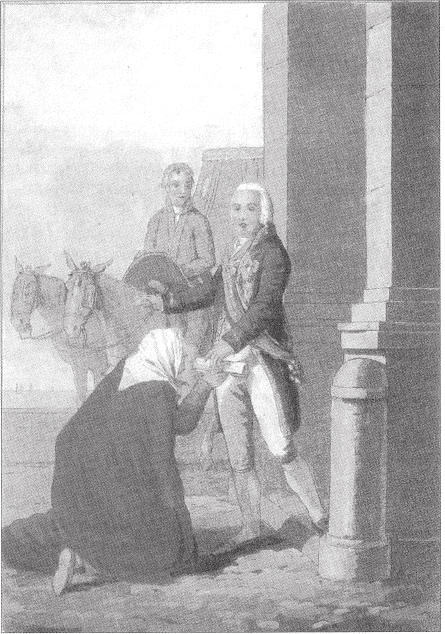
FIGURE 8: Henry L’Évêque, “The Audience of the Prince,” from Henry L’Évêque, Portuguese costumes (1814) (Lisbon: INAPA, 1993). Permission obtained from the Biblioteca Nacional, Lisbon. Commenting on the audience in Portugal, L’Évêque described it as a familial encounter. “If he [the prince regent] is preceded by a few soldiers,” L’Évêque explained, “it is not for the purpose of guarding his person. In the midst of his children what has he to fear?”
Following this tradition then, in Rio de Janeiro the prince regent held audiences regularly; daily, according to Rio’s almanac, weekly, according to Luccock, as well as on special occasions.31 Those who came to a royal audience presented themselves before the prince regent, kissed his hand, and then dropped to one or both knees to present their case in written or verbal form. New royal supplicants could draw on the experience of petitioning the viceroy, as well as on published manuals that both explicated proper conduct in the presence of royalty and provided model petitions.32 For those without such resources, however, the spectacular royal audience itself was instructive. As Luccock observed, in Rio “on high days, the ceremony of kissing hands was exhibited almost in public … at a balcony, where [the prince] could be seen by the crowd of people assembled in front of the palace.” The transition from spectator to petitioner then was simple and apparently did not require a prior encounter with royal officials. During royal audiences, as Luccock noted, “every subject decently dressed [was] admitted, and allowed to present, personally, his or her petition.”33
Residents of the new royal court seized the opportunity to seek, as one petitioner described it, “refuge from the imminent evils that caused them distress.”34 Although there apparently is no record of the precise number of petitioners, one visitor observed that the prince regent was “thronged with petitioners of every description,” calculating the average at each audience to be “no less than one hundred and fifty.” And, as had been the case in Lisbon, along with exiled courtiers, wealthy residents, and visitors to the city, the presence of “the poor” became a regular feature of Rio de Janeiro’s audiences. As the observer reported, Dom João was “worthy to be called the father of his people,” for he admitted “into his presence the meanest of his subjects and listen[ed] to their supplications”: pleas for the resolution of domestic and property disputes, requests for financial assistance, and pardon from military service and punishment.35 Such capaciousness probably stood in great contrast to the restrictions of viceregal audiences. Whereas the Viceroy Lavradio, for example, did not allow pardo officers to approach him at his own beijamão, in the 1810s in Rio de Janeiro, the British Henderson reported with both surprise and disdain, generals found themselves waiting alongside “mulattos.”36
As in Portugal, royal audiences in Rio also could be granted outside the palace, during visits to the royal chapel, when surrounding avenues and corridors reportedly would fill, and during more extended royal outings. In 1811, for example, “taking advantage” of the prince regent’s first visit to Magé, Joaquim José da Silva approached the prince regent to request a pardon from punishment for having killed his own slave.37 And in 1817 the Marquês de Loule, seeking a pardon for having collaborated with the French during the Napoleonic invasion of Portugal, recorded a strategic encounter with royalty that recalled that of Teresa and the princess previously described. Privy to the monarch’s itinerary, the Marquês explained, on a road near the city “I waited for My King and at a distance that appeared appropriate I knelt in the middle of the road. His Majesty arrived and,” to the relief of Loule, “ordered [the carriers of] his palanquin to stop.”38 One year later, perhaps in the interest of avoiding such potentially exhausting stake outs, one of Rio’s more entrepreneurial residents proposed that he could provide carriages for those who similarly wished to take advantage of the occasions of royal outings. The intendant wholeheartedly endorsed the proposal and considered the possibility of providing a subsidy and expanding the practice to include rides to the royal palace in São Cristovão. “The people,” Viana explained, “would have comfortable transportation, [to use] to make their requisitions, and to have the honor of Kissing the Hand of His Majesty.” It would allow them to enjoy “something necessarily new among us,” he continued, and “it would give comfort to the class worthy of compassion” and “the State” would have “the pleasure of preventing the ruin of the measly fortunes of those who in order to subsist must petition.”39
With such enthusiasm for opportunities for giving comfort and preventing ruin, Viana underscored that for the prince regent the practice of attending to the needs of his subjects, regardless of their social status, was politically expedient. “A liberal King comes to the aid of the poor,” Dom João had been instructed by Novaes Campos, because “the defense of the poor is the surest one.”40 Or, as the cleric Manuel Joaquim da Mai dos Homens explained, the monarch “does not lose sight of the small ones, who as contributing parts, form the harmonious union of the perfect greatness of the Sovereign Empire.”41 Thus listening and responding to petitions of all “good vassals,” the prince regent conjured up the image of a political family in which even “the poor and the destitute” were tied to their “Sovereign who is also their Father.”42 Furthermore, strategically interceding on behalf of his vassals at the expense of lesser authorities, the sovereign not only cultivated the “love” of his vassals, as the intendant claimed, but also reaffirmed that his royal authority was above all others. The audience, in other words, both engendered the unity of vassals and asserted that this unity was founded on an unequivocal political center. It showed that if, as São Carlos prayed, “the state was a living body,” it was the king, as its “heart,” who “brought the life-giving blood to Society’s extremities.”43
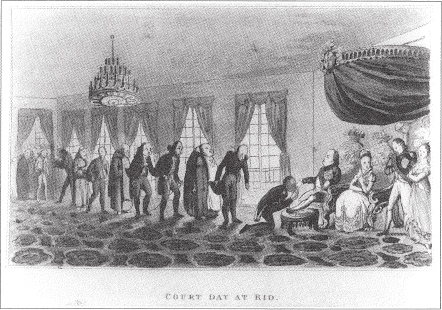
FIGURE 9: A.P.D.G., “Court Day at Rio,” from A.P.D.G, Sketches of Portuguese Life, manners, costume and character (London: George B. Whittaker, 1826). Copy and permission obtained from the General Research Division, The New York Public Library, Astor, Lenox and Tilden Foundations. With this disparaging portrait of the audience the foreign observer argued that the prince regent’s willingness to listen to the supplications of “the meanest of his subjects” was as misguided as it was remarkable.
While in projecting such images of paternal authority and the relationship between sovereign and vassal as above and beyond all other social hierarchies, Rio’s audiences and royal interventions approximated those of Lisbon, they also showed that this relationship transcended the hierarchies of empire. They revealed the Portuguese monarchy’s understanding of its regnum as what Anthony Pagden has described, writing of its Spanish counterpart, as corresponding to a “multicultural society, all of whose members enjoyed the same notional legal status before the crown.” In other words, the crown both recognized “vassal” as a political, legal identity that, as Stuart Schwartz has noted, no longer referred to “the specific relationship of the nobility to the crown” and confirmed that, although originally associated with the specific geographic space of Portugal, the community of Portuguese vassals extended along with Portugal’s empire to include the residents of the crown’s ultramarine possessions.44 As the transfer of the court itself had shown, and as Gonçalves dos Santos and other residents celebrated, the one difference between “European” and “American” vassals—distance from the crown—was only circumstantial.
Furthermore, reaffirming that vassalage was both universal and imperial facilitated the crown’s attempts to remake Rio de Janeiro in the image of the European court it left behind. Calling attention to a political, legal identity shared by American and European residents of empire, the monarchy enunciated the transatlantic unity and continuity that, as we shall see in Chapter 6, ideally marked the transition from the ancient empire of Portugal to the new “prosperous empire” of Brazil. At a time when monarchy had been successfully challenged on both sides of the Atlantic, cultivating an active relationship between sovereign and vassal also allowed the Portuguese crown to rehabilitate the image of a formerly ineffectual royal government in Brazil and to mitigate the potential damage to its own reputation that, as royal counselors cautiously noted, resulted from the French occupation of the Kingdom of Portugal. Indeed, such counsel suggests a “revalorization of the practice of the royal audience” similar to that which emerged in the context of another moment of crisis for the Portuguese monarchy: the mid-seventeenth-century struggle for independence from the crown of Castile and the restoration of Portuguese royal authority under the aegis of the prince regent’s ancestor, the Duke of Braganza. While the political culture of the Restoration, Diogo Curto explains, featured an intensification of debates over the need for the monarch to directly attend to the needs of his vassals and “a preoccupation in representing the prince and his court as accessible to all” (an accessibility denied when they were ruled from Spain), in the 1810s royal officials called attention to the beneficent consequences of the sovereign’s residence in the hopes of prevailing over revolutionary alternatives.45
This use of the royal audience to project an image of accessibility, as well as political unity, and to convey a sense of the prince regent’s absolute authority, liberality, beneficence, and justice, then depended on a proper assessment of whether to reward or punish, whether the residents’ requests for royal grace should be granted or denied, whether the prince regent should undercut or uphold lesser authorities, and whether he should reward the nobility’s service or protect others from their demands. In other words, staging audiences and responding to petitions required a careful administration of what António Manuel Hespanha has called “the economy of grace.”46 To assess petitions and define the scope of this economy, Dom João turned to his counselors. And when considering the petitions of Rio’s popular classes, he turned to one counselor in particular: the police intendant. Unlike most royal officials, Viana’s daily activities took him beyond the palace to Rio’s streets. The intendant’s staff, his network of informants, and his former experiences as a colonial magistrate made his knowledge of the local and, in his case, native setting an invaluable resource for the newly arrived prince regent. Viana’s role as broker, his ability to both facilitate and undermine a royal solution to a problem, was recognized by Rio’s popular classes as well. They both appeared before the sovereign out of dissatisfaction with Viana—and with his approach to their conduct or their troubles—and sought out the intendant to request his assistance in obtaining a royal grace. Consequently, he played a central role in defining the scope of the relationship between the prince regent and his petitioners in Rio.
When assessing petitions Viana considered, in the most general sense, whether granting a request would promote the “good order of things.”47 More specifically, this meant ensuring that an extraordinary royal intervention did not suggest a repudiation of the law or meios ordinários, the established channels for seeking justice. After all, Viana asserted in one report on a petition, the “security of any state consisted chiefly in a precise observance of the law, and in the good administration of justice.48 Thus, commenting on Sergeant Anacleto Elias Ferreira de Noronha’s request for royal intervention in a conjugal conflict, the intendant Viana advised against it, explaining that if “the Prince Our Lord were to intervene in these matters,” it would not only violate custom, but also dismantle an established legal process, in this case ecclesiastical divorce proceedings.49
Ensuring that royal interventions promoted the “good order of things” also meant ensuring that the crown did not grant requests that suggested disrespect for social and political hierarchies. The crown, in other words, had to guard against what one official characterized as “the confusion of classes and hierarchies” that, he claimed, was “the main cause of the unhappy state in which Europe finds itself.”50 For Viana this meant that the petition, and the request that it contained, had to be assessed in relation to the petitioner. As he explained in an initial report on Noronha’s case, although when the prince regent “commands as Sovereign and with full knowledge of the case” intervention is always just, “the rule is that the Sovereign never interferes in these questions on behalf of just any vassal” and rather “only when it concerns a person who because of status and service … deserves these attentions.” Although Noronha served the crown as a solider, and was an acquaintance of Viana himself, his dishonorable conduct, Viana explained, excluded him from this category.51
To balance recognition of status, service, and public virtue with a defense of the law and justice, Viana argued that although those who served the crown, including petty functionaries and soldiers, retained a privilege of royal intervention that other vassals did not have, requests for certain exemptions, such as aposentadoria, had to be denied. To avoid “scandal” and “great grumblings,” he explained, royal interventions could not appear to favor the particular interests of royal servants over the public interest embodied in the law.52 Indeed, Viana argued in 1820, officials who petitioned the crown for exceptions to the law under the “pretext of public benefits” undermined “the whole” in favor of “trivialities” and attacked government itself by inciting distrust among “the people.”53 This principled supremacy of public good over private interests was defended as well by royal minister Vila Nova Portugal, who urged the crown to suppress “feudal rights” that he judged to be both an infringement on royal authority and “injurious to the people.”54 In other words, although Dom João had a recognizable obligation to give—for “to give” was a particularly princely trait55—royal counselors also insisted that the scope of these transactions had to be narrowly defined. Petitioners had be to worthy, the request had to be virtuous—neither trivial, arrogant, nor in the interest of revenge—and the intervention both had to provide an exemplary defense of the larger principle of a public good and to display the monarch’s unrivaled authority without promoting a general disregard for other lesser authorities.56 In what cases, then, did Viana counsel the monarch to intervene?
Among numerous pleas for charity, employment, and pardon for crimes, one kind of petition that appeared to the intendant to fulfill these requirements for intervention was the request to resolve domestic conflict by upholding patriarchal rights.57 Commenting, for example, on Francisco de Souza Oliveira’s request that the crown send his “disobedient” son to serve in India, Viana justified his endorsement by claiming that “in this way young men could be made to respect the great authority of fathers,” an authority that, according to Viana, provided the “nexus” that “strengthen[ed] and deepen[ed] the bonds of society.”58 As Viana affirmed in commenting on a similar request to send an insubordinate son to serve in the army in southern Brazil, royal intervention in these cases was justified because “public authority has always aided paternal power.”59 Such interventions were, however, approached with caution. They could not, as noted above, suggest a disregard for established channels and procedures for resolving disputes nor promote “intrigue and indisposition between the sovereign and his magistrates.”60 To warrant the prince regent’s attentions domestic discord also had to have public consequences. The effects of the conflict had to transcend the boundaries of the household in question and intervention had to afford the crown the possibility of promoting public morality and virtue within the court. Thus, commenting on a magistrate’s petition that the crown sentence his abusive son-in-law to military service outside the city, the intendant energetically urged the prince regent to approve the request because, as he explained, by sending him to India “the court will be free of a vagrant and the family of an object that disgraces it and all [will have] the certainty that the prince is the common father that responds to all these evils, [and] from which can follow the great good that others correct themselves, [thus] improving society.”61
To protect patriarchal rights, and make manifest the alliance between “public authority” and the authority of “heads of family,” Viana also advised interventions into disputes between husbands and wives.62 As we have seen in the case of Anacleto Ferreira de Noronha noted above, these petitions were duly scrutinized for the morality and public status of those involved, and royal intervention was not advised when it interfered with ecclesiastical authority. The source of discord, often charges of adultery, had to be verified.63 Yet, notwithstanding these standards for intervention, conjugal discord often produced situations that, for Viana, uniquely warranted circumvention of the legal proceedings he otherwise ardently defended. Thus, in 1812 when José Lopes de Saraiva, who worked as a royal librarian, petitioned the crown for permission to send his wife Brigida Teresa, who he claimed was notoriously adulterous, to a recolhimento outside the city in Taipú, the intendant advised that “in spite of legislation concerning the way in which husbands accuse their wives … it is always good to help them using extraordinary means, by way of the seclusion of the wife.” The husband, he explained, would be spared the “more public affront” that a formal accusation and sentence would entail.64 In 1818, commenting on another petition, Viana more carefully outlined the guidelines for royal action in such cases, plainly reflecting his concern with moral and social order that, as we saw in Chapter 4, guided his efforts at policing. When a member of a family “strays in conduct,” he explained, “it has always been a consolation for the heads of families to seek in the wisdom of government a limit to their affront, requesting the confinement of this person, in the case of a woman in a recolhimento, and in the case of a man to the praças das conquistas (military service abroad), thus removing from them the object that offends them and giving a punishment that particular authority alone cannot.”65 Fathers and husbands, in other words, could count on the sovereign to “correct” insubordinate family members (sem alguma sugeição).66 Even Anacleto Elias Ferreira de Noronha, whose own conduct was less than ideal, could benefit from a royal intervention, Viana conceded a few weeks after his original dismissal, because his wife had proceeded to live so scandalously with her own stepfather, contradicting the terms of her divorce. It was only “royal authority” and its use of “force,” he judged, that would succeed in containing such “libertinage.”67
This commitment to defend patriarchal rights and the intolerance of female independence also meant that Viana adopted a considerably more skeptical position when considering pleas from women for extraordinary intervention into similar domestic disputes.68 In 1814, when Dona Anna Joaquina Miranda, in the midst of securing an ecclesiastical divorce from Captain José Joaquim de Rego, asked the prince regent to grant her formal custody of her children, Viana categorically dismissed the request. It was “arduous,” he argued, “because it attacked paternal rights which the law of all nations always respected.” Wives separated from their husbands, he further explained, enjoyed custody of their children only until the age of three, when care and the duties of raising the child (criação) were supplanted by the father’s right to provide an upbringing and education (educação).69
Yet, as this same case revealed, occasionally the crown’s commitment to defend public morality and order also could justify interventions that curtailed paternal authority. When Viana later received evidence that Rego both physically abused his children and left them unattended, he reversed his decision and advised the crown to take action against him. “If both the mother and the state are to lose these two children,” he speculated, “without them being raised to someday become useful sons and vassals, it is better that His Royal Highness, now knowing the father’s incapacity … should order that these boys be given to their mother who is capable of treating them well.”70 In 1820 Viana similarly cited the defense of a greater public good when he advised the crown to intervene against surrogate parental authority on behalf of José António Nogueira Ferrão, a captain in the Portuguese Army serving in Rio de Janeiro. Ferrão had petitioned the crown to overrule the decision of the Misericórdia’s council to deny his request to marry Rosa de Jesus, an orphan currently in its care. Such a decision, the council claimed, simply upheld a restriction, established by Rosa’s benefactor, that her marriage had to be approved by the benefactor himself in writing. For Viana, the council’s claims were indefensible and royal intervention was warranted because “the Sovereign [could] supplant the lack of consent” in a case such as this in which “everyone” knew that the supplicant’s “quality of person and position” represented an advantage for Rosa de Jesus. Furthermore, in obliging Rosa to secure his consent “regardless of her age,” Viana argued, the benefactor had not only attacked the institution of marriage that it “suit[ed] the state to promote,” but also acted in a manner that was both “arbitrary, cruel and intolerable” and contrary to “good customs.”71
The royal defense of fathers and husbands thus was both affirmed and limited by the practice of considering petitions. Even as the affinity between “the great authority” of fathers and the authority of the “common father of all vassals” meant that the crown enhanced its own paternal authority by defending the paternal authority of others, Dom João could undercut the authority of individual fathers as well, especially when those fathers contradicted the larger principle of his own paternal power. In other words, if husbands and fathers had a natural ally in the prince regent, it was also the case that they could not act in a way that the sovereign did not. The crown could not tolerate a publicly abusive or “cruel” and “arbitrary” exercise of authority. In preserving social and political hierarchy and its own authority, the crown could not appear to defend tyranny.72 This, after all, would undermine the basis for the royal audience and the ideal of absolute, yet just and liberal, royal power itself, which was so insistently and ceremoniously displayed in the new royal court of Rio and in which, as one petitioner explained, “all good vassals” expected to find refuge.
THE ECONOMY OF ROYAL GRACE IN THE NEW WORLD: RIO’S SLAVES PETITION THE THRONE
As the prince regent and the police intendant considered Rio’s residents’ numerous petitions for royal intervention, they renegotiated long-standing, Old-World debates on the economy of royal grace. The New World, however, also presented new circumstances in which the relationship between “the people” and their sovereign had to be defined. In stark contrast to Lisbon, the majority of Rio’s residents did not, after all, enjoy the same legal status before the crown. Instead, they served both residents and royal officials as slaves. Thus, as Oliveira Lima suggested, in Dom João’s court “European contact” had to be reconciled with “the effect of the servile institution,”73 an effect witnessed in the imperial capital of Lisbon but that, now more than ever before, the Portuguese sovereign was forced to contemplate in a city as African as it was Portuguese.
While Oliveira Lima argued that such a reconciliation resulted in a decadent “preference for luxuriousness and vice,” slaves had an entirely different understanding of the meaning of their presence among courtiers. Although slaves were formally excluded from the community of vassals in Rio, following the transfer of the court they nevertheless claimed a particular relationship with the crown. “Everyone knows,” the intendant lamented only weeks after Dom João’s reception, “that the thousands of slaves who exist in Brazil are hopeful that with the arrival of His Royal Highness here they will be liberated from their captivity.”74 Such a conviction reportedly was announced in the chant of the porters who first carried the prince regent’s sedan chair: “Our master has arrived, Slavery is over.”75 The claim revealed the slaves’ own understanding of the logic of the crown’s quest to remake Rio de Janeiro as a European court. If, after all, slavery had been deemed inappropriate for the old court, it followed that it would be abolished in the new one. Indeed, as we have seen, a number of royal officials and memorialists reached similar conclusions and condemned the institution of slavery on civilizing, humanitarian, and racist grounds.
In Rio de Janeiro, along with their speculative hopes for abolition by way of royal intervention, slaves also came to behold an appeal to the prince regent as a way to secure an individual carta de alforria (letter of liberty).76 They recognized, in other words, that the monarch was the source of justice to which all were subject and to which all could appeal when faced with hardship and, as one group of slave petitioners explained, the “tyranny” of their owners. Indeed, with extraordinary “acts of grace,” eighteenth-century Portuguese monarchs had demonstrated the possibility of royal intervention on behalf of people of color and slaves in disputes over their legal status and their rights to manumission. While in these cases slaves and people of color in Brazil had depended on substantial resources for the expense of written statements and intermediaries in Lisbon, following the transfer of the court, like free vassals in the city, they seized on the end of these obstacles and the less costly process of petitioning the crown that the immediate presence of Dom João afforded.77 In the new royal court to express their need for royal intervention slaves secured messengers, family members, or representatives from religious brotherhoods who petitioned the sovereign on their behalf. In 1812, for example, Gabriel Garces Gralha, the “elected king of the Congo people” in Rio, petitioned the crown to grant liberty to António Monjolo, explaining that “his Brotherhood was chartered to take care of manumissions.”78 Other slaves, however, directly petitioned for a royal intervention. Availing themselves of unsupervised moments in their day, they reportedly visited the royal palace personally. Thus, by 1817, when a “black man” named Boaventura presented himself “before the King Our Lord in the Royal Quinta da Boa Vista,” to request that the crown grant his freedom, royal officials treated the occurrence as routine.79
As was the case with petitions from Rio’s free popular classes, the crown called on the police intendant to comment on slaves’ requests for royal intervention. Slave petitioners threatened Viana’s narrow understanding of the relationship between the scope of royal grace and social hierarchies, and the image of the prince regent surrounded by a “crowd of [slave] petitioners” disrupted the ideals of metropolitan decorum and social and political order that the new court was supposed to embody. “The idea,” the intendant warned, “that His Majesty protects their cause will make them withdraw from service to their owners in order to petition for their liberty, and when they discover that it will not be obtained, they will not return to their owners’ houses and rather will become fugitives, highway robbers, and dangerous enemies.” Accordingly, in commenting on their petitions, Viana sought to establish that the slaves’ claims to a relationship with the crown were misguided.80
More specifically, Viana often responded to petitions by attempting to discredit the individual slave petitioner. Such was the case in 1814 when a crioulo (a Brazilian-born person of African descent) named Matheus petitioned the throne for his freedom on the grounds that three years earlier, when he became ill, his owner, João de Campo da Silveira, had abandoned him. A letter to Silveira from Friar José de São Francisco de Sales confirmed both that Matheus had “appeared at the door of the Convent of Santo António” and that Silveira had refused to pay for his subsequent treatment at the Misericórdia’s hospital and instead had left him to beg. In spite of this evidence against Silveira, however, in his report Viana described Matheus’s tale as “a ruse” used by many other “blacks in Brazil in order to make their owners give them their freedom without any basis in the law.” Rather than “abandoning” Matheus, Viana claimed his investigation had revealed that the owner had taken him to see some “black curandeiros” (folk healers) in Irajá as Matheus himself had requested. Matheus, he explained, then took advantage of the situation and secretly returned to the city.
The intendants commentary on slave petitions also referred to a larger politics of slavery and revealed elite anxieties about the potential of manumission. In the case of Matheus, for example, having first indicted him for a particular deceit, the intendant then proceeded to both acknowledge and dismiss the larger social context of his plea. The illegitimate nature of intervention in this case, Viana counseled, stemmed equally from the fact that it would establish a dangerous precedent. The throne would be overwhelmed with so many “representations of this nature,” he wrote, “that there would not be any space for others.”81 In 1819 when Clara Maria de Jesus “implored [the crown] to have the grace to grant” her son Jorge his liberty, Viana offered a similarly pointed assessment. Clara’s request had been precipitated by Jorge’s sale to a priest from Bahia. To avoid permanent separation from her son, she hoped to purchase his freedom for the price established in the transaction (200$000 réis). Her request was further justified, she explained, because although Jorge was born when she was still a slave, his father was José Joaquim Marquês da Graça Correa, a Lieutenant Coronel, currently serving His Majesty in Angola. Manumission in similar circumstances, her petition noted, had been upheld by royal legislation and decree. In his report on her petition, however, Viana dismissed the possibility of precedent and instead called attention to the crown’s need to defend property rights. Outside the context of mistreatment, he explained, “no one can be forced to sell a slave.” “Knowing from experience that in a country where slavery is permitted, a good slave is a … precious commodity,” he then concluded, “the particular politics” of the crown should be that “the Sovereign never gets involved in these matters.”82
These attempts to exclude questions of slave ownership from the realm of royal intervention were endorsed as well by Vila Nova Portugal, a member of the royal cabinet who, along with other ministers, supervised Viana’s execution of his duties. Commenting on allegations of cruelty to slaves in Bahia, Vila Nova Portugal counseled that under no circumstances should the crown intervene in the relationship between slave and slave owner, nor could anyone take or hold a slave against the will of his or her owner unless a debt was owed and no other movable goods existed. For “in Brazil,” he explained, “to rob a farmer of his slave is to do injury not only to that man but to the whole public.”83 Thus, although the sovereign’s grace ideally responded to the needs of his vassals, the overwhelming dimensions of slaves’ necessity disqualified them from royal intervention because such an intervention appeared to undercut established economic and social hierarchies entirely. It was not, in other words, that slaves did not have the need for royal grace, but rather that their need was unfathomable and, therefore, always disruptive. As Viana, writing to Vila Nova Portugal concerning the request of one slave who “desired to benefit from liberty,” rhetorically posed the problem: “And what slave will not so desire?”84
Such resolute disqualification of royal intervention as a means to secure a letter of liberty was founded as well on explicitly racist perceptions of the people involved. In Clara’s case, for example, Viana bolstered his dismissal of her request by conjuring up images of the “anarchy,” “laziness,” and “evil” of freed people of color, and by calling attention to Clara’s own color, social condition, and gender as reasons for why the crown could not intercede on her and her son’s behalf. If it had been the Portuguese father who submitted the petition for Jorge’s freedom, the intendant admitted, rather than Clara, a cabra of “low status” and, Viana further and perversely speculated, without the means to provide for her son as his owner had, the prince regent could have intervened. As this statement also revealed, the logic of racism could at once reinforce and undermine the logic of the conflict between the concession of liberty and larger social and economic interests and “powerful political reasons,” as the intendant described them: manumission produced anarchy; white fathers could free their enslaved sons. Such an exception signaled that even as Viana discouraged slaves and people of color from petitioning the crown the question of royal intervention on their behalf and the larger relationship among slavery, slaves, people of color, and the crown was largely unresolved.
Indeed, his categorical denial of slaves’ right to petition the sovereign notwithstanding, the intendant often undermined his own discriminatory discourse by endorsing slaves’ established prerogative to resolve disputes and seek a legal manumission using royal courts. In 1813, for example, when “António Pardo” “appeared with a petition” requesting that the crown require the merchant Pascoal Cosme dos Reis, his former owner, to return to him a horse, a saddle, the furniture of his senzala (slave quarters), and a slave named Joaquim, Viana responded, typically, with an investigation. While António claimed to have left behind these possessions when Reis sent him and his wife to the Misericórdia in Bahia “to serve the ill,” Viana substantiated that António was offended because he expected to be manumitted upon his former owners’ death, but instead was retained as a slave of the owner’s wife and Reis, her second husband. In retaliation António allegedly had led uprisings at Reis’ sugar mill where he worked as a foreman. In spite of the fact that Reis then had sent him to Bahia with the stipulation that he never again return to the city, António and his wife had come back to Rio and proceeded to live secretly at Reis’ estate. Viana concluded his summary of the case by characteristically denying the request for compensation, arguing that in this case the absence of proof of a legal manumission meant that António was still a slave. Consequently Reis’ right to banish him from the city once again was also upheld. However, the intendant added that although “extraordinary” intervention was out of the question, António had grounds to pursue “his right” to seek legal manumission in court.85
In 1815 when Estevão de Jesus, a stonemason, requested that the crown oblige his former owner João Coelho Marinho to pay him “the value of a slave named Manuel” whom he “possessed” during “the time of his own captivity,” Viana arrived at a similar conclusion. Although Viana upheld Marinho’s right to keep and then sell Manuel because “not having given his consent for the purchase of the slave” the “well-known rule that nothing that a slave has does not also belong to his owner” prevailed, he added that his decision did not mean that Estevão could not use “established channels” to resolve his dispute.86 Writing in 1820, on a petition for liberty submitted by Paschoa and Antónia, Viana even more pointedly advised that although the crown could not intervene on their behalf they should be instructed “to continue to use their right by way of ordinary means,” in this case the juizo de fora, where they originally presented their grievance.87 An even more dramatic defense of slaves’ recourse to courts then was made on behalf of Romaria da Silva, who sought to secure her own liberty, as well as that of her children and grandchildren, on the grounds that she had indigenous ancestry on her mother’s side. In this case, Viana not only endorsed her right to do so, but also secured her a royal grant of funds to continue her litigation, to be provided by the intendancy’s own coffers.88 And, as the intendant also recognized, if royal courts were to provide the recourse that, as he insisted, Dom João could not, their cases would have to be protected against intervention on behalf of slave owners who sought to avoid the social and material costs, including the placement of the slave in neutral custody during review and adjudication, that these proceedings implied.89 Thus, commenting on the petition of Dona da Cunha that her slave Magdalena be returned to her domain while she settled charges of abuse in court, Viana counseled that although he found Magdalena’s case against her owner to be unsound, based on a public petition signed by “clerks and people of little account,” legal proceedings had to run their course and therefore the crown “could not give extraordinary aid to the owner.”90
Thus directing slaves to use royal courts to pursue their grievances Viana both defended judicial process and the authority of magistrates and recognized the integrity of slaves’ grievances and, as he wrote in the case of Magdalena, “their sad condition” in Brazil. In doing so he also, and perhaps unwittingly, constructed a unique political identity for slaves. Like other vassals, slaves had “rights” and, as the intendant often noted in reports on the petitions of the city’s residents free and slave, ensuring recourse to these rights was a crucial part of maintaining order, unity, and loyalty and mitigating potentially violent consequences of discontent. Yet for slaves alone rights were uniquely limited; they stopped, according to Viana, before they reached the throne. In other words, if as one nineteenth-century jurist later argued, the position of slaves and freed people made them subject to a “peculiar legislation,”91 in Dom João’s Rio de Janeiro, this same position appeared to make them peculiar vassals. In a poignant contradiction of the principle of absolute monarchy—that all power was resolved in the figure of the monarch alone—the requests of slaves and former slaves could be considered by a royal magistrate, but not by the monarch that the magistrate represented.
Yet what Viana perceived to be a limited vassalage did not mean that slaves did not have access to the prince regent or that they stopped seeking his attention and requesting intervention. As the intendant was forced to recognize, his exclusionary efforts notwithstanding, the Quinta da Boa Vista had been identified by slaves as a place of “refuge.” When Jacinta Rosa went there to avoid being sold and separated from her children, she reported to Viana, two servants living on the estate even helped her draft a petition.92 Earlier, in 1809, the slave owner Dona Aguida Francisca de Queiros Malheiros also reported that the prince regent’s residence had become a symbol of resistance to owners’ abuse. Late one night, she recalled, some of her slaves had come to her house making noise, claiming that their disorderly conduct would go unpunished because “they came from the palace where they served His Royal Highness.” “They are all persuaded,” she lamented, “that Your Royal Highness is going to free them.” What Dona Aguida failed to mention, and of which Viana was aware, was that her slaves also “went to the palace to complain” of mistreatment.93 They, like many others, made appealing to the monarch a form of self-defense against their owner’s violence and an additional dimension of resistence to slavery that also included rebellion, flight, and pleas to colonial tribunals and officials.94
The strategy was based both on principle and a limited degree of success. As Viana also noted in his report on Dona Aguida, the appearance of slaves on the grounds of the palace or in the presence of Dom João often led to their placement in protective custody, temporary removal from their owner’s property, while their accusations were investigated. Although they “complain of any insignificant punishment,” Viana explained, it was “customary” to do so “when they go there [the palace]” “in order to not provoke the insubordination of slaves in this country.”95 In other words, although royal intervention on behalf of slaves seeking freedom was disqualified, for both royal officials and slaves, the palace and the prince regent nevertheless had become part of the process of maintaining what Viana described as the “equilibrium” between owners and slaves.
Often slave petitioners justified this search for royal justice at the palace by citing their repeatedly unsuccessful attempts to secure redress elsewhere. Challenging Viana’s recommendations that they take their cases to the courts, they argued that their “low status” qualified them for royal intervention because such a status also, in effect, disqualified their use of established judicial processes that favored the “rich and powerful.”96 Manumissions indeed rarely were attained through the courts,97 a fact that was evident to a group of brothers and sisters who jointly petitioned the crown for their liberty in 1812. “At the Royal Feet of Your Royal Highness,” their carefully worded petition began, they came to rectify a problem that began when their mother, Paula Rodrigues da Costa Reis “of the Angola Nation,” having come to Brazil as a free woman, was “falsely sold as a slave.” In 1803, they explained, they had been declared free persons “as descendants of a free womb,” a decision that was confirmed three years later, but then “rich and powerful persons” had secured the revocation of their freedom. As their subsequent appeals had resulted only in their sale to new owners, they now sought “permission to appear and seek” justice from the prince regent himself. They came, as their petition stated, as “most humble vassals” without “lawyers or agents who assumed responsibility for their defense.” While indicting a judicial process that favored the rich, their plea, they also stressed, was founded on respect for the law, which they argued was in their favor. On the contrary, their owners both disregarded the law and mistreated them, leading several of them to seek refuge in the countryside and forsake their honorable service to His Majesty as members of a militia of people of color. Thus, they discredited the possibility of an alliance between their owners and the crown by claiming that their rich owners had corrupted the courts and, consequently, threatened the sovereign’s authority itself. Such a tactic was partially successful. Rather than upholding their status as slaves, the crown ordered an inquiry. Two years later, however, the petitioners had secured only the guarantee of further judicial review.98
The social limits of seeking a remedy through litigation were also evident to a “black” slave named Magdalena who challenged the intendant directly and persistently petitioned Dom João. Her owner, José António Rodrigues Chaves, she explained in her first petition, had agreed to grant her freedom with the stipulation that she serve him until his death. Later, however, he had begun to mistreat her and, although he had signed a termo (agreement) in which he pledged that the abuse would stop,”99 it had continued. A subsequent investigation by the intendant revealed that although Chaves indeed had agreed to grant Magdalena her freedom, on another occasion, he had revoked it and had proceeded to sell her to his son. Viana then determined that both the original grant of liberty and its revocation were invalid, the first one due to Magdalena’s “ungratefulness” and the second, because it had not been properly recorded. The dispute and the question of Magdalena’s status, he concluded, would have to be solved in the courts. “In the meantime,” however, unhappy with Viana’s decision, Magdalena “went to the throne” to insist on a more favorable solution. Her appearance must have put pressure on the intendant because he reapproached the case with a new perspective. In fact, he now noted in a subsequent report, because Chaves had not begun the proper procedure to revoke her freedom, Magdelena was a free person with an obligation to work for Chaves, an obligation that she did not fulfill because of his abuse. Furthermore, Viana reported, she resented Chaves because he had forced her to live with him as his concubine, a fact that if it were to be legally substantiated, he wrote, “would be [sufficient grounds] for her to obtain pure liberty.” To eliminate opportunities for “revenge” and further “sin,” Viana decided that Chaves should be forced to grant Magdalena “pure and complete liberty,” provided that she compensate him the service provided for in the original grant of freedom. To avoid any further confusion the transaction would be duly registered in the intendancy.100
Viana had allowed for a similar concession in the case of António Monjolo and his representative, Gabriel Garces Gralha, noted above. Gralha petitioned the crown on behalf of António Monjolo because, as he reported, when his owner Padre José Garcia promised that he would grant him his freedom if he were provided with another slave trained, as António Monjolo was, to sell groceries, the Brotherhood provided him with the necessary funds. Garcia, however, then reneged on his offer, claiming that the “new black” was not properly conducting business and was not even familiar with local currency. When Gralha then appealed to the crown to uphold Garcia’s original obligation, Garcia claimed, in turn, that the money António Monjolo used to buy the slave had not been lent by the Brotherhood, but rather was stolen from him and, therefore, both António and the new slave were his. Viana, initially demonstrating a characteristic sympathy for the slave owner, nevertheless decided that after three months António should be granted his freedom, and the new slave, who by that time would be properly trained to serve Garcia, should take his place. Even more remarkable in this case, however, was Viana’s commentary on the established process for resolving similar conflicts. While Viana demanded that slaves, and all vassals, respect the decisions of royal courts, here he conceded that although António Monjolo could have pursued his freedom through established judicial channels, these channels placed him, and all slaves, at a disadvantage. Their owners, he observed, “trick them, and take advantage of their miserable condition.” In other words, even as Viana insisted that the slaves did not belong in line to petition the prince regent, he came to acknowledge that the supposed alternative was a failure, and that, worst of all, this very failure of judicial process then increased the number of slave petitioners.101
To restore the possibility of recourse to royal courts and thus diminish the need for slaves’ petitions, Viana considered modifying the process of formal adjudication with what he described in 1821 as “legislation that mitigates the sad condition of slaves without … destroying the right of owners.”102 More specifically, Viana proposed in both 1812 and 1818 the creation of a royal office exclusively entrusted with the adjudication of disputes between slaves and owners. This juiz das liberdades, he argued, would streamline normal procedures with hearings, a “simple procedure” (simples processo) based on a petition or the slave’s appearance and oral testimony, and thus eliminate “the delays of meios ordinários.”103 Although the advice went unheeded, Viana himself occasionally acted out the role he had imagined.104 In 1817, for example, a “black” named José dos Passos petitioned the crown for a letter of liberty because, as he recounted, “as a slave in Bahia” his owner sent him to the Mina coast, where he was taken prisoner by an English corsair and later left in Sierra Leone. After spending two years there and another year in São Tomé, “he came to this court in an English schooner” where he proceeded to earn a living as a sailor and then as a blacksmith in His Majesty’s Royal Stables. Although his owner had lost all rights to his service, both as a result of his capture and because the King of England had compensated the Bahians’ losses on the Mina coast, he never legally obtained his freedom. After Viana contacted his former owner, who confirmed the story, the petition was approved and Passos was spared the expense and the delays of royal courts.105
Such an intercession was not the product of Viana’s passion for judicial economy, or at least not only. Rather, he linked the imperative of establishing new forms of adjudication and redress to very specific political and social contexts. In 1818 commenting on an investigation into Dona Anna Joaquina Mesquita’s abuse of a slave named Policena, who he first had placed into protective custody and then recommended be freed, Viana explained that mistreatment such as that exhibited by Mesquita, which, as both witnesses and a doctor attested, included the mutilation of a number of her slaves and subsequent defiance of the intendant’s order to curtail Policena’s punishment, contributed to the “reduction of the black population,” which, in turn, represented a loss for both owners and the “public wealth of the state.” And it was prudent, he reminded the crown, to take note of the new politics of commerce in slaves. If before it was easy to buy a new slave, now it was no longer the case, and it would be “much less so in the future,” he contended, considering the “prohibitions, taxes, and restrictions” on the slave trade.
As Viana also recognized, an effective solution to this larger economic and imperial dilemma was linked to the question of the authority of masters. The frequency with which slaves both petitioned the intendancy and “the Sovereign and All Royal Persons” who in turn then sent the abused slaves to the intendancy, Viana explained, called for “a legal measure” that would not only curtail mistreatment per se, but also end the generally “unlimited freedom” that owners had assumed in relation to their slaves. Although he advised against the creation of a Código dos Negros, the “lack of adequate legislation on the present state of affairs,” Viana insisted, made any attempts to regulate slavery seem unfounded and therefore easier for slave owners to ignore. New legislation, in turn, would prepare the owners for further necessary restrictions on their “misunderstood and arbitrary authority,” actions that, in some cases, led to unpunished murders and provoked the disappearance of slaves, the creation of quilombos (runaway slave communities), and other types of disorder. Providing a more efficient recourse to justice would, in this sense, preserve social order and slavery in Brazil, and also mitigate a larger, future confrontation. For as Viana ambivalently observed, “the great edifice of liberty, and of the vengeance of a persecuted humanity will grow.”106
Yet, even as Viana suggested that responding to slaves’ denunciations of abuse by way of adjudication would prevent other forms of resistance and therefore indirectly work in their owners’ favor, he also recognized, as Rio’s slave petitioners themselves asserted, that in their owners’ “arbitrary authority” and “unlimited freedom” they and the prince regent had a common enemy. Not only did the rights of owners not exist in cases of inhumanity, but, as he explained, “His Majesty’s laws cannot allow that an inhumane owner has more freedom [to continue to abuse slaves], than public authority.” In other words, the monarchy’s authority itself, theoretically recognized as absolute, was undermined when slave owners acted in ways that their sovereign could not. The solution, the intendant counseled, was to make clear that the slave owner’s authority was clearly circumscribed by the law and the crown it represented. And, as Dom João himself had made evident on one occasion when he personally intervened in a public whipping he encountered during a royal outing, this included the possibility of extraordinary royal intervention on slaves’ behalf.107 In a report written three years later, Viana reinforced this uncodified principle in practice. Although in this case, citing the defense of property rights, the intendant found against Florencio Alves’ petition for liberty for having performed service in the army after he fled his owner’s domain, when he interviewed his owner and discovered his plans for revenge—incarcerating Florencio “for all his life”—he added qualifications to this decision. As incarceration was a “right that his owner did not have,” Viana counseled, Alves could be returned only “with the stipulation that he should not be punished” or, alternately, he would be sold in a transaction supervised by the intendancy.108
Following the court’s arrival at Rio slaves thus confronted a monarchy that was, as Algranti has argued, committed to a defense of the interests of their owners. Consequently, the effects of their petitions and of their defiance of official discrimination were varied and depended on their resources, especially money and assistance from free people.109 As in the case of Rio’s free petitioners, the fortunate few secured a royal intervention that perhaps only momentarily alleviated dire circumstances or, at best, permanently changed their status. Yet, as a whole, Rio’s slave petitioners succeeded in making royal officials reaffirm what had led them to the royal palace in the first place: even in the context of their captivity, their owners’ authority, like everyone else’s, was limited by the power of the monarch. As Viana conceded in one report, the “benefit” of a royal concession of liberty could be granted in cases of abuse and “good service.” Indeed, while the intendant claimed a “natural instinct” drove the slaves to seek “the clemency of His Majesty,” it was the slaves’ recognition of the logic of the Portuguese old regime that motivated their petitions.110 As vassals, they looked to the king for protection, rewards for their loyalty, and, as Florencio Alves had claimed, service “to the state in favor of the public cause.” This recognition of monarchical authority may have been reconciled, as João José Reis has argued, with African conceptions of leadership re-created in Brazil.111 Rio’s slaves, however, also exploited the contradictions in the royal project to transform the city into “the court,” a project that sought to reassert the monarchy’s power and legitimacy by celebrating New World vassalage even as the majority of the city’s residents were disqualified from being vassals.112
“The time of the king” was indeed, as Manuel Antônio de Almeida’s novel suggests, a moment when the extremes of Rio de Janeiro’s social hierarchy came into contact. If, however, in Almeida’s fictional account Dom João remains removed from the scene, in historical Rio de Janeiro his “immediate” presence reshaped the local practice of politics. For Rio’s residents both the city’s streets and the royal palace became venues where they could encounter the sovereign and seek redress. For the crown, in turn, listening to petitions and granting extraordinary interventions were gestures that were politically prudent. In undermining the injustices and tyrannies of other lesser authorities, interventions revealed that absolute royal power was virtuous. Thus, in becoming a royal court Rio de Janeiro had become a site in which the sovereign confronted his New World vassals and where these vassals also defined the terms for this encounter. Although royal officials attempted to limit royal grace to “persons of status and service,” petitioners also included those who Almeida entirely excluded from his vision of early nineteenth-century Rio and who officials formally excluded from Rio’s community of vassals: the city’s slaves.113 Exploiting the tensions between principle and practice, slave petitioners presented at times successful challenges to the limited scope of royal intervention as envisioned by royal officials and in so doing momentarily subverted the hierarchies of slavery. In challenging the hierarchy of owners and slaves, slave petitioners, like others who sought royal grace, also reaffirmed the hierarchy of sovereign and vassal. Dom João’s new royal residence thus became a “tropical Versailles” not, as Oliveira Lima argued, because “the effect of the servile institution” together with “European contact” produced decadence, but rather because in the process of both constructing a new court and forging a politics of monarchy in the New World the imperatives of colonial society and the imperatives of a royal court were reconfigured together.
NOTES
1. Manuel Antônio de Almeida, Memórias de um sargento de milífcias (1855) (Rio de Janeiro: Ediouro, n.d.).
2. Antônio Cândido de Mello e Souza, “Dialética da malandragem (caracterização das Memórias de um sargento de milicias)” Revista do Institute de Estudos Brasileiros 8 (1970), 81.
3. Anonymous, “Jornada do Sr. D. João 6° ao Brazil em 1807,” in Ângelo Pereira, Os filhos de el-rei D. João VI (Lisbon: Empresa Nacional de Publicidade, 1946), 114; Relação das festas que se fizerão no Rio de Janeiro quando o Principe Regent Nosso Senhor e toda a Sua Real Familia chegarão pela primeira vez a’quella Capital … (Lisbon: Impressão Régia, 1810), 15.
4. Paulo Fernandes Viana [police intendant] to José de Portugal e Castro, the Marquês de Aguiar [Ministro dos Negócios do Brasil], August 3, 1811, ANRJ Códice 323 v. 3, f61v.
5. José Antônio Sá, Defeza dos Direitos Nacionaes e Reaes da Monarquia Portugueza (Lisbon: Impressão Régia, 1816), 205.
6. Garcia de Resende, Crónica de D. João II e Miselânea, cited in Ana Maria Alves, Iconologia do poder real no período manuelino, à procura de uma linguagem perdida (Lousã: Imprensa Nacional, 1985), 89.
7. Francisco António de Novaes Campos, Principe Perfeito, Emblemas de D. João de Solórzano (1790) (Lisbon: Instituto de Cultura e Lingua Portuguesa, 1985), f113, f123. This facsimile edition is edited by Maria Helena Teves Costa Ureña Prieto who notes in her introduction that in 1790 other sixteenth- and seventeenth-century works on the education of the prince were reedited as well. To Solórzano’s emblems, published in Valencia in 1658, Novaes Campos added Portuguese sonnets. As part of the royal library the original text was taken to Rio de Janeiro where it remains. For a discussion of the Principe Perfeito and its political theory see Iara Lis Carvalho Souza, Pátria Coroada: O Brasil como Corpo Politico Autônomo, 1780–1831 (São Paulo: Editora UNESP, 1998), 21–38. As Carvalho Souza and Ureña Prieto note, the education of Dom João acquired a certain urgency after the death of his brother, the original heir to the throne, and in the context of Maria I’s failing health. Solórzano’s counsel notwithstanding, the Portuguese monarch’s historic interest in “showing himself” stands in contrast to his Spanish counterpart, for seventeenth-century representations of the Spanish monarch reflected a curtailed visibility and accessibility. See Antonio Feros, “‘Vicedioses, pero humanos’: el drama del Rey,” Cuadernos de Historia Moderna (Madrid) 14, 111–113.
8. Pereira, Os filhos, 55.
9. Luiz António da Silva Souza, A Discordia Ajustada, Elogio Dramatico para Manifestação do Real Busto do Senhor D. João VI … (Rio de Janeiro: Impressão Régia, 1819), 5–6.
10. Luiz Gonçalves dos Santos, Memórias para servir para à História do Reino do Brasil t. 1 (1825) (Belo Horizonte/São Paulo: Itatiaia/EDUSP, 1981), 187–189, 194.
11. Manuel Vieira da Silva, Reflexões sobre alguns dos Meios Propostos por mais Conducentes para Melhorar o Clima da Cidade … (Rio de Janeiro: Impressão Régia, 1808), in “Hygiene da cidade do Rio de Janeiro,” ABN 1 (1876), 187–190.
12. Anthony Pagden, Lords of All the World: Ideologies of Empire in Spain, Britain and France c. 1500-c. 1800 (New Haven: Yale University Press, 1995), 139; Alejandro Cañeque, “The King’s Living Image: The Culture and Politics of Viceregal Power in Seventeenth-Century New Spain” (Ph.D. dissertation, New York University, 1999), 300–327.
13. Heloisa Liberalli Bellotto, “O Estado Português no Brasil: Sistema Administrativo e Fiscal,” in Nova História da Expansão Portuguesa. O Império Luso-Brasileiro v. 8, ed. Maria Beatriz Nizza da Silva (Lisbon: Estampa, 1986), 276.
14. Juan de Solórzano Pereira, Política Indiana, cited in Pagden, 140. According to Pagden, Solórzano was referring to America. A somewhat different reading of Solórzano is provided by J.H. Elliott who notes that Solórzano distinguished between “accessory unions,” such as that of the Spanish Indies and the Crown of Castile, and the union of aeque principaliter, “constituent kingdoms,” that explicitly preserved laws and privileges. According to Elliott it was these kingdoms to which Solórzano referred. See J.H. Elliott, “A Europe of Composite Monarchies,” Past and Present 137 (November 1992), 52–53. In any case, however, it should be noted that, as both Pagden and Elliott concur, Spanish political theorists, including Suárez, Soto, and Juan de Palafox, Bishop of Puebla, were concerned with the degree to which Spanish sovereignty accounted for local privileges and custom in different parts of the monarchy and in so doing ensured that the monarch’s domain over these parts remained intact. In contrast, such a debate was not pursued to the same extent by the Portuguese. Furthermore, what Pagden wishes to stress in the Spanish case—the reaffirmation of “the distinction between the king’s real and legal person” for all of the monarchy’s dominions—is absent in Portuguese discourse. Consequently, as Rio’s residents charged in the 1810s, the absence of the real person of the king had not been filled with an effective legal presence.
15. Frei Francisco de São Carlos, Oração Sagrada que na Solemne Acção de Graças pelo muito Feliz e Augusto Nascimento da Serenissima Senhora D. Maria da Gloria, Princeza da Beira … (Rio de Janeiro: Impressão Régia, 1819), 21; see also São Carlos, Oração de Acção de Graças … (Rio de Janeiro: Impressão Régia, 1809), 11. A similar critique of colonial government was made in the Correio Braziliense, June and November 1808, in Antologia do Correio Braziliense, ed. Barbosa Lima Sobrinho (Rio de Janeiro: Cátedra/Instituto Nacional do Livro, 1977), 19, 49–52. For a discussion of the political expediency of geographic closeness to the king, see António Manuel Hespanha, La gracia del derecho: economia de la cultura en la edad moderna (Madrid: Centro de Estudios Constitucionales, 1993), 188.
16. Fernando Teles da Silva Caminha e Meneses, Marquês de Penalva, Dissertação sôbre as obrigações do vassalo (Lisbon: Régia Officina Tipographica, 1804), 78.
17. Gonçalves dos Santos, Memórias t. 1, 229.
18. Gonçalves dos Santos’ Memórias includes detailed accounts of all of the royal commemorations in Dom João’s Rio de Janeiro. Although Marrócos disparaged the celebrations for the creation of the Kingdom of Brazil, he recognized their intention to imitate “Royal Festivities of Lisbon.” See Cartas de Luiz Joaquim dos Santos Marrocos (Rio de Janeiro: Biblioteca Nacional/Ministério de Educação e Saude, 1939), 262–263, 311. For recent analysis of these festivities see Ligia Pinheiro, “Portuguese Court Festivities and Dance in Early Nineteenth-Century Monarchical Brazil” (M.A. thesis, Ohio State University, 1998); Carvalho Souza, Pátria Coroada, 207–237; Maria Eurydice de Barros Ribeiro, Os simbolos do poder. Cerimônias e imagens do Estado monárquico no Brasil (Brasilia: Editora UnB, 1995); and Jurandir Malerba, “A corte no exilio. Interpretação do Brasil joanino” (Ph.D. dissertation, University of São Paulo, 1997).
19. Alves and Resende, cited in Alves, Iconologia, 89.
20. Viana to Aguiar, May 24, 1810, ANRJ Ministério dos Negócios do Brasil (hereafter MNB) Caixa 6J 78.
21. [Report on reception], March 1808, BNRJ Ms. II–35, 4, 1, f4.
22. Arnold B. Clayton, “The Life of Tomás Antônio Vilanova Portugal: A Study in the Government of Portugal and Brazil” (Ph.D. dissertation, Columbia University, 1977), 84. On the difficulties of maintaining courtly etiquette see also Malerba, “A corte no exilio,” 57.
23. [José Vasconcellos e Souza], Marquês de Bellas, [parecer (plan for reforms)] n.d. [ca. 1808], in Ângelo Pereira, D. João VI, principe e rei v. 3 (Lisbon: Empresa Nacional de Publicidade, 1956), 39, 42.
24. Alves, Iconologia, 89.
25. Gonçalves dos Santos, Memórias t. 1, 185, 228–229.
26. António Manuel Hespanha, “A punição e a graça,” in História de Portugal: O Antigo Regime v. 4, ed. António Manuel Hespanha (Lisbon: Editorial Estampa, n.d.), 248. As we saw in the last chapter, in early nineteenth-century Rio symbolically enacted justice was joined by attempts to police and to achieve social discipline on an increasingly broader scale.
27. Antônio Felipe Soares de Andrada Brederode, Corregedor do Crime da Corte e Casa, to Sua Alteza Real, November 6, 1812, ANRJ Antiga Seção Histórica (hereafter ASH) Casa da Suplicação Caixa 1707, Antiga Caixa 774, Pacotilha 3. See also “Discurso recitado em Presença de Sua Alteza Real, na Meza do Desembargo do Paço, pelo Desembargador António Rodrigues Velloso de Olveira, Communicado por hum amigo do Autor,” O Patriota 5 (May 1813); and Decreto, October 22, 1810, for the pardons bestowed on occasion of the wedding of Dom João’s daughter, Dona Maria Teresa, with the Spanish prince Dom Pedro Carlos.
28. See “Decreto,” February 6, 1818, in Código Brasiliense, Ou Collecção das Leis, Alvarás, Decretos, Cartas Régias, &c. Promulgadas no Brasil desde a feliz chegada de El Rey Nosso Senhor A Este Reino (Rio de Janeiro: [Impressão Régia, 1811–1822]). The decree that ended the investigations of the Pernambuco rebellion also ordered sentencing based on what had been substantiated to date and stipulated that, with the exception of the rebellion’s alleged leadership, no further arrests would be made.
29. Diogo Ramada Curto, “Ritos e cerimónias da monarquia em Portugal (séculos XVI a XVIII),” in A Memória da nação, eds. Francisco Bethencourt and Diogo Ramada Curto (Lisbon: Livraria Sá da Costa, 1991), 232–234, 237. As Curto notes, one seventeenth-century ceremonial protocol explicitly accounted for the appearance of “the poor, the miserable and women” before the monarch. On João V Curto cites Merveilleux’s account of 1738.
30. Henry L’Évêque, Portuguese Costumes (London: 1814) (Lisbon: INAPA, 1993).
31. “Almanaque da cidade do Rio de Janeiro para o ano de 1811,” RIHGB 282 (January-March 1969), 108; John Luccock, Notes on Rio de Janeiro and the southern parts of Brazil; taken during a residence of ten years in that country, from 1808–1818 (London: Samuel Leigh, 1820), 245–246, 558 and L’Évêque, Portuguese Costumes. L’Évêque described the routine for the prince regent’s audiences: “Every day, at appointed hours, the prince receives, at the palace where he is residing, such of his subjects as necessity obliges to have recourse to him. Besides these special audiences, he once a week grants a general one. The day for this is fixed at the commencement of the year, and announced in the almanack.” Along these lines, the almanac of 1811 announced daily audiences and thirteen days of grande gala and twenty-five days of simples gala, which would probably include the beijamão. Although the almanacs for 1816 and 1817 did not list daily audiences, the numbers for galas are similar.
32. João de Nossa Senhora da Porta Sequeira, Escola de Política ou tratado prático da civilidade portuguesa, com as regras e exemplos do estylo epistolar em todo o genero de cartas (Rio de Janeiro: Impressão Régia, 1812). Sequeira based his work on a similar French manual by Blanchard. Although the Royal Press edition was the first Brazilian edition of the manual, it was published earlier in Portugal. The second Portuguese edition was published in 1761 in Porto. On the royal audience see pages 67–68 of the 1833 Portuguese edition published in Lisbon by Typografia Rollandia.
33. Luccock, Notes on Rio de Janeiro, 558. Luccock recorded that a “poor woman” entered the audience chamber, “lifted her hand,” and chastised the prince regent for pardoning the murderer of her husband. It was a scene that, according to Luccock, could “seldom be paralleled in the history of Courts.” The intendancy records also include many references to the apparent ease in attending audiences. One Spanish resident of Rio, for example, arrested and then sentenced to be banished from the city for having praised the revolutionaries of Buenos Aires, was able to use a furlough granted so that he could sell his pharmacy “to present himself to His Royal Highness at the Quinta da Boa Vista with a petition” to defer the date of his departure. See Viana, “Registro do Oficio expedido ao Ministro de Estado dos Negócios Estrangeiros e de Guerra.” June 17, 1811, August 11, 1811, October 19, 1811, ANRJ Códice 323 v. 3, f54–54v, f63v-64, f85; Viana, “Registro do Oficio expedido ao Juiz do Crime de São José,” October 21, 1811, ANRJ Códice 329 v. 1, f103.
34. [Representação a Sua Alteza Real], [1818], ANRJ MNB Caixa 6J 80.
35. A.P.D.G. Sketches of Portuguese Life, manners, costume and character (London: George B. Whittaker, 1826), 174, 179. The author identified himself as a foreign member of Portuguese civil service from 1793 to 1804 who returned to Portugal in the British army during the war. His account, critical and at times sarcastic, also refers to his experiences in Rio de Janeiro. For descriptions of petitions for financial assistance and conflict resolution, see, for example, Viana, “Registro expedido ao Ministro de Estado dos Negócios do Reino,” March 2, 1818, and Viana to Vila Nova Portugal, April 16, 1818, ANRJ Códice 323 v. 5, f16, f27v.
36. James Henderson, A history of the Brazils, comprising its geography, commerce, colonization, aboriginal inhabitants (London: 1821), cited in Joaquim de Souza Leão Filho, “O Rio de Janeiro de Dom João (1808–1821),” RIHGB 276 (July–September 1967), 77. On the viceroy, see Dauril Alden, Royal Government in Colonial Brazil, with Special Reference to the Administration of the Marquis of Lavradio, Viceroy, 1769–1779 (Berkeley: University of California Press, 1968), 479, 484.
37. On petitioners at the royal chapel see A.P.D.G., Sketches, 178–179. On the incident at Magé see Viana, “Registro do Oficio expedido ao Ministro dos Negócios do Brasil,” September 4, 1811, ANRJ Códice 323 v. 3, f68v.
38. “Diario do Marquês de Loule,” Biblioteca da Ajuda (Lisbon), 54-X-13-(118).
39. According to Viana, an earlier request for permission to establish “coches e seges de posta para Santa Cruz e a Quinta da Boavista” was referred to the Ministro dos Negócios Estrangeiros and granted, but the plan did not come to fruition. See Viana, “Registro da Representação feita a Sua Magestade,” January 29, 1817, ANRJ Códice 323 v. 5, f49. On the second proposal see Viana to Tomás António Vila Nova Portugal, June 14, 1818, ANRJ MNB Caixa 6J 81. This plan also included the creation of an hospedaria in Santa Cruz. See also Viana to Vila Nova Portugal, February 2, 1819, ANRJ MNB Caixa 6J 81, and February 11, 1819, Códice 323 v. 5, f100, in which Viana suggests that the intendancy could subsidize the carriages. Although another resident also requested permission to provide service to Santa Cruz in 1818, in 1819, when the king stopped going to his retreat in Santa Cruz, the viability of the concession was called into question. See Viana, “Oficio Expedido ao Ministro de Estado dos Negócios do Reino,” September 24, 1818, and Viana to Sua Alteza Real, August 26, 1820, ANRJ Códice 323 v. 5, f60 and v. 6, f17.
40. Novaes Campos, Principe Perfeito, f133, f185.
41. Manuel Joaquim da Mai dos Homens, [requerimento, ca. 1813], ANRJ ASH Desembargo do Paço Caixa 171 Documento 3.
42. Viana, [informe], November 17, 1810, f2v-f3, ANRJ MNB Caixa 6J 78. For contemporary reflections on the king as a “common Father” see also Francisco Ferreira de Azevedo, Oração de Acção de Graça que no Dia 7 de Março de 1816 Anniversario da Chegada de El Rey Nosso Senhor ao Rio de Janeiro Recitou na Capella Real … (Rio de Janeiro: Impressão Régia, 1816); and Marquês de Penalva, Dissertação, 68.
43. São Carlos, Oração Sagrada … pelo muito Feliz e Augusto Nascimento, 15–16.
44. Pagden, Lords, 140; Stuart B. Schwartz, “The Voyage of the Vassals: Royal Power, Noble Obligations, and Merchant Capital before the Portuguese Restoration of Independence, 1624–1640,” American Historical Review 96, n. 3 (June 1991), 744–745; Ana Cristina Nogueira da Silva and Antônio Manuel Hespanha, “A identidade portuguesa,” in História de Portugal: O Antigo Regime v. 4, ed. António Manuel Hespanha (Lisbon: Estampa, n.d.), 29–31.
45. Curto, “Ritos e cerimónias,” 209–210, 235.
46. As Novaes Campos instructed Dom João, “The King should reward, and give punishment.” See Principe Perfeito, f155; and Hespanha, “La economia de la gracia,” in Hespanha, La gracia del derecho.
47. Viana to Aguiar, November 29, 1808, ANRJ Códice 318, f123v.
48. Viana, “Registro do Oficio expedido ao Ministro de Estado dos Negócios Estrangeiros e de Guerra,” December 6, 1810, ANRJ Códice 323 v. 2, f10. Viana’s reports on petitions often cited a defense of meios ordinários. Commenting on a request for intervention in a case of eviction, Viana wrote: “it is to not confide in the law, and to be always overburdening the throne with unnecessary measures, because everything is provided for in the law. …” See Viana to Vila Nova Portugal, February, 11, 1819, ANRJ MNB Caixa 6J 81; Viana, “Registros do Oficios expedidos ao Ministro de Estado dos Negócios Estrangeiros e de Guerra,” January 15, 1811, and March 29, 1811, ANRJ Códice 323 v.2, f68v and v.3, f35v; and Viana to Vila Nova Portugal, January 5, 1820, ANRJ MNB Caixa 6J 86.
49. Viana to Aguiar, July 2, 1810, ANRJ MNB Caixa 6J 78. See also the requerimento of Anacleto Elias Ferreira de Noronha, identified as “alferes.” In the early nineteenth century divórcio (divorce) was the term used to indicate that an ecclesiastical judge had given permission for husband and wife to live separately and to divide their patrimony. It signified, as Nizza da Silva points out, what would come to be known later as “separation” and did not allow the parties involved to remarry. This was allowed only after attaining an annulment. The supplicants, who were mostly women, typically justified their requests by citing instances of abuse. While the ecclesiastical judge was reviewing the case the wife would be placed in an “honest house.” According to Nizza da Silva, requests for divorce rose in the early nineteenth century. Indeed, the new Royal Press published models for petitions for divorce. See Maria Beatriz Nizza da Silva, Sistema de casamento no Brasil colonial (São Paulo: Queiroz/EDUSP, 1984), 210–213.
50. John David Parker, “The Tridentine Order and Governance in Late Colonial Brazil, 1792–1821” (Ph.D. dissertation, University of Washington, 1982), 187.
51. Viana to Aguiar, July 2, 1810, ANRJ MNB Caixa 6J 78. Viana was often incensed at the requests of “unworthy” petitioners. In 1820, he angrily counseled the crown to dismiss one man’s request for pardon from his banishment to Brazil from Portugal, the “plea with which he surprised the King Our Lord,” because of his criminal past and his failure to disclose this past to Dom João. See Viana, “Registro do Oficio expedido ao Ministro de Estado dos Negócios do Reino,” February 6, 1820, ANRJ Códice 323 v. 5, f164v.
52. Viana to Vila Nova Portugal, May 1, 1820, ANRJ MNB Caixa 6J 86. See also Viana, “Registro de uma Informação dada ao Ministro de Estado dos Negócios do Reino,” October 23, 1818, ANRJ Códice 323 v. 5, f63.
53. Viana, “Registro do Oficio expedido ao Ministro de Estado dos Negócios do Reino [Vila Nova Portugal], November 25, 1820, ANRJ Códice 323 v. 6, f42v-43v. Commenting on one petitioner’s request to avoid imprisonment, Viana defended both his case against him and “public” interest by noting that a contrary decision might suggest that he had been bribed. See Viana, “Registro do Oficio expedido ao Ministro de Estado dos Negócios do Reino,” March 2, 1818, ANRJ Códice 323 v. 5, f16.
54. Vila Nova Portugal cited in Clayton, “The Life of Tomás Antônio Vilanova Portugal,” 93.
55. Hespanha, La Gracia, 165.
56. See Viana to Aguiar, March 10, 1813, ANRJ MNB Caixa 6J 79. Viana dismissed a Spanish cleric’s efforts to avoid expatriation by noting that “he had the nerve to go to the Quinta da Boa Vista and appear before His Royal Highness,” and he judged a case of destruction of property to be “so trivial that it excludes the recourse to extraordinary measures” because the law “had marked a civil action for such a cause.” See Viana, “Registro do Oficio expedido ao Ministro de Estado dos Negócios do Brasil [Vila Nova Portugal],” November 14, 1820, ANRJ Códice 323 v. 6, f37. For a case judged to be vengeful see Viana, “Registro do Oficio expedido ao Ministro de Estado dos Negócios de Ultramar,” December 1, 1814, ANRJ Códice 323 v. 2.
57. This defense had precedent. In the 1770s, the Portuguese crown had taken major steps to protect patriarchal authority, ruling that sons could not marry without their father’s permission. See Muriel Nazzari, Disappearance of the Dowry: Women, Families and Social Change in São Paulo, Brazil, 1600–1900 (Stanford: Stanford University Press, 1991), 130–134.
58. Viana to Aguiar, December 8, 1810, ANRJ MNB Caixa 6J 78. In a number of cases, Viana also recommended the “correction” of disobedient sons on behalf of their widowed mothers, emphasizing the need for public order rather than the protection of paternal authority per se. See Viana, “Registros dos Ofícios expedidos ao Ministro de Negócios Estangeiros e de Guerra,” July 11, 1814, and August 7, 1814, ANRJ Códice 323 v. 4.
59. Viana, “Registro do Oficio expedido ao Ministro de Estado dos Negócios Estrangeiros e de Guerra,” February 14, 1809, ANRJ Códice 318, f171v. For additional cases see Viana, “Registro do Oficio expedido ao Ministro e Secretário de Estado dos Negócios do Reino,” October 3, 1809, ANRJ Códice 323 v. 1, f142v; December 8, 1810, Códice 323 v. 2, f22; March 17, 1814 and March 30, 1814, ANRJ Códice 323 v. 4; Viana to Aguiar, July 11, 1814, ANRJ MNB Caixa 6J 79; and Viana, “Registro do Oficio expedido ao Ministro de Estado dos Negócios Ultramarinos,” April 15, 1815, ANRJ Códice 323 v. 4.
60. See Viana, “Registro do Oficio expedido ao Ministro de Estado dos Negócios do Brasil,” August 1, 1812, ANRJ Códice 323 v. 3, f112; Viana, “Registro do Oficio expedido ao [Ministro Vila Nova Portugal],” April 2, 1819 and July 10, 1819, ANRJ Códice 323 v. 5, f114v and f122v. In the first case, initiated with a husband’s request for the recolhimento of his wife, the crown intervened when ecclesiastical procedures had been exhausted. In the second case, regarding a father and his daughter, Viana argued that the matter was to be solved with “mere and indispensable police” rather than by the sovereign; in the third, concerning the marriage of a person in jail, Viana insisted on the poor reputation of the supplicants. In another case, Viana dismissed a husband’s plea to have his wife cloistered due to her drinking by simply instructing him to more “carefully supervise his household.” See Viana, “Registro do Oficio expedido ao Ministro do Estado dos Negócios do Brasil,” November 18, 1813, ANRJ Códice 323 v. 3.
61. Viana to Aguiar, April 15, 1815, ANRJ MNB Caixa 6J 79. For other cases of father-son conflict and military service as a correction, see Viana, “Registros dos Oficios expedidos ao Ministro de Estado dos Negócios do Brasil,” December 17, 1815, December 19, 1815, January 16, 1816 in ANRJ Códice 323 v. 4.
62. Viana, “Registro do Oficio expedido ao Ministro de Estado dos Negócios do Reino,” October 21, 1809, ANRJ Códice 323 v. 1, f161; Viana, “Registro do Oficio expedido ao Ministro de Estado dos Negócios do Reino,” November 18, 1813, ANRJ Códice 323 v. 4.
63. See Viana, “Registro do oficio expedido ao Ministro de Estado dos Negócios do Brasil,” October 17, 1815 and January 3, 1816, Códice 323 v. 4. Viana dismissed husbands’ pleas to intern their wives in recolhimentos when the husband had exhibited “poor conduct.” He also deemed certain women unworthy of recolhimentos, although the one at Taipú was regarded as more appropriate for women of the popular classes than the patrician Misericórdia and the Ajuda convent. Viana also recognized that the recolhimento was intended to preserve and restore family honor, rather than to provide punishment per se. Consequently, he often noted, Rio needed a women’s jail. See also Viana “Oficio expedido ao Ministro de Estado dos Negócios do Brasil,” April 15, 1814, and November 18, 1814, ANRJ Códice 323 v. 4; Viana, “Oficio expedido ao Ministro de Estado dos Negócios do Reino,” January 29, 1820, ANRJ Códice 323 v. 5, f163.
64. Viana to Aguiar, November 16, 1812, ANRJ MNB Caixa 6J 79. Viana made similar claims about sparing a husband from the public disclosure of his wife’s adultery in legal proceedings in the case of João da Silva Guimarães by advising the crown to send his wife’s alleged lover to serve in the army in Rio Grande do Sul. See Viana, “Oficio expedido ao Ministro de Estado dos Negócios do Reino,” January 25, 1819, ANRJ Códice 323 v. 5, f92.
65. See Viana, “Registro do Oficio expedido ao Ministro e Secretario de Estado dos Negócios do Reino,” March 13, 1818, ANRJ Códice 323 v. 5, f21. Here Viana wrote to counsel the crown to grant the request of José António de Mattos that his nephew, to whom he was “at times a father,” be banished to India rather than sentenced to death for attempting to poison him.
66. See the case of Maria Clara de Jesus in Viana, “Registro do Oficio expedido ao Ministro e Secretário de Estado dos Negócios do Reino,” May 28, 1811, ANRJ Códice 323 v. 3, f49; and Viana, “Registro do Oficio expedido ao Ministro de Estado dos Negócios do Reino,” October 6, 1816, ANRJ Códice 323 v. 4.
67. Viana, “Registro do Oficio expedido ao Ministro e Secretário de Estado dos Negócios do Brasil,” August 3, 1811, ANRJ Códice 323 v. 3, f61v. By 1814 Anacleto was in trouble again for not providing the required financial support for his wife’s confinement in the Misericórdia. See Viana, “Registro do Oficio expedido ao Ministro e Secretário de Estado dos Negócios Estrangeiros e de Guerra,” July 30, 1814, ANRJ Códice 323 v. 4.
68. In one case, for example, involving conflict among a grandmother and her grandsons and an apparent abduction of her daughters, Viana counseled the crown to dismiss the petition because it was “all business within the family.” Viana, “Registro da Representação feita a Sua Magestade” January 29, 1817, ANRJ Códice 323 v. 5, f49.
69. Viana to Aguiar, October 26, 1814, ANRJ MNB Caixa 6J 79. Children, Viana explained, “are given to the mother until the age of three, because only in her is entrusted criação (raising the child); after that the matter concerns educação (upbringing), and this is always supervised by fathers.” The Novo Dicionário Aurélio da Lingua Portuguesa defines criação as both “the period of childhood” (meninice) and of “breast-feeding, lactation.”
70. Viana to Aguiar, December 24, 1814, ANRJ MNB Caixa 6J 79.
71. Viana to Vila Nova Portugal, April, 27, 1820, ANRJ MNB Caixa 6J 86.
72. Viana made his case against one petitioner by noting that his family’s “pride” had reached the point of contempt for public authority, exhibiting “such vanity that it was necessary to refute it.” See Viana, “Registro expedido ao Ministro de Estado dos Negócios do Reino,” March 2, 1818, ANRJ Códice 323 v. 5, f16.
73. Manuel de Oliveira Lima, Dom João VI no Brasil (1808–1821) (1908) (Rio de Janeiro: José Olympio, 1945), v. 1, 129. On the petitions of slaves and people of color in Lisbon see A.J.R. Russell-Wood, “‘Acts of Grace’: Portuguese Monarchs and Their Subjects of African Descent in Eighteenth-Century Brazil,”Journal of Latin American Studies 32 (2000): 307–332.
74. Viana, “Registro do Oficio expedido ao Ministro e Secretário da Repartição da Guerra,” May 23, 1808, ANRJ Códice 318, f16v.
75. Cited in Mary C. Karasch, Slave Life in Rio de Janeiro, 1808–1850 (Princeton: Princeton University Press, 1987), 239: “Nosso Sinhô chegô, Cativêiro já acabô.”
76. On the process of manumission and the carta de alforria, the legal document that recognized manumission, see Karasch, Slave Life, Chapter 11; Leila Mezan Algranti, O feitor ausente: Estudos sobre a escravidão urbana no Rio de Janeiro, 1808–1822 (Petrópolis, Rio de Janeiro: Vozes, 1988), 94, 113, 116–117; and Katia M. de Queirós Mattoso, To Be a Slave in Brazil, 1550–1888 (1979) (New Brunswick: Rutgers University Press, 1986), 145–149; 155–176.
77. Russell-Wood, “‘Acts of Grace.’”
78. Viana to Aguiar, June 4, 1812, ANRJ MNB Caixa 6J 79.
79. Viana to Vila Nova Portugal, September 21, 1817, ANRJ MNB Caixa 6J 83. Boaventura justified his request by citing his heroic action against some Frenchmen who attempted to capture a slave ship sailing from Mozambique. According to Viana, Boaventura had made his plea earlier before the arrival of the court to Viana himself, when he served as ouvidor geral do crime (circuit judge). “After time passed,” Viana wrote, “he had means to present himself to the King Our Lord at the Royal Quinta da Boa Vista, and he deigned to send him to me.”
80. Viana to Vila Nova Portugal, December 17, 1818, ANRJ MNB Caixa 6J 80. Commenting on the petition of Damasio Dias, Viana wrote, “Because of a natural instinct all seek recourse in the Clemency of His Majesty. …” Viana made clear his denial of slaves’ legal and political personhood in the case of an owner who had killed his slave and then requested a pardon, cited above. “These are cases in which a royal pardon may apply,” he wrote, “because there is no offended party besides justice.” See Viana, “Registro do Oficio expedido ao Ministro dos Negócios do Brasil,” September 4, 1811, ANRJ Códice 323 v. 3, f68v. In the eighteenth century, royal officials in the colony of Brazil similarly sought to discredit slave petitioners and the process of petitioning the crown to secure manumission. See Russell-Wood, “‘Acts of Grace,’” 321–322.
81. Viana to Aguiar, March 5, 1814, ANRJ MNB Caixa 6J 79. See also the supporting document from Frei José de São Francisco de Sales, Procurador do Convento de Santo António, to João de Campos da Silveira, June 29, 1813.
82. Viana to Vila Nova Portugal, July 11, 1819, ANRJ MNB Caixa 6J 81. On this case see also Algranti, O feitor, 107.
83. Vila Nova Portugal cited in Clayton, “The Life of Tomás Antônio Vilanova Portugal,” 95.
84. Viana to Vila Nova Portugal, December 17, 1818, ANRJ MNB Caixa 6J 80.
85. Viana to Aguiar, January 25, 1813, ANRJ MNB Caixa 6J 79.
86. Viana to Aguiar, May 6, 1815, ANRJ MNB Caixa 6J 79. When Estevão renewed his quest for royal intervention in 1817, now appealing to his military service in Montevideo, Viana affirmed his own initial claims that he could use the courts but insisted that he had no new rights for royal intervention. See Viana, “Registro do Ofício expedido ao Ministro de Estado dos Negócios do Reino, July 29, 1817 and August 29, 1817, ANRJ Códice 323 v. 4. See also the cases of Boaventura and Damasio Dias, cited above, and Viana’s report on the petition of Pedro Congo, in which he also sided against their requests but advised that this did not preclude a quest for a carta de liberdade “by way of ordinary channels … for which the law provides.” See Viana to Vila Nova Portugal, September 21, 1817, ANRJ MNB Caixa 6J 83; Viana, “Ofício expedido ao Ministro [Vila Nova Portugal],” December 5, 1818, ANRJ Códice 323 v. 5, f83v; Viana, [Ofício expedido a Vila Nova Portugal], August 19, 1819, ANRJ Códice 323 v. 5, f134v. In response to Dias’ second petition that contradicted the facts of the first, Viana responded with harsher criticism of Dias’ claims in general. See Viana to Vila Nova Portugal, December 17, 1818, ANRJ MNB Caixa 6J 80. On slaves as property owners see Manuela Carneiro da Cunha, “Silences of the Law: Customary Law and Positive Law on the Manumission of Slaves in 19th-Century Brazil,” History and Anthropology v. 1 (1995), 430, published in Portuguese as idem, “Sobre os silêncios da lei: lei costumeira e positiva nas alforrias de escravos no Brasil do século XIX,” in Carneiro da Cunha, Antropologia do Brasil: mito, história, e etnicidade (São Paulo: Brasiliense, [1988]). As Carneiro da Cunha notes, slaves had a “peculium”; they had no de jure property rights, but de facto their ownerships were recognized, including in particular ways of branding their cattle.
87. Viana to Vila Nova Portugal, December 5, 1820, ANRJ Códice 323 v. 6, f51 v. The juiz de fora was a circuit judge. A year earlier, commenting on a particularly convoluted case involving a disputed grant of freedom for two youths he described as mulatinhos, Viana counseled the crown to jail the owner who had challenged a court decision in their favor with a petition filled with lies and suggested as well that the owner owed the youths compensation for the work they performed for him following their de jure grant of liberty. See Viana, “[Ofício expedido a Vila Nova Portugal],” July 14, 1819, ANRJ Códice 323 v. 5, f124.
88. See summary of the case in António Luiz Pereira da Cunha, “Ofício expedido ao Ministro de Estado [Conde dos Arcos],” May 24, 1821, ANRJ Códice 323 v. 6, 71 v.
89. The term used by Viana to refer to this temporary custodial arrangement was depósito and could apply to movable property in general. See also Viana to Desembargador Luiz Pedreira Couto Ferraz, January 15, 1819, ANRJ Códice 330 v. 1. On depósito see Keila Grinberg, Liberata, a lei da ambigüidade: as ações de liberdade da corte de apelação do Rio de Janeiro no século XIX (Rio de Janeiro: Dumará, 1994), 22, where she explains “the contract of deposito” as “one in which someone is obligated to guard and then restitute, when it is demanded, whatever movable object which from another he should receive.” Depósito was also used by ecclesiastical authorities during “divorce” proceedings.
90. Viana, “Oficio expedido ao Ministro de Estado dos Negócios do Reino,” January 25, 1821 and February 9, 1821, ANRJ Códice 323 v. 6, f53v, f63v.
91. Augusto Teixeira de Freitas, Consolidação das leis civis, cited in Robert Edgar Conrad, Children of God’s Fire: A Documentary History of Black Slavery in Brazil (University Park: The Pennsylvania State University Press, 1984), 235.
92. Viana to Vila Nova Portugal, October 11, 1820, ANRJ Códice 323 v. 6, f36–36v. The possibility of hiding out at the Quinta is also suggested in the case of Alexandre António Teixeira, a free person, who reportedly avoided arrest by going there “to the kitchens and an adjacent house” on the estate. See Viana, “Registro expedido [a Vila Nova Portugal],” ANRJ Códice 323 v. 5, f18v.
93. Dona Aguida Francisca de Queiros Malheiros, [petition, ca. 1809], ANRJ MNB Caixa 6J 78, f1v.
94. On slaves’ relations with courts in Brazil see Grinberg, Liberata, and Lenine Nequete, O Escravo na jurisprudência brasileira: magistratura e ideologia no segundo reinado (Porto Alegre: n.p., 1988). Although both deal with the later nineteenth century they also address colonial legislation and precedents.
95. Viana [parecer], April 19, 1809, ANRJ MNB Caixa 6J 78.
96. See the case of Estevão de Jesus described in Viana to Aguiar, May 6, 1815, ANRJ MNB Caixa 6J 79. Estevão argued that he could not pursue his dispute through meios ordinários because Marinho was “rich and powerful.” Karasch cites a later case in which the supplicant’s “miserable condition” was put forth as a reason to circumvent established judicial process. See Karasch, Slave Life, 339.
97. Algranti, O feitor, 113.
98. [Petition, ca. 1812], ANRJ ASH Desembargo do Paço Caixa 680 Documento 8: “At the Royal Feet of Your Royal Highness, the miserable Francisco Rodrigues, Rodrigo, Inacio, Feliciano appeal … all persons of black color, and descendants of one Paula Rodrigues da Costa Reis of the Angola Nation. …”
99. The intendancy brokered conflicts among family members, neighbors, and, in some cases, between owners and slaves by requiring the interested parties to sign a termo do bem viver (an agreement to live in peace). See Leila Mezan Algranti, Honradas e devotas: mulheres da Colônia: Condição feminina nos conventos e recolhimentos do Sudeste do Brasil, 1750–1822 (Rio de Janeiro/Brasília: José Olympio/EDUNB, 1993), 126–127; and Marcos de Freitas Reis, “A intendência geral da policia da corte e do estado do Brasil: os termos de bem viver e a ação de Paulo Fernandes Viana,” Anais da II Reunião da Sociedade Brasileira de Pesquisa Histórica (SBPH) (São Paulo: SBPH, 1993), 95–100.
100. Viana to Vila Nova Portugal, January 4, 1820, ANRJ MNB Caixa 6J 86.
101. Viana to Aguiar, June 4, 1812, ANRJ MNB Caixa 6J 79. Algranti also comments on the case. My reading of the document differs somewhat. See O feitor, 111. Compare this case with the intendant’s report on Tiburcio Gomes de Sa’s petition for intervention against a series of judicial decisions against his quest for liberty. See Viana, “[Oficio expedido ao] Secretário de Estado dos Negócios do Reino,” May 22, 1819, ANRJ Códice 323 v. 5, f119.
102. Viana, “Oficio expedido ao Ministro de Estado dos Negócios do Reino” ANRJ Códice 323 v. 6, f53v.
103. Viana to Aguiar, June 4, 1812, ANRJ MNB Caixa 6J 79.
104. Throughout the nineteenth century Brazilian law remained “silent” on the question of slaves’ rights to manumission. See Carneiro da Cunha, “Silences of the Law,” 438. Carneiro da Cunha argues that these legal silences served to keep manumission under private control (as a function of the owner’s “generosity”), which, in turn, bolstered relations of dependency among owners, slaves, and former slaves. She also concludes that “the State” did not mediate the relations between owners and slaves as earlier observers and scholars had claimed. Whereas the intendant’s correspondence suggests that in the 1810s this question was actively debated, the lack of legalized mediation also reinforced the image of a powerful royal authority. In other words, the king both defended the law and possessed the power to fill its silences and contradict or affirm customary practices.
105. José dos Passos, [petition, 1817], ANRJ MNB Caixa 6J 83. When a “black man” named Alexandre petitioned to have his manumission confirmed Viana similarly reviewed the circumstances, endorsed the manumission, and declared the case closed. See Viana, “Registro do Oficio dirigido ao Ministro e Secretário de Estado dos Negócios do Brasil,” March 15, 1815, ANRJ Códice 323 v. 4.
106. Viana argued that Policena, who was also ill, should be appraised and, with her owner compensated accordingly, given a letter of liberty. See “Bairro da Se … Sumário … acerca das sevicias feitas por Dona Anna Joaquina Mesquita a sua escrava Policena, parda [feito por] Desembargador Manuel Pedro Gomes,” ANRJ MNB Caixa 6J 81, including witness testimony and Viana to Sua Alteza Real, November 16, 1818.
107. Jacques Etienne Victor Arago, Promenade Autour du Monde… , cited in Karasch, Slave Life, 339.
108. Viana, “Oficio expedido ao Ministro de Estado dos Negócios do Reino” February 13, 1821, ANRJ Códice 323 v. 6, f66v. A following opinion was offered by João Ignacio da Cunha [intendant], “Oficio expedido ao Ministro de Estado dos Negócios do Reino,” October 19, 1821, ANRJ Códice 323 v. 6, f93v.
109. Algranti, O feitor, 113.
110. Viana to Vila Nova Portugal, December 17, 1818, ANRJ MNB Caixa 6J 80. For a comparative view of slavery and the political culture of monarchy see Robert Olwell, Masters, Slaves and Subjects: The Culture of Power in the South Carolina Low Country, 1740–1790 (Ithaca: Cornell University Press, 1998).
111. João José Reis, “Quilombos e revoltas escravas no Brasil,” Revista USP (Universidade de São Paulo) 28 (January-February 1995–96), 32–33. The encounter between African and European conceptions of kingship was rendered performatively in the election of kings of the Congo, noted in Chapter 4, as well as in African embassies. One such embassy from the Kingdom of Dahomey attempted to present itself to the court in Rio, but made it only as far as Bahia. See Pierre Verger, “Uma rainha africana mãe de santo em São Luiz,” Revista USP (Junho-Agosto 1990): 154–157.
112. The potential contradictions between colonialism and absolutism were evident to royal minister Vila Nova Portugal. In commentary on a conflict over housing, he counseled that “expressions of disregard due to difference of color” were “not permissible in documents issued by Public Authority” because they privileged hierarchies other than that of monarch and vassal. See Vila Nova Portugal cited in Clayton, “The Life of Tomás Antônio Vilanova Portugal,” 94.
113. Mello e Souza, “Dialética da malandragem,” 71, 74, 82.