
– 2 –
William Eamon
In March 1580, a healer by the name of Bartolomeo Riccio appeared before the Venetian Provveditori alla Sanità, or Public Health Board, to apply for a license to sell his secret remedy to cure poisonous snake bites.1 Riccio was from Lecce, a city in the southern Italian region of Puglia, which gave rise to a host of empirical healers who fanned out across Italy in the sixteenth century, plying their trade in cities large and small. A snake handler who collected vipers to sell to pharmacists to make theriac (vipers being the active ingredient in that exotic preparation), he could catch poisonous snakes with his bare hands and could kill them barehanded without causing any danger to himself. He did this, the archival record states, “to the marvel and stupor of everyone” (fig. 2.1).
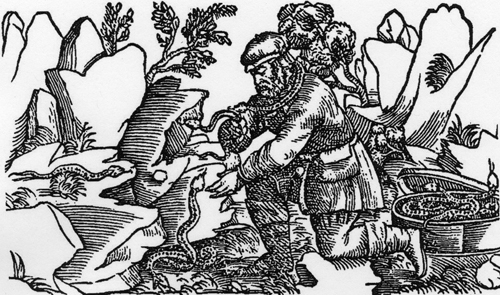
FIGURE 2.1. Snake Handler Catching Vipers, woodcut from Pietro Andrea Mattioli, I discorsi di M. Pietro Andrea Matthioli (Venice, 1557).
Courtesy of the National Library of Medicine, Bethesda, MD.
Under ordinary circumstances, obtaining permission to sell drugs in the public squares was a routine procedure. In order to sell their remedies in Venice, empirics like Riccio had to obtain a license from the Public Health Board. Usually this was a fairly simple matter of submitting the recipe for the medicament to the physicians so that they might make a judgment about whether it was safe. The Public Health Board was more concerned about whether the remedies might be harmful than with whether or not they were efficacious.2
Riccio already had a license from the Public Health Board to sell his antidote. But a prior of the Venetian College of Physicians had observed him at work in the Piazza San Marco, and was so impressed by the snake charmer’s skill that he recommended him to the Sanità. With the prior’s recommendation in hand, Riccio went to the Health Board and applied to have his license turned into a ten-year privilege. In order to prove the worth of his antidotes, Riccio appeared before the committee with his box of serpents and proceeded with a “demonstration” of the drug’s effectiveness. Under the watchful eyes of the provveditori, Riccio caused himself to be bitten on the torso by his snakes. Bare-chested, he stood resolutely as the bites swelled up and turned black. The physicians began to worry, but then Riccio calmly reached into his medicine chest and took out a vial of his secret ointment and applied it to the bites. Immediately and seemingly miraculously, the [55] swelling subsided. The examiners were so impressed that they ruled that for ten years no one other than Riccio be allowed to mount a bank and sell the remedy.
Now let us imagine Riccio as he leaves the office of the Public Health Board, license in hand, and follow him as he walks the short distance from the Salt Office, where the Health Board met, to the Piazza San Marco, where he practiced his trade. The scene on the piazza might have looked something like the one in an image from Giacomo Franco’s famous costume book, Habiti d’huomini et donne Venetiane (Venice, 1609), depicting charlatans performing their theatrical routines to attract crowds in order to vend their nostrums (fig. 2.2).3 In performances ranging from full-length shows to theatrical displays of themselves as wonder-working healers, the charlatans flaunted their supposed therapeutic prowess. In the foreground of Franco’s picture, we see a snake handler, just like Riccio.
This image is available in the print edition
FIGURE 2.2. Charlatans in the Piazza San Marco, engraving from Giacomo Franco, Habiti d’huomini e donne (Venice, 1609). London, British Museum.
© Trustees of the British Museum.
Riccio must have been quite a sight on the Piazza San Marco. We might imagine him appearing something like the character in an image from Giuseppe Maria Mitelli’s book of etchings, Le arte per via (1660), a portfolio of drawings on the humble trades (fig. 2.3). Of course, the picture [58] does not really portray Riccio; instead, Mitelli’s drawing illustrates a charlatan performing on a portable stage in a Bologna piazza. Mitelli’s stout, bearded figure wears thick eyeglasses and points to a serpent that he daringly holds aloft. The table beside him displays neatly arranged jars containing his remedies. Although Mitelli’s figure is not Riccio, imagining it to be so would not be too far off the mark; for Mitelli’s charlatan is a sanpaolaro, one of the so-called Men of Saint Paul, snake handlers who sold an antidote for poisonous bites under the trade name St. Paul’s Grace (Gratia di S. Paolo). One of his snakes menacingly slithers out of a basket onto the stage floor as a fascinated audience looks on.
This image is available in the print edition
FIGURE 2.3. Snake Handler in a Bologna Piazza, engraving from Giuseppe Maria Mitelli, Le arte per via (Bologna, 1660). London, British Museum.
© Trustees of the British Museum.
Like many others who plied his trade—the profession of the ciarlatano, or charlatan—Bartolomeo Riccio had to play on two radically different stages: the open, public space of the piazza and the closed, official space of established medicine. In order to sell his remedies, he had to perform in the public square; but to get a license to sell his wares, he had to prove himself in the private space of the doctors. This microcosmic snapshot of the relationship of popular culture versus official culture will be my point of departure for exploring two contrasting spaces for veiling and unveiling secrets: one public, the other private; one popular, the other official.
To begin that exploration, let us go back a few centuries and look briefly at the medieval ethic governing transmission of knowledge. That excursion will help us understand the answers given to the leading question regarding the dissemination of natural knowledge: who gets to know?
The thirteenth-century Franciscan friar and philosopher Roger Bacon articulated the standard medieval view toward the dissemination of natural knowledge. In the Opus Majus, Bacon wrote,
The wise have always been divided from the multitude, and have veiled the secrets of wisdom not only from the world at large but also from ordinary philosophers. Aristotle says in his book of secrets that he would break the celestial seal if he made public the secrets of nature. For this reason the wise, although giving in their writings the roots of the mysteries of science, have not given the branches, flowers, and fruits to the rank and file of philosophers. For they have either omitted these topics from their writings or have veiled them in figurative language. Hence, according to Aristotle, the secrets of the sciences are not written on the skins of goats and sheep so that they may be discovered by the multitude.4
The text that Bacon refers to in this passage—he calls it “Aristotle’s Book of Secrets”—was, in fact, a tenth-century Arabic work attributed to Aristotle and translated into Latin in the twelfth century under the title Secretum secretorum, or “Secret of Secrets.” This pseudo-Aristotelian treatise, one of countless medieval texts attributed to Aristotle that entered the West with the wave of translations, was said to comprise the letters that Aristotle sent to Alexander the Great while the young king was on his Persian campaign.5In contrast to Aristotle’s public doctrine contained in the works on logic and natural science, the Secretum supposedly revealed the philosopher’s esoteric teachings, which he reserved for a few intimate disciples.6 The Secretum secretorum was a kind of manifesto of the medieval doctrine of esotericism. Central to the doctrine was the idea that nature is inherently [59] arcane; the veil of nature’s outer appearances conceals hidden qualities and virtues—the “secrets of nature”—that lie within.7
The doctrine of esotericism implied in the idea of arcana naturae gave rise to a peculiarly medieval view about intellectual curiosity, specifically with respect to curiosity about the secrets of nature. In the Middle Ages the word curiosity (curiositas) had a far more pejorative meaning than it has today.8 To be curious about something was neither innocent nor virtuous. Instead, it implied being a meddlesome intellectual busybody who pries into things that are none of his business. Nor, according to patristic opinion, could scientific curiosity be considered fully legitimate, because God intended nature to be a mystery and had so fashioned the world as to make its secrets occult and unintelligible. The popular image of the goddess Natura, usually depicted covering herself with a veil in order to hide her secrets from mortals, reinforced this theological view.9
The twin themes of arcana naturae and forbidden knowledge carried a warning that was continually repeated in the medieval and early modern periods: the secrets of nature were hidden from the vulgus with good reason; be not curious about them.10 The admonition not to cast the pearls of knowledge before swine was a key component of the moral economy of medieval science.11
The widespread currency of the “secrets of nature” metaphor testifies to a firm partition between learned and popular cultures. In the Middle Ages, literacy was the principal criterion that determined on which side of the boundary one fell. Since “literacy” almost invariably meant knowing how to read and write Latin, knowledge of the Latin language became the norm that separated the learned elite from the rest of society. The identification of literacy with rationality, and of illiteracy with credulity and superstition, solidified the barrier between insiders (academics) and outsiders (others).12
As long as literate culture was the exclusive property of academics, that boundary was relatively secure and the “secrets of nature” remained hidden within the cloak of Latin Scholasticism. Two events occurred in the early modern period to create conditions that threatened to remove the veil surrounding nature’s secrets: the first was the advent of printing, which made the written word more widely available to a broad spectrum of society, and the second was the commercialization of culture, which turned “secrets” into commodities. With the emergence of popular culture in the sixteenth century, the secrets of nature could not only be read about in books, but could also be purchased or viewed in the marketplaces and piazzas. Whether in popular “books of secrets” or on the mountebank’s stage, revealing and vending nature’s secrets subverted the academic monopoly over medicine and natural knowledge. As we will see, in the domain of popular culture, attempts to break down the barrier of esotericism in scientific discourse were at the same time either burlesques or travesties of high culture, depending only upon how seriously the audience was expected to take them. The “professors of secrets” who flooded the marketplace with their [60] books of secrets denounced in high moral terms the pretensions of academics, and in turn saw themselves caricatured by mountebanks in the piazza.
The year 1555 may be said to mark, symbolically, a watershed year in the history of the treatment of the secrets of nature. It was in that year that the last Renaissance edition of the Latin Secretum secretorum was published in Naples.13 By the time the edition appeared, practically all scholars knew that the work was spurious. Sixteenth-century editors of the Aristotelian corpus rarely bothered to mention the work.
Quite coincidentally, that same year the Venetian bookstalls displayed a book of secrets whose content and intended audience were entirely different from that of the Secretum secretorum. The book, The Secrets of Alessio Piemontese, contained the expression of the new attitude toward the “secrets of nature.” Confidently advertising itself as “a most useful and universally necessary work,” the Secrets opened up to readers a new world of exotic secrets and practical recipes. Alessio’s secrets included remedies unknown to the doctors, recipes for cosmetics used by the Turks, exotic perfumes and oils, dyeing techniques, tricks of the metalworking trades, alchemical secrets supposedly tried out by Alessio himself, and many more.14
Alessio’s Secreti was an instant best seller. The first edition sold out within a year and was reprinted by three different publishers. More than seventy editions of the book were published in Italian, French, German, Dutch, English, Spanish, Polish, and Latin. The work unleashed a torrent of books of secrets. So sensational were these works in their day that the social critic Tommaso Garzoni, writing in 1585, identified their authors as making up an entirely new profession. Garzoni called the writers on secrets the “professors of secrets.” He described them as intrepid seekers of hidden knowledge and rare experiments who devoted themselves so zealously to their calling that they often forsook the necessities of life.15
The Secreti was largely responsible for creating the familiar topos of the wandering empiric, the tireless explorer who, forsaking fame and fortune, travels the world over in search of the secrets of nature. Alessio, the prototypical professor of secrets, collected secrets from scholars, clerics, empirics, artisans, and even peasants. There can be little doubt that Garzoni’s inspiration was the Secreti’s famous preface, in which Alessio portrayed himself as a wealthy intellectual who had turned away from the books of the authorities in order to devote his life and fortune to searching for secrets of nature, trusting only experience to reveal the truth.
But Alessio also suffered from the disease that afflicted all seekers of the rare and exotic: vanity. So possessive was he of his secrets that he refused to reveal them out of fear that they might be vulgarized and hence lose their rarity. He was persuaded to renounce secrecy when, in Milan, a surgeon approached him asking for a remedy to cure an artisan who was tormented with a painful bladder stone. The old professor of secrets—Alessio was eighty-two at the time—refused, perceiving that the surgeon would use the secret for his own profit and glory. The poor artisan paid the price of Alessio’s vanity, for by the time he arrived at the patient’s bedside, “I found [him] so nigh his end, that after lifting up his eyes, casting them pitifully toward me, he passed from this into a better life, not having [61] any need of my secret nor any other to recover his health.”16 Gripped by remorse over the incident, Alessio relinquished all of his wealth and retired to a secluded villa, there to live the life of a solitary monk. Renouncing secrecy, he resolved to publish his secrets to the world.
The morality play acted out in Alessio’s dramatic conversion to the ethic of openness rings, frankly, of fiction. And, as it turns out, it was; for “Alessio Piemontese” was no wandering empiric at all, but was the invention of the Venetian popular writer Girolamo Ruscelli, who published the Secreti under the pseudonym of Alessio.17
But now the story becomes even more interesting, because according to Ruscelli, Alessio’s secrets were in fact the experimental results of a secret academy that he and several others had founded in Naples. The academy, which Ruscelli called the Accademia Segreta, devoted itself to making “a true anatomy of things, and of the operations of Nature.” They set up a laboratory and furnished it with alchemical equipment, which they used to try out the recipes they collected. They had an herb garden that supplied the materials for their experiments and gathered in a meeting room to discuss them. All this was done in secret, Ruscelli claims, despite the fact that the meeting house (called La Filosofia) was built in the central plaza of a “prominent city” in the Kingdom of Naples.18
A “secret” was supposedly a unique recipe or technique. Often would it bear the name or trademark of its inventor to distinguish it from other, “common” recipes. The famous Bolognese professor of secrets Leonardo Fioravanti (fig. 2.4) gave his remedies catchy trade names like Angelic Oil (Olio angelico) and Fragrant Goddess (Dia aromatica).19 Ironically, however, by flooding the marketplace with secrets, the professors of secrets made their recipes anything but unique, anything but secret. Even Garzoni, who identified the professors of secrets as a “profession,” never imagined such an outpouring of rare, exotic, and pretentious secrets that he had seen paraded in the piazzas:
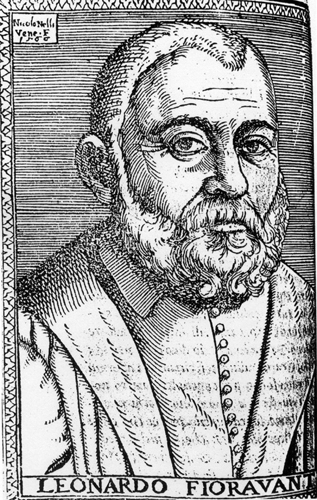
FIGURE 2.4. Nicolo Nelli, Portrait of Leonardo Fioravanti, woodcut from Leonardo Fioravanti, Tesoro della vita humana (Venice, 1582).
Courtesy of the Department of Special Collections, University of Wisconsin Libraries.
When has there ever been such an abundance of those looking for new secrets? Why, in Bergamo there’s even one who brags about having a secret to convert the Turk, and would have sold it to a physician friend of mine for a forty-piece if he so pleased—something to have made Fioravanti of Bologna, had he known of it, despair of himself for not having included it among his medical caprices under the title of Fioravanti’s Angelical and Divine Elixir.20
Alessio Piemontese’s worst fears had come true: secrets, once rare and precious, had become “public and common,” hence no longer secrets. But if all secrets were equivalent, what was to prevent anyone from making up his own or peddling those he lifted from a printed book?
In fact, that is precisely what did happen. Not only did early modern European readers witness an explosion of books of secrets in the late sixteenth and early seventeenth centuries, but the piazzas themselves became spaces—or rather, stages—for the trade in secrets. Theatrical elements were essential in the marketplace defined by the piazza. In order to attract the throngs of people that became the buyers of their nostrums, mountebanks performed a sort of slapstick comedy, [62] using the characters and tricks of what would later be called (in politer circles) commedia dell’arte.21 Indeed, contemporary descriptions of the charlatans are practically indistinguishable from those of the more sophisticated commedia troupes, suggesting that the commedia dell’arte was born in the piazza, not in the court, as often argued.22 Giovan Domenico Ottonelli gave this account of one of these troupes in the mid-seventeenth century:
From time to time a company of these gallant men comes into a city with their women (without whom they are given little applause), and spread the word that they will serve the public by selling excellent secrets and presenting a free comedy. They choose a place in the public square, where they put up a scaffold. . . . Every day at an appropriate hour a Zanni or similar character begins strumming an instrument or singing to attract an audience. In a moment another actor appears, then another, and often a woman joins the show. They all perform tricks and mix it up with one another and with the audience. Then comes the head charlatan [Archiciarlatano], the seller of secrets, and with a fine manner introduces the great and incomparable glory of his marvelous remedies. . . . Finally the head charlatan cries, “Bring on the comedy! Let the comedy begin!” The boxes and trunks are packed, the bench changed into a scene, every charlatan becomes a comedian, and there begins a comic performance that will last around two hours, filling the people with laughter and delight.23
[63] Thomas Coryat, an Englishman who visited Venice in 1608, left a similar account. Each day, he reported, the mountebanks set up their portable stages in the Piazza San Marco:
Twice a day, that is, in the morning and in the afternoon, you may see five or six stages erected for them. . . . These mountebanks at one end of their stage place their trunk, which is replenished with a world of new-fangled trumperies. After the whole rabble of them is gotten up to the stage, whereof some wear visards, being disguised like fools in a play, some that are women (for there are diverse women also amongst them) are attired with habits according to the person that they sustain. After they are all upon the stage, the music begins, sometimes vocal, sometimes instrumental, and sometimes both together. This music is a preamble and introduction to the ensuing matter. In the meantime, while the music plays, the principal mountebank, which is the Captain and ring-leader of all the rest, opens his trunk and sets abroach his wares. After the music has ceased, he makes an oration to the audience of half an hour long, or almost an hour. Wherein he doth most hyperbolically extol the virtue of his drugs and confections. . . . After the chief mountebank’s first speech is ended, he delivers out his commodities by little and little, the jester still playing his part, and the musicians singing and playing upon their instruments. The principal things that they sell are oils, sovereign waters, amorous songs printed, apothecary drugs, and a commonweale of other trifles. The head mountebank at every time that he delivers out any thing, makes an extemporal speech, which he presently intermingles with such savory jests (but spiced now and then with singular scurrility) that they minister passing mirth and laughter to the whole company, which perhaps may consist of a thousand people that flock together about their stages.24
Fynes Moryson, another sixteenth-century English traveler, was equally fascinated by the charlatans that he observed in the Piazza San Marco in Venice, although he wasn’t too impressed by their wares. “Many of them have some very good secrets,” he reported, “but generally they are all cheaters.”25 Cheats or not, the ciarlatani attracted large crowds. No visit to Venice would have been considered complete without a walk through the Piazza San Marco to watch their performances.
We can get a closer look at the charlatans’ secrets by examining the medical chapbooks they sold, along with their nostrums, in the public squares.26 They are little tracts, most just a single signature folded into a quarto, or eight pages, printed on cheap paper and containing about twenty or thirty recipes. Sold in the piazzas for a few pennies, they represent the books of secrets tradition at its commonest level. Though popular in their day, they are now extremely rare. In my research, I was able to identify more than eighty of these pamphlets, although doubtless many others were lost or worn out by use.27
The authors of these tracts—let’s call them the professorini di secreti, or “little professors of secrets”—identified themselves by their stage names, all stock commedia dell’arte characters. Tommaso Maiorini, for example, played the character Pulcinella on the mountebank’s stage and sold a pamphlet titled Frutti soavi colti nel giardino (Delicate Fruits Cultivated in the Garden). A certain Francesco, who took the part of Biscottino, published a tract called Giardino di varii secreti (Garden of Various Secrets). Pietro Maria Mutii, “il Zanni bolognese,” sold a tract called Nuovo [64] lucidario di secreti (New Illumination of Secrets). Another charlatan, who styled himself “il Marchesino d’Este” (Little Marquis of Este), wrote Il Medico de’ poveri, o sia il gran stupere de’ medici (The Poor Man’s Physician, or The Amazement of the Physicians).28
The title pages of these pamphlets fairly ring with the cries of the mountebanks extolling the virtues of their remedies. Some boasted exotic secrets from distant lands. Benedetto “il Persiano” (Persian) claimed that he translated his “marvelous occult secrets of nature” from the Persian language (fig. 2.5), while another charlatan, nicknamed “Americano,” wrote about “A True and Natural Fountain, from which flows forth a living water fountain of miracles and health-giving secrets.”29 Despite the pretension of the author’s name, this little chapbook was hardly exotic, being a reprinting of a pamphlet by the Brescia charlatan Andrea Fontana, Fontana dove n’esce fuori acque di secreti (Fountain Spouting Water Full of Secrets).30 Fontana, who also practiced as a surgeon and distiller, made cosmetics and facial waters for “honored ladies” and offered to teach the art of distillation to anyone interested. Another charlatan, Guglielmo Germerio advertised a cabinet of curiosities that included “ten very stupendous monsters, marvelous to see, among which there are seven newborn animals, six alive and one dead, and three embalmed female infants.”31
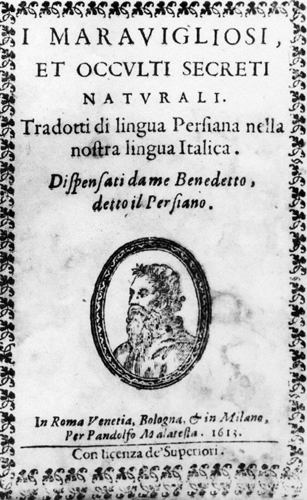
FIGURE 2.5. Title page from Benedetto (called il Persiano), I maravigliosi, et occulti secreti naturali (Rome, 1613).
Courtesy of the Department of Special Collections, University of Wisconsin Libraries.
The professors of secrets themselves became stock characters in the comic performances on the piazza, as a chapbook by the Venetian charlatan Lorenzo Leandro, titled Tesorodi varii secreti, suggests. “Fioravanti Cortese,” the pseudonym used by the author of the Giardino et fioretto di secreti (Garden and Bouquet of Secrets), was a play on the names of Leonardo Fioravanti and Isabella Cortese, two famous professors of secrets. Similarly, Il gran Piemontese, the author of another medical tract, may have been a takeoff on Alessio Piemontese. Biagio, Il Figadet, wrote a booklet of secrets “collected from various clever men,” while Giovanni Cosson, a French mountebank who called himself “Il Bontempo Francese” (The Good-Time Frenchman) wrote a booklet of practical jokes that “have greatly delighted the French, Spanish, and Italian princes and gentlemen who experimented upon them.” All of these pretensions were comic parodies of the book of secrets, from which the professorini di secreti appropriated their recipes and cures.
Obviously, the charlatans’ impersonations of the professors of secrets were calculated both to entertain and to win audiences in order to sell “secrets.” In these little chapbooks, we see the charlatans at their most jocular and disrespectful, mocking physicians, professors of secrets, and societal norms. The play on secrets—including the mountebank’s sham reluctance turned into willingness to reveal secrets to the public, as well as the obvious fact that once published in a chapbook intended for the crowd they are anything but secret—was part of the joke. In burlesquing the professor of secrets onstage, the mountebank pretended to have rare secret remedies that, just like those of the real professors of secrets, he discovered by long experience in the ways of nature. But he would give them up for the public good. Thus Domenico Fedele “il Mantoianino” (Little Mantuan), in his little chapbook of secrets, copied out verbatim the dedication from Timotheo Rossello’s more serious Summa de’ secreti universali (1561), extolling humanity’s natural desire to search for secrets, and used it as a preface for his booklet, Con il Poco farete assai (With a Little You’ll Do a Lot). But he left off at the point [65] where Rossello began addressing his exalted patron, the archdeacon of Ragusa, and concluded with the words, “I am compelled to present to you—O people!—this little garden of lovely flowers, in their variety pretty to look at, but in substance beneficial to the human body.”32 Mountebanks on every corner of the piazza making similar claims to be revealing rare and precious secrets obviously heightened the ludicrousness of the situation.
If the professors of secrets were mimicked in the piazza, the official doctors were positively lampooned. Dottor Gratiano Pagliarizzo da Bologna, the author of a chapbook on Secreti nuovi et rari (New and Rare Secrets)—almost exactly the same title as a treatise on secrets by Girolamo Ruscelli—was undoubtedly modeled on the commedia mask of Graziano, the quack doctor and astrologer (fig. 2.6). One can imagine him in his tight knee breeches, ruffled doublet, and cloak, holding forth with his learned platitudes and his ridiculous malapropisms. “He who is sick cannot be said to be well,” he would expound in a mock-serious tone, parodying the physicians, and he would prove it on the analogy that he who walks cannot be said to stand still.33
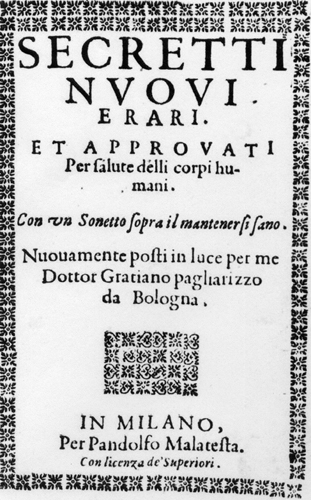
FIGURE 2.6. Title page from Dottor Gratiano Pagliarizzo, Secreti nuovi e rari (Bologna, Milan, n.d.).
Courtesy of the Department of Special Collections, University of Wisconsin Libraries.
[66] The thought of a charlatan parodying a quack doctor in a comedy, then peddling his own quack nostrums to the audience, may at first glance seem ludicrously ironic. Doubtless, the irony was intended. But the stark contrast between the physician’s complex regimens and the charlatan’s instant, surefire remedies struck a responsive chord in the audience gathered around the mountebank. The charlatan was more deeply connected to the social realities of the people than the official Galenic physician, whose humoral theories were far removed from the rules and beliefs by which most of his patients lived.34 Whether or not his remedies worked, because they often relied on purges and chemical skin treatments, at least they had the merit of producing visible results. Purges that purge can be said to be efficacious; whether or not they cure is another matter. Then as now, the people wanted results, not an intellectual understanding of the causes of their ailments. Regimens that produced no physiological changes were easy targets for unorthodox healers.
In these little chapbooks, we see the charlatans at their most jocular and disrespectful, mocking physicians, professors of secrets, and societal norms. In the culture of the piazza, the popular healer doubled as an entertainer and a salesman. The mountebank’s portable stage was his storefront, his medical theater a form of advertising that was well suited to a society that was becoming more and more commercialized.
The assault on the learned professions’ monopoly over the “secrets of nature” reveals much about the dynamics of cultural change in early modern Europe. First of all, it shows that popular culture was not a mere imitation of elite culture. Rather, it often involved aggressive appropriation and creative adaptation of elements of both literate and folk cultures.35 It also underscores the importance of the comic in early modern popular culture and illustrates Bakhtin’s claim about the insurrectionary import of laughter. To paraphrase Bakhtin, early modern laughter was directed at precisely the same objects as early modern seriousness.36
However, the connection between healing and dramatic performances was also a traditional one. That is how shamans operate.37 The power and charisma of the charlatan is vividly captured in a painting by the Sienese artist Bernardino Mei (fig. 2.7).38 The painting, titled The Charlatan, depicts an aged, bearded charlatan seated on a wooden platform and surrounded by an astonished and wondering crowd of onlookers. The scene takes place in the Piazza del Campo in Siena, with the Torre del Mangia clearly visible in the background. The view of the charlatan from below accentuates his imposing figure, while the dark, foreboding sky above him heightens the drama of the scene. On the floor of the stage is an assortment of glass bottles and vials containing his remedies. Next to the healer’s cane is a handbill bearing the title, “L’Olio de’ filosofi di Straccione” (Straccione’s Philosophers’ Oil), identifying both the charlatan and his remedy. Most dramatically, on the back of his tightly fisted hand, thrust out to the crowd, Straccione (Ragamuffin) balances a vial of his miraculous elixir. His penetrating gaze and authoritative gestures arouse expressions of wonder and fear in the crowd [67] below, which listens in rapt attention as the charlatan proclaims that its very health and well-being is contained in the powerful contents of that little vial.
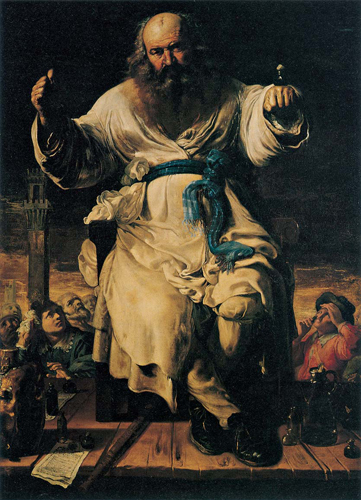
FIGURE 2.7. Bernardino Mei, Il Ciarlatano, 1656, oil on canvas.
Alfredo Dagli Orti/The Art Archive at Art Resource, NY.
Now let us return to Bartolomeo Riccio in the Piazza San Marco. Unfortunately, we have no contemporary description of him at work. However, we do have the testimony of the sixteenth-century English traveler Thomas Coryat, who reported seeing a charlatan just like him:
I saw one of them hold a viper in his hand and play with his sting for a quarter of an hour altogether, and yet receive no hurt—although another man should have been presently stung to death with it. He made us all believe that the same viper was lineally descended from the generation of that viper that leapt out of the fire upon Saint Paul’s hand, in the Island of Malta, and did him no harm; and told us moreover that it would sting some, and not others.39
Tommaso Garzoni observed similar performances, including one by Master Paolo da Arezzo, who “appears on the piazza with a long standard unfurled, on which you can see St. Paul with a sword in one hand and in the other a swarm of hissing snakes.” Master Paolo was one of the wandering [69] “Men of Saint Paul” (Uomini di San Paolo), or sanpaolari, healers who claimed descent from St. Paul, in reference to Paul’s experience in Malta. As the apostle warmed himself before a fire, according to the Acts of the Apostle, “there came a viper out of the heat, and fastened on his hand . . . and he shook off the beast into the fire and felt no harm” (Acts 28.3–5).40 This passage gave rise to the folk belief that Maltese earth was an antidote against snake venom. The sanpaolari sold it under the trade name “St. Paul’s grace” (Gratia di S. Paolo). Yet it was certainly not the folk tradition alone that convinced people of the efficacy of Maltese earth. The theatrical part of Paolo da Arezzo’s profession was equally if not more important. “He struck such fear in the crowd,” Garzoni related, “that the people trembled, and did not want to leave the city gates without taking some of the powder with them.”41
The boundary between public performances, advertising stunts, and traditional healing rituals is not easy to draw in the context of early modern culture. Certainly snake-handling was a good stunt; but it was also a tradition associated with local healing traditions.42 When the sanpalari brought their methods to the urban marketplaces, the quasi-religious elements of folk medicine gradually became commercialized and transformed into advertising gimmicks. In the charlatan, the folk healer emerged as a sort of “commercialized shaman.”43
As control over unauthorized medical practice tightened in the late sixteenth century, the balance between pretense and reality in the professional life of the charlatan became ever more precarious.44 For the mountebank’s relation to the physician had two conflicting sides. On the one hand, he played upon the image of the physician as a pretentious fool in order to maximize the economic value of ridicule. On the other hand, the physician’s authority could, and often necessarily had to, authorize his nostrums. Thus the empiric and distiller Zuanne Veronese, in registering his “artificial philosophical oil” with the Venetian Health Board, attested that the recipe was the same as that prescribed by Mesue and was “made according to the description of Dioscorides.”45
Moreover, in order to obtain the assent of the medical colleges, which authorized their practice, empirics had to enter into a doubly risky form of deception: the game of fooling the physicians. In the sixteenth century, virtually all Italian cities required empirics to obtain licenses from the local health boards before being able to dispense their medical secrets in the piazza.46 In Venice, the licensing procedures required that itinerant healers display their recipes and in some cases demonstrate the efficacy of their remedies.
As the case of Bartolomeo Riccio suggests, the sanpaolaro did this by appearing before the Health Board and essentially doing the same stunts they performed before the crowds gathered in the piazza—although, doubtless, in a more sober and serious manner. In fact, such appearances [70] occur with some regularity in the archive of the Venetian Provveditori alla Sanità. In 1563, Maffeo Bertolani, a Brescia empiric, when applying for a license to sell his antidote for poisonous animal bites, made a demonstration before the Health Board to the one that Riccio did when applying for his privilege. He and a member of his traveling “company” brought their boxes of poisonous animals to the Health Board offices and had themselves bitten in order to demonstrate the efficacy of Maffeo’s poison antidote.47
The descriptions of these rather extraordinary-sounding events, like most archival records, are bare, factual, and perfunctory. Yet when given the chance, such as in their petitions, the charlatans who did these astonishing “experiments” before the amazed provveditori did not hold back, and their applications enable us to imagine a more lively scenario. In his supplica to the Health Board for a ten-year license to sell his remedy, Riccio reminded the provveditori of the “many exhibitions” (“molte experientie”) that he had made on the piazza, including demonstrating how “with my own hands, without using a knife, I capture vipers and kill them without any harm to me, to the marvel and stupor of all.”48 He furthermore reminded the examiners, “I also did a very excellent experiment before the esteemed provveditori, causing myself to be bitten in their presence by a poisonous viper, whence they saw me swell up, and with my remedy I immediately cured myself.”49
In these incidents of performative experimental science, our attention is drawn to the locked boxes filled with remedies and, in some cases, vipers that charlatans took with them to the open spaces of the piazza and the closed spaces of official medicine. The charlatan’s locked chest was one of the symbols of his craft, and the presence of a trunk or similar container of remedies was one of the most characteristic aspects of mountebank iconography (see figs. 2.2 and 2.3). In his diary, the Swiss physician Thomas Platter noted that a troupe that he observed in 1598 used a “large locked chest” to transport their tins of ointment and envelopes of medicinal powders.50 In opening their trunks and revealing secrets that astonished the physicians, the charlatans imitated the performance of unlocking their chests and revealing secrets to the people on the piazza.
Experimental “demonstrations” of the sort that Riccio made before the Venetian Health Board elicited a variety of reactions from literate culture. On the one hand, the rise of the ciarlatani coincided with and perhaps reinforced the idea that the common people possessed “secrets” making up a body of knowledge unknown to the savants. Leonardo Fioravanti, for example, insisted that the common people’s empirical knowledge about the “rules of life” was superior to the medical learning of the schools.51 The Neapolitan magus Giambattista Della Porta thought that popular “superstitions” concealed profound truths about nature, while the Danish Paracelsian Peter Severinus urged natural philosophers to study the “astronomy and terrestrial philosophy of the peasantry.”52
[71] The physicians, on the other hand, understandably refused to remain silent in the face of the ridicule aimed at them by empirical healers. Alongside works extolling the people’s wisdom emerged an equally large body of literature on “popular errors.” Physicians rallied to the defense of medicine and lashed out against popular superstitions, folklore, and what they termed the “errors of the people.”53 Interestingly, the academic physicians did not contest the efficacy of St. Paul’s earth as a poison antidote. Instead, they attacked the sanpaolari for their dissimulation, for counterfeiting Maltese earth and for deceiving the people with various tricks to protect themselves against venomous bites.54 Above all, they attacked the empirics for intruding into the territory of the physician. The secrets of medicine, they insisted, would remain locked behind the closed door of the learned professions.
The main problem, concluded Laurent Joubert, the chancellor of the Faculty of Medicine at Montpellier, was that “everybody makes medicine his business.” There were just too many “meddlers” out there trying to cut in on a portion of the profession with their quack remedies and panaceas. He reserved special contempt for midwives, who made extravagant but foolish claims for secrets they alone supposedly knew. “What disgusts me,” wrote Joubert indignantly, “is how these women share among themselves a few small remedies, which, after all, are not even of their own invention but were taken at some time or other from physicians and later passed around among themselves. For women have never invented a single remedy; they all come from our domain or from that of our predecessors.”55
Similar attacks followed. In 1603, the Roman physician Scipione Mercurio lashed out against “errors committed in the piazza” by empirics and charlatans, who endangered the public with their ridiculous and often poisonous drugs.56 He was amazed that people could be so foolish as to credit such remedies as those “made of useless junk and sold in the piazza to the imprudent public, authorized by the presence of a vagabond dressed in velvet and wearing a gold tricorne, approved by a clown, registered by the doctrine of Dr. Graziano, proved by an unbridled whore, sealed by Burattino’s jokes, confirmed by a thousand false testimonies, and accompanied by as many lies.” Besides being vagabonds, he continued, the charlatans have absolutely no understanding of the causes of diseases. They imagine that practically all ailments are caused by worms, which they claim their potions will quickly eradicate. In reality, Mercurio observed, diseases have complex causes relating to humoral imbalances. “Since a medication cannot take into account all these things unless it is composed by a very learned physician,” he pronounced, “the charlatans, who are very ignorant, cannot compose them safely.”57 Guarding the secrets of the doctors was essential to preserving the superiority of official medicine.
The declaration of total war against popular superstitions makes it clear that the ridicule of official medicine was more than just harmless tomfoolery in the piazza. Mercurio noted that the [72] common people even played tricks on the physicians, for example by bringing the urine of an ass or a horse for diagnosis, pretending it came from a patient.58 Clearly, there was an economic issue at stake in the moral crusade against popular culture. The nostrums vended in the marketplace competed with conventional remedies and cut into the physicians’ monopoly over the medical marketplace. Mercurio regarded “secrets” as charlatanism’s greatest fraud, because they deceived the public and endangered patients.59 But it was not just the credulous common people who fell for their frauds. The English physician James Primrose knew a gentleman who paid twenty pounds for a secret he could have bought from an apothecary for a fraction of that amount.60 Primrose observed that the empirics often represented common remedies as “great secrets, which they will reveal to no one.” In reality, Primrose pronounced, “they have nothing that is worthy the name of a secret.”61 Primrose did not deny the value of secrets; instead, he appropriated them, claiming they were invented by physicians in the first place.
With Primrose, we seem to have come full circle. Initially, official culture had a monopoly over the “secrets of nature.” Secrets were valuable because of their rarity. But when empirics appropriated them, published them in books of secrets, and sold them in the piazza, academics turned around and declared that science abolished the need for secrets. “Those remedies are the best which are no secrets,” Primrose contended, “but best known, as being confirmed with more certain experience.”62
Yet even after being incorporated into the “new philosophy,” secrets did not lose their ambiguous status. If anything, they became more problematic than ever. On the one hand, demonstrations of rarities and wonders were important resources in expanding the public culture for science.63 But the danger that experiments might simply bedazzle onlookers instead of enlightening them persisted into the eighteenth century. The English virtuoso John Evelyn’s account of an experiment with phosphorus performed before the Royal Society in 1641 illustrates this danger. The experiment reminded Evelyn of having witnessed a mountebank in the Piazza Navona in Rome performing tricks with a phosphorescent ring, “and having by this surprising trick, gotten Company about him, he fell to prating for the vending of his pretended Remedies.”64 The concern about confusing charlatans and experimental philosophers was the underlying theme of Thomas Shadwell’s satirical attack on the Royal Society of London, The Virtuoso (1676).65 In the form of Sir Nicholas Gimcrack, Shadwell’s caricature of the new philosopher, the charlatan gained entrance to the parlor in order to fool an upscale audience with his secrets and experiments.
In order to ensure that the virtuosi would not be mistaken for mountebanks, the early Royal Society restricted its experimental spaces to sober, reliable, and friendly witnesses.66As Steven Shapin and Simon Schaffer pointed out, the virtuosi had to observe certain social conventions about how [73] knowledge was produced, about what may be questioned and what may not, and about what counts as evidence. The result was “a public space with restricted access,” that is, a space “restricted to those who gave their assent to the legitimacy of the game being played within its confines.”67 Another means by which the Royal Society attempted to reduce the “wonder” of experiments was to insist that experiments be replicated. Replication, the virtuosi believed, would make experimental “facts” out of what were commonly perceived as wonders. It would also reinforce the distinction between the true experimental scientist and the dilettante or charlatan whose concern was merely to exhibit novelties. As one Fellow of the Royal Society warned, an experimenter “is not to be taken for a maker of gimbals, nor an observer of Nature for a wonder-monger.”68
Although the new philosophers loudly rejected the tradition of esotericism and upheld the virtues of open disclosure of scientific knowledge, experimental knowledge in the Royal Society was never completely open. Nor is it in modern science. Although nature’s secrets are no longer arcana, they are no less esoteric and privileged. If anything, the secrets of nature are more the monopoly of an autonomous corporation of specialists now than ever before. In the modern setting, the social function of esotericism has been increasingly performed by the construction of disciplinary boundaries. Institutionalization may have replaced esotericism in science, but sociologically its goals are the same: it is a mechanism for protecting the discipline from external criticism and from pollution by outsiders. The paradox is that a form of knowledge that is the most open in principle has become the most closed in practice.
Bibliography
Archival Sources
Archivio di Stato (Venice)
Provveditori alla Sanità, Reg. 731.
Provveditori alla Sanità, Reg. 734.
Provveditori alla Sanità, Reg. 735.
Printed Sources
Americano. Il Vero, e natural fonte, dal quale n’esce fuori un fonte d’acqua viva di mirabili, e salutiferi secreti. Rome, Brescia, Bologna, 1608.
Bacon, Roger. Opus Majus. Translated by Robert Belle Burke. 2 vols. New York: Russell & Russell, 1962.
Bacon, Roger. Secretum secretorum cum glossis et notulis. Edited by Robert Steele, in Opera hactenus inedita, vol. 5. Oxford, UK: Oxford University Press, 1920.
Bagley, Paul J. “On the Practice of Esotericism.” Journal of the History of Ideas 53 (1992): 231–47.
Bakhtin, Mikhail. Rabelais and His World. Translated by Helene Iswolsky. Cambridge, MA: MIT Press, 1968.
Benedetto, detto il Persiano. I Maravigliosi, et occulti secreti naturali. Rome, Venice, Bologna, Milan, 1613.
Blumenberg, Hans. The Legitimacy of the Modern Age. Translated by R. M. Wallace. Cambridge, MA: MIT Press, 1983.
Buhagiar, Mario. “St. Paul’s Shipwreck and Early Christianity in Malta.” Catholic Historical Review 93 (2007): 1–16.
Burke, Peter. “Rituals of Healing in Early Modern Italy.” In The Historical Anthropology of Early Modern Italy: Essays on Perception and Communication, 207–20. Cambridge, UK: Cambridge University Press, 1987.
———. Popular Culture in Early Modern Europe. New York: Harper & Row, 1978.
Coryat, Thomas. Coryat’s Crudities. Glasgow: James MacLehose & Sons, 1905.
Debus, Allen G. The English Paracelsians. New York: Franklin Watts, 1965.
Eamon, William. “Physicians and the Reform of Popular Culture in Early Modern Europe.” Acta Historiae 17 (2009): 615–26.
———. The Professor of Secrets: Mystery, Magic, and Alchemy in Renaissance Italy. Washington, DC: National Geographic Books, 2010.
———. Science and the Secrets of Nature: Books of Secrets in Medieval and Early Modern Culture. Princeton, NJ: Princeton University Press, 1994.
———. “The Secrets of Nature and the Moral Economy of Early Modern Science.” In Il Segreto / The Secret, edited by A. Paravacini Bagliani, 215–35. Micrologus 14. Florence: SISMEL, 2006.
Eamon, William, and Françoise Paheau. “The Accademia Segreta of Girolamo Ruscelli: A Sixteenth-Century Italian Scientific Society.” Isis 75 (1984): 327–42.
Economou, George D. The Goddess Natura in Medieval Literature. Cambridge, MA: Harvard University Press, 1972.
Evelyn, John. The Diary of John Evelyn. Edited by E. S. De Beer. Oxford: Clarendon Press, 1955.
Fedele, D., detto il Mantoianino. Con il poco farete assai. Rome, n.d.
Fontana, Andrea. Fontana dove n’esce fuori acque di secreti. Venice, Bologna, Parma, Pavia, Modena, n.d.
Garzoni, Tomaso. L’Hospidale de’ pazzi incurabili. Venice, 1586. In Opere, edited by Paolo Cherchi. Naples: Fulvio Rossi, 1972.
———. La piazza universale di tutte le professioni del mondo. Edited by Paolo Cherchi. 2 vols. Turin: Einaudi, 1996.
Gentilcore, David. Medical Charlatanism in Early Modern Italy. Oxford, UK: Oxford University Press, 2006.
———. “Was There a ‘Popular Medicine’ in Early Modern Europe?” Folklore: Journal of the Folklore Society 115 (2004): 151–166.
Ginzburg, Carlo. The Cheese and the Worms: The Cosmos of a Sixteenth-Century Miller. Translated by Anne Tedeschi and John Tedeschi. Baltimore, MD: Johns Hopkins University Press, 1980.
———. “High and Low: The Theme of Forbidden Knowledge in the Sixteenth and Seventeenth Centuries.” Past and Present 73 (1976): 28–41.
Golinski, Jan. “A Noble Spectacle: Phosphorus and the Public Culture of Science in the Early Royal Society.” Isis 80 (1989): 24–26.
Grundmann, Herbert. “Litteratus—illiteratus. Der Wandel einer Bildungsnorm von Altertum zum Mittelalter.” Archiv für Kulturgeschichte 40 (1958): 1–65.
Henke, Robert. “The Italian Mountebank and the Commedia dell’arte.” Theatre Survey 38 (1997): 1–29.
———. Performance and Literature in the Commedia dell’Arte. Cambridge, UK: Cambridge University Press, 2002.
Hunter, Michael, and Paul B. Wood. “Toward Solomon’s House: Rival Strategies for Reforming the Early Royal Society.” History of Science 24 (1986): 49–108.
Joubert, Laurent. Popular Errors. Translated by Gregory David de Rocher. Tuscaloosa: University of Alabama Press, 1989.
Katritzky, M. A. “Marketing Medicine: The Image of the Early Modern Mountebank.” Renaissance Studies 15 (2001): 121–153.
———. “Was commedia dell’arte performed by mountebanks? Album amicorum illustrations and Thomas Platter’s description of 1598.” Theatre Research International 23 (1998): 104–126
Lea, K. M. Italian Popular Comedy. A Study in the Commedia dell’Arte, 1560–1620. New York: Russell and Russell, 1962.
Lingo, Alison. “Empirics and Charlatans in Early Modern France: The Genesis of the Classification of the ‘Other’ in Medical Practice.” Journal of Social History 19 (1986): 588.
Manzaloui, Mahmoud. “The Pseudo-Aristotelian Kitab Sirr al-Asrar: Facts and Problems.” Oriens 23/24 (1974): 147–257.
Martin, John J. “The Imaginary Piazza: Tommaso Garzoni and the Late Italian Renaissance.” In Portraits of Medieval and Renaissance Living: Essays in Memory of David Herlihy, edited by Samuel K. Cohn Jr. and Steven A. Epstein, 439–54. Ann Arbor: University of Michigan Press, 1996.
Mercurio, Scipione. De gli errori populari d’Italia. Verona, 1645.
Montinaro, Brizio. San Paolo dei serpenti: Analisi di una tradizione. Palermo: Sellerio, 1996.
Moryson, Fynes. Fynes Moryson’s Itinerary. Edited by Charles Hughes. London: Sheratt and Hughes, 1903.
Ottonelli, Giovan Domenico. Della Cristiana moderazione del teatro (1646). In La commedia dell’arte e la società barocca: La fascinazione del teatro, edited by Fernando Taviani, 489–90. La Commedia dell’arte: Storia e testi documenti 1. Rome: Bulzoni, 1970.
Pagliarizzo, Dottor Gratiano. Secreti nuovi e rari. Bologna, n.d.
Park, Katharine. “Country Medicine in the City Marketplace: Snakehandlers as Itinerant Healers.” Renaissance Studies 15 (2001): 104–20.
Piemontese, Alessio. The Secretes of the reverende maister Alexis of Piemount. Translated by William Warde. London, 1558.
Primrose, James. Popular Errours, Or the Errours of the People in Physick. Translated by Robert Wittie. London, 1651.
Ruscelli, Girolamo. Secreti nuovi. Venice, 1560.
Scatalone, Dottor Graziono. Il vero et pretioso thesoro di Sanità. Milan, 1610.
Schmitt, Charles B. “Francesco Storella and the Secretum secretorum.” In Pseudo-Aristotle the ‘Secret of Secrets’: Sources and Influences, edited by W. F. Ryan and C. B. Schmitt, 124–31. London: Warburg Institute, 1982.
Shadwell, Thomas. The Virtuoso. Edited by M. J. Nicholson and D. S. Rodes. Lincoln: University of Nebraska Press, 1966.
Shapin, Steven, and Simon Schaffer. Leviathan and the Air-Pump: Hobbes, Boyle, and the Experimental Life. Princeton, NJ: Princeton University Press, 1985.
Stock, Brian. The Implications of Literacy: Written Language and Models of Interpretation in the the Eleventh and Twelfth Centuries. Princeton, NJ: Princeton University Press, 1983.
Tolosano, Giulielmo Germerio. Gioia preciosa . . . Opera à chi brama la sanità utilissima & necessaria. Venice, 1604.
Turchini, Angelo. Morso, morbo morte: La tarantola fra cultura medica e terapia popolare. Milano: F. Angeli, 1987.
Vanzan Marchini, Nelli-Elena. I mali e I rimedi della Serenissima. Venice: Neri Pozza, 1995.
Williams, Steven. The Secret of Secrets. The Scholarly Career of a Pseudo-Aristotelian Text in the Latin Middle Ages. Ann Arbor: University of Michigan Press, 2003.
Zapata, Giovanni Battista. Li Maravigliosi secreti di medicina e chirurgia, nuovamente ritrovati per guarire ogni sorte d’infermità. Venice, 1577.
[76]