
– 7 –
Allie Terry-Fritsch
This essay examines the phenomenon of secret denunciation in fifteenth-century Florence. It traces the material history of tamburi, special containers that were used to collect anonymous denunciations, and investigates how their insertion into the physical and ritual center of the city altered its symbolic content and impacted modes of sociability. Although tamburi have been largely forgotten in art historical investigations of the material and visual culture of Renaissance Florence, they were in common use throughout the fifteenth century (fig. 7.1). Erected in strategic architectural locations such as the cathedral and governmental palace, these denunciation boxes were easily accessible to a wide Florentine public, who were encouraged by authoritative agencies to use them actively. Anyone who witnessed deviant behavior in the city could use a tamburo to transmit an anonymous denunciation against the malefactor; the witness would write down information regarding the identity or identities of the deviant(s) along with a description of the incident, then place it into one of the tamburi without signature. Once the denunciation was inserted into the box, it remained locked inside for up to a month, the whole time shielded from public view. Eventually an administrator of the authoritative agency opened the tamburo and its contents—the written denunciations—were transported to the judicial courts and entered into an official registry.1 Each denunciation was evaluated and investigated, and, ultimately, the individual implicated in the denunciation was judged and forced to accept the appropriate consequences.2
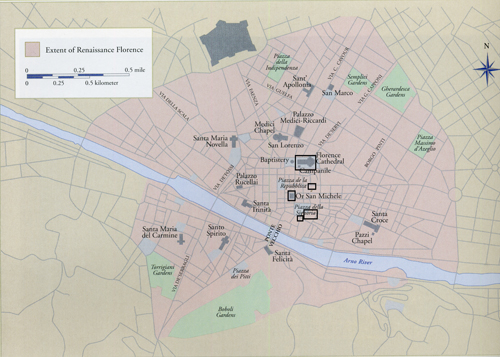
FIGURE 7.1. Map of Renaissance Florence, with locations of tamburi marked by black boxes.
Map by Allie Terry-Fritsch.
[163] The practice of secret denunciation in Florence began at the beginning of the fourteenth century as a means of encouraging members of the popolani to speak out against powerful magnates.3 It was believed that the anonymity of the denunciation process would protect informers from vendetta or social backlash, while at the same time, allowing for a form of resistance against the abuses by those who had disproportionate power in the city. Yet, in the fifteenth century, the denunciations took on a new form—moralized tattling—that exposed the secrets of fellow citizens’ sexual, social, or religious behaviors. The boxes used to collect the denunciations were controlled by several branches of a Florentine moral task force, including the Conservatori delle leggi, Ufficiali di notte, Conservatori dell’onestà dei monasteri, Ufficiali dell’onestà, and the Otto di guardia, who worked together to channel communication between the society and the judicial authority.4 Other cities, including Venice, Lucca, and Genoa, also had task forces and methods for policing deviance, yet the city of Florence was, as Michael Rocke and others have discussed, a central focus of this campaign due to its widespread reputation as a sodomitic city that was filled with deviant activities.5 As such, the Florentine officers of all branches of the task force had much [164] greater autonomy than the other “public morals” commissions and were encouraged to use creative means to locate offenders.6 These included the use of spies and monetary incentives for informants to come forward, but, most importantly, the officers relied on the secret denunciations collected from the tamburi located throughout the city center.7
The task forces sought information, above all, about immoral and illegal activities performed by Florentines, from sexual crimes to gambling to blasphemy, that were largely unknowable to a general public and therefore difficult to enforce. To gain access to knowledge on the ground, they imposed certain framing devices on the denunciation process itself that encouraged individuals to offer this information about family members or neighbors freely despite the disruption of sociability that often arises from interfering with and policing others. By formulating the denunciation process as a civic duty imperative to perform, the moral task forces, assisted by religious and political figures, urged citizens to place the integrity of the city above the social bonds of family and neighborhood.8 Telling the secrets of others was portrayed as the ultimate act of contributing to the good of the community, since the revelation of hidden deviance within the city would effect its removal and contribute to the purity of the city.9 In this way, the denunciations were used to bridge the space occupied by those on the ground with those above and thereby negotiated the dynamic of power perceived and experienced by both.
This essay considers the strategies and tactics of the denunciation system in fifteenth-century Florence to examine how the placement and use of tamburi within key ritual sites impacted communal interaction in the Renaissance city. Drawing on Michel de Certeau’s use of the terms “strategies” and “tactics,” the essay designates strategies as the various methods used by those in control of spaces to police and manipulate behaviors within them and tactics as the methods employed by the actual users of those spaces. These users were not in possession of the space, but nonetheless they occupied it and maneuvered through it according to either preestablished rules or by alternative routes.10 The tamburi may be approached as strategies that fostered heightened awareness of visibility within the Renaissance city, both the visibility of individuals to others and [165] of others to the individual. Their physical placement within select architectural spaces impacted the perceived layers of control already implied in these buildings’ function and use, and the moral agencies in charge of their erection and upkeep anticipated how the symbolic meaning and social value of these spaces would underscore the moral imperative to use them both to reveal information about others and to avoid the behaviors that would lead to denunciation. Nonetheless, the tactics employed by individuals and groups within the city—those time-based interactions within the spaces themselves—were unpredictable and therefore never fully visible. Ultimately, these tactics counteracted the power of the tamburi, and in certain cases, caused their failure.
—————
For at least the last three decades, from Richard Trexler’s groundbreaking work on public life and ritual to Roger Crum and John Paoletti’s insightful anthology on the social history of Florence, scholars of the medieval and early modern periods have increasingly acknowledged that the space of the Renaissance city cannot be disengaged from the bodily presence of those who inhabited it.11 Urban spaces were theaters of performative activities and, like the saint represented in the holy image, only came alive in the presence of the beholder.12 The center of the Renaissance city was the key zone of the social drama of everyday and festal life.13 The diverse publics who were given access to it generated a collective, or shared, gaze of the spectacle of the everyday; these visual interactions were operations of seeing and being seen with the urban theater.14 As though performing on a circular stage, the populace on the streets and in the collective spaces of civic and religious buildings participated in a continuous interchange of gazes that bound them together.
As John Najemy has discussed, the inner city was purposefully redesigned in the late thirteenth and early fourteenth centuries to reveal its openness to the Florentine community and, through ritual engagement, its spaces became “loci of political action [and] performance” that were accessible to the populace as a whole.15 Urban planning in the fifteenth century further defined this space through the focused attention of public works projects, which visually connected the city’s buildings and monuments to the political rhetoric of the Republic and represented the Florentine populace as part of a community defined by its libertas.16 At the same time, newly constructed, large private homes within the center of the city oriented their palace façades toward the public on the street and in the piazze.17
[166] The tamburi were concentrated in this most public arena of everyday life. Indeed, their positioning created a focused inner ring of surveillance within the most highly trafficked area of the city center in the fifteenth century (see fig. 7.1).18 Situated within Florentine churches and courts of law, the tamburi were placed in “open spaces”; that is, spaces that fostered public access and interaction and thereby opened this public to mutual inspection and visibility.19 Sites included the Cathedral of Santa Maria del Fiore, the Palazzo della Signoria, San Piero Scheraggio, Orsanmichele, and the Palazzo del Podestà. These spaces were socially significant to every Florentine, not just to individuals or communities on the neighborhood or parish level.20 As key ritual sites in the city, these locations were connected to Florentine identity through their real and symbolic associations to the church, government, and labor guilds. Each site was framed by its collective purpose, and the users of these spaces generally were guided into them by collectively recognized behavior.
The selection of these particular architectural sites to house the tamburi was contingent on the buildings’ function as symbolic frames for the staging of institutional and individual performances of civic duties and the upholding of civic virtues in Florence. For example, in addition to the heavy symbolic weight of Santa Maria del Fiore as the religious anchor of the city, visualized by its massive dome that embraced the entire city under its shadow, the cathedral also increasingly became a showcase for the celebration of famosi cives throughout the fifteenth century.21 Leon Battista Alberti claimed that the placement “in sacred and easily visible places the portraits of those who have been benefactors of humanity, or whose memory . . . deserves to be venerated as a divinity, in order that, through this worship, future generations in their thirst for glory strive to imitate their virtues.”22 Monuments and painted cenotaphs dedicated to men who brought honor to the city were commissioned and erected inside the Florence Cathedral from 1395 and continued through the end of the fifteenth century, including monuments to famous condottieri, theologians, poets and artists.23 In such a holy and respected space, the images of famous citizens of Florence ideally inspired their spectators to emulate their behavior and to contribute also to the good of the city. On the other hand, the tamburo that was erected within the sacred space drew attention to infamous deeds that were occurring outside the church walls. The contrast between the honorific setting of the cathedral and the disgrace of being named in a denunciation drew attention to the moral performance at play in the use of the tamburo: an individual asked to denounce a citizen-deviant did so within the symbolic frame of the performance of civic, as well as divine, duty.
[167] The placement of a tamburo within the Palazzo della Signoria, the government headquarters of Florence, likewise built upon the rhetoric of civic participation and authority inspired by both the material structure of the actual palace and the reverent actions that it housed. The soaring tower of the fortified edifice projected the image of the political strength of the Republic onto its citizens in the piazza below, and the co-sacredness of the site and the institution it housed were augmented through the addition of altars and ceremony.24 A tamburo placed in this highly charged space would have communicated a civic imperative to the users of the building to uphold the values embedded in its history.
Another tamburo was placed within the Palazzo del Podestà, located between the cathedral and the governmental palace to the east, which served as the judicial headquarters and residence of the chief magistrate of the city (fig. 7.2). Its monumental structure and crenellated bell tower, like that of the governmental palace, visually conveyed the impression of the authority and strength of the city and its administration.25 The palace and its civic function were critical to the collective perception of security in the city, and this was reiterated at times with spectacles of justice performed within its spaces. A tamburo placed here held particular significance as an active agent in the rituals of civic cleansing performed by the building’s inhabitants and seen both inside its walls and throughout the urban landscape.26
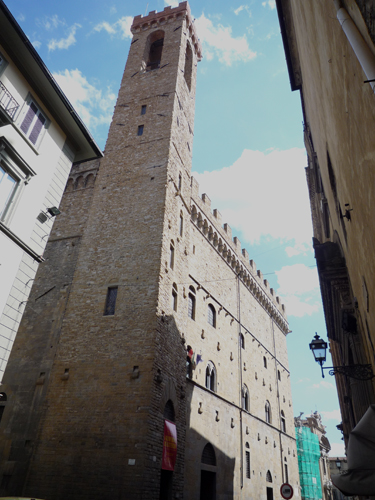
FIGURE 7.2. Exterior of the Palazzo del Podestà (Museo Nazionale del Bargello), Florence.
Photo by author.
The remaining locations of tamburi in fifteenth-century Florence were all spaces attributed with sacred and civic weight, and their geographical positions in the city were located on the major thoroughfares connecting the Piazza del Duomo with the Piazza della Signoria, forming a pedestrian ring in the very center of the city. In addition to their symbolism, the popularity and accessibility of these locations to the Florentine community at large would have ensured that the tamburi at least were seen, if not used. For example, Orsanmichele, positioned in the highly trafficked zone of the guilds and the market, drew in a large and diverse audience of devotees to its miracle-working icon of the Virgin,27 and the church of San Piero Scheraggio, located next to the Palazzo della Signoria to its south, was highly visible within the urban landscape.28 The task force in charge of administering the tamburi strategically selected these spaces for their usefulness in publicizing their cause.
[169] For the denunciation process to have functioned according to the design of the moral task force, individuals had to first witness deviant behavior, then take the initiative to communicate this deviance to the authorities. This entailed the writing down of the denouncement, travel to one of the sites featuring a tamburo in the center of the city, and the deposit of the note in the box. The denouncer in Florence was not obliged to reveal his or her identity, although those who did so were offered an award for information.29 Most extant denouncement records are left unsigned, which suggests that there were heavy social consequences that accompanied the open transmission of the secrets of members in the community.30 The anonymous transmission of these secrets, however, was widely practiced. Thousands of unsigned denunciations are recorded in registers—called tamburagioni—throughout the period under discussion, indicating that the strategies used by the task force to convince members of the Florentine populace to tell on their fellow citizens were effective. To this end, the agencies were assisted greatly by the mendicant preachers, who advertised the locations of the boxes and gave instructions on how to use them. Sermons delivered from the pulpits of churches throughout the city urged citizens to consider the spiritual welfare of both the offending individuals and the civic body as a whole.31 It was presented as the moral imperative of every Florentine to alert the authorities of wrongdoings so that the city could be purified and protected.
Yet one obstacle to complete anonymity in the Florentine denunciation process was the highly visible localities of the tamburi themselves. As mentioned above, each building that housed a tamburo in Florence was a ritually significant and well-frequented site within the city center. If the social pressure against openly telling on other members in the community was so great as to force a denouncer to remain anonymous and thus to forgo a financial reward, then how did the identity of the denouncer remain a secret when he or she had to transmit it in plain sight of the community? The introduction of the tamburi into such openly accessible and highly visible spaces suggests that a cycle of surveillance was placed into effect in these ritual zones of the city. The watching for and telling on the immoral behavior of others inspired a new kind of watching out for those who informed.
More information on the specific locations of the boxes within each of the buildings would enable a deeper analysis of how space, place, and the gaze functioned within each site, yet the recovered documentation is silent in this regard. It is unknown, for example, if the tamburi were located in private or secluded zones within the churches and courts or whether they were placed at entrances or other highly trafficked areas. Furthermore, the physical fabric of these buildings was altered, sometimes considerably, over the course of the fifteenth century; thus it is also unclear whether the boxes moved and adapted to these architectural and decorative changes. For example, [170] until the consecration of the Cathedral of Santa Maria del Fiore by Pope Eugenius IV in 1436, masses were only performed in the nave and aisles since work on Brunelleschi’s cupola prevented any congregating in the tribunal areas.32 Throughout the fifteenth century, altars were situated along the walls of the aisles and the interior wall of the façade, and paintings were erected on the pilasters throughout the church.33 Certain areas within the cathedral received particular attention due to popular devotional practices, such as the veneration of the so-called Madonna della Pila that was located near a basin of holy water in a corner of the church, or the gathering of the people around the altars of the Trinity and Madonna gratiarum plenissima that were located on the inner façade wall.34 Perhaps the tamburo in the cathedral was placed in proximity to one of these, in order to capitalize on the traffic of the congregation?
The most detailed information on the position of a tamburo within Florence is that once located within the Palazzo del Podestà, placed in the loggia on the primo piano of the inner courtyard (fig. 7.3).35 The tamburo’s position illustrates how the identity of a secret denouncer could become public through the delivery of the written note, for the loggia was exposed visually to the community, who gathered in the adjacent courtroom as well as in the open courtyard below. In this spatial configuration, the one who performed the denunciation had the potential to be under the visual scrutiny of the attending members of the community. That is, the watcher became the watched. Even individuals who were not denouncing, but who stood in close proximity to the box, could be associated with the act, and this too could produce damaging consequences to reputation and social ties.36 Thus the spatial placement of the tamburo in visually accessible locations extended the notion of policing others to include self-regulation as well. Individuals needed to be mindful of how they acted and where they moved lest others misinterpret their behavior.
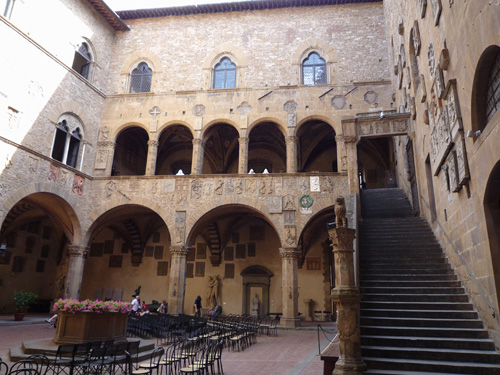
FIGURE 7.3. Interior courtyard and loggia of the of the Palazzo del Podestà (Museo Nazionale del Bargello), Florence.
Photo by author.
Self-regulation within the Renaissance city was not a new phenomenon introduced by the presence and use of the tamburi. Each space that housed one already functioned within collectively understood layers of control and the users of these spaces behaved accordingly.37 Yet each building also was designed to accentuate the powerful control of a top-down gaze, with God, of course, at the top of the ultimate panopticon in heaven.38 The invisible surveillance of the all-seeing eye of God created a permanent visibility of the public whether inside or out. To enhance visually the presence [171] of the divine gaze, the architecture and decoration of both church and court emphasized God’s continual presence as a judge of actions on earth. Religious structures within the city were considered to be, in the words of San Bernardino of Siena, “the place and hotel of God.”39 In the courts of law too, God’s penetrating gaze was once visualized in frescoed Judgment imagery in the courtroom and confession chapel, and in the deliberation chambers of the chief magistrate, stars filled the ceilings to indicate the open channels of communication between heaven and earth.40
Thus the surveillance inspired by the tamburi built on the visual rhetoric of divine regulation and the subsequent behavioral practices of self-regulation already inspired by the frames of the buildings. Yet several documented instances of tactics employed by individuals on the ground indicate that the sacral weight and authority of the heavenly panopticon was not easily translated [172] to the modes of surveillance instigated by the tamburi. In the nearby town of Prato, governed during the fifteenth century by the same moral agencies as Florence, an individual or group of individuals tore down the tamburo that was affixed inside the local parish church in 1482.41 The vandal, or vandals, then escaped back into the night, never to be identified by the local authorities. The Prato tamburo became a repeated target: less than a year before, another tamburo had been anonymously destroyed within the church, and two more boxes would suffer the same fate within the next few years.42 Other churches in Pisa, Empoli, and Arezzo also recorded incidents of vandalism against the boxes, and thus similarly point to the ways in which the denunciation process caused unwanted social disruption.43 Whether the individual or individuals who destroyed these boxes were part of a communal effort is unknown, although their actions may be read as a critique of the religio-political system. Through tactics of resistance in the form of destruction of the inanimate agent of this system, the box itself, these individuals rejected the moralized tattling put into play by the denunciation process.44
The denunciation system was flawed both in terms of the corrupt practices it inspired and in the way the tamburi significantly changed the mode in which transgressions were revealed within Florentine society. Since accusers were not required to identify themselves, spurious denunciations found their way into the tamburi. It is difficult to pin down what the motivations were for the creation of false accusations. They could, in part, represent the response of an overly watchful and morally righteous citizenry within the hypervigilant environment of moral policing.45 The full-scale campaign by the Florentine government to impose control on deviant practices in the fifteenth century extended from official revisions of the law and increased regulations imposed on taverns and other sites associated with male sociability to the unofficial, but in many ways much more powerful, sermons on the moral imperative to expose the deviance of neighbors and family. In this light, the false denunciations may be read as zealous attempts to benefit the community.
However, the anonymity of the denunciation process also allowed for the purposeful falsification of information for political or social reasons.46 Indeed, as Andrea Zorzi has demonstrated, the [173] defamation of political rivals or personal enemies through the exposure of their real or falsified deviant behavior was a consistent feature of the denunciations that were retrieved by the Conservatori delle leggi.47 The damage to political or social reputation that the denunciations, even if unsupported by evidence, could bring upon an individual was potentially quite significant and often led to partisan attempts to discredit officeholders in the city.48 Tamburi provided the concrete means for social disruption and damage.
The erection and use of the tamburo also challenged the social fabric of the community through its production of non-negotiated acts of confession for others. In fifteenth-century Florence, the efficacious revelation of particular secrets—including confessions of sin and confessions of crimes—depended on the embodied presence of the informer. As a form of ritualized telling and listening, the confession of the sinner in church or the criminal in court was a social performance ideally instigated by the offending individual. The verbal utterance of the confession, coupled with appropriate bodily gestures, served to open the secret to the public, and created new social bonds between the teller, listener, and other witnesses to the secret’s revelation. The denunciation box, on the other hand, denied the critical social function of confession by eliminating the social negotiation of the secret and its revelation. It substituted the sociability of the secret with an invisible field of surveillance.
Since the Lateran Council of 1216, all Christians were required to confess their sins to a priest at least one time per year.49 These confessions were socially negotiated through their openness—confessions occurred on the altar and in front of members of the parish—and, as a consequence, they provided a direct verbal and visual connection of the past deed to the confessant. Choreographed movements of the body, such as lowered eyes, kneeling to the side of a confessor, and tears, were visible signals of a penitent’s shame and humility. Fra Jacopo Passavanti, the Dominican prior of Santa Maria Novella, preached to Florentines in the trecento, “To be the person who wants to confess well, one has to go to the feet of the priest sorrowfully and repentant of every sin. . . . What the malefactor must do before the judge who has to judge him, is to throw himself humbly at his feet, either sitting or kneeling, in such a manner that he is at his side rather than before him.”50 The performative nature of confessions—both the verbal ownership of the transgression through the utterance of the sinful act and the gestural performance of kneeling, bowing the head, and so on—created a visual spectacle of penitence for the community, who, along with the priest, witnessed the embodied confession as a part of the healing process.51 Furthermore, unlike the aftermath of the denunciation process, confessions within the church could be followed by the negation of the sin through absolution by the priest.
Confessions were also stressed as premeditated acts that were the result of self-reflection and preparation. In his confessional manual, Lo specchio de’ peccati, Domenico Cavalca told his readers that confessions “should be simple . . . humble, pure, faithful, true, frequent, naked, tearful, rapid, [174] whole, and prepared beforehand.”52 Likewise, San Bernardino of Siena, urged the laity to “prepare yourself beforehand, and so you will begin to recollect your misdeeds.”53 Passavanti even went so far as to encourage the laity to write down their transgressions and bring these written notes to confession.54 In exchange for a confession performed well, an individual could expect absolution of sin and full confidence that the confessor would keep what had been confessed by the confessant a secret.55
Confessions within the context of the criminal justice system likewise insisted on the bodily presence of the confessant. Indeed, the perception of efficacy within the Florentine justice system depended on the connection of the criminal with the crime through the choreographed display of the convicted body during rituals of execution.56 The confession of a crime needed to be embodied in order to legitimate the judicial process and to underscore the righteousness of the community at large. As a revelation of “truth” by the criminal, the confession was the proof of both justice and the criminal’s willingness to accept responsibility for his or her actions.57 The subsequent exposure of the criminal to the community, often upon a raised cart, during the procession to the gallows was a recognized indication that the confession had been uttered and witnessed, so that the process of justice could be fulfilled.
In both the confession of sin within the church and the confession of crime within the justice system, the community had the opportunity to bear witness to what Foucault has described as the “production of truth.”58 The confessant “was authenticated by the discourse of truth he was able or obliged to pronounce concerning himself.”59 The introduction of tamburi into the spaces of the church and courts of law in Florence, however, denied that self-authenticating function of confession. It ruptured the ritual of discourse “in which the speaking subject is also the subject of the statement” by introducing a third, invisible or anonymous party into the power relationship of the confession process.60 In other words, it upturned the confessional discourse by making it an involuntary process, as opposed, ideally, to a self-obligation to confess.
The tamburo literally encased secret denunciations within its hidden interior and thus concealed them from public consumption either in verbal or visual form. The truth produced through this process, therefore, denied the critical function of confession to outwardly display the signs of shame felt by the confessant at the sin or crime committed.61 The community was excluded from [175] both the staging of the actual denunciation (i.e., one party verbally accusing another while at the same time providing a visual spectacle of the accusation), and the socially negotiated reaction to the denunciation as well (i.e., the coproduced communal response to the spectacle of accusation). In this context, the anonymous denunciations within the tamburi must be seen in contrast to the transmission of disgruntled voices of Rome in the sixteenth century on so-called speaking statues like Pasquino (fig. 7.4). Through verbal witticisms and satirical verses attached to the base of the statue, the ancient statue became animated as a transmitter of resistance against the institutional powers of Rome. The statue was thus a site of staged confrontation. Yet, Pasquino’s allure then (and now) was precisely due to the public platform for words that were transmitted. As Verity Platt has discussed, visitors to the statue are there not simply to look, but to read.62 The openness of the anonymous words—both their physical accessibility and their often carefully crafted content—explicitly signaled that they were created for a public audience who would gather to either concur with or refute their claims. Through the accumulation of voices in the form of anonymously written words, and their subsequent public revelation in the form of crowds arranged around the statue, the community united and affirmed its agency as participants in the production of knowledge and their community at large.
This image is available in the print edition
FIGURE 7.4. Nicholas Beatrizet, Pasquino, engraving. Collected and published by Antoine Lafrery in Speculum Romanae Magnificientiae, Rome, 1550. London, British Museum.
© Trustees of the British Museum.
The denunciations, on the other hand, were not designed for communal view, and their authors were not praised for eloquence or wit. Because the author’s words were never revealed publicly, they were not performed, even through a “speaking” figurehead like a statue or institutional figure. Thus the community did not physically gather around the site of the tamburo in a collective act. Rather, the various moral agencies in the city would take the denunciations as points of departure for privately rooting out networks of deviancy in the city through a process on the ground, even though administered by those above. When a denounced individual was brought in for questioning, he or she was expected to repeat the denunciation process, since an individual in front of the moral agency was required to further reveal the secrets of others as part of his or her admission of guilt.63 Indeed, individuals who snitched on others were given financial benefit in the form of a reduced penalty for deviancy. This hoped-for leniency ultimately compromised the authenticity of the confession and privileged the self or individual over the good of the community.64
—————
This essay has examined the space of the urban theater of Florence and reconstructed the ways in which tamburi produced new modes of seeing and being seen in the city. Central to this discussion is the concept of surveillance, most closely associated with Michel Foucault’s analysis of modern policing, but here used to describe an early form of panopticism inspired by the denunciation process from the ground up.65 The material presence of tamburi in fifteenth-century Florence [177] served as a powerful tool for the control of behavior, and their placement within key sites in the city center fostered a new form of policing that arguably impacted the way in which the community gathered. While the contents of the box were unknown, its open slot for the insertion of denunciations signaled the constant presence of surveillance—a controlling gaze that functioned through its potentiality. The tamburo served to remind every individual that he or she was under continual watch by his or her neighbor, and, conversely, that each member of the community was to be vigilant in his or her own gaze. The box—and the administrative agencies that maintained it—asked each individual to police and be policed. In addition to the physical presence and use of the boxes, the simultaneous rise of particular preaching strategies called for collective moral vigilance that justified and perpetuated the increasing layers of surveillance in the city.
Renaissance sociability was challenged by the institution of the tamburi, particularly in the disruption of embodied rituals of confession by the invisibility of the informant in the Florentine denunciation process. The anonymity of the informant negated what Michel de Certeau has called the “terrain of strategic relations” between actors of secrecy; that is, it disrupted the social play that occurs between an individual who tries to conceal a secret and another who attempts to reveal it.66 While there were still at least two actors involved in the denunciation process, the doer and the teller, the tamburo fostered non-negotiated transmissions of secret information. Through the full-scale adoption of strategies of secrecy to collect information about deviant individuals, the various moral police agencies in Florence eliminated the perceived authenticating function of self-disclosure of information, such as one finds in the face-to-face encounters of accusations in ordinary courts and confessions on the altars of churches.67 Instead, it provided a means for denouncers to avoid the social ramifications of their actions.
Ultimately, the urban space of Florence functioned as a network of secrecy in the fifteenth century. The insertion of a tamburo into the most sacred Florentine buildings of the city center impacted what Edward Muir and Ronald Weissman have called the “networks of space-based sociability and symbolic geography” that made up the practice of everyday life during the Renaissance period.68 The public’s inability to access the secrets within the tamburi turned their interiors into spaces of political and psychological monumentality. The denunciations gathered within them had very real potential to defame character and destroy familial or neighborhood ties; their restricted access only increased their perceived influence. Indeed, as is so often recognized with strategies of rule or the creation of sacred objects, sites, and individuals, that which remains hidden augments in power.69 As the mechanisms by which these powerful secrets were transmitted, the tamburi altered the symbolic unity of the city center and challenged the social bonds of the city. They functioned through the frames imposed upon them by the buildings’ civic meaning and communal character, and yet, the vigilance inspired by these boxes disrupted the sociability of the very sites that were supposed to reinforce the collective interests of the community.70
[178] Various real or imagined communities that were constituted through the implementation of the tamburi could have been served by the secrecy of the denunciations. Since the accusation process was hidden, it implicated each member of the community as a potential author of denunciations, and thereby augmented the agency of the individual as a potential participant in the containment of deviancy in the city. In these terms, the secret that was transmitted through the placement of notice in the drop-box could represent the individual expression of complicity with the government but also a shared social desire to make sure that the city was a safe, morally pure space. This shared social desire manifested itself at times throughout the fifteenth century in neighborhood collectives, which jointly denounced the bad behavior of another neighbor either in face-to-face confrontations or in communally written denunciations.71 Certain denunciations, written by familiars of the accused, indicate that some individuals drew upon the power and authority of the moral agency to “put a little fear in” the deviant to force him to change his ways.72 As such, the boxes may be understood to reinforce communal bonds through the active engagement of the community in the judicial process.
Yet, the hidden words also functioned to divide the community and deter open sociability, since, by means of their enclosure within the sealed tamburo, the secret denunciations represented a potential threat to every individual in the community. The material presence of the box and its implied secrets pointed to the increasing controls placed on the communal body through the development of new administrative and judicial offices as well as the policing gaze of the community from the inside.73 The threat of denunciation was communicated through the exchange of real and imagined gazes of members of the community within the systems of surveillance fostered by the church, government, and community itself.
Perhaps this is why the boxes were ultimately deemed ineffectual. Taken down or left abandoned, their presence no longer impacts the day-to-day practices of the inhabitants of their spaces. Their history, however, through its record here, no longer remains a secret.
An early version of this essay was presented at the Annual Conference of the College Art Association in Los Angeles in 2009, and I thank Tim McCall and Sean Roberts for their key insights on the project, as well as the audience for their feedback. I am also grateful for the critical discussion of the essay by my colleagues in the Division of Art History at Bowling Green State University, as well as members of the Visual and Cultural Studies Faculty Group at the Institute for the Study of Culture and Society at BGSU, especially Scott Magelssen, Jolie Sheffer, Bill Albertini, Emily Lutenski, and Clayton Rosati. Special thanks also go to Michael Rocke and Nicholas Terpstra, who read and commented on earlier drafts. Lastly, I thank Stefan Fritsch, Chriscinda Henry, Fabian Lange, and Matthew Shoaf for their assistance in locating and photographing extant denunciation boxes in Florence and Venice, and Rebecca Zorach for sharing her photograph of Pasquino.
Bibliography
Archival Sources
Cavalca, Domenico. Lo specchio de’ peccati, Biblioteca Nazionale, Firenze, MS Pal. 91, fol. 25r.
Statuti del Comune, Archivio di Stato, Firenze, 1, c.11r.
Printed Sources
Alberti, Leon Battista. De re aedificatoria. Vol. 6. Edited by Giovanni Orlandi. Milan: Edizioni Il Polifilo, 1966.
———. On Painting. Translated by Cecil Grayson. London: Phaidon Press, 1972.
Alexopoulos, Golfo. “Victim Talk: Testimony and Denunciation under Stalin.” Law and Social Inquiry 23, no. 3 (1999): 637–54.
Austin, John Langshaw. How to Do Things with Words: The William James Lectures Delivered at Harvard University in 1955. Edited by James Opie Urmson. Oxford: Clarendon, 1962.
Bakhtin, Mikhail. Rabelais and His World. Translated by Helene Iswolsky. Bloomington: Indiana University Press, 1984.
Barthes, Roland. Empire of Signs. Translated by Richard Howard. New York: Noonday, 1992.
Belting, Hans. Likeness and Presence: A History of the Image before the Era of Art. Translated by Edmund Jephcott. Chicago: University of Chicago Press, 1994.
Bennett, Tony. The Birth of the Museum: History, Theory, Politics. London: Routledge, 1995
Bentham, Jeremy. The Panopticon Writings. Edited by Miran Bozovic. London: Verso, 1995.
Bernardino of Siena. Prediche volgari inedite. Siena: E. Cantagalli, 1935.
Bruni, Leonardo. “Panegyric to the City of Florence.” In The Earthly Republic: Italian Humanists on Government and Society, edited by Benjamin Kohl and Ronald Witt, 135–75. Translated by Benjamin Kohl. Philadelphia: University of Pennsylvania Press, 1978.
Busignani, Alberto, and Raffaello Bencini, Le Chiese di Firenze. Florence: Sansoni, 1982.
Cohen, Thomas, and Elizabeth Cohen. Words and Deeds in Renaissance Rome: Trials before the Papal Magistrates. Toronto: University of Toronto Press, 1993.
Crum, Roger, and John Paoletti, ed. Renaissance Florence: A Social History. Cambridge, UK: Cambridge University Press, 2006.
de Certeau, Michel. The Mystic Fable: The Sixteenth and Seventeenth Centuries. Vol. 1. Translated by Michael B. Smith. Chicago: University of Chicago Press, 1992.
———. The Practice of Everyday Life. Translated by Steven Rendell. Berkeley: University of California Press, 1984.
Dorini, Umberto. Il diritto penale e la delinquenza in Firenze nel secolo XIV. Lucca: Domenico Corsi, 1923.
Durkheim, Emile. “Ritual, Magic, and the Sacred.” In Readings in Ritual Studies, edited by R. L. Grimes, 188–93. Upper Saddle River, NJ: Prentice Hall, 1996.
Edgerton, Samuel, Jr. “Icons of Justice.” Past and Present 89, no. 1 (1980): 23–38.
———. Pictures and Punishment: Art and Criminal Prosecution during the Florentine Renaissance. Ithaca, NY: Cornell University Press, 1985.
Fantozzi, Federico. Nuova guida della città di Firenze. Florence: Gius. e Fratelli Ducci, 1844.
Fitzpatrick, Sheila, and Robert Gallately. “Introduction to the Practices of Denunciation in Modern European History.” Journal of Modern History 68, no. 4 (1996): 763–67.
Foucault, Michel. Discipline and Punish: The Birth of the Prison. Translated by Alan Sheridan. New York: Vintage, 1977.
———. The History of Sexuality: An Introduction. Vol. 1. New York: Vintage Books, 1990.
Freedberg, David. The Power of Images: Studies in the History and Theory of Response. Chicago: University of Chicago Press, 1989.
Frosinini, Cecilia. “Paintings and Church Furnishings Between the Thirteenth and Fifteenth Century.” In The Cathedral of Santa Maria del Fiore in Florence, vol. 2, edited by Cristina Acidini Luchinat and translated by Anthony Brierly, 194–201. Florence: Cassa di Risparmio di Firenze, 1995.
Gallately, Robert. “Denunciations in Twentieth-Century Germany: Aspects of Self-Policing in the Third Reich and the German Democratic Republic.” Journal of Modern History 68 (1996): 931–67.
Geertz, Clifford. The Interpretation of Cultures: Selected Essays. New York: Basic Books, 1973.
Hartt, Frederick. “Art and Freedom in Renaissance Florence.” In Essays in Honor of Karl Lehmann, edited by Lucy Freeman Sandler, 114–31. New York: New York University, 1971.
Jansen, Katherine Ludwig. The Making of the Magdalen: Preaching and Popular Devotion in the Later Middle Ages. Princeton, NJ: Princeton University Press, 2000.
Labalme, Patricia. “Sodomy and Venetian Justice in the Renaissance.” Legal History Review 52 (1984): 217–54.
Lea, Henry Charles. A History of Confession and Indulgences in the Latin Church. London: Swan Sonnenshein, 1896.
Lochrie, Karma. Covert Operations: The Medieval Uses of Secrecy. Philadelphia: University of Pennsylvania Press, 1999.
Magelssen, Scott. “Rehearsing the ‘Warrior Ethos’: ‘Theatre Immersion’ and the Simulation of Theatres of War.” TDR: The Drama Review 53 (2009): 47–72.
McCall, Timothy. “The Gendering of Libertas and the International Gothic: Carlo Crivelli’s Ascoli Annunciation.” Studies in Iconography 30 (2009): 168–97.
Micheler, Stefan, and Patricia Szobar. “Homophobic Propaganda and the Denunciation of Same-Sex-Desiring Men under National Socialism.” Journal of the History of Sexuality 11, no. 1 (2002): 95–130.
Mormando, Franco. The Preacher’s Demons: Bernardino of Siena and the Social Underworld of Early Renaissance Italy. Chicago: University of Chicago Press, 1999.
Muir, Edward, and Ronald Weissman, “Social and Symbolic Places in Renaissance Venice and Florence.” In The Power of Place: Bringing Together Geographical and Sociological Imaginations, edited by John Agnew and James Duncan, 81–103. London: Unwin Hyman, 1989.
Najemy, John. “Civic Humanism and Florentine Politics.” In Renaissance Civic Humanism: Reappraisals and Reflections, edited by James Hankins, 75–104. Cambridge: Cambridge University Press, 2000.
———. “Florentine Politics and Urban Spaces.” In Renaissance Florence: A Social History, edited by Roger Crum and John Paoletti, 19–54. Cambridge: Cambridge University Press, 2006.
Passavanti, Jacopo. Lo Specchio di vera penitenza. Florence: Libreria Editrice Florentina, 1925.
Platt, Verity. “‘Shattered Visages’: Speaking Statues from the Ancient World.” Apollo (2003): 9–14.
Poggi, Giovanni. Il Duomo di Firenze. 2 vols. Edited by Margaret Haines. Florence: Medicea, 1988.
Richa, Giuseppe. Notizie istoriche delle chiese fiorentine. Vol. 6. Florence, 1758.
Rinaldi, Sara, Aldo Favini, and Alessandro Naldi. Firenze Romanica: Le più antiche chiese della città, di Fiesole e del contado circostante a nord dell’Arno. Empoli: Editori dell’Acero, 2005.
Rocke, Michael. Forbidden Friendships: Homosexuality and Male Culture in Renaissance Florence. New York: Oxford University Press, 1996.
Rubenstein, Nicolai. The Palazzo Vecchio, 1298–1532: Government, Architecture, and Imagery in the Civic Palace of the Florentine Republic. Oxford: Clarendon, 1995.
Ruggiero, Guido. The Boundaries of Eros: Sex Crime and Sexuality in Renaissance Venice. New York: Oxford University Press, 1985.
Strocchia, Sharon. “Theaters of Everyday Life.” In Renaissance Florence: A Social History, edited by Roger Crum and John Paoletti, 55–80. Cambridge: Cambridge University Press, 2006.
Terry, Allie. “The Craft of Torture: Bronze Sculpture and the Punishment of Sexual Offense in Early Modern Italy.” In Sex Acts: Practice, Performance, Perversion and Punishment in Early Modern Italy, edited by Allison Levy, 272–96. Burlington, VT: Ashgate, 2010.
———. “Criminals and Tourists: Prison History and Museum Politics at the Bargello in Florence.” Art History 33, no. 5 (2010): 836–55.
———. “Criminal Vision in Early Modern Florence: Fra Angelico’s Altarpiece for ‘Il Tempio’ and the Magdalenian Gaze.” In Renaissance Theories of Vision, edited by John Hendrix and Charles Carmen, 45–62. Hampshire, UK: Ashgate, 2010.
Trachtenberg, Marvin. Dominion of the Eye: Urbanism, Art, and Power in Early Modern Florence. Cambridge: Cambridge University Press, 1997.
Trexler, Richard. Public Life in Renaissance Florence. Ithaca. NY: Cornell University Press, 1980.
Uccelli, Giovanni Battista. Il Palazzo del Podestà: Illustrazione storica. Florence: Tipografia delle Murate, 1865.
Villani, Giovanni. Nuova cronica. 3 vols. Edited by Giuseppe Porta. Parma: Fondazione Pietro Bembo and Ugo Guanda, 1990–91.
Watkins, Oscar D. A History of Penance. New York: Burt Franklin, 1961.
Zazzu, Guido Nathan. “Prostituzione e moralità pubblica nella Genova del ’400.” Studi genuensi 5 (1987): 45–67.
Zimmerman, T. Price. “Confession and Autobiography in the Early Renaissance.” In Renaissance Studies in Honor of Hans Baron, edited by Anthony Mohlo and John A. Tedeschi, 121–40. Dekalb: Northern Illinois University Press, 1971.
Zorzi, Andrea. “The Judicial System in Florence in the Fourteenth and Fifteenth Centuries.” In Crime, Society and the Law in Renaissance Italy, edited by Trevor Dean and K. J. P. Lowe, 40–58. Cambridge, UK: Cambridge University Press, 1994.
[182]