
SIR FRANK STENTON’S hISTORY of Anglo-Saxon England, first published in 1943, is a remarkable book that still sets the standard by which all other work is judged. The third edition of 1971 includes a few nods in the direction of archaeology, but it remains fairly and squarely based on documentary evidence. His first chapter, ‘The Age of Migration’, begins with these words:
Between the end of Roman government in Britain and the emergence of the earliest English kingdoms [the early seventh century] there stretches a long period of which the history cannot be written…The course of events may be indicated, but it is certainly not revealed, by the isolated or incidental references to Britain made by writers of this or the following age. For the first time in five centuries Britain was out of touch with the Continent.1
It’s the last sentence that I want to query here. Archaeology shows that from the end of the fourth century there are clear signs of contact between Britain and the Continent - to take just one example, the Grübenhaus that we encountered in the previous chapter at Orton Hall Farm. During the fifth and sixth centuries the archaeological record of southern and eastern Britain is almost overwhelmed by new styles of pottery and other objects that have close parallels on the European mainland. Archaeology, if not history, shows that, far from being ‘cut off’, people in eastern Britain were probably more closely in touch with communities across the North Sea than they had ever been.
We spent the last chapter in the realms of field archaeology, and concluded with the thought that the developments observed at Orton Hall Farm, and doubtless at Maxey too, were ultimately caused by changes, to use that horrid cliché, in the macro-economic climate. At the grassroots level, to use another, the structure, if not the organisation, of rural society probably remained largely unaffected by these changes: families or lineages continued to grow and the bulk of the population still lived in the same places - a theme I will return to in more detail in Chapter 8. Now I want to take a broader, historical view of the political events that led to the end of Roman rule in Britain.
The first point to make is that there was no sudden and dramatic collapse in which the stability of the Pax Romana (Roman Peace) broke down, as it were overnight, to be followed by chaos, anarchy and pillage. It would be a mistake to view the Roman period in Britain, or indeed elsewhere, as a time of absolute stability and order, when nothing changed, even if that is the impression one gets when visiting museums and tourist attractions such as villas and Roman towns. The Roman world could be a tumultuous place, with new emperors declaring themselves in charge, first to their troops and then to as many people as would listen. Consult any list of Roman emperors and it makes the English medieval monarchy, even during the Wars of the Roses, look remarkably stable. If, for example, we take the twenty emperors who reigned in the thirty-three years from 235 to 268, their average period in office works out at about nineteen months. If you leave out the eight-year reign of Gallienus, it is much less even than that.
It’s all a question of degree. The macro-political system of the Later Roman Empire may have been unstable, but that instability was usually confined to a relatively small number of senior army officers and political heavyweights. It did not often spill over into fully-fledged civil war. And of course every so often a remarkable emperor, such as Constantine or Theodosius the Great, would arise and the system would function like clockwork once again. To put this instability into perspective: even in the fourth century, Roman citizens were forbidden from carrying arms - and so far as we know it was a rule that was actually applied.2 That suggests a level of general stability within the Roman Empire that was not matched, even remotely, within barbarian Europe.
A list of the Roman emperors of the fourth and early fifth centuries
|
House of Constantius and their rivals: |
|
|
Constantius I (Augustus) |
305-6 |
|
Constantine I (‘the Great’) |
306-37 |
|
Constantine II |
337-40 |
|
Constans (mainly in the west |
337-50 |
|
Constantius II (mainly in the east) |
337-61 |
|
Nepotian |
350 |
|
Vetranio |
350 |
|
Magnentius |
350-3 |
|
Silvanus |
355 (in Gaul) |
|
Julian II (‘the Apostate’) |
360-3 |
|
Jovian |
363-4 |
|
House of Valentinian and their rivals: |
|
|
Valentinian I |
364-75 |
|
Valens |
364-78 |
|
Procopius |
365-6 |
|
Valentinian II |
375-92 |
|
House of Theodosius and their rivals: |
|
|
Theodosius I (‘the Great’) |
379-95 |
|
Magnus Maximus |
383-8 |
|
Eugenius |
392-4 |
|
Following the death of Theodosius (395) the Empire is split into two: |
|
|
In the West |
|
|
Honorius |
395-423 |
|
Marcus (in Britain) |
406 |
|
Gratian (in Britain) |
407 |
|
Constantine III |
407-11 |
|
In the East |
|
|
Arcadius |
395-408 |
|
Theodosius II |
408-50 |
|
Emperors continue in the East until the fall of Constantinople in 1453 |
AD shows that, with certain notable exceptions such Constantine the Great (306-37), Constantius II (337-61), Theodosius the Great (379-95) and, in the Western Empire, Honorius (395-423), the reigns were also short, and sometimes nasty and brutish to boot.3
It would be a mistake to see Britain as a place of little consequence in the Roman Empire. Britain was one of the most garrisoned of all Roman provinces, with about sixteen thousand legionaries and a fluctuating but often equal number of auxiliary troops; there was also a huge array of dependants, plus supply and support services.4 Not only does this reflect the fact that the native British population was large, well organised and certainly capable of resistance, it also suggests that Rome needed what Britain had to offer, and was prepared to pay the necessary price. But it should also be borne in mind that Britain was a useful place to ‘store’ troops.5
It has already been noted that Roman Britain was not a static society, and we will see that changes, for example in the organisation of towns and of the army, were well under way before the final years of Roman occupation. Later Roman Britain has a distinct character from the more Imperial or Classical Empire of the first and second centuries ad. This is not necessarily due to a process of disintegration, but of adaptation to broader political changes that were taking place elsewhere in the Roman world.6
One of the most important events of the Later Roman Empire, the official adoption of Christianity, had strong links with Britain. In the year 306, following the death of his father Constantius I, Constantine the Great was proclaimed emperor in York, by the army. In Guy de la Bédoye`re’s words this was an act of usurpation ‘which had unimaginable consequences for the history of the Western world, but much of what followed took place beyond Britain’.7 There was then a protracted power struggle which ended with Constantine’s defeat of his principal rival, Maxentius, at the Battle of Milvian Bridge in Italy in 312; many of Constantine’s victorious troops had been raised in Britain. Milvian Bridge left Constantine in control of the Western Empire, but another rival, Licinius, was still in power in the east. Constantine did not defeat him until 324.
Constantine the Great lived up to his name, but the manner in which he achieved this - by simple military might - would ultimately prove one of the major flaws of the Western Roman Empire. The process by which a new emperor was chosen had long been a problem, but Constantine’s example opened the gates to anyone who could muster sufficient military muscle. No longer did powerful or successful military leaders have any reason to curb their ambition - and the result was the instability of the state.
While the military and political leaders of the Empire were struggling for control, Christianity was rapidly growing in popularity among the population at large. One of its great strengths was its inbuilt organisation: if you accepted Christ, then you also accepted the Church and its hierarchy of priests and bishops. The Emperor Diocletian saw Christianity as a threat to the Empire, and ordered a great persecution in 303. Fortunately for them, the Christians of Britain and Gaul were not heavily affected by this purge, as their own ‘sub-Emperor’, Constantius I, was not anti-Christian, nor was his son Constantine the Great. It is ironic that Constantine, who seized power in such a ruthless fashion, was one of the more tolerant emperors. In 313 his Edict of Milan guaranteed total religious toleration throughout the Empire. Christianity was the favoured religion in the west, and after the defeat of Licinius in 324 Constantine extended the favour to the east.
Constantine’s long reign ushered in a new age of stability in Britain, much of which seems to have been centred, not surprisingly, on his old power base of York, the military part of which was extensively enlarged and refurbished. York, although the most magnificent of the early-fourth-century civil and military works, was by no means alone. Many town walls were augmented with bastions during the fourth century; villas in the countryside, too, had additional yards and wings built onto them. There are many Roman villas in southern Britain, and they are best understood as buildings and workplaces that functioned within a working landscape. They were essential to its smooth operation, and can be seen as the Romano-British equivalents of Victorian country houses; they included comfortable rooms for the squire and his family, but provision was also made for estate workers.
I have already mentioned the Nene Valley pottery workshops.8 They were well established by the end of the second century, and flourished throughout the third and fourth. It would appear that they were still in full production at the beginning of the fifth century, but died out when their products were replaced by so-called Anglo-Saxon wares, which we now know from sites like Haddon and Orton Hall Farm were being produced in substantial quantities, probably in local workshops; by now the market, if such there was, was regional rather than national.* I have focused on the countryside around Durobrivae because it was a prosperous and not atypical Romano-British landscape. It was a setting that could be matched elsewhere in southern and Midland Britain in the fourth century, around places like York, Lincoln, Oxford and the Thames Valley. The south-eastern corner of Britain, north and south of the Thames estuary, which rose to prominence in the final decades of the Iron Age following Caesar’s campaigns in Gaul, continued to prosper.
Rural southern Britain in the third and fourth centuries was well populated, and criss-crossed with roads and trackways that kept the various farming settlements and larger estates in close touch both with each other and with the goings-on in town. It is my contention that a rural population that was by now well used to such sophisticated standards of communication would have accepted the macroeconomic changes that were taking place elsewhere in the Roman world - largely, I suspect, because they had no option. But because the farms and communities in each region would have stayed in touch with each other they would have adapted to the changing circumstances together, which would have given them both strength and flexibility. It is misleading to see the changes of the late fourth and early fifth centuries through modern eyes: to us, Roman civilisation seems vastly preferable to the Dark Age peasant economy; but was this necessarily such a stark contrast in rural areas? One could also question whether something like the decline in the standard of tableware was actually that important to people. It is entirely possible that these changes towards a simpler style of life meant that communities no longer had to bear a punitive tax burden, and in the process discovered the freedoms of self-determination.
To sum up, rural Romanised Britons in areas like the Nene Valley would not readily have given way to waves of Anglo-Saxon settlers, because they had too much to lose: their lifestyles may have altered
in certain not very important respects in the final years of the fourth and the start of the fifth centuries, but otherwise they lived much as before. Most important of all, their security lay amongst themselves. They hung together, and adapted themselves to the changing realities of the fifth century. Contrary to popular opinion, these new realities did not consist of social chaos and economic meltdown. If that were the case, how does one account for the large numbers of Romano-British sites which appear quite peacefully to have adopted new styles of pottery, dress and buildings? These are people who are making informed and rational decisions. They have been, and continue to be, in regular contact with each other, and are not being forced to do things that are antipathetic to them.
The peace and prosperity enjoyed by the Roman province of Britannia in the early to mid-fourth century can in large part be attributed to the long reign, the personality and the prestige of Constantine the Great. Constantine’s death in 337 set in motion a chain of events that were to have great importance for Britain.9 But not immediately, because we know from numerous excavations that economic conditions - and presumably this implies stability among the population at large - remained favourable in southern Britain until the second half of the century.
There is a danger in trying to identify specific political or historical events in the archaeological record. It is a notoriously difficult process, but when it seems that such a correlation has been successfully achieved it tends to sit there, unchallenged and seemingly immovable. The rebellion of the Icenian Queen Boudica in AD 60 and 61 is a good example. It left burnt destruction levels in Early Roman towns in East Anglia and London - but that does not mean that every mid-first century fire in East Anglia should be labelled as Boudican. Bakeries and blacksmiths’ shops can burn down without the help of a rebellion.
If there is a difference, culturally speaking, between prehistorians and Romanists, it is that the former tend to fight shy of assigning historical causes to layers of soil in their excavations, whereas the latter will seize the opportunity with both hands. This difference is readily explicable. Because there are so few historical events that can apply to prehistory, in the past we have sometimes forced our data to fit them. Then, when the misfit is pointed out - often with the independent assistance of radiocarbon dating - the proponents of the supposed correlation retreat in confusion. Either that, or they stick to their guns resolutely, which can be embarrassing or awkward.
The Roman period is replete with historical events of all sorts and sizes. These can often be linked, with greater or lesser reliability, to changes in coinage - and coins are found in excavations. So something as minor as the enlargement of a house can be linked, say, to the changes in the tax regime introduced by a particular governor. You may believe these correlations if you like, but they lead to a climate of thought which demands that such correspondences be made even when the known historical events start to fade away, as happened, of course, in the so-called Dark Ages. It is then that authors such as Gildas, who had their own reasons for writing and are widely accepted as being unreliable as historical sources, are treated like Caesar or Tacitus, whose reliability is far greater - although both those authors had their own agendas too.
Strained archaeological correlations, such as the sudden appearance of Anglo-Saxon ‘settlers’ in Late Roman farmhouses, are the result of habit. During the full Roman period, archaeological and historical tie-ins could be made credible. So a pattern was established. It was a pattern that suited a period where provincial administrative responsibilities were by and large well defined, and where dates could be pinned down with considerable precision. But in the fifth century the situation changed radically, and it was no longer ‘safe’ to attempt to answer historical questions with archaeological data. In that respect, if in no other, the ‘Dark Ages’ marked a return to prehistory.
We are into ‘unsafe correlation territory’ as we approach the latter part of the fourth century. What we do know is that Guy de la Bédoye` re’s ‘Golden Age’ of Roman Britain lasted well after Constantine’s death in 337, and even beyond the midpoint of the century, when, in theory at least, political events within the Roman world at large and the Western Empire in particular ought to have led quite swiftly to instability in Britain. Those events were traumatic, and it would take more space than I have available even to sketch them.10 Suffice it to say that following Constantine’s death there was a brief period of chaos without an Emperor at all. Then Constantine’s second son Constantine II was made senior emperor, with personal charge over Britain, Gaul and Spain. Another son, Constans, controlled Italy and Africa; a third son, Constantius II, held Constantinople (founded by their father) and the Eastern Empire.
Very few institutions in the Roman Empire were ever static for long, and the army was no exception. Extensive military reforms began under the Emperor Diocletian (AD 284-305). The army was divided into two groups: a mobile field army of fighting troops, and garrison forces stationed at places such as Hadrian’s Wall. Control of the army became a military matter, and was largely removed from local civilian administrations. The purpose of these reforms, in Professor Sheppard Frere’s words, was ‘partly to ensure the growth of a professional class of officers and partly to promote greater mobility by the creation of a central field army distinct from the static troops on the frontier’.11 Constantine I introduced further changes to the way the army was organised. The field armies were divided into regional forces, or comitatenses, and palatini, which were under direct imperial control from Rome. By the time of Constantine’s death it was a remarkably flexible and effective military force. Each of the three emperors who succeeded him had his own field army, which he commanded absolutely. They also had smaller units which were intended for specific tasks. Sometimes these could be temporary forces, assembled for a particular project and then disbanded. In addition, there were also frontier or garrison forces which manned strategically important places.12
The partition of the Empire among Constantine’s three sons was a recipe for disaster, and they promptly fell out. Constantine II, probably aided by British troops in his main field army, took on his brother Constans in Italy and was roundly defeated in 340. The victorious Constans paid a visit to Britain in the winter of 343. We don’t know why he visited, but it may have been in response to barbarian attacks from north of Hadrian’s Wall. His visit is supposed to be the reason why many cities in Britain were refortified at about this time - but this is approaching ‘unsafe correlation territory’.What does seem probable is that Britain, Spain and Gaul were considered a separate province with their own leader, under Constans’ general authority.
Constans was killed following a coup in 350, and after further power struggles Britain fell under the control of Magnentius, brother of the defeated Constantine II. Magnentius was a military man whose family background was ultimately Germanic - as was sometimes the case in the later Roman army. His short reign was not a success: he taxed the better-off heavily to pay for his military campaigns against Constantius II (of the eastern part of the Empire), and after two serious defeats he committed suicide in the year 353.
The Empire was now under the single authority of Constantius II. He was aggressively Christian. With calculated ruthlessness he made Christianity the sole religion of the Empire, and in the process subjected the Church to the authority of the state. When Magnentius had been in control of Britain he tolerated paganism, and had taken a field army which included British troops from there to fight against Constantius II. Constantius felt that Britain needed to be brought back into the fold, and he sent a particularly unpleasant man to carry out this task. He had earned a chilling nickname - ‘Catena’, which translates as ‘the Chain’ - by his ability to ensnare his victims. His unjust purge, which affected the upper echelons of society the most, even managed to destroy the official ruler (or vicarius*) of Britain, one Martinus, a loyal supporter of Constantius II. Peter Salway sees the aftermath of the death of Magnentius in 353 as the end of the Golden Age of Roman Britain. Things would never be the same again.
Constantius II appointed his cousin Julian in charge of Britain and Gaul in 355. Julian had been brought up in the east, where he had acquired a deep interest in history and classical literature. He was also a great soldier, and waged a successful campaign against the barbarians who had invaded parts of Gaul from northern Europe. He drove them out and then began fresh military actions in Germany, which relied to a great extent on huge shipments of grain from Britain - one of the reasons for Rome’s desire to maintain peace in the province.13 Julian’s re-establishment of the logistical connections between Britain and the Continental mainland in AD 359/60 was very important. Britain had always played a major part in the supply chain of both the army and the Empire, and Julian saw to it that these connections were restored.
Julian appointed a well-trusted aide, Alypius, as vicarius of Roman Britain. Alypius had barely taken office when news came in 360 that Picts and Scots were plundering northern parts of the province. Julian organised a massive response, sending four units of his field army to Britain under the command of Flavius Lupicinus. The troops reached London, but we know no more than that. Julian himself remained in Paris, where more pressing affairs detained him.
It would appear that Constantius II was growing jealous of Julian’s successes, and he ordered him to send large numbers of his field army back east to serve him, the Emperor. The troops in the west had no desire to shift allegiance, and promptly proclaimed Julian emperor (or ‘Augustus’, as the senior emperor was termed). He was marching with his army towards Constantinople when, conveniently, Constantius II died of fever. Julian was now undisputed Augustus.
Julian’s ambitions were cut short by his early death three years later, in 363. The army then elected one of their officers, Jovian, as Augustus, but he too died, and in 364 they selected Valentinian, a senior officer who had been opposed to Julian for various reasons, not the least being his own Christianity and his dislike of Julian’s paganism. Valentinian I, a good soldier and an able administrator, was the last emperor to organise an extensive strengthening of the military defences of the Western Empire.
Meanwhile, back in Britain, unrest was growing. There is evidence that the barbarian incursions of 360 were followed by more in 364. But by far the most serious and concerted attacks happened in 367, when the so-called Barbarian Conspiracy (barbarica conspiratio) overran the entire island. This was far more concerted than anything that had happened previously. Up until 367 attacks on the Empire by ‘barbarians’ had been confined to raids, mainly around the frontiers. But in this instance the attacks by a number of different peoples and tribes were co-ordinated: Picts (from Scotland), Attacotti and Scots (both probably from Ireland and the Western Isles) attacked Britain; Franks and Saxons invaded the coasts of Gaul. Large areas of Gaul and Britain fell to these attackers. We do not know who led the conspiracy, but he must have been a remarkable man, both to keep his plans secret in advance of the action, and to hold the loose alliance of disparate forces together when the fighting began. The later fourth century was a time when the non-Roman barbarian peoples were producing leaders who would eventually, in the person of Alaric among others, prove capable of matching the best that Rome itself could produce.
What also helped to make the conspiracy so successful was the profound knowledge its leaders showed of Roman military organisation. By the late fourth century up to a quarter of the Roman army was composed of men from Germanic backgrounds, some of whom achieved ranks that today would be the equivalent of General. It’s hardly surprising that knowledge of the Roman military system was widespread in so-called barbarian lands. They also had excellent intelligence, because the moment they chose to launch their attacks coincided with Valentinian going down with a serious illness. There is possible archaeological evidence for the success of the Barbarian Conspiracy: defences along Hadrian’s Wall were altered and updated, civil settlements along the Wall were abandoned for good, and the walled military town of Corbridge in Northumberland showed evidence of destruction.
Valentinian sent four élite units from the field army to Britain under the command of Flavius Theodosius, father of Theodosius the Great, the last emperor of a united Roman Empire. The Romans’ return to Britain was welcomed by the population at large, who had been traumatised by the looting and lawlessness of the barbarian incursions. Theodosius’ forces did, however, encounter resistance, and his victory was a very substantial military achievement. Theodosius also used his authority wisely. Raiders were tracked down and army deserters, of whom there were many, were pardoned. Looted items were returned to their rightful owners, rather than being retained by the incoming troops, as would often be the case. In Britain the barbarians mainly came from north of Hadrian’s Wall, and probably from across the Irish Sea as well. So far as we know, there were no significant numbers from the Anglo-Saxon lands along the eastern shores of the North Sea. Instead of Britain, these turned their attention to territories on the other side of the Channel, in Gaul.
By 368 or 369 Theodosius started a major programme of rebuilding and restoration in Britain. There is also some evidence that after about 370 a certain number of soldiers were positioned within walled civilian towns (previously they would have been stationed in military buildings, such as forts and barracks), both to protect the population and also doubtless to keep an eye on what they were doing. The Roman writer AmmianusMarcellinus, describing this reconstruction, tells how forts and civilian settlements had to be repaired or rebuilt; we also know from archaeology that some along Hadrian’s Wall were abandoned altogether at about this time. This pattern of destruction suggests not only that the incursions had been of considerable scale and ferocity, but that certain of the Roman troops defending military installations did not remain loyal to the Empire.
Although the population at large welcomed Theodosius and his troops back to Britain, certain elements in the higher echelons of British society resented the rule of Rome, thanks to the efforts of men like ‘the Chain’. Some of these may well have taken advantage of the lawlessness in 367 to further their own ends. It is also possible that the barbarian attacks in the north of Britain were echoed further south by an uprising, whether an orchestrated part of the wider Conspiracy or not we cannot tell, of essentially Romanised Britons against the lawful authority of Rome. This might help to explain why Theodosius was so measured in his actions after the Conspiracy had been put down. He knew that he could ill afford further to alienate the people whom he needed ultimately to run Roman Britain when order had been restored.
In 375 Valentinian I died and was succeeded in the west by his sons Gratian and Valentinian II. During the second part of the 370s the Roman Empire reeled from barbarian attacks by Goths from across the Danube frontier, who were eventually defeated by armies under the command of Theodosius, son of the Theodosius who had done so much to restore Britain after the depredations of the Barbarian Conspiracy. Theodosius the Great, as he is generally known, was a fervent Christian, but his main practical and administrative concerns were with the Eastern Empire, and during his long rule, which ended with his death in 395, Britain twice slipped beyond his direct control, the first time under the rule of Magnus Maximus (383-88), and then Eugenius (392-94).
To what extent was the diocese of Britain in practice a single, united population? A recent paper by Andrew Sargent has drawn attention to something with current resonances: the possible existence of a north-south divide. Sargent’s work was based on data used to compile the recently republished Ordnance Survey Map of Roman Britain, which shows that villas, temples and shrines were largely confined to south of the Wash, with a scatter extending up the east side of England through Lincolnshire and Yorkshire; most of Wales and of England west of the Pennines, plus Devon and Cornwall, were devoid of them.14 The distribution of various classes of military sites is almost a mirror image, with the vast majority extending across northern and west Britain; the far south-west seems to have been almost unaffected by the Roman presence. Sargent concludes that:
The distribution of monument classes illustrates that there were two very different native cultures in Roman Britain, one of which was able to adopt and adapt Roman values and symbols, and one which apparently was not. These two cultural expressions had their roots in the tribal society of pre-Roman Britain…and strong continuity has been identified from the Late Pre-Roman Iron Age among the native population: in the north and west this may have been more pronounced and have extended throughout society. Did these people ‘become Roman’ in their own way, or did they become Roman at all?15
In the light of Sargent’s analyses it would appear that the Romanised élite was very much a southern and eastern phenomenon in Britain. We have seen in Chapter 3 that the processes of ‘Romanisation’ had begun in south-eastern Britain in the Late Iron Age, not because it was forced upon the élite, but rather because it was something they wanted to adopt. So they started to develop their own, southern British, style of Roman culture. New evidence is now starting to emerge that their culture was distinguished by mystical religious beliefs that might seem strange to us today. The beliefs in question are known as Gnostic, after the Ancient Greek word gnosis, knowledge.
Gnosticism had its origins in Greece, and was a mystical religious philosophy which placed great emphasis on the power of knowledge. Gnostics believed that through knowledge of spiritual truths man could escape the confines of mortal flesh and become one with God. It was a philosophy which emphasised the importance of intellectual and spiritual movement and development. Much was made of the pilgrimage or journey towards the ultimate unity with the Divine; it also laid stress on duality and opposition between conflicting visions of truth as the journey was undertaken. Baptism, a symbol of the journey’s commencement, was a key element within Christian interpretations of Gnosticism.
Many people in the ancient world were affected by Gnosticism, including the writer of St John’s Gospel (who probably was not the disciple of that name). This account seems to have been written later than the those of the three other Evangelists - quite possibly as late as the fourth century, when Gnosticism was flourishing. The Gospel opens with a mystical summary of the writer’s own beliefs. This statement, when translated into the majestic language of the King James Bible, has to rank with the greatest poetry in English. ‘The Word’ is a reference to knowledge:
In the beginning was the Word, and the Word was with God, and the Word was God. The same was in the beginning with God. All things were made by him; and without him was not any thing made that was made. In him was life; and the life was the light of men. And the light shineth in darkness; and the darkness comprehended it not.16
In a recently published account of Gnosticism in fourth-century Britain, Dominic Perring examines two mosaic floors in a house at Frampton in Dorset, one of a group of fourth-century villas surrounding the Roman town of Durnovaria (Dorchester).17 He makes a persuasive case that the floors depict symbolic journeys that only make sense if they are seen through the eyes of a Gnostic. Most of the elements of Gnosticism are there, including the journey itself, the opposition or duality of pagan and Christian images, and the final achievement of divinity through knowledge by means of the Christian communion, or Eucharist. This service was celebrated by priests in a semi-circular or apsidal annexe that formed the focus of the second, and larger, of the two rooms given over to the Gnostic journey. A mosaic of the holy Chalice is at the focus of the annexe, where an altar might once have stood. Perring describes the purpose of the mosaics thus:
The mosaics may…have described the path to eternal life, and these rooms represented the ultimate ascent of privilege. It is reasonable to conclude that the goal of the quest described on the floor of the villa at Frampton was symbolised by the Eucharistic chalice, which here took on the attributes of a holy grail. Eternal life - the release of spirit - was the reward of this synthesis between soul and matter, divine and mortal, wine and water.18
He goes on to describe other mosaic floors, mostly laid between AD 320 and 360, in southern British villas which include motifs that are reminiscent of Frampton. He concludes that Gnostic and related forms of mystical Christianity were widespread among the ruling élite in southern Britain in the fourth century. It was in many respects a self-serving, exclusive form of worship, but it had some serious implications. To quote Perring again:
The emphasis that Gnostic ritual gave to knowledge and initiation served to protect, not challenge, the existing basis of social power. This was a mystery religion accessible only to educated classes with the leisure to engage in its arcane secrets…The Gnostics also rejected the structures of bishops and clergy, and relied on the ‘wisdom of the brotherhood…the spiritual fellowship of those united in communion’. These beliefs and structures were positively antithetical to the institutional Church. There are several reasons why such ideologies might have had a particular appeal to propertyowning classes in the Romano-British countryside. This was a province where urban institutions remained comparatively underdeveloped, and where social power appears to have been exercised from aristocratic country houses.19
The Gnostic mosaics at Frampton and at Lullingstone in Kent can be dated to the period of Julian’s rule. Julian (‘the Apostate’) was a pagan who tolerated mystical forms of Christianity such as Gnosticism, but the rulers and emperors who followed him (especially Gratian, Theodosius I and, in Britain, Magnus Maximus) were far less forbearing, and took particular exception to the fact that the Gnostics, in Perring’s words, ‘rejected the structures of bishops and clergy’. If the Church was becoming an institution over which the state had influence - and this was something that Theodosius the Great appreciated to the full - then it made sense to persecute the Gnostics, whose teachings undermined that relationship at a fundamental level.
Julian died in 363, and from about 370 - it is hard to bemore precise - there are archaeologically visible changes that can quite reasonably be attributed to the new political climate in Britain (without, that is, running the risk of doubtful historical correlation).
Dominic Perring argues that if Christianity in southern Britain had been more Gnostic than orthodox, it would have been suppressed in the years 370-390. This suppression is likely to have involved the destruction of images, symbols and places that were thought to have Gnostic connections. Some of the specifically Gnostic images on the mosaic floors at Frampton and elsewhere were hacked away at about this time. At this time, too, we find the ritualised destruction and burial of church plate elsewhere in southern Britain. But for me the most vivid image of the suppression of Gnostic Christianity is provided by the deliberate destruction of some lead tanks carrying the so-called chi-rho symbol of the Early Christians. These tanks were probably fonts, connected of course with the ceremony of Baptism.
I will never forget the afternoon I came nose-to-nose with a Roman lead tank at the bottom of a deep well at Ashton, a substantial Romano-British settlement not far from Durobrivae, in Northamptonshire.20 I had arranged to take a team of sixteen student diggers to the Ashton excavations for a site tour. Somehow we all managed to squash into my Land-Rover. We had lunch in a pub on the way, and arrived in excellent spirits. We were shown around, and were told about the well, at the bottom of which was a lead tank that had been found a couple of days previously. We were asked whether we wanted to go down. Several members of our team cried off, which I thought rather feeble until I took a look down it myself. It seemed very narrow and dark, and I was immediately gripped by a slight feeling of claustrophobia. Still, I felt it incumbent upon me to go down. So down I went.
The well was circular, lined with limestone and remarkably deep. It was a hot summer day, but as I descended into the shadow it was like clambering into a fridge. The stone walls looked remarkably fresh, and I was struck by the high quality of the workmanship, which would
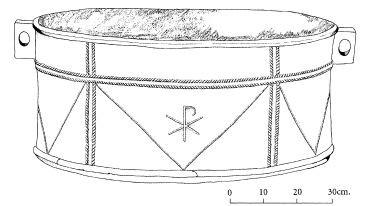
Circular Romano-British lead tank or font from Ashton, Northamptonshire, with the Christian chi-rho symbol prominent at the centre. The tank was made from three sheets of lead, about three millimetres thick, joined together and sealed with strips of lead; molten lead was added to make the joins watertight. The tank is thirty-eight centimetres high and eighty-four centimetres in diameter. When full its capacity was 220 litres, or forty-six gallons. Drawing by Maisie Taylor.
probably have been carried out by full-time professional well-diggers. As I descended I became increasingly gripped by a strange sensation that in retrospect I can only describe as the presence of the past. I became aware that everything around me, above me, below me, was ancient. Nothing had been restored. If I had been the Roman welldigger working 1,800 years ago, I would have seen precisely the same sights. Nothing had changed. I don’t think I have ever been so completely in the grip of the past.
At the bottom there was not a great deal of space in which to stand, what with the ladder, the tank, and the clipboards, tools and buckets left by the archaeologists. The lead tank seemed to have been crushed by a giant foot, and its sides had been caved in. It looked most extraordinary. As I stared I realised that in Roman times I would have been underwater, and the tank before me could have served no possible practical purpose. I remember thinking that it made no sense whatsoever: why on earth would people dispose of a lead tank? Lead was a valuable commodity in Roman times; it could easily have been melted down and used to fix hundreds of roofs and leaky pipes, so why damage and then drop such a useful item down a well?
The Ashton tank (or tanks, as there were pieces from a second one down there too) is not the only example of a circular lead tank with a chi-rho symbol, or Christian associations, that appears to have been ritually destroyed. Several examples are known from East Anglia and the East Midlands, including no fewer than three from Icklingham in Suffolk.21 One of these was found close to a small apsidal structure with obvious Christian and, bearing in mind the apsidal mosaic room at Frampton, possibly Gnostic Christian associations.
The ritualised destruction of these lead fonts is of interest in itself. Why destroy, bury or drown them? I think the association with water gives us a clue. I have already explained that water was an important symbol in pre-Roman times, and I believe something similar was happening at Ashton. At first sight the fonts had been destroyed, and that is how it might have appeared to a Roman soldier or official overseeing the operation. But to people who still shared vestiges of the old pagan religions, these rites would have had a different meaning: by being dropped into water, the tanks were being consigned to another realm or dimension, where they would continue to have life and purpose. To my mind, many people would have believed that the Ashton tank was not being destroyed at all when it was dropped into the water.*
There is now abundant evidence to suggest that pre-Roman religious rites were observed not just in rural settlements such as Ashton, but in towns throughout most of southern Britain - which makes one wonder to what extent the ordinary inhabitants of this, the most Romanised part of the province, had indeed become ‘fully Romanised’. In a recent paper, Professor Mike Fulford draws attention to ritual practices that involved deposition and water in a number of Romano-British towns: at London, Silchester, Neatham (a small town on the Silchester-Chichester road), Baldock and Verulamium (St Albans).22 Even the Later Roman fort at Portchester Castle on the south coast, where occupation did not begin until the late third century, has revealed examples of such rites, which seem - if we include the destruction of the Ashton lead tanks - to have persisted pretty well throughout the Roman period.
It follows that if ‘Celtic’ religious ideas survived though the Roman period, then other aspects of pre-Roman life must have survived too. If, as I believe, the post-Roman periods did not witness wholesale population change anywhere in Britain, then it is entirely reasonable to seek an Iron Age contribution - albeit a contribution significantly affected by three and a half centuries of Roman rule - in post-Roman times.We will see in Chapter 7 that prehistoric traditions demonstrably played an important part in the development of post-Roman culture in the west and south-west, but here I want briefly to examine the extent to which southern and eastern Britain became Romanised. This part of Britain adopted Roman ways more fully than communities elsewhere, but it is the way in which it became Romanised that interests me here. It is easy to see the adoption of Roman culture as a black-andwhite process: off comes the woad face-paint and the hairy woven trousers, and on goes the toga. But it was not as simple as that.
There are increasing indications that the end of Roman rule in Britain may have been brought about by the British themselves. The same may apply to the Claudian conquest of AD 43. It has been known for some time that the immediate excuse for the invasion seems to have been to help an ageing expatriate British prince known as Verica, the son of Commius, who had been leader of the Atrebates, a British kingdom that covered parts of what is now Surrey, Berkshire and Hampshire. Verica appears to have been a successful and stable ruler. He probably reigned for thirty years between AD 10 and 40, which was a long spell by the standards of the early first century ad. His rule ended when his territory was overrun by forces of the Catuvellauni, a powerful tribe originally based in Hertfordshire and Essex, who were then being aggressively expansive under their similarly long-lived and successful leader Cunobelin.
Verica fled across the Channel and enlisted the support of the Emperor Claudius, who now had a ‘legitimate’ reason to invade Britain. From his perspective, Britain without Verica and Cunobelin, who had just died (some time around AD 40), was in a state of near-turmoil, and now he had a direct appeal for help. So in AD 43 he invaded. Like many others I have always believed that the Roman forces landed near Richborough in Kent.23 Recently the only plausible alternative landing-place, near Chichester, in Sussex, has gained in favour. I suspect that we will be in a better position to know for sure in a few years’ time, but if the Chichester alternative does indeed come to look more probable, then it could be argued with greater force that the Roman troops were coming to the aid of Verica’s Atrebates, who would have welcomed them. Other tribal kingdoms were also friendly towards Rome.
Verica’s successor as ruler of the Atrebates was a Romanised client king known as Tiberius Claudius Cogidubnus, and he ruled successfully and for a long time, strongly supporting Rome until as late as the AD 70s or 80s. Dr Martin Henig of Oxford University points out that a client king ‘is not the same as a puppet king; he is a ruler in client relationship to the emperor. There are obligations on both sides.’24 So there is no reason to suppose that it was in the Roman interest to suppress tribal authorities in client kingdoms such as that of the Atrebates. Again, Martin Henig puts the situation well: ‘Does an invasion need to be hostile to the inhabitants of a country being invaded? Modern experience of United Nations actions, for example, should tell us that such action can have an altruistic aim. The popular view of the Roman “invasion” of AD 43 was that the Italians took over and subdued the land of Britain for motives of profit and Empire. However, the reasons were far more complex.’25 Life in the British client kingdoms would go on much as before, and Roman influences would be taken on because the presence of the Roman troops was generally welcomed. In such circumstances it is entirely natural that ‘Romanisation’ would very much reflect British traditions.
We see this sort of Iron Age/Romano-British continuity in the persistence of British or ‘Celtic’ sacred places such as the supposedly healing springs at Aqua Sulis, in Bath, and probably at the villa at Chedworth in Gloucestershire. We also see it at a number of more ordinary domestic sites that belonged to the Iron Age and Romano-British élites. One of these is in the same landscape as the Iron Age hillfort at Danebury, which incidentally is near Stockbridge on the western boundary of the kingdom of the Atrebates. Barry Cunliffe has
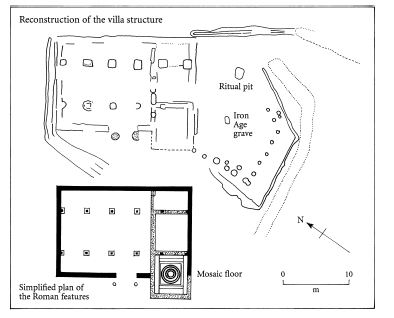
Plan of the aisled hall at Thruxton, near the hillfort of Danebury in Hampshire. The hall was built in the late second or early third century ad. A fine mosaic floor was added in the late fourth century. Outside the hall, to the south, were two Late Iron Age features: the grave of a well-to-do person and a deep ‘ritual pit’ filled with animal bones. Some time in the fourth century AD the grave and the pit were included within the grounds of the building by the construction of a stout post-built fence.
recently begun a project which aims to examine what happened in and around Danebury in the Roman period. One of the sites he has examined is a small villa at a place called Thruxton.26
The site is famous because it produced a superb mosaic floor which was removed in 1899 and may now be seen on a wall of the Roman Britain gallery at the British Museum. The mosaic depicts the god Bacchus, and features a dedicatory inscription on behalf of a Roman citizen called Natalinus, and also a Romanised Celtic family name, ‘Bodeni’, presumably the name of the family that owned the villa when the mosaic was laid down in the fourth century. The site would be remarkable just for the survival of a Celtic name so late in the Roman period, but there is more to it than that.
The Roman building is of the aisled hall type (as discussed in Chapter 4), and was built in the late second or early third century ad. It was a comparatively modest structure, comprising just six roof trusses which were set on pairs of posts. At some point in the fourth century the end of the building was divided into three rooms, presumably because the owners required more privacy. Then in the late fourth century the Bacchus mosaic was laid in one of the rooms, which was now entered not through the hall as before, but directly from outside. This would suggest that the mosaic room was not part of the domestic house; it was not, for example, a formal dining room. It was most probably a shrine of some sort.
There are two clues as to the nature of the shrine. The first lies in the use of the family name Bodeni. This might suggest that the shrine had something to do with the ancestors. This idea was greatly strengthened by the discovery, outside the building, of the grave of a man wearing Late Iron Age brooches. These brooches suggest he was a person of some standing - an impression strengthened by the discovery nearby of a deep ‘ritual pit’ that had been carefully filled with animal bones, also in the Late Iron Age - and quite possibly during the funeral ceremonies that attended the man’s burial. Normally one might feel that the presence of the Roman villa and shrine so close to an Iron Age burial was coincidental, but at Thruxton the grave and the ritual pit were united to the house by a fence of posts erected in the fourth century. There can be no doubt that the features outside the aisled hall belonged to the same settlement - and the same family.
Barry Cunliffe has summarised the situation both at Thruxton and at other Roman sites in the Danebury region:
It is abundantly clear that the Roman invasion of AD 43 was not a particularly significant event for the people farming the chalk downlands. There would, of course, have been new taxes to pay, a new range of consumer durables available in the distant market towns, and soon a new network of highways making travel much easier for those with time and inclination. But for the most part life was little changed. Farms continued to be owned and worked by families whose ancestors may have broken the land many centuries earlier - perhaps even before iron had come into general use.27
Bearing in mind that we still do not fully understand the extent to which élites in southern and eastern Britain had become fully ‘Romanised’, it is worth returning to the way in which their religious beliefs were handled by the Roman authorities on the Continental mainland, particularly the destruction of objects with Christian iconography (symbols) in the decades between 370 and 390. Were these official purges aimed primarily at Gnostic Christians and other perceived heretics by a civil authority that was keen to promote the interests of the more orthodox Church establishment, or was something else going on? The old view was that it was caused by the turmoil associated with the Barbarian Conspiracy of 367.28 This supposedly led to a breakdown of law and order and a return to paganism. In this interpretation of events it was paganism, rather than orthodox Christianity, which provided the motive for the ritualised destruction of Christian symbols. This reading only works if Britain in the late fourth century was indeed slipping into anarchy and chaos - for which, as we have seen, there is precious little evidence. There is, however, a rather extraordinary corollary if one accepts Dominic Perring’s interpretation of the events of 370-390; it has to do with the political forces that may have been behind the termination of Roman rule in Britain.
Perring suggests that one consequence of the repression of the Gnostics and other heretical beliefs by the authorities was that the ruling élite families of southern Britain became disaffected, because it was their beliefs, their property and their identity that were being attacked.29 This suggests that the end of Roman rule was not just a response to a build-up of large-scale barbarian raids, which as we have seen usually came from north of Hadrian’s Wall, and not from across the North Sea or down the English Channel.
Whether or not the ruling southern British élite had indeed taken part in the Barbarian Conspiracy, their excellent sources of intelligence would have informed them that by the early fifth century the armies of theWestern Roman Empire were in no state to respond to a challenge to their authority that came from within southern Britain itself. This is important, because it suggests that the ruling classes in fifth-century southern Britain were not powerless straws in a barbarian breeze. In AD 367 there is every chance that they were a part of that wind. At all events, Dominic Perring’s reinterpretation of the archaeological evidence suggests that during the final months of Roman rule the southern British élite may have exercised more control over events than has been hitherto supposed. It has even been suggested that the controlling élites may actually have revolted against Roman rule, because they had grown fed up with paying heavy taxes to a distant authority that was incapable of providing them with any protection.30
It does not surprise me that the southern élite could have behaved in this way: they had shown remarkable resilience in the face of orchestrated persecution, and we know that they possessed a strong sense not just of their own superiority, but of their unity as a ruling, civilised and Romanised aristocracy. I find it hard to accept that these were the men who were pleading to the Anglo-Saxons for help just thirty years later (in AD 449) - whatever Gildas might wish us to believe.
The Roman Empire enters its late phase with the death of Theodosius I (‘the Great’) in 395. Shortly before, he defeated more barbarian incursions and further attempts to reintroduce paganism. When he died the Empire was firmly Christian and the Church was in an assured and secure position. The army was winning victories, but these were gained with the help of large allied forces that were only loosely under Theodosius’ direct control. This was a weakness in the system that would shortly have dire consequences. On the death of Theodosius the Empire was officially split into two, an Eastern and a Western Empire, ruled by his sons Arcadius and Honorius respectively.
After the death of Theodosius, the emperor was less powerful than before. He became more of a head of state than an active leader. Political and military leadership was provided by the chief minister, who in the west was almost always the senior military commander. The first of this new breed of chief minister in the west was Flavius Stilicho, a Vandal* by birth and married to Theodosius’ niece, Serena.
Stilicho held power in the west for the first ten years after the death of Theodosius, and was widely supported by powerful factions in the Church, the army and the senate in Rome. The Roman army in the early fifth century was not the force it had once been, and its commanders relied heavily on hired free mercenaries, or foederati. These barbarian forces within the army were always a source of weakness; furthermore, capricious but powerful allies such as Alaric, King of the Visigoths (who occupied southern Gaul and Spain in the fifth century), needed to be treated with the greatest possible caution. An idea of how difficult it must have been to command the Roman army in the fifth century is given by Stilicho’s intention, in 408, to use barbarian forces to quell a mutiny among his Roman units.
There is as yet little reliable archaeological evidence for the employment of mercenaries in the Roman army in the late fourth and early fifth centuries in southern Britain.* This is odd, given what we know about Roman military history at this date. It is almost certain that British troops were employed in some numbers across the Channel, and it seems highly unlikely that that there were no reciprocal movements from the Continent to Britain. Given the large number of developer-funded excavations currently being undertaken, I would be most surprised if evidence for the employment of foreign mercenaries in the Late Roman army in Britain does not come to light. If this does happen, I confidently predict, first, that it will be greeted as ‘incontrovertible evidence for a substantial Anglo-Saxon presence in Late Roman Britain’, and, second, that any foreign mercenary who did not come from what is now northern Germany will be ignored, as somehow irrelevant.
The only contemporary source that covers the end of Roman Britain is the court poet Claudian (d.404), whose principal purpose was to praise the achievements of the emperor and his army. His reliability is therefore rather doubtful. Apart from him, there is of course Gildas, who also had his own agenda, and who was writing well over a hundred years after the events in question. Gildas mentions three Pictish wars before the middle of the fifth century. The first of these was extended, and did not end until about 390. Based on Claudian and Gildas, Peter Salway reckons that the second took place in 398; it mainly involved the manning of sea defences against the Saxons and Irish Scots. It is not clear whether the Picts came by land or sea, but they were denied access to Britain. Claudian writes about further successful defensive actions against barbarian incursions of Picts, Irish Scots and Saxons into Britain in the year 400.
After the movement of troops into Britain for the first of the Pictish wars, from about 398 Stilicho was obliged, by a series of barbarian attacks on the Continental mainland, to start a process of gradual troop withdrawal from Britain. Archaeologically we see the decline in the Roman military presence reflected in the coinage. The last coins to be imported into Britain in substantial numbers were issues of Arcadius and Honorius of AD 402.* Presumably these were required to pay the troops; after that year troop numbers were too small to require the importation of coins in bulk.
While Roman troops were being moved around western Europe, barbarian attacks on Britain continued. There seems to have been an incursion of Irish under Niall of the Nine Hostages in 405; meanwhile on the Continent there were major Gothic wars in 402-3 and 404-5. By now Italy itself was under threat, and Stilicho was closely involved with the organisation of her defences. At this point the Roman troops in Britain revolted, and eventually proclaimed an upper-class, civilian Briton named Gratian as their emperor in 407 - a most unusual choice. He lasted four months before he was murdered. The army in Britain feared an attack from overseas, and had little confidence that they would be supported by Roman forces on the Continent, who had more than enough to deal with. So this time they proclaimed a man with an illustrious name, Constantine III.
Given the parlous state of affairs in the early fifth century, it seems odd that Constantine III and his forces should attempt to take over the Western Empire. This ambition says much about the army in Britain, and much too about their opinion of their former leaders. Constantine and his forces crossed the Channel to Gaul, and after a struggle Gaul fell to them by the end of 407. In the following year Spain fell to troops of the Constantine cause under the command of his son, Constans. Then, in 409, Honorius (Emperor, or Augustus, of the Western Empire) declared Constantine his co-Augustus. He was given control of the Gallic prefecture, which included Britain, Gaul and Spain. Unfortunately, however, his administrative capital had been moved from its traditional home at Trier, in northern France, to Arles, on the Mediterranean coast, fifty miles west of Marseilles.31 This was a very long way indeed from Britain. As Peter Salway put it, the centre of gravity of the Gallic prefecture was now Mediterranean rather than northern.32
By now even the Mediterranean world was under barbarian threat. In 410 Rome was famously sacked by Alaric, King of the Visigoths, and in the previous year pressures were mounting on Constantine III’s Gallic prefecture in both Spain and Gaul. He was now besieged in his capital, which meant that taxes and money for the troops could not find their way north. In 409 more barbarian actions, and the threat of further attacks, caused the population and troops stationed in Britain to revolt against the Empire. Constantine was in no position to suppress this, the third revolt in Britain, which was now officially outside the Empire. For Britain, the Roman interlude had come to an end.
*The remarkable man who revealed many of the Roman sites in the Nene Valley was named Edmund Tyrell Artis. In the first part of the nineteenth century he was Agent to the Earl Fitzwilliam, of Milton Hall, just outside Peterborough. He was a close friend of the great ‘peasant’ poet John Clare, who lived in the village of Helpston just south of Maxey. His consuming passion was Roman archaeology, and he mainly excavated on the estates of the Earl Fitzwilliam, publishing the results of his work in 1828. In the early 1970s I had the good fortune to spend a couple of years living in a flat within the former stable block at Milton Hall. I will never forget my surprise when one morning I stumbled across a magnificent Roman mosaic in the old dairy - moved there for safekeeping by Artis over a century earlier.
*When I first dipped into Roman studies as a student I remember being surprised that Later Roman government and the political structure of the Empire seemed to have been modelled on the Church. Thus Britain itself is a diocese, and the person in charge of the diocese is the vicarius (hence ‘vicar’). In fact, of course, in this instance the Church is following the terminology of the state, and not the other way around.
*Dominic Perring has pointed out to me that many people in Rome also had a religious interest in wet, liminal places, so the idea of simple deception, although attractive, may not be valid. He agrees, however, that the placing of the tanks within water was indeed sending them to a new life in the Next World.
*A Germanic people, possibly originating in the Baltic region.
*A Roman cemetery at Lankhills, on the outskirts of Winchester, has produced possible evidence for the employment of a few mercenaries from the Danube valley in Hungary, but this is a matter of hot debate.
*The minting of coins in Britain had ceased during the reign of Magnus Maximus, AD 383-88.