
THE TIME OF THE ANGLO-SAXONS is commonly seen, in the words of the great historian of the period Sir David Wilson, as ‘a no-man’s-land, across which flit insubstantial, semi-legendary figures—Hengist and Horsa, Arthur, Alfred and Offa’.1 That air of mystery, through which move the shrouded figures, has allowed people to take their eyes off the archaeological ball. After all, there is something wonderfully romantic and exciting about ‘semi-legendary figures’ with strange-sounding names who perform heroic deeds. I would not wish Hengist and Horsa to be banished from the centre stage of British history, but they have occupied it for a very long time. We should allow some of those in the wings their share of the limelight. In other words, let’s look at the archaeology, because today we know a surprising amount not only about Early Saxon times, but about the last years of Roman Britain. Our principal new sources of information on the origins of the Anglo-Saxon phenomenon are not historical, but almost entirely archaeological.2 We must briefly set the likes of Gildas and even Bede temporarily to one side.
I have heard it said that the only Saxon immigrants we can really be sure of are the three boatloads that Gildas mentions:
Then a pack of cubs burst forth from the lair of the barbarian lioness, coming in three keels, as they call warships in their language. The winds were favourable, favourable too the omens and auguries, which prophesied, according to a sure portent among them, that they would live for three hundred years in the land towards which their prows were directed, and that for half the time, a hundred and fifty years, they would repeatedly lay it waste.3
Personally, I would query the ‘three keels’ too. The number three has a symbolic importance all its own - it could have been a nod in the direction of the Holy Trinity - but as a literal indication of quantity it seems doubtful. It must have been intended to have been read as a metaphor, together with the three hundred and half three hundred years that are also mentioned. This is not to suggest that there were no incomers from overseas, because of course there were. New scientific techniques are showing that the population of Britain and Europe was far more mobile than has been hitherto imagined. But that mobility did not manifest itself in simple waves of migrants who swept all before them. That sort of folk movement is the stuff of allegory: it’s a way of painting a metaphorical picture that carries a particular message.
Metaphor and allegory were methods of popular communication that had roots in the Bible - after all, what could be a more memorable way to describe the Creation than the fable of Adam and Eve? The writings of Gildas and Bede are suffused with Biblical allusions, and both authors would have been skilled in the use of that particular technique of storytelling. I believe the ‘three keels’ in Gildas are akin to the three ships in the old Christmas carol that came sailing by ‘on Christmas Day in the morning’.
In this chapter I want to examine the archaeological and historical evidence for the arrival of Anglo-Saxon migrants in eastern Britain.4 The establishment of their settlements within the landscape is still generally considered to signal the birth of a new nation called England. In the popular perception it is the presence of substantial numbers of Anglo-Saxons that makes England different from the other nations of the British Isles. England is Anglo-Saxon, the others are Celtic or Gaelic. These are important issues to do with identity, and over the years they have attracted attention from historians and archaeologists. They have also acquired a huge number of self-sustaining myths* which are based on a circular argument that goes something like this: we know for a fact that the folk movements happened, so we will interpret all new evidence in the light of that knowledge.
Let us begin with a summary of the archaeological evidence in favour of large-scale Anglo-Saxon migrations in the fifth and sixth centuries ad. As has been noted, the Anglo-Saxons are believed to have brought with them an entirely new set of objects that differ markedly from the Romano-British items previously in use. These include hand-made pottery, brooches and other fashion accessories, new styles of clothing and metalwork, such as knives, axes and weapons. They also introduced a new pagan religion, and with it a new way of disposing of the dead: cremation within urns in large cemeteries. The urns and fashion accessories are particularly important to the supporters of the invasion hypothesis, because they can be closely paralleled on the Continent, especially in parts of northern Germany.
Further evidence for influxes of new people is provided by the houses in which the Anglo-Saxons lived. A new style of house with a sunken floor, or alternatively a cellar-like space beneath the floor, the Grubenhaus or sunken feature building (SFB), is seen as particularly characteristic of the new migrants. These buildings are well known on the Continent. Similarly, larger, post-built rectangular ‘halls’ are also seen as an Anglo-Saxon introduction. The Anglo-Saxons are supposed to have introduced large villages, often sited on land that had not been settled previously. This in turn supports the suggestion that they cleared substantial areas of forest and occupied a Britain that was underpopulated and suffering from social and economic chaos following the withdrawal of the Roman legions.
It is argued that changes as profound as a new religion and rites of burial, not to mention new styles of houses and artefacts, when taken together amount to the presence of a new group of people. This argument is reinforced by the appearance of a new language, Anglo-Saxon or Early English, and the manifest hostility that existed between the ‘incomers’ and the Romanised ‘native’ British population of the north, the west and the south-west. I do not feel competent to enter into the controversy surrounding the origins of the English language. All I will note is that language is not necessarily a defining attribute of a particular ethnic group, and that the words and grammar of what was to become the English language were not solely derived from Germanic sources. Moreover, the process was to take two to three centuries, the period between the end of the Roman period and the first written records in Early English, which appear late in the seventh century.5
It is probably fair to say that serious scholars who believe in largescale Anglo-Saxon mass migrations are now in the minority. Most people, myself included, accept that there was a certain amount of movement in and out of Britain, just as there was in the Iron Age and the Roman period. We might well discover one day that certain Anglo-Saxon cemeteries in, say, East Yorkshire, contain the bodies of immigrant populations. I do not believe, however, that such discoveries will invalidate the consensus that the changes attributed to the arrival of Anglo-Saxons were usually caused by people changing their minds, rather than their places of residence.
Heinrich Härke of Reading University is a strong advocate of the mass-migration position, for all of the traditional reasons: rapid population decline in post-Roman Britain, textual sources (e.g. Gildas), new types of pottery and other artefacts, the new rite of cremation and the new language now known as Early English. He also subscribes to the more controversial view that many of the skeletal remains in the cemeteries are ‘of a population which is different from native types, but shows close similarities to populations in northern and south-western Germany’.6 There are serious problems with this idea, not the least being that the size and shape of our bodies are affected by factors other than genetics alone. If one is looking for direct evidence for an incoming population, I personally would choose some of the more reliable science-based techniques, such as stable isotope analysis (discussed further in Chapters 8 and 9).
Härke argues that the population of Britain declined in the fifth century from a Late Roman high of two to four million to a later-fifthcentury low of one to two million. He suggests that somewhere between one and two hundred thousand Anglo-Saxon settlers arrived in eastern Britain: ‘Their settlement would have been interspersed with that of the natives, who assumed the position of a lower-status population.’7 This idea has been suggested by other scholars, including Nick Higham, who less contentiously saw the incomers as a small élite of perhaps less than ten thousand people.8 The trouble with these otherwise plausible suggestions is that they are not supported by the results of excavation, which show, as yet, no clear evidence for two distinct cultural entities in the fifth century. One would expect, for example, to find distinct ‘Anglo-Saxon’ and British cemeteries close to the same settlements, but that does not happen. There is precious little evidence for a fifthcentury élite of any sort, let alone a foreign one.
I also find the suggestion that the population of late-fourth- and fifth-century Britain declined so catastrophically hard to sustain. If there was such a massive collapse, it is more likely to have taken place in the early fourth century, when life in British towns seems quite suddenly to have declined. There is indeed evidence that agriculture in Dark Age southern Britain became less intensive, but this can be explained by the need no longer to supply the Continental Roman army, nor to produce substantial surpluses from which to pay hefty taxes.*
Being a prehistorian, I tend to take a longer view than most people. I am happier dealing with millennia rather than centuries. I incline to the view that nothing of long-term significance ever happened overnight. The Great War may have been triggered by an assassination in the Balkans, but the tensions behind that horrendous conflict had been building up for a very long time. I think something similar applies in the present instance.
So far I have mainly discussed the Romanised and ‘Anglo-Saxon’ south and east of Britain. In the chapters that follow I will cross the country to consider the ‘British’ or ‘Celtic’ north and west. A broadly similar divide probably existed throughout later prehistory, from about 2000 bc, possibly reflecting the fact that Britain is an island that faces east and west. These two faces are separated by uplands that run down most of the centre. As a result, rivers with their fertile valleys and floodplains also run east-west, and drain into the North Sea or the Atlantic. Britain’s geography positively encourages communities on both sides of the country to face outwards, away from the centre.
In 1972, in his book Britain and the Western Seaways, Professor E.G. Bowen explained the cultures of western Britain and Ireland in essentially maritime terms.9 He saw ties between those regions and neighbouring parts of Europe, especially Brittany, Spain and Portugal.
More recently Barry Cunliffe has arrived at much the same view, but with a wealth of new information from Britain and the Continent.10 For my part I would stress the strong ties that unite east and south-east England to the Low Countries and north-western France, and northeastern England and eastern Scotland to Scandinavia and the North Sea shores of Germany. The natural overseas communication routes of at least half of England and Scotland lie towards the east, to the shores of the North Sea and the hinterland of north-western Europe.11
The east-west division of Britain broadly coincides with the Lowland and Upland Zones that the great archaeologist Sir Cyril Fox saw as being fundamental to the development of British landscape and culture - something he referred to as the ‘personality of Britain’.12 I tend towards a less closely defined view of these two Zones. I do not see them as inward-looking; quite the opposite, in fact. The Atlantic/ North Sea contrast is just that: it’s a long-term cultural contrast, not a divide, and it is one of the main characteristics of the British Isles. We saw from Andrew Sargent’s study in the previous chapter that this contrast continued throughout the Roman period. It is my contention that in post-Roman times the division between ‘Anglo-Saxons’ to the east and ‘British’ to the west is a continuation of this same old, or rather ancient, theme. It’s a cultural, rather than an ethnic, distinction. Being human, we like to personify such things, so we conjure up Arthur on one side and the likes of Alfred, Hengist and Horsa on the other. Doubtless there were similar heroes in the Bronze Age.
Before we consider the Anglo-Saxons and other possible incomers to Britain, we should think briefly about the land to which they are supposed to have come. On present evidence it would seem more than possible that the end of Roman rule in Britain was something that the British southern élite may have wanted to achieve. They had little confidence in the military help on offer from the Gallic prefecture, and considered that, all things being equal, it would be better to go it alone. As we have seen, the southern Romano-British élite had an identity of their own, and they must have believed that they stood a chance of surviving independently.
We can only speculate about conditions in the second and third decades of the fifth century in Britain, as there is little reliably dated archaeological evidence to go on. In those regions where there is continuity of settlement, such as the area around Durobrivae, there are no obvious disjunctions or breaks in the archaeological record.13 So we must assume that life in rural Britain continued, but without certain distinctively Romano-British items such as wheel-made pottery and coinage, both of which ceased to be used around 420/430. These changes probably reflected the collapse of a money-based market economy. As we have seen, people went back to earlier ways of doing things in the countryside: barter was important, but so was exchange based on other, largely social, obligations.
Peter Salway considers that by the 440s at the latest a distinctively ‘post-Roman’ society had emerged in Britain.14 Although there are indications of fifth-century occupation in towns, the nature of that occupation is a matter of hot debate. We must assume that settlement in post-Roman and Early Saxon Britain was essentially rural, just as it had been in the Iron Age.
In its early days the Roman army was famous for the way it moved potentially aggressive young men of various nations to distant parts of the growing Empire, where they could let off steam without fomenting civilian revolt - largely because they were not familiar with local languages and customs. It was a clever policy, and it worked well. In the later Empire various barbarian allies were employed as mercenaries. This also had the effect of introducing young men to new regions, and as we saw in Chapter 1, this was the way Gildas and Bede believed that the first Anglo-Saxons arrived in Britain. The presence of numerous Anglo-Saxon foederati in Later Roman Britain is often assumed, but is notoriously hard to pin down with any certainty. The assumption that they were there may be based on Gildas and Bede, but it also follows the writings of an influential archaeologist.
Dr J.N.L. Myres’ great work of synthesis, published in 1969, was Anglo-Saxon Pottery and the Settlement of England.15 He based much of his research on the shape, style and decoration of pottery urns found in ‘Anglo-Saxon’ cremation cemeteries in eastern and south-central England, and drew close parallels with similar pottery that was being manufactured at approximately the same time on the Continent. He concluded that the earliest British pots were made by ethnic Anglo-Saxon potters who had arrived in Britain as settlers.
When I read Myres’ books and articles for the first time I was wholly convinced by what he had to say. I now realise that this was as much due to the power of his conviction as to the strength of his argument. He greatly admired Gildas, whose flowery Latin prose informs much of his work. This is Myres on the British failure to repel further waves of invaders using mercenaries, following the adventus Saxonum (arrival of the Saxons) around ad 450:
The failure is pictured by the early sources in dramatic terms with the general uprising of all the settled barbarians and their destruction of Roman culture in the cities and the Church, the replacement in an orgy of blood and flames of what remained of the old world by the tentative and barbaric beginnings of the new.
It is to Gildas that we owe the essentials of this picture, and there can be no doubt that he was right. He was, after all, born less than fifty years later…and his parents must have been in a position to tell him directly of what they had themselves seen and heard of the years of destruction.16
Myres caused something of a sensation when he suggested that the earliest Saxon settlers arrived in Britain during his first phase of ‘overlap and controlled settlement’ (c.360-410). This is just a decade or so later than the height of Romano-British fourth-century prosperity. Myres’ next phase, of ‘transition’ (c.410-50), sees limited settlement during the so-called ‘sub-Roman’ period;* but the main waves of immigration are in his next phase, of ‘invasion and destruction’ (450-500). This half-century was a period of ‘massive and uncontrolled land-seizure by Anglo-Saxon and other barbarian peoples, and…the accompanying destruction of Romano-British civilisation’. He completes this summary of the main events of his third phase of Anglo-Saxon settlement with a telling phrase which provides us with the motivation behind his study: ‘The contemporary pottery should throw some light on the nature and range of these movements, and on the background of the principal groups of settlers in different parts.’17 In other words, the information found in the field during excavation was explicitly to be used to amplify and flesh out the observations of writers such as Gildas.
Somewhat later, in 1977, in the discussion chapters to his comprehensive catalogue of English Anglo-Saxon pottery,Myres turns to Bede, who was writing in the years prior to 731, and who used Gildas as his main source for these early events. Myres had been writing about the regions from where the early Anglo-Saxon settlers might have come, and had drawn extensively on Bede. This is what he wrote next:
These assumptions are all amply confirmed by the pottery. Even if Bede had never written what he did, it would have been abundantly clear from their pottery that the bulk of the settlers must have come from precisely the regions to which he pointed as their homes.18
In that brief passage we again find the circular argument, but it was published at a time time when the archaeological climate had changed a great deal since 1969, when Myres wrote Anglo-Saxon Pottery and the Settlement of England. So now Myres gives a nod in the direction of circularity; but it is only a nod. If leading authorities such as Myres were writing with such certainty about the wholesale migration into Britain of many tens of thousands of Continental settlers, it is hardly surprising that few people actually digging and writing up sites in the field were going to depart from such dogma. It would be professional and academic suicide.
I’m aware that I’m writing with the advantage of hindsight, but it has always struck me as odd that it never seems to have occurred to Myres and his colleagues that the data so expensively obtained from the excavation of cremation cemeteries and other sites could have served as an independent test of the generally unreliable ancient sources. I still cannot understand how the dramatic increase in new discoveries that resulted from the enhanced archaeological activity of the late 1960s had had so little effect on the world of Anglo-Saxon studies. Work carried out during this period certainly transformed our understanding of prehistory. To my mind the failure to adapt to changing circumstances says much about the prevailing culture of Anglo-Saxon studies in Britain, which was often text-led and archaeologically conservative. It is ironic that such intellectual conservatism should be used to shore up an idea that has no parallel or precedent at any other time in British history. Even the archaeologically much better attested Viking raids of the eighth and ninth centuries did not involve such a vast incursion of new people as actually to create a new nation that was culturally and ethnically unrelated to the other countries of the British Isles.
As I reread Myres in the preparation of this book, I was gripped with an extraordinarily strong feeling of déjà vu: it was as if I were rereading his contemporary Professor Christopher Hawkes, also of Oxford University, defining in considerable chronological detail successive waves of Iron Age incursions that never actually happened.19 Like Myres, Hawkes defined his phases almost solely on the basis of changing pottery styles and the way they resembled supposed Continental originals. Myres looked for his Continental homelands in the Anglo-Saxon territories of northern Germany; Hawkes towards the valley of the Marne in northern France. Both, I believe, were mistaken in thinking that the pots which they studied with such erudition and care came with large numbers of people attached. Having said that, it is entirely possible that Continental potters or merchants could have established workshops in Britain.
Returning to less controversial matters, some dress ornaments and military equipment found in fourth-century contexts in Britain and elsewhere were clearly German-inspired, but much of this was ‘standard issue’, made in state-owned workshops in the Danubian provinces. The military fashions of the time were favouring Germanic styles in fittings such as belt buckles, just as civilian dress was to do later. These objects do not suggest the presence of German foederati in mid-fourth-century Britain. As Salway notes, it is unlikely that soldiers wore different uniforms according to their national origins.20 If we are to find independent non-ceramic (i.e. non-pottery) evidence for foederati or irregular Anglo-Saxon military allies in Britain, it is most likely to be in late-fourth-century contexts. So far, however, it is lacking; which is not to say that German foederati were never present in Britain, but does suggest that they may not have been as widespread or numerous across south-eastern Britain as Gildas implied, and as Myres asserted.
So far I have discussed the foederati as the most likely source of evidence for an Anglo-Saxon presence in Britain in Late Roman times. But there is one other, often quoted and spectacular group of monuments which are grouped together under a name which proclaims a strong message. I am referring to the eleven or so ‘Saxon shore’ forts of eastern and southern England. Surely, with a name like that, which itself is quite ancient, we are on firmer ground. Sadly not. The presence of the ‘Saxon shore’ forts has helped to perpetuate the myth that Late Roman Britain was gradually slipping into a state of siege, and that the breakdown of law and order was attended by widespread lawlessness and piracy. The trouble with this view is that it makes many assumptions, most of which are wrong.
Let’s start with that name. It first appears in one of the main sources we possess on Later Roman Britain, a document known as the Notitia Dignitatum (‘List of High Offices’), a late-fourth-century (c.395) inventory of military resources and garrisons. Essentially it’s a series of lists of places and forces, with headings that relate to their command structure. It was not written as, nor was it ever intended to be, an accurate historical account, and it was subject to various alterations and additions before it reached its final version, which we have today, probably in the early fifth century. Various military installations on both sides of the Channel were listed as being under the command of the comes litoris Saxonici, or Count of the Saxon Shore. It should be noted that just because the forts were listed under the same heading in the Notitia, it does not mean that they were part of an integrated system of coastal defences across the Channel, as has been suggested.21 The Notitia was probably made for army administrators. It is not a strategic military document as such. It does not consider rules of engagement, communication, strategy, tactics or contingency planning. In other words, it does not provide us with grounds to suppose that British ‘Saxon shore’ forts had counterparts in Gaul, and formed part of a cross-Channel system of defence, as has also been suggested.22
Had the forts of the ‘Saxon shore’ only been mentioned in the Notitia, it is possible that they might have been overlooked by the early antiquaries. But they were also mentioned by William Camden in his great work on the antiquities of Britain, Britannia, published in 1586 and subsequently in 1594 and 1607. As its publication history suggests, Camden’s Britannia was immensely influential, and continued to be so throughout the eighteenth and nineteenth centuries, in editions brought out by other antiquarians. Camden, doubtless with Gildas and Bede in mind, wrote about the depredations and robberies of the Saxons who ‘grievously infested’ Britain.
We have seen how in Victorian times the Anglo-Saxons acquired their importance as the means whereby barbarian Britain was transformed into civilised England. Victorian antiquarians and historians, using Camden as a guide, believed that the ‘Saxon shore’ forts must have played a significant role in events which were ultimately to prove so important to the origin of England. Thus a link was established that would prove extremely hard to break. Again, circular arguments were involved: the forts were along the ‘Saxon shore’; therefore, selfevidently, they were built to defend Britain from Saxon attacks.
Even today the forts of the ‘Saxon shore’ are seen as a Roman response to third-century brigands and pirates from across the North Sea.23 They have accumulated their own body of literature, which includes much theory and interpretation. The conventional wisdom on the forts of the ‘Saxon shore’ is well summarised by Stephen Johnson in his book Later Roman Britain (1980).24 Johnson saw the forts as forming part of an integrated cross-Channel system of defence against barbarians who included two marauding seafaring peoples, the Franks and the Saxons. Having discussed the construction of the first shore forts, he continues:
These preliminary precautions, such as they were, were inadequate by the end of the third century, for by then our sources record that Franks and Saxons were infesting the seas. At about this time, the Roman military authorities began to develop a number of the existing harbours into full-scale defended bases, positioning strongly walled forts on the larger river estuaries and on the exposed coasts…to block Frankish and Saxon access to the interior of the province. These forts, clearly intended to hold a military garrison of both soldiery and sailors, were later to be known as the ‘Saxon shore’ frontier, protecting Britain from assault in an area she had little expected to be at risk.25
I do not share this view of the situation around the southern North Sea in the third and fourth centuries. Other authorities, such as Peter Salway, have their doubts about the forts of the ‘Saxon shore’ too,26 and Andrew Pearson has suggested some alternative roles for them in a series of recent studies.27 This work has, I believe, broken the circular argument which has traditionally placed Anglo-Saxon archaeology at the service of history. Pearson has provided us with an explanation for these south-eastern shore forts that makes practical sense, and that fits well with what we now know about second- and third-century Roman Britain.
The eleven ‘Saxon shore’ forts owe their fame not just to their resounding name, but because they are, for the most part, very imposing buildings.* They extend along the south-eastern coast from Brancaster, near the Wash, to Portchester Castle, close by the Isle of Wight. Portchester is among the most spectacular and well-preserved Roman buildings in north-western Europe. Like those at the next fort to the east, Pevensey, the Roman walls of Portchester were built into a medieval castle whose tower-like keep provides an excellent view of the Roman defences. The forts often feature projecting towers or bastions, which are characteristic of Later Roman military architecture. Bastions allow archers a clear field of view to shoot at an enemy attacking the main walls, but they also look very imposing, especially when seen from the land - which may provide us with a clue as to how the forts were used.
Pearson examined each of the forts in detail. He was at pains to place them in their local context, because with a class of site such as these, it is all too easy to assume that they comprised part of a working system, and had less significance in their own right. We should not presuppose that the forts were part of an integrated system of defence, which has not been proven. Again, there is an obvious danger of circularity here: we assume that the ‘Saxon shore’ forts are part of a system both because they line the south-eastern coast, and because we believe what we think the Notitia tells us. We must not fall into the trap of using the archaeological evidence to ‘confirm’ this version of events.
Pearson’s analysis led him to some unexpected conclusions not only about the integrity of the ‘Saxon shore’ forts as a military defensive system, but also regarding their original roles and purposes.28 On
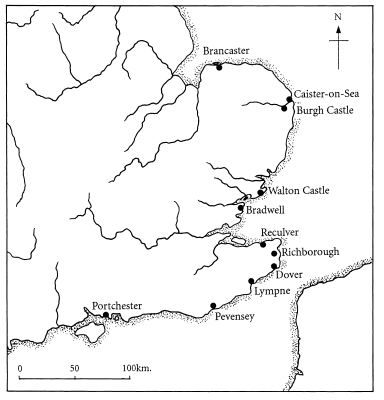
The eleven Roman so-called ‘Saxon shore’ forts built in the third century ad. These were probably fortified trading or distribution stations, rather than defences against attacking Saxon pirates, as is often assumed.
present evidence the forts were constructed in two distinct episodes, with Caister-on-Sea, Reculver and Brancaster being built in the first decades of the third century. Also at about this time the fort of the classis Britannica (British fleet) at Dover goes out of use, which firmly contradicts any suggestion that the forts formed part of a defensive system that integrated land and naval forces. The remaining forts were constructed later in the third century, between about ad 260 and 300.
Most Roman forts are jam-packed with military buildings and installations, as we will see when we come to examine Birdoswald on Hadrian’s Wall in Chapter 8. Often too, especially in the earlier years of the Empire’s expansion, they were laid out on a standard plan, with barrack blocks, grain stores, parade ground and headquarters buildings in the same places. As one would expect of the finest army of antiquity, these forts were highly organised.
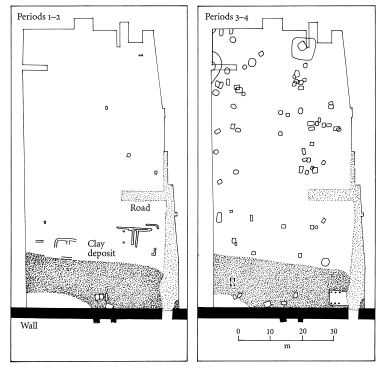
The strangest aspect of the ‘Saxon shore’ forts is the paucity of archaeological remains across their interiors. This is not the result of inadequate excavation (vanished timber buildings are not always easy to spot if one does not have the experience), as a large area within the walls of Portchester Castle was excavated by Barry Cunliffe, whose work at Danebury has shown that he and his team can locate even the most ephemeral of timber structures. What Cunliffe revealed, or rather did not reveal, at Portchester caused astonishment in the archaeological world.29 He was able to divide the ancient features into a succession of phases. He proved that there was a Romano-British presence there in the third century, but that occupation was not at all what was expected: there were no barrack blocks, granaries or headquarters buildings. In fact, if one did not know that the excavations were within the massive walls that surrounded them, one would doubt whether Portchester was even a military site. It seemed to have most of the hallmarks of a civilian settlement, and not a very organised one at that. Certainly there was no evidence for the sort of gridiron street pattern one would encounter within a Roman military installation.
After a rather unexpected decade of abandonment directly after its construction in 285-290, Portchester was occupied throughout the fourth century and perhaps into the early part of the fifth. Most of the occupation was disorganised, to use Cunliffe’s term, and there was only one period, between 345 and 364, when an attempt was made to impose a degree of order: timber buildings were reconstructed, roads and yard surfaces were cobbled, and coin loss declined - which indicates that rubbish would have been regularly removed and the place kept more clean and tidy. Thereafter disorganised, even ‘squalid’ occupation resumed.
As I have said, this does not sound like the usual style of Roman military occupation. Solid evidence for it being civilian was provided
by the discovery of twenty-seven infant skeletons, which were buried throughout the third century. Other items, such as spinning and weaving equipment, attest to the presence of women. Women were in theory banned from Roman military facilities, relegated to the so-called vici (squatter-style informal settlements) outside the walls or ramparts.* But at Portchester family life clearly thrived within the walls.
Andrew Pearson has pointed out that the three early ‘Saxon shore’ forts at Caister-on-Sea, Reculver and Brancaster show evidence for substantial structures within their defences; Reculver was even laid out on a regular geometric plan. Where we have evidence for the internal layout of the later-third-century forts it is like that at Portchester:

Three period plans showing the interior of the Roman shore fort at Portchester Castle, Hampshire, as revealed by Barry Cunliffe’s excavations of 1961-72.
slight and irregular. Cunliffe’s excavations were extensive. He stripped about an eighth of the area within the walls, so the absence of regularlylaid- out barrack blocks etc. cannot be the result of too small an excavated sample.
Pearson also says that the disposition of the three early forts makes no military sense, because they would have left Suffolk, Essex, southern Kent, Sussex and Hampshire undefended. This is particularly strange, because as we have seen, the area most threatened by Anglo-Saxon attack in the fourth century was the eastern end of the English Channel. He also pointed out that at least half of the ‘Saxon shore’ forts were abandoned before the end of Roman rule, at precisely the time when Gildas and Bede tell us that Saxon raids were becoming a problem.
There is another significant difficulty. The forts along the east coast, from Brancaster to Richborough, all have significant vici-type informal external civilian settlements, whereas those to the west do not. This suggests that the two groups of forts served fundamentally different purposes. All in all, one has the strong impression that the ‘Saxon shore’ forts never formed part of a single, unified defensive system that was set up to defend Britain from attack from overseas. So what were they intended for?
We saw in the last chapter that Britain played an important part in supplying the Roman army with grain and other supplies.30 This logistical chain was broken or severely weakened following the death of Magnentius, but was re-established by the Emperor Julian as part of his campaign against the Continental barbarians of ad 359-60. It is noticeable how many of the eastern ‘Saxon shore’ forts are positioned near the mouths of rivers which have good access inland. The fort at Brancaster is very close to the Fenland, which may have been a huge imperial estate much of whose produce, especially wool and grain, might have been destined for the army. There is other evidence: animal bones from Burgh Castle in Norfolk are mostly of non-meat cuts, suggesting that the joints were exported elsewhere. Bradwell is located in the so-called ‘red hills’ area of Essex. ‘Red hills’ are mounds of burnt silt and sand that are produced during the process of extracting salt from seawater. The Fens, too, would have produced salt, which was an important and valuable commodity in ancient times (the word salary is derived from the Latin sal, or salt).
A close analysis of the exotic building stone used in the construction of Bradwell, and possibly other ‘Saxon shore’ forts, has suggested that these places were part of long-distance trading networks.31 Pearson has pointed out that if the shore forts were indeed part of a trading system, it would explain why the first three were constructed before historical sources such as Gildas start to mention Saxon piracy. He also suggests that they might have served a secondary role following the collapse in value of Roman coinage from the middle of the third century. With money less able to retain its value, taxes would have been collected in kind - i.e. as goods or livestock. Shore forts would have served as fortified depots for the collection and redistribution of such taxes-in-kind.
If forts like Portchester were in effect secure stores, it might help to explain why their interiors were so free from obstruction. It might also account for the nature of the settlement there. Certainly soldiers would have been needed to provide a measure of security, but the main requirement was for a workforce that could move, maintain and keep an inventory of the goods under its care.
Pearson’s reassessment of the ‘Saxon shore’ forts fits well with the picture of Later Roman Britain painted by writers such as Guy de la Bédoyère. It hardly seems likely that Britain could have enjoyed a ‘Golden Age’ in the fourth century if it was under constant threat from barbarian attack. Besides, as we have seen, most of the attacks that we know about and can pin down in the archaeological record seem to have emanated from north (and west) of Hadrian’s Wall, rather than from across the North Sea. It makes far more sense to see the shore forts as symbols of prosperity than of paranoia.
If we have disposed of the ‘Saxon shore’ forts as a coherent defensive system, what was going on in the northern part of what was later to become England? This is the area where the threats from both north of Hadrian’s Wall and from Ireland were becoming increasingly severe. It is here that we find convincing evidence for military refurbishment in the fourth century, at forts like Lancaster and Caernarfon in the west; and chains of new signal stations were established in the late fourth century along the Yorkshire coast and as far north as Sunderland. These last were clearly intended to counter a maritime threat from along the coast, further north.
To summarise the picture so far, it now seems probable that Gildas greatly exaggerated the severity of Anglo-Saxon piracy, which mainly seems to have been confined to Gaul and the southern side of the English Channel. Far from being cut off from the Continent, Britain would appear to be actively trading overseas throughout the fourth century, and perhaps later. Both the ex-Roman (but still Romanised) army and the ruling élite were well organised and seemingly secure within southern Britain. We have seen that they may have taken part in the great Barbarian Conspiracy of ad 367, but they also seem to have acquired a strong sense of identity, which included a significant religious dimension. From an anthropological perspective these people seem secure within themselves, and I cannot see why they should have crumpled after the official withdrawal of Roman forces, which in any case they may have instigated, in ad 409. The arrival of the Saxons, the adventus Saxonum, is supposed to have happened around ad 450. What caused a supposedly near-complete collapse in southern British élite and military circles in little more than a generation? If such a thing did happen, one would expect it to have left clear archaeological traces: massive war graves, settlement dislocation and ‘knock-on’ impacts in northern and western Britain. But so far they have not been found.
The conventional wisdom suggests that the later fifth century (from c.450 to 500) was when Anglo-Saxon settlers moved into Britain in large numbers. If that was indeed the case, the period of mass migration must have happened very suddenly indeed, and without the benefit of the ‘overlap and controlled settlement’ and ‘transition’ phases which Myres suggests must have happened if there was to be a period of ‘invasion and destruction’ fromad 450 to 500.Andrew Pearson does not quite grasp the nettle, but his implications are nonetheless clear:
That the third and fourth centuries witnessed neither widespread piracy from the Continent, nor a fort-building response from the Romans, must have a bearing on our impressions of the state of the British province at this time. How the situation changed after the collapse of the Rhine frontier in 407 is a different matter, but by that point the majority of military bases around the British coast had long since ceased to function.32
I have mentioned that the ruling Romano-British élite in the south and east possessed a strong identity, which included a significant religious dimension. If Myres and the supporters of Gildas are correct, British culture in the south-east was completely displaced by Anglo-Saxon settlers. Britons from the south-east are supposed to have fled westwards intoWales and the south-west. (Incidentally, how that happened is anyone’s guess: one would have thought that a million or so people on the move would have left a fairly strong archaeological trace.) But if Anglo-Saxon people and culture displaced ‘native’ practices, one would expect the latter to have vanished completely. They did not. If people were not moving around in great waves of migration, how and why did the archaeological changes of post-Roman times happen? What was going on when Britain became England?
Over the centuries Britain has produced its fair share of religious innovations, ranging from the Celtic Church to Quakerism. Generally speaking the official Church greeted them as one would welcome a scorpion to one’s trousers. Pelagianism, or the Pelagian Heresy as it was rapidly dubbed by the Church at Rome, was a case in point. It was conceived by an early-fifth-century theologian named Pelagius who was probably born in Britain or Ireland, although it is not known when or where he died. Some time around ad 400 he travelled to Rome, where he was disillusioned by the moral standards he encountered there. This seems to have had a profound effect on him and the subsequent development of his theology. Clearly he held his views with much conviction, because during his career he was excommunicated twice.
Pelagius originally planned a legal career, which was probably why he visited Rome, where he encountered the established Church theology of Augustine, who taught that a person’s capacity for good is most effective when that person wholly subjects his or her will to the will of God. Augustine also taught that human beings are too frail to achieve salvation without again submitting themselves to the will of God. Pelagius found these ideas abhorrent, because he believed that human beings were in control of their own destinies.33 In effect, his ‘heresy’ denied original sin.
Pelagianism was particularly popular in Britain, especially among the ruling élite, and it is not very difficult to see why, given their erstwhile predilection for Gnosticism. Both ‘heretical’ views of Christianity stressed the importance of the individual as having free will, able to control his or her journey through life. Dominic Perring suggests that while there is nothing to indicate that Gnostic worship survived into fifth-century Britain, echoes of the dissent might have contributed to the intellectual formation of Pelagius and his followers.34
The persistence of certain religious beliefs has been a recurrent theme in this book. I have suggested that their longevity may owe something to the concept of the longue durée: they survive because they express sentiments that somehow lie behind the structure, the fabric of life. They are to do with cosmology, and also perhaps with the way that societies organised themselves. I view these fundamental principles as altogether more important than, say, language or a particular religious cult. Thus it is possible to see why elements of Christianity, and indeed Gnosticism, would have appealed to people who once practised so-called Celtic rites, such as Druidism. Dominic Perring has speculated that there may have been general underlying similarities of outlook between the Gnostics and the followers of Pelagianism, but he goes further: ‘Since the mosaics in the main room at Frampton described a form of grail quest, it is also possible to draw speculative connections between the allegories represented here and those subsequently incorporated in Arthurian legend.’35
Neither Perring nor I would suggest for one moment that the legend of the Holy Grail was added to the Arthurian canon by anyone other than Chrétien de Troyes. What we are suggesting is that the quest for the Grail was well received by its medieval audience because it appealed to them in much the same way that the Gnostic quests had struck a sympathetic chord, also with an élite audience, several centuries earlier. This is speculative territory, but it would seem odd that such similar quest stories would have appealed so strongly to two British élites if the later one was indeed wholly introduced.
I also find it hard to understand how religious beliefs such as Gnosticism and Pelagianism could have been espoused by an élite whose very existence was under threat from outside. According to Myres, by the mid-fifth century substantial numbers of immigrants were taking over a disintegrating society. What interests me is that both Gnosticism and Pelagianism were new theologies: they were innovative, and involved the acceptance of new concepts. We know from anthropology that a society that feels under threat from outside turns in on itself. In such circumstances the role of religion is to provide people with a core of stability in their lives; so beliefs tend to become more traditional, conservative, and perhaps even fundamentalist.36 That is not what was happening in late-fourth- and fifthcentury southern Britain. Certainly, if the archaeological record is any guide, society was indeed radically changing, but the incentive to change was mainly coming from within; it was not being imposed from without.
The Pelagian Heresy clearly troubled the British Church, who appealed for help to Rome. Their response was to send a powerful - charismatic we would call him today - preacher and ex-Roman general, Germanus, Bishop of Auxerre, who effectively countered the heresy at a mass meeting of Church leaders in St Albans in 429. He stayed on in Britain to win a battle against barbarian forces in Wales, during which he converted his army to Christianity. Germanus made a second visit to Britain around 446-47. These and other contacts between Britain, Gaul and Rome show clearly that the Church and organised Christianity played a major role in political life in the fifth century. As late as 455, for example, modifications to the date on which Easter was to be celebrated, made by Pope Leo I in Rome, were adopted by the Celtic Church in Britain.
At this point we should be clear that the famous Celtic Church of Britain and Ireland, with its beautiful carved crosses, isolated monks’ cells and fabulous illuminated manuscripts was a direct descendant of the Christian Church of Roman Britain. It was not a phenomenon that was imported and adapted to the British Isles during the Dark Ages, the time when it flourished. It was something that was there already.
The eastern half of Britain was by no means as overwhelmingly pagan as is often supposed. According to the conventional wisdom, the waves of Anglo-Saxon migrants are supposed eventually to have caused Christian Britons either to migrate west or to reject their Christianity, which after all had only recently been acquired. Myres tells us that during his ‘transition’ phase (between about ad 410 and 450) it was ‘abundantly clear that, whatever the relations between the two communities may have been, they remained rigidly distinct and no attempt whatever was made to weld them into one. This follows… from the obstinate adherence of the German settlers to their ancestral practice of cremation, which implies…that they were never converted to Christianity.’37
If there were ‘German settlers’, and if indeed incomers and natives were ‘rigidly distinct’, it makes no archaeological sense to find them using precisely the same settlements and buildings, as we saw at Orton Hall Farm. You cannot have it both ways: if the Anglo-Saxon settlers are new and different, they should inhabit sites that are new and different.
One striking aspect of Myres’ work is the speed with which his phases flash by. Each is of about fifty years’ duration. Such speed simply does not fit with what we know about the archaeology of social processes. By the late 1960s radiocarbon dates had begun to show that significant social change tends to be gradual. To a prehistorian, the phases that Myres was able to define - based, it will be recalled, largely on changing pottery styles - were essentially that: changing pottery styles, which can alter with remarkable rapidity.
Certain styles of pottery decoration and dress ornaments were subject to the whims of fashion, or had short-term or family significance. An example of such ephemeral decoration is the patterns still knitted into traditional fishermen’s sweaters. I have long been struck by the similarity between patterns on nineteenth- and early-twentiethcentury fishermen’s sweaters, particularly from the Shetland Islands, and the decoration on early Bronze Age Beaker pottery. The fisherman’s sweater is unique to that individual, and can be ‘read’ by those familiar with the patterning. Maybe the same applied to the pots, which were often buried with individuals. Both decorative styles, like Anglo-Saxon cremation urns, used a limited repertoire of decorative motifs that could be assembled in a huge variety of combinations. Anglo-Saxon urns and beakers relied heavily on stamped or impressed decoration that was arranged in clearly defined zones over the body of the vessel.38 Detailed changes in decoration signify an individual’s status and family relationships over short periods of time. That is the level at which they are most fruitfully studied; they are only indirectly about issues as broad as culture and ethnicity. In my opinion Myres overinterpreted his pottery because he was working at the wrong scale.
Whether or not Germans settled in Britain before or during the so-called ‘Migration Period’ of the fifth and sixth centuries, their culture had a profound effect on insular traditions of housing, fashion, burial and even language. I shall discuss the notion of a ‘Migration Period’ in the next chapter; here it is sufficient to note that Continental and British scholars believed - and many still believe - that the post- Roman period in Europe was a time of wholesale folk-movement. It was thought that the pressures released by the collapse of the frontiers of the Roman Empire gave rise to two centuries of social turmoil, which were characterised by migration.* But why should the social disruption brought about by the end of the Western Roman Empire cause people to wander aimlessly about? The usual response to drastic change is to ‘dig in’ and stay put.Migration simply imposes yet another form of stress at a time when people want stability above all else.
I believe that the changes in the archaeological record of eastern and south-eastern Britain are better explained by ‘acculturation’ than migration. Acculturation has been defined as the ‘transference of ideas, beliefs and traditions…by long-termpersonal contact and interaction between communities or societies. Adoption through assimilation by prolonged contact’.40 Acculturation (aided by the internet and other means) is the process behind, for example, the coming together of Britain and the United States today.
We saw in Chapter 3 that overseas contacts had been maintained since at least the Bronze Age, and they reached something of a peak in the Late Iron Age, when there is good evidence for quite extensive contact with places as far away as the Mediterranean.41During the Roman period London was a major centre of commerce, and in the next chapter we will see how trade and other contacts between Britain and south-eastern Europe continued throughout the Dark Ages. It seems to me that the creation of the distinctive insular culture that would later be termed England was in part the result of a persistent tradition of communication between Britain and the mainland of Europe. This was a complex process, that took time. It was not something that can be explained by a simple, single cause, such as mass migration.
Traditionally, southern Britain in Later Roman times has been seen as growing ever more insular, cowering behind its ‘Saxon shore’ defences before being driven to hire Anglo-Saxon mercenaries for protection against Anglo-Saxon ‘pirates’. It will be clear by now that I do not believe that the southern Romano-British élites were that weak, or that stupid. By any standards, hiring Saxons to fend off Saxons would be reckless and short-sighted. Surely it would have been far better, and simpler, to hire Picts and Irish Scots, who had a proven record and were ready at hand.
We will see in the next chapter that concrete evidence for Germanic paganism is lacking in England, and that there is clear archaeological evidence to suggest that the supposedly new ‘Anglo-Saxon’ rites of cremation were by no means universally adopted, even in the so-called Anglo-Saxon heartlands of eastern England. There can be little doubt now that the changes that took place in burial rites in the fifth and sixth centuries were far more complex than had previously been supposed. To my mind it is inconceivable that the traditional economic heartland of Britain, in other words what was now becoming eastern and south-eastern England, should have been largely pagan - and therefore out of the religious and political picture - for most of the period between, say, 450 and 650.We know that Christianity continued to be a significant force in both western and eastern Britain, as we will see in the following two chapters.
It is ironic that the greatest support for the manifestly unreliable ‘historical’ version of ‘Dark Age’ Britain provided by Gildas actually comes from archaeology - and archaeology of a high class, technically speaking.Many excavations of Anglo-Saxon cemeteries and settlements have been superb, but with certain notable exceptions they take Anglo- Saxon incursions as given. As a student I spent two of the most miserable months of my life in December and January 1965-66 working on one of the key Early Saxon sites at Mucking, not far from Southend in Essex. The site was atop a gravel ridge overlooking the Thames estuary, and a cold, damp wind was our constant companion. The director, Margaret Jones, was one of the first archaeologists to realise that landscapes required excavation on a vast scale, and her team worked closely alongside a co-operative gravel quarry operator.
The discovery of the Mucking Saxon settlement and cremation cemetery caused an immense stir. Never before had so many distinctively Anglo-Saxon sunken floored huts or houses been found in England. Objects found within the graves were considered by Myres to be exceptionally early - dating to the decades on either side of ad 400, which would place their arrival to the Late Roman period. Myres suggested that they were probably introduced toMucking by Germanic foederati, and he cited Gildas in support of this.42 By 1974, after further seasons of work, I detected that Margaret Jones had become less attached to the idea of wholesale Saxon settlement, although she still paid lip-service to it in print. She found it hard, however, to deny that there was evidence for continuity: Mucking was, for example, ‘the only site where Late Roman bronzes have been found in both Saxon graves and Saxon huts’.43 The ‘Saxon huts’ were of the sunken feature building or Grubenhaus type. Sadly Margaret herself was unable to complete the gargantuan task of writing up Mucking, which still awaits full publication, but an excellent site atlas was prepared in 1993 by Ann Clark. In that report the discussion (by H. Hamerow) of the Early Saxon period still acknowledges the possibility of incoming settlers, although the conviction behind the words seems pretty thin:
The evidence regarding the origins of the Anglo-Saxon settlement, and particularly for the presence of Germanic foederati, is inconclusive, though the hypothesis remains plausible. Despite apparent continuity of land-use from the Romano-British period, there is no clear evidence for socio-economic continuity or for the integration of the Romano-British and Anglo-Saxon communities.44
At this point I am tempted to enquire about those Late Roman bronzes that were found ‘in both Saxon graves and Saxon huts’ - they represent pretty good ‘socio-economic continuity’ to me. Instead, I shall offer one final thought about the Mucking landscape, which in many ways resembles that around Maxey.
Having both worked on the site and studied the detailed plans of Mucking, I am in little doubt that occupation was essentially continuous. Viewed as a landscape, rather than as a succession of separate archaeological features, it seems to show clear logical progression, first from Iron Age to Roman, and then from Roman to Anglo-Saxon. By and large Saxon features occur near Roman ones, and although Roman ditches may have partially silted up by the time Saxon settlement becomes evident, the alignments of later features, such as buildings and cemeteries, tends to follow that of Roman times. The fact that ditches had been allowed to silt up probably reflects a change in land-use, for example from arable to pasture. If there was discontinuity in the development of theMucking landscape it certainly is not obvious to me.
Myres’ two great studies of Anglo-Saxon pottery are detailed and comprehensive, but as happens from time to time in archaeology, their very size and exhaustive attention to detail conceal the fact that they have been used to bolster up some rather suspect ideas. Myres’ erudition was overwhelming, and as Bodley’s Librarian he had a vast repertoire of ancient material at his fingertips. Who on earth would have the temerity to take on such a formidable authority? Dr Sam Lucy did, in The Anglo-Saxon Way of Death: Burial Rites in Ancient England (2000), and to my mind she won hands down in a wonderful book that Professor Martin Carver, the excavator of Sutton Hoo, the well-known Early Saxon cemetery in Suffolk, described as ‘one of the most important publishing events for twenty-five years - the clear, friendly and authoritative exposition of a subject that has long been shrouded in Masonic murk’.45
Lucy spends some time discussing the historiography of Anglo-Saxon studies in an effort to find what it was that started people on the circular chase to prove Anglo-Saxon ethnicity in England. Why were - and are - so many scholars so convinced that south and eastern Britain was colonised by settlers from abroad in the fifth and sixth centuries? It is almost as if they wanted to be persuaded of it.
The reason may lie in the nineteenth century. The Victorian era was a time when the previously separate strands of history and science came together in a form of both pseudo-history and pseudo-science which today we would simply label as racist. This doctrine held that human beings came in physically, mentally and intellectually distinct races, the ‘purity’ of which would be threatened by mixing with the blood of another race. This was of course a fundamentally flawed doctrine, which would have appalling consequences in the twentieth century.
Different races were ascribed different characteristics. Celts, for example, were hot-headed and emotional, while the German or Teutonic race, which included the English, thanks to those Anglo-Saxon migrations, was the best of the lot: rational, loyal, artistic, inventive, etc., etc. Sam Lucy quotes a passage from William Stubbs, Professor of Modern History at Oxford from 1866 to 1884. It was commonplace at the time to attribute English parliamentary democracy to Teutonic antecedents: ‘The political institutions we find in the conquered land [England]…are the most purely German institutions that any branch of the German race has preserved.’ Meanwhile in 1875 the historical novelist Charles Kingsley (Professor of Medieval History at Cambridge from 1860) maintained that Teutonic racial purity had given him ‘a calm and steady brain, and a free and a loyal heart; the energy which springs from health; the self-respect which comes from self-restraint; and the spirit which shrinks from neither God nor man, and feels it light to die for wife and child, for people and for Queen’. Laying aside the stomach-turning smugness, it is strong emotional stuff, and one can understand why it persisted for so long.46
In 1895 the German prehistorian Gustaf Kossinna came up with a new ‘culture-historical’ approach to archaeology. This approach, which was to prove influential throughout the first half of the twentieth century, suggested that ‘archaeology was capable of isolating cultural areas which could be identified with specific ethnic or national units and traced back into prehistory’.47 Later he asserted that it could even isolate areas occupied by individual peoples or tribes.
It is easy, with hindsight, to rubbish the ‘culture-historical’ approach, but it did help take our understanding of prehistory forward, and it was based on certain useful observations. For example, burial rites are not easily changed, and the form of ordinary domestic items can indeed be linked with certain identifiable groups of people. But as an approach it was used poorly, and its principles were applied without much thought. This led to a multiplicity of invasions and migrations that were invented to account for even minor changes in the archaeological record. Prehistorians started to discard this approach in the 1960s, when the first generation of post-war archaeologists became more interested in the processes that lay behind the development of ancient societies than in their identification.
When Victorian ideas about the characteristics and purity of races were allied to the ‘culture-historical’ approach, archaeologists and historians believed they could provide a solid academic basis for English Teutonic origins. That is also why manifestly unreliable sources such as Gildas were pressed into service. Gildas’ shortcomings were ignored because he was saying what people wanted to hear. These then were the forces that lay behind the circular argument that has bedevilled the study of fifth- and sixth-century Britain for over a century.
The ‘Masonic murk’ that Martin Carver referred to is probably at its most impenetrably dense when it comes to the study of cremation cemeteries and the objects found in them. It has generally been held that cremation was a new burial rite that was introduced to Britain by Anglo-Saxon incomers. In fact it had been well established in
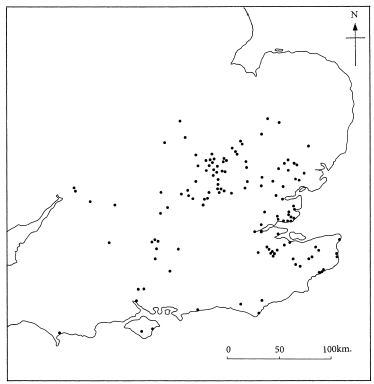
Distribution of Late Iron Age cremations. This should be compared with the southern distribution of ‘Anglo-Saxon’ cremations (see page 223).
pre-Roman Britain, and was the dominant rite in the Late Iron Age in Kent, where there are large cemeteries of what used to be called the ‘Aylesford-Swarling Culture’. Generally speaking, Iron Age cremations are found along the eastern side of Britain; in my experience they often occur in small numbers in settlements rather than cemeteries.48 By contrast, the dominant rite on the western side of Britain was inhumation within a small box or ‘cist’ made from stone slabs.49 This is yet another example of the east-west divide that one finds so often in British prehistory.
Sam Lucy makes the important point that the presence of foreign objects on a British site does not mean that foreigners necessarily came with them - any more than there are German drivers in the many Volkswagens, BMWs and Mercedes-Benzes on British roads. She points out that it simply is not valid to jump from an object to observations about ethnicity. It is the way that objects were used that matters: grave-goods, such as brooches from Early Saxon graves, were used in Britain in ways that differed from Continental practices in the fifth century, and British versions of supposedly Continental originals are known from earliest times. Lucy suggests that the people buried in the Anglo-Saxon cemeteries may well have been British and, as we will see in Chapter 8, there is now scientific evidence to back this up. But why did they adopt these new objects and new rites in their funerary rituals and their daily lives?
The first answer to this question is that they wanted to. Maybe they preferred what they had seen, and possibly experienced, abroad. Maybe to the élites in south and eastern Britain the so-called ‘barbarian’ world north of the Roman frontier was more politically attractive than the Later Roman Empire, where taxation was an increasing burden and security could not be guaranteed. This exercise of free will is something that an archaeologist of the ‘culture-historical’ school would find hard to swallow. To such a person, people change their identities through folk-movement and conquest; his view of the ancient world is straightforward, verging on the mechanistic: pots equate with people, and influences spread or diffuse, rather like disease.50 There is no allowance for invention and free will. Ancient cultures are not allowed to be unpredictable and human in the way they behave.
Sam Lucy is doubtful whether even cemeteries, with all their rich symbolic meaning, can yield reliable information on origins and ethnicity. But they can tell us much about what was going on at the time, what motivated people and gave meaning to their lives - and that is far more interesting than mere ethnicity. Writing about Anglo-Saxon cemeteries of the fifth to seventh centuries, Lucy states:
They tell us little of migrants or invasions of people from the Continent and Scandinavia. Rather, they take us into a richer and more complex world, where we can encounter both the physical reality of early medieval people, and something of their thoughts and aspirations. They also give indications of networks of influence which reached across the Channel and the North Sea…People living in eastern Britain were integrally involved in these networks, which stretched from Norway to south-western France and probably beyond. They came into contact with a range of ideas, brought by merchants, travellers and others, and they selected those that were appropriate…Perhaps the changes in burial rites seen from the fifth century are a result, to a certain extent, of this contact and appropriation of ideas - a process that allows for a certain dynamism in the people involved, rather than one-way traffic from the Continent to Britain.51
The exchange of influences and ideas that Sam Lucy writes about with regard to Saxon-period cemeteries has sometimes been referred to as a change in ‘fashion’, because dress, clothing and appearance were certainly a part of this new identity. Changes in female fashions required the wearing of brooches, both as decoration and to hold the new style of garments together. These brooches survive in graves and are very characteristic of the period: they are usually large, highly decorated, and to modern eyes seem rather overblown. Various items would be suspended from a belt around the waist. There was nothing new about such profound changes of personal identity. We saw in Chapter 3 that the final centuries of the Iron Age witnessed the adoption of new Continentally-inspired brooches, the so-called ‘fibula event horizon’ that J.D. Hill saw as ‘the end of one kind of body and the beginning of another kind of body’. We can find further examples of such changes in personal appearance even earlier in prehistory: the ‘ornament horizon’ of the Middle Bronze Age in south-western Britain being a case in point.52
Sam Lucy is keen to point out that there was far more to these changes of appearance and identity than mere fashion. They were quite swiftly to lead to a new political orientation in the south and east, which fromthe sixth century onwards would find itself in opposition to different traditions in the north and west. It would be a mistake, however, to write ‘fashion’ off as necessarily trivial or ephemeral. It can be a symbol of more profound social changes, as in the 1960s, when mini-skirts were both a fashion and a token of young women’s

Reconstruction of the Anglian style of female Anglo-Saxon dress. The shoulder straps of the outer gown were attached by a pair of small brooches; the large brooch on the bodice could also have been used to attach a cloak. The cuffs of the inner garment were joined by metal sleeve-clasps. From the belt hangs a knife and a pair of ‘girdle-hangers’ which were probably symbolic household keys and may have been worn as a form of amulet or protection.
newfound freedom, brought about by factors including the contraceptive pill and the emergence of the feminist movement.
If ever the Trustees of the British Museum decide to return the Elgin Marbles to Greece, the extraordinary finds from the royal ship burial at Sutton Hoo, in Suffolk, will probably become their most celebrated possessions.53 Excavations in 1938 revealed the burial chamber, probably of a man (no bones were found), in an actual, probably seaworthy, wooden ship which superficially resembled a Viking longship. He was accompanied by fabulous gold jewellery and other items, such as a sword, shield, helmet, lyre, and a series of bronze Byzantine bowls from the eastern Mediterranean. The workmanship of the jewellery is probably British and is of the highest possible order; other items buried in the chamber were either made in, or show clear stylistic influences from, Scandinavia, ‘Celtic’ Britain, the Eastern Roman Empire (Byzantium) and beyond. Sutton Hoo was undoubtedly the burial of a pagan king - and most authorities now agree it was probably that of King Raedwald, an early ruler of the kingdom of Essex, who died in ad 625.
The Sutton Hoo burial was not a unique event. Martin Carver’s excavations around the main mound have shown that there were more than fourteen barrows, and many graves that were not placed beneath mounds. Sam Lucy and Martin Carver see the flamboyance of Sutton Hoo as ‘defiant paganism’ in the face of Christianity, which was rapidly gaining influence in eastern England after ad 600. The finds from Sutton Hoo clearly demonstrate that East Anglia was an integral part of a larger North Sea community. The fact that the ship contained a king shows that by the early seventh century, social changes originally brought about by a process of ‘acculturation’ had developed their own momentum. They had become a real political force in the shaping of early England.
*By ‘self-sustaining myths’ I mean, for example, the hundreds, possibly thousands, of excavation reports which routinely attribute the appearance of Early Saxon pottery to the arrival of settlers.
*See the discussion of East Anglian post-Roman landscapes in Chapter 8.
*The term ‘sub-Roman’, has a pejorative ring which recalls ‘sub-human’. It is still sometimes used to describe the period 410-500.
*A twelfth has been suggested at Clausentum, Bitterne, Southampton.
*Simon James has pointed out to me that the ban on women within Roman forts was probably more theoretical than actual. The fort at Vindolanda on Hadrian’sWall, for example, has revealed the shoes of women and children.
*I too formerly subscribed to the idea of a ‘Migration Period’ - until, that is, I had to think about it closely for the preparation of this book. Sharp-eyed readers of Britain bc will have noticed that in the table of dates and periods I labelled the fifth and sixth centuries AD as the ‘main period of folk movements from the Continent’.39