
WE HAVE SEEN how the southern élites may have played a significant role in the end of Roman Britain, and that their power had an economic base that wasmade possible by the stability and prosperity of the ‘Golden Age’ of Roman Britain in the early and mid-fourth century. I want to start this chapterwith a brief look at the administration of fourth-century Roman Britain, and what it may have contributed to subsequent events.
Just as the organisation of the Roman army changed over time, so did that of the civil administration. Londinium (London) was the capital of the diocese of Britannia, which in turn belonged to the ‘praetorian prefecture of the Gauls’, which also included Gaul, parts of southern Germany and Spain. The capital of this prefecture was first at Trier in northern France and then, from the early fifth century, at Arles on the Mediterranean coast.
By the fourth century the diocese of Britain was divided into four provinces. Up until now we have concerned ourselves with the provinces of Maxima Caesarensis (provincial capital Londinium) and Flavia Caesarensis (provincial capital Lindum - Lincoln), together with south-easterly parts of the northern province Britannia Secunda (provincial capital Eboracum - York). In this chapter we will turn our attention to the less fully Romanised parts of Britannia Secunda and the most westerly province of Britannia Prima (provincial capital Corinium Dobunnorum - Cirencester). It should be recalled that significant parts of Wales and most of Devon and Cornwall were hardly affected by the Roman conquest at all.

Roman Britain in the fourth century.
The four main provinces were subdivided into smaller units known as civitates (singular civitas) or counties. The civitas capital was usually, but not always, the principal town and administrative centre of the province. Official administration was carried out in a large public building called a basilica; these usually formed a part of the official market and administrative centre of the town or city, known as the ‘forum-basilica’ complex. Below the civitas capitals was a tier of smaller towns which included places like Durobrivae, which was discussed in Chapter 4.1 These smaller towns generally lacked an official ‘forumbasilica’ complex, but were nonetheless market centres for their regions.
Like all modern states, the Roman Empire depended on the collection of taxes to pay for civil administration and for military security. These taxes were collected by way of London. When Roman administration ceased, the official collection of taxes in Britain had already been creaking for some time, and it used to be thought that when the central authority of London petered out, everything came to a grinding halt. But we now know that a great deal of authority had already been transferred to the provincial capitals by the end of the fourth century. So when the official Roman presence came to an end, not a great deal changed: one layer of administration had been lost, and a huge burden of taxation had been removed. From the point of view of ordinary people these were positive advantages. Against them, however, should be set the collapse of the monetary system, and with it the trading and production of mass-produced goods such as pottery. The important point is that it was only the monetary market system that broke down: law and order did not. The Romanised élite saw to it that their relatively comfortable and stable existence continued throughout most of the fifth century.
The question of the demise of Romano-British towns is currently a matter of fervent debate among scholars of the Roman period. When I first learnt about British archaeology as a student, many things seemed simpler than they do today. Archaeology was on the brink of an intellectual revolt against the old ‘culture-historical’ school, a transformation from which it would never look back. Very often in situations where rapid change is about to happen, the people who will most be affected by that change seem completely unaware of the storm about to engulf them. That certainly applied in the Department of Archaeology at Cambridge, where many of the objectors to the then status quo were graduate students. They poured scorn on the idea of pots marching across Europe bearing culture-historical labels such as ‘Beaker People’.
Nobody, however, was laughing at the Anglo-Saxons or the Romans, because these were taboo subjects, the province of historical archaeologists and classicists.When as a prehistorian one entered those particular academic worlds, one felt like a stranger. Here everything was calm and peaceful. Not so much as a breath of controversy was allowed to disturb the surface of their classical wine-dark sea. In the study of these later periods the ‘culture-historical’ school ruled absolutely, but very much at the behest of history: the purpose of archaeology was to confirm what historical sources suggested. I’m glad to say that the world of classical studies has since changed a great deal for the better. It’s not perhaps quite as pleasantly anarchic as prehistoric archaeology, but it’s tending in that direction.
Nowhere was the pervasive academic conformity more apparent thirty years ago than in Romano-British studies. In this conservative intellectual climate, towns did not exist in Britain before the Roman period, thrived during it, and collapsed at the end of it. Nobody gave a thought to the social implications of urban life: towns were treated as yet another technical innovation, like roads, masonry or factoryproduced pottery. The fact that people had to live in them was not considered important. The towns appeared, almost it would seem by magic, and the population miraculously organised itself to live urban lives, having previously been rural. If that was what actually happened, it would rank as one of the most extraordinary social transformations in history - but at the time nobody seemed to think it even slightly peculiar.
The sudden transformation of a large part of the ‘native’ British population from rural to urban dwellers did worry prehistorians, who were more concerned about the social processes that lay behind historical events. Towns in Roman Britain were very much seen as ‘historical events’: their defensive walls survived, and the masonry and mosaic floors of their buildings had been revealed by excavation since Victorian times. Nobody but a madman could possibly doubt that they existed. So prehistorians sought precursors for towns in Iron Age Britain. Barry Cunliffe, as one of the few archaeologists who are equally at home excavating Roman and prehistoric sites, is uniquely qualified to judge whether any large Iron Age settlements could be considered as urban. He has come to the conclusion that some do show certain characteristics of towns: at Danebury, for example, there are lines of houses that face onto streets. But this of itself is not solely an urban feature: many villages and smaller settlements pack houses into a given area of land if for some reason space is at a premium - as it may be on the top of a hill. Cunliffe tends to use terms like ‘proto-urban’ to describe the situation in Iron Age Britain.
In recent years there has been renewed activity on some of the very large, dispersed Later Iron Age settlements of south-eastern England. In Chapter 3 I concluded that these areas were not so much towns as ‘polyfocal settlements’, with open countryside separating built-over areas. Maybe one day these settlement sprawls would develop into towns, but in the Iron Age they had yet to make this important step. They remained large, but essentially rural communities. What they lacked, and what a true town has to have in order to function at all, is some sort of local government. Without self-regulation settlement densities beyond a certain point become hazardous, due among other things to the spread of disease.
We saw in Chapter 3 that there are slight indications at the King Harry Lane cemetery at St Albans that a small proportion of the ‘proto-urban’ population in south-eastern Britain, may have been in the process of making the shift from a rural to a more fluid, urban style of life, but these are only hints, and they only seem to apply to a part of Britain that was under the strongest Roman influence prior to the conquest. I would be surprised if there were no indications of a shift of this sort, following almost a century of close contact with the Continental mainland with its many Roman influences. So, with the outside possibility of a tiny proportion of south-eastern Britain as an exception, it would appear that there is no good evidence for fully urbanised communities in the British pre-Roman Iron Age.
While prehistorians like Barry Cunliffe were addressing the problem of pre-Roman urban life, many Romanists were growing anxious about the status and nature of post-Roman towns. A famous conference was organised in Durham over Easter 1978 to consider ‘The End of Roman Britain’. Richard Reece gave a controversial paper which suggested that Late Roman Britain actually ran from ad 400 to 700 in the western province of Britannia Prima, and did not come to a sharp halt in AD 410. He also pointed out that Romano-British towns went into a sharp decline in the late third century, and that after approximately AD 300 urban activity was very much reduced.
Some have suggested that there was a ‘flight to the suburbs’, but whatever happened, most are agreed that in the fourth century the Golden Age of Roman Britain was more a rural than an urban phenomenon.2 The wealthiest members of society preferred to live out in the countryside in their increasingly luxurious villa estates. While new urban housing became rarer, places of public entertainment such as baths, temples and theatres were allowed to run down. The magnificent theatre at Verulamium, for example, ‘became a public refuse tip. Standing, as it does, close to the forum and across the road from a still-functioning market building the theatre must have presented a dismal aspect.’3 In the fourth century building within Romano-British towns almost came to a complete halt, and what work there was tended to be concentrated on the walls that surrounded them. This would suggest that if a threat was anticipated, people from the surrounding area would take refuge in what were, for the most part, ghost or skeleton towns.
Richard Reece’s paper at the Durham conference caused a huge stir. When he offered it for publication it was accepted by the editor of the conference proceedings (and his advisers), but was refused by the publishers, who ‘declined to print the volume if the paper were included’. So he offered it to the prestigious journalWorld Archaeology, which promptly published it in full.4 The refusal of the first publisher to print such an important paper by a leading authority is an indication not just of how certain circles in Romano-British archaeology could be extremely conservative, but of how hard it was to alter entrenched academic attitudes. Some people would prefer no debate to real debate.
Richard Reece examined the supposed collapse of Romano-British towns from around ad 300.5 This date was far too early to be attributed to Anglo-Saxon incursions (which he does not seem to believe in anyway), and was on the very eve of Roman Britain’s most prosperous century. He came to the conclusion that Roman towns in Britain ‘failed’ because they had never truly existed. This is still a very controversial suggestion, and is by no means accepted by everybody. From the perspective of prehistory, though, it does seem to make good sense.
Reece pointed out that towns around the Mediterranean basin were true towns that were already in existence from the early first millennium bc. So they were long-established when Rome included them within her Empire. They had most of the characteristics of a modern town: there were clearly defined cemetery areas, a system of drains, water supplies, rubbish disposal sites and monumental administrative buildings. For reasons that are probably due to the different way that societies were organised in the lands north of the Mediterranean, the notion of true towns did not spread beyond the south of France into Gaul north of the Alps. In northern Europe those large, essentially rural settlements known as oppida were the nearest equivalents, but they were hardly towns in the sense we would understand the term today. They were more like enormously inflated hillforts.
When the Romans conquered Britain, they set about establishing a system of provincial and county administration. In the absence of any true towns Reece suggested they established many of their civitas capitals at places where people traditionally met to market and exchange goods and produce. The Roman authorities formalised these arrangements and built monumental administrative buildings and all the other trappings of towns, including streets, walls and so forth. The idea seemed to catch on, and these elaborated trading stations grew in size and population. To Richard Reece ‘this suggests a view of the town in Roman Britain as a trading settlement within a classical façade’.6
It follows from this that it is not necessary to explain why they went into a decline at the end of the third century, because they had never really got going as towns. The first parts to go were what Richard Reece calls the ‘trappings’ of a classical town: the forum, the basilica and the theatre. After the initial short period of enthusiasm they ceased to be relevant, largely, I suspect, because society had not yet adapted itself to be urban; it was an idea ahead of its time. You cannot have towns without townspeople, and if the population of Britain remained essentially rural, it is not to be wondered at that the Golden Age of Roman Britain was also a rural age.
I find Reece’s ideas attractive, because they take into account the long-term development of British societies. They are not based on an assessment of the status of bricks and mortar alone, removed from their wider social context. He does not say that such-and-such a range of buildings are so large and complex that they therefore have to be part of a true town. Instead he looks at the people (and how they organised themselves) first, and the buildings second - which is how a prehistorian likes to work.
Starting in the later fourth and fifth centuries, first eastern and then western Britain underwent a process of de-Romanisation. True towns - and this time they were indeed truly urban - only came into existence from the beginning of the eighth century, some three hundred years after Roman rule. These urban settlements began as trading posts around the coast, at places like Hamwic, the Saxon name for Southampton. The fact that true towns began as trading centres supports Richard Reece’s view that despite the Romans’ intentions, the Britons were not yet ready for them. Incidentally, when Hamwic did get going, it did so with impressive speed: it covered about a hundred acres and boasted a population of two to three thousand people in the eighth century.7 Most of the trade seems to have been with France, Germany and the Low Countries, together with other parts of Britain. Hamwic and other English trading ports went into sharp decline in the mid-ninth century, probably due to Viking raids which disrupted long-distance trade.
While Romano-British towns may have declined during the fourth century, there is now some evidence that some of them continued into the fifth. If one takes Richard Reece’s view that in Roman Britain there was ‘life in towns’, rather than ‘town life’ in the sense that we understand it today, then the later occupation of the fourth, fifth and even sixth centuries (at Wroxeter, near modern Telford) was not truly urban. But on the other hand it was not ‘squatter settlement’, as I have heard it described, either. These places had been trading centres in pre-Roman times, and that is probably what they returned to being in the fourth and fifth centuries. I am sure that a proportion of the surplus produced at a wealthy site such as Orton Hall Farm would still have been taken to market in Durobrivae, only this time the ‘buyers’ would have bartered, and would have come from other farms and settlements in the neighbourhood.
The point is that the withdrawal of Roman troops did not signal the collapse of social organisation. London may have ceased to have been the centre of the diocese and the diocese itself ceased to have an identity, but the provinces and the counties still continued to exercise a degree of authority as they had done throughout the fourth century, despite the abandonment of many basilica buildings in the civitas capitals. The rural population was controlled from the large estates in the countryside. From the later fourth century villas may have been abandoned, but there is no evidence to suggest that civil order collapsed. Presumably the old élites still maintained a degree of control, perhaps aided by the Church, especially in and around towns. We have some evidence for such control at the Roman city of Viroconium Cornoviarum, or Wroxeter, in the province of Britannia Prima.
Wroxeter was the fourth-largest town in Roman Britain, and it is chiefly remarkable in archaeological circles because it survived for well over a century after the official end of the empire in Britain.8 This is important because it proves that western Britain did not revert to ‘Dark Age’ chaos following the events of ad 410. Instead, there is evidence to suggest not only that people lived at Wroxeter, but that they lived what one might term ordered lives. These were certainly not squatters wearing rags and scavenging scraps of food among the ruins of former grandeur.
We owe the discovery of post-Roman Wroxeter largely to the painstaking excavation of Philip Barker, whose early death in 2001 came as a huge blow to everyone who knew him. Before Phil it is probably fair to say that most archaeologists had not spent a great deal of trouble systematically working through the deposits that lay above the Roman layers that interested them. In the early and middle twentieth century budgets were far smaller than they are today, and it made little sense to waste one’s time and money carefully sifting through layers of material that were peripheral to one’s main interest. No funding organisation would thank one for revealing the details of, say, a Victorian farmhouse, while leaving precious Roman deposits beneath it untouched.
Phil began his work at Wroxeter in 1966, and soon realised that the site was going to be different. For a start, it was a Roman city that had not been replaced by a Saxon and then a modern one, as happened, for example, at York, Lincoln and London. It was in fact a ‘green-field’ site, where cows were peacefully grazing. What damage there had been was largely accidental: the construction of a few cottages and farm buildings. Apart from that, the place had been abandoned in the seventh century when the powerful ‘Anglo-Saxon’ kingdom of Mercia overran the area from the Midlands. The history of the site meant that the latest Roman and post-Roman layers would still be there, largely undisturbed.
Phil had a shrewd suspicion that the ‘Dark Age’ buildings would have been made from timber, which would long since have rotted away. The buildings of the Roman town were made of masonry, and were not difficult to spot - in fact a two-storey-high wall of the main public building, the baths basilica, still survives, formerly as part of a barn but now part of a Scheduled Ancient Monument (to use the legal term). The upstanding wall is known as the ‘Old Work’, and it is well worth visiting.
The Old Work is now surrounded by the remains of the massive baths basilica, much of which was excavated in the nineteenth century. These earlier archaeologists had not found evidence of ‘Dark Age’ activity on site, but by modern standards their techniques were relatively crude. It was usual, for example, to employ workmen with picks and shovels. Thomas Wright, one of the main Victorian excavators at Wroxeter, was a freelance excavator and journalist, and he was plainly rather better at being the latter than the former. He does seem, however, to have had a genuine gift for publicising archaeology, which in the 1860s was becoming a subject of great public interest. This was a time when curiosity about origins and early history had been fuelled by Darwin’s great workOn the Origin of Species, published in 1859. Previous decades had witnessed the partition of prehistoric times into Ages of Stone, Bronze and Iron; public enthusiasm for archaeology was also greatly increased by the discovery of the Swiss ‘Lake Villages’ following the dry winter of 1853-54.9
Wright had written a book, The Celt, the Roman and the Saxon, which attempted unsuccessfully to pour scorn on the Three-Age system. Like almost everyone at the time, he accepted the Anglo-Saxon ‘invasions’ as fact, and like most archaeologists subsequently, he allowed that belief to colour his work. One example will suffice: it concerns ‘the old man in the hypocaust’. This body was probably a post-Roman burial that had been inserted into the abandoned baths basilica hypocaust (under-floor heating system). But it was meat and drink to Wright, who ‘saw the body as that of a poor unfortunate who crawled into the hypocaust to escape the Anglo-Saxon pillage of the city and who had died there alone and terrified’.10 Not surprisingly, this tragic image haunted the public imagination for many years, and influenced poets and artists alike.
Phil Barker realised that the only way to identify the slight traces left by vanished timber buildings was to plot the precise position of every pebble.11 It was an extraordinary undertaking, but it worked. I remember taking my own excavation team to visit Phil while he was digging some time in the early 1970s. We thought we were pretty good at working on geologically ‘difficult’ (i.e. variable) ground, where archaeological deposits were hard to distinguish from nonmanmade features such as the filled-in fissures left by the freezing of old stream channels during the Ice Age; but that paled into insignificance when set alongside Wroxeter. I recall Phil trying to get us to see the faint traces left by a wall or path that ran across a patch of pebbly ground before us. All I could see were stones of different sizes. Then he showed us a plan of the area, and suddenly we could see what he meant. How on earth he and his supervisors spotted such things I will never know.
Phil Barker and his team concentrated on the area alongside the central official buildings of the baths basilica block, close by the Old Work. Like government or official buildings in other civitas capitals, the forum basilica building at Wroxeter experienced catastrophic problems at the end of the third century, when it burnt down and was abandoned as a building, if not as a site. The baths also declined: floors wore out and mosaics deteriorated. The damage to the baths building was made good, but in a more rugged, less lavish fashion, in the late third or the fourth century. There is evidence that trade
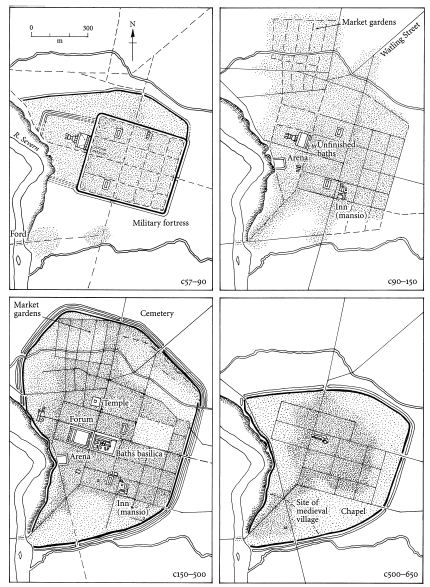
The development of the Roman city of Viroconium Cornoviarum (Wroxeter) from its beginnings as a military fortress and civilian settlement to its final state as a small ‘Dark Age’ town. Areas of settlement are shown by stippling.
continued near the baths basilica, first with money and, after the collapse of the monetary system, using barter.
The ‘Dark Age’ buildings of the fifth and sixth centuries are remarkable, not just for their discovery in the first place, nor because they were made in a non-Roman technique, from timber, but because they were built in a Roman style and laid out using a Roman system of measurement (based on Roman feet).12 This gives us a fascinating insight into the ways in which the post-Roman inhabitants of the town thought and acted. The process of de-Romanisation discussed by Reece may have begun, but evidently it was by no means complete.
There has been much discussion about whether the post-Roman use of Wroxeter was ‘town life’ at all. My own view is that it was probably something akin to what we saw at the very end of the Iron Age: intensive but essentially rural settlement around a market centre that was used by everyone in the locality. As any farmer will tell you, some form of market is essential to rural life. Very few farmers are fully self-sufficient, because they will always require new bloodlines when inbreeding becomes a problem, and sources of fresh seed when yields decline. Markets are also where they and their families can meet other people and escape from the confines of the farm. At Wroxeter the shell of the basilica, and doubtless the area around it too, had been made safe and was still used as a market. ‘The conversion of a public building in this way reminded one of the staff of the excavation, who now lives in Warsaw, of the principal black market in communist Warsaw, held in the ruins of a burnt-out government building which had not been reconstructed after the Second World War.’13 That is a telling image.
Some time roughly between ad 530 and 580 the centre of the old Roman city was transformed. The remains of the old basilica were demolished and the site was prepared to take a number of substantial new timber buildings, including one, known as Building 10, that was particularly grand. It is possible too that what had once been the cool room, or frigidarium, of the old Roman sauna-style bath building nearby was converted into a chapel. One reason for suggesting this was Thomas Wright’s discovery of a dozen or so burials in the floor of the bath house surrounding the frigidarium; one of these was ‘the old man in the hypocaust’.
This work has to have been organised in some way. It was not the unplanned activity of a group of squatters. The person in command may have been a local tyrranus (to use Gildas’ term), or king, but if that were the case one might have expected him to have chosen a rural rather than an urban site for his headquarters, as it will be recalled that the Late Roman élites showed a marked preference for the country. If ever a place demanded an Arthur it is surely post-Roman Wroxeter, but his name has never been linked to it. Roger White and Philip Barker have, however, suggested a much more plausible controlling authority:
If the frigidarium had indeed become Wroxeter’s church then the likeliest occupant of Building 10, and for instigating the work in the first place, can perhaps be identified as a bishop. Such a conclusion may take some by surprise but in the context of the later and immediately post-Roman world this makes perfect sense. Bishoprics had been established by the emperors in the fourth century in every major town. Once established, they are likely to have become self-perpetuating, appointing and reappointing among themselves since there was no authority to answer to other than the emperor, the pope not yet having established primacy in the west.14
Wroxeter is not the only town in the province of Britannia Prima to show evidence for post-Roman occupation. The baths at Roman Bath, for example, were repaired and kept in use well into the fifth or even the sixth centuries. Chester too shows evidence for settlement after the Roman period, and also for a possible bishop, named Viventius. Elsewhere in the country there is evidence to suggest that the major decline in urban Roman Britain was around the beginning of the fourth century, rather than when one might have expected it, a hundred years later: there is evidence for fifth-century occupation near the crossing of the River Ouse at York.
One of the problems in recognising these late phases of settlement is that Roman pottery ceases to be used, and we still do not fully understand what immediately took its place. At Wroxeter, for example, Late Roman pots were frequently mended and maintained in (rather unhygienic) use. Recent research by Dr Mark Whyman of the York Archaeological Trust has shown that a form of rather unlovely, coarse, hand-made pottery known as calcite-gritted ware was made well into the fifth century, and was used by the inhabitants of ‘Dark Age’ York. Whyman’s research gives us, almost for the first time, a means of accurately dating early post-Roman settlement in the York area. To judge from the buildings where these people lived and worked it was a smallish town-like settlement, in many ways comparable with fifthand sixth-century Wroxeter.
Although less prosperous than in Earlier Roman times, fourthcentury London does not seem to have been quite so run-down as other towns and cities of Roman Britain. Maybe this was because of the general wealth of the city’s merchants and the value of their trade. Nevertheless, there is archaeological evidence that some properties in the city became open areas or yards at this time, so clearly not all was well. Matters became worse from the beginning of the fifth century, with the city disappearing in the space of a few years, the population presumably dispersing to the countryside.15 Some of them probably took fancy mosaic floors with them, as there is evidence of them being cut up and removed.
In Colchester, or Camulodunum, in the heart of the Anglo-Saxon area, there are signs of Anglo-Saxon influences in Later Roman times, just as we saw at Mucking and elsewhere. If we assume that this is evidence for the spread of new ideas rather than mercenaries, it is interesting that two of the distinctively ‘Anglo-Saxon’ sunken feature buildings were found at Lion Walk, Colchester.16 This famous site is located within the Roman walled town, and one of the ‘Anglo-Saxon’ buildings was built against the walls of an abandoned Romano-British house. Philip Crummy, who excavated the site, dates this occupation, which seems more akin to a ‘squatters’ camp’ than anything more urban, to about ad 440-450.
Christianity was to have a strong influence on the development of western Europe in post-Roman times. Its roots lay, of course, in the Roman period, and the Church perpetuated not just the Latin language but many aspects of Romanitas, or Roman civilisation. The Church was also an institution that was capable of providing stability in unstable times. Maybe it was indeed the Church that lay behind the late occupation of Wroxeter - we cannot be certain. But even if it did not, it could have done, which is almost as important.
From a crudely historical perspective, we know that Christ was crucified in the first half of the first century ad.17 A century later, Christian churches were to be found in many towns and cities around the Mediterranean. This was still a largely clandestine Church, which by its very nature is almost archaeologically undetectable, but it does not seem unreasonable to assume that it reached Britain at some point in the second century, given what we know about the efficiency of Roman communications. As we have seen, in Britain it became sufficiently well established to allow the development of two heresies and for there to have been a substantial backlash against them on behalf of the established (ultimately Celtic) Church.
So Christianity in Britain had probably already undergone over a century and a half of insular development before the withdrawal of Roman civil administration in ad 410. The next major event was the supposed ‘introduction’ of Christianity to Anglo-Saxon pagan Britain by St Augustine’s missionaries, who arrived at Canterbury in ad 597 - or at least that is what most people over forty were taught at school. The only other thing I was taught about St Augustine’s mission was the famous remark attributed to Pope Gregory the Great (590-604) after seeing two blond Anglo-Saxon youths in the market at Rome, that they were ‘not Angles, but angels’.18 The sight of them so moved him that he determined to send a mission to Britain. Bede goes on to tell us that, being Pope, he was not allowed to travel so far from Rome, which is why he entrusted the mission to St Augustine.
The notion that Augustine’s mission was to pagans and new British converts is undermined by Bede himself. Dr David Howlett has described the situation Augustine encountered in Britain: ‘According to Bede, before meeting Augustine the British bishops consulted a wise and holy hermit who advised them to follow Augustine, if he bore himself the yoke he wished them to bear. But when they approached Augustine he did the Roman diplomatic thing and stayed seated, which they interpreted as a mark of arrogance. Note that seven bishops turned up on this occasion, not the whole bench of bishops. That implies that more existed in the British Church.’ Howlett added that the British were better Latinists than the Augustinian missionaries. All of this illustrates that sixth-century south-eastern Britain was far from a pagan wilderness. And we will shortly see that the Latin language and scholarship also flourished in the rest of Britain, especially Wales, the south-west and the north.
So south-eastern Britain was far less ignorant and pagan than the missionaries had been led to expect. We also know that in the seventy or so years that followed St Augustine’s mission, the newly arrived Roman Church and the indigenous Celtic Churches developed their own liturgical practices, which reflected their different cultural backgrounds. It might seem odd to us today, but in the fifth and sixth centuries such matters as the means whereby the annual date of Easter Day was calculated actually mattered, because they were an integral part of the way people thought about life and the natural world.
We know that these calendrical debates were very important to people at the time, and I suspect that this is an indication of something ancient and profound. As I mentioned in the earlier discussion of pre-Roman Britain, religion and ideology were an expression of a person’s cosmology or belief system. They were not distinct from normal, day-to-day life. The coming of Christianity started or hastened the process of such a separation, but in the fifth to seventh centuries ad, God, the Church and the mundane were still far more closely integrated than they are today. Religion was a real and powerful force in people’s lives, and special days of celebration mattered to everyone. They had to be got right. The intricacy of the calculations that surrounded feast days was part of their mystery and magic. Just like the solsticial sunrise over Stonehenge, these liturgical calculations united the world of human ideology to a larger, natural order of things, which was now seen as the work of a supreme Creator.
The two Churches continued their separate patterns of development, and the submission of the Celtic to the Roman Church was not begun until a great assembly of senior clergy of both Churches met at Whitby on the Yorkshire coast in 664. After the famous Synod of Whitby, St Augustine’s Roman Church would become the official Church of Britain. The Celtic Church, however, had been a powerful force in the land for perhaps three centuries, and its influence would continue to be felt for as long, or even longer.
Recently scholars of the Early Saxon period have grown dissatisfied with the notion that Britain was somehow different from the rest of the provinces that had once comprised the Western Roman Empire. In his recent book, Britain and the End of the Roman Empire, Ken Dark accepts the idea that Anglo-Saxon settlers arrived in Britain first as foederati, or mercenaries, but turned against their erstwhile masters in the Anglo-Saxon rebellion that Gildas writes about and which (if it happened) would have taken place some time around 490-500.19 Before that cataclysmic event, he suggests that what had been Roman Britain remained firmly under British control. This is the period that would once have been dubbed the ‘sub-Roman’ period, but which Dark and others prefer to include within ‘Late Antiquity’, which broadly extends from the mid-third to the seventh centuries ad; it deliberately includes a significant part of the Roman period, because, as we have seen, changes in military and other institutions of the Later Roman Empire contributed to the changes that would affect not just the collapse of the formal Empire, but the continuation of civil life in the fifth and sixth centuries.
The idea of ‘Late Antiquity’ goes against the earlier view of life in post-Roman western Europe, where Roman order gave way to the so-called ‘Migration Period’, during which large numbers of people are supposed to have migrated hither and thither over the Continent, either settling down or passing through. Viewed from the perspective of prehistory, the very idea of a ‘Migration Period’ is absurd: why would people suddenly decide to move around in this peculiar and hyperactive fashion? What was in it for them, other than wholesale disruption?
With the exception of this one period, the lesson of the past is that as a rule human societies prefer to stay put, on land in which they have a personal, ideological and economic stake. Laws of marriage and other factors such as trade, exchange or persecution may lead to the movement of people, but that is quite distinct from wholesale migration. Similarly, raiding can eventually lead to more permanent settlements away from home. But even nomads restrict their movements to fixed routes which both follow seasonally available resources and are recognised by other groups living in the area. I know of no nomadic people that have wandered across the face of the earth unrestricted in any way.20
The picture of ‘Dark Age’ or ‘Migration Period’ Britain that is beginning to emerge bears little resemblance to the ‘Pagan Saxon Period’ as portrayed by Myres. Those terms themselves, with their heavily-charged, emotive words - ‘Dark’, ‘Migration’ and ‘Pagan’ - suggest a degree of pre-judgement, or prejudice. I do wish that those who study the post-Roman periods would come up with less loaded terminology: ‘Stone Age’, for example, carries with it no ethnic or cultural baggage in the way that ‘Saxon’, or even ‘Early Christian’, does.
Throughout his book Ken Dark writes about ‘Anglo-Saxons’ in inverted commas, as a token that he does not wish to assign them an ethnic identity. He takes a longer view of the period, tending to stress continuity rather than change, and makes a strong case for the survival of Christianity, even in the so-called Anglo-Saxon heartlands of eastern and southern Britain, throughout the fifth and sixth centuries. This undermines the old view that ‘Dark Age’ Britain was very different from the rest of what had once been the Western Roman Empire:
In so far as most of Britain was different from other Late Antique western European societies at all…this was often because more, not less, of its Roman heritage survived and because the Britons were particularly effective in spreading their version of the Late Antique Romano-Christian culture to neighbouring peoples. What enabled these differences to occur was the ability of the Britons to retain their political independence longer than any of theirWestern provincial counterparts.21
The principal driving force behind Christianity in the fifth and sixth centuries was the Eastern Roman Empire, otherwise known as Byzantium. I have mentioned that the Sutton Hoo ship burial produced a set of Byzantine bronze bowls, and these are neither an outlying nor a unique find. A slightly different form of Byzantine bronze bowl has been found in the Thames Valley and in south-eastern Britain, along the Rhine Valley and into central Europe and the Adriatic Sea.22 These bowls, which often stand on short feet, are known rather confusingly as ‘Coptic’ bowls, despite the fact that we know they were not made in Coptic Egypt.* We will see shortly that at least another possible trading route lay through the Mediterranean and thus to Spain, Portugal, Ireland and western Britain. Both Ken Dark and another authority on the period, Anthea Harris, argue persuasively that these connections played an active part in shaping the barbarian and ex-Roman west until at least the seventh century. I do not know the extent to which this was a deliberate political decision by leaders in the Eastern Roman Empire, now known as Byzantium. What I am convinced of, however, is that the so-called ‘barbarian’ west, which included Britain, was sufficiently sophisticated and well organised to beworthsubjecting to such influence. This would certainly imply that paganism had not triumphed even in places like south-east England, which has quite a heavy distribution of bronze ‘Coptic’ vessels. It would seem probable that the Church was playing a significant and a growing role even in these easterly areas.
We have known for some time that the (Celtic) Church played an important part in the development of post-Roman society in the south-west. As Ken Dark puts it: ‘We might see…the fifth century as a turning point for the character of religious foci in western Britain. Whereas as late as the mid-fourth century the principal rural religious foci throughout the region were pagan temples, by 500 this situation had ceased. There is no trace of organised paganism in western Britain after the early fifth century, and the main religious foci are now monastic sites and churches.’23
Before Anthea Harris’s Byzantium, Britain and the West: The Archaeology of Cultural Identity ad 400-650 (2003), the links between Britain and the Mediterranean world were best illustrated by finds from Wales and the West Country. The most famous of these finds have undoubtedly come from perhaps the best-known archaeological site in western Britain, the stunningly beautiful coastal site in north Cornwall known as Tintagel Castle. It’s a place that cries out to have magic and legends attached to it - and not surprisingly, this is precisely what has happened.
If the archaeology of Britain has been bedevilled by the fact that
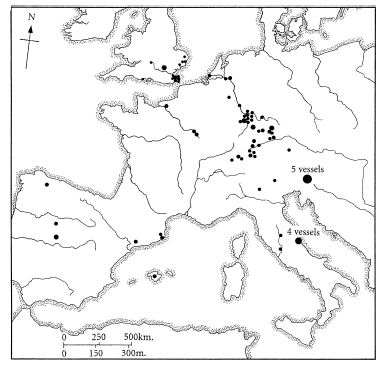
Distribution of so-called ‘Coptic’ bronze vessels produced in the Eastern Roman Empire (perhaps in and around Constantinople) during the late fifth and sixth centuries AD.
archaeologists tend to stick to their own time periods, one way around this sometimes rigid chronological compartmentalising is to become a specialist in a given region. There is one regional specialist who stands head and shoulders above the rest, and that is Professor Charles Thomas. He has researched Tintagel and written about its archaeology in a fine book.24 He would certainly object strongly to the now oldfashioned term ‘Dark Age’ being applied to the south-west, and would prefer ‘Early Christian’.* Tintagel Castle is a spectacular rocky promontory joined to the shore by a narrow land bridge, which is constantly being eroded by the sea. The name is derived from two words in Cornish, din + tagell, meaning ‘fort by the neck of land’, which describes the site precisely.25The fortifications are mainly concentrated on either end of the land bridge and on one spot on the ‘island’, where there was a landing place for ships. Most of the walls and fortifications now visible belong to the medieval castle built by Earl Richard of Cornwall after he acquired the site in 1233.
I am concerned here with events earlier than the thirteenth century, for which there is abundant evidence. The earliest fortification was the Great Ditch, which was dug out, probably in the Early Christian period, some time in the fifth or sixth centuries, along the line of a natural fissure in the rock that effectively cuts off access to the land bridge from the mainland. The medieval defences follow the Great Ditch.
The remains of probable Early Christian houses can be seen as slight humps and bumps over large areas of the ‘island’. Many of these have not been excavated, and must be preserved for the future. In the 1930s some rather poor work, even by the standards of the time, was carried out on them, but the records have not survived. More recent research has revealed the remains of further Early Christian houses, but what astonished the archaeological world was the profusion of finds from the Mediterranean that they revealed. No other fifth- and sixth-century site in Britain has yielded so much imported material as Tintagel.
The sheer quantity and variety of the Tintagel finds clearly show that we are not dealing here with, say, a chance shipwreck on a rocky shore. This has to be evidence of regular trading contact: the result of supply meeting demand. The demand for exotic things was certainly there: glassware fromsouthern Spain, wine amphorae from Byzantium, oil jars and fine tableware from the north African coast. This is topquality stuff, and it is moreover manifestly Roman in appearance. Arranged on an Early Christian prince’s table, it would have proclaimed not only that he was rich and powerful, but that he espoused Roman values. He was telling the people who dined with him that he was a civilised Roman Briton. It was a potent message.
Tintagel was more than a temporary settlement. People lived and died there. Charles Thomas has revealed that some graves beneath low mounds in the churchyard of Tintagel church, above the cliffs that overlook the castle about half a mile to the south, probably date to the sixth century. This was the time that Tintagel may well have been the home of a powerful leader of Dumnonia, the ancient kingdom of what is now Devon and Cornwall. We first hear of Dumnonia in the Iron Age, and so far as we know it continued in existence throughout the Roman period, during which Roman rule barely affected the far south-west. It would seem probable that the adoption of Roman ways by the Early Christian British élites in Dumnonia was a way of expressing their prestige, but also their identity. As we saw in Chapter 2, something similar happened in north Wales, but rather later, in the ninth century.
If Dark Age Wroxeter cried out for an Arthur figure, Tintagel makes an even louder plea, and Geoffrey of Monmouth, ever eager to please, provided one in his Historia Regum Britanniae (c.1136). In fact he generously provided posterity with the real thing: he suggested that Arthur was conceived there, following some morally dubious magic by Merlin, who transformed Arthur’s father, King Uther Pendragon, to look exactly like Duke Gorlois of Cornwall. In this guise Uther then bedded the beautiful Igraine, the Duke’s lawful wife, and the result was Arthur. It’s an excellent, if unlikely, story, and the inhabitants of Tintagel have been dining out on it ever since.
In 1998 the press became over-excited by the discovery at Tintagel of the so-called ‘Artognou’ stone by a team of archaeologists from Glasgow University under Dr Chris Morris. This slate had been reused to cover a sixth-century drain, and it bore a scratched inscription with the name ‘Artognou’ on it. Artognou is not the same as Arthur, although both names come from the Welsh word for a bear. It was not, as the media screamed, conclusive evidence that Arthur was ever actually at Tintagel.
There is abundant evidence for a revival of trade between western and south-western Britain, north Africa and the Byzantine realms of the eastern Mediterranean in the fifth and sixth centuries. Tintagel was by no means the only place where such trade in luxury goods has been recorded, but by far the majority of find spots are in south Wales
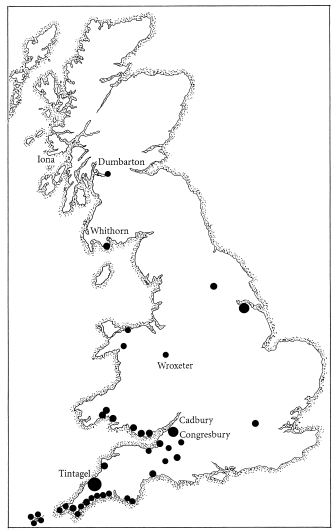
Distribution of imported Byzantine pottery of late-fifth- and sixth-century date in Britain. Small dots, 1-4 finds; medium dots, 10-20 finds; large dot, 60+ finds; Tintagel, 80+ finds.
and the south-west. Apart from any other considerations, sea trade would have been encouraged by the political fragmentation of the Western Empire, which inevitably led to a deterioration of the originally Roman road network.
The small harbour at Tintagel is known as the Haven. It consists of a small sandy beach on the north side of the land bridge. Here the sea is relatively calm. Ships could be beached at the Haven or perhaps moored a couple of hundred metres further along the ‘island’ at a place which was converted into a defended wharf in medieval times. On the other side of the land bridge the shore is rocky and the seas fiercer. Tintagel would not have been a port as such, but a stop-off point for trading vessels that were ‘leapfrogging’ along the coast, moving from one small community to another. It was a pattern of trade that we know was popular in pre-Roman times.
Charles Thomas is of the opinion that the trade between Britain and the Byzantine world would have been carried out by merchant captains who sailed their ships around the Mediterranean, collecting what they knew would sell in Britain. (He is unpersuaded by the currently fashionable idea, espoused by Ken Dark and others, that this trade had broader political implications to do with the foreign policy of Byzantium.) The ‘currency’ used in exchange for the luxury items was probably mainly Cornish tin, which was shipped out of Britain in the form of ingots.
The recent find of a coastal settlement amongst the dunes at Bantham Ham on the south coast of Devon is particularly exciting. The site, at the mouth of the Devon River Avon, is a naturally sheltered sandy haven on an otherwise rocky coast. There were two episodes of Dark Age settlement, which included imported table wares from North Africa and large fragments of eastern Mediterranean amphorae. The size of these pieces is most unusual, and might suggest they may have been broken during the process of unloading a vessel. A few miles to the north-west of Bantham Ham the discovery of a wreck site in Bigbury Bay revealed over forty tin ingots of Late Roman or Dark Age date.26 To me, this looks more like organised trade than the casual peddling of wares by adventurous merchant-captains.
The Early Christian period in the west and south-west is fascinating to an archaeologist because it provides evidence of how people make use of the objects and even the landscape around them to express their identity. The west was comparatively unaffected by the end of the Roman Empire in Britain, because most of it was beyond the broadly southerly zone of Andrew Sargent’s north/south divide. Richard Reece sees the end of the Roman period around Cirencester, the provincial capital of Britannia Prima, as essentially being a return to the pre-Roman status quo. In the Iron Age people in the area lived a rural life, for some reason without much pottery (which is irritating if you are an archaeologist), and this was the style of life they returned to in the fifth and sixth centuries. He sees no evidence for chaos or social collapse, because communities were resuming a pattern of life that had not died out and that was already well-established prior to the Roman interlude.
Further west we see a more conscious adoption of various symbols that expressed people’s identity. We have already seen how the southwestern élites used Roman objects as a way of expressing their high social status and their identity as Romanised Britons, and we will see shortly how in Wales this reinvention of Romanitas reached extraordinary levels of intellectual sophistication. But there was another, British, side to the coin. The post-Roman élite in the west needed to encourage links with the pre-Roman past. In current anthropological jargon, it was a means of ‘legitimising their authority’. Leaders like to do this from time to time, especially if the political climate is at all turbulent, as it was in the fourth and fifth centuries.* It would shortly become even worse when the ‘Anglo-Saxonised’ people of the Midlands and east turned their attention on the Romanised people of the west.
In the fifth and sixth centuries British leaders in the west paid special attention to sites and monuments that had been important in pre-Roman times. Very often these were in locations that stood out from and dominated the landscape. Just like the builders of the great medieval cathedrals who chose spectacular sites at places like Durham, Lincoln, Salisbury and Ely, their aim was to impress and to dominate. These places quite literally overshadowed people’s lives. They were intended to be a constant reminder of who was on top and who was below. The message was crude, but effective.
We have come across one of these sites already. Leslie Alcock was convinced that South Cadbury was Arthur’s Camelot. To my mind that is something of a red herring: what matters is that that particular Somerset hillfort dominated the surrounding countryside, and had been a place of great importance throughout the last millennium bc. Modern research has shown that in pre-Roman times it sat within a prosperous and settled landscape of fields and farms.27 The recent discovery of a ceremonial Late Bronze Age bronze shield that had been placed in a ditch and then ritually destroyed by having a wooden stake driven through it suggests that the hill was also a religious centre by 1000 bc.28 Then, shortly after the Roman Conquest, we find clear evidence that efforts were made to erase or destroy the site’s continuing role as a focus for the community and as a symbol of local people’s identity.
The Roman army marched in. Burials were disturbed, ditches were filled in and a new shrine, to Roman gods, was constructed which it was hoped would focus local beliefs in a more ‘constructive’ direction.29 To my mind it is no surprise that South Cadbury became an important centre in early post-Roman times: the ramparts were enlarged and new buildings were constructed on the hilltop. I suspect that South Cadbury had stood as a symbol of local British identity throughout the Roman period. It was the natural place for new Dark Age leaders to seek legitimacy in the eyes of the community.
If you stand on top of the South Cadbury ramparts you can clearly see the steep hill of Glastonbury Tor in the distance to the north-west, across the marshes of the Somerset Levels. Today Glastonbury Tor attracts strange theories and peculiar views of the past, as I suspect it always has done. There is something about the place that seems unnatural, improbable and, dare I say it, magical. The terraces that make the hill look like a grass-covered ziggurat have a perfectly normal explanation (they are so-called ‘strip lynchets’ formed by medieval agriculture), but many people believe they form part of a mysterious maze.
Whatever your opinions on Glastonbury Tor, it is reasonable to suppose that people in the past would have seen it as a special place.30 If we add the extra dimension of water, because both the Tor and the Abbey are at the edge of the Somerset Levels, the place assumes added religious significance. In the Bronze and Iron Ages wet places, and particularly unusual wet places, were often seen as being close to the next world; Glastonbury is so strange that I think we could assume it was a religious centre, or a special place of some sort, even without the numerous remarkable finds that have been made nearby in the Levels.31
Viewed as a piece of landscape, the Glastonbury area is completely dominated by the steep-sided hill known today as the Tor. The name Glastonbury may predate Roman times: ‘the stronghold of the people living at Glaston’, a Celtic name possibly meaning ‘woad place’.32 The Tor is where anyone wishing to draw strength from pre-Roman traditions would establish a presence, and that is where we find Early Christian remains.
In the 1960s Professor Philip Rhatz was commissioned by a group of American Glastonbury enthusiasts to investigate the top of the Tor. He found no evidence for Christ’s presence there, nor yet an Ark, but he did find the remains of a fifth- or sixth-century settlement, including sherds of Mediterranean amphorae. There were also traces of timber buildings, and a large number of animal bones suggested that top-quality cuts of meat had been eaten there (they were butchered elsewhere, presumably at the bottom of the hill). We now know from other excavations that feasting formed a part of life in fifth- and sixth-century monastic sites. Add to that the discovery of two burials, and it would seem that the top of the Tor was indeed an Early Christian monastic settlement.
I have to say I was slightly disappointed when I first visited Glastonbury Abbey in the 1960s. It seemed a bit shabby, run-down and really not very old. To make matters worse, I had hitch-hiked across England to see Philip’s dig on the Tor, and like a typical student I hadn’t bothered to check the dates. After a long climb, I found the place windy and deserted. So I felt little enthusiasm when I revisited the site nearly forty years later, being in no rush to see again the site of that late-twelfth-century archaeologico-religious travesty known as the Discovery of Arthur’s Tomb (see page 36). I was, however, impressed by the new Abbey Visitor Centre and its excellent displays.
I was in that Visitor Centre and it was raining outside. Somewhere above me the Tor lurked, hidden in the mist. I was sipping a mug of coffee when my eye was caught by a small case with a bronze vessel in it that superficially resembled one of those supposedly ‘Coptic’ bronze bowls I discussed earlier. It was indeed a Byzantine piece, not a ‘Coptic’ bowl but a censer with a chain - a vessel used to hold burning incense. It was found during roadworks in 1980 on Silver Street, just north of the Abbey precinct, and probably dates to the late sixth or seventh century. It is a very fine piece, and one which can only have been used in a church.
The distribution map of Dark Age settlements in the south-west includes a number of reused pre-Roman sites, of which perhaps the best-known are the Iron Age hillforts of Cadbury Congesbury, also in Somerset, and Dinas Powys, in south Wales. Both are classic examples of places where ‘Dark Age’ leaders have sought validation through extensive reuse of significant Iron Age hillforts. Both, too, have yielded examples of imported Mediterranean pottery.
I will close this chapter with a most remarkable example of literacy in a supposedly ‘Dark Age’. It consists of a series of what at first glance appear to be rather crudely carved stones, each one of which carries several lines of Latin inscription. They are mainly found in Wales, but other examples are known from the south-west. These inscribed stones are at odds with the conventional wisdom, as succinctly expressed by Dr David Howlett, who has done more than his fair share to debunk it:
Some books about the end of Roman Britain imply that after the departure of military and civil administrators in ad 410 the Roman way of life ended suddenly, with gentlemen farmers abandoning their villas to live in holes in the ground, and everyone becoming illiterate.33
The writing on the stones is not in the usual style, of capital letters, found on Roman inscriptions. Instead they are written in a form which
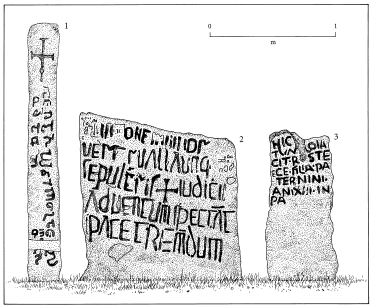
Examples of so-called ‘Class-1’ inscribed stones from Wales: (1) Towyn, (2) Llanleonfel and (3) Llanerfyl. Fifth-seventh centuries ad.
more resembles lower-case, or handwriting. Roman-style capital letters feature clean, straight lines which are well suited for carving in stone; the more cursive script of the Class-1 stones* looks clumsy and illexecuted, but in this case looks are deceptive.
They are memorial stones, each with an epitaph in Latin and/or Goidelic (an early form of Gaelic), sometimes written in a form of script involving a series of short strokes, known as Ogham. The inscriptions frequently employ Christian symbols, such as crosses. The stones are generally not much larger than a man, and where we know they are still in situ they appear to be sited with care, and occasionally in a way which seems deliberately to be mimicking the positioning of prehistoric standing stones - perhaps some kind of reference back to earlier traditions.
David Howlett and Charles Thomas have shown that the Latin language used in these inscriptions is literate and well-informed.34 It is not the product of ignorant backwoodsmen grappling with an unfamiliar tongue, but spoken Latin of a high order, employing all sorts of clever word-play which was fashionable in the late- and post-Roman world: epitaphs could be read forwards and backwards, and would mean different things in the different directions.35 Erudite tricks are also played with rhyme and with scansion. These stones are remarkable because they are quite common, and it seems reasonable to suppose that they could have been read by more than just the highest echelons of society.
Class-1 stones occur in areas of Britain that did not have a tradition of inscribed stones in Roman times. We must therefore assume that although some Latin may well have survived in certain households or in, for example, the Church, this was essentially a reintroduction or the introduction of a new tradition from outside. It was introduced because, like so-called ‘Anglo-Saxon’ culture in the east, people wanted to adopt it for their own reasons, which in Wales and the south-west included the notion of cultural identity, which would later come to stand for British identity. But where did this new tradition come from?
Leslie Alcock, like all great scholars, can be allowed to slip up occasionally, as he did with Camelot and South Cadbury; but on Class-1 stones his words still carry weight:
Their overwhelming distribution pattern is away from the lowland heart of Roman Britain, and lies instead in the Irish Sea zone. This pattern reveals new influences, and some of the formulae of the inscriptions make it clear that these came from Gaul and the Mediterranean. In broad archaeological terms - but only in broad terms - they demonstrate the same contacts and the same routes as the imported pottery…the distribution of [Class] I stones reflects the travels of the Celtic saints, both around the Irish Sea and beyond it to Gaul and the Mediterranean.36
The Celtic saints did more than just spread the word of God; they also took with them the important message that culture and learning mattered, and in the process they helped to inspire a sense of identity that would last for centuries. Their beliefs are growing in popularity even today. They must have been remarkably charismatic people. St Patrick, for example, lived in the fifth century and probably came from a family of Romanised Britons. When only sixteen he was abducted by Irish pirates and spent six years as a slave in Ireland, before he managed to escape in a ship bound for the Continent. We do not know how long he was away, but eventually, having acquired a Christian education, he was inspired by a vision to return to Ireland and spread the word, which he did with great success. For me St Patrick’s life exemplifies the Dark Ages: there is erudition and literacy, travel and religion, but within a broader political context that is only slowly acquiring stability, following the enormous upheaval brought about by the end of the Western Roman Empire.
*I have chosen to describe these vessels as being made from ‘bronze’, as this will mean something to most readers. Technically speaking, Roman and post-Roman ‘bronze’ often contains small amounts of zinc, which makes it brass. To most people familiar with modern metal, brass is glistening and gold-like. The usual academic term ‘copper alloy’ is safe, but meaningless to non-specialists.
*I was disappointed to see that ‘Dark Age’ is used throughout the otherwise excellent English Heritage guide to the castle. I suspect that this was not an authorial decision, but was made by an ‘expert’ in ‘interpretation’.
*We have recently witnessed something similar in our own time. The aftermath of the invasion of Iraq in March 2003 has been bloody, and at the time of writing, more than a year later, to many people the political justification for it seems doubtful. So what does President Bush do? He seeks legitimation by copying John F. Kennedy’s announcement of a Space Race: Kennedy aimed for the moon, Bush for Mars. Bush needs public legitimation if he is to win the next election, and he seeks it by emulating a predecessor who is acknowledged as a great leader.
*They are known as Class-1 stones because they can be dated to the fifth-seventh centuries (Classes 2 and 4 run to the ninth and eleventh centuries respectively).