
CHAPTER XII
In the spring of 1385 John of Trastámara had stretched the resources of Castile to their limits to overcome the resistance of his opponents in Portugal. In the previous year he had collected no fewer than eight monedas from his Castilian subjects in spite of their bitter complaints. In 1385 he exacted twelve. His officials were preparing one of the largest fleets ever assembled by a Castilian king. Ten galleys and twenty large converted merchantmen were already lying in the Tagus off Lisbon. Another five galleys had been hired from the King of Aragon. Five more galleys and some two dozen armed merchantmen were being fitted out to join them. On land the Castilian King’s army was expected to be nearly twice as large as the one which had besieged Lisbon in 1384. In addition to the resources of his own kingdom John of Trastámara’s lieutenants could call on the military support of most of the inland towns in northern and central Portugal and by far the greater part of the nobility. The invasion plan was the classic two-pronged attack which had so often been deployed in Castile’s wars against Portugal. The main army of invasion was directed to assemble near the border city of Badajoz in April. These men would cross the River Guadiana near Elvas under the King’s personal command and make directly for Lisbon. A second, smaller army was to be formed by the Archbishop of Toledo at Ciudad Rodrigo in the north and reach the Portuguese capital by the longer route through Viseu and Coimbra.1
It was in these difficult circumstances that the Master of Avis decided to abandon the claim to rule Portugal as regent of the imprisoned Infante João and take the crown for himself. Popular support for the Infante had been an important factor in the rejection of Beatrice. But an absent sovereign who was in the power of the enemy was no longer a plausible source of authority or even a useful figurehead. The Cortes of Portugal gathered at the beginning of March 1385 at Coimbra. Ostensibly a national assembly, the participants were in fact drawn exclusively from the supporters of the nationalist cause. Its deliberations were dominated by the delegates of the thirty-one towns represented, which had always been the bedrock of the Master’s support. A month was taken up with legal wrangling. Legally John’s claim had little to be said for it. He was a bastard whereas the Infante’s João’s father was generally believed to have been secretly married to Inez de Castro. Even if the marriage had never happened, as John’s advocate contended, there was no legal basis for brushing aside the claims of Beatrice and her issue. She had her own advocates even in such a gathering. Law, however, could not resolve what was in reality a Portuguese civil war. It could only anoint the partisans. The decisive factors were political. The crowd outside had already shown where their sympathies lay. They acclaimed John of Avis as King as he arrived at the beginning of the proceedings. They spoke for the streets of Lisbon and Oporto where his real power lay. On 6 April 1385 the Cortes declared him King of Portugal. Five days later, on the 11th, he was crowned in the cathedral. He was twenty-seven years old. Among his first acts were the appointment of the twenty-four-year-old Nun’ Alvarez Pereira as Constable of Portugal and the issue of a new coinage in his own name. The coinage was not just a public demonstration of sovereignty. In conditions where effective tax collection was impossible, devaluation and minting profits were expected to raise much of the money needed to fight the Castilians. The new King declared his international allegiance at once. Fresh instructions were sent to Lourenço Fogaça and Alonso de Albuquerque, who were still struggling with their creditors in England, to complete the negotiations for an Anglo-Portuguese treaty. Another embassy left for Rome to declare Portugal’s allegiance to Urban II.2
Weighed down by problems of recruitment and finance John of Trastámara was unable to assemble his army of invasion for more than two months after the date originally planned. The delay proved fatal to his ambitions, for the Castilians lost the initiative never to regain it. Moving quickly to exploit the moment of euphoria following his coronation, John of Avis and his Constable overran almost all the territory north of the Duero in the space of six weeks. The thirteenth-century fortress of Guimarães, one of the strongest of the region, surrendered after the Castilian King had proved unable to organise a relief force in time. Its captain, who was one of John of Trastámara’s most prominent allies among the Portuguese nobility, went over to John of Avis. Men of his kind had assumed that the Castilian King would prevail by sheer force of numbers and resources. Once these certainties were dented, support for the house of Trastámara began to drain away. There were wholesale desertions among the Portuguese troops serving in Castilian garrisons, whose wages had not been paid for nearly a year.3
Towards the end of May 1385 the Castilian King tried to shore up his support in Portugal with a military demonstration. He ordered the Archbishop of Toledo, who was in command at Ciudad Rodrigo, to send the forces at his disposal across the border to waste the territory around Guarda and Viseu. Some 300 men-at-arms, supported by light horse and infantry, perhaps 1,000 men in all, took part in this raid. Returning laden with booty on 29 May they were confronted by the combined garrisons of a number of nearby castles, arrayed on foot in front of the gates of the small walled town of Trancoso. The Portuguese were greatly outnumbered but they had the advantage of the defensive. The Castilian men-at-arms dismounted and charged them on foot across the rough ploughed fields. At the same time they sent their light horsemen round the Portuguese position to attack their infantry from the rear. The soft terrain broke up the formation of the Castilian men-at-arms while the infantry rushed the Portuguese lines in no order at all. Both groups were repelled and in the pursuit which followed almost all of them were killed.4
The news from Guimarães and Trancoso unnerved John of Trastámara. He had entered Portugal in the last days of May with a small advance guard and stopped a few miles beyond the Guadiana at Elvas, where he proposed to wait for the bulk of his army to arrive. He was unwell, as he had so often been at critical moments of his reign. Illness made him hesitant and vacillating. A few days after arriving at Elvas he abruptly abandoned his existing plans and decided instead to draw the whole of his army together for a single thrust into Portugal by the north, where most of John of Avis’s own forces were now concentrated. This decision entailed fresh disruption and delay. The muster had to be moved from Badajoz to Ciudad Rodrigo, more than a hundred miles away, and postponed to July. The Castilian King reached Ciudad Rodrigo, probably towards the end of June, only to receive the news of yet another military reverse, this time at Mertola in the Algarve. Mertola was a small walled town just inside Portugal which was occupied by a Castilian garrison. It had been under siege for some weeks by a horde of locally recruited Portuguese infantry supported by a small contingent of men-at-arms. A relief force of about 300 Castilian men-at-arms and 800 infantry had been sent from Seville to raise the siege. Over-confidence seems once more to have been their undoing. They were decisively defeated in a pitched battle outside the town and withdrew with heavy losses.5
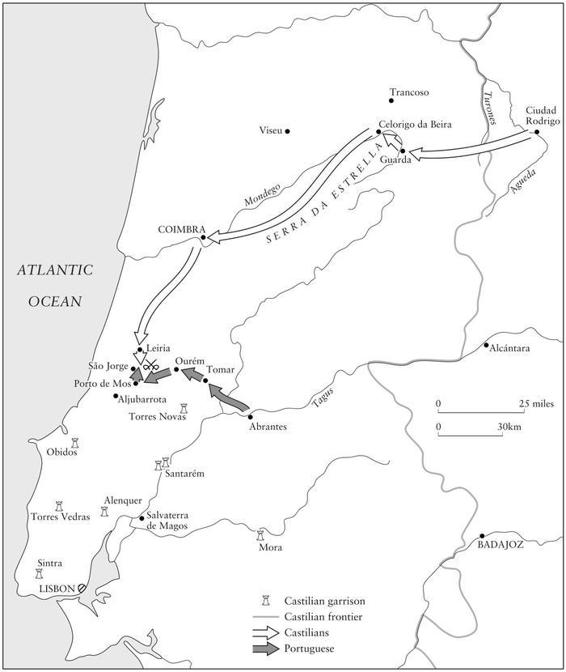
20 The Castilian invasion of Portugal, July—August 1385
In the massive fortress which his father had built at Ciudad Rodrigo, above the banks of the River Agueda, John of Trastámara called his Council together to consider yet another change of plan. Ostensibly the argument was about strategy. The alternatives were to invade Portugal and march on Lisbon, which would probably provoke a pitched battle with John of Avis; or to adopt a more cautious approach, disbanding part of the army and standing on the frontier until the naval blockade in the Tagus and the garrisons north of Lisbon starved the Portuguese capital into submission. Behind this debate lay more fundamental issues. Many of John’s councillors had had misgivings about his Portuguese ambitions from the outset. These men, who were probably the majority of the Council, included the chronicler Ayala, who describes the arguments in vivid language. They were alarmed by the cost and the political risks of the coming campaign. Tax receipts had fallen a long way short of expectations. Recruitment had been exceptionally difficult, partly for that reason. Many of Castile’s best soldiers were dead. The rest were unpaid and unenthusiastic and their leaders inexperienced. The King’s health was poor and his heir a minor. They were by no means as confident of victory as the leaders of the army were. John of Avis was believed to have about 2,000 men-at-arms under his command plus an uncertain number of light horse and infantry. But they included some battle-hardened English and Gascon cavalry and a force of English archers, whose presence caused much anxiety among the Castilian commanders. A major battle would risk everything on the fortunes of a single day without any assurance of success. There were substantial arguments on the other side. Grave as John of Trastámara’s financial and military difficulties were, abandoning the invasion would destroy his party in Portugal at a stroke and make the annexation of the country all but impossible. But the pacifists believed that annexation had become impossible anyway. Better, they said, to wage a war of attrition with small numbers of men and then compromise with the enemy, acknowledging John of Avis’s Crown and exacting substantial territorial concessions in exchange. Especially as the alternative could be defeat and bankruptcy.6
Unable to decide finally between either school of thought, John ended up by adopting both. In the third week of July 1385 he crossed the River Turones into Portugal, declaring that his intention was to conduct a short punitive raid into Portugal with his whole army. He planned, he said, to penetrate as far as the mountain passes north of Coimbra in order to save his honour and then to retreat to Castile, leaving the further prosecution of the war to raiding parties from the border fortresses and to the ships and garrisons around Lisbon. In spite of the ambitious target given to the recruiting officers the Castilian army was quite small, probably between 4,000 and 5,000 men-at-arms. Of these about 1,200 were French. In due course they were reinforced by John’s Portuguese allies and by men-at-arms drawn from the Castilian garrisons in Portugal. However, the total number of men-at-arms never exceeded 6,000. In addition there were about 2,000 jinetes, lightly armed cavalry from Andalusia, and a large host of pikemen, crossbow men and other infantry whose number can only be guessed. The whole force, including camp-followers, may well have approached the 30,000 men attributed to it by the principal Portuguese chronicler, but that included many troops of poor quality. The King himself made a sorry sight, racked with illness and carried after his men in a litter. On about 21 July the Castilians captured the important border fortress of Celorigo da Beira. Then they marched down the rich valley of the Mondego, destroying everything before them. The slaughter of his troops at Lisbon and Trancoso had provoked fury among the King’s followers. They avenged their companions by brutally killing or mutilating all the Portuguese who had not had the time or wit to flee before they arrived. As the Castilian army approached, John of Avis retreated south from Coimbra. When this move was reported to him, John of Trastámara changed his plans once more. Concluding that the Portuguese King did not, after all, intend to fight a pitched battle, John resolved to pursue him into the interior.7
At the end of July 1385 John of Avis joined forces with his Constable, Nun’ Alvarez Pereira, at the bridge of Abrantes on the Tagus. There a council of war was held which in some ways mirrored the proceedings of John of Trastámara’s Council at Ciudad Rodrigo. Most of the Portuguese King’s advisers, like those of his rival, were against hazarding everything on a battle. They preferred to wait for the arrival of further reinforcements from England which were reported to be on their way. The main advocate of the offensive was the Constable, Nun’ Alvarez. He pointed out that most of John of Avis’s garrison in Lisbon had been withdrawn to swell the numbers of his army. Unless the Castilian King was stopped, he would join forces with the garrisons of the Castilian fortresses around Lisbon. There would then be nothing to prevent him from taking the capital by assault. Having made his points before a sceptical Council the Constable walked out. He would lead his own men against the enemy, he announced, whatever the rest of them decided. John of Avis overruled his councillors and accepted Nun’ Alvarez’s advice. The truth was that he had little choice. He could not afford to avoid a battle, any more than his Castilian rival could, if he was to maintain his support in Portugal. So, in the second week of August 1385, the Portuguese army moved east to Porto de Mos, a castle standing on high ground overlooking the River Lena, just east of the main highway from Coimbra to Lisbon. The Castilian army was reported to be encamped to the north around the fortress-town of Leiria, which had once served as the southern bastion of the Christian kingdom against the Moors.8
In the early morning of 14 August 1385 the Portuguese moved forward to block the road at a point eight miles south of Leiria and about the same distance north of the insignificant village of Aljubarrota. Their army was much the smaller of the two. Ayala, an experienced soldier in the Castilian King’s entourage, reckoned its total strength at about 2,200 men-at-arms and about 10,000 pikemen, bowmen and other infantry. Not all of the English in Portugal were present. Some are known to have been doing garrison duty beyond the Duero. But an English chronicler, who appears to have been reading a news-letter from Portugal, records that the English contingent numbered 700 men including archers and this is broadly consistent with other evidence. In addition there was a small Gascon company recruited in England, which was led by a prominent Périgourdin nobleman, Guillaume de Montferrand. The Portuguese Constable had carefully reconnoitred the ground on the previous day. He drew up the vanguard of the army across the highway at the northern extremity of a narrow ridge. The road sloped steeply away in front of them towards Leiria. On either side of the vanguard the Constable placed his wings, with their outer flanks protected at each extremity by a creek. The English and Gascon cavalry were placed under the command of Guillaume de Montferrand on the left wing and Portuguese men-at-arms on the right. Behind each wing the Portuguese and English bowmen stood on slightly higher ground where they could see the action and fire their weapons over the heads of the cavalrymen in front. John of Avis himself took up position with the rearguard immediately behind the Constable’s battalion. The Portuguese chronicler who tells us these things remarks that the terms used for these units, van, rear, right and left wings, had been borrowed from the military jargon used by the officers of the Earl of Cambridge three years before. Both the Portuguese forces and their Castilian adversaries were now organised on the model of their English and French allies, with a constable in command of operations and marshals to serve as their deputies and maintain discipline. It was part of the long process by which the armies of the Iberian peninsula adopted the organisation, equipment and battle tactics of the leading protagonists in the western European war.9
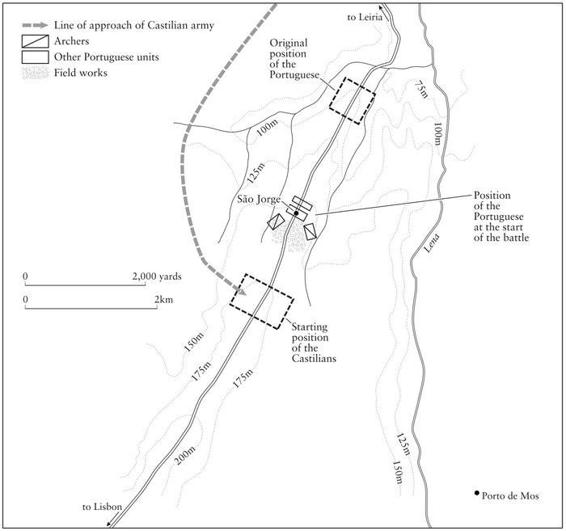
21 The battle of Aljubarrota, 14 August 1385
Towards the end of the morning of 14 August 1385 the forward units of the Castilian army approached along the road from Leiria. When they saw the Portuguese ahead of them they halted while John of Trastámara came up from behind to take stock. Before them the road crossed a stream and rose steeply towards Nun’ Alvarez’s lines. A frontal assault was out of the question. It was decided to manoeuvre the Castilian army round the Portuguese positions and approach the enemy along the high road from the south. This was probably the only course open to them but it involved a difficult and time-consuming march of about five miles through thickly wooded terrain by some twenty to thirty thousand men encumbered with several hundred carts full of supplies and equipment. It also had to be carried out in the midday sun by troops who had been on the road since daybreak. While the Castilians carried out this manoeuvre the Portuguese Constable turned his whole army around to face the new threat and repositioned them about a mile further south, near the village of São Jorge. Their position here was less strong, since the Castilians would be attacking down a gentle slope, but the Portuguese had time to strengthen it by building primitive field fortifications in front of their line: a line of stakes and brushwood and a series of deep trenches.
John of Trastámara sent the chronicler Ayala forward as a parlementaire with an escort of men-at-arms. Ayala’s formal task was to demand that John of Avis should avoid spilling blood in such an unworthy cause, but the real object of his mission was to reconnoitre the Portuguese lines and report back to the King and his advisers. Ayala quickly formed the view that it would madness to attack the enemy’s positions that day. It was now late afternoon. The Castilians were exhausted. They had not eaten since morning. Their cavalry were on their own, since the bowmen and infantry were still struggling through the valley with the supply train and had not yet reached the main road. The Portuguese line was too narrow to enable the whole Castilian army to engage it and a flanking action was impossible because of the creek on either side. A direct frontal assault on the Portuguese centre would require the Castilian centre to run the gauntlet of the two blocks of English and Portuguese bowmen on the wings. In a day or so, Ayala said, the Portuguese would have exhausted their rations and would have to move. The Castilians, by comparison, had supplies for several days. All of these views were endorsed by Jean de Rye, who acted as spokesman for the French captains. The kings of France, he said, had lost two great battles at Crécy and Poitiers by attacking strong defensive positions without taking the time to organise their own order of battle and impose discipline on their men. Others in the Castilian King’s tents scoffed at their caution. The Portuguese army, they said, was far inferior to their own. It was sheer cowardice not to seize the moment to inflict a decisive defeat on them. The chance would not necessarily come again.
All of Jean de Rye’s fears were borne out by the event. John of Trastámara was persuaded to defer the battle until the following day but his tents were well behind the front line, out of earshot of his principal commanders, and his orders took some time to reach them. By the time that the couriers reached the forward units of the Castilian army the fighting had already begun. The Master of the Castilian military order of Alcántara took the initiative. Accompanied by a large force of light cavalry and supported by the heavy cavalry of the French, he tried to force his way through the wings of the Portuguese army to attack their position from the rear. He did not realise how strong the Portuguese position was until it was too late. The horsemen were forced back by concentrated arrow fire from the flanks. John of Trastámara had no choice now but to try to save the day by ordering in the rest of his available troops. The Castilian vanguard charged the centre of the Portuguese line. As the attackers tried to cross the Portuguese field fortifications the two Portuguese wings closed in on them, decimating them with murderous flanking fire before they had even reached the enemy. Those that penetrated as far as the Portuguese lines succeeded in driving them back with their first impact but the rearguard under John of Avis advanced to confront them. The Castilian formation broke up into small splinter groups which flailed about right and left without support from their comrades. Within about an hour the Castilian King’s standard was seen to fall.
John of Trastámara’s bodyguard quickly transferred him from his litter onto a horse and sped away. The King’s departure was the signal for what was left of the Castilian army to flee. They had suffered terrible casualties. John of Trastámara’s Aragonese constable was among the dead, along with both marshals of the army, the newly appointed Admiral of Castile and several of the principal officers of his household. Jean de Rye, who had done his best to avert the tragedy, was found among the dead. Geoffrey de Parthenay, the captain of the Bretons, died in the mêlée. Almost all the Castilian King’s Portuguese allies were killed. Several famous and colourful figures from past campaigns were among the casualties: Arnaud du Solier, the notorious Limousin brigand of the 1360s, who had passed the last fifteen years of his life as a Castilian prince; Juan Ramírez de Arellano, the Navarrese captain who had served Charles the Bad, Edward III and both Trastámaran kings of Castile in his time. Writing to the city of Lisbon, John of Avis announced that 2,500 men-at-arms of the enemy, nearly half of their cavalry, were dead. Reports reaching England suggested that, when light horse and infantry were included, the total Castilian casualties were three times that number. John of Trastámara arrived with his attendants at the castle of Santarém, nearly fifty miles from the battlefield, in the early hours of the following morning. There he embarked on an armed barge in the Tagus and made for Seville by sea. The Castilian fleet blockading Lisbon withdrew shortly afterwards. Over the following weeks all the Castilian garrisons around the capital and most of those in the north and centre of the kingdom were either evacuated or captured by the victorious Portuguese.
The battle of Aljubarrota was the foundation of Portuguese independence and the beginning of the greatest period of the country’s history. The house of Avis was destined to rule Portugal for two centuries and the threat of absorption by Castile did not reappear until after it had become extinct in 1579. On a virgin site close to the battlefield, which became known as Batalha, John of Avis founded the Dominican monastery of Santa Maria da Vitoria which his successors travailed to complete until well into the sixteenth century. Constructed by Portuguese, English and Flemish architects to plans derived in large measure from contemporary English buildings, this magnificent monument served to commemorate his victory and in due course to serve as his tomb. The battle sealed the Anglo-Portuguese alliance even before wax and ribbon could do so. It also transformed the balance of power among the southern allies of England and France and consolidated Portugal’s position as a naval power capable of challenging Castile on Europe’s Atlantic seaboard. For Castile Aljubarrota was a national catastrophe. John of Trastámara withdrew to the fortress of Carmona east of Seville rather than show his face in the city. His self-confidence, which had never been very great, was shattered by the defeat. The prestige of his dynasty and of the Castilian military nobility which had been its principal pillar took many years to recover. The cavalry arm of his army took years to rebuild and the Crown’s finances were left in embarrassing disorder for a long time to come. For the rest of the decade France, which had so far been the main beneficiary of the alliance with Castile, was obliged to devote considerable resources to shoring up its southern ally while receiving very little in return.10
*
Shortly after the battle of Aljubarrota John of Avis wrote to the Duke of Lancaster with an account of the campaign and an appeal for help. The Portuguese King knew that for the moment he had disabled the Castilians but he was far from confident for the future. Castile was a richer and more populous country than Portugal. The Castilian nobility were burning to avenge their defeat. John urged the Duke of Lancaster to press his claim to the Castilian throne while its current occupant was in disarray and he had the assurance of Portuguese support. ‘There will never be a better chance than now to realise your ambitions,’ he told John of Gaunt. Yet when this letter reached England in the first few days of September 1385 the Duke was no longer certain what his ambitions were. The Portuguese ambassador in England, the indispensable Lourenço Fogaça, was present when John’s letter was read out and reported that the Duke’s first reaction was to make his excuses. Gaunt had given little thought to his Castilian ambitions for the past two years, he said. He had been heavily committed to the affairs of the Scottish border. The current problems of the English royal house required all his attention. He may also have reflected that his declining political influence in England made it hard to see how an English expeditionary army to Castile would be financed. According to the Portuguese sources from which this information comes it was only the pleading of his wife and daughter which caused Gaunt to change his mind. This may be true. But the evidence suggests that by this time Gaunt no longer expected to dethrone the Trastámaran dynasty. The battle of Aljubarrota had changed many things, but Gaunt’s main purpose now was to sell his claims to his Castilian rival for the highest possible price, in cash and in diplomatic advantage. He resolved to bring his daughters Philippa and Catherine with him to Castile. They would prove to be valuable diplomatic bargaining counters. Over the following weeks Gaunt began to make detailed plans for a seaborne expedition to Castile in the spring of 1386.11
Parliament had been summoned to meet at Westminster on 20 October 1385. The meeting was one of the longest for many years and among the most ill-tempered. The proceedings were overshadowed from the outset by the continuing financial crisis of the Crown and the quarrels of the English political class, intensified by the humiliating outcome of the campaign in Scotland which many of those present had witnessed at first hand. Michael Pole, now Earl of Suffolk, expounded England’s dilemmas in his opening speech, as he had done with eloquence and force on every such occasion for the past two years. Attacking France at home was the most effective way of defending England, he repeated, but it was too expensive. Pole was right but being right won him no friends. His address was followed by a concerted attack on the government by a coalition of those who wanted to reduce the burden of taxation and others whose main ambition was to prosecute the war on a more ambitious scale and return to the glorious days of Edward III. The ultimate objectives of these two groups were entirely incompatible but they found a common target in the King’s financial administration and in the closed group of courtiers around him, who were believed to be diverting public funds into their own pockets. It was the programme of 1376, informed by all the old delusions. Attention was focussed on the peerage promotions and associated grants which the King had made on his entry into Scotland. Some of them were thought to be undeserved. All of them were thought to be extravagant. There was strong opposition to the promotions of Neville, Burley, Pole and Robert de Vere. The first two were obliged to abandon their new dignities before Parliament even met. Pole’s promotion was confirmed even if some people, according to the snobbish Thomas Walsingham, remembered that his father was a wool merchant and moneylender and thought him ‘better suited to commerce than knighthood’. No one would have said that of Robert de Vere, Earl of Oxford. But his promotion to be Marquis of Dublin, coupled with a proposal to send him in state to Ireland at a cost of some £45,000, was confirmed only after weeks of wrangling.12
The attack broadened out in the course of November 1385 into a general assault on the government’s management of its finances and on the propensity of the eighteen-year-old King to listen to his friends rather than his Council. A commission of three bishops and six lay peers was appointed to examine the government’s accounts. The commission, presided over by that old enemy of royal government William of Wykeham, reported so fast that it is hard to believe that there was any serious investigation of the problem. The commissioners were very critical. They concluded that with honest and efficient administration the revenues of the customs, alien priories and royal demesne might be significantly increased. They thought that some heads of government expenditure were too high and ought to be reduced, notably the staff of the King’s household, royal grants, naval operations and garrisons. The Commons embraced these proposals with open arms. They insisted on the appointment of four additional councillors, including Wykeham himself and the aged former Treasurer Thomas Brantingham, with a special commission to investigate the disappearance of the enormous sum of £120,000 which was believed to be unaccounted for in the Exchequer’s records. They forced the King to agree to a complete stop on all royal grants from revenue for a year. If they had had their way they would have made him revoke existing grants. The Commons finally agreed to grant one and a half subsidies, worth about £55,000. By the standard of recent Parliamentary grants this was generous, but it came with stringent conditions. The financial reforms proposed by Wykeham’s commission were to be put into effect. There were also elaborate provisions designed to ensure that the funds did not fall into the wrong hands. Three receivers of the subsidy were appointed and two supervisors to watch over them, all of whom were made answerable to Parliament. These men were charged to pay out nothing in satisfaction of past debts or services of any kind, nothing for any other purpose than the war.13
In the midst of these debates the realities of the war beyond England’s shores forced itself on the men at Westminster. About a week after the opening of Parliament news arrived of a fresh crisis in Ghent. On 26 October 1385 there had been a major demonstration organised by the growing party within the town which was weary of the war and of the English alliance. The guilds who were behind the peace movement summoned their members to parade through the streets with banners of the Lion of Flanders, shouting their slogans and making for the Friday Market. Their leaders had by now obtained letters from the King of France and the Duke and Duchess of Burgundy reciting the very favourable terms which had been offered to them in Paris. They planned to read these out in public. The only obstacles to peace were the presence of Sir John Bourchier’s English garrison, and the personal position of Francis Ackerman and Peter Van den Bossche. Their power-base in the town had been undermined by the discreditable retreat from Damme, but they still commanded a powerful and violent following. There is some evidence that Ackerman was willing to compromise. But Van den Bossche was not. He planned to occupy the market-place with his own supporters in advance of the public meeting. Bourchier and his English soldiers would be on hand to help. The peace party, however, outmanoeuvred him. They brought forward the time of their demonstration and occupied the ground first. There was an ugly moment when both sides stood at opposite ends of the market-place, each defended by phalanxes of armed men. But there was no mistaking the sentiment of the majority. More than four-fifths of those present moved into the lines of the peace party. Van den Bossche withdrew in fury with his men, leaving the English men-at-arms and archers to escape as best they could. The peace party swiftly took control of the government of the town. Three days later, on 29 October, they wrote to the French King proposing talks. A conference was arranged for December between the new leaders of the town and the councillors of the King of France and the Duke of Burgundy.14
For the moment the die-hards refused to give up. They appealed to the English government. Sir John Bourchier, fearing for his life in an increasingly hostile city, sent urgently to England for reinforcements. Their letters reached Westminster in the first week of November. The Council obtained Parliamentary authority to send 1,000 men to shore up their only remaining northern European ally. It was proposed to finance this force by borrowing. Sir Hugh Drayton and Sir Hugh Despenser, experienced soldiers who had both commanded companies in Flanders during the Bishop of Norwich’s crusade, were ordered to sail from Sandwich as soon as their men could be assembled. They appear to have been planning to fight their way through to Ghent from Calais.15
It was in this difficult atmosphere that John of Gaunt rose to press the case for invading Castile. Gaunt had no doubt that he was entitled to his countrymen’s support. He recited his many services to the English Crown. He expounded the claims of his wife to the succession of King Pedro. He pointed to the opportunity which the Portuguese victory at Aljubarrota offered for knocking Castile out of the war. He suggested, perhaps rather disingenuously, that he could draw the flower of Scottish chivalry and the lords of Albret and Armagnac to his banner, thereby contributing indirectly to the security of the Scottish and Gascon marches as well. It is perhaps surprising that he met with so little opposition given the degree of scepticism which previous projects of the kind had aroused among the Commons. The reasons must be a matter for speculation. In some quarters there was undoubtedly a strong desire to be rid of John of Gaunt, whose presence in England was an obstacle to the disparate political ambitions of a younger generation. But the decisive factors were probably less personal. There was a better strategic case to be made for the ‘path of Portugal’ in the aftermath of Aljubarrota than there had been when the idea had last been mooted in the winter of 1382—3. John of Trastámara’s distractions in Portugal had in fact kept the Castilian galley fleet in southern waters since 1380, just as Gaunt had predicted that they would. The King of Portugal, moreover, was offering the English King the services of a comparable galley fleet of his own and had already given an earnest of performance by despatching six galleys to the Channel in the summer. There was no other method of striking at the enemy at affordable cost now that the English position in Flanders had all but collapsed.
John of Gaunt was the richest man in England after the King and could be expected to bear much of the financial burden himself. Hard bargaining drove the subsidy from public funds well below the £40,000 that John of Gaunt had asked for. The deal ultimately agreed between Richard and his uncle allowed the Duke 20,000 marks (£13,333) unconditionally out of the proceeds of the Parliamentary subsidy. Another 20,000 marks was lent to him on somewhat complex terms. If he made peace with his rival the treaty was to provide for the payment of 200,000 doblas (about £40,000) in compensation for the Castilian naval attacks on England. In that event the loan would be cancelled. But if the Duke became King of Castile or surrendered his claim on any other terms, the sum would be repayable within three years. The upshot was that the Commons received some assurance that wider English interests would be served by the campaign. Privately Richard II assured his uncle that none of these stipulations would be enforced. So, subject to some rather distant contingencies, Gaunt received a subsidy of £26,666. This must have been a modest proportion of the total cost of the expedition. The Duke’s financial affairs in this period are particularly opaque but it is likely that most of the cost of the expedition was raised by borrowing against the revenues of his English estates.16
The last echoes of the ‘path of Flanders’ were heard in December 1385. On 7 December, as Parliament closed at Westminster and Drayton and Despenser set out with their men for the coast, more than 200 prominent citizens of Ghent arrived at Tournai to negotiate with the Duke of Burgundy and the councillors of the King of France. They made a grand entrance, mounted on expensive horses with a great suite of attendants, and declined to dismount when they came into the presence of the Duke. Evidently, as French observers noted with irritation, they had not come to grovel. Nor did they need to. On 18 December, after ten days of negotiation in the buildings of St. Martin’s abbey, the representatives of Ghent agreed to submit. The terms, when they were announced, were generous. Ghent retained the charters and privileges granted to it by former Counts of Flanders. There were to be no proscriptions and no executions. Philip issued a general pardon to the inhabitants, however prominent their part in the events of the past six years. The blockade was lifted. Confiscated assets were restored. Exiles were to be allowed to return home. Prisoners would be released. In a gesture of great symbolic power the Duke declared that he would not even force the men of Ghent to do anything against their conscience, which was a veiled promise not to interfere with their allegiance to the Roman Pope. But in a larger sense the defeat of Ghent was plain for all to see. The war had been a disaster for the town. The peace, for all its formal concessions to their interests, did little to mitigate the disaster. The town lost the power which it had once held over the towns of eastern Flanders and the waterways of the Scheldt. The cloth-workers’ guilds lost ground to the grain-shippers and victuallers, as the town’s famous textiles industry moved into terminal decline. Ghent would never again be the political and economic force that had dominated Flanders for the past hundred years.17
Politically the immediate result of the peace was a complete severance of Ghent’s political and commercial relations with England. The expedition of Drayton and Despenser was cancelled just as it was about to sail and their men diverted to reinforce the garrison of Berwick. In the Château de Gavre, Sir John Bourchier and his English company resigned themselves to the new reality. They had no intention of fighting a last-ditch battle against overwhelming odds. So they negotiated a safe-conduct with the representatives of the Duke of Burgundy and, gathering up the English King’s standards, they left for Calais.18 After three years of absolute power Peter Van den Bossche had made too many enemies in Ghent to sleep soundly in his bed once he had lost it. He fled with Bourchier and settled in England, where he lived on a pension from Richard II and continued to support the English cause against his fellow countrymen. He served with the English garrison of Guines in the summer of 1386 and with the English fleet in the following year. Occasional letters trying to stir up trouble in Ghent were intercepted by the Duke of Burgundy’s agents. Peter’s old ally Francis Ackerman, for years the main pillar of the English alliance in Ghent, stayed in Ghent but he would have done well to follow his colleague’s example. In July 1386 he was assassinated by a relative of one of his old rivals.19
*
In the Castilian city of Valladolid another monarch was confronting the problems of high taxation, military failure and public resentment. The Cortes met in about the middle of November 1385 in the church of Santa María la Mayor, which was then the cathedral. John of Trastámara appeared before his subjects dressed in black mourning robes. He delivered a remarkable oration in which he lamented the sins of the Castilians and his own failure to govern them as he should have done. He had lost many of his finest soldiers. He had brought dishonour and ruin to his realm, ‘the pain and shame of which we feel in our heart’. He ordained penitential processions in Castilian cities and declared that for his part he would wear his mourning robes until God had signalled his forgiveness by granting him victory over his enemies. The Cortes approved some radical reforms. They forced the King to delegate many of his prerogatives to a council of twelve, drawn from the three estates of Castile, ostensibly so that he could concentrate his failing energy on the conduct of the war. They introduced a tough scheme of conscription which made every man liable to be called up for military service from his twentieth birthday to his sixtieth and provided for regular inspections to ensure that they were properly trained, mounted and equipped.
Taxation proved to be the most contentious issue. John of Trastámara already knew that his Portuguese rival had sent ambassadors to England to press for a joint invasion of Castile. He acknowledged that the heavy taxes which he had levied to date were profoundly unpopular and that they were economically damaging. But he could see no prospect of relief while the war continued. Indeed in the present crisis it would be necessary to increase them. The Cortes agreed to increase the rate of the alcabala (or sales tax) to twenty per cent, double the current level, and to authorise a forced loan of up to ten million maravedis (about £44,000). But as in France sales taxes were profoundly unpopular in the streets. This one provoked such uproar in Castile’s towns that the representatives went back on their decision almost as soon as they had made it. Instead of higher indirect taxes on commodities, they offered a tax on moveable property, which was less burdensome to the poor but proved to be administratively unworkable. Within two months the King had been forced to return to a variant of the original plan but even at the slightly reduced rate of 16.6 per cent the new sales tax proved impossible to collect. Merchants closed their shops. Fairs were deserted. Out of sight of the collectors the black market flourished. John had reached the limits of his subjects’ taxable capacity as Charles VI and Richard II had before him. In December 1385, shortly after the Cortes of Valladolid closed, a Castilian embassy left Valladolid for France to plead for the urgent despatch of a French expeditionary army to the peninsula. John could not afford to pay these men as the existing treaties with France required. For the first time, he was obliged to plead with his French allies for financial as well as military support.20
At about the time that John of Trastámara’s ambassadors were receiving their instructions Philip of Burgundy made contact with the English court through an unusual intermediary. Leo VI of Lusignan was one of the figureheads of the revived crusading movement of the late fourteenth century. He was the titular King of Armenia, a prince of French ancestry who had lost his kingdom to the Mamluk Sultans of Egypt in 1375 and passed several years in a Cairo prison before being released and settling in Paris. His life’s ambition was to recover his realm at the head of a western army. In the short time that he had been in France he had won a good deal of support for this project, especially from the young King and from the Duke of Burgundy. One of the many impediments in the way was the continuing war with England. So Leo made it his mission to reconcile the two countries. In spite of his poor French and non-existent Latin, Leo had some advantages as a mediator. He was a ‘wise and crafty man’, according to a contemporary English source. He was also charming, exotic and genuinely neutral. Leo appeared at Richard II’s court at Eltham in the midst of the Christmas festivities to announce his mission to the King. He made a strong impression on Richard, whose own aversion to the war was growing year by year. Leo also worked assiduously on the chief advocates of the war in England. He passed the feast of the Epiphany with the Duke of Gloucester at his fine new manor at Pleshey in Essex. He was with the court at Westminster when the King’s Council was persuaded to authorise talks with the representatives of the King of France after eighteen months in which there had been virtually no diplomatic contact between the two countries. Leo’s proposals have not survived but they were attractive enough for Richard to start making arrangements to cross the Channel and meet the King of France as soon as agreement had been reached.21
The conference opened on 1 March 1386 in the familiar surroundings of Leulinghem church. The English side was led by Michael Pole. He was supported by Walter Skirlaw, the Keeper of the Privy Seal and veteran of many previous conferences. The French were represented by another experienced diplomat, Nicholas de Bosc, Bishop of Bayeux, assisted by a formidable team of officials which included the Chancellor of France and the First President of the Parlement. Their main objective was made very clear by their instructions. They were to avoid agreeing a permanent peace. Instead they were to press for a long-term truce of at least six years and preferably more, which would bring an end to the war while avoiding the need to buy out English claims with expensive territorial concessions. The English ministers, in spite of their misgivings about the truce, were sufficiently disillusioned with the war to go along with this. The rock on which it all foundered was Castile. The French would not commit themselves to any proposals for a long-term truce unless John of Gaunt’s expedition was cancelled. They thought that the English could be persuaded to agree to this. They could not believe that Richard’s ministers would allow the conference to fail on such an issue. Indeed Charles VI and his court were already making their way north in preparation for the arrival of the King of England to seal the agreement.22
They under-estimated John of Gaunt’s determination. He was intent on pressing on with his invasion of Castile and Richard II was not prepared to force on him the loss of face involved in backing down. Urban VI’s crusade against the Spanish adherents of Avignon had been proclaimed in St. Paul’s churchyard in London on 18 February 1386. Gaunt himself had been recruiting men-at-arms for at least two months. The Admirals’ officers were passing from port to port through southern England requisitioning ships for his passage from Plymouth. An English agent, Sir John Parr, was with John of Avis at the prolonged siege of Chaves in northern Portugal, negotiating the loan of transports and warships from Portugal. On 5 and 6 March 1386 there were two days of jousting at Smithfield to honour the leaders of the expedition. Shortly after the celebrations closed Richard II in full Council formally declared his uncle to be King of Castile ‘so far as it lay with him to do so’, and gave him precedence as a fellow monarch at the banquet which followed. In London, a Great Council gathered on 15 March to consider the English response to the French negotiating position at Leulinghem. Forced to choose between an admittedly unsatisfactory truce and the Castilian campaign the magnates opted for the latter, with what misgivings we cannot know. On 19 March, as Charles VI’s cortege approached Boulogne, the peace conference broke up. The English were given until Easter (22 April) to say whether they were prepared to return for another session in the summer, when the Scots and the Castilians could be present. But the die was already cast. By the time that Pole and Skirlaw returned to Westminster at the end of March the Duke of Lancaster was already on the road to Plymouth. The embarkation of his army for Castile was due to begin on 15 April 1386.23
At Westminster Richard’s councillors sat down with the ambassadors of John of Avis to conclude the long-delayed alliance of England and Portugal. The terms were agreed by the beginning of May. They were read out before the King in the Chapter House of St. George’s Chapel, Windsor, and again a week later before a great concourse of noblemen and officials in the Star Chamber of the palace of Westminster. The treaty was couched in very general terms, with mutual promises of military assistance against enemies within and without. It said very little about the parties’ immediate plans. The real point of the deal was apparent from the separate declaration which the Portuguese ambassadors executed a few days later, in which they undertook that in return for English participation in the invasion of Castile the King of Portugal would send ten war galleys of 180 oars, each with a full complement of officers and crew and thirty crossbowmen, to serve at his expense under the English Admirals’ command. The galleys were already being made ready in Portugal. Their first task would be to escort John of Gaunt’s fleet of transports across the Bay of Biscay to Castile.24
The French King held his own Great Council in Paris on about 24 April 1386. The Dukes of Berry, Burgundy and Bourbon were all present, together with the principal officers of the Crown and a crowd of captains and officials. They confirmed the decision made in the previous autumn to make another attempt to invade England with a view, according to the King’s proclamation, to putting an end to the war once and for all. The King proposed to sail with them, accompanied by all three of his uncles. The enterprise was conceived on an even more magnificent scale than the abortive expedition of 1385, which had itself provoked the wonder of contemporaries. This time there would be no question of passing through Scotland. The plan was to embark the army at Sluys and sail for eastern England, probably between the Thames estuary and the Wash. An army of between 6,000 and 8,000 men-at-arms and about 3,000 bowmen seems to have been envisaged. This marked a substantial increase on the invasion force planned for the previous year. It was made possible by keeping much smaller forces in Flanders and western France and stripping men from the march of Gascony. A good deal of thought had been devoted to the problems of landing on a hostile coast, an exceptionally dangerous operation which no French army had attempted since Louis IX’s landings in Egypt more than a century before. The landings were likely to take several days, during which the first contingents to reach the shore would be vulnerable to the inevitable counter-attack. To meet this difficulty it was proposed to construct an immense wooden fort which could be carried across the North Sea in prefabricated sections and erected within three hours of a landing. These field-works, which were manufactured in Normandy over the summer months, were designed to be large enough to protect the landing site, with twenty-foot-high walls and thirty-foot towers. The whole project called for heavy and sustained expenditure over the remainder of the year. The announcement of the government’s plans was accompanied by orders to impose a fresh taille in every province of France at a rate twenty-five per cent higher than that of the previous year. Taking account of the ordinary receipts from the aides and a smaller supplemental taille imposed in July, the French Treasury must have raised approximately three million livres (about £600,000) from taxation in 1386.25
Having committed themselves to all of this the French King’s Council turned to the problems of John of Trastámara. His ambassadors had been in the French capital since about February. They were waiting for a response to their appeals. Charles VI’s councillors found it hard to believe that John of Gaunt would persist with his expedition to Castile once it became clear that England itself was threatened with invasion but they could not risk leaving Castile exposed. Olivier du Guesclin, the late Constable’s brother, and Pierre de Villaines, the French Count of Ribadeo, were authorised to raise 1,000 men-at-arms and to leave urgently for the peninsula. Both men were experienced captains who had already served for long periods in Castile. The first contingents sailed to Santander from La Rochelle early in May. The French government promised that if necessary another 2,000 men-at-arms would follow under the Duke of Bourbon as soon as they could be spared. They undertook to pay the first 100,000 francs of their wages by way of loan to the King of Castile. But they made it perfectly clear that the invasion of England had first claim on France’s resources. Indeed Bourbon himself was among its designated leaders. This meant that the extra troops were unlikely to reach Castile until well into the following year. In the meantime John of Trastámara’s ambassadors were pressed with the advice which French strategists had so often given to Castilian commanders: if the English landed they must learn from the French disasters of the previous generation and at all costs avoid giving battle.26
Decision-making was hampered on both sides of the Channel by lack of accurate and up-to-date intelligence. The most valuable sources of information available to the English Council were ships sent to cruise off the French coast and report on the movements of transports. They, however, could not detect the early stages of the enemy’s preparations or their detailed plans. The English were beginning to make more extensive use of spies, of whom better things were expected. Their efforts were organised from Calais and Middelburg and concentrated in the Low Countries, where a large population of seamen and merchants with fluid loyalties and good international contacts were willing to serve any master who would pay them. Hennequin du Bos was in some ways a characteristic member of this fickle underworld. He was the bastard son of Jean de Jauche, lord of Gommegnies, the Hainaulter who had commanded the English fortress at Ardres on the march of Calais for many years. He had been brought up in France, joined the expedition of Jean de Vienne to Scotland in 1385 and then changed sides after being captured at Carlisle. Hennequin was sent into France via Middelburg in about March 1386 and seems to have successfully infiltrated the households of the Count of Saint-Pol and Jean de Sempy, the French governor of western Flanders, both of whom were closely involved in the preparations for the invasion. But he was caught reconnoitring around Montreuil not long after the start of his mission and after three successful escapes was finally executed in Paris in 1390. The confession extracted from him in the cells of the Châtelet is a mine of information about other English spies. At the height of their activity, in 1386 and 1387, they were operating across much of northern and western France. They picked up their information by taking menial jobs in the households of prominent French noblemen and by wandering about the recruiting and mustering areas disguised as horse-dealers, cloth-merchants, monks, hermits, soldiers of fortune or itinerant tradesmen. Their reports were passed by word of mouth to the English captain of Calais, who sifted the information and passed it on to Richard II’s ministers at Westminster.27
For all the high hopes invested in them their reports were not worth much judging by the confused changes of plan on both sides of the Channel. Richard II’s councillors began to receive casual reports of French naval activity in March. They concluded that an invasion of England was imminent more than a month before any firm decision had even been made in France. Commissions of array were issued for all the counties of England as early as 15 March. When eventually the French royal Council did resolve upon an invasion they planned to embark their army at Sluys. But the belief at Westminster was that the French intended to concentrate their strength in Picardy. Their concern was therefore focussed on the Channel, Calais and the Kent coast while the real target area in East Anglia was left exposed. Large sums of money were expended on revictualling Calais, carrying out emergency work on its defences and sending reinforcements across the Channel to defend the town against an attack that was never part of French plans. The famous jewelled shrine of St. Thomas Becket was moved from Canterbury cathedral to Dover castle. During the first half of May and again in late June the inhabitants of the coastal districts of Kent were ordered to abandon their homes and take refuge in Dover, Rye and Sandwich, taking with them all the foodstuffs they could carry.28
English maritime strategy was a picture of confusion. The major naval enterprise of the summer was to be the carriage of John of Gaunt’s army to Castile. His fleet of transports, escorted by both Admirals, was expected to sail from Plymouth in late April and to return in June. This operation was likely to denude England of all its larger ships. Major naval operations in home waters were not expected to begin until July, when the Admirals planned to have thirty sailing ships and twenty-four oared barges fitted out for cruising off the French coast, supported by a supply train of victualling ships. In the event the sailing of Gaunt’s fleet was delayed and the rest of the Council’s plans had to be remade when firm intelligence began to come in about the French government’s invasion plans. The Admirals were diverted to commerce raiding. They put to sea at the end of May with some two dozen fortified sailing cogs and ranged along the coast of Flanders from Calais to Sluys until early August. They attacked merchant ships which were thought to belong to French or Castilian owners. They boarded neutral vessels to see whether they were carrying French or Castilian cargoes ‘as the law of the sea ordains and as the King’s Admirals and lieges have been accustomed to do from time immemorial’. The cruise produced a considerable amount of plunder but almost as much neutral and allied property was taken, for which the English government was later obliged to pay compensation. While they were engaged in these operations the ports of England were cleared out to create a new and larger fleet to defend the country against the threatened invasion. The new fleet was to be assembled in the Thames, where it would be in a position to defend the capital and move either north to East Anglia or south to the Downs when the direction of the French attack became clearer.29
The French and Castilian governments were no better informed than the English. Philip of Burgundy had at least one Flemish agent operating in England in the summer of 1386. An elaborate ring of spies was operated from Mechelen in Brabant by a person who is known only by his code-name: the ‘beardless man’ (‘l’homme sans barbe’). This shadowy figure, whose activities can be traced from 1384 to 1394, appears to have derived most of his information from the tavern drinkers of Calais, Flemish exiles in England and the talkative English community in the port of Middelburg. The results were not impressive. Writing to the bailli of Bruges in April, Philip of Burgundy confessed that he knew little or nothing about the scale or timing of John of Gaunt’s expedition and pressed him to find out more. In Castile John of Trastámara sent a squadron of six galleys from Seville to cruise in the Channel, watching for signs of activity.30
For some time the prevailing view among Charles VI’s councillors was that the signs of continuing activity around Plymouth were an elaborate feint, designed to mask a projected invasion of France. Until they could be sure of Gaunt’s destination they were reluctant to denude their home fronts by concentrating all their forces at the northern tip of Flanders. They kept an anxious watch on the three English coastal fortresses in western France. There was a brief panic at the end of May when a new English captain arrived at Cherbourg and the garrison was changed round. French troops were mustered across Normandy to contain an imaginary English descent on the Cotentin. Rather similar fears probably lay behind John de Montfort’s decision, at about the same time, to blockade the harbour and fortress of Brest. Large-scale siege operations were begun against the fortress on about 20 June 1386. A ring of ships with fortified superstructures was chained together and anchored across the entrance to the harbour. On land a great stone bastion with ten-foot-thick walls and seven turrets was built outside the main gateway of the fortress in the space of three weeks by an immense workforce of masons and labourers, guarded by several thousand soldiers. A fortnight later, at the beginning of July, attention shifted to western Flanders, with troops being mustered to defend the coast around Gravelines against an English descent. The mere presence of the Duke of Lancaster’s fleet in Plymouth thus proved to be a more effective protection for England than all the activities of Richard II’s Admirals. It not only slowed the pace of French preparations but may have delayed the invasion by as much as two months.31
On 9 July 1386 the Duke of Lancaster finally sailed out of Plymouth Sound. His fleet consisted of 104 ships: 75 of the largest English merchantmen afloat; 11 barges chartered for the Duke’s service in Germany and the Low Countries, which were probably used to carry the horses; 12 immense Portuguese carracks, including 2 monsters of 600 tons burden; and an escort of 6 Portuguese war galleys. Crammed into these vessels were about 2,000 men-at-arms according to the most reliable contemporary estimate and probably about the same number of archers. With the usual varlets and pages the whole force must have been about 5,000 strong. In addition the Duke had brought with him a mass of attendants who would be needed if he was to cut the figure of a King in Castile: clerks, servants and ministers, minstrels and trumpeters, heralds, painters and tailors, falcons and hunting dogs, as well as the household staffs of his wife and daughters. The Castilian squadron lying off the coast, which had observed the embarkation of the troops, scuttled south to warn John of Trastámara of the coming armada. As for the French, they appear to have known nothing about the Duke’s departure until his fleet appeared without warning off Brest on about 12 July. Their worst fears seemed to be confirmed when the army began to disembark, probably in the harbour of Saint-Mathieu, west of the town. Saint-Mathieu was a traditional landfall where English ships crossing the Bay of Biscay would wait for a favourable wind. But Gaunt may well have hoped to confuse both his French and his Castilian adversaries by attacking the French siege works outside the town. Leaving their horses on the ships the army surrounded John de Montfort’s new bastion and brought down a section of the walls with mines. They launched a bloody assault against the breach, supported by Portuguese troops from the galleys. Both sides suffered heavy casualties before the French finally sued for terms, agreeing to pay an indemnity of 20,000 francs, demolish John de Montfort’s siege works and withdraw. The English remained ashore for just three days. On about 16 July they re-embarked and sailed south.32
The arrival of the Anglo-Portuguese fleet at Brest and its subsequent departure for Castile lifted the fog which had concealed each side’s preparations from the other. It provided the French King’s ministers with their first certain intelligence that John of Gaunt’s armada was not directed against France. Within a week the pace of French preparations for the invasion noticeably accelerated. In about the third week of July 1386 the French royal Council directed Jean de Vienne to proceed with all possible speed with the requisitioning of the huge fleet of transports which would be required. The great stocks of victuals and equipment which had been accumulated in the river ports of western France since early June were shipped onto barges to be carried to Sluys. A supplementarytaille was decreed, the fourth in two years. The arrière-ban was proclaimed throughout France. The noise was soon picked up by the English, who now acquired for the first time a clear picture of the French government’s intentions. Sluys was quickly identified from ship movements as the embarkation port. The reinforcements sent to defend the march of Calais were urgently recalled to England. On about 28 July men-at-arms across England were ordered to hold themselves ready to concentrate against the French invasion force as soon as the signal was given.33
On about 8 August 1386 Richard II presided over another Great Council, this time in the abbey church of Osney at Oxford. The proceedings were overshadowed by the latest news from France and by the alarming deterioration of the government’s finances. John of Gaunt’s expedition had consumed nearly £34,000 out of the government’s coffers, including some £6,300 spent on shipping. This was equivalent to the whole of the receipts from the Parliamentary subsidy. The Scottish march, Calais and coastal defence had all taken their toll on the government’s resources. Requisitioning had brought England’s export trade to a halt with serious consequences for customs revenues. The government was subsisting on short-term loans at high rates of interest, mainly from Italian bankers in London. To save money the masters of the ships gathered in the Thames against a French invasion had been allowed to lay off most of their crews in the hope that the press gangs would find them again when they were needed. The caretaker crews left on board were no longer being paid. The government’s stock was at its lowest point for many years. Malicious reports circulated about Richard’s idleness and cowardice and the corruption and peculation of his ministers. They found a ready audience among those who had no idea of the financial straitjacket in which Richard’s government was confined. Stung by these accusations, the King put before the magnates at Oxford an aggressive scheme for pre-empting the French invasion force by attacking its transports at Sluys before they sailed. The King proposed to take command of this expedition in person. The assembly reacted coolly. They pointed out that there was no money to pay for it and that only Parliament could authorise further taxation. Undeterred, Richard summoned a new Parliament to meet at the beginning of October. In the meantime he pressed on with his preparations, sending sergeants and clerks along the east coast to requisition more merchantmen and impress crewmen to man the ships lying immobilised in the Thames. Agents were sent to Holland and Germany to hire ships and barges to increase their numbers.34
At the beginning of September 1386 the mustering of companies for the army of invasion began at provincial centres throughout France and beyond its borders in Savoy, Lorraine and the francophone provinces of the Empire. Shortly the men began to converge on Arras. Intense expectations had built up around the enterprise, encouraged by an organised campaign of public prayers and processions and official propaganda which portrayed it as the chance to crush the enemy and force a permanent peace on France’s terms. The response took even the French King’s ministers by surprise. Charles VI left Paris on 7 September 1386. By the time he entered Arras on about the 19th there were already nearly 9,000 men-at-arms encamped around the town. Writing to his financial officials in Paris two days later the King observed that this was more than his councillors had planned for and that fresh companies were still arriving daily. The war treasurers’ accounts show that over the following weeks the number of men-at-arms on their payroll rose to nearly 15,000 in addition to those detached for garrison duty in Flanders and Artois. There was also a large force of about 1,100 bowmen on the war treasurers’ payroll and about 2,500 bowmen and 500 men-at-arms contributed by the northern towns. It was the biggest external threat to England in its history until the Spanish Armada of 1588. With pages and hangers-on included the total force may well have matched the 28,500 men reported by a well-informed Flemish chronicler. Yet the numbers proved to be the undoing of the enterprise. They imposed an immense strain on the French military organisation and particularly on its shipping and supplies. The tonnage required to carry the great mass of men, animals and material across the North Sea to England exceeded the entire merchant marine of France and Flanders. It had been necessary to send commissioners to charter ships from Castile, Genoa, Venice, Scotland, Germany and the Low Countries. About 1,000 transports had been assembled in the anchorages of Sluys by the end of September 1386. The muster dates and the movements of the King suggest that the original plan was to embark the army at Sluys by the end of September before the autumn gales. The army originally planned might have made it by then. But not the huge host which ultimately gathered round the King in Flanders. The sailing date had to be put back by a month to the end of October, while efforts were made to find more ships and expand the supply train.35
The English government was by now receiving regular reports on the build-up. Ships were regularly sent out from London and Middelburg to reconnoitre the Flanders coast. More information was coming in from the captain of Calais. Their reports caused mounting alarm at Westminster. From time to time fragments of firmer intelligence reached them. By early September 1386 the Council had either discovered or worked out for themselves that the French planned to land on the Suffolk coast near Orwell, a region of broad open shingle beaches just sixty miles from London. Shortly after this they learned about the great prefabricated fort which the French planned to erect on the shore, when English ships operating from Calais captured four ships carrying sections of this vast structure and brought them into Sandwich. A stream of orders issued from Westminster in the course of the month. The county levies were arrayed once more, traditionally every able-bodied man aged from sixteen to sixty who was capable of bearing arms. In East Anglia beach defences were constructed along the coast and timber forts at river crossings. Harbour entrances were blocked and fortified. Garrisons were placed in the Solent and on the Yorkshire coast in case the enemy attempted diversions against these places.36
The Council met at Westminster in the presence of the King on 10 September 1386 to review their plans. Richard still clung to his scheme for taking the fight to the enemy by landing an army in Flanders but it is clear that his Council had written off the chances of this enterprise. They were already assuming that the French could not be prevented from landing. They proposed to confront them after the landings with an army of about 10,000 men concentrated north of London. The levies of the inland and western counties and the companies of the professional captains were ordered to have their men in the capital by 29 September. Meanwhile the Londoners prepared themselves for a siege. Terrified citizens formed demolition crews to pull down the buildings which had accumulated around the walls and ditches over the decades of domestic peace. Men who were away from home were summoned back. Householders were ordered to lay in three months’ food. Abbot Litlington of Westminster and two of his monks put on their armour and joined the defence although Litlington was in his late seventies.37
The ‘Wonderful’ Parliament, as it later became known, opened at Westminster on 1 October 1386. Michael Pole, Earl of Suffolk, rose for the last time in his career to address the assembled Lords and Commons. The government’s position could not have been worse. The Treasury was almost empty. Appeals for loans had been made to towns, merchants and prominent ecclesiastics across the country, but even in the current crisis they had fallen on deaf ears. Less than £800 had been raised and all of that came from just four bishops. There were nearly 150 ships waiting for orders in the Thames, most of them fully crewed. Some forty per cent of them were chartered foreign ships. They needed to be paid. Between 7,000 and 10,000 soldiers had arrived over the past few days in response to the King’s summons. Most of them had not been paid by their counties before setting out. They arrived in London to find that the King could not pay them either. Fearing that they would riot in the streets the marshals sent them to bide their time in camps at some distance from the capital. Many of them deserted. The rest kept themselves by selling off their equipment, looting villages and terrorising the roads. Pole told Parliament that the King needed no less than four lay subsidies and four tenths from the clergy in order to pay his debts, carry out his pre-emptive landing on the enemy’s coast and defend the realm against invasion. This represented about £220,000. It was more than the Commons had ever been asked to grant in a single year and more than twice the value of the ill-famed poll tax of 1381.38
Pole’s demands may have been a negotiating tactic, the prelude to a gracious compromise. If so his plan went badly wrong. There was uproar in the Commons. They were shocked by the evidence of the government’s financial incontinence and confirmed in the prejudice already embedded in their minds that the crisis was due to ministers lining their pockets. Pole had struggled to find economies in the war budget, but border garrisons were the only area where there was any fat to be lost. The truce with Scotland had enabled the garrisons of the northern march to be halved. Expenditure of English revenues on Gascony, which had been running at about £5,000 a year, was stopped completely. The contract for the defence of Cherbourg was let at a much reduced fee and the system of fixed-price contracts was extended to Brest. But economies were impossible at Calais, which now faced a persistent threat from Burgundian Flanders. The cost of its garrison, currently about £25,000 a year, continued to rise inexorably to a peak of over £30,000 in the following years.39 Nothing had been done to give effect to William of Wykeham’s reforms of the royal household and administration, which the Commons had expected to produce the largest savings. Richard had blocked these. Moreover, he had paid no attention to the warnings uttered in the last Parliament about his tendency to take advice from a small group of intimates whom the nobility distrusted. As a result the main targets of the government’s enemies were Robert de Vere and Michael Pole himself. Of the two men De Vere was the more profoundly hated for his rudeness and arrogance, his ambition and greed, his tendency to trample on the local interests of the nobility and above all his intimacy with the King. But it was on Pole that the blow fell. Pole was perhaps the outstanding royal servant of the reign but he was vulnerable. He was the government’s titular head and spokesman. He was a parvenu. He was personally unpopular. In some quarters he was even thought to be in league with the French. A brief conference between the two houses followed Pole’s opening address. They then called ‘with one assent’ for his dismissal and declared their intention of impeaching him.40
At such a moment the King would have benefited by the presence of John of Gaunt, whose loyalty and natural authority had enabled Richard to survive earlier crises. In Gaunt’s absence the dominant voice among the nobility was that of his brother Thomas of Woodstock, Duke of Gloucester. He was supported by Richard Fitzalan, Earl of Arundel, and Thomas Beauchamp, Earl of Warwick. Arundel had become a brutal power politician, his character warped by defeat, inaction and frustrated ambition. Warwick, on the other hand, was a surprising man to find at the head of the opposition. His life had been devoted mainly to estate management and to building. He had little interest in the daily grind of government. But, like Gloucester and Arundel, he was an intemperate and embittered man. All three of them loathed the people about the King. They were disgusted by England’s declining military fortunes, whose causes they did not begin to understand. Ultimately military defeat would discredit them as well, but for the moment they had the support of most of the Parliamentary peerage. The King made the position worse by withdrawing from Westminster after the opening sessions of Parliament and declining to participate in the debates. From Eltham he issued a defiant declaration that Parliament should mind its own business and get on with the task of granting a subsidy. As for the attack on his ministers, he ‘would not dismiss the meanest kitchen boy at their behest’. To emphasise the point he announced his intention to promote De Vere to be Duke of Ireland, the first duke ever to be made from outside the royal family. Rumours began to circulate that Richard was planning to dissolve Parliament or even to have the leaders of the opposition murdered.41
The French army had by now been encamped around Lille since the beginning of October. On 18 October Charles VI marched north with his whole host towards Sluys. At about the same time Richard II’s ministers at Westminster received accurate intelligence about the embarkation date, currently fixed for the end of the month. This meant that the invasion force could be expected to reach England at the beginning of November. In the encampments north of London the army which had been assembled to defend the realm was disintegrating. The county levies, their ranks already reduced by desertion and mutiny, were sent home for want of money to pay them and told to come back when summoned. The fate of England was in the hands of a thin crust of locally recruited coast-guards along the east coast, the fleet in the Thames and some 5,000 retained troops still waiting outside London.42
There were voices of moderation in Parliament urging that this was no time for a confrontation with the King but their protests were lost in the noise of politics. The Lords were determined to press the issue to a conclusion. They carried with them the knights of the shires who traditionally dominated the political debate in the Commons. They appointed as their spokesmen the Duke of Gloucester and the Earl of Arundel’s brother, Thomas Arundel, Bishop of Ely, an emotional and volatile clerical politician, then thirty-three years old. The two men had an ill-tempered audience with the teenage King at the royal manor of Eltham. They told him that, unless he returned to Westminster, Parliament would decline to proceed with any business and its members would disperse to their homes without voting a subsidy. According to a report of the proceedings which circulated shortly afterwards, the King replied that he had always realised that there was rebellion afoot and for his part would rather submit to Charles VI of France than to his own disloyal subjects. This account may well be tinged by propaganda. But Richard was a mercurial personality who was capable of acts of great folly, and the public was in a mood to believe him capable of anything. Gloucester and Arundel responded with an officious lecture about England’s past glories. ‘Just think’, they said, ‘how your grandfather, King Edward III, and your father, Prince Edward, sweated and laboured all their lives in heat and cold to conquer France which was theirs by right and is now yours.’ They reminded him that generations of Englishmen had braved danger and death in the cause and had spent all their treasure to sustain it. They complained of the impoverishment of the country by heavy and persistent taxation, which destroyed the revenues of the nobility on whom the King depended to fight his wars. ‘And all of this has come about through the King’s evil ministers, who have mismanaged the affairs of the kingdom and are still mismanaging them.’ Richard, they said, should remember the fate of his great-grandfather, Edward II. There was an ancient law which authorised the English nation to depose a king who declined to be guided by the ‘wholesome counsel of the lords and nobles of your kingdom’ and to set up another in his place.
Richard never forgave them for this speech. But for the moment there was no alternative to submission. The King returned to Westminster. On 24 October 1386 Pole was dismissed and replaced as Chancellor by Thomas Arundel. The Keeper of the Privy Seal, Walter Skirlaw, and the Treasurer, John Fordham, Bishop of Durham, were removed at the same time. The Commons then proceeded to arraign Pole before the Lords on charges of obstructing William of Wykeham’s reforms, neglecting the defence of the sea, diverting funds intended for the defence of Ghent and exploiting his office to fill his own coffers at the King’s expense. Most of these charges were dismissed. Even Pole’s enemies found it hard to blame him for collective decisions of the King’s Council. But the charges of abusing his office for his own enrichment were difficult to deny. Pole was sentenced to be imprisoned and to forfeit all his gains. These proceedings occupied the whole of the last week of October.43
Charles VI entered Bruges on 21 October 1386 and established his headquarters in the castle of the counts of Flanders. The four-week delay in launching the invasion cost the French dearly. The weather had broken about a week before the King’s arrival. The wind blew off the sea into the mouth of the harbour, making it impossible for the ships to get out of the channel to the open sea. Storms caused havoc in the crowded anchorages, driving ships down on each other and causing serious damage. Torrential rain had soaked stores. Food vanished from local markets and prices rose to astronomical levels. The perennial violence, indiscipline and theft associated with any large medieval army had begun to provoke intense hostility in Flanders. The citizens of Bruges guarded their streets with large armed patrols. They tried to shut their gates in the faces of the Dukes of Berry and Burgundy. When the Duke of Berry forced his way in they mobbed him so badly that he was forced to take to his bed for three weeks. Meanwhile the army spread itself out across the rain-sodden plain between Sluys and Damme, waiting for its orders. ‘Today the King will come,’ they said to each other each morning, ‘tomorrow we will sail.’44
On 27 October 1386, the day fixed for the sailing of the fleet, the King finally came. The principal captains of the army held a council of war on the following morning. They decided that the final review of the troops would be held on 2 November before embarkation began. The armada would sail for England, weather permitting, on about 9 November. Privately the royal Council was uneasy enough to contemplate a confidential approach to the English government. Leo of Armenia was once again the messenger. He was authorised to cross to England via Calais with fresh diplomatic proposals. In public, however, none of this was allowed to show. All was confident bravado. Froissart, who was with the army at Sluys, reported the elation of the men when the sailing date was announced. The oldest man alive, he wrote, could not have imagined such a scene. Mingling with soldiers of every province and dialect in the crowded camps he reported that morale was high, fed by the accumulated resentments of decades. ‘Smash these English swine …’ they said, ‘now is the time to avenge our fathers and mothers and our dead friends.’ One of these men was the soldier-poet Eustache Deschamps. He had witnessed the devastation of Champagne in 1380 and the destruction of his family home by the soldiers of Thomas of Woodstock. Deschamps longed for the day when men would say, contemplating the heap of charred ruins which had once been the home of giants: ‘long ago this place was called England.’ By 8 November 1386, the day before the fleet was due to sail, the army had boarded the ships. The King conducted a review of the fleet from his flagship. The Florentine merchant Buonaccorso Pitti, who had pooled his funds with some compatriots in Paris and hired a ship to join the army as volunteers, counted 1,200 vessels lying in the harbour. There were about 600 cogs of every size for carrying soldiers. There were broad barges with stern ramps for the horses, equipment and stores. The King’s flagship bore him past the dense lines of ships, their masts festooned with banners and streamers, their sides brightly painted with the arms and devices of the principal captains: a white hart and a golden crown for the King’s ships, interlaced initials of Philip and his wife in three colours on those of the Duke and Duchess of Burgundy, the Duke of Bourbon’s motto on his, Bonne Esperance. The soldiers and seamen crowded onto the decks, filling the air with the sound of braying horns and trumpets.45
The princes and the commanders of the army were not present to witness the scene. They were ashore, attending a tense meeting in the lodgings of the Duke of Berry. The Duke, perennially risk-averse, had for some time had cold feet about the whole enterprise. The fleet would not be able to sail on the next day unless the wind changed. So many men and animals could not be kept cooped up indefinitely in their ships. It was late in the year. The days were short and the nights dark and bitterly cold. The English coast was hazardous. The east coast harbours, most of which were river ports, were hard to reach in foul weather. Confused reports had reached Flanders about the quarrels of the English King with his Parliament but these were only dimly comprehended and no one imagined that the English would not be waiting for them by the coast. Charles VI’s reputation, even his life, were at risk. In the evening the meeting broke up without a decision, to allow the shipmasters to be consulted. The most experienced seamen in the fleet deliberated daily over the next four days. On about 13 November they sent a delegation before the King’s Council with their advice. Before the fleet could sail, they said, they needed clear skies, a full moon and a following wind. The present weather conditions could last for a long time. It was the season of the south-westerly equinoctial gales, which traditionally lasted until St. Catherine’s Day (25 November). In the shipmasters’ view the crossing should not be attempted for at least two weeks. Although the seamen did not say so, it was obvious that this meant calling off the expedition for the second time. It would be a humiliating anticlimax. Some of those present were for pressing on. They included the two principal military officers of the Crown, the Constable and the Admiral. Many of the captains of the army supported them. But they were overruled by the politicians.
It is fair to say that bolder men than Jean de Berry recognised that the invasion plan had become too dangerous. Even on the most optimistic assumptions they would not now reach England until December. The truth was that the French had overreached themselves. Their fleet was too large to be handled together at sea. The ships would either collide or lose each other in the long nights and autumn fogs. The army was too large to be properly managed, supplied and paid. It had taken a week to get the huge mass of men and beasts onto the ships. It would take another week to get them off again and a third to re-embark them when the wind changed. Bringing them ashore across the beaches of eastern England would be a time-consuming and dangerous operation. Most of the stores collected for the campaign had been consumed during the long wait. Replacing them would be hard in mid-winter, impossible in England. But the decisive factor was the financial situation, which was now extremely serious. The monthly wage bill greatly exceeded the amounts originally budgeted. Wages were substantially in arrears. The war treasurers had exhausted the proceeds of the taille and tapped the credit markets of Flanders for all they were worth. By November no one would lend money for more than a month at the outside. All of these problems were bound to get worse as the campaign continued. Even the vast resources of the French state were not equal to the task which its leaders had set themselves. So, on 16 November 1386, the heralds passed through the encampments with the announcement that the invasion was being deferred until further notice. The fleet was retained at Sluys, guarded by some 1,300 soldiers, until the outcome of the King of Armenia’s embassy in England was known.46
The news, which reached England about a week later, was greeted there as a miracle. But the English had other things to hold their attention. On 19 November 1386, after nearly three weeks of argument, the English Parliamentary peerage and their allies in the Commons took power out of the hands of nineteen-year-old Richard II. They imposed on him a new ‘continual council’ which became known as the Commission of Government. It was in effect a council of regency which was to take control over Richard’s administration, household and revenues for a period of a year. Ostensibly the object was to force through the reforms of the royal administration which the Commons had been demanding for a decade. In practice its mandate was much wider than that, extending to the whole conduct of government. The Commission’s members were the three principal officers of state and eleven Parliamentary peers. But its proceedings were dominated from the outset by the King’s enemies: the new Chancellor Thomas Arundel, Bishop of Ely; the King’s uncle Thomas of Woodstock, Duke of Gloucester; the Earls of Arundel and Warwick; and old partisans of administrative reform like William of Wykeham. Their appointment was to be announced in every county town. Any resistance to their ordinances and any attempts to help the King escape its tutelage were declared to be punishable as treason. It was for all practical purposes a coup d’état by a group which had constituted the unofficial opposition for the past three years. Richard later claimed that Gloucester and Arundel had forced the measure through by intimidating the Commons and threatening him with death. This may have been true. Even at the time the King declared that he would recognise none of its proceedings so far as they trespassed on his prerogatives. His protest was ordered to be recorded on the Parliament Rolls but it was ignored by all but the clerk. Consistently with their belief that the war could be financed by savings on the cost of the royal administration and household, the Commons made a grant which can only be described as derisory: half of a tenth and fifteenth, reserved for the defence of the realm, with another half to be levied in a year’s time if that proved inadequate. Taken with the clerical subsidy granted by convocation shortly afterwards, direct taxation would contribute just £26,000 in the financial year 1386/7, less than a twentieth of the tax revenues of the King of France over the past year.47
The mood of the new regime was signalled at once. The peace mission of the King of Armenia was announced at Westminster in the middle of the row between the King and the Lords. Leo had arrived at Calais while the French army was still boarding the ships at Sluys and had sent a message to England asking for a safe-conduct. Richard, who liked Leo, would have been glad to receive him and said so but the Parliamentary peers would have none of it. They dismissed him as a charlatan and had him sent away from Calais empty-handed. At the end of November 1386 the French royal Council assembled at Amiens in the presence of the leading captains of the army to receive Leo’s report on the failure of his mission. They resolved to hold the fleet at Sluys and to make a third attempt against England when the weather cleared in the spring. The English, who were now receiving regular reports from their spies in Flanders, learned of this decision almost immediately. One of the first acts of the Commission of Government was to organise large-scale naval operations to disrupt the enemy’s new invasion plans. On 10 December the Earl of Arundel, one of its most aggressive members, was made Admiral of England with jurisdiction over both admiralties, the first time that a single officer had been appointed to this function in wartime. He was retained to take a fleet to sea for three months in the spring with 2,500 troops on board. Requisitioning of shipping began throughout England before Christmas. The ships were to be in the Thames ready to sail against the enemy by February 1387.48
*
On 25 July 1386 John of Gaunt’s armada had arrived off Corunna, a large and sheltered natural harbour on the Galician coast of Castile. Gaunt’s exact destination had been a well-guarded secret and it was generally assumed that he would land in Portugal. The arrival of the English in Galicia therefore took everyone by surprise. Orders had been given for all supplies and foodstuffs in coastal areas to be removed into walled places but otherwise the defences were unprepared. The Duke disembarked and set up his standard in which the arms of Castile and León were quartered with those of England and France. The whole army was quickly put ashore with its horses and stores. The only troops in the area were the garrison of Corunna, which looked on impotently from the walls of the citadel at the western extremity of the bay. A short distance away, in the inlet of Betanzos, the six Castilian galleys which had been cruising off Plymouth were lying beached while their officers and soldiers celebrated the feast of St. James, forty miles away in Santiago de Compostela. The crews of the Portuguese warships seized them without difficulty, recovering in the process some English prisoners taken at sea and a large quantity of goods looted from English west country villages. Once the landings were complete John of Gaunt dismissed the English and Dutch ships, which were sent back to England. The Portuguese warships left for Lisbon a few days later.49
The selection of Galicia as Gaunt’s point of entry into the kingdom had been a careful strategic choice. Separated from the rest of the kingdom by the inhospitable mountain chains of León, Cantabria and the Asturias, the province was remote from the political heartlands of the Castilian monarchy. Its dialect and historical traditions were in many ways closer to those of Portugal than Castile. The Trastámaran dynasty had never been wholly accepted there. Nearly two decades after Pedro’s murder the dead King’s cause still had partisans in the region. Yet by 1386 the main source of disaffection was no longer emotional loyalty to the old dynasty, even in a legitimist region like Galicia. More significant was the intensive government and high taxation which had characterised the reigns of the first two Trastámaran kings, and the persistent inflation and devaluations which ate into the revenues of landowners and townsmen alike. John of Trastámara himself believed that the invasion had brought a crisis of loyalty to a head. Addressing the Cortes later in the year he complained that a vicious campaign of slander had been conducted against himself, his councillors and officials, and the leading magnates of the realm; false reports had been deliberately spread about to undermine his government; treasonable letters were passing from hand to hand through the country. These things are unlikely to have been imagined and were certainly not confined to Galicia. What was less clear was how far they would drive the Castilians to embrace the cause of the Duke of Lancaster.50
At about the beginning of August 1386 John of Gaunt marched inland to Santiago, leaving a curtain of troops to contain the garrison of Corunna. Santiago was the principal city of Galicia and the site of the shrine of St. James, the patron saint of Castile. It was ungarrisoned and virtually defenceless. The clergy and leading inhabitants received the invader in front of their gates and escorted him processionally to the tomb of the Apostle in the cathedral. Very shortly after this the English occupied the walled town of Orense, a much stronger place on the River Miño, close to the Portuguese border. It was here, towards the end of August, that the Duke established his court and a rudimentary administration. He organised his own chancery under the direction of his Castilian secretary, Juan Gutiérrez, which issued letters and charters laying out his titles in the traditional fashion. He had his own silver coins minted. He forced the cathedral chapter of Santiago to depose their Clementist bishop, who was also John of Trastámara’s chancellor. He called on the nobility and towns of Castile to acknowledge him. Many Galicians did so. They came to Santiago and kissed his ringed finger. They offered their reverences and promises and their symbols of submission. Some took service at his court or in his army.51 Others kept their heads down and tried to ensure that when the crisis had passed they would not be found to have supported the wrong side. Whatever their personal sympathies they were unwilling to acknowledge the Duke of Lancaster only to see him withdraw to England or Portugal and abandon them to the vengeance of his rival. When the men of Santiago opened their gates to the invader they were careful to qualify their submission. They would recognise him as King on condition that he could get himself acknowledged by the rest of Castile. This proved to be the pattern for the rest of Galicia.52
For the first few weeks the only serious resistance to the invaders came from the isolated garrison of Corunna. Its commander was a substantial local landowner called Fernán Perez de Andrade. He took a band of French volunteers into the citadel, who had been part of the advance guard sent to Castile with Olivier du Guesclin and happened to be among the mass of pilgrims at Santiago when the English landed. With their assistance, he conducted a spirited fight from the dilapidated walls of the town before eventually making a highly qualified submission to the invader. In early September Perez placed himself nominally under Gaunt’s command but kept the gates of Corunna firmly closed against his army. He agreed to recognise Gaunt’s claims but only on the equivocal conditions allowed to the men of Santiago, namely that he could establish his authority in the rest of the kingdom.
In September and October 1386 Sir Thomas Morieux, one of the marshals of the English army, conducted a cavalcade through Galicia accepting the surrender of the principal towns and castles. Most of them acknowledged Gaunt’s authority on the same terms as Santiago and Corunna. They wanted a quiet life and the Duke did not press for more. He knew the limitations of armed force. He did not have the men to spare for garrison duties and could not afford the heavy casualties associated with assaulting walled towns. Submissions, however guarded, were politically more valuable than conquests. At the same time the ease with which Gaunt overcame much of Galicia was symptomatic of a wider strategic problem. The English army had been retained on six-month contracts. Most of them would expire at about the end of the year. There was no money to pay for further service. The Duke’s plans had assumed that a decisive encounter would follow shortly after his landing, making a prolonged campaign unnecessary. The passivity of the Castilian defence disturbed that calculation, forcing him to defer the decisive battle until the following year and leaving him with serious problems of finance, discipline and morale.53
The Castilians’ failure to challenge Gaunt in Galicia was not initially a deliberate strategy. It arose from their weakness and disarray. The heavy casualties suffered by the Castilian nobility in Portugal over the past two years had made skilled cavalrymen scarce. At the beginning of August 1386 John of Trastámara had some 3,000 men-at-arms at his disposal in addition to bowmen and other supporting troops. This was about half as much again as the army of John of Gaunt but it was substantially less than the combined strength of the English and the Portuguese. Their value was reduced by the fact that they were dispersed across western Castile, owing to the King’s unshakeable conviction that the main attack would come through Portugal. Some were far away in the south, in garrisons between Seville and the Portuguese frontier. Others had been sent into Galicia in July but they appear to have been distributed too thinly to make much difference. The King himself was at Zamora on the Duero with a strategic reserve of about 1,000 men-at-arms, most of them belonging to the French companies who had recently arrived with Olivier du Guesclin. In addition to these forces some 1,500 Breton and Gascon mercenaries had been hired by Castilian agents in France and were reported to be making their way through Bas-Languedoc towards the Aragonese passes. It was far from clear how any of these forces would be paid. There had been a generalised tax strike across Castile since the beginning of the year. After the failure of the sales taxes voted by the Cortes the previous autumn the Castilian King tried to collect no fewer than four monedas on his own authority in the course of April. But his demands were widely resisted and in the event brought in very little. The King was reduced to begging the principal cities of his realm to send him whatever funds they would be willing to pay unless they wanted to see the English sweep unopposed across the land.54
John of Trastámara’s situation would have been difficult enough even if his vacillating temperament had not led him to make frequent changes of plan. His first instinct was to negotiate. In August 1386 he sent four of his councillors to the Duke of Lancaster. Ostensibly their mission was to defend their master’s cause against the claims of the invader, which they did with much ingenuity and at extreme length, but the real purpose of their visit was to suggest a deal. At a secret session of Gaunt’s council at Orense they proposed a marriage between John of Trastámara’s heir Henry and Catherine of Lancaster, who was King Pedro’s grand-daughter. Their master, they said, would be willing to add in a large cash indemnity for the Duke himself. How seriously John of Gaunt took these offers at this stage is hard to say but he was sufficiently interested to send Sir Thomas Percy, one of the principal captains serving with his army, to discuss them with the Castilian King in person. The talks appear to have been broken off when John of Trastámara decided that he would have to consult the French but by this time they had already been overtaken by more aggressive projects on both sides. In about the middle of August the Castilian King resolved to confront the invaders in Galicia. He marched north from Zamora with his French troops, announcing his intention to go to the relief of Corunna. But, entering the city of León at about the end of the month, he was greeted with the news that Corunna had just surrendered and the English were heading east. John lost his nerve. The planned offensive in Galicia was abandoned. A few hundred men were left in León under the command of his Chancellor, Archbishop Manrique of Santiago. The King himself withdrew to Valladolid with Olivier du Guesclin and the rest of the army.55
Here, in the first week of September 1386, John of Trastámara held a nervous council of war with his ministers and principal captains. The main concerns of those present were the small size of the Castilian field army and the danger that, if they entered Galicia, the Portuguese would turn their flank by invading Castile through the valley of the Duero. These fears were heightened by their uncertainty about the Duke of Lancaster’s intentions. He might try to penetrate east into the Duero basin; or disappear into Portugal to join forces with John of Avis; or even, as Olivier du Guesclin was inclined to think, re-embark for England to support the defence of the country against the army of invasion now gathering in Flanders. The consensus was that the Castilian King should stand on the defensive through the winter. The English would be held west of the mountains by guarding the passes. Garrisons would be built up opposite the northern sector of the Portuguese frontier. There would be time in the spring to recruit a fresh army to confront the invaders on their own ground. By then the Duke of Bourbon should have arrived with a further 2,000 French men-at-arms. This was probably the only realistic strategy and it would be wholly vindicated in the coming months. It was presumably the French knights present who pointed out that another army of John of Gaunt had been destroyed by very similar methods in France in the winter of 1373—4. But, as in France, the main problem was political. John of Trastámara addressed a long circular to the chief towns of his realm to explain a decision which he knew would offend all their instincts about how a king should respond to the invasion of his territory. John tried to reassure his subjects about Galicia. He told them that his garrisons there were inflicting serious damage on the enemy and that he intended to reinforce them so that they could carry on the fight over the winter. This was a half-truth at best. There is some evidence of Castilian military activity in eastern Galicia during the winter but substantially the whole territory west of the River Miño was being abandoned to the English until the following year.56
On 1 November 1386 John of Gaunt met the Portuguese King at Ponte do Mouro, a small village near Moncão on the south side of the River Miño, which marked the boundary between Portugal and Castile. John of Avis had erected in the meadows by the river bank the magnificent campaign tent of John of Trastámara which he had captured with the rest of the booty of the Castilian camp after the battle of Aljubarrota. Here, on 2 November, the two men sat down with their councillors and staffs to plan the joint invasion of Castile. John of Gaunt’s objective was to invade the old kingdom of León, the rich grain-growing region lying east of Galicia which extended from the Asturias in the north to the basin of the Duero in the south. It was out of the question to get there by forcing the mountain passes. The two armies would have to turn the mountain barrier by attacking through Portugal. Ideally the campaign would begin early in the new year, before John of Trastámara’s reinforcements arrived from France. John of Avis agreed to take the field in person with 5,000 men. He undertook to have them ready by 26 December, the earliest feasible date, and to keep them continuously in the field until the decisive battle with John of Trastámara, up to the end of August 1387 if necessary. If the Duke was prepared to take over the payment of their wages they would be held at his disposal for even longer. In return, once Lancaster had conquered Castile, he was to cede to the Portuguese King a band of Castilian territory about fifty miles wide running almost the whole length of Portugal’s eastern march, including Ciudad Rodrigo, Cáceres, Merida, Badajoz and all the major frontier fortresses of Castile. The alliance was to be sealed by the marriage of John of Avis with Philippa of Lancaster, Gaunt’s daughter by his first marriage. The wedding would take place as soon as possible, and in any event before the opening of the campaign. The summit meeting concluded with a great banquet at which the two leaders were waited on by the principal dignitaries of their entourage, and their whole following, several hundred strong, was seated according to their rank. The talk, says the chronicler, continued for long after the meal had ended.57
The Duke of Lancaster could not have done without Portuguese help but there is no doubt that his treaty with the victor of Aljubarrota gave John of Trastámara a propaganda advantage of which he made skilful use. The Cortes of Castile opened in the city of Segovia a few days after the meeting at Ponte do Mouro. The King delivered an angry oration to the assembled representatives. It was, he said, the duty of all men to defend ‘this realm which God has given us and to which I and all of you belong’. The English were arrogant schismatics who had been enemies of the true Church for as long as they had been Christians, murderers ever since the death of Thomas Becket and fomentors of discord among nations from time immemorial. The Duke of Lancaster, who exemplified all the wickedness of his ancestors, was trying to seize the throne without a shadow of a right. If he got his way Castile would be subjected to a foreign government supported by traitors and friends of the tyrant Pedro. Its territory would be partitioned among the kings of Aragon and Navarre, the rebel regime in Portugal and the Muslim rulers of Granada. Its people would be murdered, kidnapped or raped by English soldiers or dishonoured and driven from their homes as the natives of Brittany and Gascony had been. The King ordained ferocious penalties against those caught speaking against the government. People entering or leaving Castilian towns were to be searched at the gates for letters and any which did not bear the royal seal would be opened and read for seditious matter. The main task of the Cortes, however, was to furnish the government with the resources needed to pay his native and foreign troops and to finance the great fleet of galleys, barges and sailing ships which he had planned for the following year. They responded with the largest grant of taxation ever authorised by a Castilian assembly. The alcabala was confirmed at the traditional rate of ten per cent. A servicio (or extraordinary tax) was granted amounting to eight monedas over 1387 and 1388 plus a supplementary servicio to be collected in the first year. Moreover, for the first time the Cortes specified the precise value in coin of these taxes instead of reckoning them simply in conventional percentages or monedas whose value depended on the efficiency of collection. They were expected to bring in the immense sum of 47 million maravedis (about £204,000) and in fact brought in a very substantial proportion of that amount. Total revenues in the year 1387 were about 53 million maravedis (about£230,000), the highest level ever attained by the Castilian Crown in the fourteenth century.58
*
The French court had followed events in Spain with growing perplexity. Part of the problem was that they were receiving information from several sources, much of which was inconsistent, inaccurate or out of date. In September 1386 they learned of John of Trastámara’s plan to negotiate with his adversary and did not like the sound of it. Three ambassadors, including one of Charles VI’s private secretaries, left at once for the Castilian court to protect French interests, quite pointlessly as it turned out since the discussions had been abandoned by the time they arrived. Shortly afterwards exaggerated reports began to arrive of Lancaster’s triumphs. Santiago was one of the few Castilian cities whose name was recognised across Europe and its occupation by the English was widely reported. John of Gaunt, it was said, had already made himself ‘master of all Castile’. This was followed at the beginning of November by the arrival of a Castilian embassy at Sluys in the last, confused days of the invasion project. They were able to explain that Lancaster had not yet penetrated beyond Galicia, but they were full of anguish about the prospects for the following year if large-scale reinforcements failed to reach the King in time.59
Charles VI’s ministers were not able to attend to any of this until after the army of England had been disbanded and the King had returned to Paris. All the royal princes, the leaders of the nobility and the officers of the Crown gathered in the capital in December for the traditional Christmas and New Year celebrations. It was a time of balls and banquets, lavish gifts and a duel about scandalous allegations of adultery and rape which had obsessed the court for months. The atmosphere was poisonous. Philip of Burgundy quarrelled with the rest of the King’s Council about the three Walloon-speaking castleries of southern Flanders, which he had long ago promised his brother Charles that he would restore to France after Louis de Mâle’s death. Pressed on his undertaking by the other princes he refused point-blank to honour it. The dispute was resolved in January, substantially on Philip’s terms, but only after a bruising row which had paralysed decision-making for nearly two months. Recriminations about the abortive invasion continued unabated. The Duke of Berry, who had presided over the debates at Sluys, found himself the victim of a campaign of denigration by some of the captains of the army, who blamed him for the whole debacle. A variety of projects and petitioners competed for the attention of the King’s councillors. The Constable and the Admiral regarded the defeat of England as the first priority. They were keen to follow up the decision made at Amiens to make a third attempt in the spring. They believed that England, paralysed by its internal disputes, was incapable of defending itself. The Duke of Burgundy supported the idea in principle but was not prepared to enrage his Flemish subjects by making Sluys available again. The dowager Countess of Anjou was pressing for French intervention in the kingdom of Naples on behalf of her young son. The Duke of Berry was, as ever, lukewarm about all of these schemes. The erratic character of the decision-making process and the enmities and tensions beneath the surface are graphically conveyed in the journal of Jean le Fèvre, Bishop of Chartres, who was in Paris fighting the corner of the Countess of Anjou. His was a daily round of visits to princely mansions: appointments refused, decisions deferred, perfunctory audiences, snatched conversations in antechambers and gossip at dinner tables, with no firm news apart from the laconic observations of officials buttonholed as they came out of Council meetings.60
The ‘matter of Castile’ provoked as much dispute as any other issue. The French princes had never expected to have to honour their promises to John of Trastámara. At the time no one in Paris had imagined that John of Gaunt would persist in his expedition. Yet he had not only persisted but had conquered much of Galicia and, according to exaggerated reports circulating in France, was poised to overwhelm the rest of Castile. The Castilian King’s leading, perhaps only advocate in the royal Council was the Duke of Bourbon. Others appear to have been indifferent or hostile. The whole issue was ‘most intractable’, Jean de Berry confided to the good Bishop of Chartres, who had seized the opportunity to lobby him at his prayers in the chapel of the Hôtel de Nesle. On 23 January 1387 Charles VI presided over a Great Council in the Louvre to decide the main lines of French strategy for the coming year. The meeting was evidently difficult, for it continued for the best part of three days. The French ministers knew a good deal by now about the political crisis in England and the takeover of power by Gloucester and Arundel and their friends. How far they understood its implications is difficult to say but they were certainly aware that a powerful fleet was being collected in England. They must also have known, at least in outline, about John of Gaunt’s deal with the King of Portugal. The decision was that the undertakings given to John of Trastámara would have to be honoured ‘in spite of other important and pressing affairs’. Because of the urgency of John’s situation, two protégés of the Duke of Bourbon, Guillaume de Neilhac and Gaucher de Passat, were commissioned to raise 2,000 men-at-arms and to lead them to Castile in March. The Duke of Bourbon promised to follow them shortly afterwards.61
The plans for invading England in 1387 were reviewed at the same assembly. They seem to have been just as controversial. The truth was that the French government could not afford them, even without the distraction of Castile. The ultimate decision seems to have represented a compromise between those who would have preferred to abandon the project altogether and the military officers, Olivier de Clisson and Jean de Vienne, who regarded it as the first call on French resources. It was resolved to proceed with the invasion but on a much reduced scale. The King and the great noblemen, whose stately retinues had encumbered past invasion projects, would stay at home this time. Clisson and Vienne themselves were designated as the commanders. Instead of the hordes planned for 1385 and 1386, they were assigned an army of just 3,000 elite troops, including bowmen. They would embark on locally requisitioned ships from a port in western France instead of Flanders. The invasion would be launched in June instead of at the very end of the sailing season. The French royal Council proposed to raise 400,000 livres (£80,000) from yet another taille. The new tax was generally referred to as the taille ‘for Castile’ but at least three-quarters of it appears to have been earmarked for the invasion of England.62
*
That left the question what to do about the invasion fleet of the previous autumn, now largely redundant and lying under guard in the anchorage at Sluys. Most of the ships were released to trade. A large number of their masters decided to take on cargoes at La Rochelle, the principal wine port of the Bay of Biscay after Bordeaux. They formed themselves into a large convoy to force the English Channel on the outward and again on the return voyage. It would mean running the gauntlet of the waiting ships of the Earl of Arundel and the captain of Calais, a dangerous operation as the fate of the fleet of 1385 had shown. Jan Buuc, the Admiral of Flanders, agreed to organise the venture at his own financial risk in return for a fixed subsidy from the King and a fee from the ships’ masters of a franc per ton of cargo. Buuc’s orders were to defend his convoy, to reconnoitre the English coast on his way south, to prey on English shipping and perhaps to attack Arundel’s ships if he got the chance.63
Jan Buuc’s fleet, comprising about 200 armed merchantmen from every country of Europe’s western seaboard, passed through the Channel unchallenged and must have reached La Rochelle in about the middle of February 1387. Shortly afterwards the Earl of Arundel put to sea with a small squadron of ships to engage in commerce raiding in the Channel while the rest of his fleet assembled in the Downs off Sandwich. They were sighted by Norman seamen and the reports passed urgently to Buuc in La Rochelle. At this stage the convoy was being re-formed for the laden voyage back to Flanders. The Marshal, Louis de Sancerre, who had recently arrived in Poitou to guard the march of Gascony, offered to put an extra 500 men-at-arms onto the ships. But Sancerre wanted half of Buuc’s tonnage fee for his pains and Buuc was not prepared to agree to that. So the ships sailed with their original complements. This was a serious misjudgment. By the time Buuc’s fleet approached the Channel on its return journey Arundel had forty-seven large ships lying off the Downs with more on the way. There were 2,500 soldiers waiting by the shore to board them, including the retinues of two earls and several famous English captains. As Thomas Walsingham observed, these were not the ‘cobblers and tailors’ who had traditionally fought from the decks of English warships but experienced men-at-arms.64
On 24 March 1387 Arundel’s fleet ambushed Buuc off Margate. They fell on his ships in what a contemporary called a ‘hate-filled onslaught’. The English ships were outnumbered but they were larger and better armed. They were also supported by about seventy Dutch and German ships in Buuc’s convoy, which abandoned the rest as soon as the battle began and changed sides to join forces with their assailants. As many as fifty of Buuc’s ships were captured in the first engagement. Having sent these under guard into the port of Orwell, Arundel pursued the rest northward for two days, catching up with them off the island of Cadzand at the entrance to the Sluys channel. There was a second engagement in which several more captures were made and eleven ships were sunk or burned. Others were wrecked as they tried to find refuge on the Flanders coast. On 26 March Arundel arrived off Sluys, penetrated into the outer anchorage and set up a blockade which lasted more than two weeks. The English stopped and seized incoming vessels. They put landing parties ashore to burn and plunder coastal villages and seize rich prisoners for ransom. They even toyed with the idea of trying to occupy Sluys. The Ghent exile Peter Van den Bossche, who was serving with the English fleet, strongly urged this course on Arundel but the English rejected his advice. The Duke of Burgundy’s officers were already rushing troops to the scene. If Arundel had succeeded in taking over the port he would not have been strong enough to hold it against the inevitable counter-attack. The fleet was eventually forced to return to England by shortage of water and sickness among the crews. On 12 April 1387 Arundel sailed away with his booty. A total of sixty-eight sailing ships, most of them Flemish, had been captured, plus three huge laden carracks which were probably Castilian, a number of oared barges and at least 8,000 barrels of wine. Among the prisoners taken was Jan Buuc himself. He was imprisoned in the Tower of London and then in Arundel castle while the Earl held out for an impossible ransom and the Council considered whether to release him at all. The Duke of Burgundy was furious about Buuc’s refusal to accept Sancerre’s offer of reinforcements. He washed his hands of him and the wretched man eventually died, unransomed, in England in 1389.65
On 1 May 1387 the Earl of Arundel sailed from Orwell on his second cruise with a larger squadron of nearly sixty ships. This time his objective was Brest, which had now been under siege by John de Montfort for nearly a year. Recently the attack on the town had been intensified. The besiegers had built a large timber fort by the harbour beneath the town and two stone bastions on the landward approaches. Like John of Gaunt the year before Arundel arrived without warning, landed his soldiers close to the town and fell on the French siege works. The timber fort was burned. One of the stone bastions was captured and occupied. Arundel then launched a large-scale foraging raid into western Brittany. The fruits of this brief campaign were said to have been enough to supply the defenders of Brest for several months. Arundel’s ships did not, however, have it all their own way. Sir Hugh Despenser, who was in command of part of the fleet, found himself attacked by a squadron from Harfleur on his way home. His vessels were driven aground and forced to surrender. He himself was carried off to Paris as a prisoner. The rest of Arundel’s fleet headed north again and passed through the Channel to prey on the shipping lanes of the North Sea. By the time the cruise ended on 12 June 1387, the tally of prizes taken since March had risen to 160.66
The sea had been the Commission of Government’s chosen theatre of war. Arundel’s two cruises did much to establish its reputation for honest competence and Arundel himself as the hero of the hour. The glut of looted wine and other goods lifted morale in London and East Anglia, where most of it was landed. Arundel made as much political capital as he could from the campaign. The strategy of attacking the French bases in Flanders and controlling the narrow seas of the Channel was not of course his. It had been an axiom of English naval policy for two centuries and had been followed by all of Richard II’s Admirals since Percy’s raid on Sluys in 1385. But Arundel had followed it with verve. The sea battles inflicted the largest marine losses on the Flemings for many years and must have contributed to the unpopularity of the war among Philip of Burgundy’s subjects. The blockade of Sluys and the landings nearby had alarmed the Duke and forced him to divert resources to the defence of the coast. The relief of Brest was an object-lesson in the effective use of seapower to achieve a brief, local superiority on land. Yet Richard II’s friends, who were inclined to sneer about Arundel’s exploits, were not entirely wrong. The results, although highly profitable for those involved, were rather meagre in strategic terms. Although the English had known since March that the French had shifted their invasion plans to the Channel, Arundel’s attention remained fixed on the North Sea. Meanwhile a large fleet of French and Castilian merchant vessels, supported by six Castilian war galleys, was beginning to assemble at Harfleur, in the ports of northern Brittany and at La Rochelle. These preparations must have been difficult to hide but, so far as is recorded, Arundel made no attempt to interfere with them. The English ships were paid off on 12 June, only days before Clisson’s invasion fleet was due to sail.67
*
John of Gaunt’s invasion of León had been planned for January 1387 but did not get under way until the end of March. The reasons are obscure and generated a certain amount of ill-tempered argument at the time. The main problem seems to have arisen from a hitch in the process of getting the Portuguese King released by the Pope from his monastic vows, which in turn delayed his marriage to Philippa of Lancaster. At the end of January John of Gaunt, frustrated by the delay, resolved to bring the issue to a head. He insisted that the marriage should take place before the opening of the campaign, dispensation or no. In the event it was celebrated at Oporto on 14 February. The festivities were muted and hurried. There had been no time to summon the dignitaries who would normally have attended and the occasion was inevitably overshadowed by preparations for the coming campaign. Much of the Portuguese nobility was absent. Even John of Gaunt was too busy to attend.68
There are hints in the Portuguese chronicle of Fernão Lopes, which is the main source for these events, that the difficulties about the dispensation may have masked other, more intractable issues, including opposition to the Lancastrian alliance among a section of the Portuguese nobility. The value of the alliance had been much diminished over the winter months by a catastrophe which overcame the English army. Galicia was a subsistence economy at the best of times and winter there was harsh. The men were forbidden to loot but had no money to buy food. Relations between the army and the peasantry, which had begun well, broke down as the men escaped from their quarters and turned to looting in the countryside. Isolated groups of soldiers wandered about looking for food, only to be set upon and murdered by enraged peasants. As supplies dried up the army found itself forced to import bulk supplies of grain by sea from England to avoid starvation. Weakened by hunger and cold, the English, who were always vulnerable to the endemic diseases of the peninsula, succumbed to an unidentified plague. The epidemic claimed its first victims in September and then swept through the ranks of John of Gaunt’s army over the following months. By March, according to reports reaching the Castilian court, the English army was reduced to just 1,200 men fit for service. The true number was probably closer to 2,000 but even that was only half the force Gaunt had brought from England. Many of these were ill, badly mounted and inadequately equipped. They made a poor impression on the Portuguese.69
After much debate in his Council, John of Avis resolved to increase the size of his army to make up the deficiency of numbers. This involved withdrawing all the garrisons of his kingdom apart from those in the Alemtejo. It was a controversial decision. Several members of the Council had already come to the conclusion that the Lancastrian enterprise was doomed and urged the Portuguese King to do no more than the minimum consistent with the treaty. As it was he entered the campaign with 3,000 men-at-arms, 2,000 crossbowmen, more than 4,000 infantry and an uncertain number of volunteers, perhaps 10,000 men in all or double the force promised at Ponte do Mouro. But the size of the Portuguese army created its own problems. As the contributor of barely a sixth of the combined army John of Gaunt lost status, especially in relation to the prickly and assertive Constable of Portugal, Nun’ Alvarez Pereira. This was not just a matter of pride. It diminished his political influence and meant that he was unable to direct the campaign in the way that had been envisaged at Ponte do Mouro. A symbolic issue arose when Nun’ Alvarez demanded the right to command the vanguard of the army, a position that John of Gaunt had expected to take for himself. John of Avis tried to dissuade the Constable. He pointed out that the Duke of Lancaster had commanded the vanguard at the battle of Nájera. He outranked the Constable. He was a great lord in his own country and was present in the peninsula as King of Castile, taking precedence before all but John himself. But Pereira was adamant and got his way. The place appointed for the junction of the armies was the broad plain east of the cathedral city of Bragança on the north-east march of Portugal. Towards the end of February 1387 John of Avis set out from Oporto with part of his troops while the rest came up from the south with the Constable. John of Gaunt must have left Orense at about the same time. In the last week of March the whole army was assembled. On the 25th they began to move across the River Matanzas into Castile.70

22 The Anglo-Portuguese invasion of Castile, March—June 1387
John of Trastámara had between 3,000 and 4,000 men-at-arms mobilised, at least half of whom were French or Gascon. This was about the same as the cavalry contingent of the Anglo-Portuguese army. There was also an uncertain number of supporting troops of variable quality. The disposition of these men reflected the defensive strategy which had been agreed with the French captains at Valladolid the previous autumn. They were established in garrisons extending in an arc over some eighty miles from the foothills of the Cantabrian mountains in the north to the River Duero in the south. The northern anchor of the Castilian line was León, where there was a large Castilian garrison under the command of Archbishop Manrique. The southern anchor was the impregnable fortress-city of Zamora on the Duero, for many years one of the principal bastions of Castile against invasion from the west. In the centre the main concentrations of troops were at Benavente and Villalpando. Benavente was a walled town at the hub of the road system of the northern march. It stood across the highways leading north towards the Asturias and the Galician passes, east through Old Castile towards the cities of Palencia and Burgos and south to Zamora and Salamanca. Here John had stationed the largest garrison of the sector under the command of the leading territorial magnate of the region, Alvaro Perez de Osorio. His principal lieutenant was a Norman knight with a taste for foreign adventures, Robert de Bracquemont, who had fought with Louis of Anjou in Italy and had distinguished himself in the defence of Corunna the year before. Between them these two men had about 1,200 men-at-arms: some 600 Castilian cavalry and about 600 Frenchmen. As for Villalpando, that was a considerable town in the fourteenth century with a palace and six churches, commanding an important crossing of the River Valderaduey. It was held in 1387 by Olivier du Guesclin, the leading French captain in the peninsula, with about 1,000 French men-at-arms. The open country in between these fortresses was largely abandoned to the enemy. Castles which were judged indefensible were demolished. Supplies were stripped from the unwalled villages and towns and their populations evacuated into walled places. River bridges were broken, fords blocked with sharpened stakes and guarded by companies of soldiers. The plan was to avoid giving battle unless they could achieve overwhelming local superiority. The Castilians intended to use their garrisons to delay the enemy and protect the local population. They would also serve as reserves from which to form flying columns to harass the flanks of the invading army and pick off their stragglers and foraging parties. It was the strategy which the French had perfected in response to the Englishchevauchées of the previous decade.71
The Anglo-Portuguese army was ill-equipped to counter it. Their whole plan depended on forcing the Castilian King to battle. They had brought no siege equipment or artillery. There was a supply train but it was not large enough for an army of this size. The invaders’ difficulties were aggravated by the presence of a large number of non-combatants including John of Gaunt’s wife, Doña Constanza, and her ladies and domestic staff, all of whom had to be fed. What stocks remained after the first few days quickly rotted, leaving the troops dependent for food on what they could find in the store-rooms of captured towns and castles. This meant that they had to make rapid conquests. Nun’ Alvarez Pereira, who directed the army’s movements from the outset, understood this well. He decided to make boldly for the strongest point of the Castilian defence. Passing over the Sierra de la Culebra, he marched up the valley of the River Esla and on 2 April 1387 laid siege to Benavente. The siege went badly from the start. Benavente was a strong, walled town, defended by determined troops. The garrison made frequent sorties from the gates, preventing the allies from constructing their siege works. But there was no sign that they would be tempted to fight a pitched battle.72
Part of the Anglo-Portuguese army was detached and sent north along the highway towards Astorga to capture smaller walled places and find food. They returned from the north after four days, having taken one small town by assault and ransacked countless abandoned villages but with nothing to show for it except for a few cattle and meagre quantities of stores.73 The English hated being in Castile for much the same reasons as the French had hated Scotland. Their letters home were full of bile against the land to which they had come. Castile, they said according to Froissart’s informants, ‘was not a profitable land to fight in like France, with its prosperous villages, serene countryside, beautiful rivers and fine houses.’ There was nothing but rocks and crags, harsh desiccating winds, muddy rivers, undrinkable wine and a devious population of half-naked peasants. Opportunities to take prisoners and loot in a country claimed by their commander as his own were necessarily limited. Even the Duke of Lancaster was beginning to write off the prospects of success. According to Froissart he compared his lot to that of Louis of Anjou, who had invaded Italy ‘as grandly as ever a prince could’ only to encounter stalemate, bankruptcy and death.
After only a week on the march hunger and failure were already straining relations between the English and their Portuguese allies. At a personal level John of Avis remained on good terms with his father-in-law, whom he never failed to treat with deference. Gaunt for his part was generous about the Portuguese. He mourned their heroes when they were killed in skirmishes. He boomed out ‘Well done, good Portugal!’ when they prevailed. It was a different story among their subordinates. Language must have been a problem. Attitudes were another. The English looked down on the Portuguese, whom they dismissed as verbose, impulsive and lazy. The Portuguese for their part regarded their allies as arrogant, loud-mouthed and rash and were apt to mock their pretensions. There were constant disputes about the division of spoils and the distribution of rations. Relations between the two armies sank so low that it was no longer possible to organise joint foraging expeditions. Easter Sunday fell on 7 April in 1387. A truce was declared around Benavente for the Sunday and Monday to mark the holy season. The English and French knights, some of whom recognised each other from encounters in France, found that they had much more in common with each other than either had with their Iberian allies. They fraternised freely, taking an obvious relish in the ritual jousts organised during the Easter break: stylised fights governed by strict rules, three charges, one blow each in a single encounter. For the Castilians fighting for their homes and the Portuguese for their national independence the issues at stake were closer to home and altogether more serious. The audience traded insults during the sport and real fighting broke out among them.74
The French experience of fighting in Castile was very different from the English. They were sustained by the sense that the tide of war was running in their favour. ‘The English used to say that we knew more about singing and dancing than fighting,’ Froissart has them say, ‘but now see how the tables are turned.’ For French soldiers Castile was a land of opportunity where riches could be gained in the service of the Trastámaras. Olivier du Guesclin was receiving large sums from the proceeds of the alcabala in León. Robert de Bracquemont would later make a rich marriage in Castile and acquire great estates there. Men like these could not understand what the English had to gain from the hopeless endeavour to subdue the whole of Castile. They knew, of course, about John of Trastámara’s proposal to settle the succession by marrying the Infante to Catherine of Lancaster. They were sure that the offer was still open. These hints were reported to John of Gaunt and were evidently not rejected out of hand. He put it about that his position was stronger than it seemed. If necessary, he said, he could always summon reinforcements from England and return later in greater force. But Gaunt was whistling in the dark. There was no prospect of raising fresh troops in England as he must have known. The public there was weary of the war with Castile. Contemplating the stout walls of Benavente, Gaunt was quite content to signal his renewed interest in a negotiated settlement. On 10 April, after the Easter truce had expired, the Anglo-Portuguese army abandoned the siege.75
John of Trastámara had established his headquarters in the city of Salamanca. From here he would ride out to the fortresses of the Duero, north of the city, to get the latest reports from the front. He was well-informed about the sufferings of the invaders and convinced that they were a certain sign of the restoration of God’s favour after the recent disasters. In about the middle of April 1387 the Castilian King held a Great Council to review his campaign strategy. It was attended by the leading magnates of the kingdom and the masters of the military orders. With the support of the assembly the King decided to move onto the offensive as soon as he had received the reinforcements which were expected from France. Guillaume de Neilhac and Gaucher de Passat had left Paris about a fortnight before with an advance guard of just over 1,300 men-at-arms, all that they could raise without courting further delay. They had reached Carcassonne by 22 April. The Duke of Bourbon was due to follow later with the rest of the expeditionary force. Other French captains were reported to have volunteered to bring further companies to Castile. John had been told that he could expect 4,000 French men-at-arms before the campaign was out. These forces would give him for the first time a decisive superiority in cavalry over the combined army of the English and Portuguese. To balance his cavalry arm with adequate numbers of infantry and bowmen the King now issued a general military summons to his subjects. But John, ever cautious and troubled about the immense cost of his French auxiliaries, did not intend to rely on superior strength alone. Towards the end of April, after the exchanges between the English and French knights at Benavente had been reported to him, he appears to have sent an emissary into the English camp to find out whether anything could be built on them.76
The Castilian King’s emissary must have found the Anglo-Portuguese army in a sorry condition. The campaign had degenerated into a formless mass foraging expedition with no other object than to feed the army. After the abandonment of the siege of Benavente the invaders forded the River Esla and moved east into the Tierra de Campos, the broad plateau of Old Castile watered by the tributaries of the Duero which extended east to the coronation city of the Castilian kings at Burgos. This region, which was still the granary of Spain in spite of the progressive encroachment of cattle farming, had been almost uninhabited before the great internal migrations of the twelfth and thirteenth centuries and it was still sparsely populated when John of Gaunt came to claim the succession of King Pedro. The English and Portuguese troops established themselves in a small country town called Roales. It was an insignificant place defended only by peasants, who abandoned it as soon as the soldiers appeared. But they found enough food there to supply them for a few days while groups of mounted men fanned out across the countryside in search of more. About three weeks had been lost by the time the commanders of the army succeeded in restoring a measure of strategic direction.77
At the beginning of May 1387 the campaign was redirected towards the garrisoned towns on the road south towards the Duero, in the hope of finally provoking the defenders to battle. A small siege train was constructed, initially consisting of a mobile timber tower and a stone-thrower. These were hauled into position outside Valderas, a market town on the River Cea some fourteen miles east of Benavente. Valderas was defended by baked clay walls and a stone citadel dating from the twelfth century. There was a garrison of eighty Castilian and Breton men-at-arms and some French bowmen. The captain of the place, apparently frightened by the sight of the siege-tower, decided that it was indefensible and agreed to surrender. He bargained for a safe-conduct out of the castle and undertook that the inhabitants would do homage to the Duke of Lancaster. But the inhabitants would have none of this. They refused to acknowledge the Duke as their king and began to destroy the stores of food and fodder in the town. They then abandoned their homes and marched out of the gates with the garrison. Their departure was followed by a serious incident between the English and Portuguese troops. John of Gaunt had insisted throughout the campaign that captured places should be regarded as his in right of the Castilian Crown, a claim which was accepted by the Portuguese King but not by his army. They laughed at John of Gaunt’s claims and refused to accept his right to dispose of the spoils of ‘his’ kingdom, when they had borne the main burden of the campaign. At Valderas all this came to a head. The two leaders agreed that to avoid riots between the two armies the English would have a free hand to pillage the town until midday, when the Portuguese would be allowed to take what was left. This agreement was received with indignation in the Portuguese ranks. They burst through the gates before the appointed hour. They began to pillage alongside the English and seized some of the loot which the English had already appropriated. The King was obliged to enter the place in person, sword in hand, to restore order among his men. Valderas was an insignificant capture which the allies shortly abandoned but the incident had a symbolic importance which can hardly have escaped John of Gaunt. It was clear that, for all the resentment against John of Trastámara’s government, he would not be welcomed as a liberator, at least in León. His claim to the Castilian Crown was regarded here not with indifference, as it had been in much of Galicia, but with overt hostility.78
Enough bread and wine had escaped destruction at the hands of the townsmen of Valderas to relieve the army’s hunger for a few days. On about 9 May 1387 they resumed the march south making for Villalobos, another small, walled town about ten miles away. Like Valderas, it was defended by a Castilian garrison, which was reinforced as the invaders approached and supported by cavalry detachments operating outside the town. Like Valderas also, the garrison surrendered after a few days rather than face an assault by superior forces. Some wine and grain were obtained from the inhabitants but foraging had by now become more difficult than ever. To find fodder for the horses foraging parties encumbered by large numbers of pack-animals were having to range fifteen or twenty miles from the army’s encampments, escorted by large contingents of cavalry. Flying columns of up to 400 mounted men came out from Benavente and Villalpando to attack them. The Constable of Portugal, seeing his army slowly reduced by attrition, hunger and desertion, made a final attempt to provoke a battle. He took part of the army encamped around Villalobos and marched on the French-held castle of Villalpando. Olivier du Guesclin led his garrison out of the castle as they approached and drew them up in battle order in front of the gates. But there was to be no battle. The French withdrew behind their walls as soon as they saw the size of the Constable’s force.79
The temperature rose sharply during May. A dull haze hung over the north Castilian plain. The horses began to die for want of fodder and clean water. The men sweltered in the midday sun and were then chilled to the bones during the cold nights. They drank stagnant water and strong red wine brought in from Portugal, which made them ill. Shortly another epidemic disease began to spread through their ranks, aggravated by the dysentery which was inseparable from the life of military encampments. The men sickened and died. According to Castilian estimates at least 300 English men-at-arms died of disease during the march in addition to a large number of archers. These deaths finally broke the morale of the English army. They declared that they had had enough. Their pay was now at least four months in arrears. There were only limited opportunities for taking plunder and ransoms. A substantial number decided to withdraw to Gascony. Their ringleader was Sir John Holand, who as Constable of the army was ultimately responsible for its discipline. Holand was a vain and hot-tempered playboy in his mid-thirties who had recently married John of Gaunt’s daughter Elizabeth after getting her pregnant while she was still married to her first husband. It was Holand who came before the Duke to tell him the temper of the men. Everyone knew, he said, that the invasion had failed and that sooner or later there would have to be an accommodation with the Trastámaras. There was no longer a cause to fight for. He himself intended to apply to the Castilian King for asafe-conduct to enable him to take his wife (who was travelling with the army) and anyone else who wanted to leave to the passes of the Pyrenees. As for the rest of the army there was nothing for it, he said, but to abandon the enterprise and return to Portugal. John of Gaunt, who knew as well as Holand did that the campaign was lost, reacted with surprising equanimity. He authorised Holand to send a herald to open discussions with John of Trastámara about the safe-conducts.80
Shortly after this interview John of Avis had a remarkably candid discussion with his ally. From his point of view the campaign had become pointless. The only advantage it had ever offered lay in the prospect of annexing territory in western Castile if Gaunt succeeded in toppling the Trastámaras. This now seemed an impossibly remote outcome. The Portuguese King told Gaunt to his face that he had no support in Castile. None of the places that they had attacked had willingly received him. Those that they had conquered were few and insignificant and would be too expensive to hold. To conquer the whole of Castile town by town would require an ‘endless’ war. Of course, he added, if Gaunt was set on that path he would support him as he had undertaken to do, but the English army was now so small that he risked making himself ridiculous. In his view there were only two choices: Gaunt could call for more troops from England and reinvade later; or he could make a deal with John of Trastámara. The Duke responded with the same weary resignation as he had shown to Holand. He told him about the approaches made by the French knights at Benavente and about Holand’s plan to obtain safe-conducts from the Castilians. He said that he had already resolved that if John of Trastámara made an honourable proposal he would accept it. The Portuguese King was taken aback to discover how much had been going on behind his back. But there was no point in recrimination now. The two men agreed that the army would withdraw to Portugal. To avoid the humiliation of returning by the way they had come they proposed to press on towards Zamora and Salamanca and re-enter Portugal further south. By staying on Castilian territory for longer they would not just save their faces but perhaps maintain pressure on John of Trastámara to negotiate with his rival. Few men were deceived. At Villalpando the French commander Olivier du Guesclin went to extremes of courtesy which showed how well he understood the situation. He arranged for Sir Thomas Morieux, one of the marshals of the English army, to be taken under escort with two of his companions to the town of Medina del Campo, where John of Trastámara then was, in order to petition for safe-conducts out of the country.81
Five or six days’ march, roughly following the old Roman Calzada de la Plata, took the Anglo-Portuguese army eighty miles south across one of the most arid regions of the peninsula. Fording the River Tormes, they arrived on about 19 May 1387 in the plain west of Salamanca. The Castilian commander in the city was the Portuguese Infante Don João, now released from his prison and appointed by the Castilian King as titular regent of Portugal. He had a large body of Castilian troops with him. There was also an important contingent of French men-at-arms under the command of Renaud de Roye, who had recently arrived in Castile. The English and the Portuguese troops remained encamped within a few miles of the city for about a week. French men-at-arms would come into their encampment with cartloads of bread, wine and mutton for their English friends. The English responded by organising tournaments. English, French and Castilians all participated. But the Portuguese seem to have been excluded from both the feasting and the jousting. Their men were still were scavenging along the roads for fallen birds’ nests.82
John of Trastámara stayed well away from the front at Medina del Campo. Behind the scenes his councillors were talking to Morieux and his companions. The Castilians had nothing to lose by encouraging the drain of manpower to the north and readily granted the safe-conducts. If Froissart is to be believed they took the opportunity to impose a condition that the holders of Castilian safe-conducts were to undertake not to take up arms against Castile for at least six years. The condition aroused some controversy in the English encampment. But John of Gaunt, distraught by the heavy losses among his friends, did not object. He had criers sent through the camp to announce that all the sick or wounded were at liberty to accept the Castilian King’s offer. A large number left at once. Not all of them made it. By the time the convoy of sick reached Villalpando on the road north many could no longer carry on. They were taken into the French fortress by Olivier du Guesclin. In Castile, as the English chronicler Thomas Walsingham observed, both sides were too far from home to take the antagonisms of the real war seriously. Some of these men later recovered and found their way home under French protection. Others succumbed to wounds and disease. The dead included men very close to the Duke. Among them were both marshals of the army, Sir Thomas Morieux and Sir Richard Burley. Morieux, who probably died on the road, was a Norfolk landowner who had married Gaunt’s illegitimate daughter Blanche. He had been with the Earl of Cambridge in Portugal and had fought in France, Gascony, Brittany and Scotland. Burley, who died at Villalpando, had served John of Gaunt for twenty years since the days when they had fought together in the army of Nájera. He had wanted to be buried in St. Paul’s cathedral in London opposite the tomb which Gaunt had prepared there for himself. The Duke could not have suffered more grievous losses if he had been defeated in battle. The men who withdrew from his army were ‘not traitors but men conquered by hardship’, he told the King of Portugal, who came up to him on the road to protest against the desertions. Then he bowed his head and wept upon his horse’s mane.83
In the last week of May 1387 the army began the final part of its march. They headed south-west towards Ciudad Rodrigo and the frontier of Portugal, passing across the undulating plain of the Campo Charro, in modern times a bleak landscape of open scrubland but then a land of vast oak forests where foraging was easier than it had been further north. The Castilians in Salamanca had by now seen with their own eyes the weakness of the retreating army. They became bolder in attacking it. The Infante Don João and his Castilian lieutenants left the city with his cavalry and, travelling at night by obscure paths, succeeded in reaching the walled town of Ciudad Rodrigo the day before the enemy. Some miles from the town they ambushed the Anglo-Portuguese army as they crossed a narrow bridge over a deep stream. It was the most vulnerable moment of any army on the march. The vanguard had already crossed when the French and Castilians came rapidly down a slope and fell on the rearguard stranded on the other bank. The Portuguese bowmen succeeded in holding off the attack for long enough to enable the rest of the army to reach safety across the bridge. The English appear to have taken little part in this engagement.84 As they approached the River Turones, which marked the frontier of Portugal in this sector, Sir John Holand came up to the rearguard where the King of Portugal and the Duke of Lancaster were stationed in order to take his leave. He had done his duty, as he saw it, by staying with the army up to this point. On the following morning the army crossed into Portugal and made for the Portuguese border fortress of Almeida. Holand rode back along the road to Salamanca and then north to Navarre. With him went his wife, many of the ladies who had been following the army in the entourage of the Duchess of Lancaster and some fifty able-bodied English men-at-arms clutching their Castilian safe-conducts. By the end of June they had crossed the pass of Roncevalles into Gascony.85
Meanwhile the French companies of Guillaume de Neilhac and Gaucher de Passat had finally reached Castile. They had been delayed at Carcassonne by the difficulty of obtaining safe-conducts to pass through Aragon. By the time the issue was resolved most of them had decided to take the longer route through Béarn and Navarre. They reached the Castilian town of Logroño on the Navarrese border at the beginning of June 1387. Riding south through León they must have passed Sir John Holand’s company on the road. As for the Duke of Bourbon, he was still on his way down the Rhône valley and did not arrive for another month. By the time the French companies finally joined John of Trastámara he had already resolved to make peace with his rival.86
On about 10 June 1387, as the Duke of Lancaster was on his way to Coimbra with the remnants of his army, John of Trastámara’s ambassadors caught up with him at the castle of Trancoso in eastern Portugal. Given the importance of its mission the composition of the embassy was most unusual. Instead of the traditional prelate or great magnate, it consisted of two low-ranking clerics. One was the Castilian King’s Franciscan confessor and spiritual adviser, Fray Fernando de Illescas. The other was the learned doctor of civil and canon laws, Alvaro Martinez, whom Gaunt may have remembered for his prolix arguments at Orense the year before. Their instructions were to conclude a deal as soon as possible before the new French companies arrived on the Portuguese border, even if it meant that revisions would be required later. John of Gaunt appointed two members of his council to deal with them: Sir Thomas Percy, who habitually represented the Duke on such occasions, and Sir John Trailly. The four of them reached agreement so quickly and in such detail that it seems likely that they were working from proposals which had already been exchanged in the course of the campaign.
Within two days a comprehensive treaty had been drawn up. It provided for Catherine of Lancaster to marry John of Trastámara’s eldest son, the Infante Don Enrique. A substantial landed endowment was to be provided for the couple in Castile and a declaration made at the next meeting of the Cortes that they would in due course succeed to the throne of Castile. In addition John undertook to pay the Duke of Lancaster no less than 600,000 francs (about £100,000) plus a pension of 40,000 francs (£6,700) a year for the rest of his life or Doña Constanza’s if she should outlive him. These enormous sums would double the income of a man who was already by far the richest nobleman in England. The payments were later increased by adding the revenues of three Castilian cities, Medina del Campo, Guadalajara and Olmedo, which were to be made over to Doña Constanza for her lifetime in compensation for the surrender of her own claims. In return for all this the Duke and Duchess agreed to renounce their claims to the sovereignty of Castile and never to reassert them again. The various places that the English had conquered in Galicia were to be restored to the Castilian King’s officers against an undertaking that those who had submitted to the invaders would not be penalised.
The parties avoided the thorny question of their allies, which had proved such a formidable obstacle at successive diplomatic conferences in France, by simply ignoring it. This was to be a treaty between John of Trastámara and John of Gaunt, not between England and Castile or indeed between Castile and Portugal. The Castilians agreed to lend their good offices to a broader treaty of peace in due course and to work together for the healing of the schism in the Church. But they remained at war with England and expressly reserved their right to perform all their obligations to France under the Franco-Castilian naval treaty. Their only concession was that they would do no more for France than the terms of those treaties strictly bound them to do. These provisions complied with the letter if not the spirit of John of Trastámara’s obligations to his ally. John of Gaunt was more careless of his. He had promised Richard II before leaving England that any treaty that he made with Castile would provide for an indemnity of 200,000 doblasto the English government on account of damage done by Castilian coastal raids, but no such provision appeared in the Treaty of Trancoso. As for Portugal, nothing was said about the continuing dispute between John of Avis and his Castilian rival and nothing was done to secure the country against future attacks from Castile. Gaunt even allowed the text of the treaty to include the kingdom of Portugal among John of Trastámara’s titles.87
After a highly successful campaign, in which the Duke of Lancaster had been visibly discredited and most of his army lost, it is at first sight surprising that the King of Castile should have conceded so much. But there were sound reasons of policy for taking this course. John had already inflicted heavier fiscal burdens on his subjects than they could bear, a fact which not only raised practical difficulties in continuing the war but troubled the soul of this morbidly religious and self-critical man. He was now faced with the prospect of a crippling wage bill for some 3,000 new arrivals from France in addition to the 2,000 or so who were already serving under Olivier du Guesclin. Even with the immense taxes voted by the Cortes at Segovia the Castilian treasury could not have supported this burden for very long. The French garrisons on the march had already made themselves unpopular by their demands for food and supplies. Once their pay stopped they could be expected to start plundering Castile. And after the current campaigning season? As matters stood there was no end in sight to the annual rounds of servicios and musters on the frontiers. John of Trastámara was not the only intelligent observer of his times who overrated the offensive capabilities and staying power of the English. He never realised how far they had been hobbled by the financial debility and political squabbles of the past decade. He plainly took seriously the hints dropped by John of Gaunt that he could recruit a fresh army in England. Even after twenty years the Black Prince’s astonishing triumph at Nájera cast a long shadow over Castilian war policy. It seemed better to buy off the English in order to deal with the real enemy, Portugal. The King’s choice of ambassadors suggests that the policy behind the treaty was very much his own. The decision seems to have been made within the small circle of his closest advisers. So far as the admittedly exiguous surviving documentation shows none of the great lay magnates of Castile or the commanders of the army was involved. On 12 June 1387 the Duke of Lancaster swore to observe the treaty before the Castilian ambassadors at Trancoso. The English negotiators then accompanied the Castilians to Zamora and were present in the bishop’s palace on the 23rd when the Castilian King swore his own oath. The die was cast. But the text was not formally published and for some time after the oaths were sworn both parties appear to have been somewhat secretive about its contents. Some amendments were negotiated in the course of the next month and more were agreed in the following year but the basic framework negotiated between Fray Fernando and Sir Thomas Percy remained intact.88
John of Trastámara did not initially tell the French about his agreement with the Duke of Lancaster. The Duke of Bourbon arrived at the Castilian court in early July. He announced his intention of advancing into Portugal in pursuit of the Duke of Lancaster and John of Avis. Many prominent Castilians responded to this plan with enthusiasm. The francophile soldier and diplomat Ayala, who tells us this, was one of them. But the King would not contemplate it. He told the French captains that he was grateful for their support but the danger had now passed and he expected them to return as soon as possible to France. Archbishop Manrique would pay them at Burgos for the time they had already passed in Castile but there was no more money available for war wages. Bourbon was furious. He replied that the King of France had sent him to Castile to fight the English and that was what he intended to do. His temper cannot have been improved when rumours began to circulate about the agreement with John of Gaunt. Many years later Jean de Châteaumorand, one of Bourbon’s retained knights, dictated a garbled and inaccurate version of these events but his account of Bourbon’s parting words has the ring of truth. ‘Take care what you do,’ he is supposed to have said, ‘for your French ally is the most powerful living monarch, as he has more than once demonstrated both in your time and your father’s.’ The Castilian King retained Olivier du Guesclin in Castile with a reduced company of 300 men. The rest of the French troops were dismissed. Their captains made for home. Angry and frustrated at the way they had been treated they allowed their men to have their head. There were serious incidents of looting and violence as scattered companies of French soldiers crossed the plain of Old Castile towards Burgos. The worst occurred at Sahagún, a small walled town in the north of the Tierra de Campos dominated by a famous Cluniac monastery, which was sacked by the companies of Neilhac and Passat. An estimated 400 people were killed in this incident alone. At Burgos the French received as much of their due as the Castilian treasury could find to pay them, with deductions in some cases for the damage they had done. Then they rode north across the Pyrenees through Navarre and the county of Foix. The Duke of Bourbon was feted wherever he went. There were bullfights at Tudela, banquets at Pamplona, lavish distributions at Orthez. But nothing could disguise the fact that he had suffered a humiliating political reverse.89
In spite of the protestations of loyalty to the French alliance which had been included in the Treaty of Trancoso, everyone could see that John of Trastámara would have no interest in performing his obligations to France once the threat to his throne had been removed. The fact that there was no peace with Portugal meant that his resources would be tied up in the peninsula for some time to come. In the longer term the marriage of the Infante to an English princess seemed likely to bring an end to the dominant role which France had played in the politics of the peninsula for three decades. At the end of the year Charles VI sent Jean de Vienne to Castile to express his displeasure at the turn which events had taken and to reconfirm the naval treaty. The Admiral’s instructions were to negotiate the despatch of at least twelve galleys to northern waters in the spring. He found the Castilian King unapologetic. It was only with the utmost reluctance that he was persuaded to confirm the treaty and then he did no more than the minimum. Instead of twelve Castilian galleys the French got a promise of six captured Portuguese galleys commanded by a renegade Portuguese nobleman, and a rather indistinct undertaking to hire more at French expense in the Mediterranean.90
Most of the surviving soldiers of the English army were paid off with IOUs at the end of July 1387. They were left to find their own way back by sea to England. The Duke himself remained in Portugal for long enough to oversee the withdrawal of the English garrisons from Galicia. At the end of September he embarked with his personal retinue and household at Oporto on six galleys provided by the King of Portugal and sailed for the Gascon city of Bayonne. There he installed himself in the spacious buildings of the Franciscans. Gaunt intended to remain as close as he could to Castile until the main provisions of the treaty had been duly performed.91 Raising the large sums of money required to pay off the Duke was always going to require time and delicate negotiations with John of Trastámara’s subjects.
The Cortes of Castile met in December 1387 at Briviesca, a modest walled town some twenty-five miles from Burgos where the representatives gathered to escape the plague which had broken out in the Castilian capital. The assembly agreed to continue thealcabala and voted a servicio of 540,000 gold francs. The tax was widely resisted and had still not been collected in July 1388 when the treaty in its final form was sealed in Bayonne and publicly proclaimed in both Gascony and Castile. The nine-year-old Catherine of Lancaster was married to the Infante in the half-completed shell of Palencia cathedral in September 1388. In another part of the city a new Cortes was being pressed to vote another 20 million maravedis to pay off the Duke of Lancaster on top of an estimated 45 million maravedis required to prosecute the war with Portugal. They responded very much as their counterparts had done at Westminster, with abrasive demands for more information about what had happened to the last subsidy and overt accusations of dishonesty levelled at the King’s officials. Ultimately the Cortes granted the Crown’s demands only on condition that their own officers would authorise the collection and disbursement of the new taxes. In October 1388 the first instalment of the indemnity, some 200,000 francs in silver ingots and assorted coins of Castile, Aragon, Morocco and France, was loaded onto pack-animals and sent off to be delivered to John of Gaunt’s treasurer at Bayonne. A few days after this the Duke sent to John of Trastámara the gold crown which Richard II had given him more than a year before for his coronation at Burgos.92
Notes
1 Ayala, Crón., ii, 202, 218, 221; Lopes, Crón. D. João, ii, 11. Tax: Col. doc. Murcia, xi, nos. 154, 167, 175. Army: ibid., xi, nos. 158, 170, 172; Suarez Fernandez (1977), i, 203. Ships: ACA reg. 1289, fols. 166, 168; *Suarez Fernandez (1959), 144—9;
2 Ayala, Crón., ii, 213; Lopes, Crón. D. João, i, 341—73, ii, 10—11; 181—3; Foed., vii, 518—19.
3 Ayala, Crón., ii, 214—17, 223; Lopes, Crón. D. João, ii, 12—37. Finance: Col. doc. Murcia, xi, no. 175.
4 Ayala, Crón., ii, 218—19; Lopes, Crón. D. João, ii, 38—45. Date: Batlle.
5 Ayala, Crón., ii, 219—22; Col. doc. Murcia, xi, nos. 175—6.
6 Ayala, Crón., ii, 222—5.
7 Lopes, Crón. D. João, ii, 58—60 (nos. 82, 84); Ayala, Crón., ii, 225—6, 436 (date). Illness: ibid., 228; Col. doc. Murcia, xi, no. 178.
8 Ayala, Crón., ii, 227—8; Coron. Condestabre, 112—16; Lopes, Crón. D. João, ii, 60—66, 70—1.
9 Ayala, Crón., ii, 227; Lopes, Crón. D. João, ii, 71, 83—6; Col. doc. Murcia, xi, no. 178. English: Westminster Chron., 132; Documentos das chancelarias reais anteriores a 1531 relativos a Marrocos, ed. P. de Azevedo, i (1915), 6—7 (garrisons). Organisation: Lopes, Crón. D. Fernando, 523—4; Ayala, Crón., ii, 157.
10 Col. doc. Murcia, xi, no. 178; Ayala, Crón., ii, 228—36, 237, 238, 240, 241; Coron. Condestabre, 122—3; Lopes, Crón. D. João, ii, 96—9, 103, 108—9, 122—8; Westminster Chron., 132. Fieldworks: Paço.
11 Lopes, Crón. D. João, ii, 183—4; PRO E403/508, m. 22 (18 Sept.).
12 Parl. Rolls, vii, 4—5, 11—19 (5, 16—17); Walsingham, Chron. Maj., i, 780—2; CPR 1385—9, 123. Burley, Neville: see Palmer (1971)[3], 489—90.
13 Parl. Rolls, vii, 6—7, 26—7 (10, 41—3); Westminster Chron., 146; PPC, i, 84—6 (date: Palmer (1971)[3], 480—1); *Palmer (1969), 100—1.
14 Froissart, Chron. (SHF), xi, 290—3. Ackerman: Cron. Tournay, 280. Negotiations: *Froissart, Chron. (KL), x, 562—3; *Rek. Gent, 487—95.
15 PRO E403/510, mm. 7 (7 Nov.); C76/70, m. 32, E403/519, m. 23 (14 Sept.); Westminster Chron., 146. Loan: Parl. Rolls, vii, 38 (6); CPR 1385—9, 60, 74.
16 Westminster Chron., 142; Crón. D. João, ii, 184—5. Finance: Foed., vii, 495, 679—80; Cal. Reg. Wakefield, no. 807; PRO E403/512, m. 26 (26 July).
17 Rek. Gent, 493—5; Cron. Tournay, 281; Chron. r. St.-Denis, i, 410; Rec. Ord. Pays-Bas, i, nos. 71, 81. Pope: *Froissart, Chron. (KL), x, 572, 573—4; Thes. nov. anecd., i, 1625. Economic consequences: Nicholas (1971), 334—40; Nicholas (1987), 14—16.
18 Drayton, Despenser: PRO C76/70, m. 32; E101/40/18; E403/510, mm. 7, 8 (7 Nov.), E403/519, m. 23 (14 Sept.); Foed., vii, 488—9; Westminster Chron., 146—8; Walsingham, Chron. Maj., i, 786—8. Bourchier: *Prevenier (1961), 305; Froissart, Chron. (SHF), xi, 294—5, 311—13.
19 Nicholas Barbot, see: PRO E403/517, m. 16 (27 July); E403/521, m. 18 (8 Feb.); E403/527, m. 4 (6 Nov.); E403/532, m. 9 (10 Dec.). Coudenberghe: Perroy (1930), 273—5. Others: PRO E403/527, m. 2 (22 Oct.); E403/530, m. 17 (23 July). Van den Bossche: CCR 1385—9, 204; PRO E101/40/29; *Cartellieri, 130; Froissart, Chron. (KL), xx, 364 and Chron. (SHF), xi, 312—13, xiii, 7, 9, 140, 141. Ackerman: Froissart, Chron. (SHF), xiii, 7—11; Istore, ii, 383.
20 Cortes Castilla, ii, 315—19, 329—35; Col. doc. Murcia, xi, nos. 183, 185, 187—8. Date: ibid., nos. 180—1. Embassy: Ayala, Crón., ii, 241, 242.
21 Westminster Chron., 154; Chron. r. St.-Denis, i, 418—26; Foed., vii, 491—4, 497; CPR 1385—9, 503. On Leo: Jorga, 462—3; Paviot (2003), 18—19.
22 ‘Voyage de N. de Bosc’, 349—55, 359. Charles’s movements: ‘Séjours de Charles VI’, 430—1; Chron. r. St.-Denis, i, 428—9.
23 Westminster Chron., 164—5; Foed., vii, 490—1, 499—504; PRO C76/20, mm. 29, 22, 20; E101/40/13, E101/42/18; E101/319/23—4; E403/510, m. 23 (25 Mar.); C76/20, mm. 29, 22; Foed., vii, 501—2. Parr: PRO C81/1031/13; Lopes, Crón. D. João, ii, 156—7. Great Council: PRO E403/510, m. 23 (31 Jan.). Conference: ‘Voyage de N. de Bosc’, 352—5, 359. Charles’s movements: ‘Séjours’, 430—1; Chron. r. St.-Denis, i, 428—9.
24 Foed., vii, 515—18, 521—3; Lopes, Crón. D. João, ii, 185—6, 187.
25 Chron. r. St.-Denis, i, 428—30; Terrier de Loray, PJ. no 119; *Palmer (1972), 249; Froissart, Chron. (SHF), xiii, 4—5; Walsingham, Chron. Maj., i, 794—6; Knighton, Chron., 348; *Puiseux, 18—19, 25; Doc. Clos des Galées, i, no. 1372. Charles VI wrote on 21 Sept. that the numbers of men-at-arms mustered to date (9,000) exceeded those planned: see AN K53B/57. Between 3,000 and 4,000 bowmen actually served (see below), which probably represented roughly the number called for. Finance: Terrier de Loray, PJ. no 119 (‘le parisis pour le tournois’); Rey (1965), i, 392, 404.
26 Froissart, Chron. (SHF), xii, 299—302, xiii, 44—5; Chron. r. St.-Denis, i, 440—2; Ayala, Crón., ii, 243—5; *Daumet, 176—7; Col. doc. Murcia, xi, no. 195 (pp. 380, 381). In the event, Pierre de Villaines remained in France: BN Fr. 7858, fol. 256vo.
27 Spy ships: PRO E101/40/21, m. 12; E403/512, m. 23 (17 Sept.); E403/515, m. 8, 10, 11 (5, 23, 28 Nov.). Hennequin: Reg. crim. Châtelet, i, 379—93, esp. at 382—5, 386—9.
28 CCR 1385—9, 60, 77; CPR 1385—9, 175, 180; PRO C76/70, m. 18; E403/510, mm. 29—30 (9, 12, 14 Apr.); E403/512, mm. 1—2 (4, 5, 7, 9 May); E101/40/24—9; Walsingham, Chron. Maj., i, 790—2. Eulogium, iii, 358—9; Thorne, Gesta Abbatum S. Augustini, cols. 2182—3.
29 PRO C76/70, m. 25; E101/40/19, 21, 22; E364/24, m. 1 (Darcy); E403/524, m. 21 (28 Aug.); BL Harley Charters, 49 D.3; Knighton, Chron., 346; Walsingham, Chron. Maj., i, 792—4; PRO E403/512, m. 14 (7 July); E403/524, m. 21 (28 Aug.); Dipl. Corr., 41, 199—200; *Baldwin, 507—10 (quotation). Thames: Foed., vii, 507.
30 AD Côte d’Or B1465, fol. 108; Inv. AD Nord, iv, 1; Haegeman, 175—9; Mirot (1915), 442. Galleys: Lopes, Crón. D. João, ii, 188, 199.
31 Chron. r. St.-Denis, i, 430. Cherbourg: PRO E101/40/13; C76/70, m. 18; BN Clair. 9/487, 16/1077, 22/1585, 25/1805, 26/5971, 44/3257, 46/3423, etc. Brest: Knighton, Chron., 342; Chron. r. St.-Denis, i, 430—4; Morice, Preuves, ii, col. 526. Flanders: BN Fr. 32510, fols. 278vo—279; BN Clair. 6/239, 19/1283, 41/3045, 65/5047, 91/3865, 92/3907, 102/152, etc. Palmer (1972), 73, attributes the delay, less plausibly, to the illness of the Duke of Burgundy in early May.
32 PRO E101/40/19; Westminster Chron., 164; Knighton, Chron., 340—4; Walsingham, Chron. Maj., i, 788; Lopes, Crón. D. João, ii, 187—8; ‘Chron. Brioc.’, 58; Chron. r. St.-Denis, i, 434—6. Lopes’s figure for archers, at 3,000, is probably too high. Ayala’s figures for both categories are lower: Crón., ii, 249. Russell’s calculation (at p. 418), based on a comparison with the tonnage per man in the Earl of Cambridge’s fleet of 1381, makes insufficient allowance for the presence of horses in 1386.
33 Terrier de Loray, PJ., no. 120; Doc. Clos des Galées, i, nos. 1375—7, 1379, 1385—6, 1395, 1405, 1415, 1390—3, 1396—1402, 1437—40. Taille: Rey (1965), i, 392 and n4. Arrière-ban: AD Côte d’Or B1465, fol. 109vo; BN Fr. 20590/78. English measures: PRO E101/40, 24, 26; E403/512, m. 17 (28 July); Walsingham, Chron. Maj., i, 792.
34 Great Council: PRO E403/512, m. 12 (2 July); Reports Dignity Peer, iv, 721—4; cf. Richard’s itinerary in Saul (1997), 471. Finance: PRO E403/512, m. 3 (10, 12 May), m. 23 (18 Sept.), mm. 25, 26 (19 May, 19 June, 26 July); Ormrod (1999), 162 (Table 8.3); ESFDB/orm/engd030; Steel (1954), 54—6. Fleet: PRO E101/40/21, mm. 3—4, 6—7; E403/512, mm. 19, 20, 21 (2, 25 Aug., 6 Sept.). Richard’s plans: Reports Dignity Peer, iv, 721—4; Parl. Rolls, vii, 35 (1).
35 BN Fr. 7858, fols. 255—295; AN K53B/57; Cron. Tournay, 286 (urban contingents); BN Fr. 32510, fols. 276—80 (garrisons). Shipping: Cron. Tournay, 285, 290; ‘Cronaca prima d’anonimo’, RISS2, xviii.3, 102 (correspondents’ reports reaching Florence on 25 Oct.); Chron. r. St.-Denis, i, 450 (900 ships). Postponement: ‘Ann. Arch. Datini’, xii, 93; CCR 1385—9, 214; Mézières, Songe, ii, 437; Doc. Clos des Galées, i, nos. 1395, 1423, 1429, 1430, 1434, 1435, 1437.
36 Spy ships: PRO E403/512, mm. 21, 23 (6, 17 Sept.); E403/515, mm. 1, 3, 8, 10, 11 (2, 17 Oct., 5, 23, 28 Nov.); E101/40/21, m. 12. Defence: PRO E403/512, m. 21, 22 (6, 15 Sept.); CPR 1385—9, 190, 214, 259; CCR 1385—9, 169, 190; *Cron. Tournay, 360. Fort: Knighton, Chron., 348; Walsingham, Chron. Maj., i, 796. Levies: PRO E403/512, m. 21 (6 Sept.).
37 PRO E403/512, m. 21 (6 Sept.); C76/71, m. 19; CCR 1385—9, 264—5; CPR 1385—9, 216, 217, 242; Foed., vii, 545—6. London: Cal. Letter Books H, 285—6; Walsingham, Chron. Maj., i, 792; Westminster Abbey Muniments, cited by Saul (1997), 155n26.
38 Knighton, Chron., 354. Loans: Foed., vii, 543—5; PRO E403/512, m. 21 (6 Sept.); PRO E401/564 (15 Sept.). Ships: PRO E101/40/21, mm. 5—6. Troops: CCR 1385—9, 187; PRO E403/515, m. 1 (2 Oct.); Knighton, Chron., 348—50; Walsingham, Chron. Maj., i, 796—8. PRO E403/515, mm. 1—9, 11, 12, 14, 16, 26 (2 Oct.—1 Apr.) records payments to 4,637 retained men, more than 70% of them archers; plus ten companies whose strength is not stated. The commissioners of array were asked to produce about 6,120 archers, but the number actually produced was smaller: CCR 1395—9, 217, 242, 315, 322.
39 North: PRO E364/23, m. 7 (Tempest & Talbot); E364/32, m. 5d (Swinburne). William Scrope’s expenditure as Seneschal of Aquitaine from 1382 to 1385 had been financed from the English Exchequer: PRO E364/18, m. 7 (Scrope). His successor, Sir John Harpeden, had to rely entirely on local revenues: PRO E364/21, m. 3 (Stratton); E364/27, m. 7d (Gedney). Cherbourg: PRO E364/20, m. 1d (Holand); E364/23, m. 6 (Scrope). Brest: Jones (1970), 219 (App. C); PRO E101/68/10 (237, 238); Parl. Rolls, vii, 39 (7). Calais: PRO E364/22, m. 6 (de Burgh); E364/25, m. 5 (Walden).
40 Walsingham, Chron. Maj., i, 794, 798—800, 878; Thorne, Gesta Abbatum S. Augustini, 2181—3; Parl. Rolls, vii, 37—46 (6—17); Knighton, Chron., 352—4; Eulogium, iii, 359—60. Cf. Somers Tracts, ed. W. Scott (1809), i, 15, a 17th-century narrative probably based on a lost contemporary account: see Taylor, 272—3.
41 Knighton, Chron., 352—4; Eulogium, iii, 359—60; Walsingham, Chron. Maj., i, 798—800.
42 Cron. Tournay, 283—4; CCR 1385—9, 190, 322; CCR 1385—9, 193—4; Knighton, Chron., 348—50; Walsingham, Chron. Maj., i, 796—8.
43 Walsingham, Chron. Maj., i, 798; Knighton, Chron., 354—68; Eulogium, iii, 359—60; Foed., vii, 548; Parl. Rolls, vii, 37—46 (6—17). Skirlaw, Fordham: CPR 1385—9, 232; Tout (1920—37), vi, 24, 53.
44 Cron. Tournay, 284—5, 286—7, *359; Chron. r. St.-Denis, i, 458; Knighton, Chron., 348; Inv. Arch. Bruges, iii, 102—3; Memorieboek Ghent, i, 119; Froissart, Chron. (SHF), xiii, 75, 83, 94—7.
45 Cron. Tournay, 285—8, 290, 296, *359, *360; Dipl. Corr., 42—3; Froissart, Chron. (SHF), xiii, 75; Deschamps, Oeuvres, i, no. 26, ii, no. 211, v, nos. 835, 836, 845; Pitti, Cron., 71—2; Chron. r. St.-Denis, i, 450.
46 Cron. Tournay, 288—92, 296; Chron. r. St.-Denis, i, 452—4, 460, 480; Pitti, Cron., 72; ‘Ann. Arch. Datini’, 94; Cochon, Chron., 180—1.
47 Invasion: PRO E403/515, m. 11 (28 Nov.); Walsingham, Chron. Maj., i, 804. The ships in the Thames were dismissed on 24 Nov.: PRO E101/40/21, mm. 5—6. Coup: Parl. Rolls, vii, 345—7 (11). Finance: Parl. Rolls, vii, 46—7, 48, 53 (18, 20, 35); Statutes, ii, 44—6; Rec. Convoc., iv, 107—8.
48 Leo: Walsingham, Chron. Maj., i, 804; Foed., vii, 549; Dipl. Corr., 42—3. New invasion: Cron. Tournay, 285, 294, 295—6; PRO C76/71, m. 16. Arundel: PRO C76/71, m. 18; E364/21, m. 6d (Arundel); E403/515, mm. 11, 18, 20, 25 (26, 28 Nov., 4 Feb., 19 Mar.).
49 Ayala, Crón., ii, 249, 252; Lopes, Crón. D. João, ii, 188—9, 199; *Russell, 570; Col. doc. Murcia, xi, no. 196; Knighton, Chron., 344—6; PRO E403/512, m. 19 (2 Aug.); E101/40/19. Removal of supplies: El libro becerro de la catedral de Oviedo, ed. P. Floriano Llorente (1963), 101—7, 174—5.
50 Cortes Castilla, ii, 349—50.
51 Lopes, Crón. D. João, ii, 198—9, 200, 202; Ayala, Crón., ii, 250, 303.
52 Lopes, Crón. D. João, ii, 198—9, 200, 202; Ayala, Crón., ii, 250, 253, 303; Froissart, Chron. (SHF), xii, 314—19, xiii, 18, 56, 57, 58, 59, 65, 66, 67; Cron. Tournay, 283; Knighton, Chron., 344. Date: CPR 1396—9, 489.
53 Ayala, Crón., ii, 249—50; Froissart, Chron. (SHF), xii, 309—10, 319—20, xiii, 18, 53—72; Lopes, Crón. D. João, ii, 198. Surrender of Corunna reported to John of Trastámara between 4 and 7 September: Col. doc. Murcia, xi, no. 193—5. Six-month contracts: PRO E101/169/10 (250B).
54 Lopes, Crón. D. João, ii, 180—1; *Russell, 569—71; Col. doc. Murcia, xi, nos. 193, 195; ACA reg. 1674, fols. 108vo, 111; ‘Ann. Arch. Datini’, xii, 92; BN Coll. Doat, 203, fols. 50—61. Shortage of cavalry: Ayala, Crón., ii, 252; cf. survey of military obligations in 1390, ibid., ii, 306—14. Finance: Col. doc. Murcia, xi, nos. 189—90, 193—4.
55 Ayala, Crón., ii, 253—61, esp. at 255, 261; Choix de pièces, i, 74—6; *Russell, 570; Col. doc. Murcia, xi, nos. 193—5; Froissart, Chron. (SHF), xiii, 44—5.
56 Col. doc. Murcia, xi, no. 195; Ayala, Crón., ii, 252—3; Froissart, Chron. (SHF), xiii, 44—5, 72—4. Military activity: *Catalina Garcia, ii, 330n1.
57 Lopes, Crón. D. João, ii, 202—6.
58 Cortes Castilla, ii, 336, 349—59. Finance: Col. doc. Murcia, xi, nos. 199, 200; Ormrod (1995), 145 (fig. 21), based on calculations of Ladero Quesada at ESFDB/orm/casd001.
59 Choix de pièces, i, 74—6; Cron. Tournay, 283.
60 Le Fèvre, Journal, 326—33; Rec. ord. Pays-Bas, i, no. 136; Chron. r. St.-Denis, i, 452, 458, 480; Froissart, Chron. (SHF), xiii, 84—5, 92—3, 96—101; Juvénal des Ursins, Hist., 58, 61; AD Côte d’Or B1465, fol. 95 (Burgundy’s support).
61 Le Fèvre, Journal, 331—3; BN Fr. 25705/149; Juvénal des Ursins, Hist., 61; BN Fr. 25705/149; BL Add. Chart. 3358; Choix de pièces, i, 76—8 (quotation). Cf. Chron. Bourbon, 188—91 (inaccurate in detail). On Neilhac and Passat: Troubat, 732—3, 735; Contamine (1972), 583—4.
62 Chron. r. St.-Denis, i, 480; Juvénal des Ursins, Hist., 61. Clisson left Paris for Brittany at the end of January to start recruiting troops for the invasion of England: Juvénal, loc. cit.; Le Fèvre, Journal, 333. Finance: BN Fr. 25705/149; Chronographia, iii, 85; Le Fèvre, Journal, 337; Rey (1965), i, 404. The commitment to Castile was limited to 100,000 livres.
63 AD Nord B584/16591bis (cited in Paviot (1995)[1], 36n9); BN Fr. 32510, fol. 309vo; Cron. Tournay, 311.
64 PRO E403/515, m. 25 (11 Mar.) (prisoners landed at Sandwich); BN Fr. 26022/996 (sighting); Cron. Tournay, 310—11. Arundel’s fleet: PRO E364/21, m. 6d (Arundel); E101/40/33, 34, 35; Walsingham, Chron. Maj., i, 808.
65 Westminster Chron., 180—4; Cron. Tournay, 311—15; Froissart, Chron. (SHF), xiii, 136—46; Walsingham, Chron. Maj., i, 808—12; Knighton, Chron., 388—90. Cf. on Sluys blockade: Rek. Gent, 377; Hanserecesse, iii, 207; Inv. Arch. Bruges, iii, 100—1; *Haegeman, 157n17. Buuc’s fate: CCR 1385—9, 329; CPR 1388—92, 146.
66 Westminster Chron., 184; Walsingham, Chron. Maj., i, 812; Knighton, Chron., 390; Chron. r. St.-Denis, i, 476—8; PRO E101/40/35, 36; Terrier de Loray, PJ., no. 124.
67 Walsingham, Chron. Maj., i, 808—10, 812. Fee: PRO E364/21, m. 6d (Arundel). Sluys: Handelingen, no. 34; BN PO 326/Bethune 54; BN Clair. 56/182, 59/4479, 60/4269, 86/6773, 87/6869, etc. La Rochelle: Doc. Clos des Galées, i, nos. 1459—60, 1462—4, 1467; ii, nos. 73, 75. Galleys: Duro. 12 June: PRO E101/40/35, 36.
68 Lopes, Crón. D. João, ii, 205, 207—8, 212—13, 251—63; *Russell, 571—3.
69 Lopes, Crón. D. João, ii, 214, 223; Froissart, Chron. (SHF), xiv, 84—6; Ayala, Crón., ii, 251, 263; Col. doc. Murcia, xi, no. 210; Walsingham, Chron. Maj., i, 892. Imports: PRO C76/71, mm. 11, 13. The first recorded victim of plague was Lord Fitzwalter, who died on 26 September 1386: Cal. Inq. P.M., xvi, nos. 377—93.
70 Lopes, Crón. D. João, ii, 213—15; Itin. D. João, 31.
71 Ayala, Crón., ii, 252—3, 263—4; Lopes, Crón. D. João, ii, 215—17, 228, 229. On Bracquemont: Anselme, vii, 816—17; Froissart, Chron. (SHF), xii, 312, xiv, 85—6, 89. On Villalpando: Russell, 477n1.
72 Lopes, Crón. D. João, ii, 215; Ayala, Crón., ii, 263—4.
73 Lopes, Crón. D. João, ii, 216—20; Ayala, Crón., ii, 263—4
74 Lopes, Crón. D. João, ii, 223, 230, 231, 233; Froissart, Chron. (SHF), xiii, 196, xiv, 88, xv, 7, 22.
75 Froissart, Chron. (SHF), xiv, 133. Guesclin: Cat. doc. Burgos, nos. 267, 269, 271—3, 276—8, 280—2. Bracquemont: Anselme, vii, 816—17. 10 April: Itin. D. João, 31.
76 Ayala, Crón., ii, 264; Col. doc. Murcia, xi, no. 210. Neilhac, Passat: BN Fr. n.a. 8604/76, 84; BN Fr. 26022/1008—9; ‘Ann. Arch. Datini’, xii, 97, 98; AN J916/3. John’s movements: Suarez Fernandez (1977), i, 408—9. Gaunt’s emissary: see John of G. Reg. (1379—83), no. 1234.
77 Lopes, Crón. D. João, ii, 220; Ayala, Crón., ii, 264.
78 Lopes, Crón. D. João, ii, 221—4; Col. cédulas, v, 395—413; Ayala, Crón., ii, 264. Date: Itin. D. João, 32.
79 Lopes, Crón. D. João, ii, 224—8. Date: Itin. D. João, 32.
80 Ayala, Crón., ii, 264—5; Lopes, Crón. D. João, ii, 224, 230; Westminster Chron., 190; Walsingham, Chron. Maj., i, 892; Froissart, Chron. (SHF), xiv, 98—102, 114—16. Pay: Goodman (1992), 122—3. On Holand: Knighton, Chron., 338, 340, 342; Westminster Chron., 122, 144, 192.
81 Lopes, Crón. D. João, ii, 229—30; Froissart, Chron. (SHF), xiv, 103—4.
82 Lopes, Crón. D. João, ii, 232, 233—4. Roye: ACA reg. 1675, fol. 100vo; John of G. Reg. (1379—83), no. 1233. Dates: Itin. D. João, 32.
83 Walsingham, Chron. Maj., i, 892; Froissart, Chron. (SHF), xiv, 105—12. Deaths: ibid., xiv, 111—12; Ayala, Crón., ii, 265; Westminster Chron., 190; Cal. Inq. P.M., xvi, nos. 514—15, 610—23. On Morieux: John of G. Reg. (1379—83), nos. 543, 558; Controversy Scrope Grosvenor, i, 56. On Burley: see Political Poems, i, 109; Walker (1990)[1], 266;Reg. Gilbert, 109.
84 Lopes, Crón. D. João, ii, 233—6;
85 Lopes, Crón. D. João, ii, 233—6; Ayala, Crón., ii, 265—6; Cat. Arch. Navarra (Comptos), xvi, nos. 1057, 1106, 1108. Dates: Itin. D. João, 32.
86 Neilhac, Passat: ACA reg. 1751, fols. 17, 42vo, 51vo; Cat. Arch. Navarra (Comptos), xvi, nos. 902, 905, 914, 939, 959, 967, 974; Ayala, Crón., ii, 266. Bourbon: ‘Ann. Arch. Datini’, 99; Petit Thalamus, 411; ACA reg. 1751, fol. 74.
87 Ayala, Crón., ii, 268—9; Lopes, Crón. D. João, ii, 237—8; Treaty of Bayonne, 3—15. Amendments: ibid., 25—47 (see clause xxiiii at page 46 for the grant to D. Constanza).
88 Col. doc. Murcia, xi, no. 213; Ayala, Crón., ii, 266—7; Froissart, Chron. (SHF), xiv, 123—4; Lopes, Crón. D. João, ii, 238; Eulogium, iii, 367; Treaty of Bayonne, 15—18, 19, 19—47 (note clauses xxv and xxvi).
89 ‘Ann. Arch. Datini’, 101; Chron. Bourbon, 195—9; Ayala, Crón., ii, 266—8. Sahagún: Froissart, Chron. (SHF), xiv, 126—32. Guesclin: ibid., xiv, 125; Cat. doc. Burgos, nos. 282. Deductions: ibid., no. 273. Bourbon in Navarre: Cat. Arch. Navarra (Comptos), xvi, nos. 1147, 1149—50, 1234, 1264—5, 1301, 1308, 1319, 1326.
90 *Terrier de Loray, PJ nos. 126—7; Froissart, Chron. (SHF), xv, 200—2, 216—19. Portuguese: BN Fr. 32510, fol. 305; BN PO 2030 Montmaur/24—26. On the commander (Gonzales de Tenreiro): Crón. D. João, i, 62, 317, 337—8, ii, 150.
91 John of G. Reg. (1379—83), nos. 1235—9; Ayala, Crón., ii, 269, 270; Lopes, Crón. D. João, ii, 244—5.
92 Ayala, Crón., ii, 271—2, 278—81; Cortes Castilla, ii, 395—6, 399—412; Col. doc. Murcia, xi, no. 254; Colección de documentos ineditos para la historia de España, li (1867), 39—46; Suarez Fernandez (1977), 286—8, 296. Final treaty: Treaty of Bayonne, 49—66. On the Crown: Knighton, Chron., 340.