• 1 •
The modern word “crusade” derives from cruce signati (“those signed by the cross”), a descriptive term used occasionally after the twelfth century to refer to crusaders. Today, the term is commonly used to denote a grand enterprise, often with a moral dimension, as in General Eisenhower’s “Crusade in Europe” or a “crusade for adult literacy.” When the crusades of the Middle Ages are remembered at all, it is usually with derision. In a post-Enlightenment world, the concept of religious warfare is odious, largely because most people no longer believe that one’s religious beliefs are relevant to one’s view of the world. Traditionally, modern wars are fought for political and ideological causes, like democracy or nationalism—ideas that would not seem worth the shedding of one drop of blood to most medieval men and women. It was only in the aftermath of September 11, 2001, that westerners discovered that religion remains a reason to wage deadly war. But war has not changed much in nine hundred years, only its weapons and tactics. Rather than fighting for a patriotic vision of a nation-state, thousands of medieval Europeans marched off to fight for Christ. In both cases, the soldiers felt similarly about their causes. They were willing to sacrifice their lives to defend what they held most sacred.
HOLY WAR
Unlike Islam, Christianity had no well-defined concept of holy war before the Middle Ages. Christ had no armies at his disposal, nor did his early followers. Only in AD 312, after the conversion to Christianity of the Roman emperor Constantine I (306–337), did the religion come into direct contact with statecraft and warfare. Within a century, Christianity and the Roman Empire were fused tightly together. Christians in government found themselves faced with questions of life and death, war and peace—questions that their religion had not wrestled with before. In the fifth century, St. Augustine outlined the necessary conditions for a Christian leader to wage a just war, but he was quick to insist that the faithful not engage in wars of religious conversion or for the purpose of destroying heresies or killing pagans. Warfare was a necessary evil sometimes forced upon a good leader—it was not to be a tool of the church.
The collapse of Roman power in the western Mediterranean did not spell a similar loss of power for Christianity because the Germanic barbarians who carved up the Western empire were themselves Christians. The Christian faith, therefore, remained the faith of the large majority of people throughout Europe, the Near East, and North Africa.
Christianity’s first serious competitor did not arise until the seventh century, when the prosperous Arab merchant Mohammed founded a new religion. Islam, or “submission to the will of God,” was and is a scrupulously monotheistic faith. Muslims believe that the God of the Jews and Christians made his word known to Mohammed, who then “recited” what he had been told. All these prophecies were carefully preserved and later written down in the Koran. Mohammed noted that God had frequently spoken to his people through the prophets of the Old Testament, but time and again the Jews had ignored these holy men. Mohammed accepted Jesus as a blessed prophet who was fundamentally misunderstood by both Jews and Christians: the former persecuted him, and the latter proclaimed him God. Mohammed and his followers believed that God now bestowed his infallible word on a new people. Those who embraced the humble life of submission, good works, and prayer that the Koran enjoined would enjoy the riches of heaven for eternity after death.
Mohammed began his prophecies and preaching in Mecca, a trading city in Arabia. In 622, he moved to nearby Medina and became that city’s ruler. There, Mohammed inspired more than just a religion. Because the Prophet was both a political and religious leader, Islam was at once a faith and a means of government. Commerce, justice, diplomacy, and war were built into the bedrock of the religion. Unlike Christian leaders, who tried to reconcile their prestige, power, and wealth with Christ’s life of poverty, Muslims had in their founder a model of a worldly and a spiritual leader. Mohammed waged war, first against other Arab towns and then against Mecca itself. Muslims called each of these wars a jihad, or “struggle.” Soldiers who died in a jihad were thought to be martyrs of the faith. At the moment of their deaths, Muslims believed, the fallen in a jihad rose instantly from the sands of battle to their reward in a lush and sensual paradise. Yet not every war was a jihad. It could only be waged against unbelievers, those who refused to accept the one God, and those who sought to harm Islam. Jews and Christians, from the Muslim point of view, worshiped the true God, failing only to accept the prophecy of Mohammed. For that reason, they were misguided, but they were not pagans. They were the “People of the Book,” who should remain free to retain their religious practices in the lands conquered by Islam. If they actively persecuted or hindered the advance of Islam, however, they too were legitimate targets of jihad.
After the conquest of Arabia, Mohammed envisioned the continued expansion of Islam. Indeed, expansionism working hand in hand with jihad became an important component in the Muslim worldview. Traditional Islamic thought divided the world into two spheres, the Dar al-Islam (Abode of Islam) and the Dar al-Harb (Abode of War). The Dar al-Islam consisted of those lands directly ruled by Muslims and subject to Islamic law. The Dar al-Harb, which included the Christian world, was the place in which Muslims were enjoined to wage jihad against unbelievers, capturing their lands and subjecting their peoples. In this way it was believed that the Dar al-Harb would shrink and the Dar al-Islam would correspondingly increase until it covered the entire world.
The rapid expansion of Islam was truly remarkable. After Mohammed’s death in 632 a series of caliphs (successors) waged energetic jihads against neighboring peoples. Within a century, Arab Muslims had conquered Persia, Egypt, and Syria. Such rapid expansion led to rifts within the faith itself. The most important and long-lasting of these, the division between Sunni and Shia, occurred in the late seventh century. The original split was the result of a succession dispute, but the two groups soon began to drift apart theologically as well. The minority Shi’ites looked to their imams, who led them and attained for them the esoteric truths of the Koran. The majority Sunnites insisted on the political and religious unity of the Islamic state and rejected the leadership of the imams.
It would be too strong to say that it was the idea of jihad that led to Christianity’s own concept of holy war. The Christians of the eastern Roman Empire, known to historians as the Byzantine Empire, were willing enough to flirt with the idea of holy war during Emperor Heraclius’s (610–641) campaigns against the Persians. When the forces of Islam exploded onto Byzantine lands shortly thereafter, however, the idea did not resurface. Christians were too fragmented into opposing sects to organize around such a fundamentally central doctrine. For minority Christian sects in Syria and Egypt, the arrival of Muslims was actually good news. The new Arab leaders allowed them a freedom of worship that the emperor in Constantinople did not. Despite their close proximity to Islamic kingdoms, Byzantine Christians, it appears, never developed a religious rationale for waging or condoning holy war.
It was in western Europe that the concept of Christian holy war took root and grew. Muslim conquerors who swept through all of Christian North Africa also crossed the Strait of Gibraltar and established their rule over Spain. By the eighth century, Muslim expeditionary forces were crossing the Pyrenees and marching into the heart of Catholic Europe. In 732, at the famous Battle of Tours, Frankish leader Charles Martel defeated the Muslims, driving them back into Spain. Spain was still Christendom, however, and Europeans believed strongly that Muslims should not be there. From their perspective, these lands were consecrated to Christ. It was not right that infidels should dwell there, let alone rule. Was it not self-evident that a Christian who fought to reclaim lands conquered by unbelievers was himself fighting for Christ? Thus, it was in dealing with the Muslim presence in Spain that Western soldiers and theologians first cut their teeth on the idea of holy war. The Reconquista, or “reconquest,” was the training ground for the theological and moral justification of the crusading movement. Like the later crusades, the Reconquista joined military campaigns with holy pilgrimage.
In the ninth century, in a thin strip of Christian-held territory in northern Spain, the bones of St. James the Greater were discovered at Santiago de Compostello. The cult of St. James flourished in Europe, and the shrine became a rallying point for warriors who were spurred to liberate the lands they believed the apostle had claimed for Christ. During the first centuries of the Reconquista, the church promoted the war as a just and appropriate reaction to Muslim aggression but did not articulate the kind of spiritual benefits that would signify a holy war.
TURKISH CONQUESTS
Like the Reconquista, the crusades began as a result of a Muslim conquest of Christian territories. The Byzantine Empire had lost much in the storm of Muslim expansion but emerged with its most important regions intact—namely, Greece and Asia Minor. The latter was essential for the recruitment of soldiers and the production of food to feed the great capital city of Constantinople. In the eleventh century, a new group, the Seljuk Turks, threatened Byzantium. The Seljuks were Muslims but not Arabs. They had swept into the region early in the century, conquering Armenia, Syria, and Palestine. Because they were themselves split into antagonistic factions, they disrupted the peace of the Near East that had been established by the Arabs. After their conquest of Jerusalem, many of the Turks were amazed to find Christian churches and monasteries flourishing in Muslim lands. They destroyed some churches, murdered clergy, and seized pilgrims. It was not long, though, before the new conquerors learned what the Arabs had long known: Jerusalem was profitable only by virtue of its pilgrims. Great sums of money poured into the city from the pockets of Christian penitents eager to pray at the holy shrines. Soon the Turkish conquerors halted direct persecutions; nevertheless, the multiplicity of petty rulers and the relative instability of the region made pilgrimage to the Holy Land a difficult and often deadly task.
In 1071, Emperor Romanus IV (1068–71) arrayed his forces against the Turkish assault on Asia Minor at the Battle of Manzikert. The Turks destroyed the Byzantine armies and captured the emperor. Beyond the body-strewn battlefield, the rich plains of Anatolia lay almost defenseless, and it took the Turks only a short time to capture them. Within a few years, the citizens of Constantinople could look across the Bosporus and see the land of the Turks. And the Turks were not the only enemies closing in on them. From the north, the Pechenegs were pressing south, and in the west, the Normans had ousted Byzantine troops from their last foothold in Italy. Many feared that the long-lived Roman Empire had finally reached its end. But, as so often occurred in Byzantine history, just as events seemed hopeless a powerful emperor came to the throne to turn the situation around. Alexius I Comnenus (1081–1118) rallied Byzantine spirits and raised a large mercenary army to defend against the external threats. He also considered turning to the West for help. This was an action not lightly taken. Byzantines viewed all of western Europe as Roman territory temporarily occupied by barbarians. Although westerners were Christian, from the Byzantine perspective they were misguided by various liturgical errors and heretical beliefs, chief of which was their insistence on the central authority of the pope over all Christians. Yet Alexius needed troops, and there were a good number of them in Europe.
POPE GREGORY VII
Byzantium’s plight was already well known in the West. Pope Gregory VII (1073–85) had made serious plans to raise an army against the Turks as early as 1074. For the pope, there was much to commend such a venture. In the aftermath of the Viking, Hungarian, and Islamic invasions of the ninth and tenth centuries, western Europe had become in many respects an armed camp. Fortified castles dotted the landscape. Armed knights and trained infantry were everywhere. Kings had almost no control over most of their vassals and therefore could claim sovereignty over only a small portion of their kingdoms. With no central authority and a proliferation of warriors, it is not surprising that the level of violence rose dramatically. Pitched battles and castle sieges were bad enough, but combatants were not above destroying villages and killing women and children. The church had attempted to reduce the violence with various initiatives, but none met with much success. The Peace of God movement threatened divine sanctions against those who attacked noncombatants, and the Truce of God attempted to put a stop to warfare on Sundays and holy days. The church, however, like the kings of Europe, had little control over petty knights and landed barons.
Gregory VII saw the Byzantine plight as the perfect opportunity to employ Europe’s warriors in the service of God. When he envisioned the mighty army that he hoped would march to the East, he saw himself at its head. This fit well with the church’s evolving view of its role in secular life during the eleventh-century reform movement. Reformers like Humbert of Silva Candida and Gregory himself had long argued that for the church to rid itself of sinful clerical abuses, it must first be free from the stain of lay control. Kings and emperors were ordained by God to look after the material needs of their people, but it was the pope and the church that had the greater responsibility for the care of the souls of Christendom. In the final analysis, these reformers maintained, it was the pope who wielded supreme power, even above that of an emperor. At least that was the theory, not at all subscribed to by Europe’s ruling elite. A large army raised by the church and led by the pope against the enemies of Christ would be dramatic evidence of the reformers’ contention.
Gregory also was concerned about the state of relations between the Christians of the East and West. Relations had been seriously strained by the reformers’ renewed insistence on the primacy of the See of St. Peter. As the papacy sought to restore its ancient rights over the clergy in the West, it was natural that the universal character of Roman primacy as the reformers envisioned it would spill over into the Byzantine sphere. Matters had come to an unfortunate head when, in 1054, Humbert traveled to Constantinople and delivered a papal bull of excommunication to the patriarch in the great church of Hagia Sophia. Since then, both sides had tried to smooth over the situation, but few gestures would be as effective in restoring Christian unity as the destruction of Christ’s foes by the combined forces of pope and emperor. Gregory may even have hoped that such a victory would once and for all settle the matter of papal authority.
Gregory did not characterize this planned expedition as a holy war. Instead, he saw it as an errand of mercy and an act of charity. The Christians of the East had suffered mightily at the hands of the Turks. It was only right that their fellow Christians in the West should sally forth to help reclaim their lands and property. Although the pope seems to have envisioned a visit to the Holy Land after the defeat of the Turks, it was not the central focus of the expedition. While Gregory led the knights of Christendom east, he suggested leaving Germany’s King Henry IV (1056–1106) to protect and guide the church in his absence. Henry was glad to oblige, but the period of friendship between pope and king was too brief to bring the expedition beyond the planning stages. Soon Gregory issued his decree against lay investiture of clergy. Henry replied with his letter condemning the pope as a power-hungry usurper of the throne of St. Peter. Thus began the great struggle between empire and papacy known as the Investiture Controversy (1075–1122). Matters in the East were, for the moment, forgotten.
THE COUNCIL OF CLERMONT
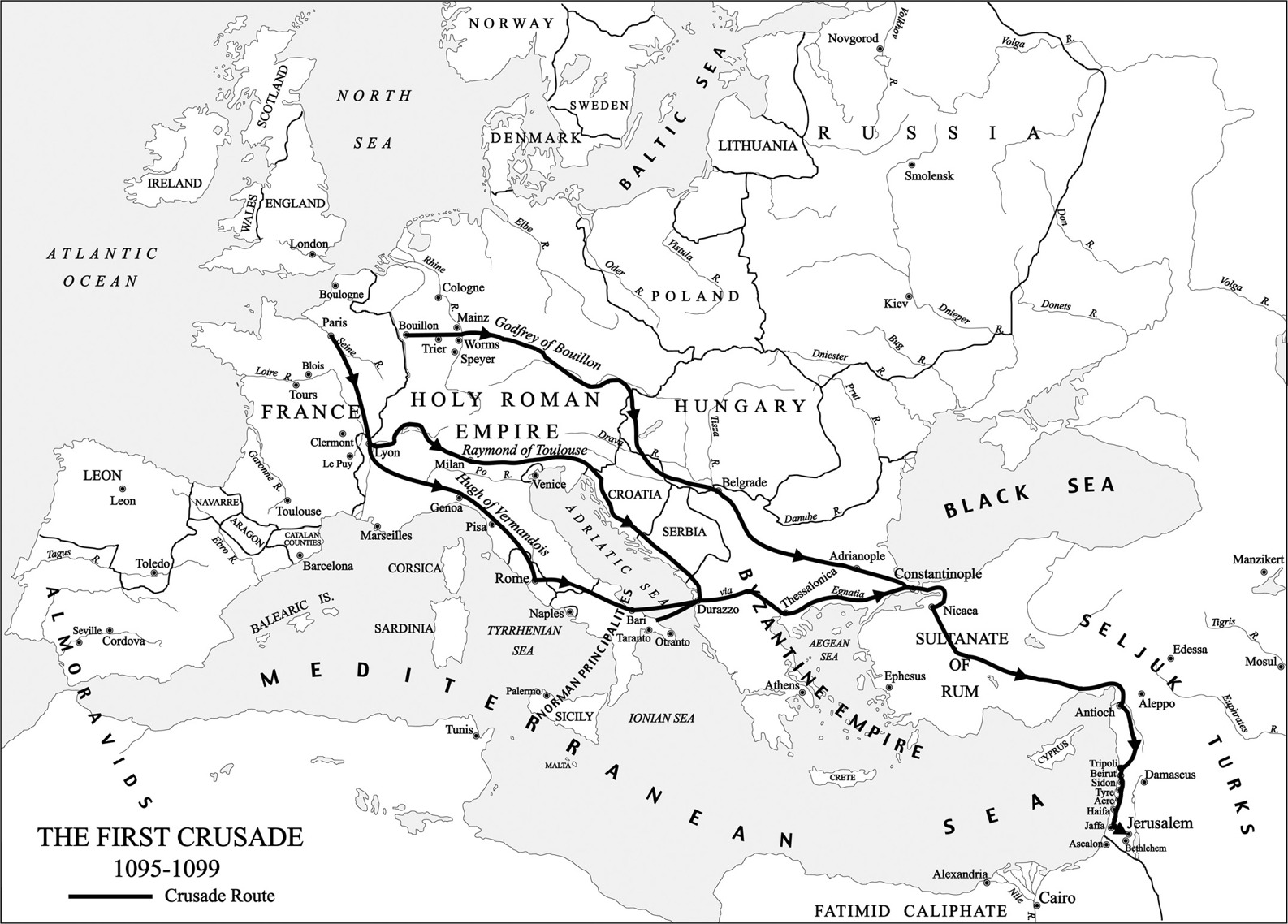
By the end of the eleventh century, the papacy was gaining the upper hand in its struggle with the Holy Roman Empire. Other European powers began to fall in line with papal directives lest they suffer the same destructive divisions that wracked the Germans. Pope Urban II (1088–99) spent much of his life promoting the reform agenda in the church, above all working to remove lay control. By 1095, when Alexius I Comnenus sent an envoy to request aid against the Turks, the papacy had the moral and political authority to make Gregory VII’s dream a reality. On November 27 of that year, at the Council of Clermont, Pope Urban II preached the First Crusade.
The precise wording of Urban’s call, which he repeated at numerous other synods, meetings, and councils, is not preserved. It is clear, however, that he began where Gregory had left off. He called the knights of Christ to take up a war of liberation. The Christians of the East must be free from the brutal and humiliating conditions of Muslim rule. With the help of the West, Constantinople, the greatest Christian city in the world, could be liberated from the danger that beset it daily. As compelling as this message was, Urban knew that it was insufficient to stir men’s hearts to bold action, so what was a mere possibility for Gregory VII became a focal point for Urban II: the Holy Land. The “soldiers of St. Peter,” as he referred to them, would not only sweep away the festering presence of the Seljuk Turks in Asia Minor but continue on to liberate the very lands of Christ. The goal was now Jerusalem. Byzantium was simply on the way.
Jerusalem and the Holy Land had a primacy of importance in medieval minds that is scarcely conceivable to moderns. Christianity had long placed a heavy emphasis on the inherent holiness of relics, the objects and bodies left behind by the saints. Pilgrimage to holy sites provided Christians with a means of penance, and the relics themselves were vital avenues of divine grace. The holiest sites were, of course, those in which Jesus himself had lived. Jerusalem, the holy city revered in the scriptures, where Christ walked, preached, died, and was resurrected, was the greatest destination of any pilgrimage. For medieval people, Jerusalem lay at the very center of the universe. That it had been taken by Arab Muslims in the seventh century was scandal enough. At least they had allowed Christian pilgrims to visit the holy shrines unmolested, albeit for a price. Now the Turks occupied the region, and, as Urban recounted in graphic detail, they committed every kind of sacrilege and crime against Christ and his followers. In a summary of Urban’s speech, Robert the Monk has the pope proclaim:
They [the Turks] have completely destroyed some of God’s churches and they have converted others to the uses of their own cult. They ruin the altars with filth and defilement. They circumcise Christians and smear the blood from the circumcision over the altars or throw it into the baptismal fonts. They are pleased to kill others by cutting open their bellies, extracting the end of their intestines, and tying it to a stake. Then, with flogging, they drive their victims around the stake until, when their viscera have spilled out, they fall dead on the ground. They tie others, again, to stakes and shoot arrows at them; they seize others, stretch out their necks, and try to see whether they can cut off their heads with a single blow of a naked sword. And what shall I say about the shocking rape of women?1
For knights steeped in a culture of militant Christianity, these were stories to make the blood boil. The shouts of Europe’s fighting men, filled with righteous anger, rang out across the land: “God wills it! God wills it!”
Urban could not preach to all of Europe himself, nor could his words alone have been responsible for the tremendous wave of enthusiasm that ensued. Bishops and preachers were sent out to spread the word. To their listeners, they quoted the words of Christ. “If any man would come after me, let him deny himself and take up his cross and follow me” (Matt. 16:24). “And everyone who has left houses or brothers or sisters or father or mother or children or lands, for my name’s sake, will receive a hundredfold, and inherit eternal life” (Matt. 19:29). It was Christ himself, the preachers proclaimed, who called his warriors to the aid of Jerusalem. Preachers also employed feudal ideas familiar to their audience. Was it not the duty of every vassal to come to the aid of his lord if that lord’s lands were unjustly taken from him? How much more, then, did the vassals of Christendom owe to their Lord and Savior Jesus Christ? Images of Christ carried by crusade preachers and manufactured in the workshops of Europe portrayed the Savior during the Passion and Crucifixion as a pitiful object of scorn and derision. Later, turban-headed Muslims in these depictions sometimes replaced the Roman torturers. The message was clear: Christ was crucified again in the persecution of his faithful and the defilement of his sanctuaries. The knights of Christ were called to be the avengers of an injured God.
CRUSADE AND PILGRIMAGE
Urban II did not overturn the teachings of Augustine but rather blended the just war theory with other well-established principles such as Christian charity and pilgrimage. At Clermont, the pope issued the call that Gregory VII had crafted but not delivered. Urban’s innovation was to emphasize the liberation of Palestine over the reconquest of Asia Minor and to tie it to the idea of pilgrimage. Each crusader joined the enterprise by taking a pilgrim’s vow. During the “taking of the cross,” or “crossing,” a crusader swore to make a pilgrimage to the Holy Sepulcher, the tomb in which Christ was placed and from which he rose. Because of the great expense and difficulties of such a journey, a crusader received a remission from sins, the same as any pilgrim who traveled to a holy shrine. The crusader’s vow was frequently accompanied by other vows of fasting or abstention from sex or by special devotions to be performed during the course of the pilgrimage. Finally, a simple cross was sewn onto the shoulder of the crusader’s garment to signify his status as a pilgrim. The distinction between holy war and pilgrimage was real. Crusaders usually referred to themselves as “pilgrims” or “cross bearers.”
A pilgrimage the crusade might be, but it was a strange pilgrimage nonetheless. The many thousands who took the cross bore swords, armor, and other implements of war with them on their pilgrimage. Armed pilgrimages were nothing new. Given the unstable situation in the Near East, pilgrims to Jerusalem had often found it necessary to arm themselves for protection against pirates, highwaymen, unscrupulous officials, and every other sort of riffraff who preyed on foreigners with money in their purses. In this case, though, the pilgrims’ party consisted of thousands of soldiers, trained in war and prepared not just for defense but for conquest.
From a distance, the crusades do look like great armies organized and directed by the church against the enemies of Christ, yet from within the ranks it was a very different picture. Each crusader took a pilgrim’s vow to reach the Holy Sepulcher. He was a pilgrim, first and foremost. The oath he swore was to God, not to the pope or to any other man. The only cohesion within a crusading army was that enforced by feudal obligations, family ties, friendship, or fear. A great lord who had taken the cross could command his own vassals but could not reasonably expect to command anyone else, least of all the other powerful lords who accompanied him on the crusade. Although it was customary to select a “commander in chief,” the title was honorary. Even crusading kings found it difficult to maintain control over a crusade. Popes in faraway Rome never could. A crusade army was, in effect, a loosely organized mob of soldiers, clergy, servants, and followers heading in roughly the same direction for roughly the same purposes. Once launched, it could be controlled no more than the wind or the sea.
Because the crusade was preached as a pilgrimage, a holy act of charity, and a means of grace and penance, able-bodied men were not the only ones to heed the call. Women and elderly men had just as strong an appetite for salvation as did their husbands and sons, and so they, too, clamored to be crossed. Urban II ordered his bishops and preachers not to receive vows from those who could not participate in the army, and he dissolved those vows already taken. It was difficult, however, to make the case that some should be denied the right to make a pilgrimage simply because they could not fight. A great many of the poor, sick, and otherwise unfit donned the crusader’s cross despite the papal pronouncements. Urban forbade monks to leave their monasteries or clergy to leave their parishes without proper permission. Those who could not wage the battle with swords should do so with prayers and devotions at home. Monks especially were enjoined to fulfill their role as “those who pray” rather than adding a burden to the tasks of “those who fight.” The pope further directed that no Spaniards should take the cross. Their struggle against Islam was at home, not abroad. None of these prohibitions meshed well with the popular view of the crusade as pilgrimage, and so they were often ignored.
CRUSADER MOTIVATIONS
It was long believed by historians that the crusades were manned by Europe’s castoffs: aristocratic second or third sons with no claim to their father’s lands or title, robber barons, highwaymen, ne’er-do-wells, and greedy monks. In part, this interpretation was an assessment of demographic evidence. Europe’s population soared during the tenth century, which suggested a need for more land. Thus, the crusades were often described as Europe’s first colonial wars, a kind of proto-imperialism visited on the Muslim people. Men with little to lose and everything to gain, it was argued, took the cross merely as a pious pretext to enrich themselves with stolen booty and carve out a new home in a distant land. Historians who lived through Europe’s scramble for empire or the subsequent dissolution of imperialism naturally saw the crusades in that familiar light. In addition, the post-Enlightenment and positivist view of religiosity too often presumed that medieval men and women could not possibly take seriously the pious words they uttered and wrote. For scholars of those schools, religion was not an impetus but a diversion, a ruse for those who spoke of the next world while profiting in this one. Unfortunately, this mistaken view is still dominant in popular works and even in many otherwise fine textbooks.
The advent of computer databases opened up new vistas of research for scholars such as Jonathan Riley-Smith to analyze large numbers of documents relating to the men and women who participated in the crusades. Rather than general impressions, we now have solid evidence regarding those who took up the church’s call and the factors that motivated them. Approximately 150,000 people across Europe responded to Urban II’s summons by donning the cross of the pilgrim. The vast majority of these were poor, and many were women or elderly (or both). During the course of the First Crusade, approximately 40,000 men marched to the East. Some left early, others late. Many did not make the entire journey. Only a minority of that total were knights; nevertheless, it was the knights and barons who brought with them the armies, so their acceptance of the crusading vow was crucial to the success of the crusade. What is clearest in the documentary record is that the great majority of these knightly crusaders were not spare sons but instead the lords of their estates. It was not those with the least to lose who took up the cross, but rather those with the most. Such men knew well the dangers of the proposed journey of some two thousand miles. A few of them were even familiar with the Turks, having served previously as mercenaries to the Byzantine Empire.
The cost of crusading was truly enormous. A knight who planned to bring a few family members (as many did) and an army appropriate to his position and authority would need to assemble funds equal to five or six times his annual income. Few had that sort of money lying around. They were forced to sell freeholds or settle property disputes to their disadvantage to raise the funds. In many cases, they also turned to their relatives, who liquidated their own assets to support the crusade. All of this represented a significant, in many cases dangerous, drain on the resources of a crusading knight and his family. And for what? All knew that a pilgrimage to Palestine was a treacherous undertaking even in the best of times. The tears that flowed when a crusader left his wife were not solely the result of an expected long absence but also of the strong likelihood that the soldier would never return. Although some hoped for the opportunity for plunder, the pope had decreed that all lands captured were to belong to the “prince” in command at the time. The expectation was that this “prince” would be the Byzantine emperor. In the event, very few crusaders remained in the Holy Land after their vows were fulfilled. The vast majority returned to Europe with neither riches nor land.
To impoverish one’s family for the remote possibility of garnering wealth in Palestine would have been foolish in the extreme. The price was too great and the chances of return too slim. To understand why thousands of knights and their families made such profound sacrifices, one must remember that they were medieval, not modern, people. The culture of nobility in the eleventh century was one of public displays of piety. Lords were known as much for their love of God as for their skill on the battlefield. Indeed, the two were seen as different sides of the same coin, neither possible without the other. With open hands, these families had showered lands and wealth upon Europe’s churches and monasteries for centuries. It was the duty of the nobility, who were blessed by God, to return the fruits of that blessing to God’s people and his church. The crusade was simply another means of doing that. Knights were willing to make profound sacrifices for the crusade because it was in the nature of their class to do so. By expending great wealth, they were storing up treasure where rust and moth could not corrupt. By defending the church, they defended all that was good and true in their world. In short, most noblemen who joined the crusade did so from a simple and sincere love of God. As is still true, people gladly march off to horrible wars if they believe that the cause for which they fight is noble, true, and greater than themselves.
This is not to say that crusading armies were made up of saints, nor that these warriors were particularly saintly on the march. They were men of the sword: pious and idealistic, but also crude, arrogant, and, at times, savage. The crusade provided a means for such men to turn their talent for warfare and bloodshed into a means of their own salvation. One can presume that most of the lesser men, who made up the bulk of a crusade army, were motivated by many of the same pious principles that led their betters to take the cross, but undoubtedly those who had little must surely have hoped to gain something in the enterprise. Most, however, were beholden to the greater men who supported them and could not have made the journey without their largesse. A crusade army was a curious mix of rich and poor, saints and sinners, motivated by every kind of pious and selfish desire, yet it could not have come into being without the pious idealism that led men to risk all to liberate the lands of Christ.
NOTE
1. From the account of Robert the Monk, Historia Hierosolimitana, in James A. Brundage, The Crusades: A Documentary Survey (Milwaukee: Marquette University Press, 1962), 18.