
PART 4
14
According to Vergil’s account of the Battle of Stoke, following the defeat of the Yorkist army:
Young Lambert the pretender was taken, together with his tutor Richard, but the lives of the both of them were spared, because the former was innocent and, thanks to his youth, had done no wrong, as being incapable of doing anything in his own right, and the latter was a priest. And yet, so that he might learn (as they say) that a rock hangs over the head of the man who has cast it aloft, he was remanded to perpetual darkness and chains. Lambert is still alive, made a falconer by the king after he had turned the spit for a while in the royal kitchen and performed other base tasks.1
The emphasis on the pretender’s youth seems consistent with the official estimates of his age cited earlier. This is worth noting in the light of contradictory age evidence which will be examined presently.
We have already noted that if only one priest called Symonds/Simons acted as Lambert Simnel’s mentor then the account of his capture given by Vergil contradicts the earlier evidence from the convocation of the Province of Canterbury. It remains possible that two priests (possibly related to one another) were involved, and that one of them was apprehended before the coronation of the Dublin King, whereas the second was only captured after the Battle of Stoke. If this was not the case, and if there was only one priest mentor, it would seem that Vergil or his source must have been in error, because the evidence from the Canterbury court regarding its interrogation of the priest in February 1486/87 seems incontrovertible.
However, the Book of Howth, a sixteenth-century Irish source, appears to confirm Vergil’s account in respect of the priest, and also in respect of Lambert Simnel’s subsequent employment by Henry VII. The Book of Howth account is brief and omits any specific reference to work in the royal kitchens, though it depicts Lambert Simnel acting as a wine waiter. It states that ‘this feigned King and crafty priest his master was taken alive. This priest was commanded to perpetual prison and this innocent child became falconer to the King after.’2
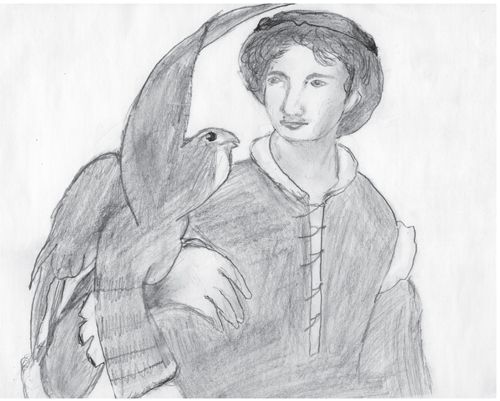
A young falconer. © Muhammad Hanif.
The Book of Howth is a manuscript which belonged to Christopher St Lawrence, eighth Baron Howth (c.1510–89). It recounts at some length a unique story relating to Lambert Simnel, representing the pretender as serving wine at table on one important occasion in 1489. In the Book of Howth, no precise date is assigned to this incident, but the event obviously post-dates the Battle of Stoke. The fact that the story relates to a period when Henry VII had invited Irish peers to attend his court in England allows the year in question to be identified.
In Ireland after the Battle of Stoke, Kildare and his supporters continued to follow their own course. However, in June 1488 Henry VII sent Sir Richard Edgecombe to Ireland to try to establish his authority. Edgecombe waited in Dublin for several weeks, until eventually Kildare came to Dublin and on 20 July it was agreed that he and the Irish peers would take oaths of allegiance to Henry VII. Following this, the king invited the Irish lords to come to England. Thus the banquet described in the Book of Howth took place in 1489.3
The story recounted in the book of Howth runs as follows:
After the King sent for all his Lords of Ireland being in England with the King. After long talk with them, the King said to the Lords, ‘My Masters of Ireland, you will crown apes at length’. Those Lords being a procession appointed, with certain Lords of England to be their companions and fellows in that procession appointed, amongst all one Lord was and the Lord of Houthe together, which trembled with fear, and scarse could speak, and said ‘Sir, there shall be no butchery done upon none of us this time, praise be to God, for the face of the axe is turned from us’. This axe was borne afore the procession, as is accustomed, and as he was speaking he could scarse speak with fear. Being asked by the Lord of Houthe the cause why he frayed said, that ‘the Lord my father and grandfather was beheaded’. ‘Well,’ said the Lord of Houthe, ‘follow my counsel; serve God with all your heart, and fear your Prince and obey his laws to your power, and you need never doubt of any such thing’.
This same day at dinner, where as these Lords of Ireland was at Court, a gentleman came where as they was at dinner, and told them that their new King Lambarte Symenell brought them wine to drink, and drank to them all. None would have taken the cup out of his hands, but bade the great Devil of Hell him take before that ever they saw him. ‘Bring me the cup if the wine be good’, said the Lord of Houth, being a merry gentleman, ‘and I shall drink it off for the wine’s sake and mine own sake also; and for thee, as thou art, so I leave thee, a poor innocent’. After, the Lords being there a time longer than their purses could well bear, they were licensed to go to their country, and the King did give the Lord of Houthe the apparel that he ware that day, and 300l. In gold, with thanks; and so departed.
The Lord Howth who figures in this story, and who attended the dinner in question, was Nicholas St Lawrence, fourth Baron Howth (c.1460–1526) – the same man whom we met earlier as one of Henry VII’s reported sources of information concerning the Dublin coronation of ‘King Edward VI’. However, the manuscript that survives is not contemporary. It is known to have belonged to the eighth Lord Howth, one of the three brothers, all grandsons of the fourth Lord Howth, who succeeded to the Howth title in turn, following the demise of their father.4 How the eighth Lord Howth obtained the manuscript is not recorded. The identity of the English peer with whom his grandfather had been paired in the procession of 1489 is unknown. Thus the reported reason for the English peer’s fear – namely that both his father and his grandfather had been beheaded – while by no means incredible – is hard to substantiate. However, the key point of the story in connection with Lambert Simnel relates to his serving of the wine, and how he was received by the Irish lords.
It has sometimes been stated that the Irish nobles failed to recognise Lambert Simnel when he served them wine on this occasion. Smith, for example, suggested that ‘the other Irish lords [apart from Howth] needed to be informed in advance that the serving boy would be Lambert, and such information seems to presuppose that they might not have realised that he had been the lad they had crowned in Dublin’.5 This is possibly an overstatement. For while it does certainly appear that none of the Irish lords spontaneously recognised the boy who was serving them, that could simply have been because they didn’t actually take any notice of him. After all he was merely a servant.
Nevertheless, it is clear that Henry VII deliberately had the wine served by Simnel on this occasion. This raises the possibility that the king’s objective was to confirm the identity of his new servant. He may have been hoping that independent witnesses (the Irish lords) would spontaneously recognise his serving lad as their former Dublin King. This could possibly imply that Henry VII himself had some doubts about the servant’s identity. The reason for this could perhaps have been related to the fact that while the Dublin King had been described as a boy of 10, the Lambert Simnel who was captured after the Battle of Stoke seems to have been nearer the age of 17. This conflicting age evidence will be examined in greater detail presently.
If Henry VII did have doubts as to whether his captive was, in fact, identical with the boy who had been crowned in Dublin, if he was seeking independent confirmation of his prisoner’s identity, that would certainly explain his gratitude and generosity to Lord Howth following the latter’s apparent recognition of the former pretender. Ironically, however, Howth was one of the very few Anglo-Irish lords who had not supported the Dublin King. Therefore he may never have seen the boy while he was the titular head of state in Dublin. Thus, in reality, Howth’s apparent acknowledgement of the identity of the person who served him the wine was probably meaningless.
It is also interesting to note that, according to the version of the story which has survived (possibly a somewhat biased account), Lord Howth appears to have been the only Anglo-Irish peer who accorded recognition to the servant on this occasion. Since he was also possibly the only Anglo-Irish lord present who had never seen the Dublin King while the boy was on his throne, it seems that the failure of his companions to recognise Lambert Simnel as their former boy-king was probably more significant than Howth’s pretence of recognition.
Another issue which concerned Smith and other writers relates to the age of the young person who was taken into Henry VII’s service after the Battle of Stoke, firstly as a kitchen lad, and subsequently as a falconer. As we have already seen, in 1487 the Dublin King was thought to be 10 years of age by representatives of Henry VII’s government who saw the boy in Ireland during his ‘reign’. At that time the real Earl of Warwick would have been 12; Richard of Shrewsbury, Duke of York would have been 14, and Edward V would have been approaching 17. The age differences between them certainly appear, on the face of things, to be significant, though it has been noted that the Earl of Warwick might have shared with his father, the Duke of Clarence, a stature lower than average, so that at the age of 12 he might possibly have been mistaken for a boy of 10. On the other hand the Duke of York and Edward V had a father who was much taller than average. It therefore seems improbable that either of them would have been mistaken for a 10-year-old in 1487.
In this context, however, it is very curious to discover that Francis Bacon describes Lambert Simnel as ‘of the age of some fifteen years, a comely youth and well favoured, not without some extraordinary dignity and grace of aspect’.6 In this particular sentence, Bacon is clearly referring to Simnel in 1485–86, because he goes on to explain that the boy’s promising appearance attracted the attention of the man who was to become his priestly mentor. It is therefore evident that the pretension had not yet started. Of course, Bacon was not a contemporary, but the ultimate source for this estimated age must presumably have been someone who had seen Lambert Simnel. However, Bacon’s immediate source for his stated age of 15 may have been Vergil, who had erroneously given 15 as the age of the Earl of Warwick in 1485.7
Of course, no one at the Tudor court had set eyes on Lambert Simnel in 1485–86. Henry VII’s writers only saw Simnel after he was captured. They must therefore have estimated the pretender’s age in 1485–86 from the appearance of the youth detained by Henry VII from 1487 onwards. In other words Bacon’s information would appear to suggest that, after the Battle of Stoke, the person who was said be the captured Dublin King, and who was subsequently employed in the service of Henry VII, had the appearance of a lad of about 17 at or shortly after the time when he was captured.8
In this connetion, it is noteworthy that at some point Vergil changed his text, deleting his initial use of the word ‘boy’ and substituting the word ‘lad’. This seems to imply that he too had found himself confronting, and having to deal with, conflicting information which spoke of a Dublin King aged 10 but a captured pretender aged 16 or 17.9 This apparent age discrepancy has been interpreted by some writers as suggesting that the Lambert Simnel who was Henry VII’s prisoner after the Battle of Stoke cannot have been identical with the much younger Dublin King. And as we have seen, it is possible that Henry VII also found himself wondering about this.
To confuse the situation still further, some historians have chosen to accept the non-official evidence which suggests that the pretender was in his middle to late teens even at the time of his coronation. Consequently they have rejected the official statements which ascribe to him an age of 10 years. In other words, they assume that the Dublin King was six or seven years older than the official statements suggested. It has also been noted that the age ascribed to the teenaged pretender would then have been perfectly compatible with the age of Edward V, if he was still alive in 1487.
But we have already noted that no contemporary fifteenth-century source suggests that the Dublin King was, or ever claimed to be, Edward V. Moreover, we have produced clear evidence that he used the royal style of ‘Edward VI’. Therefore the notion that the Dublin King was older than reported by the official Tudor sources is almost certainly worthless. It is far more likely that the Lambert Simnel who served Henry VII from 1487 – and who indeed may then have been in his late teens – was a different person than the younger boy who had been crowned in Dublin.
Vergil’s statement that ‘Lambert is still alive’ has been taken by Michael Bennett and others to mean that Lambert lived until 1534 – the year in which Vergil’s text was first published.10 This interpretation may be correct, but actually the point is by no means certain. The problem is that althouth the first edition of Vergil’s history was published in 1534 – and Vergil had updated his text somewhat with that publication in mind – the original text had been completed in 1512–13. It is therefore possible that Vergil’s statement merely implies that Lambert Simnel was still alive in about 1513.
Nevertheless, whatever the precise meaning of Vergil’s text, an independent source provides incontestable evidence that Lambert Simnel lived until at least the twenty-sixth year of the reign of Henry VIII (1524). From that year, records survive relating to the ‘expenses of the funeral of Sir Thomas Lovel, Knt. of the Garter, who died at his manor of Elsynges in Endfeld, Middlesex, 25 May Corpus Christi even at 7 pm 26 Hen. VIII 1524’.11 These records show that livery cloth was issued to ninety-seven yeomen. The list of the yeomen in question ends with the following words: ‘broche turners, scullions, housekeepers, labourers, carters, Lambert Symnell, the schoolmaster, and Jack the lad in the kitchen’.12 This implies that up until the early summer of 1524 Lambert Simnel had been employed by Sir Thomas Lovell in a relatively menial capacity, probably at his manor of Elsyng at Enfield, Middlesex. Lovell had acquired this manor in 1492, through his wife, Isabel de Ros. The manor house had probably been built by her uncle, John Tiptoft, Earl of Worcester (executed 1470).
We have no precise record, then, of when Lambert Simnel died. Nor do we know where he was buried. If he died at, or near, Elsyng House (which is by no means certain), the nearest church and graveyard would have been at St Andrew’s Church, Enfield, and Lambert Simnel may have been buried there. Until the monastery’s dissolution in 1538, St Andrew’s Church belonged to the Benedictine Abbey of Walden (at Saffron Walden in Essex). One possible means of clarifying Lambert Simnel’s true identity – if only his bones could be recovered – would be by means of DNA. Unfortunately, however, there is currently little prospect of undertaking such scientific research: the earliest surviving memorial stone in St Andrew’s graveyard dates only from 1680.13 There are earlier monuments within the church, but none of these commemorates Lambert Simnel.
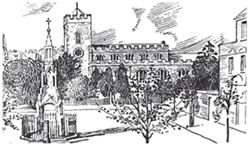
The possible burial place of Lambert Simnel. St Andrew’s Church, Enfield, in 1895.
Bennett suggested that, ‘given the rarity of the surname in England, Richard Simnel, canon of St Osith’s in Essex at the time of the dissolution in 1539, may have been [Lambert’s] son’.14 Canon Richard Simnel certainly existed. That is proved by surviving documentation relating to the dissolution of St Osyth’s Priory in Essex, which lists among the canons of that religious house on 8 August 31 Henry VIII, ‘Ric. Symnell, canon’.15
As we have seen, however, Bennett’s assumptions concerning the origins of the Simnel surname, and the frequency of its occurrence, are not based on any real evidence. Still, Canon Richard Simnel may perhaps have been a relative of Lambert. The possibility has already been noted that Lambert may have had at least one relative called Richard who served as a priest in the Church (see above). However, this falls far short of proving that Canon Richard Simnel of St Osyth’s was a relation, and there is certainly no proof that the canon was Lambert’s son. Further fascinating evidence of when and where the surname SIMNEL(L) is recorded, both in the UK, and in some of the former British colonies, is offered in Appendix 3 (see here).
Notes
Abbreviations
|
CPR |
Calendar of Patent Rolls |
|
ODNB |
Oxford Dictionary of National Biography |
|
PROME |
Parliament Rolls of Medieval England |
1. Sutton, Anglica Historia, http://www.vision.net.au/~pwood/june04.htm, accessed December 2013.
2. Calendar of the Carew Manuscripts preserved in the Archiepiscopal Library at Lambeth: The Book of Howth, London 1871, p. 189.
3. A.J. Otway-Ruthven, A History of Medieval Ireland, New York 1980, p. 406.
4. For details of the Barons of Howth, see http://en.wikipedia.org/wiki/Earl_of_Howth, accessed November 2013.
5. Smith, ‘Lambert Simnel and the King from Dublin’, p. 516.
6. R. Lockyer, ed., F. Bacon, The History of the Reign of King Henry the Seventh, London 1971, p. 54.
7. ‘Before leaving Leicester, [Henry VII] sent Robert Willing into Yorkshire to fetch Edward Earl of Warwick, the fifteen year-old son of George Duke of Clarence, whom Richard had been holding in the castle of Sheriff Hutton.’ Sutton, Anglica Historia, http://www.vision.net.au/~pwood/june04.htm, accessed December 2013.
8. On this point, see also Smith, ‘Lambert Simnel and the King from Dublin’, p. 503.
9. In Vergil’s Latin text the change in vocabulary was from the word puer in the published text of 1534, to the word adolescens in the published text of 1546. Smith, ‘Lambert Simnel and the King from Dublin’, p. 513, n. 103.
10. ‘Lambert Simnel’, ODNB.
11. J.S. Brewer, ed., Letters and Papers, Foreign and Domestic, Henry VIII,vol. 4, part 1 (1524–1526), London 1870, pp. 149–150.
12. Brewer, Letters and Papers, pp. 149–50.
13. http://www.gravestonephotos.com/public/cemetery.php?cemetery=835, accessed December 2013.
14. Simnel is not a common surname, but it does exist and seems to be geographically quite widely distributed – see above for origins – see also https://familysearch.org/search/record/results#count=20&query=%2Bsurname%3ASimnel~%20%2Brecord_country%3AEngland, accessed August 2013. Also, ‘Simnel cakes have been known since at least the medieval times. They would be eaten on the middle Sunday of Lent, Laetare Sunday (also known as Refreshment Sunday, Mothering Sunday, Sunday of the Five Loaves, and Simnel Sunday), when the forty day fast would be relaxed. More recently, they became a Mothering Sunday tradition, when young girls in service would make one to be taken home to their mothers on their day off. The word simnel probably derived from the Latin word simila, meaning fine, wheaten flour.’ http://en.wikipedia.org/wiki/Simnel_cake, accessed August 2013.
15. J. Gairdner and R.H. Brodie, eds, Letters and Papers, Foreign and Domestic, Henry VIII,vol. 15 (1540), London 1896, item 147.