
15
The case of the second Yorkist pretender – the man who called himself Richard of England, who was recognised by many important people as Richard of Shrewsbury, Duke of York, the younger of Edward IV’s sons, and who is now known to history as Perkin Warbeck – has received a good deal more attention from historians than the case of the Dublin King. Several books have been written about him – and the most recent one, by Anne Wroe, was very extensive.1
Perkin Warbeck is important to our story in two ways. First, in telling the story of the Dublin King, the second claimant’s case, and the results of his attempt on the English throne, cannot be ignored. The actions of Richard of England had an effect both on the foreign policy of Henry VII, and on the hopes of Margaret of York. Moreover, they eventually produced a very significant impact on at least one of the people associated with the case of the Dublin King, namely the official Earl of Warwick. It was the actions of Perkin Warbeck which ultimately provided the excuse for Warwick’s execution. Second, it is rather important – and also potentially instructive and informative – to compare the cases of the Dublin King and of Perkin.
Strangely, in the past the case of the Dublin King has tended to be easily dismissed as insignificant. The boy at the centre of the plot has been almost universally dismissed as a fake. Perkin Warbeck, on the other hand, seems to have been taken seriously by foreign courts during the early stages of his campaign, and while some historians have dismissed him as a false claimant, others have at least speculated about the possibility that maybe his claim should be taken seriously.
Yet in the case of Perkin Warbeck one is dealing with a situation which, in the final analysis, is either black or white. Either Richard of England really was Richard, Duke of York, the younger son of Edward IV, or he was not. On the other hand the case of the Dublin King is a much more complex picture, in shades of grey. One cannot, for example, simply say that the Dublin King either was, or was not, the Earl of Warwick.
This is because there may have been more than one Earl of Warwick in existence in the 1470s and 1480s. Thus the Dublin King may have been the genuine biological son of the Duke and Duchess of Clarence, delivered by his father to Ireland when he was a very small child, and subsequently brought up there. On the other hand he may have been a child who somehow became involved at a very early age in the substitution plot of the Duke of Clarence. A boy who was not, perhaps, the biological son of the Duke of Clarence, but who may have been brought up for most of his young life believing that he was the Earl of Warwick. A third possibility is that the boy could have been a simple impostor, who was himself very well aware of the falseness of his claim.
What is more, not one of these possible scenarios is necessarily inconsistent with the official Tudor account which tells us that at some stage he bore the name of Simnel (or one of its variants). Thus, in every respect, the story of the Dublin King (which has for so many years been treated as a very simple tale) is actually far more complex than the story of Perkin Warbeck.
It was in 1493 that the city of York became aware that a second Yorkist claimant to the English throne was in prospect. On 13 May of that year the city archives recorded that:
the Maier shewed that the publike noyse and rumour was that the Kyngs enimys and rebelles beyng byond the sea with the lady Margaret, duches of Burgon, and en especiall oon callyng hym self Richard, duke of York and secund son to the Kyng Edward the iiijth, late Kyng of this realme, with other his adherents, entendeth in right short tyme to entre this the Kyngs realme; wherfor my said lord the Maier on the Kyngs byhalve, and as they wald answer unto the Kyngs highnes at theyr jouperty and perill, charges all the said presence and every of theym that they in there wards shuld prepare and make redy all suche ordinauncez and abiliments of warre as they had in theyr wards, and as well gunnes, gonne stones, gonne powder as portculez and other; also that every wardeyn to se almaner of reseants within theyr wards have theyr harnas redy as jake, salet, bowez, arowez and other weappyns as they wold answer for.2
Like the Dublin King, the new claimant was backed, morally and financially, by his putative aunt, Margaret of York. He was also well received by the crowned heads of Europe, beginning with Margaret’s relatives-in-law, the Habsburg family. Through the Habsburg connection he also came to the attention of Ferdinand and Isabel, the king and queen of Spain, who, for a complex mixture of reasons, also supported his claims. This Spanish support may later have led to rather serious consequences for the claimant, as we shall see.
Eventually Richard of England found himself in Scotland, where he was married to a relative of the Scottish king. Of course, if the claimant really was Richard of Shrewsbury – or as he now usually described himself, Richard of England – Lady Catherine Gordon was his second wife, the first having been little Anne Mowbray.
With the aid of his new relative by marriage, King James IV of Scotland, Richard of England invaded the land he claimed as his own. Yet, as in the earlier case of the Dublin King, his contest for the crown of England was ultimately unsuccessful. Local support failed to materialise, and he penetrated only a few miles into the kingdom he was seeking to win. Later, from Ireland, he made a second attempt, based on an invasion of Cornwall.
In the case of the first Yorkist claimant, as we have seen, reportedly the Dublin King was eventually captured by Henry VII and was later employed in a menial capacity in his household. However, we have also learned that another version of the story exists, which states that ‘Edward VI’ escaped after the Battle of Stoke, and that the subsequent kitchen servant of Henry VII was, in reality, a different person, of a different age.
In the case of the second claimant, when all of Richard of England’s attempts on the English throne had failed, he too was eventually captured by Henry VII – and that capture has never been disputed. Subsequently, however, Perkin Warbeck was treated in a totally different manner from Lambert Simnel. Eventually he was placed in prison in the Tower of London,and in 1499 Henry VII had him put to death.
No such fate ever overtook Lambert Simnel. Instead Lambert Simnel was completely and utterly discredited as a Yorkist claimant to the throne of England. The Tudor government therefore had nothing more to fear from him. History would remember him merely as a fake and an impostor. There was no reason to kill him.
Perkin Warbeck, on the other hand, was still seen in 1499 as an enigma. Despite the government’s publication of his official identity as a native of Tournai, not everyone was convinced by this account, either at the time, or subsequently. While there has certainly never been universal agreement that he really was Richard of Shrewsbury, he seems to have closely resembled his putative father, King Edward IV. Thus, even if he was not precisely who he claimed to be, the possibility remains that he may have been a son of Edward IV – though perhaps a more blatantly illegitimate offspring than the so-called ‘Princes in the Tower’.
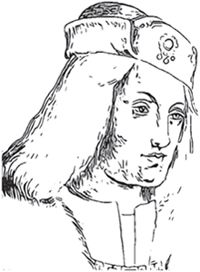
‘Richard of England’, also known as ‘Perkin Warbeck’, redrawn from the contemporary sketch at Arras.
Whatever the true identity of Perkin Warbeck, it was precisely because Henry VII and his advisers had not succeeded in completely discrediting him that he needed first to be forced to make a public confession to the effect that he was an impostor, and then put to death. That way, even if he was a child of Edward IV, and a descendant of the royal house of York, he would no longer represent a threat to Henry VII and his dynasty.
Notes
Abbreviations
|
CPR |
Calendar of Patent Rolls |
|
ODNB |
Oxford Dictionary of National Biography |
|
PROME |
Parliament Rolls of Medieval England |
1. Wroe, Perkin.
2. Raine, York Civic Records, pp. 100–1.