
Chapter 3
The French armistice brought a period of celebration for Germany as Hitler still believed that Britain would want to negotiate for peace that he would so gladly have granted. This was not unrealistic given the British attitude towards Hitler during the late 1930s but by June 1940 Britain was led by a new and tougher Prime Minister, Winston Churchill, and clearly there would be no peace.
The euphoria following the defeat of France seemed to have removed any doubts that might have existed in the German High Command about its ability to defeat the RAF. Göring had convinced Hitler that his Luftwaffe would ensure the sky over the Channel and southern England would be secure for an invasion to take place. Furthermore, there was a strong belief within some quarters that an invasion of southern England should not be delayed. Milch, for one, believed that any delay would allow the British to regroup across the Channel and by the time Hitler was ready to commence operations against Britain it would be too late.
Not all shared this opinion. Jeschonnek was revelling in the victory over France but, while the Luftwaffe seemingly idled its time away, Britain was preparing for a full-scale war. Aircraft production in Britain increased, particularly of fighters, and the quantitative advantage enjoyed by the Luftwaffe at the start of the war was quickly eroding away. Nonetheless, it remained an impressive air armada. Between them Kesselring and Sperrle had more than 1,200 bombers, 400 dive bombers and 1,100 fighters (800 Bf 109s and 300 Bf 110s). They would be at the forefront of the onslaught with the fighter elements coming under the control of the Jagdfliegerführer for each air fleet, their task being to achieve aerial supremacy over the English Channel so that the bombers could pave the way for the German invasion of southern England.
Opposing the Luftwaffe across the Channel was RAF Fighter Command consisting of nearly fifty squadrons of Spitfires and Hurricanes, totalling just over 750 aircraft, under the command of Air Chief Marshal Sir Hugh Dowding. Fighter Command was organized into three, and very soon four, operational groups covering large geographical areas. Each group had the responsibility of protecting its own area with its own centralized command and control system, although the overall system was sufficiently flexible to allow mutual support between groups.
The RAF also enjoyed the benefit of early warning provided by a chain of radar stations along the southern and eastern coasts of Britain, meaning it would not have to waste vital resources by having to provide air patrols over southern England. The Hurricane and Spitfire pilots would also be operating close to home, allowing them to maximize best use of their fuel, and any aircraft damaged during air combat stood a realistic chance of either force-landing or making it back to its own base. Furthermore, any pilot shot down who survived uninjured could return to flying in a short period of time. Fighter Command also benefitted from an established network of communications links between its headquarters and the various group and sector operations rooms around southern England.
For the Jagdwaffe the brief period of rest was soon over and from the beginning of July the Jagdgeschwader moved forward to their new airfields in France. Although Hitler would not yet allow a full-scale aerial offensive over southern England he did allow attacks against British shipping in the Channel, and the Kanalkampf (Channel Battle), which commenced on 10 July 1940, marked the opening phase of what would later become known as the Battle of Britain.
With a number of Jagdgeschwader still settling at their new bases in northern France, it was mostly the Bf 109s of JG 51, and then JG 26 and JG 53 that took part in the opening exchanges. There was a cloudy start to the day but the weather gradually improved and one of the first exchanges on the opening day involved twenty Bf 109s of III./JG 51, led by Hannes Trautloft, accompanied by thirty Bf 110s of I./ZG 26 escorting twenty Do 17s tasked with attacking a large convoy off Folkestone. The formation was intercepted by thirty RAF fighters patrolling the area and so the attack achieved little success with only one ship sunk. One of the Bf 110s was shot down but the Bf 109s claimed six aircraft destroyed, three of which were claimed by Walter Oesau, the Kapitän of 7./JG 51; his three victims were all Spitfires.
It was cloudy again the following day but there were sufficient gaps to allow further attacks against shipping off the east coast of England as well as attacks against Portland and Portsmouth. The pattern was much the same during the following days with the cloudy weather, light rain and occasional fog preventing any activity of note but there were further attacks against British shipping off Dover and the south coast of England. The Bf 109s had been allowed to carry out freier Jagd (‘free fighter’) sorties, which gave them relative freedom to roam.
With its build-up complete, the Luftwaffe was now ready to commence its major offensive against Britain. Kesselring’s Luftflotte 2 consisted of I. Fliegerkorps in north-east France, commanded by Ulrich Grauert, II. Fliegerkorps in Belgium (Bruno Loerzer) and IX. Fliegerkorps in Holland and north-west Germany (Joachim Coeler). Sperrle’s Luftflotte 3 consisted of IV. Fliegerkorps in Brittany (Alfred Keller) and V. Fliegerkorps in the Seine area (Robert Ritter von Greim). Also available was X. Fliegerkorps of Luftflotte 5 in Norway under the command of Hans Geisler.
The vast area now under German occupation meant that the Luftwaffe was able to spread its resources far and wide, with bombers based as far west as Brittany and as far north as Norway from where they could reach most of Britain. But the limited combat radius of the Bf 109E meant it was effectively restricted to operations over south-east England and would only be able to reach as far as London if deployed forward to airfields in the Pas de Calais region, and could only operate over the south-west of England if operating from bases in and around the Cherbourg Peninsula. Therefore, the Bf 109s were based at airfields in two main areas. The majority of Jagdgeschwader – JG 3, 26, 51, 52 and 54 – were allocated to Luftflotte 2 and spread across twenty airfields in the Pas de Calais. Those allocated to Luftflotte 3 – JG 2, 27 and 53 – were spread across a number of airfields further west in Normandy, Brittany and the Channel Islands. At each airfield there was typically one Gruppe, with its three Staffeln and Stab flight, led by a Hauptmann or Major.
The aerial exchanges during the opening ten days of the campaign against Britain had been relatively small-scale with losses on either side amounting to a handful a day. The Bf 109Es of Trautloft’s III./JG 51 continued to enjoy success against the RAF and during one encounter with twelve Boulton-Paul Defiants, a rather cumbersome single-engine fighter with no forward-firing guns but armed instead with a powered rear turret, near Dover on 19 July, Trautloft’s unit shot down six without loss and it was only the intervention of Hurricanes that prevented the destruction of the entire Defiant squadron.
Both Galland and Mölders experienced their first action of the campaign over the Channel during July. Galland, leading III./JG 26 and now promoted to Major, was impressed by the Spitfire during his early exchanges with the type over the Channel, particularly in a slow-speed dogfight when he found the Spitfire was capable of out-manoeuvring the Bf 109E. During one encounter, an inferior number of Spitfires successfully forced Galland’s Gruppe into a hard manoeuvring fight that resulted in the 109s becoming short of fuel. Galland was fortunate to make his escape but did so only by executing a long curving dive that the Spitfire behind him was unable to match, and so Galland got away at low level across the Channel and back to his base in the Pas de Calais.
Galland shot down his first Spitfires at the end of July, and was subsequently awarded the Knight’s Cross for his seventeen victories, but the Spitfire had already demonstrated to him that it was an extremely capable aircraft. He felt the Bf 109 was the better aircraft when making an attack but it was not so capable when having to defend against a Spitfire, which, although he found it to be a little slower than the Bf 109, was much more manoeuvrable in combat.
It was still early days in its operational life but the Spitfire was now appearing in increasing numbers and its pilots were learning quickly. Even those amongst the Jagdwaffe with plenty of combat experience were discovering that victory over Britain was far from certain. Mölders, having also been promoted to Major and now leading JG 51, was also impressed by the Spitfire. He, too, had been fortunate to escape with his life when his first action in command ended in near tragedy. While escorting a formation of bombers he was wounded in the leg during a clash with Spitfires and had to crash-land back at base, although one of his young pilots, Oberleutnant Richard Leppla, Kapitän of 3./JG 51, scored the first of his eventual sixty-eight successes during the action that day.
These early exchanges across the Channel often showed that the Jagdwaffe had the better tactics and usually, but not always, the Jagdflieger came out on top. The RAF was still using rigid tactics based on a typical squadron-size formation of aircraft whereas the Jagdgruppen flew in fluid and flexible formations with breadth, depth and variations in altitude. Even when the RAF chose to adopt a single aircraft as a weaver, which flew above and astern of the formation to act as lookout and to guard the main formation from attack from high and behind, the pilots of Fighter Command soon learned the weaver proved too vulnerable and eventually abandoned the idea.
The Luftwaffe’s basic fighter formation remained based on the Staffel, led by the Staffelkapitän with his Rottenflieger as his number two, swept above and to one side of the leader. The distance and height between the two aircraft varied according to many factors such as cloud conditions, sun position and the threat direction at the time. The rest of the Staffel flew echeloned behind the leader and above him with part of the formation swept to the left of the Kapitän and the other to his right. The size of each element would depend on the number of aircraft the Staffel had available on the day but, typically, one element would operate as a Schwarm, with the Schwarmführer leading the four aircraft and his wingman, the Rottenflieger, flying above him and swept on the outside of the overall formation. The other pair, led by a Rottenführer, would also be swept above and on the outside of the formation. On the other side there would be either another Schwarm of four or a number of pairs depending on the size of the Staffel, and they would fly at a height and position depending on all the factors the Staffelkapitän needed to take into account.
The Jagdflieger would usually have two main advantages: numbers and height. He also had the advantage of only having one responsibility: to engage the RAF fighters or, at least, to prevent them from engaging the bombers. However, he did not have all the advantages. It was unnerving to cross the Channel in a single-engine fighter and any technical malfunction could soon result in disastrous consequences. It was also important continuously to maintain awareness of how much fuel he had, which was never easy during combat, and so he had to fly around with his eyes continuously scanning the fuel gauge in his cockpit to see when the low-fuel warning light started to flash.
The Bf 109’s limited endurance would prove critical throughout the Battle of Britain. The Jagdgruppen were not helped by having first to join up in a large formation and it could take up to thirty minutes after take off before the 109s had crossed the Channel, even at the narrowest point, which would then give only about twenty minutes of combat time before it was necessary to head back home. Even the units based in the Pas de Calais could spend little time over southern England as the 109’s combat radius of approximately 125 miles proved to be a limiting factor, and anything beyond London was certainly out of reach.
Aircraft recognition was also proving a problem. In the air the Bf 109 looked remarkably similar to the Spitfire and Hurricane, and when taking into consideration the large number of fighters that were involved in the aerial exchanges, and the speed of decision-making for the fighter pilot during air combat, it became increasingly important on both sides to prevent firing on a friendly aircraft. Some Bf 109 units began to apply large areas of yellow paint to aircraft engine cowlings, rudders and wing tips to make recognition in the air easier.
The Jagdwaffe was now involved in a quite different air war to what it had encountered before, where it had flown in support of a ground offensive. It was now about gaining air superiority and the RAF had to be defeated, or at least reduced to a level where it could not mount any great opposition to the planned invasion of Britain.
Operations across the Channel during July and early August saw the Luftwaffe’s bombers sink some 70,000 tons of British shipping while its fighters carried out a number of freier Jagd sorties over the Channel and south-east England to probe the RAF’s defences. It had already become apparent to the Jagdwaffe that the RAF fighters always seemed to be in the right place at the right time, and gradually the exchanges swung in favour of the RAF as the pilots of Fighter Command became more familiar with the Bf 109E and its tactics.
Hitler had already ordered the preparation of a seaborne invasion of Britain and his Directive 17 issued on 1 August called for the Luftwaffe to use all available resources to defeat the RAF. The Bf 109 units were now at their peak strength and the air battle intensified on 8 August when fierce attacks were carried out on a Channel convoy off Dover and the Isle of Wight. The day produced the heaviest air fighting to date, involving more than 150 aircraft, and resulted in the Jagdwaffe claiming twenty RAF fighters shot down.13
The second phase of the offensive, Adlerangriff (‘Eagle Attack’), began on 13 August and was intended to annihilate Fighter Command with the Luftwaffe’s bombers attacking the RAF’s ground organization; specifically the airfields, the radar sites and Britain’s aircraft industry. The opening day, known as Adler Tag (‘Eagle Day’), was hampered by poor weather during the early morning and meant the day started badly with Kesselring having to cancel Luftflotte 2’s involvement in the morning operations, although Sperrle was able to commit Luftflotte 3. Improvement in the weather during the afternoon meant that Luftflotte 2 was able to participate but, despite flying nearly 1,500 sorties during the day, the Luftwaffe failed to target the Spitfires and Hurricanes of Fighter Command and only thirteen RAF fighters were destroyed; the Jagdwaffe lost twenty-seven fighters, eighteen of which were Bf 110s and nine were Bf 109s. It had been far from one of the greatest days in the Luftwaffe’s short history as had been so eagerly anticipated at its start.
Two days later the weather had turned fine and the most intense day of fighting so far followed, including raids against targets in the north of England by bombers of Luftflotte 5 operating from Norway. Many RAF airfields were damaged and more than thirty RAF fighters were claimed, although the Jagdwaffe had suffered heavily with more than seventy aircraft claimed by Fighter Command.
The weather stayed good for the following three days and 18 August proved to be the hardest day of fighting to date when the Luftwaffe launched three major raids against targets in southern England. German intelligence had assessed that nearly 600 of Fighter Command’s aircraft had been destroyed since the beginning of July and estimated that the RAF’s fighter strength was now just 300 fighters, of which 200 were in the south-east of England. The reality was somewhat different as the RAF still had 800 single-engine fighters available, with more than 300 fighters in the south-east alone. However, the Luftwaffe still boasted a large and capable force with nearly 800 bombers, 280 dive bombers, 700 Bf 109s and more than 150 Bf 110s. The Bf 109s of Luftflotte 2 now occupied fourteen airfields in the Pas de Calais with nearly 450 aircraft available from JG 3, 26, 51, 52 and 54, while the Bf 109s of Luftflotte 3 remained further west with JG 2 in the vicinity of Le Havre, JG 27 occupying airfields along the Cherbourg Peninsula and JG 53 centred round Rennes.14
Fine weather meant that a full day of operations could be planned but a layer of haze over southern England prevented the first raid from carrying out its attack until mid-day. The bombers of Luftflotte 2, escorted by Bf 109s, were tasked with carrying out strikes against the RAF sector airfields of Biggin Hill and Kenley. The Bf 109s of III./JG 26, led by Gerhard Schöpfel, were more than twenty miles ahead of the main bomber force in an attempt to bring the RAF fighters into the sky.
Schöpfel was quick to spot a squadron of Hurricanes beneath him and decided to gain the early initiative. Leaving his formation intact above, so as not to give away the element of surprise, Schöpfel pounced alone. He knew the larger formation was likely to be seen but the Hurricane pilots were unlikely to spot a lone fighter coming out of the sun. The tactic worked. The tightness of the Hurricane formation allowed Schöpfel to create havoc amongst its ranks. In no time at all he claimed two Hurricanes flying as weavers above the squadron and he then attacked the main formation, succeeding in shooting down two more. Schöpfel had claimed four Hurricanes in just a few minutes, bringing his total to twelve.
While Schöpfel had managed to enjoy success, the story was not the same elsewhere as the RAF’s reaction to the three major raids during the day had been much stronger than expected. Fighter Command had matched the Luftwaffe’s sortie rate of nearly a thousand during the day and by nightfall seventy German aircraft had either been shot down or severely damaged; half of these had come down in southern England. The RAF losses in the air were half that but many more aircraft had been destroyed or damaged on the ground as the day ended as the most costly single day of the campaign so far for both sides.
A deterioration in the weather over southern England prevented much air activity during the following few days but on 24 August it all changed. Again the RAF airfields took a pounding with raids extending as far as the Midlands and South Wales. The pattern was much the same just two days later, and then again on 28 August when the Luftwaffe also flew 600 sorties at night. Fighter Command was now under real strain but poor German intelligence was proving frustrating for those escorting bombers to carry out attacks against airfields that later proved to be inactive. Furthermore, the advantages of the Bf 109E over the Spitfire and Hurricane were rarely exploited as the German bombers were operating at medium altitude where most of the strengths of the 109 were lost.
Göring was far from satisfied as losses mounted. The Luftwaffe’s bomber crews also complained, citing a lack of fighter protection as the reason for their own high losses. The Bf 110, in particular, had proved a disappointment and had been unable to protect either the bombers or itself from the marauding Spitfires and Hurricanes. Göring refused to agree to the plea from his commanders to remove the Bf 110 from the battle, choosing instead to task the Bf 109 units to escort the 110s, thus creating the quite bizarre tactical situation of a fighter having to protect another fighter escorting a bomber. The Bf 110 was not the only aircraft causing concern as the Ju 87 Stuka, which had promised so much during the early months of the war, had also suffered badly against the RAF fighters and now had to be withdrawn from the battle.
Göring decided to reprimand his commanders for a lack of aggression and replaced some of his pre-war leaders with pilots with proven combat experience. Many Luftwaffe officers thought that this decision was interfering and almost amateurish; they believed that Göring should have been offering motivation rather than criticism. However, the decision now provided the opportunity for some of the younger pilots to lead in air combat. Adolf Galland was to be given command of JG 26 and his appointment meant that Gerhard Schöpfel, who had served as Staffelkapitän of 9./JG 26 since the outbreak of war, would become Kommandeur of III./JG 26. Other new appointments included promotion to Major for Günther Lützow who was given command of JG 3; Hanns Trübenbach was given command of JG 52; Günther Freiherr von Maltzahn, Kommandeur of II./JG 53, replaced Hans-Jürgen von Cramon-Taubadel as Kommodore of JG 53; and Hannes Trautloft was appointed Kommodore of JG 54 with Walter Oesau replacing Trautloft as Kommandeur of III./JG 51.
Göring also decided to use the Bf 109s as close escorts for the German bombers, another decision hugely disliked and one that met severe opposition from men like Galland and Mölders who now felt robbed of their freedom to roam and to engage the enemy on their own terms. This would now place the Bf 109 pilot in severe difficulties as he was used to having height advantage, which he could convert into increased speed so that he could swoop down on his opponent. He had also learned that many RAF pilots seemed to find it harder to spot an attacker over their right shoulders, and so having attacked from a position high and astern, he would then pull up in his opponent’s blind spot from below and astern to achieve his kill.
As close-escort fighters the 109s were now tied to the route of the bombers as well as their heights and timings. They were already operating at the limit of their combat radius over southern England and the difference in speed between the Bf 109s and the bombers meant the 109s were required to zig-zag across the Channel to maintain formation with the slower bombers but not give up too much speed. The Jagdflieger often found that he was poorly positioned and now had to look up for the Spitfires and Hurricanes as they picked their moment to make their attack. Even when engaging the RAF fighters his speed was often too low and this meant he could only make one turn and fire a short burst, after which he was unable to continue his attack. He would often be left to watch the Spitfires and Hurricanes freely engage the bombers that he was there to protect. Furthermore, the lack of any fighter– bomber affiliation training between the different Geschwader, either before the war or since its start, had now become most evident.
These changes in tactics did have some success as German bomber losses reduced over the following two weeks. Göring also believed the RAF was on its last legs and was now reduced to less than 200 fighters. Whether this was due to poor intelligence or because he simply wanted to believe that victory was in sight is unclear but he now turned on the RAF, its infrastructure and its command and control. By early September the Luftwaffe was mounting raids of up to 1,500 aircraft a day against Fighter Command bases in the south-east of England and during the two weeks of air fighting leading up to 6 September losses were around 300 aircraft on each side.
As far as the fighter-to-fighter battle was concerned, the Luftwaffe had lost about 150 Bf 109s with the RAF losing around 200 Spitfires and Hurricanes. The British aircraft industry was working hard to replace losses and was able to maintain the RAF’s front-line fighter strength consistently at around 650 aircraft throughout the summer of 1940 but it was the loss of pilots that had become the key factor. In just one week Fighter Command lost 230 pilots killed, wounded or missing and it was not only the number of pilots that was cause for concern, it was also that the quality and experience levels of the pilots were being diluted, with Fighter Command having lost about a quarter of its squadron commanders and half of its flight commanders.
The intensity of the air activity over the Channel and southern England meant that the personal scores of some had increased noticeably. Once again, the most successful included Werner Mölders, who scored his twenty-seventh victory of the war on 26 August, bringing his overall total to forty-one, and Adolf Galland, who recorded his twenty-second victory on 15 August having claimed three Spitfires during the day. Another to achieve considerable success was Helmut Wick, the Kapitän of 3./JG 2. During the late afternoon of 26 August Wick claimed two Hurricanes over Portsmouth in the space of just a few minutes to bring his total to twenty-two, earning him the Knight’s Cross, awarded to him personally by Göring, after which Wick was appointed as Kommandeur with promotion to Hauptmann.
Inevitably, though, there were also losses and one to fall during this period was Oberleutnant Horst Tietzen, the Kapitän of 5./JG 51. Tietzen had been the fourth to achieve twenty victories during the war but on 18 August, with his overall score on twenty-seven (including the seven he had achieved in Spain), he was shot down by a Hurricane over the Thames Estuary; his body was eventually washed ashore at Calais in northern France.
While Dowding considered withdrawing his fighters north of London he knew that to do so would effectively hand control of the sky over the Channel and southern England to Göring. Dowding knew that the RAF needed a change of fortune, a miracle even, if Britain was to survive but he could not have imagined that Hitler’s fury following a relatively small-scale attack by Bomber Command against Berlin would lead to a sudden change in the Luftwaffe’s tactics that would give Fighter Command valuable time to recover.
Hitler had publicly expressed his outrage at the attack on Berlin and pledged to erase British cities in return and now ordered daylight attacks on London. It would be the turning point of the battle. Even Göring could see this change of tack was a mistake as it would divert attention from gaining the air superiority that he so clearly desired.
The bombing campaign against London began during the afternoon of 7 September, marking the third phase of the offensive. The Luftwaffe had managed to replace most of its losses with new aircraft and the total number of aircraft now available was nearly 2,000; only 15 per cent less than at the start of the campaign. The first day saw 600 bombers carry out attacks against the docks with the heavy raids continuing into the night. It was the start of the Blitz and targets would soon include other major British cities.
On 15 September the plan was to mount the largest formations to date with two main raids against London during the day. The first was to take place around mid-day and was to centre on the rail network on the southern edge of the city, and the second, a much larger raid during the mid-afternoon, was to centre on the docks and warehouses in the east of London and to the south of the River Thames.
At their airfields in the Pas de Calais, the experienced Bf 109 pilots were familiar with the routine. On this day there was a leisurely start to the morning, with breakfast for those that could stomach it, and then the briefing; their task, once again, to provide close escort for the bombers attacking London. When it was time to prepare for take-off they climbed into their cockpits. It would take several minutes for each Gruppe to get all its aircraft off the ground but by 11.00 they were airborne and climbing above 15,000 feet to orbit above the coastline to wait for their formation of bombers to arrive; there were twenty Do 17s. Timing was important. London was nearly a hundred miles away and on the limit of their operational radius. They had to make sure they were in position and ready to join up to head north across the Channel but they did not have fuel to waste in lengthy holds or overly complicated manoeuvres to join up in formation. Looking northwards they could already see that the weather was not quite as good as forecast, which might cause a problem for the bombers but could always offer the fighters protection if necessary. It would be no easy ride. The RAF had remained undefeated and those that had crossed the Channel many times before were used to counting the losses on return.
The first Bf 109s crossed the English coastline at 11.30. These 109s were the lucky ones as they were ahead of the main force and were given the freedom to roam as their task was to get at the RAF fighters first and to disrupt their formations before the Spitfires and Hurricanes could reach the bombers.
As the first 109s arrived over southern England a small formation of twenty more Bf 109Es of LG 2, all carrying bombs, were getting airborne from their airfield at Calais. Their task was to get ahead of the main bomber formation and to carry out nuisance raids on London just minutes before the main attack. Even when laden with bombs, the fighter-bombers could transit nearly 100 mph faster than the main bombers and so would have no trouble in passing them en route. They even enjoyed the luxury of being escorted by more Bf 109s to provide them with their own fighter protection.
The air armada began to cross the English coastline to the south-east of London but the formation had already been detected by radar stations along the English coast and the first RAF squadrons were already airborne. There was a further problem as the cloud was much thicker than expected and a strong headwind had slowed the whole formation down, which reduced the time the Bf 109s could spend over southern England. While the RAF and Luftwaffe locked horns, the first bombs fell on London as the clocks in the city struck mid-day. The fighter-bombers of LG 2 had been fortunate. They had arrived over London unchallenged and now started their attack, the pilots carefully selecting their targets from 20,000 feet. One by one they entered a 45-degree dive before finally releasing their bombs from a height of 3,000 feet. Just forty minutes later it was all over and the last of the raiders were back over the Channel and on their way home.
Several claims were made by both sides but one to enjoy success during the mid-day encounter was Oberleutnant Hermann-Friedrich Joppien, the Kapitän of 1./JG 51. The two Spitfires he claimed brought his total to twenty-one for which he was awarded the Knight’s Cross. Joppien would emerge from the battle against Britain as the fifth-highest scorer with twenty-six victories during the campaign and was appointed as the Gruppenkommandeur. There was also a brace of victories for Leutnant Erich Schmidt of 9./JG 53. Schmidt had scored his first success only just a month before, a Spitfire over the Isle of Wight on 12 August, but he was quick to learn and the two Spitfires he shot down to the south of London brought his total to six.
There was a brief lull in the early afternoon before the second raid, a large bomber force of more than a hundred He 111s and Do 17s, crossed over south-east England soon after 14.00. The three lead bomber formations, totalling seventy aircraft, were spread over a large front stretching six miles with each bomber formation protected by a Gruppe of Bf 109s. The second wave of two bomber formations, totalling fifty more bombers, and each protected by a Gruppe of Bf 109s, were just three miles behind.15 The aerial action soon intensified once more as the first bombs fell on east London at 14.45. The cloud had thickened since the morning raid and now covered much of the sky with a cloud base of just 2,000 feet that extended vertically in places to more than 10,000 feet and prevented many of the bombers from identifying their main targets.
For the next fifteen minutes German bombs rained on the east and south-east of London. The fighter-to-fighter exchanges were fast and furious as the 109s did not have the fuel to be drawn into long manoeuvring dogfights with the RAF. The most successful form of air combat was to get in quick and hit hard and then quickly disengage. Some of those with plenty of combat experience were already masters at such tactics. Adolf Galland, for example, leading JG 26, gave a masterful display of such a tactic during an engagement with Hurricanes over the Thames Estuary when he carried out a swift surprise attack from the blind spot, and quickly dispatched into the ground his thirty-third victim of the war.
There were other successes too, with the young Erich Schmidt, airborne again having only just returned from the mid-day raid, adding another Spitfire to his total. Another to gain success was Hans ‘Assi’ Hahn, Kapitän of 4./JG 2, who claimed his eighteenth victory, a Spitfire over London, during the afternoon. Hahn would be awarded the Knight’s Cross and appointed as Kommandeur of III./JG 2 the following week after taking his tally to twenty victories.
At the end of the afternoon raid, the Luftwaffe had claimed nearly twenty RAF fighters shot down and damaged many more but in return had lost a dozen fighters and more than twenty bombers. As the 109s landed back at their airfields in France, it was clearly evident that the RAF was far from defeated.
Activity over the following days was relatively minimal but on 27 September there were more heavily escorted daylight raids against London and Bristol followed up at night with further attacks against London. Again the Luftwaffe suffered badly, particularly amongst the Ju 88 crews, and three days later saw the last of the mass daylight raids against England; these raids resulted in further heavy losses for relatively negligible damage.
A new bombing phase commenced on 1 October, mainly under the cover of darkness with few daylight raids. When daylight raids did take place, they were usually made by small numbers of Ju 88s, escorted by Bf 109s carrying bombs at high altitude, protected by more Bf 109s flying above. While these swift raids suffered few losses, they had no strategic impact at all.
The nightly raids against London and other targets would continue until May 1941 during which London would be bombed more than seventy times. Targets included fifteen more cities across Britain but the Blitz never achieved success for many reasons, not least because Germany had no possibility of mounting an effective bombing campaign against Britain’s war industries due to its lack of a strategic bomber.
In the six weeks since the opening day of the offensive against London, the Luftwaffe lost one-third of its bomber strength and one-quarter of its fighters – which resulted in Hitler cancelling the invasion of Britain indefinitely. Fighter Command was far from defeated and Göring was again quick to blame his fighters, saying they had let the Luftwaffe down. But his pilots had not let him down. As far as the tactical battle was concerned, several had distinguished themselves with forty achieving ten victories or more during the battle against Britain. Adolf Galland was credited with thirty-five victories during the campaign with the other highest scorers being Walter Oesau (thirty-four), Helmut Wick (thirty-one) and Werner Mölders (twenty-nine). This brought the overall total for Mölders to sixty-eight and Galland’s to forty-nine, for which both were awarded the Oak Leaves to the Knight’s Cross. Oesau and Wick would both be promoted: Oesau as Kommandeur of III./JG 3 and Wick, also awarded the Oak Leaves, promoted to Major and appointed Kommodore of JG 2 at the age of just twenty-five, making Wick the Luftwaffe’s youngest Major and Kommodore at the time.
Many others achieved great success, including Oberleutnant Herbert Ihlefeld of I./JG 77 with twenty-four victories, Oberleutnant Hermann-Friedrich Joppien, Kapitän of 1./JG 51, with nineteen victories during the Battle of Britain (twenty-three overall), and Hauptmann Gerhard Schöpfel, Kommandeur of III./JG 26 with seventeen victories during the campaign (twenty-one overall); all three were awarded the Knight’s Cross in September 1940.
Despite the vulnerability of the Bf 110, the most successful Zerstörer pilots during the Battle of Britain were Major Erich Groth of III./ZG 76, credited with thirteen victories, and Oberleutnant Hans-Joachim Jabs of 2./ZG 76 who was credited with twelve victories (eight Spitfires and four Hurricanes) for which he was awarded the Knight’s Cross in October. Other Bf 110 pilots to have achieved double figures during the campaign, all with ten victories, were Leutnant Rolf Kaldrack of III./ZG 76, Feldwebel Walter Scherer of III./ZG 26 and Leutnant Eduard Tratt of I./EprGr 210. Tratt would go on to achieve a total of thirty-eight victories before he was killed in February 1944, making him the top-scoring Zerstörerflieger of the war.
Perhaps rather surprisingly there was one pilot who flew during the Battle of Britain without gaining an aerial victory. Leutnant Gerhard Barkhorn flew more than twenty combat missions with 6./JG 52 and was actually shot down during the last days of the battle but survived the ordeal and would go on to become the second-highest-scoring fighter pilot in history. The fact that Barkhorn did not gain an aerial success during the summer of 1940 is not altogether unusual as many who would go on to fame later in the war did not claim a single victory during the Battle of Britain. This was often due to how the Jagdwaffe operated tactically and most times it was the formation leaders who would get the opportunity to score victories while others supported and protected them, and often paid the ultimate price for doing so.
While there had been numerous examples of great individual achievements amongst the Jagdwaffe, the Battle of Britain was strategically a defeat for Germany and had cost some of the Luftwaffe’s finest their lives. One was Helmut Wick whose war came to an end on 28 November. Flying with Erich Leie as his wingman, Wick took off from the airfield at Cherbourg-Querqueville shortly after 16.00. He had only just landed from his previous sortie during which he had claimed a Spitfire in the vicinity of the Isle of Wight. Now, with his 109 re-armed and re-fuelled, he was back in the air again and back in the same area near the Isle of Wight when he spotted a section of Spitfires nearby. Climbing even higher to gain an advantage, Wick then dived down on his opponent to claim his fifty-sixth victim. He was now ranking alongside Galland as the Jagdwaffe’s highest scorer but moments later he was shot down, the victim of another Spitfire in the area.
Although Wick was seen to have bailed out of his aircraft over the sea, there was no further sign of him. In desperation, his wingman and Stab colleague, Oberleutnant Rudi Pflanz, held in the area as long as he could, searching for his friend, but when his fuel had got too low he reluctantly returned across the Channel; he even tried transmitting over the radio on the British fighter frequency that a Spitfire had been shot down in the hope that the British would mount a search in the area. However, despite extensive air and sea searches over the following days Wick’s body was never found. Having flown nearly 170 combat missions, Wick was the first recipient of the Oak Leaves to lose his life in combat.
Another to fall during this period was Hans-Karl Mayer, Kommandeur of I./JG 53 and the Geschwader’s highest scorer, who went missing on 17 October after taking off on a test flight. Mayer, holder of the Knight’s Cross, had been credited with thirty victories; his body was washed ashore on the south coast of England ten days later.
Mayer’s JG 53 had been amongst the Jagdwaffe’s top scorers during the Battle of Britain with more than 250 enemy aircraft destroyed, although the Geschwader had lost more than fifty pilots killed, wounded or taken as prisoners of war. Another unit to claim more than 250 enemy aircraft was JG 26 but it had also lost nearly fifty pilots killed, missing or captured. There was no doubting the courage and commitment as the figures for JG 54, JG 27 and JG 52 were similar. And so it went on. Overall, the Luftwaffe lost more than 600 Bf 109s during the Battle of Britain, although the Jagdwaffe had claimed nearly 800 Spitfires and Hurricanes. This gave it a slightly better fighter-to-fighter kill ratio than the RAF but its successes were only one-quarter of what had been expected at the start of the campaign when figures of around 5 : 1 were anticipated, indeed expected, by the hierarchy.
The Jagdwaffe had suffered as a result of losing pilots but production of the Bf 109E continued to meet demands and deliveries remained in excess of 150 aircraft per month. The Emil had now been further improved with the introduction of the E-7 sub-variant, capable of carrying an auxiliary drop tank for additional fuel or bombs of different weights. The E-8 and E-9, which would be the final sub-variants of the Emil, followed but these were not new airframes, rather they were converted E-3s and E-4s with the E-9 being a reconnaissance version of the E-8. These latest sub-variants were powered by the improved DB 601E engine that generated 1,350 hp and had first appeared during the autumn of 1940. Production of the Bf 109E would cease in early 1942, by which time more than 4,000 Emils had been built.
The Bf 109E had proved to be the Luftwaffe’s best fighter during 1940 by some margin but the next variant, the Bf 109F, had already come off the production line and had made its first combat appearance during the latter days of the Battle of Britain when it was flown operationally for the first time by Werner Mölders on 9 October.
Compared to the earlier Emil, the Bf 109F was much improved aerodynamically with changes including a much smoother and more streamlined front to the aircraft, a re-designed wing, which included new leading edge slats, and a completely re-designed tail section. Many experienced pilots felt the 109 Friedrich was the best handling of all the 109 series and the variant also benefitted from greater fuel efficiency, which increased its combat radius by more than a third.
As 1940 came to a close, the Luftwaffe’s bombers continued the nightly raids against London. Hitler still believed there remained an outside chance of British morale collapsing and Churchill submitting to defeat but the reality was quite different; even Göring had lost interest in the campaign, returning instead to Berlin to concentrate on his collection of art and other treasures. The number of German bombing sorties against London gradually decreased from nearly 4,000 in December 1940 to below 1,500 by February 1941, and by May the last major raids had been flown against London.
Any thoughts of a renewed campaign against Britain during the spring of 1941 never materialized as Hitler turned his attention elsewhere, which is not overly surprising given that he had not considered Britain his main enemy when war had broken out nearly two years before and defeating Britain was certainly not his highest priority now. Hitler chose instead to leave the planned invasion of Britain on the sidelines, to be returned to if and when necessary.
The Jagdgeschwader in northern France soon returned to strength as the improved Bf 109F appeared in greater numbers. There was also a change in strategy by RAF Fighter Command. Having spent the first eighteen months of the war fighting a defensive air battle, the RAF fighters were now able to go on to the offensive for the first time and carried out a mix of low-level incursions across the Channel to attack Luftwaffe airfields and installations, with larger formations carrying out fighter sweeps to entice the Jagdwaffe into combat.
Great air battles raged along the Channel Front throughout the summer of 1941. The roles of the two air forces were now reversed as the Jagdflieger were fighting over their own, albeit occupied, territory and had the advantage of operating close to their own airfields. When flying as a formation of four, the pilots found that flying in line abreast offered advantages over the finger-four but as more Jagdgruppen were deployed elsewhere, it was left to JG 26 and JG 2 to become the RAF’s main adversaries during their daytime excursions across the Channel, with the two Geschwader having to defend the entire Channel coast and Atlantic Wall stretching from Belgium to Spain.
Still commanding JG 26, and now an Oberstleutnant, Adolf Galland had been Germany’s first recipient of the Swords to the Knight’s Cross with Oak Leaves. The announcement of his Swords came on 21 June and he received the news in hospital that evening having been shot down during the late afternoon after claiming his seventieth victory, a Spitfire to the north of Etaples. Galland was instructed not to fly any more combat missions but he ignored the order and continued to lead JG 26 against the incursions and fighter sweeps, adding twelve more RAF fighters to his total before the end of August.
Galland’s three Gruppen were based at Moorseele in Belgium, and at St-Omer and Abbeville in northern France. Amongst Galland’s many distinguished pilots was Oberleutnant Josef Priller of 1./JG 26 who went on a run of victories in a period of six weeks between mid-June and the end of July 1941 when he claimed twenty-four RAF fighters including twenty-two Spitfires, to bring his overall total to forty-four and earn him the Oak Leaves to his Knight’s Cross.
Leading JG 2 was Wilhelm Balthasar, who had been appointed Kommodore earlier in the year having previously served during the Battle of Britain as Kommandeur of III./JG 3. During the last week of June 1941, Balthasar claimed nine enemy aircraft, including five RAF Blenheim twin-engine light bombers in the St-Omer–Lille–Gravelines area, to bring his total to forty-seven victories, including the seven he had claimed during the Spanish Civil War. On 2 July came the announcement of the award of the Oak Leaves to his Knight’s Cross for his fortieth victory of the war but then on the following day he was killed during combat with RAF fighters to the south-east of St-Omer. Balthasar was posthumously promoted to Major and buried alongside his father at a First World War cemetery in Flanders.
Appointed as Balthasar’s replacement was the high-scoring Walter Oesau. Oesau enjoyed much success while leading JG 2 on the Channel Front. His first success, a Spitfire during the afternoon of 10 August 1941, was followed up two days later by shooting down five Spitfires during the day to take his total past a century of victories.
JG 2 took its total number of victories past 800 during the same month to make it the leading fighter wing. Amongst the most successful were: 23-year-old Oberleutnant Egon Mayer, Kapitän of 7./JG 2 based at St Pol-Brias, who was awarded the Knight’s Cross in August having achieved twenty victories; Oberleutnant Siegfried Schnell, Kapitän of 9./JG 2, who claimed fifteen Spitfires during July, for which he was awarded the Oak Leaves to his Knight’s Cross; and Oberfeldwebel Josef Wurmheller of II./JG 2, who claimed ten Spitfires in three weeks during August, which earned him the Knight’s Cross.
It was also during August 1941 that the Luftwaffe introduced a new fighter type, the Focke-Wulf FW 190, a fighter that would become the scourge of Allied fighter pilots for the rest of the war. When the first FW 190A entered service with 6./JG 26 at Le Bourget in France, it was technically superior to its Allied adversaries. Dubbed rather emotively as the Würger (‘Shrike’), its origins dated back to 1937 when a development contract was placed for a second German fighter to supplement the Bf 109. The contract was given to Focke-Wulf Flug-zeugbau and the design was a single-engine, low-wing monoplane fighter that could be powered by either a Daimler-Benz DB 601 twelve-cylinder engine, as fitted to the Bf 109, or a BMW 139 eighteen-cylinder radial engine. The prototype was first flown by Focke-Wulf’s chief test pilot, Hans Sander, in June 1939 and early test flights witnessed speeds in excess of 370 mph. The BMW 139 was soon replaced by the BMW 801 fourteen-cylinder engine and the early production aircraft, designated the FW 190A-1 rolled off the production line in June 1941. The early aircraft were armed with two MG 17 7.9 mm machine guns in the wing roots, two fuselage-mounted MG 17s above the engine cowling, with all four machine guns synchronized to fire through the propeller arc, and two MG FF 20 mm cannon in the outer section of the wing.
The FW 190A was a superb aircraft. The general layout of the cockpit was good and on the ground the 190 offered better visibility looking forward than the 109; the 109 pilot had poor all-round visibility in comparison due to the framework design of the canopy and a large blind spot to the rear whereas the design of the FW 190’s single-piece sliding canopy meant the pilot could clearly see his tail. In the air the 190 was aerodynamically beautiful. Its semi-reclined seat reduced the effect of gravitational forces on the pilot when in combat but the most impressive feature of the aircraft was its high rate of roll. Although it had a tendency to flick, the pilots soon learned how to turn this into an advantage when having to get out of a tight corner.
During the early weeks of the FW 190’s combat career, the Allies were seemingly unaware of the new fighter and at times even attributed the new radial-engine fighter reports to be referring to captured French Curtiss Hawk 75As. Gradually, though, more FW 190s appeared along the Channel Front and the yellow-nosed fighters of Galland’s JG 26 soon gained a fearful reputation amongst the Allied fighter pilots as their losses started to mount.
As with the introduction of any new fighter, it would take a while for the FW 190A really to shape the air war but it quickly proved to be very capable, although its performance was noted to drop off when at high altitude, in particular when operating above 25,000 feet, and every effort would be made to rectify this in later variants, particularly the A-3 which would become the first major production variant.
Focke-Wulf was soon producing 250 new aircraft every month and the FW 190A outperformed the Spitfire V, at the time the best of the RAF’s fighters, in just about every aspect except its turning radius. Nonetheless, the FW 190A had considerably better firepower and straight line speed at low level, which would later lead to the British accelerating into service the more powerful Spitfire IX.16
Deteriorating weather towards the end of 1941 brought an end to skirmishes across the Channel and they would not resume until the following spring by which time the FW 190A was meeting the Luftwaffe’s great expectations with Allied fighter losses continuing to rise. The Channel Front belonged to the Jagdflieger.

Hauptmann Hannes Trautloft (far right), Kommandeur of III./JG 51, pictured at St-Omer Clairmarais in July 1940. Trautloft served with the Legion Condor in Spain and commanded 2./JG 77 during the invasion of Poland and then I./JG 20 during the campaign in France, adding three more victories (one in Poland and two in France) to the five he achieved in Spain. Trautloft is pictured with other Jagdflieger of the Stab, L to R: Oberleutnant Otto Kath; Leutnant Werner Pichon-Kalau; and Leutnant Herbert Wehnelt. (Chris Goss collection)

Hauptmann Hans-Karl Mayer, Staffelkapitän of 1./JG 53, pictured at Cherbourg during August 1940 after a lucky escape. Mayer was a veteran of the Legion Condor, claiming eight victories in Spain, and had served during the French campaign before the Battle of Britain. (Chris Goss collection)
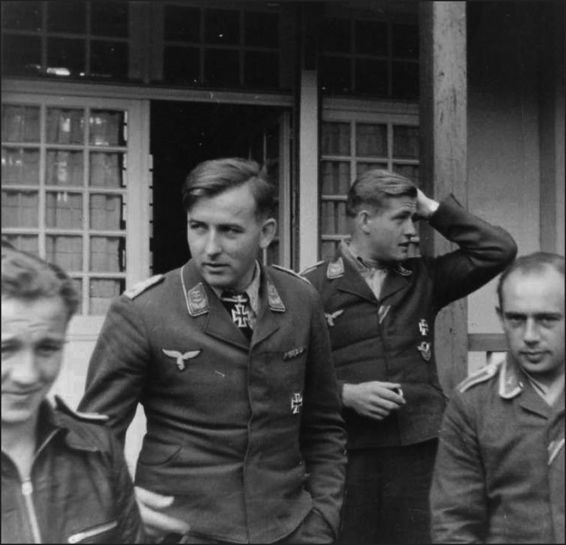
Recently appointed Kommandeur of I./JG 53, Hans-Karl Mayer (2nd left) became one of the earliest recipients of the Knight’s Cross in September 1940 before he was killed over the English Channel the following month having been credited with thirty victories. (Chris Goss collection)
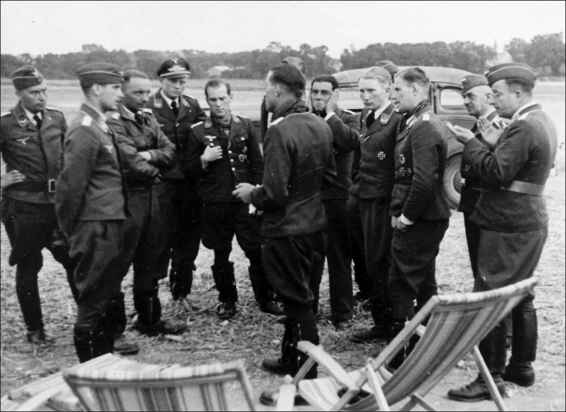
Debriefing during August 1940 – III./JG 26 Kommandeur Major Adolf Galland with his officers: (left, outer) medical doctor; (L to R) Hauptmann Gerhard Schöpfel, Oberleutnant Franz Beyer, Leutnant Gerhard Müller-Dühe, Leutnant Josef Bürschgens, Leutnant Walter Blume, Leutnant Gustav Sprick, Leutnant Joachim Müncheberg; (outer right) Hauptmann Dr Schroedter, III./JG 26 Technical Officer (with glasses). (Bürschgens via Caldwell)

Two of the Luftwaffe’s finest Jagdflieger relaxing together during the autumn of 1940. On the left is Major Werner Mölders, Geschwaderkommodore of JG 51, and on the right is Major Adolf Galland, Gruppenkommandeur of III./JG 26. They would soon become respectively the second and third recipients of the Oak Leaves to the Knight’s Cross. (Glunz via Caldwell)

Reichsmarschall Hermann Göring (centre) listening to two of his most distinguished air-combat leaders – Major Werner Mölders (left) and Major Adolf Galland – at the height of the Battle of Britain. (Cranston via Caldwell)

Pilots of the exceptionally successful III./JG 26 in October 1940. On the left is Leutnant Gustav Sprick (wearing the Knight’s Cross awarded earlier in the month for his twenty victories), in the centre is Leutnant Klaus Mietusch and on the right is Leutnant Heinz Ebeling. (Payne via Caldwell)

The rudder section of Hauptmann Wilhelm Balthasar’s Bf 109, showing his impressive array of victories, taken during the later days of the Battle of Britain. Balthasar was then Kommandeur of III./JG 3, having been only the second Jagdflieger to be decorated with the Knight’s Cross. (Chris Goss collection)

The second major re-design of the Messerschmitt Bf 109 during 1940 was the Bf 109F, with an improved engine, re-designed wings and better overall aerodynamic performance. A handful of Friedrichs appeared during the later stages of the Battle of Britain but it would be mid-1941 before the variant came into wider use. The Friedrichs shown here belong to JG 2, which maintained a number of Bf 109Es and Fs in north-west Europe to counter the increasing number of fighter sweeps by RAF Spitfires across the Channel during 1941–2. (Chris Goss collection)

Major Walter Oesau (2nd from left) assumed command of JG 2 ‘Richthofen’ in July 1941 having become only the third Jagdflieger to reach eighty victories and was only the third recipient of the Swords to the Knight’s Cross. He is pictured with three key Jagdflieger of JG 2: Oberleutnant Erich Leie (far left) of the Stab of I./JG 2; Oberleutnant Rudolf Pflanz of the 1. Staffel (soon to become Staffelkapitän of 11./JG 2), and Oberfeldwebel Günther Seeger also of the Stab. (Chris Goss collection)

Oberleutnant Joachim Müncheberg, Staffelkapitän of 7./JG 26, prepares to leave his aircraft at Gela in Sicily on 28 March 1941 following his 200th combat sortie. He has a flare pistol in his hand and the metal Staffel command pennant on his radio mast is clearly visible. Müncheberg was still only twenty-two years old but he led his Staffel with distinction during a most successful tour in the Mediterranean when his small detachment claimed more than fifty victories without loss, twenty of which were credited to Müncheberg, earning him the Oak Leaves to his Knight’s Cross. (Bundesarchiv-Bildarchiv 427-408-19)
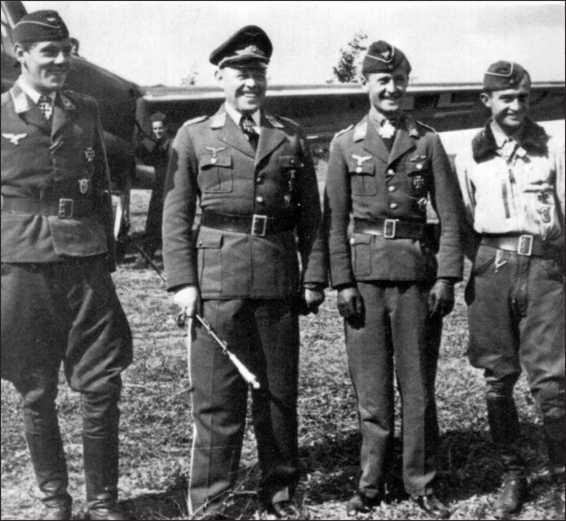
The Commander of Luftflotte 2, Feldmarschall Albert Kesselring (2nd from left), pictured with three recent Knight’s Cross winners of JG 53 in front of Kesselring’s aircraft during his visit to Sarush airfield on 9 August 1941. It was the early days of Barbarossa and confidence is clearly high. L to R: Leutnant Herbert Schramm (Flugzeugführer of III./JG 53), Kesselring, Hauptmann Wolf-Dietrich Wilcke (Kommandeur of III./JG 53) and Leutnant Erich Schmidt. Both Schramm and Wilcke had been awarded the Knight’s Cross just three days earlier while Schmidt had received his the month before. (John Weal)
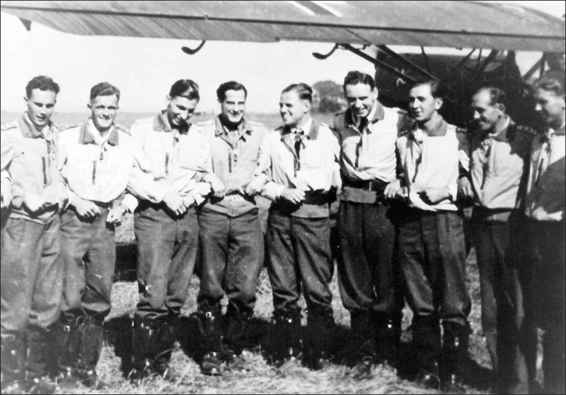
Pilots of 7./JG 26 at Ligescourt in northern France after their return from Libya in 1941 having provided valuable support to Rommel’s Afrika Korps. L to R: Feldwebel Karl-Heinz Ehlen; Feldwebel Edmund Wagner; Oberleutnant Klaus Mietusch; Hauptmann Gerhard Schöpfel (III./JG 26 Kommandeur); Oberleutnant Joachim Müncheberg; Leutnant Theo Lindemann; unknown; Oberfeldwebel Karl Kühdorf; unknown. (Schöpfel via Caldwell)

Successful pilots of JG 26 in late 1941 or early 1942. L to R: Leutnant Theo Lindemann; Hauptmann Joachim Müncheberg; Oberleutnant ‘Wutz’ Galland; Oberleutnant Kurt Ebersberger. (Glunz via Caldwell)

Leutnant Hans-Joachim Marseille (facing the camera) of 3./JG 27. Quick to develop his abilities as a fighter pilot in the desert war of North Africa, Marseille reached the zenith of his career during 1942 when he was awarded the Knight’s Cross, Oak Leaves, Swords and Diamonds within a period of just seven months. (John Weal)

Oberleutnant Erich Rudorffer (right), Staffelkapitän of 6./JG 2, pictured with his Geschwaderkommodore, Oberstleutnant Walter Oesau, in early 1943. Rudorffer led his unit during the Tunisian campaign, scoring twenty-seven victories and ended the war with a total of 224. (Chris Goss collection)

Hans-Joachim Marseille, the ‘Star of Africa’. Marseille flew the Bf 109 for his entire combat career before his death on 30 September 1942 and achieved all but seven of his 158 victories against the RAF’s Desert Air Force over North Africa, more than any other Experte claimed against the Western Allies. (John Weal)
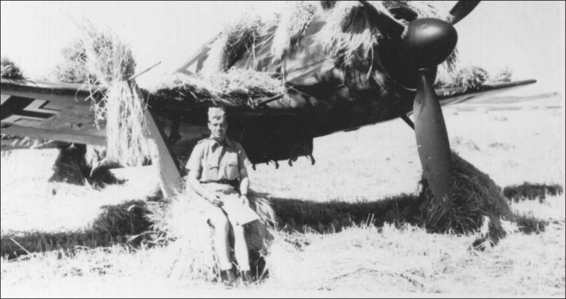
Oberleutnant Fritz Holzapfel of 13./SKG 10 pictured at Gerbini in Sicily in front of his heavily camouflaged FW 190 during July 1943, just days before the airfield was captured by the Allies. The unit had been used in a variety of ground-attack roles in Tunisia during the final days of the North Africa campaign, attacking targets such as airfields, harbours, vehicles and troop concentrations. (Chris Goss collection)