
Chapter Four
On 16 September 1941 Field Marshal Fedor von Bock ordered the capture of Moscow under the codename Typhoon. Three panzer groups would spearhead the assault, with one of them being withdrawn from the attack on Leningrad. Although Hitler instructed the 3rd and 4th Panzer Groups to conduct two strikes opposite Moscow, following the Kiev victory von Bock added a third with Guderian’s 2nd Panzer Group advancing from the southwest.
To resist almost 2 million German troops were 1.2 million Soviet troops of A. Yerëmenko’s Bryansk Front, I.S. Konev’s (having replaced Timoshenko in mid-September) Western Front and S.M. Budënny’s new Reserve Front. Behind them the Vyazma Line was held by 84 rifle divisions, nine cavalry divisions, two motorised rifle divisions and a tank division, plus supporting services.
Hitler opened his attack against the Bryansk and South West Fronts on 30 September. Guderian’s panzers quickly broke through the former and charged towards Orel. The 2nd Panzer Group pushed through towards Sevsk and Orel on Yerëmenko’s left flank. Orel fell on 3 October, while General Joachim Lemelsen’s XLVII Panzer Corps swung to the north to cut off Yerëmenko. However, Guderian’s tanks suffered a reverse near Mtensk on 6 October at the hands of Soviet T-34s and his 4th Panzer Division suffered heavy casualties.
By 7 October the 3rd and 4th Panzer Groups had trapped the Soviet armies west of Vyazma in a vast pocket. Just a week later, on the 13th, resistance collapsed and a staggering 650,000 men laid down their arms, surrendering over 1,000 tanks and 4,000 pieces of artillery. This constituted some 45 divisions, almost half of Stalin’s forces resisting Typhoon. The poor weather, combined with Hitler’s demands that Tula to the northeast and Kursk to the south be captured, now slowed German progress.
Stalin chose this critical moment to reorganise his high command and the situation slipped from his grasp. The tried and tested Zhukov was summoned from Leningrad to organise the Mozhaisk Defence Line before Moscow. He found it far from complete, but bolstered it with six divisions, six armoured brigades and ten artillery regiments.
In reality, Army Group Centre was now far too stretched to constitute a real threat to Moscow; with the 2nd Panzer Group tasked to take Tula and envelop Moscow from the south, the 2nd Army striking from Kursk to Voronezh, 4th Army west of Moscow, 3rd and 4th Panzer Groups enveloping from the northwest and 9th Army instructed to help Army Group North, von Bock’s front had expanded by a third. He wanted to attack Moscow by the shortest possible route, but found his original front had expanded from 400 to 600 miles.
During mid-October the only new and trained formation to reach the Soviet front was the Siberian 310th Motorised Division, though it arrived at Zvietkovo railway station without its vehicles. In early November troops from the Far East began to arrive in ever greater numbers, indeed Zhukov had doubled his strength by the time the German offensive commenced. The Far Eastern Front provided 17 divisions, eight tank brigades and one cavalry brigade, equipped with a total of 1,700 tanks and 1,500 aircraft.
Exhausted and lacking adequate winter clothing, the German armed forces were in a dire situation. Regardless of this, on 7 November Hitler issued orders for Typhoon to be resumed. This was based on the premise that the Red Army in front of Moscow was getting weaker not stronger. In reality, the West Front had received some 100,000 reinforcements with 300 tanks and 2,000 guns. Typhoon started again on the 15th and although the panzers got to within a few miles of Moscow, they were unable to make decisive breakthroughs either to the north or south.
In mid-November Stalin asked Zhukov if he could hold Moscow. The latter’s response was ‘yes’ if he could have two additional armies and 200 tanks. He would be given the 1st Shock Army and the 10th Army but no tanks. The Siberians made their presence felt on 18 November when a division supported by an armoured brigade newly arrived from the Far East attacked the German 112th Infantry Division, which was guarding the 4th Panzer’s push on Venev. The 112th, having already suffered 50 per cent frostbite casualties, was overrun by T-34 tanks. A week later German intelligence identified more fresh reserves from the Far East which had been thrown into the fighting, notably the 108th Tank Brigade and the 31st Cavalry and 299th Rifle Divisions.
On 2 December von Kluge’s 4th Army was launched into the attack and advanced elements of the 258th Infantry Division penetrated Moscow’s suburbs. Strong Soviet counter-attacks convinced von Kluge that he was not going to break through and that these advanced units should be withdrawn. This proved to be a prudent action as Zhukov threw 100 divisions into his general counter-offensive.
The German offensive was formally called off on 5 December; two days earlier some local withdrawals had already been sanctioned. The net result was that Zhukov held Moscow and von Bock lost his job to von Kluge. In January 1942 Konev opened a counter-attack supported by Rokossovsky’s 16th Army and Vlasov’s 20th Army. He pierced the enemy lines on the Volokolamsk Highway, while Zhukov attacked along the Mozhaisk Highway. However, German reinforcements from western Europe ensured things did not go according to plan for the Soviet commanders.
This culminated in a crisis at the junction of Zhukov’s Western Front and the Bryansk Front. The Soviet offensive lasted until 20 April and Zhukov pushed forwards up to 155 miles, but in the process the Red Army suffered twice the losses of the Wehrmacht. In the north the offensive produced no results and in the south managed just 60 miles. In total the battle for Moscow lasted six months and cost Stalin 926,000 dead, not to mention wounded and missing. These colossal losses were greater than Britain and America lost in the whole of the Second World War. Zhukov, enjoying his first if flawed victory, recalled triumphantly, ‘The Hitlerites lost on the battlefields of Moscow a grand total of over half a million men, 1,300 tanks, 2,500 guns, over 15,000 vehicles, and much other materiel.’

However you look at it, the summer of 1941 was a complete disaster for the Red Army. Its command structure and deployment of its tank divisions and mechanised corps proved a shambles. In the face of Hitler’s panzers Soviet tanks such as the T-26 light tank and T-35 heavy tank, seen here slewed off the road, proved all but useless. Inexperienced and frightened tank crews died at their posts or abandoned their vehicles in terror. (Scott Pick Collection)

The death of a Soviet tanker becomes a tragic sideshow as German infantry come to gawp at his disabled T-26. The German army captured so many tanks that some were temporarily pressed into service for security duties behind the lines. (Scott Pick Collection)

Making good the colossal losses of July and August, such as this T-34/76B caught in a massive crater, became a priority for the Soviet high command. According to Marshal Zhukov, the first batch of new T-34s came off the Chelyabinsk Tractor Plant production line a month after the relocation of the Leningrad factory. The Sormovo shipyards in Gorky (Nizhniy Novogorod) on the Volga were also put to work producing T-34s, and these were employed during the battle of Moscow. Charged with defending the capital, Zhukov noted that they came just in time and played a conspicuous role in the fighting. (Author’s Collection)

The burnt remains of a BA-10 armoured car and one of its crew. Rather late in the year three panzer groups were tasked with capturing Moscow, and Operation Typhoon opened on 30 September 1941. In the Bryansk and Vyazma pockets the Red Army lost over half a million men taken prisoner and over 1,000 tanks. Hitler’s panzer divisions destroyed seven armies, including eleven Soviet tank brigades. (Scott Pick Collection)

By the time of the crucial battle for Moscow, 1,364 KV heavy tanks had been produced, although many had been captured or destroyed in the preceding months. Early models suffered clutch and transmission problems, and mobility was further compromised by the fact that the tank had to stop to change gear. This KV-1 threw a track and became stuck in the frozen mud with the onset of winter. (Scott Pick Collection)

Most KV-2 losses were due to breakdowns or lack of fuel. Although they were exceedingly well armoured, once the tracks had been shot off they were immobilised and the crew had little choice but to abandon their posts. (Scott Pick Collection)
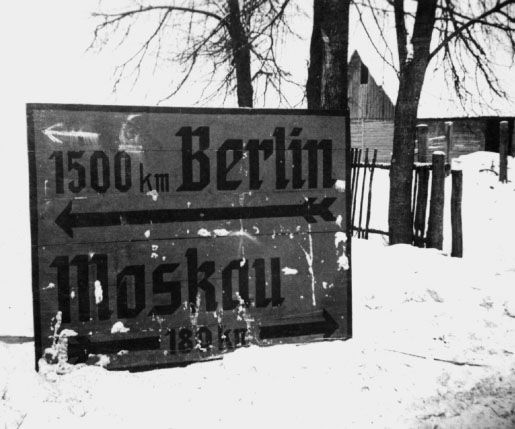
Following the success of Operation Barbarossa, the panzer crews began to realise just how far from home they were. All eyes were now on the tank battles being fought to the west of Moscow. Hitler’s generals knew that it was vital to take the city before the Red Army had an opportunity to recover from its crippling losses. (Scott Pick Collection)
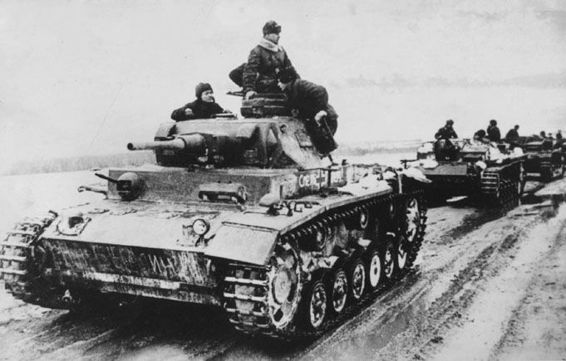
Disastrously, in one swoop, Stalin lost almost half the forces opposing Typhoon but the Red Army rallied every available tank for the city’s defence, including captured German armour such as this Panzer III and StuG III that were pressed into service. (WH462)

Judging by the paint splattered over the wheels and tracks, this Panzer III Ausf H command vehicle has just been whitewashed in some haste. Note the large frame antenna on the rear deck, the dummy 37mm gun and the turret bolted in place. (Author’s Collection)
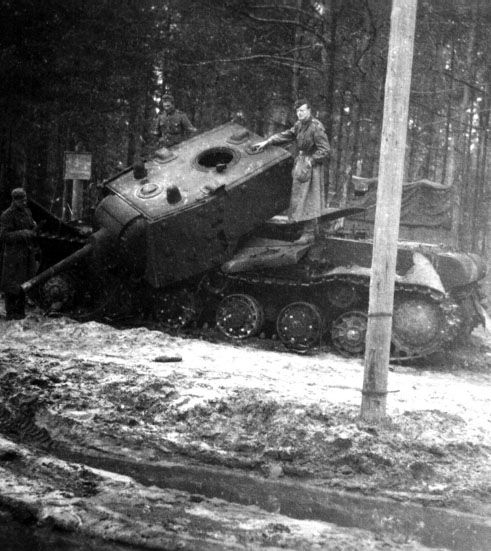
This KV-1 was lost just as the first snows began to fall. Judging by its dislodged turret, the ammunition exploded, instantly incinerating the crew. Note the large bolts securing the additional turret armour; this was a wartime upgrade that made the tank even heavier. Eventually the KV’s contribution to the Soviet war effort was to provide the basis for the KV-85 and then the Joseph Stalin or IS heavy tank. (Scott Pick Collection)

KV-2 manufacture had been moved eastwards by October 1941 and some were employed unsuccessfully in the defensive winter battles for Moscow. They were little better than vulnerable mobile pillboxes. (Author’s Collection)
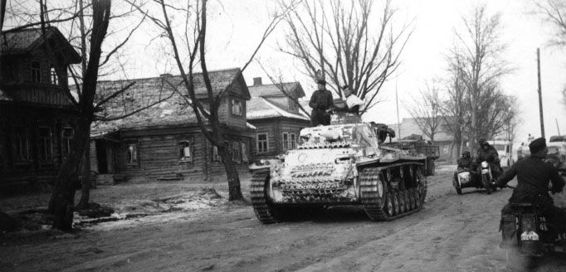
A Panzer III pushing through a Russian town somewhere west of Moscow. The euphoria of the summer’s victories was soon lost as General Guderian’s 2nd Panzer Group suffered a bloody nose at Mtensk at the hands of the Soviet T-34, which began to redeem itself after its poor early performance. (Scott Pick Collection)

This BT-7, being looted for souvenirs or warm clothing, was destroyed during an engagement defending Moscow. The winter battles, though, did not repeat the wholesale disasters of the summer. (Scott Pick Collection)

A patrol of T-40 light tanks and supporting infantry. During a lull in Typhoon, under Zhukov’s guidance Moscow’s defences were bolstered by reinforcements from the Far East including 1,700 much-needed tanks. (A46)

By mid-November 1941 Stalin had directed Zhukov to conduct spoiling attacks south of the capital, resulting in more losses involving the 44th Cavalry Division. In contrast Siberian troops such as these anti-tank gunners supported by T-34s overran a German infantry division. (Author’s Collection)

A Soviet cavalryman passing a knocked-out Panzer III. The Russian winter came as a terrible shock to Hitler’s panzer forces, which were ill-prepared for the freezing conditions. General Guderian was furious at the slow provision of winter clothing. (Author’s Collection)
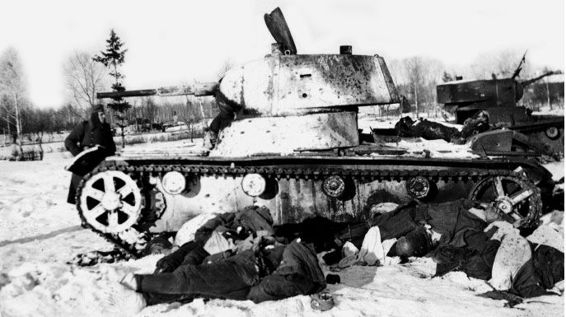
Two destroyed T-26 tanks west of Moscow. The one in the foreground has been whitewashed for winter warfare. The mottling on the rear of the turret and the charred corpse on the engine grille show that the tank caught fire before the crew could bale out. (Scott Pick Collection)

The same tank from the rear. Clearly the supporting infantry were caught in the open by shell or machine-gun fire. (Scott Pick Collection)

A poor quality official Soviet photograph showing Soviet infantry in winter camouflage supported by a T-40 amphibious tank. Issued in February 1942, the original caption stated ‘The Red Army’s triumphant offensive … a magnificent picture from the advancing front line, illustrating the fine physique and high spirits of the heroic Soviet Soldier.’ Propaganda aside, the Red Army’s aggressive operations during the winter of 1941/42 showed that the weather would not inhibit its defence of the motherland. (Author’s Collection)
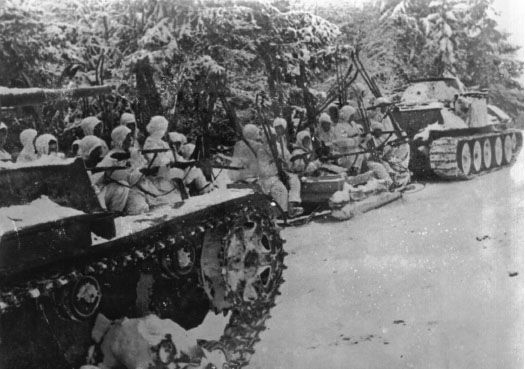
Another Soviet photo of ski troops supported by a T-26 and a T-34. Zhukov’s Moscow counter-offensive ran from early January to mid-April 1942 and successfully pushed the panzers back 150 miles. However, Stalin’s forces suffered twice the casualties that Hitler’s did, making it a costly and rather hollow triumph. (Author’s Collection)