
Chapter Six
The newly created Stalingrad Front absorbed the battered South Western Front, reinforced with the newly formed 1st and 4th Tank Armies. By 22 July the Stalingrad Front numbered 38 divisions, with 16 divisions deployed in the main defensive zone. It was their job to fend off the 18 divisions of the German 6th Army.
The Germans attacked Stalingrad’s first defensive line on 17 August 1942, with General Gustav von Wietersheim’s XIV Panzer Corps breaking through five days later to reach the Volga north of the city. His panzer corps split the Stalingrad defence near Vertyachi and the Soviet 62nd Army was cut off from the Stalingrad Front and was transferred to Yerëmenko. German bombers pounded Stalingrad to rubble and the following day the panzer corps attacked towards the Tractor Works but was cut off for several days by a Soviet counter-attack. To the south of the city the South Eastern Front was forced to withdraw on first the outer and then the inner defences.
The 4th Panzer Army’s two panzer corps reached the second line of defence by the end of the month and the third by mid-September. The battle then turned into bitter urban warfare that dragged on until 18 November, by which time the Germans had reached the limit of their offensive. From that point on they were on the defensive.
By early November 1942 Hitler’s strength on the Eastern Front, according to Soviet intelligence, totalled about 6.2 million men organised into 266 divisions equipped with 5,080 tanks and assault guns. Soviet industrial muscle had ensured that by this stage Stalin’s massive losses of 1941 had been made good. Soviet manpower stood at about 6.6 million men equipped with 7,350 tanks. On top of this the Soviet high command had considerable reserves. It was time for them to strike back.
The main attack for Stalin’s Operation Uranus was to be launched over 100 miles west of Stalingrad and would cut southeastwards. At 6.30am on 19 November 3,500 Russian guns opened up on the Romanian 3rd Army’s positions. Trenches and bunkers were smashed as the barrage ranged in. Men staggered about in a deafened daze as their inadequate defences collapsed in the face of the concerted onslaught. Then came the Soviets’ dreaded T-34s clanking across the snow-draped landscape. Most of the Romanian defenders took fright and fled.
The Soviets broke through in two places. This was achieved by General Romaneko’s 5th Tank Army launching itself from the bridgehead southwest of Serafimovich and General I.M. Chistyakov’s 21st Army attacking from the Kletskaya bridgehead. The Romanian 1st Tank Division and Romanian 7th Cavalry Division were thrown into the fight to halt the 5th Tank Army, but the tank division was easily brushed aside.
The 26th Tank Corps’ advance guard seized a bridge over the Don on 26 November. The Germans mistook the attack for an exercise using captured Russian tanks and the armour rumbled unopposed over the bridge. Kalach lay a little over a mile away, but the German defenders were not so easily overwhelmed until Soviet reinforcements arrived. Far to the southeast the Romanian 4th Army suffered a similar fate, just 24 hours after the South Western and Don Fronts had opened the offensive.
In an attempt to stem the advance on Kalach, the 16th and 24th Panzer Divisions foolishly got in the way. By 4pm on 23 November the Soviets were in the vicinity of Sovetsky to the east of Kalach. It was only a matter of time before a link-up was effected, trapping the Germans deployed between the Don and the Volga. The next stage was to destroy the Axis forces trapped in the Kessel (‘Cauldron’), as the Stalingrad pocket became known.
Stalin also launched Operation Mars on 25 November 1942, designed to destroy the German forces in the Rzhev salient. This involved the Kalinin Front supported by the 1st and 3rd Mechanised Corps, as well as the Western Front supported by the 5th, 6th and 8th Tank Corps and the 2nd Guards Cavalry Corps.
Unlike Uranus, this offensive was not destined to be a resounding success. The intended victims were not ill-prepared and ill-equipped Romanians, but tough German divisions that were well dug in. Furthermore, help was at hand: at Rzhev the German 9th Army had the 1st and 9th Panzer and Grossdeutschland and 14th Panzergrenadier Divisions in reserve, while the 19th and 20th Panzer Divisions were also within reach; Western Front was faced by the 5th Panzer Division.
On the 25th the two mechanised corps broke through the German defences north and south of Beyli, and only bad weather and determined German resistance finally brought them to a halt. To the north the 39th Army hit the Germans northeast of Rzhev, while to the west it struggled to cut the Rzhev–Olenio railway. During December German reserves succeeded in destroying the 1st Mechanised Corps and the 6th Rifle Corps. The 3rd Mechanised Corps was driven back and contained. The Western Front alone lost 42,000 dead and 1,655 tanks by 14 December.
Von Manstein’s highly capable and experienced 11th Army HQ was formed into the new Army Group Don to coordinate Operation Winter Storm: the relief of 6th Army. This mission was assigned to the rump of 4th Panzer Army remaining outside Stalingrad, now grandly named Armeegruppe Hoth under General Herman Hoth.
It was intended that Hoth would make a single concerted thrust using General Friedrich Kirchner’s LVII Panzer Corps, comprising the 6th and 23rd Panzer Divisions, later bolstered by the 17th Panzer Division. Looking at the map, both von Manstein and Hoth realised that the shortest route to Stalingrad was from Nizhne Chirskaya, but this was not the best path for success. In the region lay the 5th Tank and 5th Shock Armies of Lieutenant N.F. Vatutin’s South West Front, the key players in the success of Operation Uranus.
With 230 tanks of 6th and 23rd Panzer Divisions, plus air support from the Luftwaffe, the operation commenced on 12 December. Initially it made some headway but waiting in reserve were the Soviets’ 4th and 13th Mechanised Corps. The Soviets quickly realised what was going on and committed not only the 4th Cavalry Corps but also the 7th Tank Corps and the 2nd Guards Army belonging to the South-West Front. In the face of such resistance the panzers could make no further progress.
Having smashed the Romanians so effectively, Stalin set about crushing the other Axis armies. Operation Saturn, following the encirclement of Stalingrad, smashed the Italian 8th Army to create a larger pocket of trapped Axis forces. On 16 December Soviet tanks crashed into the Italian army and two days later it was surrounded.
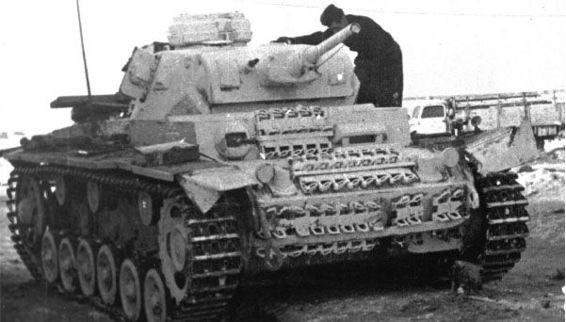
A Panzer III Ausf J made ready for winter warfare. During the summer of 1942 there were 1,100 Mk IIIs armed with the 50mm gun serving with the panzer divisions at the front. (Author’s Collection)
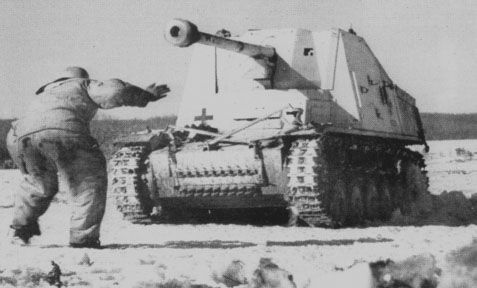
A Marder II also whitewashed for the winter. This type consisted of the Panzer II chassis and a Pak 40 75mm anti-tank gun, and production ran from June 1942 to June 1943, when Panzer II facilities were turned over to the Wespe 105mm self-propelled gun. Nonetheless, with over 650 built it remained in service until the end of the war. (WHPanzer)
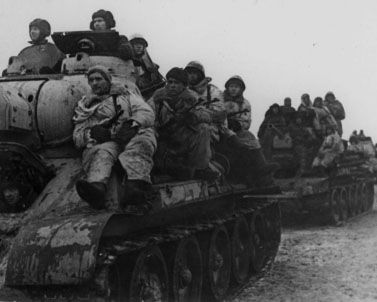
At 6.30am on 19 November 1942 some 3,500 Soviet guns heralded Stalin’s Stalingrad counter-offensive. Behind this massive bombardment came the tried and tested T-34. Those troops in its path had good reason to fear it. (B84)
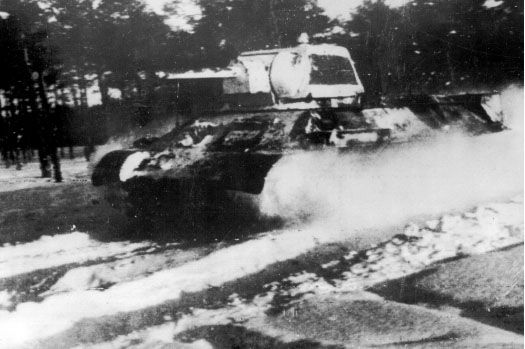
Obsolete Hungarian, Italian and Romanian anti-tank guns were incapable of stopping the T-34/76. A halfhearted counter-attack by a Romanian tank division was simply swept away in the chaos of their disintegrating armies. (Author’s Collection)
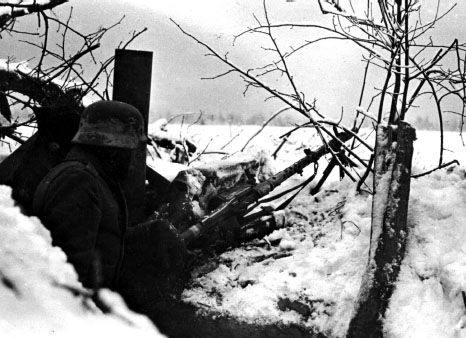
The Don provided little protection for the ill-equipped German forces and their allies against Stalin’s Operation Uranus, launched in the winter of 1942 some 100 miles west of the ruined city of Stalingrad. (Scott Pick Collection)
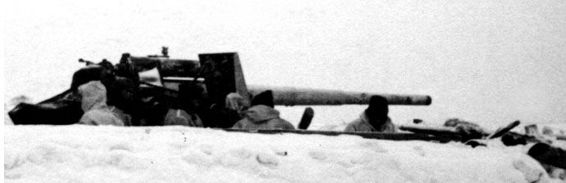
German defences in the Stalingrad area were ill-prepared to withstand a major Soviet offensive. This entrenched 88mm gun, though, would have provided a nasty surprise if it withstood the Red Army’s preliminary bombardment. (Scott Pick Collection)
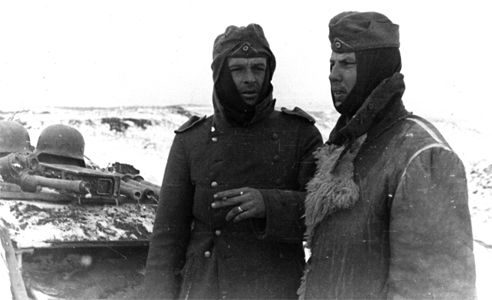
German infantry awaiting the inevitable appearance of Soviet infantry and their supporting T-34s. Dug-in troops often found the pace of such attacks quite unnerving. The T-34 was well suited to the Russian weather; its wide tracks and low ground pressure gave it good traction and speed. (Scott Pick Collection)
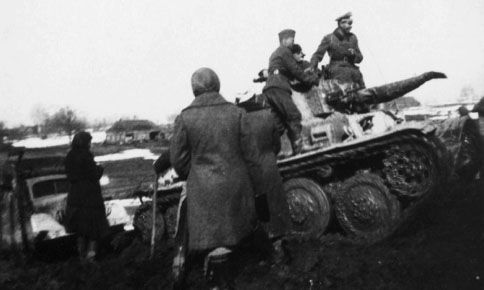
By the winter of 1942 nearly all the German army’s Czech 38(t) light tanks had been worn out, and their chassis given over to a highly successful range of self-propelled guns and tank destroyers. (WH491)
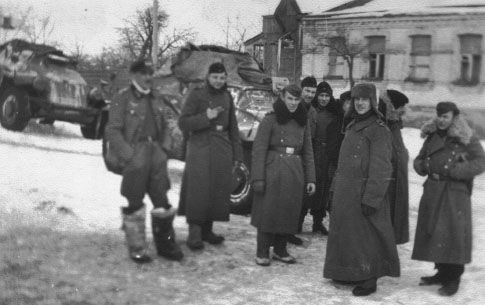
These SdKfz 222 crews were wrapped up against the bitter cold of the Russian winter. Armed with a 20mm gun, almost 1,000 of these light armoured cars were built and they remained in service on the Eastern Front until the end of the war. (Author’s Collection)
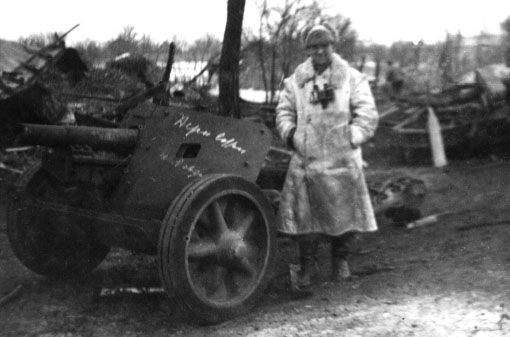
A German officer dressed for the weather with the remains of a Pak 40 anti-tank gun. (Scott Pick Collection)
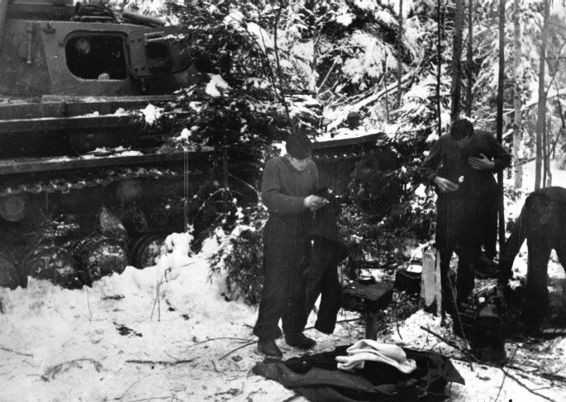
The winter of 1942, like the previous winter, proved to be an endurance test for the tank crews of both sides. Vehicles had to be kept operational regardless of the freezing weather. The crew of this Panzer IV are having a spring clean during a lull in the fighting. Lice were always a problem. (Author’s Collection)
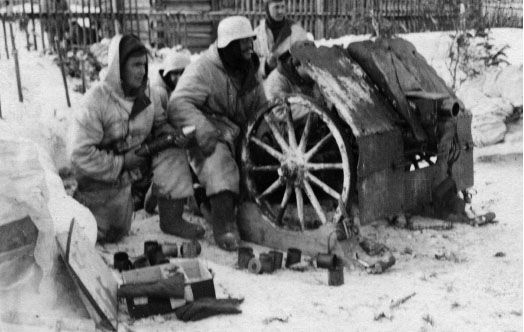
German infantry taking cover from Soviet armour behind what appears to be a 75mm Infanterie Geschütz support weapon. (Scott Pick Collection)
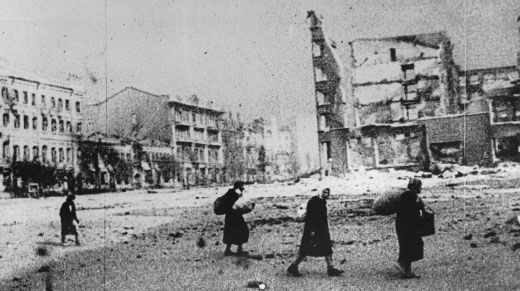
Some 270,000 German and other Axis troops were trapped in the Stalingrad pocket after the Romanian army collapsed along the Don and Volga rivers. By this stage the city was in ruins and its remaining population starving. (Author’s Collection)
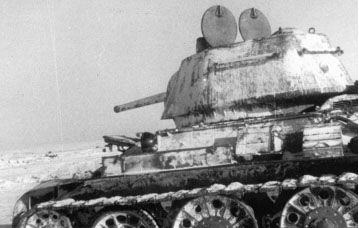
At the same time three Soviet tank corps struck the Rzhev salient. However, on this occasion Hitler’s armour was much better prepared and the Red Army lost 1,655 tanks in the face of stiff German resistance. Remarkably Stalin was able to shrug off such losses thanks to his tank factories. (K9)
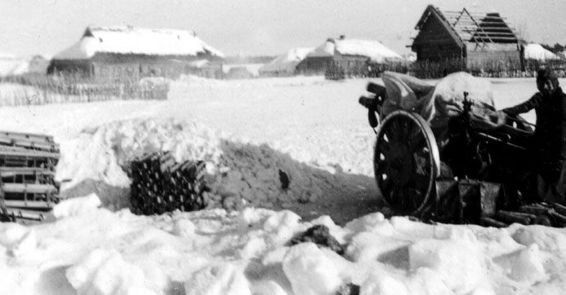
Winter conditions were far from ideal for the frozen gun crews, but at least the tanks presented good targets exposed on the snow-draped landscape. (Scott Pick Collection)
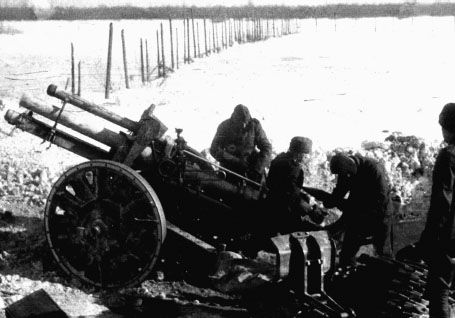
A frozen leFH 18 105mm gun crew laying down supporting fire – which would last only as long as the ammunition did. (Scott Pick Collection)
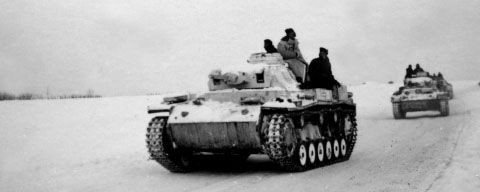
Localised and desperate counter-attacks by the panzers were insufficient to prevent Soviet armour bursting through on both sides of Stalingrad and snapping the trap closed on the German 6th Army. (Scott Pick Collection)
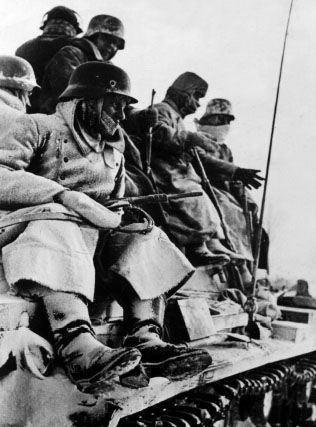
Field Marshal von Manstein himself oversaw Operation Winterstorm, a futile effort to bludgeon a way through to those forces encircled at Stalingrad using three panzer divisions. It ended in failure. (Scott Pick Collection)
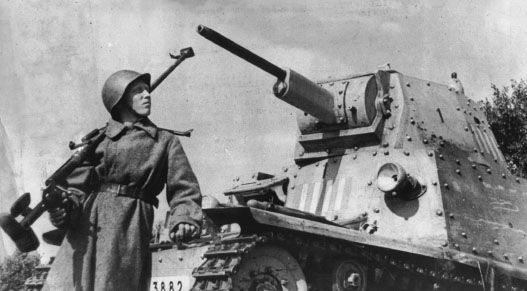
A Red Army anti-tank gunner armed with a PTRD 1941 anti-tank rifle stands proudly in front of an Italian L6/40 light tank he had knocked out northwest of Stalingrad. (Author’s Collection)
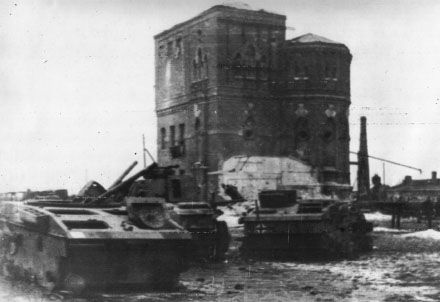
Cannibalised panzer hulks abandoned near Kotelnikovo southwest of Stalingrad. This photo was taken by a Soviet photographer for the Ministry of Information in December 1942 or January 1943. (Author’s Collection)
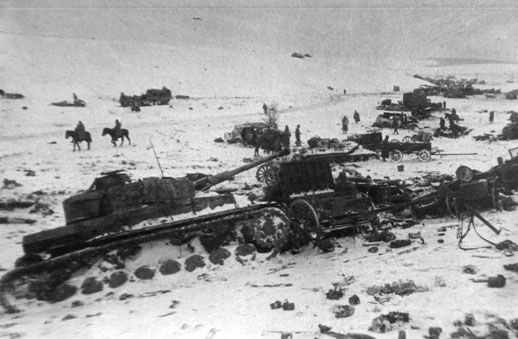
Abandoned German equipment, including this Panzer IV, lay at the mercy of Soviet souvenir hunters. Stalingrad was one of the first major setbacks that the German army suffered on the Eastern Front, and the troops found it increasingly difficult to bounce back from the disaster. In terms of deploying its armour, the Red Army had drawn on the important lessons gained at Kharkov. (BA51)