
As first light began to illuminate the sky over the Firth of Forth at about 3.15a.m. on that fateful Monday, in the woods of the New Park the Scots prepared themselves for battle. King Robert gave orders for a dawn attack, and the disciplined formations of pikemen drew up in the open under the banners of their leaders. There, in full view of the enemy, the Scots knelt briefly to say the Lord’s Prayer and for every man to commend his soul to God.
The English cavalry had taken advantage of the easier contours of the land between the Pelstream Burn and the Wood of Balquhiderock to begin to establish themselves on the firm ground or dryfield above the 20m contour. They were glad to leave the sodden Carse of Balquhiderock and though they were anticipating opposition to their advance they were not expecting the Scots to issue from their wooded stronghold and attack them. The division of Edward Bruce, which had probably been stationed somewhere between the Borestone and Saint Ninian’s, was on the right of the Scottish line and had the honour of leading the attack. On his left and slightly in echelon behind, was the division of King Robert. The Earl of Moray’s division made up the left wing of the Scottish host, but to the English they appeared as one huge mass of advancing men. King Edward watched as the Scots infantry emerged from the woods and apparently still unaware that they meant to attack asked, ‘What, will yon Scots fight?’ Sir Ingram d’Umfraville, a Scot himself, assured the King that they would. When the Scots paused and knelt to pray, Edward, according to Barbour, mistook the situation and told Umfraville, ‘Yon folk kneel to ask mercy.’
‘They ask mercy, surely, but not from you. They ask God for mercy for their sins,’ replied Sir Ingram, ‘Yon men will win all, or die; none will flee for fear of death.’ Umfraville and several of the older more experienced knights, who appreciated the fighting qualities of the Scots, had advised delaying the advance for a day because of the state of the army after its long march north. Gloucester, who shared their opinion, had put this to the King but the younger knights called this good advice cowardice and Edward rebuffed the Earl, hotly accusing him of treachery. Umfraville’s tactical advice to the King, which involved a feigned withdrawal, was impractical and potentially disastrous and Edward, rightly for once, rejected it. It was too late for such niceties anyway, the initiative had passed to the Scots, the English had no choice, they were in a tight corner and must fight their way out of it.
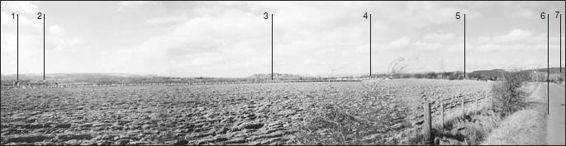
Panorama of the Carse of Stirling looking towards the castle from the south-east. The Bannock Burn flows immediately behind Redhall Farm on the left of the view.
1. Gillies Hill.
2. Redhall Farm.
3. Stirling Castle.
4. Ben Ledi.
5. Wallace Memorial on the Abbey Craig.
6. Viewpoint NS824919.
7. Ochil Hills.
The Lanercost Chronicle, which contains the report of an eyewitness, says that before the Scots infantry closed with the enemy, ‘the English archers were thrown forward before the line and the Scottish archers engaged them, a few being killed and wounded on either side; but the King of England’s archers quickly put the others to flight.’ This exchange seems to have been an isolated affair of archers, and it had no effect on the advance of the Scots pikemen. The Scots archers may have been discomforted in this early exchange but they were by no means defeated and it may have been their fire that tipped the scales at the climax of the battle. Their contribution to the victory has been much undervalued.
As the Scots infantry surged towards the still disorganised English to their front, Gloucester hastily formed up the cavalry of the vanguard and with himself at their head, charged the leading schiltron of Edward Bruce. The impetuous Earl outstripped his support and rode headlong on to the pikes of the Scots, his horse was brought down and he was killed. It is said that he had armed in haste and had no heraldic surcoat over his armour so, unrecognised, he was despatched by the pikemen. Thus, as Robert Bruce later lamented, was a princely ransom lost. Gloucester’s charge was a disastrous failure and the English vanguard was tumbled in bloody confusion before the impenetrable forest of pikes.
The two Scots divisions advancing on Edward Bruce’s left came into contact almost simultaneously with the disordered English line to their front, which was little more than a great mass of men bunched together in confusion, ‘all in a schiltrom’ as Barbour puts it. Grey describes the English as, ‘jammed together’ and, as stated previously, Lanercost says much the same.
It seems from this that some of the English infantry had come up but were unable to deploy because of the restricted space between the entangled woodland covering the steep-sided channel of the Pelstream Burn and the Wood of Balquhiderock and were pressing forward behind the horsemen, causing confusion. The majority of the English infantry, for this reason, seem to have taken no part in the fighting, though it may be that many remained south of the Bannock Burn enshrouded by the fog of war and knew nothing of the drama unfolding out of their line of sight. Meanwhile, a dangerous number of English archers had managed to take up position on the flank of the mêlée and commenced a galling fire, ‘so fast that if their shooting had persisted it would have gone hard for the Scots’, wrote Barbour. Robert Bruce knew, better than the English leaders themselves it seems, the danger posed by the bowmen and ordered the Marischal, Sir Robert Keith, who was held in reserve, to attack them with his light-horse. Their charge was delivered with such effect that the archers were scattered and driven headlong into the ranks of those advancing from the rear, causing more confusion and alarm.
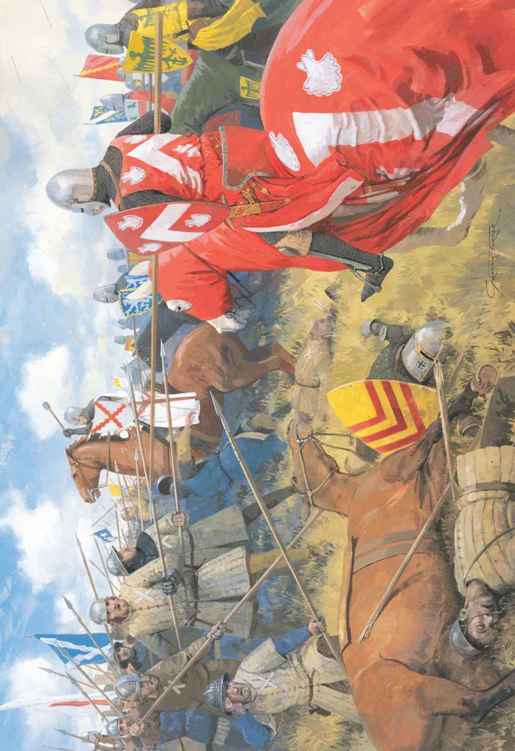
As the pikemen of the Scottish schiltrons surged to the attack on the morning of 24 June, Gilbert de Clare, Earl of Gloucester, hastily gathered the cavalry of the English vanguard and led them to the attack. With himself at their head Gloucester launched the cavalry at the leading schiltron commanded by Edward Bruce. The result was a disastrous and bloody failure; The English cavalry was unable to penetrate the hedge of pikes and recoiled in confusion. Gloucester himself was unhorsed and killed. Having armed quickly he did not wear his heraldic surcoat, which would probably have saved him as the value of his ransom would have meant his life was spared. (Graham Turner)
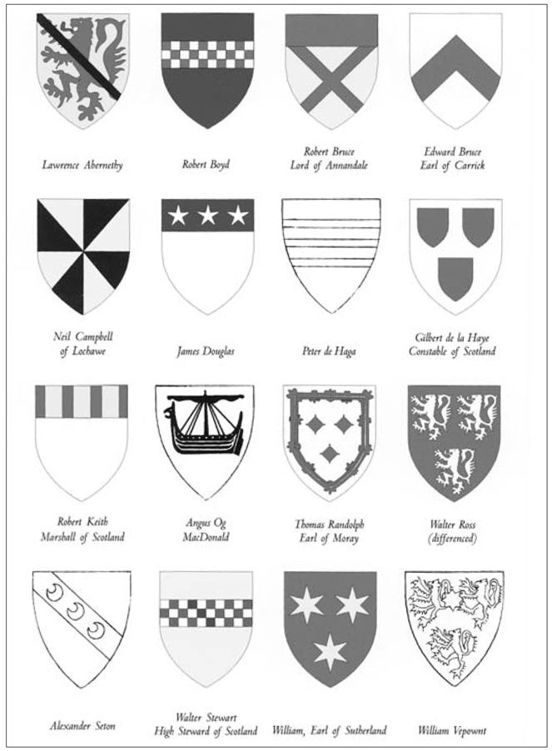
Arms of the Scottish knights who fought for Robert Bruce at Bannockburn. (illustration by Lyn Armstrong)
For a moment the outcome of the battle hung in the balance, the entire strength of the Scottish army was now committed to battle and fighting raged fiercely along the whole front. The air filled with the din of battle as inexorably the weight of the steel-tipped schiltrons bore down on the confused mass of entangled horsemen and foot before them. The English were jammed together so closely that there was barely room to wield their weapons and those that fell were trampled underfoot in the press. The Scots archers, emboldened by the defeat of the English bowmen, poured a deadly hail of arrows into the struggling mass of the enemy. The English began to give ground, gradually at first, then their resistance crumbled and the trickle of men making their way to the rear became a torrent as they broke and fled. At this, a great shout of triumph went up from the ranks of the Scots and the schiltrons surged forwards.