
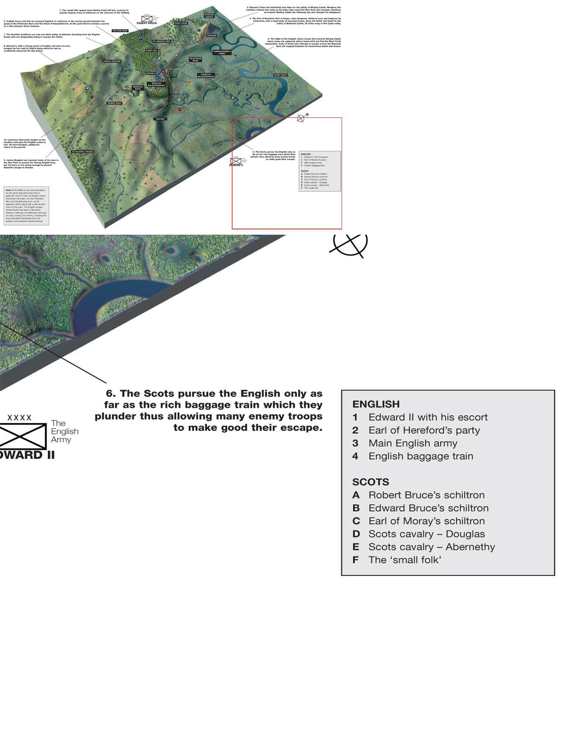
The battle was past saving for the English, and the defeated troops thought only of survival and escape. At this moment in the rear of the attacking Scots appeared a mob of non-combatants, wagoners, cooks, camp followers and servants; the ‘small folk’, who had been sent away by Robert Bruce before the battle to the safety of a hollow to the north of Coxet Hill. Now with makeshift weapons and improvised banners they streamed towards the rout with bloodthirsty cries. Their intervention had little or no effect on the outcome of the battle, though the fleeing English may have thought they were fresh reinforcements arriving and redoubled their efforts to escape. Robert Bruce can hardly have welcomed the arrival of this undisciplined, plundering rabble who would prove a hindrance if unrestrained.
When the English leaders saw that all was lost, the Earl of Pembroke and Sir Giles d’Argentan, who were at King Edward’s side, realised that his safety was vital and that he must not fall into the hands of the Scots as the repercussions of his capture were unthinkable. Much against his will the King was led from the field, in the nick of time, towards the safety of Stirling Castle, for the way along the edge of the carse was still open. The Scots laid hold of the covering of the King’s charger but he struck out and felled them with his mace. He had one horse killed under him before he fought his way free though his trusty shield-bearer, Sir Roger Northburgh, was brought down and captured. Once clear of the fighting, the King rode for the castle accompanied by Pembroke and a large body of horsemen. As soon as he saw the King out of danger Giles d’Argentan, fearful for his honour and unaccustomed to flight, turned his mount and plunged back into the thick of the fighting where he was killed. The flight of Edward II from the battlefield signalled the break-up of the English army. Some followed the King towards Stirling, others fled across the carse towards the River Forth but it was impassable and many drowned attempting to cross. The disorderly mass of men that fled south were thrown into confusion as they attempted to pass the Bannock Burn. The passage of thousands had churned the banks of the burn into a sea of treacherous mud and set a trap into which the fleeing mass of men, carried forward by the great press behind, tumbled headlong and perished. It was here that the beaten army suffered some of its heaviest losses, including the King’s seneschal, Sir Edmund Mauley. Barbour paints a vivid word-picture of the Bannock Burn, so choked with the bodies of drowned men and horses that it could be crossed dry-shod.
THE COLLAPSE OF THE ENGLISH ARMY
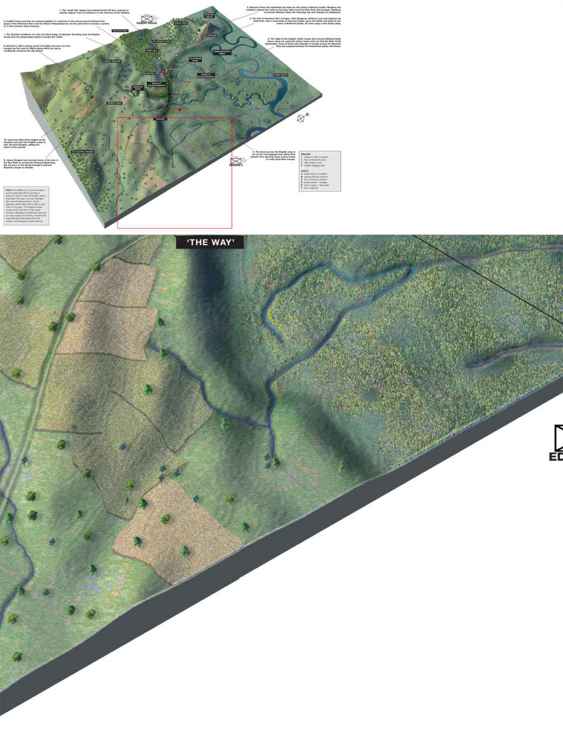
Monday 24 June 1314, mid-late morning, viewed from the southeast. The English cavalry are repulsed by the Scottish pikemen and as their retreat turns to defeat and flight the King’s banner is seen to leave the field. The infantry quickly follow suit, many not having struck a blow as they were behind the cavalry and hemmed in by the terrain. Only a fraction of the English army has been defeated but the Scots have won a great victory.
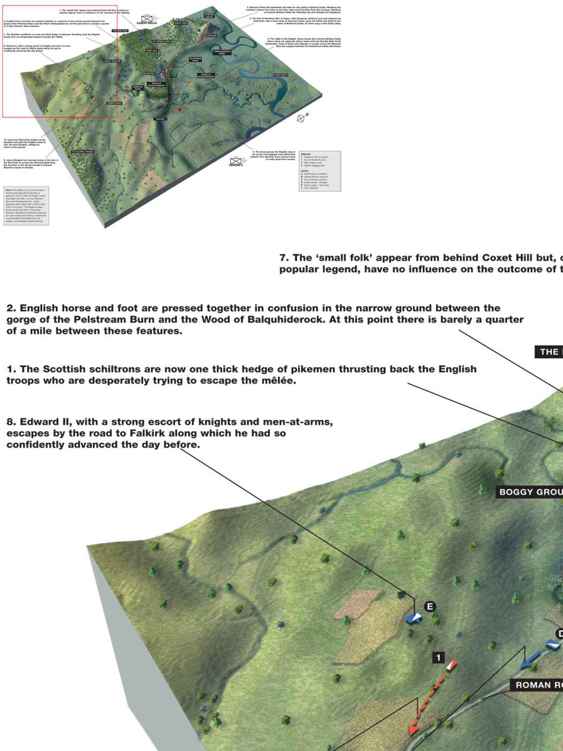
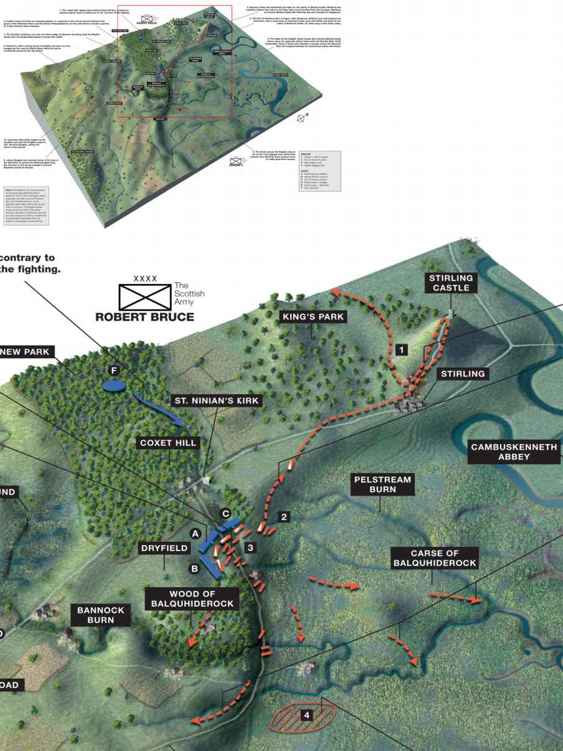
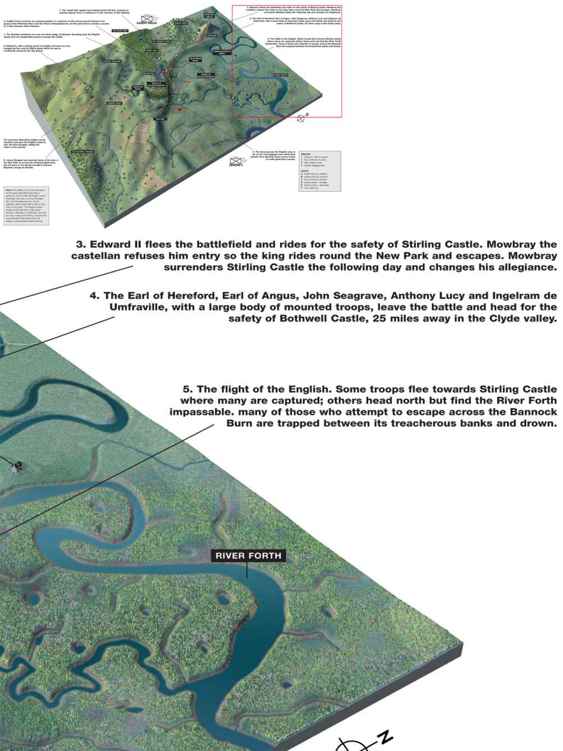
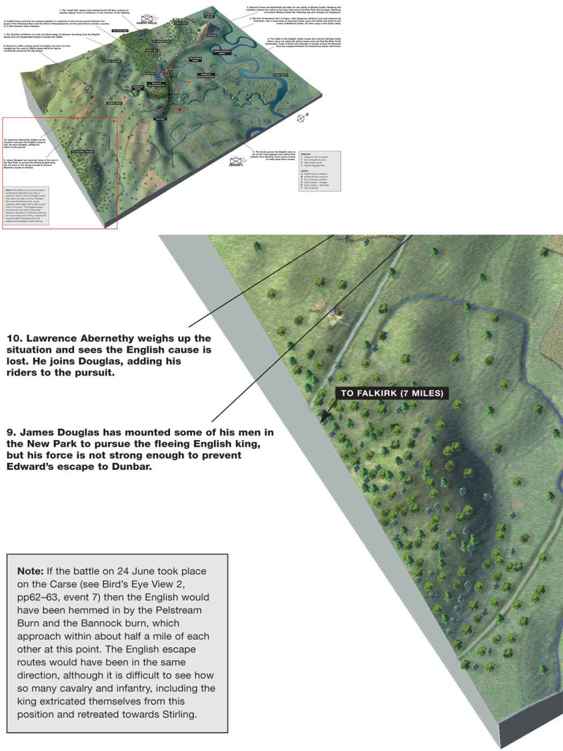
When King Edward and his knights arrived before Stirling Castle they found that Sir Phillip Moubray had raised the drawbridge and barred the gates against them. Had Edward gained entry he would certainly have fallen into the hands of the Scots when the castle fell to the Scots, as it inevitably must in the aftermath of the battle. Moubray’s action may have been because he foresaw this. Thus, and by good fortune, the King escaped. He rode around the King’s Park, then across the rear of the Scots army before regaining the road through the Torwood, along which he had advanced with such confidence a short time before.