
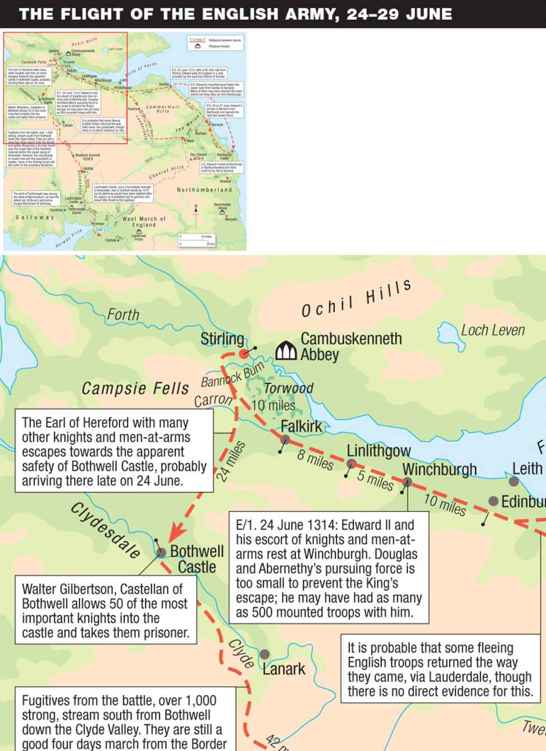
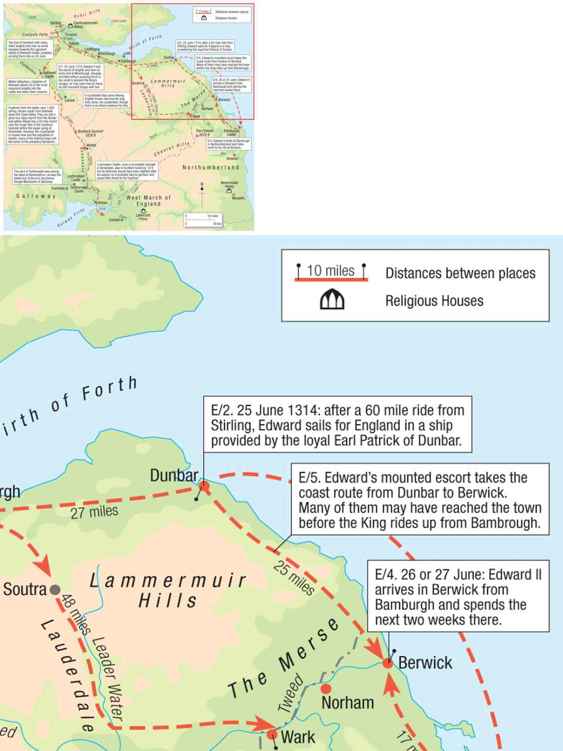
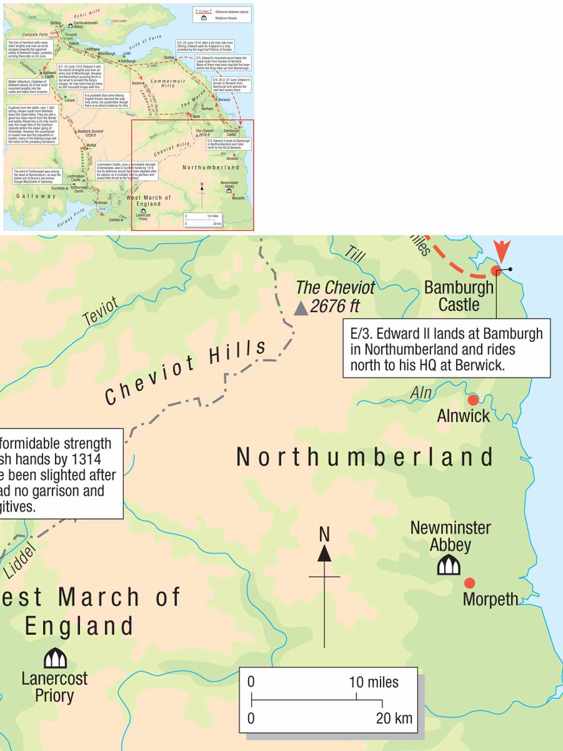
King Edward fled the battlefield accompanied by his favourite, Sir Hugh Despencer, whose expectation of the lands of the Earl of Moray were now dashed, and by Sir Henry Beaumont, whose quest for an earldom was, for the moment at least, disappointed. The Earl of Pembroke’s retinue of knights and men-at-arms may have formed the rearguard and covered Edward’s retreat. Pembroke’s retinue suffered heavy casualties in the fighting, including Sir John Comyn, son of the ‘Red Comyn’ murdered by Bruce in Dumfries in 1306. The fugitives rode for the port of Dunbar and covered the 60 miles at such a pace that, as Barbour puts it, there was, ‘not even leisure to make water’. Sir James Douglas set out in hot pursuit though he had fewer than 60 hastily gathered horsemen with him. As he rode through the Torwood he met Sir Lawrence Abernethy with 80 men who had come to help the English but, on seeing the situation, thought better of it and joined Douglas in the chase. Before they arrived at Linlithgow, the Scots came close enough to the fleeing English to exchange shouts of derision but Douglas judged them too strong to attack in the open. Barbour’s assertion of the strength of Edward’s force, which he puts at 500 men-at-arms compared to Douglas’s and Abernethy’s force, which numbered just less that 140 riders, may be an attempt to excuse his hero for his failure to prevent Edward’s escape. Douglas nevertheless harried the English rearguard and picked off any stragglers. At Winchburgh the English halted and dismounted to rest their weary horses while Douglas followed suit close by. This is hardly the stuff of headlong flight; the halt at Winchburgh together with Barbour’s description of Edward’s prudently led and well-ordered men-at-arms, suggest an orderly withdrawal. Edward arrived at Dunbar on 25 June where the loyal Earl Patrick had a ship prepared that took the King safely to Bamburgh in Northumberland. Douglas, seeing that his efforts to take the King had failed, abandoned the pursuit and returned to Stirling. At Dunbar Edward’s escort took the coast route to Berwick, which was about 25 miles away, and must have been back at that town by the evening of 26 June, just 11 days after they set out. The King rode up to Berwick from Bamburgh and spent the next two weeks there from 27 June.
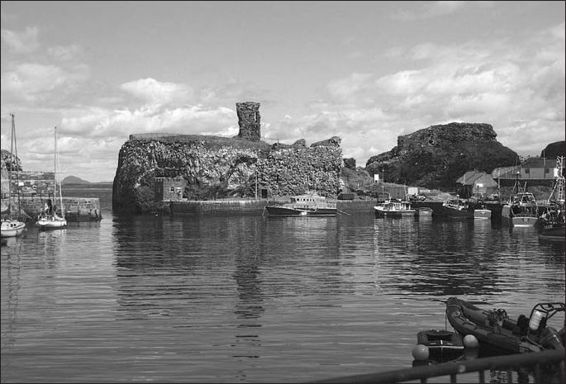
The ruins of Earl Patrick’s castle stand guard over the entrance to the harbour at Dunbar. From here Edward II sailed for England at the end of his disastrous Bannockburn campaign. (photo Peter Ryder)
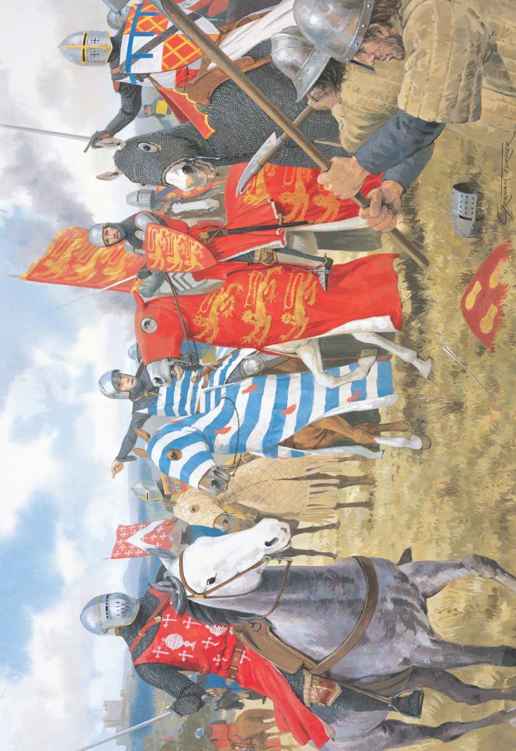
When it became clear that all was lost the Earl of Pembroke and Sir Giles d’Argentan led King Edward II from the field, much against his will. The route along the edge of the carse to the apparent safety of Stirling castle was still open, but only just. Edward and his retinue had to fight their way past the Scots who came close enough to lay hands on the caparison of the King’s horse but he struck them down with his mace. King Edward had one horse killed under him and his shield-bearer, Sir Roger Northburgh, was brought down and captured. Only a determined rearguard action by the Earl of Pembroke’s men guaranteed Edward’s escape. (Graham Turner)
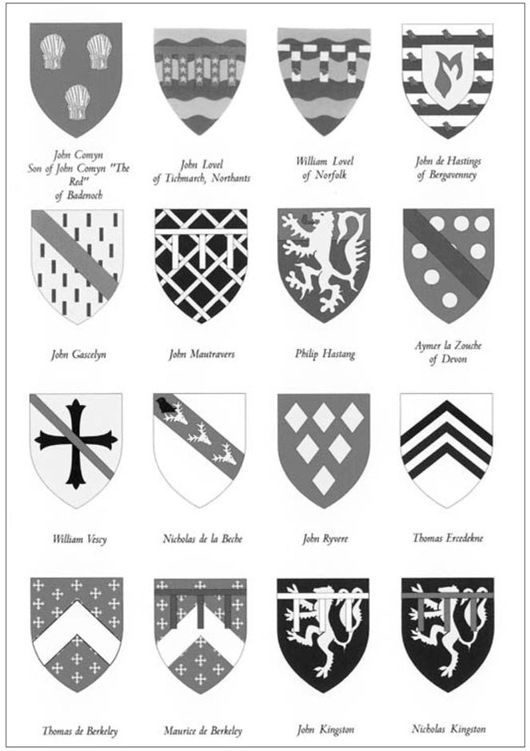
Arms of the knights of the Earl of Pembroke’s retinue who fought a costly rearguard action to ensure the escape of Edward II after Bannockburn. (illustration by Lyn Armstrong)
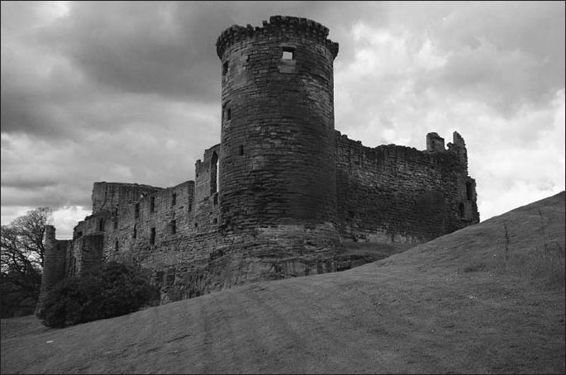
Bothwell Castle on the River Clyde has been called the grandest of Scotland’s medieval castles. Edward I took it in 1301 with the aid of a huge siege tower called ‘le berefrey’ (belfry) that required 30 wagons to transport it from Glasgow. (photo Peter Ryder)
When the English army broke up, a large numbers of soldiers, eager to escape the vengeance of the Scots, followed the King towards Stirling Castle where, unable to enter, they were cornered on the rocky outcrops below the castle. They posed a threat to Bruce’s rear and he was forced to detach a strong body of men to contain them until they surrendered later in the day. Barbour blames the distraction caused by this incident, rather than any failure on the part of Bruce or Douglas, for the failure to mount an adequate pursuit of Edward II. The fleeing English troops were not pressed far beyond the Bannock Burn and, as soon as the remnants of the enemy under Stirling Castle had been dealt with, the Scots spent the rest of the day plundering the spoils of the battlefield and the English baggage train. The Vita tells us that ‘while our people sought safety in flight, a great part of the Scottish army was occupied in plunder … if all the Scots had been attending to the pursuit of our men, few would have escaped.’
Many English troops left the battle in some semblance of order, some had taken no part in the fighting and one English source records that ‘over 200 knights neither drew sword nor struck a blow’. Sir Maurice Berkeley left the battle with a ‘gret rout off Walis-men’. The Earl of Hereford ‘with a great crowd of knights, six hundred other mounted men and one thousand foot, fled towards Carlisle’. At Bothwell Castle on the Clyde, which was still in English hands, Walter Gilbertson, the castellan, admitted the Earl and 50 of his followers. Hereford made the mistake that the King had avoided at Stirling and found himself in a trap, for when Edward Bruce heard that the Earl was at Bothwell he gathered a strong force together and rode there without delay. When he appeared before the castle, Gilbertson, a Scot himself, abruptly changed his allegiance and opened the gates, surrendering the castle and with it the Earls of Hereford and Angus and a rich haul of barons and high-ranking knights.
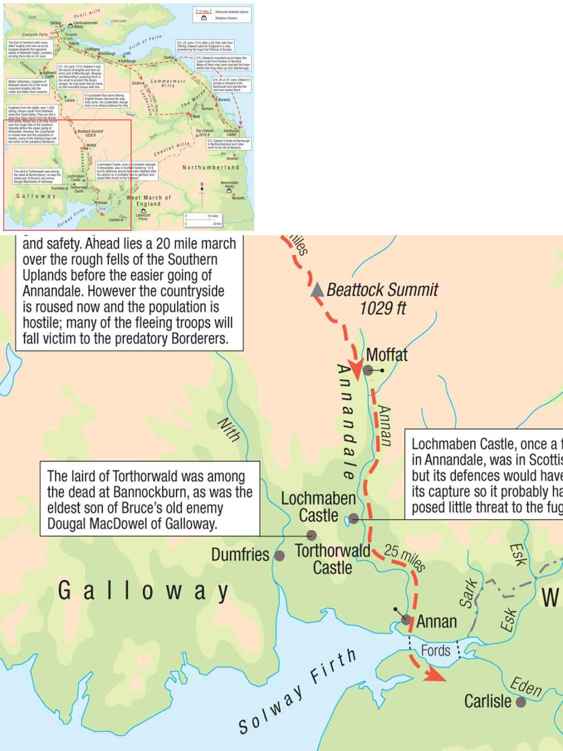
The rest of the fugitives made their way up the Clyde Valley. They were still four days’ march from the Border and ahead lay a tough 20-mile slog over the rough fells of the Southern Uplands into Annandale. The countryside was alerted and the population was in arms and hostile. Many of the fleeing troops would fall victim to the predatory Border clans of the area, who would snap at their heels all the way to the Solway Firth.
The Earl of Hereford was the King’s brother-in-law and was so rich a prize that Bruce exchanged him in October for 15 Scottish captives held in England. Among those released were Elizabeth, his Queen, his daughter Marjory, his sister Christina and Robert Wishart the Bishop of Glasgow, who had grown old and blind during his long years of captivity. Bruce’s nephew, Donald the young Earl of Mar, chose not to return as he had developed a close personal relationship with Edward II.
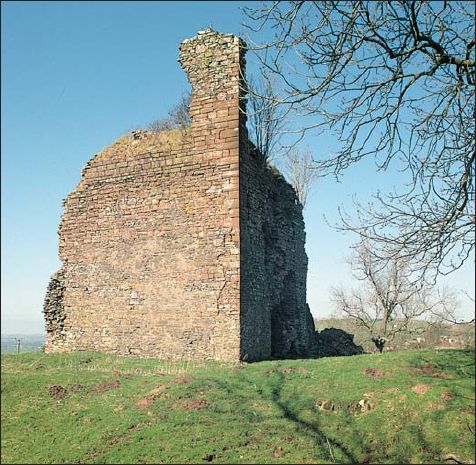
The laird of Torthorwald was one of many Scots from south-west Scotland who fought for Edward II at Bannockburn; both he and the eldest son of his neighbour Dougal MacDowell were killed.
Ransom demands were huge and though there is no direct example of an earl’s ransom from Bannockburn, we know that John de Bretagne, Earl of Richmond, who Bruce captured at Byland in 1322, paid the huge sum of £20,000 for his release. Sir Ralph Neville of Raby’s son Robert, known as the ‘peacock of the north’, was captured at Bannockburn and freed by the Scots on security to procure a ransom of 2,000 marks (a mark was two-thirds of a pound sterling). The battle cost the Nevilles dear for Alexander and John Neville were also taken prisoner, leaving Lord Neville desperate for ways of raising the ransom. Sir Walter Fauconberg lost his eldest son at Bannockburn, his younger son was more fortunate, he was captured and ransomed for 500 marks. In November 1314 the King commanded the exchequer to pay Aleyn de Walingford, his sergeant-at-arms, the sum of £100 to ransom his son, who was also in the hands of the Scots.
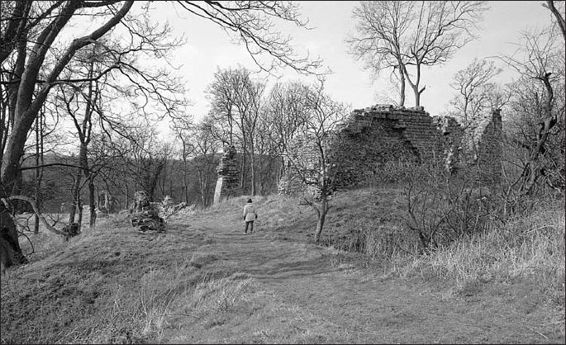
The shattered ruins of Kilton Castle in Cleveland, home of Sir Marmaduke de Thweng, are all that remain today to remind us of this famous old warrior.
Bruce regretted the death of his brother-in-law Gloucester, as well as the loss of his ransom, and had him taken to a nearby church where he maintained a vigil the night after the battle. The Earl of Gloucester and Sir Robert Clifford were the most prominent knights killed at Bannockburn and Bruce had their bodies returned to Berwick pickled in wine casks. The young Earl was eventually interred at Tewkesbury Abbey. Bruce showed humanity and generosity towards some of his prisoners. When Marmaduke de Thweng, hero of the battle of Stirling Bridge and many other encounters, surrendered to Bruce personally after spending the night after the battle hiding in a bush, he was treated like an old friend and sent home to Yorkshire ransom free. Sir Ralf Monthermer was freed without ransom too, which suggests the truth of the romantic tale of him having helped Bruce escape the anger of Edward I in his days at the English court. Not everyone was so fortunate to escape the wrath of the vengeful Scots, however, and we hear that Robert Bottel of Merstone’s son ‘lost both his ears by the violence of the Scots’.
Hundreds of horses and wagons loaded with stores and valuables were abandoned by the English and fell into the hands of the Scots. The great Privy Seal of England was discarded and found among the chaotic remains of Edward’s machinery of government. The Carmelite Friar Robert Baston was discovered wandering on the battlefield; he was a notable poet of the day and King Edward had brought him along to immortalise his triumph over the Scots in verse. Instead, in return for his release, Bruce had him compose a poem to relate the Scots victory. It survives to this day, but unfortunately Brother Baston was more concerned with versifying than conveying information and his tedious Latin epic contains little of factual value. Philip Moubray surrendered Stirling Castle the morning after the battle and was allowed to change his allegiance and come into King Robert’s peace. The Scots, in line with their usual policy, immediately set about dismantling the defences of the castle.
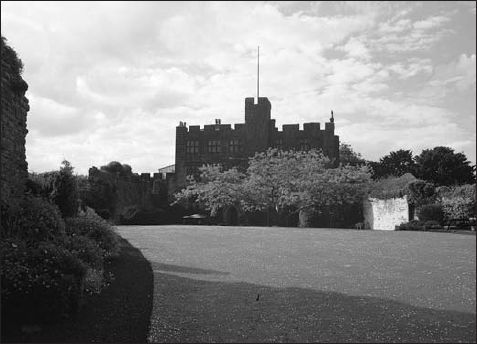
Roger de Woderington in Northumberland was a witness in court at a proof of age in 1335 and then aged 47 said that he was at Bannockburn with his lord Sir Robert de Bertram of Bothal Castle (above), who died there.
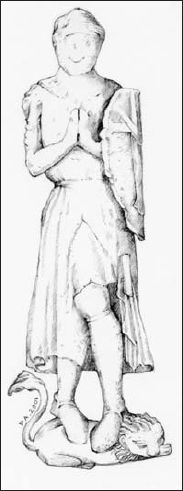
Effigy of William Vescy of Malton in Yorkshire, who was 21 years of age when he was killed at Bannockburn. The effigy, like many of the memorials of Bannockburn, has suffered the ravages of time. It was originally in St Mary’s Abbey in York but was removed and used as a parish boundary mark, being partially buried against a wall, thus inadvertently ensuring that the lower part remained in a fair state of preservation (re-drawn by the author from YAJ).
It is impossible to estimate the casualties among the English foot, though losses would have been disproportionately spread as some units took no part in the fighting and may have withdrawn unscathed. The number of knights and barons killed at Bannockburn was quite astonishingly high by English standards of warfare. Casualty lists of the knighthood were usually short, as it was customary for a knight to surrender rather than be killed and prisoners were eagerly sought in battle as they brought a rich ransom. At the battles of Lewes and Evesham, within living memory, large bodies of baronial cavalry had fought together yet only a mere handful of knights had been killed. In previous affairs in Scotland the same had been true. Even at the disastrous battle of Stirling Bridge, which looms so large in folklore, apart from the unlamented Sir Hugh Cressingham few knights seem to have paid the price of Wallace’s victory. The more fully documented battle of Falkirk the following year was fought on the grand scale, and though we know from the horse lists that numerous knights lost their mounts there is no evidence that the riders themselves suffered much damage.
Medieval chroniclers as a rule wildly overestimated the numbers of troops involved in battles, neither they nor their informants seem to have had a head for large numbers. Barbour was clearly out of his depth when he credits Edward with more that 100,000 fighting men. Yet when he writes of the number of English knights killed at Bannockburn he says that, ‘Two hundred pairs of red spurs were taken from dead knights’. This is surely a sober and believable estimate. Barbour is at home with smaller numbers, particularly when he could probably enumerate many of the casualties by name. There exist, remarkably, two casualty lists for Bannockburn compiled shortly after the battle when interest in the disaster was at its height. The first is contained in the chronicle known as the Annals of London, where the names of 37 knights killed at the battle are recorded. The second source is known as the Continuation of Nicholas Trevet and is a West Country chronicle of the years 1307–18. Here are listed the names of 80 of those killed and taken prisoner in the battle. The Earl of Gloucester heads the list, then follow the names of 27 of the barons and bannerets killed, of which 18 also appear in the Annals of London. The list continues with the names of 22 earls, barons and bannerets and 31 ordinary knights captured. The total of knights killed and captured according to Trevet was 154, over a hundred of whom are known to us by name.
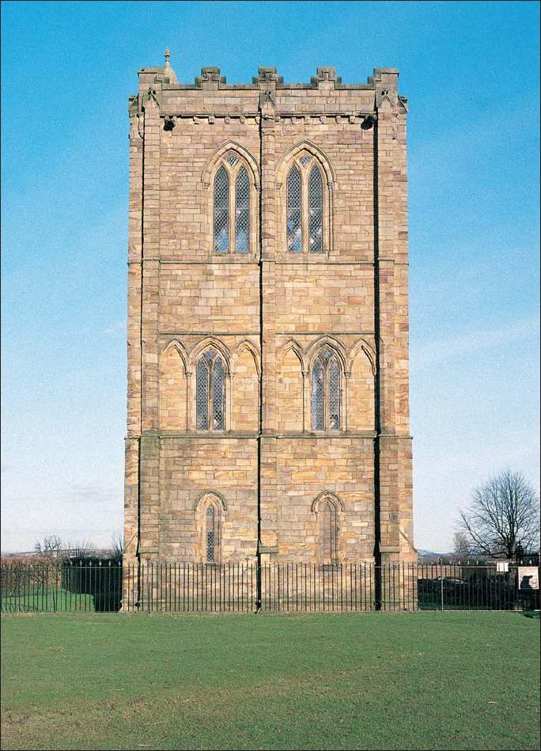
Cambuskenneth Abbey, scene of the treacherous Earl of Atholl’s attack on the Scottish supply depot on the night of 23 June 1314.
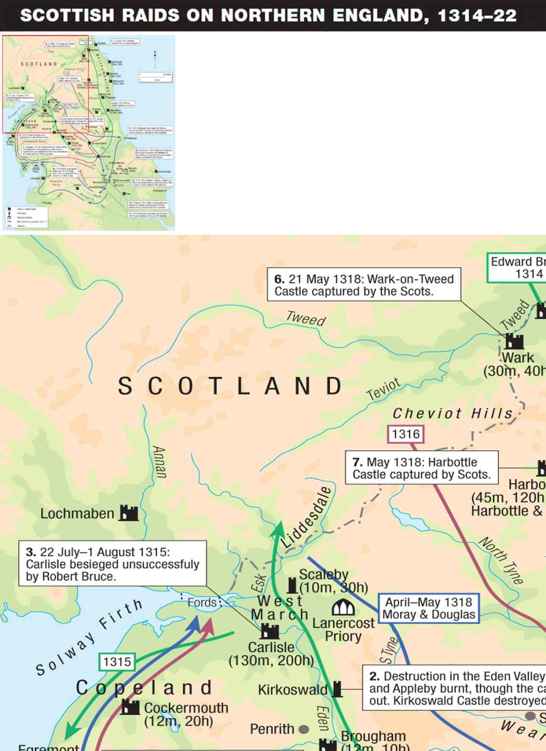
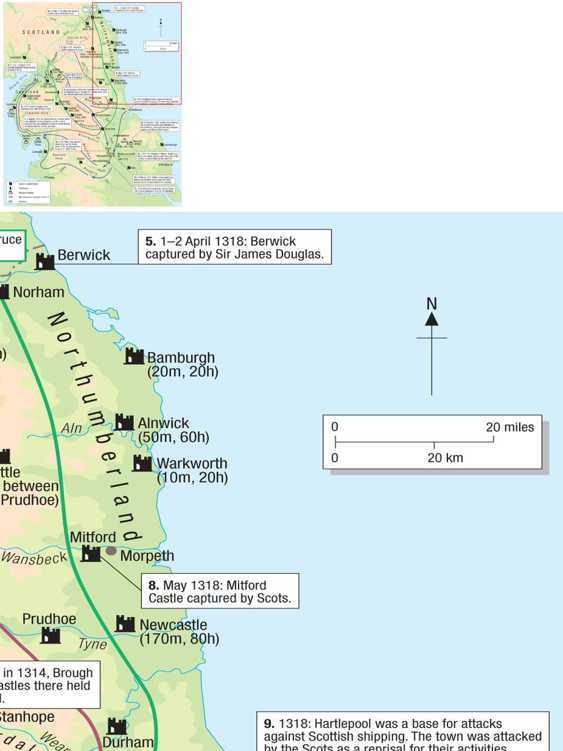
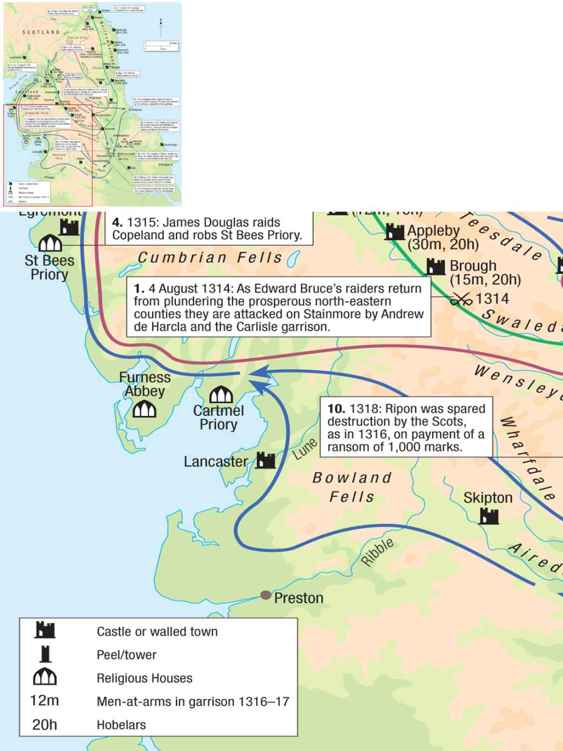
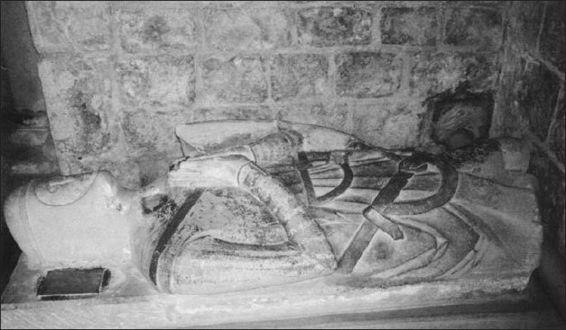
Robert de Reymes, whose effigy can be seen in Bolam Church in Northumberland, was taken prisoner at Bannockburn and paid a hefty ransom for his release. His misfortunes did not end there, for in the years following the battle Robert’s Northumbrian estates were devastated by the Scots and the income from his lands fell from £50 a year to only 14s 7p.
There were losses among the Scottish knights too, though these were remarkably light, only William Vipoint and Walter Ross are named by Barbour as being killed in the battle. Edward Bruce was much distressed by Walter’s death as he was the young brother of Isabella, daughter of the Earl of Ross, who Edward married in 1308. Sir William Airth was killed too, though in a curious aside to the battle. He was at Cambuskenneth, north of the River Forth, guarding the Scot’s supply depot when, on the night of 23/24 June, the Earl of Atholl treacherously plundered the depot, leaving Sir William and a number of his men dead in their wake. Atholl’s disaffection from the Bruce cause was because his sister Isabella had borne Edward Bruce an illegitimate son and was then it seems discarded by him in favour of the Ross marriage.